TBSE Class 12 Sample Paper 2023 Philosophy
Finished viewing? Save it for later —
Download TBSE Class 12 Sample Paper 2023 Philosophy (PDF · 6 pages)About TBSE Class 12 Sample Paper 2023 Philosophy
TBSE Class 12 Sample Paper 2023 Philosophy is available here for free download. Published by Tripura Board for Class 12, this sample paper can be viewed online or downloaded as a PDF (6 pages). Candidates preparing for Class 12 can use TBSE Class 12 Sample Paper 2023 Philosophy to understand the exam pattern, the type of questions asked, and the overall difficulty level.
Frequently Asked Questions
How can I download TBSE Class 12 Sample Paper 2023 Philosophy?
Open this page and click the Download button to save TBSE Class 12 Sample Paper 2023 Philosophy as a PDF. It is completely free on AglaSem Docs.
Is TBSE Class 12 Sample Paper 2023 Philosophy free to download?
Yes. TBSE Class 12 Sample Paper 2023 Philosophy can be viewed online and downloaded as a PDF free of cost on AglaSem Docs.
How many pages does TBSE Class 12 Sample Paper 2023 Philosophy have?
TBSE Class 12 Sample Paper 2023 Philosophy contains 6 pages, which you can read online or download together as a single PDF.
Where can I find more Class 12 study material?
You can find more Class 12 question papers, sample papers, syllabus, and answer keys on AglaSem Docs.
TBSE Class 12 Sample Paper 2023 Philosophy – Text
Read the full text of this sample paper below — useful to quickly search, copy and reference the content online without downloading the PDF.
📄 View text version (6 pages)
Page 1
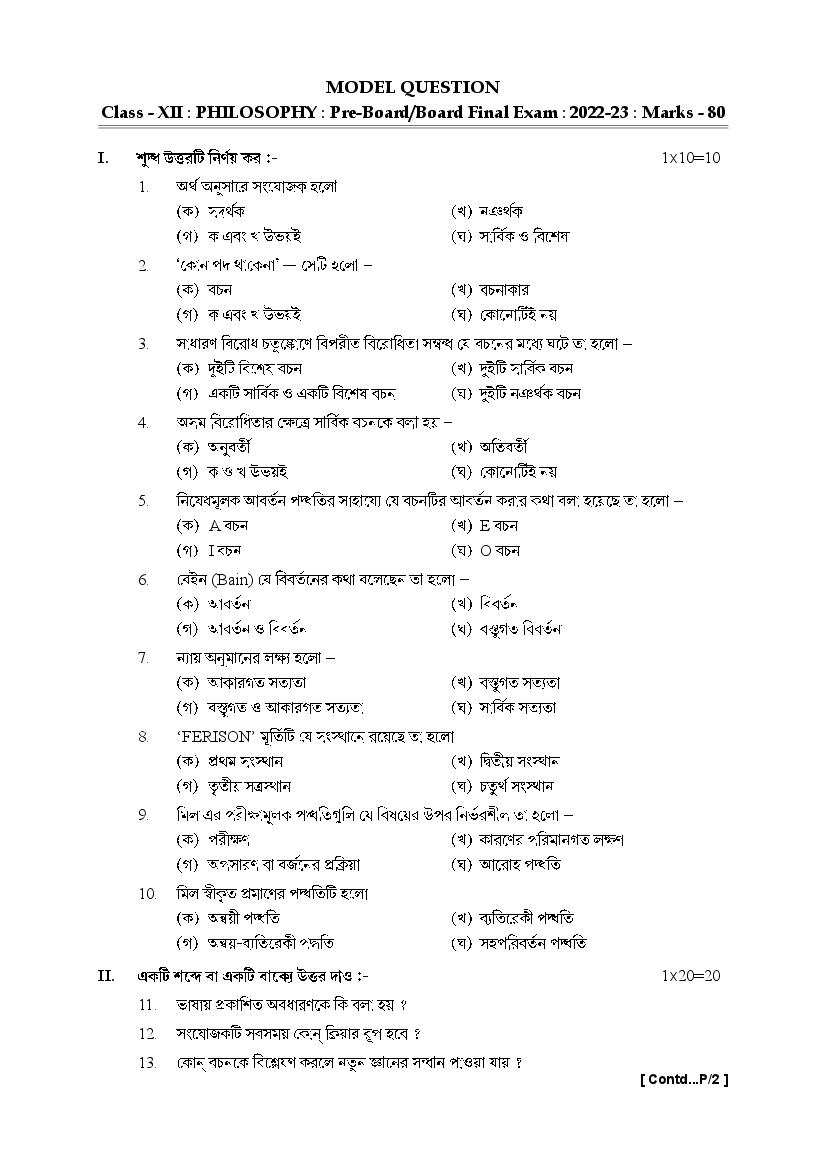
Class - XII : PHILOSOPHY : Pre-Board/Board Final Exam : 2022-23 : Marks - 80
I. 1x10=10
1.
2.
3.
4.
5.
A E
I O
6. (Bain)
7.
8. ‘FERISON’
9.
10.
II. 1x20=20
11.
12.
13.
[ Contd...P/2 ]
Page 2
14.
15.
16.
17.
18.
19.
20.
21.
22.
23.
24.
25.
26.
27.
28.
29.
30. ABC –––– abc
BC –––– bc .
‘A’ ‘a’
III. 2x5=10
31.
32.
33.
34.
35.
IV. 60 3x2=6
36.
37.
V. 80 4x6=24
38.
39.
[ Contd...P/3 ]
Page 3
40.
41.
42.
43.
VI. 120 5x2=10
45.
ENGLISH VERSION
I. Choose the correct answer :– 1x10=10
1. In the term of meaning a copula is –
(A) Affirmative (B) Negative
(C) Both A and B (D) Universal and particular
2. ‘Have no term’ is –
(A) Proposition (B) Proposition form
(C) Both A and B (D) None of these
3. Which type of propositions related to contrary opposition in common square of
opposition is –
(A) Two particular proposition
(B) Two universal proposition
(C) One universal and one particular proposition
(D) Two negative proposition
4. The other name of universal proposition in the relation of sub-altern opposition or
sub-alternation is –
(A) Sub-alternate (B) Super-alternate
(C) Both A and B (D) None of these
5. Which proposition converted by ‘Conversion by Negation’ is –
(A) A proposition (B) E proposition
(C) I proposition (D) O proposition
[ Contd...P/4 ]
Page 4
6. ______ type of obversion explained by Bain is –
(A) Conversion (B) Obversion
(C) Conversion and obversion (D) Material obversion
7. The aim of syllogism is to achieve –
(A) Formal truth (B) Material truth
(C) Both material and formal truth (D) Universal truth
8. The Mood ‘FERISON’ belongs to –
(A) lst figure (B) 2nd figure
(C) 3rd figure (D) 4th figure
9. Mill’s methods of Experiment are dependent on –
(A) Experiment (B) Quantitative marks of cause
(C) Cannons of elimination (D) Inductive method
10. Mill’s method of proof is known as –
(A) Method of Agreement
(B) Method of Difference
(C) Joint method of agreement and difference
(D) Method of Concomitant variation.
II. Answer in one word or in one sentence :– 1x20=20
11. What is the judgment called when expressed in a language ?
12. What form will the verb ‘Copula’ take always ?
13. Which type of proposition gives ‘New Knowledge’ by analysis ?
14. Which type of opposition is very much significant in Aristotle’s square of opposition?
15. What is the other name of particular proposition in the relation of sub-altern opposition
or sub-alternation ?
16. What condition are to be fulfilled at the time of establishing the relation of opposition
of proposition ?
17. What is called the proposition which can not be converted ?
18. What is called the type of conversion which is done in case of definite singular
proposition ?
19. What is called the Immediate inference, in which the ‘Subject’ of both the premise
and the conclusion remains same ?
20. What is material obversion ?
21. What is Figure of syllogism ?
22. What is the fallacy in a syllogism when the middle term is used in more than one
meaning ?
23. What is meant by ‘mood’ of a categorical syllogism ?
24. What is Minor Term ?
[ Contd...P/5 ]
Page 5
25. How many valid moods are there in categorical syllogism ?
26. What is the fallacy that occurs due to the non-practice of the method of difference ?
27. What is the type of Inductive fallacy which the ‘Fallacy of non-observation’ belongs
to ?
28. Give a symbolic example of Mill’s method of agreement.
29. According to Mill’s what is ‘Permanent Cause’ ?
30. ABC –––– abc
BC –––– bc .
A is the cause of ‘a’.
Identify the argument or method (Mill’s) involved in this symbolic example.
III. Answer each question very briefly :– 2x5=10
31. Translate the following sentences into logical proposition.
(A) No man is both tall and short at the same time.
(B) There is no coin which is not made of metal.
32. Mention the rules for occurring contrary opposition.
33. Indicate two points of difference between simple conversion and conversion by
limitation.
34. How many valid moods are there in each of the figures of categorical syllogism ?
35. Name the method of Mill by which the cause can be deducted from its effect. Give a
concrete example.
IV. Answer each question within sixty (60) words :– 3x2=6
36. Explain with concrete example ‘fallacy of four terms’.
37. What is Direct variation ? Give a concrete example of Direct variation.
V. Answer each question within eighty (80) words :– 4x6=24
38. Explain the four points with example the difference between propositional and
proposition form.
39. Is sub-alternation a real opposition of propositions ? Discuss with concrete example.
40. Transform the following sentences into logical form and give the converse and obverse
of each, if possible :
(A) Can a circle be a square ?
(B) Nothing is both safe and exciting.
41. Discuss the characteristics of a categorical syllogism.
42. What is meant by Fallacy of Undistributed Middle’ ? Give a concrete example.
OR
Prove that : If one promise be particular, the conclusion must be particular.
43. Explain Mill’s method of Agreement with symbolic and concrete examples.
[ Contd...P/6 ]
Page 6
VI. Answer each question within 120 words :– 5x2=10
44. What is categorical syllogism ? Explain its structure along with a concrete example.
OR
Identify the following arguments and test their validity :
(A) He is not a mad, since he is learned, and learned person sometimes become mad.
(B) He must be an Indian for all Indians hold such views.
45. Explain Mill’s method of concomitant variation with symbolic and concrete examples.
How many kinds of concomitant variation are there ? Name them. Mention two
merits of the method.
––––––––––––––