NCERT Book Class 12 Chemistry Chapter 1 Solutions
Finished viewing? Save it for later —
Download NCERT Book Class 12 Chemistry Chapter 1 Solutions (PDF · 30 pages)About NCERT Book Class 12 Chemistry Chapter 1 Solutions
NCERT Book Class 12 Chemistry Chapter 1 Solutions is available here for free download. Published by NCERT for Class 12, this books can be viewed online or downloaded as a PDF (30 pages). Candidates preparing for Class 12 can use NCERT Book Class 12 Chemistry Chapter 1 Solutions to understand the exam pattern, the type of questions asked, and the overall difficulty level.
Frequently Asked Questions
How can I download NCERT Book Class 12 Chemistry Chapter 1 Solutions?
Open this page and click the Download button to save NCERT Book Class 12 Chemistry Chapter 1 Solutions as a PDF. It is completely free on AglaSem Docs.
Is NCERT Book Class 12 Chemistry Chapter 1 Solutions free to download?
Yes. NCERT Book Class 12 Chemistry Chapter 1 Solutions can be viewed online and downloaded as a PDF free of cost on AglaSem Docs.
How many pages does NCERT Book Class 12 Chemistry Chapter 1 Solutions have?
NCERT Book Class 12 Chemistry Chapter 1 Solutions contains 30 pages, which you can read online or download together as a single PDF.
Where can I find more Class 12 study material?
You can find more Class 12 question papers, sample papers, syllabus, and answer keys on AglaSem Docs.
NCERT Book Class 12 Chemistry Chapter 1 Solutions – Text
Read the full text of this books below — useful to quickly search, copy and reference the content online without downloading the PDF.
📄 View text version (1 page)
Page 1
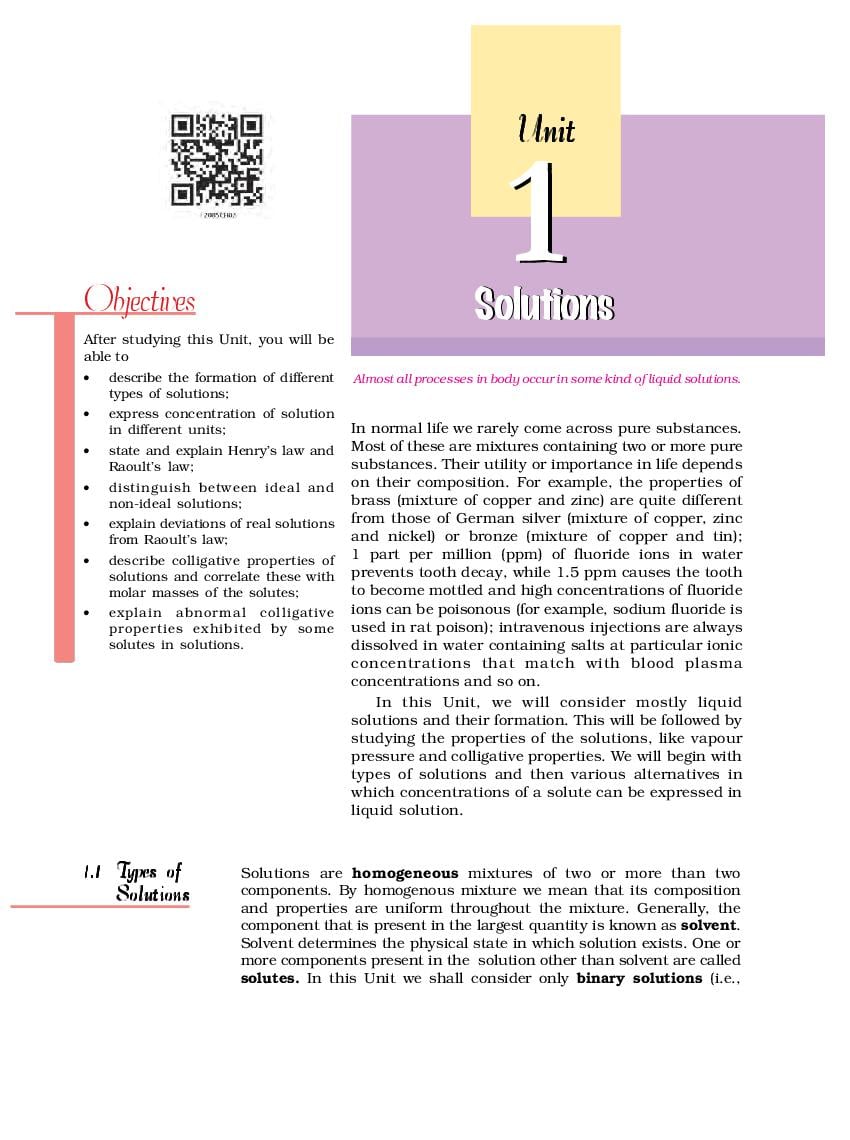
Objectives
1
Solutions
After studying this Unit, you will be
able to
· describe the formation of different Almost all processes in body occur in some kind of liquid solutions.
types of solutions;
· express concentration of solution
in different units; In normal life we rarely come across pure substances.
· state and explain Henry’s law and Most of these are mixtures containing two or more pure
Raoult’s law; substances. Their utility or importance in life depends
· distinguish between ideal and on their composition. For example, the properties of
non-ideal solutions; brass (mixture of copper and zinc) are quite different
· explain deviations of real solutions from those of German silver (mixture of copper, zinc
from Raoult’s law; and nickel) or bronze (mixture of copper and tin);
· describe colligative properties of 1 part per million (ppm) of fluoride ions in water
solutions and correlate these with prevents tooth decay, while 1.5 ppm causes the tooth
molar masses of the solutes; to become mottled and high concentrations of fluoride
· explain abnormal colligative ions can be poisonous (for example, sodium fluoride is
properties exhibited by some used in rat poison); intravenous injections are always
solutes in solutions. dissolved in water containing salts at particular ionic
concentrations that match with blood plasma
concentrations and so on.
In this Unit, we will consider mostly liquid
solutions and their formation. This will be followed by
studying the properties of the solutions, like vapour
pressure and colligative properties. We will begin with
types of solutions and then various alternatives in
which concentrations of a solute can be expressed in
liquid solution.
1.1 Types of Solutions are homogeneous mixtures of two or more than two
Solutions components. By homogenous mixture we mean that its composition
and properties are uniform throughout the mixture. Generally, the
component that is present in the largest quantity is known as solvent.
Solvent determines the physical state in which solution exists. One or
more components present in the solution other than solvent are called
solutes. In this Unit we shall consider only binary solutions (i.e.,
Showing the first page only. Download the PDF above for the complete document.
Document Details
| Board / Org | NCERT |
| Exam | Class 12 |
| Type | Books |
| Pages | 30 |
| Updated | 29 Aug 2026 |