Goa Board Class 10 Question Paper Mar 2019 General Science English CWSN
Finished viewing? Save it for later —
Download Goa Board Class 10 Question Paper Mar 2019 General Science English CWSN (PDF · 14 pages)About Goa Board Class 10 Question Paper Mar 2019 General Science English CWSN
Goa Board Class 10 Question Paper Mar 2019 General Science English CWSN is available here for free download. Published by Goa Board for Class 10, this question paper can be viewed online or downloaded as a PDF (14 pages). Candidates preparing for Class 10 can use Goa Board Class 10 Question Paper Mar 2019 General Science English CWSN to understand the exam pattern, the type of questions asked, and the overall difficulty level.
Frequently Asked Questions
How can I download Goa Board Class 10 Question Paper Mar 2019 General Science English CWSN?
Open this page and click the Download button to save Goa Board Class 10 Question Paper Mar 2019 General Science English CWSN as a PDF. It is completely free on AglaSem Docs.
Is Goa Board Class 10 Question Paper Mar 2019 General Science English CWSN free to download?
Yes. Goa Board Class 10 Question Paper Mar 2019 General Science English CWSN can be viewed online and downloaded as a PDF free of cost on AglaSem Docs.
How many pages does Goa Board Class 10 Question Paper Mar 2019 General Science English CWSN have?
Goa Board Class 10 Question Paper Mar 2019 General Science English CWSN contains 14 pages, which you can read online or download together as a single PDF.
Where can I find more Class 10 study material?
You can find more Class 10 question papers, sample papers, syllabus, and answer keys on AglaSem Docs.
Goa Board Class 10 Question Paper Mar 2019 General Science English CWSN – Text
Read the full text of this question paper below — useful to quickly search, copy and reference the content online without downloading the PDF.
📄 View text version (14 pages)
Page 1
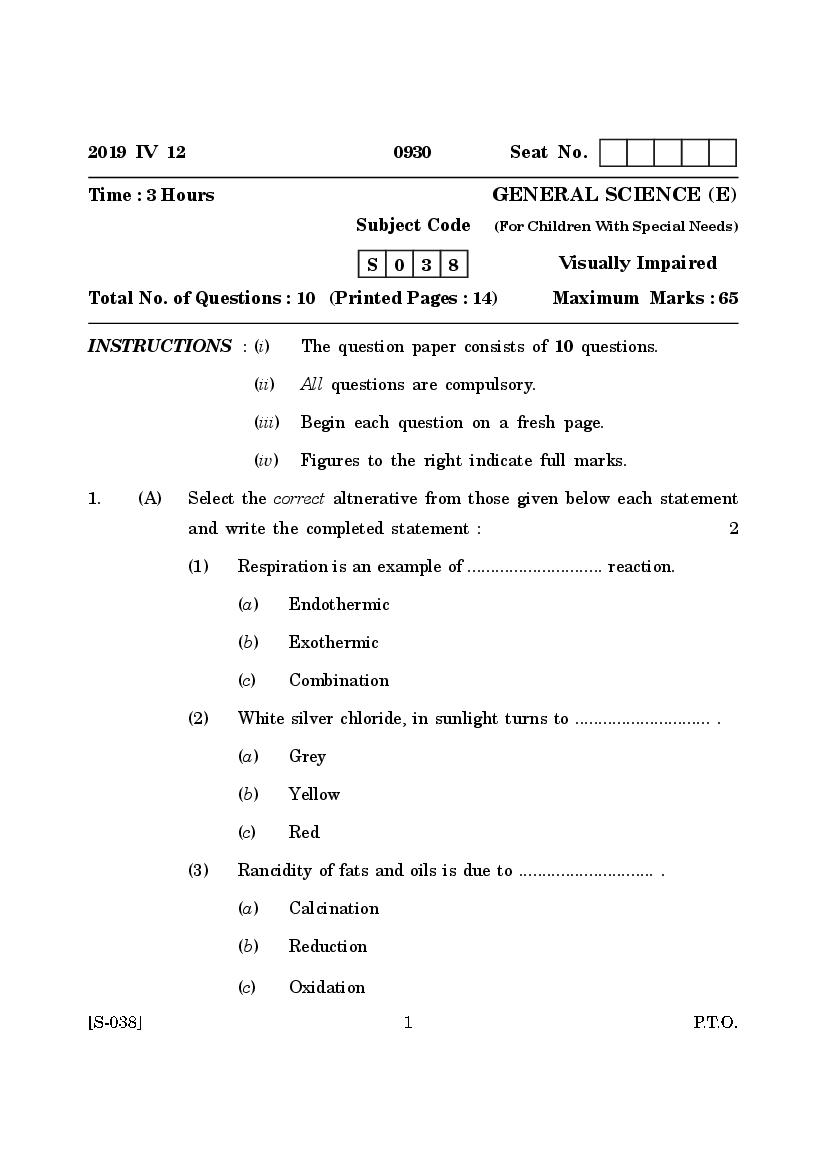
Time : 3 Hours GENERAL SCIENCE (E)
Subject Code (For Children With Special Needs)
S 0 3 8 Visually Impaired
Total No. of Questions : 10 (Printed Pages : 14) Maximum Marks : 65
INSTRUCTIONS : (i) The question paper consists of 10 questions.
(ii) All questions are compulsory.
(iii) Begin each question on a fresh page.
(iv) Figures to the right indicate full marks.
1. (A) Select the correct altnerative from those given below each statement
and write the completed statement : 2
(1) Respiration is an example of ............................. reaction.
(a) Endothermic
(b) Exothermic
(c) Combination
(2) White silver chloride, in sunlight turns to ............................. .
(a) Grey
(b) Yellow
(c) Red
(3) Rancidity of fats and oils is due to ............................. .
(a) Calcination
(b) Reduction
(c) Oxidation
Page 2
is called ............................. reaction.
(a) Decomposition
(b) Combination
(c) Double displacement
(B) Answer the following (any two) : 1
(1) What is the product formed when magnesium ribbon burns in
air ?
(2) State one change that occurs when a chemical reaction takes place.
(3) What is the colour of copper sulphate solution ?
(C) Name the following : 2
(1) The main source of water in India.
(2) The agitation that originated from an incident that look place
in a remote village called Reni in Garhwal.
(3) One stakeholder of the forest.
(4) The pollutant given out by burning of fossil fuels that cause global
warming.
(D) Answer the following (any three) : 3
(1) State one advantage of storing water underground.
(2) What are mono cultures ?
(3) What is meant by the 3R’s ?
Page 3
(5) Forests are biodiversity ‘hot spots’. Why ?
2. (A) Select the correct alternative from those given below each statement
and write the completed statement : 2
(1) During photosynthesis substance absorbed from the atmosphere
is ................................. .
(a) Oxygen
(b) Carbon dioxide
(c) Nitrogen
(2) Hydrochloric acid is secreted in the ................................. .
(a) Stomach
(b) Mouth
(c) Small intestine
(3) Emulsified fats are broken down by ................................. .
(a) Trypsin
(b) Pepsin
(c) Lipase
(4) The filtration units in kidneys are ................................. .
(a) Alveoli
(b) Nephrons
(c) Villi
Page 4
(1) The pigment absorbing light energy in leaves of green plants.
(2) Balloon like structures in human lungs.
(3) Fluid medium of blood.
(4) Organisms that derive food from other organisms without killing
them.
(C) Answer the following (any three) : 3
(1) The ventricles have thick walls. Give scientific reason.
(2) Give one difference between Arteries and Veins.
(3) What is the function of the ureters ?
(4) Human heart has four chambers. Give scientific reason.
(5) What is the function of villi in the small intestine ?
(D) Match the following : 1
A B
(a) Autotroph (i) Bread mould
(b) Saprophyte (ii) Hibiscus
(iii) Dog
3. (A) Select the correct alternative from those given below each statement
and write the completed statement : 1
(1) The pH of a neutral solution is ................................. .
(a) Equal to 7
(b) Less than 7
(c) More than 7
Page 5
(a) Calcium oxide
(b) Calcium carbonate
(c) Calcium phosphate
(B) Answer the following (any four) : 4
(1) What happens when water is added to plaster of paris ?
(2) How does acid rain affect aquatic life ?
(3) Why does a bee sting cause pain and irritation ?
(4) What precuation must be taken while mixing an acid with
water ?
(5) State two uses of Bleaching powder.
(6) Why is baking soda used in the preparation of antacids ?
4. (A) Select the correct alternative from those given below each statement
and write the completed statement : 1
(1) The gas that makes biogas an excellent fuel is ....................... .
(a) Methane
(b) Nitrogen
(c) Sulphur
(2) The energy conversion in a wind mill is ................................. .
(a) Kinetic energy to mechanical energy
(b) Kinetic energy to chemical energy
(c) Kinetic energy to electrical energy
Page 6
(1) What is the major hazard of nuclear power generation ?
(2) Give one disadvantage of construction of high rise dam.
(3) Why is the inner surface of a solar cooker painted black ?
(4) Many thermal power plants are set up near coal or oil fields.
Why ?
(5) Name any two elements used as nuclear fuels.
(6) State any two limitations of harnessing wind energy.
5. (A) Select the correct alternative from those given below each statement
and write the completed statement : 1½
(1) The non-metal that has lustre is ................................. .
(a) Carbon
(b) Sulphur
(c) Iodine
(2) Bronze is an alloy of ................................. .
(a) Copper and zinc
(b) Copper and tin
(c) Lead and tin
(3) Bauxite is an ore of ................................. .
(a) Aluminium
(b) Iron
(c) Mercury
Page 7
A B
(a) Malleability (i) Bells
(b) Ductility (ii) Bags
(c) Sonorus (iii) Sheets
(iv) Wires
(C) Answer the following (any two) : 2
(1) What is galvanization ?
(2) Why should we not store pickles and curd in aluminium
container ?
(3) State any two conditions necessary for rusting.
6. (A) Select the correct alternative from those given below each statement
and write the completed statement : 2
(1) The ovules are present in the ................................. .
(a) Stigma
(b) Anther
(c) Ovary
(2) An example of a sexually transmitted viral infection
is .................................
(a) Gonorrhoea
(b) Wartz
(c) Syphilis
Page 8
the .................................
(a) Ureters
(b) Uterus
(c) Urinary bladder
(4) The fusion of the male and female gamete to form a zygote is
called ................................. .
(a) Fertilisation
(b) Menstruation
(c) Reproduction
(B) Name the following : 2
(1) The tissue through which the human embryo gets nutrition from
the mother’s blood.
(2) The male reproductive part of the flower.
(3) Transfer of pollen from the anther to the stigma of a flower.
(4) The hormone that brings about changes in girls during puberty.
(C) Answer the following (any three) : 3
(1) What are contraceptive pills ?
(2) Why is prenatal sex determination prohibited by law ?
(3) The testes are located outside the abdominal cavity in the scrotum.
Why ?
Page 9
(5) State any one advantage of vegetative propagation.
7. (A) Select the correct alternative from those given below each statement
and write the completed statement : 1½
(1) We can walk in a straight line. The part of the brain involved
in this activity is ................................. .
(a) The cerebrum
(b) The cerebellum
(c) The pons
(2) The olfactory receptors detect ................................. .
(a) Smell
(b) Heat
(c) Taste
(3) The spinal cord is protected by the ................................. .
(a) Skull
(b) Ribs
(c) Vertebral column
(B) Shaila visited the Jumbo Circus in Margao. She observed a dwarf about
50 years old acting like a Joker. 2
(1) Name the hormone responsible for the Joker to be a dwarf.
(2) Which gland secretes the above hormone ?
Page 10
(B) The salt packet contains iodine : 2
(1) Why is iodine necessary for the thyroid gland ?
(2) Name the disease caused due to lack of iodine.
(C) Name the following : 1½
(1) Any one biotic component of ecosystem.
(2) The main source of energy in a food chain.
(3) The layer that protects us from the damaging ultraviolet rays
of the sun.
(D) Answer the following (any four) : 4
(1) What is meant by a food chain ?
(2) Why does the last trophic level receive less amount of energy ?
(3) What will happen if we kill all the Lizards ?
(4) What are producers ?
(5) What are biodegradable substances ?
(6) What is meant by biological magnification ?
8. (A) Select the correct alternative from those given below each statement
and write the completed statement : 2
(1) The relationship between focal length (f) and radius of curvature
(R) is ................................. .
(a) f = 2R
1
(b) f =
R
R
(c) f =
2
Page 11
(a) Diminished and erect
(b) Enlarged and erect
(c) Enlarged and inverted
(3) The central point of a lens is called ................................. .
(a) Optical centre
(b) Radius of curvature
(c) Origin
(4) The reflected rays of light meet and form a real image in
a .................................
(a) Plane mirror
(b) Concave mirror
(c) Convex mirror
(B) Answer the following (any five) : 5
(1) Define the power of a lens.
(2) Why does a pencil appear bent when placed in a glass of
water ?
(3) State one use of convex mirror.
(4) What is a virtual image ?
(5) State two characteristics of an image seen in a plane mirror.
(6) A piece of paper catches fire if reflected suns rays from a concave
mirror are focussed on it. Why ?
(7) Why should we never look at the sun directly ?
Page 12
and write the completed statement : 1
(1) The crystalline lens of old people becomes milky and cloudy. This
condition is called ................................. .
(a) Myopia
(b) Hypermetropia
(c) Cataract
(2) The splitting of white light into its component colours is
called ................................. of light.
(a) Reflection
(b) Dispersion
(c) Refraction
(B) Name the following : 1
(1) The delicate light sensitive membrane on which the image is
formed.
(2) The farthest point upto which the eye can see objects clearly.
(C) Answer the following (any two) : 3
(1) What do you mean by power of accommodation ?
(2) The eye lens is made up of a jelly-like materials. Give scientific
reason.
Page 13
(4) What do you mean by Tyndall effect ?
(5) Concave mirrors are commonly used in headlights of vehicles.
Give scientific reason.
10. (A) Select the correct alternative from those given below each statement
and write the completed statement : 2
(1) The instrument used to measure current is ................................. .
(a) Ammeter
(b) Galvanometer
(c) Voltmeter
(2) The property of the conductor that does not allow the flow of
charge through it is ................................. .
(a) Current
(b) Resistance
(c) Voltage
(3) The normal voltage in our domestic electricity supply in India
is ................................. .
(a) 220 volts
(b) 110 volts
(c) 55 volts
Page 14
to ................................. .
(a) Heat and light
(b) Light only
(c) Heat only
(B) Name the following : 1
(1) The commercial unit of electricity.
(2) Materils that have a high resistance and do not allow easy flow
of electric current.
(C) Answer the following (any three) : 3
(1) When does overloading occur ?
(2) Why should we never touch or open an electrical socket ?
(3) Which metals are used to make electrical wires ?
(4) What is an electric motor ?
(5) State one disadvantage of a series circuit.
Document Details
| Board / Org | Goa Board |
| Exam | Class 10 |
| Type | Question Paper |
| Pages | 14 |
| Updated | 30 Apr 2026 |