NCERT Book Class 12 Chemistry Chapter 6 Haloalkanes and Haloarenes
Finished viewing? Save it for later —
Download NCERT Book Class 12 Chemistry Chapter 6 Haloalkanes and Haloarenes (PDF · 34 pages)About NCERT Book Class 12 Chemistry Chapter 6 Haloalkanes and Haloarenes
NCERT Book Class 12 Chemistry Chapter 6 Haloalkanes and Haloarenes is available here for free download. Published by NCERT for Class 12, this books can be viewed online or downloaded as a PDF (34 pages). Candidates preparing for Class 12 can use NCERT Book Class 12 Chemistry Chapter 6 Haloalkanes and Haloarenes to understand the exam pattern, the type of questions asked, and the overall difficulty level.
Frequently Asked Questions
How can I download NCERT Book Class 12 Chemistry Chapter 6 Haloalkanes and Haloarenes?
Open this page and click the Download button to save NCERT Book Class 12 Chemistry Chapter 6 Haloalkanes and Haloarenes as a PDF. It is completely free on AglaSem Docs.
Is NCERT Book Class 12 Chemistry Chapter 6 Haloalkanes and Haloarenes free to download?
Yes. NCERT Book Class 12 Chemistry Chapter 6 Haloalkanes and Haloarenes can be viewed online and downloaded as a PDF free of cost on AglaSem Docs.
How many pages does NCERT Book Class 12 Chemistry Chapter 6 Haloalkanes and Haloarenes have?
NCERT Book Class 12 Chemistry Chapter 6 Haloalkanes and Haloarenes contains 34 pages, which you can read online or download together as a single PDF.
Where can I find more Class 12 study material?
You can find more Class 12 question papers, sample papers, syllabus, and answer keys on AglaSem Docs.
NCERT Book Class 12 Chemistry Chapter 6 Haloalkanes and Haloarenes – Text
Read the full text of this books below — useful to quickly search, copy and reference the content online without downloading the PDF.
📄 View text version (1 page)
Page 1
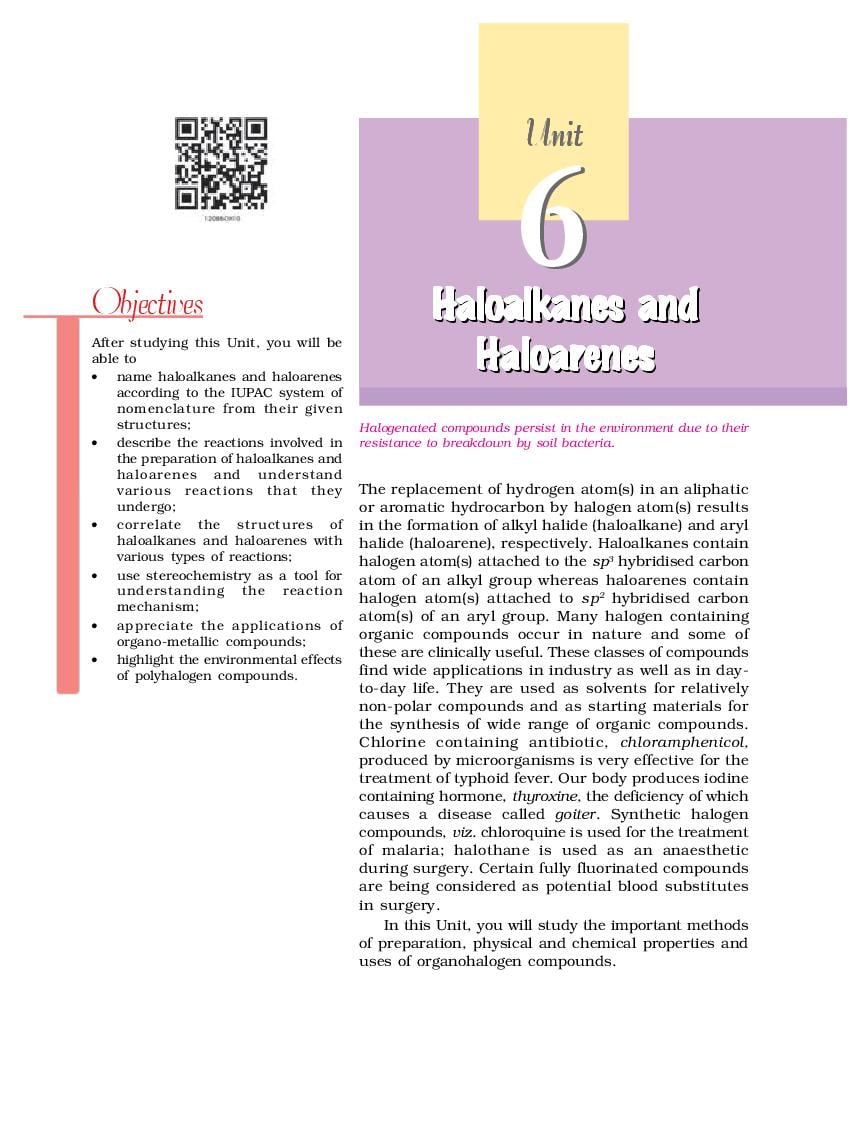
Objectives
6
Haloalkanes and
After studying this Unit, you will be
able to
· name haloalkanes and haloarenes
Haloar enes
Haloarenes
according to the IUPAC system of
nomenclature from their given
structures; Halogenated compounds persist in the environment due to their
· describe the reactions involved in resistance to breakdown by soil bacteria.
the preparation of haloalkanes and
haloarenes and understand
various reactions that they The replacement of hydrogen atom(s) in an aliphatic
undergo; or aromatic hydrocarbon by halogen atom(s) results
· correlate the structures of in the formation of alkyl halide (haloalkane) and aryl
haloalkanes and haloarenes with halide (haloarene), respectively. Haloalkanes contain
various types of reactions; halogen atom(s) attached to the sp3 hybridised carbon
· use stereochemistry as a tool for atom of an alkyl group whereas haloarenes contain
understanding the reaction
halogen atom(s) attached to sp2 hybridised carbon
mechanism;
atom(s) of an aryl group. Many halogen containing
· appreciate the applications of
organo-metallic compounds;
organic compounds occur in nature and some of
these are clinically useful. These classes of compounds
· highlight the environmental effects
of polyhalogen compounds. find wide applications in industry as well as in day-
to-day life. They are used as solvents for relatively
non-polar compounds and as starting materials for
the synthesis of wide range of organic compounds.
Chlorine containing antibiotic, chloramphenicol,
produced by microorganisms is very effective for the
treatment of typhoid fever. Our body produces iodine
containing hormone, thyroxine, the deficiency of which
causes a disease called goiter. Synthetic halogen
compounds, viz. chloroquine is used for the treatment
of malaria; halothane is used as an anaesthetic
during surgery. Certain fully fluorinated compounds
are being considered as potential blood substitutes
in surgery.
In this Unit, you will study the important methods
of preparation, physical and chemical properties and
uses of organohalogen compounds.
Showing the first page only. Download the PDF above for the complete document.
Document Details
| Board / Org | NCERT |
| Exam | Class 12 |
| Type | Books |
| Pages | 34 |
| Updated | 29 Aug 2026 |