JNUEE 2021 Question Paper MPH Master of Public Health
Finished viewing? Save it for later —
Download JNUEE 2021 Question Paper MPH Master of Public Health (PDF · 21 pages)About JNUEE 2021 Question Paper MPH Master of Public Health
JNUEE 2021 Question Paper MPH Master of Public Health is available here for free download. Published by NTA for JNUEE, this question paper can be viewed online or downloaded as a PDF (21 pages). Candidates preparing for JNUEE can use JNUEE 2021 Question Paper MPH Master of Public Health to understand the exam pattern, the type of questions asked, and the overall difficulty level.
Frequently Asked Questions
How can I download JNUEE 2021 Question Paper MPH Master of Public Health?
Open this page and click the Download button to save JNUEE 2021 Question Paper MPH Master of Public Health as a PDF. It is completely free on AglaSem Docs.
Is JNUEE 2021 Question Paper MPH Master of Public Health free to download?
Yes. JNUEE 2021 Question Paper MPH Master of Public Health can be viewed online and downloaded as a PDF free of cost on AglaSem Docs.
How many pages does JNUEE 2021 Question Paper MPH Master of Public Health have?
JNUEE 2021 Question Paper MPH Master of Public Health contains 21 pages, which you can read online or download together as a single PDF.
Where can I find more JNUEE study material?
You can find more JNUEE question papers, sample papers, syllabus, and answer keys on AglaSem Docs.
JNUEE 2021 Question Paper MPH Master of Public Health – Text
Read the full text of this question paper below — useful to quickly search, copy and reference the content online without downloading the PDF.
📄 View text version (21 pages)
Page 1
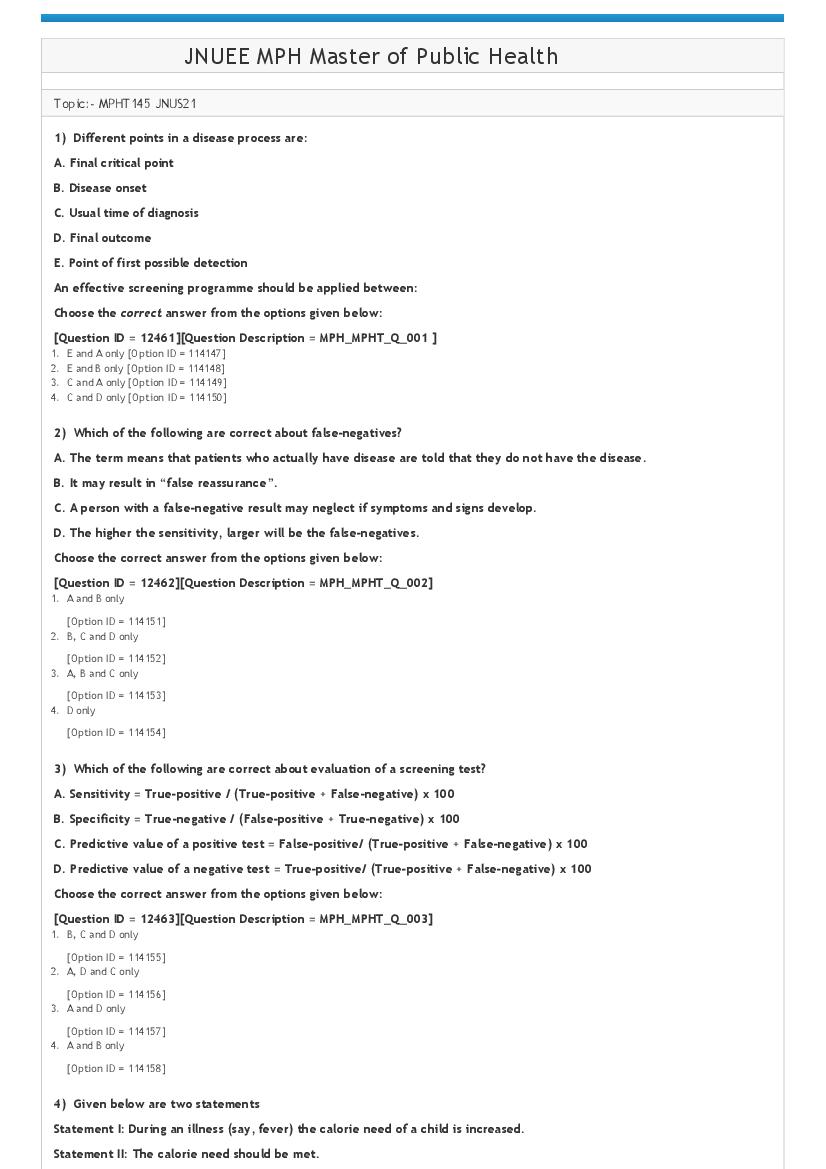
Topic:‐ MPHT145 JNUS21
1) Different points in a disease process are:
A. Final critical point
B. Disease onset
C. Usual time of diagnosis
D. Final outcome
E. Point of first possible detection
An effective screening programme should be applied between:
[Question ID = 12461][Question Description = MPH_MPHT_Q_001 ]
1. E and A only [Option ID = 114147]
2. E and B only [Option ID = 114148]
3. C and A only [Option ID = 114149]
4. C and D only [Option ID = 114150]
2) Which of the following are correct about false‐negatives?
A. The term means that patients who actually have disease are told that they do not have the disease.
B. It may result in “false reassurance”.
C. A person with a false‐negative result may neglect if symptoms and signs develop.
D. The higher the sensitivity, larger will be the false‐negatives.
[Question ID = 12462][Question Description = MPH_MPHT_Q_002]
1. A and B only
[Option ID = 114151]
2. B, C and D only
[Option ID = 114152]
3. A, B and C only
[Option ID = 114153]
4. D only
[Option ID = 114154]
3) Which of the following are correct about evaluation of a screening test?
A. Sensitivity = True‐positive / (True‐positive + False‐negative) x 100
B. Specificity = True‐negative / (False‐positive + True‐negative) x 100
C. Predictive value of a positive test = False‐positive/ (True‐positive + False‐negative) x 100
D. Predictive value of a negative test = True‐positive/ (True‐positive + False‐negative) x 100
[Question ID = 12463][Question Description = MPH_MPHT_Q_003]
1. B, C and D only
[Option ID = 114155]
2. A, D and C only
[Option ID = 114156]
3. A and D only
[Option ID = 114157]
4. A and B only
[Option ID = 114158]
4) Given below are two statements
Statement I: During an illness (say, fever) the calorie need of a child is increased.
Statement II: The calorie need should be met.
Page 2
[Question ID = 12464][Question Description = MPH_MPHT_Q_004]
1. Both Statement I and Statement II are correct
[Option ID = 114159]
2. Both Statement I and Statement II are incorrect
[Option ID = 114160]
3. Statement I is correct but Statement II is incorrect
[Option ID = 114161]
4. Statement I is incorrect but Statement II is correct
[Option ID = 114162]
5) Which are the correct statements about human milk?
A. Protein content is four times less than cow’s milk.
B. Proteins in human milk and cow’s milk are same.
C. Breast milk is completely digested whereas much of cow’s milk protein is excreted by the infant undigested.
D. Human milk is virtually a “living” fluid.
[Question ID = 12465][Question Description = MPH_MPHT_Q_005]
1. A, B, C and D
[Option ID = 114163]
2. C and D only
[Option ID = 114164]
3. A, B and C only
[Option ID = 114165]
4. A and C only
[Option ID = 114166]
6) Which of the following are anthropometric measurements?
A. Chest circumference
B. Height
C. Weight
D. Skinfold thickness
[Question ID = 12466][Question Description = MPH_MPHT_Q_006]
1. C and D only
[Option ID = 114167]
2. A, B C and D
[Option ID = 114168]
3. A, C and D only
[Option ID = 114169]
4. A, B and D only
[Option ID = 114170]
7) Identify the correct combination/s of nutrients and biochemical tests.
A. Niacin: Urine N‐methylnicotinamide
B. Folate: Platelet folate
C. Folate: Red cell folate
D. Vitamin K: Prothrombin time
[Question ID = 12467][Question Description = MPH_MPHT_Q_007]
1. A only
[Option ID = 114171]
2. A and D only
[Option ID = 114172]
3. A, B and D only
[Option ID = 114173]
Page 3
[Option ID = 114174]
8) Which of the following is not a viral food‐borne infection?[Question ID = 12468][Question Description =
MPH_MPHT_Q_008]
1. Hepatitis A [Option ID = 114175]
2. Hepatitis E [Option ID = 114176]
3. Norovirus [Option ID = 114177]
4. Ascariasis [Option ID = 114178]
9) Identify the correct statement regarding level of iodization fixed under the Prevention of Food Adulteration Act:
[Question ID = 12469][Question Description = MPH_MPHT_Q_009]
1. Not less than 60 ppm at the production point, not less than 15 ppm at the consumer level. [Option ID = 114179]
2. Not less than 45 ppm at the production point, not less than 30 ppm at the consumer level. [Option ID = 114180]
3. Not less than 30 ppm at the production point, not less than 15 ppm at the consumer level. [Option ID = 114181]
4. Not less than 20 ppm at the production point, not less than 15 ppm at the consumer level. [Option ID = 114182]
10) Which of the following is not an example of non‐probability sampling?[Question ID = 12470][Question Description =
MPH_MPHT_Q_010]
1. Multiphase sampling [Option ID = 114183]
2. Snowball sampling [Option ID = 114184]
3. Convenience sampling [Option ID = 114185]
4. Quota sampling [Option ID = 114186]
11) Identify the correct statements about Mode.
A. It is an index of central tendency.
B. Defined as the most frequently occurring value of the variable.
C. Because the value of the variable is the most frequent one, it is a natural choice to represent the typical value of the
distribution.
D. It is very straightforward to identity in a raw data set.
[Question ID = 12471][Question Description = MPH_MPHT_Q_011]
1. A, C and D only
[Option ID = 114187]
2. A, B, C and D only.
[Option ID = 114188]
3. B, C and D only
[Option ID = 114189]
4. A, B and D only
[Option ID = 114190]
12) Given below are two statements
Statement I: Correlation coefficient measures the closeness of a linear relationship between two variables.
Statement II: : If the interest lies in quantifying the change in one phenomenon when the other is changed, regression
analysis is preferred.
In light of the above statements, choose the correct answer from the options given below
[Question ID = 12472][Question Description = MPH_MPHT_Q_012]
1. Both Statement I and Statement II are true [Option ID = 114191]
2. Both Statement I and Statement II are false [Option ID = 114192]
3. Statement I is true but Statement II is false [Option ID = 114193]
4. Statement I is false but Statement II is true [Option ID = 114194]
13) Uses of epidemiology include all the following except:[Question ID = 12473][Question Description = MPH_MPHT_Q_013]
1. Describing disease processes [Option ID = 114195]
2. Assessing health technologies [Option ID = 114196]
3. Measuring occurrence of diseases in a population [Option ID = 114197]
4. Analysing health policy processes [Option ID = 114198]
14) Epidemiological study designs include all of the following except:[Question ID = 12474][Question Description =
MPH_MPHT_Q_014]
1. Ecological designs [Option ID = 114199]
2. Qualitative studies [Option ID = 114200]
3. Correlational studies [Option ID = 114201]
Page 4
15) The basic science of Public Health is:[Question ID = 20274][Question Description = MPH_MPHT_Q_015]
1. Anatomy [Option ID = 114203]
2. Epidemiology [Option ID = 114204]
3. Clinical trials [Option ID = 114205]
4. Health economics [Option ID = 114206]
16) An Odds Ratio of 2 between industrial workers getting cancer and farmers getting cancer indicates that:
[Question ID = 20275][Question Description = MPH_MPHT_Q_016]
1. Industrial workers have double the risk of cancer
[Option ID = 114207]
2. Farmers have double the risk of cancer
[Option ID = 114208]
3. Industrial workers have half the risk of cancer
[Option ID = 114209]
4. Farmers have a 4 times greater risk of cancer
[Option ID = 114210]
17) Two statements are given below labeled A for an assertion and R for a reason.
Assertion A: A Simple Random Sample is selected by numbering all population units and picking a lottery among them.
Reason R: This is done to give all those picked in the lottery a monetary gain if they participate in the study without any
bias.
Based on the statements given above, choose the correct answer from those below:
[Question ID = 20276][Question Description = MPH_MPHT_Q_017]
1. Both A and R are true and R is the correct explanation of A
[Option ID = 114211]
2. Both A and R are true but R is NOT the correct explanation of A
[Option ID = 114212]
3. Both A and R are true but R is NOT the correct explanation of A
[Option ID = 114213]
4. A is false but R is true
[Option ID = 114214]
18) Statistical correlation indicates the degree of association between two characteristics. The correlation coefficients
range from ‐ 1.0 to +1.0.
A correlation coefficient of 1.0 means that the two variables exhibit a perfect linear relationship.
However, correlation cannot be used to invoke causation, because the sequence of exposure preceding disease (temporal
association)
cannot be assumed to have occurred.
Based on the passage above, choose the correct statement:
[Question ID = 20277][Question Description = MPH_MPHT_Q_018]
1. Causation implies correlation
[Option ID = 114215]
2. Correlation implies causation
[Option ID = 114216]
3. Correlation measures risk
[Option ID = 114217]
4. Correlation is the same as regression
[Option ID = 114218]
19) Match List I with List II
List I List II
(Concept) (Epidemiological meaning)
A. Incubation period I. Changes in a daily cycle
B. Diurnal variation II. Changes over an annual cycle
Page 5
D. Seasonal trends IV. Changes over long periods of time
[Question ID = 20278][Question Description = MPH_MPHT_Q_019]
1. A ‐ I, B ‐ II, C ‐ III, D ‐ IV [Option ID = 114219]
2. A ‐ IV, B ‐ I, C ‐ III, D ‐ II [Option ID = 114220]
3. A ‐ III, B ‐ I, C ‐ IV, D ‐ II [Option ID = 114221]
4. A ‐ I, B ‐ II, C ‐ IV, D ‐ III [Option ID = 114222]
20) Match List I with List II
List I List II
(Concept) (Example )
A. Proximal determinants I. Environmental conditions
B. Distal determinants II. Social status
C. Social determinants III. Germs
D. Behavioural determinants IV. Unhealthy diets
[Question ID = 20279][Question Description = MPH_MPHT_Q_020]
1. A ‐ III, B ‐ II, C ‐ IV, D ‐ I [Option ID = 114223]
2. A ‐ II, B ‐III , C ‐ IV, D ‐ I [Option ID = 114224]
3. A ‐ I, B ‐ II, C ‐ III, D ‐ IV [Option ID = 114225]
4. A ‐ III, B ‐ I, C ‐ II, D ‐ IV [Option ID = 114226]
21) John Snow is known as the father of :[Question ID = 20280][Question Description = MPH_MPHT_Q_021]
1. Bronchoscopy [Option ID = 114227]
2. Use of the stethoscope [Option ID = 114228]
3. Epidemiology [Option ID = 114229]
4. Medical experiments [Option ID = 114230]
22) The number of people with a disease at a specified time divided by the number of people in the populaiton multiplied
by thousand will give us: [Question ID = 20281][Question Description = MPH_MPHT_Q_022]
1. the incidence rate of the disease [Option ID = 114231]
2. the prevalence rate of the disease [Option ID = 114232]
3. the severity of the disease [Option ID = 114233]
4. the duration of the disease [Option ID = 114234]
23) Which of the following data sets DO NOT provide epidemiological data on disease profile in India? [Question ID = 20282]
[Question Description = MPH_MPHT_Q_023]
1. Surveys of the National Sample Survey Organisation [Option ID = 114235]
2. The National Family Health Survey [Option ID = 114236]
3. The Health Management Information System [Option ID = 114237]
4. The Census of India [Option ID = 114238]
24) Herd Immunity theory proposes that in diseases passed from individual to individual, it is difficult to maintain a chain of
infection when large numbers of a population are immune.
The higher the number of immune individuals, the lower the likelihood that a susceptible person will come in contact with
an infectious agent
Development of herd immunity depends upon which of the following factors?
[Question ID = 20283][Question Description = MPH_MPHT_Q_024]
1. Natural exposure to infection
[Option ID = 114239]
2. Vaccination
[Option ID = 114240]
3. Population structure of human and animal hosts
[Option ID = 114241]
4. All the above
[Option ID = 114242]
25) Who among the following was responsible for the 19th Century report on “The Sanitary Conditions of the Labouring
Population in Great Britain” in industrial England? [Question ID = 20284][Question Description = MPH_MPHT_Q_025]
1. Karl Marx [Option ID = 114243]
2. Edwin Chadwick [Option ID = 114244]
Page 6
4. None of the Above [Option ID = 114246]
26) Mortality indicator to assess the health status of a population include the following:
[Question ID = 20285][Question Description = MPH_MPHT_Q_026]
1. Crude Death Rate
[Option ID = 114247]
2. Infant Mortality Rate
[Option ID = 114248]
3. Child Mortality Rate
[Option ID = 114249]
4. All of the Above
[Option ID = 114250]
27) Epidemiological transition includes the following:[Question ID = 20286][Question Description = MPH_MPHT_Q_027]
1. Decline in mortality rates among adult population [Option ID = 114251]
2. Fall in morbidity rates among adult population [Option ID = 114252]
3. Shift from high mortality due to infectious to degenerative disease [Option ID = 114253]
4. None of the above [Option ID = 114254]
28) Match List I with List II
List I List II
A. Provisioning of medicine free of cost by the government to all its citizensI. Dr. John Ryle
B.‘Medicine is a social science and politics is medicine on a large scale’ II. Social Medicine
C. Recognition of social factors in aetiology of disease III. Socialized Medicine
D. A prominent leader in social medicine in early 20th Century IV. Virchow
[Question ID = 20287][Question Description = MPH_MPHT_Q_028]
1. A ‐ III, B ‐ IV, C‐ II, D ‐ I [Option ID = 114255]
2. A ‐ II, B ‐ III, C ‐ IV, D ‐ I [Option ID = 114256]
3. A ‐ I, B ‐ II, C ‐ III, D ‐ IV [Option ID = 114257]
4. A ‐ IV, B ‐ II, C ‐ I, D ‐ III [Option ID = 114258]
29) Disease is defined as:[Question ID = 20288][Question Description = MPH_MPHT_Q_029]
1. Subjective experience of illness [Option ID = 114259]
2. That can be measured in terms of disease and death [Option ID = 114260]
3. Physiological or psychological dysfunction of the body [Option ID = 114261]
4. Both 2 and 3 only [Option ID = 114262]
30) Illness is defined as:[Question ID = 20289][Question Description = MPH_MPHT_Q_030]
1. feeling aware about not being well [Option ID = 114263]
2. physiological dysfunction of the body [Option ID = 114264]
3. Subjective experience of not being well [Option ID = 114265]
4. Both 1 and 3 only [Option ID = 114266]
31) Preventive Medicine is “applied to 'healthy' people, customarily by actions affecting large number of populations. Its
primary objective is prevention of disease and promotion of health” What are the services included under preventive
medicine? [Question ID = 20290][Question Description = MPH_MPHT_Q_031]
1. Vaccination [Option ID = 114267]
2. Screening and regular health check ups [Option ID = 114268]
3. Chemoprophylaxis and mass drug administration [Option ID = 114269]
4. All of the above [Option ID = 114270]
32) Given below are two statements, one is labelled as Assertion A and the other is labelled as
Reason R
Assertion A: In the biomedical view, health is viewed as an ‘absence of disease’. It draws
upon the “germ theory” of disease.
Reason R: This is because it does not address the enviornmental and social determinants of
health
In light of the above statements, choose the most appropriate answer from the options given
below
[Question ID = 20291][Question Description = MPH_MPHT_Q_032]
Page 7
[Option ID = 114271]
2. Both A and R are correct but R is NOT the correct explanation of A
[Option ID = 114272]
3. A is correct but R is not correct
[Option ID = 114273]
4. A is correct but R is not correct
[Option ID = 114274]
33) Given below are two statements, one is labelled as Assertion A and the other is labelled as Reason R
Assertion A : The United Nation’s Millennium Development Goals were intended to address global inequalities in health
outcomes.
Reason R : This was due to rising socio‐economic inequalities as a result of liberalisation, globalisation and privatisation.
In light of the above statements, choose the correct answer from the options given below
[Question ID = 20292][Question Description = MPH_MPHT_Q_033]
1. Both A and R are true and R is the correct explanation of A
[Option ID = 114275]
2. Both A and R are true but R is NOT the correct explanation of A
[Option ID = 114276]
3. A is true but R is false
[Option ID = 114277]
4. A is false but R is true
[Option ID = 114278]
34) Health is a multidimensional concept. The WHO has identified three important dimensions and they include:
[Question ID = 20293][Question Description = MPH_MPHT_Q_034]
1. Emotional Dimension
[Option ID = 114279]
2. Vocational Dimension
[Option ID = 114280]
3. Social Dimension
[Option ID = 114281]
4. None of the above
[Option ID = 114282]
35) Given below are two statements, one is labelled as Assertion A and the other is labelled as Reason R:
Assertion A: The concept of well being is important for assessing the health status of a population.
Reason R: The concept of well being encompasses both the objective and subjective conditions of individuals in a
population. Objective conditions relate to level of living and subjective conditions is the perception of individuals about
the quality of their life.
In light of the above statements, choose the most appropriate answer from the options given below
[Question ID = 12475][Question Description = MPH_MPHT_Q_035]
1. Both A and R are correct and R is the correct explanation of A
[Option ID = 114283]
2. Both A and R are correct and R is the correct explanation of A
[Option ID = 114284]
3. Both A and R are correct and R is the correct explanation of A
[Option ID = 114285]
4. Both A and R are correct and R is the correct explanation of A
[Option ID = 114286]
36) The Human Development Index developed by the UNDP focuses on basic dimensions of human development. Which
one of the following are included in computing the Human Development Index? [Question ID = 12476][Question Description
= MPH_MPHT_Q_036]
1. Gross Domestic Product [Option ID = 114287]
2. Gross National Product [Option ID = 114288]
3. Inequality Index [Option ID = 114289]
4. Life Expectancy Index [Option ID = 114290]
Page 8
[Question Description = MPH_MPHT_Q_037]
1. Bihar [Option ID = 114291]
2. Madhya Pradesh [Option ID = 114292]
3. Maharashtra [Option ID = 114293]
4. Uttar Pradesh [Option ID = 114294]
38) Name the Committee constituted in 1989 by the Planning Commission, which submitted its report in 1993 for
estimating the Poverty line in India. [Question ID = 12478][Question Description = MPH_MPHT_Q_038]
1. Dutt Committee [Option ID = 114295]
2. Chelliah Committee [Option ID = 114296]
3. Chakravorty Committee [Option ID = 114297]
4. Lakdawala Committee [Option ID = 114298]
39) Disguised Unemployment is a kind of Hidden Unemployment. It is best understood as‐
A. Unemployment in which there are more people engaged in a work than required.
B. In a family of six people, all are engaged in the same agricultural plot. If three people are
withdrawn from it, even then there is no reduction in output.
C. Lack of non‐agricultural employment in Rural Area
D. Employment in selected sectors in Urban Area
[Question ID = 12479][Question Description = MPH_MPHT_Q_039]
1. A, B and D only
[Option ID = 114299]
2. A and C only
[Option ID = 114300]
3. A and B only
[Option ID = 114301]
4. C and D only
[Option ID = 114302]
40) Given below are two statements
Statement I: Structural theories of stratification predict that groups with low positions in social
hierarchies experience high rates of mental health problems.
Statement II: The 'double Jeopardy' and 'triple Jeopardy' hypotheses postulate that groups that
are subordinate in multiple stratification systems such as gender, race, and class are especially at
high risk and can be understood through intersectionality.
In light of the above statements, choose the most appropriate answer from the options given
below
[Question ID = 12480][Question Description = MPH_MPHT_Q_040]
1. Both Statement I and Statement II are correct
[Option ID = 114303]
2. Both Statement I and Statement II are incorrect
[Option ID = 114304]
3. Statement I is correct but Statement II is incorrect
[Option ID = 114305]
4. Statement I is incorrect but Statement II is correct
[Option ID = 114306]
41) Match List I with List II
List I List II
(Population Dynamics) (Factors)
A. Age Composition I. Social
B. Literacy Rate II. Demographic
C. Sex Ratio III. Gender
D. Crude Death Rate IV. Mortality
Page 9
1. A ‐ I, B ‐ III, C ‐ II, D ‐ IV [Option ID = 114307]
2. A ‐ IV, B ‐ I, C ‐ II, D ‐ III [Option ID = 114308]
3. A ‐ II, B ‐ I, C ‐ III, D ‐ IV [Option ID = 114309]
4. A ‐ IV, B ‐ I, C ‐ III, D ‐ II [Option ID = 114310]
42) Arrange the States‐ in increasing order of the share of India's population as per the Census 2011
A. West Bengal
B. Madhya Pradesh
C. Uttar Pradesh
D. Bihar
E. Gujarat
Choose the correct answer from the options given below
[Question ID = 12482][Question Description = MPH_MPHT_Q_042]
1. C, D, A, B, E
[Option ID = 114311]
2. E, B, A, D, C
[Option ID = 114312]
3. C, A, B, D, E
[Option ID = 114313]
4. E, C, D, A, B
[Option ID = 114314]
43) Consider the following statements‐
A. Gini Coefficient is the area between the line of perfect equality and the line of perfect inequality.
B. Lorenze Curve is a percentage of the area between the line of perfect equality and the line of perfect inequality.
Which of the statements given above is/are correct?
[Question ID = 12483][Question Description = MPH_MPHT_Q_043]
1. A only
[Option ID = 114315]
2. B only
[Option ID = 114316]
3. Both A and B
[Option ID = 114317]
4. Neither A nor B
[Option ID = 114318]
44) Given below are some targets for the 'Beti Bachao, Beti Padhao Abhiyan'. Identify which of the
following is/are not part of the Abhiyan‐
A. Provide toilets for the girls in every school
B. Increase enrolment in educational institutions
C. Promote a safe environment
D. Construct roads
E. Ensure electricity supply
[Question ID = 12484][Question Description = MPH_MPHT_Q_044]
1. A, B and C only [Option ID = 114319]
2. B, C and D only [Option ID = 114320]
3. C, D and E only [Option ID = 114321]
4. A, B, C, D and E [Option ID = 114322]
45) In a diagram representing Concentric Zone Theory of land use, the core is called:
[Question ID = 12485][Question Description = MPH_MPHT_Q_045]
1. High‐Class Residential Area [Option ID = 114323]
2. Central Business District [Option ID = 114324]
3. Low‐Class Residential Area [Option ID = 114325]
4. Industrial Area [Option ID = 114326]
Page 10
A. Declining birth rate
B. Improvement in the literacy level
C. Size of its young adult population
D. Improvement in the health budget
[Question ID = 12486][Question Description = MPH_MPHT_Q_046]
1. A and D only
[Option ID = 114327]
2. B and C only
[Option ID = 114328]
3. B and D only
[Option ID = 114329]
4. D only
[Option ID = 114330]
47) 'Reliability' in research refers to which of the following:
[Question ID = 12487][Question Description = MPH_MPHT_Q_047]
1. Stability and consistency of measurements
[Option ID = 114331]
2. Research can be conducted anywhere
[Option ID = 114332]
3. Does not influence data processing
[Option ID = 114333]
4. All the above
[Option ID = 114334]
48) When did the National Population Policy come into effect?[Question ID = 12488][Question Description =
MPH_MPHT_Q_048]
1. 2001 [Option ID = 114335]
2. 1947 [Option ID = 114336]
3. 1952 [Option ID = 114337]
4. 2000 [Option ID = 114338]
49) …………………. is/are a form of undernutrition that occurs when intake and absorption of vitamins
and minerals (such as zinc, iodine, and iron) are too low to sustain good health and development.
A. Hidden hunger
B. Micronutrient deficiency
C. Both Hidden hunger and Micronutrient deficiency
D. Neither Hidden hunger nor Micronutrient deficiency
[Question ID = 12489][Question Description = MPH_MPHT_Q_049]
1. A and C only
[Option ID = 114339]
2. C and D only
[Option ID = 114340]
3. A and B only
[Option ID = 114341]
4. A and D only
[Option ID = 114342]
50) A National Health Service financed out of general tax revenue is found in
[Question ID = 12490][Question Description = MPH_MPHT_Q_050]
1. India [Option ID = 114343]
2. United States of America [Option ID = 114344]
3. Germany [Option ID = 114345]
4. United Kingdom [Option ID = 114346]
51) The Indian government launched the National Mental Health Programme (NMHP) to increase access to mental
Page 11
1. 1951 [Option ID = 114347]
2. 1978 [Option ID = 114348]
3. 1982 [Option ID = 114349]
4. 1997 [Option ID = 114350]
52) Analytical psychology was founded by[Question ID = 12492][Question Description = MPH_MPHT_Q_052]
1. Carl Jung [Option ID = 114351]
2. Sigmund Freud [Option ID = 114352]
3. Jacques Lacan [Option ID = 114353]
4. B. F Skinner [Option ID = 114354]
53) When trying to connect ‘health’ and ‘economics’, which of these statements does a health
economist emphasise more?
A. Health being the most precious good,In order to remain in good health just about anything
should be done.
B. health care being in a crisis. If the costs of health care were to continue to increase at the
current rate, then health might become unaffordable to most people.
[Question ID = 20313][Question Description = MPH_MPHT_Q_053]
1. A only is correct
[Option ID = 114355]
2. B only is correct
[Option ID = 114356]
3. Neither A nor B is correct
[Option ID = 114357]
4. Both A and B are correct
[Option ID = 114358]
54) A. The primary focus of Mental Healthcare Act (MHA) 2017 is on the rights of persons with
mental illness as well as the right to mental healthcare in noncustodial settings that are
acceptable to the client.
B. The Mental Healthcare Act (MHA) 2017 aims to align the laws of India to the Convention on
Rights of Persons with Disabilities, which India ratified in 2007.
[Question ID = 20314][Question Description = MPH_MPHT_Q_054]
1. Only A is correct [Option ID = 114359]
2. Only B is correct [Option ID = 114360]
3. Both A and B are correct [Option ID = 114361]
4. Both A and b are not correct [Option ID = 114362]
55) A. The ‘economics of health’ concerns the valuation of health in monetary terms, i.e., the
weighing of good health against other objectives, in particular consumption of other goods.
B. The ‘economics of health care’ raises the issues of what determines the quantity and quality of
medical services produced in a society.
[Question ID = 20315][Question Description = MPH_MPHT_Q_055]
1. Only A is correct [Option ID = 114363]
2. Only B is correct [Option ID = 114364]
3. Both A and B are correct [Option ID = 114365]
4. Both A and B are not correct [Option ID = 114366]
56) A. Economic growth is only conditionally related to improvements in wellbeing – better health
and lower health inequalities.
B. Neo‐liberalism produces increased social and income inequalities and lowered social
cohesion, which are themselves related, through various avenues, to health inequalities.
[Question ID = 20316][Question Description = MPH_MPHT_Q_056]
Page 12
2. Only B is correct [Option ID = 114368]
3. Both A and B are correct [Option ID = 114369]
4. Both A and B are not correct [Option ID = 114370]
57) A.The study of biomedical bases for mental illnesses and their treatment is called biological
psychiatry or biopsychiatry.
B. A basic premise of biopsychiatry is that psychiatric symptoms occur in many conditions‐some
psychological and some medical.
[Question ID = 20317][Question Description = MPH_MPHT_Q_057]
1. Only A is correct [Option ID = 114371]
2. Only B is correct [Option ID = 114372]
3. Both A and B are correct [Option ID = 114373]
4. Neither A nor B are correct [Option ID = 114374]
58) A. The Diagnostic and Statistical Manual (DSM) contains diagnostic criteria, research findings,
and treatment information for Cancer
B. The Diagnostic and Statistical Manual (DSM) contains diagnostic criteria, research findings,
and treatment information for Mental Disorder
C. The Diagnostic and Statistical Manual (DSM) contains diagnostic criteria, research findings,
and treatment information for Global Burden of Disease
D. The Diagnostic and Statistical Manual (DSM) contains diagnostic criteria, research findings,
and treatment information for Tuberculosis
[Question ID = 20318][Question Description = MPH_MPHT_Q_058]
1. A and C only are correct [Option ID = 114375]
2. B only is correct [Option ID = 114376]
3. C only is correct [Option ID = 114377]
4. A and D only are correct [Option ID = 114378]
59) Match List I with List II
List I List II
A. Cognitive‐behavior I. Psychotherapy groups that utilize the principles of unconscious needs and motivations developed by
therapy Sigmund Freud.
B. Phenomenological II. A therapeutic approach that focuses on increasing awareness of feelings and impulses in the
therapy present.
C. Gestalt therapy III. A therapeutic approach that focuses on the interpretations individuals place on their experiences.
D. Psychodynamic IV. An approach to psychotherapy that emphasizes the correction of distorted thinking patterns and
groups changing one’s behaviors accordingly.
[Question ID = 20319][Question Description = MPH_MPHT_Q_059]
1. A ‐ IV, B ‐ III, C ‐ II, D ‐ I [Option ID = 114379]
2. A ‐ II, B ‐ I, C ‐ III, D ‐ IV [Option ID = 114380]
3. A ‐ III, B ‐ IV, C ‐ I, D ‐ II [Option ID = 114381]
4. A ‐ I, B ‐ II, C ‐ IV, D ‐ III [Option ID = 114382]
60) A. Public goods are goods or services such that one person’s consumption does not reduce the
amount available for others to consume.
B. Control of disease vectors and protection of food and water safety are examples of public
goods in health.
[Question ID = 20320][Question Description = MPH_MPHT_Q_060]
1. Only A is correct [Option ID = 114383]
2. Only B is correct [Option ID = 114384]
3. Both A and B are correct [Option ID = 114385]
4. Nether A nor B are correct [Option ID = 114386]
Page 13
Reason R
Assertion A: Family planning is an action plan to attain reproductive health among people.
Reason R: RCH program ensures better reproductive health.
In light of the above statements, choose the correct answer from the options given below
[Question ID = 20321][Question Description = MPH_MPHT_Q_061]
1. Both A and R are true and R is the correct explanation of A
[Option ID = 114387]
2. Both A and R are true but R is NOT the correct explanation of A
[Option ID = 114388]
3. A is true but R is false
[Option ID = 114389]
4. A is false but R is true
[Option ID = 114390]
62) Match List I with List II
List I List II
Colour Waste Description
A. Yellow I. Catheters, tubes, syringes, used gloves, lab waste
B. Red II. Green waste, non‐infected materials & papers, cardboards, office waste, food waste.
C. Green III. Human tissues, organs, body parts, items contaminated by blood and body fluids.
D. Black IV. Discarded medicine, discarded cytotoxic drugs
[Question ID = 20322][Question Description = MPH_MPHT_Q_062]
1. A ‐ I, B ‐II , C ‐IV , D ‐III [Option ID = 114391]
2. A ‐II , B ‐III , C ‐IV , D ‐I [Option ID = 114392]
3. A ‐II , B ‐III , C ‐ I, D ‐ IV [Option ID = 114393]
4. A ‐III, B ‐I, C ‐II, D ‐ IV [Option ID = 114394]
63) Match List I with List II
List I List II
A. Amenorrhea I. Painful Menstruation
B. DysmenorrheaII. Absence of menstruation
C. Menorrhagia III. Gradual ending of menstruation
D. Menopause IV. Excessive menstrual bleeding
[Question ID = 20323][Question Description = MPH_MPHT_Q_063]
1. A ‐ IV, B ‐I , C ‐ III, D ‐ II
[Option ID = 114395]
2. A ‐ IV, B ‐II , C ‐ I, D ‐ III
[Option ID = 114396]
3. A‐II, B ‐I , C ‐IV, D ‐ III
[Option ID = 114397]
4. A ‐I , B ‐IV , C ‐ II, D ‐ III
[Option ID = 114398]
64) Match List I with List II
List I List II
Book Author
A. The Emperor of all Maladies I. Oliver Sacks
B. Being Mortal II. John M Barry
C. The Great Influenza III. Atul Gawande
Page 14
[Question ID = 20324][Question Description = MPH_MPHT_Q_064]
1. A ‐I , B ‐ II, C ‐III , D ‐IV [Option ID = 114399]
2. A ‐I , B ‐III , C ‐II , D ‐ IV [Option ID = 114400]
3. A ‐ IV, B ‐ II, C ‐III , D ‐ I [Option ID = 114401]
4. A ‐IV , B ‐III , C ‐ II, D ‐ I [Option ID = 114402]
65) Ectopic pregnancy is
A. a benign tumour in the fetus.
B. implantation of the fertilized ovum in an area other than the uterus.
C. bringing ova and sperm to fertilize outside the uterus.
D. removal of fibroid tumour from the uterus.
[Question ID = 20325][Question Description = MPH_MPHT_Q_065]
1. A and D only [Option ID = 114403]
2. B only [Option ID = 114404]
3. A and B only [Option ID = 114405]
4. C only [Option ID = 114406]
66) Match List I with List II
List I List II
Concept
Meaning
I. Set of traditions, rules, symbols that shape and are enacted as feelings, thoughts and
A. Society
behaviours of groups of people.
II. Humanly created organization or system of interrelations that connects individuals in a
B. Culture
common culture
III. Concepts and behaviour that constitute the normal, behavioural rules or standards of social
C. Values
interaction
D. Norms IV. Ideas people share about what is good, bad, desirable, undesirable.
[Question ID = 20326][Question Description = MPH_MPHT_Q_066]
1. A ‐II , B ‐I , C ‐III , D ‐ IV [Option ID = 114407]
2. A ‐II , B ‐I , C ‐IV , D ‐ III [Option ID = 114408]
3. A ‐II , B ‐ IV, C ‐ I, D ‐ III [Option ID = 114409]
4. A ‐ I, B ‐ II, C ‐III , D ‐IV [Option ID = 114410]
67) Given below are two statements, one is labelled as Assertion A and the other is labelled as Reason R
Assertion A : There are four main factors of production in any economy. These are Land, Capital, Labour and Entrepreneurs.
Reason R : An economy is not so productive when resources are used efficiently at the lowest possible cost to address the
particular needs of society.
In light of the above statements, choose the correct answer from the options given below
[Question ID = 20327][Question Description = MPH_MPHT_Q_067]
1. Both A and R are true and R is the correct explanation of A
[Option ID = 114411]
2. Both A and R are true but R is NOT the correct explanation of A
[Option ID = 114412]
3. A is true but R is false
[Option ID = 114413]
4. A is false but R is true
[Option ID = 114414]
68) Accreditation agencies are
A. NABH
B. JCI
C. NACO
Page 15
[Question ID = 20328][Question Description = MPH_MPHT_Q_068]
1. A, B and D only [Option ID = 114415]
2. A, C and D only [Option ID = 114416]
3. A and B only [Option ID = 114417]
4. B and D only [Option ID = 114418]
69) Given below are two statements
Statement I: Accreditation is a quality improvement program that provides official recognition
and endorsement that an organization meets, or exceeds, pre‐defined standards of excellence.
Statement II: Accreditation involves only internal evaluation.
In light of the above statements, choose the most appropriate answer from the options given
below
[Question ID = 20329][Question Description = MPH_MPHT_Q_069]
1. Both Statement I and Statement II are correct [Option ID = 114419]
2. Both Statement I and Statement II are incorrect [Option ID = 114420]
3. Statement I is correct but Statement II is incorrect [Option ID = 114421]
4. Statement I is incorrect but Statement II is correct [Option ID = 114422]
70) Place the disasters in the order of old to new.
A.Bhopal Gas Leak
B. Gujarat Bhuj Earthquake
C. Odisha Super Cyclone
D. Indian Ocean Tsunami
Choose the correct answer from the options given below
[Question ID = 20330][Question Description = MPH_MPHT_Q_070]
1. A, B, C, D [Option ID = 114423]
2. A, C, D, B [Option ID = 114424]
3. A, C, B, D [Option ID = 114425]
4. B, A, C, D [Option ID = 114426]
71) Given below are two statements
Statement I: Sex refers to a person's physical characteristics at birth, and gender encompasses a
person's identities, expressions, and societal roles.
Statement II: Sex is usually categorized as female or male and gender refers to the socially
constructed roles, behaviours, expressions and identities of girls, women, boys, men, and gender
diverse people
In light of the above statements, choose the correct answer from the options given below
[Question ID = 20331][Question Description = MPH_MPHT_Q_071]
1. Both Statement I and Statement II are true [Option ID = 114427]
2. Both Statement I and Statement II are false [Option ID = 114428]
3. Statement I is true but Statement II is false [Option ID = 114429]
4. Statement I is false but Statement II is true [Option ID = 114430]
72) Given below are two statements
Statement I: The most common direct causes of maternal death are excessive blood loss,
infection, high blood pressure, unsafe abortion, and obstructed labour, as well as indirect causes
such as anaemia, malaria, and heart disease.
Statement II: Most maternal deaths are preventable with timely management by a skilled health
professional working in a supportive environment.
In light of the above statements, choose the correct answer from the options given below
[Question ID = 20332][Question Description = MPH_MPHT_Q_072]
1. Both Statement I and Statement II are true [Option ID = 114431]
2. Both Statement I and Statement II are false [Option ID = 114432]
3. Statement I is true but Statement II is false [Option ID = 114433]
4. Statement I is false but Statement II is true [Option ID = 114434]
Page 16
Statement I: School health programs are those that promote health through schools. These
embody the total school programme in health involving all health activities that are planned,
organized and conducted by the school and are under the jurisdiction of the School.
Statement II: Investment in school health programs is the most efficient and cost‐effective way
to improve students' health and academic performance.
In light of the above statements, choose the correct answer from the options given below
[Question ID = 12493][Question Description = MPH_MPHT_Q_073]
1. Both Statement I and Statement II are true [Option ID = 114435]
2. Both Statement I and Statement II are false [Option ID = 114436]
3. Statement I is true but Statement II is false [Option ID = 114437]
4. Statement I is false but Statement II is true [Option ID = 114438]
74) __________________has been used for the process of determining the total health status of child through the use of
such means as health histories; observations, screenings, and medical, dental and psychological examinations. [Question ID =
12494][Question Description = MPH_MPHT_Q_074]
1. 1. Health Assessment [Option ID = 114439]
2. 2. School Health Appraisal [Option ID = 114440]
3. 3. Child Health Check‐Up [Option ID = 114441]
4. 4. None of the above [Option ID = 114442]
75) Which of the following is/ are part of school health education?
A. Academic skills and knowledge development
B. Health and nutrition education
C. Life skill education
D. Staff education through training
E. None of the above
Choose the correct answer from the options given below
[Question ID = 12495][Question Description = MPH_MPHT_Q_075]
1. A, B, C and D [Option ID = 114443]
2. E only [Option ID = 114444]
3. A, B and D [Option ID = 114445]
4. B, C and D [Option ID = 114446]
76) Formal school health program was nonexistant in India. However, school medical inspection was started first in
_______________city in 1909. [Question ID = 12496][Question Description = MPH_MPHT_Q_076]
1. Mumbai [Option ID = 114447]
2. Delhi [Option ID = 114448]
3. Baroda [Option ID = 114449]
4. Ahmedabad [Option ID = 114450]
77) Community paediatrics encompasses a number of strands of pediatrics and child health including‐
A. development paediatrics
B. behavioural paediatrics
C. educational medicine (school health)
D. ambulatory paediatrics
E. child public health
[Question ID = 12497][Question Description = MPH_MPHT_Q_077]
1. A, B and D only
[Option ID = 114451]
2. A, B, C, D and E
[Option ID = 114452]
3. A, C and E only
[Option ID = 114453]
4. B, C and E only
[Option ID = 114454]
78) Given below are two statements, one is labelled as Assertion A and the other is labelled as
Page 17
Assertion A: There are numerous reasons for the non‐enrollment of children, poor performance
and learning in school.
Reason R: There can be an immense destabilizing effect on the political, social and economic
system of the country if we fail to nurture the children's health, their hopes, and their skills.
In light of the above statements, choose the most appropriate answer from the options given
below
[Question ID = 12498][Question Description = MPH_MPHT_Q_078]
1. Both A and R are correct and R is the correct explanation of A
[Option ID = 114455]
2. Both A and R are correct but R is NOT the correct explanation of A
[Option ID = 114456]
3. A is correct but R is not correct
[Option ID = 114457]
4. A is not correct but R is correct
[Option ID = 114458]
79) Match List I with List II
List I List II
Components of School Health
Descriptions/Characteristics
A. School health care services I. Constructive involvement in community development project
II. Safe water supply and sanitation services, healthy organization culture, good location,
B. School health education
structure, and green and safe envirionment
III. academic skills and knowledge development; health and nutrition education; first aid, life
C. School health environment
skills education.
D. School community projects IV. Preventive, curative and referral services focusing not only on students but also school
and outreach staff
[Question ID = 12499][Question Description = MPH_MPHT_Q_079]
1. A ‐ III, B ‐ II, C ‐ I, D ‐ IV [Option ID = 114459]
2. A ‐ II, B ‐ III, C ‐ IV, D ‐ I [Option ID = 114460]
3. A ‐ I, B ‐ II, C ‐ III, D ‐ IV [Option ID = 114461]
4. A ‐ IV, B ‐ III, C ‐ II, D ‐ I [Option ID = 114462]
80) In which year did the Government set up Renuka Ray School Health Committee to review the school health program at
the national level? [Question ID = 12500][Question Description = MPH_MPHT_Q_080]
1. 1962 [Option ID = 114463]
2. 1961 [Option ID = 114464]
3. 1966 [Option ID = 114465]
4. 1971 [Option ID = 114466]
81) Social Paediatrics acts in three areas. Identify the three areas from the options given below ‐
A. Child health problems with physical deformities
B. Child health problems with social causes
C. Child health problems with social consequences
D. Child health care in society
E. Child health problems with mental retardation
Choose the correct answer from the options given below
[Question ID = 12501][Question Description = MPH_MPHT_Q_081]
1. A, B, and E only [Option ID = 114467]
2. B, C and D only [Option ID = 114468]
3. A, B and C only [Option ID = 114469]
4. C, D and E only [Option ID = 114470]
82) ______________ is a process with intellectual, psychological and social dimensions relating to activities which increase
the abilities of people to make informed decisions affecting their personal, family and community well being. [Question ID =
12502][Question Description = MPH_MPHT_Q_082]
Page 18
2. Health Communication [Option ID = 114472]
3. Health Education [Option ID = 114473]
4. Health Information [Option ID = 114474]
83) Child Public Health is concerned with child health at the population rather than individual level and has been defined
by ________________ as: "....the organized efforts of society to develop healthy public health policies to promote child
and young people's health, to prevent disease in children and young people and to foster equity for children and young
people, within a framework of sustainable development." [Question ID = 12503][Question Description = MPH_MPHT_Q_083]
1. Kohler (1996) [Option ID = 114475]
2. WHO (1986) [Option ID = 114476]
3. UNICEF (1986) [Option ID = 114477]
4. None of the above [Option ID = 114478]
84) A cascade strategy for disseminating life skills education should be used in the adolescent
population. Identify the correct sequence of strategies to be adopted.
A. Selection of peer trainers be done by selecting few students to represent classes and sections
B. Trained School counsellors and teachers to identify "peer trainers" who have the qualities of
leadership, motivation etc..
C. Training workshop with school counsellors and interested teachers to orient them to the
rationale, methodology and relevance of life skills in school set up.
D. The peer trainers along with counsellors and teachers then train other students in their school
using the same teaching schedule
E. Focus on feedback supported by professional help
Choose the correct answer from the options given below
[Question ID = 12504][Question Description = MPH_MPHT_Q_084]
1. A, B, C, D, E
[Option ID = 114479]
2. C, B, A, D, E
[Option ID = 114480]
3. B, C, A, D, E
[Option ID = 114481]
4. A, C, B, D, E
[Option ID = 114482]
85) Given below are two statements
Statement I: School phobia, psychosomatic complaints, emotional/behavioural problems, poor
sleep and appetite, difficulties in coping and declining scholastic performance are common
manifestations of stress in school children.
Statement II: Specific mental health programs addressing these issues reduced coping skills,
increase stress, and decrease support for a healthy school community.
In light of the above statements, choose the most appropriate answer from the options given
below
[Question ID = 12505][Question Description = MPH_MPHT_Q_085]
1. Both Statement I and Statement II are correct [Option ID = 114483]
2. Both Statement I and Statement II are incorrect [Option ID = 114484]
3. Statement I is correct but Statement II is incorrect [Option ID = 114485]
4. Statement I is incorrect but Statement II is correct [Option ID = 114486]
86) Given below are two statements, one is labelled as Assertion A and the other is labelled as
Reason R
Assertion A: It has been estimated by World Development Report (1993) that 1.3 years of
schooling to the mother reduces child mortality by about 15%.
Reason R: More years of education a female receives, the more likely it is that her children will
survive the first 5 years of life.
In light of the above statements, choose the correct answer from the options given below
Page 19
1. Both A and R are true and R is the correct explanation of A
[Option ID = 114487]
2. Both A and R are true but R is NOT the correct explanation of A
[Option ID = 114488]
3. A is true but R is false
[Option ID = 114489]
4. A is false but R is true
[Option ID = 114490]
87) Match List I with List II
List I List II
Disease Cause
A.Silicosis I. Irondust
B. Byssinosis II. Cotton fibers
C. Bagassosis III. Sugarcane dust
D. Siderosis IV. Silica dust
[Question ID = 12507][Question Description = MPH_MPHT_Q_087]
1. A ‐ IV, B ‐ II, C ‐ III, D ‐ I [Option ID = 114491]
2. A ‐ IV, B ‐ III, C ‐ II, D ‐ I [Option ID = 114492]
3. A ‐ IV, B ‐ I, C ‐ III, D ‐ II [Option ID = 114493]
4. A ‐ IV, B ‐ II, C ‐ I, D ‐ III [Option ID = 114494]
88) Match List I with List II
List I List II
Disease Agent
A. Small pox I. Picornavirus
B. Measles II. Flavivirus
C. Hepatitis A III. Paramyxovirus
D. Japanese encephalitis IV. Variola virus
[Question ID = 12508][Question Description = MPH_MPHT_Q_088]
1. A ‐ IV, B ‐ III, C ‐ II, D ‐ I [Option ID = 114495]
2. A ‐ IV, B ‐ III, C ‐ I, D ‐ II [Option ID = 114496]
3. A ‐ IV, B ‐ I, C ‐II , D ‐ III [Option ID = 114497]
4. A ‐ IV, B ‐ II, C ‐ I, D ‐ III [Option ID = 114498]
89) Match List I with List II
List I List II
Type Insecticide
A. Organo‐ phosphorus compoundI. Melathion
B. Carbamates II. Benzyl benzoate
C. Fumigant III. Methyl bromide
D. Repellent IV. Dimetilan
[Question ID = 12509][Question Description = MPH_MPHT_Q_089]
1. A ‐ I, B ‐ II, C ‐ III, D ‐ IV [Option ID = 114499]
2. A ‐ II, B ‐ IV, C ‐ I, D ‐ III [Option ID = 114500]
3. A ‐ I, B ‐ IV, C ‐ III, D ‐ II [Option ID = 114501]
4. A ‐ II, B ‐ I , C ‐ IV, D ‐ III [Option ID = 114502]
90) Arrange the following in chronological sequence
A. Janani Shishu Suraksha Karyakram (JSSK)
B. Integrated Management of Neonatal and Childhood Illnesses (IMNCI)
C. Janani Suraksha Yojana (JSY)
Page 20
E. Navjat Shishu Suraksha Karyakram (NSSK)
Choose the correct answer from the options given below
[Question ID = 12510][Question Description = MPH_MPHT_Q_090]
1. C, E, A, D, B
[Option ID = 114503]
2. C, A, B, E, D
[Option ID = 114504]
3. C, B, A, E, D
[Option ID = 114505]
4. C, E, B, A, D
[Option ID = 114506]
91) Arrange the following in logical sequence
A. Sewage
B. Screen
C. Primary sedimentation tank
D. Final sedimentation tank
E. Effluent disposal
F. Grit chamber
G. Biological treatment
Choose the correct answer from the options given below
[Question ID = 12511][Question Description = MPH_MPHT_Q_091]
1. A, C, B, G, D, F, E
[Option ID = 114507]
2. A, B, F, C, G, D, E
[Option ID = 114508]
3. A, C, F, G, B, D, E
[Option ID = 114509]
4. A, F, B, C, G, D, E
[Option ID = 114510]
92) Which of the following are live vaccines
A. BCG
B. IPV
C.MMR
D. JE
E. Rotavirus
F. Chickenpox vaccine
G. Hib
[Question ID = 12512][Question Description = MPH_MPHT_Q_092]
1. A, C, E, F [Option ID = 114511]
2. A, C, E, G [Option ID = 114512]
3. A, C, F, G [Option ID = 114513]
4. A, C, D, E [Option ID = 114514]
93) In India maximum deaths are caused by which of the following[Question ID = 12513][Question Description =
MPH_MPHT_Q_093]
1. Drowning [Option ID = 114515]
2. Burns [Option ID = 114516]
3. Poisoning [Option ID = 114517]
4. Road traffic accidents [Option ID = 114518]
94) The Most common cause of blindness in India is[Question ID = 12514][Question Description = MPH_MPHT_Q_094]
1. Glaucoma [Option ID = 114519]
2. Xerophthalmia [Option ID = 114520]
3. Trachoma [Option ID = 114521]
Page 21
95) Calculate BMI if weight in kilograms is 98 and height in centimeters is 175[Question ID = 12515][Question Description =
MPH_MPHT_Q_095]
1. 28 [Option ID = 114523]
2. 32 [Option ID = 114524]
3. 36 [Option ID = 114525]
4. 40 [Option ID = 114526]
96) Elimination of leprosy is defined as prevalence
[Question ID = 12516][Question Description = MPH_MPHT_Q_096]
1. < 1 per 100
[Option ID = 114527]
2. < 1 per 1000
[Option ID = 114528]
3. < 1 per 10000
[Option ID = 114529]
4. < 1 per 100,000
[Option ID = 114530]
97) For the treatment of case of class‐III dog bite, all of the following are correct except[Question ID = 12517][Question
Description = MPH_MPHT_Q_097]
1. Give ARV [Option ID = 114531]
2. Immediately stitch wound under antibiotic coverage [Option ID = 114532]
3. Immediately wash wound with soap and water [Option ID = 114533]
4. Give Immunoglobulins for passive immunity [Option ID = 114534]
98) The minimum recommended level of residual chlorine in the drinking water after one hour is…[Question ID = 12518]
[Question Description = MPH_MPHT_Q_098]
1. 0.25 mg/L [Option ID = 114535]
2. 0.5 mg/L [Option ID = 114536]
3. 1.0 mg/L [Option ID = 114537]
4. 2.0 mg/L [Option ID = 114538]
99) Strength of sewage is expressed in terms of all except[Question ID = 12519][Question Description = MPH_MPHT_Q_099]
1. Biological Oxygen Demand [Option ID = 114539]
2. Chemical oxygen demand [Option ID = 114540]
3. Suspended solids [Option ID = 114541]
4. Coliform count [Option ID = 114542]
100) Diseases associated with rodents include all except[Question ID = 12520][Question Description = MPH_MPHT_Q_100]
1. Leptospirosis [Option ID = 114543]
2. Rat Bite fever [Option ID = 114544]
3. Tularemia [Option ID = 114545]
4. Oriental sore [Option ID = 114546]