GATE 2021 Question Paper XE B Engineering Sciences - Fluid Mechanics
Finished viewing? Save it for later —
Download GATE 2021 Question Paper XE B Engineering Sciences - Fluid Mechanics (PDF · 13 pages)About GATE 2021 Question Paper XE B Engineering Sciences - Fluid Mechanics
GATE 2021 Question Paper XE B Engineering Sciences - Fluid Mechanics is available here for free download. Published by IIT for Graduate Aptitude Test in Engineering, this question paper can be viewed online or downloaded as a PDF (13 pages). Candidates preparing for Graduate Aptitude Test in Engineering can use GATE 2021 Question Paper XE B Engineering Sciences - Fluid Mechanics to understand the exam pattern, the type of questions asked, and the overall difficulty level.
Frequently Asked Questions
How can I download GATE 2021 Question Paper XE B Engineering Sciences - Fluid Mechanics?
Open this page and click the Download button to save GATE 2021 Question Paper XE B Engineering Sciences - Fluid Mechanics as a PDF. It is completely free on AglaSem Docs.
Is GATE 2021 Question Paper XE B Engineering Sciences - Fluid Mechanics free to download?
Yes. GATE 2021 Question Paper XE B Engineering Sciences - Fluid Mechanics can be viewed online and downloaded as a PDF free of cost on AglaSem Docs.
How many pages does GATE 2021 Question Paper XE B Engineering Sciences - Fluid Mechanics have?
GATE 2021 Question Paper XE B Engineering Sciences - Fluid Mechanics contains 13 pages, which you can read online or download together as a single PDF.
Where can I find more Graduate Aptitude Test in Engineering study material?
You can find more Graduate Aptitude Test in Engineering question papers, sample papers, syllabus, and answer keys on AglaSem Docs.
GATE 2021 Question Paper XE B Engineering Sciences - Fluid Mechanics – Text
Read the full text of this question paper below — useful to quickly search, copy and reference the content online without downloading the PDF.
📄 View text version (13 pages)
Page 1
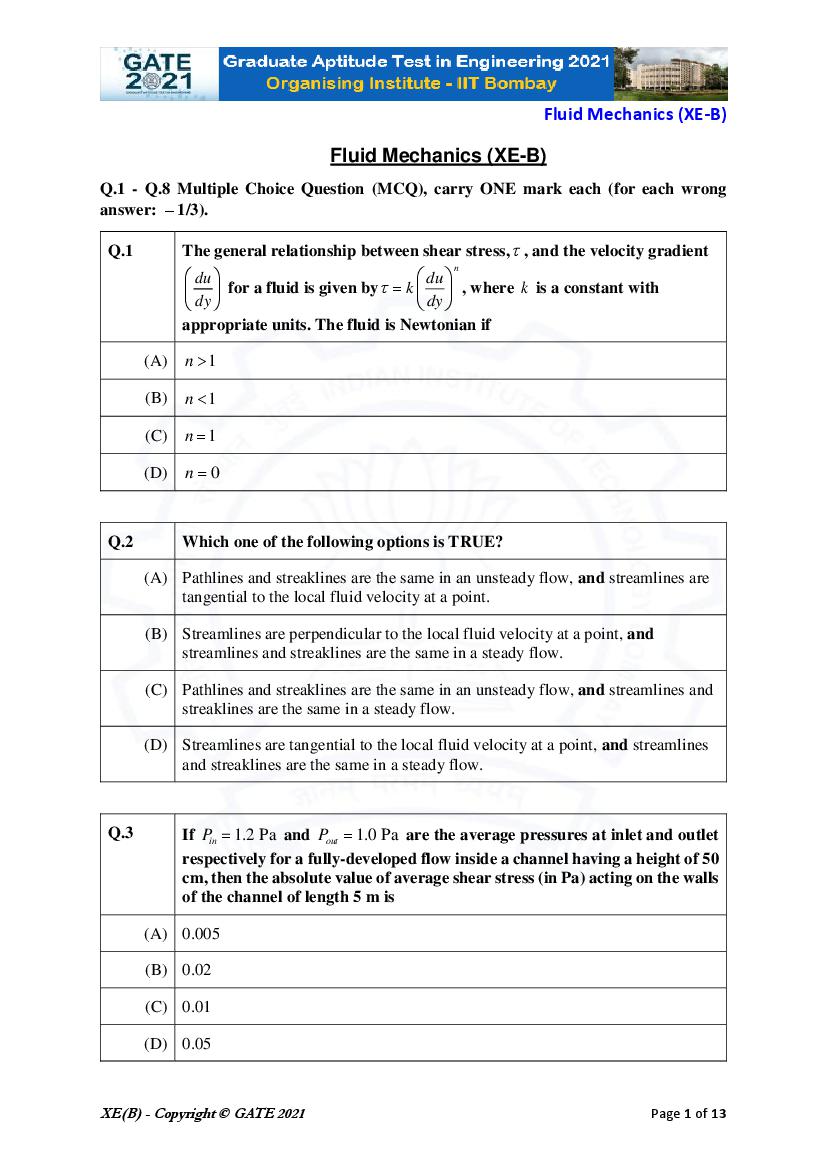
answer: – 1/3).
Q.1 The general relationship between shear stress, , and the velocity gradient
n
du du
for a fluid is given by = k , where k is a constant with
dy dy
appropriate units. The fluid is Newtonian if
(A) n 1
(B) n 1
(C) n =1
(D) n=0
Q.2 Which one of the following options is TRUE?
(A) Pathlines and streaklines are the same in an unsteady flow, and streamlines are
tangential to the local fluid velocity at a point.
(B) Streamlines are perpendicular to the local fluid velocity at a point, and
streamlines and streaklines are the same in a steady flow.
(C) Pathlines and streaklines are the same in an unsteady flow, and streamlines and
streaklines are the same in a steady flow.
(D) Streamlines are tangential to the local fluid velocity at a point, and streamlines
and streaklines are the same in a steady flow.
Q.3 If Pin = 1.2 Pa and Pout = 1.0 Pa are the average pressures at inlet and outlet
respectively for a fully-developed flow inside a channel having a height of 50
cm, then the absolute value of average shear stress (in Pa) acting on the walls
of the channel of length 5 m is
(A) 0.005
(B) 0.02
(C) 0.01
(D) 0.05
XE(B) - Copyright © GATE 2021 Page 1 of 13
Page 2
viscosity ) through a smooth pipe of diameter D and length L . The
average velocity of the flow is V . If the length of the pipe is doubled,
keeping V , D, , constant, the friction factor
(A) increases by two times
(B) remains the same
(C) decreases by two times
(D) increases by four times
Q.5 The absolute value of pressure difference between the inside and outside of
a spherical soap bubble of radius, R , and surface tension, , is:
(A) 2
R
(B)
R
(C)
2R
(D) 4
R
Q.6 Which one of the following statements is TRUE about the continuity
u v w
equation + + = 0 (where u, v, w are the velocity components along
x y z
the x, y, and z coordinates respectively):
(A) The equation is valid only for steady incompressible flows.
(B) The equation is valid for both steady and unsteady incompressible flows.
(C) The equation is valid only for steady compressible flows.
(D) The equation is valid only for unsteady compressible flows.
XE(B) - Copyright © GATE 2021 Page 2 of 13
Page 3
passage depends on the shape of the entry. The following figure shows
three different types of flow entry into a pipe. Which one of the following
relationships correctly represents the head loss associated with the three
different flow entries?
V V V
(KL)a (KL)b (KL)c
(a) (b) (c)
(A) ( KL )a ( KL )b ( KL )c
(B) ( KL )b ( KL )a ( KL )c
(C) ( KL )b ( KL )a = ( KL )c
(D) ( KL )b ( KL )a ( KL )c
XE(B) - Copyright © GATE 2021 Page 3 of 13
Page 4
of air occurs past any object. Two orientations of a finite flat plate are
shown in the figure. In Orientation-1, the plate is placed perpendicular to
the flow while in Orientation-2, the plate is placed parallel to the flow. If
the velocity (V) of air in both orientations is the same, which one of the
following options is TRUE?
Velocity, V Velocity, V
(Orientation-2)
(Orientation-1)
(A) Orientation-1 has higher form drag and lower friction drag and Orientation-2
has lower form drag and higher friction drag
(B) Orientation-1 has lower form drag and lower friction drag and Orientation-2
has higher form drag and higher friction drag
(C) Orientation-1 has lower form drag and higher friction drag and Orientation-2
has higher form drag and lower friction drag
(D) Orientation-1 has higher form drag and higher friction drag and Orientation-2
has lower form drag and lower friction drag
XE(B) - Copyright © GATE 2021 Page 4 of 13
Page 5
Q.9 A spherical ball is steadily supported against gravity by an upward air jet
as shown in the figure. Take acceleration due to gravity to be g = 10 m/s2.
The mass flow rate of air, reaching the ball, is 0.01 kg/s and the air reaches
the ball at an upward velocity of 3 m/s. Neglecting the buoyancy force, and
using the principle of integral momentum balance, the mass (in grams, up
to one decimal place) of the ball is ____.
XE(B) - Copyright © GATE 2021 Page 5 of 13
Page 6
answer: – 2/3).
Q. 10 The incompressible flow of air over a curved surface having possible flow
separation is schematically shown in the figure. Two zones P and Q are
indicated in the figure. Which one of the following combinations is TRUE
for zones P and Q?
(a) Acceleration of flow, (b) Deceleration of flow, (c) Adverse pressure
gradient, (d) Favorable pressure gradient, (e) No flow separation (f) Possible
flow separation.
(A) P: (a), (d), (e) and Q: (b), (c), (f)
(B) P: (a), (d), (f) and Q: (b), (d), (f)
(C) P: (a), (c), (f) and Q: (a), (d), (e)
(D) P: (a), (c), (e) and Q: (a), (d), (f)
XE(B) - Copyright © GATE 2021 Page 6 of 13
Page 7
is exposed to a crossflow (of velocity U ) of a viscous fluid (of viscosity
and density f ). Due to the crossflow, the string makes an angle of
inclination, , with the top surface as shown in the figure. The acceleration
due to gravity is denoted by g . For this flow, Reynolds number,
𝜌 𝑈∞ 𝐷
𝑹𝒆 = 𝑓 𝜇 ≪ 1and buoyancy force in the fluid is negligible compared to
viscous force. Assuming the string to be weightless and offering negligible
drag, the expression for is
(A) 1 D 2 s2 g
tan −1
18 U f
(B) 1 D2 f g
tan −1
18 U
(C) 2 D2 s g
sin −1
9 U
(D) 1 D2 s g
−1
tan
18 U
XE(B) - Copyright © GATE 2021 Page 7 of 13
Page 8
a Newtonian fluid is given by
V = u0 (1 − ay 2 ) i
Here, V is the velocity vector in m/s, i is the unit vector in the x-direction,
u 0 is a positive, real constant (in m/s), and a is a positive, real constant (in
m-2). The viscosity of the fluid is µ (in Pa-s). The absolute value of the
pressure gradient (in Pa/m) is
(A) a u0
(B) 2au0
(C) 3au0
(D) 4au0
XE(B) - Copyright © GATE 2021 Page 8 of 13
Page 9
marks).
In a laminar, incompressible, fully-developed pipe flow of a Newtonian fluid,
Q. 13
as shown in the figure, the velocity profile over a cross-section is given by
r2
u = U 1 − 2 , where U is a constant. The pipe length is L and the fluid
R
viscosity is µ. The power P required to sustain the flow is expressed as
P = c LU 2 , where c is a dimensionless constant. The value of the constant c
(up to one decimal place) is _________.
Q. 14 The two-dimensional velocity field V of a flow in a Cartesian coordinate
y2
system is given in dimensionless form by V = ( x − axy ) i + bxy − j .
2
2
Here, i and j are the unit vectors along the x and y directions respectively, a
and b are independent of x, y and time. If the flow is incompressible, then
the value of (a − b) , up to one decimal place, is ______.
XE(B) - Copyright © GATE 2021 Page 9 of 13
Page 10
above water of density 1000 kg/m3. Assuming hydrostatic conditions and
acceleration due to gravity g = 10 m/s2, the length L (in meters, up to one
decimal place) of water in the inclined tube is _____.
Q. 16 A two-dimensional Eulerian velocity field is given (in m/s) by
𝐕 = [(√5)𝑥] 𝐢 − [(√12)𝑦] 𝐣, where x and y are the coordinates (in meters)
in a Cartesian coordinate system. The magnitude of the acceleration (in
m/s2, up to one decimal place) of a fluid particle at 𝑥 = 1 m and 𝑦 = −1 m
is ______.
Q. 17 A large pump is to deliver oil at an average velocity (V ) of 1.5 m/s. The
pump has an impeller diameter ( D) of 40 cm and the pressure rise across
the pump is 400 kPa. To design this pump, a lab-scale model pump with an
impeller diameter of 4 cm is to be used with water as the fluid. The
viscosity ( ) of the oil is 100 times that of water, and the densities ( ) of
oil and water are identical. A complete geometric similarity is maintained
between the model and prototype. If the pressure rise is a function only of
V , D, and , the pressure rise (in kPa, up to one decimal place) across
the model pump is ______.
XE(B) - Copyright © GATE 2021 Page 10 of 13
Page 11
which is part of a larger piping system, as shown in the figure. The
volumetric flow rate of water is 0.1 m3/s. The gage pressure at the inlet is
500 kPa, while the exit is open to atmosphere. The x -component of the
force on the support is Fx . The absolute value of Fx (in kN, up to one
decimal place) is ___.
Q. 19 Air (of density 0.5 kg/m3) enters horizontally into a jet engine at a steady
speed of 200 m/s through an inlet area of 1.0 m2. Upon entering the engine,
the air passes through the combustion chamber and the exhaust gas exits
the jet engine horizontally at a constant speed of 700 m/s. The fuel mass
flow rate added in the combustion chamber is negligible compared to the
air mass flow rate. Also neglect the pressure difference between the inlet
air and the exhaust gas. The absolute value of the horizontal force (in kN,
up to one decimal place) on the jet engine is__________.
XE(B) - Copyright © GATE 2021 Page 11 of 13
Page 12
the figure. The flow is considered frictionless. Initially, the water level in
the tank was h1 = 2 m. The diameter of the tank is D = 1 m, while the
diameter of the jet is d = 10 cm, and the acceleration due to gravity is
g = 10 m/s 2 . The time taken (in seconds, up to one decimal place) for the
water level in the tank to come down to h2 = 1 m is _______.
Q. 21 Water discharges steadily from a large reservoir through a long pipeline, as
shown in the figure. The Darcy friction factor in the pipe is 0.02. The pipe
diameter is 20 cm and the discharge of water is 360 m3/h. Water level in the
reservoir is 10 m and acceleration due to gravity g = 10 m/s 2 . If minor
losses are negligible, the length L (in meters, up to one decimal place) of the
pipeline is ____ .
XE(B) - Copyright © GATE 2021 Page 12 of 13
Page 13
low pressure created at the venturi section (Section-1 in the figure), water
from a reservoir is drawn upward using a connecting pipe as shown in the
figure. Take acceleration due to gravity g = 10 m/s 2 . The flow rate
𝑄 = 0.1 m3/s, D1 = 8 cm , and D2 = 20 cm. The maximum height ( h , in
meters, up to one decimal place) of the venturi from the reservoir just
sufficient to raise the liquid upto Section-1 is ____________.
END OF THE QUESTION PAPER
XE(B) - Copyright © GATE 2021 Page 13 of 13
Document Details
| Board / Org | IIT |
| Exam | Graduate Aptitude Test in Engineering |
| Type | Question Paper |
| Pages | 13 |
| Language | english |
| Updated | 30 Apr 2026 |