Page 1
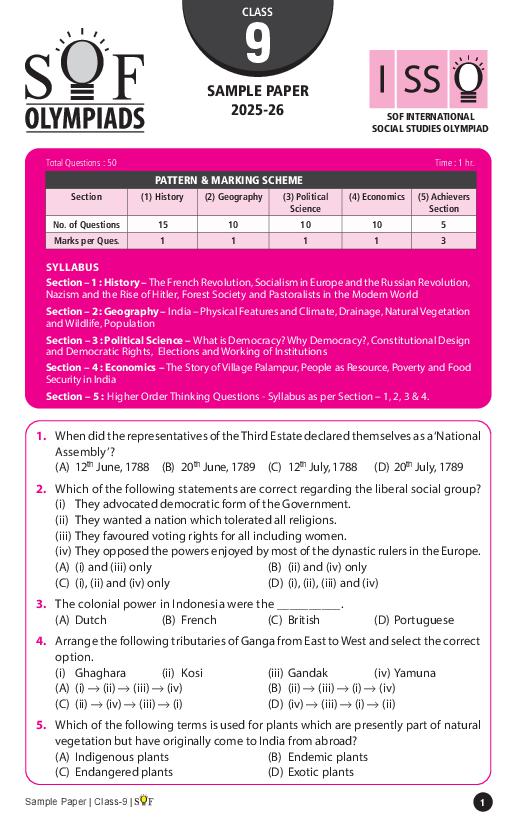
CLASS 9 SAMPLE PAPER 2025-26 SOF INTERNATIONAL SOCIAL STUDIES OLYMPIAD Total Questions : 50 Time : 1 hr. PATTERN & MARKING SCHEME Section (1) History (2) Geography (3) Political (4) Economics (5) Achievers Science Section No. of Questions 15 10 10 10 5 Marks per Ques. 1 1 1 1 3 SYLLABUS Section – 1 : History – The French Revolution, Socialism in Europe and the Russian Revolution, Nazism and the Rise of Hitler, Forest Society and Pastoralists in the Modern World Section – 2 : Geography – India – Physical Features and Climate, Drainage, Natural Vegetation and Wildlife, Population Section – 3 : Political Science – What is Democracy? Why Democracy?, Constitutional Design and Democratic Rights, Elections and Working of Institutions Section – 4 : Economics – The Story of Village Palampur, People as Resource, Poverty and Food Security in India Section – 5 : Higher Order Thinking Questions - Syllabus as per Section – 1, 2, 3 & 4. 1. When did the representatives of the Third Estate declared themselves as a ‘National Assembly’? (A) 12th June, 1788 (B) 20th June, 1789 (C) 12th July, 1788 (D) 20th July, 1789 2. Which of the following statements are correct regarding the liberal social group? (i) They advocated democratic form of the Government. (ii) They wanted a nation which tolerated all religions. (iii) They favoured voting rights for all including women. (iv) They opposed the powers enjoyed by most of the dynastic rulers in the Europe. (A) (i) and (iii) only (B) (ii) and (iv) only (C) (i), (ii) and (iv) only (D) (i), (ii), (iii) and (iv) 3. The colonial power in Indonesia were the __________. (A) Dutch (B) French (C) British (D) Portuguese 4. Arrange the following tributaries of Ganga from East to West and select the correct option. (i) Ghaghara� (ii) Kosi� (iii) Gandak� (iv) Yamuna (A) (i) → (ii) → (iii) → (iv) (B) (ii) → (iii) → (i) → (iv) (C) (ii) → (iv) → (iii) → (i) (D) (iv) → (iii) → (i) → (ii) 5. Which of the following terms is used for plants which are presently part of natural vegetation but have originally come to India from abroad? (A) Indigenous plants (B) Endemic plants (C) Endangered plants (D) Exotic plants Sample Paper | Class-9 | 1
Page 2
6. In August 2002, Pervez Musharraf issued a ‘Legal Framework Order’ that amended the Constitution of Pakistan. What could the President of Pakistan do according to this order? (A) Dismiss the national and provincial assemblies (B) Appoint the members of the national assembly (C) Amend the constitution on his own (D) Form councils to control military rulers 7. Which Fundamental Right mentions the provision that human trafficking is a punishable offence under the Constitution of India? (A) Right against Exploitation (B) Right to Freedom (C) Right to Equality (D) Right to Constitutional Remedies 8. X is an important poverty alleviation programme which was launched by Government of India in 1999. The aim of this programme is to assist poor families in rising above the poverty line by organising them into self-help groups by providing them bank credit and government subsidies. Identify X. (A) Pradhan Mantri Mudra Yojana (B) Swarnajayanti Gram Swarozgar Yojana (C) Rural Employment Generation Programme (D) Antyodya Anna Yojana ACHIEVERS SECTION 9. Which of the following statements regarding Maasai are correct? (i) The Maasai lost about 60 percent of their pre-colonial lands during the late nineteenth century. (ii) They were confined to an arid zone with uncertain rainfall and poor pastures. (iii) The word ‘Maasai’ is derived from the word ‘Maa’ which means ‘my land’. (iv) In 1865, Maasailand was cut into half with an international boundary between British Kenya and Russian Tanganyika. (A) (i) and (iv) only (B) (i) and (ii) only (C) (ii), (iii) and (iv) only (D) (i), (ii), (iii) and (iv) 10. Match column I with column II and select correct option from the given codes. Column I Column II (River) (Place of Origin) (i) Kaveri (a) Mahabaleshwar (ii) Tapi (b) Satpura ranges (iii) Krishna (c) Brahmagiri range (iv) Mahanadi (d) Highlands of Chhattisgarh (i) (ii) (iii) (iv) (A) (d) (c) (b) (a) (B) (c) (a) (b) (d) (C) (c) (b) (a) (d) (D) (a) (b) (c) (d) ANSWER KEY 1. (B) 2. (B) 3. (A) 4. (B) 5. (D) 6. (A) 7. (A) 8. (B) 9. (B) 10. (C) 2 | Sample Paper | Class-9