UGC NET 2021 Question Paper Folk Literature Shift 1
Finished viewing? Save it for later —
Download UGC NET 2021 Question Paper Folk Literature Shift 1 (PDF · 59 pages)About UGC NET 2021 Question Paper Folk Literature Shift 1
UGC NET 2021 Question Paper Folk Literature Shift 1 is available here for free download. Published by NTA for UGC NET, this question paper can be viewed online or downloaded as a PDF (59 pages). Candidates preparing for UGC NET can use UGC NET 2021 Question Paper Folk Literature Shift 1 to understand the exam pattern, the type of questions asked, and the overall difficulty level.
Frequently Asked Questions
How can I download UGC NET 2021 Question Paper Folk Literature Shift 1?
Open this page and click the Download button to save UGC NET 2021 Question Paper Folk Literature Shift 1 as a PDF. It is completely free on AglaSem Docs.
Is UGC NET 2021 Question Paper Folk Literature Shift 1 free to download?
Yes. UGC NET 2021 Question Paper Folk Literature Shift 1 can be viewed online and downloaded as a PDF free of cost on AglaSem Docs.
How many pages does UGC NET 2021 Question Paper Folk Literature Shift 1 have?
UGC NET 2021 Question Paper Folk Literature Shift 1 contains 59 pages, which you can read online or download together as a single PDF.
Where can I find more UGC NET study material?
You can find more UGC NET question papers, sample papers, syllabus, and answer keys on AglaSem Docs.
UGC NET 2021 Question Paper Folk Literature Shift 1 – Text
Read the full text of this question paper below — useful to quickly search, copy and reference the content online without downloading the PDF.
📄 View text version (59 pages)
Page 1
Topic:‐ GP_20NOV_A_SH2
1)
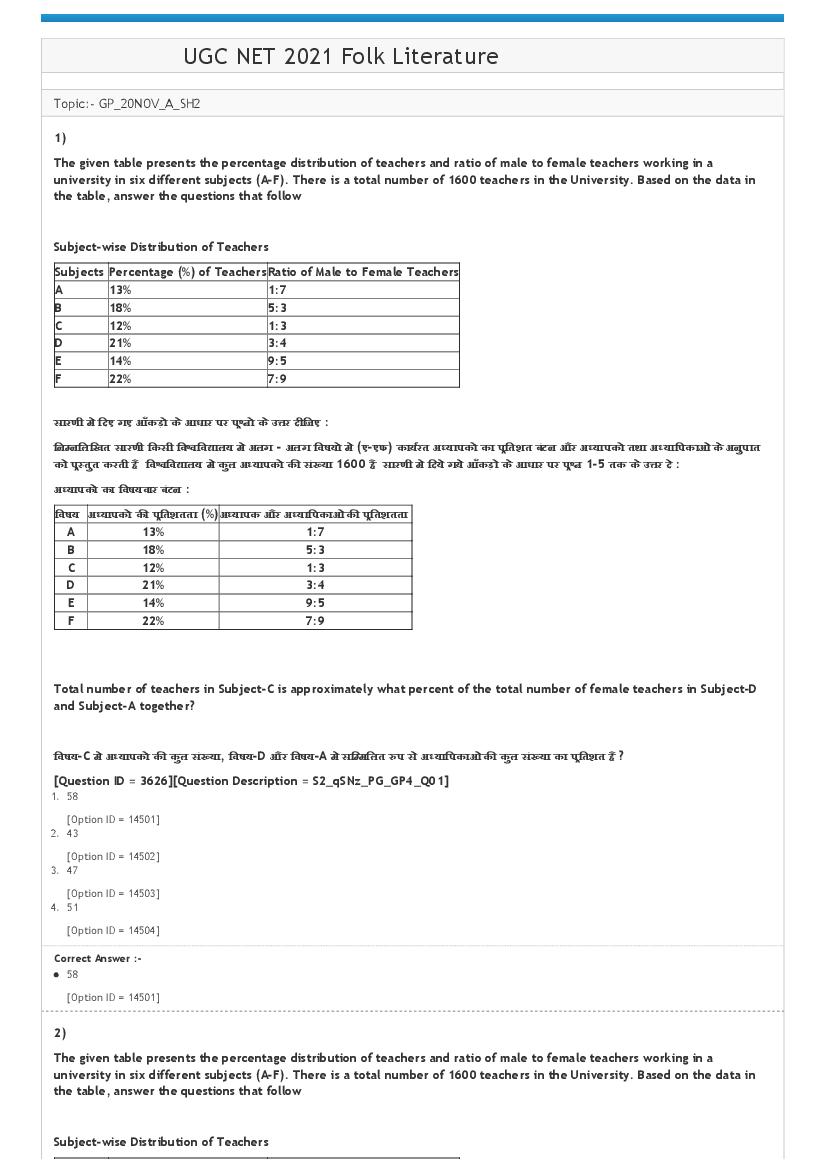
The given table presents the percentage distribution of teachers and ratio of male to female teachers working in a
university in six different subjects (A‐F). There is a total number of 1600 teachers in the University. Based on the data in
the table, answer the questions that follow
Subject‐wise Distribution of Teachers
Subjects Percentage (%) of TeachersRatio of Male to Female Teachers
A 13% 1:7
B 18% 5:3
C 12% 1:3
D 21% 3:4
E 14% 9:5
F 22% 7:9
सारणी म िदए गए आँकड़ के आधार पर प के उ र दीिजए :
िन निलिखत सारणी िकसी िव िव ालय म अलग ‐ अलग िवषय म (ए‐एफ) कायरत अ यापक का पितशत बंटन और अ यापक तथा अ यािपकाओं के अनुपात
को प तुत करती है िव िव ालय म कुल अ यापक क सं या 1600 है सारणी म िदये गये आँकड़ो के आधार पर प 1‐5 तक के उ र द :
अ यापक का िवषयवार बंटन :
िवषय अ यापक क पितशतता (%)अ यापक और अ यािपकाओं क पितशतता
A 13% 1:7
B 18% 5:3
C 12% 1:3
D 21% 3:4
E 14% 9:5
F 22% 7:9
Total number of teachers in Subject‐C is approximately what percent of the total number of female teachers in Subject‐D
and Subject‐A together?
िवषय‐C म अ यापक क कुल सं या, िवषय‐D और िवषय‐A म सि मिलत प से अ यािपकाओं क कुल सं या का पितशत है ?
[Question ID = 3626][Question Description = S2_qSNz_PG_GP4_Q01]
1. 58
[Option ID = 14501]
2. 43
[Option ID = 14502]
3. 47
[Option ID = 14503]
4. 51
[Option ID = 14504]
58
[Option ID = 14501]
2)
The given table presents the percentage distribution of teachers and ratio of male to female teachers working in a
university in six different subjects (A‐F). There is a total number of 1600 teachers in the University. Based on the data in
the table, answer the questions that follow
Subject‐wise Distribution of Teachers
Page 2
A 13% 1:7
B 18% 5:3
C 12% 1:3
D 21% 3:4
E 14% 9:5
F 22% 7:9
सारणी म िदए गए आँकड़ के आधार पर प के उ र दीिजए :
िन निलिखत सारणी िकसी िव िव ालय म अलग ‐ अलग िवषय म (ए‐एफ) कायरत अ यापक का पितशत बंटन और अ यापक तथा अ यािपकाओं के अनुपात
को प तुत करती है िव िव ालय म कुल अ यापक क सं या 1600 है सारणी म िदये गये आँकड़ो के आधार पर प 1‐5 तक के उ र द :
अ यापक का िवषयवार बंटन :
िवषय अ यापक क पितशतता (%)अ यापक और अ यािपकाओं क पितशतता
A 13% 1:7
B 18% 5:3
C 12% 1:3
D 21% 3:4
E 14% 9:5
F 22% 7:9
What is the difference between the total number of teachers in Subject‐F and the total number of male teachers in
Subject‐A and Subject‐B together?
िवषय‐F म कुल अ यापक क सं या और िवषय‐A तथा िवषय‐B म सि मिलत प से अ यापक क सं या के बीच िकतना अंतर है ?
[Question ID = 3627][Question Description = S2_qSNz_PG_GP4_Q02]
1. 192
[Option ID = 14505]
2. 182
[Option ID = 14506]
3. 146
[Option ID = 14507]
4. 136
[Option ID = 14508]
192
[Option ID = 14505]
3)
The given table presents the percentage distribution of teachers and ratio of male to female teachers working in a
university in six different subjects (A‐F). There is a total number of 1600 teachers in the University. Based on the data in
the table, answer the questions that follow
Subject‐wise Distribution of Teachers
Subjects Percentage (%) of TeachersRatio of Male to Female Teachers
A 13% 1:7
B 18% 5:3
C 12% 1:3
D 21% 3:4
E 14% 9:5
F 22% 7:9
सारणी म िदए गए आँकड़ के आधार पर प के उ र दीिजए :
िन निलिखत सारणी िकसी िव िव ालय म अलग ‐ अलग िवषय म (ए‐एफ) कायरत अ यापक का पितशत बंटन और अ यापक तथा अ यािपकाओं के अनुपात
को प तुत करती है िव िव ालय म कुल अ यापक क सं या 1600 है सारणी म िदये गये आँकड़ो के आधार पर प 1‐5 तक के उ र द :
Page 3
िवषय अ यापक क पितशतता (%)अ यापक और अ यािपकाओं क पितशतता
A 13% 1:7
B 18% 5:3
C 12% 1:3
D 21% 3:4
E 14% 9:5
F 22% 7:9
What is the difference between the number of female teachers in Subject‐F and the number of male teachers in Subject‐
C?
िवषय‐F म अ यािपकाओं क सं या और िवषय‐C म अ यापक क सं या के बीच िकतना अंतर है ?
[Question ID = 3628][Question Description = S2_qSNz_PG_GP4_Q03]
1. 156
[Option ID = 14509]
2. 160
[Option ID = 14510]
3. 150
[Option ID = 14511]
4. 153
[Option ID = 14512]
156
[Option ID = 14509]
4)
The given table presents the percentage distribution of teachers and ratio of male to female teachers working in a
university in six different subjects (A‐F). There is a total number of 1600 teachers in the University. Based on the data in
the table, answer the questions that follow
Subject‐wise Distribution of Teachers
Subjects Percentage (%) of TeachersRatio of Male to Female Teachers
A 13% 1:7
B 18% 5:3
C 12% 1:3
D 21% 3:4
E 14% 9:5
F 22% 7:9
सारणी म िदए गए आँकड़ के आधार पर प के उ र दीिजए :
िन निलिखत सारणी िकसी िव िव ालय म अलग ‐ अलग िवषय म (ए‐एफ) कायरत अ यापक का पितशत बंटन और अ यापक तथा अ यािपकाओं के अनुपात
को प तुत करती है िव िव ालय म कुल अ यापक क सं या 1600 है सारणी म िदये गये आँकड़ो के आधार पर प 1‐5 तक के उ र द :
अ यापक का िवषयवार बंटन :
िवषय अ यापक क पितशतता (%)अ यापक और अ यािपकाओं क पितशतता
A 13% 1:7
B 18% 5:3
C 12% 1:3
D 21% 3:4
E 14% 9:5
F 22% 7:9
What is the total number of male teachers in the University?
Page 4
[Question ID = 3629][Question Description = S2_qSNz_PG_GP4_Q04]
1. 696
[Option ID = 14513]
2. 702
[Option ID = 14514]
3. 712
[Option ID = 14515]
4. 668
[Option ID = 14516]
696
[Option ID = 14513]
5)
The given table presents the percentage distribution of teachers and ratio of male to female teachers working in a
university in six different subjects (A‐F). There is a total number of 1600 teachers in the University. Based on the data in
the table, answer the questions that follow
Subject‐wise Distribution of Teachers
Subjects Percentage (%) of TeachersRatio of Male to Female Teachers
A 13% 1:7
B 18% 5:3
C 12% 1:3
D 21% 3:4
E 14% 9:5
F 22% 7:9
सारणी म िदए गए आँकड़ के आधार पर प के उ र दीिजए :
िन निलिखत सारणी िकसी िव िव ालय म अलग ‐ अलग िवषय म (ए‐एफ) कायरत अ यापक का पितशत बंटन और अ यापक तथा अ यािपकाओं के अनुपात
को प तुत करती है िव िव ालय म कुल अ यापक क सं या 1600 है सारणी म िदये गये आँकड़ो के आधार पर प 1‐5 तक के उ र द :
अ यापक का िवषयवार बंटन :
िवषय अ यापक क पितशतता (%)अ यापक और अ यािपकाओं क पितशतता
A 13% 1:7
B 18% 5:3
C 12% 1:3
D 21% 3:4
E 14% 9:5
F 22% 7:9
Which is the ratio of the number of female teachers in Subject‐E to the number of male teachers in Subject‐D?
िवषय‐E म अ यािपकाओं क सं या के पितशत का अनुपात िवषय‐D म अ यापक क सं या का िकतना है ?
[Question ID = 3630][Question Description = S2_qSNz_PG_GP4_Q05]
1. 5 : 9
[Option ID = 14517]
2. 2 : 9
[Option ID = 14518]
3. 3 : 7
[Option ID = 14519]
4. 5 : 3
[Option ID = 14520]
5:9
[Option ID = 14517]
Page 5
1) The variability or flexibility of delivery during the presentation of a lesson by a teacher is called as
एक अ यापक ारा पाठ के प तुतीकरण के दौरान प तुित के प रवतनशीलता अथवा न यता को िकस प म जाना जाता है ?
[Question ID = 3631][Question Description = S2_qSNz_PG_GP4_Q06]
1. Thinking curriculum/िचंतन पा यकम [Option ID = 14521]
2. Instructional variety/नैिमि क िविवधता [Option ID = 14522]
3. Comprehension/समझ [Option ID = 14523]
4. Procedural knowledge/पिकया मक ान [Option ID = 14524]
Thinking curriculum/िचंतन पा यकम [Option ID = 14521]
2) Ministry of Education, Government of India's, SWAYAM platform for offering MOOCs has how many quadrants for
designing courses?
भारत सरकार के िश ा मंतालय ारा संचािलत एम.ओ.ओ. सी. (MOOCs) पदान करने हेतु वयं (SWAYAM) मंच के कोस को बनाने (िडजाइिनंग) के िलए
िकतने चतुथक है ?
[Question ID = 3632][Question Description = S2_qSNz_PG_GP4_Q07]
1. 2 Quadrants/2 चतुथक [Option ID = 14525]
2. 4 Quadrants/4 चतुथक [Option ID = 14526]
3. 6 Quadrants/6 चतुथक [Option ID = 14527]
4. 8 Quadrants/8 चतुथक [Option ID = 14528]
2 Quadrants/2 चतुथक [Option ID = 14525]
3) Given below are two statements
Statement I: All components of working memory are in place by the age of 4 in a child as a development stage
Statement II: If a child does not continue to pay attention to information, the activation level weakens and finally drops so
low that the information cannot be reactivated and it disappears altogether
In light of the above statements, choose the most appropriate answer from the options given below
नीचे दो कथन िदए गए ह :
कथन ‐ I : िवकास क अव था के प म 4 वष क उम के बालक म िकयाशील मृित के सभी घटक अपने थान पर होते ह
कथन ‐ II : सूचनाओं के पित यिद एक बालक लगातार यान नह देता, तो उ पेरण तर कमजोर होता है और अ त म इतना िगर जाता है िक सूचना को पुनः
उ पे रत नह िकया जा सकता और यह पूण प से िवलु हो जाता है
उपरो कथन के आलोक म, नीचे िदए गए िवक प म से सही उ र का चयन क िजए :
[Question ID = 3633][Question Description = S2_qSNz_PG_GP4_Q08]
1. Both Statement I and Statement II are correct/कथन I और II दोन सही ह [Option ID = 14529]
2. Both Statement I and Statement II are incorrect/कथन I और II दोन गलत ह [Option ID = 14530]
3. Statement I is correct but Statement II is incorrect/कथन I सही है, िक तु कथन II गलत है [Option ID = 14531]
4. Statement I is incorrect but Statement II is correct/कथन I गलत है, िक तु कथन II सही है [Option ID = 14532]
Both Statement I and Statement II are correct/कथन I और II दोन सही ह [Option ID = 14529]
4) Match List I with List II
Neural system of BrainType of Memory
A. Conscious I. Implicit Memory
B. Unconscious II. Procedural Memory
C. Motor skills III. Explicit Memory
D. Own experiences IV. Episodic Memory
Choose the correct answer from the options given below:
सूची ‐I को सूची ‐II से सुमेिलत क िजए :
सूची ‐I सूची ‐II
(मि त क का यूरॉन संबंधी तंत) ( मृित पकार)
A. चेतन I. अंतिनिहत मृित
B. अचेतन II. कायिविधक मृित
Page 6
D. आ मानुभव IV. सांयोिगक मृित
नीचे िदए गए िवक प म से सही उ र चुिनए :
[Question ID = 3634][Question Description = S2_qSNz_PG_GP4_Q09]
1. A ‐ IV, B ‐ III, C ‐ I, D ‐ II [Option ID = 14533]
2. A ‐ III, B ‐ I, C ‐ II, D ‐ IV [Option ID = 14534]
3. A ‐ I, B ‐ II, C ‐ IV, D ‐ III [Option ID = 14535]
4. A ‐ II, B ‐ IV, C ‐ III, D ‐ I [Option ID = 14536]
A ‐ IV, B ‐ III, C ‐ I, D ‐ II [Option ID = 14533]
5) Cognitive domain for behavioural objectives comprises which of these objectives?
A. Evaluation
B. Valuing
C. Comprehension
D. Precision
E. Knowledge
Choose the correct answer from the options given below:
यवहारवादी उ े य के िलए सं ाना मक ेत म इन उ े य को समािव िकया जाता है :
A. मू यांकन
B. मू य िनधारण करना
C. समझ
D. यथाथता
E. ान
नीचे िदए गए िवक प म से सही उ र चुन :
[Question ID = 3635][Question Description = S2_qSNz_PG_GP4_Q10]
1. A, B and C only/केवल A, B, C
[Option ID = 14537]
2. B, C and D only/केवल B, C, D
[Option ID = 14538]
3. A, C and E only/केवल A, C, E
[Option ID = 14539]
4. C, D and E only/केवल C, D, E
[Option ID = 14540]
A, B and C only/केवल A, B, C
[Option ID = 14537]
6) During research when we avoid speculative and metaphysical approaches and instead concentrate on studying
observable facts, it is called:
शोध के दौरान जब हम मीमांसा मक और ताि वक ि कोण से बचते ह और पे णीय त य पर यान केि दत करते ह तो इसे िन निलिखत म से या कहा जाता है
:
[Question ID = 3636][Question Description = S2_qSNz_PG_GP4_Q11]
1. Feminism/नारीवाद [Option ID = 14541]
2. Ethnomethodology/नृजाितिव ान [Option ID = 14542]
3. Constructionism/संरचना मकता [Option ID = 14543]
4. Positivism/िन या मकता [Option ID = 14544]
Feminism/नारीवाद [Option ID = 14541]
7) In research, the combination of different methods, study groups, local and temporal settings, and different theoretical
perspectives in dealing with a phenomenon is called:
Page 7
[Question ID = 3637][Question Description = S2_qSNz_PG_GP4_Q12]
1. Triangulation/ितभुजन [Option ID = 14545]
2. Content analysis/िवषय सामगी िव ेषण [Option ID = 14546]
3. Corpus/कापस [Option ID = 14547]
4. Mediation/म य थता [Option ID = 14548]
Triangulation/ितभुजन [Option ID = 14545]
8) Identify the CORRECT sequence of steps for the centroid method of factor analysis
A. Work out the sum of coefficients in each column of the correlation matrix
B. Compute a matrix of correlation
C. Obtain the Sum (T) of columns
D. Divide the sum of each column by the square root of (T)
Choose the correct answer from the options given below
फै टर िव े ण क के दक प ित के िलए कदम के सहीकम क पहचान कर :
ष
A. सहसंबंध मैिट स के प येक कालम म गुणांक का योगफल िनकाल
B. सहसंबंध के मैिट स क गणना कर
C. कालम का योगफल (T) पा कर
D. प येक कालम के योगफल को (T) के वगमूल से िवभािजत कर
नीचे िदए गए िवक प म से सही उ र चुन :
[Question ID = 3638][Question Description = S2_qSNz_PG_GP4_Q13]
1. A, C, D, B [Option ID = 14549]
2. C, B, A, D [Option ID = 14550]
3. B, A, C, D [Option ID = 14551]
4. B, C, A, D [Option ID = 14552]
A, C, D, B [Option ID = 14549]
9) Match List I with List II for scale construction techniques
List I List II
A.
I. Number of individual items are developed into
Arbitrary
a test which is given to a group of respondents
approach
B.
Consensus II. Scale is developed on an ad‐hoc basis
approach
C. Item III. Chosen on the basis of their conforming to
Analysis some ranking of items with ascending and
approach descending discriminating power
D.
IV. Panel of Judges evaluate the items chosen
Cumulative
for inclusion in the instrument
scales
Choose the correct answer from the options given below:
सूची ‐I को सूची ‐II से सुमेिलत क िजए :
सूची ‐I सूची ‐II
A. या ि छक I. अलग‐अलग मद क सं या को एक पाठ म िवकिसत िकया जाता है
ि कोण िजसे उ रदाताओं के समूह को िदया जाता है
B. सवस मत
II. तदथ आधार पर पैमाने को िवकिसत िकया जाता है
ि कोण
Page 8
ष सिहत कुछ मद क शेणीकरण
ि कोण क अनु पता के आधार पर चयिनत
D. संचयी IV. िलखत म शािमल करने के िलए चुनी गई मद का मू यांकन करने के
पैमाना िलए िनणायक का पैनल
नीचे िदए गए िवक प म से सही उ र चुिनए :
[Question ID = 3639][Question Description = S2_qSNz_PG_GP4_Q14]
1. A ‐ III, B ‐ II, C ‐ I, D ‐ IV
[Option ID = 14553]
2. A ‐ II, B ‐ IV, C ‐ I, D ‐ III
[Option ID = 14554]
3. A ‐ I, B ‐ III, C ‐ II, D ‐ IV
[Option ID = 14555]
4. A ‐ IV, B ‐ I, C ‐ III, D ‐ II
[Option ID = 14556]
A ‐ III, B ‐ II, C ‐ I, D ‐ IV
[Option ID = 14553]
10) Given below are two statements
Statement I: The base of the binary number system is 2.
Statement II: Binary addition is just like decimal addition except that the rules are much simpler.
In light of the above statements, choose the correct answer from the options given below
नीचे दो कथन िदए गए ह :
कथन ‐ I : ि आधारी सं या पणाली का आधार 2 है
कथन ‐ II : ि आधारी योग, दशमलव जोड़ के समान ही होता है िसवाय इसके िक िनयम काफ सरल ह
उपरो कथन के आलोक म, नीचे िदए गए िवक प म से सही उ र का चयन क िजए :
[Question ID = 3640][Question Description = S2_qSNz_PG_GP4_Q15]
1. Both Statement I and Statement II are true/कथन I और II दोन स य ह [Option ID = 14557]
2. Both Statement I and Statement II are false/कथन I और II दोन अस य ह [Option ID = 14558]
3. Statement I is true but Statement II is false/कथन I स य है , िक तु कथन II अस य है [Option ID = 14559]
4. Statement I is false but Statement II is true/कथन I अस य है , िक तु कथन II स य है [Option ID = 14560]
Both Statement I and Statement II are true/कथन I और II दोन स य ह [Option ID = 14557]
11) More and more informal exchanges within a group to resolve conflicts is an example of
टकराव का समाधान करने के िलए एक समूह के भीतर अिधक से अिधक अनौपचा रक आदान‐पदान उदाहरण है ‐
[Question ID = 3641][Question Description = S2_qSNz_PG_GP4_Q16]
1. Vertical communication/उ वाधर संपषे ण का [Option ID = 14561]
2. Horizontal communication/ िै तज संपष े ण का [Option ID = 14562]
3. Risk communication/जोिखम संपष े ण का [Option ID = 14563]
4. Personal communication/वैयि क संपष े ण का [Option ID = 14564]
Vertical communication/उ वाधर संपष
े ण का [Option ID = 14561]
12) Which of the following are identified as verbal communication skills?
A. Use of aggressive language
B. Assertiveness
C. Opening feedback channels
D. Taking credit for oneself
E. Use of affirmative words
Choose the correct answer from the options given below:
Page 9
A. आकामक भाषा का पयोग
B. आगिहता
C. फ डबैक के चैनल का पावधान
D. वयं को शेय देना
E. वीकारा मक श द का पयोग
नीचे िदए गए िवक प म से सही उ र चुन :
[Question ID = 3642][Question Description = S2_qSNz_PG_GP4_Q17]
1. A, B and C only/केवल A, B और C [Option ID = 14565]
2. B, C and D only/केवल B, C और D [Option ID = 14566]
3. C, D and E only/केवल C, D और E [Option ID = 14567]
4. B, C and E only/केवल B, C और E [Option ID = 14568]
A, B and C only/केवल A, B और C [Option ID = 14565]
13) Given below are two statements
Statement I: Body language is the basis of deceptive communication.
Statement II: Non‐verbal cues have their own shared meanings.
In light of the above statements, choose the correct answer from the options given below
नीचे दो कथन िदए गए ह :
कथन ‐ I : सांकिे तक भाषा, भामक भाषा का आधार होती है
कथन ‐ II : गैर‐वािचक संकेत का अपना साझा अथ होता है
उपरो कथन के आलोक म, नीचे िदए गए िवक प म से सही उ र का चयन क िजए :
[Question ID = 3643][Question Description = S2_qSNz_PG_GP4_Q18]
1. Both Statement I and Statement II are true/कथन I और II दोन स य ह [Option ID = 14569]
2. Both Statement I and Statement II are false/कथन I और II दोन अस य ह [Option ID = 14570]
3. Statement I is true but Statement II is false/कथन I स य है , िक तु कथन II अस य है [Option ID = 14571]
4. Statement I is false but Statement II is true/कथन I अस य है , िक तु कथन II स य है [Option ID = 14572]
Both Statement I and Statement II are true/कथन I और II दोन स य ह [Option ID = 14569]
14) Identify the CORRECT sequence of categories of grapevine communication
A. Cluster chain
B. Probability chain
C. Gossip chain
D. Single strand chain
Choose the correct answer from the options given below
जनपवाद संपेषण क शेिणय के सही कम क पहचान कर :
A. समूह शख
ंृ ला
B. संभा यता शख
ंृ ला
C. गपशप शख
ंृ ला
D. एकल टांड शख
ंृ ला
नीचे िदए गए िवक प म से सही उ र चुन :
[Question ID = 3644][Question Description = S2_qSNz_PG_GP4_Q19]
1. A, B, C, D [Option ID = 14573]
2. B, C, D, A [Option ID = 14574]
3. D, C, B, A [Option ID = 14575]
4. C, D, A, B [Option ID = 14576]
A, B, C, D [Option ID = 14573]
Page 10
List I List II
Categories of communication Features
A. Lateral I. Touch communication
B. Haptics II. Between equals
C. Semantics III. Interpretation of signs
D. Semiotics IV. Concerned with meanings
Choose the correct answer from the options given below:
सूची ‐I को सूची ‐II से सुमेिलत क िजए :
सूची ‐I सूची ‐II
(संपेषण शेिणयाँ) (िवशेषताएँ)
A. पाि क I. संपेषण पश
B. पश िव ान II. समक के बीच संपेषण
C. अथपूरक III. संकेत क या या
D. सांकिे तक IV. अथ से संबंिधत
नीचे िदए गए िवक प म से सही उ र चुिनए :
[Question ID = 3645][Question Description = S2_qSNz_PG_GP4_Q20]
1. A ‐ II, B ‐ I, C ‐ IV, D ‐ III [Option ID = 14577]
2. A ‐ III, B ‐ II, C ‐ I, D ‐ IV [Option ID = 14578]
3. A ‐ IV, B ‐ III, C ‐ II, D ‐ I [Option ID = 14579]
4. A ‐ I, B ‐ IV, C ‐ III, D ‐ II [Option ID = 14580]
A ‐ II, B ‐ I, C ‐ IV, D ‐ III [Option ID = 14577]
16) What comes next in the following sequence?
8, 6, 4.5, 3.5, ___
8, 6, 4.5, 3.5 के अनुकम म अगला कौन‐सा अंक होगा ?
[Question ID = 3646][Question Description = S2_qSNz_PG_GP4_Q21]
1. 1/1 [Option ID = 14581]
2. 2/2 [Option ID = 14582]
3. 2.5/2.5 [Option ID = 14583]
4. 3/3 [Option ID = 14584]
1/1 [Option ID = 14581]
17) X has one and a quarter times as many as Y, and Z has one and a quarter times as many as X. Altogether, they have 61.
How many do Z, Y and X have, respectively?
X के पास Y का सवा गुना है और Z के पास X का सवा गुना है ये सभी के पास सि मिलत प से 61 ह Z, Y और X के पास कमशः िकतने ह ?
[Question ID = 3647][Question Description = S2_qSNz_PG_GP4_Q22]
1. 25, 16, 20/25, 16, 20 [Option ID = 14585]
2. 20, 16, 12/20, 16, 12 [Option ID = 14586]
3. 25, 20, 16/25, 20, 16 [Option ID = 14587]
4. 16, 20, 25/16, 20, 25 [Option ID = 14588]
25, 16, 20/25, 16, 20 [Option ID = 14585]
18) Showing the man in a photo, Kavita said, "He is the brother of my uncle's daughter".
How is the man realted to Kavita?
एक फोटो म एक यि को िदखाते हए किवता ने कहा, वह मेरे चाचा क बेटी का भाई है उस यि से किवता का या र ता है ?
[Question ID = 3648][Question Description = S2_qSNz_PG_GP4_Q23]
1. Nephew/भतीजा [Option ID = 14589]
2. Cousin/चचेरा भाई (किजन) [Option ID = 14590]
3. Uncle/चाचा [Option ID = 14591]
4. Son/पुत [Option ID = 14592]
Nephew/भतीजा [Option ID = 14589]
Page 11
Statement I: In one minute, the minute hand of a clock gains 5° over the hour hand.
Statement II: If both the minute and hour hands start moving together from the same position, both the hands will coincide
after 64 minutes.
In light of the above statements, choose the correct answer from the options given below
नीचे दो कथन िदए गए ह :
कथन ‐ I : एक िमनट म िकसी दीवार घडी क िमनट क सुई, घंटे क सुई से 5° आगे बढ़ जाती है
कथन ‐ II : यिद िमनट और घंटे क सुइयाँ एक ही ि थित म आगे बढ़ना शु करती ह तो दोन सुइयाँ 64 िमनट बाद एक, दूसरे से िमलगी
उपरो कथन के आलोक म, नीचे िदए गए िवक प म से सही उ र का चयन क िजए :
[Question ID = 3649][Question Description = S2_qSNz_PG_GP4_Q24]
1. Both Statement I and Statement II are true/कथन I और II दोन स य ह [Option ID = 14593]
2. Both Statement I and Statement II are false/कथन I और II दोन अस य ह [Option ID = 14594]
3. Statement I is true but Statement II is false/कथन I स य है , िक तु कथन II अस य है [Option ID = 14595]
4. Statement I is false but Statement II is true/कथन I अस य है , िक तु कथन II स य है [Option ID = 14596]
Both Statement I and Statement II are true/कथन I और II दोन स य ह [Option ID = 14593]
20)
[Question ID = 3650][Question Description = S2_qSNz_PG_GP4_Q25]
1. A and B only/केवल A और B [Option ID = 14597]
2. B and C only/केवल B और C [Option ID = 14598]
3. A and C only/केवल A और C [Option ID = 14599]
4. A only/केवल A [Option ID = 14600]
A and B only/केवल A और B [Option ID = 14597]
21) In the context of uses of language, which of the following is the fallacy that pertains to the relationship between a
person's beliefs and his circumstances?
िन निलिखत म से कौन‐सा तक दोष है जो यि के िव ास और प रि थितय के बीच संबंध को य करता है
[Question ID = 3651][Question Description = S2_qSNz_PG_GP4_Q26]
1. Argumentum and Baculum (force)/आगुमटम एंड बैकल
ु म (शि ) [Option ID = 14601]
2. Argumentum ad Hominem (circumstantial)/आगुमटम एंड होिमनेम (प रि थितज य) [Option ID = 14602]
3. Argumentum ad lgnorantiam (ignorance)/आगुमटम एंड इ नोरिटयन (अ ानता) [Option ID = 14603]
4. Argumentum ad Verecundiam (authority)/आगुमटम एंडवेरक
े िंु डयन (पािधकार) [Option ID = 14604]
Argumentum and Baculum (force)/आगुमटम एंड बैकल
ु म (शि ) [Option ID = 14601]
22) If 'Some members are not voters' is false in a square of the opposition of proposition, which of the following code can
Page 12
A. 'All members are voters' is false
B. 'Some members are voters' is true
C. 'All members are voters' is true
D. 'No members are voters' is true
Choose the correct answer from the options given below:
तक वा य के िवरोधी वग म यिद "कुछ सद य मतदाता नह ह" अस य है, तो िन निलिखत म से िकस कूट को सही माना जा सकता है
A. "सभी सद य मतदाता ह" अस य ह
B. "कुछ सद य मतदाता ह" स य है
C. "सभी सद य मतदाता है" स य है
D. "कोई सद य मतदाता नह ह" स य है
नीचे िदए गए िवक प म से सही उ र चुन :
[Question ID = 3652][Question Description = S2_qSNz_PG_GP4_Q27]
1. A and D only/केवल A और D [Option ID = 14605]
2. A and B only/केवल A और B [Option ID = 14606]
3. B and C only/केवल B और C [Option ID = 14607]
4. C and D only/केवल C और D [Option ID = 14608]
A and D only/केवल A और D [Option ID = 14605]
23) Which of the following codes correctly represents the figure and mood of the argument?
All businessmen are self‐confident
No self‐confident men are religious
Therefore, No religious men are businessmen
Choose the correct answer from the options given below
िन निलिखत कौन‐सा कूट तकवा य के आकार और पकार को सही प म प तुत करता है :
सभी यापारी आ म‐िव ासी होते है
आ म‐िव ास रिहत कोई भी यि धािमक नह होता
इसिलए कोई भी धािमक यि यापारी नह होता
[Question ID = 3653][Question Description = S2_qSNz_PG_GP4_Q28]
1. AEE ‐ I
[Option ID = 14609]
2. AEE ‐ II
[Option ID = 14610]
3. AEE ‐ III
[Option ID = 14611]
4. AEE ‐ IV
[Option ID = 14612]
AEE ‐ I
[Option ID = 14609]
24) The knowing self knows objects through the instrumentality of the sense organs (Indriyas) but the existence of Indriya
is proved by
ाता इि दय क सहायता से पदाथ के बारे म जानकारी पा करता है इि दय का अि त व पमािणत िकया जाता है िन न म से िकसके ारा :
[Question ID = 3654][Question Description = S2_qSNz_PG_GP4_Q29]
Page 13
2. Śabda pramana/श द पमाण ारा [Option ID = 14614]
3. Arthapatti Pramana/अथापि ारा [Option ID = 14615]
4. Upamana Pramana/उपमान पमाण ारा [Option ID = 14616]
Anumana Pramana/अनुमान पमाण ारा [Option ID = 14613]
25) Which form of knowledge is NOT derived through the instrumentality of other knowledge?
ान के िकस व प को अ य ान क सहायता से पा नह िकया जाता है
[Question ID = 3655][Question Description = S2_qSNz_PG_GP4_Q30]
1. Perception/प य [Option ID = 14617]
2. Inference/अनुमान [Option ID = 14618]
3. Word‐testimony/श द पमाण [Option ID = 14619]
4. Comparison/उपमान [Option ID = 14620]
Perception/प य [Option ID = 14617]
26) In respect of computer software, features of a typical operating system include:
A. The interface‐allowing communication between the user and the computer
B. Memory management‐allocating internal memory (RAM) to programs and data in use and retrieving and storing data on
the external memory devices
C. Resource handling‐controlling peripheral devices (input and output devices) and handling user requests for peripheral
devices
D. Internet access‐providing connectivity to the services on the Internet
Choose the correct answer from the options given below:
कं यूटर सॉ टवेअर के संबंध म िकसी पितिनिधक आपरेिटंग िस टम क िवशेषताओं म िन निलिखत शािमल होते है
A. िद इंटरफेस ‐ पयो ा व कं यूटर के बीच संपेषण क अनुमित देता है
B. मेमोरी पबंधन ‐ पयोग हो रहे पोगाम और आंकड़ के िलए आतं रक मेमोरी (आर ए एम) का आवंटन और बा मेमोरी डेवाइसेस पर आंकड़ क पुनःपाि
व भंडारण
C. संसाधन संभालना ‐ प रधीय डेवाइस (इनपुट व आउटपुट डेवाइस) को िनयंितत करना व प रघीय डेवाइस के िलए पयो ा अनुरोध को संभालना
D. इंटरनेट पहच
ं ‐ इंटरनेट पर से व ाओं के िलये संपक पदान करना
नीचे िदए गए िवक प म से सही उ र चुन :
[Question ID = 3656][Question Description = S2_qSNz_PG_GP4_Q31]
1. A, C and D only/केवल A, C और D [Option ID = 14621]
2. B, C and D only/केवल B, C और D [Option ID = 14622]
3. A, B and C only/केवल A, B और C [Option ID = 14623]
4. A, B and D only/केवल A, B और D [Option ID = 14624]
A, C and D only/केवल A, C और D [Option ID = 14621]
27) Match List I with List II
List I List II
(Description) (Appropriate Technical Term)
A. Authoring language used to create
documents to be viewed on the World I. Browser
Wide Web
B. Computer that responds to requests
to provide information and services II. HTTP
over the Internet
C. Defines how messages are
transmitted and formatted over the III. HTML
Internet
D. Software that enables users to
access/view documents and other IV. Internet server
resources on the Internet
Page 14
सूची ‐I को सूची ‐II से सुमेिलत क िजए :
सूची ‐I सूची ‐II
(िववरण) (उपयु तकनीक पद)
A. डॉ युमट बनाने के िलए ल वेज िलखना िजसे व ड वाइड
I. बाउजर
वेब पर देखा जाए
B. इंटरनेट पर सूचनाएँ एवं सेवाएँ देने के िलए िकए गए आगह
II. एच.टी.टी.पी.
का उ र देने वाले कं यूटर
C. इंटरनेट पर टांसिमट एवं फॉम ट होने वाले मैसेजेज को
III. एच.टी.एम.एल.
प रभािषत करना
D. ऐसा सॉ टवेयर जो पयोगक ा को इंटरनेट पर डॉ यूमट
IV. इंटरनेट सवर
और दूसरे संसाधन को ऐ सेस/देखने के यो य बनाता हो
नीचे िदए गए िवक प म से सही उ र चुिनए :
[Question ID = 3657][Question Description = S2_qSNz_PG_GP4_Q32]
1. A ‐ III, B ‐ IV, C ‐ I, D ‐ II
[Option ID = 14625]
2. A ‐ I, B ‐ IV, C ‐ II, D ‐ III
[Option ID = 14626]
3. A ‐ IV, B ‐ III, C ‐ I, D ‐ II
[Option ID = 14627]
4. A ‐ III, B ‐ IV, C ‐ II, D ‐ I
[Option ID = 14628]
A ‐ III, B ‐ IV, C ‐ I, D ‐ II
[Option ID = 14625]
28) Arrange the following optical storage devices in decreasing order of their storage capacity
A. DVD
B. CD‐ROM
C. Blu‐Ray
Choose the correct answer from the options given below
टोरेज कैपेिसटी के घटते कम म िन नांिकत टोरेज िडवाइसेस को यवि थत क िजए:
A. डी.वी.डी.
B. सी.डी. ‐ रौम
C. लू रे
नीचे िदए गए िवक प म से सही उ र चुन :
[Question ID = 3658][Question Description = S2_qSNz_PG_GP4_Q33]
1. C, B, A [Option ID = 14629]
2. C, A, B [Option ID = 14630]
3. B, C, A [Option ID = 14631]
4. A, C, B [Option ID = 14632]
C, B, A [Option ID = 14629]
29) Given below are two statements
Statement I: An operating system controls peripherals, and allocates memory and processor time.
Statement II: An operating system provides Internet access.
In light of the above statements, choose the correct answer from the options given below
नीचे दो कथन िदए गए ह :
Page 15
कथन ‐ II : एक ऑपरेिटंग िस टम इंटरनेट ऐ सेस पदान करता है
उपरो कथन के आलोक म, नीचे िदए गए िवक प म से सही उ र का चयन क िजए :
[Question ID = 3659][Question Description = S2_qSNz_PG_GP4_Q34]
1. Both Statement I and Statement II are true/कथन I और II दोन स य ह [Option ID = 14633]
2. Both Statement I and Statement II are false/कथन I और II दोन अस य ह [Option ID = 14634]
3. Statement I is true but Statement II is false/कथन I स य है , िक तु कथन II अस य है [Option ID = 14635]
4. Statement I is false but Statement II is true/कथन I अस य है , िक तु कथन II स य है [Option ID = 14636]
Both Statement I and Statement II are true/कथन I और II दोन स य ह [Option ID = 14633]
30) Which of the following is the appropriate GUI (Graphical User Interface) component used to select one from multiple
alternatives?
िन नांिकत म से कौन उपयु जी.यू.आई. (गैिफकल यूजर इंटरफेस) घटक है जो बह िवक प म से एक को चुनने म पयोग िकया जाता है
[Question ID = 3660][Question Description = S2_qSNz_PG_GP4_Q35]
1. Scroll bar/ कॉल बार [Option ID = 14637]
2. Push button/पुश बटन [Option ID = 14638]
3. Progress bar/पोगसे बार [Option ID = 14639]
4. Radio button/रेिडयो बटन [Option ID = 14640]
Scroll bar/ कॉल बार [Option ID = 14637]
31) Which one among the following diseases is NOT caused due to exposure to ultra‐violet radiation?
िन निलिखत म से कौन‐सा रोग परा बैगनी िविकरण पभावन के कारण नह होता है ?
[Question ID = 3661][Question Description = S2_qSNz_PG_GP4_Q36]
1. Bronchitis/ ासनली शोथ [Option ID = 14641]
2. Melanoma/मेलानोमा [Option ID = 14642]
3. Ocular damage/नेत ित [Option ID = 14643]
4. Erythema/ वकि मा [Option ID = 14644]
Bronchitis/ ासनली शोथ [Option ID = 14641]
32) Match List I with List II
List I List II
Class of water
Example/Explanation
pollutants
A. Disease‐causing I. Organic wastes decomposed by aerobic
agents bacteria
B. Oxygen depleting
II. Acids, salts, compounds of toxic metals
wastes
C. Inorganic plant
III. Bacteria, protozoa, worms etc.
nutrients
D. Water‐soluble IV. Water‐soluble nitrates and phosphate cause
inorganic chemicals excessive growth of algae etc
Choose the correct answer from the options given below:
सूची ‐I को सूची ‐II से सुमेिलत क िजए :
सूची ‐I सूची ‐II
जल पदूषक का वग उदाहरण / या या
A. रोगजनक कारक I. वायुजीवी जीवाणु ारा िवघिटत काबिनक अपिश
B. ऑ सीजन कम करने वाले
II. अ ल,लवण, िवषा धातु ओ ं के यौिगक
अपिश
C. पौध के अकाबिनक पोषक
III. जीवाणु, पजीवाणु (पोटोजोआ) कृिम इ यािद
तव
D. जल म घुलनशील IV. जल म घुलनशील नाइटेट और फॉ फेट शैवाल इ यािद
अकाबिनक रसायन क अित वृि करते ह
Page 16
[Question ID = 3662][Question Description = S2_qSNz_PG_GP4_Q37]
1. A ‐ I, B ‐ IV, C ‐ II, D ‐ III
[Option ID = 14645]
2. A ‐ II, B ‐ III, C ‐ I, D ‐ IV
[Option ID = 14646]
3. A ‐ III, B ‐ I, C ‐ IV, D ‐ II
[Option ID = 14647]
4. A ‐ IV, B ‐ II, C ‐ III, D ‐ I
[Option ID = 14648]
A ‐ I, B ‐ IV, C ‐ II, D ‐ III
[Option ID = 14645]
33) Given below are two statements
Statement I: Nitrification results in an increase in effluent ammonia toxicity
Statement II: Denitrification reduces nitrate to nitrogen gas using bacteria
In light of the above statements, choose the most appropriate answer from the options given below
नीचे दो कथन िदए गए ह :
कथन ‐ I : बिहःसाव क अमोिनया िवषा ता म वृि नाइटीकरण का प रणाम है
कथन ‐ II : िवनाइटीकरण म जीवाणु का पयोग कर नाइटेट को नाइटोजन गै स म अपचियत करते ह
उपरो कथन के आलोक म, नीचे िदए गए िवक प म से सही उ र का चयन क िजए :
[Question ID = 3663][Question Description = S2_qSNz_PG_GP4_Q38]
1. Both Statement I and Statement II are correct/कथन I और II दोन सही ह [Option ID = 14649]
2. Both Statement I and Statement II are incorrect/कथन I और II दोन गलत ह [Option ID = 14650]
3. Statement I is correct but Statement II is incorrect/कथन I सही है , िक तु कथन II गलत है [Option ID = 14651]
4. Statement I is incorrect but Statement II is correct/कथन I गलत है , िक तु कथन II सही है [Option ID = 14652]
Both Statement I and Statement II are correct/कथन I और II दोन सही ह [Option ID = 14649]
34) Flotation is a unit operation, used in wastewater treatment to
A. Remove the lighter suspended solids
B. Concentrate biological sludge
C. Remove oil and grease
D. Remove the temporary hardness of the water
Choose the correct answer from the options given below:
लवन एक इकाई िकया है िजसका उपयोग अपिश जल से या शु करने म िकया जाता है:
A. हिषत िनलंिबत ठोस पदाथ को हटाने म
B. सांद जैिवक य गाढ़े क चड़ के िलए
C. तेल और गीस (गीज) को हटाने म
D. जल के अ थायी कठोरता को हटाने म
नीचे िदए गए िवक प म से सही उ र चुन :
[Question ID = 3664][Question Description = S2_qSNz_PG_GP4_Q39]
1. A, B and C only/केवल A, B और C [Option ID = 14653]
2. B, C and D only/केवल B, C और D [Option ID = 14654]
3. A, B and D only/केवल A, B और D [Option ID = 14655]
4. A, B, C and D/A, B, C और D [Option ID = 14656]
A, B and C only/केवल A, B और C [Option ID = 14653]
35) Match List I with List II
Page 17
Ozone depleting substanceName
A. C3HF7 I. HCFC
B. C2FH3Cl2 II. Halons
C. C2F4Cl2 III. HFC
D. CF3Br IV. CFC
Choose the correct answer from the options given below:
सूची ‐I को सूची ‐II से सुमेिलत क िजए :
सूची ‐I सूची ‐II
ओजोन रत पदाथ नाम
A. C3HF7 I. HCFC
B. C2FH3Cl2 II. हैलो स
C. C2F4Cl2 III. HFC
D. CF3Br IV. CFC
नीचे िदए गए िवक प म से सही उ र चुिनए :
[Question ID = 3665][Question Description = S2_qSNz_PG_GP4_Q40]
1. A ‐ I, B ‐ III, C ‐ II, D ‐ IV [Option ID = 14657]
2. A ‐ III, B ‐ I, C ‐ IV, D ‐ II [Option ID = 14658]
3. A ‐ II, B ‐ IV, C ‐ III, D ‐ I [Option ID = 14659]
4. A ‐ IV, B ‐ II, C ‐ I, D ‐ III [Option ID = 14660]
A ‐ I, B ‐ III, C ‐ II, D ‐ IV [Option ID = 14657]
36) The country which has the highest number of higher education institutions is:
वह देश जहाँ पर उ च िश ा सं थान क सवािधक सं या है :
[Question ID = 3666][Question Description = S2_qSNz_PG_GP4_Q41]
1. India/भारत [Option ID = 14661]
2. China/चीन [Option ID = 14662]
3. USA/यु.एस.ए. [Option ID = 14663]
4. Russia/ स [Option ID = 14664]
India/भारत [Option ID = 14661]
37) Arrange the following in chronological order of their occurrence
A. Hartog Commission
B. Sadler Commission
C. Macaulay's Minutes
D. Sargent plan
E. Wood's Despatch
Choose the correct answer from the options given below
िन निलिखत को उनके गठन कम कालकमानुसार यवि थत क िजए
A. हाट ग आयोग
B. सेडलर आयोग
C. मैकाले कायवृत (िमन स)
D. साजट योजना ( लान)
E. वुड िड पैच
नीचे िदए गए िवक प म से सही उ र चुन :
[Question ID = 3667][Question Description = S2_qSNz_PG_GP4_Q42]
1. C, E, A, B, D [Option ID = 14665]
2. C, E, B, A, D [Option ID = 14666]
3. C, E, B, D, A [Option ID = 14667]
4. C, B, E, A, D [Option ID = 14668]
C, E, A, B, D [Option ID = 14665]
Page 18
A. NAAC
B. NMC
C. NCERT
D. AICTE
E. NCTE
Choose the correct answer from the options given below:
िन निलिखत म से कौन से सांिविधक िनकाय ह :
A. NAAC
B. NMC
C. NCERT
D. AICTE
E. NCTE
नीचे िदए गए िवक प म से सही उ र चुन :
[Question ID = 3668][Question Description = S2_qSNz_PG_GP4_Q43]
1. A and B only/केवल A और B [Option ID = 14669]
2. C and D only/केवल C और D [Option ID = 14670]
3. A and C only/केवल A और C [Option ID = 14671]
4. D and E only/केवल D और E [Option ID = 14672]
A and B only/केवल A और B [Option ID = 14669]
39) UGC is established for:
A. Promoting research and innovations in higher education in the country
B. Coordination, determination and maintenance of standards of university education
C. Increasing access to higher education in the country
D. Disbursing grants to the universities and colleges
E. Serving as a vital link between the Union and State governments and institutions of higher learning
Choose the correct answer from the options given below:
यू जी सी क थापना िकस उ े य के िलए हई है ?
A. देश म उ च िश ा म अनुसंधान और नवपवतन को बढ़ावा देना
B. िव िव ालयी िश ा के मानक का सम वयन, िनधारण और देखभाल
C. देश म उ च िश ा तक पहच
ँ को बढ़ाना
D. िव िव ालय और कॉलेज को अनुदान का िवतरण करना
E. संघ तथा रा य सरकार और उ च िश ा अिधगम सं थान के बीच मह वपूण कड़ी के प म सेवा पदान करना
नीचे िदए गए िवक प म से सही उ र का चयन क िजए :
[Question ID = 3669][Question Description = S2_qSNz_PG_GP4_Q44]
1. A, C and E only/केवल A, C और E [Option ID = 14673]
2. A, B and C only/केवल A, B और C [Option ID = 14674]
3. A, B, C and D only/केवल A, B, C और D [Option ID = 14675]
4. B, D and E only/केवल B, D और E [Option ID = 14676]
A, C and E only/केवल A, C और E [Option ID = 14673]
40) Match List I with List II
List I List II
A. AICTE I. Promotes research in Philosophy
B. ICHR II. Promotes research in History
C. ICPR III. Promotion of quality in Technical Education
D. ICSSR IV. Promotes research in Social Sciences
Choose the correct answer from the options given below:
Page 19
सूची ‐I सूची ‐II
A. AICTE I. दशनशा त म अनुसंधान को बढ़ाना
B. ICHR II. इितहास म अनुसंधान को बढ़ाना
C. ICPR III. तकनीक िश ा क गुणव ा को बढ़ावा देना
D. ICSSR IV. सामािजक िव ान म अनुसंधान को बढ़ाना
नीचे िदए गए िवक प म से सही उ र चुिनए :
[Question ID = 3670][Question Description = S2_qSNz_PG_GP4_Q45]
1. A ‐ III, B ‐ II, C ‐ I, D ‐ IV [Option ID = 14677]
2. A ‐ III, B ‐ II, C ‐ IV, D ‐ I [Option ID = 14678]
3. A ‐ II, B ‐ III, C ‐ I, D ‐ IV [Option ID = 14679]
4. A ‐ IV, B ‐ II, C ‐ III, D ‐ I [Option ID = 14680]
A ‐ III, B ‐ II, C ‐ I, D ‐ IV [Option ID = 14677]
Topic:‐ GP_20NOV_C_SH2
1) Read the given passage and answer the questions that follow
Social exclusion is a multi‐dimensional concept conceived to capture different aspects of social disadvantage‐economic,
social, political and cultural‐that exist in multiple variations across nations. Stripped to its essence, the term focuses on the
groups excluded in economic, social and cultural terms as well as on the mechanisms that work to relegate them to the
status of social outsiders. Originating mainly in the writings of French sociologists, the concept is receiving growing scholarly
attention in Western Europe. The emergence of the term, in fact, reflects an attempt to reconceptualise the changing
nature of social disadvantage in post‐industrial societies in the face of major technological change and economic
restructuring. The West, for example, has been experiencing an intensifying process of social integration that is occurring
because of long‐term unemployment, increasing migration and the rolling back of the welfare state. Consequently, new
vulnerable social groups have been emerging and are labelled in different ways: 'the new industrial poor', 'immigrants',
'ethnic groups', 'single parents', among others. Interest in social exclusion has grown in relation to the growth of new social
problems in the west. Two important issues are worth considering here. First, does the concept add anything new which
cannot be provided by analysis within a more conventional framework of, say, poverty, inequality, deprivation and so on.
Second and more important, can this concept be extended beyond a European perspective to a development setting? Can it
be exported from the North to the South, from a situation where the majority are well‐off to a situation where the majority
are poor? Clearly, a great deal of attention has been paid, in development analysis, to related issues such as poverty,
inequality, deprivation, entitlements and capabilities.
िदये गए ग ांश को पढ़ और नीचे िदए गए प के उ र द :
सामािजक बिह कार एक बह ‐ आयामी अवधारणा है जो स पूण देश म िविवध प म अि त ववान आिथक, सामािजक, राजनीितक और सां कृितक ‐ सामािजक
किमय के िविभ न पहलुओं को समािव करने क धारणा है इसके स व के िलए खुले हए; यह श द, उन समूह जो आिथक, सामािजक और सां कृितक प से
बिह कृत समूह पर यान किदत करता है और साथ ही यह श द सामािजक प से बाहरी लोग को उनक ि थित से बाहर िनकालने का काय करने वाले तंत पर
यान किदत करता है फाँस के समाज शाि तय के लेख म मु य प उ ूत यह अवधारणा पि मी यूरोप म बढ़ते हए प म िव ान का यान पा कर रही है इस
श द क उ पि , वा तव म मु य तकनीक बदलाव और आिथक पुनसरचना के चलते उ र ‐ आ ोिगक समाज म सामािजक कमी के बदलते व प को
पुनअवधारणा बनाने के एक पयास को पदिशत करती है उदाहरण के िलए पि म सामािजक िवख डन क एक घनीभूत होती पिकया का अनुभव कर रहा है जो
इसिलए हो रहा है य िक वहां लंबे समय क बेरोजगारी, बढ़ता अपवासन और क याणकारी रा य से पीछे हटने क गितिविधयाँ पायी जा रही है फल व प नये
सुभे सामािजक समूह का उ व हो रहा है और वे दूसर के बीच म िविभ न प म जाने जाते ह; 'नव औ ोिगक गरीब', 'अपवासी', 'नृजातीय समूह', 'एकल
अिभभावक' पि म म नयी सामािजक सम याओं के वृि के संबंध म सामािजक बिह कार म िच बढ़ गयी है यहाँ दो मह वपूण मु े मू यवान िवचार के ह पथम
या अवधारणा म नया शािमल होता है जो िव ष े ण ारा गरीबी, असमानता, वंचन इ यािद के जैसे अिधक परंपरागत फ े म वक के तहत नह पदान िकया जा
सकता दूसरा और अिधक मह वपूण, िक या इस अवधारणा का यूरोपीय प रपे य से िवकास यव था (सेिटंग) के अित र िव ता रत िकया जा सकेगा ? या यह
उ र क तरफ से दि ण क तरफ जा सकेगा, एक ऐसी ि थित िजसम बहसं यक लोग धनी ह से एक ऐसी ि थित िजसम बहसं यक लोग गरीब हो ? प प
से गरीबी, असमानता, वंचन हकदारी और मताओं वाले संबंिधत मु पर िवकास िव ष े ण म यापक प से यान िदया गया है
The concept of social exclusion is multidimensional because of:
सामािजक बिह कार क अवधारणा िकस कारण से बहआयामी है :
[Question ID = 3671][Question Description = S2_qSNz_PG_GP4_Q46]
1. multiple groups to focus on/िविवध समूह पर किदत [Option ID = 14681]
2. variations in deprivations/वंचना के व प म िभ नता [Option ID = 14682]
3. the prevalent notion about social outsiders/सामािजक प से बाहरी लोग के बारे म पचिलत अवधारणा [Option ID = 14683]
4. social statuses across nations/संपूण देश म सामािजक ि थित [Option ID = 14684]
multiple groups to focus on/िविवध समूह पर किदत [Option ID = 14681]
Page 20
Social exclusion is a multi‐dimensional concept conceived to capture different aspects of social disadvantage‐economic,
social, political and cultural‐that exist in multiple variations across nations. Stripped to its essence, the term focuses on the
groups excluded in economic, social and cultural terms as well as on the mechanisms that work to relegate them to the
status of social outsiders. Originating mainly in the writings of French sociologists, the concept is receiving growing scholarly
attention in Western Europe. The emergence of the term, in fact, reflects an attempt to reconceptualise the changing
nature of social disadvantage in post‐industrial societies in the face of major technological change and economic
restructuring. The West, for example, has been experiencing an intensifying process of social integration that is occurring
because of long‐term unemployment, increasing migration and the rolling back of the welfare state. Consequently, new
vulnerable social groups have been emerging and are labelled in different ways: 'the new industrial poor', 'immigrants',
'ethnic groups', 'single parents', among others. Interest in social exclusion has grown in relation to the growth of new social
problems in the west. Two important issues are worth considering here. First, does the concept add anything new which
cannot be provided by analysis within a more conventional framework of, say, poverty, inequality, deprivation and so on.
Second and more important, can this concept be extended beyond a European perspective to a development setting? Can it
be exported from the North to the South, from a situation where the majority are well‐off to a situation where the majority
are poor? Clearly, a great deal of attention has been paid, in development analysis, to related issues such as poverty,
inequality, deprivation, entitlements and capabilities.
िदये गए ग ांश को पढ़ और नीचे िदए गए प के उ र द :
सामािजक बिह कार एक बह ‐ आयामी अवधारणा है जो स पूण देश म िविवध प म अि त ववान आिथक, सामािजक, राजनीितक और सां कृितक ‐ सामािजक
किमय के िविभ न पहलुओं को समािव करने क धारणा है इसके स व के िलए खुले हए; यह श द, उन समूह जो आिथक, सामािजक और सां कृितक प से
बिह कृत समूह पर यान किदत करता है और साथ ही यह श द सामािजक प से बाहरी लोग को उनक ि थित से बाहर िनकालने का काय करने वाले तंत पर
यान किदत करता है फाँस के समाज शाि तय के लेख म मु य प उ ूत यह अवधारणा पि मी यूरोप म बढ़ते हए प म िव ान का यान पा कर रही है इस
श द क उ पि , वा तव म मु य तकनीक बदलाव और आिथक पुनसरचना के चलते उ र ‐ आ ोिगक समाज म सामािजक कमी के बदलते व प को
पुनअवधारणा बनाने के एक पयास को पदिशत करती है उदाहरण के िलए पि म सामािजक िवख डन क एक घनीभूत होती पिकया का अनुभव कर रहा है जो
इसिलए हो रहा है य िक वहां लंबे समय क बेरोजगारी, बढ़ता अपवासन और क याणकारी रा य से पीछे हटने क गितिविधयाँ पायी जा रही है फल व प नये
सुभे सामािजक समूह का उ व हो रहा है और वे दूसर के बीच म िविभ न प म जाने जाते ह; 'नव औ ोिगक गरीब', 'अपवासी', 'नृजातीय समूह', 'एकल
अिभभावक' पि म म नयी सामािजक सम याओं के वृि के संबंध म सामािजक बिह कार म िच बढ़ गयी है यहाँ दो मह वपूण मु े मू यवान िवचार के ह पथम
या अवधारणा म नया शािमल होता है जो िव ष े ण ारा गरीबी, असमानता, वंचन इ यािद के जैसे अिधक परंपरागत फ े म वक के तहत नह पदान िकया जा
सकता दूसरा और अिधक मह वपूण, िक या इस अवधारणा का यूरोपीय प रपे य से िवकास यव था (सेिटंग) के अित र िव ता रत िकया जा सकेगा ? या यह
उ र क तरफ से दि ण क तरफ जा सकेगा, एक ऐसी ि थित िजसम बहसं यक लोग धनी ह से एक ऐसी ि थित िजसम बहसं यक लोग गरीब हो ? प प
से गरीबी, असमानता, वंचन हकदारी और मताओं वाले संबंिधत मु पर िवकास िव ष े ण म यापक प से यान िदया गया है
The new reflection on social exclusion has emerged from
सामािजक बिह कार पर नव ‐ िचंतन कहाँ से उ प न हआ है ?
[Question ID = 3672][Question Description = S2_qSNz_PG_GP4_Q47]
1. The industrialisation process in Europe/यूरोप म औ ोगीकरण पिकया [Option ID = 14685]
2. The arrival of new scholarship in sociology/समाजशा त म नये पांिड य ( कालरिशप) का आगमन [Option ID = 14686]
3. The technological impact on societies/समाज पर तकनीक पभाव [Option ID = 14687]
4. The changes in the nature of social inclusion/सामािजक समावेशन के व प म बदलाव [Option ID = 14688]
The industrialisation process in Europe/यूरोप म औ ोगीकरण पिकया [Option ID = 14685]
3) Read the given passage and answer the questions that follow
Social exclusion is a multi‐dimensional concept conceived to capture different aspects of social disadvantage‐economic,
social, political and cultural‐that exist in multiple variations across nations. Stripped to its essence, the term focuses on the
groups excluded in economic, social and cultural terms as well as on the mechanisms that work to relegate them to the
status of social outsiders. Originating mainly in the writings of French sociologists, the concept is receiving growing scholarly
attention in Western Europe. The emergence of the term, in fact, reflects an attempt to reconceptualise the changing
nature of social disadvantage in post‐industrial societies in the face of major technological change and economic
restructuring. The West, for example, has been experiencing an intensifying process of social integration that is occurring
because of long‐term unemployment, increasing migration and the rolling back of the welfare state. Consequently, new
vulnerable social groups have been emerging and are labelled in different ways: 'the new industrial poor', 'immigrants',
'ethnic groups', 'single parents', among others. Interest in social exclusion has grown in relation to the growth of new social
problems in the west. Two important issues are worth considering here. First, does the concept add anything new which
cannot be provided by analysis within a more conventional framework of, say, poverty, inequality, deprivation and so on.
Second and more important, can this concept be extended beyond a European perspective to a development setting? Can it
be exported from the North to the South, from a situation where the majority are well‐off to a situation where the majority
are poor? Clearly, a great deal of attention has been paid, in development analysis, to related issues such as poverty,
inequality, deprivation, entitlements and capabilities.
Page 21
सामािजक बिह कार एक बह ‐ आयामी अवधारणा है जो स पूण देश म िविवध प म अि त ववान आिथक, सामािजक, राजनीितक और सां कृितक ‐ सामािजक
किमय के िविभ न पहलुओं को समािव करने क धारणा है इसके स व के िलए खुले हए; यह श द, उन समूह जो आिथक, सामािजक और सां कृितक प से
बिह कृत समूह पर यान किदत करता है और साथ ही यह श द सामािजक प से बाहरी लोग को उनक ि थित से बाहर िनकालने का काय करने वाले तंत पर
यान किदत करता है फाँस के समाज शाि तय के लेख म मु य प उ ूत यह अवधारणा पि मी यूरोप म बढ़ते हए प म िव ान का यान पा कर रही है इस
श द क उ पि , वा तव म मु य तकनीक बदलाव और आिथक पुनसरचना के चलते उ र ‐ आ ोिगक समाज म सामािजक कमी के बदलते व प को
पुनअवधारणा बनाने के एक पयास को पदिशत करती है उदाहरण के िलए पि म सामािजक िवख डन क एक घनीभूत होती पिकया का अनुभव कर रहा है जो
इसिलए हो रहा है य िक वहां लंबे समय क बेरोजगारी, बढ़ता अपवासन और क याणकारी रा य से पीछे हटने क गितिविधयाँ पायी जा रही है फल व प नये
सुभे सामािजक समूह का उ व हो रहा है और वे दूसर के बीच म िविभ न प म जाने जाते ह; 'नव औ ोिगक गरीब', 'अपवासी', 'नृजातीय समूह', 'एकल
अिभभावक' पि म म नयी सामािजक सम याओं के वृि के संबंध म सामािजक बिह कार म िच बढ़ गयी है यहाँ दो मह वपूण मु े मू यवान िवचार के ह पथम
या अवधारणा म नया शािमल होता है जो िव ष े ण ारा गरीबी, असमानता, वंचन इ यािद के जैसे अिधक परंपरागत फ े म वक के तहत नह पदान िकया जा
सकता दूसरा और अिधक मह वपूण, िक या इस अवधारणा का यूरोपीय प रपे य से िवकास यव था (सेिटंग) के अित र िव ता रत िकया जा सकेगा ? या यह
उ र क तरफ से दि ण क तरफ जा सकेगा, एक ऐसी ि थित िजसम बहसं यक लोग धनी ह से एक ऐसी ि थित िजसम बहसं यक लोग गरीब हो ? प प
से गरीबी, असमानता, वंचन हकदारी और मताओं वाले संबंिधत मु पर िवकास िव ष े ण म यापक प से यान िदया गया है
The post‐industrial society and economic restructuring have contributed for
उ र ‐ औ ोिगक समाज और आिथक पुनसरचना ने िकसके िलए योगदान िदया है ?
[Question ID = 3673][Question Description = S2_qSNz_PG_GP4_Q48]
1. The reconsideration of employment issue/रोजगार मु े पर पुनिवचार [Option ID = 14689]
2. Strategies aimed at social integration/सामािजक एक करण हेतु लि त रणनीितयाँ [Option ID = 14690]
3. Fragmentation of welfare state/क याणकारी रा य का िबखराव [Option ID = 14691]
4. Social disintegration into new deprived groups/नव वंिचत समूह म सामािजक िवख डन [Option ID = 14692]
The reconsideration of employment issue/रोजगार मु े पर पुनिवचार [Option ID = 14689]
4) Read the given passage and answer the questions that follow
Social exclusion is a multi‐dimensional concept conceived to capture different aspects of social disadvantage‐economic,
social, political and cultural‐that exist in multiple variations across nations. Stripped to its essence, the term focuses on the
groups excluded in economic, social and cultural terms as well as on the mechanisms that work to relegate them to the
status of social outsiders. Originating mainly in the writings of French sociologists, the concept is receiving growing scholarly
attention in Western Europe. The emergence of the term, in fact, reflects an attempt to reconceptualise the changing
nature of social disadvantage in post‐industrial societies in the face of major technological change and economic
restructuring. The West, for example, has been experiencing an intensifying process of social integration that is occurring
because of long‐term unemployment, increasing migration and the rolling back of the welfare state. Consequently, new
vulnerable social groups have been emerging and are labelled in different ways: 'the new industrial poor', 'immigrants',
'ethnic groups', 'single parents', among others. Interest in social exclusion has grown in relation to the growth of new social
problems in the west. Two important issues are worth considering here. First, does the concept add anything new which
cannot be provided by analysis within a more conventional framework of, say, poverty, inequality, deprivation and so on.
Second and more important, can this concept be extended beyond a European perspective to a development setting? Can it
be exported from the North to the South, from a situation where the majority are well‐off to a situation where the majority
are poor? Clearly, a great deal of attention has been paid, in development analysis, to related issues such as poverty,
inequality, deprivation, entitlements and capabilities.
िदये गए ग ांश को पढ़ और नीचे िदए गए प के उ र द :
सामािजक बिह कार एक बह ‐ आयामी अवधारणा है जो स पूण देश म िविवध प म अि त ववान आिथक, सामािजक, राजनीितक और सां कृितक ‐ सामािजक
किमय के िविभ न पहलुओं को समािव करने क धारणा है इसके स व के िलए खुले हए; यह श द, उन समूह जो आिथक, सामािजक और सां कृितक प से
बिह कृत समूह पर यान किदत करता है और साथ ही यह श द सामािजक प से बाहरी लोग को उनक ि थित से बाहर िनकालने का काय करने वाले तंत पर
यान किदत करता है फाँस के समाज शाि तय के लेख म मु य प उ ूत यह अवधारणा पि मी यूरोप म बढ़ते हए प म िव ान का यान पा कर रही है इस
श द क उ पि , वा तव म मु य तकनीक बदलाव और आिथक पुनसरचना के चलते उ र ‐ आ ोिगक समाज म सामािजक कमी के बदलते व प को
पुनअवधारणा बनाने के एक पयास को पदिशत करती है उदाहरण के िलए पि म सामािजक िवख डन क एक घनीभूत होती पिकया का अनुभव कर रहा है जो
इसिलए हो रहा है य िक वहां लंबे समय क बेरोजगारी, बढ़ता अपवासन और क याणकारी रा य से पीछे हटने क गितिविधयाँ पायी जा रही है फल व प नये
सुभे सामािजक समूह का उ व हो रहा है और वे दूसर के बीच म िविभ न प म जाने जाते ह; 'नव औ ोिगक गरीब', 'अपवासी', 'नृजातीय समूह', 'एकल
अिभभावक' पि म म नयी सामािजक सम याओं के वृि के संबंध म सामािजक बिह कार म िच बढ़ गयी है यहाँ दो मह वपूण मु े मू यवान िवचार के ह पथम
या अवधारणा म नया शािमल होता है जो िव ष े ण ारा गरीबी, असमानता, वंचन इ यािद के जैसे अिधक परंपरागत फ े म वक के तहत नह पदान िकया जा
सकता दूसरा और अिधक मह वपूण, िक या इस अवधारणा का यूरोपीय प रपे य से िवकास यव था (सेिटंग) के अित र िव ता रत िकया जा सकेगा ? या यह
उ र क तरफ से दि ण क तरफ जा सकेगा, एक ऐसी ि थित िजसम बहसं यक लोग धनी ह से एक ऐसी ि थित िजसम बहसं यक लोग गरीब हो ? प प
से गरीबी, असमानता, वंचन हकदारी और मताओं वाले संबंिधत मु पर िवकास िव ष े ण म यापक प से यान िदया गया है
The scholarship on social exclusion has gone beyond
सामािजक बिह कार पांिड य ( कॉलरिशप) इसके परे जा चुका है :
[Question ID = 3674][Question Description = S2_qSNz_PG_GP4_Q49]
Page 22
2. The conventional thinking/परंपरागत सोच [Option ID = 14694]
3. The normal issues of deprivation/वंचना के सामा य मु े [Option ID = 14695]
4. Common perspectives of inclusion/समावेशन के सामा य प रपे य [Option ID = 14696]
The reach of governments/सरकार क पहच
ँ [Option ID = 14693]
5) Read the given passage and answer the questions that follow
Social exclusion is a multi‐dimensional concept conceived to capture different aspects of social disadvantage‐economic,
social, political and cultural‐that exist in multiple variations across nations. Stripped to its essence, the term focuses on the
groups excluded in economic, social and cultural terms as well as on the mechanisms that work to relegate them to the
status of social outsiders. Originating mainly in the writings of French sociologists, the concept is receiving growing scholarly
attention in Western Europe. The emergence of the term, in fact, reflects an attempt to reconceptualise the changing
nature of social disadvantage in post‐industrial societies in the face of major technological change and economic
restructuring. The West, for example, has been experiencing an intensifying process of social integration that is occurring
because of long‐term unemployment, increasing migration and the rolling back of the welfare state. Consequently, new
vulnerable social groups have been emerging and are labelled in different ways: 'the new industrial poor', 'immigrants',
'ethnic groups', 'single parents', among others. Interest in social exclusion has grown in relation to the growth of new social
problems in the west. Two important issues are worth considering here. First, does the concept add anything new which
cannot be provided by analysis within a more conventional framework of, say, poverty, inequality, deprivation and so on.
Second and more important, can this concept be extended beyond a European perspective to a development setting? Can it
be exported from the North to the South, from a situation where the majority are well‐off to a situation where the majority
are poor? Clearly, a great deal of attention has been paid, in development analysis, to related issues such as poverty,
inequality, deprivation, entitlements and capabilities.
िदये गए ग ांश को पढ़ और नीचे िदए गए प के उ र द :
सामािजक बिह कार एक बह ‐ आयामी अवधारणा है जो स पूण देश म िविवध प म अि त ववान आिथक, सामािजक, राजनीितक और सां कृितक ‐ सामािजक
किमय के िविभ न पहलुओं को समािव करने क धारणा है इसके स व के िलए खुले हए; यह श द, उन समूह जो आिथक, सामािजक और सां कृितक प से
बिह कृत समूह पर यान किदत करता है और साथ ही यह श द सामािजक प से बाहरी लोग को उनक ि थित से बाहर िनकालने का काय करने वाले तंत पर
यान किदत करता है फाँस के समाज शाि तय के लेख म मु य प उ ूत यह अवधारणा पि मी यूरोप म बढ़ते हए प म िव ान का यान पा कर रही है इस
श द क उ पि , वा तव म मु य तकनीक बदलाव और आिथक पुनसरचना के चलते उ र ‐ आ ोिगक समाज म सामािजक कमी के बदलते व प को
पुनअवधारणा बनाने के एक पयास को पदिशत करती है उदाहरण के िलए पि म सामािजक िवख डन क एक घनीभूत होती पिकया का अनुभव कर रहा है जो
इसिलए हो रहा है य िक वहां लंबे समय क बेरोजगारी, बढ़ता अपवासन और क याणकारी रा य से पीछे हटने क गितिविधयाँ पायी जा रही है फल व प नये
सुभे सामािजक समूह का उ व हो रहा है और वे दूसर के बीच म िविभ न प म जाने जाते ह; 'नव औ ोिगक गरीब', 'अपवासी', 'नृजातीय समूह', 'एकल
अिभभावक' पि म म नयी सामािजक सम याओं के वृि के संबंध म सामािजक बिह कार म िच बढ़ गयी है यहाँ दो मह वपूण मु े मू यवान िवचार के ह पथम
या अवधारणा म नया शािमल होता है जो िव ष े ण ारा गरीबी, असमानता, वंचन इ यािद के जैसे अिधक परंपरागत फ े म वक के तहत नह पदान िकया जा
सकता दूसरा और अिधक मह वपूण, िक या इस अवधारणा का यूरोपीय प रपे य से िवकास यव था (सेिटंग) के अित र िव ता रत िकया जा सकेगा ? या यह
उ र क तरफ से दि ण क तरफ जा सकेगा, एक ऐसी ि थित िजसम बहसं यक लोग धनी ह से एक ऐसी ि थित िजसम बहसं यक लोग गरीब हो ? प प
से गरीबी, असमानता, वंचन हकदारी और मताओं वाले संबंिधत मु पर िवकास िव ष े ण म यापक प से यान िदया गया है
The concept of social exclusion is now
सामािजक बिह कार क आजकल अवधारणा है :
[Question ID = 3675][Question Description = S2_qSNz_PG_GP4_Q50]
1. The focus theme of Europeans/यूरोपीय लोग पर किदत िवषय (थीम) [Option ID = 14697]
2. An issue of developmental capability/िवकासा मक साम य का मु ा [Option ID = 14698]
3. A commodity for export from the North to the South/उ र से दि ण क तरफ िनयात के िलए व तु [Option ID = 14699]
4. Universal in character, going beyond the western hemisphere/वैि क व प वाली, पि मी गोलाध से बाहर जाती हई [Option ID = 14700]
The focus theme of Europeans/यूरोपीय लोग पर किदत िवषय (थीम) [Option ID = 14697]
Topic:‐ FolkLit_A
1) According to Ben Amos, the cultural modes of communication as a system that constitutes a grammar of folklore is
revealed through the study of:
बेन एमोस के अनुसार एक पणाली के प म संपेषण क सां कृितक रीित जो िक लोकसािह य के याकरण का िनमाण करती ह, यह बात िकस अ ययन के ारा
प होती है ‐
[Question ID = 5266][Question Description = S2_qSNz_PG_FLT_Q01]
1. Folk Art/लोक कला [Option ID = 21061]
2. Tangible Heritage/मूत धरोहर [Option ID = 21062]
3. Ethnic Genre/नृत वीय शैली [Option ID = 21063]
4. Cultural Heritage/सां कृितक धरोहर [Option ID = 21064]
Page 23
2) Folklore is "the learning of the people", is the definition given by:
लोकवाता "लोग का अिधगम" है ‐ यह प रभाषा दी गई है इनके ारा ‐
[Question ID = 5267][Question Description = S2_qSNz_PG_FLT_Q02]
1. James Frazer/जे स फ े ज़ र [Option ID = 21065]
2. Sophia Burne/सोिफ़या बन [Option ID = 21066]
3. Maria Leach/म रया लीश [Option ID = 21067]
4. L. H. Morgan/एल एच मॉरगन [Option ID = 21068]
James Frazer/जे स फ े ज़ र [Option ID = 21065]
3) Folklore can be defined as the "collective objectifications of basic emotions, such as awe, fear, hatred, reverence and
desire, on the part of the social group"; who stated this?
लोकवाता को इस प म प रभािषत िकया जा सकता है िक यह "सामािजक समूह क ओर से बुिनयादी भावनाओं जैसे िक िव मय, भय, घृणा, श ा और कामना का
सामूिहक व तुकरण है" ‐ िकसने कहा ?
[Question ID = 5268][Question Description = S2_qSNz_PG_FLT_Q03]
1. Archer Taylor/अचर टेलर [Option ID = 21069]
2. Francis Gummere/फांिसस गुमरे े [Option ID = 21070]
3. Levi‐Bruhl/लेवी ब ुल [Option ID = 21071]
4. Joseph Rysan/जोसेफ रायसन [Option ID = 21072]
Archer Taylor/अचर टेलर [Option ID = 21069]
4) The idea of "Tradition", refers to folklore in relation to the thoughts and beliefs in terms of relative time depth, is
implied by the theories of :
लोकवाता के संबंध म िवकार और िव ास क संक पना म परंपरा क अवधारणा िन निलिखत म से िकस िस ांत से गहनता से जुड़ी है ?
[Question ID = 5269][Question Description = S2_qSNz_PG_FLT_Q04]
1. Contextual Theories/संदिभत िस ांत [Option ID = 21073]
2. Evolution Theories/कमिवकास का िस ांत [Option ID = 21074]
3. Performance Theories/पदशन का िस ांत [Option ID = 21075]
4. Structured Theories/संरिचत िस ांत [Option ID = 21076]
Contextual Theories/संदिभत िस ांत [Option ID = 21073]
5) In folkloristics, who brought out the significance of dialects in order to know what language is, and viewed that it alone
can represent the real natural life of the language?
लोकवाता के अ ययन म, यह जानने के िलए िक वह कौन सी भाषा है, यह देखा गया िक वह अकेली ही भाषा के वा तिवक पाकृितक जीवन का पितिनिध व कर
सकती है इस संबंध म बोिलय के मह व को सामने लेन वाले थे
[Question ID = 5270][Question Description = S2_qSNz_PG_FLT_Q05]
1. Wilhelm Mannhardt/िव हेम मनहा ट [Option ID = 21077]
2. Vladimir Propp/ लािदमीर पॉप [Option ID = 21078]
3. Claude Levi‐Strauss/ लॉड लेवी‐ टॉस [Option ID = 21079]
4. Max Muller/मै समूलर [Option ID = 21080]
Wilhelm Mannhardt/िव हेम मनहा ट [Option ID = 21077]
6) In folkloristics, the concept of 'folk' in the stage of 'civilization' is associated with:
लोकअ ययन म, 'स यता' के चरण म 'लोक' क अवधारणा इससे संबंिधत है ‐
[Question ID = 5271][Question Description = S2_qSNz_PG_FLT_Q06]
1. Mercenary/भाड़ोती (Mercenary) [Option ID = 21081]
2. Peasantry/िकसानी [Option ID = 21082]
3. Savagery/नृशस ं ता (Savagery) [Option ID = 21083]
4. Literary/सािहि यक [Option ID = 21084]
Mercenary/भाड़ोती (Mercenary) [Option ID = 21081]
7) The American Evolutionary School, which added Enlightenment as the fourth stage of development, was propagated by:
Page 24
[Question ID = 5272][Question Description = S2_qSNz_PG_FLT_Q07]
1. John Wesley Powell/जॉन वे ली पॉवेल [Option ID = 21085]
2. Henry Rowe Schoolcraft/हेनरी रोव कूलका ट [Option ID = 21086]
3. Willlaim Wells Newell/िविलयम वे स नेवेल [Option ID = 21087]
4. Franz Boas/फांज़ बोआस [Option ID = 21088]
John Wesley Powell/जॉन वे ली पॉवेल [Option ID = 21085]
8) "The Popular Religion and Folklore of Northern India" is authored by:
"लोकिपय धम और उ र भारत क लोक वाता" के लेखक ह ‐
[Question ID = 5273][Question Description = S2_qSNz_PG_FLT_Q08]
1. David Kinsely/डेिवड िफ सले [Option ID = 21089]
2. William Crooke/िविलयम क ु क[Option ID = 21090]
3. Charles E. Grover/चा स ई. गूवर [Option ID = 21091]
4. Edgar Thurston/एडगर थसटन [Option ID = 21092]
David Kinsely/डेिवड िफ सले [Option ID = 21089]
9) "Myth is a part of the religious system and expresses in words what ritual expresses in actions", is the view of:
"िमथक धािमक यव था का अंग है तथा अनु ान िजसे िक याओं ारा अिभ य करता है, यह उसे श द ारा पकट करता है" ‐ िकसका िवचार है ?
[Question ID = 5274][Question Description = S2_qSNz_PG_FLT_Q09]
1. Claude Levi‐Strauss/ लॉड लेवी‐ टॉस [Option ID = 21093]
2. Mircea Eliade/मिसया एिलएड [Option ID = 21094]
3. Carl Jung/काल जंग [Option ID = 21095]
4. Emile Durkheim/एिमली दुख़ाइम [Option ID = 21096]
Claude Levi‐Strauss/ लॉड लेवी‐ टॉस [Option ID = 21093]
10) According to Dundes, folklorists generally classify narratives involving fairies as:
डंडेस के अनुसार, आमतौर पर लोक अ ययन प रय से जुड़े आ यान का इस प म वग करण करते ह ‐
[Question ID = 5275][Question Description = S2_qSNz_PG_FLT_Q10]
1. Legends/दंतकथा [Option ID = 21097]
2. Memorates/ मृितकथा [Option ID = 21098]
3. Fables/पौरािणक कथा [Option ID = 21099]
4. Formula tales/सूत कथाऍ [Option ID = 21100]
Legends/दंतकथा [Option ID = 21097]
11) Narratives that concentrate on representative incidents regarding named individuals or groups, is the definition of the
verbal genre:
वे आ यान जो उि लिखत यि य अथवा समूह के संबंध म पितिनिध घटनाओं पर केि दत होते ह, यह िकस मौिखक शैली क प रभाषा है ?
[Question ID = 5276][Question Description = S2_qSNz_PG_FLT_Q11]
1. Tall tale/लंबी कथा [Option ID = 21101]
2. Exemplum/ ांत कथा [Option ID = 21102]
3. Anecdote/उपा यान [Option ID = 21103]
4. Tell tale/कथा कथन [Option ID = 21104]
Tall tale/लंबी कथा [Option ID = 21101]
12) A group of poems, stories or plays, which are united by a central theme, is called as:
किवताओं, कहािनय अथवा नाटक का एक समूह जो एक कदीय िवषय से बँधा होता है, कहा जाता है ‐
[Question ID = 5277][Question Description = S2_qSNz_PG_FLT_Q12]
1. Couplet/दोहा [Option ID = 21105]
2. Cycle/चक [Option ID = 21106]
3. Corpus/गंथ संगह [Option ID = 21107]
4. Genre/शैली [Option ID = 21108]
Couplet/दोहा [Option ID = 21105]
13) Identify the genre that has defined indexing where the texts are too variable to study, using the Historic‐Geographic
Method.
Page 25
:
[Question ID = 5278][Question Description = S2_qSNz_PG_FLT_Q13]
1. Riddle/पहेली [Option ID = 21109]
2. Folktale/लोककथा [Option ID = 21110]
3. Legend/दंतकथा [Option ID = 21111]
4. Proverb/लेकोि [Option ID = 21112]
Riddle/पहेली [Option ID = 21109]
14) Identify the scholars who were prominent in the development of the global comparative approach in the study of
culture.
उन िव ान क पहचान क िजए जो सां कृित के अ ययन म वैि क तुलना मक ि कोण के िवकास म अगणी थे ‐
[Question ID = 5279][Question Description = S2_qSNz_PG_FLT_Q14]
1. E. B. Taylor and J. G. Frazer/ई.बी. टेलर और जे.जी.फ ेज़र [Option ID = 21115]
2. Eleanor Long and Henry Glassie/एिलनोर लांग और हेनरी लासी [Option ID = 21116]
3. Franz Boas and Roger Abrahams/फांज बोआस और रोज़र अबाहम [Option ID = 21113]
4. Archer Taylor and Richard Dorson/आचर टेलर और रचड डॉरसन [Option ID = 21114]
Franz Boas and Roger Abrahams/फांज बोआस और रोज़र अबाहम [Option ID = 21113]
15) Tylor states that the primitive religion was rational in its own way and was present in the form of:
टेलर यह कहते ह िक आिदकालीन धम अपने ढंग से तकपूण था और इस प म उपि थत था ‐
[Question ID = 5280][Question Description = S2_qSNz_PG_FLT_Q15]
1. Shamanism/शमनवाद [Option ID = 21117]
2. Totemism/टोटेमवाद [Option ID = 21118]
3. Polytheism/बह देववाद [Option ID = 21119]
4. Animism/जीववाद [Option ID = 21120]
Shamanism/शमनवाद [Option ID = 21117]
16) The form of the substance of myths, according to the theory of solar mythology, rests on:
सौर िमथकिव ा के िस ांत के अनुसार िमथक के त व का व प इसपर अवलंिबत है ‐
[Question ID = 5281][Question Description = S2_qSNz_PG_FLT_Q16]
1. Nouns/सं ाएँ [Option ID = 21121]
2. Verbs/िकयाएँ [Option ID = 21122]
3. Appellatives/जाितवाचक सं ा [Option ID = 21123]
4. Orthonym/ऑथ िनम [Option ID = 21124]
Nouns/सं ाएँ [Option ID = 21121]
17) Concomitant to Max Muller's Solar Mythology, the theory that was developed was:
मै समूलर क सौर िमथकिव ा के समवत जो िस ांत िवकिसत हआ, वह था ‐
[Question ID = 5282][Question Description = S2_qSNz_PG_FLT_Q17]
1. Myth‐ritual/िमथक‐अनु ान [Option ID = 21125]
2. Totemism/टोटमवाद [Option ID = 21126]
3. Noble Savage/अिभजात व य [Option ID = 21127]
4. Barbarism/बबरता [Option ID = 21128]
Myth‐ritual/िमथक‐अनु ान [Option ID = 21125]
18) For Giambattista Vico, the "mental language" of myths manifests itself as man's universal capacity to understand:
िगयमबि ता िवको के िलए, िमथक क "मानिसक भाषा" वयं को, समझने म मनु य क सावभौिमक मता को पकट करती है ‐
[Question ID = 5283][Question Description = S2_qSNz_PG_FLT_Q18]
1. Poetic wisdom of the primitives/आिदम का का य िववेक [Option ID = 21129]
2. Civil histories of the first peoples/पथम जनो का नाग रक इितहास [Option ID = 21130]
3. Creativity of the primitives/आिदम क रचना मकता [Option ID = 21131]
4. Civil laws of the first peoples/पथमजान के नाग रक कानून [Option ID = 21132]
Poetic wisdom of the primitives/आिदम का का य िववेक [Option ID = 21129]
Page 26
सा युर क 'पितशुित' क अवधारणा इसके संबंिधत है ‐
[Question ID = 5284][Question Description = S2_qSNz_PG_FLT_Q19]
1. Syntax/वा यिव यास [Option ID = 21133]
2. Diachronic/कालकिमक [Option ID = 21134]
3. Synchronic/एककािलक [Option ID = 21135]
4. Dialectics/ ं ा मक [Option ID = 21136]
Syntax/वा यिव यास [Option ID = 21133]
20) Emile Durkheim argues that the basic function of social systems rests on the principle of:
एिमली दख़ाइम तक देते ह िक समाज यव था का बुिनयादी काय इसके िस ांत पर अवलंिबत है ‐
[Question ID = 5285][Question Description = S2_qSNz_PG_FLT_Q20]
1. Social Solidarity/सामािजक एकता [Option ID = 21137]
2. Social Contract/सामािजक संिवदा [Option ID = 21138]
3. Self preservation of basic needs/बुिनयादी आव यकताओं का आ म‐प र ण [Option ID = 21139]
4. Self satisfaction of basic needs/बुिनयादी आव यकताओं क आ म‐संतिु [Option ID = 21140]
Social Solidarity/सामािजक एकता [Option ID = 21137]
21) Psychoanalysis has produced much evidence to show that all our ideas, feelings, interests and beliefs originate in the:
े ण ने इस बात के पया पमाण प तुत िकए ह िक हमारे िवचार, भावनाएँ, अिभ िचयाँ और िव ास इसम उ प न होते ह ‐
मनोिव ष
[Question ID = 5286][Question Description = S2_qSNz_PG_FLT_Q21]
1. Sub‐conscious/अवचेतना [Option ID = 21141]
2. Pre‐conscious/पूवचेतना [Option ID = 21142]
3. Conscious/चेतना [Option ID = 21143]
4. Unconscious/अचेतन [Option ID = 21144]
Sub‐conscious/अवचेतना [Option ID = 21141]
22) "The presentation of self in everyday life", which emphasised on the analysis of everyday events, is written by:
"द पेजे टेशन ऑफ़ से फ इन एवरीडे लाइफ" दैिनक घटनाओं के िव ष
े ण पर ज़ोर देता है िजसे िलखा है ‐
[Question ID = 5287][Question Description = S2_qSNz_PG_FLT_Q22]
1. Jack Goody/जैक गूडी [Option ID = 21145]
2. Erving Goffman/इिवग गॉफ़मन [Option ID = 21146]
3. Max Gluckman/मै स लकमन [Option ID = 21147]
4. Clifford Geertz/ि लफ़ड िग ज़ [Option ID = 21148]
Jack Goody/जैक गूडी [Option ID = 21145]
23) The method, that typically adds a record of subjective explanations and meanings provided by the people engaged in
the behaviours, is known as:
वह पणाली जो य हार म संल न लोग ारा पदिशत िवषय या याओं और अथ का पित प अिभलेख देनेवाली िविध है उसको कहा जाता है ‐
[Question ID = 5288][Question Description = S2_qSNz_PG_FLT_Q23]
1. Ethnology/नृजाित िव ान [Option ID = 21149]
2. Emic description/ यव थापरक िववरण [Option ID = 21150]
3. Thick description/सधन िववरण [Option ID = 21151]
4. Participant Observation/भागीदार का अवलोकन [Option ID = 21152]
Ethnology/नृजाित िव ान [Option ID = 21149]
24) Who objected the marginalisation of performance and proposed the notion of communicative competence, necessary to
use language in social context as an object of linguistic inquiry?
िकसने पदशन के हिशयाकरण का िवरोध िकया और सामािजक संदभ म भाषा के पयोग म अिभ यि शील मता क धारणा को भाषा मूलक जाँच‐पड़तम के प म
प तािपत िकया, वह थे ‐
[Question ID = 5289][Question Description = S2_qSNz_PG_FLT_Q24]
1. Richard Bouman/ रचड बाउमन [Option ID = 21153]
2. Erving Goffman/एरिवंग गॉफ़मन [Option ID = 21154]
3. Richard Hoggart/ रचड हॉगट [Option ID = 21155]
4. Dell Hymes/डेल हाइ स [Option ID = 21156]
Richard Bouman/ रचड बाउमन [Option ID = 21153]
Page 27
leads to the formation of 'Version' and 'Variation' is:
लॉड बोमांड के अनुसार, बालांड के िवषय के प म कहानी के कथानक का औिच य है िक एक महाका यया िमथक जो िकसी ' पांतरण' या 'अ तरण' म पांत रत
होता है, वह है ‐
[Question ID = 5290][Question Description = S2_qSNz_PG_FLT_Q25]
1. Interchangeability of interdependent texture/पर पर िनभर संरचना क अ तिविनमेयता [Option ID = 21157]
2. Transposability of autonomous structure/ वायत संरचना क िवपययता [Option ID = 21158]
3. Performer's ability/कलाकार क मता [Option ID = 21159]
4. Textured discourse/संरचना िवमश [Option ID = 21160]
Interchangeability of interdependent texture/पर पर िनभर संरचना क अ तिविनमेयता [Option ID = 21157]
26) "Second‐hand mediation and presentation of folk culture" is defined as folklorism by:
"सेकड ह ड मीिडएशन एंड पेजे टेशन ऑफ फोक क चर" को लोकवातावाद के प म इनके ारा प रभािषत िकया गया है ‐
[Question ID = 5291][Question Description = S2_qSNz_PG_FLT_Q26]
1. Linda Dégh/िलंडा देघ [Option ID = 21161]
2. Felix Oinas/फेिल स ओइनस [Option ID = 21162]
3. Hermann Bausinger/हरमन बॉिसंगर [Option ID = 21163]
4. Hans Moser/हंस मोज़र [Option ID = 21164]
Linda Dégh/िलंडा देघ [Option ID = 21161]
27) Folklorism is viewed as a "process of adaptation, reproduction and transformation of folklore" by:
ू न क पिकया पुन पादन और पांतरण के प म इनके ारा देखा गया है ‐
लोकवातावाद को लोकवाता के अनुकल
[Question ID = 5292][Question Description = S2_qSNz_PG_FLT_Q27]
1. Russian folklorists/ सी लोकवाताकार [Option ID = 21165]
2. German folklorists/जमन लोकवाताकार [Option ID = 21166]
3. American folklorists/अमे रक लोकवाताकार [Option ID = 21167]
4. Finnish folklorists/िफि नश लोकवाताकार [Option ID = 21168]
Russian folklorists/ सी लोकवाताकार [Option ID = 21165]
28) When new folklorism studies got impetus, the term 'folk creativity' was favoured by:
जब नए लोकवातावाद के अ ययन को पो साहन िमला तब 'लोक रचना मकता' श द का अनुमोदन इनके ारा िदया गया ‐
[Question ID = 5293][Question Description = S2_qSNz_PG_FLT_Q28]
1. American folklorists/अम रक लोकवाताकार [Option ID = 21169]
2. Russian and Soviet folklorists/ सी और सोिवयत लोकवाताकार [Option ID = 21170]
3. French folklorists/फांसीसी लोकवाताकार [Option ID = 21171]
4. Danish folklorists/डेिनश लोकवाताकार [Option ID = 21172]
American folklorists/अम रक लोकवाताकार [Option ID = 21169]
29) Using folklore by folklorists' methods, investigative techniques and skills as a personal resource to alter social, cultural
and economic condition, can be termed as:
लोकवातािवद ारा लोकवाता क प ितयाँ पयोग म लाई जाती ह वे अनुसंघा मक, तकनीक और कौशल को यि गत सोत के प म सामािजक, सां कृितक और
आिथक ि थितय के तौर पर पयोग क जाती ह, वह है ‐
[Question ID = 5294][Question Description = S2_qSNz_PG_FLT_Q29]
1. Folklorism/लोकवातावाद [Option ID = 21173]
2. Folk creativity/लोक रचना मकता [Option ID = 21174]
3. Applied folklore/अनुपयु लोकवाता [Option ID = 21175]
4. Public folklore/जन लोकवाता [Option ID = 21176]
Folklorism/लोकवातावाद [Option ID = 21173]
30) The term 'Glocalisation', coined by Roland Robertson, is influenced by a concept from :
रोल ड रॉब सन ारा लाया गया श द ' लोकलाइजेशन' िकस अपधारणा से पभािवत है ?
[Question ID = 5295][Question Description = S2_qSNz_PG_FLT_Q30]
1. Chinese/चीनी [Option ID = 21177]
2. Japanese/जापानी [Option ID = 21178]
3. Vietnamese/िवयतनामी [Option ID = 21179]
4. Indians/भारतीय [Option ID = 21180]
Page 28
31) Cultural Creolization model of the global ecumene was formed by:
वैि क सवभौमता का सां कृितक िकओलीकरण पितमान का िनमाण इनके ारा िकया गया था:
[Question ID = 5296][Question Description = S2_qSNz_PG_FLT_Q31]
1. Mikhail Bakhtin/िमखैल बि तन [Option ID = 21181]
2. Ronald Robertson/रोना ड राबटसन [Option ID = 21182]
3. Ulf Hannerz/उ फ हैननज [Option ID = 21183]
4. Arjun Appadurai/अजुन अ पादुआरी [Option ID = 21184]
Mikhail Bakhtin/िमखैल बि तन [Option ID = 21181]
32) According to Jan Nederveen Pieterse, through the processes of cultural mixing, we are witnessing the formation of:
जैन नेटरवीन पीटस के अनुसार सां कृितक मेल जोल से हम इस संगठन का पे ण (सा ा कार) करते ह
[Question ID = 5297][Question Description = S2_qSNz_PG_FLT_Q32]
1. Global homogeneous culture/वैि क सम प सं कृित [Option ID = 21185]
2. Cultural metabolism/सां कृितक उपायचय [Option ID = 21186]
3. Glocalisation/गोकलाइजेशन [Option ID = 21187]
4. Global melange culture/वैि क सि मशण सं कृित [Option ID = 21188]
Global homogeneous culture/वैि क सम प सं कृित [Option ID = 21185]
33) 'The globalisation of the western market economy has led to the commodification of folklore for mass consumption', is a
view expressed by:
पि मी बाजार क अथ यव था के वै ीकरण ने जनजाती को जनसमूद के उपभोग के िलए जनवाता का व तुकरण कर िदया है यह िवचार िकसके ारा य क
गयी है :
[Question ID = 5298][Question Description = S2_qSNz_PG_FLT_Q33]
1. Roger Abrahams/रोजर अबाह स [Option ID = 21189]
2. Richard Dorson/ रजड डोरसन [Option ID = 21190]
3. Alan Dundes/एलन डंडस [Option ID = 21191]
4. Barre Toelken/बार टोलकेन [Option ID = 21192]
Roger Abrahams/रोजर अबाह स [Option ID = 21189]
34) A one‐act play that has its roots in the rural Assam, which is written in Brajavali, a unique Assamese‐Maithili mixed
language, is:
एक एक‐अंक य‐नाटक िजसक जड़ गा य आसाम से है और अन य असिमय‐मैिथली िमिशत भाषा म िलखी गई है वह है :
[Question ID = 5299][Question Description = S2_qSNz_PG_FLT_Q34]
1. Bhari Gan/भरी गान [Option ID = 21193]
2. Bihu/बीह [Option ID = 21194]
3. Ankiya Naat/अंक य नाट [Option ID = 21195]
4. Bagurumba/बगू बा [Option ID = 21196]
Bhari Gan/भरी गान [Option ID = 21193]
35) The folk theatre of the south India, having live dances and songs, wearing wide colourful costumes, sparkling shoulder
plates and elaborate head dresses, is named as:
दि ण भारत का वह लोक नाटक िजसमे रंग िबरंगे पोशाक चमकते कंधे प का एवं व त म तक पोशाक पहनते है को कहा जाता है ‐
[Question ID = 5300][Question Description = S2_qSNz_PG_FLT_Q35]
1. Kaavadi attam/कावाडी अ म [Option ID = 21197]
2. Karakatam/काराकाटम [Option ID = 21198]
3. Therukoothu/िथ कूथू [Option ID = 21199]
4. Kummi/क मी [Option ID = 21200]
Kaavadi attam/कावाडी अ म [Option ID = 21197]
36) Contextualisation, Interpretation and Understanding Perspective is the purpose of a kind of research known as:
संदभण, िनवचन और संदभ को समझना एक शोध काय का उ े य है िजसे जाना जाता है :
Page 29
1. Quantitative/प रमाणा मक [Option ID = 21201]
2. Ex post facto/कायो र [Option ID = 21202]
3. Empirical/आनुभिवक [Option ID = 21203]
4. Qualitative/गुणा मक [Option ID = 21204]
Quantitative/प रमाणा मक [Option ID = 21201]
37) In Ethnographic research, the field work protocol requires that participants must be fully knowledgeable of how the
data will be used, this is known as:
नृजातीय वणन शोधकाय के ेतीय काय के याचार म (डेटा) आंकड़ का पयोग िकस पकार िकया जाए इसका पूण ान है :
[Question ID = 5302][Question Description = S2_qSNz_PG_FLT_Q37]
1. Informant Consent/सूचक सहमित [Option ID = 21205]
2. Copyright/ व वािधकार [Option ID = 21206]
3. Data Accession/आँकड़ा प रगहण [Option ID = 21207]
4. Data Acquisition/आँकड़ा अजन [Option ID = 21208]
Informant Consent/सूचक सहमित [Option ID = 21205]
38) Rich details of cultural scenes constructed as a method of writing culture is developed by:
सां कृितक य का िव तृत या या जो लेखन सं कृित के पणाली के प म िनिमत हई थी को िवकिसत िकया था ‐
[Question ID = 5303][Question Description = S2_qSNz_PG_FLT_Q38]
1. Clifford Geertz/िक फड गी ज [Option ID = 21209]
2. Atkinson P/एटिकनसन पी [Option ID = 21210]
3. Kenneth Goldstein/केिनथ गो डसेटन [Option ID = 21211]
4. Barre Toelken/बैरी टोलकेन [Option ID = 21212]
Clifford Geertz/िक फड गी ज [Option ID = 21209]
39) One of the major ontological influences on the ethnography tradition of inquiry, through the use of personal interaction
combined with statistical data, is from the:
सां यिकिवद आँकड़ो से संयु यि गत पार प रक पभाव के मा यम से नृजातीवणन के जाँच‐पड़ताल क परंपरा पर स मीमांसा का पभाव मु यतः इससे है :
[Question ID = 5304][Question Description = S2_qSNz_PG_FLT_Q39]
1. American School of Anthropology/अम रकन कूल ऑफ़ ए थोपालजी [Option ID = 21213]
2. Chicago School of Sociology/िशकागो कूल ऑफ़ सोिशयोलॉजी [Option ID = 21214]
3. American Folklife Centre/अमे रकन फोकलाइफ़ से टर [Option ID = 21215]
4. British School of Anthropology/िबिटश कूल ऑफ़ ए थोपालजी [Option ID = 21216]
American School of Anthropology/अम रकन कूल ऑफ़ ए थोपालजी [Option ID = 21213]
40) If the population from which a sample is to be drawn does not constitute a homogeneous group, then the technique
applied is:
यिद पितदश जनसं या के उस समूह से िलया जाय जो सम प नह है, उस पयु तकनीक को कहा जाता है:
[Question ID = 5305][Question Description = S2_qSNz_PG_FLT_Q40]
1. Deliberate Sampling/संकि पत पितदश [Option ID = 21217]
2. Systematic Sampling/ यवि थत पितदश [Option ID = 21218]
3. Random Sampling/या ि छक पितदश [Option ID = 21219]
4. Stratified Sampling/ त रत पितदश [Option ID = 21220]
Deliberate Sampling/संकि पत पितदश [Option ID = 21217]
41) In 1960s Lauri Honko developed research methods in the field of folk‐narrative which brought about a shift in Finnish
folkloristics to:
A. Synchronic Approach
B. Geographical‐Historical Orientation
C. Diachronic Approach
D. Functionalist Orientation
Page 30
वष 1960 म लौरी हांको ने लोक ‐ कथन के ेत म एक अनुसंधान िविध को िवकिसत िकया िजससे िफिनश लोकवाता क _______ म प रवतन आया
A. एककािलक ि कोण
B. भौगोिलक ‐ ऐितहािसक ि कोण
C. कालकिमक ि कोण
D. पकायवादी ि कोण
नीचे िदए गए िवक प म से सही उ र चुन :
[Question ID = 5306][Question Description = S2_qSNz_PG_FLT_Q41]
1. B and C only/केवल B और C [Option ID = 21221]
2. C and D only/केवल C और D [Option ID = 21222]
3. A and D only/केवल A और D [Option ID = 21223]
4. A and B only/केवल A और B [Option ID = 21224]
B and C only/केवल B और C [Option ID = 21221]
42) Van Gennep emphasised that the phenomenon of culture should be examined based on:
A. Natural Environment
B. Theatrical Paradigm
C. Phenomenon of Biological Sciences
D. Phenomenon of Physical Sciences
Choose the most appropriate answer from the options given below:
वॉन गेनेप के अनुसार सं कृित क अवधारणा का िवचार _____ पर आधा रत होना चािहए
A. पाकृितक पयावरण
B. नाटक य पयावरण
C. जीव िव ान क संक पना
D. शारी रक िव ान क संक पना
नीचे िदए गए िवक प म से सही उ र चुन :
[Question ID = 5307][Question Description = S2_qSNz_PG_FLT_Q42]
1. B and D only/केवल B और D [Option ID = 21225]
2. A and C only/केवल A और C [Option ID = 21226]
3. C and D only/केवल C और D [Option ID = 21227]
4. A and B only/केवल A और B [Option ID = 21228]
B and D only/केवल B और D [Option ID = 21225]
43) Robert Redfield argues that the "folk society" is distinguished by specific characteristics such as:
A. Little Republics
B. Use of few secondary tools
C. High division of labour
D. Use of few skilled tools
E. Independent Economies
Choose the most appropriate answer from the options given below:
राबट रेडफ ड का मत है िक ''लोक समाज'' को िन न िवशेषताओं के कारण जाना जाता है, जैसे िक
A. छोटे गणतंत
B. कुछ ि तीयक औजार का पयोग
C. उ च शम िवभाजन
D. कुछ कुशल उपकरण का पयोग
E. वतंत अथ यव थाए
Page 31
[Question ID = 5308][Question Description = S2_qSNz_PG_FLT_Q43]
1. A, B and C only/केवल A, B और C [Option ID = 21229]
2. B, C and D only/केवल B, C और D [Option ID = 21230]
3. A, B and D only/केवल A, B और D [Option ID = 21231]
4. A, B and E only/केवल A, B और E [Option ID = 21232]
A, B and C only/केवल A, B और C [Option ID = 21229]
44) According to Walter Ong, in a primary oral culture, thought and expression tend to be driven by the psychodynamics
of:
A. Imaginary rather than tangible
B. Situational rather than abstract
C. Communal rather than participatory
D. Empathetic rather than objectively distanced
Choose the most appropriate answer from the options given below:
वालटर आंग के अनुसार पाथिमक मौिखक सं कृित म, िवचार और अिभ यि _______ मनोगित ारा िनयंितत होते ह
A. मूत के बजाय का पिनक
B. अमूत के बजाय ि थित परक
C. सहभािगता के बजाय सामुदाियक
D. व तुिन दूरी के बजाय तदनुभिू तक
नीचे िदए गए िवक प म से सही उ र का चयन क िजए :
[Question ID = 5309][Question Description = S2_qSNz_PG_FLT_Q44]
1. A and C only/केवल A और C [Option ID = 21233]
2. B and D only/केवल B और D [Option ID = 21234]
3. A and D only/केवल A और D [Option ID = 21235]
4. C and D only/केवल C और D [Option ID = 21236]
A and C only/केवल A और C [Option ID = 21233]
45) Subaltern studies have been diversly influenced by the global scholorship of:
A. Power and Politics
B. Power and Discourse
C. Structuralist Marxism
D. Marxism‐Leninism
Choose the most appropriate answer from the options given below:
______ के वैि क ने उपािशत अ ययन को िविभ न पकार से पभािवत िकया है
A. स ा और राजनीित
B. स ा और िवमश
C. संरचना मक मा सवाद
D. मा सवाद ‐ लेिनन वाद
नीचे िदए गए िवक प म से सही उ र का चयन क िजए :
[Question ID = 5310][Question Description = S2_qSNz_PG_FLT_Q45]
1. B and C only/केवल B और C [Option ID = 21237]
2. A and B only/केवल A और B [Option ID = 21238]
3. B and D only/केवल B और D [Option ID = 21239]
4. C and D only/केवल C और D [Option ID = 21240]
B and C only/केवल B और C [Option ID = 21237]
46) Diaspora studies brought forth new methodologies and the key methodological tools include:
A. Empirical Ethnography
Page 32
C. Multi‐sited Ethnography
D. Mobile Ethnography
Choose the correct answer from the options given below:
अपवासी (डायसपोरा) अ ययन ने नई पिविधयां और पमुख सु यवि थत साधन प तुत िकए िजनम शािमल ह :
A. आनुभािवक नृजाित वणन
B. संवादपरक नृजाित वणन
C. बह‐ थलीय नृजाित वणन
D. गितशील नृजाित वणन
नीचे िदए गए िवक प म से सही उ र का चयन क िजए :
[Question ID = 5311][Question Description = S2_qSNz_PG_FLT_Q46]
1. A and B only/केवल A और B [Option ID = 21241]
2. B and C only/केवल B और C [Option ID = 21242]
3. C and D only/केवल C और D [Option ID = 21243]
4. A and D only/केवल A और D [Option ID = 21244]
A and B only/केवल A और B [Option ID = 21241]
47) According to Richard Bauman, "Patterning of Performance" rests on the basic elements such as:
A. Actor
B. Event
C. Role
D. Genre
E. Texture
Choose the correct answer from the options given below:
रचड बाउमैन के अनुसार, 'पदशन का पितमानीकरण' बुिनयािद त व यथा _____ पर िनभर करता है
A. कता
B. घटना
C. भूिमका
D. िवधा
E. गठन
नीचे िदए गए िवक प म से सही उ र का चयन क िजए :
[Question ID = 5312][Question Description = S2_qSNz_PG_FLT_Q47]
1. B, C and D only/केवल B, C और D [Option ID = 21245]
2. A, B and D only/केवल A, B और D [Option ID = 21246]
3. B, D and E only/केवल B, D और E [Option ID = 21247]
4. A, C and E only/केवल A, C और E [Option ID = 21248]
B, C and D only/केवल B, C और D [Option ID = 21245]
48) Alan Lomax's "Cantometrics" comprises vocal performance and his computational methods of study which cover:
A. Forms and Rhythm
B. Ornamentation and Blend
C. Text and Texture
D. Tension and Dynamics
Choose the most appropriate answer from the options given below:
अलन लोमै स ''कटोमेिट स'' म वािचक पदशन समािव है और उनक अ ययन क संगणन िविधय म शािमल ह :
A. प और लय
Page 33
C. पाठ और संघटन
D. तनाव और गितक
नीचे िदए गए िवक प म से सही उ र का चयन क िजए :
[Question ID = 5313][Question Description = S2_qSNz_PG_FLT_Q48]
1. A and C only/केवल A और C [Option ID = 21249]
2. B and C only/केवल B और C [Option ID = 21250]
3. C and D only/केवल C और D [Option ID = 21251]
4. B and D only/केवल B और D [Option ID = 21252]
A and C only/केवल A और C [Option ID = 21249]
49) In folk literature, a common literary device, most often used in speech rhetoric as a witty understatement, that
belittles something is termed as:
A. Meiosis
B. Litotes
C. Analogy
D. Eulogy
Choose the correct answer from the options given below:
लोक सािह य म एक आम सािहि यक साधन िजसका पभाग अिधकांशतः वा पटुता म एक वाि वद ध यूनोि के प म िकया जाता है जो िकसी चीज को छोटा
बनाता है, कहा जाता है :
A. िमओिसस
B. सिनषेध मंडनोि
C. सा य
D. पशि त
नीचे िदए गए िवक प म से सही उ र का चयन क िजए :
[Question ID = 5314][Question Description = S2_qSNz_PG_FLT_Q49]
1. C and D only/केवल C और D [Option ID = 21253]
2. A and B only/केवल A और B [Option ID = 21254]
3. B and C only/केवल B और C [Option ID = 21255]
4. A and D only/केवल A और D [Option ID = 21256]
C and D only/केवल C और D [Option ID = 21253]
50) According to James Frazer, human intellectual development passed through which three of the following stages?
A. Animism
B. Magic
C. Religion
D. Technology
E. Science
Choose the correct answer from the options given below:
जे स फ े ज़ र के अनुसार, मनु य का बौि क िवकास तीन चरण से होकर गुजरा है, यथा :
A. जीववाद
B. जादूगरी
C. धम
D. पौ ोिगक
E. िव ान
नीचे िदए गए िवक प म से सही उ र का चयन क िजये :
[Question ID = 5315][Question Description = S2_qSNz_PG_FLT_Q50]
Page 34
2. B, C and D only/केवल B, C और D [Option ID = 21258]
3. B, C and E only/केवल B, C और E [Option ID = 21259]
4. A, C and D only/केवल A, C और D [Option ID = 21260]
A, B and C only/केवल A, B और C [Option ID = 21257]
51) The basic concepts of Historical‐Geographical Method include:
A. Variant and Normal form
B. Version and Stereotypic form
C. Original form and Deduction
D. Ur‐form and Redaction
Choose the most appropriate answer from the options given below:
ऐितहािसक ‐ भौगोिलक िविध क मूल अवधारणा म शािमल है :
A. िभ न प और सामा य प
B. सं करण और िढ़ प
C. मूल प और घटाव
D. उर ‐ फॉम और नवसं करण
नीचे िदए गए िवक प म से सही उ र का चयन क िजए :
[Question ID = 5316][Question Description = S2_qSNz_PG_FLT_Q51]
1. A and D only/केवल A और D [Option ID = 21261]
2. B and C only/केवल B और C [Option ID = 21262]
3. C and D only/केवल C और D [Option ID = 21263]
4. B and D only/केवल B और D [Option ID = 21264]
A and D only/केवल A और D [Option ID = 21261]
52) According to Johann Gottfried Herder, "Volkskunde" or 'Science of the Nation', on which the cultural identity of people
is constructed, is based on:
A. Ethnic Behaviour
B. Literature
C. Language
D. Traditions
E. Popular Lore
Choose the correct answer from the options given below:
जोहान गॉटफायड हडर के अनुसार, 'फो सकु दे' अथवा 'रा का िव ान' िजस पर यि य क सां कृितक पहचान िनिमत होती है, आधा रत होता है :
A. नृजातीय यवहार पर
B. सािह य पर
C. भाषा पर
D. पर पराओं पर
E. लोकिपय जनशुित
नीचे िदए गए िवक प म से सही उ र का चयन क िजए :
[Question ID = 5317][Question Description = S2_qSNz_PG_FLT_Q52]
1. A, B and C only/केवल A, B और C [Option ID = 21265]
2. B, C and E only/केवल B, C और E [Option ID = 21266]
3. A, C and D only/केवल A, C और D [Option ID = 21267]
4. B, C and D only/केवल B, C और D [Option ID = 21268]
A, B and C only/केवल A, B और C [Option ID = 21265]
53) African Bantu riddles combine the functions of:
A. Instinctual Pleasure
Page 35
C. Relaxation
D. Pedagogy
Choose the most appropriate answer from the options given below:
अफीक बंतू पहेिलय म िकनके काय संयु ह:
A. वाभािवक आनंद
B. आमोद ‐ पमोद
C. आराम
D. िश ाशा त .
नीचे िदए गए िवक प म से सही उ र का चयन क िजए ::
[Question ID = 5318][Question Description = S2_qSNz_PG_FLT_Q53]
1. A and B only/केवल A और B [Option ID = 21269]
2. B and C only/केवल B और C [Option ID = 21270]
3. C and D only/केवल C और D [Option ID = 21271]
4. B and D only/केवल B और D [Option ID = 21272]
A and B only/केवल A और B [Option ID = 21269]
54) A move towards synchronic approaches raised the issue of the basic unit of analysis in folktale scholarship and as a
result the units derived are:
A. Text
B. Scene
C. Type
D. Motif
E. Act
Choose the most appropriate answer from the options given below:
समकिमक (िस कोिनक) उपागम क ओर एक अिभमान के प म लोककथा िव ता क बुिनयािद इकाई के मु े को उठाया गया और इसके पितफलन म पा
इकाइयां ह :
A. पाठ
B. य
C. पकार
D. कथानक िढ़
E. अिभनय
नीचे िदए गए िवक प म से सही उ र का चयन क िजए :
[Question ID = 5319][Question Description = S2_qSNz_PG_FLT_Q54]
1. A and C only/केवल A और C [Option ID = 21273]
2. B and D only/केवल B और D [Option ID = 21274]
3. C and D only/केवल C और D [Option ID = 21275]
4. A and B only/केवल A और B [Option ID = 21276]
A and C only/केवल A और C [Option ID = 21273]
55) Some of the important characteristics of dreams, according to Freud are:
A. Dreams possess linguistic symbols
B. Dreams reveal the archaic heritage of the person
C. Dreams possess fantasy
D. Dreams reveal the metaphysical world
Choose the most appropriate answer from the options given below:
फायड के अनुसार व न के कुछ मह वपूण िवशेषताएं ह :
Page 36
B. व न यि के पुरातन िवरासत को उ ािटत करते ह
C. व न म वैरक पना होती है
D. व न म पराभौितक संसार उ ािटत होता है
नीचे िदए गए िवक प म से सही उ र का चयन क िजए :
[Question ID = 5320][Question Description = S2_qSNz_PG_FLT_Q55]
1. A and B only/केवल A और B [Option ID = 21277]
2. B and C only/केवल B और C [Option ID = 21278]
3. C and D only/केवल C और D [Option ID = 21279]
4. A and D only/केवल A और D [Option ID = 21280]
A and B only/केवल A और B [Option ID = 21277]
56) According to Van Gennep, a common experience of mental state during the transitional phase of initiation rites include:
A. Harmony
B. Ordeals
C. Dissonance
D. Reconciliation
Choose the most appropriate answer from the options given below:
वान गेनेप के अनुसार, दी ा सं कार के संकमण चरण के दौरान मानिसक दशा के एक आम अनुभव म शािमल होते है :
A. सामंज य
B. स यपरी ा
C. विनवैष य
D. मेलिमलाप
नीचे िदए गए िवक प म से सही उ र का चयन क िजए :
[Question ID = 5321][Question Description = S2_qSNz_PG_FLT_Q56]
1. A and B only/केवल A और B [Option ID = 21281]
2. B and C only/केवल B और C [Option ID = 21282]
3. C and D only/केवल C और D [Option ID = 21283]
4. A and D only/केवल A और D [Option ID = 21284]
A and B only/केवल A और B [Option ID = 21281]
57) Turner suggests that we distinguish three levels of symbolic meanings in cultural practices which constitute:
A. Informant's meaning
B. Actual usage of form's meaning
C. Ritual symbol's meaning
D. Researcher's meaning
E. Actual gatekeeper's meaning
Choose the most appropriate answer from the options given below:
टनर का मानना है िक हम सां कृितक प थाओं म पतीका मक अथ के तीन तर म भेद करते ह, ये ह ‐
A. सूचक का अथ
B. प के वा तिवक पयोग का अथ
C. कमका ड पतीक का अथ
D. अनुसंधानकता का अथ
E. वा तिवक ारपाल का अथ
नीचे िदए गए िवक प म से सही उ र का चयन क िजए :
[Question ID = 5322][Question Description = S2_qSNz_PG_FLT_Q57]
Page 37
2. B, C and D only/केवल B, C और D [Option ID = 21286]
3. A, B and D only/केवल A, B और D [Option ID = 21287]
4. A, C and D only/केवल A, C और D [Option ID = 21288]
A, B and C only/केवल A, B और C [Option ID = 21285]
58) Moser and Bausinger conceived the concept of folklorism and their definitions were intended for all forms of folklore
which have:
A. Primary existence
B. Secondary tradition
C. Adaptation to new conditions
D. Adaptation to cyber platforms
Choose the correct answer from the options given below:
मोजेर और बाउिसंगर ने लोकवातावाद (फोकलो र म) क अवधारणा दी थी तथा उनक प रभाषाएं उन सभी लोकवाता प को लि त थ िजनके पास ह :
A. पाथिमक अि त व
B. ि तीयक परंपरा
C. नई प रि थितय के पित अनुकल
ू न
D. साइबर मंच के पित अनुकल
ू न
नीचे िदए गए िवक प म से सही उ र का चयन क िजए :
[Question ID = 5323][Question Description = S2_qSNz_PG_FLT_Q58]
1. A and B only/केवल A और B [Option ID = 21289]
2. B and C only/केवल B और C [Option ID = 21290]
3. C and D only/केवल C और D [Option ID = 21291]
4. B and D only/केवल B और D [Option ID = 21292]
A and B only/केवल A और B [Option ID = 21289]
59) New Media Platforms are commonly considered to include:
A. Skyrock
B. Billboards
C. Pinterest
D. Quora
Choose the most appropriate answer from the options given below:
नए मीिडया मंच आम तौर पर शािमल करते ह ?
A. काईरॉक
B. िबलबो स
C. िपंटेरे ट
D. वोरा
नीचे िदए गए िवक प म से सही उ र का चयन क िजए :
[Question ID = 5324][Question Description = S2_qSNz_PG_FLT_Q59]
1. B, C and D only/केवल B, C और D [Option ID = 21293]
2. A, C and D only/केवल A, C और D [Option ID = 21294]
3. A, B and D only/केवल A, B और D [Option ID = 21295]
4. A, B and C only/केवल A, B और C [Option ID = 21296]
B, C and D only/केवल B, C और D [Option ID = 21293]
60) Identify the scholars who attempted to theorize global cultural processes by way of a practice‐centered approach.
A. Arjun Appadurai
B. Jan Nederveen Pieterse
C. Ulf Hannerz
Page 38
Choose the most appropriate answer from the options given below:
उन िव ान क पहचान क िजए िज ह ने पथा केि दत उपागम के मा यम से वैि क सां कृितक प िक याओं का िस ांतीकरण करने का पयास िकया :
A. अजुन अ पादुरई
B. जान नीडेरवीन पीटस
C. उ फ हैनज़
D. जोनाथन फायडमैन
नीचे िदए गए िवक प म से सही उ र का चयन क िजए :
[Question ID = 5325][Question Description = S2_qSNz_PG_FLT_Q60]
1. A and D only/केवल A और D [Option ID = 21297]
2. B and C only/केवल B और C [Option ID = 21298]
3. C and D only/केवल C और D [Option ID = 21299]
4. B and D only/केवल B और D [Option ID = 21300]
A and D only/केवल A और D [Option ID = 21297]
61) Stuart Hall defines a "new form of globalisation" as distinctly American cultural homogenization through the apparatus
of:
A. Television and Film
B. Internet and New media
C. Mass advertisement
D. Mass consumption
Choose the most appropriate answer from the options given below:
टुअट हाल ने ''वै ीकरण के नए प'' को प रभािषत िकया है यह प तया िन निलिखत के मा यम से अमरीक सां कृितक स शीकरण है :
A. टेलीिवजन और िफ म
B. इंटरनेट और नया मीिडया
C. यापक िव ापन
D. यापक खपत
नीचे िदए गए िवक प म से सही उ र का चयन क िजए :
[Question ID = 5326][Question Description = S2_qSNz_PG_FLT_Q61]
1. B and D only/केवल B और D [Option ID = 21301]
2. B and C only/केवल B और C [Option ID = 21302]
3. A and C only/केवल A और C [Option ID = 21303]
4. A and B only/केवल A और B [Option ID = 21304]
B and D only/केवल B और D [Option ID = 21301]
62) According to Pierre Bourdieu, the possession of knowledge and formal or informal qualifications by which an individual
gains position in particular social circles and organisations is known as:
A. Cultural Capital
B. Social Capital
C. Working Capital
D. Flexible Capital
Choose the most appropriate answer from the options given below:
पीयर वारडयू के अनुसार जब यि अपने ान एवं औपचा रक और अनौपचा रक यो यताओं के वािम व के ारा एक िविश सामािजक समुदाय या संगठन म
अपना थान पा करता है उसे कहा जाता है :
A. सां कृितक पूंजी
B. सामािजक पूंजी
C. काय पूंजी
Page 39
नीचे िदए गए िवक प म से सही उ र का चयन क िजए :
[Question ID = 5327][Question Description = S2_qSNz_PG_FLT_Q62]
1. A and B only/केवल A और B [Option ID = 21305]
2. B and C only/केवल B और C [Option ID = 21306]
3. A and C only/केवल A और C [Option ID = 21307]
4. A and D only/केवल A और D [Option ID = 21308]
A and B only/केवल A और B [Option ID = 21305]
63) A traditional folk theatre form of Maharashtra, 'Tamasha' has evolved from the folk forms such as:
A. Gondhal
B. Jagran
C. Powada
D. Bahurupi
E. Kirtan
Choose the correct answer from the options given below:
महारा का पारंप रक लोक ना य : 'तमाशा' इन लोक पकार से उि किसत हआ है :
A. ग धल
B. जागरण
C. पोवाड़ा
D. बह पी
E. क तन
नीचे िदए गए िवक प म से सही उ र का चयन क िजए :
[Question ID = 5328][Question Description = S2_qSNz_PG_FLT_Q63]
1. B, C and D only/केवल B, C और D [Option ID = 21309]
2. A, C and D only/केवल A, C और D [Option ID = 21310]
3. B, D and E only/केवल B, D और E [Option ID = 21311]
4. A, B and E only/केवल A, B और E [Option ID = 21312]
B, C and D only/केवल B, C और D [Option ID = 21309]
64) Development of ethnography was driven by a need to study complexity of the human condition and a rejection of the
growing use of decontextualised, experimental methods associated with:
A. Empiricism
B. Perspectivism
C. Objectivism
D. Positivism
E. Relativism
Choose the correct answer from the options given below:
नृजातीय वणन का िवकास मानव प रि थित के जिटलताओं के अ ययन क आव यकताओं से पे रत था और िवसंदश करण के बढ़ते पयोग का अ वीकरण था, ये
पयोिगक पणािलयां संबंिधत है :
A. अनुभववाद
B. पितपे यवाद
C. िवषयिन वाद
D. प य वाद
E. संबंध वाद
नीचे िदए गए िवक प म से सही उ र का चयन क िजए :
[Question ID = 5329][Question Description = S2_qSNz_PG_FLT_Q64]
Page 40
2. A, C and D only/केवल A, C और D [Option ID = 21314]
3. A, B and D only/केवल A, B और D [Option ID = 21315]
4. B, C and D only/केवल B, C और D [Option ID = 21316]
B, C and E only/केवल B, C और E [Option ID = 21313]
65) Two of the most common ways of collecting data within the qualitative approach in the development of social science
research are:
A. Schedules
B. Research Diaries
C. Interviews
D. Questionnaires
Choose the most appropriate answer from the options given below:
सामािजक शा त शोध के िवकास म गुणा मक ि कोण के अंतगत आंकड़ा संगह के दो अित समा य तरीके (प ितयां) है :
A. कायकम
B. शोध डाय रयाँ
C. सा ा कार
D. प ाविलयाँ
नीचे िदए गए िवक प म से सही उ र का चयन क िजए :
[Question ID = 5330][Question Description = S2_qSNz_PG_FLT_Q65]
1. A and B only/केवल A और B [Option ID = 21317]
2. A and C only/केवल A और C [Option ID = 21318]
3. B and C only/केवल B और C [Option ID = 21319]
4. B and D only/केवल B और D [Option ID = 21320]
A and B only/केवल A और B [Option ID = 21317]
66) Match List I with List II
List I List II
Definition of Folklore Propounders
A. as the people's knowledge I. Edward Leech
B. as the common property II. Y. M. Sokolov
C. as collective actions of the multitude III. Samuel P. Bayard
D. as accumulated knowledge of homogeneous unsophisticated peopleIV. James G. Frazer
Choose the correct answer from the options given below:
सूची ‐I को सूची ‐II से सुमेिलत क िजए :
सूची ‐I सूची ‐II
(लोकवाता क प रभाषा) (पितपादक)
A. लोग के ान के प म I. एडवड लीच
B. जन संपि के प म II. वाई. एम. शोकोलोव
C. बहसं यक के सामूिहक िकया के प म III. सेमुअल पी. बेयाड
D. सजातीय िन कपट लोग के संिचत ान के पम IV. जे स जी फ े ज़ र
नीचे िदए गए िवक प म से सही उ र चुिनए :
[Question ID = 5331][Question Description = S2_qSNz_PG_FLT_Q66]
1. A ‐ I, B ‐ II, C ‐ III, D ‐ IV [Option ID = 21321]
2. A ‐ III, B ‐ IV, C ‐ I, D ‐ II [Option ID = 21322]
3. A ‐ IV, B ‐ I, C ‐ II, D ‐ III [Option ID = 21323]
4. A ‐ II, B ‐ III, C ‐ IV, D ‐ I [Option ID = 21324]
A ‐ I, B ‐ II, C ‐ III, D ‐ IV [Option ID = 21321]
67) Match List I with List II
List I List II
Scholars Area of study
A. John D. Smith I. Punjabi Folklore
B. William Crooke II. Kashmiri Folklore
Page 41
D. Frank Koram IV. Rajasthani Folklore
Choose the correct answer from the options given below:
सूची ‐I को सूची ‐II से सुमेिलत क िजए :
सूची ‐I सूची ‐II
(िव ान / मम ) (अ ययन का ेत)
A. जॉन डी ि मथ I. पंजाबी लोकवाता
B. िविलयम क ु क II. क मीरी लोकवाता
C. िहनटन नोवल III. बंगाली लोकवाता
D. फ क कोराम IV. राज थानी लोकवाता
नीचे िदए गए िवक प म से सही उ र चुिनए :
[Question ID = 5332][Question Description = S2_qSNz_PG_FLT_Q67]
1. A ‐ I, B ‐ II, C ‐ III, D ‐ IV [Option ID = 21325]
2. A ‐ II, B ‐ III, C ‐ IV, D ‐ I [Option ID = 21326]
3. A ‐ IV, B ‐ I, C ‐ II, D ‐ III [Option ID = 21327]
4. A ‐ III, B ‐ IV, C ‐ I, D ‐ II [Option ID = 21328]
A ‐ I, B ‐ II, C ‐ III, D ‐ IV [Option ID = 21325]
68) Match List I with List II
List I List II
Idea/Concept Meaning
A. Annotation I. A song of lament
B. Dirge II. A collection of bits from various writers
C. Cento III. Separation of a compound word
D. Diacope IV. Textual comment in a book
Choose the correct answer from the options given below:
सूची ‐I को सूची ‐II से सुमेिलत क िजए :
सूची ‐I सूची ‐II
(िवचार / अवधारणाएँ) (अथ)
A. एनोटेशन I. एक शोकगीत
B. डरज II. िविभ न लेखक के िलिखत अंश का संगह
C. से टो III. एक िमिशत वा य का िव छेद
D. डायाकोप IV. एक पु तक म पाठ िवषयक िट पणी
नीचे िदए गए िवक प म से सही उ र चुिनए :
[Question ID = 5333][Question Description = S2_qSNz_PG_FLT_Q68]
1. A ‐ I, B ‐ II, C ‐ III, D ‐ IV [Option ID = 21329]
2. A ‐ IV, B ‐ I, C ‐ II, D ‐ III [Option ID = 21330]
3. A ‐ II, B ‐ III, C ‐ IV, D ‐ I [Option ID = 21331]
4. A ‐ III, B ‐ IV, C ‐ I, D ‐ II [Option ID = 21332]
A ‐ I, B ‐ II, C ‐ III, D ‐ IV [Option ID = 21329]
69) Match List I with List II
List I List II
Myth Ritualist Country
A. Mircea Eliade I. England
B. Robertson Smith II. Scotland
C. Stanley Edgar Hyman III. Romania
D. Jane Ellen Harrison IV. America
Choose the correct answer from the options given below:
सूची ‐I को सूची ‐II से सुमेिलत क िजए :
सूची ‐I सूची ‐II
A. मरिसया एलीएड I. इ लड
B. राबटसन ि मथ II. कॉटलड
C. टेनली एडगर हेमन III. रोमािनया
D. जेन एलन है रसन IV. अमरीका
नीचे िदए गए िवक प म से सही उ र चुिनए :
Page 42
1. A ‐ I, B ‐ III, C ‐ II, D ‐ IV [Option ID = 21333]
2. A ‐ IV, B ‐ I, C ‐ III, D ‐ II [Option ID = 21334]
3. A ‐ III, B ‐ II, C ‐ IV, D ‐ I [Option ID = 21335]
4. A ‐ II, B ‐ IV, C ‐ I, D ‐ III [Option ID = 21336]
A ‐ I, B ‐ III, C ‐ II, D ‐ IV [Option ID = 21333]
70) Match List I with List II
List I List II
Book Approaches
A. Argonauts of the Western Pacific I. Social functionalism
B. A Natural Science of Society II. Symbolic functionalism
C. The Elementary Forms of Religious Life III. Bio‐cultural functionalism
D. Purity and Danger IV. Structural functionalism
Choose the correct answer from the options given below:
सूची ‐I को सूची ‐II से सुमेिलत क िजए :
सूची ‐I सूची ‐II
(पु तक) ( ि कोण)
A. आरगोनो स ऑफ द वे टन पेिसिफक I. सामािजक पकायवाद
B. अ नैचुरल साइंस आफ सोसाइटी II. पतीका मक पकायवाद
C. दी एलीमटरी फामस आफ रलीज स लाइफ III. जैव ‐ सां कृितक पकायवाद
D. यू रटी ए ड डे जर IV. संरचना मक पकायवाद
नीचे िदए गए िवक प म से सही उ र चुिनए :
[Question ID = 5335][Question Description = S2_qSNz_PG_FLT_Q70]
1. A ‐ I, B ‐ II, C ‐ III, D ‐ IV [Option ID = 21337]
2. A ‐ III, B ‐ IV, C ‐ I, D ‐ II [Option ID = 21338]
3. A ‐ II, B ‐ III, C ‐ I, D ‐ IV [Option ID = 21339]
4. A ‐ IV, B ‐ I, C ‐ II, D ‐ III [Option ID = 21340]
A ‐ I, B ‐ II, C ‐ III, D ‐ IV [Option ID = 21337]
71) Match List I with List II
List I List II
Scholars Concept
A. Milton Singer I. Game Analogy
B. Erving Goffman II. Environmental Theater
C. Richard Schechner III. Black Cultural Innovations
D. Roger Abrahams IV. Ritual Cities
Choose the correct answer from the options given below:
सूची ‐I को सूची ‐II से सुमेिलत क िजए :
सूची ‐I सूची ‐II
(िव ान) (अवधारणा)
A. िमलटन िसंगर I. खेल अनु पता
B. इरिवंग गोफमैन II. पयावरणा मक ना यशाला
C. रचड शेखनर III. अ ेत सं कृित ‐ नवपवतन
D. रोजर अबाहमस IV. धािमक नगर
नीचे िदए गए िवक प म से सही उ र चुिनए :
[Question ID = 5336][Question Description = S2_qSNz_PG_FLT_Q71]
1. A ‐ I, B ‐ III, C ‐ IV, D ‐ II [Option ID = 21341]
2. A ‐ III, B ‐ I, C ‐ II, D ‐ IV [Option ID = 21342]
3. A ‐ II, B ‐ I, C ‐ III, D ‐ IV [Option ID = 21343]
4. A ‐ IV, B ‐ I, C ‐ II, D ‐ III [Option ID = 21344]
A ‐ I, B ‐ III, C ‐ IV, D ‐ II [Option ID = 21341]
72) Match List I with List II
List I List II
Social Media Function
A. Italki I. Voice based site
Page 43
C. Xing III. Social trading site
D. Bubbly IV. Career oriented site
Choose the correct answer from the options given below:
सूची ‐I को सूची ‐II से सुमेिलत क िजए :
सूची ‐I सूची ‐II
(सोशल िमिडया) (काय)
A. आइटाकइ I. वाक् आधा रत थल
B. इटोरो II. भाषा अिधगम थल
C. िजंक (िजंग) III. सामािजक यापार थल
D. बबली IV. जीिवका अिभमुख थल
नीचे िदए गए िवक प म से सही उ र चुिनए :
[Question ID = 5337][Question Description = S2_qSNz_PG_FLT_Q72]
1. A ‐ II, B ‐ III, C ‐ IV, D ‐ I [Option ID = 21345]
2. A ‐ III, B ‐ II, C ‐ I, D ‐ IV [Option ID = 21346]
3. A ‐ I, B ‐ IV, C ‐ II, D ‐ III [Option ID = 21347]
4. A ‐ IV, B ‐ I, C ‐ III, D ‐ II [Option ID = 21348]
A ‐ II, B ‐ III, C ‐ IV, D ‐ I [Option ID = 21345]
73) Match List I with List II
List I List II
Concept Propounders
A. Common Culture I. Theodor Roszak
B. Constellation II. Henry Jenkins
C. Convergence III. Raymond Williams
D. Counter Culture IV. Walter Benjamin
Choose the correct answer from the options given below:
सूची ‐I को सूची ‐II से सुमेिलत क िजए :
सूची ‐I सूची ‐II
(अवधारणा) (पितपादक)
A. समान सं कृित I. िथयोडोर रोज़ाक
B. तारामंडल II. हेनरी जेनिक स
C. अिभसरण III. रेम ड िविलयमस
D. पित ‐ सं कृित IV. वालटर बे जािमन
नीचे िदए गए िवक प म से सही उ र चुिनए :
[Question ID = 5338][Question Description = S2_qSNz_PG_FLT_Q73]
1. A ‐ I, B ‐ II, C ‐ III, D ‐ IV [Option ID = 21349]
2. A ‐ II, B ‐ IV, C ‐ III, D ‐ I [Option ID = 21350]
3. A ‐ IV, B ‐ I, C ‐ III, D ‐ II [Option ID = 21351]
4. A ‐ III, B ‐ IV, C ‐ II, D ‐ I [Option ID = 21352]
A ‐ I, B ‐ II, C ‐ III, D ‐ IV [Option ID = 21349]
74) Match List I with List II
List I List II
Indian State Ethnic Cuisine
A. Himachal Pradesh I. Kafuli
B. Madhya Pradesh II. Dham
C. Odisha III. Chenna Poda
D. Uttarakhand IV. Bhutte Ka Kees
Choose the most appropriate answer from the options given below:
सूची ‐I को सूची ‐II से सुमेिलत क िजए :
सूची ‐I सूची ‐II
(भारतीय रा य) (पारंप रक यंजन)
A. िहमाचल प देश I. काफूली
B. म य प देश II. धाम
Page 44
D. उ राखंड IV. भु े का क स
नीचे िदए गए िवक प म से सही उ र चुिनए :
[Question ID = 5339][Question Description = S2_qSNz_PG_FLT_Q74]
1. A ‐ II, B ‐ IV, C ‐ III, D ‐ I [Option ID = 21353]
2. A ‐ II, B ‐ I, C ‐ IV, D ‐ III [Option ID = 21354]
3. A ‐ III, B ‐ IV, C ‐ II, D ‐ I [Option ID = 21355]
4. A ‐ I, B ‐ II, C ‐ IV, D ‐ III [Option ID = 21356]
A ‐ II, B ‐ IV, C ‐ III, D ‐ I [Option ID = 21353]
75) Match List I with List II
List I List II
Approach Practitioners
A. Ethnopoetic I. Pierre Maranda
B. Structural II. Dennis Tedlock
C. Ethnography III. Judith Butler
D. Gender IV. John Gumperz
Choose the correct answer from the options given below:
सूची ‐I को सूची ‐II से सुमेिलत क िजए :
सूची ‐I सूची ‐II
( ि कोण) (कता)
A. नृका यशा त I. पीयर मरांडा
B. संरचना मक II. डेिनस टेडलाक
C. नृजाित वणन III. जूिडथ बटलर
D. िलंग IV. जान गुमपज
नीचे िदए गए िवक प म से सही उ र चुिनए :
[Question ID = 5340][Question Description = S2_qSNz_PG_FLT_Q75]
1. A ‐ III, B ‐ II, C ‐ I, D ‐ IV [Option ID = 21357]
2. A ‐ IV, B ‐ III, C ‐ II, D ‐ I [Option ID = 21358]
3. A ‐ II, B ‐ I, C ‐ IV, D ‐ III [Option ID = 21359]
4. A ‐ I, B ‐ II, C ‐ III, D ‐ IV [Option ID = 21360]
A ‐ III, B ‐ II, C ‐ I, D ‐ IV [Option ID = 21357]
76) Sequence the development of concepts of folklore in chronological order:
A. Grand Narrative
B. Archetype
C. Social Solidarity
D. Cultural Metabolism
Choose the correct answer from the options given below
लोकवाता क संक पनाओं को िवकास के कमानुसार लगाएं
A. महान आ यान
B. आ टाइप
C. सामािजक एका मता
D. सां कृितक चयापचय
नीचे िदए गए िवक प म से सही उ र चुन :
[Question ID = 5341][Question Description = S2_qSNz_PG_FLT_Q76]
1. A, B, C, D [Option ID = 21361]
2. C, A, B, D [Option ID = 21362]
3. D, C, A, B [Option ID = 21363]
4. B, C, D, A [Option ID = 21364]
A, B, C, D [Option ID = 21361]
77) Arrange the scholars who worked on mythology, from West to East, based on their country of origin.
Page 45
B. Carl Jung
C. Bronislaw Malinowski
D. Claude Levi‐Strauss
Choose the correct answer from the options given below
पुराण िव ा पर काम करने वाले िन निलिखत िव ान को उनके देश के अनुसार पि म से पूव के कम म लगाएं :
A. व डी डोिनजर
B. काल जंग
C. बॉिन ला मािलनोव क
D. लाड लेवी ट ास
नीचे िदए गए िवक प म से सही उ र चुन :
[Question ID = 5342][Question Description = S2_qSNz_PG_FLT_Q77]
1. D, B, A, C [Option ID = 21365]
2. A, D, B, C [Option ID = 21366]
3. C, D, A, B [Option ID = 21367]
4. D, A, B, C [Option ID = 21368]
D, B, A, C [Option ID = 21365]
78) Sequence the forms of folktale as per the Stith Thompson's Analysis:
A. Hero Tales
B. Explanatory Tales
C. Animal Tales
D. Fables
E. Numskull Tales
Choose the correct answer from the options given below
लोककथा के िन न प को ि टथ थॉ पसन ारा िकए गए िव े ण के अनुसार लगाएं :
ष
A. नायक कथाएं
B. िववरणा मक कथाएं
C. पशु कथाएं
D. दंत कथाएं
E. बुि हीन (न कल) कथाएं
नीचे िदए गए िवक प म से सही उ र चुन :
[Question ID = 5343][Question Description = S2_qSNz_PG_FLT_Q78]
1. D, A, C, B, E [Option ID = 21369]
2. A, D, B, C, E [Option ID = 21370]
3. E, A, B, C, D [Option ID = 21371]
4. E, A, D, C, B [Option ID = 21372]
D, A, C, B, E [Option ID = 21369]
79) Sequence the scholars who were connected with migration theories:
A. Kaarle Krohn
B. Carl von Sydow
C. Stith Thompson
D. Theodor Benfey
Choose the correct answer from the options given below
पवजन िस ांत से संब िन निलिखत िव ान को कमानुसार लगाएं :
Page 46
B. काल वान सीडो
C. ि टथ था पसन
D. िथयोडोर बे फे
नीचे िदए गए िवक प म से सही उ र चुन :
[Question ID = 5344][Question Description = S2_qSNz_PG_FLT_Q79]
1. D, A, B, C [Option ID = 21373]
2. A, B, C, D [Option ID = 21374]
3. B, C, D, A [Option ID = 21375]
4. C, B, D, A [Option ID = 21376]
D, A, B, C [Option ID = 21373]
80) Sequence the comparitive mythologists with their country of origin, from West to East:
A. Jose Manuel Losada
B. Alexander Haggerty Krappe
C. Fedor Ivanovich Buslaev
D. Bernard Sergent
Choose the correct answer from the options given below
िन निलिखत तुलना मक पुराण अ ये ाओं को उनके अपने ‐ अपने देश के अनुसार पि म से पूव के कम म लगाएं :
A. जोस मैनुअल लोसाडा
B. अले जडर हैगट काप
C. फेदर इवानोिवच बु लाऐव
D. बनाड सरजट
नीचे िदए गए िवक प म से सही उ र चुन :
[Question ID = 5345][Question Description = S2_qSNz_PG_FLT_Q80]
1. A, B, C, D [Option ID = 21377]
2. B, C, D, A [Option ID = 21378]
3. C, A, D, B [Option ID = 21379]
4. B, D, A, C [Option ID = 21380]
A, B, C, D [Option ID = 21377]
81) Arrange in sequence the correct origin and classification of Anglo‐American Ballads:
A. Parlor Songs
B. Child Ballads
C. Cowboy Songs
D. Broadside Blues
Choose the correct answer from the options given below:
िन न आं ल ‐ अमरीक गाथा गीत को उनक सही उ पि और वग करण के कमानुसार लगाएं
A. वाता (पालर) गीत
B. बाल गाथागीत
C. वाल गीत
D. बाड साइड यूज
नीचे िदए गए िवक प म से सही उ र चुन :
[Question ID = 5346][Question Description = S2_qSNz_PG_FLT_Q81]
1. A, B, D, C [Option ID = 21381]
2. B, C, D, A [Option ID = 21382]
3. A, B, C, D [Option ID = 21383]
4. B, D, C, A [Option ID = 21384]
Page 47
82) Arrange in sequence, the concepts related to folklorism:
A. Folklorism
B. Folklorisation
C. Second life of folklore
D. Folk Creativity
Choose the correct answer from the options given below:
लोकवाता वाद से संबंिधत िन निलिखत संक पनाओं को कमानुसार लगाएं :
A. लोकवाता वाद
B. लोकवाताकरण
C. लोकवाता का ि तीय जीवन
D. लोक सृजना मकता
नीचे िदए गए िवक प म से सही उ र चुन :
[Question ID = 5347][Question Description = S2_qSNz_PG_FLT_Q82]
1. C, A, B, D [Option ID = 21385]
2. A, D, B, C [Option ID = 21386]
3. B, D, C, A [Option ID = 21387]
4. D, C, B, A [Option ID = 21388]
C, A, B, D [Option ID = 21385]
83) Arrange in sequence the social movements in India
A. Save Silent Valley Movement
B. Vaikom Satyagraha
C. Nirbhaya Movement
D. Namantar Andolan
Choose the correct answer from the options given below
भारत म िन निलिखत सामािजक आ दोलन को कालकमानुसार लगाएं :
A. सेव साइलट वैली मूवमट
B. वाइकांम स यागह
C. िनभया आंदोलन
D. नामांतर आंदोलन
नीचे िदए गए िवक प म से सही उ र चुन :
[Question ID = 5348][Question Description = S2_qSNz_PG_FLT_Q83]
1. A, B, C, D [Option ID = 21389]
2. C, A, B, D [Option ID = 21390]
3. B, A, D, C [Option ID = 21391]
4. C, D, B, A [Option ID = 21392]
A, B, C, D [Option ID = 21389]
84) Arrange in sequence, the ethnic cuisines of India from West to East:
A. Kosha Mangsho
B. Dal Batti Churma
C. Bajre Ki Kichdi
D. Litti Chowkha
Choose the correct answer from the options given below
Page 48
A. कोशा मांगशो
B. दालबाटी चूरमा
C. बाजरे क िखचड़ी
D. िल ी चोखा
नीचे िदए गए िवक प म से सही उ र चुन :
[Question ID = 5349][Question Description = S2_qSNz_PG_FLT_Q84]
1. B, C, D, A [Option ID = 21393]
2. C, D, B, A [Option ID = 21394]
3. A, B, C, D [Option ID = 21395]
4. D, C, A, B [Option ID = 21396]
B, C, D, A [Option ID = 21393]
85) Arrange in sequence the steps involved in the content analysis of an interview:
A. Assign codes to the main themes
B. Identify the main themes
C. Integrate themes and responses into the text of your report
D. Classify responses under the main themes
Choose the correct answer from the options given below
सा ा कार के िवषयव तु िव ष
े ण म सि मिलत सोपान को कमानुसार लगाएं
A. मु य िवषय के िलए कूट िनयत करना
B. मु य िवषय क पहचान करना
C. िवषय और प यु र को अपने पितवेदन म समाकिलत करना
D. प यु र का मु य िवषय के अंतगत वग करण
नीचे िदए गए िवक प म से सही उ र चुन :
[Question ID = 5350][Question Description = S2_qSNz_PG_FLT_Q85]
1. C, D, A, B [Option ID = 21397]
2. A, B, C, D [Option ID = 21398]
3. B, A, D, C [Option ID = 21399]
4. D, A, B, C [Option ID = 21400]
C, D, A, B [Option ID = 21397]
86) Given below are two statements, one is labelled as Assertion A and the other is labelled as Reason R
Assertion A : Levi‐Strauss contended that the purpose of myth is to provide a logical model capable of overcoming a
contradiction.
Reason R : Such operations are an inherent feature of the means invented by nature to make possible the functioning of
language and thought.
In light of the above statements, choose the correct answer from the options given below
नीचे दो कथन िदए गए ह : एक अिभकथन (A) के प म िलिखत है तो दूसरा उसके कारण (R) के पम:
अिभकथन (A) : लेवी ट ॉस का कहना था िक िमथक का उ े य अंतिवरोध से पार पाने म समथ एक तकसंगत मॉडल पदान करना है
कारण (R) : इस पकार के पचालन भाषा और िवचार के कायकरण को संभव बनाने के िलए पकृित ारा आिव कृत उपाय के अ तिनिहत ल ण ह
उपरो कथन के आलोक म, नीचे िदए गए िवक प म से सबसे उपयु उ र का चयन क िजए :
[Question ID = 5351][Question Description = S2_qSNz_PG_FLT_Q86]
1. Both A and R are true and R is the correct explanation of A/(A) और (R) दोन स य ह और (R), (A) क सही या या है [Option ID = 21401]
2. Both A and R are true but R is NOT the correct explanation of A/(A) और (R) दोन स य ह पर तु (R), (A) क सही या या नह है [Option ID = 21402]
3. A is true but R is false/(A) स य है, लेिकन (R) अस य है [Option ID = 21403]
4. A is false but R is true/(A) अस य है , लेिकन (R) स य है [Option ID = 21404]
Both A and R are true and R is the correct explanation of A/(A) और (R) दोन स य ह और (R), (A) क सही या या है [Option ID = 21401]
Page 49
Assertion A : In 'Verbal Art', Bauman defines performance as a special mode of interaction in which the performer takes the
responsibility for display of communication competence.
Reason R : One of the many techniques that may be used to mark a stretch of behaviour as a performance is explicit
disclaimers and denials of performance.
In light of the above statements, choose the correct answer from the options given below
नीचे दो कथन िदए गए ह : एक अिभकथन (A) के प म िलिखत है तो दूसरा उसके कारण (R) के पम:
अिभकथन (A) : 'मौिखक कला' म बाउमैन पदशन को अंतःिकया के एक ऐसे िवशेष मा य के प म प रभािषत करते ह िजसम कलाकार संपेषण स मता के
पदशन के िलए उ रदािय व लेता है
कारण (R) : सु प अ वीकरण व पदशन का ख डन ऐसी अनेक पिविधय म से एक है िजसका यवहार के एक भाग को पदशन के प म िचि हत िकया जा
सकता है
उपरो कथन के आलोक म, नीचे िदए गए िवक प म से सबसे उपयु उ र का चयन क िजए :
[Question ID = 5352][Question Description = S2_qSNz_PG_FLT_Q87]
1. Both A and R are true and R is the correct explanation of A/(A) और (R) दोन स य ह और (R), (A) क सही या या है [Option ID = 21405]
2. Both A and R are true but R is NOT the correct explanation of A/(A) और (R) दोन स य ह लेिकन (R), (A) क सही या या नह है [Option ID = 21406]
3. A is true but R is false/(A) स य है, लेिकन (R) अस य है [Option ID = 21407]
4. A is false but R is true/(A) अस य है, लेिकन (R) स य है [Option ID = 21408]
Both A and R are true and R is the correct explanation of A/(A) और (R) दोन स य ह और (R), (A) क सही या या है [Option ID = 21405]
88) Given below are two statements:
Statement I: The first life of folklore exists outside the source‐community and is manifested in an objectified form.
Statement II: The second life of folklore is a part of the fabric of everyday living and is a natural part of a broader tradition
system.
In light of the above statements, choose the most appropriate answer from the options given below
नीचे दो कथन िदए गए ह :
कथन ‐ I : लोकवाता के पथम जीवन का अपने सोत ‐ समुदाय से बाहर अि त व होता है और व तुकत
ृ प म अिभ य होता है
कथन ‐ II : लोक वाता का ि तीय जीवन दैनंिदन जीवन के ताने ‐ बाने का एक भाग है और वृह र पारंप रक पणाली का एक पाकृितक भाग है
उपरो कथन के आलोक म, नीचे िदए गए िवक प म से सबसे उपयु उ र का चयन क िजए :
[Question ID = 5353][Question Description = S2_qSNz_PG_FLT_Q88]
1. Both Statement I and Statement II are correct/कथन I और II दोन सही ह [Option ID = 21409]
2. Both Statement I and Statement II are incorrect/कथन I और II दोन गलत ह [Option ID = 21410]
3. Statement I is correct but Statement II is incorrect/कथन I सही है , िक तु कथन II गलत है [Option ID = 21411]
4. Statement I is incorrect but Statement II is correct/कथन I गलत है , िक तु कथन II सही है [Option ID = 21412]
Both Statement I and Statement II are correct/कथन I और II दोन सही ह [Option ID = 21409]
89) Given below are two statements, one is labelled as Assertion A and the other is labelled as Reason R
Assertion A: The mere fact of having engaged in an internet activity does not produce in a user the sort of sense of identity
and belonging which accompanies the term community.
Reason R: Narratives on email and SMS are shared with friends and relatives, and are circulated among those who enjoy
them.
In light of the above statements, choose the correct answer from the options given below
नीचे दो कथन िदए गए ह : एक अिभकथन (A) के प म िलिखत है तो दूसरा उसके कारण (R) के पम:
अिभकथन (A) : इंटरनेट िकया कलाप म संल न होने का त य मात पयो ा म पहचान और जुड़ाव का वैसा भाव उ प न नह करता है जै स ा समुदाय से जुड़ा होता
है
कारण (R) : ईमेल व एसएमएस के मा यम से िमत व प रजन के साथ आ यान साझा िकए जाते ह और उनके बीच प रचािलत िकए जाते ह जो उनका आनंद ले
सकते ह
उपरो कथन के आलोक म, नीचे िदए गए िवक प म से सबसे उपयु उ र का चयन क िजए :
[Question ID = 5354][Question Description = S2_qSNz_PG_FLT_Q89]
Page 50
2. Both A and R are true but R is NOT the correct explanation of A/(A) और (R) दोन स य ह लेिकन (R), (A) क सही या या नह है [Option ID = 21414]
3. A is true but R is false/(A) स य है, लेिकन (R) अस य है [Option ID = 21415]
4. A is false but R is true/(A) अस य है, लेिकन (R) स य है [Option ID = 21416]
Both A and R are true and R is the correct explanation of A/(A) और (R) दोन स य ह और (R), (A) क सही या या है [Option ID = 21413]
90) Given below are two statements, one is labelled as Assertion A and the other is labelled as Reason R
Assertion A : The aim of the ethnographic interviewing process is to collect data that reveal the culture of the person being
interviewed, specifically, insights into their perceptions and world views.
Reason R : The position, the researcher holds as the one who must balance the insider/outsider experience is crucial in
helping explicate the meanings underlying mundane realities of the culture being studied.
In light of the above statements, choose the correct answer from the options given below
नीचे दो कथन िदए गए ह : एक अिभकथन (A) के प म िलिखत है तो दूसरा उसके कारण (R) के पम:
अिभकथन (A) : नृजातीय सा ा कार पिकया का ल य है ऐसे आंकड़े एकत करना जो सा ा कार िकए जा रहे यि क सं कृित को, िवशेषकर उनके प य बोध
और उनके िव ि कोण क सू म ि उजागर करे
कारण (R) : शोधकता क ि थित एक ऐसे यि के प म जो भीतरी / बाहरी अनुभव के बीच संतुलन बैठाता है, अ ययन क जा रही सं कृित को सांसा रक
यथाथ के नीचे के अथ को प करने म अ यिधक सहायक है
उपरो कथन के आलोक म, नीचे िदए गए िवक प म से सबसे उपयु उ र का चयन क िजए :
[Question ID = 5355][Question Description = S2_qSNz_PG_FLT_Q90]
1. Both A and R are true and R is the correct explanation of A/(A) और (R) दोन स य ह और (R), (A) क सही या या है [Option ID = 21417]
2. Both A and R are true but R is NOT the correct explanation of A/(A) और (R) दोन स य ह पर तु (R), (A) क सही या या नह है [Option ID = 21418]
3. A is true but R is false/(A) स य है, लेिकन (R) अस य है [Option ID = 21419]
4. A is false but R is true/(A) अस य है, लेिकन (R) स य है [Option ID = 21420]
Both A and R are true and R is the correct explanation of A/(A) और (R) दोन स य ह और (R), (A) क सही या या है [Option ID = 21417]
Topic:‐ FolkLit_B
1) Read the passage given below and answer the questions that follow
The idea of projection brings one logically to psychoanalytic theories of myth, which actually antedate Cassirer's. These
theories come in a variety of forms. Perhaps the best known is the Jungian, because Jung and his followers bring myth into
their basic theoretical suppositions about the nature of the human mind, while the followers of Freud treat the phenomena
of myth as derivative from other fundamental properties. The kernel of all psychoanalytic theories of myth is the
assumption that the symbols of myth and, possibly, the themes underlying the plots are constructed in, or well up from, the
unconscious: and when psychoanalysts use the word 'unconscious' they do not mean by this what most laymen mean by the
term 'subconscious'. The material of the unconscious is not on the tip of the conscious tongue; it cannot readily be made
conscious, except by using a theory which, firstly, interprets the symbols of the unconscious in the language of
consciousness and secondly, unravels the processes of condensation, displacement, splitting, etc., which are characteristic
of it.
For Jung, the symbolic structure of the unconscious is a reality, sui generis: it cannot be fully reduced to any other level of
experience. Some of this symbolic substratum is shared by all humans; other parts are shared only by members of the same
race, nation or cultural group. (Neo‐Jungians would opt for cultural group and stress socialisation as opposed to racial‐
genetic inheritance.) The universal characteristics of the collective unconscious of mankind takes local forms.
िन निलिखत ग ांश को पिढ़ए और प के उ र दीिजए :
प ेपण का िवचार य तािकक प से िमथक के मनोिव ष े णी िस ांतो तक ले जाता है जो व तुतः के िसयार का पितिदनांिकत है यह िस ांत कई प म पाए
जाते है शायद सवािधक पचिलत जंगीयन है य िक जंग और अनेक अनुयायी िमथक को मानव िववेक के पकृित के मौिलक िस ाि तक मा यताओं म समािव
करते है जबिक फाइट के अनुयायी िमथक क प रधरना को मूलभूत गुण से यु प न मानते है िमथक के सभी मनोिव ष े णी िस ा त के मूल म यह पूव धारणा
या है िक िमथक के संकते संभवतः कथांतक म अ तिनिहत भाव अचेतन मन म उ प न होता है और जब मनोिव ष े क अचेतन श द का पयोग करते है तब इससे
उनका अिभपाय वह नह होता जै स ा िक अिधकांश सामा य मानव अवचेतन पद का अिभपाय समझते ह अचेतन व तुएँ चेतन िज हा के अग भाग म नह होते; उसे
त काल चेतन नह बनाया जा सकता इसे केवल उस ि थित के आलावा िजसम िस ांत का पयोग कर पथमतः सचेतता क भाषा म अचेतन मन के संकेत क
या या क जाती है और ि तीयतः संघनन िव थापन ख डन अिद जैसे इसके अिभला िणक प िक याओं म इसका रह यो ारण िकया जाता है, सचेत ि थित म
आसानी से नह लाया जा सकता है
जंग के मतानुसार अचेतन मन क सांकिे तक संरचना यथाथ, वयंभू है ; इसे पूणतः घटाकर अनुभव के अ य िकसी तर तक नह लाया जा सकता है कितपय
सांकिे तक अिध ान सभी यि य म होती है; अ य अंश केवल उसी न ल, रा या सां कृितक समूह के सद य म िव मान होता है (नव‐जंगी सां कृितक समूह
और तनाव समाजीकरण को नसली‐जनिनक अनुवांिशकता के िव गय के प म अपनाते है)
Page 51
Psychoanalytical theories relate 'myth' to the process of the mind in terms of
े ी िस ांत म िन निलिखत म से िकस संदभ िमथक को मि त क क पिकया से जोड़ा गया है ?
मनोिव ष
[Question ID = 5356][Question Description = S2_qSNz_PG_FLT_Q91]
1. Idea of condensation/संघनन का िवचार [Option ID = 21421]
2. Idea of subconscious/अवचेतन मन का िवचार [Option ID = 21422]
3. Idea of mental property/मानिसक गुण का िवचार [Option ID = 21423]
4. Idea of projection/प पे ण का िवचार [Option ID = 21424]
Idea of condensation/संघनन का िवचार [Option ID = 21421]
2) Read the passage given below and answer the questions that follow
The idea of projection brings one logically to psychoanalytic theories of myth, which actually antedate Cassirer's. These
theories come in a variety of forms. Perhaps the best known is the Jungian, because Jung and his followers bring myth into
their basic theoretical suppositions about the nature of the human mind, while the followers of Freud treat the phenomena
of myth as derivative from other fundamental properties. The kernel of all psychoanalytic theories of myth is the
assumption that the symbols of myth and, possibly, the themes underlying the plots are constructed in, or well up from, the
unconscious: and when psychoanalysts use the word 'unconscious' they do not mean by this what most laymen mean by the
term 'subconscious'. The material of the unconscious is not on the tip of the conscious tongue; it cannot readily be made
conscious, except by using a theory which, firstly, interprets the symbols of the unconscious in the language of
consciousness and secondly, unravels the processes of condensation, displacement, splitting, etc., which are characteristic
of it.
For Jung, the symbolic structure of the unconscious is a reality, sui generis: it cannot be fully reduced to any other level of
experience. Some of this symbolic substratum is shared by all humans; other parts are shared only by members of the same
race, nation or cultural group. (Neo‐Jungians would opt for cultural group and stress socialisation as opposed to racial‐
genetic inheritance.) The universal characteristics of the collective unconscious of mankind takes local forms.
िन निलिखत ग ांश को पिढ़ए और प के उ र दीिजए :
प ेपण का िवचार य तािकक प से िमथक के मनोिव ष े णी िस ांतो तक ले जाता है जो व तुतः के िसयार का पितिदनांिकत है यह िस ांत कई प म पाए
जाते है शायद सवािधक पचिलत जंगीयन है य िक जंग और अनेक अनुयायी िमथक को मानव िववेक के पकृित के मौिलक िस ाि तक मा यताओं म समािव
करते है जबिक फाइट के अनुयायी िमथक क प रधरना को मूलभूत गुण से यु प न मानते है िमथक के सभी मनोिव ष े णी िस ा त के मूल म यह पूव धारणा
या है िक िमथक के संकते संभवतः कथांतक म अ तिनिहत भाव अचेतन मन म उ प न होता है और जब मनोिव ष े क अचेतन श द का पयोग करते है तब इससे
उनका अिभपाय वह नह होता जै स ा िक अिधकांश सामा य मानव अवचेतन पद का अिभपाय समझते ह अचेतन व तुएँ चेतन िज हा के अग भाग म नह होते; उसे
त काल चेतन नह बनाया जा सकता इसे केवल उस ि थित के आलावा िजसम िस ांत का पयोग कर पथमतः सचेतता क भाषा म अचेतन मन के संकेत क
या या क जाती है और ि तीयतः संघनन िव थापन ख डन अिद जैसे इसके अिभला िणक प िक याओं म इसका रह यो ारण िकया जाता है, सचेत ि थित म
आसानी से नह लाया जा सकता है
जंग के मतानुसार अचेतन मन क सांकिे तक संरचना यथाथ, वयंभू है ; इसे पूणतः घटाकर अनुभव के अ य िकसी तर तक नह लाया जा सकता है कितपय
सांकिे तक अिध ान सभी यि य म होती है; अ य अंश केवल उसी न ल, रा या सां कृितक समूह के सद य म िव मान होता है (नव‐जंगी सां कृितक समूह
और तनाव समाजीकरण को नसली‐जनिनक अनुवांिशकता के िव गय के प म अपनाते है)
मानव माता क सामूिहक अवचेतन के सावभौिमक ल ण थािनक व प गहण कर लेता ह
The significant study material of myth for psychoanalysis to unravel the unconscious encompasses:
A. Symbols of myth
B. Plots of myth
C. Images of myth
D. Narration of myth
Choose the correct answer from the options given below:
अचेतन मन को सुलझाने के िलए मनोिव े क के िनिमत िमथक क मह वपूण अ ययन सामगी से िन निलिखत म से कौन से त व शािमल ह :
ष
A. िमथक के संकत
े
B. िमथक का कथानक
C. िमथक के िब ब
D. िमथक क या या
नीचे िदए गए िवक प म से सही उ र चुन :
Page 52
1. A and B only/केवल A और B [Option ID = 21425]
2. A and D only/केवल A और D [Option ID = 21426]
3. B and C only/केवल B और C [Option ID = 21427]
4. C and D only/केवल C और D [Option ID = 21428]
A and B only/केवल A और B [Option ID = 21425]
3) Read the passage given below and answer the questions that follow
The idea of projection brings one logically to psychoanalytic theories of myth, which actually antedate Cassirer's. These
theories come in a variety of forms. Perhaps the best known is the Jungian, because Jung and his followers bring myth into
their basic theoretical suppositions about the nature of the human mind, while the followers of Freud treat the phenomena
of myth as derivative from other fundamental properties. The kernel of all psychoanalytic theories of myth is the
assumption that the symbols of myth and, possibly, the themes underlying the plots are constructed in, or well up from, the
unconscious: and when psychoanalysts use the word 'unconscious' they do not mean by this what most laymen mean by the
term 'subconscious'. The material of the unconscious is not on the tip of the conscious tongue; it cannot readily be made
conscious, except by using a theory which, firstly, interprets the symbols of the unconscious in the language of
consciousness and secondly, unravels the processes of condensation, displacement, splitting, etc., which are characteristic
of it.
For Jung, the symbolic structure of the unconscious is a reality, sui generis: it cannot be fully reduced to any other level of
experience. Some of this symbolic substratum is shared by all humans; other parts are shared only by members of the same
race, nation or cultural group. (Neo‐Jungians would opt for cultural group and stress socialisation as opposed to racial‐
genetic inheritance.) The universal characteristics of the collective unconscious of mankind takes local forms.
िन निलिखत ग ांश को पिढ़ए और प के उ र दीिजए :
प ेपण का िवचार य तािकक प से िमथक के मनोिव ष े णी िस ांतो तक ले जाता है जो व तुतः के िसयार का पितिदनांिकत है यह िस ांत कई प म पाए
जाते है शायद सवािधक पचिलत जंगीयन है य िक जंग और अनेक अनुयायी िमथक को मानव िववेक के पकृित के मौिलक िस ाि तक मा यताओं म समािव
करते है जबिक फाइट के अनुयायी िमथक क प रधरना को मूलभूत गुण से यु प न मानते है िमथक के सभी मनोिव ष े णी िस ा त के मूल म यह पूव धारणा
या है िक िमथक के संकते संभवतः कथांतक म अ तिनिहत भाव अचेतन मन म उ प न होता है और जब मनोिव ष े क अचेतन श द का पयोग करते है तब इससे
उनका अिभपाय वह नह होता जै स ा िक अिधकांश सामा य मानव अवचेतन पद का अिभपाय समझते ह अचेतन व तुएँ चेतन िज हा के अग भाग म नह होते; उसे
त काल चेतन नह बनाया जा सकता इसे केवल उस ि थित के आलावा िजसम िस ांत का पयोग कर पथमतः सचेतता क भाषा म अचेतन मन के संकेत क
या या क जाती है और ि तीयतः संघनन िव थापन ख डन अिद जैसे इसके अिभला िणक प िक याओं म इसका रह यो ारण िकया जाता है, सचेत ि थित म
आसानी से नह लाया जा सकता है
जंग के मतानुसार अचेतन मन क सांकिे तक संरचना यथाथ, वयंभू है ; इसे पूणतः घटाकर अनुभव के अ य िकसी तर तक नह लाया जा सकता है कितपय
सांकिे तक अिध ान सभी यि य म होती है; अ य अंश केवल उसी न ल, रा या सां कृितक समूह के सद य म िव मान होता है (नव‐जंगी सां कृितक समूह
और तनाव समाजीकरण को नसली‐जनिनक अनुवांिशकता के िव गय के प म अपनाते है)
मानव माता क सामूिहक अवचेतन के सावभौिमक ल ण थािनक व प गहण कर लेता ह
Match List I with List II
List I List II
Person Idea
A. Freud I. Subconscious
B. Jung II. Socialization
C. Laymen III. Myth as a derivative form
D. Neo‐Jungians IV. Experience is non‐reduceable
Choose the correct answer from the options given below:
सूची ‐I को सूची ‐II से सुमेिलत क िजए :
सूची ‐I सूची ‐II
( यि ) (िवचार)
A. फायड I. अवचेतन
B. जंग II. समाजीकरण
C. लेमेन III. यु पि के प म िमथक
D. नव जंगी IV. अनुभव हासमान नह है
नीचे िदए गए िवक प म से सही उ र चुिनए :
[Question ID = 5358][Question Description = S2_qSNz_PG_FLT_Q93]
1. A ‐ IV, B ‐ III, C ‐ I, D ‐ II/A ‐ IV, B ‐ III, C ‐ I, D ‐ II [Option ID = 21429]
2. A ‐ III, B ‐ IV, C ‐ I, D ‐ II/A ‐ III, B ‐ IV, C ‐ I, D ‐ II [Option ID = 21430]
3. A ‐ II, B ‐ IV, C ‐ III, D ‐ I/A ‐ II, B ‐ IV, C ‐ III, D ‐ I [Option ID = 21431]
4. A ‐ I, B ‐ II, C ‐ IV, D ‐ III/A ‐ I, B ‐ II, C ‐ IV, D ‐ III [Option ID = 21432]
Page 53
4) Read the passage given below and answer the questions that follow
The idea of projection brings one logically to psychoanalytic theories of myth, which actually antedate Cassirer's. These
theories come in a variety of forms. Perhaps the best known is the Jungian, because Jung and his followers bring myth into
their basic theoretical suppositions about the nature of the human mind, while the followers of Freud treat the phenomena
of myth as derivative from other fundamental properties. The kernel of all psychoanalytic theories of myth is the
assumption that the symbols of myth and, possibly, the themes underlying the plots are constructed in, or well up from, the
unconscious: and when psychoanalysts use the word 'unconscious' they do not mean by this what most laymen mean by the
term 'subconscious'. The material of the unconscious is not on the tip of the conscious tongue; it cannot readily be made
conscious, except by using a theory which, firstly, interprets the symbols of the unconscious in the language of
consciousness and secondly, unravels the processes of condensation, displacement, splitting, etc., which are characteristic
of it.
For Jung, the symbolic structure of the unconscious is a reality, sui generis: it cannot be fully reduced to any other level of
experience. Some of this symbolic substratum is shared by all humans; other parts are shared only by members of the same
race, nation or cultural group. (Neo‐Jungians would opt for cultural group and stress socialisation as opposed to racial‐
genetic inheritance.) The universal characteristics of the collective unconscious of mankind takes local forms.
िन निलिखत ग ांश को पिढ़ए और प के उ र दीिजए :
प ेपण का िवचार य तािकक प से िमथक के मनोिव ष े णी िस ांतो तक ले जाता है जो व तुतः के िसयार का पितिदनांिकत है यह िस ांत कई प म पाए
जाते है शायद सवािधक पचिलत जंगीयन है य िक जंग और अनेक अनुयायी िमथक को मानव िववेक के पकृित के मौिलक िस ाि तक मा यताओं म समािव
करते है जबिक फाइट के अनुयायी िमथक क प रधरना को मूलभूत गुण से यु प न मानते है िमथक के सभी मनोिव ष े णी िस ा त के मूल म यह पूव धारणा
या है िक िमथक के संकते संभवतः कथांतक म अ तिनिहत भाव अचेतन मन म उ प न होता है और जब मनोिव ष े क अचेतन श द का पयोग करते है तब इससे
उनका अिभपाय वह नह होता जै स ा िक अिधकांश सामा य मानव अवचेतन पद का अिभपाय समझते ह अचेतन व तुएँ चेतन िज हा के अग भाग म नह होते; उसे
त काल चेतन नह बनाया जा सकता इसे केवल उस ि थित के आलावा िजसम िस ांत का पयोग कर पथमतः सचेतता क भाषा म अचेतन मन के संकेत क
या या क जाती है और ि तीयतः संघनन िव थापन ख डन अिद जैसे इसके अिभला िणक प िक याओं म इसका रह यो ारण िकया जाता है, सचेत ि थित म
आसानी से नह लाया जा सकता है
जंग के मतानुसार अचेतन मन क सांकिे तक संरचना यथाथ, वयंभू है ; इसे पूणतः घटाकर अनुभव के अ य िकसी तर तक नह लाया जा सकता है कितपय
सांकिे तक अिध ान सभी यि य म होती है; अ य अंश केवल उसी न ल, रा या सां कृितक समूह के सद य म िव मान होता है (नव‐जंगी सां कृितक समूह
और तनाव समाजीकरण को नसली‐जनिनक अनुवांिशकता के िव गय के प म अपनाते है)
मानव माता क सामूिहक अवचेतन के सावभौिमक ल ण थािनक व प गहण कर लेता ह
Sequence the concepts related to idea of projection in myth
A. Myth forms the unconscious
B. Process of displacement
C. Myth forms the natrue of mind
D. Shared by symbolic substratum
Choose the correct answer from the options given below
िमथक म प ेपण के िवचार से संबंिधत अवधारणाओं को सही कम म यवि थत क िजए :
A. िमथक से अचेतन मन का िनमाण होता है
B. िव थापन क पिकया
C. िमथक से मन का व प िनमाण होता है
D. यह सांकिे तक अधः तर ारा सांझा िकया जाता है
नीचे िदए गए िवक प म से सही उ र चुन :
[Question ID = 5359][Question Description = S2_qSNz_PG_FLT_Q94]
1. A, C, B, D/A, C, B, D [Option ID = 21433]
2. B, D, A, C/B, D, A, C [Option ID = 21434]
3. C, A, B, D/C, A, B, D [Option ID = 21435]
4. C, B, D, A/C, B, D, A [Option ID = 21436]
A, C, B, D/A, C, B, D [Option ID = 21433]
5) Read the passage given below and answer the questions that follow
The idea of projection brings one logically to psychoanalytic theories of myth, which actually antedate Cassirer's. These
Page 54
their basic theoretical suppositions about the nature of the human mind, while the followers of Freud treat the phenomena
of myth as derivative from other fundamental properties. The kernel of all psychoanalytic theories of myth is the
assumption that the symbols of myth and, possibly, the themes underlying the plots are constructed in, or well up from, the
unconscious: and when psychoanalysts use the word 'unconscious' they do not mean by this what most laymen mean by the
term 'subconscious'. The material of the unconscious is not on the tip of the conscious tongue; it cannot readily be made
conscious, except by using a theory which, firstly, interprets the symbols of the unconscious in the language of
consciousness and secondly, unravels the processes of condensation, displacement, splitting, etc., which are characteristic
of it.
For Jung, the symbolic structure of the unconscious is a reality, sui generis: it cannot be fully reduced to any other level of
experience. Some of this symbolic substratum is shared by all humans; other parts are shared only by members of the same
race, nation or cultural group. (Neo‐Jungians would opt for cultural group and stress socialisation as opposed to racial‐
genetic inheritance.) The universal characteristics of the collective unconscious of mankind takes local forms.
िन निलिखत ग ांश को पिढ़ए और प के उ र दीिजए :
प ेपण का िवचार य तािकक प से िमथक के मनोिव ष े णी िस ांतो तक ले जाता है जो व तुतः के िसयार का पितिदनांिकत है यह िस ांत कई प म पाए
जाते है शायद सवािधक पचिलत जंगीयन है य िक जंग और अनेक अनुयायी िमथक को मानव िववेक के पकृित के मौिलक िस ाि तक मा यताओं म समािव
करते है जबिक फाइट के अनुयायी िमथक क प रधरना को मूलभूत गुण से यु प न मानते है िमथक के सभी मनोिव ष े णी िस ा त के मूल म यह पूव धारणा
या है िक िमथक के संकते संभवतः कथांतक म अ तिनिहत भाव अचेतन मन म उ प न होता है और जब मनोिव ष े क अचेतन श द का पयोग करते है तब इससे
उनका अिभपाय वह नह होता जै स ा िक अिधकांश सामा य मानव अवचेतन पद का अिभपाय समझते ह अचेतन व तुएँ चेतन िज हा के अग भाग म नह होते; उसे
त काल चेतन नह बनाया जा सकता इसे केवल उस ि थित के आलावा िजसम िस ांत का पयोग कर पथमतः सचेतता क भाषा म अचेतन मन के संकेत क
या या क जाती है और ि तीयतः संघनन िव थापन ख डन अिद जैसे इसके अिभला िणक प िक याओं म इसका रह यो ारण िकया जाता है, सचेत ि थित म
आसानी से नह लाया जा सकता है
जंग के मतानुसार अचेतन मन क सांकिे तक संरचना यथाथ, वयंभू है ; इसे पूणतः घटाकर अनुभव के अ य िकसी तर तक नह लाया जा सकता है कितपय
सांकिे तक अिध ान सभी यि य म होती है; अ य अंश केवल उसी न ल, रा या सां कृितक समूह के सद य म िव मान होता है (नव‐जंगी सां कृितक समूह
और तनाव समाजीकरण को नसली‐जनिनक अनुवांिशकता के िव गय के प म अपनाते है)
मानव माता क सामूिहक अवचेतन के सावभौिमक ल ण थािनक व प गहण कर लेता ह
Given below are two statements, one is labelled as Assertion A and the other is labelled as Reason R
Assertion A : The material of the unconscious cannot readily be made conscious except by a theory.
Reason R : The universal characteristics of the collective unconscious of mankind takes local forms.
In light of the above statements, choose the correct answer from the options given below
नीचे दो कथन िदए गए ह : एक अिभकथन (A) के प म िलिखत है तो दूसरा उसके कारण (R) के पम:
अिभकथन (A) : अवचेतन मन के त व को एक िस ांत के िसवाय चेतन मन म आसानी से प रवितत नह िकया जा सकता है
कारण (R) : मानव मात क सामूिहक अवचेतना का सावभौिमक ल ण थानीय व प गहण कर लेता है
उपरो कथन के आलोक म, नीचे िदए गए िवक प म से सबसे उपयु उ र का चयन क िजए :
[Question ID = 5360][Question Description = S2_qSNz_PG_FLT_Q95]
1. Both A and R are true and R is the correct explanation of A/(A) और (R) दोन स य ह और (R), (A) क सही या या है [Option ID = 21437]
2. Both A and R are true but R is NOT the correct explanation of A/(A) और (R) दोन स य ह पर तु (R), (A) क सही या या नह है [Option ID = 21438]
3. A is true but R is false/(A) स य है, लेिकन (R) अस य है [Option ID = 21439]
4. A is false but R is true/(A) अस य है, लेिकन (R) स य है [Option ID = 21440]
Both A and R are true and R is the correct explanation of A/(A) और (R) दोन स य ह और (R), (A) क सही या या है [Option ID = 21437]
Topic:‐ FolkLit_C
1) Read the given passage and answer the questions that follow
In order to discuss the various relationships folklore has had with feminist theory it seems necessary to first explore two
fundamental questions‐ what is feminism? and is there a feminism? Certainly all feminist theory "posits gender as a
significant characteristic that interacts with other characteristics, such as race and class, to structure relationships between
individuals, within groups, and within society as a whole."
Feminists have argued that gender is a fundamental organizing category of experience; sexual inequality is a cultural
construct; and male perspectives have dominated fields of knowledge, shaping paradigms and methods. However, the ways
that each of the many existing feminisms posit gender as an organizing category of experience vary widely. Furthermore,
every discipline has its own approach to applying the tenets of these varying feminisms.
Feminist theory began its relationship with folklore in an era of radical questioning of previously held assumptions. During
Page 55
late 1960s women's liberation movement stepped in and added to the general deconstruction of folklore theory and
method.
While these two revolutionary movements perhaps had different specific goals, their larger goals were similar to broaden
the scope of folklore study and redefine the parameters of who might be called the folk.
Feminist folklorists, using the consciousness raising movement as a base, argued that, "traditionally, knowledge, truth, and
reality have been constructed as if men's experiences were normative, as if being human meant being male."
िन निलिखत ग ांश को पिढ़ए और प के उ र दीिजए
लोकवाता और नारीवादी िस ांत के बीच के िविभ न संबंधो पर चचा करने हेतु पथमतः यह आव यक हो जाता है िक दो मूलभूत प क छानबीन क जाए ये प
है नारीवादी िस ांत जडर को एक ऐसी मह वपूण िवशेषता मानते ह जो यि य के बीच, समूह के अंदर और समग समाज के अंदर संबंध को संरचनाब करने के
िलए अ य िवशेषताओं यथा न ल और वग के साथ पार प रक िकया करती है
नारीवािदय ने तक िदया है िक जडर अनुभव क मौिलक सु यवि थत शेणी है; िलंग भेद सं कृित ारा िनिमत है; तथा पु ष क सोच ने ान के ेत, पितमान और
प ितय को आकर देने म अपना पभु व रखा है तथािप अनेक वतमान नारीवािदय म से प येक ने िजस पकार से जडर को अनुभव का एक संगठना मक शेणी मन
है उसम काफ अंतर है इसके आलावा, प येक िवधान के पास इन िविभ न नारीवादी िसधा तो को लागु करने का अपना वयं का तरीका है
नारीवादी िस ांत ने लोकवाता के साथ अपने संबंध को उस युग म शु िकया िजससे िवगत क धारणाओं पर मौिलक प उठाये जाने लगे थे 1970 के दशक म
जै स ा िक "यंग तुक " ने नए ि कोण िवकिसत िकए और पुरानी प रभाषाओं क साथकता पर प खड़े िकए, 1960 के दशक के उ रा के नारी मुि आंदोलन
से िनकले नारीवािदय ने उस ेत म कदम रखा और लोकवाता िस ांत और िविध के सामा य िवगह म योग िदया
य िप इन दोन कांितकारी आंदोलन के शायद अलग‐अलग िविश उ े य के, उनके यापक उ े य सामान थे म उ े य के लोकवाता अ ययन के दायरे को
बढ़ाना और लोक (फोक) को प रभािषत करेने वाले मानदंड को पुनः प रभािषत करना
नारीवादी लोकवातािवद ने जाग कता सृजन आंदोलन एक आधार के प म पयोग करते हए यह तक िदया िक "पारंप रक प से ान, स य और वा तिवकता का
िनमाण इस पकार से िकया गया है जैसे मनो पु ष के अनुभव िनयामक थे, मनु य होने का मतलब पु ष होना है"
According to Feminists, what is the fundamental organising category of experience?
नारीवािदय के अनुसार, अनुभव क मौिलक संगठना मक शेणी या है ?
[Question ID = 5361][Question Description = S2_qSNz_PG_FLT_Q96]
1. Male/पु ष [Option ID = 21441]
2. Gender/जडर [Option ID = 21442]
3. Class/वग [Option ID = 21443]
4. Race/न ल [Option ID = 21444]
Male/पु ष [Option ID = 21441]
2) Read the given passage and answer the questions that follow
In order to discuss the various relationships folklore has had with feminist theory it seems necessary to first explore two
fundamental questions‐ what is feminism? and is there a feminism? Certainly all feminist theory "posits gender as a
significant characteristic that interacts with other characteristics, such as race and class, to structure relationships between
individuals, within groups, and within society as a whole."
Feminists have argued that gender is a fundamental organizing category of experience; sexual inequality is a cultural
construct; and male perspectives have dominated fields of knowledge, shaping paradigms and methods. However, the ways
that each of the many existing feminisms posit gender as an organizing category of experience vary widely. Furthermore,
every discipline has its own approach to applying the tenets of these varying feminisms.
Feminist theory began its relationship with folklore in an era of radical questioning of previously held assumptions. During
the 1970s as the "young Turks" developed new perspectives and laid waste to old definitions, feminists coming out of the
late 1960s women's liberation movement stepped in and added to the general deconstruction of folklore theory and
method.
While these two revolutionary movements perhaps had different specific goals, their larger goals were similar to broaden
the scope of folklore study and redefine the parameters of who might be called the folk.
Feminist folklorists, using the consciousness raising movement as a base, argued that, "traditionally, knowledge, truth, and
reality have been constructed as if men's experiences were normative, as if being human meant being male."
िन निलिखत ग ांश को पिढ़ए और प के उ र दीिजए
लोकवाता और नारीवादी िस ांत के बीच के िविभ न संबंधो पर चचा करने हेतु पथमतः यह आव यक हो जाता है िक दो मूलभूत प क छानबीन क जाए ये प
है नारीवादी िस ांत जडर को एक ऐसी मह वपूण िवशेषता मानते ह जो यि य के बीच, समूह के अंदर और समग समाज के अंदर संबंध को संरचनाब करने के
िलए अ य िवशेषताओं यथा न ल और वग के साथ पार प रक िकया करती है
नारीवािदय ने तक िदया है िक जडर अनुभव क मौिलक सु यवि थत शेणी है; िलंग भेद सं कृित ारा िनिमत है; तथा पु ष क सोच ने ान के ेत, पितमान और
Page 56
है उसम काफ अंतर है इसके आलावा, प येक िवधान के पास इन िविभ न नारीवादी िसधा तो को लागु करने का अपना वयं का तरीका है
नारीवादी िस ांत ने लोकवाता के साथ अपने संबंध को उस युग म शु िकया िजससे िवगत क धारणाओं पर मौिलक प उठाये जाने लगे थे 1970 के दशक म
जै स ा िक "यंग तुक " ने नए ि कोण िवकिसत िकए और पुरानी प रभाषाओं क साथकता पर प खड़े िकए, 1960 के दशक के उ रा के नारी मुि आंदोलन
से िनकले नारीवािदय ने उस ेत म कदम रखा और लोकवाता िस ांत और िविध के सामा य िवगह म योग िदया
य िप इन दोन कांितकारी आंदोलन के शायद अलग‐अलग िविश उ े य के, उनके यापक उ े य सामान थे म उ े य के लोकवाता अ ययन के दायरे को
बढ़ाना और लोक (फोक) को प रभािषत करेने वाले मानदंड को पुनः प रभािषत करना
नारीवादी लोकवातािवद ने जाग कता सृजन आंदोलन एक आधार के प म पयोग करते हए यह तक िदया िक "पारंप रक प से ान, स य और वा तिवकता का
िनमाण इस पकार से िकया गया है जैसे मनो पु ष के अनुभव िनयामक थे, मनु य होने का मतलब पु ष होना है"
The two significant intellectual movements which broaden the scope of folklore study are:
A. Feminism
B. Young Turks
C. Deconstruction
D. Women's Liberation
Choose the correct answer from the options given below:
लोकवाता अ ययन का दायरा बढ़ाने वाले दो मह वपूण बौि क आंदोलन ह :
A. नारीवाद
B. यंग तुक
C. िवगह
D. नारी मुि
नीचे िदए गए िवक प म से सही उ र चुन :
[Question ID = 5362][Question Description = S2_qSNz_PG_FLT_Q97]
1. A and D only/केवल A और D [Option ID = 21445]
2. B and C only/केवल B और C [Option ID = 21446]
3. A and B only/केवल A और B [Option ID = 21447]
4. C and D only/केवल C और D [Option ID = 21448]
A and D only/केवल A और D [Option ID = 21445]
3) Read the given passage and answer the questions that follow
In order to discuss the various relationships folklore has had with feminist theory it seems necessary to first explore two
fundamental questions‐ what is feminism? and is there a feminism? Certainly all feminist theory "posits gender as a
significant characteristic that interacts with other characteristics, such as race and class, to structure relationships between
individuals, within groups, and within society as a whole."
Feminists have argued that gender is a fundamental organizing category of experience; sexual inequality is a cultural
construct; and male perspectives have dominated fields of knowledge, shaping paradigms and methods. However, the ways
that each of the many existing feminisms posit gender as an organizing category of experience vary widely. Furthermore,
every discipline has its own approach to applying the tenets of these varying feminisms.
Feminist theory began its relationship with folklore in an era of radical questioning of previously held assumptions. During
the 1970s as the "young Turks" developed new perspectives and laid waste to old definitions, feminists coming out of the
late 1960s women's liberation movement stepped in and added to the general deconstruction of folklore theory and
method.
While these two revolutionary movements perhaps had different specific goals, their larger goals were similar to broaden
the scope of folklore study and redefine the parameters of who might be called the folk.
Feminist folklorists, using the consciousness raising movement as a base, argued that, "traditionally, knowledge, truth, and
reality have been constructed as if men's experiences were normative, as if being human meant being male."
िन निलिखत ग ांश को पिढ़ए और प के उ र दीिजए
लोकवाता और नारीवादी िस ांत के बीच के िविभ न संबंधो पर चचा करने हेतु पथमतः यह आव यक हो जाता है िक दो मूलभूत प क छानबीन क जाए ये प
है नारीवादी िस ांत जडर को एक ऐसी मह वपूण िवशेषता मानते ह जो यि य के बीच, समूह के अंदर और समग समाज के अंदर संबंध को संरचनाब करने के
िलए अ य िवशेषताओं यथा न ल और वग के साथ पार प रक िकया करती है
नारीवािदय ने तक िदया है िक जडर अनुभव क मौिलक सु यवि थत शेणी है; िलंग भेद सं कृित ारा िनिमत है; तथा पु ष क सोच ने ान के ेत, पितमान और
Page 57
है उसम काफ अंतर है इसके आलावा, प येक िवधान के पास इन िविभ न नारीवादी िसधा तो को लागु करने का अपना वयं का तरीका है
नारीवादी िस ांत ने लोकवाता के साथ अपने संबंध को उस युग म शु िकया िजससे िवगत क धारणाओं पर मौिलक प उठाये जाने लगे थे 1970 के दशक म
जै स ा िक "यंग तुक " ने नए ि कोण िवकिसत िकए और पुरानी प रभाषाओं क साथकता पर प खड़े िकए, 1960 के दशक के उ रा के नारी मुि आंदोलन
से िनकले नारीवािदय ने उस ेत म कदम रखा और लोकवाता िस ांत और िविध के सामा य िवगह म योग िदया
य िप इन दोन कांितकारी आंदोलन के शायद अलग‐अलग िविश उ े य के, उनके यापक उ े य सामान थे म उ े य के लोकवाता अ ययन के दायरे को
बढ़ाना और लोक (फोक) को प रभािषत करेने वाले मानदंड को पुनः प रभािषत करना
नारीवादी लोकवातािवद ने जाग कता सृजन आंदोलन एक आधार के प म पयोग करते हए यह तक िदया िक "पारंप रक प से ान, स य और वा तिवकता का
िनमाण इस पकार से िकया गया है जैसे मनो पु ष के अनुभव िनयामक थे, मनु य होने का मतलब पु ष होना है"
Match List I with List II
List I List II
Perspectives Thurst Areas
A. Feminists I. Redefinition of Folk
B. Feminist folklorists II. Sexual inequality as a construct
C. Young Turks III. Gender as structural relationship
D. Feminist theory IV. Folklore theory
Choose the correct answer from the options given below:
सूची ‐I को सूची ‐II से सुमेिलत क िजए :
सूची ‐I सूची ‐II
(प रपे य)) (मह वपूण ेत)
A. नारीवादी I. लोक को पुनः प रभािषत करना
B. नारीवादी लोकवातािवद् II. एक िनिमित के प म लिगक असमानता
C. यंग तुक III. संबंध के प म जडर
D. नारीवादी िस ांत IV. लोकवाता िस ांत
नीचे िदए गए िवक प म से सही उ र चुिनए :
[Question ID = 5363][Question Description = S2_qSNz_PG_FLT_Q98]
1. A ‐ III, B ‐ IV, C ‐ II, D ‐ I/A ‐ III, B ‐ IV, C ‐ II, D ‐ I [Option ID = 21449]
2. A ‐ II, B ‐ III, C ‐ I, D ‐ IV/A ‐ II, B ‐ III, C ‐ I, D ‐ IV [Option ID = 21450]
3. A ‐ IV, B ‐ II, C ‐ III, D ‐ I/A ‐ IV, B ‐ II, C ‐ III, D ‐ I [Option ID = 21451]
4. A ‐ II, B ‐ IV, C ‐ I, D ‐ III/A ‐ II, B ‐ IV, C ‐ I, D ‐ III [Option ID = 21452]
A ‐ III, B ‐ IV, C ‐ II, D ‐ I/A ‐ III, B ‐ IV, C ‐ II, D ‐ I [Option ID = 21449]
4) Read the given passage and answer the questions that follow
In order to discuss the various relationships folklore has had with feminist theory it seems necessary to first explore two
fundamental questions‐ what is feminism? and is there a feminism? Certainly all feminist theory "posits gender as a
significant characteristic that interacts with other characteristics, such as race and class, to structure relationships between
individuals, within groups, and within society as a whole."
Feminists have argued that gender is a fundamental organizing category of experience; sexual inequality is a cultural
construct; and male perspectives have dominated fields of knowledge, shaping paradigms and methods. However, the ways
that each of the many existing feminisms posit gender as an organizing category of experience vary widely. Furthermore,
every discipline has its own approach to applying the tenets of these varying feminisms.
Feminist theory began its relationship with folklore in an era of radical questioning of previously held assumptions. During
the 1970s as the "young Turks" developed new perspectives and laid waste to old definitions, feminists coming out of the
late 1960s women's liberation movement stepped in and added to the general deconstruction of folklore theory and
method.
While these two revolutionary movements perhaps had different specific goals, their larger goals were similar to broaden
the scope of folklore study and redefine the parameters of who might be called the folk.
Feminist folklorists, using the consciousness raising movement as a base, argued that, "traditionally, knowledge, truth, and
reality have been constructed as if men's experiences were normative, as if being human meant being male."
िन निलिखत ग ांश को पिढ़ए और प के उ र दीिजए
लोकवाता और नारीवादी िस ांत के बीच के िविभ न संबंधो पर चचा करने हेतु पथमतः यह आव यक हो जाता है िक दो मूलभूत प क छानबीन क जाए ये प
है नारीवादी िस ांत जडर को एक ऐसी मह वपूण िवशेषता मानते ह जो यि य के बीच, समूह के अंदर और समग समाज के अंदर संबंध को संरचनाब करने के
िलए अ य िवशेषताओं यथा न ल और वग के साथ पार प रक िकया करती है
नारीवािदय ने तक िदया है िक जडर अनुभव क मौिलक सु यवि थत शेणी है; िलंग भेद सं कृित ारा िनिमत है; तथा पु ष क सोच ने ान के ेत, पितमान और
Page 58
है उसम काफ अंतर है इसके आलावा, प येक िवधान के पास इन िविभ न नारीवादी िसधा तो को लागु करने का अपना वयं का तरीका है
नारीवादी िस ांत ने लोकवाता के साथ अपने संबंध को उस युग म शु िकया िजससे िवगत क धारणाओं पर मौिलक प उठाये जाने लगे थे 1970 के दशक म
जै स ा िक "यंग तुक " ने नए ि कोण िवकिसत िकए और पुरानी प रभाषाओं क साथकता पर प खड़े िकए, 1960 के दशक के उ रा के नारी मुि आंदोलन
से िनकले नारीवािदय ने उस ेत म कदम रखा और लोकवाता िस ांत और िविध के सामा य िवगह म योग िदया
य िप इन दोन कांितकारी आंदोलन के शायद अलग‐अलग िविश उ े य के, उनके यापक उ े य सामान थे म उ े य के लोकवाता अ ययन के दायरे को
बढ़ाना और लोक (फोक) को प रभािषत करेने वाले मानदंड को पुनः प रभािषत करना
नारीवादी लोकवातािवद ने जाग कता सृजन आंदोलन एक आधार के प म पयोग करते हए यह तक िदया िक "पारंप रक प से ान, स य और वा तिवकता का
िनमाण इस पकार से िकया गया है जैसे मनो पु ष के अनुभव िनयामक थे, मनु य होने का मतलब पु ष होना है"
Sequence the concepts in feminist perspectives, as per the passage.
A. Male perspective
B. Deconstruction of folklore theory
C. Sexual inequity
D. Female experience centric
Choose the correct answer from the options given below
ग ांश के अनुसार, नारीवादी प रपे य म िन निलिखत अवधारणाओं को यवि थत क िजए :
A. पु षवादी ि कोण
B. लोकवाता िस ांत का िवगह
C. लिगक असमानता
D. नारी अनुभव केि दत
नीचे िदए गए िवक प म से सही उ र चुन :
[Question ID = 5364][Question Description = S2_qSNz_PG_FLT_Q99]
1. C, A, D, B/C, A, D, B [Option ID = 21453]
2. A, C, D, B/A, C, D, B [Option ID = 21454]
3. C, D, B, A/C, D, B, A [Option ID = 21455]
4. B, C, A, D/B, C, A, D [Option ID = 21456]
C, A, D, B/C, A, D, B [Option ID = 21453]
5) Read the given passage and answer the questions that follow
In order to discuss the various relationships folklore has had with feminist theory it seems necessary to first explore two
fundamental questions‐ what is feminism? and is there a feminism? Certainly all feminist theory "posits gender as a
significant characteristic that interacts with other characteristics, such as race and class, to structure relationships between
individuals, within groups, and within society as a whole."
Feminists have argued that gender is a fundamental organizing category of experience; sexual inequality is a cultural
construct; and male perspectives have dominated fields of knowledge, shaping paradigms and methods. However, the ways
that each of the many existing feminisms posit gender as an organizing category of experience vary widely. Furthermore,
every discipline has its own approach to applying the tenets of these varying feminisms.
Feminist theory began its relationship with folklore in an era of radical questioning of previously held assumptions. During
the 1970s as the "young Turks" developed new perspectives and laid waste to old definitions, feminists coming out of the
late 1960s women's liberation movement stepped in and added to the general deconstruction of folklore theory and
method.
While these two revolutionary movements perhaps had different specific goals, their larger goals were similar to broaden
the scope of folklore study and redefine the parameters of who might be called the folk.
Feminist folklorists, using the consciousness raising movement as a base, argued that, "traditionally, knowledge, truth, and
reality have been constructed as if men's experiences were normative, as if being human meant being male."
िन निलिखत ग ांश को पिढ़ए और प के उ र दीिजए
लोकवाता और नारीवादी िस ांत के बीच के िविभ न संबंधो पर चचा करने हेतु पथमतः यह आव यक हो जाता है िक दो मूलभूत प क छानबीन क जाए ये प
है नारीवादी िस ांत जडर को एक ऐसी मह वपूण िवशेषता मानते ह जो यि य के बीच, समूह के अंदर और समग समाज के अंदर संबंध को संरचनाब करने के
िलए अ य िवशेषताओं यथा न ल और वग के साथ पार प रक िकया करती है
नारीवािदय ने तक िदया है िक जडर अनुभव क मौिलक सु यवि थत शेणी है; िलंग भेद सं कृित ारा िनिमत है; तथा पु ष क सोच ने ान के ेत, पितमान और
Page 59
है उसम काफ अंतर है इसके आलावा, प येक िवधान के पास इन िविभ न नारीवादी िसधा तो को लागु करने का अपना वयं का तरीका है
नारीवादी िस ांत ने लोकवाता के साथ अपने संबंध को उस युग म शु िकया िजससे िवगत क धारणाओं पर मौिलक प उठाये जाने लगे थे 1970 के दशक म
जै स ा िक "यंग तुक " ने नए ि कोण िवकिसत िकए और पुरानी प रभाषाओं क साथकता पर प खड़े िकए, 1960 के दशक के उ रा के नारी मुि आंदोलन
से िनकले नारीवािदय ने उस ेत म कदम रखा और लोकवाता िस ांत और िविध के सामा य िवगह म योग िदया
य िप इन दोन कांितकारी आंदोलन के शायद अलग‐अलग िविश उ े य के, उनके यापक उ े य सामान थे म उ े य के लोकवाता अ ययन के दायरे को
बढ़ाना और लोक (फोक) को प रभािषत करेने वाले मानदंड को पुनः प रभािषत करना
नारीवादी लोकवातािवद ने जाग कता सृजन आंदोलन एक आधार के प म पयोग करते हए यह तक िदया िक "पारंप रक प से ान, स य और वा तिवकता का
िनमाण इस पकार से िकया गया है जैसे मनो पु ष के अनुभव िनयामक थे, मनु य होने का मतलब पु ष होना है"
Given below are two statements
Statement I: Feminists argued that traditionally, knowledge, truth, and reality have been constructed on 'Male's
experience'.
Statement II: Feminist theorists followed women's liberation movement to come up with a folklore theory and method.
In light of the above statements, choose the most appropriate answer from the options given below
नीचे दो कथन िदए गए ह :
कथन ‐ I : नारीवािदय ने तक िदया िक पारंप रक प से ान, स य और वा तिवकता को पु ष अनुभव पर िनिभत िकया गया है
कथन ‐ II : नारीवादी िस ांतकार ने लोकवाता िस ांत और िविध का िनमाण करने हेतु मिहला मुि आंदोलन का अनुकरण िकया
उपरो कथन के आलोक म, नीचे िदए गए िवक प म से सबसे उपयु उ र का चयन क िजए :
[Question ID = 5365][Question Description = S2_qSNz_PG_FLT_Q100]
1. Both Statement I and Statement II are correct/कथन I और II दोन सही ह [Option ID = 21457]
2. Both Statement I and Statement II are incorrect/कथन I और II दोन गलत ह [Option ID = 21458]
3. Statement I is correct but Statement II is incorrect/कथन I स य है , िक तु कथन II गलत है [Option ID = 21459]
4. Statement I is incorrect but Statement II is correct/कथन I अस य है , िक तु कथन II सही है [Option ID = 21460]
Both Statement I and Statement II are correct/कथन I और II दोन सही ह [Option ID = 21457]
Document Details
| Board / Org | NTA |
| Exam | UGC NET |
| Type | Question Paper |
| Pages | 59 |
| Updated | 22 Jul 2026 |