GATE 2021 Question Paper XE H Engineering Sciences - Atmospheric and Oceanic Sciences
Finished viewing? Save it for later —
Download GATE 2021 Question Paper XE H Engineering Sciences - Atmospheric and Oceanic Sciences (PDF · 9 pages)About GATE 2021 Question Paper XE H Engineering Sciences - Atmospheric and Oceanic Sciences
GATE 2021 Question Paper XE H Engineering Sciences - Atmospheric and Oceanic Sciences is available here for free download. Published by IIT for GATE, this question paper can be viewed online or downloaded as a PDF (9 pages). Candidates preparing for GATE can use GATE 2021 Question Paper XE H Engineering Sciences - Atmospheric and Oceanic Sciences to understand the exam pattern, the type of questions asked, and the overall difficulty level.
Frequently Asked Questions
How can I download GATE 2021 Question Paper XE H Engineering Sciences - Atmospheric and Oceanic Sciences?
Open this page and click the Download button to save GATE 2021 Question Paper XE H Engineering Sciences - Atmospheric and Oceanic Sciences as a PDF. It is completely free on AglaSem Docs.
Is GATE 2021 Question Paper XE H Engineering Sciences - Atmospheric and Oceanic Sciences free to download?
Yes. GATE 2021 Question Paper XE H Engineering Sciences - Atmospheric and Oceanic Sciences can be viewed online and downloaded as a PDF free of cost on AglaSem Docs.
How many pages does GATE 2021 Question Paper XE H Engineering Sciences - Atmospheric and Oceanic Sciences have?
GATE 2021 Question Paper XE H Engineering Sciences - Atmospheric and Oceanic Sciences contains 9 pages, which you can read online or download together as a single PDF.
Where can I find more GATE study material?
You can find more GATE question papers, sample papers, syllabus, and answer keys on AglaSem Docs.
GATE 2021 Question Paper XE H Engineering Sciences - Atmospheric and Oceanic Sciences – Text
Read the full text of this question paper below — useful to quickly search, copy and reference the content online without downloading the PDF.
📄 View text version (9 pages)
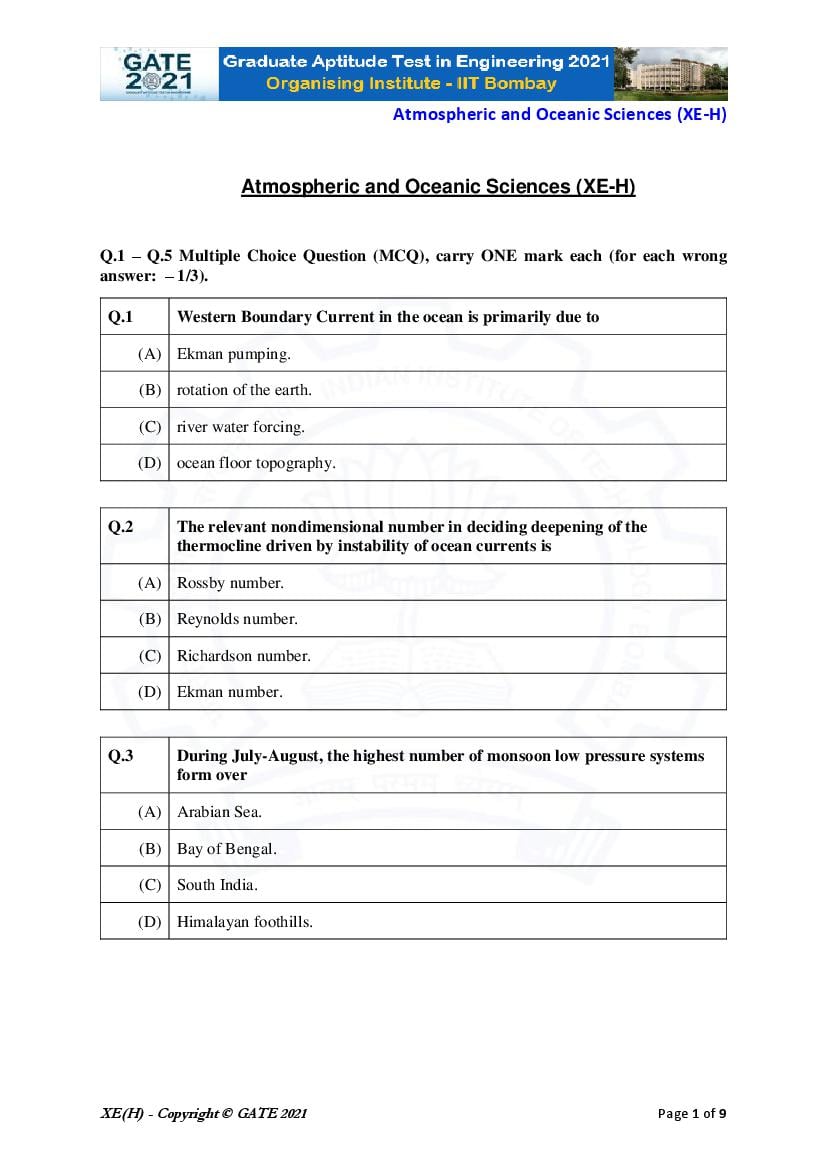
Page 1
answer: – 1/3).
Q.1 Western Boundary Current in the ocean is primarily due to
(A) Ekman pumping.
(B) rotation of the earth.
(C) river water forcing.
(D) ocean floor topography.
Q.2 The relevant nondimensional number in deciding deepening of the
thermocline driven by instability of ocean currents is
(A) Rossby number.
(B) Reynolds number.
(C) Richardson number.
(D) Ekman number.
Q.3 During July-August, the highest number of monsoon low pressure systems
form over
(A) Arabian Sea.
(B) Bay of Bengal.
(C) South India.
(D) Himalayan foothills.
XE(H) - Copyright © GATE 2021 Page 1 of 9
Page 2
the annual anthropogenic emissions are retained in the atmosphere. If
nations agree to reduce annual CO2 emissions by one Giga ton every year
starting from 2021, then in which year will the CO2 concentration in the
atmosphere stop rising due to anthropogenic emissions?
Take the anthropogenic CO2 emissions in 2020 as 40 Giga tons.
(A) 2020
(B) 2050
(C) 2060
(D) 2100
Q.5 The figure shows a schematic of Indian Ocean surface circulation. This
pattern is representative of the circulation in which month of the year?
(A) January
(B) July
(C) May
(D) November
XE(H) - Copyright © GATE 2021 Page 2 of 9
Page 3
Q.6 Over the open ocean, if the air sea temperature difference is zero, then
which of the following statements is/are always true?
(A) Sensible heat flux is zero.
(B) Latent heat flux is zero.
(C) Momentum flux is zero.
(D) Net energy flux is zero.
Q.7 The psychrometric equation, which is useful in measuring humidity, is
derived assuming the following process(es).
(A) Isobaric process
(B) Isothermal process
(C) Adiabatic process
(D) Isentropic process
XE(H) - Copyright © GATE 2021 Page 3 of 9
Page 4
Q.8 The water vapour mixing ratio of an air parcel increases from 10 g kg-1 to 20 g
kg-1 at a constant pressure of 1010 hPa and temperature of 300 K. The change
in virtual temperature is _____ K (to one decimal place).
Q.9 The Ekman layer thickness, if turbulent diffusivity is 0.01 m2 s-1, is _____ m.
Take Coriolis parameter to be 10-4 s-1. Calculate to the nearest integer.
XE(H) - Copyright © GATE 2021 Page 4 of 9
Page 5
answer: – 2/3).
Q. 10 The figure shows vertical variation of two chemicals P and Q measured in
the Pacific Ocean. Identify the correct combination showing (P, Q) pair
from the list below.
(A) Oxygen, Nitrate
(B) Oxygen, Neon
(C) Nitrate, Oxygen
(D) Neon, Nitrate
XE(H) - Copyright © GATE 2021 Page 5 of 9
Page 6
marks).
Q. 11 Consider tropical high-level clouds and low-level stratus clouds with bases
at 12 km and 1 km above the surface of the Earth, respectively. Which of
the following statement(s) is/are correct?
(A) High clouds are composed of ice crystals.
(B) High clouds have a larger albedo than low clouds.
(C) High clouds have a net warming effect on climate.
(D) Low clouds have a net warming effect on climate.
Q. 12 Which of the following statement(s) is/are correct in the context of
Sverdrup transport?
(A) Sverdrup transport is always in the meridional direction.
(B) Sverdrup transport is always orthogonal to the wind direction.
(C) Sverdrup transport depends on the variation of the Coriolis parameter.
(D) Sverdrup transport is only due to ageostrophic currents.
Q.13 Which of the following statement(s) is/are true with regard to the Hadley
circulation?
(A) The ascending branch is narrower than its descending branch.
(B) Thunderstorms are more frequent in the subsiding region of the Hadley cell than
in its ascending region.
(C) The lower level winds between the ascending and descending branches of the
Hadley cell are north-westerly.
(D) Latent heat is transported from the subsiding to the ascending region of the
Hadley cell.
XE(H) - Copyright © GATE 2021 Page 6 of 9
Page 7
(A) Large-scale ocean surface currents are driven by winds.
(B) Cold, dense and salty water forms in the North Atlantic Ocean.
(C) Upwelling currents bring warm nutrient deficient water to the surface of the
ocean.
(D) Thermohaline circulation does not transport energy in the meridional direction.
Q. 15 Coral reefs are found primarily in tropical and subtropical shallow
seawaters. Which of the following statement(s) is/are correct?
(A) Corals require plenty of sunlight for photosynthesis and sunlight is abundant in
the tropical and subtropical latitudes.
(B) Corals grow optimally in seawater unsaturated in carbonate, which is found
only in the tropical and subtropical oceans.
(C) Corals grow optimally in fresh low-salinity water.
(D) Corals grow optimally in water temperatures between 23oC and 29oC.
XE(H) - Copyright © GATE 2021 Page 7 of 9
Page 8
marks).
Q. 16 In an incompressible fluid, the horizontal divergence is −0.01 s-1. Then, the
vertical velocity at 50 m above a flat surface is ____ m s-1. Round off to one
decimal place.
Q. 17 In an atmosphere, temperature (T) decreases linearly with height above the
ground (z), i.e., T(z) = To – z, where is a constant. Surface pressure is
900 hPa. If the atmosphere is at rest, then the value of z at which the
pressure decreases to half of that at the surface is _____ m (round off to the
nearest integer).
Take acceleration due to gravity g = 10 m s-2, gas constant R = 300 J kg-1 K-
1, T = 300 K and = 1/30 K m-1, and the atmosphere behaves as an ideal
o
gas.
Q. 18 In a local Cartesian system, a zonal jet has a form u(y) = uo (1 – y2/L2), for
−L ≤ y ≤ L. Here, y is the meridional distance measured from the axis of the
jet and is positive northward. The vertical component of vorticity of this
flow at y=L/2 is _____ s-1. Round off to 3 decimal places.
Take uo = 50 m s-1 and L = 5 km.
Q.19 An eastward flow with a speed of 10 m s-1 goes from station M to station N,
which are separated by a distance of 1 km. The temperature at station N is
always higher than that at station M by 10 K. The absolute change in
temperature due to advection at the mid-point between the stations in 50 s
is _________ K (round off to nearest integer).
Q.20 Suppose, because of the doubling of atmospheric CO2 concentration, an
ocean water column receives an additional net energy input of 4 Wm-2. If
the entire water column of depth 1 km heats up uniformly, the water
temperature will increase by 1 K in ____ years (round off to the nearest
integer).
Assume all the additional heat added is retained and not lost. Take density
of seawater = 1000 kg m-3; specific heat capacity of seawater = 4200 J kg-1
K-1.
XE(H) - Copyright © GATE 2021 Page 8 of 9
Page 9
downwelling longwave radiation at 5 and 6 km is 240 and 230 Wm-2,
respectively. The upwelling longwave radiation at these heights is 260 and
240 Wm-2, respectively. The longwave heating rate in this layer is___ K per
day. (Round off to one decimal place.)
Take the average density of air in this layer to be 0.5 kg m-3; Specific heat
capacity of air at constant pressure = 1000 J kg-1 K-1.
Q.22 A spherical asteroid, revolving around the sun in a circular orbit, is in
radiative balance. Suddenly, the asteroid enters the shadow of a planet and
solar radiation is cut off. Assuming that the asteroid emits as a blackbody
in the longwave regime, the time taken to reduce the average temperature
of the asteroid by 0.5 K is ______ seconds (round off to the nearest integer).
Ignore the temporal change in radiation emitted by the asteroid during this
cooling period.
The physical properties of the asteroid are: diameter = 2 m,
density = 3000 kg m-3, specific heat = 2000 J kg-1 K-1 and albedo = 0.8 in
shortwave radiation. Take the solar constant = 500 W m-2,
Stefan-Boltzmann constant = 5.67 x 10⁻⁸ W m−2 K−4.
END OF THE QUESTION PAPER
XE(H) - Copyright © GATE 2021 Page 9 of 9
Document Details
| Board / Org | IIT |
| Exam | GATE |
| Type | Question Paper |
| Pages | 9 |
| Language | english |
| Updated | 01 May 2026 |