DUET Question Paper 2019 for M.Sc Microbiology
Finished viewing? Save it for later —
Download DUET Question Paper 2019 for M.Sc Microbiology (PDF · 20 pages)About DUET Question Paper 2019 for M.Sc Microbiology
DUET Question Paper 2019 for M.Sc Microbiology is available here for free download. Published by NTA for DUET, this question paper can be viewed online or downloaded as a PDF (20 pages). Candidates preparing for DUET can use DUET Question Paper 2019 for M.Sc Microbiology to understand the exam pattern, the type of questions asked, and the overall difficulty level.
Frequently Asked Questions
How can I download DUET Question Paper 2019 for M.Sc Microbiology?
Open this page and click the Download button to save DUET Question Paper 2019 for M.Sc Microbiology as a PDF. It is completely free on AglaSem Docs.
Is DUET Question Paper 2019 for M.Sc Microbiology free to download?
Yes. DUET Question Paper 2019 for M.Sc Microbiology can be viewed online and downloaded as a PDF free of cost on AglaSem Docs.
How many pages does DUET Question Paper 2019 for M.Sc Microbiology have?
DUET Question Paper 2019 for M.Sc Microbiology contains 20 pages, which you can read online or download together as a single PDF.
Where can I find more DUET study material?
You can find more DUET question papers, sample papers, syllabus, and answer keys on AglaSem Docs.
DUET Question Paper 2019 for M.Sc Microbiology – Text
Read the full text of this question paper below — useful to quickly search, copy and reference the content online without downloading the PDF.
📄 View text version (20 pages)
Page 1
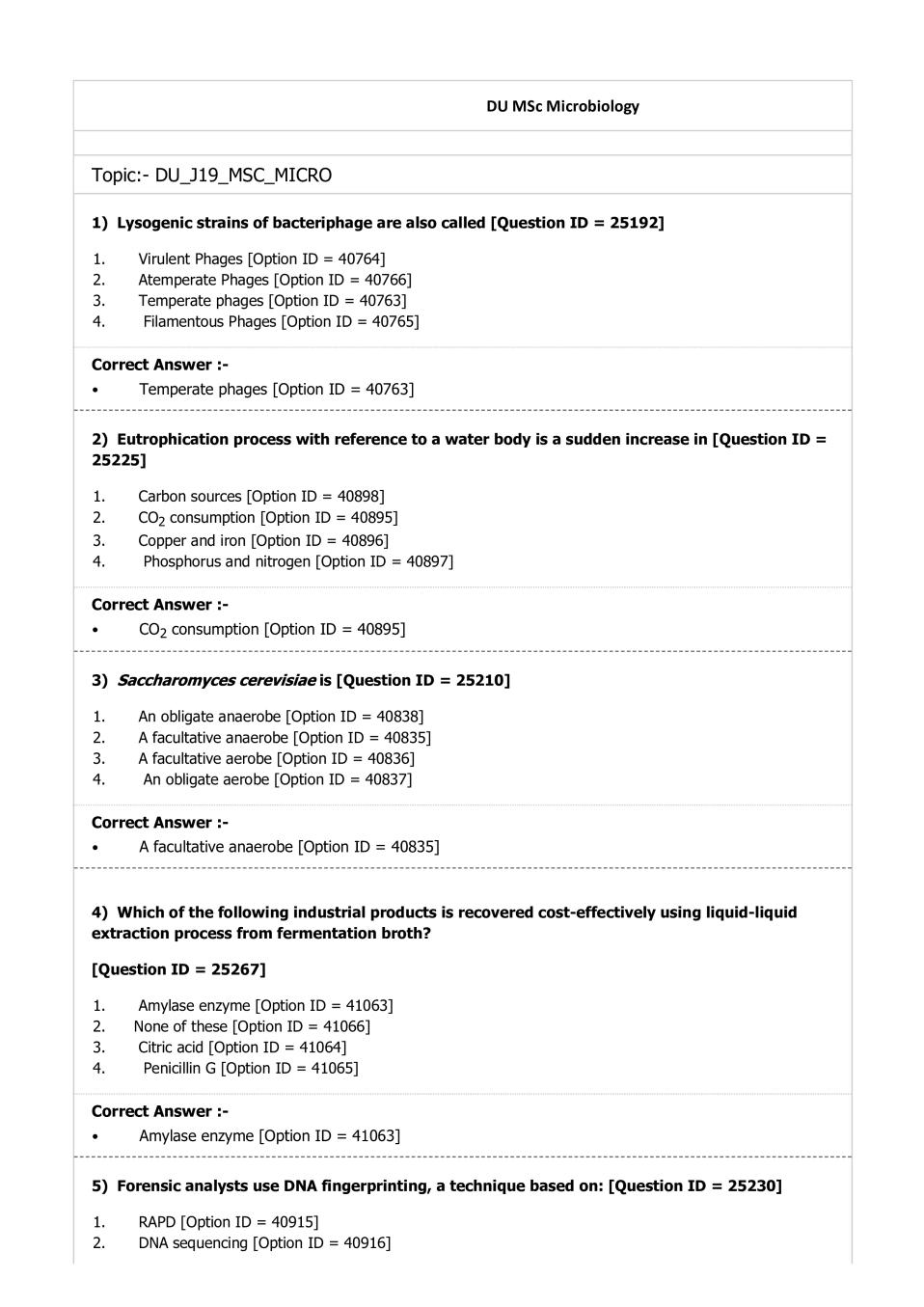
Topic:- DU_J19_MSC_MICRO
1) Lysogenic strains of bacteriphage are also called [Question ID = 25192]
1. Virulent Phages [Option ID = 40764]
2. Atemperate Phages [Option ID = 40766]
3. Temperate phages [Option ID = 40763]
4. Filamentous Phages [Option ID = 40765]
Temperate phages [Option ID = 40763]
2) Eutrophication process with reference to a water body is a sudden increase in [Question ID =
25225]
1. Carbon sources [Option ID = 40898]
2. CO2 consumption [Option ID = 40895]
3. Copper and iron [Option ID = 40896]
4. Phosphorus and nitrogen [Option ID = 40897]
CO2 consumption [Option ID = 40895]
3) Saccharomyces cerevisiae is [Question ID = 25210]
1. An obligate anaerobe [Option ID = 40838]
2. A facultative anaerobe [Option ID = 40835]
3. A facultative aerobe [Option ID = 40836]
4. An obligate aerobe [Option ID = 40837]
A facultative anaerobe [Option ID = 40835]
4) Which of the following industrial products is recovered cost-effectively using liquid-liquid
extraction process from fermentation broth?
[Question ID = 25267]
1. Amylase enzyme [Option ID = 41063]
2. None of these [Option ID = 41066]
3. Citric acid [Option ID = 41064]
4. Penicillin G [Option ID = 41065]
Amylase enzyme [Option ID = 41063]
5) Forensic analysts use DNA fingerprinting, a technique based on: [Question ID = 25230]
1. RAPD [Option ID = 40915]
2. DNA sequencing [Option ID = 40916]
Page 2
4. RFLP [Option ID = 40917]
RAPD [Option ID = 40915]
6) Common opportunistic infections in patients with reduced antibody responses are [Question
ID = 25263]
1. Intestinal helminths [Option ID = 41048]
2. Atypical mycobacteria [Option ID = 41050]
3. Influenza [Option ID = 41047]
4. Encapsulated bacteria [Option ID = 41049]
Influenza [Option ID = 41047]
7) A draft tube is generally fitted in which of the following bioreactor design types? [Question ID
= 25282]
1. Cyclone Bioreactors [Option ID = 41126]
2. Air-Lift Bioreactor [Option ID = 41123]
3. Fluidized-Bed Bioreactor [Option ID = 41124]
4. Membrane Bioreactors [Option ID = 41125]
Air-Lift Bioreactor [Option ID = 41123]
8) What is the temperature at which microbial cultures are being preserved when they are
stored in liquid Nitrogen?
[Question ID = 25266]
1. – 1960C [Option ID = 41059]
2. – 800C [Option ID = 41062]
3. – 1260C [Option ID = 41060]
4. – 1000C [Option ID = 41061]
– 1960C [Option ID = 41059]
9) Influenza A virus genome consist of [Question ID = 25215]
1. Twelve segments of double stranded RNA [Option ID = 40858]
2. Ten segments of positive sense RNA [Option ID = 40856]
3. Eight segments of negative sense RNA [Option ID = 40855]
4. Ten segments of negative sense RNA [Option ID = 40857]
Eight segments of negative sense RNA [Option ID = 40855]
10) Without vaccination, which of these infections is almost 100% fatal [Question ID = 25279]
1. HIV [Option ID = 41111]
2. Rabies virus [Option ID = 41114]
Page 3
4. Ebola virus [Option ID = 41113]
HIV [Option ID = 41111]
11) Yogurt is produced by which of the following types of fermentation processes? [Question ID
= 25187]
1. Is not produced by fermentation [Option ID = 40746]
2. Thermophilic fermentation [Option ID = 40744]
3. Mesophilic fermentation [Option ID = 40743]
4. Mesophilic and Thermophilic fermentation [Option ID = 40745]
Mesophilic fermentation [Option ID = 40743]
12) Rod in chain is the morphology of [Question ID = 25190]
1. Bacillus pumilus [Option ID = 40755]
2. Bacillus megaterium [Option ID = 40756]
3. Bacillus subtilis [Option ID = 40758]
4. Bacillus licheniformis [Option ID = 40757]
Bacillus pumilus [Option ID = 40755]
13) In RNA splicing, an intermediate consisting of a circular structure with a tail that is created
by a 5’ to 2’ bond is called: [Question ID = 25202]
1. stem loop [Option ID = 40806]
2. lariat [Option ID = 40803]
3. branch site [Option ID = 40804]
4. spliceosome [Option ID = 40805]
lariat [Option ID = 40803]
14) The microbial test used to assess the carcinogenic potential of a chemical compound is
called: [Question ID = 25244]
1. Coliform test [Option ID = 40974]
2. Bioburden test [Option ID = 40972]
3. Microbial Limits test [Option ID = 40971]
4. Ames Test [Option ID = 40973]
Microbial Limits test [Option ID = 40971]
15) During oxidative phosphorylation, the proton motive force generated by electron transport
is used to
[Question ID = 25248]
1. Oxidize NADH to NAD+ [Option ID = 40990]
Page 4
3. Generate the substrates ADP + Pi for ATP synthesis [Option ID = 40989]
4. Induce a conformational change in ATP synthase [Option ID = 40988]
Reduce O2 to H2O [Option ID = 40987]
16) Polygalacturonases (PG) split pectin chain by [Question ID = 25246]
1. Breaking N-glycosidic bond [Option ID = 40982]
2. Breaking linkages between two galacturonic acid residues [Option ID = 40979]
3. Removing two water molecules from the linkage [Option ID = 40980]
4. Catalyzing the hydrolysis of two methyl esters [Option ID = 40981]
Breaking linkages between two galacturonic acid residues [Option ID = 40979]
17) The natural inhibitory substances present in milk are [Question ID = 25195]
1. Lactose and fats [Option ID = 40775]
2. Casein and fructose [Option ID = 40776]
3. Lactoperoxidase and Agglutinins [Option ID = 40778]
4. Cholesterol and fat [Option ID = 40777]
Lactose and fats [Option ID = 40775]
18) The genome-wide in vivo binding sites of a transcriptional activator can be identified by:
[Question ID = 25265]
1. EMSA [Option ID = 41058]
2. DNA microarray [Option ID = 41056]
3. protein array [Option ID = 41055]
4. ChIP-seq [Option ID = 41057]
protein array [Option ID = 41055]
19) Pyrococcus is given the species name furiosus because
[Question ID = 25262]
1. It has an unusual respiratory system [Option ID = 41046]
2. It is cocci in shape with polytrichous flagellation [Option ID = 41044]
3. It is an extremophile with optimum growth temperature of 100 ˚C [Option ID = 41043]
4. It has 37 minutes of doubling time at boiling temperature and shows rapid swimming [Option ID =
41045]
It is an extremophile with optimum growth temperature of 100 ˚C [Option ID = 41043]
20) The primase responsible for initiating the synthesis of each Okazaki fragment is: [Question
ID = 25201]
1. DnaA [Option ID = 40799]
Page 5
3. DnaG [Option ID = 40802]
4. DnaC [Option ID = 40801]
DnaA [Option ID = 40799]
21) The protein that triggers the SOS response to DNA damage is: [Question ID = 25194]
1. AP endonuclease [Option ID = 40774]
2. LexA [Option ID = 40771]
3. FEN1 [Option ID = 40772]
4. RecA [Option ID = 40773]
LexA [Option ID = 40771]
22) The bivalent Poliovirus vaccine contains [Question ID = 25208]
1. Type 1 and Type 2 strains [Option ID = 40827]
2. Type 1 and Type 3 strains [Option ID = 40828]
3. There is no bivalent polio vaccine [Option ID = 40830]
4. Type 2 and Type 3 strains [Option ID = 40829]
Type 1 and Type 2 strains [Option ID = 40827]
23) Under ideal conditions in continuous stirred-tank reactor (CSTR), when will biomass
accumulation take place in the fermentor?
[Question ID = 25259]
1. There is no relation between µ and D [Option ID = 41034]
2. µ>D [Option ID = 41031]
3. µ<D [Option ID = 41033]
4. µ=D [Option ID = 41032]
µ>D [Option ID = 41031]
24) The fungus Glomerella tucumanensis causes [Question ID = 25211]
1. Red rot disease of sugarcane [Option ID = 40839]
2. Green rot of crucifers [Option ID = 40842]
3. Black rot of crucifers [Option ID = 40840]
4. Black rot of sugarcane [Option ID = 40841]
Red rot disease of sugarcane [Option ID = 40839]
25) The composition of Bordeaux mixture is [Question ID = 25238]
1. Sodium hydroxide and Potassium hydroxide [Option ID = 40948]
2. Copper sulfate (CuSO4) and Zinc chloride [Option ID = 40947]
3. Calcium hydroxide and Sodium hydroxide [Option ID = 40950]
Page 6
Copper sulfate (CuSO4) and Zinc chloride [Option ID = 40947]
26) Langerhans' cells are found in [Question ID = 25250]
1. Skin [Option ID = 40998]
2. Lymph [Option ID = 40995]
3. Lymph nodes [Option ID = 40996]
4. Periarteriolar lymphoid sheaths [Option ID = 40997]
Lymph [Option ID = 40995]
27) The ability of microorganisms to maintain balance internally against stress is called
[Question ID = 25217]
1. Ecosystem management [Option ID = 40863]
2. Biological spectrum management [Option ID = 40864]
3. Homeostasis [Option ID = 40866]
4. Ecological niche [Option ID = 40865]
Ecosystem management [Option ID = 40863]
28) Phaseolotoxin is produced by [Question ID = 25252]
1. Pseudomonas syringae [Option ID = 41003]
2. Pseudomonas fluorescens [Option ID = 41006]
3. Pyricularia grisea [Option ID = 41004]
4. Pseudomonas aeruginosa [Option ID = 41005]
Pseudomonas syringae [Option ID = 41003]
29) RTS,S/AS01 is a vaccine currently undergoing clinical trial in humans against which disease
or organism [Question ID = 25271]
1. Malaria [Option ID = 41080]
2. Kala Azar [Option ID = 41079]
3. Dengue [Option ID = 41081]
4. Helicobacter pylori[Option ID = 41082]
Kala Azar [Option ID = 41079]
30) Ziehl-Neelsen staining can be used to stain
[Question ID = 25206]
1. Mycobacterium tuberculosis only [Option ID = 40819]
2. Neither Mycobacterium tuberculosis nor Nocardia [Option ID = 40822]
3. Nocardia only [Option ID = 40820]
4. Both Mycobacterium tuberculosis and Nocardia [Option ID = 40821]
Page 7
31) DNA polymerase I is: [Question ID = 25193]
1. A polymerase that is part of the nucleotide excision repair pathway [Option ID = 40768]
2. The primary polymerase that synthesizes long DNA chains during DNA replication [Option ID = 40767]
3. A part of the eukaryotic replisome [Option ID = 40770]
4. Devoid of proof-reading activity [Option ID = 40769]
The primary polymerase that synthesizes long DNA chains during DNA replication [Option ID =
40767]
32) Which type of toxin is Tetanus toxin [Question ID = 25256]
1. Neurotoxin [Option ID = 41020]
2. Endotoxin [Option ID = 41022]
3. Enterotoxin [Option ID = 41019]
4. Cytotoxin [Option ID = 41021]
Enterotoxin [Option ID = 41019]
33) When making genomic DNA libraries for whole genome sequencing the choice of vectors to
be used would be: [Question ID = 25251]
1. M13 and lambda phage vectors [Option ID = 41000]
2. BACs and YACs [Option ID = 41002]
3. Plasmids and cosmids [Option ID = 40999]
4. Phagemids and plasmids [Option ID = 41001]
Plasmids and cosmids [Option ID = 40999]
34) A DNA fragment to be used as a probe in Southern blotting could be radiolabelled by:
[Question ID = 25223]
1. DNAseI treatment [Option ID = 40890]
2. S1 nuclease treatment [Option ID = 40888]
3. nick translation [Option ID = 40887]
4. DNA footprinting [Option ID = 40889]
nick translation [Option ID = 40887]
35) The only firmicutes known to be phototrophic [Question ID = 25255]
1. Halobacterium [Option ID = 41016]
2. Corynebacterium [Option ID = 41015]
3. Bifidobacterium [Option ID = 41018]
4. Heliobacteria [Option ID = 41017]
Corynebacterium [Option ID = 41015]
Page 8
centrifugation is proportional to [Question ID = 25277]
1. Square of the diameter of the particles [Option ID = 41103]
2. Cube of the diameter of the particles [Option ID = 41106]
3. The diameter of the particles [Option ID = 41104]
4. Half of the diameter of the particles [Option ID = 41105]
Square of the diameter of the particles [Option ID = 41103]
37) When originally conceived, the Baltimore scheme of classification of viruses consisted of
only six classes. Which class of viruses was added subsequently to this scheme? [Question ID =
25199]
1. RNA viruses with segmented genomes [Option ID = 40794]
2. DNA viruses with RNA intermediate in life cycle [Option ID = 40791]
3. Viruses which require helper viruses to replicate [Option ID = 40792]
4. Viruses which do not encode any proteins [Option ID = 40793]
DNA viruses with RNA intermediate in life cycle [Option ID = 40791]
38) In year 1898, Martinus Beijerinck confirmed Iwanowski's results on tobacco mosaic virus
and described it with phrase "Contagium Vivum Fluidum" which means [Question ID = 25183]
1. Flowing infectious particle [Option ID = 40730]
2. Soluble living germ [Option ID = 40728]
3. Contagious vital flow [Option ID = 40727]
4. Fluid contamination [Option ID = 40729]
Contagious vital flow [Option ID = 40727]
39) What do MDR-TB and XDR-TB stand for [Question ID = 25274]
1. Maximum-drug resistant tuberculosis and X-drug resistant tuberculosis [Option ID = 41092]
2. Maximum-drug resistant tuberculosis and Extremely-drug resistant tuberculosis [Option ID = 41091]
3. Multi-drug resistant tuberculosis and X-drug resistant tuberculosis [Option ID = 41094]
4. Multi-drug resistant tuberculosis and Extensively-drug resistant tuberculosis [Option ID = 41093]
Maximum-drug resistant tuberculosis and Extremely-drug resistant tuberculosis [Option ID = 41091]
40) The three main tRNA binding sites in the ribosome are: [Question ID = 25209]
1. A, D, E [Option ID = 40831]
2. A, P, E [Option ID = 40832]
3. A, P, T [Option ID = 40834]
4. A, E, T [Option ID = 40833]
A, D, E [Option ID = 40831]
41) Plasma arc furnace during incineration is generally used for [Question ID = 25231]
Page 9
2. Solid waste management [Option ID = 40919]
3. Carbon dioxide sequestration [Option ID = 40922]
4. Acetic acid distillation [Option ID = 40921]
Solid waste management [Option ID = 40919]
42) What is sulfite waste liquor? [Question ID = 25278]
1. A by-product from the alcohol beverage industry [Option ID = 41108]
2. A by-product from the paper industry [Option ID = 41107]
3. A by-product from the sugar cane industry [Option ID = 41110]
4. A by-product from Dye industry [Option ID = 41109]
A by-product from the paper industry [Option ID = 41107]
43) Non-composite bacterial transposons replicate by: [Question ID = 25237]
1. cut-and-paste mechanism [Option ID = 40943]
2. replicative mechanism [Option ID = 40944]
3. sigmoidal mechanism [Option ID = 40946]
4. dispersive mechanism [Option ID = 40945]
cut-and-paste mechanism [Option ID = 40943]
44) Under ideal conditions during ethanol production where there are no by-products, how
much maximum ethanol can be recovered from fermentation broth initially supplied with 100 g/L
of glucose? [Question ID = 25260]
1. 41 g/L [Option ID = 41036]
2. 100 g/L [Option ID = 41038]
3. 30 g/L [Option ID = 41035]
4. 51 g/L [Option ID = 41037]
30 g/L [Option ID = 41035]
45) Archaeal membranes differ from the eubacterial membranes as they possess [Question ID =
25268]
1. Tetraethers only [Option ID = 41068]
2. Isoprene units, tetraethers and long chain fatty acids [Option ID = 41070]
3. Isoprene units only [Option ID = 41067]
4. Long chain fatty acids only [Option ID = 41069]
Isoprene units only [Option ID = 41067]
46) Antibody titer refers to the [Question ID = 25249]
1. Absolute amount of specific antibody [Option ID = 40992]
2. Affinity of specific antibody [Option ID = 40991]
3. Highest dilution of antibody still able to give a positive result in a test system [Option ID = 40994]
Page 10
Affinity of specific antibody [Option ID = 40991]
47) Pattern recognition receptors (PRR) include [Question ID = 25236]
1. LPS [Option ID = 40939]
2. PAMPs [Option ID = 40940]
3. Lectin-like molecules [Option ID = 40942]
4. Lipoteichoic acid [Option ID = 40941]
LPS [Option ID = 40939]
48) Place the following five steps of ELISA in the correct order. 1. Add sample serum to each
well. 2. Enzyme substrate is added to each well. 3. Anti-antibodies with enzyme are added to
each well. 4. Each well is coated with antigen molecules in solution. 5. Excess antigen is washed
and gelatin is used to coat any surface not coated with antigen. [Question ID = 25270]
1. 5, 4, 3, 2, 1 [Option ID = 41075]
2. 4, 5, 2, 1, 3 [Option ID = 41078]
3. 4, 5, 1, 3, 2 [Option ID = 41076]
4. 1, 2, 3, 5, 4 [Option ID = 41077]
5, 4, 3, 2, 1 [Option ID = 41075]
49) The Most Probable Number (MPN) method is based on which of the following statistical
distribution methods? [Question ID = 25232]
1. Discrete uniform distribution [Option ID = 40926]
2. Binomial distribution [Option ID = 40924]
3. Poisson distribution [Option ID = 40923]
4. Geometric distribution [Option ID = 40925]
Poisson distribution [Option ID = 40923]
50) During oxygenic photosynthesis, O2 is evolved from [Question ID = 25233]
1. Sunlight [Option ID = 40928]
2. Carbohydrate [Option ID = 40927]
3. Water [Option ID = 40930]
4. Carbon dioxide [Option ID = 40929]
Carbohydrate [Option ID = 40927]
51) A patient with H. pylori
infection is treated with drugs. The best method to detect presence
of residualH.pyloriinfection in this person is [Question ID = 25280]
1. Urea breath test [Option ID = 41116]
2. Serum anti H.pylori titer [Option ID = 41118]
3. Rapid urease test [Option ID = 41115]
4. Endoscopy and biopsy [Option ID = 41117]
Page 11
52) The presence of Pedicoccus cerevisiae in beer causes which of the following diseases
[Question ID = 25188]
1. Septic sore throat [Option ID = 40750]
2. Sarcina sickness [Option ID = 40748]
3. Sleeping sickness [Option ID = 40747]
4. Pulmonary embolism [Option ID = 40749]
Sleeping sickness [Option ID = 40747]
53) Defects in neutrophil NADPH oxidase system produce: [Question ID = 25235]
1. Chediak-Higashi disease [Option ID = 40936]
2. Leukocyte adhesion deficiency [Option ID = 40938]
3. Chronic granulomatous disease [Option ID = 40935]
4. Hashimoto's disease [Option ID = 40937]
Chronic granulomatous disease [Option ID = 40935]
54) A pathogen which typically causes immune deficiency and increases the risk of secondary
infection is
[Question ID = 25264]
1. Measles virus [Option ID = 41051]
2. Rabies virus [Option ID = 41054]
3. Toxoplasma [Option ID = 41052]
4. Candida albicans [Option ID = 41053]
Measles virus [Option ID = 41051]
55) Deinococcus radiodurans is radiation resistant bacterium because it accumulates high levels
of [Question ID = 25276]
1. Calcium [Option ID = 41099]
2. Zinc [Option ID = 41102]
3. Manganese [Option ID = 41100]
4. Magnesium [Option ID = 41101]
Calcium [Option ID = 41099]
56) Griseofulvin is used in the treatment of
[Question ID = 25275]
1. All of these [Option ID = 41098]
2. Herpesvirus infection [Option ID = 41096]
3. Dermatophyte infections [Option ID = 41095]
Page 12
Dermatophyte infections [Option ID = 41095]
57) Which of the following factors influence the filtration rate in a Cross-flow filtration strategy
during fermentation? [Question ID = 25272]
1. Viscosity only [Option ID = 41084]
2. Temperature only [Option ID = 41083]
3. Temperature, viscosity and pressure [Option ID = 41086]
4. Pressure only [Option ID = 41085]
Temperature only [Option ID = 41083]
58) Heterothallism in fungi was discovered by [Question ID = 25254]
1. Pontecarvo & Roper [Option ID = 41012]
2. Albert Blakeslee [Option ID = 41011]
3. G.W. Martin [Option ID = 41014]
4. J. Alexopoulos [Option ID = 41013]
Albert Blakeslee [Option ID = 41011]
59) Water activity (aw) of pure water is [Question ID = 25203]
1. 0.25 [Option ID = 40810]
2. 0.75 [Option ID = 40808]
3. 1.0 [Option ID = 40807]
4. 0.5 [Option ID = 40809]
1.0 [Option ID = 40807]
60) Lysozyme attacks bacterial cell wall by [Question ID = 25205]
1. Breaking peptide interbridge [Option ID = 40815]
2. Dephosphorylating amino acids in the peptidoglycan layer [Option ID = 40818]
3. Inhibiting transpeptidation [Option ID = 40816]
4. Breaking glycosidic linkage [Option ID = 40817]
Breaking peptide interbridge [Option ID = 40815]
61) A mutation is most likely to change three-dimensional conformation of a protein if [Question
ID = 25234]
1. There is a substitution of hydrophobic amino acid in place of hydrophilic amino acid [Option ID =
40934]
2. It changes the carboxy-terminal amino acid [Option ID = 40932]
3. It changes the amino-terminal amino acid [Option ID = 40931]
4. It introduces proline in the middle of an alpha helix [Option ID = 40933]
Page 13
62) Anderson sampler is employed to enumerate microbes in [Question ID = 25218]
1. Ground water [Option ID = 40870]
2. Polluted rivers [Option ID = 40867]
3. Deep ocean [Option ID = 40868]
4. Atmosphere [Option ID = 40869]
Polluted rivers [Option ID = 40867]
63) The main microorganism in tempeh production at an industrial scale is [Question ID =
25196]
1. Rhizopus oligosporus [Option ID = 40779]
2. Aspergillus niger [Option ID = 40782]
3. Actinimucor elegans [Option ID = 40780]
4. Aspergillus oryzae [Option ID = 40781]
Rhizopus oligosporus [Option ID = 40779]
64) Rice tungro disease is caused by [Question ID = 25245]
1. Viruses [Option ID = 40978]
2. Bacteria [Option ID = 40975]
3. Yeast [Option ID = 40976]
4. Fungi [Option ID = 40977]
Bacteria [Option ID = 40975]
65) Choose the most appropriate option from below when considering forms of intracellular
signaling: [Question ID = 25185]
1. Paracrine only [Option ID = 40735]
2. Paracrine, endocrine and synaptic [Option ID = 40738]
3. Exocrine only [Option ID = 40736]
4. Synaptic only [Option ID = 40737]
Paracrine only [Option ID = 40735]
66) Which of these require a helper virus for replication [Question ID = 25184]
1. Adenovirus (AV) [Option ID = 40734]
2. Hepatitis B virus (HBV) [Option ID = 40732]
3. Tomato planta macho viroid (TPMVd) [Option ID = 40731]
4. Hepatitis delta virus (HDV) [Option ID = 40733]
Tomato planta macho viroid (TPMVd) [Option ID = 40731]
67) Which of these is not a function of teichoic acid? [Question ID = 25198]
Page 14
2. Maintains the structure of cell envelope [Option ID = 40788]
3. Protects the cell from harmful substance [Option ID = 40787]
4. Has a role in cell division [Option ID = 40789]
Protects the cell from harmful substance [Option ID = 40787]
68) Which of the following is not true for a bacteriophage? [Question ID = 25191]
1. A very simple structure [Option ID = 40759]
2. Complex structure that infects bacteria [Option ID = 40762]
3. Consist of either DNA or RNA [Option ID = 40760]
4. Bacteriophages are viruses [Option ID = 40761]
A very simple structure [Option ID = 40759]
69) Which of the following provides the longest lasting immunity to host against an infectious
agent? [Question ID = 25221]
1. Naturally acquired passive immunity [Option ID = 40879]
2. Artificially acquired passive immunity [Option ID = 40880]
3. Artificially acquired active immunity [Option ID = 40882]
4. Naturally acquired active immunity [Option ID = 40881]
Naturally acquired passive immunity [Option ID = 40879]
70) Which of the following substances will not stimulate an immune response unless they are
bound to a larger molecule? [Question ID = 25222]
1. Virus [Option ID = 40884]
2. Miligen [Option ID = 40886]
3. Antigen [Option ID = 40883]
4. Hapten [Option ID = 40885]
Antigen [Option ID = 40883]
71) Which of the following regions of the atmosphere is very important in the dispersal of
microbes? [Question ID = 25204]
1. Ionosphere [Option ID = 40814]
2. Stratosphere [Option ID = 40812]
3. Troposphere [Option ID = 40811]
4. Mesosphere [Option ID = 40813]
Troposphere [Option ID = 40811]
72) Which of the following is known as a blue enzyme for green chemistry [Question ID =
25224]
1. Glucose oxidase [Option ID = 40891]
2. Superoxide Dismutase [Option ID = 40892]
Page 15
4. Laccase [Option ID = 40893]
Glucose oxidase [Option ID = 40891]
73) Which of the following is a plasmid-mediated toxin? [Question ID = 25257]
1. Diphtheria toxin [Option ID = 41023]
2. Botulism toxin [Option ID = 41024]
3. Food-poisoning toxin ofS.aureus [Option ID = 41026]
4. Tetanus toxin [Option ID = 41025]
Diphtheria toxin [Option ID = 41023]
74) Which of the following is used to disinfect skin but is not sporicidal [Question ID = 25241]
1. Formaldehyde [Option ID = 40959]
2. Chlorine [Option ID = 40960]
3. Quaternary ammonium salts [Option ID = 40962]
4. Ethylene oxide [Option ID = 40961]
Formaldehyde [Option ID = 40959]
75) Which of the following enzyme’s activity is dependent on thiamine? [Question ID = 25227]
1. fumarase [Option ID = 40904]
2. pyruvate carboxylase [Option ID = 40903]
3. citrate synthase [Option ID = 40906]
4. α-ketoglutarate dehydrogenase [Option ID = 40905]
pyruvate carboxylase [Option ID = 40903]
76) Which of the following enzyme’s activity is unique to heterofermentative lactic acid bacteria
[Question ID = 25212]
1. Transketolase [Option ID = 40844]
2. Transaldolase [Option ID = 40843]
3. Phosphoaldolase [Option ID = 40846]
4. Phosphoketolase [Option ID = 40845]
Transaldolase [Option ID = 40843]
77) Which of the following compounds cannot give rise to the net synthesis of glucose [Question
ID = 25220]
1. Glycerol [Option ID = 40876]
2. Lactate [Option ID = 40875]
3. Oxaloacetate [Option ID = 40878]
4. Acetyl CoA [Option ID = 40877]
Page 16
78) Which of the following gene clusters do not contribute to antigen binding capabilities of
antibodies [Question ID = 25242]
1. CL [Option ID = 40964]
2. D [Option ID = 40966]
3. VL [Option ID = 40963]
4. VH [Option ID = 40965]
VL [Option ID = 40963]
79) Which of the following statements does not apply to IgG [Question ID = 25243]
1. Neutralizes bacterial toxins [Option ID = 40968]
2. Crosses the human placenta [Option ID = 40970]
3. Appears early in the primary immune response [Option ID = 40967]
4. Can fix complement [Option ID = 40969]
Appears early in the primary immune response [Option ID = 40967]
80) Which of the following immune cells or molecules are most effective at destroying
intracellular pathogens? [Question ID = 25228]
1. T cytolytic cells [Option ID = 40910]
2. B cells [Option ID = 40908]
3. T helper cells [Option ID = 40907]
4. Complement [Option ID = 40909]
T helper cells [Option ID = 40907]
81) Which of the following is most hyperthermophilic methanogen [Question ID = 25261]
1. Methanobacterium [Option ID = 41042]
2. Methanocaldococcus [Option ID = 41039]
3. Methanobrevibacter [Option ID = 41040]
4. Methanopyrus [Option ID = 41041]
Methanocaldococcus [Option ID = 41039]
82) Which of the following is the mode of action of formaldehyde [Question ID = 25219]
1. Shows oxidizing property [Option ID = 40871]
2. Interferes with respiration [Option ID = 40874]
3. Changes permeability of plasma membrane [Option ID = 40872]
4. Combines with vital nitrogen compounds [Option ID = 40873]
Shows oxidizing property [Option ID = 40871]
83) Which of the following act as a test organism in the procedure of the phenol-coefficient
method [Question ID = 25240]
Page 17
2. Salmonella typhi [Option ID = 40956]
3. Streptococcus faecalis [Option ID = 40958]
4. Lactobacillus [Option ID = 40957]
Escherichia coli [Option ID = 40955]
84) Which one of the following mathematical expressions correctly depicts the specific growth
rate of the microorganism, where X is biomass, S is substrate, P is product, and µ is specific
growth rate. [Question ID = 25253]
1. µ=1/S*(dP/dt) [Option ID = 41010]
2. µ=1/X*(dX/dt) [Option ID = 41007]
3. µ=1/P*(dP/dt) [Option ID = 41008]
4. µ=1/p*(dS/dt) [Option ID = 41009]
µ=1/X*(dX/dt) [Option ID = 41007]
85) Which one of these does not function as a receptor or co-receptor for HIV-1 virus [Question
ID = 25200]
1. CAR4 [Option ID = 40798]
2. CCR5 [Option ID = 40796]
3. CD4 [Option ID = 40795]
4. CXCR4 [Option ID = 40797]
CD4 [Option ID = 40795]
86) Which one of these viruses is associated with a rare skin cancer in humans [Question ID =
25207]
1. Merkel Cell Polyomavirus [Option ID = 40824]
2. Human T-Cell Lymphotropic Virus Type 1 [Option ID = 40826]
3. Epstein Barr Virus [Option ID = 40823]
4. Hepatitis B Virus [Option ID = 40825]
Epstein Barr Virus [Option ID = 40823]
87) Bacteria having linear chromosome [Question ID = 25197]
1. Borrelia [Option ID = 40786]
2. Vibrio [Option ID = 40784]
3. Pseudomonas [Option ID = 40783]
4. Mycoplasma [Option ID = 40785]
Pseudomonas [Option ID = 40783]
88) The specificity of an antibody is due to [Question ID = 25229]
1. Its valence [Option ID = 40911]
2. The heavy chains [Option ID = 40912]
Page 18
4. The Fc portion of the molecule [Option ID = 40913]
Its valence [Option ID = 40911]
89) Which of the following is transported by facilitated diffusion in E. coli? [Question ID =
25213]
1. Lactose [Option ID = 40850]
2. Maltose [Option ID = 40848]
3. Glucose [Option ID = 40847]
4. Glycerol [Option ID = 40849]
Glucose [Option ID = 40847]
90) The Michaelis constant Km is [Question ID = 25226]
1. Numerically equal to twice the Vmax [Option ID = 40902]
2. Numerically equal to ½ Vmax [Option ID = 40899]
3. Dependant on enzyme concentration [Option ID = 40900]
4. Numerically equal to substrate concentration that gives half-maximal velocity [Option ID = 40901]
Numerically equal to ½ Vmax [Option ID = 40899]
91) In lac I s mutants, the lac operon would be: [Question ID = 25258]
1. repressible [Option ID = 41030]
2. constitutive [Option ID = 41028]
3. non-inducible [Option ID = 41027]
4. inducible [Option ID = 41029]
non-inducible [Option ID = 41027]
92) Biological indicator usually used to check working of an autoclave is [Question ID = 25269]
1. Spores of Geobacillus stearothermophilus [Option ID = 41074]
2. Spores of Bacillus subtilis [Option ID = 41071]
3. Vegetative cells of Clostridium botulinum [Option ID = 41072]
4. Spores of Clostridium [Option ID = 41073]
Spores of Bacillus subtilis [Option ID = 41071]
93) The mechanism of plant pathogen control by Trichoderma is via
[Question ID = 25239]
1. Antibiosis, mycoparasitism and competition [Option ID = 40954]
2. Antibiosis only [Option ID = 40951]
3. Mycoparasitism only [Option ID = 40952]
4. Competition only [Option ID = 40953]
Page 19
94) The first viral vector-based gene therapy to be approved for clinical use in humans
[Question ID = 25214]
1. Strimvelis, recombinant gammaretrovirus to treat patients with a very rare disease Severe Combined
Immunodeficiency due to Adenosine Deaminase deficiency [Option ID = 40853]
2. Glybera, recombinant adeno-associated virus for treatment of hereditary lipoprotein lipase deficiency
[Option ID = 40852]
3. No gene therapy has ever been approved for human use till date [Option ID = 40854]
4. Gendicine, recombinant adenovirus engineered to express wildtype p53 [Option ID = 40851]
Gendicine, recombinant adenovirus engineered to express wildtype p53 [Option ID = 40851]
95) The media for recombinant protein production in mammalian cells can be sterilized by
[Question ID = 25273]
1. Boiling at 100oC [Option ID = 41088]
2. Autoclaving at 121oC [Option ID = 41087]
3. A combination of all of these [Option ID = 41090]
4. Filtration [Option ID = 41089]
Autoclaving at 121oC [Option ID = 41087]
96) The process by which actin filaments are maintained at a constant length by the addition of
subunits at one end and the removal of subunits at the other end is called:
[Question ID = 25186]
1. Nucleation [Option ID = 40742]
2. Translation [Option ID = 40741]
3. Translocation [Option ID = 40740]
4. Treadmilling [Option ID = 40739]
Treadmilling [Option ID = 40739]
97) Disposable petridishes are pre-sterilized by [Question ID = 25247]
1. Gamma irradiation [Option ID = 40984]
2. Beta irradiation [Option ID = 40986]
3. Ethylene oxide [Option ID = 40983]
4. Steam [Option ID = 40985]
Ethylene oxide [Option ID = 40983]
98) Lignin in the plant cell wall is degraded by [Question ID = 25281]
Page 20
2. β-glucosidases [Option ID = 41120]
3. Xanthine oxidase [Option ID = 41122]
4. Glucose oxidase [Option ID = 41121]
Polyphenol oxidases [Option ID = 41119]
99) The members of which bacterial phylum have their genetic material enclosed in a
membrane? [Question ID = 25189]
1. Actinobacteria [Option ID = 40754]
2. Chlamydia [Option ID = 40751]
3. Planctomycetes [Option ID = 40752]
4. Proteobacteria [Option ID = 40753]
Chlamydia [Option ID = 40751]
100) A lambda phage carrying a mutation in the nutR site would form: [Question ID = 25216]
1. no plaques [Option ID = 40862]
2. turbid plaques [Option ID = 40859]
3. clear plaques [Option ID = 40860]
4. small plaques with fuzzy edge [Option ID = 40861]
turbid plaques [Option ID = 40859]
Document Details
| Board / Org | NTA |
| Exam | DUET |
| Type | Question Paper |
| Pages | 20 |
| Updated | 30 Apr 2026 |