Telangana Class 7 Syllabus Social Studies
Finished viewing? Save it for later —
Download Telangana Class 7 Syllabus Social Studies (PDF · 7 pages)About Telangana Class 7 Syllabus Social Studies
Telangana Class 7 Syllabus Social Studies is available here for free download. Published by Telangana Board for Class 7, this syllabus can be viewed online or downloaded as a PDF (7 pages). Candidates preparing for Class 7 can use Telangana Class 7 Syllabus Social Studies to understand the exam pattern, the type of questions asked, and the overall difficulty level.
Frequently Asked Questions
How can I download Telangana Class 7 Syllabus Social Studies?
Open this page and click the Download button to save Telangana Class 7 Syllabus Social Studies as a PDF. It is completely free on AglaSem Docs.
Is Telangana Class 7 Syllabus Social Studies free to download?
Yes. Telangana Class 7 Syllabus Social Studies can be viewed online and downloaded as a PDF free of cost on AglaSem Docs.
How many pages does Telangana Class 7 Syllabus Social Studies have?
Telangana Class 7 Syllabus Social Studies contains 7 pages, which you can read online or download together as a single PDF.
Where can I find more Class 7 study material?
You can find more Class 7 question papers, sample papers, syllabus, and answer keys on AglaSem Docs.
Telangana Class 7 Syllabus Social Studies – Text
Read the full text of this syllabus below — useful to quickly search, copy and reference the content online without downloading the PDF.
📄 View text version (7 pages)
Page 1
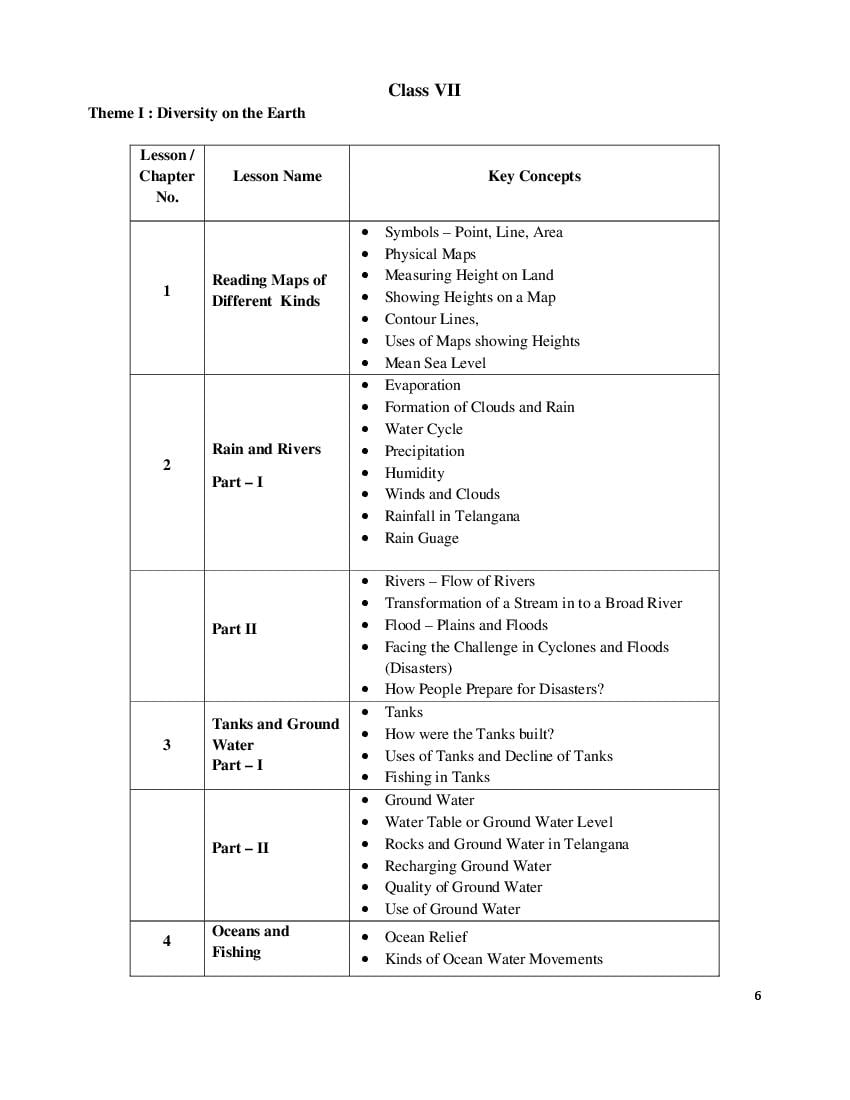
Theme I : Diversity on the Earth
Chapter Lesson Name Key Concepts
No.
• Symbols – Point, Line, Area
• Physical Maps
Reading Maps of • Measuring Height on Land
1 • Showing Heights on a Map
Different Kinds
• Contour Lines,
• Uses of Maps showing Heights
• Mean Sea Level
• Evaporation
• Formation of Clouds and Rain
• Water Cycle
Rain and Rivers • Precipitation
2 • Humidity
Part – I
• Winds and Clouds
• Rainfall in Telangana
• Rain Guage
• Rivers – Flow of Rivers
• Transformation of a Stream in to a Broad River
Part II • Flood – Plains and Floods
• Facing the Challenge in Cyclones and Floods
(Disasters)
• How People Prepare for Disasters?
• Tanks
Tanks and Ground
• How were the Tanks built?
3 Water
• Uses of Tanks and Decline of Tanks
Part – I
• Fishing in Tanks
• Ground Water
• Water Table or Ground Water Level
Part – II • Rocks and Ground Water in Telangana
• Recharging Ground Water
• Quality of Ground Water
• Use of Ground Water
Oceans and • Ocean Relief
4
Fishing • Kinds of Ocean Water Movements
6
Page 2
No.
Part - I - Waves
- Currents
- Tides
• Fishing Village on the Coastal Plains
• Fishing
Part – II • Nets
• Agriculture and Animal Husbandry
• Salinity and Drinking Water
• Social Life
• Location of Europe
• Mountains, Plains and Rivers
• Peninsulas, Islands and Bays
• Climate, Distance from the Equator
• The Atlantic Ocean – Its Influence
• Westerlies
• Warm Ocean Currents
• Western Europe: Showers all the year round
• Mediterranean Climate in Southern Europe
• Land, Climate and Agriculture
• Discovery of Sea Routes
Europe - Industrial Revolution in Europe
5
• Introduction
• Mountains, Plains and Plateaus
• Climate
• The Four Seasons and Agriculture
• Winter
• Spring
• Summer
• Autumn
• Animal Rearing and Fodder Crops
• French Farms – Modern Agriculture
• Minerals and Industries
• Sources of Energy and Industrialization
7
Page 3
No.
• Africa – A Vast Plateau
• Climate
• Regions with Heavy, Moderate and Scanty Rainfall
• The People of Africa
• The African Coast
• Slave Trade
• European Colonies
• Independent Africa
• Seasons
Africa • Natural Vegetation of Nigeria
6
• Mangrove Forests
• Equatorial Forests
• The Savanna
• Natural Regions of Nigeria
• People
• Agriculture
• Crops and Plantations of South Nigeria
• Agriculture and Animal Husbandry in Northern
Nigeria
• Mineral Oil
Theme – II : Production, Exchange and Livelihoods
Handicrafts and • Polaiah - Basket Maker of Andugula
7 Handlooms • Urban Slum – Basket Makers
Part - I
• Handloom Weavers – Pochampally
• Stages of Weaving Saree
Part – II - Dyeing yarn
- Warp and Weft
• Weaver’s Problems and Cooperative Societies
• Increasing control of Traders
Industrial • Beginning of Industrial Revolution 1750-1850 A.D.
8 • James Watt’s Invention
Revolution
• Factory System of Production
• The Experience of a 19th Century Child Worker
8
Page 4
No.
• Inside Early factories
• Sources of Energy and Industrial Development
• Transport Revolution
• Trade in Industrial Products
- Urbanization and Slums
• Paper Mills in Telangana
• Raw Materials
Production in a • Paper Mills and Disappearance of Bamboo
9 Factory – A Paper • Process of Paper making
Mill • Selling the Paper
• Working in Paper Mill
• Ownership of the Paper Mill
• Paper mills – Pollution – Control
• Transport System in Telangana
- Road ways
- Railways
- Airways
Importance of - Waterways
10 • Use of Roads for production and Sale of Goods
Transport System
• Employment in Transport activities
• Transport Services and Choices
• Congestion and Pollution
• Travel in Safe way
• Road Safety Week
Theme – III : Political Systems and Governance
• The Emergence of New Dynasties
New Kings and • Prashastis and Land Grants
11 Kingdoms - Part – • Administration in the Kingdoms
I • Warfare for Wealth
• Mohmud Ghazni
• Chahamanas
• The Cholas
• From Uraiyur to Thanjavur
Part – II • Splendid Temples and Bronze Sculpture
• Agriculture and Irrigation
• Administration of the Empire
9
Page 5
No.
• Types of Land
• Inscriptions and Texts
• Arose of the Kakatiya Kingdom in Warangal
• Important Kakatiya Rulers
The Kakatiyas – • Rudradeva
12 Emergence of a • Rudrama Devi
Regional Kingdom • Nayankara System
• Encouragement to Agriculture and Temples
• Trade
• The End of the Kakatiyas
• Foundation of Vijayanagara Empire
• Some Important Kings of Vijayanagara
• The City of Vijayanagara
The Kings of • Armies and Military Leaders
13 • ‘Captains of the Troops’ – The Amaranayakas
Vijayanagara
• Amaranayakas and Agriculture
• Trade and Cavalry
• Krishnadeva Raya – The Ruler
• Golkonda – Kutubshahis
• Who were the Mughals?
• Important Mughal Emperors – Major Campaigns
and Events
• Mughal Relations with other Rulers
14 Mughal Empire • Mansabdars and Jagirdars
• Zabt and Zamindars
• A closer look - Akber’s Policies
• Sulh – i – kul
• The Mughal Empire in the 17th Century and after
• Asafjahis of Hyderabad
• East India Company
• Mercantilism
• Armed Traders
• Growing European Interference in the Kingdoms of
Establishment of India
15 British Empire in • Misuse of Company’s Power
India • The English Impose their Rule
• Discontent with English Rule
• The Revolt of 1857 and Spreads
• Every Village in Revolt
• The Revolt is Suppressed
• After the Revolt
10
Page 6
No.
• Hyderabad State and British
16 Making of Laws in • Our Government after Independence
the State Assembly • Government make Acts for the benefit of people
• Legislative Assembly
• Assembly Constituency
• Election of MLA
• Formation of Government
• Council of Ministers
• The State Assembly
• The Legislative Council – System of Reservation
and Reserved Constituencies
• Governor
• The Making of Laws
• Discussions in the Assembly
• We have Government at District level also
• Functions of the office of District Collector and
Implementation of Magistrate of Nallavaram
17 Laws in the • Tahasildar (MRO) and Village Revenue Officers
District • How Laws of Implemented
- A.P. Water, Land and Trees Protection Act.
2002
Theme – IV : Social Organization and Inequities
• Caste Discrimination
Caste • Cast discrimination faced by Dr. B.R. Ambedkar
Discrimination and • Caste system during vedic period
18 • Striving for Equality
the Struggle for
Equality • Depressed classes – B.S. Venkat Rao
• Constitution – Government
• Programmes for equal opportunities
• Working as ‘Permanent Worker’s in Factories’
- Trade Union
Livelihood and • KRS Medicines Factory
19 Struggles of • Working on Construction Sites and Brick Kilns
Urban Workers • Ensuring Workers Rights – A Global Concern
• Informal Work and Workers in Towns
• Self Employed Women’s Association (SEWA)
11
Page 7
No.
Theme – V : Religion and Society
• Folk worship
- Folk gods and Goddesses
• Village deities
• Community Worship of Folk Deities
- Medaram Jathara – The Story
• Moharram (Peerila) and Urs
20 Folk – Religion - Jahangir Peer Dargah – A Symbol of Religious
Tolerance
• Bonalu
• The antiquity of Folk Traditions
• The intermixing of Village deities and High
Religious traditions
• Folk Wisdom and Higher Religion
• The Philosophy and Bhakti
• Basavanna’s Virashaivism
• The Saints of Maharashtra
• Nathpanthis, Siddhas and Yogis
• Islam and Sufism
Devotional Paths
21 • New Religious Developments in India
to the Divine
- Bammera Potana
- Thallapaka Annamacharya
- Chaitanya Mahaprabhu
- Kancharla Gopanna
- Tulsidas
• A Closer Look : Kabir and Baba Gurunanak
Theme – VI : Culture and Communication
• Our Kings and Rulers built different structural
monuments
• Engineering Skills and Construction
Rulers and • Temple Construction in the Early Eleventh Century
22 - A new way of building
Buildings
• Building Temples, Mosques and Tanks
• Why were Temples destroyed?
• Imperial Style of the Vijayanagara Period
• Gardens, Tombs and Forts
***
12