UGC NET 2021 Question Paper Folk Literature
Finished viewing? Save it for later —
Download UGC NET 2021 Question Paper Folk Literature (PDF · 92 pages)About UGC NET 2021 Question Paper Folk Literature
UGC NET 2021 Question Paper Folk Literature is available here for free download. Published by NTA for UGC NET, this question paper can be viewed online or downloaded as a PDF (92 pages). Candidates preparing for UGC NET can use UGC NET 2021 Question Paper Folk Literature to understand the exam pattern, the type of questions asked, and the overall difficulty level.
Frequently Asked Questions
How can I download UGC NET 2021 Question Paper Folk Literature?
Open this page and click the Download button to save UGC NET 2021 Question Paper Folk Literature as a PDF. It is completely free on AglaSem Docs.
Is UGC NET 2021 Question Paper Folk Literature free to download?
Yes. UGC NET 2021 Question Paper Folk Literature can be viewed online and downloaded as a PDF free of cost on AglaSem Docs.
How many pages does UGC NET 2021 Question Paper Folk Literature have?
UGC NET 2021 Question Paper Folk Literature contains 92 pages, which you can read online or download together as a single PDF.
Where can I find more UGC NET study material?
You can find more UGC NET question papers, sample papers, syllabus, and answer keys on AglaSem Docs.
UGC NET 2021 Question Paper Folk Literature – Text
Read the full text of this question paper below — useful to quickly search, copy and reference the content online without downloading the PDF.
📄 View text version (92 pages)
Page 1
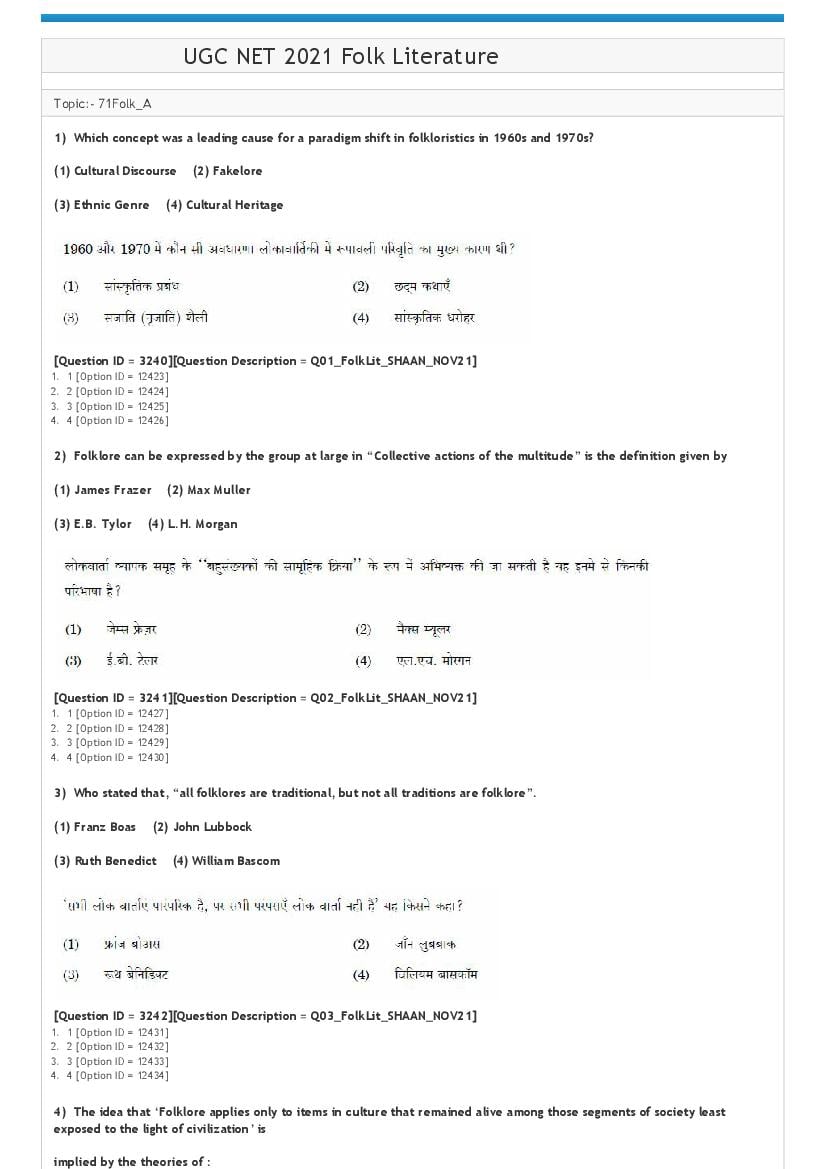
Topic:‐ 71Folk_A
1) Which concept was a leading cause for a paradigm shift in folkloristics in 1960s and 1970s?
(1) Cultural Discourse (2) Fakelore
(3) Ethnic Genre (4) Cultural Heritage
[Question ID = 3240][Question Description = Q01_FolkLit_SHAAN_NOV21]
1. 1 [Option ID = 12423]
2. 2 [Option ID = 12424]
3. 3 [Option ID = 12425]
4. 4 [Option ID = 12426]
2) Folklore can be expressed by the group at large in “Collective actions of the multitude” is the definition given by
(1) James Frazer (2) Max Muller
(3) E.B. Tylor (4) L.H. Morgan
[Question ID = 3241][Question Description = Q02_FolkLit_SHAAN_NOV21]
1. 1 [Option ID = 12427]
2. 2 [Option ID = 12428]
3. 3 [Option ID = 12429]
4. 4 [Option ID = 12430]
3) Who stated that, “all folklores are traditional, but not all traditions are folklore”.
(1) Franz Boas (2) John Lubbock
(3) Ruth Benedict (4) William Bascom
[Question ID = 3242][Question Description = Q03_FolkLit_SHAAN_NOV21]
1. 1 [Option ID = 12431]
2. 2 [Option ID = 12432]
3. 3 [Option ID = 12433]
4. 4 [Option ID = 12434]
4) The idea that ‘Folklore applies only to items in culture that remained alive among those segments of society least
exposed to the light of civilization’ is
implied by the theories of :
Page 2
(3) Performance theories (4) Structural theories
[Question ID = 3243][Question Description = Q04_FolkLit_SHAAN_NOV21]
1. 1 [Option ID = 12435]
2. 2 [Option ID = 12436]
3. 3 [Option ID = 12437]
4. 4 [Option ID = 12438]
5) In a collection of folklore, who advised an editor of a journal to give story in the ‘ipsissima verba’ of the story teller to
protect its autochthonic nature?
(1) Wilhelm Mannhardt (2) Alan Dundes
(3) Don Ben‐Amos (4) Max Muller
[Question ID = 3244][Question Description = Q05_FolkLit_SHAAN_NOV21]
1. 1 [Option ID = 12439]
2. 2 [Option ID = 12440]
3. 3 [Option ID = 12441]
4. 4 [Option ID = 12442]
6) In folkloristics, the concept of ‘folk’ under globalization is associated with :
(1) Literate Communities (2) Imagined Communities
(3) Cyborg Communities (4) Liminal Communities
[Question ID = 3245][Question Description = Q06_FolkLit_SHAAN_NOV21]
1. 1 [Option ID = 12443]
2. 2 [Option ID = 12444]
3. 3 [Option ID = 12445]
4. 4 [Option ID = 12446]
7) The American Evolutionary School propagated by John Wesley Powell addressed the fourth stage of development as:
(1) Enlightenment (2) Industrialization
(3) Americanization (4) Modernization
Page 3
1. 1 [Option ID = 12447]
2. 2 [Option ID = 12448]
3. 3 [Option ID = 12449]
4. 4 [Option ID = 12450]
8) Omens and Superstitions of Southern India’ is authored by :
(1) David Kinsely (2) William Crooke
(3) Edgar Thurston (4) Charles E. Grover
[Question ID = 3247][Question Description = Q08_FolkLit_SHAAN_NOV21]
[Option ID = 12451]
[Option ID = 12452]
[Option ID = 12453]
[Option ID = 12454]
9) 'Myth is to be read literally, and treated as an explanation of certain phenomena” is the view of :
(1) Levi‐Strauss (2) Malinowski
(3) Carl Jung (4) J.G. Frazer
[Question ID = 3248][Question Description = Q09_FolkLit_SHAAN_NOV21]
[Option ID = 12455]
[Option ID = 12456]
[Option ID = 12457]
[Option ID = 12458]
10) In his ‘Morphology’, Propp selected tales which are commonly referred to in English as ‘Fairy Tales’, but they were
classified earlier by Antti Aarne as:
(1) Tales of Magic (2) Wonder Tales
(3) Fables (4) Catch Tales
Page 4
1. 1 [Option ID = 12459]
2. 2 [Option ID = 12460]
3. 3 [Option ID = 12461]
4. 4 [Option ID = 12462]
11) In Narratology, a term used by A.J. Greimas to describe the paired role as common to all stories is:
(1) Actant (2) Adage
(3) Agitprop (4) Agon
[Question ID = 3250][Question Description = Q11_FolkLit_SHAAN_NOV21]
1. 1 [Option ID = 12463]
2. 2 [Option ID = 12464]
3. 3 [Option ID = 12465]
4. 4 [Option ID = 12466]
12) In the traditional sense, ‘Distinct and Self‐defined literary types’ are considered as :
(1) Novels (2) Epics
(3) Genres (4) Grand Narratives
[Question ID = 3251][Question Description = Q12_FolkLit_SHAAN_NOV21]
1. 1 [Option ID = 12467]
2. 2 [Option ID = 12468]
3. 3 [Option ID = 12469]
4. 4 [Option ID = 12470]
13) Comparative method in folkloristics is the contribution of :
(1) Philosophy (2) Functionalism
(3) Philology (4) Structuralism
[Question ID = 3252][Question Description = Q13_FolkLit_SHAAN_NOV21]
1. 1 [Option ID = 12471]
2. 2 [Option ID = 12472]
3. 3 [Option ID = 12473]
4. 4 [Option ID = 12474]
14) The belief in indwelling spirits inherent in people, animals, plants or even lifeless things, often presented in
personalized or anthro‐morphized images is proposed as the theory of :
Page 5
(3) Polytheism (4) Animism
[Question ID = 3253][Question Description = Q14_FolkLit_SHAAN_NOV21]
1. 1 [Option ID = 12475]
2. 2 [Option ID = 12476]
3. 3 [Option ID = 12477]
4. 4 [Option ID = 12478]
15) The American scholars prominent in the development of Indexes essential to the Historic‐Geographic method are :
(1) Franz Boas and Roger Abrahams (2) Wolfgang Mieder and Richard Dorson
(3) Stith Thomson and Archer Taylor (4) Axel Olrik and Julius Krohn
[Question ID = 3254][Question Description = Q15_FolkLit_SHAAN_NOV21]
1. 1 [Option ID = 12479]
2. 2 [Option ID = 12480]
3. 3 [Option ID = 12481]
4. 4 [Option ID = 12482]
16) Who defined “folklore as, the entire body of ancient popular beliefs, customs and traditions which have survived
among the less educated of civilized societies”?
(1) Felix Onias (2) John L. Mish
(3) Warren E. Roberts (4) Alex Olrik
[Question ID = 3256][Question Description = Q17_FolkLit_SHAAN_NOV21]
1. 1 [Option ID = 12487]
2. 2 [Option ID = 12488]
3. 3 [Option ID = 12489]
4. 4 [Option ID = 12490]
17) For Giambattista Vico, the “Mental language” manifests itself as man’s universal capacity to formulate :
(1) Functions (2) Structures
(3) Oral Formulaic (4) Performance
Page 6
[Option ID = 12491]
[Option ID = 12492]
[Option ID = 12493]
[Option ID = 12494]
18) Saussure’s concept of ‘langue’ is related to the study of :
(1) Synchronic (2) Syntagmatic
(3) Diachronic (4) Dialectics
[Question ID = 3258][Question Description = Q19_FolkLit_SHAAN_NOV21]
1. 1 [Option ID = 12495]
2. 2 [Option ID = 12496]
3. 3 [Option ID = 12497]
4. 4 [Option ID = 12498]
19) Malinowski argued that the basic function of social system rests on the principle of :
(1) Self‐satisfaction of basic needs (2) Social Contract
(3) Self‐preservation of basic needs (4) Social Solidarity
[Question ID = 3259][Question Description = Q20_FolkLit_SHAAN_NOV21]
[Option ID = 12499]
[Option ID = 12500]
[Option ID = 12501]
[Option ID = 12502]
20) In Psychoanalysis, inner conscience is equated with :
(1) Ego (2) Unconscious
(3) Sub‐conscious (4) Superego
Page 7
[Option ID = 12503]
[Option ID = 12504]
[Option ID = 12505]
[Option ID = 12506]
21) 'Everyday life : A poetics of Vernacular practices” emphasizes ‘everyday‐ness’, including aspects of sociability and
goodwill. This concept is initiated by :
(1) Erving Goffman (2) Roger Abrahams
(3) Richard Dorson (4) Clifford Geertz
[Question ID = 3261][Question Description = Q22_FolkLit_SHAAN_NOV21]
[Option ID = 12507]
[Option ID = 12508]
[Option ID = 12509]
[Option ID = 12510]
22) The idea of study as a kind of hermeneutic practice concerned with elicit narration of human social action in their
context as interpreted by the actors is termed as:
(1) Symbolic psychology (2) Emic description
(3) Thick description (4) Folkloristics
[Question ID = 3262][Question Description = Q23_FolkLit_SHAAN_NOV21]
[Option ID = 12511]
[Option ID = 12512]
[Option ID = 12513]
[Option ID = 12514]
23) One of the first sociolinguists who pioneered the connection between speech and social relations placing at the centre
the ‘Performative turn’ within social science is:
(1) Richard Baumen (2) Erving Goffman
Page 8
[Question ID = 3263][Question Description = Q24_FolkLit_SHAAN_NOV21]
1. 1 [Option ID = 12515]
2. 2 [Option ID = 12516]
3. 3 [Option ID = 12517]
4. 4 [Option ID = 12518]
24) According to Bauman, what does ‘performance’ mean in the verbal art tradition?
(1) Artistic action and interaction (2) Artistic behaviour and values
(3) Artistic telling and re‐telling (4) Artistic watching and listening
[Question ID = 3264][Question Description = Q25_FolkLit_SHAAN_NOV21]
1. 1 [Option ID = 12519]
2. 2 [Option ID = 12520]
3. 3 [Option ID = 12521]
4. 4 [Option ID = 12522]
25) Second‐hand mediation and presentation of folk culture’ is defined as:
(1) Fakelore (2) Public Folklore
(3) Applied Folklore (4) Folklorismus
[Question ID = 3265][Question Description = Q26_FolkLit_SHAAN_NOV21]
1. 1 [Option ID = 12523]
2. 2 [Option ID = 12524]
3. 3 [Option ID = 12525]
4. 4 [Option ID = 12526]
26) Folklorism is defined as a ‘process of adaptation, reproduction and transformation of folklore’ by :
(1) Viktor Gusev (2) Felix Oinas
(3) Blogs (4) Instagram
[Question ID = 3266][Question Description = Q27_FolkLit_SHAAN_NOV21]
Page 9
[Option ID = 12528]
[Option ID = 12529]
[Option ID = 12530]
27) When ‘new folklorism studies’ were stimulated by Soviet folklorists, they favoured the term ‐
(1) Folk Art (2) Folk Creativity
(3) Public Folklore ' (4) Applied Folklor
[Question ID = 3267][Question Description = Q28_FolkLit_SHAAN_NOV21]
1. 1 [Option ID = 12531]
2. 2 [Option ID = 12532]
3. 3 [Option ID = 12533]
4. 4 [Option ID = 12534]
28) 29. Internet functions more or less as a worldwide digital library and it impacts traditional forms like story telling
through :
(1) Android Tablets (2) Tik Tok
(3) Blogs (4) Instagram
[Question ID = 3268][Question Description = Q29_FolkLit_SHAAN_NOV21]
[Option ID = 12535]
[Option ID = 12536]
[Option ID = 12537]
[Option ID = 12538]
29) The term ‘Glocalization’ coined by Roland Robertson is influenced by the concept of:
(1) Kolkhoz (2) Dochakuku
(3) Nongye (4) Popu
Page 10
[Option ID = 12539]
[Option ID = 12540]
[Option ID = 12541]
[Option ID = 12542]
30) 31. Hannerz’s model of the global ecumene founded on the dominant metaphor is known as:
(1) Heterogenization (2) Hybridization
(3) Creolization (4) Homogenization
[Question ID = 3270][Question Description = Q31_FolkLit_SHAAN_NOV21]
[Option ID = 12543]
[Option ID = 12544]
[Option ID = 12545]
[Option ID = 12546]
31) The concept of ‘Global melange culture’ through processes of cultural mixing is propounded by:
(1) Anthony Giddens (2) David Harvey
(3) Stuart Hall &nbsP; (4) Jan Nederveen Pieterse
[Question ID = 3271][Question Description = Q32_FolkLit_SHAAN_NOV21]
[Option ID = 12547]
[Option ID = 12548]
[Option ID = 12549]
[Option ID = 12550]
32) Having a dramatic form of entertainment with subtle social criticism laced through humour as a part of ritual offering
made to Goddess Amba, is the speciality of the following folk theatre tradition:
(1) Garba (2) Tippani
(3) Dandiya Raas (4) Bhavai
Page 11
[Option ID = 12555]
[Option ID = 12556]
[Option ID = 12557]
[Option ID = 12558]
33) Name of the dance of Lord Shiva that was performed when the Lord got enraged with Sati’s death, also known as the
Dance of Destruction in South India, is :
(1) Kaavadi Aatam (2) Veeranatyam
(3) Yakshaganam (4) Tappeta Gullu
[Question ID = 3274][Question Description = Q35_FolkLit_SHAAN_NOV21]
1. 1 [Option ID = 12559]
2. 2 [Option ID = 12560]
3. 3 [Option ID = 12561]
4. 4 [Option ID = 12562]
34) The ‘Researcher tends to remain objectively separated from the subject matter’ is the type of research known as:
(1) Longitudinal (2) Quantitative
(3) Qualitative ; (4) Enthnographic
[Question ID = 3275][Question Description = Q36_FolkLit_SHAAN_NOV21]
1. 1 [Option ID = 12563]
2. 2 [Option ID = 12564]
3. 3 [Option ID = 12565]
4. 4 [Option ID = 12566]
35) In Ethnographic research, which involves the researcher’s self in making meaning, the significant issues that arise are
concerned with :
(1) Patent right (2) Copyright
(3) Ethical issues (4) Reprobate
Page 12
[Option ID = 12567]
[Option ID = 12568]
[Option ID = 12569]
[Option ID = 12570]
36) The idea that cultural phenomena are different from those typically investigated in the physical sciences resulted in
the development of the following research method:
(1) Applied (2) Ethnography
(3) Quantitative (4) Empirical
[Question ID = 3278][Question Description = Q39_FolkLit_SHAAN_NOV21]
[Option ID = 12575]
[Option ID = 12576]
[Option ID = 12577]
[Option ID = 12578]
37) In the field of research into oral epic forms, Lauri Honko’s approach shifted the focus from the old literary theories to
new perspectives with a focus on the:
(A) Products of folklore
(B) Textualization process
(C) Producers of folklore
(D) Context to text
Choose the most appropriate answer from the options given below:
(1) (A) and (C) only (2) (B) and (C) only
(3) (C) and (D) only (4) (D) and (A) only
Page 13
1. 1 [Option ID = 12583]
2. 2 [Option ID = 12584]
3. 3 [Option ID = 12585]
4. 4 [Option ID = 12586]
38) Van Gennep emphasized that the phenomena of culture should be examined based on:
(A) Context
(B) Theatrical paradigm
(C) Natural environment
(D) Life course paradigm
Choose the most appropriate answer from the options given below:
(1) (A) and (B) only (2) (A) and (C) only
(3) (C) and (B) only (4) (D) and (A) only
[Question ID = 3281][Question Description = Q42_FolkLit_SHAAN_NOV21]
[Option ID = 12587]
[Option ID = 12588]
[Option ID = 12589]
[Option ID = 12590]
39) Robert Redfield argued that the ‘folk society’ is distinguished by specific characteristics such as:
(A) Isolated
(B) Static
Page 14
(D) Rural
(E) Self‐Sufficient
Choose the most appropriate answer from the options given below:
(1) (B), (C) and (E) only (2) (A), (C) and (E) only
(3) (D), (B) and (C) only (4) (A), (B) and (E) only
[Question ID = 3282][Question Description = Q43_FolkLit_SHAAN_NOV21]
[Option ID = 12591]
[Option ID = 12592]
[Option ID = 12593]
[Option ID = 12594]
40) 44. According to Walter Ong, in a primary oral culture, thought and expression tend to be driven by the
psychodynamics of :
(A) Grammatical rather than morphological
(B) Additive rather than subordinative
(C) Taciturnity rather then rhetoric
(D) Aggregative rather than analytic
Choose the most appropriate answer from the options given below:
(1) (A) and (C) only (2) (B) and (D) only
(3) (C) and (B) only (4) (D) and (A) only
Page 15
1. 1 [Option ID = 12595]
2. 2 [Option ID = 12596]
3. 3 [Option ID = 12597]
4. 4 [Option ID = 12598]
41) Subaltern studies have been diversely influenced by the scholarship of:
(A) Anil Seal
(B) Louis Althusser
(C) Edward Said
(D) Raymond Williams
Choose the most appropriate answer from the options given below:
1) (A) and (D) only (2) (B) and (C) only
(3) (C) and (D) only (4) (A) and (C) only
[Question ID = 3284][Question Description = Q45_FolkLit_SHAAN_NOV21]
1. 1 [Option ID = 12599]
2. 2 [Option ID = 12600]
3. 3 [Option ID = 12601]
4. 4 [Option ID = 12602]
42) Formation of ‘Diasporas’ considers the heterogenity of the diasporic experiences of the members with attributions
relating to :
Page 16
(B) Nation and Native
(C) Gender and Ethnicityv
(D) Race and Classv
Choose the most appropriate answer from the options given below:
(1) (A) and (B) only (2) (B) and (D) only
(3) (C) and (D) only (4) (C) and (A) only
[Question ID = 3285][Question Description = Q46_FolkLit_SHAAN_NOV21]
1. 1 [Option ID = 12603]
2. 2 [Option ID = 12604]
3. 3 [Option ID = 12605]
4. 4 [Option ID = 12606]
43) Alan Lomax’s ‘Cantometrics’ can be broadly grouped into the domains of:
(A) Performance event
(B) Vocal performance
(C) Enactment structure
(D) Song structure
Choose the correct answer from the options given below:
(1) (C) and (A) only (2) (A) and (B) only
(3) (B) and (C) only ; (4) (B) and (D) only
Page 17
1. 1 [Option ID = 12611]
2. 2 [Option ID = 12612]
3. 3 [Option ID = 12613]
4. 4 [Option ID = 12614]
44) In folk literature, a rhetorical device used as completely infeasible idea is known as :
(A) Adynation
(B) Hyperbole
(C) Allusion
(D) Illusion
Choose the correct answer from the options given below:
(1) (B) and (C) only (2) (A) and (B) only
(3) (C) and (D) only (4) (A) and (D) only
[Question ID = 3288][Question Description = Q49_FolkLit_SHAAN_NOV21]
[Option ID = 12615]
[Option ID = 12616]
[Option ID = 12617]
[Option ID = 12618]
45) According to Evans‐Pritchard, two versions of a dream theory of the origin of religion based on primitive cultures,
Page 18
(A) Somatic theory
(B) Ghost theory
(C) Soul theory
(D) Spiritual theory
Choose the correct answer from the options given below:
(1) (B) and (A) only (2) (C) and (A) only
(3) (B) and (C) only (4) (A) and (D) only
[Question ID = 3289][Question Description = Q50_FolkLit_SHAAN_NOV21]
1. 1 [Option ID = 12619]
2. 2 [Option ID = 12620]
3. 3 [Option ID = 12621]
4. 4 [Option ID = 12622]
46) The Historical‐Geographical method was influenced by the approaches of :
(A) Philology
(B) Phonology
(C) Andrew Lang
(D) Darwin
Choose the correct answer from the options given below:
(1) (A) and (D) only
(2) (A) and (B) only
(3) (C) and (D) only
(4) (B) and (D) only
Page 19
[Option ID = 12623]
[Option ID = 12624]
[Option ID = 12625]
[Option ID = 12626]
47) According to Tristram Potter Coffin (1977), American Ballads are different from British Ballads as they :
(A) Concentrate on exposition and have supernatural motifs
(B) Tend to be shorter and more lyrical
(C) Concentrate on the climax and have rationalistic motifs
(D) Tend to be complex and more poetic
Choose the most appropriate answer from the options given below:
(1) (B) and (A) only (2) (A) and (C) only
(3) (B) and (C) only (4) (D) and (A) only
[Question ID = 3292][Question Description = Q53_FolkLit_SHAAN_NOV21]
1. 1 [Option ID = 12631]
2. 2 [Option ID = 12632]
3. 3 [Option ID = 12633]
4. 4 [Option ID = 12634]
Page 20
(A) Subjective – love
(B) Ego – love
(C) Superego – love
(D) Object – love
Choose the most appropriate answer from the options given below:
(1) (B) and (D) only (2) (B) and (C) only
(3) (A) and (D) only (4) (A) and (C) only
[Question ID = 3294][Question Description = Q55_FolkLit_SHAAN_NOV21]
1. 1 [Option ID = 12639]
2. 2 [Option ID = 12640]
3. 3 [Option ID = 12641]
4. 4 [Option ID = 12642]
49) According to Van Gennep, a common component of the traditional phase of initiation rites includes :
(A) Family mutilation
(B) Genital mutilation
(C) Tattooing
(D) Body art
Choose the most appropriate answer from the options given below :
(1) (B) and (D) only
(2) (B) and (C) only
(3) (A) and (C) only
(4) (A) and (D) only
Page 21
[Option ID = 12643]
[Option ID = 12644]
[Option ID = 12645]
[Option ID = 12646]
50) Turner suggests that we should distinguish three levels of symbolic meaning in the study of cultural practices as :
(A) Exegetical meaning
(B) Operational meaning
(C) Positional meaning
(D) Deeper meaning
(E) Literal meaning
Choose the most appropriate answer from the options given below:
(1) (A), (B) and (C) only (2) (A), (B) and (D) only
(3) (B), (C) and (D) only (4) (A), (B) and (E) only
Page 22
[Option ID = 12647]
[Option ID = 12648]
[Option ID = 12649]
[Option ID = 12650]
51) When New Folklorism studies were stimulated, the Communist folklorists favoured the terms?
(A) Folk creatvity
(B) New Media Creativity
(C) Contemporary Folklore
(D) Post‐modern folklore
Choose the most appropriate answer from the options given below:
(1) (A) and (D) only (2) (B) and (C) only
(3) (A) and (C) only (4) (C) and (D) only
[Question ID = 3297][Question Description = Q58_FolkLit_SHAAN_NOV21]
[Option ID = 12651]
[Option ID = 12652]
[Option ID = 12653]
[Option ID = 12654]
52) New Media Platforms are commonly considered to include :
(A) Linked In
(B) Broadcasts
Page 23
(D) Reddit
Choose the most appropriate answer from the options given below:
(1) (A), (B) and (C) only (2) (B), (C) and (D) only
(3) (A), (C) and (D) only (4) (A), (B) and (D) only
[Question ID = 3298][Question Description = Q59_FolkLit_SHAAN_NOV21]
[Option ID = 12655]
[Option ID = 12656]
[Option ID = 12657]
[Option ID = 12658]
53) Identify the scholars who linked folklorism to the processes of modernization and globalization :
(A) Konard Kostlin
(B) Felix J. Oinas
(C) Yuriy M. Sokolov
(D) Hermann Bausinger
Choose the most appropriate answer from the options given below:
(1) (A) and (D) only (2) (B) and (C) only
(3) (C) and (D) only (4) (B) and (D) only
Page 24
[Option ID = 12659]
[Option ID = 12660]
[Option ID = 12661]
[Option ID = 12662]
54) “McWorld as a totalizing force intent on Americanizing everyone and everything in its path” is the view expressed by :
(A) Benjamin R. Barber
(B) Benedic Anderson
(C) Stuart Hall
(D) Mike Featherstone
Choose the most appropriate answer from the options given below:
(1) (B) and (D) only (2) (A) and (B) only
(3) (A) and (C) only (4) (C) and (D) only
[Question ID = 3300][Question Description = Q61_FolkLit_SHAAN_NOV21]
1. 1 [Option ID = 12663]
2. 2 [Option ID = 12664]
Page 25
4. 4 [Option ID = 12666]
55) Two methodological approaches which provide a basic foundation for qualitative approach in the development of social
science research are :
(A) Action Research
(B) Ethnography Research
(C) Case Study Research
(D) Experimental Research
Choose the most appropriate answer from the options given below:
(1) (B) and (D) only (2) (A) and (C) only
(3) (B) and (C) only (4) (C) and (D) only
[Question ID = 3304][Question Description = Q65_FolkLit_SHAAN_NOV21]
1. 1 [Option ID = 12679]
2. 2 [Option ID = 12680]
3. 3 [Option ID = 12681]
4. 4 [Option ID = 12682]
56) Match List I with List II :
List I List II
Scholars Area of study
(A) Hanna de Bruim (I) Telugu Folklore
(B) Gene H Roghair (II) Kannada Folklore
(C) Benjamin L. Rice (III) Malayalam Folklore
(D) Phillip Jarrill (IV) Tamil Folklore
Choose the correct answer from the options given below:
(1) (A) – (III), (B) – (IV), (C) – (II), (D) – (I)
(2) (A) – (IV), (B) – (II), (C) – (III), (D) – (I)
(A) – (II), (B) – (I), (C) – (III), (D) –
(3)
(IV)
(A) – (IV), (B) – (I), (C) – (II), (D) –
(4)
(III)
Page 26
[Option ID = 12687]
[Option ID = 12688]
[Option ID = 12689]
[Option ID = 12690]
57) Match List I with List II :
List I List II
Concept Meaning
(A) Acryology (I) A composition to be sung
(B) Ditty (II) The jargon of slang
(C) Cant (III) Misplaced action, scene
(D) Anachorism (IV) Obsolete diction
Choose the correct answer from the options given below:
(A) – (IV), (B) – (II), (C) – (I), (D) –
(1)
(III)
(A) – (IV), (B) – (I), (C) – (II), (D) –
(2)
(III)
(A) – (III), (B) – (II), (C) – (I), (D) –
(3)
(IV)
(4) (A) – (IV), (B) – (III), (C) – (II), (D) – (I)
Page 27
[Option ID = 12691]
[Option ID = 12692]
[Option ID = 12693]
[Option ID = 12694]
58) Match List I with List II :
List I List II
Romantic Nationalists Country of Origin
(A) R. Kreutzwald (I) German
(B) Wilhelm Jordan (II) Russia
(C) Krisjanis Barnos (III) Estonia
(D) N. Rybrikov (IV) Latvia
Choose the correct answer from the options given below:
(A) – (I), (B) – (III), (C) – (II), (D) –
(1)
(IV)
(2) (A) – (IV), (B) – (III), (C) – (II), (D) – (I)
(A) – (III), (B) – (I), (C) – (IV), (D) –
(3)
(II)
(A) – (I), (B) – (II), (C) – (III), (D) –
(4)
(IV)
[Question ID = 3308][Question Description = Q69_FolkLit_SHAAN_NOV21]
[Option ID = 12695]
[Option ID = 12696]
[Option ID = 12697]
Page 28
59) Match List I with List II :
List I List II
Approaches
Books
(A) The hero of tradition (I) Psychoanalytical
(B) The myth of the birth of the hero (II) Rites of passage
(C) The hero with thousand faces (III) Analytical psychology
(D) Recurring themes in myth and
(IV) Structural
mythmaking
Choose the correct answer from the options given below:
(A) – (I), (B) – (IV), (C) – (II), (D) –
(1)
(III)
(A) – (III), (B) – (II), (C) – (I), (D) –
(2)
(IV)
(A) – (IV), (B) – (I), (C) – (II), (D) –
(3)
(III)
(A) – (III), (B) – (IV), (C) – (I), (D) –
(4)
(II)
[Question ID = 3309][Question Description = Q70_FolkLit_SHAAN_NOV21]
[Option ID = 12699]
[Option ID = 12700]
[Option ID = 12701]
[Option ID = 12702]
60) Match List I with List II :
List I List II
Scholars Concept
(A) Milton Singer (I) Total institution
(B) Erving Goffman (II) Rasaboxes Technique
(C) Richard Schechner (III) Folklore creolization
(D) Roger Abrahams (IV) Heterogenic centres
Page 29
(A) – (I), (B) – (II), (C) – (III), (D) –
(1)
(IV)
(A) – (IV), (B) – (I), (C) – (III), (D) –
(2)
(II)
(A) – (III), (B) – (IV), (C) – (I), (D) –
(3)
(II)
(A) – (IV), (B) – (I), (C) – (II), (D) –
(4)
(III)
[Question ID = 3310][Question Description = Q71_FolkLit_SHAAN_NOV21]
[Option ID = 12703]
[Option ID = 12704]
[Option ID = 12705]
[Option ID = 12706]
61) Match List I with List II :
List I List II
Concepts Propounders
(A) Aura (I) Catherine Besley
(B) Civil Society (II) Mikhaill Bakhtin
(C) Carnivalesque (III) Walter Benjamin
(D) Closure (IV) Antonia Gramsci
Choose the correct answer from the options given below:
(1) (A) – (II), (B) – (IV), (C) – (III), (D) – (I)
(A) – (I), (B) – (II), (C) – (III), (D) –
(2)
(IV)
(3) (A) – (IV), (B) – (III), (C) – (II), (D) – (I)
(4) (A) – (III), (B) – (IV), (C) – (II), (D) – (I)
Page 30
[Option ID = 12711]
[Option ID = 12712]
[Option ID = 12713]
[Option ID = 12714]
62) Match List I with List II :
List I List II
Indian State Cuisine
(A) Manipur (I) Jadoh
(B) Arunachal Pradesh (II) Chakhwi
(C) Tripura (III) Kangshoi
(D) Meghalaya (IV) Thukpa
Choose the correct answer from the options given below:
(1) (A) – (III), (B) – (IV), (C) – (II), (D) – (I)
(2) (A) – (IV), (B) – (III), (C) – (II), (D) – (I)
(A) – (I), (B) – (II), (C) – (IV), (D) –
(3)
(III)
(A) – (III), (B) – (II), (C) – (I), (D) –
(4)
(IV)
[Question ID = 3313][Question Description = Q74_FolkLit_SHAAN_NOV21]
Page 31
[Option ID = 12716]
[Option ID = 12717]
[Option ID = 12718]
63) Match List I with List II :
List I List II
Approaches
Practitioner
(A) Contextual (I) Ernest Jones
(B) Psychoanalytical (II) Arnold Van Gennep
(C) Philological (III) Erving Goffman
(D) Phenomenological (IV) Milman Parry
Choose the correct answer from the options given below:
(A) – (III), (B) – (I), (C) – (II), (D) –
(1)
(IV)
(2) (A) – (IV), (B) – (II), (C) – (III), (D) – (I)
(A) – (II), (B) – (I), (C) – (IV), (D) –
(3)
(III)
(A) – (I), (B) – (III), (C) – (II), (D) –
(4)
(IV)
[Question ID = 3314][Question Description = Q75_FolkLit_SHAAN_NOV21]
[Option ID = 12719]
[Option ID = 12720]
[Option ID = 12721]
[Option ID = 12722]
64) Sequence the development of concepts of folklore in chronological order :
(A) Cultural Capital
Page 32
(C) Binary oppositions
(D) Ethnography of speaking
Choose the correct answer from the options given below:
(1) (B), (D), (C), (A)
(2) (C), (B), (D), (A)
(3) (A), (B), (D), (C)
(4) (B), (C), (D), (A)
[Question ID = 3315][Question Description = Q76_FolkLit_SHAAN_NOV21]
[Option ID = 12723]
[Option ID = 12724]
[Option ID = 12725]
[Option ID = 12726]
65) Sequence the comparative philologists with their countries of origin from West to East :
(A) Filip Vezdin
(B) William Jones
(C) Franz Bopp
(D) Georges Dumezil
Choose the correct answer from the options given below:
(1) (D), (B), (A), (C)
(2) (C), (D), (B), (A)
(3) (A), (B), (C), (D)
(4) (B), (D), (A), (C)
Page 33
[Option ID = 12739]
[Option ID = 12740]
[Option ID = 12741]
[Option ID = 12742]
66) Arrange in sequence the scholars who worked on Rites of Passage?
(A) Maurice Bloch
(B) Van Gennep
(C) Edmund Leach
(D) Victor Turner
Choose the correct answer from the options given below:
(1) (C), (D), (B), (A)
(2) (B), (C), (D), (A)
(3) (B), (D), (C), (A)
(4) (A), (B), (D), (C)
Page 34
[Option ID = 12743]
[Option ID = 12744]
[Option ID = 12745]
[Option ID = 12746]
67) Arrange in sequence the concepts related to second life of folklore :
(A) Folklorismus
(B) Folorization
(C) Public Folklore
(D) Fakelore
Choose the correct answer from the options given below:
(1) (B), (D), (A), (C)
(2) (A), (D), (B), (C)
(3) (C), (B), (D), (A)
(4) (A), (D), (C), (B)
[Question ID = 3321][Question Description = Q82_FolkLit_SHAAN_NOV21]
[Option ID = 12747]
[Option ID = 12748]
[Option ID = 12749]
[Option ID = 12750]
68) Arrange in sequence the social movements in India :
(A) Jungle Bachao Andolan
(B) Chipko Movement
(C) Jan Lokpal Bill
Page 35
Choose the correct answer from the options given below:
(1) (B), (D), (C), (A)
(2) (C), (D), (B), (A)
(3) (B), (A), (D), (C)
(4) (C), (B), (D), (A)
[Question ID = 3322][Question Description = Q83_FolkLit_SHAAN_NOV21]
[Option ID = 12751]
[Option ID = 12752]
[Option ID = 12753]
[Option ID = 12754]
69) Arrange in sequence the ethnic cuisines of India from North to South :
(A) Kuzhi Paniyaram
(B) Kafuli
(C) Bhutte ka Kees
(D) Pootha Rekulu
Choose the correct answer from the options given below:
(1) (B), (C), (D), (A)
(2) (B), (D), (C), (A)
(3) (C), (B), (A), (D)
(4) (A), (B), (C), (D)
Page 36
[Option ID = 12755]
[Option ID = 12756]
[Option ID = 12757]
[Option ID = 12758]
70) Arrange in sequence the steps involved in preparation of research designs appropriate for a particular research
problem :
(A) Objectives of the research study
(B) Sample design
(C) Tools for data collection
(D) Methods of data collection
(E) Data analysis
Choose the correct answer from the options given below:
(1) (A), (C), (B), (D), (E)
(2) (A), (D), (B), (C), (E)
(3) (C), (B), (D), (A), (E)
(4) (E), (A), (B), (C), (D)
Page 37
[Option ID = 12759]
[Option ID = 12760]
[Option ID = 12761]
[Option ID = 12762]
71) Given below are two statements:
Assertion A : Like Propp, Levi Strauss had proposed a formula for the structure of narrative; but unlike Propp, his formula
was totally alegebraic involving ‘functions’ and ‘terms’.
Reason R : Levi Strauss contended that mythical thought always works from the awareness of oppositions towards their
progressive mediation.
In the light of the above statements, choose the correct answer from the options given below:
(1) Both A and R are true and R is the correct explanation of A
(2) Both A and R are true but R is NOT the correct explanation of A
(3) A is true but R is false
(4) A is false but R is true
[Question ID = 3325][Question Description = Q86_FolkLit_SHAAN_NOV21]
[Option ID = 12763]
[Option ID = 12764]
[Option ID = 12765]
[Option ID = 12766]
72) Given below are two statements:
Statement I : The study of folklore performance is grounded in the ethnographic descriptive tradition, hence, the search for
Page 38
Statement II : It is possible to describe a behaviour as universal without defining its biological foundation in the case of
cultural performance
In the light of the above statements, choose the correct answer from the options given below:
(1) Both Statement I and Statement II are true.
(2) Both Statement I and Statement II are false.
(3) Statement I is true but Statement II is false
(4) Statement I is false but Statement II is true
[Question ID = 3326][Question Description = Q87_FolkLit_SHAAN_NOV21]
[Option ID = 12767]
[Option ID = 12768]
[Option ID = 12769]
[Option ID = 12770]
73) . Given below are two statements:
Assertion A : Europeans were increasingly willing to deal with folklore ‘out of context’; i.e. with the ideological, political,
social and economic implications of applied
folklore.
Reason R : Folklore is commonly recorded as commercialized folklore and is manifested in an objectified form.
In the light of the above statements, choose the correct answer from the options given below:
(1) Both A and R are true and R is the correct explanation of A
(2) Both A and R are true but R is NOT the correct explanation of A
(3) A is true but R is false
(4) A is false but R is true
Page 39
[Option ID = 12771]
[Option ID = 12772]
[Option ID = 12773]
[Option ID = 12774]
74) Given below are two statements:
Statement I : Hypertext is a form of electronic writing that allows writers to link paragraphs or pages using computer –
mediated connections between discrete ideas.
Statement II : In shaping hypertext, its inventor, Ted Nelson’s fundamental insight was the notion that human thinking is
unilinear.
In the light of the above statements, choose the correct answer from the options given
below:
(1) Both Statement I and Statement II are true.
(2) Both Statement I and Statement II are false.
(3) Statement I is true but Statement II is false
(4) Statement I is false but Statement II is true
Page 40
[Option ID = 12775]
[Option ID = 12776]
[Option ID = 12777]
[Option ID = 12778]
75) Given below are two statements:
Assertion A : The cultural inferences arrived through ethnography grow from the interpretations of three primary sources :
what people say, what people do and the artifacts that they make and use.
Reason R : When fieldnotes, interviews and collected artifacts are separated from the social context in which they are
produced, the defining character of ethnography is lost.
In the light of the above statements, choose the correct answer from the options given below:
(1) Both A and R are true and R is the correct explanation of A
(2) Both A and R are true but R is NOT the correct explanation of A
(3) A is true but R is false
(4) A is false but R is true
[Question ID = 3329][Question Description = Q90_FolkLit_SHAAN_NOV21]
[Option ID = 12779]
[Option ID = 12780]
[Option ID = 12781]
[Option ID = 12782]
76) Who sought to discover the patterns and forms of the ritual of ‘earlyman’ from underlying literature?
(1) James Frazer (2) E.B. Tylor
(3) Theodor Benfry (4) Kaarle Krohn
Page 41
[Option ID = 12783]
[Option ID = 12784]
[Option ID = 12785]
[Option ID = 12786]
77) Dorson’s concept of ‘fakelore’ portrayed the following stories as not based on oral tradition but as literary fabrications:
(1) Paul Bunyan Stories (2) Cinderella stories
(3) John Bunyan stories (4) Aesop’s Fables
[Question ID = 3331][Question Description = Q33_FolkLit_SHAAN_NOV21]
1. 1 [Option ID = 12787]
2. 2 [Option ID = 12788]
3. 3 [Option ID = 12789]
4. 4 [Option ID = 12790]
78) Rich details of cultural scenes constructed as a method of writing culture is known as :
(1) Thick Description (2) Travelogues
(3) Field notes (4) Thin description
[Question ID = 3332][Question Description = Q38_FolkLit_SHAAN_NOV21]
1. 1 [Option ID = 12791]
2. 2 [Option ID = 12792]
3. 3 [Option ID = 12793]
4. 4 [Option ID = 12794]
79) Each and every item in the target groups in any given pilot study has an equal chance and probability of inclusion in
the sample. Such sample is known as:
(1) Deliberate sampling (2) Systematic sampling
(3) Stratified sampling (4) Random sampling
[Question ID = 3333][Question Description = Q40_FolkLit_SHAAN_NOV21]
1. 1 [Option ID = 12795]
Page 42
3. 3 [Option ID = 12797]
4. 4 [Option ID = 12798]
80) Richard Bauman’s ‘aesthetic of performance’ rests on the concepts such as :
(A) Mimesis
(B) Reflexivity
(C) Metacommunication
(D) Metaphysical presence
Choose the correct answer from the options given below:
(1) (B) and (C) only (2) (B) and (A) only
(3) (A) and (D) only (4) (C) and (D) only
[Question ID = 3334][Question Description = Q47_FolkLit_SHAAN_NOV21]
[Option ID = 12799]
[Option ID = 12800]
[Option ID = 12801]
[Option ID = 12802]
81) According to Johann Gottfield Herder, ‘Volkskunde’ or ‘Science of the Nation’ on which the cultural identity of a
people is contructed, is based on :
(A) Ethnic plays and popular dramas
(B) Household tales and proverbs
(C) Popular songs and ethnic values
(D) Fables and legends
Choose the most appropriate answer from the options given below:
(1) (A) and (B) only
(2) (B) and (C) only
(3) (B) and (D) only
Page 43
[Question ID = 3335][Question Description = Q52_FolkLit_SHAAN_NOV21]
[Option ID = 12803]
[Option ID = 12804]
[Option ID = 12805]
[Option ID = 12806]
82) According to Dundes, the advantage of the structural units of motifeme and allomotifs was that, they represent :
(A) Elements of motifs
(B) Elements of a story
(C) Story telling
(D) Narrator’s telling
Choose the most appropriate answer from the options given below:
(1) (B) and (C) only (2) (B) and (D) only
(3) (A) and (D) only (4) (C) and (D) only
Page 44
[Option ID = 12807]
[Option ID = 12808]
[Option ID = 12809]
[Option ID = 12810]
83) According to Jean Baudrillard, consumerism is linked to the shopping mall where consumers are seduced and stupefied
by the display and diversity due to :
(A) Autonomy of the signifier
(B) Hyperreality
(C) Autonomy of the sign
(D) Hyporeality
Choose the most appropriate answer from the options given below:
(1) (A) and (B) only (2) (C) and (D) only
(3) (D) and (B) only (4) (A) and (C) only
[Question ID = 3337][Question Description = Q62_FolkLit_SHAAN_NOV21]
1. 1 [Option ID = 12811]
2. 2 [Option ID = 12812]
3. 3 [Option ID = 12813]
4. 4 [Option ID = 12814]
84) The dialogues, costumes, ornaments, entry and foot movements are unique for the following theatre forms in India :
(A) Bhaona Ankiya Naat
(B) Chauvittu – Natakam
Page 45
(D) Jatra
(E) Cindu Yakshaganam
Choose the most appropriate answer from the options given below:
(1) (A), (B) and (C) only (2) (B), (C) and (D) only
(3) (C), (D) and (E) only (4) (A), (B) and (E) only
[Question ID = 3338][Question Description = Q63_FolkLit_SHAAN_NOV21]
1. 1 [Option ID = 12815]
2. 2 [Option ID = 12816]
3. 3 [Option ID = 12817]
4. 4 [Option ID = 12818]
85) Scholars who influenced the development of application of ethnography through a focus on social and cultural
characteristics of existing primitive societies are :
(A) Franz Boas
(B) Andrew Lang
(C) Branislaw Malinowski
(D) Radcliffe Brown
(E) Milton Singer
Choose the most appropriate answer from the options given below:
(1) (A), (B) and (C) only (2) (A), (C) and (D) only
(3) (C), (D) and (E) only (4) (A), (B) and (E) only
Page 46
1. 1 [Option ID = 12819]
2. 2 [Option ID = 12820]
3. 3 [Option ID = 12821]
4. 4 [Option ID = 12822]
86) Match List I with List II :
List I List II
Definition of Folklore Propounders
(A) As the learning of the People (I) Alexander H. Krappe
(B) As living fossils (II) Sophia Burne
(C) As a mirror of culture (III) Fransis Potter
(D) As historical science (IV) Alan Dundes
Choose the correct answer from the options given below:
(1) (A) – (III), (B) – (II), (C) – (IV), (D) – (I)
(A) – (I), (B) – (II), (C) – (III), (D) –
(2)
(IV)
(3) (A) – (IV), (B) – (III), (C) – (II), (D) – (I)
(4) (A) – (II), (B) – (III), (C) – (IV), (D) – (I)
[Question ID = 3340][Question Description = Q66_FolkLit_SHAAN_NOV21]
[Option ID = 12823]
[Option ID = 12824]
Page 47
[Option ID = 12826]
87) Match List I with List II :
List I List II
Social Media Function
(A) Care 2 (I) Business Network site
(B) Mix (II) Social Activist site
(C) Twitch (III) News Aggregators site
(D) Viadeo (IV) Gaming site
Choose the correct answer from the options given below:
(1) (A) – (II), (B) – (IV), (C) – (III), (D) – (I)
(2) (A) – (II), (B) – (III), (C) – (IV), (D) – (I)
(3) (A) – (III), (B) – (IV), (C) – (II), (D) – (I)
(4) (A) – (IV), (B) – (III), (C) – (II), (D) – (I)
[Question ID = 3341][Question Description = Q72_FolkLit_SHAAN_NOV21]
[Option ID = 12827]
[Option ID = 12828]
[Option ID = 12829]
[Option ID = 12830]
88) Arrange the scholars who worked on mythology from West to East based on their country of origin :
(A) Joseph Campbell
(B) Georges Dumezil
(C) Otto Rank
(D) Walter Burkert
Choose the correct answer from the options given below:
(1) (A), (B), (C), (D)
Page 48
(3) (B), (A), (D), (C)
(4) (D), (C), (A), (B)
[Question ID = 3342][Question Description = Q77_FolkLit_SHAAN_NOV21]
[Option ID = 12831]
[Option ID = 12832]
[Option ID = 12833]
[Option ID = 12834]
89) Arrange in sequence the forms of folklore as per Stith Thompson’s analysis :
(A) Marchen
(B) Hero Tale
(C) Legend
(D) Novella
(E) Humorous Anecdotes
Choose the correct answer from the options given below:
(1) (A), (B), (C), (D), (E)
(2) (A), (D), (B), (C), (E)
(3) (A), (C), (D), (B), (E)
(4) (C), (E), (A), (B), (D)
Page 49
[Option ID = 12835]
[Option ID = 12836]
[Option ID = 12837]
[Option ID = 12838]
90) Sequence the scholars who are connected with the super‐organic theory :
(A) Axel Olrik
(B) Franz Boas
(C) Alfred Kroeber
(D) Herbert Spencer
Choose the correct answer from the options given below:
(1) (D), (A), (B), (C)
(2) (A), (B), (C), (D)
(3) (C), (D), (B), (A)
(4) (B), (C), (D), (A)
[Question ID = 3344][Question Description = Q79_FolkLit_SHAAN_NOV21]
[Option ID = 12839]
[Option ID = 12840]
Page 50
[Option ID = 12842]
Topic:‐ 71Folk_B
1) Read the given passage and answer the questions that follow:
One of the most important differences in emphasis between the syntagmatic and paradigmatic brands of structural analysis
has been the concern or lack of concern with context. Propp’s syntagmatic approach has unfortunately dealt with the
structure of text alone, just as literary folklorists generally have considered the text in isolation from its social and cultural
context. In this sense, pure formalistic structural analysis is probably every bit as sterile as motif‐hunting and word‐counting.
In contrast, Levi‐Strauss has bravely attempted to relate the paradigm(s) he “finds” in myth to the world at large, that is,
to other aspects of culture such as cosmology and world view. It is in this light that Lévi‐Strauss’ approach has helped lead
to the new notion of myth (and other forms of folklore) as models. (Note that Malinowski’s basically diachronic conception of
myth as charter [set back in primeval time] has had to be updated to include a more synchronic conception of myth as
model. The intellectual shift from “myth as charter” to “myth as model” is surely one significant consequence of synchronic
structural analysis.) However, the emphasis upon context is rather one of application of the results of structural analysis
than one inherent in the paradigmatic approach. The problem is that Propp made no attempt to relate his extraordinary
morphology to Russian (or Indo‐European) culture as a whole.
The major difference between syntagmatic and paradigmatic structural analysis is
(1) Presence or absence of textual analysis
(2) Presence or absence of context sensibility
(3) Presence or absence of structural analysis
(4) Presence or absence of textual similarity
[Question ID = 3345][Question Description = Q91_FolkLit_SHAAN_NOV21]
[Option ID = 12843]
[Option ID = 12844]
[Option ID = 12845]
[Option ID = 12846]
Page 51
One of the most important differences in emphasis between the syntagmatic and paradigmatic brands of structural analysis
has been the concern or lack of concern with context. Propp’s syntagmatic approach has unfortunately dealt with the
structure of text alone, just as literary folklorists generally have considered the text in isolation from its social and cultural
context. In this sense, pure formalistic structural analysis is probably every bit as sterile as motif‐hunting and word‐counting.
In contrast, Levi‐Strauss has bravely attempted to relate the paradigm(s) he “finds” in myth to the world at large, that is,
to other aspects of culture such as cosmology and world view. It is in this light that Lévi‐Strauss’ approach has helped lead
to the new notion of myth (and other forms of folklore) as models. (Note that Malinowski’s basically diachronic conception of
myth as charter [set back in primeval time] has had to be updated to include a more synchronic conception of myth as
model. The intellectual shift from “myth as charter” to “myth as model” is surely one significant consequence of synchronic
structural analysis.) However, the emphasis upon context is rather one of application of the results of structural analysis
than one inherent in the paradigmatic approach. The problem is that Propp made no attempt to relate his extraordinary
morphology to Russian (or Indo‐European) culture as a whole.
Propp’s structuralism is formalistic in its approach as it is relating to
(A) World View
(B) Motif Hunting
(C) Word Counting
(D) Arche type
Choose the correct answer from the options given below:
(1) (A) and (B) only
(2) (A) and (C) only
(3) (B) and (C) only
(4) (C) and (D) only
[Question ID = 3346][Question Description = Q92_FolkLit_SHAAN_NOV21]
Page 52
[Option ID = 12848]
[Option ID = 12849]
[Option ID = 12850]
3) Read the given passage and answer the question that follow:
One of the most important differences in emphasis between the syntagmatic and paradigmatic brands of structural analysis
has been the concern or lack of concern with context. Propp’s syntagmatic approach has unfortunately dealt with the
structure of text alone, just as literary folklorists generally have considered the text in isolation from its social and cultural
context. In this sense, pure formalistic structural analysis is probably every bit as sterile as motif‐hunting and word‐counting.
In contrast, Levi‐Strauss has bravely attempted to relate the paradigm(s) he “finds” in myth to the world at large, that is,
to other aspects of culture such as cosmology and world view. It is in this light that Lévi‐Strauss’ approach has helped lead
to the new notion of myth (and other forms of folklore) as models. (Note that Malinowski’s basically diachronic conception of
myth as charter [set back in primeval time] has had to be updated to include a more synchronic conception of myth as
model. The intellectual shift from “myth as charter” to “myth as model” is surely one significant consequence of synchronic
structural analysis.) However, the emphasis upon context is rather one of application of the results of structural analysis
than one inherent in the paradigmatic approach. The problem is that Propp made no attempt to relate his extraordinary
morphology to Russian (or Indo‐European) culture as a whole.
Match List I with List II :
List I List II
Scholars Concepts
(A) Malinowski (I) Myths as models
(II) Intellectual shift in mythic
(B) Levi – Strauss
studies
(C) Synchronic structuralists (III) Syntagmatic approach
(D) Valdimir Propp (IV) Myth as charter
Choose the correct answer from the options given below:
(A) – (I), (B) – (II), (C) – (III), (D) –
(1)
(IV)
(2) (A) – (II), (B) – (III), (C) – (IV), (D) – (I)
(A) – (III), (B) – (I), (C) – (II), (D) –
(3)
(IV)
(A) – (IV), (B) – (I), (C) – (II), (D) –
(4)
(III)
Page 53
[Option ID = 12851]
[Option ID = 12852]
[Option ID = 12853]
[Option ID = 12854]
4) Read the given passage and answer the question that follow:
One of the most important differences in emphasis between the syntagmatic and paradigmatic brands of structural analysis
has been the concern or lack of concern with context. Propp’s syntagmatic approach has unfortunately dealt with the
structure of text alone, just as literary folklorists generally have considered the text in isolation from its social and cultural
context. In this sense, pure formalistic structural analysis is probably every bit as sterile as motif‐hunting and word‐counting.
In contrast, Levi‐Strauss has bravely attempted to relate the paradigm(s) he “finds” in myth to the world at large, that is,
to other aspects of culture such as cosmology and world view. It is in this light that Lévi‐Strauss’ approach has helped lead
to the new notion of myth (and other forms of folklore) as models. (Note that Malinowski’s basically diachronic conception of
myth as charter [set back in primeval time] has had to be updated to include a more synchronic conception of myth as
model. The intellectual shift from “myth as charter” to “myth as model” is surely one significant consequence of synchronic
structural analysis.) However, the emphasis upon context is rather one of application of the results of structural analysis
than one inherent in the paradigmatic approach. The problem is that Propp made no attempt to relate his extraordinary
morphology to Russian (or Indo‐European) culture as a whole.
Page 54
(A) Synchronic analysis
(B) Text in isolation
(C) Morphology
(D) Cosmology
Choose the correct answer from the options given below:
(1) (B), (D), (A), (C)
(2) (B), (D), (C), (A)
(3) (A), (B), (D), (C)
(4) (C), (A), (B), (D)
[Question ID = 3348][Question Description = Q94_FolkLit_SHAAN_NOV21]
[Option ID = 12855]
[Option ID = 12856]
[Option ID = 12857]
[Option ID = 12858]
5) Read the given passage and answer the question that follow:
One of the most important differences in emphasis between the syntagmatic and paradigmatic brands of structural analysis
has been the concern or lack of concern with context. Propp’s syntagmatic approach has unfortunately dealt with the
structure of text alone, just as literary folklorists generally have considered the text in isolation from its social and cultural
context. In this sense, pure formalistic structural analysis is probably every bit as sterile as motif‐hunting and word‐counting.
In contrast, Levi‐Strauss has bravely attempted to relate the paradigm(s) he “finds” in myth to the world at large, that is,
to other aspects of culture such as cosmology and world view. It is in this light that Lévi‐Strauss’ approach has helped lead
to the new notion of myth (and other forms of folklore) as models. (Note that Malinowski’s basically diachronic conception of
myth as charter [set back in primeval time] has had to be updated to include a more synchronic conception of myth as
model. The intellectual shift from “myth as charter” to “myth as model” is surely one significant consequence of synchronic
structural analysis.) However, the emphasis upon context is rather one of application of the results of structural analysis
than one inherent in the paradigmatic approach. The problem is that Propp made no attempt to relate his extraordinary
morphology to Russian (or Indo‐European) culture as a whole.
Page 55
Assertion A : Malinowski’s conception of myth as charter is based on diachronic approach.
Reason R : ‘Myth as a model’ is a synchronic approach.
In the light of the above statements, choose the most appropriate answer from the options given below:
(1) Both A and R are correct and R is the correct explanation of A
(2) Both A and R are correct but R is NOT the correct explanation of A
(3) A is correct but R is not correct
(4) A is not correct but R is correct
[Question ID = 3349][Question Description = Q95_FolkLit_SHAAN_NOV21]
[Option ID = 12859]
[Option ID = 12860]
[Option ID = 12861]
[Option ID = 12862]
Topic:‐ 71Folk_C
1) Read the given passage and answer the question that follow.
Russian structuralist studies fall into three major categories: linguistics, poetics and the typology of cultures. These
categories overlap; one can even argue that the last one includes the other two. The division, however, seems useful for
practical purposes.
Structuralism in linguistics began to develop vigorously after 1955, when computer translations were first tried in Russia.
Page 56
diverse professional backgrounds, from philosophy to anthropology and music). Works in linguistics are not of great interest
to the general reader; they rely heavily on mathematics and require familiarity with a highly specialized terminology. Some
of the language modelling that the linguists do, however, borders on the semiotics of culture. Examples of this are
mentioned below.
Poetics is a significant part of Russian structuralism. It has formalist inspiration (although the complexity and sophistication of
some present‐day formulations make certain formalist statements sound rather crude) and, like linguistics, it occasionally
relies on mathematics (e.g., Kolmogorov’s studies of contemporary free verse and of the rhythmic structures favored by
certain poets and epochs).’ Poetics has also offered a redefinition of such basic terms as “the literary work” and “the
literary device.” In the interpretation of Russian theorists, the literary work is not limited to the written text: it comprises
the connections of this text with the world outside. In particular, it includes the “negative elements of structure,” i.e.,
those elements which signify by means of their conspicuous absence.
Structuralism in Linguistics began with which of the following in Russia?
(1) Mathematical Formulations (2) Specialized Terminology
(3) Computer Translations (4) Poetic Devices
[Question ID = 3350][Question Description = Q96_FolkLit_SHAAN_NOV21]
[Option ID = 12863]
[Option ID = 12864]
[Option ID = 12865]
[Option ID = 12866]
2) Read the given passage and answer the question that follow.
Page 57
categories overlap; one can even argue that the last one includes the other two. The division, however, seems useful for
practical purposes.
Structuralism in linguistics began to develop vigorously after 1955, when computer translations were first tried in Russia.
The majority of Russian structuralists are linguists by training (in contrast to Western structuralists, many of whom have
diverse professional backgrounds, from philosophy to anthropology and music). Works in linguistics are not of great interest
to the general reader; they rely heavily on mathematics and require familiarity with a highly specialized terminology. Some
of the language modelling that the linguists do, however, borders on the semiotics of culture. Examples of this are
mentioned below.
Poetics is a significant part of Russian structuralism. It has formalist inspiration (although the complexity and sophistication of
some present‐day formulations make certain formalist statements sound rather crude) and, like linguistics, it occasionally
relies on mathematics (e.g., Kolmogorov’s studies of contemporary free verse and of the rhythmic structures favored by
certain poets and epochs).’ Poetics has also offered a redefinition of such basic terms as “the literary work” and “the
literary device.” In the interpretation of Russian theorists, the literary work is not limited to the written text: it comprises
the connections of this text with the world outside. In particular, it includes the “negative elements of structure,” i.e.,
those elements which signify by means of their conspicuous absence.
Russian structuralists works in linguistics rely much on
(A) Mathematics
(B) Philosophy
(C) Terminology
(D) Poetics
Choose the correct answer from the options given below:
(1) (A) and (C) only
(2) (A) and (D) only
(3) (B) and (C) only
(4) (C) and (D) only
Page 58
[Option ID = 12867]
[Option ID = 12868]
[Option ID = 12869]
[Option ID = 12870]
3) Read the given passage and answer the question that follow.
Russian structuralist studies fall into three major categories: linguistics, poetics and the typology of cultures. These
categories overlap; one can even argue that the last one includes the other two. The division, however, seems useful for
practical purposes.
Structuralism in linguistics began to develop vigorously after 1955, when computer translations were first tried in Russia.
The majority of Russian structuralists are linguists by training (in contrast to Western structuralists, many of whom have
diverse professional backgrounds, from philosophy to anthropology and music). Works in linguistics are not of great interest
to the general reader; they rely heavily on mathematics and require familiarity with a highly specialized terminology. Some
of the language modelling that the linguists do, however, borders on the semiotics of culture. Examples of this are
mentioned below.
Poetics is a significant part of Russian structuralism. It has formalist inspiration (although the complexity and sophistication of
some present‐day formulations make certain formalist statements sound rather crude) and, like linguistics, it occasionally
relies on mathematics (e.g., Kolmogorov’s studies of contemporary free verse and of the rhythmic structures favored by
certain poets and epochs).’ Poetics has also offered a redefinition of such basic terms as “the literary work” and “the
literary device.” In the interpretation of Russian theorists, the literary work is not limited to the written text: it comprises
the connections of this text with the world outside. In particular, it includes the “negative elements of structure,” i.e.,
those elements which signify by means of their conspicuous absence.
Match List I with List II :
List I List II
Thinkers and Concepts Meanings
Page 59
(B) Russian strcuturalists (II) Negative elements of structure
(C) Language modelling (III) Formalism
(D) Literary work (IV) Typology of cultures
Choose the correct answer from the options given below:
(A) – (II), (B) – (I), (C) – (III), (D) –
(1)
(IV)
(A) – (I), (B) – (II), (C) – (III), (D) –
(2)
(IV)
(A) – (II), (B) – (III), (C) – (I), (D) –
(3)
(IV)
(A) – (IV), (B) – (III), (C) – (I), (D) –
(4)
(II)
[Question ID = 3352][Question Description = Q98_FolkLit_SHAAN_NOV21]
[Option ID = 12871]
[Option ID = 12872]
[Option ID = 12873]
[Option ID = 12874]
4) Read the given passage and answer the question that follow.
Russian structuralist studies fall into three major categories: linguistics, poetics and the typology of cultures. These
categories overlap; one can even argue that the last one includes the other two. The division, however, seems useful for
practical purposes.
Structuralism in linguistics began to develop vigorously after 1955, when computer translations were first tried in Russia.
The majority of Russian structuralists are linguists by training (in contrast to Western structuralists, many of whom have
diverse professional backgrounds, from philosophy to anthropology and music). Works in linguistics are not of great interest
to the general reader; they rely heavily on mathematics and require familiarity with a highly specialized terminology. Some
of the language modelling that the linguists do, however, borders on the semiotics of culture. Examples of this are
mentioned below.
Poetics is a significant part of Russian structuralism. It has formalist inspiration (although the complexity and sophistication of
some present‐day formulations make certain formalist statements sound rather crude) and, like linguistics, it occasionally
Page 60
certain poets and epochs).’ Poetics has also offered a redefinition of such basic terms as “the literary work” and “the
literary device.” In the interpretation of Russian theorists, the literary work is not limited to the written text: it comprises
the connections of this text with the world outside. In particular, it includes the “negative elements of structure,” i.e.,
those elements which signify by means of their conspicuous absence.
Sequence the ideas in the passage :
(A) Formalism
(B) Rhythmic structure
(C) Semiotics of culture
(D) Negative elment and structure
Choose the correct answer from the options given below:
(1) (A), (B), (C), (D)
(2) (C), (A), (B), (D)
(3) (D), (C), (B), (A)
(4) (A), (D), (C), (B)
Page 61
[Option ID = 12875]
[Option ID = 12876]
[Option ID = 12877]
[Option ID = 12878]
5) Read the given passage and answer the question that follow.
Russian structuralist studies fall into three major categories: linguistics, poetics and the typology of cultures. These
categories overlap; one can even argue that the last one includes the other two. The division, however, seems useful for
practical purposes.
Structuralism in linguistics began to develop vigorously after 1955, when computer translations were first tried in Russia.
The majority of Russian structuralists are linguists by training (in contrast to Western structuralists, many of whom have
diverse professional backgrounds, from philosophy to anthropology and music). Works in linguistics are not of great interest
to the general reader; they rely heavily on mathematics and require familiarity with a highly specialized terminology. Some
of the language modelling that the linguists do, however, borders on the semiotics of culture. Examples of this are
mentioned below.
Poetics is a significant part of Russian structuralism. It has formalist inspiration (although the complexity and sophistication of
some present‐day formulations make certain formalist statements sound rather crude) and, like linguistics, it occasionally
relies on mathematics (e.g., Kolmogorov’s studies of contemporary free verse and of the rhythmic structures favored by
certain poets and epochs).’ Poetics has also offered a redefinition of such basic terms as “the literary work” and “the
literary device.” In the interpretation of Russian theorists, the literary work is not limited to the written text: it comprises
the connections of this text with the world outside. In particular, it includes the “negative elements of structure,” i.e.,
those elements which signify by means of their conspicuous absence.
Given below are two statements:
Statement I : Literary work consists of written text.
Statement II : Negative elements of structure are those which comprise the connections of the text with the world outside.
In the light of the above statements, choose the most appropriate answer from the options given below:
(1) Both Statement I and Statement II are correct.
(2) Both Statement I and Statement II are incorrect.
(3) Statement I is correct but Statement II is incorrct
(4) Statement I is incorrect but Statement II is correct
Page 62
[Option ID = 12879]
[Option ID = 12880]
[Option ID = 12881]
[Option ID = 12882]
Topic:‐ GP_Set2_C
1) Read the passage carefully and answer the question that follow
India is one of the world’s largest repositories of music, dance, theatre, folk traditions, songs, performing arts, rites and
rituals, paintings and writings that are known, collectively as ‘‘Intangible Cultural Hertiage’’. India’s cultural heritage is a
source of inspiration to people everywhere. India’s century old cultural exchanges with South East Asia continue to inspire
people‐to‐people relationships. There is a visible impact of the Indian heritage on the scriptures and the way of life of the
people of the Mekong region. There is deep conviction about the Buddhist traits of humility, gentleness, justice and charity.
There are many similarities in languages of the region and Sanskrit. The Panchtantra and Jataka tales are narrated with
great enthusiasm and are part of folklore. The Ramayan culture is visible all across South East Asia.
The common culture binding India with South East Asian Countries apart from Buddhism is the great epic of Ramayana.
Angkor Wat has the great Ramayana Panel depicting the battle between Vanaras and the Asuras. SAARC remains an
important component of India’s cultural diplomacy representing multilateralism and people to people contacts. People to
people exchanges are being promoted amongst the BRICS countries with the BRICS Culture Ministers meetings laying down
the road map for collaboration. Cultural exchanges amongst the Member Nations of the Shanghai Cooperation Organisation is
also being actively promoted in the fields of tourism, education, science, archeology, music, dance and yoga.
India’s soft power status varies with the regions. In South East Asia, Buddhism links India to the people of the region.
In the Indian Ocean countries, Project Mausam (the monsoon) linked the people to common traits. There are several new
links that have emerged – cricket ties with Australia and South Africa represented by Cricket connects exhibitions. The
theoretical framework for the formulation of India’s soft power status is best represented in the Government’s new ideas –
Digital India, Business Promtion, Yoga Diplomacy.
UNESCO has also focused on building Peace through Cultural Diplomacy. The influence of – Mahatma Gandhi. Nelson Mandela
and Martin Luther King Jr around the world, and the popularity of their ideas of harmonious co‐existence amongst various
layers of society is considerable.
Page 63
(A) Ramayan
(B) Multilateral engagements
(C) Business Promotion
(D) People to people contacts
Choose the correct answer from the options given below :
(1) (A) and (D) only (2) (A), (C) and (D) only
(3) (B), (C) and (D) only (4) (B) and (D) only
Page 64
[Option ID = 13691]
[Option ID = 13692]
[Option ID = 13693]
[Option ID = 13694]
2) Read the passage carefully and answer the question that follow
India is one of the world’s largest repositories of music, dance, theatre, folk traditions, songs, performing arts, rites and
rituals, paintings and writings that are known, collectively as ‘‘Intangible Cultural Hertiage’’. India’s cultural heritage is a
source of inspiration to people everywhere. India’s century old cultural exchanges with South East Asia continue to inspire
people‐to‐people relationships. There is a visible impact of the Indian heritage on the scriptures and the way of life of the
people of the Mekong region. There is deep conviction about the Buddhist traits of humility, gentleness, justice and charity.
There are many similarities in languages of the region and Sanskrit. The Panchtantra and Jataka tales are narrated with
great enthusiasm and are part of folklore. The Ramayan culture is visible all across South East Asia.
The common culture binding India with South East Asian Countries apart from Buddhism is the great epic of Ramayana.
Angkor Wat has the great Ramayana Panel depicting the battle between Vanaras and the Asuras. SAARC remains an
important component of India’s cultural diplomacy representing multilateralism and people to people contacts. People to
people exchanges are being promoted amongst the BRICS countries with the BRICS Culture Ministers meetings laying down
the road map for collaboration. Cultural exchanges amongst the Member Nations of the Shanghai Cooperation Organisation is
also being actively promoted in the fields of tourism, education, science, archeology, music, dance and yoga.
India’s soft power status varies with the regions. In South East Asia, Buddhism links India to the people of the region.
In the Indian Ocean countries, Project Mausam (the monsoon) linkded the people to common traits. There are several new
links that have emerged – cricket ties with Australia and South Africa represented by Cricket connects exhibitions. The
theoretical framework for the formulation of India’s soft power status is best represented in the Government’s new ideas –
Digital India, Business Promtion, Yoga Diplomacy.
UNESCO has also focused on building Peace through Cultural Diplomacy. The influence of – Mahatma Gandhi. Nelson Mandela
and Martin Luther King Jr around the world, and the popularity of their ideas of harmonious co‐existence amongst various
layers of society is considerable.
Page 65
(A) Buddist tenets
(B) Yoga
(C) Cricket
(D) Ramayan
(E) Sanskrit
Choose the correct answer from the options given below :
(1) (A) only (2) (A), (B), (C) and (D) only
(3) (A) and (D) only (4) (A), (B), (D) and (E) only
[Question ID = 3558][Question Description = Q47_GP_20NOV_S2_SHAAN_Shift2]
1. 1 [Option ID = 13695]
2. 2 [Option ID = 13696]
3. 3 [Option ID = 13697]
4. 4 [Option ID = 13698]
3) Read the passage carefully and answer the question that follow
India is one of the world’s largest repositories of music, dance, theatre, folk traditions, songs, performing arts, rites and
rituals, paintings and writings that are known, collectively as ‘‘Intangible Cultural Hertiage’’. India’s cultural heritage is a
source of inspiration to people everywhere. India’s century old cultural exchanges with South East Asia continue to inspire
people‐to‐people relationships. There is a visible impact of the Indian heritage on the scriptures and the way of life of the
people of the Mekong region. There is deep conviction about the Buddhist traits of humility, gentleness, justice and charity.
There are many similarities in languages of the region and Sanskrit. The Panchtantra and Jataka tales are narrated with
great enthusiasm and are part of folklore. The Ramayan culture is visible all across South East Asia.
The common culture binding India with South East Asian Countries apart from Buddhism is the great epic of Ramayana.
Angkor Wat has the great Ramayana Panel depicting the battle between Vanaras and the Asuras. SAARC remains an
Page 66
people exchanges are being promoted amongst the BRICS countries with the BRICS Culture Ministers meetings laying down
the road map for collaboration. Cultural exchanges amongst the Member Nations of the Shanghai Cooperation Organisation is
also being actively promoted in the fields of tourism, education, science, archeology, music, dance and yoga.
India’s soft power status varies with the regions. In South East Asia, Buddhism links India to the people of the region.
In the Indian Ocean countries, Project Mausam (the monsoon) linkded the people to common traits. There are several new
links that have emerged – cricket ties with Australia and South Africa represented by Cricket connects exhibitions. The
theoretical framework for the formulation of India’s soft power status is best represented in the Government’s new ideas –
Digital India, Business Promtion, Yoga Diplomacy.
UNESCO has also focused on building Peace through Cultural Diplomacy. The influence of – Mahatma Gandhi. Nelson Mandela
and Martin Luther King Jr around the world, and the popularity of their ideas of harmonious co‐existence amongst various
layers of society is considerable.
Which of the following is not reflective of India’s soft power status?
(1) Digital India (2) Skill India
(3) Business Promotion (4) Yoga Diplomacy
[Question ID = 3559][Question Description = Q48_GP_20NOV_S2_SHAAN_Shift2]
1. 1 [Option ID = 13699]
2. 2 [Option ID = 13700]
3. 3 [Option ID = 13701]
4. 4 [Option ID = 13702]
4) Read the passage carefully and answer the question that follow
Page 67
rituals, paintings and writings that are known, collectively as ‘‘Intangible Cultural Hertiage’’. India’s cultural heritage is a
source of inspiration to people everywhere. India’s century old cultural exchanges with South East Asia continue to inspire
people‐to‐people relationships. There is a visible impact of the Indian heritage on the scriptures and the way of life of the
people of the Mekong region. There is deep conviction about the Buddhist traits of humility, gentleness, justice and charity.
There are many similarities in languages of the region and Sanskrit. The Panchtantra and Jataka tales are narrated with
great enthusiasm and are part of folklore. The Ramayan culture is visible all across South East Asia.
The common culture binding India with South East Asian Countries apart from Buddhism is the great epic of Ramayana.
Angkor Wat has the great Ramayana Panel depicting the battle between Vanaras and the Asuras. SAARC remains an
important component of India’s cultural diplomacy representing multilateralism and people to people contacts. People to
people exchanges are being promoted amongst the BRICS countries with the BRICS Culture Ministers meetings laying down
the road map for collaboration. Cultural exchanges amongst the Member Nations of the Shanghai Cooperation Organisation is
also being actively promoted in the fields of tourism, education, science, archeology, music, dance and yoga.
India’s soft power status varies with the regions. In South East Asia, Buddhism links India to the people of the region.
In the Indian Ocean countries, Project Mausam (the monsoon) linkded the people to common traits. There are several new
links that have emerged – cricket ties with Australia and South Africa represented by Cricket connects exhibitions. The
theoretical framework for the formulation of India’s soft power status is best represented in the Government’s new ideas –
Digital India, Business Promtion, Yoga Diplomacy.
UNESCO has also focused on building Peace through Cultural Diplomacy. The influence of – Mahatma Gandhi. Nelson Mandela
and Martin Luther King Jr around the world, and the popularity of their ideas of harmonious co‐existence amongst various
layers of society is considerable.
Cultural exchanges amongst the member nations of the Shanghai Cooperation Organisation are in the following fields :
(A) Archeology
(B) Folklore
(C) Tourism
Page 68
(E) Education
Choose the correct answer from the options given below :
(1) (A), (C), (D) and (E) only (2) (A), (B), (C) and (E) only
(3) (A), (B) and (E) only (4) (B), (C), (D) and (E) only
[Question ID = 3560][Question Description = Q49_GP_20NOV_S2_SHAAN_Shift2]
1. 1 [Option ID = 13703]
2. 2 [Option ID = 13704]
3. 3 [Option ID = 13705]
4. 4 [Option ID = 13706]
5) Read the passage carefully and answer the question that follow
India is one of the world’s largest repositories of music, dance, theatre, folk traditions, songs, performing arts, rites and
rituals, paintings and writings that are known, collectively as ‘‘Intangible Cultural Hertiage’’. India’s cultural heritage is a
source of inspiration to people everywhere. India’s century old cultural exchanges with South East Asia continue to inspire
people‐to‐people relationships. There is a visible impact of the Indian heritage on the scriptures and the way of life of the
people of the Mekong region. There is deep conviction about the Buddhist traits of humility, gentleness, justice and charity.
There are many similarities in languages of the region and Sanskrit. The Panchtantra and Jataka tales are narrated with
great enthusiasm and are part of folklore. The Ramayan culture is visible all across South East Asia.
The common culture binding India with South East Asian Countries apart from Buddhism is the great epic of Ramayana.
Angkor Wat has the great Ramayana Panel depicting the battle between Vanaras and the Asuras. SAARC remains an
important component of India’s cultural diplomacy representing multilateralism and people to people contacts. People to
people exchanges are being promoted amongst the BRICS countries with the BRICS Culture Ministers meetings laying down
the road map for collaboration. Cultural exchanges amongst the Member Nations of the Shanghai Cooperation Organisation is
also being actively promoted in the fields of tourism, education, science, archeology, music, dance and yoga.
India’s soft power status varies with the regions. In South East Asia, Buddhism links India to the people of the region.
In the Indian Ocean countries, Project Mausam (the monsoon) linkded the people to common traits. There are several new
links that have emerged – cricket ties with Australia and South Africa represented by Cricket connects exhibitions. The
theoretical framework for the formulation of India’s soft power status is best represented in the Government’s new ideas –
Digital India, Business Promtion, Yoga Diplomacy.
UNESCO has also focused on building Peace through Cultural Diplomacy. The influence of – Mahatma Gandhi. Nelson Mandela
and Martin Luther King Jr around the world, and the popularity of their ideas of harmonious co‐existence amongst various
layers of society is considerable.
Page 69
(1) The emergence of India as a super power
(2) The role of culture for peace and harmonious relations with other countries
(3) India’s cultural hegemony
(4) India’s relations with BRICS countries
[Question ID = 3561][Question Description = Q50_GP_20NOV_S2_SHAAN_Shift2]
1. 1 [Option ID = 13707]
2. 2 [Option ID = 13708]
3. 3 [Option ID = 13709]
4. 4 [Option ID = 13710]
Topic:‐ GP_Set2_A
1)
Page 70
company?
(1) 119 : 145 (2) 116 : 135
(3) 119 : 135 (4) 119 : 130
[Question ID = 3562][Question Description = Q01_GP_20NOV_S2_SHAAN_Shift2]
1. 1 [Option ID = 13711]
2. 2 [Option ID = 13712]
3. 3 [Option ID = 13713]
4. 4 [Option ID = 13714]
2)
Page 71
that month were sold without a discount?
(1) 882 (2) 1635
(3) 1638 (4) 885
[Question ID = 3563][Question Description = Q02_GP_20NOV_S2_SHAAN_Shift2]
1. 1 [Option ID = 13715]
2. 2 [Option ID = 13716]
3. 3 [Option ID = 13717]
4. 4 [Option ID = 13718]
3)
Page 72
earned on the PCs of that company during the same month?
(1) 6,49,900 (2) 6,45,900
(3) 6,49,400 (4) 6,49,500
[Question ID = 3564][Question Description = Q03_GP_20NOV_S2_SHAAN_Shift2]
1. 1 [Option ID = 13719]
2. 2 [Option ID = 13720]
3. 3 [Option ID = 13721]
4. 4 [Option ID = 13722]
4)
Page 73
HP during December?
(1) 110% (2) 140%
(3) 150% (4) 130%
[Question ID = 3565][Question Description = Q04_GP_20NOV_S2_SHAAN_Shift2]
1. 1 [Option ID = 13723]
2. 2 [Option ID = 13724]
3. 3 [Option ID = 13725]
4. 4 [Option ID = 13726]
5)
Page 74
(1) 10000 (2) 15000
(3) 10500 (4) 9500
[Question ID = 3566][Question Description = Q05_GP_20NOV_S2_SHAAN_Shift2]
[Option ID = 13727]
[Option ID = 13728]
[Option ID = 13729]
[Option ID = 13730]
Topic:‐ GP_Set2_B
1) In which level of teaching promotion of critical thinking is the hall mark?
(1) Memory level (2) Understanding level
(3) Reflective level (4) Autonomous development level
[Question ID = 3567][Question Description = Q06_GP_20NOV_S2_SHAAN_Shift2]
1. 1 [Option ID = 13731]
2. 2 [Option ID = 13732]
3. 3 [Option ID = 13733]
4. 4 [Option ID = 13734]
2) The key behaviour of an effective teacher is marked by which of the following features? (A) Structuring (B) Teacher
task orientation (C) Instructional Variety (D) Lesson clarity (E) Probing Choose the correct answer from the options given
below :
(1) (A), (B) and (C) only (2) (A), (C) and (D) only
(3) (B), (C) and (D) only (4) (C), (D) and (E) only
Page 75
[Option ID = 13735]
[Option ID = 13736]
[Option ID = 13737]
[Option ID = 13738]
3) Match List I with List II gives their characteristic features.
List I List II
(Modes of Evaluation) (Characteristic Features)
(A) Formative Evaluation (I) Compares one student with another student
(B) Summative Evaluation (II) Compares the progress of a student against prespecified standards
(C) Criterion‐referenced Evaluation (III) Used primarily for motivational and monitoring purposes of learning
(D) Norm‐referenced Evaluation (IV) Used primarily for gradation of progress made
Choose the correct answer from the options given below :
(1) (A)‐(IV), (B)‐(III), (C)‐(I), (D)‐(II) (2) (A)‐(III), (B)‐(IV), (C)‐(II), (D)‐(I)
(3) (A)‐(II), (B)‐(I), (C)‐(III), (D)‐(IV) (4) (A)‐(I), (B)‐(II), (C)‐(IV), (D)‐(III)
[Question ID = 3569][Question Description = Q08_GP_20NOV_S2_SHAAN_Shift2]
1. 1 [Option ID = 13739]
2. 2 [Option ID = 13740]
3. 3 [Option ID = 13741]
4. 4 [Option ID = 13742]
4) Given below are two statements :
Statement I : One of the basic principles of progressive view of teaching is that education should be life itself rather than a
preparation for living.
Statement II : According to reconstructionist view of education the new social order must be ‘genuinely democratic’.
In the light of the above statements, Choose the correct answer from the options given below :
(1) Both Statement I and Statement II are true. (2) Both Statement I and Statement II are false.
(3) Statement I is true but Statement II is false. (4) Statement I is false but Statement II is true.
Page 76
1. 1 [Option ID = 13743]
2. 2 [Option ID = 13744]
3. 3 [Option ID = 13745]
4. 4 [Option ID = 13746]
5) Given below are two statements : One is labeled as Assertion A and the other is labeled as Reason R.
Assertion (A) : ‘Teaching’ involves critical and creative interchanges between teacher and learner and hence it is different
from ‘instruction’ and ‘training’.
Reason (R) : Both ‘instruction’ and ‘training’ are directed at lower order cognitive interchanges.
In the light of the above statements, Choose the most appropriate answer from the options given below :
(1) Both (A) and (R) are correct and (R) is the correct explanation of (A). (2) Both (A) and (R) are correct but (R) is NOT
the correct explanation of (A).
(3) (A) is correct but (R) is not correct. (4) (A) is not correct but (R) is correct.
[Question ID = 3571][Question Description = Q10_GP_20NOV_S2_SHAAN_Shift2]
1. 1 [Option ID = 13747]
2. 2 [Option ID = 13748]
3. 3 [Option ID = 13749]
4. 4 [Option ID = 13750]
6) In which of the following researches, attempts are made to establish context‐free generalizations?
(1) Phenomenology (2) Grounded theory
(3) Symbolic interactionism (4) Experimental Studies
[Question ID = 3572][Question Description = Q11_GP_20NOV_S2_SHAAN_Shift2]
1. 1 [Option ID = 13751]
2. 2 [Option ID = 13752]
3. 3 [Option ID = 13753]
4. 4 [Option ID = 13754]
Page 77
(A) It is concerned with understanding the phenomena from the participant’s perspective
(B) It assumes that there are social facts with a single objective reality
(C) Researcher becomes immersed in the situation, present or past
(D) Researcher is detached from the study to avoid bias
(E) There is greater flexibility in both the methods and research process
Choose the correct answer from the options given below :
(1) (A), (C) and (E) only (2) (A), (B) and (C) only
(3) (B), (C) and (D) only (4) (C), (D) and (E) only
[Question ID = 3573][Question Description = Q12_GP_20NOV_S2_SHAAN_Shift2]
1. 1 [Option ID = 13755]
2. 2 [Option ID = 13756]
3. 3 [Option ID = 13757]
4. 4 [Option ID = 13758]
8) Match List I with List II :
List I List II
Methods of research Features emphasized
(A) Experimental (I) Primary and secondary sources tapped with emphasis on internal criticism
(B) ExPost Facto (II) Status of facts and conditions are ascertained
(C) Descriptive (III) A variable is manipulated to see its effect on other variable
(D) Historical (IV) The differences are noted and factors causal or otherwise are determined
Choose the correct answer from the options given below :
(1) (A)‐(I), (B)‐(II), (C)‐(III), (D)‐(IV) (2) (A)‐(II), (B)‐(I), (C)‐(IV), (D)‐(III)
(3) (A)‐(III), (B)‐(IV), (C)‐(II), (D)‐(I) (4) (A)‐(IV), (B)‐(III), (C)‐(I), (D)‐(II)
Page 78
1. 1 [Option ID = 13759]
2. 2 [Option ID = 13760]
3. 3 [Option ID = 13761]
4. 4 [Option ID = 13762]
9) Given below are two statements :
Statement I : Data analysis in research being a technical job, ‘research ethics’ does not matter.
Statement II : ICT is helpful almost at all stages of research.
In the light of the above statements, Choose the correct answer from the options given below :
(1) Both Statement I and Statement II are true. (2) Both Statement I and Statement II are false.
(3) Statement I is true but Statement II is false. (4) Statement I is false but Statement II is true.
[Question ID = 3575][Question Description = Q14_GP_20NOV_S2_SHAAN_Shift2]
1. 1 [Option ID = 13763]
2. 2 [Option ID = 13764]
3. 3 [Option ID = 13765]
4. 4 [Option ID = 13766]
10) Given below are two statements : One is labeled as Assertion A and the other is labeled as Reason R.
Assertion (A) : When Null Hypothesis (H0) is rejected, researcher’s hypothesis (H1) is accepted.
Reason (R) : Null Hypothesis (H0) is a chance hypothesis and as such (H1) being true, the researcher’s hypothesis lies in the
domain of acceptability.
In the light of the above statements, Choose the most appropriate answer from the options given below :
(1) Both (A) and (R) are correct and (R) is the correct explanation of (A). (2) Both (A) and (R) are correct but (R) is NOT
the correct explanation of (A).
(3) (A) is correct but (R) is not correct. (4) (A) is not correct but (R) is correct.
Page 79
1. 1 [Option ID = 13767]
2. 2 [Option ID = 13768]
3. 3 [Option ID = 13769]
4. 4 [Option ID = 13770]
11) Which of the following is an exclusive example of Non‐verbal cue that includes the pitch, rate, volume and use of
pauses?
(1) Linear Model of Communication (2) Interactional Model
(3) Non‐Verbal Cues (4) Para‐Language
[Question ID = 3577][Question Description = Q16_GP_20NOV_S2_SHAAN_Shift2]
1. 1 [Option ID = 13771]
2. 2 [Option ID = 13772]
3. 3 [Option ID = 13773]
4. 4 [Option ID = 13774]
12) Given below are two statements : One is labeled as Assertion A and the other is labeled as Reason R.
Assertion (A) : In the context of communication, the perceptual process creates, semantic‐noise also called word‐noise.
Reason (R) : The various meanings either cannotative or denotative are sources of semantic noise.
In the light of the above statements, Choose the most appropriate answer from the options given below :
(1) Both (A) and (R) are correct and (R) is the correct explanation of (A).
(2) Both (A) and (R) are correct but (R) is NOT the correct explanation of (A).
(3) (A) is correct but (R) is not correct.
(4) (A) is not correct but (R) is correct.
[Question ID = 3578][Question Description = Q17_GP_20NOV_S2_SHAAN_Shift2]
[Option ID = 13775]
[Option ID = 13776]
[Option ID = 13777]
[Option ID = 13778]
13) Given below are two statements :
Page 80
Statement II : Facial expression and postures fall under visual communication.
In the light of the above statements, Choose the correct answer from the options given below :
(1) Both Statement I and Statement II are true. (2) Both Statement I and Statement II are false.
(3) Statement I is true but Statement II is false. (4) Statement I is false but Statement II is true.
[Question ID = 3579][Question Description = Q18_GP_20NOV_S2_SHAAN_Shift2]
1. 1 [Option ID = 13779]
2. 2 [Option ID = 13780]
3. 3 [Option ID = 13781]
4. 4 [Option ID = 13782]
14) Identify the barriers to communication from the list given below :
(A) Time and distance
(B) By‐passed instructions
(C) Encoding of thoughts and ideas
(D) Decoding of thoughts and ideas
(E) Logical sequence
Choose the correct answer from the options given below :
(1) (A) and (B) only (2) (B) and (C) only
(3) (C) and (D) only (4) (D) and (E) only
[Question ID = 3580][Question Description = Q19_GP_20NOV_S2_SHAAN_Shift2]
[Option ID = 13783]
Page 81
[Option ID = 13785]
[Option ID = 13786]
15) Match List I with List II :
List I List II
Types of Communication Main features
(A) Downward Communication (I) Grows primarily to meet organizational/member’s need for communication
(B) Upward Communication (II) It forms a useful link in decision making for task coordination
(C) Horizontal Communication (III) Provides management with feedback about current issues and problems
(D) Grapevine Communication (IV) It is the most common communication system in an organization
Choose the correct answer from the options given below :
(1) (A)‐(I), (B)‐(II), (C)‐(IV), (D)‐(III) (2) (A)‐(II), (B)‐(I), (C)‐(III), (D)‐(IV)
(3) (A)‐(III), (B)‐(IV), (C)‐(I), (D)‐(II) (4) (A)‐(IV), (B)‐(III), (C)‐(II), (D)‐(I)
[Question ID = 3581][Question Description = Q20_GP_20NOV_S2_SHAAN_Shift2]
1. 1 [Option ID = 13787]
2. 2 [Option ID = 13788]
3. 3 [Option ID = 13789]
4. 4 [Option ID = 13790]
16) If the cost price is 25% of selling price, then what is the profit percentage?
(1) 100 (2) 200
(3) 300 (4) 400
[Question ID = 3582][Question Description = Q21_GP_20NOV_S2_SHAAN_Shift2]
1. 1 [Option ID = 13791]
2. 2 [Option ID = 13792]
3. 3 [Option ID = 13793]
4. 4 [Option ID = 13794]
17) A seller mixes 26 kg rice of a price of Rs. 20/kg, with 30 kg of different variety rice of a price of Rs. 36/kg. He sells
both the mixed rices at Rs. 30/kg. What will be the profit in percentage?
(1) 5% (2) 10%
(3) 15% (4) 20%
Page 82
1. 1 [Option ID = 13795]
2. 2 [Option ID = 13796]
3. 3 [Option ID = 13797]
4. 4 [Option ID = 13798]
18) A milk man purchases milk at Rs. X per litre and sells it at Rs. 2X per litre. Still he mixes 2 litres of water with every 6
litre of pure milk. What is his profit percentage?
(1) 33.33 (2) 66.66
(3) 133.33 (4) 166.66
[Question ID = 3584][Question Description = Q23_GP_20NOV_S2_SHAAN_Shift2]
1. 1 [Option ID = 13799]
2. 2 [Option ID = 13800]
3. 3 [Option ID = 13801]
4. 4 [Option ID = 13802]
19) The average monthly income of P and Q is Rs. 5,050/‐. The average montly income of Q and R is Rs. 6,250/‐ and that
of P and R is Rs. 5,200. What will be the monthly income of P?
(1) Rs. 3,000/‐ (2) Rs. 3,500/‐
(3) Rs. 4,000/‐ (4) Rs. 4,500/‐
[Question ID = 3585][Question Description = Q24_GP_20NOV_S2_SHAAN_Shift2]
1. 1 [Option ID = 13803]
2. 2 [Option ID = 13804]
3. 3 [Option ID = 13805]
4. 4 [Option ID = 13806]
20) The average of 4 terms is 20, and the first term is 1/3rd of sum of the remaining 3 terms. What will be the value of
first term?
(1) 15 (2) 20
(3) 25 (4) 30
[Question ID = 3586][Question Description = Q25_GP_20NOV_S2_SHAAN_Shift2]
1. 1 [Option ID = 13807]
2. 2 [Option ID = 13808]
3. 3 [Option ID = 13809]
4. 4 [Option ID = 13810]
21)
Page 83
1. 1 [Option ID = 13811]
2. 2 [Option ID = 13812]
3. 3 [Option ID = 13813]
4. 4 [Option ID = 13814]
22)
Page 84
1. 1 [Option ID = 13815]
2. 2 [Option ID = 13816]
3. 3 [Option ID = 13817]
4. 4 [Option ID = 13818]
23)
Page 85
1. 1 [Option ID = 13819]
2. 2 [Option ID = 13820]
3. 3 [Option ID = 13821]
4. 4 [Option ID = 13822]
24) ‘‘All radically egalitarian societies are societies that do not preserve individual liberties’’.
Which of the following statements is true with reference to the above statement?
(1) ‘‘No radically egalitarian societies are societies that preserve individual liberties’’ is obverse of the given statement and
it is logically equivalent.
(2) ‘‘No radically egalitarian societies are societies that preserve individual liberties’’ is obverse of the given statement and
it is not logically equivalent.
(3) ‘‘Some radically egalitarian societies are societies that preserve individual liberties’’ is converse of the given statement
and it is logically equivalent.
(4) ‘‘Some radically egalitarian societies are not societies that preserve individual liberties’’ is converse of the given
statement and it is logically equivalent.
[Question ID = 3590][Question Description = Q29_GP_20NOV_S2_SHAAN_Shift2]
1. 1 [Option ID = 13823]
2. 2 [Option ID = 13824]
3. 3 [Option ID = 13825]
4. 4 [Option ID = 13826]
25) Two propositions are contradictories if :
(1) One is denial or negation of the other
(2) If they can both be true but cannot both be false
(3) If they have different subject and predicate term and differ from each other in both quality and quantity
(4) If they have the same subject and predicate terms but differ from each other only in quantity but not in quality
[Question ID = 3591][Question Description = Q30_GP_20NOV_S2_SHAAN_Shift2]
1. 1 [Option ID = 13827]
2. 2 [Option ID = 13828]
3. 3 [Option ID = 13829]
4. 4 [Option ID = 13830]
26) What is the binary equivalent of the decimal number 67.625?
(1) 1000010.110 (2) 1000011.110
(3) 1000010.101 (4) 1000011.101
Page 86
[Option ID = 13831]
[Option ID = 13832]
[Option ID = 13833]
[Option ID = 13834]
27) Identify the correct order of the following different types of computer components ranked from fastest to slowest in
terms of access time.
(A) RAM
(B) Optical Drive
(C) CPU Cache
(D) SSD
Choose the correct answer from the options given below :
(1) (B), (D), (A), (C) (2) (C), (D), (A), (B)
(3) (A), (B), (C), (D) (4) (C), (A), (D), (B)
[Question ID = 3593][Question Description = Q32_GP_20NOV_S2_SHAAN_Shift2]
1. 1 [Option ID = 13835]
2. 2 [Option ID = 13836]
3. 3 [Option ID = 13837]
4. 4 [Option ID = 13838]
28) Given below are two statements :
Statement I : The abbreviation ‘MOOC’ stands for ‘Massive Open Online Courses’.
Statement II : The abbreviation ‘SWAYAM’ stands for ‘Study Webs of Active‐Learning for Young Academic Minds’,
In the light of the above statements, Choose the correct answer from the options given below :
(1) Both Statement I and Statement II are true. (2) Both Statement I and Statement II are false.
(3) Statement I is true but Statement II is false. (4) Statement I is false but Statement II is true.
Page 87
1. 1 [Option ID = 13839]
2. 2 [Option ID = 13840]
3. 3 [Option ID = 13841]
4. 4 [Option ID = 13842]
29) Which of the following statements are related to the role of ICT in citizen services?
(A) Access to public documents
(B) On‐line payments
(C) Better medical education across the country
Choose the correct answer from the options given below :
(1) (A), (B) and (C) (2) (A) and (C) only
(3) (B) and (C) only (4) (A) and (B) only
[Question ID = 3595][Question Description = Q34_GP_20NOV_S2_SHAAN_Shift2]
1. 1 [Option ID = 13843]
2. 2 [Option ID = 13844]
3. 3 [Option ID = 13845]
4. 4 [Option ID = 13846]
30) Match List I with List II :
List I List II
(Computer Terms) (Description)
(A) HTML (I) Semantic Web
(B) Web 2.0 (II) Use of Internet to make phone calls
(C) Web 3.0 (III) Language used to create web pages
(D) VOIP (IV) Collaborative web
Choose the correct answer from the options given below :
(1) (A)‐(III), (B)‐(IV), (C)‐(I), (D)‐(II) (2) (A)‐(III), (B)‐(I), (C)‐(IV), (D)‐(II)
(3) (A)‐(II), (B)‐(IV), (C)‐(I), (D)‐(III) (4) (A)‐(IV), (B)‐(III), (C)‐(I), (D)‐(II)
Page 88
1. 1 [Option ID = 13847]
2. 2 [Option ID = 13848]
3. 3 [Option ID = 13849]
4. 4 [Option ID = 13850]
31) Given below are two statements :
Statement I : Noise Pollution has an adverse impact on hearing ability as well as psychological well being of a person.
Statement II : Human perception of noise levels is linear.
In the light of the above statements, Choose the correct answer from the options given below :
(1) Both Statement I and Statement II are true. (2) Both Statement I and Statement II are false.
(3) Statement I is true but Statement II is false. (4) Statement I is false but Statement II is true.
[Question ID = 3597][Question Description = Q36_GP_20NOV_S2_SHAAN_Shift2]
1. 1 [Option ID = 13851]
2. 2 [Option ID = 13852]
3. 3 [Option ID = 13853]
4. 4 [Option ID = 13854]
32) Which country is in the process of setting up the largest integrated solar‐wind energy park of 30 GW capacity?
(1) China (2) India
(3) Australia (4) Saudi Arabia
[Question ID = 3598][Question Description = Q37_GP_20NOV_S2_SHAAN_Shift2]
1. 1 [Option ID = 13855]
2. 2 [Option ID = 13856]
3. 3 [Option ID = 13857]
4. 4 [Option ID = 13858]
33) Given below are two statements : One is labeled as Assertion A and the other is labeled as Reason R.
Assertion (A) : There has to be an integrated approach to achieve the targets of Sustainable Development Goals (SDGs).
Reason (R) : Many of the SDGs are interconnected.
In the light of the above statements, Choose the most appropriate answer from the options given below :
Page 89
(2) Both (A) and (R) are correct but (R) is NOT the correct explanation of (A).
(3) (A) is correct but (R) is not correct.
(4) (A) is not correct but (R) is correct.
[Question ID = 3599][Question Description = Q38_GP_20NOV_S2_SHAAN_Shift2]
[Option ID = 13859]
[Option ID = 13860]
[Option ID = 13861]
[Option ID = 13862]
34) Given below are two statements : One is labeled as Assertion A and the other is labeled as Reason R.
Assertion (A) : Mankind’s interaction with Earth has led to a highly complex and diverse ecosystem to an increasingly
degraded environment.
Reason (R) : Many of the changes taking place in Earth’s environment are irreversible.
In the light of the above statements, Choose the most appropriate answer from the options given below :
(1) Both (A) and (R) are true and (R) is the correct explanation of (A).
(2) Both (A) and (R) are true but (R) is NOT the correct explanation of (A).
(3) (A) is true but (R) is false.
(4) (A) is false but (R) is true.
Page 90
[Option ID = 13863]
[Option ID = 13864]
[Option ID = 13865]
[Option ID = 13866]
35) What percentage of India’s land is vulnerable to earthquakes?
(1) ~ 57% (2) ~ 42%
(3) ~ 37% (4) ~ 28%
[Question ID = 3601][Question Description = Q40_GP_20NOV_S2_SHAAN_Shift2]
1. 1 [Option ID = 13867]
2. 2 [Option ID = 13868]
3. 3 [Option ID = 13869]
4. 4 [Option ID = 13870]
36) Which of the following is most effectively promoted by Globalisation among the societies?
(1) Monocultural values (2) Multicultural values
(3) Regionalisation (4) Self centredness
[Question ID = 3602][Question Description = Q41_GP_20NOV_S2_SHAAN_Shift2]
1. 1 [Option ID = 13871]
2. 2 [Option ID = 13872]
3. 3 [Option ID = 13873]
4. 4 [Option ID = 13874]
37) CBCS stands for
(1) Choice Based Central Schemes (2) Choice Based Credit System
(3) Central Board of Credit Schemes (4) Credit Board of Central Sponsors
[Question ID = 3603][Question Description = Q42_GP_20NOV_S2_SHAAN_Shift2]
1. 1 [Option ID = 13875]
2. 2 [Option ID = 13876]
3. 3 [Option ID = 13877]
4. 4 [Option ID = 13878]
38) COVID‐19 acronym stands for
(1) Corona Virus Disease 2019
(2) Corona Virus Disease strain 19
(3) Corona Virus Disaster 2019
(4) Corona Virus Disease 2020
Page 91
[Option ID = 13879]
[Option ID = 13880]
[Option ID = 13881]
[Option ID = 13882]
39) NITI Aayog is
(1) National Institution for Transforming India (2) National Institute of Technology Integration
(3) National Institute of Technological Innovation (4) National Institute of Transformation and Innovation
[Question ID = 3605][Question Description = Q44_GP_20NOV_S2_SHAAN_Shift2]
1. 1 [Option ID = 13883]
2. 2 [Option ID = 13884]
3. 3 [Option ID = 13885]
4. 4 [Option ID = 13886]
40) Match List I with List II :
List I List II
(Days Celebrated) (When)
(A) Earth Day (I) 24 January
(B) UNO Day (II) 5th June
(C) Environment Day (III) 24th October
(D) International Day of Education (IV) 22nd April
Choose the correct answer from the options given below :
(1) (A)‐(I), (B)‐(III), (C)‐(II), (D)‐(IV) (2) (A)‐(IV), (B)‐(III), (C)‐(I), (D)‐(II)
(3) (A)‐(II), (B)‐(IV), (C)‐(I), (D)‐(III) (4) (A)‐(IV), (B)‐(III), (C)‐(II), (D)‐(I)
Page 92
1. 1 [Option ID = 13887]
2. 2 [Option ID = 13888]
3. 3 [Option ID = 13889]
4. 4 [Option ID = 13890]
Document Details
| Board / Org | NTA |
| Exam | UGC NET |
| Type | Question Paper |
| Pages | 92 |
| Updated | 22 Jul 2026 |