JNUEE 2021 Question Paper Ph.D Biotechnology
Finished viewing? Save it for later —
Download JNUEE 2021 Question Paper Ph.D Biotechnology (PDF · 15 pages)About JNUEE 2021 Question Paper Ph.D Biotechnology
JNUEE 2021 Question Paper Ph.D Biotechnology is available here for free download. Published by NTA for JNUEE, this question paper can be viewed online or downloaded as a PDF (15 pages). Candidates preparing for JNUEE can use JNUEE 2021 Question Paper Ph.D Biotechnology to understand the exam pattern, the type of questions asked, and the overall difficulty level.
Frequently Asked Questions
How can I download JNUEE 2021 Question Paper Ph.D Biotechnology?
Open this page and click the Download button to save JNUEE 2021 Question Paper Ph.D Biotechnology as a PDF. It is completely free on AglaSem Docs.
Is JNUEE 2021 Question Paper Ph.D Biotechnology free to download?
Yes. JNUEE 2021 Question Paper Ph.D Biotechnology can be viewed online and downloaded as a PDF free of cost on AglaSem Docs.
How many pages does JNUEE 2021 Question Paper Ph.D Biotechnology have?
JNUEE 2021 Question Paper Ph.D Biotechnology contains 15 pages, which you can read online or download together as a single PDF.
Where can I find more JNUEE study material?
You can find more JNUEE question papers, sample papers, syllabus, and answer keys on AglaSem Docs.
JNUEE 2021 Question Paper Ph.D Biotechnology – Text
Read the full text of this question paper below — useful to quickly search, copy and reference the content online without downloading the PDF.
📄 View text version (15 pages)
Page 1
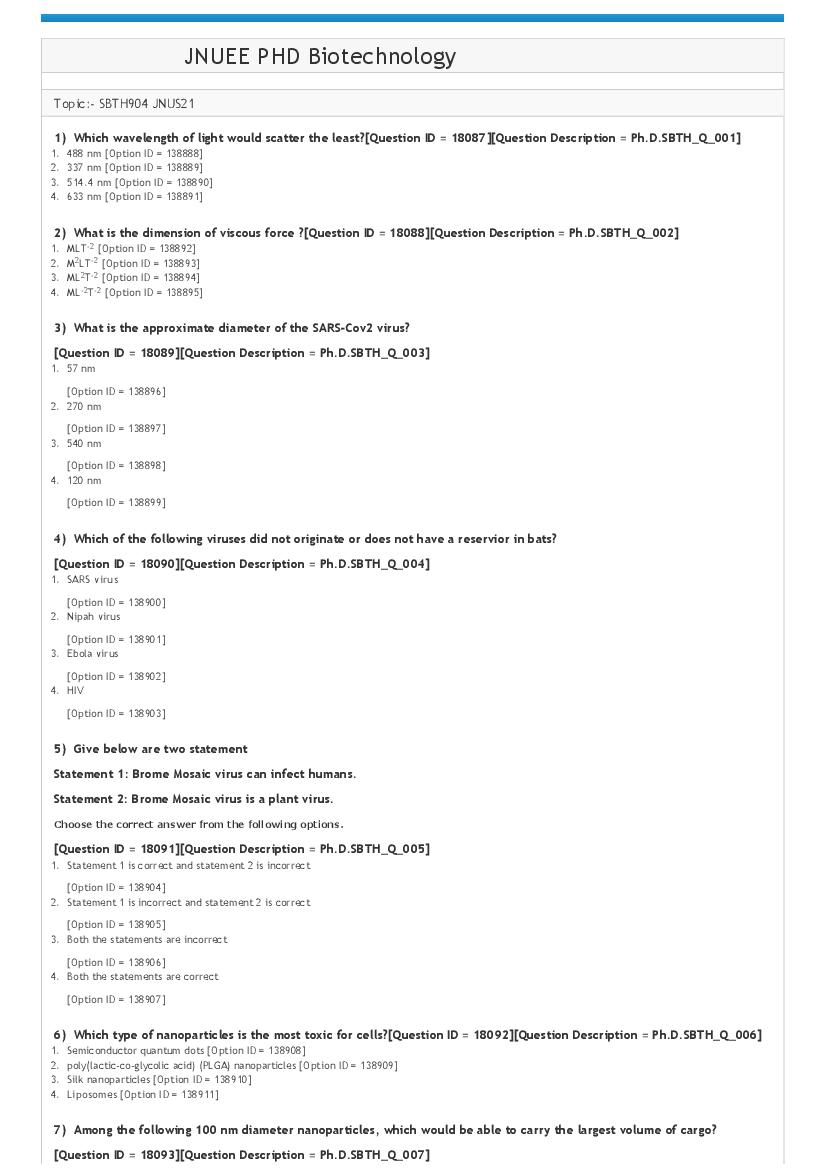
Topic:‐ SBTH904 JNUS21
1) Which wavelength of light would scatter the least?[Question ID = 18087][Question Description = Ph.D.SBTH_Q_001]
1. 488 nm [Option ID = 138888]
2. 337 nm [Option ID = 138889]
3. 514.4 nm [Option ID = 138890]
4. 633 nm [Option ID = 138891]
2) What is the dimension of viscous force ?[Question ID = 18088][Question Description = Ph.D.SBTH_Q_002]
1. MLT‐2 [Option ID = 138892]
2. M 2LT‐2 [Option ID = 138893]
3. ML2T ‐2 [Option ID = 138894]
4. ML‐2T ‐2 [Option ID = 138895]
3) What is the approximate diameter of the SARS‐Cov2 virus?
[Question ID = 18089][Question Description = Ph.D.SBTH_Q_003]
1. 57 nm
[Option ID = 138896]
2. 270 nm
[Option ID = 138897]
3. 540 nm
[Option ID = 138898]
4. 120 nm
[Option ID = 138899]
4) Which of the following viruses did not originate or does not have a reservior in bats?
[Question ID = 18090][Question Description = Ph.D.SBTH_Q_004]
1. SARS virus
[Option ID = 138900]
2. Nipah virus
[Option ID = 138901]
3. Ebola virus
[Option ID = 138902]
4. HIV
[Option ID = 138903]
5) Give below are two statement
Statement 1: Brome Mosaic virus can infect humans.
Statement 2: Brome Mosaic virus is a plant virus.
Choose the correct answer from the following options.
[Question ID = 18091][Question Description = Ph.D.SBTH_Q_005]
1. Statement 1 is correct and statement 2 is incorrect
[Option ID = 138904]
2. Statement 1 is incorrect and statement 2 is correct
[Option ID = 138905]
3. Both the statements are incorrect
[Option ID = 138906]
4. Both the statements are correct
[Option ID = 138907]
6) Which type of nanoparticles is the most toxic for cells?[Question ID = 18092][Question Description = Ph.D.SBTH_Q_006]
1. Semiconductor quantum dots [Option ID = 138908]
2. poly(lactic‐co‐glycolic acid) (PLGA) nanoparticles [Option ID = 138909]
3. Silk nanoparticles [Option ID = 138910]
4. Liposomes [Option ID = 138911]
7) Among the following 100 nm diameter nanoparticles, which would be able to carry the largest volume of cargo?
[Question ID = 18093][Question Description = Ph.D.SBTH_Q_007]
Page 2
[Option ID = 138912]
2. Gold nanoparticles
[Option ID = 138913]
3. Iron oxide nanoparticles
[Option ID = 138914]
4. Liposomes
[Option ID = 138915]
8) Which type of nanoparticles are the most suitable as an exogenous contrast agent in magnetic resonance imaging?
[Question ID = 18094][Question Description = Ph.D.SBTH_Q_008]
1. Silver nanoparticles
[Option ID = 138916]
2. Gold nanoparticles
[Option ID = 138917]
3. Iron Oxide nanoparticles
[Option ID = 138918]
4. Nanoliposomes
[Option ID = 138919]
9) Which of the following biological entities is in nano‐meter range in all dimensions?
[Question ID = 18095][Question Description = Ph.D.SBTH_Q_009]
1. HeLa cells
[Option ID = 138920]
2. Osteoblast cells
[Option ID = 138921]
3. Lactobacillus acidophilus
[Option ID = 138922]
4. SARS‐Cov2 virus
[Option ID = 138923]
10) Given below are two statements
Statement I: The behaviour of nanoparticles is largely governed by the classical mechanics.
Statement II: The behaviour of nanoparticles is largely governed by the quantum mechanics.
In light of the above statements, choose the most appropriate answer from the options given below
[Question ID = 18096][Question Description = Ph.D.SBTH_Q_010]
1. Both Statement I and Statement II are correct
[Option ID = 138924]
2. Both Statement I and Statement II are incorrect
[Option ID = 138925]
3. Statement I is correct but Statement II is incorrect
[Option ID = 138926]
4. Statement I is incorrect but Statement II is correct
[Option ID = 138927]
11) The cellular COP II vesicles transport biomolecules from
[Question ID = 18097][Question Description = Ph.D.SBTH_Q_011]
1. The rough ER to the cis‐Golgi
[Option ID = 138928]
2. The rough ER to the trans‐Golgi
[Option ID = 138929]
3. The rough ER to the cis‐Golgi and trans‐Golgi
[Option ID = 138930]
4. The rough ER to the trans‐Golgi and endosome
[Option ID = 138931]
12) Vesicle targeting and fusion are mostly regulated via[Question ID = 18098][Question Description = Ph.D.SBTH_Q_012]
1. GTP‐binding Ran protein [Option ID = 138932]
2. GTP‐binding Rab protein [Option ID = 138933]
3. Heterotrimeric proteins [Option ID = 138934]
4. Heterotrimeric proteins and GPCR [Option ID = 138935]
Page 3
1. The lumen of the rough ER. [Option ID = 138936]
2. The lumen of the smooth ER. [Option ID = 138937]
3. Free ribosomes [Option ID = 138938]
4. Lysosomes [Option ID = 138939]
14) In mammalian rhodopsin, absorption of light triggers isomerization of the[Question ID = 18100][Question Description =
Ph.D.SBTH_Q_014]
1. 11‐cis‐retinal to all‐trans retinal [Option ID = 138940]
2. all‐trans retinal to 11‐cis‐retinal [Option ID = 138941]
3. all‐trans retinal to 13‐cis‐retinal [Option ID = 138942]
4. all‐trans retinal to 11‐cis‐retinal and all‐trans retinal to 13‐cis‐retinal [Option ID = 138943]
15) A neural action potential results mainly from the organized opening and closing of the[Question ID = 18101][Question
Description = Ph.D.SBTH_Q_015]
1. Ligand‐gated ion channels [Option ID = 138944]
2. Light‐gated ion channel [Option ID = 138945]
3. Voltage‐gated ion channels [Option ID = 138946]
4. Mechanosensitive ion channel [Option ID = 138947]
16) Several internalized RTKs are degraded in[Question ID = 18102][Question Description = Ph.D.SBTH_Q_016]
1. Endosomes [Option ID = 138948]
2. Phagosomes [Option ID = 138949]
3. Lysosomes [Option ID = 138950]
4. Vesicles [Option ID = 138951]
17) The RecBCD multi‐enzyme complex is stabilized by the[Question ID = 17974][Question Description =
Ph.D.SBTH_Q_017]
1. Binding of RecE protein [Option ID = 138952]
2. Interaction of topoisomerase [Option ID = 138953]
3. Binding of RecA protein [Option ID = 138954]
4. Binding of cAMP [Option ID = 138955]
18) Bacterial primase induces the formation of[Question ID = 17975][Question Description = Ph.D.SBTH_Q_018]
1. DNA primers [Option ID = 138956]
2. RNA Primers for DNA Synthesis [Option ID = 138957]
3. DNA‐RNA hybrid primer [Option ID = 138958]
4. Methylated primers [Option ID = 138959]
19) Cytosolic pH is mostly maintained by the [Question ID = 17976][Question Description = Ph.D.SBTH_Q_019]
1. Ligand‐gated ion channel [Option ID = 138960]
2. Cotransporters [Option ID = 138961]
3. Light‐gated ion channel [Option ID = 138962]
4. ABC pump [Option ID = 138963]
20) Amino acids having hydroxyl group as main functionality is/are
[Question ID = 17977][Question Description = Ph.D.SBTH_Q_020]
1. Cys, Ser, Thr
[Option ID = 138964]
2. Tyr, Ser
[Option ID = 138965]
3. Tyr, Trp
[Option ID = 138966]
4. Asp, Tyr, Ser, Glu
[Option ID = 138967]
21) Which of the following amino acids have more than one chiral center
[Question ID = 17978][Question Description = Ph.D.SBTH_Q_021]
1. Gly, Ser, Glu
[Option ID = 138968]
2. Pro, Gln, Lys
[Option ID = 138969]
3. Ile, Thr
[Option ID = 138970]
4. Phe, Trp
[Option ID = 138971]
22) Which one of the following is not true for Carbanion[Question ID = 17979][Question Description = Ph.D.SBTH_Q_022]
Page 4
2. sp3hybridised [Option ID = 138973]
3. planar structure [Option ID = 138974]
4. good nucelophiles [Option ID = 138975]
23) Chemical oxidation using hypochlorite kills[Question ID = 17980][Question Description = Ph.D.SBTH_Q_023]
1. bacteria [Option ID = 138976]
2. virus [Option ID = 138977]
3. insects [Option ID = 138978]
4. termites [Option ID = 138979]
24) Which one of the following species can be used as a reducing agent in biological systems ?
[Question ID = 17981][Question Description = Ph.D.SBTH_Q_024]
1. NADH
[Option ID = 138980]
2. FAD
[Option ID = 138981]
3. Methionine
[Option ID = 138982]
4. Water
[Option ID = 138983]
25) Which of the following amino acids have heterocyclic ring ?
[Question ID = 17982][Question Description = Ph.D.SBTH_Q_025]
1. His, Arg, Leu
[Option ID = 138984]
2. His, Pro, Tyr
[Option ID = 138985]
3. Tyr, Cys, Met
[Option ID = 138986]
4. His, Trp
[Option ID = 138987]
26) Which one of the following is not a characteristics of epimers ?
[Question ID = 17983][Question Description = Ph.D.SBTH_Q_026]
1. their physical and chemical properties may differ
[Option ID = 138988]
2. they may be cyclic or acyclic
[Option ID = 138989]
3. they are enantiomeric pairs
[Option ID = 138990]
4. they are diastereomeric pairs
[Option ID = 138991]
27) Which of the following is not a reactive oxygen species ?
[Question ID = 17984][Question Description = Ph.D.SBTH_Q_027]
1. singlet oxygen
[Option ID = 138992]
2. superoxide
[Option ID = 138993]
3. hydroxy radical
[Option ID = 138994]
4. triplet oxygen
[Option ID = 138995]
28) Which one of the following C‐N bonds have high rotational barrier ?
[Question ID = 17985][Question Description = Ph.D.SBTH_Q_028]
1. C‐N bonds in acetamide
[Option ID = 138996]
2. C‐N bonds in methyl amine
[Option ID = 138997]
3. C‐N bonds in anilines
[Option ID = 138998]
Page 5
[Option ID = 138999]
29) Which of the following statements could be unambiguously shown from X‐ray Fibre Diffraction experiments ? [Question
ID = 17986][Question Description = Ph.D.SBTH_Q_029]
1. There are 10 conformational repeating units in one turn of B‐form DNA, while in one turn of A‐form DNA there are 11 such conformational repeat
units. [Option ID = 139000]
2. Adenine base pairs with Thymine and Guanine base pairs with Cytosine. [Option ID = 139001]
3. Both A and B form DNA are double helices. [Option ID = 139002]
4. DNA consists of nitrogenous base, deoxyribose sugar and phosphodiester groups. [Option ID = 139003]
30) The statement, "The value of the ω torsion angle in peptides is generally close to 180o ", implies which of the following
?
[Question ID = 17987][Question Description = Ph.D.SBTH_Q_030]
1. The peptide bond is generally planar and trans.
[Option ID = 139004]
2. There is no steric hindrance between the carbonyl oxygen atom of the peptide and the first carbon atom of the amino acid side chain.
[Option ID = 139005]
3. Most amino acids in peptides and proteins have the L‐configuration.
[Option ID = 139006]
4. Peptide bonds are generally not part of cyclic structures.
[Option ID = 139007]
31) Imagine all amino acids in proteins could exist either in the D‐ or the L‐configuration, chosen at random during protein
synthesis on the ribosome. Which of the following statements would hold in that case ? [Question ID = 17988][Question
Description = Ph.D.SBTH_Q_031]
1. Uniquely folded globular proteins would not have existed. [Option ID = 139008]
2. α‐helices would be left handed but there would be little effect on β‐sheets.
[Option ID = 139009]
3. Parallel β‐sheets would be more common and stable than anti‐parallel β‐sheets.
[Option ID = 139010]
4. Uniquely folded globular proteins would have existed but not fibrous proteins.
[Option ID = 139011]
32) Which of the following is an epimeric pair?[Question ID = 17989][Question Description = Ph.D.SBTH_Q_032]
1. D‐Glucose and D‐Galactose [Option ID = 139012]
2. D‐Glucose and L‐Mannose [Option ID = 139013]
3. D‐Glucose and D‐Fructose [Option ID = 139014]
4. D‐Glucose and D‐Ribose [Option ID = 139015]
33) Which of the following enzymes is not also a protein?[Question ID = 17990][Question Description = Ph.D.SBTH_Q_033]
1. Lysozyme [Option ID = 139016]
2. Hammerhead Ribozyme [Option ID = 139017]
3. Deoxyribonuclease [Option ID = 139018]
4. Adenosine diphosphate ribosyl transferase [Option ID = 139019]
34)
[Question ID = 17991][Question Description = Ph.D.SBTH_Q_034]
1. Ribose [Option ID = 139020]
2. Ascorbic acid [Option ID = 139021]
3. Hydroxyproline [Option ID = 139022]
4. Glucofuranose [Option ID = 139023]
35) Which of the following distance properties are always followed by dissimilarities between gene sequences?
A.The dissimilarity value of a sequence with itself is always 0.
Page 6
C. The dissimilarity value between Sequences S and T is exactly the same as the dissimilarity value between sequences T
and S (Symmetry).
D. If R, S and T denote three sequences and DRS, DRT and DST denote the dissimilarity value between sequences R and
S, sequences R and T and sequences S and T respectively, then DRS ≤ DRT +DST (Triangle Inequality).
Choose the correct answer from the options given below:
[Question ID = 17992][Question Description = Ph.D.SBTH_Q_035]
1. A only
[Option ID = 139024]
2. A and B only
[Option ID = 139025]
3. A, B and C only
[Option ID = 139026]
4. A, B, C and D
[Option ID = 139027]
36) Consider the assertion, "In Artificial Intelligence (AI) based biological classification problems, use of the same data set
both for training and testing of the classifier is not a good practice".
Which of the following reasons correctly justify or refute the assertion ?
[Question ID = 18103][Question Description = Ph.D.SBTH_Q_036]
1. The assertion is correct because such a practice causes underestimation of the true error rate.
[Option ID = 139028]
2. The assertion is correct because such a practice causes overestimation of the true error rate.
[Option ID = 139029]
3. The assertion is wrong because the true error rate is independent of the data set used, regardless of whether it was used to develop the classifier
itself.
[Option ID = 139030]
4. The assertion is wrong, because the true error rate varies with different data sets, and may be sometimes underestimated, sometimes
overestimated and sometimes correctly predicted. This has nothing to do whether the same data was used for training the classifier or not.
[Option ID = 139031]
37) Which of the following conditions have to be met for a nucleus to be observable by Nuclear Magnetic Resonance
Spectroscopy ?
A. Both atomic mass and atomic number are odd.
B. Atomic mass is odd but the atomic number is even.
C. Atomic mass is even but the atomic number is odd.
D. Both atomic mass and atomic number are even.
Choose the correct answer from the options given below:
[Question ID = 18104][Question Description = Ph.D.SBTH_Q_037]
1. A only
[Option ID = 139032]
2. A and B only
[Option ID = 139033]
3. A, B and C only
[Option ID = 139034]
4. A, B, C and D
[Option ID = 139035]
38) Hollow fibre bioreactor is used to grow[Question ID = 18105][Question Description = Ph.D.SBTH_Q_038]
1. HeLa cells [Option ID = 139036]
2. Plant cells [Option ID = 139037]
3. Saccharomyces cerevisiae [Option ID = 139038]
4. E. coli [Option ID = 139039]
39) When the rate of cell removal in the bioreactor outlet is more than the rate of generation by growth, it is called
[Question ID = 18106][Question Description = Ph.D.SBTH_Q_039]
1. Specific growth rate [Option ID = 139040]
2. Dilution rate [Option ID = 139041]
3. Washout [Option ID = 139042]
4. Critical dilution rate [Option ID = 139043]
Page 7
[Question ID = 18107][Question Description = Ph.D.SBTH_Q_040]
1. Oxygen transfer constant
[Option ID = 139044]
2. Constant of area
[Option ID = 139045]
3. Oxygen transfer coefficient
[Option ID = 139046]
4. Mass Transfer
[Option ID = 139047]
41) Depth filters are used for[Question ID = 18108][Question Description = Ph.D.SBTH_Q_041]
1. Air Filtration [Option ID = 139048]
2. Media filtration [Option ID = 139049]
3. Biomass filtration [Option ID = 139050]
4. None of the above [Option ID = 139051]
42) Temperature controlling devices used in the in situ glass bioreactor (vol. 3L) are:
[Question ID = 18109][Question Description = Ph.D.SBTH_Q_042]
1. Cooling finger
[Option ID = 139052]
2. Heating Blanket
[Option ID = 139053]
3. Both 1 and 2
[Option ID = 139054]
4. Thermometer
[Option ID = 139055]
43) An enzyme manufacturing company wants to separate enzymes (size ranging from 10 to 104 A°) from fermentation
mixture. The following methods would be useful
A. Microfiltration
B. Ultrafiltration
C. Filtration
D. Rotary Vacuum filtration
E. Reverse osmosis
Choose the correct answer from the options given below:
[Question ID = 18110][Question Description = Ph.D.SBTH_Q_043]
1. A, B and D
[Option ID = 139056]
2. B, C and D
[Option ID = 139057]
3. A, B and E
[Option ID = 139058]
4. C, D and E
[Option ID = 139059]
44) Which bioreactor have maximum reaction surface area in multiphase bioreactors ?
[Question ID = 18111][Question Description = Ph.D.SBTH_Q_044]
1. Fluidised bed
[Option ID = 139060]
2. Packed bed
[Option ID = 139061]
3. Trickle bed
[Option ID = 139062]
4. All of the above
[Option ID = 139063]
45) What is the function of sparger in a bioreactor?
[Question ID = 18112][Question Description = Ph.D.SBTH_Q_045]
Page 8
[Option ID = 139064]
2. Generating of air bubbles
[Option ID = 139065]
3. Both Breaking of air bubbles and Generating of air bubbles
[Option ID = 139066]
4. Reduction of vortex formation
[Option ID = 139067]
46) Chemostat, Turbidostat, and Plug flow are the types of[Question ID = 18113][Question Description =
Ph.D.SBTH_Q_046]
1. Fed‐batch culture [Option ID = 139068]
2. Batch culture [Option ID = 139069]
3. Continuous culture [Option ID = 139070]
4. Repetitive Fed batch culture [Option ID = 139071]
47) Select the virulence proteins that are coded from the genes located on Ti plasmid of Agrobacterium tumefaciens and
facilitate the transfer of T‐DNA from Agrobacterium to plant cell.
[Question ID = 18114][Question Description = Ph.D.SBTH_Q_047]
1. Vir A and Vir G
[Option ID = 139072]
2. Vir G and Vir D2
[Option ID = 139073]
3. Vir E2 and Vir D2
[Option ID = 139074]
4. Vir G and Vir E1
[Option ID = 139075]
48) Monoploid number of chromosomes in a plant is ¼th of the total number of chromosomes in its pollen nuclei. What would
be the ploidy level of this plant?
[Question ID = 18115][Question Description = Ph.D.SBTH_Q_048]
1. Tetraploid
[Option ID = 139076]
2. Hexaploid
[Option ID = 139077]
3. Octaploid
[Option ID = 139078]
4. Triploid
[Option ID = 139079]
49) Which of the following is not a true sequence of events in an Agrobacterium‐mediated plant transformation
experiment?
[Question ID = 18116][Question Description = Ph.D.SBTH_Q_049]
1. Preculture, Cocultivation, Callus formation, Shoot development, plantlets.
[Option ID = 139080]
2. Cocultivation, Callus formation, Shoot development, Plantlets, Plant hardening.
[Option ID = 139081]
3. Preculture, Shoot development, Cocultivation, Callus formation, Plantlets.
[Option ID = 139082]
4. Explants, Callusing, Agrobacterium infection, Regeneration, Plantlets.
[Option ID = 139083]
50) Which of the following is responsible for signaling of stomatal closure in response to water scarcity? [Question ID =
18117][Question Description = Ph.D.SBTH_Q_050]
1. Abscisic acid [Option ID = 139084]
2. Gibberellins [Option ID = 139085]
3. Auxins [Option ID = 139086]
4. Ethylene [Option ID = 139087]
51) Which of the following could be the main source of eutrophication of water in lakes or other water bodies? [Question ID
= 18118][Question Description = Ph.D.SBTH_Q_051]
1. Calcium and Potassium [Option ID = 139088]
2. Magnesium and Calcium [Option ID = 139089]
3. Magnesium and Potassium [Option ID = 139090]
4. Nitrogen and Phosphorus [Option ID = 139091]
Page 9
Ph.D.SBTH_Q_052]
1. Bioenergy crops [Option ID = 139092]
2. Agricultural residues [Option ID = 139093]
3. Tree logs [Option ID = 139094]
4. Corn Starch [Option ID = 139095]
53) Choose the correct statement that best defines the metagenomics.
[Question ID = 18120][Question Description = Ph.D.SBTH_Q_053]
1. Isolation of microbes from soil, culture them individually and sequencing their genome separately.
[Option ID = 139096]
2. Study of the genetic material collected from a mixture of organisms.
[Option ID = 139097]
3. Enrichment of the exome sequences from plant genome and sequencing using next generation sequencing.
[Option ID = 139098]
4. Extraction and sequencing of total RNA from several tissues of the same plant.
[Option ID = 139099]
54) For the molecular characterization of the transgenic plants, T‐DNA copy number can be effectively determined by
[Question ID = 18121][Question Description = Ph.D.SBTH_Q_054]
1. Southern hybridization
[Option ID = 139100]
2. Quantative‐real time PCR using T‐DNA border‐specific primers
[Option ID = 139101]
3. Amplification of T‐DNA specific amplicon, following by sequencing, and alignment of sequencing data to T‐DNA
[Option ID = 139102]
4. Random shearing of gDNA, followed by adaptor ligations and sequencing ends of the genomic fragments
[Option ID = 139103]
55) Seedless bananas are [Question ID = 17993][Question Description = Ph.D.SBTH_Q_055]
1. Diploid [Option ID = 139104]
2. Triploid [Option ID = 139105]
3. Tetraploid [Option ID = 139106]
4. Hexaploid [Option ID = 139107]
56) Which of the following fluorescent probe is an intrinsic fluorescent probe[Question ID = 17994][Question Description =
Ph.D.SBTH_Q_056]
1. Thioflavin‐T [Option ID = 139108]
2. Fluorescein [Option ID = 139109]
3. Tryptophan [Option ID = 139110]
4. 1‐Anilinonaphthalene‐8‐sulfonic acid [Option ID = 139111]
57) Amyloids are deposited in several neurodegenerative diseases that are rich in beta sheet structure. By using circular
dichroism (CD) spectroscopy, which of the following signature peak can be used to identify the amyloid structure ?
[Question ID = 17995][Question Description = Ph.D.SBTH_Q_057]
1. ‐222 nm
[Option ID = 139112]
2. ‐208 nm
[Option ID = 139113]
3. ‐218 nm
[Option ID = 139114]
4. ‐195 nm
[Option ID = 139115]
58) Tryptophan emission spectrum of native protein shows wavelength maxima at 348 nm, which did not change upon
unfolding in 6.0 M GdmCl solution. What conclusion can be drawn about tryptophan from the above observation? [Question
ID = 17996][Question Description = Ph.D.SBTH_Q_058]
1. It is buried in the hydrophobic core [Option ID = 139116]
2. It is present on the surface of protein [Option ID = 139117]
3. It is partially buried [Option ID = 139118]
4. It is quenched by neighbouring residues [Option ID = 139119]
59) Molecular chaperones are a class of protein which help the cellular protein folding by[Question ID = 17997][Question
Description = Ph.D.SBTH_Q_059]
1. Preventing aggregation [Option ID = 139120]
Page 10
3. Helping in cis‐trans isomerization [Option ID = 139122]
4. Decreasing the solubility [Option ID = 139123]
60) In protein sequencing, amino terminal ‐amino group is labelled with
[Question ID = 17998][Question Description = Ph.D.SBTH_Q_060]
1. Sodium dodecyl sulfate (SDS)
[Option ID = 139124]
2. 5,5’‐dithiobis‐(2‐benzoic acid) (DTNB)
[Option ID = 139125]
3. 1‐Fluoro‐2,4‐dinitrobenzene (FDNB)
[Option ID = 139126]
4. 5‐thio‐2‐nitrobenzoic acid (TNB)
[Option ID = 139127]
61) A 200 kDa protein was purified by size exclusion chromatography. Non‐reducing SDS‐PAGE shows the presence of
90,80 and 30 kDa band on the gel. Reduced SDS‐PAGE shows the presence of 80, 45 and 30 kDa bands on the gel. What is
the subunit composition of protein? [Question ID = 17999][Question Description = Ph.D.SBTH_Q_061]
1. Monomer [Option ID = 139128]
2. Dimer [Option ID = 139129]
3. Trimer [Option ID = 139130]
4. Tetramer [Option ID = 139131]
62) The decreasing order of hydrophobicity of Ala, Val and Leu is[Question ID = 18000][Question Description =
Ph.D.SBTH_Q_062]
1. Leu>Val>Ala [Option ID = 139132]
2. Ala>Val>Leu [Option ID = 139133]
3. Val>Ala>Leu [Option ID = 139134]
4. Leu>Ala>Val [Option ID = 139135]
63) In electrospray ionization‐mass spectrometry (ESI‐MS) of proteins, which type of the molecular species are present in
the spectra? [Question ID = 18001][Question Description = Ph.D.SBTH_Q_063]
1. +1 charged [Option ID = 139136]
2. partially charged [Option ID = 139137]
3. Multiple charged [Option ID = 139138]
4. Uncharged [Option ID = 139139]
64) In the cis‐peptide bond, torsion angle ω is[Question ID = 18002][Question Description = Ph.D.SBTH_Q_064]
1. +180o [Option ID = 139140]
2. ‐180o [Option ID = 139141]
3. +90o [Option ID = 139142]
4. 0o [Option ID = 139143]
65) Mutant mice lacking in brain specific form of calcium‐calmodulin dependent CaMKII will have specific defects in which
of the following function? [Question ID = 18003][Question Description = Ph.D.SBTH_Q_065]
1. Closing of olfactory neurons [Option ID = 139144]
2. Opening of rod photoreceptors [Option ID = 139145]
3. Ability to remember [Option ID = 139146]
4. Skeletal muscle motor movement [Option ID = 139147]
66) A drug screening cell based assay to identify therapeutic molecules increasing cAMP levels in lung cancer cell will
require [Question ID = 18004][Question Description = Ph.D.SBTH_Q_066]
1. Inhibition of Phosphodiesterase [Option ID = 139148]
2. Inhibition of cAMP dependent gene Transcription [Option ID = 139149]
3. Activation of Phosphodiesterase [Option ID = 139150]
4. Inhibition of Adenyl Cyclase [Option ID = 139151]
67) Overexpression of EGFR in MCF7, breast cancer cell lines has been observed in culture. What mechanisms will you
target to inhibit EGFR response in these cells? [Question ID = 18005][Question Description = Ph.D.SBTH_Q_067]
1. Determine the phosphorylation of Threonine residues [Option ID = 139152]
2. Determine the translocation of EGFR receptor from plasma membrane to nucleus [Option ID = 139153]
3. Determine SUMOylation of EFGR in endosomes [Option ID = 139154]
4. Determine ubiquitination of EGFR in endosomes [Option ID = 139155]
68) Which cell surface molecule primarily mediate cell‐cell adhesion mechanism for lymphocyte migration?[Question ID =
18006][Question Description = Ph.D.SBTH_Q_068]
1. Proteoglycans [Option ID = 139156]
2. Cadherins [Option ID = 139157]
3. Selectins [Option ID = 139158]
4. GPCR [Option ID = 139159]
Page 11
responsible for this stress? [Question ID = 18007][Question Description = Ph.D.SBTH_Q_069]
1. Heat Shock Proteins [Option ID = 139160]
2. Sialyltransferase [Option ID = 139161]
3. Ser/Thr Kinase [Option ID = 139162]
4. IP3 Receptor [Option ID = 139163]
70) Which of the following inherited single gene human diseases do not involve protein aggregation in the pathobiology?
[Question ID = 18008][Question Description = Ph.D.SBTH_Q_070]
1. Sickel Cell Anemia
[Option ID = 139164]
2. ‐1‐Trypsin Deficiency
[Option ID = 139165]
3. Duchenne Muscle Dystrophy
[Option ID = 139166]
4. Adenosine deaminase deficiency
[Option ID = 139167]
71) Which of the following inherited single gene disorders are linked to X‐chromosome?[Question ID = 18009][Question
Description = Ph.D.SBTH_Q_071]
1. GNE Myopathy [Option ID = 139168]
2. Limb Girdle Dystrophy [Option ID = 139169]
3. Duchenne Muscle Dystrophy [Option ID = 139170]
4. Congenital Muscular Dystrophy [Option ID = 139171]
72) Which of the following research strategies could be innovative and result oriented in unique clinical trial design for rare
diseases? [Question ID = 18010][Question Description = Ph.D.SBTH_Q_072]
1. Increase population Size [Option ID = 139172]
2. Visibility of rare diseases for commercial interest [Option ID = 139173]
3. Using patients as their own control will improve statistical efficiency [Option ID = 139174]
4. Focus on high risk patients [Option ID = 139175]
73) You have isolated CD4 T cells and co‐cultured with Macrophages in the presence of immobilized anti‐CD3 antibody
under four different conditions:
1. IL‐4 and anti‐IFN‐ antibody,
2. IL‐12 and anti‐IL‐4 antibody,
3. Transforming growth factor (TGF)‐β,
4. TGF‐β and IL‐6
For three rounds to induce T‐helper cell differentiation identifiable by the cytokines they express predominantly.
Which one of the following is the most likely combination of predominant cytokine expression in these cultures?
[Question ID = 18011][Question Description = Ph.D.SBTH_Q_073]
1. (A) IL‐4 (B) IFN‐ (C) IL‐10 (D)IL‐17
[Option ID = 139176]
2. (A) IFN‐ (B) IL‐4 (C) IL‐17 (D)IL‐10
[Option ID = 139177]
3. (A) IL‐17 (B) IL‐4 (C) IFN‐ (D)IL‐10
[Option ID = 139178]
4. (A) IL‐17 (B) IL‐10 (C) IL‐4 (D)IFN‐
[Option ID = 139179]
74) The monoclonal antibody approved for the treatment of Lymphoma is [Question ID = 18122][Question Description =
Ph.D.SBTH_Q_074]
1. Rituximab [Option ID = 139180]
2. Cetuximab [Option ID = 139181]
3. Bevacizumab [Option ID = 139182]
4. Herceptin [Option ID = 139183]
75) An intracellular pathogen is causing a disease that is associated with host anti‐inflammatory response. Please suggest
which one of the following may serve as an effective therapeutic approach.
[Question ID = 18123][Question Description = Ph.D.SBTH_Q_075]
1. Depletion of IFN‐ from the system
[Option ID = 139184]
2. Treatment with IL‐4 and IL‐10
Page 12
3. Treatment with macrophage activating agent
[Option ID = 139186]
4. Treatment with TGF‐β
[Option ID = 139187]
76) Defect in the transcription factor GATA‐3 will affect the release of
[Question ID = 18124][Question Description = Ph.D.SBTH_Q_076]
1. IFN‐
[Option ID = 139188]
2. IL‐4
[Option ID = 139189]
3. IL‐17
[Option ID = 139190]
4. Both IFN‐ and IL‐17
[Option ID = 139191]
77) During the development of thymocytes, the Double Negative cells (DN1‐DN2‐DN3‐DN4) are classified based on CD44
and CD25 markers. Which cells express Pre TCR for the first time during developmental process? [Question ID = 18125]
[Question Description = Ph.D.SBTH_Q_077]
1. CD44+CD25‐ [Option ID = 139192]
2. CD44‐CD25+ [Option ID = 139193]
3. CD44+CD25+ [Option ID = 139194]
4. CD44‐CD25‐ [Option ID = 139195]
78) CD19 is a marker for
[Question ID = 18126][Question Description = Ph.D.SBTH_Q_078]
1. T cells
[Option ID = 139196]
2. B cells
[Option ID = 139197]
3. Mcrophages
[Option ID = 139198]
4. NK cells
[Option ID = 139199]
79) Among HIV‐infected subjects, Elite controllers are [Question ID = 18127][Question Description = Ph.D.SBTH_Q_079]
1. HIV‐infected individuals who control the virus in presence of antiretroviral therapy (ART) [Option ID = 139200]
2. HIV‐infected individuals with preserved CD4 count and average viral load of 30,000 copies/ml [Option ID = 139201]
3. HIV‐infected subjects who are chronic progressors [Option ID = 139202]
4. HIV‐infected individuals who maintain the undetectable viral load even in the absence of therapy [Option ID = 139203]
80) The isoelectric point of a protein is defined as: [Question ID = 18128][Question Description = Ph.D.SBTH_Q_080]
1. The pH at which a protein has no net charge. [Option ID = 139204]
2. The pH at which a protein loses its activity. [Option ID = 139205]
3. The pH at which a protein has maximal activity. [Option ID = 139206]
4. Both option 1 and 2 are correct. [Option ID = 139207]
81) Which of the following statements about the completion of the human genome sequencing in year 2000 is FALSE?
[Question ID = 18129][Question Description = Ph.D.SBTH_Q_081]
1. Only 90% of the genome was sequenced at that time. [Option ID = 139208]
2. The genome sequences released in year 2000 were draft versions of the sequence. [Option ID = 139209]
3. All of the euchromatin sequence was finished. [Option ID = 139210]
4. Most of the heterochromatin had not been sequenced. [Option ID = 139211]
82) What is an open reading frame (ORF)? [Question ID = 18130][Question Description = Ph.D.SBTH_Q_082]
1. All of the nucleotides of a gene that are transcribed into mRNA. [Option ID = 139212]
2. The nucleotides of a gene that make up the codons specifying amino acids. [Option ID = 139213]
3. The nucleotides of an mRNA molecule before the introns have been removed. [Option ID = 139214]
4. The amino acid sequence of a polypeptide. [Option ID = 139215]
83) The conversion of RNA to DNA and its amplification by PCR is called[Question ID = 18131][Question Description =
Ph.D.SBTH_Q_083]
1. Real time PCR. [Option ID = 139216]
2. Reverse transcriptase PCR. [Option ID = 139217]
3. Transcriptional PCR. [Option ID = 139218]
4. Translational PCR. [Option ID = 139219]
Page 13
pairs upstream or downstream from the genes they regulate? [Question ID = 18132][Question Description =
Ph.D.SBTH_Q_084]
1. Activators. [Option ID = 139220]
2. Enhancers. [Option ID = 139221]
3. Silencers. [Option ID = 139222]
4. Terminators. [Option ID = 139223]
85) Mouse embryonic stem cells are used in gene inactivation experiments because they
[Question ID = 18133][Question Description = Ph.D.SBTH_Q_085]
1. can be cloned to give rise to a stable cell line.
[Option ID = 139224]
2. are chimeric and will produce cells heterozygous for the gene.
[Option ID = 139225]
3. are the only mouse cells that can be genetically engineered to inactivate genes.
[Option ID = 139226]
4. are totipotent and can give rise to all types of differentiated cells.
[Option ID = 139227]
86) Which technique is used to resolve the different sizes of DNA fragments following a restriction enzyme digest?
[Question ID = 18134][Question Description = Ph.D.SBTH_Q_086]
1. DNA sequencing. [Option ID = 139228]
2. Gel electrophoresis. [Option ID = 139229]
3. Gene cloning. [Option ID = 139230]
4. PCR. [Option ID = 139231]
87) The online protein structure database is[Question ID = 18135][Question Description = Ph.D.SBTH_Q_087]
1. Protein Data Bank [Option ID = 139232]
2. Swiss‐Prot [Option ID = 139233]
3. Protein Information Resource [Option ID = 139234]
4. Ensembl [Option ID = 139235]
88) Given below are two statements
Statement I: Two sequences are homologous if they share a common evolutionary ancestry.
Statement II: Homologous proteins almost always share a significantly related three‐ dimensional structure.
In light of the above statements,choose the correct answer from the options given below
[Question ID = 18136][Question Description = Ph.D.SBTH_Q_088]
1. Both Statement I and Statement II are true
[Option ID = 139236]
2. Both Statement I and Statement II are false
[Option ID = 139237]
3. Statement I is true but Statement II is false
[Option ID = 139238]
4. Statement I is false but Statement II is true
[Option ID = 139239]
89) An example of negatively charged amino acids is
[Question ID = 18137][Question Description = Ph.D.SBTH_Q_089]
1. Leucine
[Option ID = 139240]
2. Tyrosine
[Option ID = 139241]
3. Aspartic acid
[Option ID = 139242]
4. Lysine
[Option ID = 139243]
90) A tool for comparing a protein or DNA sequence to other sequences in various databases is called as
[Question ID = 18138][Question Description = Ph.D.SBTH_Q_090]
1. MUSCLE
[Option ID = 139244]
Page 14
[Option ID = 139245]
3. ClustalW
[Option ID = 139246]
4. BLAST
[Option ID = 139247]
91) BLAST is[Question ID = 18139][Question Description = Ph.D.SBTH_Q_091]
1. Basic Longest Alignment Search Tool [Option ID = 139248]
2. Basic Local Alignment Sequence Tool [Option ID = 139249]
3. Basic Local Alignment Search Tool [Option ID = 139250]
4. Basic Local Alignment Search Target [Option ID = 139251]
92) ORF stands for[Question ID = 18140][Question Description = Ph.D.SBTH_Q_092]
1. Open Reading Frequency [Option ID = 139252]
2. Open Reading Frame [Option ID = 139253]
3. Open Random Frame [Option ID = 139254]
4. Other Reading Frame [Option ID = 139255]
93) Given below are two statements
Statement I: A small number of characteristic amino acid residues that occur consistently are called motifs.
Statement II: Motifs are typically subsets of protein domains.
In light of the above statements, choose the correct answer from the options given below
[Question ID = 18012][Question Description = Ph.D.SBTH_Q_093]
1. Both Statement I and Statement II are true
[Option ID = 139256]
2. Both Statement I and Statement II are false
[Option ID = 139257]
3. Statement I is true but Statement II is false
[Option ID = 139258]
4. Statement I is false but Statement II is true
[Option ID = 139259]
94) A trinucleotide repeat is a sequence of three nucleotides that are abnormally repeated a number of times in a row. As
a result, the number of repeats change as the gene is passed from parents to offsprings and the signs of symptoms of
genetic conditions become more severe even at an early age. This phenomenon of the genetic transmission of a trait that
results in diseases like myotonic dystrophy and fragile X syndrome is called [Question ID = 18013][Question Description =
Ph.D.SBTH_Q_094]
1. uniparental disomy [Option ID = 139260]
2. anticipation [Option ID = 139261]
3. genomic imprinting [Option ID = 139262]
4. x‐linked dominance [Option ID = 139263]
95) A pregnant mother with a history of genetic disease went through a chromosomal screening test of amniotic fluid at 15
weeks of pregnancy. The Giemsa stained chromosomes at mitotic metaphase showed deletion of the short arm of
chromosome 5. In your opinion, what would be the most likely clinical diagnosis of the fetus
[Question ID = 18014][Question Description = Ph.D.SBTH_Q_095]
1. klinefelter syndrome
[Option ID = 139264]
2. cri‐du‐chat syndrome
[Option ID = 139265]
3. down syndrome
[Option ID = 139266]
4. turner syndrome
[Option ID = 139267]
96) The first living beings are considered to be single celled organisms surrounded by an abundance of organic molecules.
Probably they didn’t have the luxury of experiencing oxygen and prepared organic compounds by ingesting preformed
carbon molecules such as carbohydrates, proteins, and lipids made by other organisms. Such organisms are called [Question
ID = 18015][Question Description = Ph.D.SBTH_Q_096]
1. chemoautotrophs [Option ID = 139268]
2. photoheterotrophs [Option ID = 139269]
3. photoautotrophs [Option ID = 139270]
4. chemoheterotrophs [Option ID = 139271]
Page 15
elements in the human genome. The project has been phenomenally successful in uncovering the dynamics of the human
genome. However, one of the key limitations of the ENCODE dataset is that [Question ID = 18016][Question Description =
Ph.D.SBTH_Q_097]
1. pooling of incomplete data [Option ID = 139272]
2. use of incorrect annotation methods [Option ID = 139273]
3. data taken from an inhomogeneous population of cells with genomic instability [Option ID = 139274]
4. low quality data [Option ID = 139275]
98) The first published complete genome sequence was in which one of the following organisms ?
[Question ID = 18017][Question Description = Ph.D.SBTH_Q_098]
1. H. sapiens
[Option ID = 139276]
2. E.coli K‐12
[Option ID = 139277]
3. S. cerevisiae
[Option ID = 139278]
4. ϕX174 bacteriophage
[Option ID = 139279]
99) If we ever wish to find a “fourth law" of Mendelian inheritance that connects genotype with phenotype, the most
promising space for finding the law would be: [Question ID = 18018][Question Description = Ph.D.SBTH_Q_099]
1. karyotyped chromosomes [Option ID = 139280]
2. single nucleotide polymorophisms [Option ID = 139281]
3. biomolecular pathways [Option ID = 139282]
4. microbial genomes [Option ID = 139283]
100) The science of engineering biological systems from a standard inventory of parts and rational design approach is known
as [Question ID = 18019][Question Description = Ph.D.SBTH_Q_100]
1. systems biology [Option ID = 139284]
2. genetic engineering [Option ID = 139285]
3. directed evolution [Option ID = 139286]
4. synthetic biology [Option ID = 139287]