CMI Entrance Exam 2021 Question Paper for M.Sc or Ph.D Mathematics
Finished viewing? Save it for later —
Download CMI Entrance Exam 2021 Question Paper for M.Sc or Ph.D Mathematics (PDF · 3 pages)About CMI Entrance Exam 2021 Question Paper for M.Sc or Ph.D Mathematics
CMI Entrance Exam 2021 Question Paper for M.Sc or Ph.D Mathematics is available here for free download. Published by Default for CMI Entrance Exam, this question paper can be viewed online or downloaded as a PDF (3 pages). Candidates preparing for CMI Entrance Exam can use CMI Entrance Exam 2021 Question Paper for M.Sc or Ph.D Mathematics to understand the exam pattern, the type of questions asked, and the overall difficulty level.
Frequently Asked Questions
How can I download CMI Entrance Exam 2021 Question Paper for M.Sc or Ph.D Mathematics?
Open this page and click the Download button to save CMI Entrance Exam 2021 Question Paper for M.Sc or Ph.D Mathematics as a PDF. It is completely free on AglaSem Docs.
Is CMI Entrance Exam 2021 Question Paper for M.Sc or Ph.D Mathematics free to download?
Yes. CMI Entrance Exam 2021 Question Paper for M.Sc or Ph.D Mathematics can be viewed online and downloaded as a PDF free of cost on AglaSem Docs.
How many pages does CMI Entrance Exam 2021 Question Paper for M.Sc or Ph.D Mathematics have?
CMI Entrance Exam 2021 Question Paper for M.Sc or Ph.D Mathematics contains 3 pages, which you can read online or download together as a single PDF.
Where can I find more CMI Entrance Exam study material?
You can find more CMI Entrance Exam question papers, sample papers, syllabus, and answer keys on AglaSem Docs.
CMI Entrance Exam 2021 Question Paper for M.Sc or Ph.D Mathematics – Text
Read the full text of this question paper below — useful to quickly search, copy and reference the content online without downloading the PDF.
📄 View text version (3 pages)
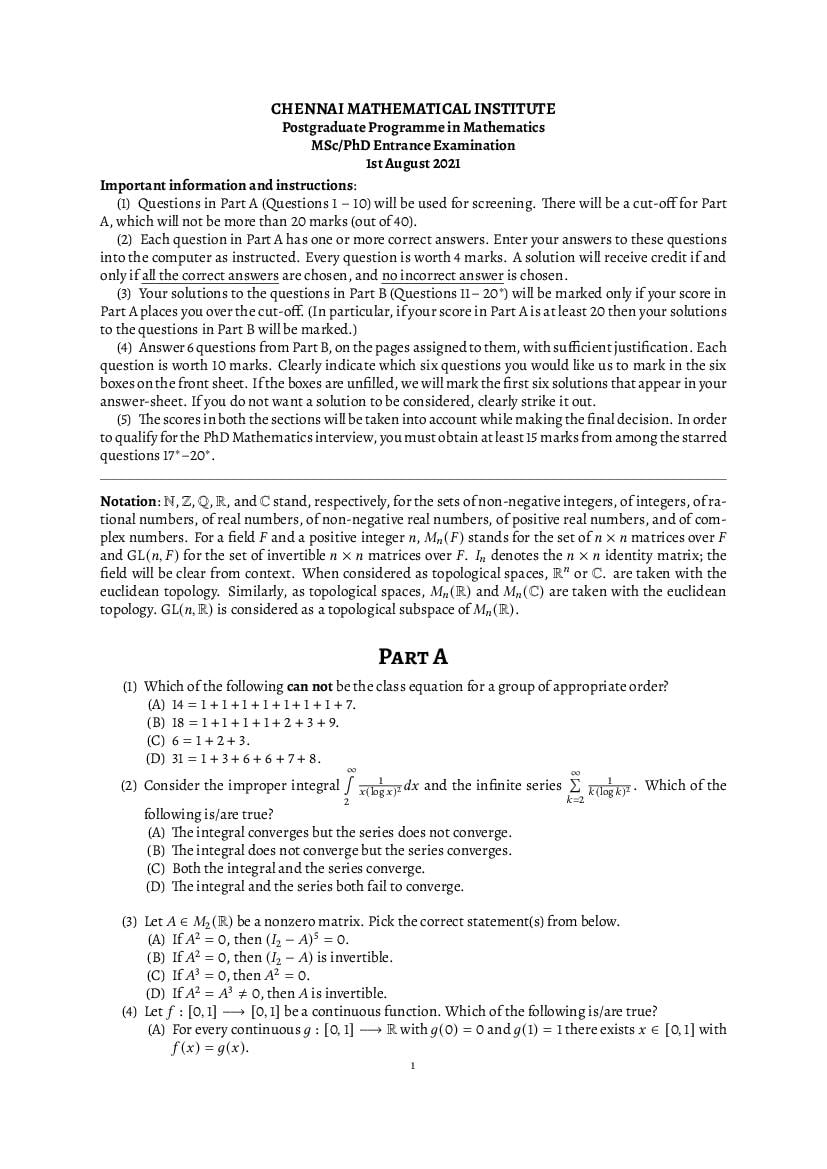
Page 1
Postgraduate Programme in Mathematics
MSc/PhD Entrance Examination
1st August 2021
Important information and instructions:
(1) Questions in Part A (Questions 1 – 10) will be used for screening. There will be a cut-off for Part
A, which will not be more than 20 marks (out of 40).
(2) Each question in Part A has one or more correct answers. Enter your answers to these questions
into the computer as instructed. Every question is worth 4 marks. A solution will receive credit if and
only if all the correct answers are chosen, and no incorrect answer is chosen.
(3) Your solutions to the questions in Part B (Questions 11– 20∗ ) will be marked only if your score in
Part A places you over the cut-off. (In particular, if your score in Part A is at least 20 then your solutions
to the questions in Part B will be marked.)
(4) Answer 6 questions from Part B, on the pages assigned to them, with sufficient justification. Each
question is worth 10 marks. Clearly indicate which six questions you would like us to mark in the six
boxes on the front sheet. If the boxes are unfilled, we will mark the first six solutions that appear in your
answer-sheet. If you do not want a solution to be considered, clearly strike it out.
(5) The scores in both the sections will be taken into account while making the final decision. In order
to qualify for the PhD Mathematics interview, you must obtain at least 15 marks from among the starred
questions 17∗ –20∗ .
Notation: N, Z, Q, R, and C stand, respectively, for the sets of non-negative integers, of integers, of ra-
tional numbers, of real numbers, of non-negative real numbers, of positive real numbers, and of com-
plex numbers. For a field 𝐹 and a positive integer 𝑛, 𝑀𝑛 (𝐹 ) stands for the set of 𝑛 × 𝑛 matrices over 𝐹
and GL(𝑛, 𝐹 ) for the set of invertible 𝑛 × 𝑛 matrices over 𝐹 . 𝐼𝑛 denotes the 𝑛 × 𝑛 identity matrix; the
field will be clear from context. When considered as topological spaces, R𝑛 or C. are taken with the
euclidean topology. Similarly, as topological spaces, 𝑀𝑛 (R) and 𝑀𝑛 (C) are taken with the euclidean
topology. GL(𝑛, R) is considered as a topological subspace of 𝑀𝑛 (R).
Part A
(1) Which of the following can not be the class equation for a group of appropriate order?
(A) 14 = 1 + 1 + 1 + 1 + 1 + 1 + 1 + 7.
(B) 18 = 1 + 1 + 1 + 1 + 2 + 3 + 9.
(C) 6 = 1 + 2 + 3.
(D) 31 = 1 + 3 + 6 + 6 + 7 + 8.
∫∞ ∞
(2) Consider the improper integral 𝑥 (log1 𝑥) 2 𝑑𝑥 and the infinite series 1
Í
𝑘 (log 𝑘) 2 . Which of the
2 𝑘=2
following is/are true?
(A) The integral converges but the series does not converge.
(B) The integral does not converge but the series converges.
(C) Both the integral and the series converge.
(D) The integral and the series both fail to converge.
(3) Let 𝐴 ∈ 𝑀2 (R) be a nonzero matrix. Pick the correct statement(s) from below.
(A) If 𝐴2 = 0, then (𝐼 2 − 𝐴) 5 = 0.
(B) If 𝐴2 = 0, then (𝐼 2 − 𝐴) is invertible.
(C) If 𝐴3 = 0, then 𝐴2 = 0.
(D) If 𝐴2 = 𝐴3 ≠ 0, then 𝐴 is invertible.
(4) Let 𝑓 : [0, 1] −→ [0, 1] be a continuous function. Which of the following is/are true?
(A) For every continuous 𝑔 : [0, 1] −→ R with 𝑔(0) = 0 and 𝑔(1) = 1 there exists 𝑥 ∈ [0, 1] with
1
Page 2
(C) For every continuous 𝑔 : [0, 1] −→ R with 0 < 𝑔(0) < 1 and 0 < 𝑔(1) < 1 there exists
𝑥 ∈ [0, 1] with 𝑓 (𝑥) = 𝑔(𝑥).
(D) For every continuous 𝑔 : [0, 1] −→ [0, 1] there exists 𝑥 ∈ [0, 1] with 𝑓 (𝑥) = 𝑔(𝑥).
(5) Let 𝐼, 𝐽 be nonempty open intervals in R. Let 𝑓 : 𝐼 −→ 𝐽 and 𝑔 : 𝐽 −→ R be functions. Let
ℎ : 𝐼 −→ R be the composite function 𝑔 ◦ 𝑓 . Pick the correct statement(s) from below.
(A) If 𝑓 , 𝑔 are continuous, then ℎ is continuous.
(B) If 𝑓 , 𝑔 are uniformly continuous, then ℎ is uniformly continuous.
(C) If ℎ is continuous, then 𝑓 is continuous.
(D) If ℎ is continuous, then 𝑔 is continuous.
(6) Let 𝐴, 𝐵 be non-empty subsets of R2 . Pick the correct statement(s) from below:
(A) If 𝐴 is compact, 𝐵 is open and 𝐴 ∪ 𝐵 is compact, then 𝐴 ∩ 𝐵 ≠ ∅.
(B) If 𝐴 and 𝐵 are path-connected and 𝐴 ∩ 𝐵 ≠ ∅ then 𝐴 ∪ 𝐵 is path-connected.
(C) If 𝐴 and 𝐵 are connected and open and 𝐴 ∩ 𝐵 ≠ ∅, then 𝐴 ∩ 𝐵 is connected.
(D) If 𝐴 is countable with |𝐴| ≥ 2, then 𝐴 is not connected.
(7) Pick the correct
Î∞ statement(s) from below.𝑛
(A) 𝑋 = Î 𝑛=1 𝑋𝑛 where 𝑋𝑛 = {1, 2, . . . , 2 } for 𝑛 ≥ 1 is not compact in the product topology.
∞
(B) 𝑌 = Î𝑛=1 𝑌𝑛 where 𝑌𝑛 = [0, 2𝑛 ] ⊆ R for 𝑛 ≥ 1 is path-connected in the product topology.
∞
(C) 𝑍 = Î 𝑛=1 𝑍𝑛 where 𝑍𝑛 = (0, 𝑛1 ) ⊆ R for 𝑛 ≥ 1 is compact in the product topology.
∞
(D) 𝑃 = 𝑛=1 𝑃𝑛 where 𝑃𝑛 = {0, 1} for 𝑛 ≥ 1 (with product topology) is homeomorphic to (0, 1).
𝑧 −1
(8) Let 𝑓 (𝑧) = 𝑧𝑒(𝑧−1) be defined on the extended complex plane C ∪ {∞}. Which of the following
is/are true?
(A) 𝑧 = 0, 𝑧 = 1, 𝑧 = ∞ are poles.
(B) 𝑧 = 1 is a simple pole.
(C) 𝑧 = 0 is a removable singularity.
(D) 𝑧 = ∞ is an essential singularity
(9) For 𝐴 ∈ 𝑀3 (C), let 𝑊𝐴 = {𝐵 ∈ 𝑀3 (C) | 𝐴𝐵 = 𝐵𝐴}. Which of the following is/are true?
(A) For all diagonal 𝐴 ∈ 𝑀3 (C), 𝑊𝐴 is a linear subspace of 𝑀3 (C) with dimC 𝑊𝐴 ≥ 3.
(B) For all 𝐴 ∈ 𝑀3 (C), 𝑊𝐴 is a linear subspace of 𝑀3 (C) with dimC 𝑊𝐴 > 3.
(C) There exists 𝐴 ∈ 𝑀3 (C) such that 𝑊𝐴 is a linear subspace of 𝑀3 (C) with dimC 𝑊𝐴 = 3.
(D) If 𝐴 ∈ 𝑀3 (C) is diagonalizable, then every element of 𝑊𝐴 is diagonalizable.
(10) Let 𝐾 be a field of order 243 and let 𝐹 be a subfield of 𝐾 of order 3. Pick the correct statement(s)
from below.
(A) There exists 𝛼 ∈ 𝐾 such that 𝐾 = 𝐹 (𝛼).
(B) The polynomial 𝑥 242 = 1 has exactly 242 solutions in 𝐾.
(C) The polynomial 𝑥 26 = 1 has exactly 26 roots in 𝐾.
(D) Let 𝑓 (𝑥) ∈ 𝐹 [𝑥] be an irreducible polynomial of degree 5. Then 𝑓 (𝑥) has a root in 𝐾.
2
Page 3
(11) Let 𝐺 be a finite group and 𝑋 the set of all abelian subgroups 𝐻 of 𝐺 such that 𝐻 is a maximal
subgroup of 𝐺 (under inclusion) and is not normal in 𝐺. Let 𝑀 and 𝑁 be distinct elements of 𝑋 .
Show the following:
(A) The subgroup of 𝐺 generated by 𝑀 and 𝑁 is contained in the centralizer of 𝑀 ∩ 𝑁 in 𝐺.
(B) 𝑀 ∩ 𝑁 is the centre of 𝐺.
(12) Let 𝑓 : R2 −→ R2 be a smooth function whose derivative at every point is non-singular. Suppose
that 𝑓 (0) = 0 and for all 𝑣 ∈ R2 with |𝑣 | = 1, |𝑓 (𝑣)| ≥ 1. Let 𝐷 denote the open unit ball
{𝑣 : |𝑣 | < 1}. Show that 𝐷 ⊂ 𝑓 (𝐷). (Hint: Show that 𝑓 (𝐷) ∩ 𝐷 is closed in 𝐷.)
(13) Let 𝑋 be a topological space and 𝑥 0 ∈ 𝑋 . Let S = {𝐵 ⊆ 𝑋 | 𝑥 0 ∈ 𝐵 and 𝐵 is connected}. Let
Ø
𝐴= 𝐵.
𝐵 ∈S
Show that 𝐴 is closed.
Í
(14) Let 𝑓 : [1, ∞) −→ R \ {0} be uniformly continuous. Show that the series 𝑛 ≥1 1/𝑓 (𝑛) is diver-
gent.
∫∞ √ 1/100
(15) Show that 𝑥 10𝑒 −𝑥 𝑑𝑥 < ∞.
0
(16) Consider the following statement: Let 𝐹 be a field and 𝑅 = 𝐹 [𝑋 ] the polynomial ring over 𝐹 in
one variable. Let 𝐼 1 and 𝐼 2 be maximal ideals of 𝑅 such that the fields 𝑅/𝐼 1 ≃ 𝑅/𝐼 2 ; 𝐹 . Then
𝐼1 = 𝐼2 .
Prove or find a counterexample to the following claims:
(A) The above statement holds if 𝐹 is a finite field.
(B) The above statement holds if 𝐹 = R.
∗
(17 ) Let O(2, R) be the subgroup of GL(2, R) consisting of orthogonal matrices, i.e., matrices 𝐴 satis-
fying 𝐴tr𝐴 = 𝐼 . Let B+ (2, R) be the subgroup of GL(2, R) consisting of upper triangular matrices
with positive entries on the diagonal.
(A) Let 𝐴 ∈ GL(2, R). Show that there exist 𝐴𝑜 ∈ O(2, R) and 𝐴𝑏 ∈ B+ (2, R) such that 𝐴 = 𝐴𝑜 𝐴𝑏 .
(Hint: use appropriate elementary column operations.)
(B) Show that the map
𝜙 : O(2, R) × B+ (2, R) −→ GL(2, R) (𝐴 0, 𝐴 00) ↦→ 𝐴 0𝐴 00
is injective.
(C) Show that GL(2, R) is homeomorphic to O(2, R) × B+ (2, R). (Hint: first show that the map
𝐴 ↦→ 𝐴𝑏 is continuous.)
(18∗ ) Let 𝐹 be a field of characteristic 𝑝 > 0 and𝑉 a finite-dimensional 𝐹 -vector-space. Let 𝜙 ∈ GL(𝑉 )
be an element of order 𝑝 3 . Show that there exists a basis of 𝑉 with respect to which 𝜙 is given by
an upper-triangular matrix with 1’s on the diagonal.
∗
√5
(19 ) Let 𝜁 5 ∈ C be a primitive 5th root √5 of unity; let 2 denote a real 5th root of 2, and let 𝚤 denote a
square root of −1. Let 𝐾 = Q(𝜁 5, 2).
(A) Find the degree [𝐾 : Q] of the field 𝐾 over Q.
(B) Determine if 𝚤 ∈ Q(𝜁 5 ). (Hint: You may use, without proof, the following fact: if 𝜁 20 ∈ C is a
primitive 20th root of unity, then [Q(𝜁 20 ) : Q] > 4.)
(C) Determine if 𝚤 ∈ 𝐾.
(20∗ ) Let 𝑎 0 and 𝑎 1 be complex numbers and define 𝑎𝑛 = 2𝑎𝑛−1 + 𝑎𝑛−2 for 𝑛 ≥ 2. Í
(A) Show that there are polynomials 𝑝 (𝑧), 𝑞(𝑧) ∈ C[𝑧] such that 𝑞(0) ≠ 0 and 𝑛 ≥0 𝑎𝑛 𝑧𝑛 is the
𝑝 (𝑧)
Taylor series expansion (around 0) of 𝑞 (𝑧) .
(B) Let 𝑎 0 = 1 and 𝑎 1 = 2. Show that there exist complex numbers 𝛽 1, 𝛽 2, 𝛾 1, 𝛾 2 such that
𝑎𝑛 = 𝛽 1𝛾 1𝑛+1 + 𝛽 2𝛾 2𝑛+1
for all 𝑛.
3
Document Details
| Board / Org | Default |
| Exam | CMI Entrance Exam |
| Type | Question Paper |
| Pages | 3 |
| Updated | 09 Oct 2026 |