JNUEE 2021 Question Paper Ph.D Chinese Korean and Japanese Studies
Finished viewing? Save it for later —
Download JNUEE 2021 Question Paper Ph.D Chinese Korean and Japanese Studies (PDF · 25 pages)About JNUEE 2021 Question Paper Ph.D Chinese Korean and Japanese Studies
JNUEE 2021 Question Paper Ph.D Chinese Korean and Japanese Studies is available here for free download. Published by NTA for Jawaharlal Nehru University Entrance Examination, this question paper can be viewed online or downloaded as a PDF (25 pages). Candidates preparing for Jawaharlal Nehru University Entrance Examination can use JNUEE 2021 Question Paper Ph.D Chinese Korean and Japanese Studies to understand the exam pattern, the type of questions asked, and the overall difficulty level.
Frequently Asked Questions
How can I download JNUEE 2021 Question Paper Ph.D Chinese Korean and Japanese Studies?
Open this page and click the Download button to save JNUEE 2021 Question Paper Ph.D Chinese Korean and Japanese Studies as a PDF. It is completely free on AglaSem Docs.
Is JNUEE 2021 Question Paper Ph.D Chinese Korean and Japanese Studies free to download?
Yes. JNUEE 2021 Question Paper Ph.D Chinese Korean and Japanese Studies can be viewed online and downloaded as a PDF free of cost on AglaSem Docs.
How many pages does JNUEE 2021 Question Paper Ph.D Chinese Korean and Japanese Studies have?
JNUEE 2021 Question Paper Ph.D Chinese Korean and Japanese Studies contains 25 pages, which you can read online or download together as a single PDF.
Where can I find more Jawaharlal Nehru University Entrance Examination study material?
You can find more Jawaharlal Nehru University Entrance Examination question papers, sample papers, syllabus, and answer keys on AglaSem Docs.
JNUEE 2021 Question Paper Ph.D Chinese Korean and Japanese Studies – Text
Read the full text of this question paper below — useful to quickly search, copy and reference the content online without downloading the PDF.
📄 View text version (25 pages)
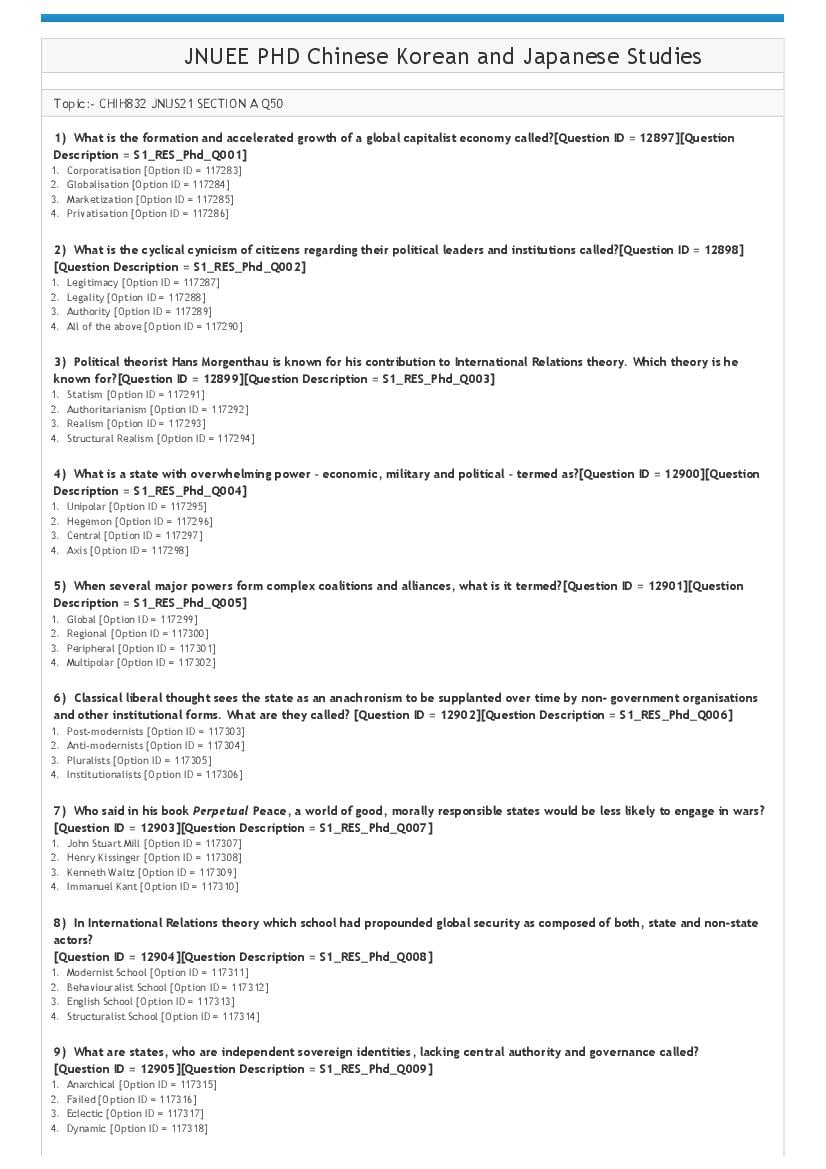
Page 1
Topic:‐ CHIH832 JNUS21 SECTION A Q50
1) What is the formation and accelerated growth of a global capitalist economy called?[Question ID = 12897][Question
Description = S1_RES_Phd_Q001]
1. Corporatisation [Option ID = 117283]
2. Globalisation [Option ID = 117284]
3. Marketization [Option ID = 117285]
4. Privatisation [Option ID = 117286]
2) What is the cyclical cynicism of citizens regarding their political leaders and institutions called?[Question ID = 12898]
[Question Description = S1_RES_Phd_Q002]
1. Legitimacy [Option ID = 117287]
2. Legality [Option ID = 117288]
3. Authority [Option ID = 117289]
4. All of the above [Option ID = 117290]
3) Political theorist Hans Morgenthau is known for his contribution to International Relations theory. Which theory is he
known for?[Question ID = 12899][Question Description = S1_RES_Phd_Q003]
1. Statism [Option ID = 117291]
2. Authoritarianism [Option ID = 117292]
3. Realism [Option ID = 117293]
4. Structural Realism [Option ID = 117294]
4) What is a state with overwhelming power – economic, military and political – termed as?[Question ID = 12900][Question
Description = S1_RES_Phd_Q004]
1. Unipolar [Option ID = 117295]
2. Hegemon [Option ID = 117296]
3. Central [Option ID = 117297]
4. Axis [Option ID = 117298]
5) When several major powers form complex coalitions and alliances, what is it termed?[Question ID = 12901][Question
Description = S1_RES_Phd_Q005]
1. Global [Option ID = 117299]
2. Regional [Option ID = 117300]
3. Peripheral [Option ID = 117301]
4. Multipolar [Option ID = 117302]
6) Classical liberal thought sees the state as an anachronism to be supplanted over time by non‐ government organisations
and other institutional forms. What are they called? [Question ID = 12902][Question Description = S1_RES_Phd_Q006]
1. Post‐modernists [Option ID = 117303]
2. Anti‐modernists [Option ID = 117304]
3. Pluralists [Option ID = 117305]
4. Institutionalists [Option ID = 117306]
7) Who said in his book Perpetual Peace, a world of good, morally responsible states would be less likely to engage in wars?
[Question ID = 12903][Question Description = S1_RES_Phd_Q007]
1. John Stuart Mill [Option ID = 117307]
2. Henry Kissinger [Option ID = 117308]
3. Kenneth Waltz [Option ID = 117309]
4. Immanuel Kant [Option ID = 117310]
8) In International Relations theory which school had propounded global security as composed of both, state and non‐state
actors?
[Question ID = 12904][Question Description = S1_RES_Phd_Q008]
1. Modernist School [Option ID = 117311]
2. Behaviouralist School [Option ID = 117312]
3. English School [Option ID = 117313]
4. Structuralist School [Option ID = 117314]
9) What are states, who are independent sovereign identities, lacking central authority and governance called?
[Question ID = 12905][Question Description = S1_RES_Phd_Q009]
1. Anarchical [Option ID = 117315]
2. Failed [Option ID = 117316]
3. Eclectic [Option ID = 117317]
4. Dynamic [Option ID = 117318]
Page 2
societies called?
[Question ID = 12906][Question Description = S1_RES_Phd_Q010]
1. Globalisation [Option ID = 117319]
2. Localisation [Option ID = 117320]
3. Economic Structuralism [Option ID = 117321]
4. Economic Modernization [Option ID = 117322]
11) What is the School of thought in International Relations that characterises dynamic engagements in various realms, as
contributing to knowledge?
[Question ID = 12907][Question Description = S1_RES_Phd_Q011]
1. Constructivism [Option ID = 117323]
2. Positivism [Option ID = 117324]
3. Neo‐realism [Option ID = 117325]
4. Globalism [Option ID = 117326]
12) When a state focuses on survival, welfare and protection, what is it broadly termed?[Question ID = 12908][Question
Description = S1_RES_Phd_Q012]
1. Liberty [Option ID = 117327]
2. Security [Option ID = 117328]
3. Sovereignty [Option ID = 117329]
4. Statist [Option ID = 117330]
13) What is nationalism?
[Question ID = 12909][Question Description = S1_RES_Phd_Q013]
1. Sovereignty [Option ID = 117331]
2. Identity [Option ID = 117332]
3. Security [Option ID = 117333]
4. Theory [Option ID = 117334]
14) What is a conceptual framework that allows one to sort out data for purposes of comparison?
[Question ID = 12910][Question Description = S1_RES_Phd_Q014]
1. Narrative [Option ID = 117335]
2. Theory [Option ID = 117336]
3. Inference [Option ID = 117337]
4. Evaluation [Option ID = 117338]
15) In research, what is an informed guess or argument called?[Question ID = 12911][Question Description =
S1_RES_Phd_Q015]
1. Supposition [Option ID = 117339]
2. Explanation [Option ID = 117340]
3. Reasoning [Option ID = 117341]
4. Hypothesis [Option ID = 117342]
16) What is a unified view of science, meaning a belief that it is possible to adopt the methodologies of the natural
sciences, to explain the social world, including international relations and world politics
called?
[Question ID = 12912][Question Description = S1_RES_Phd_Q016]
1. Post Modernism [Option ID = 117343]
2. Post Structuralism [Option ID = 117344]
3. Post Behaviouralism [Option ID = 117345]
4. Positivism [Option ID = 117346]
17) Who are the theorists who argue that beliefs held have a bias in their truth claims that legitimise
particular world orders?
[Question ID = 12913][Question Description = S1_RES_Phd_Q017]
1. Realists [Option ID = 117347]
2. Empiricists [Option ID = 117348]
3. Critical Theorists [Option ID = 117349]
4. Functionalists [Option ID = 117350]
18) What are the assumptions about being – the way things are – that an individual’s world view is,
called?
[Question ID = 12914][Question Description = S1_RES_Phd_Q018]
1. Epistemology [Option ID = 117351]
2. Tautology [Option ID = 117352]
3. Psychology [Option ID = 117353]
4. Ontology [Option ID = 117354]
19) The theory that explains hard choices to be made by policy makers with norms and values influencing moral and ethical
choices is …?
[Question ID = 12915][Question Description = S1_RES_Phd_Q019]
Page 3
2. Constructive theory [Option ID = 117356]
3. Rational theory [Option ID = 117357]
4. Policy theory [Option ID = 117358]
20) International relations theorists who say that when two or more powers are similar in their attributes, it invites a new
theory to become a template. Which theory is this?
[Question ID = 12916][Question Description = S1_RES_Phd_Q020]
1. Unipolar theory [Option ID = 117359]
2. Consensual theory [Option ID = 117360]
3. Power transition theory [Option ID = 117361]
4. Multipolar theory [Option ID = 117362]
21) Which theory explains the global system going through distinct and identifiable cycles or patterns of behaviour?
[Question ID = 12917][Question Description = S1_RES_Phd_Q021]
1. Historical theory [Option ID = 117363]
2. Regime theory [Option ID = 117364]
3. Dynasty theory [Option ID = 117365]
4. Long‐cycle theory [Option ID = 117366]
22) The ideas of natural law (jus natural) as well as laws of nations binding on all people everywhere (jus gentium) were
contributions made by which ancient empire?
[Question ID = 12918][Question Description = S1_RES_Phd_Q022]
1. Greek
[Option ID = 117367]
2. Roman
[Option ID = 117368]
3. Persian
[Option ID = 117369]
4. Chinese
[Option ID = 117370]
23) Who was Niccolo Machiavelli? [Question ID = 12919][Question Description = S1_RES_Phd_Q023]
1. Roman emperor [Option ID = 117371]
2. Poet [Option ID = 117372]
3. Political theorist [Option ID = 117373]
4. Prince of Naples [Option ID = 117374]
24) Who was the author of the book Leviathan (1650) that explains establishment of domestic political authority
determining relationship between ruler and the ruled?
[Question ID = 12920][Question Description = S1_RES_Phd_Q024]
1. Thomas Hobbes [Option ID = 117375]
2. John Locke [Option ID = 117376]
3. Edgar Snow [Option ID = 117377]
4. John Stuart Mill [Option ID = 117378]
25) What was the political theory preaching the state should play an important role in the economy
seeking to accumulate domestic capital or treasure by running continual trade surpluses in relation to other states?
[Question ID = 12921][Question Description = S1_RES_Phd_Q025]
1. Capitalism [Option ID = 117379]
2. Mercantilism [Option ID = 117380]
3. Corporatism [Option ID = 117381]
4. Globalism [Option ID = 117382]
26) When was the Peace of Westphalia arrived at in Europe after the Thirty Years’ War?[Question ID = 12922][Question
Description = S1_RES_Phd_Q026]
1. 1638 [Option ID = 117383]
2. 1643 [Option ID = 117384]
3. 1648 [Option ID = 117385]
4. 1651 [Option ID = 117386]
27) Who was Hugo Grotius?[Question ID = 12923][Question Description = S1_RES_Phd_Q027]
1. Dutch Emperor (1635‐1643) [Option ID = 117387]
2. French Emperor (1627‐1653) [Option ID = 117388]
3. Dutch legal theorist [Option ID = 117389]
4. Dutch navy admiral [Option ID = 117390]
28) Europe witnessed a new balance of power after the Congress of Vienna (1815) circumscribing the power of which
Emperor? [Question ID = 12924][Question Description = S1_RES_Phd_Q028]
1. The Czar of Russia [Option ID = 117391]
Page 4
3. Napoleon Bonaparte [Option ID = 117393]
4. King Charles I [Option ID = 117394]
29) Raw power politics in the ancient world revealed a classic realist understanding where ideals such as justice and rights
to be independent or neutral fail in a world where the strong do what they will and weak do what they must. Which book
captures this?
[Question ID = 12925][Question Description = S1_RES_Phd_Q029]
1. The Peloponnesian War by Thucydides [Option ID = 117395]
2. The Rise of Modern China by Immanuel C.Y. Hsu [Option ID = 117396]
3. 1984 by Eric Arthur Blair [Option ID = 117397]
4. Clash of Civilisations by Samuel Huntington [Option ID = 117398]
30) What is the unit of analysis in international relations research methods?[Question ID = 12926][Question Description =
S1_RES_Phd_Q030]
1. A state [Option ID = 117399]
2. Potential influence to coerce [Option ID = 117400]
3. Overwhelming influence in every known aspect [Option ID = 117401]
4. Dissent [Option ID = 117402]
31) Who is the author of the book Political realism and Political Idealism (1951), where the author found faults with both
the adversaries of the Cold War?
[Question ID = 12927][Question Description = S1_RES_Phd_Q031]
1. Hans J. Morgenthau [Option ID = 117403]
2. John Herz [Option ID = 117404]
3. John Ikenberry [Option ID = 117405]
4. Robert Kaplan [Option ID = 117406]
32) Which school of thought in International Relations theory argues that interests, objectives, threats, and opportunities,
are not givens, but rather malleable and subject to redefinition by actors?
[Question ID = 12928][Question Description = S1_RES_Phd_Q032]
1. Realists [Option ID = 117407]
2. Neo‐realists [Option ID = 117408]
3. Constructivists [Option ID = 117409]
4. Structural Realists [Option ID = 117410]
33) Applying psychological concepts to historical events and key diplomatic exchanges to perceive others behaviour form
judgements about their intentions and hence define threats to national security, was the contribution to International
Relations theory by whom?
[Question ID = 12929][Question Description = S1_RES_Phd_Q033]
1. Jean Jacques Rousseau [Option ID = 117411]
2. Francis Godemont [Option ID = 117412]
3. Robert Jervis [Option ID = 117413]
4. Henry Kissinger [Option ID = 117414]
34) Do you think it is easier for states to cooperate in an era of increasing globalisation, undermining the pessimistic realist
implications of living in a world characterised by anarchy?
[Question ID = 12930][Question Description = S1_RES_Phd_Q034]
1. Yes [Option ID = 117415]
2. No [Option ID = 117416]
3. Maybe [Option ID = 117417]
4. Perhaps [Option ID = 117418]
35) When all political authority is concentrated in one government in its capital city, what is such a state called?
[Question ID = 12931][Question Description = S1_RES_Phd_Q035]
1. Federal [Option ID = 117419]
2. Centralised [Option ID = 117420]
3. Unitary [Option ID = 117421]
4. None of the above [Option ID = 117422]
36) When all political authority or power is divided between a central government and provinces, how does one typify such
a state?
[Question ID = 12932][Question Description = S1_RES_Phd_Q036]
1. Legislative [Option ID = 117423]
2. Presidential [Option ID = 117424]
3. Autonomous [Option ID = 117425]
4. Federal [Option ID = 117426]
37) When executive and legislative functions are a single branch of government, what is this called?[Question ID = 12933]
[Question Description = S1_RES_Phd_Q037]
1. Executive government [Option ID = 117427]
2. Parliamentary government [Option ID = 117428]
Page 5
4. Judicial government [Option ID = 117430]
38) Primary means by which states attempt to exert influence over other states, using positive and
negative features is called …?
[Question ID = 12934][Question Description = S1_RES_Phd_Q038]
1. Coercion [Option ID = 117431]
2. Co‐option [Option ID = 117432]
3. Cooperation [Option ID = 117433]
4. Diplomacy [Option ID = 117434]
39) When threatening to use force and influence an outcome, before hostilities follow, it is termed …? [Question ID =
12935][Question Description = S1_RES_Phd_Q039]
1. Active diplomacy [Option ID = 117435]
2. Persuasive diplomacy [Option ID = 117436]
3. Constructive Diplomacy [Option ID = 117437]
4. Coercive diplomacy [Option ID = 117438]
40) What is the statement to a foreign government usually making a formal proposal in the expectation of a formal response
termed as?[Question ID = 12936][Question Description = S1_RES_Phd_Q040]
1. Ultimatum [Option ID = 117439]
2. Proposal [Option ID = 117440]
3. Demarche [Option ID = 117441]
4. Request [Option ID = 117442]
41) What is the tendency for social pressure to enforce conformity and consensus in cohesive decision making groups
called?
[Question ID = 12937][Question Description = S1_RES_Phd_Q041]
1. Consensus [Option ID = 117443]
2. Dissensus [Option ID = 117444]
3. Group think [Option ID = 117445]
4. Faction [Option ID = 117446]
42) In diplomacy, foreign policy decision making plays a central role. Who was the academician who
brought to focus the bureaucratic process model, where, coalitions and counter coalitions exist
among bureaucratic actors?
[Question ID = 12938][Question Description = S1_RES_Phd_Q042]
1. James Rosenau [Option ID = 117447]
2. Graham Allison [Option ID = 117448]
3. Robert Keohane [Option ID = 117449]
4. Joseph Nye [Option ID = 117450]
43) What is the mentality during negotiations where one side gains and the other side loses, termed?[Question ID = 12939]
[Question Description = S1_RES_Phd_Q043]
1. Zero‐sum [Option ID = 117451]
2. Mutually beneficial [Option ID = 117452]
3. Stasis [Option ID = 117453]
4. Pro‐active [Option ID = 117454]
44) Known for his Long Telegram, who was George Kennan?[Question ID = 12940][Question Description =
S1_RES_Phd_Q044]
1. US journalist [Option ID = 117455]
2. US academic [Option ID = 117456]
3. US diplomat [Option ID = 117457]
4. US researcher [Option ID = 117458]
45) The best way to ensure progress toward peace is to encourage the growth of republics whose
constitutional arrangements check or balance competing domestic interests. Who had made this
political philosopher assertion?
[Question ID = 12941][Question Description = S1_RES_Phd_Q045]
1. Socrates [Option ID = 117459]
2. Immanuel Kant [Option ID = 117460]
3. Plato [Option ID = 117461]
4. Chanakya [Option ID = 117462]
46) What is the balance, or equilibrium in conflict relations between two states called? [Question ID = 12942][Question
Description = S1_RES_Phd_Q046]
1. Strategic defeat [Option ID = 117463]
2. Deterrence [Option ID = 117464]
3. Stalemate [Option ID = 117465]
4. Equilibrium [Option ID = 117466]
Page 6
for attaining objectives, resolving conflicts, or any other purpose?
[Question ID = 12943][Question Description = S1_RES_Phd_Q047]
1. Neutrality [Option ID = 117467]
2. Stalling [Option ID = 117468]
3. Pacifism [Option ID = 117469]
4. Negotiations [Option ID = 117470]
48) Discounting human costs of armed conflict, motivated by war producing people willing to make
sacrifices is called …?
[Question ID = 12944][Question Description = S1_RES_Phd_Q048]
1. War mongering [Option ID = 117471]
2. Bellicism [Option ID = 117472]
3. Conflictual [Option ID = 117473]
4. Collective suicide [Option ID = 117474]
49) What is normative theory that prescribes right conduct of how states and their agents ought to act during armed
conflicts called?
[Question ID = 12945][Question Description = S1_RES_Phd_Q049]
1. Just War theory [Option ID = 117475]
2. Mediation [Option ID = 117476]
3. Multilateral diplomacy [Option ID = 117477]
4. Peace overture [Option ID = 117478]
50) Who was the political philosopher who said human life is “solitary, poor, nasty, brutish and short”?
[Question ID = 12946][Question Description = S1_RES_Phd_Q050]
1. John Locke [Option ID = 117479]
2. Niccolo Macchiavelli [Option ID = 117480]
3. Thomas Hobbes [Option ID = 117481]
4. Karl von Clausewitz [Option ID = 117482]
Topic:‐ CHIH832 JNUS21 SECTION B1 Q50
1) China’s One Belt and One Road initiative was announced at the following place and year[Question ID = 12947][Question
Description = S1_CHIH_832_Phd_Q001]
1. Tsinghua University, 2014 [Option ID = 117483]
2. Beijing University, 2013 [Option ID = 117484]
3. Kazakh National University, 2013 [Option ID = 117485]
4. Nazerbayev University, 2013 [Option ID = 117486]
2) China‐Russia Treaty of Good Neighbourliness and Friendly Cooperation for twenty years was signed in
[Question ID = 12948][Question Description = S1_CHIH_832_Phd_Q002]
1. July 2001
[Option ID = 117487]
2. May 2001
[Option ID = 117488]
3. July 2002
[Option ID = 117489]
4. May 2002
[Option ID = 117490]
3) When and where was the China‐Arab Cooperation Forum established?[Question ID = 12949][Question Description =
S1_CHIH_832_Phd_Q003]
1. Beijing, 2006 [Option ID = 117491]
2. Cairo, 2004 [Option ID = 117492]
3. Bahrain 2008 [Option ID = 117493]
4. Tianjin 2010 [Option ID = 117494]
4) When and where was the China‐Central and East European Countries summit meetings began?[Question ID = 12950]
[Question Description = S1_CHIH_832_Phd_Q004]
1. Warsaw 2012 [Option ID = 117495]
2. Bucharest 2013 [Option ID = 117496]
3. Belgrade 2012 [Option ID = 117497]
4. Riga 2016 [Option ID = 117498]
5) When was the word “soft power” first used officially in a Communist Party Congress?[Question ID = 12951][Question
Description = S1_CHIH_832_Phd_Q005]
1. 19th party congress in 2017 [Option ID = 117499]
2. 18th party congress in 2012 [Option ID = 117500]
3. 17th party congress in 2007 [Option ID = 117501]
Page 7
6) When did Liu Xiaobo receive Nobel Peace Prize?[Question ID = 12952][Question Description = S1_CHIH_832_Phd_Q006]
1. 2010 [Option ID = 117503]
2. 2011 [Option ID = 117504]
3. 2009 [Option ID = 117505]
4. 2012 [Option ID = 117506]
7) Which of the following is the largest think‐tank in China in terms of number of researchers?[Question ID = 12953]
[Question Description = S1_CHIH_832_Phd_Q007]
1. China Foundation for International Strategic Studies [Option ID = 117507]
2. China Centre for International Economic Relations [Option ID = 117508]
3. China Institute for International Studies [Option ID = 117509]
4. China Institutes for Contemporary International Relations [Option ID = 117510]
8) Which of the following is the highest foreign policy decision‐making institution in China?[Question ID = 12954][Question
Description = S1_CHIH_832_Phd_Q008]
1. Central Military Commission [Option ID = 117511]
2. National Security Committee [Option ID = 117512]
3. Foreign Ministry [Option ID = 117513]
4. Central Foreign Affairs Small Leading Group [Option ID = 117514]
9) When was the first Confucius Institute established?[Question ID = 12955][Question Description =
S1_CHIH_832_Phd_Q009]
1. 2002 [Option ID = 117515]
2. 2003 [Option ID = 117516]
3. 2004 [Option ID = 117517]
4. 2005 [Option ID = 117518]
10) When was an armistice agreement signed to terminate the Korean War?[Question ID = 12956][Question Description =
S1_CHIH_832_Phd_Q010]
1. July 27, 1953 [Option ID = 117519]
2. June 25, 1950 [Option ID = 117520]
3. May 24, 1953 [Option ID = 117521]
4. July 16, 1954 [Option ID = 117522]
11) How many key industrial projects did the Soviet Union help China with?[Question ID = 12957][Question Description =
S1_CHIH_832_Phd_Q011]
1. 156 [Option ID = 117523]
2. 154 [Option ID = 117524]
3. 153 [Option ID = 117525]
4. 152 [Option ID = 117526]
12) What is the main policy behind the slogan of “Clean up the house before inviting guests” by China?[Question ID =
12958][Question Description = S1_CHIH_832_Phd_Q012]
1. To uproot western influences in China [Option ID = 117527]
2. To showcase China for reform and opening up [Option ID = 117528]
3. To get diplomatic recognition from different countries [Option ID = 117529]
4. To expand relations with western countries [Option ID = 117530]
13) Where did China sent its first UN Peace Keeping Operation force?[Question ID = 12959][Question Description =
S1_CHIH_832_Phd_Q013]
1. Cambodia [Option ID = 117531]
2. Golan Heights and Sinai [Option ID = 117532]
3. Sierra Leone and Mozambique [Option ID = 117533]
4. Rwanda [Option ID = 117534]
14) When was the Sino‐British joint declaration on setting up a special administrative region for Hong Kong signed[Question
ID = 12960][Question Description = S1_CHIH_832_Phd_Q014]
1. 1982 [Option ID = 117535]
2. 1983 [Option ID = 117536]
3. 1984 [Option ID = 117537]
4. 1985 [Option ID = 117538]
15) When did China join the World Trade Organisation?
[Question ID = 12961][Question Description = S1_CHIH_832_Phd_Q015]
1. November 2000
[Option ID = 117539]
2. December 2001
[Option ID = 117540]
3. December 2000
Page 8
4. November 2001
[Option ID = 117542]
16) When did China sign the Comprehensive Test Ban Treaty[Question ID = 12962][Question Description =
S1_CHIH_832_Phd_Q016]
1. 1993 [Option ID = 117543]
2. 1994 [Option ID = 117544]
3. 1995 [Option ID = 117545]
4. 1996 [Option ID = 117546]
17) When did China decide to send its naval contingency to the Indian Ocean Region to counter piracy?[Question ID =
12963][Question Description = S1_CHIH_832_Phd_Q017]
1. 2008 [Option ID = 117547]
2. 2009 [Option ID = 117548]
3. 2010 [Option ID = 117549]
4. 2011 [Option ID = 117550]
18) When did Japan’s Emperor Akihito visited China?[Question ID = 12964][Question Description =
S1_CHIH_832_Phd_Q018]
1. 1991 [Option ID = 117551]
2. 1992 [Option ID = 117552]
3. 1993 [Option ID = 117553]
4. 1994 [Option ID = 117554]
19) What was the vessel which became the eye of the storm between China and the United States in 1993?[Question ID =
12965][Question Description = S1_CHIH_832_Phd_Q019]
1. Yinhe [Option ID = 117555]
2. Han [Option ID = 117556]
3. Xia [Option ID = 117557]
4. Shang [Option ID = 117558]
20) Which of the following are not part of Jiang Zemin’s “three represents”[Question ID = 12966][Question Description =
S1_CHIH_832_Phd_Q020]
1. That the communist party represents workers [Option ID = 117559]
2. That the communist party represented broad masses of people [Option ID = 117560]
3. That the communist party represents productive forces [Option ID = 117561]
4. That the communist party represents advanced culture [Option ID = 117562]
21) Which of the following incidents is considered to be the beginning of Japan’s invasion of China?[Question ID = 12967]
[Question Description = S1_CHIH_832_Phd_Q021]
1. Nanjing massacre [Option ID = 117563]
2. Manchuguo [Option ID = 117564]
3. Harbin [Option ID = 117565]
4. Lugou [Option ID = 117566]
22) Which of the following is not a decisive military campaign fought by Communist forces against Kuomintang?[Question ID
= 12968][Question Description = S1_CHIH_832_Phd_Q022]
1. Liaoxi‐Shenyang [Option ID = 117567]
2. Xian [Option ID = 117568]
3. Huai‐Hai [Option ID = 117569]
4. Beiping‐Tianjin [Option ID = 117570]
23) Which of the following is not a base area created by Communist forces[Question ID = 12969][Question Description =
S1_CHIH_832_Phd_Q023]
1. Shaan‐Gan‐Ning [Option ID = 117571]
2. Ruijin [Option ID = 117572]
3. Jinggangshan [Option ID = 117573]
4. Nanchang [Option ID = 117574]
24) When was the First Five Year Plan begun in China?[Question ID = 12970][Question Description =
S1_CHIH_832_Phd_Q024]
1. 1949 [Option ID = 117575]
2. 1950 [Option ID = 117576]
3. 1953 [Option ID = 117577]
4. 1952 [Option ID = 117578]
25) Which of the following is the earliest railway line in China?[Question ID = 12971][Question Description =
S1_CHIH_832_Phd_Q025]
1. Baoji to Chengdu [Option ID = 117579]
2. Tianshui to Lanzhou [Option ID = 117580]
3. Chengyu railway [Option ID = 117581]
Page 9
26) Which of the following “autonomous regions” was established prior to the formation of the People’s Republic of China in
1949?[Question ID = 12972][Question Description = S1_CHIH_832_Phd_Q026]
1. Tibet Autonomous Region [Option ID = 117583]
2. Inner Mongolian Autonomous Region [Option ID = 117584]
3. Guangxi Zhuang Autonomous Region [Option ID = 117585]
4. Ningxia Hui Autonomous Region [Option ID = 117586]
27) Which of the following educational institutions was taken over as a part of “educational sovereignty” in China in the
1950s?[Question ID = 12973][Question Description = S1_CHIH_832_Phd_Q027]
1. Beijing University [Option ID = 117587]
2. Tsinghua University [Option ID = 117588]
3. Fudan University [Option ID = 117589]
4. Fu Jen University [Option ID = 117590]
28) Who among the following is not a famous scientist who returned to China after 1949?[Question ID = 12974][Question
Description = S1_CHIH_832_Phd_Q028]
1. Qian Xuesen [Option ID = 117591]
2. Ma Yinchu [Option ID = 117592]
3. Li Siguang [Option ID = 117593]
4. Wu Zhonghua [Option ID = 117594]
29) Identify one of the following movies that was criticised by Mao Zedong.
[Question ID = 12975][Question Description = S1_CHIH_832_Phd_Q029]
1. Steel Warriors
[Option ID = 117595]
2. Dong Cunrui
[Option ID = 117596]
3. White Haired Girl
[Option ID = 117597]
4. The Life of Wu Xun
[Option ID = 117598]
30) What was the phrase “launching Sputniks” meant in China in the 1950s?[Question ID = 12976][Question Description =
S1_CHIH_832_Phd_Q030]
1. Launching of satellites [Option ID = 117599]
2. Launching Soviet‐style heavy industry [Option ID = 117600]
3. Launching of agricultural production [Option ID = 117601]
4. Launching of sports activities [Option ID = 117602]
31) Which of the following is not a role model proposed to be emulated in China in the 1960s?[Question ID = 12977]
[Question Description = S1_CHIH_832_Phd_Q031]
1. Lei Feng [Option ID = 117603]
2. Hu Shih [Option ID = 117604]
3. Jiao Yulu [Option ID = 117605]
4. Wang Jinxi [Option ID = 117606]
32) Which of the following countries helped China in breaking the United States trade embargoes?[Question ID = 12978]
[Question Description = S1_CHIH_832_Phd_Q032]
1. Singapore [Option ID = 117607]
2. India [Option ID = 117608]
3. Sri Lanka [Option ID = 117609]
4. Indonesia [Option ID = 117610]
33) Who among the following was not considered as part of “anti‐Party clique” in 1966[Question ID = 12979][Question
Description = S1_CHIH_832_Phd_Q033]
1. Peng Zhen [Option ID = 117611]
2. Yang Shangkun [Option ID = 117612]
3. Luo Ruiqing [Option ID = 117613]
4. Lin Biao [Option ID = 117614]
34) Who among the following is not part of the Cultural Revolution Group?[Question ID = 12980][Question Description =
S1_CHIH_832_Phd_Q034]
1. Chen Boda [Option ID = 117615]
2. Kang Sheng [Option ID = 117616]
3. Lu Dingyi [Option ID = 117617]
4. Jiang Qing [Option ID = 117618]
35) Which of the following Plenary Session of the 11th Communist Party Central Committee decided to usher in reform
Page 10
1. First [Option ID = 117619]
2. Second [Option ID = 117620]
3. Third [Option ID = 117621]
4. Fourth [Option ID = 117622]
36) In which province was the first experiments of “farm output quotas per household” and “work contracted to
households” made?[Question ID = 12982][Question Description = S1_CHIH_832_Phd_Q036]
1. Anhui [Option ID = 117623]
2. Hebei [Option ID = 117624]
3. Hubei [Option ID = 117625]
4. Hunan [Option ID = 117626]
37) When do China’s People’s Liberation Army consider as its founding date?[Question ID = 13130][Question Description =
S1_CHIH_832_Phd_Q037]
1. August 1, 1927 [Option ID = 117627]
2. July 1, 1921 [Option ID = 117628]
3. July 1, 1927 [Option ID = 117629]
4. August 1, 1921 [Option ID = 117630]
38) What is the key objective of China’s military reforms of 2015?[Question ID = 13131][Question Description =
S1_CHIH_832_Phd_Q038]
1. To support the communist party [Option ID = 117631]
2. To build integrated joint commands [Option ID = 117632]
3. To build revolutionary armed forces [Option ID = 117633]
4. To capture Taiwan [Option ID = 117634]
39) Where did China’s President Xi Jinping and Taiwan’s President Ma Ying‐jeau met for the first time?[Question ID =
13132][Question Description = S1_CHIH_832_Phd_Q039]
1. Beijing [Option ID = 117635]
2. Taipei [Option ID = 117636]
3. Hong Kong [Option ID = 117637]
4. Singapore [Option ID = 117638]
40) What is the gross domestic product growth target set by China in 2021?[Question ID = 13133][Question Description =
S1_CHIH_832_Phd_Q040]
1. Above 11 percent [Option ID = 117639]
2. Above 6 percent [Option ID = 117640]
3. Above 10 percent [Option ID = 117641]
4. None of the above [Option ID = 117642]
41) When were the two major Taiwan Straits crises?[Question ID = 13134][Question Description = S1_CHIH_832_Phd_Q041]
1. 1958 and 1994‐95 [Option ID = 117643]
2. 1954 and 1994‐95 [Option ID = 117644]
3. 1958 and 1990‐91 [Option ID = 117645]
4. 1954 and 1990‐91 [Option ID = 117646]
42) Which of the following is not part of the judgement of the Permanent Court of Arbitration on South China Sea in 2016?
[Question ID = 13135][Question Description = S1_CHIH_832_Phd_Q042]
1. That China’s “historical claims” are not valid [Option ID = 117647]
2. That the livelihood of fishermen is affected [Option ID = 117648]
3. That dredging of reefs had affected the environment in the region [Option ID = 117649]
4. That China has militarised the region [Option ID = 117650]
43) Which of the following areas are not part of the territorial dispute between India and China[Question ID = 13136]
[Question Description = S1_CHIH_832_Phd_Q043]
1. Galwan [Option ID = 117651]
2. Pangong Tso [Option ID = 117652]
3. Daulat Beg Oldie [Option ID = 117653]
4. Gogra Heights [Option ID = 117654]
44) Who was the first major Chinese leader to visit the United States?[Question ID = 13137][Question Description =
S1_CHIH_832_Phd_Q044]
1. Mao Zedong [Option ID = 117655]
2. Zhou Enlai [Option ID = 117656]
3. Hua Guofeng [Option ID = 117657]
4. Deng Xiaoping [Option ID = 117658]
45) Who among the following leaders stated that “unless and until China and India develop there is no Asian
Century”[Question ID = 13138][Question Description = S1_CHIH_832_Phd_Q045]
1. Zhou Enlai [Option ID = 117659]
2. Deng Xiaoping [Option ID = 117660]
3. Jiang Zemin [Option ID = 117661]
Page 11
46) Which of the following is not part of India‐China partnership?[Question ID = 13139][Question Description =
S1_CHIH_832_Phd_Q046]
1. Cooperative and constructive partnership [Option ID = 117663]
2. Strategic and cooperative partnership [Option ID = 117664]
3. Developmental partnership [Option ID = 117665]
4. Comprehensive strategic partnership [Option ID = 117666]
47) At which Shanghai Cooperation Organisation summit meeting that India became a member?[Question ID = 13140]
[Question Description = S1_CHIH_832_Phd_Q047]
1. Qingdao [Option ID = 117667]
2. Shanghai [Option ID = 117668]
3. Astana [Option ID = 117669]
4. Yekaterinburg [Option ID = 117670]
48) When was the Declaration of Conduct signed on South China Sea?[Question ID = 13141][Question Description =
S1_CHIH_832_Phd_Q048]
1. 2002 [Option ID = 117671]
2. 2003 [Option ID = 117672]
3. 2004 [Option ID = 117673]
4. 2005 [Option ID = 117674]
49) In which of the following United Nations Security Council committees that China objected to Indian counter‐terrorism
efforts?[Question ID = 13142][Question Description = S1_CHIH_832_Phd_Q049]
1. 1172 [Option ID = 117675]
2. 1267 [Option ID = 117676]
3. 1482 [Option ID = 117677]
4. 1592 [Option ID = 117678]
50) The following has not served as China’s foreign minister. Identify
[Question ID = 13143][Question Description = S1_CHIH_832_Phd_Q050]
1. Zhou Enlai
[Option ID = 117679]
2. Qian Qichen
[Option ID = 117680]
3. Li Zhaoxing
[Option ID = 117681]
4. Liu Shaoqi
[Option ID = 117682]
Topic:‐ CHIH832 JNUS21 SECTION B2 Q50
1) The Emperor of Japan is also known as[Question ID = 13144][Question Description = S1_JPIH_833_Phd_Q001]
1. Tesso [Option ID = 117683]
2. Temmo [Option ID = 117684]
3. Tenno [Option ID = 117685]
4. Tetsuo [Option ID = 117686]
2) Hiroshima is located in[Question ID = 13145][Question Description = S1_JPIH_833_Phd_Q002]
1. Hokkaido [Option ID = 117687]
2. Kyushu [Option ID = 117688]
3. Honshu [Option ID = 117689]
4. Shikoku [Option ID = 117690]
3) Japan is also known as[Question ID = 13146][Question Description = S1_JPIH_833_Phd_Q003]
1. Nippon [Option ID = 117691]
2. Neppon [Option ID = 117692]
3. Nipon [Option ID = 117693]
4. Nippoon [Option ID = 117694]
4) The Meiji Restoration began in[Question ID = 13147][Question Description = S1_JPIH_833_Phd_Q004]
1. 1857 [Option ID = 117695]
2. 1847 [Option ID = 117696]
3. 1868 [Option ID = 117697]
4. 1858 [Option ID = 117698]
5) The San Francisco Treaty was signed in the year[Question ID = 13148][Question Description = S1_JPIH_833_Phd_Q005]
1. 1950 [Option ID = 117699]
2. 1951 [Option ID = 117700]
Page 12
4. 1953 [Option ID = 117702]
6) The full form of SCAP is[Question ID = 13149][Question Description = S1_JPIH_833_Phd_Q006]
1. Supreme Committee of Allied Power [Option ID = 117703]
2. Supreme Controller of Allied Power [Option ID = 117704]
3. Supreme Commander of Allied Power [Option ID = 117705]
4. Supreme Comptroller of Allied Power [Option ID = 117706]
7) The national animal of Japan is[Question ID = 13150][Question Description = S1_JPIH_833_Phd_Q007]
1. Kami [Option ID = 117707]
2. Koi [Option ID = 117708]
3. Kane [Option ID = 117709]
4. Kato [Option ID = 117710]
8) How many times did Tokyo get the chance of holding Olympics?[Question ID = 13151][Question Description =
S1_JPIH_833_Phd_Q008]
1. One time [Option ID = 117711]
2. Two times [Option ID = 117712]
3. Three times [Option ID = 117713]
4. Four times [Option ID = 117714]
9) The Hanshin earth quake happened in[Question ID = 13152][Question Description = S1_JPIH_833_Phd_Q009]
1. 1990 [Option ID = 117715]
2. 1991 [Option ID = 117716]
3. 1993 [Option ID = 117717]
4. 1995 [Option ID = 117718]
10) The ruling party of Japan is[Question ID = 13153][Question Description = S1_JPIH_833_Phd_Q010]
1. Liberal Democratic Party [Option ID = 117719]
2. Literal Democratic Party [Option ID = 117720]
3. Littoral Democratic Party [Option ID = 117721]
4. Lateral Democratic Party [Option ID = 117722]
11) Japan joined United Nations in[Question ID = 13154][Question Description = S1_JPIH_833_Phd_Q011]
1. 1953 [Option ID = 117723]
2. 1954 [Option ID = 117724]
3. 1955 [Option ID = 117725]
4. 1956 [Option ID = 117726]
12) What best explains “Soft Power” of Japan[Question ID = 13155][Question Description = S1_JPIH_833_Phd_Q012]
1. Trade between Japan and India [Option ID = 117727]
2. Exchange of students between Japan and India [Option ID = 117728]
3. India’s defence equipment buying from Japan [Option ID = 117729]
4. Japan participation in Malabar exercise [Option ID = 117730]
13) Japan India Friendship Treaty was signed in[Question ID = 13156][Question Description = S1_JPIH_833_Phd_Q013]
1. 1952 [Option ID = 117731]
2. 1953 [Option ID = 117732]
3. 1954 [Option ID = 117733]
4. 1955 [Option ID = 117734]
14) Womenomics was promoted by[Question ID = 13157][Question Description = S1_JPIH_833_Phd_Q014]
1. Shinzu Abe [Option ID = 117735]
2. Shinto Abe [Option ID = 117736]
3. Shinzo Abe [Option ID = 117737]
4. Shinze Abe [Option ID = 117738]
15) QUAD is associated with[Question ID = 13158][Question Description = S1_JPIH_833_Phd_Q015]
1. South China Sea [Option ID = 117739]
2. East China Sea [Option ID = 117740]
3. Indo Pacific region [Option ID = 117741]
4. Pacific region [Option ID = 117742]
16) The Takeshima Island dispute is with
[Question ID = 13159][Question Description = S1_JPIH_833_Phd_Q016]
1. South Korea
[Option ID = 117743]
2. North Korea
[Option ID = 117744]
3. China
Page 13
4. Vietnam
[Option ID = 117746]
17) Japan is not a member of[Question ID = 13160][Question Description = S1_JPIH_833_Phd_Q017]
1. ASEAN plus Three [Option ID = 117747]
2. AIIB [Option ID = 117748]
3. ADB [Option ID = 117749]
4. APEC [Option ID = 117750]
18) The national anthem of Japan is called
[Question ID = 13161][Question Description = S1_JPIH_833_Phd_Q018]
1. Kimigayo
[Option ID = 117751]
2. Kinogaya
[Option ID = 117752]
3. Kimmoya
[Option ID = 117753]
4. Kinhoya
[Option ID = 117754]
19) Okinawa has been in news in Japan because of[Question ID = 13162][Question Description = S1_JPIH_833_Phd_Q019]
1. Continuous natural calamity [Option ID = 117755]
2. Uprising by people in Okinawa [Option ID = 117756]
3. American Base in Okinawa [Option ID = 117757]
4. Nuclear disaster in Okinawa [Option ID = 117758]
20) JSDF is under[Question ID = 13163][Question Description = S1_JPIH_833_Phd_Q020]
1. Ministry of Labor [Option ID = 117759]
2. Ministry of Defense [Option ID = 117760]
3. Ministry of Environment [Option ID = 117761]
4. Ministry of Foreign Affairs [Option ID = 117762]
21) Which party did Prime Minister Naoto Kan belong?[Question ID = 13164][Question Description =
S1_JPIH_833_Phd_Q021]
1. Democratic Party of Japan [Option ID = 117763]
2. Liberal Democratic Party [Option ID = 117764]
3. Japan Communist Party [Option ID = 117765]
4. Japan Socialist Party [Option ID = 117766]
22) Who occupied Japan after World War II?[Question ID = 13165][Question Description = S1_JPIH_833_Phd_Q022]
1. British [Option ID = 117767]
2. American [Option ID = 117768]
3. French [Option ID = 117769]
4. Russia [Option ID = 117770]
23) The history between Japan and which countries has been a source of discontent
[Question ID = 13166][Question Description = S1_JPIH_833_Phd_Q023]
1. South Korea and North Korea
[Option ID = 117771]
2. South Korea and Taiwan
[Option ID = 117772]
3. South Korea and Russia
[Option ID = 117773]
4. South Korea and China
[Option ID = 117774]
24) Which nationality was Commander Perry?[Question ID = 13167][Question Description = S1_JPIH_833_Phd_Q024]
1. British [Option ID = 117775]
2. German [Option ID = 117776]
3. Dutch [Option ID = 117777]
4. America [Option ID = 117778]
25) The word “manga” is best associated with[Question ID = 13168][Question Description = S1_JPIH_833_Phd_Q025]
1. Animation in television [Option ID = 117779]
2. Cartoon in print [Option ID = 117780]
3. Carton boxes [Option ID = 117781]
4. Animal kingdom [Option ID = 117782]
Page 14
S1_JPIH_833_Phd_Q026]
1. Two third majority in both houses and ratification by people. [Option ID = 117783]
2. One third majority in both houses [Option ID = 117784]
3. By simple majority of the people of Japan [Option ID = 117785]
4. By proportional voting system [Option ID = 117786]
27)
Assertion A
India Japan relationship has moved from economic engagement to strategic engagement
Reason R
India is largest recipient of aid from Japan[Question ID = 13170][Question Description = S1_JPIH_833_Phd_Q027]
1. Both A and R are correct and R is the correct explanation of A [Option ID = 117787]
2. Both A and R are correct and R is NOT the correct explanation of A [Option ID = 117788]
3. A is correct but R is not correct [Option ID = 117789]
4. A is not correct but R is correct [Option ID = 117790]
28) Assertion A
Foreign Direct Investment from Japan has led to economic growth of India
Reason R
Japanese Foreign Direct Investment is mainly in infrastructure development
[Question ID = 13171][Question Description = S1_JPIH_833_Phd_Q028]
1. Both A and R are correct and R is the correct explanation of A [Option ID = 117791]
2. Both A and R are correct and R is NOT the correct explanation of A [Option ID = 117792]
3. A is correct but R is not correct [Option ID = 117793]
4. A is not correct but R is correct [Option ID = 117794]
29) Assertion A
Japan relations with North Korea has nose‐dived in the last ten years
Reason R
North Korea is following a strong nuclear policy.
[Question ID = 13172][Question Description = S1_JPIH_833_Phd_Q029]
1. Both A and R are correct and R is the correct explanation of A [Option ID = 117795]
2. Both A and R are correct and R is NOT the correct explanation of A [Option ID = 117796]
3. A is correct but R is not correct [Option ID = 117797]
4. A is not correct but R is correct [Option ID = 117798]
30) Assertion A
Japan followed the policy of check book diplomacy till the 1990s
Reason R
This was due to the Japan policy of economic engagement.
[Question ID = 13173][Question Description = S1_JPIH_833_Phd_Q030]
1. Both A and R are correct and R is the correct explanation of A [Option ID = 117799]
2. Both A and R are correct and R is NOT the correct explanation of A [Option ID = 117800]
3. A is correct but R is not correct [Option ID = 117801]
4. A is not correct but R is correct [Option ID = 117802]
31) Assertion A
Japan and South Korea are both part of US alliance system in Asia.
Reason R
Currently, Japan's relationship with South Korea is going through a “cold phase”
[Question ID = 13174][Question Description = S1_JPIH_833_Phd_Q031]
1. Both A and R are correct and R is the correct explanation of A
[Option ID = 117803]
2. Both A and R are correct and R is NOT the correct explanation of A
Page 15
3. A is correct but R is not correct
[Option ID = 117805]
4. A is not correct but R is correct
[Option ID = 117806]
32) Assertion A
Japan’s Indo Pacific policy has moved from “strategic” to a “vision”.
Reason R
Change from “strategic” to “vision” is to accommodate other partners of QUAD
[Question ID = 13175][Question Description = S1_JPIH_833_Phd_Q032]
1. Both A and R are correct and R is the correct explanation of A [Option ID = 117807]
2. Both A and R are correct and R is NOT the correct explanation of A [Option ID = 117808]
3. A is correct but R is not correct [Option ID = 117809]
4. A is not correct but R is correct [Option ID = 117810]
33) Assertion A
Comprehensive economic partnership between countries in Asia is called the ‘noodle bowl”
Reason R
Formulation of RCEP was to create a common order for trade and investment among the Asian countries.
[Question ID = 13176][Question Description = S1_JPIH_833_Phd_Q033]
1. Both A and R are correct and R is the correct explanation of A [Option ID = 117811]
2. Both A and R are correct and R is NOT the correct explanation of A [Option ID = 117812]
3. A is correct but R is not correct [Option ID = 117813]
4. A is not correct but R is correct [Option ID = 117814]
34) Assertion A
Japan is a member of both RCEP and CPTPP.
Reason R
Japan is the only country which has membership in RCEP and CPTPP
[Question ID = 13177][Question Description = S1_JPIH_833_Phd_Q034]
1. Both A and R are correct and R is the correct explanation of A [Option ID = 117815]
2. Both A and R are correct and R is NOT the correct explanation of A [Option ID = 117816]
3. A is correct but R is not correct [Option ID = 117817]
4. A is not correct but R is correct [Option ID = 117818]
35) Assertion A
Japan is concerned about China’s assertion in South China Sea.
Reason R
Japan has enhanced its aid diplomacy with ASEAN countries.
[Question ID = 13178][Question Description = S1_JPIH_833_Phd_Q035]
1. Both A and R are correct and R is the correct explanation of A [Option ID = 117819]
2. Both A and R are correct and R is NOT the correct explanation of A [Option ID = 117820]
3. A is correct but R is not correct [Option ID = 117821]
4. A is not correct but R is correct [Option ID = 117822]
36) Assertion A
Japan wants to protect its Sea lane of Communication.
Reason R
Japan is ensuring aid to India to build its infrastructure.
[Question ID = 13179][Question Description = S1_JPIH_833_Phd_Q036]
1. Both A and R are correct and R is the correct explanation of A [Option ID = 117823]
2. Both A and R are correct and R is NOT the correct explanation of A [Option ID = 117824]
3. A is correct but R is not correct [Option ID = 117825]
4. A is not correct but R is correct [Option ID = 117826]
Page 16
Japan has been limited in industrial development because of the alliance system with the United States.
Reason R
Japan has developed a strong economic base built on the export of manufactured goods.
[Question ID = 13180][Question Description = S1_JPIH_833_Phd_Q037]
1. Both A and R are correct and R is the correct explanation of A [Option ID = 117827]
2. Both A and R are correct and R is NOT the correct explanation of A [Option ID = 117828]
3. A is correct but R is not correct [Option ID = 117829]
4. A is not correct but R is correct [Option ID = 117830]
38) Statement 1
A major effect of geography on Japan is that it has fertile plains which have enabled Japan to keep food prices low.
Statement 2
A major effect of geography on Japan is that it has mountains which have prevented invasions by foreign nations.
[Question ID = 13181][Question Description = S1_JPIH_833_Phd_Q038]
1. Both Statement 1 and Statement 2 are true
[Option ID = 117831]
2. Both Statement 1 and Statement 2 are false
[Option ID = 117832]
3. Statement 1 is correct but 2 is false
[Option ID = 117833]
4. Statement 1 is incorrect but Statement 2 is true
[Option ID = 117834]
39)
[Question ID = 13182][Question Description = S1_JPIH_833_Phd_Q039]
1. A…III….. B…I…… C…II….. D……IV….
[Option ID = 117835]
2. A……II.. B……I… C…IV….. D…III…….
[Option ID = 117836]
3. A…I….. B…III…… C…II….. D…IV…….
[Option ID = 117837]
4. A…III….. B…II…… C…I….. D…IV…….
[Option ID = 117838]
40)
[Question ID = 13183][Question Description = S1_JPIH_833_Phd_Q040]
1. A…I…. B…II…… C…III….. D…IV…….
[Option ID = 117839]
2. A…IV….. B……II… C…III….. D…I…….
[Option ID = 117840]
Page 17
[Option ID = 117841]
4. A…III….. B……II… C…IV….. D…I…….
[Option ID = 117842]
41) Statement 1. Akhihito is the current emperor of Japan.
Statement 2. Emperor Akhihito era is known as Heisei
[Question ID = 13184][Question Description = S1_JPIH_833_Phd_Q041]
1. Both Statement 1 and Statement 2 are true [Option ID = 117843]
2. Both Statement 1 and Statement 2 are false [Option ID = 117844]
3. Statement 1 is correct but 2 is false [Option ID = 117845]
4. Statement 1 is incorrect but Statement 2 is true [Option ID = 117846]
42) Statement 1. Constitution of Japan is a Pacifist Constitution.
Statement 2. Constitution of Japan calls for peace.
[Question ID = 13185][Question Description = S1_JPIH_833_Phd_Q042]
1. Both Statement 1 and Statement 2 are true [Option ID = 117847]
2. Both Statement 1 and Statement 2 are false [Option ID = 117848]
3. Statement 1 is correct but 2 is false [Option ID = 117849]
4. Statement 1 is incorrect but Statement 2 is true [Option ID = 117850]
43) Statement 1: Yoshida Doctrine focused on building relations with its neighbours.
Statement 2: Yoshida Doctrine concentrated on reconstructing Japan’s economy while accepting the security alliance to
guarantee Japan its security.
[Question ID = 13433][Question Description = S1_JPIH_833_Phd_Q043]
1. Both Statement 1 and Statement 2 are true
[Option ID = 117851]
2. Both Statement 1 and Statement 2 are false
[Option ID = 117852]
3. Statement 1 is correct but 2 is false
[Option ID = 117853]
4. Statement 1 is incorrect but Statement 2 is true
[Option ID = 117854]
44) Statement 1: Yasukuni Shrine is shrouded in diplomatic controversy with Japan’s neighbours.
Statement 2: Yasukuni Shrine honors 2.5 million Japanese war dead – including 14 Class‐A war criminals.
[Question ID = 13434][Question Description = S1_JPIH_833_Phd_Q044]
1. Both Statement 1 and Statement 2 are true
[Option ID = 117855]
2. Both Statement 1 and Statement 2 are false
[Option ID = 117856]
3. Statement 1 is correct but 2 is false
[Option ID = 117857]
4. Statement 1 is incorrect but Statement 2 is true
[Option ID = 117858]
45) Statement 1: Japanese language has Kanji as part of its scripts.
Statement 2: Most Kanji have two readings‐ Kun yomi and On yomi.
[Question ID = 13435][Question Description = S1_JPIH_833_Phd_Q045]
1. Both Statement 1 and Statement 2 are true
[Option ID = 117859]
2. Both Statement 1 and Statement 2 are false
[Option ID = 117860]
3. Statement 1 is correct but 2 is false
[Option ID = 117861]
4. Statement 1 is incorrect but Statement 2 is true
[Option ID = 117862]
46) Statement 1 Kyoto Protocol is associated with Global warming.
Page 18
[Question ID = 13436][Question Description = S1_JPIH_833_Phd_Q046]
1. Both Statement 1 and Statement 2 are true [Option ID = 117863]
2. Both Statement 1 and Statement 2 are false [Option ID = 117864]
3. Statement 1 is correct but 2 is false [Option ID = 117865]
4. Statement 1 is incorrect but Statement 2 is true [Option ID = 117866]
47) PASSAGE DONOT JUMBLE THE QUESTIONS
Three years of Abenomics have bought huge achievements. On the second stage of Abenomics we will tackle the issue of
declining birthrate and aging population head on. This is not just a kind of social policy but can be called as the ultimate
growth strategy. The new three arrows are robust economy that gives rise to hope, dream‐weaving child care support,
social security that provides reassurance.
First stage of Abenomics is MOST closely associated too
[Question ID = 13437][Question Description = S1_JPIH_833_Phd_Q047]
1. Aggressive monetary policy
[Option ID = 117867]
2. Aggressive public expenditure
[Option ID = 117868]
3. Quantum increase in expenditure on social support
[Option ID = 117869]
4. Strong liberal Immigration policy
[Option ID = 117870]
48) PASSAGE DONOT JUMBLE THE QUESTIONS
Three years of Abenomics have bought huge achievements. On the second stage of Abenomics we will tackle the issue of
declining birthrate and aging population head on. This is not just a kind of social policy but can be called as the ultimate
growth strategy. The new three arrows are robust economy that gives rise to hope, dream‐weaving child care support,
social security that provides reassurance.
Which is NOT part of Abenomics second stage
[Question ID = 13438][Question Description = S1_JPIH_833_Phd_Q048]
1. It looks at increasing productive of the nation.
[Option ID = 117871]
2. It looks at strong social support.
[Option ID = 117872]
3. It looks at achieving growth by addressing declining birth rate.
[Option ID = 117873]
4. It looks at giving corporates easy loans.
[Option ID = 117874]
49) PASSAGE DONOT JUMBLE THE QUESTIONS
Three years of Abenomics have bought huge achievements. On the second stage of Abenomics we will tackle the issue of
declining birthrate and aging population head on. This is not just a kind of social policy but can be called as the ultimate
growth strategy. The new three arrows are robust economy that gives rise to hope, dream‐weaving child care support,
social security that provides reassurance.
Among the statements below which is the most critical “Aging population“
problem?
[Question ID = 13439][Question Description = S1_JPIH_833_Phd_Q049]
1. The society has lesser children.
[Option ID = 117875]
2. The women of Japan do not participate in productive activity
[Option ID = 117876]
3. The healthcare system of Japan is overburdened
[Option ID = 117877]
4. There is decline in productive labour participation.
[Option ID = 117878]
50) PASSAGE DONOT JUMBLE THE QUESTIONS
Page 19
declining birthrate and aging population head on. This is not just a kind of social policy but can be called as the ultimate
growth strategy. The new three arrows are robust economy that gives rise to hope, dream‐weaving child care support,
social security that provides reassurance.
What does Abe mean by “Social Security that provides reassurance”?
[Question ID = 13440][Question Description = S1_JPIH_833_Phd_Q050]
1. Reassurance to the current generation of social security contributors that they will be looked after in their old age
[Option ID = 117879]
2. Reassurance to young children that their education will be taken care of
[Option ID = 117880]
3. Reassurance that every Japanese will be employed
[Option ID = 117881]
4. Reassurance that Japan will increase police personnel.
[Option ID = 117882]
Topic:‐ CHIH832 JNUS21 SECTION B3 Q50
1) Under which dynasty the capital moved from Koegyoung to Hanyang (Modern Seoul)?[Question ID = 13441][Question
Description = S1_KOTH_834_Phd_Q001]
1. Shilla [Option ID = 117883]
2. Koryo [Option ID = 117884]
3. Koguryo [Option ID = 117885]
4. Choson [Option ID = 117886]
2) The ‘Miracle of Hangang River’ in Republic of Korea’s Context is referred to?[Question ID = 13442][Question Description
= S1_KOTH_834_Phd_Q002]
1. Military Development [Option ID = 117887]
2. Rural Development [Option ID = 117888]
3. Economic Development [Option ID = 117889]
4. River Development [Option ID = 117890]
3) The New Community Movement (Saemaul Undong ) of Republic of Korea was aimed at?[Question ID = 13443][Question
Description = S1_KOTH_834_Phd_Q003]
1. Education Development [Option ID = 117891]
2. Integrated Rural Development [Option ID = 117892]
3. Women Empowerment [Option ID = 117893]
4. Child Development [Option ID = 117894]
4) Samguk Sagi (Historical Records of the Three Kingdom) Published in which year?[Question ID = 13444][Question
Description = S1_KOTH_834_Phd_Q004]
1. 1285 AD [Option ID = 117895]
2. 1145 AD [Option ID = 117896]
3. 1013 AD [Option ID = 117897]
4. 1098 AD [Option ID = 117898]
5) Statement I: The Koreans Produced the World’s First movable metal type printing press.
Statement II: Koreans Published a 50 –Volume detailed text for Rites of the Past & Present authored by Ch’oe Yun‐ui in
1234.
In the light of the above statements, choose the most appropriate answer from the option given below:
[Question ID = 13445][Question Description = S1_KOTH_834_Phd_Q005]
1. Both Statement I and Statement II are correct
[Option ID = 117899]
2. Both Statements I and Statement II are incorrect
[Option ID = 117900]
3. Statement I is correct but Statement II is incorrect
[Option ID = 117901]
4. Statement I is incorrect but Statement II is correct
[Option ID = 117902]
6) Among the three Kingdoms: Koguryo, Paekche & Shilla, Which Kingdom/s unified Korea?
[Question ID = 13446][Question Description = S1_KOTH_834_Phd_Q006]
1. Paekche
[Option ID = 117903]
2. Shilla
Page 20
3. Koguryo
[Option ID = 117905]
4. Paekche & Koguryo
[Option ID = 117906]
7) The first General Election of Republic of Korea was held in?[Question ID = 13447][Question Description =
S1_KOTH_834_Phd_Q007]
1. May 10, 1948 [Option ID = 117907]
2. June 5, 1950 [Option ID = 117908]
3. August 15, 1948 [Option ID = 117909]
4. October25, 1950 [Option ID = 117910]
8) In Republic of Korea the Yushin System or Revitalizing reforms was initiated under which presidency?
[Question ID = 13448][Question Description = S1_KOTH_834_Phd_Q008]
1. Syangman Rhee
[Option ID = 117911]
2. Park Chung‐hee
[Option ID = 117912]
3. Chun Doo‐hwan
[Option ID = 117913]
4. Roh Tae‐woo
[Option ID = 117914]
9) Among the Republic of Korea (RoK) Presidents who received Noble Peace Prize for his Policy towards Democratic
People’s Republic of Korea (DPRK)[Question ID = 13449][Question Description = S1_KOTH_834_Phd_Q009]
1. Kim Young –sam [Option ID = 117915]
2. Kim Dae‐ Jung [Option ID = 117916]
3. Roh Moo‐hyun [Option ID = 117917]
4. Lee Myung‐bak [Option ID = 117918]
10) During the Koreyo Dynasty the Nine –Tier Pagoda at Hwangnyongsa Temple destroyed by
[Question ID = 13450][Question Description = S1_KOTH_834_Phd_Q010]
1. Manchus
[Option ID = 117919]
2. Mongols
[Option ID = 117920]
3. Japanese Pirates
[Option ID = 117921]
4. Khitans
[Option ID = 117922]
11) The largest event in the history of Korea G‐20 Summit (2010) hosted at[Question ID = 13451][Question Description =
S1_KOTH_834_Phd_Q011]
1. Deagu [Option ID = 117923]
2. Gwangju [Option ID = 117924]
3. Seoul [Option ID = 117925]
4. Busan [Option ID = 117926]
12) The Global Green Growth Institute (GGGI) Headquarters is located at
[Question ID = 13452][Question Description = S1_KOTH_834_Phd_Q012]
1. Busan
[Option ID = 117927]
2. Seoul
[Option ID = 117928]
3. Ulsan
[Option ID = 117929]
4. Daegu
[Option ID = 117930]
13) In which year the Democratic People’s Republic of Korea (DPRK) became the United Nations (UN) member in
[Question ID = 13186][Question Description = S1_KOTH_834_Phd_Q013]
1. 1945
[Option ID = 117931]
Page 21
[Option ID = 117932]
3. 1991
[Option ID = 117933]
4. 1994
[Option ID = 117934]
14) Among the Presidents of Republic of Korea: The Sunshine Policy towards DPRK was initiated by[Question ID = 13187]
[Question Description = S1_KOTH_834_Phd_Q014]
1. Roh –Moo hyun [Option ID = 117935]
2. Kim Young –sam [Option ID = 117936]
3. Lee Myung‐bak [Option ID = 117937]
4. Kim Dae‐ Jung [Option ID = 117938]
15) Among the Presidents of Republic of Korea, who committed suicide after his tenure?[Question ID = 13188][Question
Description = S1_KOTH_834_Phd_Q015]
1. Kim Dae Jung [Option ID = 117939]
2. Roh‐ Moo hyun [Option ID = 117940]
3. Lee Myung –bak [Option ID = 117941]
4. Kim Young –sam [Option ID = 117942]
16) Statement I:
The Shapes of the Korean Alphabet were based on the shapes made by the human vocal apparatus during pronunciation.
Statement II:
Many Scholars have stated that Hangul is the most scientific and easy‐to –learn writing system in the world.
In the light of the above statements, choose the most appropriate answer from the option given below:
[Question ID = 13189][Question Description = S1_KOTH_834_Phd_Q016]
1. Both Statement I and Statement II are correct
[Option ID = 117943]
2. Both Statements I and Statement II are incorrect
[Option ID = 117944]
3. Statement I is correct but Statement II is incorrect
[Option ID = 117945]
4. Statement I is incorrect but Statement II is correct
[Option ID = 117946]
17) Who was the Founder of Koguryo Kingdom?[Question ID = 13190][Question Description = S1_KOTH_834_Phd_Q017]
1. Sejong [Option ID = 117947]
2. Tongmyoung [Option ID = 117948]
3. Onjo [Option ID = 117949]
4. Wankon [Option ID = 117950]
18) Which is the Longest River of Korean Peninsula?[Question ID = 13191][Question Description =
S1_KOTH_834_Phd_Q018]
1. Geumgang [Option ID = 117951]
2. Nakdonggang [Option ID = 117952]
3. Yeongsanggang [Option ID = 117953]
4. Hangang [Option ID = 117954]
19) In which year the Largest Peasant Movement in Korean History Tonghak Uprising was held?[Question ID = 13192]
[Question Description = S1_KOTH_834_Phd_Q019]
1. 1893 [Option ID = 117955]
2. 1894 [Option ID = 117956]
3. 1895 [Option ID = 117957]
4. 1896 [Option ID = 117958]
20) In which year the Comprehensive Economic Partnership Agreement (CEPA) was signed between India & Republic of
Korea?[Question ID = 13193][Question Description = S1_KOTH_834_Phd_Q020]
1. 2010 [Option ID = 117959]
2. 2014 [Option ID = 117960]
3. 2016 [Option ID = 117961]
4. 2019 [Option ID = 117962]
21) In which year the Korean Armistice Agreement (KAA) was signed?[Question ID = 13194][Question Description =
Page 22
1. 1950 [Option ID = 117963]
2. 1953 [Option ID = 117964]
3. 1972 [Option ID = 117965]
4. 1991 [Option ID = 117966]
22) In which year the Agreed Framework Signed between Democratic People’s Republic of Korea & United States?
[Question ID = 13195][Question Description = S1_KOTH_834_Phd_Q022]
1. 1991 [Option ID = 117967]
2. 1992 [Option ID = 117968]
3. 1993 [Option ID = 117969]
4. 1994 [Option ID = 117970]
23) The Total number of US Soldiers stationed in Republic of Korea by 2020[Question ID = 13196][Question Description =
S1_KOTH_834_Phd_Q023]
1. 30,000 [Option ID = 117971]
2. 28,500 [Option ID = 117972]
3. 32,500 [Option ID = 117973]
4. 40,000 [Option ID = 117974]
24) Which geographic factor has often made Korea a key reason for those seeing to control East Asia?
[Question ID = 13197][Question Description = S1_KOTH_834_Phd_Q024]
1. Long Coastline
[Option ID = 117975]
2. Location
[Option ID = 117976]
3. Mountains
[Option ID = 117977]
4. Climate
[Option ID = 117978]
25) Republic of Korea’s New Southern Policy (NSP) under President Moon Jae‐in focused on?[Question ID = 13198]
[Question Description = S1_KOTH_834_Phd_Q025]
1. Africa & India [Option ID = 117979]
2. West Asia & India [Option ID = 117980]
3. Southeast Asia & India [Option ID = 117981]
4. South Asia & India [Option ID = 117982]
26) Republic of Korea’s ‘May 24 Measures’ in 2010 against Democratic People’s Republic of Korea refers to [Question ID =
13199][Question Description = S1_KOTH_834_Phd_Q026]
1. Financial Aid [Option ID = 117983]
2. Humanitarian Aid [Option ID = 117984]
3. Unilateral sanctions [Option ID = 117985]
4. Measures of Divided Family Reunions [Option ID = 117986]
27) The Republic of Korea’s Nordpolitk or Northern Policy towards Eastern Block initiated in the year
[Question ID = 13200][Question Description = S1_KOTH_834_Phd_Q027]
1. 1989
[Option ID = 117987]
2. 1988
[Option ID = 117988]
3. 1987
[Option ID = 117989]
4. 1986
[Option ID = 117990]
28) The US President who visited Democratic People’s Republic of Korea Twice[Question ID = 13201][Question Description
= S1_KOTH_834_Phd_Q028]
1. Bill Clinton [Option ID = 117991]
2. George W. Bush [Option ID = 117992]
3. Barak Obama [Option ID = 117993]
4. Jimmy Carter [Option ID = 117994]
29) In which year the Democratic People’s Republic of Korea withdrew from Nuclear Non‐proliferation Treaty (NPT)?
[Question ID = 13202][Question Description = S1_KOTH_834_Phd_Q029]
1. 2008 [Option ID = 117995]
2. 2006 [Option ID = 117996]
3. 2003 [Option ID = 117997]
4. 2002 [Option ID = 117998]
Page 23
13203][Question Description = S1_KOTH_834_Phd_Q030]
1. George W. Bush [Option ID = 117999]
2. Barak Obama [Option ID = 118000]
3. Donald Trump [Option ID = 118001]
4. Bill Clinton [Option ID = 118002]
31) Democratic People’s Republic of Korea admitted as a full‐fledged member of Non‐Aligned Movement (NAM) in?
[Question ID = 13204][Question Description = S1_KOTH_834_Phd_Q031]
1. 1972
[Option ID = 118003]
2. 1974
[Option ID = 118004]
3. 1975
[Option ID = 118005]
4. 1978
[Option ID = 118006]
32) In which year the Democratic People’s Republic of Korea tested its First Nuclear Weapon?[Question ID = 13205]
[Question Description = S1_KOTH_834_Phd_Q032]
1. 2005 [Option ID = 118007]
2. 2006 [Option ID = 118008]
3. 2008 [Option ID = 118009]
4. 2009 [Option ID = 118010]
33) "The Democratic People’s Republic of Korea should abandon its Nuclear ambition, the Government would help it
achieve $3,000 per‐ captia income within Ten Years‐“ De‐nuke, Open 3000” Policy was announced by ?
[Question ID = 13206][Question Description = S1_KOTH_834_Phd_Q033]
1. Roh Moo‐Hyun
[Option ID = 118011]
2. Lee Myoung‐Bak
[Option ID = 118012]
3. Ms Park Geun Hye
[Option ID = 118013]
4. Kim Dae‐Jung
[Option ID = 118014]
34) The Policy of TrustPolitkwas initiated towards Democratic People’s Republic of Korea by?[Question ID = 13207]
[Question Description = S1_KOTH_834_Phd_Q034]
1. Ms. Park Geun Hye [Option ID = 118015]
2. Roh Tae‐woo [Option ID = 118016]
3. Park Chung‐hee [Option ID = 118017]
4. Roh Moo –Hyun [Option ID = 118018]
35) Republic of Korea served as United Nations Security Council (UNSC) non‐permanent member during _____
[Question ID = 13208][Question Description = S1_KOTH_834_Phd_Q035]
1. 2011‐12
[Option ID = 118019]
2. 2013‐14
[Option ID = 118020]
3. 2015‐16
[Option ID = 118021]
4. 2017‐18
[Option ID = 118022]
36) Under the United nations Military Observers Group (UNMOGIP) for Surveillance on Kashmir regions Cease –fire, Republic
of Korea has contributing _____[Question ID = 13209][Question Description = S1_KOTH_834_Phd_Q036]
1. 12 Military Observers [Option ID = 118023]
2. 10 Military Observers [Option ID = 118024]
3. 8 Military Observers [Option ID = 118025]
4. 7 Military Observers [Option ID = 118026]
37) In which year the Treaty of Peace, Amity, Commerce and Navigation between United States & Joseon Dynasty was
signed?[Question ID = 13210][Question Description = S1_KOTH_834_Phd_Q037]
1. 1892 [Option ID = 118027]
Page 24
3. 1872 [Option ID = 118029]
4. 1862 [Option ID = 118030]
38) During Japanese Colonial rule Kwangju student independent movement was organised in which year?[Question ID =
13211][Question Description = S1_KOTH_834_Phd_Q038]
1. 1909 [Option ID = 118031]
2. 1919 [Option ID = 118032]
3. 1929 [Option ID = 118033]
4. 1939 [Option ID = 118034]
39) 2002 FIFA World Cup Jointly Hosted by[Question ID = 13212][Question Description = S1_KOTH_834_Phd_Q039]
1. Korea/China [Option ID = 118035]
2. Korea/Japan [Option ID = 118036]
3. Korea/ Russia [Option ID = 118037]
4. Korea/USA [Option ID = 118038]
40) Hanyang (Present Seoul) became the capital of Korea under Choson dynasty in[Question ID = 13213][Question
Description = S1_KOTH_834_Phd_Q040]
1. 1392 [Option ID = 118039]
2. 1393 [Option ID = 118040]
3. 1394 [Option ID = 118041]
4. 1395 [Option ID = 118042]
41) The National Game of Republic of Korea[Question ID = 13214][Question Description = S1_KOTH_834_Phd_Q041]
1. Baseball [Option ID = 118043]
2. Taekwondo [Option ID = 118044]
3. Badminton [Option ID = 118045]
4. Fencing [Option ID = 118046]
42) The Founder of Joseon Dynasty [Question ID = 13215][Question Description = S1_KOTH_834_Phd_Q042]
1. Yi Bang‐wan [Option ID = 118047]
2. Yi‐Song‐gye [Option ID = 118048]
3. Wankon [Option ID = 118049]
4. Hyokkose [Option ID = 118050]
43) The Founder of Beakje Dynasty[Question ID = 13216][Question Description = S1_KOTH_834_Phd_Q043]
1. Yi Bang‐won [Option ID = 118051]
2. Onjo [Option ID = 118052]
3. Yi Song‐gye [Option ID = 118053]
4. Tongmyoung [Option ID = 118054]
44) The Term of Elected member of National Assembly of Republic of Korea is?[Question ID = 13217][Question Description
= S1_KOTH_834_Phd_Q044]
1. 5 Years [Option ID = 118055]
2. 4 Years [Option ID = 118056]
3. 6 years [Option ID = 118057]
4. 7 Years [Option ID = 118058]
45) The Term of the Republic of Korea’s President is?[Question ID = 13218][Question Description =
S1_KOTH_834_Phd_Q045]
1. 4 years [Option ID = 118059]
2. 5 years [Option ID = 118060]
3. 6 Years [Option ID = 118061]
4. 3 Years [Option ID = 118062]
46) In Republic of Korea the Hungual Day is celebrated on
[Question ID = 13219][Question Description = S1_KOTH_834_Phd_Q046]
1. Oct‐09
[Option ID = 118063]
2. Sep‐09
[Option ID = 118064]
3. Aug‐09
[Option ID = 118065]
4. Jul‐09
[Option ID = 118066]
47) The Summer Olympics hosted by Republic of Korea in 1988 was in the series of?[Question ID = 13220][Question
Description = S1_KOTH_834_Phd_Q047]
1. 21st [Option ID = 118067]
2. 22nd [Option ID = 118068]
Page 25
4. 24th [Option ID = 118070]
48) The Piracy of the Japanese in the Korean waters began in 1223, hundreds of the Koreans were taken captive and
many villages were burnt down. The Japanese pirates commonly called
[Question ID = 13221][Question Description = S1_KOTH_834_Phd_Q048]
1. Chong
[Option ID = 118071]
2. Wako
[Option ID = 118072]
3. Uijong‐bu
[Option ID = 118073]
4. Chung‐in
[Option ID = 118074]
49) In 1196 who among the following carried out a military coup of Koryo, banished all Buddhist monks from palace?
[Question ID = 13222][Question Description = S1_KOTH_834_Phd_Q049]
1. Yi Song‐gye [Option ID = 118075]
2. Choe Chung‐hon [Option ID = 118076]
3. Ch’oe Ui [Option ID = 118077]
4. Chang Chang –bu [Option ID = 118078]
50) In Korean Peninsula, the Unification of the three Kingdoms done by the Shilla Dynasty with the military assistance
of[Question ID = 13223][Question Description = S1_KOTH_834_Phd_Q050]
1. Sui Dynasty of China [Option ID = 118079]
2. Tang Dynasty of China [Option ID = 118080]
3. Ming Dynasty of China [Option ID = 118081]
4. Ching Dynasty of China [Option ID = 118082]
Document Details
| Board / Org | NTA |
| Exam | Jawaharlal Nehru University Entrance Examination |
| Type | Question Paper |
| Pages | 25 |
| Updated | 22 Jul 2026 |