JNUEE 2021 Question Paper Ph.D Chemical Science
Finished viewing? Save it for later —
Download JNUEE 2021 Question Paper Ph.D Chemical Science (PDF · 18 pages)About JNUEE 2021 Question Paper Ph.D Chemical Science
JNUEE 2021 Question Paper Ph.D Chemical Science is available here for free download. Published by NTA for Jawaharlal Nehru University Entrance Examination, this question paper can be viewed online or downloaded as a PDF (18 pages). Candidates preparing for Jawaharlal Nehru University Entrance Examination can use JNUEE 2021 Question Paper Ph.D Chemical Science to understand the exam pattern, the type of questions asked, and the overall difficulty level.
Frequently Asked Questions
How can I download JNUEE 2021 Question Paper Ph.D Chemical Science?
Open this page and click the Download button to save JNUEE 2021 Question Paper Ph.D Chemical Science as a PDF. It is completely free on AglaSem Docs.
Is JNUEE 2021 Question Paper Ph.D Chemical Science free to download?
Yes. JNUEE 2021 Question Paper Ph.D Chemical Science can be viewed online and downloaded as a PDF free of cost on AglaSem Docs.
How many pages does JNUEE 2021 Question Paper Ph.D Chemical Science have?
JNUEE 2021 Question Paper Ph.D Chemical Science contains 18 pages, which you can read online or download together as a single PDF.
Where can I find more Jawaharlal Nehru University Entrance Examination study material?
You can find more Jawaharlal Nehru University Entrance Examination question papers, sample papers, syllabus, and answer keys on AglaSem Docs.
JNUEE 2021 Question Paper Ph.D Chemical Science – Text
Read the full text of this question paper below — useful to quickly search, copy and reference the content online without downloading the PDF.
📄 View text version (18 pages)
Page 1
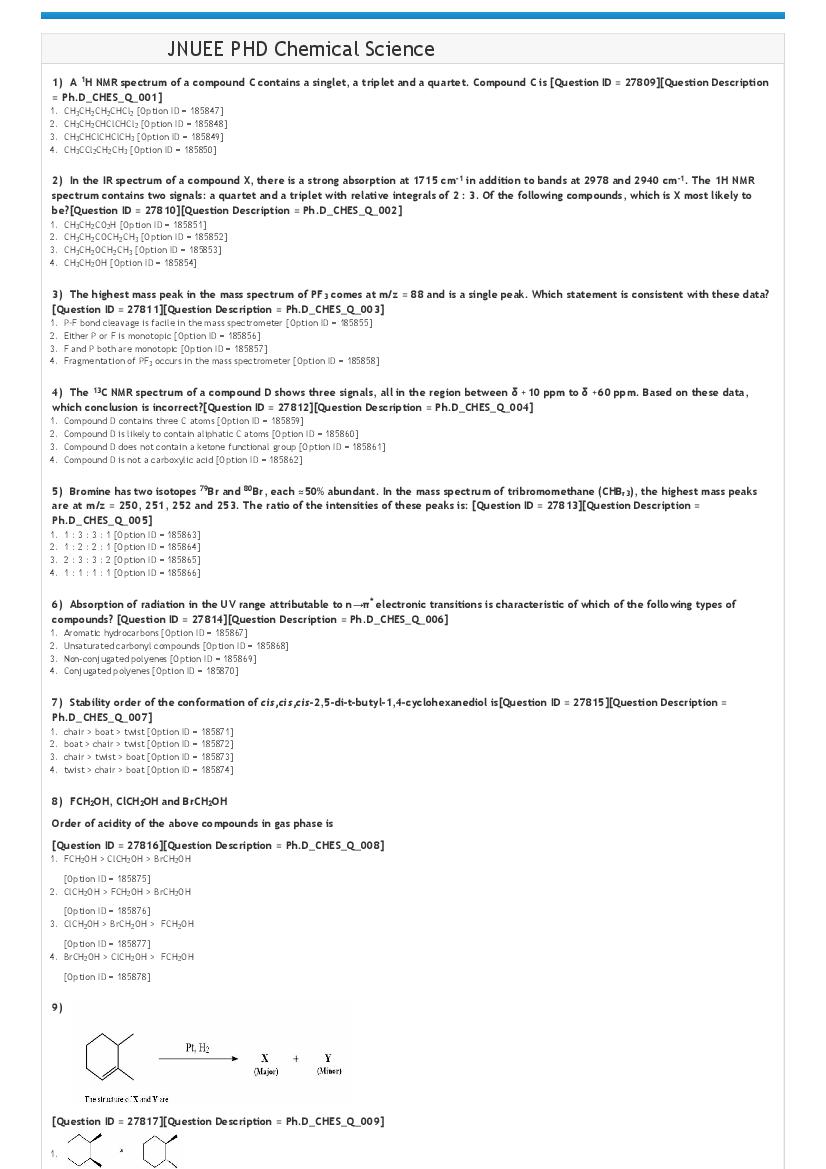
1) A 1H NMR spectrum of a compound C contains a singlet, a triplet and a quartet. Compound C is [Question ID = 27809][Question Description
= Ph.D_CHES_Q_001]
1. CH3CH2CH2CHCl2 [Option ID = 185847]
2. CH3CH2CHClCHCl2 [Option ID = 185848]
3. CH3CHClCHClCH3 [Option ID = 185849]
4. CH3CCl2CH2CH3 [Option ID = 185850]
2) In the IR spectrum of a compound X, there is a strong absorption at 1715 cm‐1 in addition to bands at 2978 and 2940 cm‐1. The 1H NMR
spectrum contains two signals: a quartet and a triplet with relative integrals of 2 : 3. Of the following compounds, which is X most likely to
be?[Question ID = 27810][Question Description = Ph.D_CHES_Q_002]
1. CH3CH2CO2H [Option ID = 185851]
2. CH3CH2COCH2CH3 [Option ID = 185852]
3. CH3CH2OCH2CH3 [Option ID = 185853]
4. CH3CH2OH [Option ID = 185854]
3) The highest mass peak in the mass spectrum of PF3 comes at m/z = 88 and is a single peak. Which statement is consistent with these data?
[Question ID = 27811][Question Description = Ph.D_CHES_Q_003]
1. P–F bond cleavage is facile in the mass spectrometer [Option ID = 185855]
2. Either P or F is monotopic [Option ID = 185856]
3. F and P both are monotopic [Option ID = 185857]
4. Fragmentation of PF3 occurs in the mass spectrometer [Option ID = 185858]
4) The 13C NMR spectrum of a compound D shows three signals, all in the region between δ +10 ppm to δ +60 ppm. Based on these data,
which conclusion is incorrect?[Question ID = 27812][Question Description = Ph.D_CHES_Q_004]
1. Compound D contains three C atoms [Option ID = 185859]
2. Compound D is likely to contain aliphatic C atoms [Option ID = 185860]
3. Compound D does not contain a ketone functional group [Option ID = 185861]
4. Compound D is not a carboxylic acid [Option ID = 185862]
5) Bromine has two isotopes 79Br and 80Br, each ≈50% abundant. In the mass spectrum of tribromomethane (CHBr3), the highest mass peaks
are at m/z = 250, 251, 252 and 253. The ratio of the intensities of these peaks is: [Question ID = 27813][Question Description =
Ph.D_CHES_Q_005]
1. 1 : 3 : 3 : 1 [Option ID = 185863]
2. 1 : 2 : 2 : 1 [Option ID = 185864]
3. 2 : 3 : 3 : 2 [Option ID = 185865]
4. 1 : 1 : 1 : 1 [Option ID = 185866]
6) Absorption of radiation in the UV range attributable to n→π* electronic transitions is characteristic of which of the following types of
compounds? [Question ID = 27814][Question Description = Ph.D_CHES_Q_006]
1. Aromatic hydrocarbons [Option ID = 185867]
2. Unsaturated carbonyl compounds [Option ID = 185868]
3. Non‐conjugated polyenes [Option ID = 185869]
4. Conjugated polyenes [Option ID = 185870]
7) Stability order of the conformation of cis,cis,cis‐2,5‐di‐t‐butyl‐1,4‐cyclohexanediol is[Question ID = 27815][Question Description =
Ph.D_CHES_Q_007]
1. chair > boat > twist [Option ID = 185871]
2. boat > chair > twist [Option ID = 185872]
3. chair > twist > boat [Option ID = 185873]
4. twist > chair > boat [Option ID = 185874]
8) FCH2OH, ClCH2OH and BrCH2OH
Order of acidity of the above compounds in gas phase is
[Question ID = 27816][Question Description = Ph.D_CHES_Q_008]
1. FCH2OH > ClCH2OH > BrCH2OH
[Option ID = 185875]
2. ClCH2OH > FCH2OH > BrCH2OH
[Option ID = 185876]
3. ClCH2OH > BrCH2OH > FCH2OH
[Option ID = 185877]
4. BrCH2OH > ClCH2OH > FCH2OH
[Option ID = 185878]
9)
[Question ID = 27817][Question Description = Ph.D_CHES_Q_009]
1.
Page 2
2.
[Option ID = 185880]
3.
[Option ID = 185881]
4.
[Option ID = 185882]
10)
[Question ID = 27818][Question Description = Ph.D_CHES_Q_010]
1. II > I > IV > III
[Option ID = 185883]
2. II > IV > I > III
[Option ID = 185884]
3. II > IV > III > I
[Option ID = 185885]
4. III > II > IV > I
[Option ID = 185886]
11)
[Question ID = 27819][Question Description = Ph.D_CHES_Q_011]
1.
[Option ID = 185887]
2.
[Option ID = 185888]
3.
[Option ID = 185889]
4.
[Option ID = 185890]
12) In the gas phase, order of stability of the carbanion: CH3‐ ; CH3CH2‐ ; (CH3) 2CH‐ and (CH3) 3C‐ is [Question ID = 27820][Question
Description = Ph.D_CHES_Q_012]
1.
Page 3
2.
[Option ID = 185892]
3.
[Option ID = 185893]
4.
[Option ID = 185894]
13) The most preferable solvent for alkylation of diethyl n‐butylmalonate is[Question ID = 27821][Question Description = Ph.D_CHES_Q_013]
1. MeOH [Option ID = 185895]
2. DMSO [Option ID = 185896]
3. Benzene [Option ID = 185897]
4. THF [Option ID = 185898]
14)
[Question ID = 27822][Question Description = Ph.D_CHES_Q_014]
1.
[Option ID = 185899]
2.
[Option ID = 185900]
3.
[Option ID = 185901]
4.
[Option ID = 185902]
15)
[Question ID = 27823][Question Description = Ph.D_CHES_Q_015]
1. Aldol condensation
[Option ID = 185903]
2. Claisen condensation
[Option ID = 185904]
3. Dieckmann condensation
[Option ID = 185905]
4. Knoevenagel condensation
[Option ID = 185906]
16)
Page 4
1. If the substitution reaction goes through SN2 mechanism the reactivity order is I > II > III > IV. [Option ID = 185907]
2. If the substitution reaction goes through SN1 mechanism the reactivity order is I > II > III > IV [Option ID = 185908]
3. The reactions cannot go through SN2 mechanism at all. [Option ID = 185909]
4. The substitution reaction goes through SN2 mechanism and the reactivity order is IV > III > II > I. [Option ID = 185910]
17)
Order of the equilibrium constant (k) for cyanohydrination of the above keto compounds is
[Question ID = 32811][Question Description = Ph.D_CHES_Q_017]
1. IV > I > II > III > V
[Option ID = 185911]
2. I > II > III > IV > V
[Option ID = 185912]
3. V > IV > III > II > I
[Option ID = 185913]
4. IV > V > II > III > I
[Option ID = 185914]
18)
Among the above molecules which are not aromatic?
[Question ID = 32812][Question Description = Ph.D_CHES_Q_018]
1. I & III
[Option ID = 185915]
2. II & III
[Option ID = 185916]
3. I & II
[Option ID = 185917]
4. II & IV
[Option ID = 185918]
19) Specific heat capacity can be determined by[Question ID = 32813][Question Description = Ph.D_CHES_Q_019]
1. Cyclic voltametry [Option ID = 185919]
2. NMR spectroscopy [Option ID = 185920]
3. TGA [Option ID = 185921]
4. DSC [Option ID = 185922]
20)
Page 5
1.
[Option ID = 185923]
2.
[Option ID = 185924]
3.
[Option ID = 185925]
4.
[Option ID = 185926]
21)
[Question ID = 32815][Question Description = Ph.D_CHES_Q_021]
1.
[Option ID = 185927]
2.
[Option ID = 185928]
3.
[Option ID = 185929]
4.
[Option ID = 185930]
Page 6
[Question ID = 32816][Question Description = Ph.D_CHES_Q_022]
1. electrocyclic involving 4Π electrons and the reaction takes place in conrotatory mode
[Option ID = 185931]
2. electrocyclic involving 4Π electrons and the reaction takes place in disrotatory mode
[Option ID = 185932]
3. electrocyclic involving 2Π electrons and the reaction takes place in disrotatory mode.
[Option ID = 185933]
4. electrocyclic involving 2Π electrons and the reaction takes place in conrotatory mode
[Option ID = 185934]
23)
Molecular structure of the D‐ monosaccharide is
[Question ID = 32817][Question Description = Ph.D_CHES_Q_023]
1.
[Option ID = 185935]
2.
[Option ID = 185936]
3.
[Option ID = 185937]
4.
[Option ID = 185938]
24)
[Question ID = 32818][Question Description = Ph.D_CHES_Q_024]
1. HOMO of diene reacts with LUMO of dienophile in supra‐antara mode
[Option ID = 185939]
Page 7
[Option ID = 185940]
3. HOMO of diene reacts with LUMO of dienophile in supra‐supra mode
[Option ID = 185941]
4. HOMO of dienophile reacts with LUMO of diene in supra‐supra mode
[Option ID = 185942]
25)
[Question ID = 32819][Question Description = Ph.D_CHES_Q_025]
1.
[Option ID = 185943]
2.
[Option ID = 185944]
3.
[Option ID = 185945]
4.
[Option ID = 185946]
26)
[Question ID = 32820][Question Description = Ph.D_CHES_Q_026]
1. (S)‐2‐butanol
[Option ID = 185947]
2. (S)‐2‐butylchloride
[Option ID = 185948]
3. (R)‐2‐butylchloride
[Option ID = 185949]
4. mixture of (R)‐2‐butanol and (S)‐2‐butanol
[Option ID = 185950]
27)
[Question ID = 32821][Question Description = Ph.D_CHES_Q_027]
1. nucleophilic substitution reaction
[Option ID = 185951]
2. electrophilic substitution reaction
[Option ID = 185952]
3. addition reaction
Page 8
4. addition‐elimination reaction
[Option ID = 185954]
28) Characteristic spectral data of an organic compound B is given below:
IR: 1735 cm‐1
1H NMR: δ 3.59 (singlet, 3H), 3.32 (triplet, 2H), 2.25 (triplet, 2H), 1.85‐1.75 (multiplet, 2H), 1.73‐1.62 (multiplet, 2H)
13C NMR: δ 174.0, 51.0, 32.9, 32.8, 31.0, 23.0
The correct structure of the compound B is
[Question ID = 32822][Question Description = Ph.D_CHES_Q_028]
1.
[Option ID = 185955]
2.
[Option ID = 185956]
3.
[Option ID = 185957]
4.
[Option ID = 185958]
29) The sequence of an mRNA molecule produced from a DNA template strand with the composition 5'‐AGCTACACT‐3' is [Question ID =
32823][Question Description = Ph.D_CHES_Q_029]
1. 5'‐AGUGUAGCU‐3' [Option ID = 185959]
2. 5'‐AGTGTAGCT‐3' [Option ID = 185960]
3. 5'‐UCGAUGUGA‐3' [Option ID = 185961]
4. 5'‐TCGATGTGA‐3' [Option ID = 185962]
30)
[Question ID = 32824][Question Description = Ph.D_CHES_Q_030]
1. Birch reduction
[Option ID = 185963]
2. Wolf‐Kishner reduction
[Option ID = 185964]
3. Clemmensen reduction
[Option ID = 185965]
4. Hydride reduction
[Option ID = 185966]
31) Which of the following heterocyclic compounds is not aromatic[Question ID = 32825][Question Description = Ph.D_CHES_Q_031]
1. Piperidine [Option ID = 185967]
2. Pyrrole [Option ID = 185968]
3. Pyridine [Option ID = 185969]
4. Furan [Option ID = 185970]
32) A mixture of furan, ammonia and steam is passed over heated alumina. The product formed in this reaction is
[Question ID = 32826][Question Description = Ph.D_CHES_Q_032]
1.
[Option ID = 185971]
Page 9
[Option ID = 185972]
3.
[Option ID = 185973]
4.
[Option ID = 185974]
33) Quinoline undergoes nucleophilic substitution reaction on heating with NaNH2 to produce[Question ID = 32827][Question Description =
Ph.D_CHES_Q_033]
1. 4‐aminoquinoline [Option ID = 185975]
2. 3‐aminoquinoline [Option ID = 185976]
3. 8‐aminoquinoline [Option ID = 185977]
4. 2‐aminoquinoline [Option ID = 185978]
34) Aniline can be distinguished from methyl amine by its reaction with[Question ID = 32828][Question Description = Ph.D_CHES_Q_034]
1. p‐toluene sulphonyl chloride/KOH [Option ID = 185979]
2. (i) NaNO2/HCl, 0‐5º C (ii) alkaline ß‐naphthol [Option ID = 185980]
3. Sn/HCl [Option ID = 185981]
4. acetyl chloride [Option ID = 185982]
35) Arrange the following species in the increasing order of ionic radii:
[Question ID = 32829][Question Description = Ph.D_CHES_Q_035]
1. Al3+ < Mg2+ < Na+ < O2 <F
[Option ID = 185983]
2. Na+ < Mg2+ < Al3+ <F < O2
[Option ID = 185984]
3. F‐ < O2 < Na+ < Mg2+ <Al3+
[Option ID = 185985]
4. Al3+ < Mg2+ < Na+ <F< O2
[Option ID = 185986]
36) Which of the following pair of elements has the greatest difference in metallic character?
[Question ID = 28052][Question Description = Ph.D_CHES_Q_036]
1. Rb and O
[Option ID = 185987]
2. O and l
[Option ID = 185988]
3. Rb and l
[Option ID = 185989]
4. Li and O
[Option ID = 185990]
37) In which of the following molecules/ions all the bond angles are not equal?[Question ID = 28053][Question Description =
Ph.D_CHES_Q_037]
1. SiF4 [Option ID = 185991]
2. ICl4‐ [Option ID = 185992]
3. SF4 [Option ID = 185993]
4. PCl4+ [Option ID = 185994]
38) The CORRECT order of the increasing bond order in NO, NO+ and NO‐ is:
[Question ID = 28054][Question Description = Ph.D_CHES_Q_038]
1. NO < NO+ < NO‐
[Option ID = 185995]
2. NO‐ < NO < NO+
[Option ID = 185996]
3. NO+ < NO <NO‐
[Option ID = 185997]
4. NO <NO‐ <NO+
[Option ID = 185998]
39) Predict the CORRECT order of the strength of σ (sigma)‐bonds formed due to the overlap of atomic orbitals of s‐s, s‐p and p‐p.[Question
Page 10
1. s‐s > s‐p > p‐p [Option ID = 185999]
2. p‐p > s‐p > s‐s [Option ID = 186000]
3. s‐s > p‐p > s‐p [Option ID = 186001]
4. p‐p > s‐s > s‐p [Option ID = 186002]
40) Choose the correct order of the complexing ability of the following bases with BMe3:[Question ID = 28056][Question Description =
Ph.D_CHES_Q_040]
1. 4‐Methylpyridine > 2‐Methylpyridine > Pyridine [Option ID = 186003]
2. Pyridine > 2‐Methylpyridine > 4‐Methylpyridine [Option ID = 186004]
3. 4‐Methylpyridine > Pyridine > 2‐Methylpyridine [Option ID = 186005]
4. 2‐Methylpyridine > 4‐Methylpyridine > Pyridine [Option ID = 186006]
41) Which of the following is the CORRECT combination in term of basicity? [Question ID = 28057][Question Description = Ph.D_CHES_Q_041]
1. MgO > CaO and (CH3)3N > (SiH3)3N [Option ID = 186007]
2. MgO > CaO and (SiH3)3N > (CH3)3N [Option ID = 186008]
3. CaO > MgO and (CH3)3N > (SiH3)3N [Option ID = 186009]
4. CaO > MgO and (SiH3)3N > (CH3)3N [Option ID = 186010]
42) The reaction of Et2N‐PF2 with BH3 gives a product in which boron is bonded to:[Question ID = 28058][Question Description =
Ph.D_CHES_Q_042]
1. Only N in end‐on mode [Option ID = 186011]
2. Only P in end‐on mode [Option ID = 186012]
3. Both N and P in end‐on mode [Option ID = 186013]
4. Both N and P in bridging mode [Option ID = 186014]
43) Which of the following species acts as the strongest reducing agent?[Question ID = 28059][Question Description = Ph.D_CHES_Q_043]
1. H +, E° = 0.00 V [Option ID = 186015]
2. Mg2+, E° = − 2.37 V [Option ID = 186016]
3. Cr3+, E° = − 0.41 V [Option ID = 186017]
4. Cu2+, E° = + 0.34 V [Option ID = 186018]
44)
[Question ID = 28060][Question Description = Ph.D_CHES_Q_044]
1. + 0.62 V [Option ID = 186019]
2. + 0.92 V [Option ID = 186020]
3. – 0.62 V [Option ID = 186021]
4. – 0.92 V [Option ID = 186022]
45) Pourbaix diagram is a graphical plot of:
(E = Potential, T = Temperature, N = Oxidation number, ΔG = Change in free energy)
[Question ID = 28061][Question Description = Ph.D_CHES_Q_045]
1. E vs. T
[Option ID = 186023]
2. E vs. N
[Option ID = 186024]
3. E vs. pH
[Option ID = 186025]
4. E vs. ΔG
[Option ID = 186026]
46) The atomicity and the total number of bonds in the elemental white phosphorus molecule is respectively:[Question ID = 28062][Question
Description = Ph.D_CHES_Q_046]
1. 4 and 6 [Option ID = 186027]
2. 6 and 4 [Option ID = 186028]
3. 4 and 4 [Option ID = 186029]
4. 6 and 6 [Option ID = 186030]
47) Using chlorobenzene as solvent, the reagents needed for an efficient synthesis of borazines are:[Question ID = 28063][Question
Description = Ph.D_CHES_Q_047]
1. NH4Cl and BCl3 [Option ID = 186031]
2. NH4Cl, BCl3 and NaBH4 [Option ID = 186032]
3. NH4Cl and NaBH4 [Option ID = 186033]
4. NH3 and BCl3 [Option ID = 186034]
48) Silicones may be prepared by reaction of[Question ID = 28064][Question Description = Ph.D_CHES_Q_048]
1. SiCl4 with ROH [Option ID = 186035]
2. R 2SiCl2 with ROH [Option ID = 186036]
3. R 3SiCl with water [Option ID = 186037]
4. R 2SiCl2 with water [Option ID = 186038]
49) Which of the following pair is CORRECT? [Question ID = 28065][Question Description = Ph.D_CHES_Q_049]
Page 11
2. [Co(NH3)6]3+; diamagnetic [Option ID = 186040]
3. [CoF6]3‐; diamagnetic [Option ID = 186041]
4. [Fe(CN)6]3‐; diamagnetic [Option ID = 186042]
50) The crystal field stabilization energy (CFSE) for a low‐spin d7 octahedral complex is:
(∆oct = Crystal field stabilization energy in an octahedral field, P = Pairing energy)
[Question ID = 28066][Question Description = Ph.D_CHES_Q_050]
1. −1.8∆oct
[Option ID = 186043]
2. −1.8∆oct + P
[Option ID = 186044]
3. −1.8∆oct + 2P
[Option ID = 186045]
4. −1.8∆oct + 3P
[Option ID = 186046]
51) Which of the following correctly places the metal centres in their order in the spectrochemical series?
[Question ID = 28067][Question Description = Ph.D_CHES_Q_051]
1. Mn(ll) < Fe(lll) < Rh(lll)
[Option ID = 186047]
2. Co(lll) < Co(ll) < Rh(lll)
[Option ID = 186048]
3. Pt(IV) < Pd(ll) < Ni(ll)
[Option ID = 186049]
4. Pd(II) < Ni(ll) < Pt(lV)
[Option ID = 186050]
52) Which of the following metal complexes are expected to have a Jahn‐Teller distortion? [Question ID = 28068][Question Description =
Ph.D_CHES_Q_052]
1. [Cr(H2O)6]3+ [Option ID = 186051]
2. [Ni(H2O)6]2+ [Option ID = 186052]
3. [Fe(CN)6]3‐ [Option ID = 186053]
4. [Co(CN)6]3‐ [Option ID = 186054]
53) Which of the following metal complexes are expected to have orbital contribution to the magnetic moment?[Question ID = 28069]
[Question Description = Ph.D_CHES_Q_053]
1. [Fe(H2O)6]3+ [Option ID = 186055]
2. [Co(CN)6]3‐ [Option ID = 186056]
3. [Co(H2O)6]2+ [Option ID = 186057]
4. [Ni(NH3)6]2+ [Option ID = 186058]
54)
[Question ID = 28070][Question Description = Ph.D_CHES_Q_054]
1. S N1 mechanism
[Option ID = 186059]
2. S N2 mechanism
[Option ID = 186060]
3. S N1CB mechanism
[Option ID = 186061]
4. S Ni mechanism
[Option ID = 186062]
55) The ligand field bands of lanthanide complexes are generally sharp line like peak than those of transition metal complexes because:
[Question ID = 28071][Question Description = Ph.D_CHES_Q_055]
1. Transitions are allowed for lanthanide complexes [Option ID = 186063]
2. Intensity of the bands is higher for lanthanides complexes [Option ID = 186064]
3. f‐orbital’s have higher energy than d‐orbital’s [Option ID = 186065]
4. f‐orbital’s interact less effectively with the ligands compared to d‐orbital’s [Option ID = 186066]
56) Which phosphine has the largest Tolman cone angle?[Question ID = 28072][Question Description = Ph.D_CHES_Q_056]
1. P(OPh)3 [Option ID = 186067]
2. PPh3 [Option ID = 186068]
3. P(2‐MeC6H 4)3 [Option ID = 186069]
4. P(4‐MeC6H 4)3 [Option ID = 186070]
57)
[Question ID = 28073][Question Description = Ph.D_CHES_Q_057]
1.
Page 12
2.
[Option ID = 186072]
3.
[Option ID = 186073]
4.
[Option ID = 186074]
58) The bonding of cyclopentadienyl in Ti(Cp)4 is such that[Question ID = 28074][Question Description = Ph.D_CHES_Q_058]
1. All Cp rings are pentahapto [Option ID = 186075]
2. One Cp is pentahapto and the other three rings are monohapto [Option ID = 186076]
3. Two Cp is monohapto and the other two rings are pentahapto [Option ID = 186077]
4. All Cp rings are monohapto [Option ID = 186078]
59)
[Question ID = 28075][Question Description = Ph.D_CHES_Q_059]
1.
[Option ID = 186079]
2.
[Option ID = 186080]
3.
[Option ID = 186081]
4.
[Option ID = 186082]
60) W(CO)6 reacts with MeLi to give an intermediate which upon treatment with CH2N2 yield:[Question ID = 28076][Question Description =
Ph.D_CHES_Q_060]
1. WMe6 [Option ID = 186083]
2. (CO)5W–Me [Option ID = 186084]
3. (CO)5W═C(Me)OMe [Option ID = 186085]
4. (CO)5W≡CMe [Option ID = 186086]
61)
[Question ID = 28116][Question Description = Ph.D_CHES_Q_061]
1. (1) > (2) > (3) > (4)
[Option ID = 186243]
2. (1) > (3) > (2) > (4)
[Option ID = 186244]
3. (4) > (3) > (2) > (1)
[Option ID = 186245]
4. (4) > (2) > (3) > (1)
[Option ID = 186246]
62) The structure of [C2B9H11]2‐ and [Ru6(CO)18]2‐ is respectively:[Question ID = 28077][Question Description = Ph.D_CHES_Q_062]
1. closo and closo [Option ID = 186087]
2. nido and nido [Option ID = 186088]
3. closo and nido [Option ID = 186089]
4. nido and closo [Option ID = 186090]
63) Which of the following is TRUE about the Bohr Effect? [Question ID = 28078][Question Description = Ph.D_CHES_Q_063]
1. When carbon dioxide goes into the blood, blood pH rises [Option ID = 186091]
2. When blood pH rises, oxygen affinity of hemoglobin goes down [Option ID = 186092]
3. When the oxygen concentration increases hemoglobin holds less oxygen [Option ID = 186093]
4. When pH is low the oxygen affinity of hemoglobin is low [Option ID = 186094]
64) Hemocyanin contains[Question ID = 28079][Question Description = Ph.D_CHES_Q_064]
1. Dinuclear copper core and binds dioxygen in the cuprous state [Option ID = 186095]
2. A dinuclear copper core and binds dioxygen in the cupric state [Option ID = 186096]
3. A mononuclear copper core and binds dioxygen in the cuprous state [Option ID = 186097]
4. A mononuclear copper core and binds dioxygen in the cupric state [Option ID = 186098]
65) The compound whose 0.1 M solution is basic is:[Question ID = 28080][Question Description = Ph.D_CHES_Q_065]
Page 13
2. Ammonium chloride [Option ID = 186100]
3. Ammonium sulphate [Option ID = 186101]
4. Sodium acetate [Option ID = 186102]
66) If ClF3 has to be stereochemically rigid, its 19F NMR spectrum (I for 19F=1/2) would be (assume that Cl is not NMR active):[Question ID =
28081][Question Description = Ph.D_CHES_Q_066]
1. A singlet [Option ID = 186103]
2. A doublet and a singlet [Option ID = 186104]
3. A doublet and a triplet [Option ID = 186105]
4. Two singlet [Option ID = 186106]
67) Among the following diatomic molecules, the one that shows EPR signals is:[Question ID = 28082][Question Description =
Ph.D_CHES_Q_067]
1. Li2 [Option ID = 186107]
2. B2 [Option ID = 186108]
3. C2 [Option ID = 186109]
4. N2 [Option ID = 186110]
68) The first emission line in hydrogen atom spectra in Balmer series appears at what energy? (R is the Rydberg’s constant)[Question ID =
28083][Question Description = Ph.D_CHES_Q_068]
1. 0.1389 R cm‐1 [Option ID = 186111]
2. 0.0486 R cm‐1 [Option ID = 186112]
3. 0.1667 R cm‐1 [Option ID = 186113]
4. 0.7500 R cm‐1 [Option ID = 186114]
69)
[Question ID = 28084][Question Description = Ph.D_CHES_Q_069]
1. (d)
[Option ID = 186115]
2. (b)
[Option ID = 186116]
3. (a)
[Option ID = 186117]
4. (c)
[Option ID = 186118]
70)
[Question ID = 28085][Question Description = Ph.D_CHES_Q_070]
1. 1.17 cm [Option ID = 186119]
2. 0.02 cm [Option ID = 186120]
3. 11.27 cm [Option ID = 186121]
4. 2.34 cm [Option ID = 186122]
71) Consider a solvent whose enthalpy of vaporization is given by 25.76 kJ mol‐1 at its boiling point of 78.4°C. The entropy change of the
surroundings due to the solvent evaporation will be how much?[Question ID = 28086][Question Description = Ph.D_CHES_Q_071]
1. – 13.641 J K‐1 mol‐1 [Option ID = 186123]
2. – 0.0733 J K‐1 mol‐1 [Option ID = 186124]
3. 13.641 kJ K‐1 mol‐1 [Option ID = 186125]
4. – 0.0733 kJ K‐1 mol‐1 [Option ID = 186126]
72) For a perfect gas which of the following relations hold?[Question ID = 28087][Question Description = Ph.D_CHES_Q_072]
1.
[Option ID = 186127]
2.
[Option ID = 186128]
Page 14
[Option ID = 186129]
4.
[Option ID = 186130]
73)
[Question ID = 28088][Question Description = Ph.D_CHES_Q_073]
1. 250 [Option ID = 186131]
2. 125 [Option ID = 186132]
3. 225 [Option ID = 186133]
4. 100 [Option ID = 186134]
74) In an experiment, a researcher wants to freeze a glycerol containing solution to form transparent glass at 195 K. Which cryogenic agent
the researcher should use for freezing the sample?[Question ID = 28089][Question Description = Ph.D_CHES_Q_074]
1. Liquid Nitrogen [Option ID = 186135]
2. Ice/salt mixture [Option ID = 186136]
3. Dry‐ice/Acetone mixture [Option ID = 186137]
4. Liquid Helium [Option ID = 186138]
75) 2,4,6‐octatriene shows absorption band at round 19870 cm‐1. Considering particle in 1‐D box problem the approximate length of the
molecule can be calculated as below. (Given h = 6.626 × 10‐34 J s, mass of electron = 9.11 × 10‐31 kg, 1 cm‐1 = 1.986 × 10‐23 J)[Question ID =
28090][Question Description = Ph.D_CHES_Q_075]
1. 11.00 nm [Option ID = 186139]
2. 3.03 nm [Option ID = 186140]
3. 0.52 nm [Option ID = 186141]
4. 1.03 nm [Option ID = 186142]
76) The z‐component of angular momentum operator in Cartesian co‐ordinate can be written as,[Question ID = 28091][Question Description =
Ph.D_CHES_Q_076]
1.
[Option ID = 186143]
2.
[Option ID = 186144]
3.
[Option ID = 186145]
4.
Page 15
77) A second order reaction becomes pseudo first‐order reaction when[Question ID = 28092][Question Description = Ph.D_CHES_Q_077]
1.
[Option ID = 186147]
2.
[Option ID = 186148]
3. [reactant1] ≥ [reactant2] [Option ID = 186149]
4. [reactant1] ≈ [reactant2] ≥ [product(t)] [Option ID = 186150]
78) A chemical reaction can be a slow process when?[Question ID = 28093][Question Description = Ph.D_CHES_Q_078]
1. The reaction is kinetically favoured, but thermodynamically not favoured [Option ID = 186151]
2. The reaction is a bi‐molecular reaction which is only kinetically favoured [Option ID = 186152]
3. The reaction is thermodynamically favoured, but kinetically not favoured [Option ID = 186153]
4. The reaction is both kinetically and thermodynamically favoured [Option ID = 186154]
79) For a second order reaction, the initial concentration of reactant and half‐life of the reaction are given by 6 mM and 79.4 s,
respectively. The rate constant of the reaction can be calculated as,[Question ID = 28094][Question Description = Ph.D_CHES_Q_079]
1. 2099 M‐1 s‐1 [Option ID = 186155]
2. 0.076 x 10‐6 M‐1 s‐1 [Option ID = 186156]
3. 0.0021 M‐1 s‐1 [Option ID = 186157]
4. 13 M‐1 s‐1 [Option ID = 186158]
80)
[Question ID = 28095][Question Description = Ph.D_CHES_Q_080]
1. (a) [Option ID = 186159]
2. (b) [Option ID = 186160]
3. (c) [Option ID = 186161]
4. (d) [Option ID = 186162]
81)
[Question ID = 28096][Question Description = Ph.D_CHES_Q_081]
1. y(x) = Aeix + Be‐2ix [Option ID = 186163]
2. y(x) = A cos x + 2B sin x [Option ID = 186164]
3. y(x) = 2A cos x + i B sin x [Option ID = 186165]
4. y(x) = Aex + Be2x [Option ID = 186166]
82) What is the quantization condition proposed by Niels Bohr regarding electrons in atomic orbit?[Question ID = 28097][Question Description
= Ph.D_CHES_Q_082]
1. p = nh with n = 1, 2, 3, … [Option ID = 186167]
2. mvr = nh/2π with n = 0, 1, 2, 3, … [Option ID = 186168]
3. K = l2/2I with n = 1, 2, 3, … [Option ID = 186169]
4. mv = nh/2πr with n = 1, 2, 3, … [Option ID = 186170]
83) Which of following order is correct according to molecules’ hybridization?[Question ID = 28098][Question Description =
Ph.D_CHES_Q_083]
1. BeCl2 → sp2; C2H 2 → sp; BCl3 → sp2; NH3 → sp3 [Option ID = 186171]
2. BeCl2 → sp2; C2H 2 → sp; BCl3 → sp3; NH3 → sp3 [Option ID = 186172]
3. BeCl2 → sp; C2H 2 → sp; BCl3 → sp3; H2O → sp3 [Option ID = 186173]
4. BeCl2 → sp; C2H 2 → sp; BCl3 → sp2; H2O → sp3 [Option ID = 186174]
84)
[Question ID = 28099][Question Description = Ph.D_CHES_Q_084]
Page 16
[Option ID = 186175]
2.
[Option ID = 186176]
3.
[Option ID = 186177]
4.
[Option ID = 186178]
85) A do‐loop for repetitive calculations in FORTRAN‐77 programming can be correctly written as (with i, n and sum as integers)[Question ID
= 28100][Question Description = Ph.D_CHES_Q_085]
1.
[Option ID = 186179]
2.
[Option ID = 186180]
3.
[Option ID = 186181]
4.
[Option ID = 186182]
86) An experimentalist claim to measure the size of a small nanoparticle as 5 nm in an optical microscope using a green laser light. Which
statement is correct for such claim?[Question ID = 28101][Question Description = Ph.D_CHES_Q_086]
1. The claim is correct as the experimentalist used a laser light to see the nanoparticle [Option ID = 186183]
2. The claim is incorrect as the size of nanoparticles is typically 10 – 100 nm [Option ID = 186184]
Page 17
4. The claim is correct as the experimentalist observed the nanoparticle under a microscope [Option ID = 186186]
87) If a universal power supply (UPS) has the power delivering capacity of 2.5 kVA with the power factor of 0.8 then which following
statement is correct?[Question ID = 28102][Question Description = Ph.D_CHES_Q_087]
1. An instrument with running power requirement of 2.0 kWatt can be connected safely to the UPS [Option ID = 186187]
2. An instrument with running power requirement of up to 3.0 kWatt can be connected safely to the UPS [Option ID = 186188]
3. An instrument with running power requirement of any value lower than 3.3 kWatt can be connected safely to the UPS [Option ID = 186189]
4. The UPS can not supply power to any instrument with running power requirement higher than 2.5 kWatt [Option ID = 186190]
88) A compressor cools a refrigerator which discards heat to surroundings at 30° C. The compressor is designed for maximum electric power of
100 W. The heat load on the refrigerator is 375 W. Minimum temperature that can be maintained in this refrigerator is[Question ID = 28103]
[Question Description = Ph.D_CHES_Q_088]
1. ‐100°C [Option ID = 186191]
2. ‐41.3°C [Option ID = 186192]
3. ‐33.8°C [Option ID = 186193]
4. ‐26.3°C [Option ID = 186194]
89) If a diatomic molecule of reduced mass of 16 x 10‐27 kg and having a force constant between atoms of 600 N m‐1 rotates 1012 times per
second, then the number of full vibrations the molecule can undergo during one cycle of rotation is[Question ID = 28104][Question
Description = Ph.D_CHES_Q_089]
1. 3 x 10¹³ [Option ID = 186195]
2. 9600 [Option ID = 186196]
3. 30 [Option ID = 186197]
4. 16 x 109 [Option ID = 186198]
90) Consider a non‐ideal gas (of 1 mole) changes its state of 2.30 atm pressure and 3.50 L volume at 100 K to a state of 4.00 atm and 5.50 L
at 300 K with a change in internal energy of 35.00 L atm. The change in enthalpy of the process is,[Question ID = 28105][Question
Description = Ph.D_CHES_Q_090]
1. 9790.00 L atm K [Option ID = 186199]
2. 48.95 L atm [Option ID = 186200]
3. 0.24475 L atm K‐1 [Option ID = 186201]
4. not defined as the pressure is not constant [Option ID = 186202]
91)
[Question ID = 28106][Question Description = Ph.D_CHES_Q_091]
1. 8.32 [Option ID = 186203]
2. 2.38 [Option ID = 186204]
3. 5.94 [Option ID = 186205]
4. 2.66 [Option ID = 186206]
92) Which of the following is a characteristic of chemisorption?[Question ID = 28107][Question Description = Ph.D_CHES_Q_092]
1. Adsorption can form multi‐molecular layer [Option ID = 186207]
2. Adsorption is non‐specific [Option ID = 186208]
3. Adsorption is irreversible [Option ID = 186209]
4. Adsorption accompany low enthalpy change [Option ID = 186210]
93)
[Question ID = 28108][Question Description = Ph.D_CHES_Q_093]
1. E B → A < EA → B < EB → C
[Option ID = 186211]
2. E C → A < EB → A < EA → B
[Option ID = 186212]
3. E A → B> EB → C > EC → A
[Option ID = 186213]
4. E B → A < EC → A > EA → B
Page 18
94)
[Question ID = 28109][Question Description = Ph.D_CHES_Q_094]
1. 19/4 [Option ID = 186215]
2. 38/9 [Option ID = 186216]
3. 38/4 [Option ID = 186217]
4. 19/9 [Option ID = 186218]
95) The separation between the planes of {244} in a crystal for which the cubic unit cell has side 523 pm is [Question ID = 28110][Question
Description = Ph.D_CHES_Q_095]
1. 0.0872 nm [Option ID = 186219]
2. 174.4 pm [Option ID = 186220]
3. 165.4 pm [Option ID = 186221]
4. 44.6 nm [Option ID = 186222]
96)
[Question ID = 28111][Question Description = Ph.D_CHES_Q_096]
1. 4 and 8 [Option ID = 186223]
2. 3 and 9 [Option ID = 186224]
3. 8 and ‐2 [Option ID = 186225]
4. 5 and 6 [Option ID = 186226]
97) What will happen if titanium transforms from hcp to bcc crystal? (The atomic radius of titanium is 145 pm in hcp but 143 pm in bcc. The
packing fractions of hcp and bcc are given by 0.74 and 0.68, respectively.)[Question ID = 28112][Question Description = Ph.D_CHES_Q_097]
1. The transition involves an expansion of the crystal volume [Option ID = 186227]
2. The transition involves a contraction of the crystal volume [Option ID = 186228]
3. The transition involves no change in the crystal volume [Option ID = 186229]
4. Titanium can not undergo the said transformation [Option ID = 186230]
98) The diffusion coefficient of a biomolecule is D = 1.0 × 10‐11 m2 s‐1 in the medium of cell interior. How long it will take to cover a typical
distance of 1.0 μm within the cell? [Question ID = 28113][Question Description = Ph.D_CHES_Q_098]
1. 0.104 s [Option ID = 186231]
2. 0.025 s [Option ID = 186232]
3. 0.017 s [Option ID = 186233]
4. 1.023 s [Option ID = 186234]
99) For an electrode‐solution interface, which of the following statement is correct?[Question ID = 28114][Question Description =
Ph.D_CHES_Q_099]
1. The boundary between the solid and liquid phases creates a monolayer which consists of a neutralized charge at the surface of the electrode. [Option ID = 186235]
2. In the Helmholtz layer model of the electrode‐solution interface the solvated ions can not arrange themselves along the surface of the electrode due to repulsion among
the ions [Option ID = 186236]
3. In the Gouy–Chapman model of the electrode‐solution interface, the disordering effect of thermal motion is also considered to explain the structure of the interface.
[Option ID = 186237]
4. In the Stern model of electrode‐solution interface the ions closest to the electrode are not constrained due to the presence of hydration layer around those ions. [Option
ID = 186238]
100) At isoelectric point of colloidal particles which of the following statement is valid?[Question ID = 28115][Question Description =
Ph.D_CHES_Q_100]
1. Particles become neutral [Option ID = 186239]
2. Particles migrate to oppositely charged electrode [Option ID = 186240]
3. Particles aggregate and precipitate [Option ID = 186241]
4. Particles conduct electricity with lowest resistance of solution [Option ID = 186242]
Document Details
| Board / Org | NTA |
| Exam | Jawaharlal Nehru University Entrance Examination |
| Type | Question Paper |
| Pages | 18 |
| Updated | 22 Jul 2026 |