JNUEE 2021 Question Paper Ph.D Cinema Studies
Finished viewing? Save it for later —
Download JNUEE 2021 Question Paper Ph.D Cinema Studies (PDF · 22 pages)About JNUEE 2021 Question Paper Ph.D Cinema Studies
JNUEE 2021 Question Paper Ph.D Cinema Studies is available here for free download. Published by NTA for Jawaharlal Nehru University Entrance Examination, this question paper can be viewed online or downloaded as a PDF (22 pages). Candidates preparing for Jawaharlal Nehru University Entrance Examination can use JNUEE 2021 Question Paper Ph.D Cinema Studies to understand the exam pattern, the type of questions asked, and the overall difficulty level.
Frequently Asked Questions
How can I download JNUEE 2021 Question Paper Ph.D Cinema Studies?
Open this page and click the Download button to save JNUEE 2021 Question Paper Ph.D Cinema Studies as a PDF. It is completely free on AglaSem Docs.
Is JNUEE 2021 Question Paper Ph.D Cinema Studies free to download?
Yes. JNUEE 2021 Question Paper Ph.D Cinema Studies can be viewed online and downloaded as a PDF free of cost on AglaSem Docs.
How many pages does JNUEE 2021 Question Paper Ph.D Cinema Studies have?
JNUEE 2021 Question Paper Ph.D Cinema Studies contains 22 pages, which you can read online or download together as a single PDF.
Where can I find more Jawaharlal Nehru University Entrance Examination study material?
You can find more Jawaharlal Nehru University Entrance Examination question papers, sample papers, syllabus, and answer keys on AglaSem Docs.
JNUEE 2021 Question Paper Ph.D Cinema Studies – Text
Read the full text of this question paper below — useful to quickly search, copy and reference the content online without downloading the PDF.
📄 View text version (22 pages)
Page 1
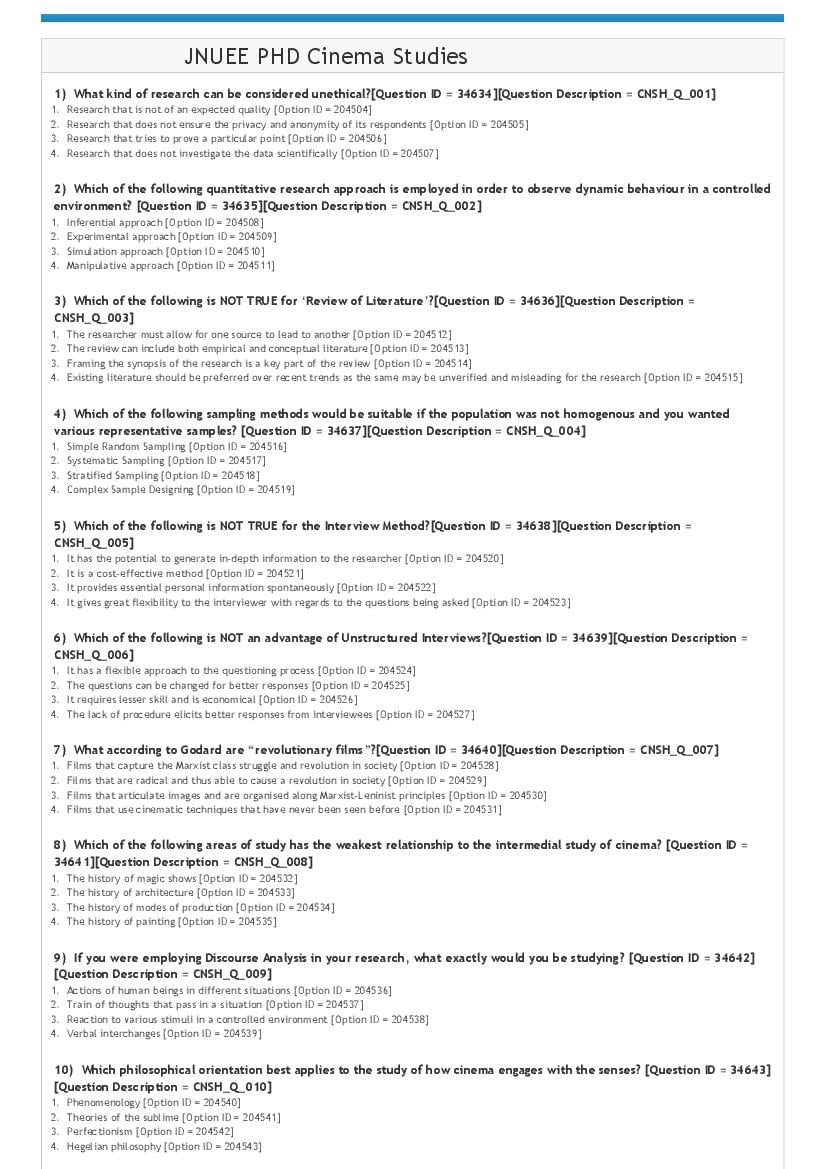
1) What kind of research can be considered unethical?[Question ID = 34634][Question Description = CNSH_Q_001]
1. Research that is not of an expected quality [Option ID = 204504]
2. Research that does not ensure the privacy and anonymity of its respondents [Option ID = 204505]
3. Research that tries to prove a particular point [Option ID = 204506]
4. Research that does not investigate the data scientifically [Option ID = 204507]
2) Which of the following quantitative research approach is employed in order to observe dynamic behaviour in a controlled
environment? [Question ID = 34635][Question Description = CNSH_Q_002]
1. Inferential approach [Option ID = 204508]
2. Experimental approach [Option ID = 204509]
3. Simulation approach [Option ID = 204510]
4. Manipulative approach [Option ID = 204511]
3) Which of the following is NOT TRUE for ‘Review of Literature’?[Question ID = 34636][Question Description =
CNSH_Q_003]
1. The researcher must allow for one source to lead to another [Option ID = 204512]
2. The review can include both empirical and conceptual literature [Option ID = 204513]
3. Framing the synopsis of the research is a key part of the review [Option ID = 204514]
4. Existing literature should be preferred over recent trends as the same may be unverified and misleading for the research [Option ID = 204515]
4) Which of the following sampling methods would be suitable if the population was not homogenous and you wanted
various representative samples? [Question ID = 34637][Question Description = CNSH_Q_004]
1. Simple Random Sampling [Option ID = 204516]
2. Systematic Sampling [Option ID = 204517]
3. Stratified Sampling [Option ID = 204518]
4. Complex Sample Designing [Option ID = 204519]
5) Which of the following is NOT TRUE for the Interview Method?[Question ID = 34638][Question Description =
CNSH_Q_005]
1. It has the potential to generate in‐depth information to the researcher [Option ID = 204520]
2. It is a cost‐effective method [Option ID = 204521]
3. It provides essential personal information spontaneously [Option ID = 204522]
4. It gives great flexibility to the interviewer with regards to the questions being asked [Option ID = 204523]
6) Which of the following is NOT an advantage of Unstructured Interviews?[Question ID = 34639][Question Description =
CNSH_Q_006]
1. It has a flexible approach to the questioning process [Option ID = 204524]
2. The questions can be changed for better responses [Option ID = 204525]
3. It requires lesser skill and is economical [Option ID = 204526]
4. The lack of procedure elicits better responses from interviewees [Option ID = 204527]
7) What according to Godard are “revolutionary films”?[Question ID = 34640][Question Description = CNSH_Q_007]
1. Films that capture the Marxist class struggle and revolution in society [Option ID = 204528]
2. Films that are radical and thus able to cause a revolution in society [Option ID = 204529]
3. Films that articulate images and are organised along Marxist‐Leninist principles [Option ID = 204530]
4. Films that use cinematic techniques that have never been seen before [Option ID = 204531]
8) Which of the following areas of study has the weakest relationship to the intermedial study of cinema? [Question ID =
34641][Question Description = CNSH_Q_008]
1. The history of magic shows [Option ID = 204532]
2. The history of architecture [Option ID = 204533]
3. The history of modes of production [Option ID = 204534]
4. The history of painting [Option ID = 204535]
9) If you were employing Discourse Analysis in your research, what exactly would you be studying? [Question ID = 34642]
[Question Description = CNSH_Q_009]
1. Actions of human beings in different situations [Option ID = 204536]
2. Train of thoughts that pass in a situation [Option ID = 204537]
3. Reaction to various stimuli in a controlled environment [Option ID = 204538]
4. Verbal interchanges [Option ID = 204539]
10) Which philosophical orientation best applies to the study of how cinema engages with the senses? [Question ID = 34643]
[Question Description = CNSH_Q_010]
1. Phenomenology [Option ID = 204540]
2. Theories of the sublime [Option ID = 204541]
3. Perfectionism [Option ID = 204542]
4. Hegelian philosophy [Option ID = 204543]
Page 2
34644][Question Description = CNSH_Q_011]
1. Tom Gunning [Option ID = 204544]
2. Peter Wollen [Option ID = 204545]
3. Sergei Eisenstein [Option ID = 204546]
4. Mary Ann Doane [Option ID = 204547]
12) What is the name of the research approach of Max Weber which is used to understand how people create meanings in
natural settings? [Question ID = 34645][Question Description = CNSH_Q_012]
1. positive paradigm [Option ID = 204548]
2. critical paradigm [Option ID = 204549]
3. natural paradigm [Option ID = 204550]
4. interpretive paradigm [Option ID = 204551]
13) If you are researching on the female gaze in the cinema of Satyajit Ray and for the same, you watch the relevant films
of the director and watch his interviews, which of the following would you be conducting/employing?
A. Historical research
B. Inferential research approach
C. Qualitative research
D. Empirical research
[Question ID = 34646][Question Description = CNSH_Q_013]
1. A and B only
[Option ID = 204552]
2. B and C only
[Option ID = 204553]
3. B and D only
[Option ID = 204554]
4. A and C only
[Option ID = 204555]
14) Which of the following is the best candidate for a study of Indian national cinema?[Question ID = 34647][Question
Description = CNSH_Q_014]
1. Bengali cinema [Option ID = 204556]
2. Hindi cinema [Option ID = 204557]
3. Malyalam cinema [Option ID = 204558]
4. Any Indian film [Option ID = 204559]
15) Match List I with List II
List I List II
Types of Research Characteristics
A. Fundamental Research I. Find out the extent of perceived impact of an intervention
B. Applied Research II. Developing an effective explanation through theory‐building
C. Action Research III. Improving an existing situation through use of interventions
D. Evaluative Research IV. Exploring the possibility of a theory for use in various situations
[Question ID = 34648][Question Description = CNSH_Q_015]
1. A ‐ II , B ‐ IV , C ‐ III , D ‐ I [Option ID = 204560]
2. A ‐ II , B ‐ I , C ‐ IV , D ‐ III [Option ID = 204561]
3. A ‐ III , B ‐ IV , C ‐ II , D ‐ I [Option ID = 204562]
4. A ‐ I , B ‐ II , C ‐ III , D ‐ IV [Option ID = 204563]
16) Given below are two statements, one is labelled as Assertion A and the other is labelled as Reason R
Assertion A: Participant observation is more easily disguised than non‐participant observation
Reason R: In participant observation, the observed subjects do not know that one among them is actually recording their
behaviour.
In light of the above statements, choose the most appropriate answer from the options given below
[Question ID = 34649][Question Description = CNSH_Q_016]
Page 3
[Option ID = 204564]
2. Both A and R are correct but R is NOT the correct explanation of A
[Option ID = 204565]
3. A is correct but R is not correct
[Option ID = 204566]
4. A is not correct but R is correct
[Option ID = 204567]
17) Given below are two statements, one is labelled as Assertion A and the other is labelled as Reason R
Assertion A: Films like Satyajit Ray’s Pather Panchali are erroneously considered to be a part of ethnographic studies.
Reason R: Satyajit Ray wanted to show an objective and true picture of rural Bengal during his time.
In light of the above statements, choose the most appropriate answer from the options given below
[Question ID = 34650][Question Description = CNSH_Q_017]
1. Both A and R are correct and R is the correct explanation of A
[Option ID = 204568]
2. Both A and R are correct but R is NOT the correct explanation of A
[Option ID = 204569]
3. A is correct but R is not correct
[Option ID = 204570]
4. A is not correct but R is correct
[Option ID = 204571]
18) Arrange the following steps of Research process in the order in which they would be carried out:
A. Interpretation
B. Review of Literature
C. Testing of Hypothesis
D. Collection of data
Choose the correct answer from the options given below
[Question ID = 34651][Question Description = CNSH_Q_018]
1. A, B, C, D
[Option ID = 204572]
2. B, C, D, A
[Option ID = 204573]
3. B, D, C, A
[Option ID = 204574]
4. D, A, B, C
[Option ID = 204575]
19) Arrange the following parts of the sampling process in Grounded Theory research in the order in which they would be
conducted:
A. Similar cases are chosen till no new information can be contributed to the analysis
B. Contrasting cases are sampled
C. Cases are chosen on the basis of the theory to be developed
D. Cases similar to the one are taken to check if emerging concepts are also applicable to them
Choose the correct answer from the options given below
[Question ID = 32423][Question Description = CNSH_Q_019]
1. A, B, C, D
[Option ID = 204576]
2. C, B, A, D
[Option ID = 204577]
3. C, D, B, A
[Option ID = 204578]
4. C, A, D, B
Page 4
20) Which Journal provided a forum for articulating auteur theory which celebrated the film director as an artist whose
body of work could be read stylistically and thematically in terms of their personality and creative vision?[Question ID =
32424][Question Description = CNSH_Q_020]
1. Cahiers du cinema
[Option ID = 204580]
2. Film & History
[Option ID = 204581]
3. Camera Obscura
[Option ID = 204582]
4. Film Quarterly
[Option ID = 204583]
21) The work of Critical Theorists in the 1920s on modern mass culture has played an important role in understanding
cinema as part of the public sphere. Which of these theorists were not associated with this group, often called the Frankfurt
School?
A. T.W. Adorno
B. Bela Balazs
C. Siegfried Kracauer
D. Leo Braudy
E. Walter Benjamin
[Question ID = 32425][Question Description = CNSH_Q_021]
1. A and C only
[Option ID = 204584]
2. C and E only
[Option ID = 204585]
3. A and E only
[Option ID = 204586]
4. B and D only
[Option ID = 204587]
22) Given below are two statements, one is labelled as Assertion A and the other is labelled as Reason R
Assertion A : Between 1907 and 1913 films were made in order to draw spectators to focus on animation and thrill of
images, rather than on the narrative.
Reason R : The linear narrative structure in art and literature was unknown to the audiences of the day.
In light of the above statements, choose the correct answer from the options given below
[Question ID = 32426][Question Description = CNSH_Q_022]
1. Both A and R are true and R is the correct explanation of A
[Option ID = 204588]
2. Both A and R are true but R is NOT the correct explanation of A
[Option ID = 204589]
3. A is true but R is false
[Option ID = 204590]
4. A is false but R is true
[Option ID = 204591]
23) Match the filmstars in List I with the research books/articles written about them in List II
List I List II
Stars Books/Research articles on them
A. Fearless Nadia I. M.S.S. Pandian’s The Image‐Trap
B. Chiranjeevi II. Nandana Bose’s “Bollywood’s Fourth Khan”
C. Vidya Balan III. S.V. Srinivas’ Megastar
D. M.G. RamachandranIV. Rosie Thomas’ “Not Quite Pearl White”
Page 5
1. A‐I, B‐II, C‐III, D‐IV [Option ID = 204592]
2. A‐II, B‐I, C‐IV, D‐III [Option ID = 204593]
3. A‐IV, B‐III, C‐II, D‐I [Option ID = 204594]
4. A‐III, B‐IV, C‐I, D‐II [Option ID = 204595]
24) Match the films in List I with the film movements with which they are usually associated in List II
List I List II
Names of Films Film Movements
A. Ken Loach’s Kes (1969) I. Third Cinema
B. Fritz Lang’s Metropolis (1927) II. British Social realism
C. Dziga Vertov’s Man With a Movie Camera (1929)III. Expressionism
D. Sarah Maldoror’s Sambizanga (1972) IV. Soviet Montage
[Question ID = 32428][Question Description = CNSH_Q_024]
1. A ‐ IV, B ‐ I, C ‐ II, D ‐ III [Option ID = 204596]
2. A ‐ III, B ‐ II, C ‐ I, D ‐ IV [Option ID = 204597]
3. A ‐ II, B ‐ III, C ‐ IV, D ‐ I [Option ID = 204598]
4. A ‐ I, B ‐ IV, C ‐ III, D ‐ II [Option ID = 204599]
25) Read the passage below and answer the question that follows:
Detecting noir accents in Indian cinema is less than straightforward, rather a circuitous route yielding unexpected rewards
in the form of lost films—both long and short—, marginal styles, low‐budget productions, obsolete technologies, as well as
conceptual brilliance. To look for noir is to remap genealogies of Indian cinema. It is as well to undergo cognitive relocations
when confronting the distinctiveness of Indian cinema. Long absent in Indian cinema studies, film noir is finally sighted in
2000 by Corey Creekmur in his reading of Raj Khosla’s Hindi film C.I.D (1956): ‘If C.I.D.’s story incorporates some of the
differences between traditional detective stories and the hard‐boiled variations that inspired film noir, in its visual style the
film’s affiliation with Hollywood noir is even more evident.’ Eschewing the presumption of direct influence or homage
Creekmur suggests a wider net of influences and affiliations with the visual style of film noir than has hitherto been
explored in writing on this period, particularly discovering a consonance between the opening segments of Fritz Lang’s The
Big Heat (1953) and C.I.D. It appears for reasons that will continue to unravel as scholarship expands, historical noir styles
subside completely in popular Indian cinema in the 1960s and 1970s, resurfacing again as cycles of neo‐noir films emerge
from America, Japan, and Hong Kong right up to the late 1980s. Vidhu Vinod Chopra’s Parinda (1989), is a film that has by
now been canonized by scholars in two different accounts. My reading in Cinema of Interruptions (2002) classifies it as a
gangster film drawing on its visual and narrative virtuosity, most evident in extensive explorations of time and point of view
in the film. A complementary reading of Chopra’s film is forwarded in Ranjani Mazumdar’s Bombay Cinema (2007) when her
attention turns to narratives of the decline besetting the city of Bombay: ‘the city of ruin emerges to express catastrophe,
despair, and permanent crisis’ and later ‘the spatial topography of dread, decay, and death. One of the principle features
of noir is its ability to destroy urban spectacle.’ What Mazumdar ushers into focus is the idea of noir, a genre that since
1980s clings to the gangster films, as is the case with other national cinemas in earlier decades. While crime films abound in
other regional cinemas, Tamil films for instance, gangster films rely on the topos of a modern city and the repeated return
to Bombay in such films seals its fate as the iconic city in this genre. In a series of overlaps and steady distillation, ‘Bombay
Noir’ is the term I want to recognize as the concept that emerges from the shadows of Mazumdar’s ‘Bombay Cinema’ and
‘noir,’ rife with anachronism.
Which of the following have scholars not done in recent times to find the noir in Indian cinema, a style long considered
absent in it?
[Question ID = 32485][Question Description = CNSH_Q_025]
1. Tracing broader patterns of stylistic affiliation with western noir
[Option ID = 204904]
2. Looking for noir stylistic elements in hitherto unseen places and sources
[Option ID = 204905]
3. Re‐reading and re‐naming other films like gangster films as noir
[Option ID = 204906]
4. Completely altered the definition of noir to suit Indian cinema
[Option ID = 204907]
26) Read the passage below and answer the question that follow:
Page 6
in the form of lost films—both long and short—, marginal styles, low‐budget productions, obsolete technologies, as well as
conceptual brilliance. To look for noir is to remap genealogies of Indian cinema. It is as well to undergo cognitive relocations
when confronting the distinctiveness of Indian cinema. Long absent in Indian cinema studies, film noir is finally sighted in
2000 by Corey Creekmur in his reading of Raj Khosla’s Hindi film C.I.D (1956): ‘If C.I.D.’s story incorporates some of the
differences between traditional detective stories and the hard‐boiled variations that inspired film noir, in its visual style the
film’s affiliation with Hollywood noir is even more evident.’ Eschewing the presumption of direct influence or homage
Creekmur suggests a wider net of influences and affiliations with the visual style of film noir than has hitherto been
explored in writing on this period, particularly discovering a consonance between the opening segments of Fritz Lang’s The
Big Heat (1953) and C.I.D. It appears for reasons that will continue to unravel as scholarship expands, historical noir styles
subside completely in popular Indian cinema in the 1960s and 1970s, resurfacing again as cycles of neo‐noir films emerge
from America, Japan, and Hong Kong right up to the late 1980s. Vidhu Vinod Chopra’s Parinda (1989), is a film that has by
now been canonized by scholars in two different accounts. My reading in Cinema of Interruptions (2002) classifies it as a
gangster film drawing on its visual and narrative virtuosity, most evident in extensive explorations of time and point of view
in the film. A complementary reading of Chopra’s film is forwarded in Ranjani Mazumdar’s Bombay Cinema (2007) when her
attention turns to narratives of the decline besetting the city of Bombay: ‘the city of ruin emerges to express catastrophe,
despair, and permanent crisis’ and later ‘the spatial topography of dread, decay, and death. One of the principle features
of noir is its ability to destroy urban spectacle.’ What Mazumdar ushers into focus is the idea of noir, a genre that since
1980s clings to the gangster films, as is the case with other national cinemas in earlier decades. While crime films abound in
other regional cinemas, Tamil films for instance, gangster films rely on the topos of a modern city and the repeated return
to Bombay in such films seals its fate as the iconic city in this genre. In a series of overlaps and steady distillation, ‘Bombay
Noir’ is the term I want to recognize as the concept that emerges from the shadows of Mazumdar’s ‘Bombay Cinema’ and
‘noir,’ rife with anachronism.
What does establishing the presence of noir in Indian cinema serve to do?
[Question ID = 32486][Question Description = CNSH_Q_026]
1. Dispel the notion that Indian cinema is inferior or lacking
[Option ID = 204908]
2. Affirm Indian cinema as a derivative one
[Option ID = 204909]
3. Unravel unexpected interconnections and affiliations with western films
[Option ID = 204910]
4. Reinstate the noir as a dominant style of filmmaking world‐wide
[Option ID = 204911]
27) Read the passage below and answer the question that follow:
Detecting noir accents in Indian cinema is less than straightforward, rather a circuitous route yielding unexpected rewards
in the form of lost films—both long and short—, marginal styles, low‐budget productions, obsolete technologies, as well as
conceptual brilliance. To look for noir is to remap genealogies of Indian cinema. It is as well to undergo cognitive relocations
when confronting the distinctiveness of Indian cinema. Long absent in Indian cinema studies, film noir is finally sighted in
2000 by Corey Creekmur in his reading of Raj Khosla’s Hindi film C.I.D (1956): ‘If C.I.D.’s story incorporates some of the
differences between traditional detective stories and the hard‐boiled variations that inspired film noir, in its visual style the
film’s affiliation with Hollywood noir is even more evident.’ Eschewing the presumption of direct influence or homage
Creekmur suggests a wider net of influences and affiliations with the visual style of film noir than has hitherto been
explored in writing on this period, particularly discovering a consonance between the opening segments of Fritz Lang’s The
Big Heat (1953) and C.I.D. It appears for reasons that will continue to unravel as scholarship expands, historical noir styles
subside completely in popular Indian cinema in the 1960s and 1970s, resurfacing again as cycles of neo‐noir films emerge
from America, Japan, and Hong Kong right up to the late 1980s. Vidhu Vinod Chopra’s Parinda (1989), is a film that has by
now been canonized by scholars in two different accounts. My reading in Cinema of Interruptions (2002) classifies it as a
gangster film drawing on its visual and narrative virtuosity, most evident in extensive explorations of time and point of view
in the film. A complementary reading of Chopra’s film is forwarded in Ranjani Mazumdar’s Bombay Cinema (2007) when her
attention turns to narratives of the decline besetting the city of Bombay: ‘the city of ruin emerges to express catastrophe,
despair, and permanent crisis’ and later ‘the spatial topography of dread, decay, and death. One of the principle features
of noir is its ability to destroy urban spectacle.’ What Mazumdar ushers into focus is the idea of noir, a genre that since
1980s clings to the gangster films, as is the case with other national cinemas in earlier decades. While crime films abound in
other regional cinemas, Tamil films for instance, gangster films rely on the topos of a modern city and the repeated return
to Bombay in such films seals its fate as the iconic city in this genre. In a series of overlaps and steady distillation, ‘Bombay
Noir’ is the term I want to recognize as the concept that emerges from the shadows of Mazumdar’s ‘Bombay Cinema’ and
‘noir,’ rife with anachronism.
Which is not an important characteristic of classic film noir?
[Question ID = 32487][Question Description = CNSH_Q_027]
1. Action, often violent in urban settings, and dark alleys of cities like New York, Los Angeles and Chicago
[Option ID = 204912]
2. The presence of a femme fatale, a figure that curiously attracts as well as repels the male
[Option ID = 204913]
Page 7
[Option ID = 204914]
4. The mandatory happy ending where crime is followed by punishment
[Option ID = 204915]
28) Read the passage below and answer the question that follow:
Detecting noir accents in Indian cinema is less than straightforward, rather a circuitous route yielding unexpected rewards
in the form of lost films—both long and short—, marginal styles, low‐budget productions, obsolete technologies, as well as
conceptual brilliance. To look for noir is to remap genealogies of Indian cinema. It is as well to undergo cognitive relocations
when confronting the distinctiveness of Indian cinema. Long absent in Indian cinema studies, film noir is finally sighted in
2000 by Corey Creekmur in his reading of Raj Khosla’s Hindi film C.I.D (1956): ‘If C.I.D.’s story incorporates some of the
differences between traditional detective stories and the hard‐boiled variations that inspired film noir, in its visual style the
film’s affiliation with Hollywood noir is even more evident.’ Eschewing the presumption of direct influence or homage
Creekmur suggests a wider net of influences and affiliations with the visual style of film noir than has hitherto been
explored in writing on this period, particularly discovering a consonance between the opening segments of Fritz Lang’s The
Big Heat (1953) and C.I.D. It appears for reasons that will continue to unravel as scholarship expands, historical noir styles
subside completely in popular Indian cinema in the 1960s and 1970s, resurfacing again as cycles of neo‐noir films emerge
from America, Japan, and Hong Kong right up to the late 1980s. Vidhu Vinod Chopra’s Parinda (1989), is a film that has by
now been canonized by scholars in two different accounts. My reading in Cinema of Interruptions (2002) classifies it as a
gangster film drawing on its visual and narrative virtuosity, most evident in extensive explorations of time and point of view
in the film. A complementary reading of Chopra’s film is forwarded in Ranjani Mazumdar’s Bombay Cinema (2007) when her
attention turns to narratives of the decline besetting the city of Bombay: ‘the city of ruin emerges to express catastrophe,
despair, and permanent crisis’ and later ‘the spatial topography of dread, decay, and death. One of the principle features
of noir is its ability to destroy urban spectacle.’ What Mazumdar ushers into focus is the idea of noir, a genre that since
1980s clings to the gangster films, as is the case with other national cinemas in earlier decades. While crime films abound in
other regional cinemas, Tamil films for instance, gangster films rely on the topos of a modern city and the repeated return
to Bombay in such films seals its fate as the iconic city in this genre. In a series of overlaps and steady distillation, ‘Bombay
Noir’ is the term I want to recognize as the concept that emerges from the shadows of Mazumdar’s ‘Bombay Cinema’ and
‘noir,’ rife with anachronism.
Which of the following is not an example of neo‐noir film?
[Question ID = 32488][Question Description = CNSH_Q_028]
1. Children of Men (2006)
[Option ID = 204916]
2. Taxi Driver (1976)
[Option ID = 204917]
3. Pulp Fiction (1994)
[Option ID = 204918]
4. Fight Club (1999)
[Option ID = 204919]
29) Read the passage below and answer the question that follow:
Detecting noir accents in Indian cinema is less than straightforward, rather a circuitous route yielding unexpected rewards
in the form of lost films—both long and short—, marginal styles, low‐budget productions, obsolete technologies, as well as
conceptual brilliance. To look for noir is to remap genealogies of Indian cinema. It is as well to undergo cognitive relocations
when confronting the distinctiveness of Indian cinema. Long absent in Indian cinema studies, film noir is finally sighted in
2000 by Corey Creekmur in his reading of Raj Khosla’s Hindi film C.I.D (1956): ‘If C.I.D.’s story incorporates some of the
differences between traditional detective stories and the hard‐boiled variations that inspired film noir, in its visual style the
film’s affiliation with Hollywood noir is even more evident.’ Eschewing the presumption of direct influence or homage
Creekmur suggests a wider net of influences and affiliations with the visual style of film noir than has hitherto been
explored in writing on this period, particularly discovering a consonance between the opening segments of Fritz Lang’s The
Big Heat (1953) and C.I.D. It appears for reasons that will continue to unravel as scholarship expands, historical noir styles
subside completely in popular Indian cinema in the 1960s and 1970s, resurfacing again as cycles of neo‐noir films emerge
from America, Japan, and Hong Kong right up to the late 1980s. Vidhu Vinod Chopra’s Parinda (1989), is a film that has by
now been canonized by scholars in two different accounts. My reading in Cinema of Interruptions (2002) classifies it as a
gangster film drawing on its visual and narrative virtuosity, most evident in extensive explorations of time and point of view
in the film. A complementary reading of Chopra’s film is forwarded in Ranjani Mazumdar’s Bombay Cinema (2007) when her
attention turns to narratives of the decline besetting the city of Bombay: ‘the city of ruin emerges to express catastrophe,
despair, and permanent crisis’ and later ‘the spatial topography of dread, decay, and death. One of the principle features
of noir is its ability to destroy urban spectacle.’ What Mazumdar ushers into focus is the idea of noir, a genre that since
1980s clings to the gangster films, as is the case with other national cinemas in earlier decades. While crime films abound in
other regional cinemas, Tamil films for instance, gangster films rely on the topos of a modern city and the repeated return
to Bombay in such films seals its fate as the iconic city in this genre. In a series of overlaps and steady distillation, ‘Bombay
Noir’ is the term I want to recognize as the concept that emerges from the shadows of Mazumdar’s ‘Bombay Cinema’ and
‘noir,’ rife with anachronism.
Page 8
[Question ID = 32489][Question Description = CNSH_Q_029]
1. Noir films made in Bollywood
[Option ID = 204920]
2. Crime and gangster films set in Bombay, in which Bombay is a city of crises and despair
[Option ID = 204921]
3. Films that follow the conventions of Hindi cinema
[Option ID = 204922]
4. Films made before the renaming of Bombay as Mumbai
[Option ID = 204923]
30) Preparing the research document/dissertation is a final important step in research. What is the proper sequential order
in which these items precede and follow the chapters in the dissertation as per MLA?
A. Table of Contents
B. Abstract
C. Appendices
D. Works Cited
Choose the correct answer from the options given below
[Question ID = 32429][Question Description = CNSH_Q_030]
1. A, B, D, C
[Option ID = 204600]
2. C, D, B, A
[Option ID = 204601]
3. D, C, A, B
[Option ID = 204602]
4. B, A, C, D
[Option ID = 204603]
31) Given below are two statements, one is labelled as Assertion A and the other is labelled as Reason R
Assertion A: Standpoint theory helps to deconstruct knowledge produced from sites of epistemic privilege.
Reason R: The marginalized have a perspective that is not available to those immersed in dominant culture.
In light of the above statements, choose the most appropriate answer from the options given below
[Question ID = 32430][Question Description = CNSH_Q_031]
1. Both A and R are correct and R is the correct explanation of A
[Option ID = 204604]
2. Both A and R are correct but R is NOT the correct explanation of A
[Option ID = 204605]
3. A is correct but R is not correct
[Option ID = 204606]
4. A is not correct but R is correct
[Option ID = 204607]
32) During the pandemic, you have started your research on reception of and online fan activity around contemporary
Bollywood cinema in Latin American countries. What would be a good method for your research? [Question ID = 32431]
[Question Description = CNSH_Q_032]
1. Content Analysis [Option ID = 204608]
2. Netnographic research [Option ID = 204609]
3. Film narrative analysis [Option ID = 204610]
4. Archival research [Option ID = 204611]
33) You are writing a research paper on film melodrama, and you have come across a book titled The Melodramatic Public
by Ravi Vasudevan. Which among the following options are considered best practice and ethical in research?
A. Not to read the said book at all, so as to avoid the temptation to copy ideas from the book
B. To paraphrase and quote from the book wherever necessary, as well as weave in your own ideas and unique perspective.
C. To credit the author you have paraphrased and quoted in in‐text citation and references
D. To look for a summary of the book online, and copy that verbatim into your research article.
Page 9
[Question ID = 32432][Question Description = CNSH_Q_033]
1. A and D only [Option ID = 204612]
2. D and E only [Option ID = 204613]
3. B and C only [Option ID = 204614]
4. A and E only [Option ID = 204615]
34) In a Book Review, the reviewer thinks that two of the books under review, The Virtual Window and Translating Time
combine visual culture and film with philosophy, history, science, sociology etc. to provide in‐depth analyses of cultural
phenomena linked to visuality. What would these books be an instance of?
[Question ID = 32433][Question Description = CNSH_Q_034]
1. Film Studies as a meta discipline
[Option ID = 204616]
2. Intersectionality
[Option ID = 204617]
3. Film Studies research being intradisciplinary
[Option ID = 204618]
4. Film Studies research being interdisciplinary
[Option ID = 204619]
35) Which of the following is a quality of ‘decoupage classique’?[Question ID = 32434][Question Description = CNSH_Q_035]
1. Seamlessness [Option ID = 204620]
2. Parallel cutting [Option ID = 204621]
3. Anti‐psychology [Option ID = 204622]
4. Single shot sequencing [Option ID = 204623]
36) Who was the essayist who introduced the concept of La Camera Stylo?[Question ID = 32435][Question Description =
CNSH_Q_036]
1. Andre Bazin [Option ID = 204624]
2. Alexandre Astruc [Option ID = 204625]
3. Jean Mitry [Option ID = 204626]
4. Christian Metz [Option ID = 204627]
37) Which philosopher is associated with Interpellation, an important concept regarding the concept of ideology?[Question
ID = 32436][Question Description = CNSH_Q_037]
1. I. Lacan [Option ID = 204628]
2. F. Jameson [Option ID = 204629]
3. L. Althusser [Option ID = 204630]
4. J. F. Lyotard [Option ID = 204631]
38) Which one of the following films won the Golden Lion at Venice?[Question ID = 32437][Question Description =
CNSH_Q_038]
1. ‘Alphaville’ [Option ID = 204632]
2. ‘Prenom Carmen’ [Option ID = 204633]
3. ‘Passion’ [Option ID = 204634]
4. ‘JLG/JLG’ [Option ID = 204635]
39) What do you understand by Mise‐en‐scene?[Question ID = 32438][Question Description = CNSH_Q_039]
1. Putting into a scene [Option ID = 204636]
2. Excluding from a scene [Option ID = 204637]
3. A series of scenes [Option ID = 204638]
4. A scene with multiple characters [Option ID = 204639]
40) Which of the following affects "Depth of Field"?
A. Aperture change
B. Change of lens
C. Change of tripod
D. Change of props
[Question ID = 32439][Question Description = CNSH_Q_040]
1. A and B only
[Option ID = 204640]
2. B and D only
Page 10
3. B and C only
[Option ID = 204642]
4. A and D only
[Option ID = 204643]
41) Which of the following essayists are also known as filmmakers?
A. Jean Mitry
B. Alexander Astruc
C. Andre Bazin
D. Jean Baudrillard
[Question ID = 32440][Question Description = CNSH_Q_041]
1. A and B only
[Option ID = 204644]
2. B and C only
[Option ID = 204645]
3. B and D only
[Option ID = 204646]
4. A and D only
[Option ID = 204647]
42) Match List I with List II
List I List II
Authors Quotes/Comments
A. Jean‐Luc Godard I. "Film is the asymptote of reality"
B. Andre Bazin II. "The redemption of physical reality. A theory of film."
C. Sigfried Kracauer III. "Film is in constant danger of falling victim to this easiness."
D. Christian Metz IV. "We must move towards a semioclasm"
[Question ID = 35069][Question Description = CNSH_Q_042]
1. A‐II, B‐IV, C‐III, D‐I
[Option ID = 204648]
2. A‐III, B‐II, C‐I, D‐IV
[Option ID = 204649]
3. A‐IV, B‐I, C‐II, D‐III
[Option ID = 204650]
4. A‐II, B‐IV, C‐I, D‐III
[Option ID = 204651]
43) Arrange the following filmmakers in terms of the years of their first films, beginning with the earliest and moving on to
the latest
A. Quentin Tarantino
B. Norman Jewison
C. Darren Aronofsky
D. Orson Welles
E. John Ford
Choose the correct answer from the options given below
[Question ID = 35070][Question Description = CNSH_Q_043]
1. A, B, C, D, E
[Option ID = 204652]
2. D, E, B, A, C
[Option ID = 204653]
3. D, B, C, A, E
Page 11
4. E, D, B, A, C
[Option ID = 204655]
44) Given below are two statements, one is labelled as Assertion A and the other is labelled as Reason R
Assertion A: Ozu's "Tokyo Story" uses an ellipsis when the grandmother is about to die.
Reason R: The actual death is not shown but the events preceding and following are graphically depicted.
In light of the above statements, choose the correct answer from the options given below
[Question ID = 35071][Question Description = CNSH_Q_044]
1. Both A and R are true and R is the correct explanation of A
[Option ID = 204656]
2. Both A and R are true but R is NOT the correct explanation of A
[Option ID = 204657]
3. A is true but R is false
[Option ID = 204658]
4. A is false but R is true
[Option ID = 204659]
45) Which of the following two are key characteristics of photography for Siegfried Kracauer in his book Theory of Film?
A. The ability to capture the abstract aspects of reality
B. Its capacity to estrange us from habitual ways of perceiving the world
C. Melancholy
D. Absolute objectivity
[Question ID = 35072][Question Description = CNSH_Q_045]
1. A, B and D only
[Option ID = 204660]
2. B and C only
[Option ID = 204661]
3. C and D only
[Option ID = 204662]
4. A and D only
[Option ID = 204663]
46) How have early‐cinema historians generally conceived of the relationship between cinema and modernity, what David
Bordwell has called “the modernity thesis” of early cinema? [Question ID = 35073][Question Description = CNSH_Q_046]
1. Cinema made its spectators modern [Option ID = 204664]
2. Cinematic modernity begins only with the work of Georges Méliès [Option ID = 204665]
3. Cinema participated in modernity’s culture of distraction [Option ID = 204666]
4. Early cinema’s narratives were always about modernity [Option ID = 204667]
47) Which of the following is NOT true about the history of sound in cinema?[Question ID = 35074][Question Description =
CNSH_Q_047]
1. The silent cinema experience was often not silent [Option ID = 204668]
2. The widescale adoption of sound by film industries at first tended to limit the expressive possibilities of film editing [Option ID = 204669]
3. The first sound technology for film was invented in the 1920s [Option ID = 204670]
4. Sound is one of the key ways in which films orient their spectators within the diegetic space [Option ID = 204671]
48) Which of the following topics has been most significant to academic discussions of cinema’s adoption of digital
technologies of filmmaking?[Question ID = 35075][Question Description = CNSH_Q_048]
1. Cinematic ontology [Option ID = 204672]
2. Stardom [Option ID = 204673]
3. Transnational cultural flows [Option ID = 204674]
4. Pirate media [Option ID = 204675]
49) Which of the following techniques has been used to speak of the concept of “suture” in film theory?[Question ID =
35076][Question Description = CNSH_Q_049]
1. Tracking shot [Option ID = 204676]
2. Elliptical editing [Option ID = 204677]
3. Shot‐reverse shot [Option ID = 204678]
4. Staging in depth [Option ID = 204679]
Page 12
[Question ID = 35077][Question Description = CNSH_Q_050]
1. It conceived of the spectator as a passive figure [Option ID = 204680]
2. It relied on a model of vision that was no longer current by the time of cinema’s invention [Option ID = 204681]
3. It was concerned with the ideological aspects of vision at the expense of relevant scientific questions [Option ID = 204682]
4. It did not pay sufficient attention to the specificity of cinematic technology when compared with earlier forms of visual media [Option ID = 204683]
51) With which of the following writers does Laura Mulvey share an interest in examining the disruptive possibilities of
isolating still frames from films?[Question ID = 35078][Question Description = CNSH_Q_051]
1. Miriam Hansen [Option ID = 204684]
2. Julia Kristeva [Option ID = 204685]
3. Stephen Heath [Option ID = 204686]
4. Roland Barthes [Option ID = 204687]
52) When Paul Willemen wrote about the possibility that third cinema has often been received as second cinema outside of
its context, which of the following did he mean?[Question ID = 35079][Question Description = CNSH_Q_052]
1. Third cinema filmmakers are often accused of exploiting images of third‐world misery [Option ID = 204688]
2. Third cinema is understood as third‐world cinema [Option ID = 204689]
3. Third cinema is understood as national cinema [Option ID = 204690]
4. Third cinema films are treated as products of the filmmakers’ personal expression [Option ID = 204691]
53) Provide the correct chronological order for the following film movements in terms of when they emerged, with the
earliest first and the latest last.
A. The Romanian New Wave
B. Italian neorealism
C. The French New Wave
D. The Czech New Wave
Choose the correct answer from the options given below
[Question ID = 35080][Question Description = CNSH_Q_053]
1. A, B, C, D
[Option ID = 204692]
2. B, A, C, D
[Option ID = 204693]
3. B, C, D, A
[Option ID = 204694]
4. D, C, A, B
[Option ID = 204695]
54) Match List I with List II
List I List II
Name Description
A. Fearless Nadia I. Inspired by silent‐era Hollywood serials
B. John Wayne II. Revisionist westerns
C. Sam Peckinpah III. Neo‐noir
D. Chinatown IV. Symbol of conservative America in the 1960s
[Question ID = 35081][Question Description = CNSH_Q_054]
1. A ‐ I , B ‐ IV , C ‐ II , D ‐ III
[Option ID = 204696]
2. A ‐ II, B ‐ IV , C ‐ I , D ‐ III
[Option ID = 204697]
3. A ‐ III , B ‐ II , C ‐ IV , D ‐ I
[Option ID = 204698]
4. A ‐ IV, B ‐ III , C ‐ II , D ‐ I
[Option ID = 204699]
55) With which issue does Andre Bazin’s essay The Evolution of Language of Cinema begin ?[Question ID = 35082][Question
Description = CNSH_Q_055]
1. Deep‐Focus Cinematography [Option ID = 204700]
2. Montage [Option ID = 204701]
Page 13
4. Continuity Editing [Option ID = 204703]
56) With whom did Jean‐Luc Godard collaborate in the ‘Dziga Vertov’ collective?[Question ID = 35083][Question
Description = CNSH_Q_056]
1. Chris Marker [Option ID = 204704]
2. Ann‐Marie Mieville [Option ID = 204705]
3. Jean‐Pierre Gorin [Option ID = 204706]
4. Guy Debord [Option ID = 204707]
57) What is the date of the Report of the Cinematographic Committee Evidence related to Indian Cinema?[Question ID =
35084][Question Description = CNSH_Q_057]
1. 1924 ‐ 1925 [Option ID = 204708]
2. 1925 ‐ 1926 [Option ID = 204709]
3. 1926 ‐ 1927 [Option ID = 204710]
4. 1927 ‐ 1928 [Option ID = 204711]
58) Who wrote Bela Tarr, The Time After?[Question ID = 35085][Question Description = CNSH_Q_058]
1. Jacques Ranciere [Option ID = 204712]
2. Alain Badiou [Option ID = 204713]
3. Jean‐Luc Nancy [Option ID = 204714]
4. Gilles Deleuze [Option ID = 204715]
59) Which theorist is associated with the concept of ‘photogenie’?[Question ID = 35086][Question Description =
CNSH_Q_059]
1. Jean Renoir [Option ID = 204716]
2. Jean Epstein [Option ID = 204717]
3. Jean Mitry [Option ID = 204718]
4. Jean‐Luc Godard [Option ID = 204719]
60) What is the object of study in auteur‐structuralism?
A. Worldview of an auteur
B. Directorial strategies of an auteur
C. Patterns in an auteur’s films
D. Binaries in an auteur’s films
[Question ID = 35087][Question Description = CNSH_Q_060]
1. A and B only
[Option ID = 204720]
2. B and C only
[Option ID = 204721]
3. B and D only
[Option ID = 204722]
4. C and D only
[Option ID = 204723]
61) Which of the following is an object to study during mise‐en‐scene analysis of a film?
A. Movement of camera
B. Depth of Field
C. Ideological Context
D. Off‐Screen space
[Question ID = 35088][Question Description = CNSH_Q_061]
1. A, B and D only
[Option ID = 204724]
2. A, B and C only
[Option ID = 204725]
3. C, D, and E only
[Option ID = 204726]
4. B, C and E only
[Option ID = 204727]
62) Match the Deleuzian concepts (the left column) with the film (right column) which gets most readily associated with it.
Page 14
List I List II
Concept Film
A. Affection‐Image I. L'Avventura (1960)
B.Time‐Image II. Persona (1966)
C. Action‐Image III. The Man Who Shot Liberty Valance (1962)
D. Perception‐Image IV. Rear Window (1954)
[Question ID = 32441][Question Description = CNSH_Q_062]
1. A ‐III , B ‐ I, C ‐ II, D ‐ IV
[Option ID = 204728]
2. A ‐ I, B ‐ III, C ‐ IV, D ‐ II
[Option ID = 204729]
3. A ‐ II, B ‐ III, C ‐ I, D ‐ IV
[Option ID = 204730]
4. A ‐ II, B ‐ I, C ‐ III, D ‐ IV
[Option ID = 204731]
63) Match the Jean‐Luc Godard films (the left column) with the individuals (right column) who appeared as themselves in
it. Pick the correct combination with the given options:
List I List II
Film Person
A. Breathless I. Brice Parain
B. Vivre sa Vie II. Jean‐Pierre Mieville
C. Pierrot Le Fou III. Samuel Fuller
D. Le Mepris IV. Fritz Lang
[Question ID = 32442][Question Description = CNSH_Q_063]
1. A ‐ III, B ‐ I, C ‐ IV, D ‐ II [Option ID = 204732]
2. A ‐ I, B ‐ III, C ‐ IV, D ‐ II [Option ID = 204733]
3. A ‐ II, B ‐ III, C ‐ I, D ‐ IV [Option ID = 204734]
4. A ‐ II, B ‐ I, C ‐ III, D ‐ IV [Option ID = 204735]
64) Provide the correct chronological order of the following films according to their release date in India
A. Bhuvan Shome
B. 27 Down
C. Om‐Dar‐B‐Dar
D. Garam Hawa
Choose the correct answer from the options given below
[Question ID = 32443][Question Description = CNSH_Q_064]
1. B, D, A, C
[Option ID = 204736]
2. A, D, B, C
[Option ID = 204737]
3. A, B, D, C
[Option ID = 204738]
4. B, A, D, C
[Option ID = 204739]
Page 15
A. Le Mepris
B. Charulata
C. Masculin Feminin
D. Subarnarekha
Choose the correct answer from the options given below
[Question ID = 32444][Question Description = CNSH_Q_065]
1. B, D, A, C
[Option ID = 204740]
2. A, D, B, C
[Option ID = 204741]
3. A, B, D, C
[Option ID = 204742]
4. B, A, D, C
[Option ID = 204743]
66) Given below are two statements, one is labelled as Assertion A and the other is labelled as Reason R
Assertion A: Though it features deep‐focus cinematography and long takes, Citizen Kane (1941) is not a suitable example of
the Bazinian model of cinematic realism.
Reason R: Citizen Kane is a film which features non‐linear narration.
In light of the above statements, choose the most appropriate answer from the options given below
[Question ID = 32445][Question Description = CNSH_Q_066]
1. Both A and R are correct and R is the correct explanation of A
[Option ID = 204744]
2. Both A and R are correct but R is NOT the correct explanation of A
[Option ID = 204745]
3. A is correct but R is not correct
[Option ID = 204746]
4. A is not correct but R is correct
[Option ID = 204747]
67) Given below are two statements, one is labelled as Assertion A and the other is labelled as Reason R
Assertion A: According to Satyajit Ray, western classical music can be a model of structuring a film.
Reason R: Western classical music is generally authored by an individual composer.
In light of the above statements, choose the most appropriate answer from the options given below
[Question ID = 32446][Question Description = CNSH_Q_067]
1. Both A and R are correct and R is the correct explanation of A
[Option ID = 204748]
2. Both A and R are correct but R is NOT the correct explanation of A
[Option ID = 204749]
3. A is correct but R is not correct
[Option ID = 204750]
4. A is not correct but R is correct
[Option ID = 204751]
68) Which of the following Mrinal Sen films was based on the Bengal Famine of the 1940s?[Question ID = 32447][Question
Description = CNSH_Q_068]
1. Padatik (The Guerrilla Fighter) [Option ID = 204752]
2. Baishey Shravana (Wedding Day) [Option ID = 204753]
3. Akash Kusum (Up in the Clouds) [Option ID = 204754]
4. Bhuvan Shome (Mr. Bhuvan Shome) [Option ID = 204755]
69) Who wrote the article ‘Who's Looking?: Viewership and Democracy in the Cinema’?[Question ID = 32448][Question
Page 16
1. T. G. Alea [Option ID = 204756]
2. S V Srinivas [Option ID = 204757]
3. Ashish Rajadhyaksha [Option ID = 204758]
4. Paul Willemen [Option ID = 204759]
70) Who was the cinematographer of Kumar Shahani’s Char Adhyay (1997)?[Question ID = 32449][Question Description =
CNSH_Q_070]
1. K K Mahajan [Option ID = 204760]
2. Subrata Mitra [Option ID = 204761]
3. V K Murthy [Option ID = 204762]
4. Balu Mahendra [Option ID = 204763]
71) “Dostoevsky is the whole point of making film for me.” Who told this?[Question ID = 32450][Question Description =
CNSH_Q_071]
1. Alexander Dovzhenko [Option ID = 204764]
2. Menahem Golan [Option ID = 204765]
3. Ingmar Bergman [Option ID = 204766]
4. Andrei Tarkovsky [Option ID = 204767]
72) What is the Critical Race Theory (CRT) critical about?
A.Standpoint theories
B.Civil rights movement based on constitutional liberalism
C.Queer and feminist theories
D.“material determinism” in solving the racial discrimination
[Question ID = 32451][Question Description = CNSH_Q_072]
1. A and D only
[Option ID = 204768]
2. B and C only
[Option ID = 204769]
3. A and C only
[Option ID = 204770]
4. B and D only
[Option ID = 204771]
73) Match List I with List II
List I List II
A. Agnes Varda I. Cinemaya
B. Helen Von DongenII. Cine Tamaris
C.Baburao Patel III. The Spanish Earth
D. Aruna Vasudev IV. Filmindia
[Question ID = 32452][Question Description = CNSH_Q_073]
1. A ‐III , B ‐II, C ‐I , D ‐IV [Option ID = 204772]
2. A ‐ II, B ‐ III , C ‐IV, D ‐I [Option ID = 204773]
3. A ‐ IV, B ‐ II, C ‐I , D ‐III [Option ID = 204774]
4. A ‐ I, B ‐II , C ‐IV , D ‐III [Option ID = 204775]
74) Arrange the following according to the historical chronology of their emergence
A. Soviet Socialist Realism
B. Third Cinema
C. Montage of Collision
D. Classical Hollywood Realism
Choose the correct answer from the options given below
[Question ID = 32453][Question Description = CNSH_Q_074]
1. C, D, A, B
[Option ID = 204776]
Page 17
[Option ID = 204777]
3. D, B, A, C
[Option ID = 204778]
4. A, B, D, C
[Option ID = 204779]
75) Given below are two statements, one is labelled as Assertion A and the other is labelled as Reason R
Assertion A : The argument of subordinating melodramatic effect to ‘narrative causality’ should be objected.
Reason R : It (narrative causality) fails to recognize melodrama as a symbolic form of excess.
In light of the above statements, choose the correct answer from the options given below
[Question ID = 32454][Question Description = CNSH_Q_075]
1. Both A and R are true and R is the correct explanation of A
[Option ID = 204780]
2. Both A and R are true but R is NOT the correct explanation of A
[Option ID = 204781]
3. A is true but R is false
[Option ID = 204782]
4. A is false but R is true
[Option ID = 204783]
76) Read the passage below and answer the following question:
Chronology, genealogy, opposition, alternation — these are some of the modes of temporal sequence and causal disposition
by which historians make sense of the continuities and ruptures, the lines of force and the piles of fragments in the records
of human actions and events. The same goes for film historians faced with the family of media that rely on the moving
image. Trying to make sense of the elements of specificity and interdependence, noting overlaps and functional
equivalences, and interpreting moments of competition, influence or emulation as signs of convergence and synergy, they
have usually opted for a chronological, a dialectical or a genealogical approach. To these I suggest adding an archaeological
“turn” in order to describe the emergence and development of cinema, not in its own terms or when competing with
television, but within the technical and electronic media of the 20th century generally. I take my cue from Foucault, who
had already recommended that the genealogical method should break with the conventional nexus of causality, but who
also cautions about understanding genealogy as a lineage that can trace the present back to its “beginnings.” Where
Foucault separates cause from effect in order to re‐articulate the lines of force of his chosen field as an archaeology of
discourses and practices, the model of media‐archaeology that I am proposing involves two stages, one historiographic, the
other ontological. This archaeology, too, knows no “beginnings,” and does not make a division between the history and
prehistory of the cinema. But neither does it hold the histories of the moving image, the photographic and post‐
photographic image or the panoramic view, suspended in a purely conceptual space, ready to be re‐arranged by the
different discourses of power and knowledge. It also feels no need to re‐integrate the disparate parts from the point of view
of the present, with or without teleological inevitability, with or without leaving room for the virtual next to the actual.
Which of the following statements is correct?
[Question ID = 32480][Question Description = CNSH_Q_076]
1. The genealogical method of writing history overlaps entirely with the chronological method of writing history
[Option ID = 204884]
2. The genealogical method of writing history hardly considers the chronology of past events
[Option ID = 204885]
3. The genealogical method of writing history may follow the chronology of events but it should maintain a critical distance from the conventional
terrain of causality
[Option ID = 204886]
4. The genealogical method of writing history is a linear and teleological way of narrating the past
[Option ID = 204887]
77) Read the passage below and answer the following question:
Chronology, genealogy, opposition, alternation — these are some of the modes of temporal sequence and causal disposition
by which historians make sense of the continuities and ruptures, the lines of force and the piles of fragments in the records
of human actions and events. The same goes for film historians faced with the family of media that rely on the moving
image. Trying to make sense of the elements of specificity and interdependence, noting overlaps and functional
equivalences, and interpreting moments of competition, influence or emulation as signs of convergence and synergy, they
have usually opted for a chronological, a dialectical or a genealogical approach. To these I suggest adding an archaeological
“turn” in order to describe the emergence and development of cinema, not in its own terms or when competing with
television, but within the technical and electronic media of the 20th century generally. I take my cue from Foucault, who
Page 18
also cautions about understanding genealogy as a lineage that can trace the present back to its “beginnings.” Where
Foucault separates cause from effect in order to re‐articulate the lines of force of his chosen field as an archaeology of
discourses and practices, the model of media‐archaeology that I am proposing involves two stages, one historiographic, the
other ontological. This archaeology, too, knows no “beginnings,” and does not make a division between the history and
prehistory of the cinema. But neither does it hold the histories of the moving image, the photographic and post‐
photographic image or the panoramic view, suspended in a purely conceptual space, ready to be re‐arranged by the
different discourses of power and knowledge. It also feels no need to re‐integrate the disparate parts from the point of view
of the present, with or without teleological inevitability, with or without leaving room for the virtual next to the actual.
Which of the following statements is correct? Foucault’s ‘archaeology of knowledge’ throws new light on historiography as it
[Question ID = 32481][Question Description = CNSH_Q_077]
1. connects the knowledge with the ideology of its past by revealing that past as ideological
[Option ID = 204888]
2. stresses on re‐interpreting archived past in order to understand the present era as a break from modernity
[Option ID = 204889]
3. emphasizes more on observing the ‘architectonics of the system’ than observing system as an ideological unity
[Option ID = 204890]
4. believes that history has its own consciousness and the past events happen in favour of stable structures
[Option ID = 204891]
78) Read the passage below and answer the following question:
Chronology, genealogy, opposition, alternation — these are some of the modes of temporal sequence and causal disposition
by which historians make sense of the continuities and ruptures, the lines of force and the piles of fragments in the records
of human actions and events. The same goes for film historians faced with the family of media that rely on the moving
image. Trying to make sense of the elements of specificity and interdependence, noting overlaps and functional
equivalences, and interpreting moments of competition, influence or emulation as signs of convergence and synergy, they
have usually opted for a chronological, a dialectical or a genealogical approach. To these I suggest adding an archaeological
“turn” in order to describe the emergence and development of cinema, not in its own terms or when competing with
television, but within the technical and electronic media of the 20th century generally. I take my cue from Foucault, who
had already recommended that the genealogical method should break with the conventional nexus of causality, but who
also cautions about understanding genealogy as a lineage that can trace the present back to its “beginnings.” Where
Foucault separates cause from effect in order to re‐articulate the lines of force of his chosen field as an archaeology of
discourses and practices, the model of media‐archaeology that I am proposing involves two stages, one historiographic, the
other ontological. This archaeology, too, knows no “beginnings,” and does not make a division between the history and
prehistory of the cinema. But neither does it hold the histories of the moving image, the photographic and post‐
photographic image or the panoramic view, suspended in a purely conceptual space, ready to be re‐arranged by the
different discourses of power and knowledge. It also feels no need to re‐integrate the disparate parts from the point of view
of the present, with or without teleological inevitability, with or without leaving room for the virtual next to the actual.
What does media archaeology of film as proposed by the author consider?
[Question ID = 32482][Question Description = CNSH_Q_078]
1. the re‐articulation of the past development of cinema in the light of a new set of information available now
[Option ID = 204892]
2. revisiting the development of cinema in the light of multiple lineages it owed from different other art‐forms and media‐forms originated in history
and pre‐history of cinema
[Option ID = 204893]
3. cinema as a part of inter‐media context in the present era of new media without going into historical investigation
[Option ID = 204894]
4. cinema as a medium from the vantage point of the ontology of cinematic images and medium specificity
[Option ID = 204895]
79) Read the passage below and answer the following question:
Chronology, genealogy, opposition, alternation — these are some of the modes of temporal sequence and causal disposition
by which historians make sense of the continuities and ruptures, the lines of force and the piles of fragments in the records
of human actions and events. The same goes for film historians faced with the family of media that rely on the moving
image. Trying to make sense of the elements of specificity and interdependence, noting overlaps and functional
equivalences, and interpreting moments of competition, influence or emulation as signs of convergence and synergy, they
have usually opted for a chronological, a dialectical or a genealogical approach. To these I suggest adding an archaeological
“turn” in order to describe the emergence and development of cinema, not in its own terms or when competing with
television, but within the technical and electronic media of the 20th century generally. I take my cue from Foucault, who
had already recommended that the genealogical method should break with the conventional nexus of causality, but who
also cautions about understanding genealogy as a lineage that can trace the present back to its “beginnings.” Where
Foucault separates cause from effect in order to re‐articulate the lines of force of his chosen field as an archaeology of
discourses and practices, the model of media‐archaeology that I am proposing involves two stages, one historiographic, the
Page 19
prehistory of the cinema. But neither does it hold the histories of the moving image, the photographic and post‐
photographic image or the panoramic view, suspended in a purely conceptual space, ready to be re‐arranged by the
different discourses of power and knowledge. It also feels no need to re‐integrate the disparate parts from the point of view
of the present, with or without teleological inevitability, with or without leaving room for the virtual next to the actual.
What does "post‐photography" refer to?
[Question ID = 32483][Question Description = CNSH_Q_079]
1. new ‘aesthetics’ of photography after the advent of digital camera and processor
[Option ID = 204896]
2. image practices and creations culturally extended after the advent of the computer, software, cc tv and different online platforms
[Option ID = 204897]
3. the postmodern aesthetics of photography invented by the contemporary photographers
[Option ID = 204898]
4. the use of photographic images for the purpose of surveillance
[Option ID = 204899]
80) Read the passage below and answer the following question:
Chronology, genealogy, opposition, alternation — these are some of the modes of temporal sequence and causal disposition
by which historians make sense of the continuities and ruptures, the lines of force and the piles of fragments in the records
of human actions and events. The same goes for film historians faced with the family of media that rely on the moving
image. Trying to make sense of the elements of specificity and interdependence, noting overlaps and functional
equivalences, and interpreting moments of competition, influence or emulation as signs of convergence and synergy, they
have usually opted for a chronological, a dialectical or a genealogical approach. To these I suggest adding an archaeological
“turn” in order to describe the emergence and development of cinema, not in its own terms or when competing with
television, but within the technical and electronic media of the 20th century generally. I take my cue from Foucault, who
had already recommended that the genealogical method should break with the conventional nexus of causality, but who
also cautions about understanding genealogy as a lineage that can trace the present back to its “beginnings.” Where
Foucault separates cause from effect in order to re‐articulate the lines of force of his chosen field as an archaeology of
discourses and practices, the model of media‐archaeology that I am proposing involves two stages, one historiographic, the
other ontological. This archaeology, too, knows no “beginnings,” and does not make a division between the history and
prehistory of the cinema. But neither does it hold the histories of the moving image, the photographic and post‐
photographic image or the panoramic view, suspended in a purely conceptual space, ready to be re‐arranged by the
different discourses of power and knowledge. It also feels no need to re‐integrate the disparate parts from the point of view
of the present, with or without teleological inevitability, with or without leaving room for the virtual next to the actual.
Which of the answer options below are correct regarding the statement : "A Media Archaeologist strictly distinguishes
between the pre‐history and history of a medium and tries hard to mark the actual time of its birth in the past"?
[Question ID = 32484][Question Description = CNSH_Q_080]
1. The statement is entirely true
[Option ID = 204900]
2. The statement is entirely false
[Option ID = 204901]
3. The statement is partially true
[Option ID = 204902]
4. The statement is irrelevant in the present context
[Option ID = 204903]
81) Which is not related to Historiography?[Question ID = 32455][Question Description = CNSH_Q_081]
1. The study of past events and periods [Option ID = 204784]
2. The study of how history was written [Option ID = 204785]
3. The study of what factors influenced the writing [Option ID = 204786]
4. The study of the changes of historical understanding with time [Option ID = 204787]
82) Which of the following statements is incorrect?[Question ID = 32456][Question Description = CNSH_Q_082]
1. A research proposal is a document that plans how and in which manner a research will be conducted. [Option ID = 204788]
2. Research proposals contain extensive literature reviews. [Option ID = 204789]
3. Proposals must offer convincing support for your research topic. [Option ID = 204790]
4. Proposals need not detail the methodology of research and tools to be used. [Option ID = 204791]
83) What is ‘the process of entering a group of people with a shared identity to gain an understanding of their community’
called?[Question ID = 32457][Question Description = CNSH_Q_083]
1. Naturalistic Observation [Option ID = 204792]
2. Controlled Observation [Option ID = 204793]
3. Participant Observation [Option ID = 204794]
4. Structured Observation [Option ID = 204795]
Page 20
CNSH_Q_084]
1. Punctuations [Option ID = 204796]
2. ISBN [Option ID = 204797]
3. Title [Option ID = 204798]
4. Name of Author [Option ID = 204799]
85) What is Chain referral sampling?[Question ID = 32459][Question Description = CNSH_Q_085]
1. Snowball Sampling [Option ID = 204800]
2. Probability Sampling [Option ID = 204801]
3. Cluster Sampling [Option ID = 204802]
4. Systematic sampling [Option ID = 204803]
86) Which sampling method divides the population into smaller groups that do not overlap but represent the entire
population? [Question ID = 32460][Question Description = CNSH_Q_086]
1. Stratified Sampling [Option ID = 204804]
2. Random Sampling [Option ID = 204805]
3. Non‐probability Sampling [Option ID = 204806]
4. Systematic Sampling [Option ID = 204807]
87) What is the full form of MLA style of citation?[Question ID = 32461][Question Description = CNSH_Q_087]
1. Modern Language Association [Option ID = 204808]
2. Modern Linguistic Association [Option ID = 204809]
3. Manchester Language Alliance [Option ID = 204810]
4. Montreal Language Alliance [Option ID = 204811]
88) What is Questionnaire?[Question ID = 32462][Question Description = CNSH_Q_088]
1. Methodology of Data Processing [Option ID = 204812]
2. Technique of Data measurement [Option ID = 204813]
3. Tool of Data Collection [Option ID = 204814]
4. Technique of Data Analysis [Option ID = 204815]
89) Which of the following is not a role of hypothesis?[Question ID = 32463][Question Description = CNSH_Q_089]
1. Guides the direction of the study [Option ID = 204816]
2. Determine feasibility of conducting the study [Option ID = 204817]
3. Identifies relevant and irrelevant facts [Option ID = 204818]
4. Provides framework for organizing the conclusions [Option ID = 204819]
90) Where is an in‐text citation placed?[Question ID = 32464][Question Description = CNSH_Q_090]
1. in the list of References [Option ID = 204820]
2. in the Bibliography [Option ID = 204821]
3. at the end of a Paragraph [Option ID = 204822]
4. at the bottom of the Page [Option ID = 204823]
91) What does the citation (Richard 1985, as cited in Sharma 1987) mean?[Question ID = 32465][Question Description =
CNSH_Q_091]
1. Richard and Sharma are joint authors [Option ID = 204824]
2. Richard is the secondary source [Option ID = 204825]
3. Sharma is the secondary source [Option ID = 204826]
4. Sharma is the editor [Option ID = 204827]
92) Which statement is correct?[Question ID = 32466][Question Description = CNSH_Q_092]
1. A literature review does not consider the prior studies, their agreements or disagreements in the field. [Option ID = 204828]
2. A cohort analysis is similar to cross‐sectional research. [Option ID = 204829]
3. Review of literature shows the incredibility of the body of knowledge and identifies the points at which the researcher made the research area
ambiguous and unclear. [Option ID = 204830]
4. The literature survey provides a solid foundation for developing the theoretical framework. [Option ID = 204831]
93) What among the following is Scopus?[Question ID = 32467][Question Description = CNSH_Q_093]
1. Journal [Option ID = 204832]
2. Citation [Option ID = 204833]
3. Database [Option ID = 204834]
4. Methodology [Option ID = 204835]
94) Which among the following are Abstract properties?
A. Intuition
B. Particular
C. Fundamental
D. Universal
Page 21
1. A and B only
[Option ID = 204836]
2. B and C only
[Option ID = 204837]
3. A and C only
[Option ID = 204838]
4. A and D only
[Option ID = 204839]
95) Given below are two statements
Statement I: The simple random is the best known probability sample, in which each member of the population has an equal
probability of being selected.
Statement II: In probability sampling, every element in the population has a known nonzero probability of selection.
In light of the above statements, choose the most appropriate answer from the options given below
[Question ID = 32469][Question Description = CNSH_Q_095]
1. Both Statement I and Statement II are correct [Option ID = 204840]
2. Both Statement I and Statement II are incorrect [Option ID = 204841]
3. Statement I is correct but Statement II is incorrect [Option ID = 204842]
4. Statement I is incorrect but Statement II is correct [Option ID = 204843]
96) Given below are two statements
Statement I: Hypothesis is a statement that one has reason to believe is true but for which adequate evidence is lacking.
Statement II: Hypothesis provides link to the underlying theory and specific research question.
In light of the above statements, choose the most appropriate answer from the options given below
[Question ID = 32470][Question Description = CNSH_Q_096]
1. Both Statement I and Statement II are correct [Option ID = 204844]
2. Both Statement I and Statement II are incorrect [Option ID = 204845]
3. Statement I is correct but Statement II is incorrect [Option ID = 204846]
4. Statement I is incorrect but Statement II is correct [Option ID = 204847]
97) Match List I with List II
List I List II
Variables Meanings
A. Dependent Variable I. Non numerical values
B. Moderating Variable II. Can be changed by other components
C. Extraneous Variable III. Alter the association between independent and dependent variables
D. Qualitative Variable IV. Factors that affect the dependent variable not considered during design
[Question ID = 32471][Question Description = CNSH_Q_097]
1. A ‐ I , B ‐ II , C ‐ III , D ‐ IV [Option ID = 204848]
2. A ‐ II , B ‐ III , C ‐ IV , D ‐ I [Option ID = 204849]
3. A ‐ III, B ‐ I, C ‐ II , D ‐ IV [Option ID = 204850]
4. A ‐ IV , B ‐ III , C ‐ II , D ‐ I [Option ID = 204851]
98) Match List I with List II
List I List II
Research terms
Meanings
I. the overall strategy that you choose to integrate the different components of the study in a
A. Research Proposal
coherent and logical way
B. Research Title II. summarizes the main idea or ideas of your study
III. a plan and procedure that consists of the steps of broad assumptions to detailed methods of
C. Research design
data collection, analysis, and interpretation.
D. Research approach IV. a structured, formal document that explains what you plan to research
Page 22
1. A ‐ IV , B ‐ II , C ‐ I , D ‐ III [Option ID = 204852]
2. A ‐ III , B ‐ II , C ‐ IV, D ‐ I [Option ID = 204853]
3. A ‐ II , B ‐III , C ‐I , D ‐ IV [Option ID = 204854]
4. A ‐ I, B ‐ II , C ‐ III , D ‐ IV [Option ID = 204855]
99) Which is the correct sequence to conduct Ethnographic research?
A. Formulate presentation method
B. Determine locations for research
C. Observe and participate
D. Identify research question.
E. Code and Analyze Data
Choose the correct answer from the options given below
[Question ID = 32473][Question Description = CNSH_Q_099]
1. A, B, C, D, E
[Option ID = 204856]
2. D, B, A, C, E
[Option ID = 204857]
3. B, D, E, C, A
[Option ID = 204858]
4. D, C, B, E, A
[Option ID = 204859]
100) Identify the correct sequence of the following in a Research Paper
A. Research Methodology
B. Title
C. Literature Review
D. Data Analysis
E. Introduction
Choose the correct answer from the options given below
[Question ID = 32474][Question Description = CNSH_Q_100]
1. A, B, C, D, E
[Option ID = 204860]
2. B, E, C, A, D
[Option ID = 204861]
3. B, C, D, E, A
[Option ID = 204862]
4. E, A, C, D, B
[Option ID = 204863]
Document Details
| Board / Org | NTA |
| Exam | Jawaharlal Nehru University Entrance Examination |
| Type | Question Paper |
| Pages | 22 |
| Updated | 22 Jul 2026 |