JNUEE 2021 Question Paper Ph.D Comparative Politics N Pol Theory
Finished viewing? Save it for later —
Download JNUEE 2021 Question Paper Ph.D Comparative Politics N Pol Theory (PDF · 23 pages)About JNUEE 2021 Question Paper Ph.D Comparative Politics N Pol Theory
JNUEE 2021 Question Paper Ph.D Comparative Politics N Pol Theory is available here for free download. Published by NTA for Jawaharlal Nehru University Entrance Examination, this question paper can be viewed online or downloaded as a PDF (23 pages). Candidates preparing for Jawaharlal Nehru University Entrance Examination can use JNUEE 2021 Question Paper Ph.D Comparative Politics N Pol Theory to understand the exam pattern, the type of questions asked, and the overall difficulty level.
Frequently Asked Questions
How can I download JNUEE 2021 Question Paper Ph.D Comparative Politics N Pol Theory?
Open this page and click the Download button to save JNUEE 2021 Question Paper Ph.D Comparative Politics N Pol Theory as a PDF. It is completely free on AglaSem Docs.
Is JNUEE 2021 Question Paper Ph.D Comparative Politics N Pol Theory free to download?
Yes. JNUEE 2021 Question Paper Ph.D Comparative Politics N Pol Theory can be viewed online and downloaded as a PDF free of cost on AglaSem Docs.
How many pages does JNUEE 2021 Question Paper Ph.D Comparative Politics N Pol Theory have?
JNUEE 2021 Question Paper Ph.D Comparative Politics N Pol Theory contains 23 pages, which you can read online or download together as a single PDF.
Where can I find more Jawaharlal Nehru University Entrance Examination study material?
You can find more Jawaharlal Nehru University Entrance Examination question papers, sample papers, syllabus, and answer keys on AglaSem Docs.
JNUEE 2021 Question Paper Ph.D Comparative Politics N Pol Theory – Text
Read the full text of this question paper below — useful to quickly search, copy and reference the content online without downloading the PDF.
📄 View text version (23 pages)
Page 1
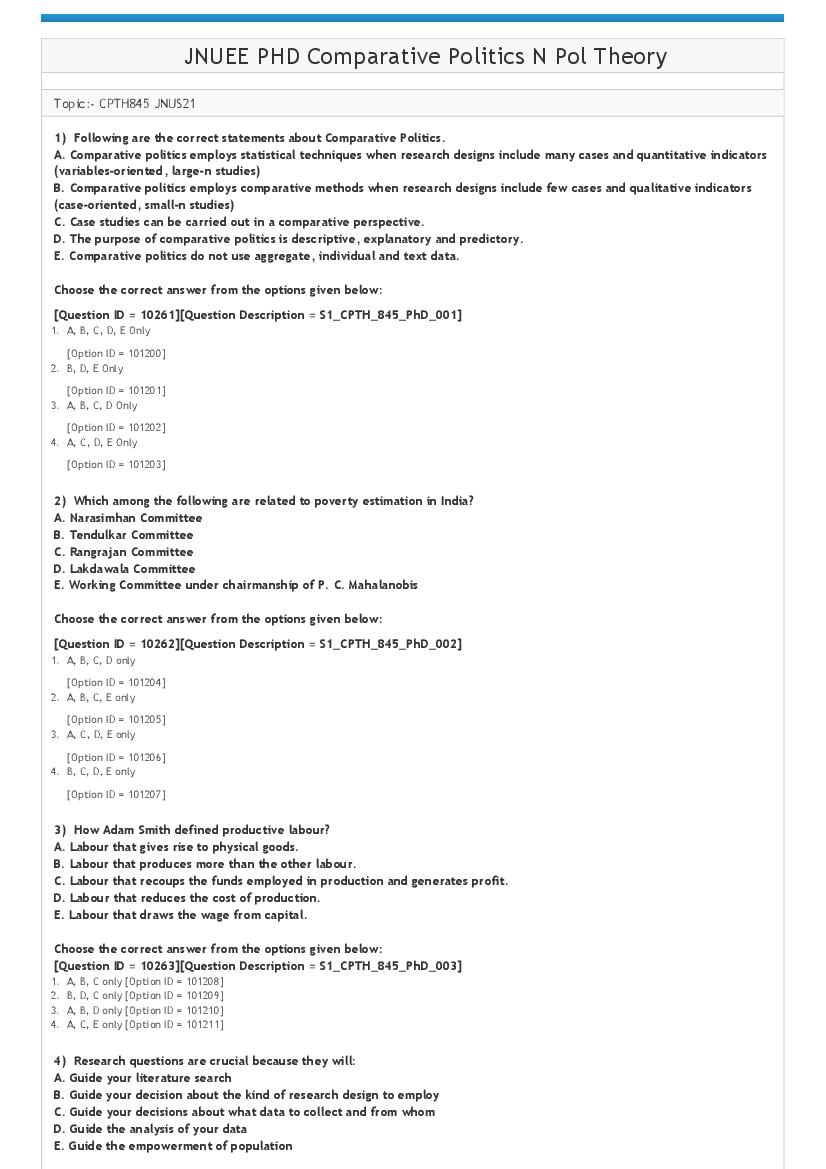
Topic:‐ CPTH845 JNUS21
1) Following are the correct statements about Comparative Politics.
A. Comparative politics employs statistical techniques when research designs include many cases and quantitative indicators
(variables‐oriented, large‐n studies)
B. Comparative politics employs comparative methods when research designs include few cases and qualitative indicators
(case‐oriented, small‐n studies)
C. Case studies can be carried out in a comparative perspective.
D. The purpose of comparative politics is descriptive, explanatory and predictory.
E. Comparative politics do not use aggregate, individual and text data.
Choose the correct answer from the options given below:
[Question ID = 10261][Question Description = S1_CPTH_845_PhD_001]
1. A, B, C, D, E Only
[Option ID = 101200]
2. B, D, E Only
[Option ID = 101201]
3. A, B, C, D Only
[Option ID = 101202]
4. A, C, D, E Only
[Option ID = 101203]
2) Which among the following are related to poverty estimation in India?
A. Narasimhan Committee
B. Tendulkar Committee
C. Rangrajan Committee
D. Lakdawala Committee
E. Working Committee under chairmanship of P. C. Mahalanobis
Choose the correct answer from the options given below:
[Question ID = 10262][Question Description = S1_CPTH_845_PhD_002]
1. A, B, C, D only
[Option ID = 101204]
2. A, B, C, E only
[Option ID = 101205]
3. A, C, D, E only
[Option ID = 101206]
4. B, C, D, E only
[Option ID = 101207]
3) How Adam Smith defined productive labour?
A. Labour that gives rise to physical goods.
B. Labour that produces more than the other labour.
C. Labour that recoups the funds employed in production and generates profit.
D. Labour that reduces the cost of production.
E. Labour that draws the wage from capital.
Choose the correct answer from the options given below:
[Question ID = 10263][Question Description = S1_CPTH_845_PhD_003]
1. A, B, C only [Option ID = 101208]
2. B, D, C only [Option ID = 101209]
3. A, B, D only [Option ID = 101210]
4. A, C, E only [Option ID = 101211]
4) Research questions are crucial because they will:
A. Guide your literature search
B. Guide your decision about the kind of research design to employ
C. Guide your decisions about what data to collect and from whom
D. Guide the analysis of your data
E. Guide the empowerment of population
Page 2
[Question ID = 10264][Question Description = S1_CPTH_845_PhD_004]
1. A, B, E only
[Option ID = 101212]
2. A, B, C, D only
[Option ID = 101213]
3. C, D, E only
[Option ID = 101214]
4. A, B, D, E only
[Option ID = 101215]
5) Which one of following is a general rule of thumb while designing questions for respondents in social science research?
[Question ID = 10265][Question Description = S1_CPTH_845_PhD_005]
1. Avoid simple language [Option ID = 101216]
2. Ask long questions [Option ID = 101217]
3. Ask leading questions [Option ID = 101218]
4. Avoid leading questions [Option ID = 101219]
6) Assertion A:
Taylor noticed a phenomenon of workers purposely operating below their capacity and called the phenomenon as
‘soldiering’ or ‘skiving’.
Reason R:
Workers deliberately do as little as one can satisfactorily do due to the belief that if they become more productive, some of
them would become surplus and would be eliminated.
In the light of the above statements, choose the most appropriate answer from the options given below:
[Question ID = 10266][Question Description = S1_CPTH_845_PhD_006]
1. Both A and R are correct and R is the correct explanation of A
[Option ID = 101220]
2. Both A and R are correct but R is NOT the correct explanation of A
[Option ID = 101221]
3. A is correct but R is not correct
[Option ID = 101222]
4. A is not correct but R is correct
[Option ID = 101223]
7) “This cannot be done by the wisest of lawyers sitting together in conclave; it cannot be done by small committees trying
to balance interests and calling that constitution‐making; it can never be done under the shadow of an external authority. It
can only be done effectively when the political and psychological conditions are present, and the urge and sanctions come
from the masses”.
The statement was given by:
[Question ID = 10267][Question Description = S1_CPTH_845_PhD_007]
1. T. H. Green [Option ID = 101224]
2. Govind Ballabh Pant [Option ID = 101225]
3. B. R. Ambedkar [Option ID = 101226]
4. Jawaharlal Nehru [Option ID = 101227]
8) Assertion A:
Kautilya attaches an element of divinity to the King.
Reason R:
Divine punishment also falls on those who treat Kings with disrespect.
In the light of the above statements, choose the most appropriate answer from the options given below:
[Question ID = 10268][Question Description = S1_CPTH_845_PhD_008]
1. Both A and R are correct and R is the correct explanation of A
[Option ID = 101228]
2. Both A and R are correct but R is NOT the correct explanation of A
[Option ID = 101229]
3. A is correct but R is not correct
[Option ID = 101230]
4. A is not correct but R is correct
[Option ID = 101231]
9)
Page 3
1. A‐II, B‐I, C‐IV, D‐III [Option ID = 101232]
2. A‐I, B‐II, C‐III, D‐IV [Option ID = 101233]
3. A‐III, B‐IV, C‐II, D‐I [Option ID = 101234]
4. A‐IV, B‐III, C‐I, D‐II [Option ID = 101235]
10) The traditional assumptions of Douglas McGregor’s ‘Theory X’ are:
A. The average human being has an inherent dislike of work and will avoid it, if she/he can
B. The expenditure of physical and mental effort in work is as natural as play or rest
C. Most people must be corrected, controlled, directed and threatened with punishment to get them to put forth adequate
effort towards the achievement of organisational objectives
D. The average human being prefers to be directed, wishes to avoid responsibility, has relatively little ambition, wants
security above all
E. Under the conditions of modern industrial life, the intellectual potentialities of the average human being are only
partially utilised
Choose the most appropriate answer from the options given below:
[Question ID = 10270][Question Description = S1_CPTH_845_PhD_010]
1. A, B, D only
[Option ID = 101236]
2. A, B, C, E only
[Option ID = 101237]
3. A, C, D only
[Option ID = 101238]
4. B, C, D only
[Option ID = 101239]
11) Statement I:
Dwight Waldo unequivocally abandoned political administration dichotomy and contended that the separation is inadequate,
either as a description of reality or as a prescription for administrative behaviour.
Waldo represents ‘the administration as politics’ approach in public administration.
In the light of the above statements, choose the most appropriate answer from the options given below:
[Question ID = 10271][Question Description = S1_CPTH_845_PhD_011]
1. Both Statement I and Statement II are Correct
[Option ID = 101240]
2. Both Statement I and Statement II are Incorrect
[Option ID = 101241]
3. Statement I is correct but Statement II is Incorrect
[Option ID = 101242]
4. Statement I is incorrect but Statement II is Correct
[Option ID = 101243]
12) The term ‘Development Administration’ was coined by
[Question ID = 10272][Question Description = S1_CPTH_845_PhD_012]
1. Fred W. Riggs
[Option ID = 101244]
2. U. L. Goswami
[Option ID = 101245]
3. Dwight Waldo
[Option ID = 101246]
4. V.A. Pai Panandiker
[Option ID = 101247]
13) Statement I:
Normative Institutionalism sees institutions more as aggregations of incentives and disincentives that influence individual
choice.
Historical Institutionalism conceptualises institutions as providing set of norms and rules that shape individual behaviour.
Page 4
1. Both Statement I and Statement II are true
[Option ID = 101248]
2. Both Statement I and Statement II are false
[Option ID = 101249]
3. Statement I is correct but Statement II is false
[Option ID = 101250]
4. Statement I is incorrect but Statement II is true
[Option ID = 101251]
14) Statement I:
During structured interviewing, interviewers should freely express their views or opinions on the topics covered by the
survey instrument.
Interviewers should not hesitate from presenting their personal information required for inferring what their preferences or
values might be that are relevant to the content of the interview.
In the light of the above statements, choose the correct answer from the options given below.
[Question ID = 10274][Question Description = S1_CPTH_845_PhD_014]
1. Both Statement I and Statement II are true [Option ID = 101252]
2. Both Statement I and Statement II are false [Option ID = 101253]
3. Statement I is correct but Statement II is false [Option ID = 101254]
4. Statement I is incorrect but Statement II is true [Option ID = 101255]
15) Which of the following are correct in relation to Human Development Index (HDI)?
A. It was devised and launched by economist Mahbub Ul‐Haq in 1990.
B. The purpose was to shift the focus of development economics from people to people centred policies to national income
accounting.
C. The HDI was created to emphasize that people and their capabilities should be the criteria for assessing the development
of a country.
D. The HDI does not include the statistic of life‐expectancy, education attainment and income per capita indicators.
E. In 2010, HD Report introduced an inequality adjusted Human Development Index (IHDI) to state the actual level of
human development.
Choose the correct answer from the options given below:
[Question ID = 10275][Question Description = S1_CPTH_845_PhD_015]
1. A, B, C, D, E only [Option ID = 101256]
2. A, B, C, D only [Option ID = 101257]
3. A, C, E only [Option ID = 101258]
4. B, C, D, E only [Option ID = 101259]
16) Assertion A:
Green revolution marked a structural shift in Indian agriculture.
Reason R:
Monetisation of Indian agriculture increased drastically after green revolution.
[Question ID = 10276][Question Description = S1_CPTH_845_PhD_016]
1. Both A and R are true and R is the correct explanation of A
[Option ID = 101260]
2. Both A and R are true but R is Not the correct explanation of A
[Option ID = 101261]
3. A is true but R is false
[Option ID = 101262]
4. A is false but R is true.
[Option ID = 101263]
17)
Page 5
1. A‐III, B‐IV, C‐I, D‐II [Option ID = 101264]
2. A‐III, B‐I, C‐IV, D‐II [Option ID = 101265]
3. A‐II, B‐IV, C‐I, D‐III [Option ID = 101266]
4. A‐II, B‐IV, C‐III, D‐I [Option ID = 101267]
18) Who among the following did use the expression ‘Bargain Sector’ for India’s agricultural sector for the first time?
[Question ID = 10278][Question Description = S1_CPTH_845_PhD_018]
1. Amartya Sen
[Option ID = 101268]
2. K. N. Raj
[Option ID = 101269]
3. S. R. Sen
[Option ID = 101270]
4. S. Chakravarty
[Option ID = 101271]
19) Statement I:
Research methodology is a way to systematically solve the research problem.
The scope of research methodology is wider than that of research methods.
[Question ID = 10279][Question Description = S1_CPTH_845_PhD_019]
1. Both Statement I and Statement II are true
[Option ID = 101272]
2. Both Statement I and Statement II are false
[Option ID = 101273]
3. Statement I is correct but Statement II is false
[Option ID = 101274]
4. Statement I is incorrect but Statement II is true
[Option ID = 101275]
20) Which one of the following is not a ‘Variable’?[Question ID = 10280][Question Description = S1_CPTH_845_PhD_020]
1. Income [Option ID = 101276]
2. Self‐Esteem [Option ID = 101277]
3. Religion [Option ID = 101278]
4. Gender [Option ID = 101279]
21)
[Question ID = 10281][Question Description = S1_CPTH_845_PhD_021]
1. A‐III, B‐I, C‐II, D‐IV [Option ID = 101280]
2. A‐I, B‐IV, C‐II, D‐III [Option ID = 101281]
3. A‐IV, B‐I, C‐II, D‐III [Option ID = 101282]
4. A‐IV, B‐III, C‐II, D‐I [Option ID = 101283]
22) Which of the following statements are true about ‘Theoretical Sampling’?
A. Extension of the basic population is known in advance.
B. Sampling is finished when theoretical saturation has been reached.
C. Features of the basic population are not known in advance.
D. Distribution of features in the basic population can be estimated.
E. Sample size is not defined in advance.
Choose the most appropriate answer from the options given below:
[Question ID = 18838][Question Description = S1_CPTH_845_PhD_022]
1. A, B, C, D only [Option ID = 101284]
2. A, B, C, E only [Option ID = 101285]
3. A, C, D, E only [Option ID = 101286]
4. B, C, E only [Option ID = 101287]
Page 6
A. Selection of research groups on which to study the question
B. Evaluation and reformulation of the specific research questions
C. Formulation of specific research questions
D. Collection of data
E. Analysing the data
Choose the correct answer from the options given below:
[Question ID = 18839][Question Description = S1_CPTH_845_PhD_023]
1. A, C, D, B, E [Option ID = 101288]
2. A, D, C, E, B [Option ID = 101289]
3. C, A, D, B, E [Option ID = 101290]
4. C, D, A, B, E [Option ID = 101291]
24) In Research, ‘official documents’ (derived from private sources) that are in public domain include the following
A. Advertisements
B. Mission statements
C. Annual reports
D. Minutes of meetings
E. Internal correspondence
Choose the correct answer from the options given below:
[Question ID = 18840][Question Description = S1_CPTH_845_PhD_024]
1. A, B, C, D only [Option ID = 101292]
2. A, C, D, E only [Option ID = 101293]
3. A, B, C only [Option ID = 101294]
4. A, B, C, E only [Option ID = 101295]
25) Which one of the following is true about structured interview in Quantitative research?[Question ID = 18841][Question
Description = S1_CPTH_845_PhD_025]
1. Interviewers can depart significantly from the interview guide. [Option ID = 101296]
2. There is a great interest in the interviewee’s point of view. [Option ID = 101297]
3. The interview is supposed to generate answers that can be coded and processed quickly. [Option ID = 101298]
4. ‘Rambling’ or going off at tangents is often encouraged. [Option ID = 101299]
26)
List I List II
1. Variables are actively manipulated
1. Experiments 2. The variables are not manipulated
2. Quasi‐experiments 3. Variables are measured, without controlling
3. Correlational studies them
4. Observational research 4. Behaviours are studied in their natural setting
without intervening (in most cases)
Choose the correct answer from the options given below:
[Question ID = 13909][Question Description = S1_CPTH_845_PhD_026 ]
1.
A‐I, B‐II, C‐IV, D‐III
[Option ID = 101592]
2.
A‐I, B‐II, C‐III, D‐IV
[Option ID = 101593]
3.
A‐II, B‐I, C‐III, D‐IV
[Option ID = 101594]
4.
A‐IV, B‐II, C‐III, D‐I
[Option ID = 101595]
27) Statement I:
Science itself rests upon a series of postulates or assumptions, which are themselves fundamentally unproved and
unprovable.
Page 7
these postulates are: The world exists, we can know the world etc.
In the light of the above statements, choose the most appropriate answer from the options given below:
[Question ID = 18842][Question Description = S1_CPTH_845_PhD_027]
1. Both Statement I and Statement II are Correct
[Option ID = 101300]
2. Both Statement I and Statement II are Incorrect
[Option ID = 101301]
3. Statement I is correct but Statement II is Incorrect
[Option ID = 101302]
4. Statement I is incorrect but Statement II is Correct
[Option ID = 101303]
28) Statement I:
Vivekananda believed that a nation is great or good because of the innate greatness, goodness of its people and not because
the state so desires and enacts legislation to that effect.
According to Vivekananda, to realise a real ideal society, education was the first and foremost requirement.
In the light of the above statements, choose the most appropriate answer from the options given below:
[Question ID = 18843][Question Description = S1_CPTH_845_PhD_028]
1. Both Statement I and Statement II are Correct
[Option ID = 101304]
2. Both Statement I and Statement II are Incorrect
[Option ID = 101305]
3. Statement I is correct but Statement II is Incorrect
[Option ID = 101306]
4. Statement I is incorrect but Statement II is Correct
[Option ID = 101307]
29) A research project in which a group of participants is observed and measured over time, sometimes over many decade
is called[Question ID = 18844][Question Description = S1_CPTH_845_PhD_029]
1. Quasi‐Experiment [Option ID = 101308]
2. Case Study [Option ID = 101309]
3. Longitudinal Study [Option ID = 101310]
4. Archival Research [Option ID = 101311]
30) The process by which scientists try to guarantee that only high quality research results appear in journals involves
getting experts to evaluate the research work. This process is called[Question ID = 18845][Question Description =
S1_CPTH_845_PhD_030]
1. Construct validity [Option ID = 101312]
2. Peer review [Option ID = 101313]
3. Literature review [Option ID = 101314]
4. Conceptual review [Option ID = 101315]
31) A domain of inquiry that has the superficial appearance of being scientific but which does not rely on the critical
scientific principles of objectivity, verifiability, empiricism, and being public. This is called[Question ID = 18846][Question
Description = S1_CPTH_845_PhD_031]
1. Medical science [Option ID = 101316]
2. Natural science [Option ID = 101317]
3. Pseudoscience [Option ID = 101318]
4. Social science [Option ID = 101319]
32) Statement I:
In deductive approach, the researcher moves from theory to observations/findings
In inductive approach, the researcher moves from observation/findings to theory
[Question ID = 18847][Question Description = S1_CPTH_845_PhD_032]
1. Both Statement I and Statement II are true
[Option ID = 101320]
2. Both Statement I and Statement II are false
[Option ID = 101321]
3. Statement I is correct but Statement II is false
Page 8
4. Statement I is incorrect but Statement II is true
[Option ID = 101323]
33) Hypothesis must possess the following characteristics
A. Hypothesis should not be consistent with most known facts.
B. Hypothesis should be clear and precise.
C. Hypothesis should be capable of being tested.
D. Hypothesis should state relationship between variables, if it happens to be a relational hypothesis.
Choose the most appropriate answer from the options given below:
[Question ID = 18848][Question Description = S1_CPTH_845_PhD_033]
1. A, B, D only [Option ID = 101324]
2. A, B, C only [Option ID = 101325]
3. A, C, D only [Option ID = 101326]
4. B, C, D only [Option ID = 101327]
34) Statement I:
In a group interview, the interviewer verbally requests information from more than one interviewee at the same time, but
they are discouraged from interacting with each other.
A focus group involves a moderator who obtains information by encouraging verbal discussion and interaction about a
focussed topic among a group of participants.
[Question ID = 18849][Question Description = S1_CPTH_845_PhD_034]
1. Both Statement I and Statement II are true
[Option ID = 101328]
2. Both Statement I and Statement II are false
[Option ID = 101329]
3. Statement I is correct but Statement II is false
[Option ID = 101330]
4. Statement I is incorrect but Statement II is true
[Option ID = 101331]
35) The functions of literature review are
A. To know what concepts and theories have been applied to the topic
B. To understand what research methods have been applied to the topic.
C. To provide an idea to the reader about research ethics.
D. To know about the key contributors to research on the topic.
E. To guide the analysis of data.
Choose the correct answer from the options given below:
[Question ID = 18850][Question Description = S1_CPTH_845_PhD_035]
1. A, B, D only [Option ID = 101332]
2. A, B, C, D only [Option ID = 101333]
3. B, C, D only [Option ID = 101334]
4. C, D, E only [Option ID = 101335]
36) Assertion A:
There is an important distinction between a research method and a research design.
Reason R:
Research methods can be and are associated with different kinds of research design. The later represents a structure that
guides the execution of a research method and the analysis of subsequent data.
[Question ID = 18851][Question Description = S1_CPTH_845_PhD_036]
1. Both A and R are true and R is the correct explanation of A
[Option ID = 101336]
2. Both A and R are true but R is Not the correct explanation of A
[Option ID = 101337]
3. A is true but R is false
[Option ID = 101338]
4. A is false but R is true
[Option ID = 101339]
Page 9
A. Measuring device
B. Indeterminacy principle
C. Non‐respondents
D. Inappropriate sampling frame
E. Natural bias in the reporting of data.
Choose the most appropriate answer from the options given below:
[Question ID = 18852][Question Description = S1_CPTH_845_PhD_037]
1. A, B, C, D only
[Option ID = 101340]
2. B, C, D, E only
[Option ID = 101341]
3. A, C, D, E only
[Option ID = 101342]
4. A, B, D, E only
[Option ID = 101343]
38)
[Question ID = 18853][Question Description = S1_CPTH_845_PhD_038]
1. A‐II, B‐I, C‐IV, D‐III [Option ID = 101344]
2. A‐II, B‐I, C‐III, D‐ IV [Option ID = 101345]
3. A‐III, B‐I, C‐IV, D‐II [Option ID = 101346]
4. A‐IV, B‐III, C‐I, D‐II [Option ID = 101347]
39) Which statement is not correct about ‘grounded theory’?[Question ID = 18854][Question Description =
S1_CPTH_845_PhD_039]
1. Theory that is derived from data, systematically gathered and analysed through the research process. [Option ID = 101348]
2. The data collection and analysis proceed in tandem, repeatedly referring back to each other. [Option ID = 101349]
3. To some writers it is a distinct method or approach to qualitative research; to others it is an approach to the generation of theory. [Option ID =
101350]
4. The most important scholar associated with ‘grounded theory’ is Thomas Hobbes. [Option ID = 101351]
40) Statement I:
Triangulation entails using more than one method or source of data in the study of social phenomenon.
Triangulation can operate within and across research strategies.
[Question ID = 18855][Question Description = S1_CPTH_845_PhD_040]
1. Both Statement I and Statement II are true
[Option ID = 101352]
2. Both Statement I and Statement II are false
[Option ID = 101353]
3. Statement I is correct but Statement II is false
[Option ID = 101354]
4. Statement I is incorrect but Statement II is true
[Option ID = 101355]
41) It can be defined as an approach in which the researcher and members of a social setting collaborate in the diagnosis of
a problem and in the development of a solution based on the diagnosis. This is the definition of[Question ID = 18856]
[Question Description = S1_CPTH_845_PhD_041]
1. Reflexivity [Option ID = 101356]
2. Action Research [Option ID = 101357]
3. Triangulation [Option ID = 101358]
4. Respondent Validation [Option ID = 101359]
42) Which statement is not true about purposive sampling?
[Question ID = 18857][Question Description = S1_CPTH_845_PhD_042]
1. Purposive sampling is a non‐probability form of sampling.
Page 10
2. The goal of purposive sampling is to sample cases/participants in a strategic way
[Option ID = 101361]
3. Purposive sampling allows the researcher to generalize a population.
[Option ID = 101362]
4. The researcher does not seek to sample research participants on a random basis.
[Option ID = 101363]
43) Assertion A:
Focussed interview is meant to focus attention on the given experience of the respondents and its effects.
Reason R:
Under focussed interview, the interviewer has the freedom to decide the manner and sequence in which the questions
would be asked and has also the freedom to explore reasons and motives.
In the light of the above statements, choose the most appropriate answer from the options given below
[Question ID = 10282][Question Description = S1_CPTH_845_PhD_043]
1. Both A and R are correct and R is the correct explanation of A
[Option ID = 101364]
2. Both A and R are correct but R is Not the correct explanation of A
[Option ID = 101365]
3. A is correct but R is not correct
[Option ID = 101366]
4. A is not correct but R is correct.
[Option ID = 101367]
44) ‘SIGN’, ‘SIGNIFIER’, ‘SIGNIFIED’, ‘POLYSEMY’, are the terms employed in [Question ID = 10283][Question Description =
S1_CPTH_845_PhD_044]
1. Postings [Option ID = 101368]
2. Semiotics [Option ID = 101369]
3. Autobiography [Option ID = 101370]
4. Thematic Analysis [Option ID = 101371]
45) Assertion A:
Interpretivism is a term given to an epistemology that contrasts with positivism.
Reason R:
Interpretivism is founded upon the view that a strategy is required that respects the differences between people and the
objects of the natural sciences and therefore requires the social scientist to grasp the subjective meaning of social action.
[Question ID = 10284][Question Description = S1_CPTH_845_PhD_045]
1. Both A and R are true and R is the correct explanation of A
[Option ID = 101372]
2. Both A and R are true but R is Not the correct explanation of A
[Option ID = 101373]
3. A is true but R is false
[Option ID = 101374]
4. A is false but R is true
[Option ID = 101375]
46) Statement I:
The basic case study entails the detailed and intensive analysis of a single case.
Case studies are frequently sites for the employment of both quantitative and qualitative research.
In the light of the above statements, choose the correct answer from the options given below.
[Question ID = 10285][Question Description = S1_CPTH_845_PhD_046]
1. Both Statement I and Statement II are true [Option ID = 101376]
2. Both Statement I and Statement II are false [Option ID = 101377]
3. Statement I is correct but Statement II is false [Option ID = 101378]
4. Statement I is incorrect but Statement II is true [Option ID = 101379]
47) There is a growing interest in visual materials among social researchers. Content analysis can be applied to visual
materials of various kinds. All images/ visuals can be coded in terms of which of the following?
A. Taste
B. Behaviour
C. Weight
Page 11
E. Distance
Choose the most appropriate answer from the options given below:
[Question ID = 10286][Question Description = S1_CPTH_845_PhD_047]
1. A, B, E only [Option ID = 101380]
2. B, C, E only [Option ID = 101381]
3. A, B, D only [Option ID = 101382]
4. B, D, E only [Option ID = 101383]
48) Assertion A:
There is an unease among some writers on qualitative research concerning the specification/delineation of the nature of
qualitative research.
Reason R:
The connection between theory & research is specifically clear in qualitative research than in quantitative research.
[Question ID = 10287][Question Description = S1_CPTH_845_PhD_048]
1. Both A and R are true and R is the correct explanation of A
[Option ID = 101384]
2. Both A and R are true but R is Not the correct explanation of A
[Option ID = 101385]
3. A is true but R is false
[Option ID = 101386]
4. A is false but R is true
[Option ID = 101387]
49) Statement I:
Standard deviation is independent of change of origin but not of scale.
Standard deviation is the maximum value of the root mean square deviation.
[Question ID = 10288][Question Description = S1_CPTH_845_PhD_049]
1. Both Statement I and Statement II are true
[Option ID = 101388]
2. Both Statement I and Statement II are false
[Option ID = 101389]
3. Statement I is correct but Statement II is false
[Option ID = 101390]
4. Statement I is incorrect but Statement II is true
[Option ID = 101391]
50)
[Question ID = 10289][Question Description = S1_CPTH_845_PhD_050]
1. A‐II, B‐IV, C‐III, D‐I
[Option ID = 101392]
2. A‐III, B‐IV, C‐II, D‐ I
[Option ID = 101393]
3. A‐IV, B‐III, C‐II, D‐I
[Option ID = 101394]
4. A‐IV, B‐III, C‐I, D‐II
[Option ID = 101395]
51) For two positive real numbers, ‘a’ and ‘b’, which of the following statement is true.[Question ID = 10290][Question
Page 12
1. Arithmetic mean ≥ Geometric mean ≤ Harmonic mean [Option ID = 101396]
2. Arithmetic mean ≤ Geometric mean ≤ Harmonic mean [Option ID = 101397]
3. Arithmetic mean ≥ Geometric mean ≥ Harmonic mean [Option ID = 101398]
4. Geometric mean ≥ Harmonic mean ≥ Arithmetic mean [Option ID = 101399]
52) Which among the following are measures of central tendency?
A. Arithmetic mean
B. Geometric mean
C. Mean deviation
D. Median
E. Mode
Choose the correct answer from the options given below:
[Question ID = 10291][Question Description = S1_CPTH_845_PhD_052]
1. A, B, D, E only [Option ID = 101400]
2. A, B, C, E only [Option ID = 101401]
3. A, C, D, E only [Option ID = 101402]
4. B, C, D, E only [Option ID = 101403]
53) Statement I:
Karimul Haque ‐‘Bike‐Ambulance‐Dada’‐from Bengal was one of the Padmashri Award winner in 2020.
P. Gopichand, Sakshi Mallik, Jitendra Singh Shunty, Rattan Lal Mittal, Mouma Das and Kartar Singh are few of the winners of
the Padmashri Award in 2021.
In the light of the above statements, choose the most appropriate answer from the options given below:
[Question ID = 10292][Question Description = S1_CPTH_845_PhD_053]
1. Both Statement I and Statement II are true
[Option ID = 101404]
2. Both Statement I and Statement II are false
[Option ID = 101405]
3. Statement I is correct but Statement II is false
[Option ID = 101406]
4. Statement I is incorrect but Statement II is true
[Option ID = 101407]
54) Statement I:
When the dependent variable is not free from the influence of extraneous variables, the relationship between the
dependent and independent variable is said to be confounded by an extraneous variable.
Independent variables that are not related to the purpose of the study, but may affect the dependent variable are termed
as ‘control variable’.
[Question ID = 10293][Question Description = S1_CPTH_845_PhD_054]
1. Both Statement I and Statement II are true
[Option ID = 101408]
2. Both Statement I and Statement II are false
[Option ID = 101409]
3. Statement I is correct but Statement II is false
[Option ID = 101410]
4. Statement I is incorrect but Statement II is true
[Option ID = 101411]
55) Which is not an example of Complex random sampling design?[Question ID = 10294][Question Description =
S1_CPTH_845_PhD_055]
1. Cluster sampling [Option ID = 101412]
2. Sequential sampling [Option ID = 101413]
3. Area sampling [Option ID = 101414]
4. Unified core sampling [Option ID = 101415]
56) The correct statements about experimental design are
A. R.A. Fisher’s name is associated with experimental design
B. Fisher enumerated three principles of experimental design
C. The experimental designs are now being used in research relating to phenomena of several disciplines.
D. The study of experimental designs has its origin in space research.
Choose the correct answer from the options given below:
Page 13
1. A, B, D only [Option ID = 101416]
2. A, B, C only [Option ID = 101417]
3. B, C, D only [Option ID = 101418]
4. A, C, D only [Option ID = 101419]
57) Measurement should be precise and unambiguous in an ideal research. But the researcher must be aware about the
sources of error in measurement. Which among the following is not a possible source of error in measurement?[Question ID =
10296][Question Description = S1_CPTH_845_PhD_057]
1. Respondent [Option ID = 101420]
2. Situation [Option ID = 101421]
3. Insurer [Option ID = 101422]
4. Measurer [Option ID = 101423]
58) Assertion A:
The problem of securing an accurate measure of internal migration is very complex and one which is not yet systematised in
the way that the measures of fertility and mortality are.
Reason R:
Questions like‐ How far must one move to become a migrant? Is a move within a city a migration? Or if not, is a move within
a country sufficient? –make it difficult to define migration.
[Question ID = 10297][Question Description = S1_CPTH_845_PhD_058]
1. Both A and R are true and R is the correct explanation of A
[Option ID = 101424]
2. Both A and R are true but R is Not the correct explanation of A
[Option ID = 101425]
3. A is true but R is false
[Option ID = 101426]
4. A is false but R is true
[Option ID = 101427]
59) List I List II
1. The structure of Scientific Revolutions
1. Michael Oakeshott
2. Unended Quest: An Intellectual
2. Thomas Kuhn
Autobiography
3. F.A. Hayek
3. Rationalism in Politics
4. Karl Popper
4. The Road to Serfdom
Choose the correct answer from the options given below:
[Question ID = 13910][Question Description = S1_CPTH_845_PhD_059 ]
1.
A‐IV, B‐III, C‐I, D‐II
[Option ID = 101596]
2. A‐II, B‐IV, C‐III, D‐ I
[Option ID = 101597]
3. A‐II, B‐IV, C‐I, D‐III
[Option ID = 101598]
4. A‐III, B‐IV, C‐I, D‐II
[Option ID = 101599]
60)
[Question ID = 10298][Question Description = S1_CPTH_845_PhD_060]
Page 14
2. A‐IV, B‐II, C‐III, D‐ I [Option ID = 101429]
3. A‐II, B‐IV, C‐I, D‐III [Option ID = 101430]
4. A‐I, B‐III, C‐IV, D‐II [Option ID = 101431]
61) The statement made by the US President in March 1947 that it ‘must be the policy of the US to support free people
who are resisting attempted subjugation by armed minorities or by outside pressures’. This is known as:[Question ID =
10299][Question Description = S1_CPTH_845_PhD_061]
1. Johnson Doctrine [Option ID = 101432]
2. Wilson Doctrine [Option ID = 101433]
3. Nixon Doctrine [Option ID = 101434]
4. Truman Doctrine [Option ID = 101435]
62) Which of the following statement is not correct about the concept of ‘Gender’?[Question ID = 18858][Question
Description = S1_CPTH_845_PhD_062]
1. Feminist define gender as a set of socially constructed characteristics that define what we mean by masculinity and femininity [Option ID = 101436]
2. Gender is a system of social welfare and it is not socially constructed [Option ID = 101437]
3. Gender is a structure that signifies unequal power relationship between women and men [Option ID = 101438]
4. Masculine characteristics are more valued than feminine one [Option ID = 101439]
63) Arrange the following in chronological order of formation:
A. National Council of Education
B. Santiniketan
C. Saraswat Ashram
D. Bhagpat Chatuspati
E. Bengal Chemical
Choose the correct answer from the options given below:
[Question ID = 18859][Question Description = S1_CPTH_845_PhD_063]
1. A, B, D, C, E [Option ID = 101440]
2. A, C, D, B, E [Option ID = 101441]
3. E, B, D, C, A [Option ID = 101442]
4. E, D, B, C, A [Option ID = 101443]
64) Arrange the following in the correct order:
A. All India Muslim League
B. Surat Session
C. Morley‐Minto Reform
D. The Government of India Act.
E. First Session of All India Hindu Mahasabha.
Choose the correct answer from the options given below:
[Question ID = 18860][Question Description = S1_CPTH_845_PhD_064]
1. A, C, B, E, D [Option ID = 101444]
2. A, B, C, E, D [Option ID = 101445]
3. D, B, C, A, E [Option ID = 101446]
4. D, C, B, A, E [Option ID = 101447]
65) Assertion A:
In the years immediately following World War‐I, fiscal needs forced the Government of India to impose protective tariffs,
pushing the prices of imported articles up, and thus helping unintentionally Indian industrialisation.
Reason R:
By the summer of 1930, the Bombay mill owners were left with record unsold stocks‐ 120000 bales of cloth and 19000 bales
of yarn.
[Question ID = 18861][Question Description = S1_CPTH_845_PhD_065]
1. Both A and R are true and R is the correct explanation of A
[Option ID = 101448]
2. Both A and R are true but R is Not the correct explanation of A
[Option ID = 101449]
3. A is true but R is false
[Option ID = 101450]
4. A is false but R is true
[Option ID = 101451]
66) The core assumptions of the neo‐realist theory of International Politics are
A. States and other actors interact in an anarchic environment
B. The most critical problem presented by anarchy is not survival, rather it is prosperity
C. The structure of the system is a major determinant of actor’s behaviour
Page 15
E. States see all other states as potential enemies and threats to their national security.
Choose the correct answer from the options given below:
[Question ID = 18862][Question Description = S1_CPTH_845_PhD_066]
1. A, B, C, D, E only [Option ID = 101452]
2. A, C, D, E only [Option ID = 101453]
3. B, C, D, E only [Option ID = 101454]
4. A, B, C, D only [Option ID = 101455]
67) The states are connected through multiple channels (both formal and informal). There is no hierarchy of issues and the
result is a decline in the use of military force. This is called:[Question ID = 18863][Question Description =
S1_CPTH_845_PhD_067]
1. Comprehensive interdependence [Option ID = 101456]
2. Collective interdependence [Option ID = 101457]
3. Community interdependence [Option ID = 101458]
4. Complex interdependence [Option ID = 101459]
68)
[Question ID = 18864][Question Description = S1_CPTH_845_PhD_068]
1. A‐II, B‐III, C‐IV, D‐I [Option ID = 101460]
2. A‐IV, B‐II, C‐I, D‐ III [Option ID = 101461]
3. A‐III, B‐II, C‐IV, D‐I [Option ID = 101462]
4. A‐I, B‐IV, C‐III, D‐II [Option ID = 101463]
69) Statement I:
The Citizenship (Amendment) Act 2019 makes foreign illegal migrants of six religious communities i.e. Hindu, Sikh,
Buddhist, Jain, Parsi and Christian from Afghanistan, Bangladesh and Pakistan eligible for Indian citizenship. It is applicable
to those who have taken shelter in India due to persecution on grounds of religion or fear of such persecution in their
countries and have entered India on or before December 31, 2014.
The provisions of the citizenship (Amendment) act 2019 do not apply to tribal areas of Assam, Meghalaya, Mizoram and
Tripura as included in the Sixth schedule to the constitution and the areas where ‘The Inner Line Permit’ is applicable
including the states of Arunachal Pradesh, Nagaland, Mizoram and Manipur.
[Question ID = 18865][Question Description = S1_CPTH_845_PhD_069]
1. Both Statement I and Statement II are true
[Option ID = 101464]
2. Both Statement I and Statement II are false
[Option ID = 101465]
3. Statement I is correct but Statement II is false
[Option ID = 101466]
4. Statement I is incorrect but Statement II is true
[Option ID = 101467]
70) ANOVA is used to determine if three or more groups or levels of an independent variable differ on a dependent
Page 16
1. Analysis of Victory [Option ID = 101468]
2. Anatomy of Variance [Option ID = 101469]
3. Assessment of Variance [Option ID = 101470]
4. Analysis of Variance. [Option ID = 101471]
71)
[Question ID = 18867][Question Description = S1_CPTH_845_PhD_071]
1. A‐III, B‐II, C‐I, D‐IV [Option ID = 101472]
2. A‐I, B‐II, C‐III, D‐ IV [Option ID = 101473]
3. A‐IV, B‐II, C‐III, D‐I [Option ID = 101474]
4. A‐II, B‐III, C‐I, D‐IV [Option ID = 101475]
72) Which among the following is not an example of closed‐ended question?[Question ID = 18868][Question Description =
S1_CPTH_845_PhD_072]
1. Do you drink alcohol? [Option ID = 101476]
2. What is your opinion about underage drinking? [Option ID = 101477]
3. Do your friends drink alcohol? [Option ID = 101478]
4. Do you drink and drive? [Option ID = 101479]
73) A variation of observation research in which the researcher reports his or her own personal experience is called:
[Question ID = 18869][Question Description = S1_CPTH_845_PhD_073]
1. Personal ethnography [Option ID = 101480]
2. Narrative ethnography [Option ID = 101481]
3. Autoethnography [Option ID = 101482]
4. Confessional ethnography [Option ID = 101483]
74) This is a technique in which the researcher initially samples a small group of people relevant to the research questions,
and these sampled participants propose other participants who have had the experience or characteristics relevant to the
research. This type of sampling is called‐[Question ID = 18870][Question Description = S1_CPTH_845_PhD_074]
1. Looseball Sampling [Option ID = 101484]
2. Snowball Sampling [Option ID = 101485]
3. Football Sampling [Option ID = 101486]
4. Sandball Sampling [Option ID = 101487]
75) Statement I:
A sample in which each unit has been selected entirely by chance. This type of sampling is called simple random sampling.
In simple random sampling, each unit of population has a known and equal probability of inclusion in the sample.
In the light of the above statements, choose the most appropriate answer from the options given below:
[Question ID = 18871][Question Description = S1_CPTH_845_PhD_075]
1. Both Statement I and Statement II are correct
[Option ID = 101488]
2. Both Statement I and Statement II are incorrect
[Option ID = 101489]
3. Statement I is correct but Statement II is incorrect
[Option ID = 101490]
4. Statement I is incorrect but Statement II is correct
[Option ID = 101491]
76)
Page 17
1. A‐I, B‐II, C‐III, D‐IV [Option ID = 101492]
2. A‐IV, B‐II, C‐III, D‐ I [Option ID = 101493]
3. A‐II, B‐I, C‐IV, D‐III [Option ID = 101494]
4. A‐I, B‐III, C‐II, D‐IV [Option ID = 101495]
77) Assertion A:
Pastoral societies do not normally accumulate many material possessions.
Reason R:
Pastoral societies are those that rely mainly on domesticated livestock and usually migrate between different areas
according to seasonal changes.
[Question ID = 18873][Question Description = S1_CPTH_845_PhD_077]
1. Both A and R are true and R is the correct explanation of A
[Option ID = 101496]
2. Both A and R are true but R is Not the correct explanation of A
[Option ID = 101497]
3. A is true but R is false
[Option ID = 101498]
4. A is false but R is true
[Option ID = 101499]
78)
[Question ID = 18874][Question Description = S1_CPTH_845_PhD_078]
1. A‐IV, B‐II, C‐III, D‐I [Option ID = 101500]
2. A‐I, B‐IV, C‐II, D‐ III [Option ID = 101501]
3. A‐IV, B‐III, C‐I, D‐II [Option ID = 101502]
4. A‐III, B‐IV, C‐II, D‐I [Option ID = 101503]
79)
[Question ID = 18875][Question Description = S1_CPTH_845_PhD_079]
1. A‐II, B‐I, C‐IV, D‐III [Option ID = 101504]
2. A‐II, B‐III, C‐I, D‐ IV [Option ID = 101505]
Page 18
4. A‐I, B‐IV, C‐II, D‐III [Option ID = 101507]
80)
[Question ID = 18876][Question Description = S1_CPTH_845_PhD_080]
1. A‐I, B‐IV, C‐III, D‐II [Option ID = 101508]
2. A‐II, B‐III, C‐I, D‐ IV [Option ID = 101509]
3. A‐IV, B‐II, C‐I, D‐III [Option ID = 101510]
4. A‐III, B‐I, C‐II, D‐IV [Option ID = 101511]
81)
[Question ID = 18877][Question Description = S1_CPTH_845_PhD_081]
1. A‐I, B‐II, C‐III, D‐IV [Option ID = 101512]
2. A‐III, B‐I, C‐II, D‐ IV [Option ID = 101513]
3. A‐II, B‐III, C‐IV, D‐I [Option ID = 101514]
4. A‐IV, B‐III, C‐I, D‐II [Option ID = 101515]
82)
[Question ID = 10300][Question Description = S1_CPTH_845_PhD_082]
1. A‐III, B‐II, C‐IV, D‐I [Option ID = 101516]
2. A‐IV, B‐II, C‐I, D‐ III [Option ID = 101517]
3. A‐III, B‐I, C‐II, D‐IV [Option ID = 101518]
4. A‐IV, B‐II, C‐III, D‐I [Option ID = 101519]
83)
[Question ID = 10301][Question Description = S1_CPTH_845_PhD_083]
1. A‐I, B‐II, C‐III, D‐IV [Option ID = 101520]
Page 19
3. A‐II, B‐IV, C‐I, D‐III [Option ID = 101522]
4. A‐II, B‐I, C‐IV, D‐III [Option ID = 101523]
84)
[Question ID = 10302][Question Description = S1_CPTH_845_PhD_084]
1. A‐I, B‐II, C‐III, D‐IV [Option ID = 101524]
2. A‐II, B‐I, C‐IV, D‐ III [Option ID = 101525]
3. A‐II, B‐I, C‐III, D‐IV [Option ID = 101526]
4. A‐IV, B‐II, C‐III, D‐I [Option ID = 101527]
85) Statement I:
Jotirao Govindrao Phule emphatically laid down the lack of education as the root cause of the degradation of lower castes.
Without Knowledge, intelligence was lost, without intelligence morality was lost and without morality was lost all dynamism!
Without dynamism money was lost and without money the shudras sank. All his misery was caused by the lack of knowledge.
In the light of the above statements, choose the most appropriate answer from the options given below:
[Question ID = 10303][Question Description = S1_CPTH_845_PhD_085]
1. Both Statement I and Statement II are correct
[Option ID = 101528]
2. Both Statement I and Statement II are incorrect
[Option ID = 101529]
3. Statement I is correct but Statement II is incorrect
[Option ID = 101530]
4. Statement I is incorrect but Statement II is correct
[Option ID = 101531]
86) Statement I:
Historical Institutionalism defines institutions as the formal or informal procedures, routines, norms and conventions
embedded in the organisational structure of the polity or political economy.
Norms and Culture are the key factors of Historical Institutionalism.
In the light of the above statements, choose the most appropriate answer from the options given below:
[Question ID = 10304][Question Description = S1_CPTH_845_PhD_086]
1. Both Statement I and Statement II are true
[Option ID = 101532]
2. Both Statement I and Statement II are true
[Option ID = 101533]
3. Statement I is correct but Statement II is false
[Option ID = 101534]
4. Statement I is incorrect but Statement II is true
[Option ID = 101535]
87) Statement I:
Dual Federalism is also referred to as layer cake federalism.
In Dual Federalism there is functional cooperation, partnership and interdependence between the national government and
the states, with emphasis on collaboration rather than conflict and separateness.
In the light of the above statements, choose the most appropriate answer from the options given below:
[Question ID = 10305][Question Description = S1_CPTH_845_PhD_087]
1. Both Statement I and Statement II are true
[Option ID = 101536]
2. Both Statement I and Statement II are false
Page 20
3. Statement I is correct but Statement II is false
[Option ID = 101538]
4. Statement I is incorrect but Statement II is true
[Option ID = 101539]
88) Statement I:
Competitive federalism means that regional or local governments compete with each other.
Fiscal federalism is a system of transfer of payments by which a federal government shares its revenue with lower levels of
government with the purpose of enforcing national rules and standards.
In the light of the above statements, choose the most appropriate answer from the options given below:
[Question ID = 10306][Question Description = S1_CPTH_845_PhD_088]
1. Both Statement I and Statement II are true
[Option ID = 101540]
2. Both Statement I and Statement II are false
[Option ID = 101541]
3. Statement I is correct but Statement II is false
[Option ID = 101542]
4. Statement I is incorrect but Statement II is true
[Option ID = 101543]
89) Points of similarity between Fascism and Communism are‐
A. Both acquired power through violence and both exalted compulsion as the supreme method of political action.
B. For both, the doctrine of economic determinism and the doctrine of class struggle were all important.
C. Both had hatred for democracy and liberalism & both despise parliamentary institutions.
D. Both did not recognise any individual liberties. Both demolished distinction between the party and the government.
E. Both work on the high velocity propaganda.
Choose the most appropriate answer from the options given below:
[Question ID = 10307][Question Description = S1_CPTH_845_PhD_089]
1. A, B, C, D only [Option ID = 101544]
2. A,C, D,E only [Option ID = 101545]
3. A,B, C, E only [Option ID = 101546]
4. B, C, D,E only [Option ID = 101547]
90) A small Ahom army led by Lachit Borphukan defeated the Mughal army in[Question ID = 10308][Question Description =
S1_CPTH_845_PhD_090]
1. Battle of Saraighat, 1670 [Option ID = 101548]
2. Battle of Saraighat, 1671 [Option ID = 101549]
3. Battle of Saraighat, 1672 [Option ID = 101550]
4. Battle of Saraighat, 1673 [Option ID = 101551]
91) The principle that refugees cannot be forced to return to their country of origin, because of fear of persecution on the
grounds of race, ethnicity, or membership in a social group is called[Question ID = 10309][Question Description =
S1_CPTH_845_PhD_091]
1. Non‐return [Option ID = 101552]
2. Non‐refoulment [Option ID = 101553]
3. Non‐repatriation [Option ID = 101554]
4. Non‐recall [Option ID = 101555]
92) Statement I:
General Agreement on Tariffs and Trade (GATT) was the interim measure introduced in 1949 before a permanent institution
was established in the form of World Trade Organisation in 1995.
The General Agreement on Tariffs and Trade (GATT) provided a context over a number of negotiating rounds for countries
to try to extend bilateral agreements for reducing tariff barriers to trade to multiple third countries.
In the light of the above statements, choose the most appropriate answer from the options given below:
[Question ID = 10310][Question Description = S1_CPTH_845_PhD_092]
1. Both Statement I and Statement II are true
[Option ID = 101556]
2. Both Statement I and Statement II are false
[Option ID = 101557]
3. Statement I is correct but Statement II is false
[Option ID = 101558]
Page 21
[Option ID = 101559]
93) Assertion A:
The term ‘false democracy’ explains that development is not about economic and social progress but also carries political
connotations of freedom and democracy.
Reason R:
Most democracies in the developing world are false because they are top down, centralised and externally imposed.
[Question ID = 10311][Question Description = S1_CPTH_845_PhD_093]
1. Both A and R are true and R is the correct explanation of A
[Option ID = 101560]
2. Both A and R are true but R is NOT the correct explanation of A
[Option ID = 101561]
3. A is true but R is false
[Option ID = 101562]
4. A is false but R is true
[Option ID = 101563]
94) Assertion A:
Federalism in Canada functions on the basis of a federal power sharing arrangement between the English speaking and
French speaking Canadians.
Reason R:
In cooperative federalism there is a functional cooperation partnership and interdependence between the national
government and the states with emphasis on collaboration rather than conflict and separateness.
[Question ID = 10312][Question Description = S1_CPTH_845_PhD_094]
1. Both A and R are true and R is the correct explanation of A
[Option ID = 101564]
2. Both A and R are true but R is NOT the correct explanation of A
[Option ID = 101565]
3. A is true but R is false
[Option ID = 101566]
4. A is false but R is true.
[Option ID = 101567]
95) The framework of political economy can be classified into:
A. Mercantilism
B. Communism
C. Feudalism
D. Social Democracy
E. Developmental State
Choose the correct answer from the options given below:
[Question ID = 10313][Question Description = S1_CPTH_845_PhD_095]
1. A, B, C, D, E only [Option ID = 101568]
2. A, B, D, E only [Option ID = 101569]
3. B, C, D, E only [Option ID = 101570]
4. A, B, C, D only [Option ID = 101571]
96) Which of these are correct in relation to Creative federalism?
A. It is also known as marble cake federalism
B. It dominated during 1960 to 1980 in USA
C. This was characterised by overloaded cooperation and cross cutting regulation
D. This may be described by ideal type of federalism
E. The balance of power is so much in favour of central government that it is even described as ‘coercive federalism’
Choose the correct answer from the options given below:
[Question ID = 10314][Question Description = S1_CPTH_845_PhD_096]
1. A, B, C, D, E only
[Option ID = 101572]
2. A, B, C only
[Option ID = 101573]
Page 22
[Option ID = 101574]
4. B and C only
[Option ID = 101575]
97) Statement I:
In 2010, the Gender Inequality Index (GII) was introduced.
GII was introduced to measure gender disparity with the help of three dimensions‐reproductive health, empowerment and
labour market participation.
In the light of the above statements, choose the Correct answer from the options given below.
[Question ID = 10315][Question Description = S1_CPTH_845_PhD_097]
1. Both Statement I and Statement II are true
[Option ID = 101576]
2. Both Statement I and Statement II are false
[Option ID = 101577]
3. Statement I is correct but Statement II is false
[Option ID = 101578]
4. Statement I is incorrect but Statement II is true
[Option ID = 101579]
98) Statement I:
The discipline of Comparative Politics is empirical and value neutral.
The discipline of Comparative politics analyses the political phenomena as they appear in the real world.
In the light of the above statements, choose the Correct answer from the options given below:
[Question ID = 10316][Question Description = S1_CPTH_845_PhD_098]
1. Both Statement I and Statement II are true
[Option ID = 101580]
2. Both Statement I and Statement II are false
[Option ID = 101581]
3. Statement I is correct but Statement II is false
[Option ID = 101582]
4. Statement I is incorrect but Statement II is true
[Option ID = 101583]
99)
[Question ID = 10317][Question Description = S1_CPTH_845_PhD_099]
1. A‐IV, B‐II, C‐III, D‐I [Option ID = 101584]
2. A‐III, B‐II, C‐I, D‐IV [Option ID = 101585]
3. A‐II, B‐III, C‐I, D‐IV [Option ID = 101586]
4. A‐II, B‐I, C‐IV, D‐III [Option ID = 101587]
100)
Page 23
1. A‐II, B‐I, C‐IV, D‐III [Option ID = 101588]
2. A‐III, B‐IV, C‐II, D‐I [Option ID = 101589]
3. A‐III, B‐IV, C‐I, D‐II [Option ID = 101590]
4. A‐II, B‐I, C‐III, D‐IV [Option ID = 101591]
Document Details
| Board / Org | NTA |
| Exam | Jawaharlal Nehru University Entrance Examination |
| Type | Question Paper |
| Pages | 23 |
| Updated | 22 Jul 2026 |