JNUEE 2021 Question Paper Ph.D Diplomacy and Disarmament
Finished viewing? Save it for later —
Download JNUEE 2021 Question Paper Ph.D Diplomacy and Disarmament (PDF · 18 pages)About JNUEE 2021 Question Paper Ph.D Diplomacy and Disarmament
JNUEE 2021 Question Paper Ph.D Diplomacy and Disarmament is available here for free download. Published by NTA for Jawaharlal Nehru University Entrance Examination, this question paper can be viewed online or downloaded as a PDF (18 pages). Candidates preparing for Jawaharlal Nehru University Entrance Examination can use JNUEE 2021 Question Paper Ph.D Diplomacy and Disarmament to understand the exam pattern, the type of questions asked, and the overall difficulty level.
Frequently Asked Questions
How can I download JNUEE 2021 Question Paper Ph.D Diplomacy and Disarmament?
Open this page and click the Download button to save JNUEE 2021 Question Paper Ph.D Diplomacy and Disarmament as a PDF. It is completely free on AglaSem Docs.
Is JNUEE 2021 Question Paper Ph.D Diplomacy and Disarmament free to download?
Yes. JNUEE 2021 Question Paper Ph.D Diplomacy and Disarmament can be viewed online and downloaded as a PDF free of cost on AglaSem Docs.
How many pages does JNUEE 2021 Question Paper Ph.D Diplomacy and Disarmament have?
JNUEE 2021 Question Paper Ph.D Diplomacy and Disarmament contains 18 pages, which you can read online or download together as a single PDF.
Where can I find more Jawaharlal Nehru University Entrance Examination study material?
You can find more Jawaharlal Nehru University Entrance Examination question papers, sample papers, syllabus, and answer keys on AglaSem Docs.
JNUEE 2021 Question Paper Ph.D Diplomacy and Disarmament – Text
Read the full text of this question paper below — useful to quickly search, copy and reference the content online without downloading the PDF.
📄 View text version (18 pages)
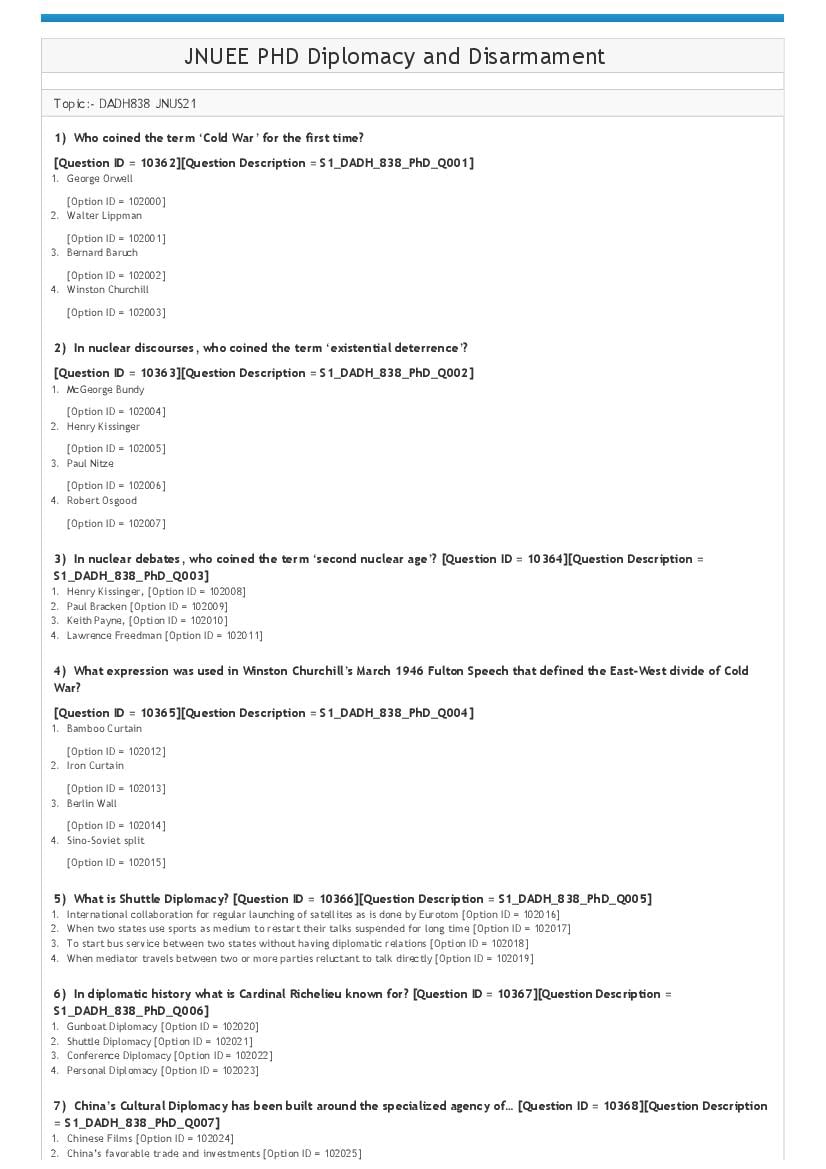
Page 1
Topic:‐ DADH838 JNUS21
1) Who coined the term ‘Cold War’ for the first time?
[Question ID = 10362][Question Description = S1_DADH_838_PhD_Q001]
1. George Orwell
[Option ID = 102000]
2. Walter Lippman
[Option ID = 102001]
3. Bernard Baruch
[Option ID = 102002]
4. Winston Churchill
[Option ID = 102003]
2) In nuclear discourses, who coined the term ‘existential deterrence’?
[Question ID = 10363][Question Description = S1_DADH_838_PhD_Q002]
1. McGeorge Bundy
[Option ID = 102004]
2. Henry Kissinger
[Option ID = 102005]
3. Paul Nitze
[Option ID = 102006]
4. Robert Osgood
[Option ID = 102007]
3) In nuclear debates, who coined the term ‘second nuclear age’? [Question ID = 10364][Question Description =
S1_DADH_838_PhD_Q003]
1. Henry Kissinger, [Option ID = 102008]
2. Paul Bracken [Option ID = 102009]
3. Keith Payne, [Option ID = 102010]
4. Lawrence Freedman [Option ID = 102011]
4) What expression was used in Winston Churchill’s March 1946 Fulton Speech that defined the East‐West divide of Cold
War?
[Question ID = 10365][Question Description = S1_DADH_838_PhD_Q004]
1. Bamboo Curtain
[Option ID = 102012]
2. Iron Curtain
[Option ID = 102013]
3. Berlin Wall
[Option ID = 102014]
4. Sino‐Soviet split
[Option ID = 102015]
5) What is Shuttle Diplomacy? [Question ID = 10366][Question Description = S1_DADH_838_PhD_Q005]
1. International collaboration for regular launching of satellites as is done by Eurotom [Option ID = 102016]
2. When two states use sports as medium to restart their talks suspended for long time [Option ID = 102017]
3. To start bus service between two states without having diplomatic relations [Option ID = 102018]
4. When mediator travels between two or more parties reluctant to talk directly [Option ID = 102019]
6) In diplomatic history what is Cardinal Richelieu known for? [Question ID = 10367][Question Description =
S1_DADH_838_PhD_Q006]
1. Gunboat Diplomacy [Option ID = 102020]
2. Shuttle Diplomacy [Option ID = 102021]
3. Conference Diplomacy [Option ID = 102022]
4. Personal Diplomacy [Option ID = 102023]
7) China’s Cultural Diplomacy has been built around the specialized agency of… [Question ID = 10368][Question Description
= S1_DADH_838_PhD_Q007]
1. Chinese Films [Option ID = 102024]
2. China’s favorable trade and investments [Option ID = 102025]
Page 2
4. Chinese Embassies [Option ID = 102027]
8) Which of these is earliest attempt at disarmament? [Question ID = 10369][Question Description =
S1_DADH_838_PhD_Q008]
1. Vienna Convention [Option ID = 102028]
2. Hague Convention [Option ID = 102029]
3. San Francisco Convention [Option ID = 102030]
4. Paris Convention [Option ID = 102031]
9) What is the last treaty to be successfully negotiated at Conference on Disarmament?
[Question ID = 10370][Question Description = S1_DADH_838_PhD_Q009]
1. Arms Trade Treaty 2014
[Option ID = 102032]
2. Anti‐personnel Landmines Convention 1997
[Option ID = 102033]
3. Chemical Weapons Convention 1997
[Option ID = 102034]
4. Comprehensive Test Ban Treaty 1996
[Option ID = 102035]
10) Which of the following treaty was negotiated in shortest time? [Question ID = 10371][Question Description =
S1_DADH_838_PhD_Q010]
1. Partial Test Ban Treaty [Option ID = 102036]
2. Threshold Test Ban Treaty [Option ID = 102037]
3. Nuclear Non‐Proliferation Treaty [Option ID = 102038]
4. Anti‐Ballistic Missiles Treaty [Option ID = 102039]
11) When did the US withdraw from the Open Skies Treaty?
[Question ID = 10372][Question Description = S1_DADH_838_PhD_Q011]
1. 2002
[Option ID = 102040]
2. 2020
[Option ID = 102041]
3. 2010
[Option ID = 102042]
4. 2016
[Option ID = 102043]
12) Expression ‘Atoms for Peace’ comes from [Question ID = 18466][Question Description = S1_DADH_838_PhD_Q012]
1. International NGO seeking ban on nuclear weapons [Option ID = 102044]
2. Conference on Disarmament Statute [Option ID = 102045]
3. President Eisenhower’s speech at launch of IAEA [Option ID = 102046]
4. President Barrack Obama’s Prague Speech [Option ID = 102047]
13) Doctrine of Responsibility to Protect or R2P was inspired by [Question ID = 18467][Question Description =
S1_DADH_838_PhD_Q013]
1. Robert Keohane’s works on ironies of sovereignty [Option ID = 102048]
2. Francis Deng’s idea of state sovereignty as a responsibility [Option ID = 102049]
3. Amitai Etzioni’s conception of ‘international community’ [Option ID = 102050]
4. Jean Bodin’s narratives on shift from feudalism to nationalism [Option ID = 102051]
14) India was admitted to the Wassenaar Arrangements in which year? [Question ID = 18468][Question Description =
S1_DADH_838_PhD_Q014]
1. 2013 [Option ID = 102052]
2. 2015 [Option ID = 102053]
3. 2017 [Option ID = 102054]
4. 2019 [Option ID = 102055]
15) Which of the following Article of UN Charter creates provision for a Military Staff Committee?
[Question ID = 18469][Question Description = S1_DADH_838_PhD_Q015]
1. Article 35
[Option ID = 102056]
2. Article 38
[Option ID = 102057]
3. Article 47
[Option ID = 102058]
Page 3
[Option ID = 102059]
16) Which Article of Nuclear Non‐Proliferation Treaty stipulates for cessation of the nuclear arms race at an early date and
complete disarmament?
[Question ID = 18470][Question Description = S1_DADH_838_PhD_Q016]
1. Article V
[Option ID = 102060]
2. Article VI
[Option ID = 102061]
3. Article VII
[Option ID = 102062]
4. Article VIII
[Option ID = 102063]
17) Which of these is not accepted as part of Weapons of Mass Destruction? [Question ID = 18471][Question Description =
S1_DADH_838_PhD_Q017]
1. Nuclear Weapons [Option ID = 102064]
2. Biological Weapons [Option ID = 102065]
3. Chemical Weapons [Option ID = 102066]
4. Ballistic Missiles [Option ID = 102067]
18) When did the United States withdraw from Anti‐Ballistic Missile Treaty?[Question ID = 18472][Question Description =
S1_DADH_838_PhD_Q018]
1. 1991 [Option ID = 102068]
2. 2002 [Option ID = 102069]
3. 2016 [Option ID = 102070]
4. 2020 [Option ID = 102071]
19) The short form for the organization responsible for implementing the ban on chemical weapons is: [Question ID =
18473][Question Description = S1_DADH_838_PhD_Q019]
1. OPCW [Option ID = 102072]
2. CTBT [Option ID = 102073]
3. NPT [Option ID = 102074]
4. PTBT [Option ID = 102075]
20) Which country is not a member of the Nuclear Non‐Proliferation Treaty? [Question ID = 18474][Question Description =
S1_DADH_838_PhD_Q020]
1. United States of America [Option ID = 102076]
2. China [Option ID = 102077]
3. India [Option ID = 102078]
4. Russia [Option ID = 102079]
21) The scientific leader of the Manhatten Project which developed the first nuclear weapons was: [Question ID = 18475]
[Question Description = S1_DADH_838_PhD_Q021]
1. Oppenheimer [Option ID = 102080]
2. Bhabha [Option ID = 102081]
3. Sakharov [Option ID = 102082]
4. Curie [Option ID = 102083]
22) India tested nuclear weapons at the test site in:
[Question ID = 18476][Question Description = S1_DADH_838_PhD_Q022]
1. Pokhran
[Option ID = 102084]
2. Leh
[Option ID = 102085]
3. Port Blair
[Option ID = 102086]
4. Shri Harikota
[Option ID = 102087]
23) India’s Ambassador to the UN offices in Geneva when it rejected the CTBT was:
[Question ID = 18477][Question Description = S1_DADH_838_PhD_Q023]
1. Arundhati Ghose
[Option ID = 102088]
2. Navtej Sarna
Page 4
3. S. Jaishankar
[Option ID = 102090]
4. D.B.V. Varma
[Option ID = 102091]
24) India’s ancient thinker most closely associated with Realism is: [Question ID = 18478][Question Description =
S1_DADH_838_PhD_Q024]
1. Tulsidas [Option ID = 102092]
2. Asoka [Option ID = 102093]
3. Chanakya [Option ID = 102094]
4. Valmiki [Option ID = 102095]
25) India’s defence minister during the war with China in 1962 was:
[Question ID = 18479][Question Description = S1_DADH_838_PhD_Q025]
1. Jawaharlal Nehru
[Option ID = 102096]
2. Swaran Singh
[Option ID = 102097]
3. V. K. Krishna Menon
[Option ID = 102098]
4. Jagjivan Ram
[Option ID = 102099]
26) In 1967, the Suez Canal was blocked by
[Question ID = 18480][Question Description = S1_DADH_838_PhD_Q026]
1. Egypt
[Option ID = 102100]
2. Jorden
[Option ID = 102101]
3. Israel
[Option ID = 102102]
4. Iran
[Option ID = 102103]
27) India will host the summit of the following international forum in 2023: [Question ID = 18481][Question Description =
S1_DADH_838_PhD_Q027]
1. G‐20 [Option ID = 102104]
2. CTBT [Option ID = 102105]
3. WTO [Option ID = 102106]
4. WHO [Option ID = 102107]
28) The book titled ‘The India Way’ on India’s Foreign Policy, published in 2020, has been authored by [Question ID =
18482][Question Description = S1_DADH_838_PhD_Q028]
1. S. Jaishankar [Option ID = 102108]
2. Jaswant Singh [Option ID = 102109]
3. Jairam Ramesh [Option ID = 102110]
4. Shashi Tharoor [Option ID = 102111]
29) What qualifies as a good scientific theory in the opinion of Karl Popper? [Question ID = 18483][Question Description =
S1_DADH_838_PhD_Q029]
1. A good scientific theory provides a robust explanation [Option ID = 102112]
2. A good scientific theory is inclusive and holistic: it does not exclude anything [Option ID = 102113]
3. A good scientific theory is a prohibition: it forbids certain things to happen [Option ID = 102114]
4. A good scientific theory is feasible and useful [Option ID = 102115]
30) Which of the following statements most accurately reflects the viewpoint of Thomas Kuhn?
[Question ID = 18484][Question Description = S1_DADH_838_PhD_Q030]
1. Most newly suggested theories do not survive
[Option ID = 102116]
2. The survival of newly suggested theories depends on their intrinsic merit
[Option ID = 102117]
3. Most newly suggested theories are encouraged
[Option ID = 102118]
4. Most newly suggested theories are subject to objective considerations
[Option ID = 102119]
Page 5
18485][Question Description = S1_DADH_838_PhD_Q031]
1. Because they advanced theories that are inconsistent with realities [Option ID = 102120]
2. Because they proposed theories which are bereft of high explanatory power [Option ID = 102121]
3. Because they refuse to specify conditions under which they are willing to give up their theoretical positions [Option ID = 102122]
4. Because they refuse to specify conditions under which they are willing to give up their theoretical positions [Option ID = 102123]
32) How does Lakatos reformulate the celebrated demarcation propounded by Karl Popper in the context of P2? [Question
ID = 10373][Question Description = S1_DADH_838_PhD_Q032]
1. Science and naive science [Option ID = 102124]
2. Normal science and pseudo‐science [Option ID = 102125]
3. Progressive and degenerating problem‐shifts [Option ID = 102126]
4. Less progressive and more progressive problem‐shifts [Option ID = 102127]
33) What is the function of a negative heuristic in the scientific research programme enunciated by Lakatos? [Question ID =
10374][Question Description = S1_DADH_838_PhD_Q033]
1. It forbids us to direct the modus tollens at the hard core [Option ID = 102128]
2. It directs us to direct the modus tollens at the hard core [Option ID = 102129]
3. It forbids us to direct the modus tollens at the protective belt [Option ID = 102130]
4. It encourages us to transcend the entire research programme [Option ID = 102131]
34) What role does criticism play in the conception of Imre Lakatos? [Question ID = 10375][Question Description =
S1_DADH_838_PhD_Q034]
1. It does eliminate the research programme as fast as Popper would recommend [Option ID = 102132]
2. It does not and must not eliminate the research programme as fast as Popper imagined [Option ID = 102133]
3. It does eliminate the research programme faster than Popper’s imagination [Option ID = 102134]
4. It is not related to the survivability of the research programme [Option ID = 102135]
35) Which of the following choices accurately represents the viewpoint of Paul Feyerabend? [Question ID = 10376]
[Question Description = S1_DADH_838_PhD_Q035]
1. There must be a separation of state and science [Option ID = 102136]
2. There must be a conversation between state and science [Option ID = 102137]
3. There must be a separation between science and market [Option ID = 102138]
4. There must be a conversation between science, and the arts and humanities [Option ID = 102139]
36) In the opinion of Bertrand Russell, how is the following question most accurately answered?
‘Will future futures resemble past futures?’
[Question ID = 10377][Question Description = S1_DADH_838_PhD_Q036]
1. By an argument which starts from past futures alone
[Option ID = 102140]
2. By an argument which starts from future futures alone
[Option ID = 102141]
3. By seeking for some principle which shall enable us to know that the future will follow the same laws as the past
[Option ID = 102142]
4. By seeking for a principle which is based neither on the past nor on the future
[Option ID = 102143]
37) The objectives of a sample survey is / are…
[Question ID = 10378][Question Description = S1_DADH_838_PhD_Q037]
1. Estimation
[Option ID = 102144]
2. Testing of hypothesis
[Option ID = 102145]
3. Interview
[Option ID = 102146]
4. Both (1) and (2)
[Option ID = 102147]
38) Choose the appropriate methods of collecting Primary Data.
[Question ID = 10379][Question Description = S1_DADH_838_PhD_Q038]
1. Observation Method
[Option ID = 102148]
2. Interview Method
[Option ID = 102149]
3. Both (1) and (2)
Page 6
4. News Paper collection
[Option ID = 102151]
39) Who announced the International Commission on Intervention and State Sovereignty (ICISS) in UN Millennium Assembly
in September 2000?[Question ID = 10380][Question Description = S1_DADH_838_PhD_Q039]
1. George.W. Bush [Option ID = 102152]
2. Atal Bihari Vajpayee [Option ID = 102153]
3. Jean Chrétien [Option ID = 102154]
4. Vladimir Putin [Option ID = 102155]
40) Choose the appropriate responsibility of chargé d’affaires ad interim
[Question ID = 10381][Question Description = S1_DADH_838_PhD_Q040]
1. The diplomat who acts as head of a mission which is neither an embassy nor a legation.
[Option ID = 102156]
2. The member of a diplomatic mission who takes charge of an embassy or a legation during the temporary absence of its head.
[Option ID = 102157]
3. An administrator or clerk in a diplomatic mission trusted with the keeping and handling of confidential documents.
[Option ID = 102158]
4. Foreign minister of European countries.
[Option ID = 102159]
41) What is Coercive diplomacy?
[Question ID = 10382][Question Description = S1_DADH_838_PhD_Q041]
1. Use of force against an opponent in order to foster a more cooperative cast of mind.
[Option ID = 102160]
2. The promotion of a state’s cultural achievements abroad.
[Option ID = 102161]
3. Diplomacy concerned with economic policy questions, including the work of delegations to conferences sponsored by bodies such as the World Trade
Organization.
[Option ID = 102162]
4. Diplomacy conducted via conferences attended by three or more states.
[Option ID = 102163]
42) Colombo Declaration (2019) is related to
[Question ID = 10383][Question Description = S1_DADH_838_PhD_Q042]
1. Nuclear disarmament
[Option ID = 102164]
2. Marine security
[Option ID = 102165]
3. Climate change
[Option ID = 102166]
4. Anti‐Drug trafficking
[Option ID = 102167]
43) Which of the following institution is not a part of the World Bank Community?
[Question ID = 10384][Question Description = S1_DADH_838_PhD_Q043]
1. IBRD
[Option ID = 102168]
2. IFC
[Option ID = 102169]
3. WTO
[Option ID = 102170]
4. IDA
[Option ID = 102171]
44) Which treaty acts as a framework for International cooperation to combat climate change by limiting average global
temperature increase[Question ID = 10385][Question Description = S1_DADH_838_PhD_Q044]
1. ICERD [Option ID = 102172]
2. UNFCCC [Option ID = 102173]
3. ICCPR [Option ID = 102174]
4. ITU [Option ID = 102175]
45) What is the supreme decision making body of the United Nations Framework Convention on Climate Change? [Question
Page 7
1. Conference of the Parties [Option ID = 102176]
2. Intergovernmental Panel on Climate Change [Option ID = 102177]
3. United Nations Environment Programme [Option ID = 102178]
4. International Environment Commission [Option ID = 102179]
46) E. H. Carr described International power in three categories, Find the correct list.
[Question ID = 10387][Question Description = S1_DADH_838_PhD_Q046]
1. Military, Economic and Power over Opinion.
[Option ID = 102180]
2. Economy, Military, and Power over Natural Resources
[Option ID = 102181]
3. Political, Economic and Population
[Option ID = 102182]
4. Civil Society, Culture and Territory
[Option ID = 102183]
47) Washington attempted to dissuade North Korea from acquiring nuclear weapons in the ‘Six‐Party Talks’, find the
correct list of members. [Question ID = 10388][Question Description = S1_DADH_838_PhD_Q047]
1. United States , South Korea, Australia, China, Britain, Japan [Option ID = 102184]
2. China, Russia, United States, Britain, Japan, North Korea [Option ID = 102185]
3. China, Japan, North Korea, Russia, United States , South Korea [Option ID = 102186]
4. United States, Britain, North Korea, Russia, China, Japan [Option ID = 102187]
48) Alexander Wendt writes about three types of relationships, find the correct list.[Question ID = 10389][Question
Description = S1_DADH_838_PhD_Q048]
1. Enmity, Rivalry and Friendship [Option ID = 102188]
2. Rivalry, Friendship and Brotherhood [Option ID = 102189]
3. Friendship, Enmity and Alliance [Option ID = 102190]
4. Friendship, Rivalry and Partnership [Option ID = 102191]
49) In the period of Second World War, which of the following institutions governed trade relations between states?
[Question ID = 10390][Question Description = S1_DADH_838_PhD_Q049]
1. IMF [Option ID = 102192]
2. WTO [Option ID = 102193]
3. GATT [Option ID = 102194]
4. World Bank [Option ID = 102195]
50) Which of the following is not linked to public diplomacy?[Question ID = 12247][Question Description =
S1_DADH_838_PhD_Q050]
1. Economic Sanction [Option ID = 102196]
2. Confucius Institute [Option ID = 102197]
3. Voice of America [Option ID = 102198]
4. Cultural Exchange Program [Option ID = 102199]
51) Soft Power is …[Question ID = 12248][Question Description = S1_DADH_838_PhD_Q051]
1. Weakening hegemonic influence [Option ID = 102200]
2. Collaboration among several emerging powers [Option ID = 102201]
3. Getting others to agree with you without using coercive forces. [Option ID = 102202]
4. The influence of financial institution and markets. [Option ID = 102203]
52) In the field of Nuclear Strategy, what does MAD stand for?[Question ID = 12249][Question Description =
S1_DADH_838_PhD_Q052]
1. Mass Arm Destruction [Option ID = 102204]
2. Missiles are dangerous [Option ID = 102205]
3. Mutually Assured Destruction [Option ID = 102206]
4. Mass Arms Disasters [Option ID = 102207]
53) “Democracies have never gone to war against each other, nor will they ever do so”. Said By[Question ID = 12250]
[Question Description = S1_DADH_838_PhD_Q053]
1. Michael Walzer [Option ID = 102208]
2. Peter Ackerman [Option ID = 102209]
3. Michael Doyel [Option ID = 102210]
4. Samuel Huntington [Option ID = 102211]
54) Which of the following has signed Nuclear Non‐Proliferation Treaty? [Question ID = 12251][Question Description =
S1_DADH_838_PhD_Q054]
1. India [Option ID = 102212]
2. Pakistan [Option ID = 102213]
3. Israel [Option ID = 102214]
4. North Korea [Option ID = 102215]
Page 8
1. UK Public health system [Option ID = 102216]
2. Ukraine’s transport system [Option ID = 102217]
3. India’s electricity system [Option ID = 102218]
4. Iranian nuclear reactor [Option ID = 102219]
56)
[Question ID = 12253][Question Description = S1_DADH_838_PhD_Q056]
1. A – III, B – II, C – I , D – IV
[Option ID = 102220]
2. A – II, B – I, C – IV , D – III
[Option ID = 102221]
3. A – I, B – II, C – IV , D – III
[Option ID = 102222]
4. A – III, B – I, C – IV , D – II
[Option ID = 102223]
57)
[Question ID = 12254][Question Description = S1_DADH_838_PhD_Q057]
1. A – I, B – II, C – III , D – IV [Option ID = 102224]
2. A – II, B – I, C – IV , D – III [Option ID = 102225]
3. A – I, B – II, C – IV , D – III [Option ID = 102226]
4. A – III, B – I, C – IV , D – II [Option ID = 102227]
58)
[Question ID = 12255][Question Description = S1_DADH_838_PhD_Q058]
1. A – I, B – II, C – III , D – IV [Option ID = 102228]
2. A – II, B – I, C – IV , D – III [Option ID = 102229]
3. A – I, B – II, C – IV , D – III [Option ID = 102230]
4. A – III, B – I, C – IV , D – II [Option ID = 102231]
59)
[Question ID = 12256][Question Description = S1_DADH_838_PhD_Q059]
Page 9
2. A – II, B – I, C – IV , D – III [Option ID = 102233]
3. A – I, B – II, C – IV , D – III [Option ID = 102234]
4. A – I, B – II, C – III , D – IV [Option ID = 102235]
60)
[Question ID = 12257][Question Description = S1_DADH_838_PhD_Q060]
1. A – III, B – I, C – IV , D – II
[Option ID = 102236]
2. A – II, B – I, C – IV , D – III
[Option ID = 102237]
3. A – IV, B – III, C – II , D – I
[Option ID = 102238]
4. A – I, B – II, C – III , D – IV
[Option ID = 102239]
61) Given below are two statements:
Statement I: Behavioralism is the study of behavior to identify causal relationship and identify general laws.
Statement II: Post‐Positivism emerged as a reaction to the strict empiricism of the positivists.
In the light of the above statements, choose the Correct answer from the options given below
[Question ID = 12258][Question Description = S1_DADH_838_PhD_Q061]
1. Both Statement I and Statement II are true
[Option ID = 102240]
2. Both Statement I and Statement II are false
[Option ID = 102241]
3. Statement I is correct but Statement II is false
[Option ID = 102242]
4. Statement I is incorrect but Statement II is true
[Option ID = 102243]
62) Given below are two statements:
Statement I: Rational choice theory is a way of explaining human behavior.
Statement II: Rational choice theory is based on the idea that people make decision for the purpose of providing themselves
the greatest possible benefits.
In the light of the above statements, choose the Correct answer from the options given below
[Question ID = 12259][Question Description = S1_DADH_838_PhD_Q062]
1. Both Statement I and Statement II are true [Option ID = 102244]
2. Both Statement I and Statement II are false [Option ID = 102245]
3. Statement I is correct but Statement II is false [Option ID = 102246]
4. Statement I is incorrect but Statement II is true [Option ID = 102247]
63) Given below are two statements:
Statement I: Casual research is called experimental research because it follows an experimental design.
Statement II: In exploratory and descriptive design, the researcher is a collector of data that already exist.
In the light of the above statements, choose the Correct answer from the options given below
[Question ID = 12260][Question Description = S1_DADH_838_PhD_Q063]
1. Both Statement I and Statement II are true
[Option ID = 102248]
2. Both Statement I and Statement II are false
[Option ID = 102249]
Page 10
[Option ID = 102250]
4. Statement I is incorrect but Statement II is true
[Option ID = 102251]
64) Given below are two statements:
Statement I: The hermeneutic tradition is a way of interpreting historical documents.
Statement II: The hermeneutic tradition has its root in the study of religious text from the point of the view of writers.
In the light of the above statements, choose the Correct answer from the options given below
[Question ID = 12261][Question Description = S1_DADH_838_PhD_Q064]
1. Both Statement I and Statement II are true
[Option ID = 102252]
2. Both Statement I and Statement II are false
[Option ID = 102253]
3. Statement I is correct but Statement II is false
[Option ID = 102254]
4. Statement I is incorrect but Statement II is true
[Option ID = 102255]
65) Given below are two statements:
Statement I: Analysis of historical record is an appropriate method of library research.
Statement II: Identification of social and economic background of respondent is an important technique of field research.
In the light of the above statements, choose the Correct answer from the options given below
[Question ID = 12262][Question Description = S1_DADH_838_PhD_Q065]
1. Both Statement I and Statement II are true
[Option ID = 102256]
2. Both Statement I and Statement II are false
[Option ID = 102257]
3. Statement I is correct but Statement II is false
[Option ID = 102258]
4. Statement I is incorrect but Statement II is true
[Option ID = 102259]
66) Given below are two statements:
Statement I: Induction theory involves moving from a specific observation to broad generalization.
Statement II: Diagnostic research is conducted to establish weather two or more variables are associated and to
determine their degree of association.
In the light of the above statements, choose the Correct answer from the options given below
[Question ID = 12263][Question Description = S1_DADH_838_PhD_Q066]
1. Both Statement I and Statement II are true
[Option ID = 102260]
2. Both Statement I and Statement II are false
[Option ID = 102261]
3. Statement I is correct but Statement II is false
[Option ID = 102262]
4. Statement I is incorrect but Statement II is true
[Option ID = 102263]
67) Given below are two statements:
Statement I: Qualitative research is concerned with qualitative phenomenon generally involving study of human behavior.
Statement II: Quantitative research involves the measurement of a phenomenon in quantitative terms.
In the light of the above statements, choose the Correct answer from the options given below
[Question ID = 12264][Question Description = S1_DADH_838_PhD_Q067]
1. Both Statement I and Statement II are true [Option ID = 102264]
2. Both Statement I and Statement II are false [Option ID = 102265]
3. Statement I is correct but Statement II is false [Option ID = 102266]
4. Statement I is incorrect but Statement II is true [Option ID = 102267]
Page 11
Statement I: A positive correlation between two variables means that both variables change in the same direction
Statement II: The positive correlation between two variables means that as one variable increases, the other variable
decreases
In the light of the above statements, choose the Correct answer from the options given below
[Question ID = 12265][Question Description = S1_DADH_838_PhD_Q068]
1. Both Statement I and Statement II are true [Option ID = 102268]
2. Both Statement I and Statement II are false [Option ID = 102269]
3. Statement I is correct but Statement II is false [Option ID = 102270]
4. Statement I is incorrect but Statement II is true [Option ID = 102271]
69) Given below are two statements:
Statement I: Qualitative research uses deductive or ‘top‐down’ approach
Statement II: Quantitative research based on logical‐positive paradigm
In the light of the above statements, choose the Correct answer from the options given below
[Question ID = 12266][Question Description = S1_DADH_838_PhD_Q069]
1. Both Statement I and Statement II are true
[Option ID = 102272]
2. Both Statement I and Statement II are false
[Option ID = 102273]
3. Statement I is correct but Statement II is false
[Option ID = 102274]
4. Statement I is incorrect but Statement II is true
[Option ID = 102275]
70) Given below are two statements:
Statement I: A hypothesis should be clearly and precisely stated.
Statement II: A hypothesis is always framed before the sample is drawn and data is collected.
In the light of the above statements, choose the Correct answer from the options given below
[Question ID = 10391][Question Description = S1_DADH_838_PhD_Q070]
1. Both Statement I and Statement II are true [Option ID = 102276]
2. Both Statement I and Statement II are false [Option ID = 102277]
3. Statement I is correct but Statement II is false [Option ID = 102278]
4. Statement I is incorrect but Statement II is true [Option ID = 102279]
71) Given below are two statements:
Statement I: The Ping Pong Diplomacy is related with sports.
Statement II: The South Korean Ping Pong team played matches against the Chinese team.
In the light of the above statements, choose the Correct answer from the options given below
[Question ID = 10392][Question Description = S1_DADH_838_PhD_Q071]
1. Both Statement I and Statement II are true [Option ID = 102280]
2. Both Statement I and Statement II are false [Option ID = 102281]
3. Statement I is correct but Statement II is false [Option ID = 102282]
4. Statement I is incorrect but Statement II is true [Option ID = 102283]
72) Given below are two statements:
Statement I: In Lahore declaration, India and Pakistan commit to the objective of universal nuclear disarmament and non‐
proliferation.
Statement II: Lahore declaration treaty was signed in 2001.
In the light of the above statements, choose the Correct answer from the options given below
[Question ID = 10393][Question Description = S1_DADH_838_PhD_Q072]
1. Both Statement I and Statement II are true
[Option ID = 102284]
2. Both Statement I and Statement II are false
[Option ID = 102285]
3. Statement I is correct but Statement II is false
[Option ID = 102286]
4. Statement I is incorrect but Statement II is true
[Option ID = 102287]
73) Given below are two statements:
Page 12
Statement II: The Paris agreement is the first‐ever agreement binding all the world’s nations to a commitment to cap global
warming.
In the light of the above statements, choose the Correct answer from the options given below
[Question ID = 10394][Question Description = S1_DADH_838_PhD_Q073]
1. Both Statement I and Statement II are true
[Option ID = 102288]
2. Both Statement I and Statement II are false
[Option ID = 102289]
3. Statement I is correct but Statement II is false
[Option ID = 102290]
4. Statement I is incorrect but Statement II is true
[Option ID = 102291]
74) Given below are two statements:
Statement I: UNSC Resolution 1172, which included sanctions on both India and Pakistan.
Statement II: The US and China issued a statement asking India and Pakistan to cease testing and Join NPT & CTBT.
In the light of the above statements, choose the Correct answer from the options given below
[Question ID = 10395][Question Description = S1_DADH_838_PhD_Q074]
1. Both Statement I and Statement II are true [Option ID = 102292]
2. Both Statement I and Statement II are false [Option ID = 102293]
3. Statement I is correct but Statement II is false [Option ID = 102294]
4. Statement I is incorrect but Statement II is true [Option ID = 102295]
75) Given below are two statements: one is labelled as Assertion A and the other is labelled as Reason R
Assertion A: India’s attachment to the collective cause of the Global South determines the adaptability and flexibility of its
reform agenda.
Reason R: India’s foreign policy has historically projected a sense of altruism and exceptionalism that has allowed India to
defend the interests of weaker states.
In the light of the above statements, choose the most appropriate answer from the options given below
[Question ID = 10396][Question Description = S1_DADH_838_PhD_Q075]
1. Both A and R are correct and R is the correct explanation of A [Option ID = 102296]
2. Both A and R are correct but R is NOT the correct explanation of A [Option ID = 102297]
3. A is correct but R is not correct [Option ID = 102298]
4. A is not correct but R is correct [Option ID = 102299]
76) Consider the appropriate information related to the 'SALT II Agreement'
A. Talk started in 1965
B. Agreement reached at Vladivostok Summit 1974
C. Delayed by ‘New Cold War’ but agreement signed in 1979
D. Ratification delayed by Soviet invasion of Afghanistan.
Choose the correct answer from the options given below:
[Question ID = 10397][Question Description = S1_DADH_838_PhD_Q076]
1. A and C Only
[Option ID = 102300]
2. A Only
[Option ID = 102301]
3. B,C and D Only
[Option ID = 102302]
4. B and D Only
[Option ID = 102303]
77) Consider the appropriate information related to the 'Heart of Asia conference'.
A. The conference is a regional initiative on security and cooperation for a stable and peaceful Afghanistan.
B. 15 countries are the member.
C. Ninth Ministerial conference was held in Tashkent, Uzbekistan.
D. India is a member of this group.
Choose the correct answer from the options given below:
[Question ID = 10398][Question Description = S1_DADH_838_PhD_Q077]
1. A, B and D only
Page 13
2. A, B and C only
[Option ID = 102305]
3. A,C and D only
[Option ID = 102306]
4. B,C,and D only.
[Option ID = 102307]
78) Consider the following sentences:
Which of the following statement(s) is/are accurately reflect(s) the viewpoint of Karl Popper?
A. It is not easy to obtain confirmations, or verifications, for nearly every theory—if we look for confirmations
B. Confirmations should count always
C. Confirmations should count only if they are the result(s) of risky predictions
D. It is easy to obtain confirmations, or verifications, for nearly every theory— if we look for confirmations.
Choose the correct answer from the options given below:
[Question ID = 10399][Question Description = S1_DADH_838_PhD_Q078]
1. A and B only
[Option ID = 102308]
2. B only
[Option ID = 102309]
3. A only
[Option ID = 102310]
4. C and D only
[Option ID = 102311]
79) Consider the following assertions:
Which of the following statement(s) is/are accurately reflect(s) the philosophy of Thomas Kuhn?
A. Lifelong resistance to a new theory is a violation of scientific standards
B. Lifelong resistance to a new theory is not a violation of scientific standards
C. It is better to trust the collective judgment of the scientific group
D. It is better to adhere to an objective scientific criterion
Choose the correct answer from the options given below:
[Question ID = 10400][Question Description = S1_DADH_838_PhD_Q079]
1. B and C only
[Option ID = 102312]
2. A and D only
[Option ID = 102313]
3. A only
[Option ID = 102314]
4. D only
[Option ID = 102315]
80) Consider the following statements:
Which of the following statement(s) is/are accurately reflect(s) the philosophy of Karl Popper, which Lakatos would label it
as P1?
A. An intersubjectively testable falsification is considered as preliminary provided it is well tested
B. An intersubjectively testable falsification is considered as final provided it is well tested
C. A corroborative appraisal made at a later date can replace a positive degree of corroboration by a negative one, but not
vice versa
D. A corroborative appraisal made at a later date can replace a negative degree of corroboration by a positive one, but not
vice versa
Choose the correct answer from the options given below:
[Question ID = 10401][Question Description = S1_DADH_838_PhD_Q080]
1. D only
[Option ID = 102316]
2. A only
[Option ID = 102317]
Page 14
[Option ID = 102318]
4. B and C only
[Option ID = 102319]
81) Consider the statements relating to Einstein’s theory of gravitation vis‐à‐vis Marx’s theory of history, Freud’s psycho‐
analysis and Alfred Adler’s ‘individual psychology’: Which of the following assertions most appropriately reflects the opinion
of Karl Popper?
A. Einstein’s theory is strikingly different since the predictions were confirmed
B. Einstein’s theory is strikingly different because of a higher explanatory power
C. Einstein’s theory is strikingly different owing to the risk involved in the prediction
D. Einstein’s theory is strikingly different since it is incompatible with certain possible results of observation
Choose the correct answer from the options given below:
[Question ID = 10402][Question Description = S1_DADH_838_PhD_Q081]
1. A only
[Option ID = 102320]
2. A and B
[Option ID = 102321]
3. B only
[Option ID = 102322]
4. C and D
[Option ID = 102323]
82) Consider the following statements:
Which of the following statements most appropriately reflect the opinion of Thomas Kuhn?
A. Considerations relevant to the context of discovery are not relevant to that of justification
B. Considerations relevant to the context of discovery are relevant to that of justification
C. The context of pedagogy is similar to that of discovery and justification
D. The context of pedagogy differs almost as much from the context of justification as it does from that of discovery
Choose the correct answer from the options given below:
[Question ID = 10403][Question Description = S1_DADH_838_PhD_Q082]
1. A only [Option ID = 102324]
2. B and D [Option ID = 102325]
3. A and C [Option ID = 102326]
4. C only [Option ID = 102327]
83) Consider the following statements in the context of Thomas Kuhn: Which of the following interpretation(s) most aptly
reflect(s) the interpretation provided by Imre Lakatos on Kuhn’s philosophy?
A. According to Kuhn, revolution is normal and scientific, and criticism in normal times is acceptable.
B. The transition from criticism to commitment marks the point where progress—and ‘normal’ science—begins.
C. The transition from commitment to criticism marks the point where progress—and ‘normal’ science—begins.
D . According to Kuhn, revolution is exceptional and extrascientific, and criticism in normal times is anathema
Choose the correct answer from the options given below:
[Question ID = 10404][Question Description = S1_DADH_838_PhD_Q083]
1. B and D only
[Option ID = 102328]
2. A and C only
[Option ID = 102329]
3. A only
[Option ID = 102330]
4. C only
[Option ID = 102331]
84) Consider the statements: Which of the following statement(s) is/are accurately capture(s) the viewpoint of Imre
Lakatos?
A. Any research programme is allowed a few defeats
B. A research programme is allowed only one defeat
C. All that the research programme needs for a comeback is to produce an n+1‐th content increasing and a verification of
some of its novel content
D. All that the research programme needs for a comeback is to produce an n+1‐th content decreasing and a falsification of
some of its novel content
Choose the correct answer from the options given below:
[Question ID = 10405][Question Description = S1_DADH_838_PhD_Q084]
1. B and D only
[Option ID = 102332]
Page 15
[Option ID = 102333]
3. A and C only
[Option ID = 102334]
4. D only
[Option ID = 102335]
85) Comprehensive Test Ban Treaty (CTBT) was …
A. Adopted by the United Nations general assembly in 1996.
B. A multilateral treaty that bans nuclear test both civilian and military.
C. Came into force in 2002.
D. Not ratified by the USA, China, India, Pakistan and North Korea
Choose the correct answer from the options given below:
[Question ID = 10406][Question Description = S1_DADH_838_PhD_Q085]
1. A, B and D only [Option ID = 102336]
2. A, B and C only [Option ID = 102337]
3. B,C, and D only [Option ID = 102338]
4. B and C only [Option ID = 102339]
86) In 'Agenda for Peace', Boutros Boutros Ghali linked the idea of peace‐building to
A. Conflict prevention
B. Conflict management
C. Post‐conflict reconstruction
Choose the correct answer from the options given below:
[Question ID = 10407][Question Description = S1_DADH_838_PhD_Q086]
1. A and B only
[Option ID = 102340]
2. A, B and C only
[Option ID = 102341]
3. B only
[Option ID = 102342]
4. B and C only
[Option ID = 102343]
87) Find the appropriate statement about United Nations Peace‐building Commission (PBC)
A. The Commission is an intergovernmental advisory body.
B. It is entrusted with the task of coordinating peace‐building activities.
C. In 2005, the Security Council and the General Assembly jointly created the United Nations Peace‐building Commission
(PBC)
D. This commission has been constituted with 25 members from different regions of the world.
Choose the correct answer from the options given below:
[Question ID = 10408][Question Description = S1_DADH_838_PhD_Q087]
1. A, B and D only
[Option ID = 102344]
2. A, B and C only
[Option ID = 102345]
3. B,C, and D only
[Option ID = 102346]
4. B and C only
[Option ID = 102347]
88) Chose the most appropriate statement in the context of the Lome Convention
A. A trade agreement between the EU and Maghreb states
B. Reciprocal trade agreement between the EU and its former colonies.
C. Preferential trade agreement concluded between EU and its France’s colonies
D. A trade and aid package between the EU and the African, Caribbean and Pacific states.
Choose the correct answer from the options given below:
[Question ID = 12267][Question Description = S1_DADH_838_PhD_Q088]
1. A and C only [Option ID = 102348]
2. B only [Option ID = 102349]
3. A,B and D only [Option ID = 102350]
4. D only [Option ID = 102351]
Page 16
1. Agreement on Reconciliation, Nonaggression and Exchange and Cooperation between the South and the North.
2. Agreement between North and South Korea concluded in 1991.
3. Both parties pledged to respect each other’s sovereignty.
4. Both parties agreed to establish a joint military commission to negotiate confidence‐ and security‐building measures
(CSBMs).
Choose the correct answer from the options given below:
[Question ID = 12268][Question Description = S1_DADH_838_PhD_Q089]
1. A, B, C, and D. [Option ID = 102352]
2. B,C and D only [Option ID = 102353]
3. A and B only. [Option ID = 102354]
4. C and D only [Option ID = 102355]
90) Consider the following statements in the context of literature review.
A. To gain familiarity with existing body of knowledge in the area being studied.
B. To summarize the major finding of the prior studies.
C. To link the current project with prior research.
Choose the correct answer from the options given below:
[Question ID = 12269][Question Description = S1_DADH_838_PhD_Q090]
1. A, B and C only
[Option ID = 102356]
2. B and C only
[Option ID = 102357]
3. A and B only
[Option ID = 102358]
4. A and C only
[Option ID = 102359]
91) Find the correct statement about Camp David Accords.
A. Agreement dealt with establishing a framework for the conclusion of a peace treaty between Egypt and Israel.
B. Negotiations for the establishment of Palestinian autonomy in the West Bank and Gaza.
C. It was part of confidence‐ and security‐building measures (CSBMs)
D. It was signed in 1975.
Choose the correct answer from the options given below:
[Question ID = 12270][Question Description = S1_DADH_838_PhD_Q091]
1. A, C and D only.
[Option ID = 102360]
2. B and D only
[Option ID = 102361]
3. A, B and C only.
[Option ID = 102362]
4. A,B,C and D only
[Option ID = 102363]
92) Consider the following statements in the context of Experimental research.
A. It develops a cause and effect relationship.
B. Flexible design with great versatility.
C. Well defined sampling plan and data is collected through experiments under controlled condition.
Choose the correct answer from the options given below:
[Question ID = 12271][Question Description = S1_DADH_838_PhD_Q092]
1. A and B only [Option ID = 102364]
2. C only [Option ID = 102365]
3. A and C only [Option ID = 102366]
4. B and C only [Option ID = 102367]
93) Consider the following statements in the context of Case study research
A. Case study research is a qualitative research method.
B. It involves a detailed contextual analysis of limited number of conditions and their relationship.
C. It helps a researcher to understand a complex issue and add strength to what is already known through previous
Page 17
D. In Case studies method spontaneous answers are required.
E. The nature of case study method ensures uniformity.
Choose the correct answer from the options given below:
[Question ID = 12272][Question Description = S1_DADH_838_PhD_Q093]
1. A, B and C only [Option ID = 102368]
2. A,B,C,D and E only [Option ID = 102369]
3. A,B,C only D only. [Option ID = 102370]
4. B,C and D only. [Option ID = 102371]
94) Find the basic postulates of scientific method of research.
A. It relies on empirical evidence.
B. It is committed to only objective considerations
C. It results into probabilistic predictions.
Choose the correct answer from the options given below:
[Question ID = 12273][Question Description = S1_DADH_838_PhD_Q094]
1. A and C only [Option ID = 102372]
2. B only [Option ID = 102373]
3. A only [Option ID = 102374]
4. A,B and C only [Option ID = 102375]
95) Find the suitable techniques in the context of Field research.
A. Interviewer uses a detailed schedule with open and close questions.
B. Researcher uses statistical compilations and manipulations.
C. Interviewer focuses attention upon a given experience and its effects.
D. Small groups of respondents are interviewed simultaneously.
Choose the correct answer from the options given below:
[Question ID = 12274][Question Description = S1_DADH_838_PhD_Q095]
1. A,B and C only
[Option ID = 102376]
2. A, B and D only
[Option ID = 102377]
3. A, C and D only
[Option ID = 102378]
4. B,C and D only
[Option ID = 102379]
96) Find the appropriate category for Qualitative research.
A. Explanatory research studies
B. Interpretive research studies
C. Critical research studies
Choose the correct answer from the options given below:
[Question ID = 12275][Question Description = S1_DADH_838_PhD_Q096]
1. A,B and C only [Option ID = 102380]
2. A and B only [Option ID = 102381]
3. B and C only [Option ID = 102382]
4. C only [Option ID = 102383]
97) Klein and Meyers have developed a set of fundamental principles to conduct and evaluate interpretive research,
which is/are related to
A. Hermeneutic Circle
B. Contextual Nature
C. Abstraction and Generalization
D. Principle of Multiple Interpretations
E. Dialogical Reasoning
Choose the correct answer from the options given below:
[Question ID = 12276][Question Description = S1_DADH_838_PhD_Q097]
1. A,B,C,D and E
[Option ID = 102384]
2. A,B,C and D only
[Option ID = 102385]
3. A,B and C only
Page 18
4. C, D and E only
[Option ID = 102387]
98) Consider the following instance: ‘Once your eyes were thus opened you saw confirming instances everywhere: the
world was full of verifications of the theory. Whatever happened always confirmed it.’ How would Karl Popper judge such a
theory? [Question ID = 12277][Question Description = S1_DADH_838_PhD_Q098]
1. High explanatory power, and hence scientific [Option ID = 102388]
2. Always true and thus scientific [Option ID = 102389]
3. Eminently acceptable and therefore scientific [Option ID = 102390]
4. Formulated to be proven always, and hence unscientific [Option ID = 102391]
99) The followers of Marx rescued the Marxist theory of history from refutation. In the opinion of Karl Popper, what did this
move tantamount to?[Question ID = 12278][Question Description = S1_DADH_838_PhD_Q099]
1. They enhanced the scientific status of Marxist theory of history [Option ID = 102392]
2. They destroyed the scientific status of Marxist theory of history [Option ID = 102393]
3. They did nothing relating to the scientific status of Marxist theory of history [Option ID = 102394]
4. They proposed an entirely new theory, and hence retained the scientific status of theory [Option ID = 102395]
100) What is the apparent strength in the following theories, namely, Marx’s theory of history, Freud’s psycho‐analysis and
Alfred Adler’s ‘individual psychology’ that began to dawn on Karl Popper as their weakness? [Question ID = 12279][Question
Description = S1_DADH_838_PhD_Q100]
1. That they were always confirmed [Option ID = 102396]
2. That they were confirmed in most of the cases [Option ID = 102397]
3. That their confirmation varies from case to case [Option ID = 102398]
4. That they revolted against the conventional wisdom [Option ID = 102399]
Document Details
| Board / Org | NTA |
| Exam | Jawaharlal Nehru University Entrance Examination |
| Type | Question Paper |
| Pages | 18 |
| Updated | 22 Jul 2026 |