AMU Entrance Exam Syllabus for M.Sc. in Museology
Finished viewing? Save it for later —
Download AMU Entrance Exam Syllabus for M.Sc. in Museology (PDF · 3 pages)About AMU Entrance Exam Syllabus for M.Sc. in Museology
AMU Entrance Exam Syllabus for M.Sc. in Museology is available here for free download. Published by Default for Admission Tests, this syllabus can be viewed online or downloaded as a PDF (3 pages). Candidates preparing for Admission Tests can use AMU Entrance Exam Syllabus for M.Sc. in Museology to understand the exam pattern, the type of questions asked, and the overall difficulty level.
Frequently Asked Questions
How can I download AMU Entrance Exam Syllabus for M.Sc. in Museology?
Open this page and click the Download button to save AMU Entrance Exam Syllabus for M.Sc. in Museology as a PDF. It is completely free on AglaSem Docs.
Is AMU Entrance Exam Syllabus for M.Sc. in Museology free to download?
Yes. AMU Entrance Exam Syllabus for M.Sc. in Museology can be viewed online and downloaded as a PDF free of cost on AglaSem Docs.
How many pages does AMU Entrance Exam Syllabus for M.Sc. in Museology have?
AMU Entrance Exam Syllabus for M.Sc. in Museology contains 3 pages, which you can read online or download together as a single PDF.
Where can I find more Admission Tests study material?
You can find more Admission Tests question papers, sample papers, syllabus, and answer keys on AglaSem Docs.
AMU Entrance Exam Syllabus for M.Sc. in Museology – Text
Read the full text of this syllabus below — useful to quickly search, copy and reference the content online without downloading the PDF.
📄 View text version (3 pages)
Page 1
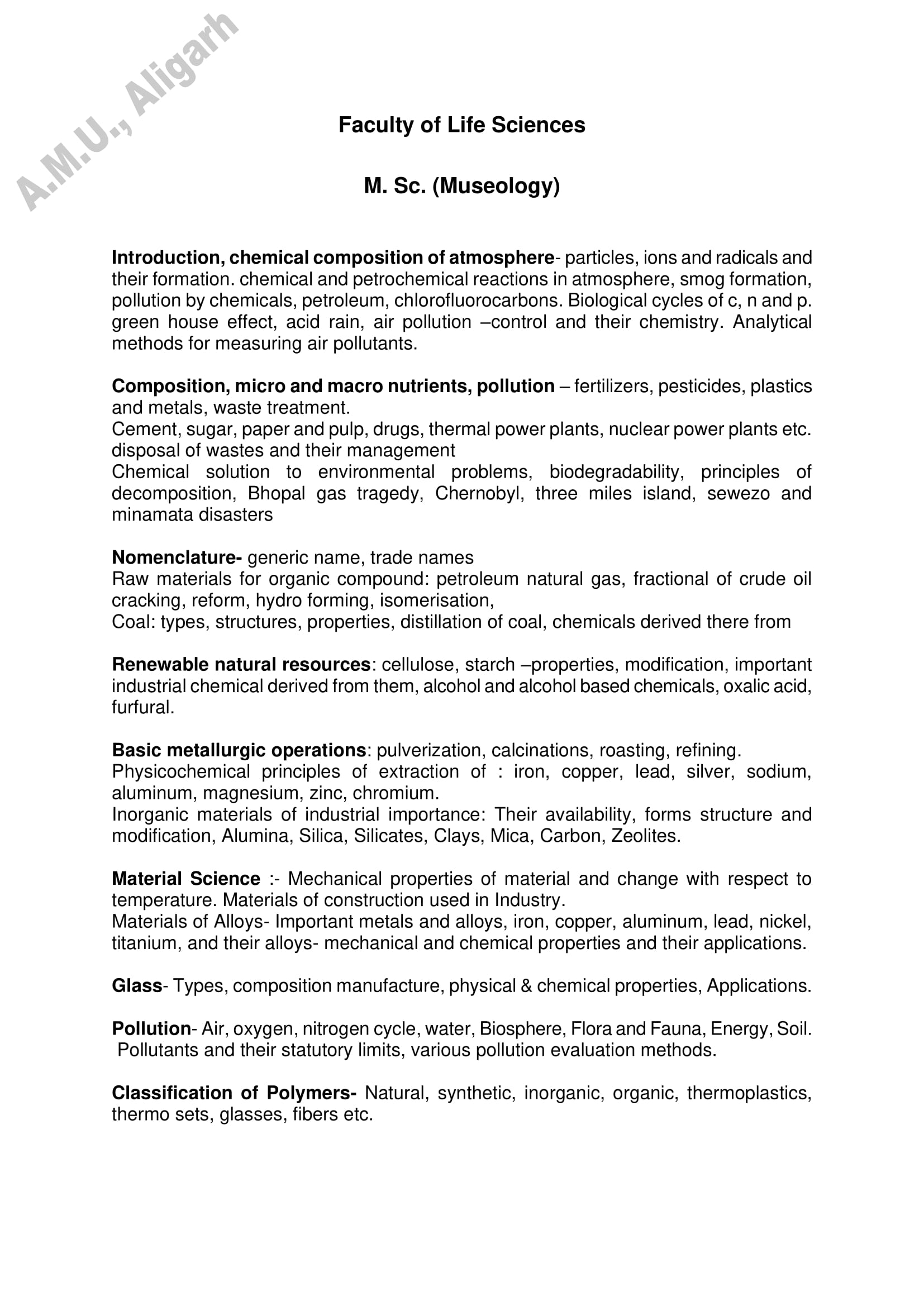
M. Sc. (Museology)
Introduction, chemical composition of atmosphere- particles, ions and radicals and
their formation. chemical and petrochemical reactions in atmosphere, smog formation,
pollution by chemicals, petroleum, chlorofluorocarbons. Biological cycles of c, n and p.
green house effect, acid rain, air pollution –control and their chemistry. Analytical
methods for measuring air pollutants.
Composition, micro and macro nutrients, pollution – fertilizers, pesticides, plastics
and metals, waste treatment.
Cement, sugar, paper and pulp, drugs, thermal power plants, nuclear power plants etc.
disposal of wastes and their management
Chemical solution to environmental problems, biodegradability, principles of
decomposition, Bhopal gas tragedy, Chernobyl, three miles island, sewezo and
minamata disasters
Nomenclature- generic name, trade names
Raw materials for organic compound: petroleum natural gas, fractional of crude oil
cracking, reform, hydro forming, isomerisation,
Coal: types, structures, properties, distillation of coal, chemicals derived there from
Renewable natural resources: cellulose, starch –properties, modification, important
industrial chemical derived from them, alcohol and alcohol based chemicals, oxalic acid,
furfural.
Basic metallurgic operations: pulverization, calcinations, roasting, refining.
Physicochemical principles of extraction of : iron, copper, lead, silver, sodium,
aluminum, magnesium, zinc, chromium.
Inorganic materials of industrial importance: Their availability, forms structure and
modification, Alumina, Silica, Silicates, Clays, Mica, Carbon, Zeolites.
Material Science :- Mechanical properties of material and change with respect to
temperature. Materials of construction used in Industry.
Materials of Alloys- Important metals and alloys, iron, copper, aluminum, lead, nickel,
titanium, and their alloys- mechanical and chemical properties and their applications.
Glass- Types, composition manufacture, physical & chemical properties, Applications.
Pollution- Air, oxygen, nitrogen cycle, water, Biosphere, Flora and Fauna, Energy, Soil.
Pollutants and their statutory limits, various pollution evaluation methods.
Classification of Polymers- Natural, synthetic, inorganic, organic, thermoplastics,
thermo sets, glasses, fibers etc.
Page 2
Comparison of systems of classification ( Bentham & Hooker and Engler & Prantal):
Primitive and Advance features; salient features of the International Gods of Botanical
Nomenclature.
Diagnostic features of the following families with reference to local flora and economic
importance: Ranunculaceae, Malvaceae, Brassicaceae, Pappilionaceae,
Caesalpinaceae, Solanaceae, Astraceae, Poaceae.
Ecosystem development and energy flow:
Ecosystem: Concept and structure, energy flow, ecological efficiencies, cycling of C, N
and P. Biotic and a biotic components their interrelationships. Trophic organisation,
autotrophy, heterotrophy, parasitism, detritus and decomposition.
Systematic in practice- Importance of herbarium specimens and their preparation;
Role of herbaria and botanical gardens.
Human ecology and ecological management:- The Human population , renewable
and non-renewable recourses and their management, conservation of biodiversity,
endangered species.
Geology and its perspective: Earth in the solar system: origin, size, shape, mass,
density, rotational and revolution parameters. Formation of core, mantle, crust,
hydrosphere & biosphere. Radioactivity and age of the earth.
Origin of oceans, continents and mountains. Earthquake and earthquake belts, its
measurement.
Volcanoes: types and distribution.
Magma: Definition, physical properties and chemical composition, origin.
Types of rocks and their significance.
Palaeobiology: definition, branches and scope. Preservation potential of organism,
requirement of fossilization. Fossils, process of fossilization and different kinds of fossils.
Elementary idea about origin of life.
Stratigraphic classification and correlation. Methods of collecting Stratigraphic data,
surface data, sub-surface data.
Introduction to Natural History: Ecology & Evolution, Geological time chart,
Taxonomy and binomial nomenclature, Concept of species and genus.
Characteristic features of animal phyla from protozoa to mammals.
Current Environmental Issues and Nature Conservation.
Cell structure and chemical organisation: Techniques in cell biology, cell culture, cell
theory, structure of prokaryotic and eukaryotic cells, animal and plant cell, chemical
organisation of cell.
Genetics: Mendelian inheritance, genetic control and pedigree. Gene interaction
Linkage and crossing over, sex determination. Structure of chromosome, Chromosomal
disorder and karyotypes( Human).
Page 3
Cultural and Natural Heritage of India (Tangible & Intangible): Dances, festivals, Music,
Drama, monuments, traditions & rituals, flora, fauna, national parks, bird sanctuaries,
fragrances and calls & voices of animals etc.
History, History of Arts, History of Science.
Current environmental and health Issues.
Important Museums, Archives and Libraries of India.
Other important current event and issues of the world.
Document Details
| Board / Org | Default |
| Exam | Admission Tests |
| Type | Syllabus |
| Pages | 3 |
| Updated | 30 Apr 2026 |