AMU Entrance Exam Syllabus for M.Sc. in Industrial Chemistry
Finished viewing? Save it for later —
Download AMU Entrance Exam Syllabus for M.Sc. in Industrial Chemistry (PDF · 4 pages)About AMU Entrance Exam Syllabus for M.Sc. in Industrial Chemistry
AMU Entrance Exam Syllabus for M.Sc. in Industrial Chemistry is available here for free download. Published by Default for Admission Tests, this syllabus can be viewed online or downloaded as a PDF (4 pages). Candidates preparing for Admission Tests can use AMU Entrance Exam Syllabus for M.Sc. in Industrial Chemistry to understand the exam pattern, the type of questions asked, and the overall difficulty level.
Frequently Asked Questions
How can I download AMU Entrance Exam Syllabus for M.Sc. in Industrial Chemistry?
Open this page and click the Download button to save AMU Entrance Exam Syllabus for M.Sc. in Industrial Chemistry as a PDF. It is completely free on AglaSem Docs.
Is AMU Entrance Exam Syllabus for M.Sc. in Industrial Chemistry free to download?
Yes. AMU Entrance Exam Syllabus for M.Sc. in Industrial Chemistry can be viewed online and downloaded as a PDF free of cost on AglaSem Docs.
How many pages does AMU Entrance Exam Syllabus for M.Sc. in Industrial Chemistry have?
AMU Entrance Exam Syllabus for M.Sc. in Industrial Chemistry contains 4 pages, which you can read online or download together as a single PDF.
Where can I find more Admission Tests study material?
You can find more Admission Tests question papers, sample papers, syllabus, and answer keys on AglaSem Docs.
AMU Entrance Exam Syllabus for M.Sc. in Industrial Chemistry – Text
Read the full text of this syllabus below — useful to quickly search, copy and reference the content online without downloading the PDF.
📄 View text version (4 pages)
Page 1
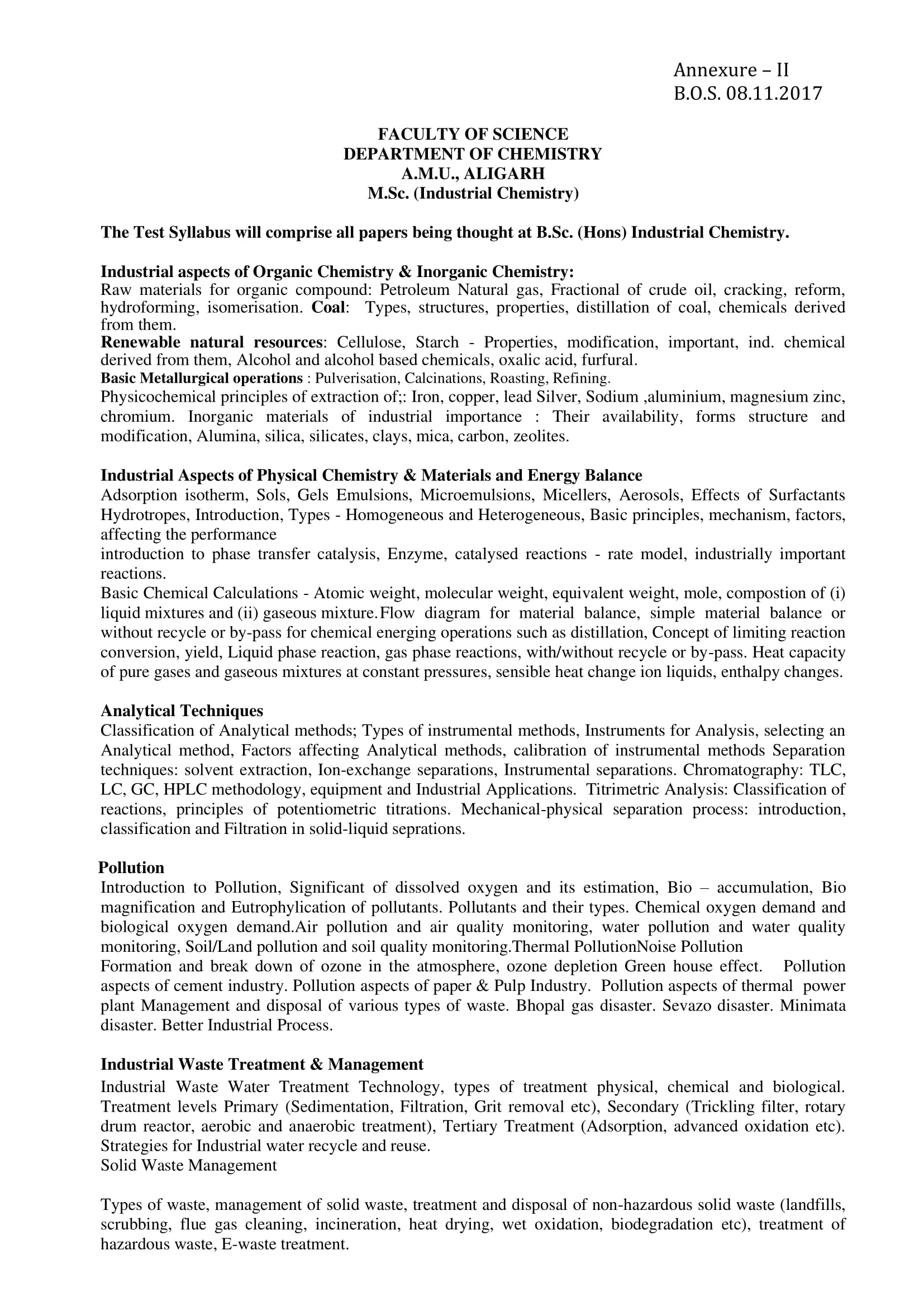
B.O.S. 08.11.2017
FACULTY OF SCIENCE
DEPARTMENT OF CHEMISTRY
A.M.U., ALIGARH
M.Sc. (Industrial Chemistry)
The Test Syllabus will comprise all papers being thought at B.Sc. (Hons) Industrial Chemistry.
Industrial aspects of Organic Chemistry & Inorganic Chemistry:
Raw materials for organic compound: Petroleum Natural gas, Fractional of crude oil, cracking, reform,
hydroforming, isomerisation. Coal: Types, structures, properties, distillation of coal, chemicals derived
from them.
Renewable natural resources: Cellulose, Starch - Properties, modification, important, ind. chemical
derived from them, Alcohol and alcohol based chemicals, oxalic acid, furfural.
Basic Metallurgical operations : Pulverisation, Calcinations, Roasting, Refining.
Physicochemical principles of extraction of;: Iron, copper, lead Silver, Sodium ,aluminium, magnesium zinc,
chromium. Inorganic materials of industrial importance : Their availability, forms structure and
modification, Alumina, silica, silicates, clays, mica, carbon, zeolites.
Industrial Aspects of Physical Chemistry & Materials and Energy Balance
Adsorption isotherm, Sols, Gels Emulsions, Microemulsions, Micellers, Aerosols, Effects of Surfactants
Hydrotropes, Introduction, Types - Homogeneous and Heterogeneous, Basic principles, mechanism, factors,
affecting the performance
introduction to phase transfer catalysis, Enzyme, catalysed reactions - rate model, industrially important
reactions.
Basic Chemical Calculations - Atomic weight, molecular weight, equivalent weight, mole, compostion of (i)
liquid mixtures and (ii) gaseous mixture. Flow diagram for material balance, simple material balance or
without recycle or by-pass for chemical energing operations such as distillation, Concept of limiting reaction
conversion, yield, Liquid phase reaction, gas phase reactions, with/without recycle or by-pass. Heat capacity
of pure gases and gaseous mixtures at constant pressures, sensible heat change ion liquids, enthalpy changes.
Analytical Techniques
Classification of Analytical methods; Types of instrumental methods, Instruments for Analysis, selecting an
Analytical method, Factors affecting Analytical methods, calibration of instrumental methods Separation
techniques: solvent extraction, Ion-exchange separations, Instrumental separations. Chromatography: TLC,
LC, GC, HPLC methodology, equipment and Industrial Applications. Titrimetric Analysis: Classification of
reactions, principles of potentiometric titrations. Mechanical-physical separation process: introduction,
classification and Filtration in solid-liquid seprations.
Pollution
Introduction to Pollution, Significant of dissolved oxygen and its estimation, Bio – accumulation, Bio
magnification and Eutrophylication of pollutants. Pollutants and their types. Chemical oxygen demand and
biological oxygen demand.Air pollution and air quality monitoring, water pollution and water quality
monitoring, Soil/Land pollution and soil quality monitoring.Thermal PollutionNoise Pollution
Formation and break down of ozone in the atmosphere, ozone depletion Green house effect. Pollution
aspects of cement industry. Pollution aspects of paper & Pulp Industry. Pollution aspects of thermal power
plant Management and disposal of various types of waste. Bhopal gas disaster. Sevazo disaster. Minimata
disaster. Better Industrial Process.
Industrial Waste Treatment & Management
Industrial Waste Water Treatment Technology, types of treatment physical, chemical and biological.
Treatment levels Primary (Sedimentation, Filtration, Grit removal etc), Secondary (Trickling filter, rotary
drum reactor, aerobic and anaerobic treatment), Tertiary Treatment (Adsorption, advanced oxidation etc).
Strategies for Industrial water recycle and reuse.
Solid Waste Management
Types of waste, management of solid waste, treatment and disposal of non-hazardous solid waste (landfills,
scrubbing, flue gas cleaning, incineration, heat drying, wet oxidation, biodegradation etc), treatment of
hazardous waste, E-waste treatment.
Page 2
Pharmaceuticals Chemistry – Introduction – nature and sources of drugs–Study of drugs- classification and
nomenclature of drugs- Mechanism of drug action and metabolism of drugs.Clinical Chemistry _
determination of sugar in serum- estmation of glucose in urine- detection of cholesterol in urine – detection
of dibetes- estimation of hemoglobin- red cell count. Causes of common diseases and their treatment by
drugs Insect borne, air- borne and water borne diseases- disorder of digestive system-diseases of respiratory
system- disorder of nervous system.
Elementary Spectroscopy
Mass Spectrscopy: basic principal of mass spectrum- molecular peak – base peak- isotopic peak-meta stable
peak – factors influencing the fragmentation – nitrogen rule - ring rule determination of molecular formulate
with examples – instrumentation.
Infra red spectroscopy : molecular vibration- Hooke’s law –vibration frequencies – factors affecting
vibration frequencies- instrumentation – block diagram- source – monochormator – cell sampling echiques-
detector recorders- solvent shift
NMR spectroscopy : Principle of nuclear magnetic Resonance- basic instrumentation- shielding mechanism
– chemical shift- number of signals-spin- spin coupling and coupling constant – splitting of signals.
Agrichemicals
Introduction: General introduction to Agrichemicals. Introduction and types of pesticides. Stomach
poisons, contact poisons, systemic poisons, fumigants. Insecticides: Synthesis and manufacture, mode of
action and uses of insecticides in the following classes: Inorganic insecticides (acid lead arsenate and
calcium arsenate), Fungicides General introduction and classification of fungicides. Synthesis and
manufacture, mode of action and uses of: Inorganic fungicides (copper sulphate and bordeaux mixture),
Organomercuric compounds (ethylmercuric chloride and ceresan-M), Dithiocarbamates (zineb and maneb)
and Miscellaneous fungicides (captan and folpet). Herbicides, Fumigants, Nematicides, Rodenticides and
Plant growth regulators General introduction. Synthesis and uses of the following: Herbicides (2,4-D and
MCP), Fumigants (ethylene halides and methyl halides)
Polymer Science: Brief history of macromolecular science, general characteristics of polymers in
comparison to common organic compounds, some basic definitions (functionality, polymer, polymerization,
homopolymer, copolymer terpolymer etc.).Classification of polymers: Natural synthetic, inorganic, organic,
thermoplastics, thermosets, glasses, elastomers, fibres, commodity engineering, speciality, linear, branched,
cross-linked copolymers (random, alternative, block and graft), tacticity (isotactic, and atactic polymers),
crystallinity (crystalline, semi-crystalline and amorphous polymers. Addition polymerization (mechanism of
free-radical, anionic and cationic polymerization), initiators, inhibitors, retarders, living polymers,
condensation polymerization copolymerization, coordination polymerization (bulk, suspension, emulsion,
solution).
Average molecular weight, number - average and weight-average molecular weights, sedimentation and
viscosity average, molecular weights, practical significance of molecular weight and molecular weight
distribution, size of polymer molecules, determination, of molecular weight (viscosity, osmometry, light
scattering).
PETROCHEMICALS
Origin and formation of Petroleum, Petroleum Reserves and Deposits, Composition of crude oil, Non-
hydrocarbon components in Petroleum, Asphltenes and Resins.
Characterization of crude oil: TBP and ASTM distillation, Classification by chemical composition,
Correlation Index, Density, API gravity, Viscosity, UOP characterization factor, etc. Physical & Thermal
properties of petroleum, Petroleum products and their quality control. Thermal conversion processes:
Visbreaking, Delayed Coking, Fluid coking, Flexicoking, etc Catalytic conversion processes: Fluid Catalytic
Cracking, RFCC, DCC, Hydrocracking, Hydrotreating Processes, etc.
Catalytic Reforming, Alkylation, Polymerization, Isomerisation etc. Technology for the production of
Methanol, Ethylene oxide, Ethylene glycol and Vinyl Chloride, Acetic acid Technology for the Production
of acetone, acrylonitrile, linear alkyl benzene Technology for the production of benzene, toluene, xylines,
Page 3
Petrochemical Industry: Indian reserves, Indian Refining Scenario, Quality control and Petroleum
Distribution, Environmental concern and Emission Norms, Refinery waste Disposal Practices.
Inorganic Chemistry
Idea of de Broglie matter waves, Heisenberg uncertainty principle, atomic orbitals, Schrodinger wave equation,
significance of and 2, quantum numbers, radial and angular wave functions and probability distribution
curves, shapes of s, p, d orbitals. Aufbau and Pauli exclusion principles, Hund's multiplicity rule. Electronic
configurations of the elements. Atomic and ionic radii, ionization energy, electron affinity and electronegativity
definition, effective nuclear charge, methods of determination or evaluation, trends in periodic table and
applications in predicting and explaining the chemical behaviour. Lattice energy and Born-Haber cycle,
solvation energy and solubility of ionic solids, polarizing power and polarisability of ions, Fajan's rule,
Metallic bond-free electron, valence bond and band theories
Chemical properties of the noble gases, chemistry of xenon, structure and b onding in xenon
compounds Electronic structure, oxidation states and ionic radii and lanthanide contraction,
complex formation, occurrence and isolation, lanthanide compounds. Comparative study
Arrhenius, Bronsted-Lowry, the Lux-Flood, solvent system and Lewis concepts of acids and bases
Classification of acids and bases as hard and soft, Pearson's HSAB concept, acid-base strength and hardness
and softness, Symbiosis, theoretical basis of hardness and softness, elecctronegativity and hardness and
softness. Physical properties of a solvent, types of solvents and their general characteristics, reaction in non-
aqueous solvents with reference to liquid NH3 and liquid SO2
Organic Chemistry
Hybridization and its effect on bond length and bond angles, bond energy, localized and delocalized
chemical bond, inductive, resonance, hyperconjugation, hydrogen bonding, van der Waals interactions
Homolytic and heterolytic bond breaking. Types of reagents-electrophiles and nucleophiles, Types of
organic reactions. Energy considerations. Reactive intermediates-carbocations, carbanions, free radicals,
carbenes, arynes and nitrenes (with examples). Assigning formal charges in intermediates and other ionic
species. Concept of isomerism. Optical isomers, enantiomers and diastereomers, chiral and achiral moecules
with two stereogenic centres, absolute configuration, sequences rules, D & L and R & S systems of
nomenclature. Geometrical isomerism - E & Z system of nomenclature, in alkenes oximes and cyclopropane
derivative compounds. Alkanes: Methods of formation (with special reference to Wurtz reaction, Kolbe
reaction, Corey-House reaction and decarboxylation of carboxylic acids), Mechanism of free radical
halogenation of alkanes- orientation, reactivity and selectivity. Methods of formation, dehydration of
alcohols and dehydrohalogenation of alkyl halides, regioselectivity in alcohol dehydration. The Saytzeff
rule, Hofmann elimination, Relative stabilities of alkenes. Chemical reactions-mechanisms involved in
hydrogenation, electrophilic and free radical additions.
Markownikoff’s rule. Hydroboration-oxidation, oxymercuration-demercuration, epoxidation, ozonolysis,
hydration, hydroxylation with KMnO4. classification- isolated, conjugated and cumulated dienes. Structure,
method of formation and reactions (1,2- and 1,4-additions, Diels-Alder reaction) of butadiene. Mehtods of
formation, chemical reactions and acidity of alkynes. Mechanism of electrophilic and nucleophilic addition
reaction. Methods of formation by reduciotn of aldehydes, ketones, carboxylic acids and esters. Grignard
synthesis: Grignard reagent and its use for synthesis of alcohol. Reactions of alcohols. Distinction between
Primary, Secondary and Tertairy alcohols., Oxidative cleavage [(Pb(OAc)4 and (HIO4)] and Pinacol-
Pinacolone rearrangement. Structure of benzene-molecular formula and Kekule structure. Stability and
carbon-carbon bond lengths of benzene, resonance structure, MO picture. Aromaticity- the Huckel rule,
aromatic ions. Aromatic electrophilic substitutiongeneral pattern of the mechanism, role of σ– and π-
complexes. Mechanism of nitration, halogenation, sulphonation and Friedel-Craft reactions.
Page 4
Postulates of kinetic theory of gases, deviation from ideal behavior, van der Waals equation of state. Critical
Phenomena: PV isotherms of real gases, continuity of states, the isotherms of van der Waals equation,
relationship between critical constants and van der Waals constants, the law of corresponding states, reduced
equation of state.
Problems Molecular velocities: Root mean square, average and most probable velocities. Qualitative
discussion of the Maxwell's distribution of molecular velocities, collision number, mean free path and collision
diameter. liquification of gases (based on Joule-Thomson effect). Problems Definition of space lattice, unit
cell. Laws of crystallography - (i) Law of constancy of interfacial angles (ii) Laws of rationality of indices (iii)
Law of symmetry. Symmetry elements in crystals.
Solid State
X-ray diffraction by crystals. Derivation of Bragg equation. Determination of crystal structure of NaCl, KCl
and CsCl. Definition of colloids, classification of colloids.
First law of thermodynamics: statement, definition of internal energy and enthalpy, Heat capacity. Heat
capacities at constant volume and pressure and their relationship. Joule-Thomson coefficient and inversion
temperature. Calculation of w,q, dU & dH for the expansion of ideal gases under isothermal and adiabatic
conditions for reversible process. Problems.
Thermochemistry: Enthalpy of neutralization. Bond dissociation energy and its calculation from thermo-
chemical data, temperature dependence of enthalphy. Kirchhoff's equation.
Second law of thermodynamics: Different statements of the law. Carnot cycle and its efficiency, Carnot
theorem. Thermodynamic scale of temperature. Concept of entropy: entropy as a state function, entropy as a
function of V & T, entropy as a function of P & T, entropy change in physical change, Clausius inequality,
entropy as a criteria of spontaneity and equilibrium. Entropy change in ideal gases and mixing of gases.
Gibbs and Helmholtz functions: Gibbs function (G) and Helmholtz function (A) as thermodynamic
quantities, A & G as criteria for thermodynamic equilibrium and spontaneity, their advatage over entropy
change, Variation of G and A with P, V and T.
Thermodynamics of ideal solution and Raoult’s law, deviations from Raoult’s law – non-ideal solutions.
Partial miscibility of liquids: Critical solution temperature; Nernst distribution law and its applications, Ideal
and non-ideal solutions, methods of expressing concentrations of solutions, activity and activity coefficient,
Problems.
Solution
Dilute solution, Colligative properties, relative lowering of vapour pressure, law of osmotic pressure and its
measurement, Elevation of boiling point and depression of freezing point. Phases, components and degrees
of freedom of system, criteria of phase equilibrium. Gibbs Phase Rule and its thermodynamic derivation.
Derivation of Clapeyron equation and its importance in phase equilibria.
Statistics and Mathematics
Graphical representation of data , measure of central tendency and dispersion, skewness, kurtosis,
correlation, Regression, Probability, Sampling and sampling distribution, Discrete & continuous distribution,
Test of significance, time series analysis, Index numbers, analysis of variance, Matrix and Determinants,
Partial Differentiation and elementary partial differential equation. Algebra and Complex numbers,
Functions, limit and continuity, differentiability, differential Calculus, Integral Calculus, Ordinary
differential equations, Introduction to numerical methods or analysis and their application in chemistry.
Document Details
| Board / Org | Default |
| Exam | Admission Tests |
| Type | Syllabus |
| Pages | 4 |
| Updated | 30 Apr 2026 |