AMU Entrance Exam Syllabus for M.Sc. in Physics
Finished viewing? Save it for later —
Download AMU Entrance Exam Syllabus for M.Sc. in Physics (PDF · 3 pages)About AMU Entrance Exam Syllabus for M.Sc. in Physics
AMU Entrance Exam Syllabus for M.Sc. in Physics is available here for free download. Published by Default for Admission Tests, this syllabus can be viewed online or downloaded as a PDF (3 pages). Candidates preparing for Admission Tests can use AMU Entrance Exam Syllabus for M.Sc. in Physics to understand the exam pattern, the type of questions asked, and the overall difficulty level.
Frequently Asked Questions
How can I download AMU Entrance Exam Syllabus for M.Sc. in Physics?
Open this page and click the Download button to save AMU Entrance Exam Syllabus for M.Sc. in Physics as a PDF. It is completely free on AglaSem Docs.
Is AMU Entrance Exam Syllabus for M.Sc. in Physics free to download?
Yes. AMU Entrance Exam Syllabus for M.Sc. in Physics can be viewed online and downloaded as a PDF free of cost on AglaSem Docs.
How many pages does AMU Entrance Exam Syllabus for M.Sc. in Physics have?
AMU Entrance Exam Syllabus for M.Sc. in Physics contains 3 pages, which you can read online or download together as a single PDF.
Where can I find more Admission Tests study material?
You can find more Admission Tests question papers, sample papers, syllabus, and answer keys on AglaSem Docs.
AMU Entrance Exam Syllabus for M.Sc. in Physics – Text
Read the full text of this syllabus below — useful to quickly search, copy and reference the content online without downloading the PDF.
📄 View text version (3 pages)
Page 1
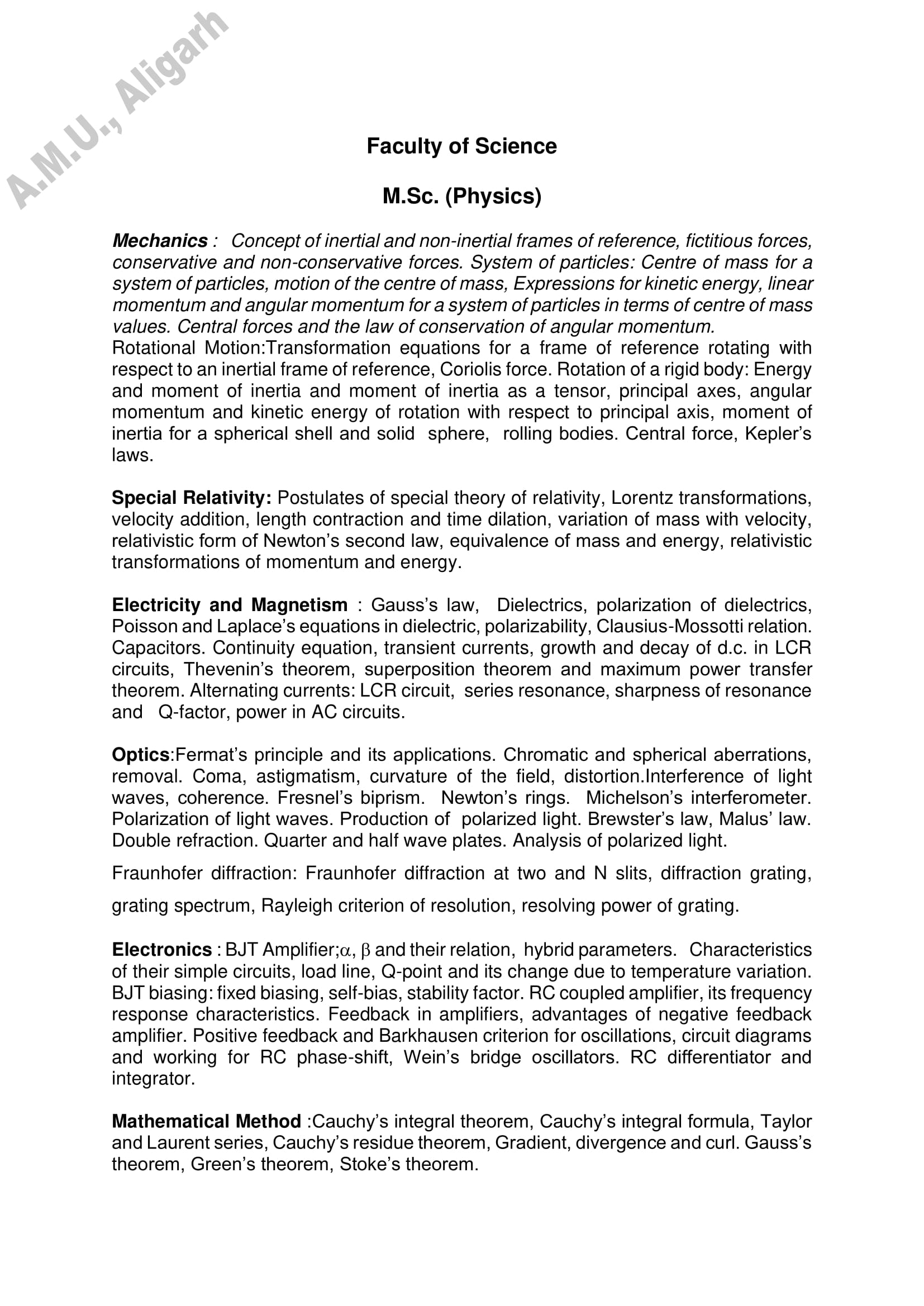
M.Sc. (Physics)
Mechanics : Concept of inertial and non-inertial frames of reference, fictitious forces,
conservative and non-conservative forces. System of particles: Centre of mass for a
system of particles, motion of the centre of mass, Expressions for kinetic energy, linear
momentum and angular momentum for a system of particles in terms of centre of mass
values. Central forces and the law of conservation of angular momentum.
Rotational Motion:Transformation equations for a frame of reference rotating with
respect to an inertial frame of reference, Coriolis force. Rotation of a rigid body: Energy
and moment of inertia and moment of inertia as a tensor, principal axes, angular
momentum and kinetic energy of rotation with respect to principal axis, moment of
inertia for a spherical shell and solid sphere, rolling bodies. Central force, Kepler’s
laws.
Special Relativity: Postulates of special theory of relativity, Lorentz transformations,
velocity addition, length contraction and time dilation, variation of mass with velocity,
relativistic form of Newton’s second law, equivalence of mass and energy, relativistic
transformations of momentum and energy.
Electricity and Magnetism : Gauss’s law, Dielectrics, polarization of dielectrics,
Poisson and Laplace’s equations in dielectric, polarizability, Clausius-Mossotti relation.
Capacitors. Continuity equation, transient currents, growth and decay of d.c. in LCR
circuits, Thevenin’s theorem, superposition theorem and maximum power transfer
theorem. Alternating currents: LCR circuit, series resonance, sharpness of resonance
and Q-factor, power in AC circuits.
Optics:Fermat’s principle and its applications. Chromatic and spherical aberrations,
removal. Coma, astigmatism, curvature of the field, distortion.Interference of light
waves, coherence. Fresnel’s biprism. Newton’s rings. Michelson’s interferometer.
Polarization of light waves. Production of polarized light. Brewster’s law, Malus’ law.
Double refraction. Quarter and half wave plates. Analysis of polarized light.
Fraunhofer diffraction: Fraunhofer diffraction at two and N slits, diffraction grating,
grating spectrum, Rayleigh criterion of resolution, resolving power of grating.
Electronics : BJT Amplifier;, and their relation, hybrid parameters. Characteristics
of their simple circuits, load line, Q-point and its change due to temperature variation.
BJT biasing: fixed biasing, self-bias, stability factor. RC coupled amplifier, its frequency
response characteristics. Feedback in amplifiers, advantages of negative feedback
amplifier. Positive feedback and Barkhausen criterion for oscillations, circuit diagrams
and working for RC phase-shift, Wein’s bridge oscillators. RC differentiator and
integrator.
Mathematical Method :Cauchy’s integral theorem, Cauchy’s integral formula, Taylor
and Laurent series, Cauchy’s residue theorem, Gradient, divergence and curl. Gauss’s
theorem, Green’s theorem, Stoke’s theorem.
Page 2
function of the second kind, the generating function, upper bound for Pn(x),
Rodrigues’ formula, orthogonality relation. Associated Legendre functions and its
orthogonality property. Laguerre functions.
Quantum Mechanics :The basic postulates of quantum mechanics, properties, physical
significance and Born interpretation of wave functions in quantum mechanics, probability
density. Operator algebra in quantum mechanics.Ehrenfest theorem, Heisenberg’s
uncertainty principle and its simple applications .Time dependent and independent
Schrodinger equations. Stationary states, continuity equation.One dimensional problem:
Free particle, particle in a box, potential step, potential barrier (tunneling). Particle in
One dimensional infinite square well, Finite Square well, linear harmonic
oscillator.Schrodinger equation for two particles and its reduction in terms of central of
mass and relative motion. Schrodinger equation in spherical coordinates with central
potential. The free particle in spherical coordinates. Orbital angular momentum
operators and their communication relations, Eigen values and eigen functions of L2 and
Lz.
Thermal Physics :First law of thermodynamics, heat capacities, internal energy,
Carnot cycle, efficiency of reversible heat engine and refrigerator; second law of
thermodynamics, entropy, entropy changes in reversible and irreversible processes,
entropy of an ideal gas, Gibb’s paradox.e TdS equations, energy equations, expressions
for the difference and the ratio of heat capacities, enthalpy, Helmholtz and Gibb’s
functions, Maxwell’s equations.Third law of thermodynamics.
Atomic and Molecular Physics :One valence electron atom: Electronic configuration
and atomic states, spin-orbit interaction , fine structure, intensity rules for structure
doublets, selection rules. Two valence electron atoms: LS and jj coupling scheme, terms
and levels. Hund’s rules. Zeeman effect.
Diatomic molecule as rigid and non-rigid rotator, rotational spectrum. The vibrating
diatomic molecule: harmonic and anharmonic oscillator models, vibrating-rotator and its
spectrum. Raman and Electronic spectra of diatomic molecules.
Laser Physics:Basic principle, Properties of laser beam. Einstein’s A and B
coefficients, spontaneous and stimulated emissions, population inversion, resonator.
Principle and working of He-Ne laser.
Solid State Physics: Crystalline and amorphous structure: Lattice, basis, primitive cell,
unit cell, Wigner-Seitz cell, Bravais Lattices, common crystal structures, index system
for directions and planes. Atomic cohesion and crystal binding, concept of reciprocal
lattice, Bragg law, Brillouin zones. Lattice vibrations: Normal modes of a one-
dimensional monatomic chain, the periodic boundary condition, dispersion curve, salient
features, normal modes of a diatomic chain, acoustical and optical modes, dispersion
curves.
Nuclear Physics: General properties of the atomic nuclei: Constituents of the nucleus.
Size of the nucleus. Nuclear charge. Nuclear mass, mass defect and binding energy,
variation of binding energy with atomic mass, elementary idea of nuclear fission and
fusion.
Page 3
quadrupole moment. Nature of nuclear forces: short range, saturation, charge
independence, charge symmetry, state dependence, tensor nature. alpha, beta and
gamma-decays. Energy loss of heavy charged particles, semi-empirical formula for
energy loss, Interaction of gamma radiation with matter: photoelectric effect, Compton
effect and pair production.
Particle Physics
Basic interactions and their mediating quanta, classification of particles; Fermions and
Bosons, leptons and hadrons, particles and antiparticles, conservation rules in
fundamental interactions.
Document Details
| Board / Org | Default |
| Exam | Admission Tests |
| Type | Syllabus |
| Pages | 3 |
| Updated | 30 Apr 2026 |