GATE 2021 Question Paper XH C4 Humanities and Social Sciences - Philosophy
Finished viewing? Save it for later —
Download GATE 2021 Question Paper XH C4 Humanities and Social Sciences - Philosophy (PDF · 36 pages)About GATE 2021 Question Paper XH C4 Humanities and Social Sciences - Philosophy
GATE 2021 Question Paper XH C4 Humanities and Social Sciences - Philosophy is available here for free download. Published by IIT for Graduate Aptitude Test in Engineering, this question paper can be viewed online or downloaded as a PDF (36 pages). Candidates preparing for Graduate Aptitude Test in Engineering can use GATE 2021 Question Paper XH C4 Humanities and Social Sciences - Philosophy to understand the exam pattern, the type of questions asked, and the overall difficulty level.
Frequently Asked Questions
How can I download GATE 2021 Question Paper XH C4 Humanities and Social Sciences - Philosophy?
Open this page and click the Download button to save GATE 2021 Question Paper XH C4 Humanities and Social Sciences - Philosophy as a PDF. It is completely free on AglaSem Docs.
Is GATE 2021 Question Paper XH C4 Humanities and Social Sciences - Philosophy free to download?
Yes. GATE 2021 Question Paper XH C4 Humanities and Social Sciences - Philosophy can be viewed online and downloaded as a PDF free of cost on AglaSem Docs.
How many pages does GATE 2021 Question Paper XH C4 Humanities and Social Sciences - Philosophy have?
GATE 2021 Question Paper XH C4 Humanities and Social Sciences - Philosophy contains 36 pages, which you can read online or download together as a single PDF.
Where can I find more Graduate Aptitude Test in Engineering study material?
You can find more Graduate Aptitude Test in Engineering question papers, sample papers, syllabus, and answer keys on AglaSem Docs.
GATE 2021 Question Paper XH C4 Humanities and Social Sciences - Philosophy – Text
Read the full text of this question paper below — useful to quickly search, copy and reference the content online without downloading the PDF.
📄 View text version (36 pages)
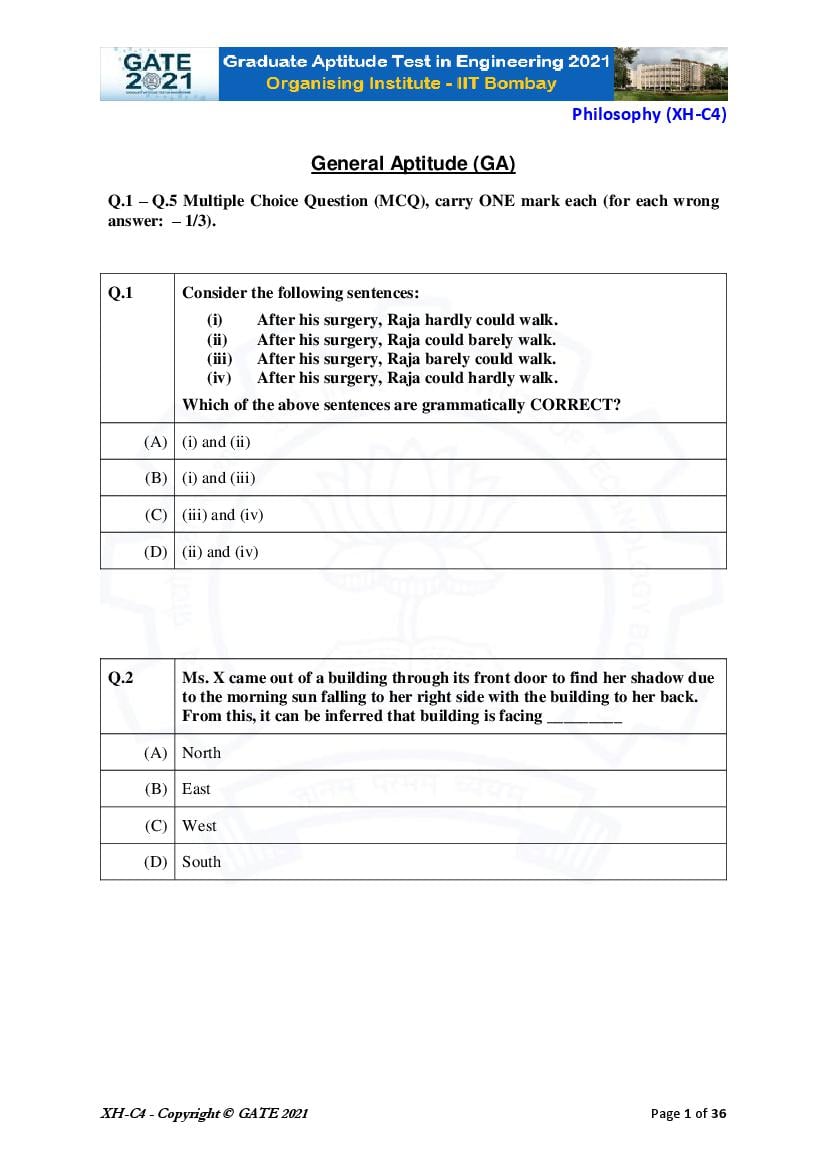
Page 1
Q.1 – Q.5 Multiple Choice Question (MCQ), carry ONE mark each (for each wrong
answer: – 1/3).
Q.1 Consider the following sentences:
(i) After his surgery, Raja hardly could walk.
(ii) After his surgery, Raja could barely walk.
(iii) After his surgery, Raja barely could walk.
(iv) After his surgery, Raja could hardly walk.
Which of the above sentences are grammatically CORRECT?
(A) (i) and (ii)
(B) (i) and (iii)
(C) (iii) and (iv)
(D) (ii) and (iv)
Q.2 Ms. X came out of a building through its front door to find her shadow due
to the morning sun falling to her right side with the building to her back.
From this, it can be inferred that building is facing _________
(A) North
(B) East
(C) West
(D) South
XH-C4 - Copyright © GATE 2021 Page 1 of 36
Page 2
O N
In the above figure, O is the center of the circle and, M and N lie on the
circle.
The area of the right triangle MON is 50 cm2.
What is the area of the circle in cm2 ?
(A) 2π
(B) 50π
(C) 75π
(D) 100π
Q.4 " " means" − ",
" " means" ",
If
" " means" + ",
" " means" ",
then, the value of the expression 2 3 ( ( 4 2) 4) =
(A) -1
(B) -0.5
(C) 6
(D) 7
XH-C4 - Copyright © GATE 2021 Page 2 of 36
Page 3
clear indication that the people in the state have begun to lead a healthy
lifestyle”
Which of the following can be logically inferred from the information
presented in the above statement?
(A) The people in the state did not consume leafy vegetables earlier.
(B) Consumption of leafy vegetables may not be the only indicator of healthy
lifestyle.
(C) Leading a healthy lifestyle is related to a diet with leafy vegetables.
(D) The people in the state have increased awareness of health hazards causing by
consumption of junk foods.
XH-C4 - Copyright © GATE 2021 Page 3 of 36
Page 4
answer: – 2/3).
Q.6 Oxpeckers and rhinos manifest a symbiotic relationship in the wild. The
oxpeckers warn the rhinos about approaching poachers, thus possibly
saving the lives of the rhinos. Oxpeckers also feed on the parasitic ticks
found on rhinos.
In the symbiotic relationship described above, the primary benefits for
oxpeckers and rhinos respectively are,
(A) Oxpeckers get a food source, rhinos have no benefit.
(B) Oxpeckers save their habitat from poachers while the rhinos have no benefit.
(C) Oxpeckers get a food source, rhinos may be saved from the poachers.
(D) Oxpeckers save the lives of poachers, rhinos save their own lives.
XH-C4 - Copyright © GATE 2021 Page 4 of 36
Page 5
A jigsaw puzzle has 2 pieces. One of the pieces is shown above. Which one
of the given options for the missing piece when assembled will form a
rectangle? The piece can be moved, rotated or flipped to assemble with the
above piece.
(A)
(B)
(C)
(D)
XH-C4 - Copyright © GATE 2021 Page 5 of 36
Page 6
respectively. The total number of hens, ducks and goats in a nearby farm Q
is 416. The ratio of hens:ducks:goats in farm Q is 5:14:13. All the hens, ducks
and goats are sent from farm Q to farm P.
The new ratio of hens:ducks:goats in farm P is_____
(A) 5:7:13
(B) 5:14:13
(C) 10:21:26
(D) 21:10:26
Q.9
The distribution of employees at the rank of executives, across different
companies C1, C2, …, C6 is presented in the chart given above. The ratio of
executives with a management degree to those without a management degree
in each of these companies is provided in the table above. The total number
of executives across all companies is 10,000.
The total number of management degree holders among the executives in
companies C2 and C5 together is_____.
(A) 225
(B) 600
(C) 1900
(D) 2500
XH-C4 - Copyright © GATE 2021 Page 6 of 36
Page 7
same order. Q and R are separated by one person, and S should not be
seated adjacent to Q.
The number of distinct seating arrangements possible is:
(A) 4
(B) 8
(C) 10
(D) 16
XH-C4 - Copyright © GATE 2021 Page 7 of 36
Page 8
Q.1 – Q.5 Multiple Choice Question (MCQ), carry ONE mark each (for each wrong
answer: – 1/3).
Q.1 According to a recent article in a medical journal, consuming curcumin
(from turmeric) significantly lowers the risk of COVID-19. The researchers
draw this conclusion from a study that found that people who consumed
one or more teaspoons of curcumin extract everyday were half as likely to
be diagnosed with the disease as people who did not consume curcumin.
Which of the following, if true, most weakens the argument in the article?
(A) In another study, people who were given a zinc supplement everyday were more
than four times less likely to be diagnosed with COVID-19 as those who did
not.
(B) All the participants in this study were from the same state where no other spices
or herbs are consumed.
(C) The participants who consumed curcumin were also more likely to exercise than
those who did not.
(D) In another study, COVID-19 patients who were given curcumin were no more
likely to recover than others.
Q.2 Froot Inc. carried out an internet advertisement campaign for its new
beverage CocoLoco. After the campaign, the director of the advertising
company conducted a survey and found that the CocoLoco sales were
higher than that of TenderJoos a competing product from Joos Inc. The
agency concluded that the internet advertising campaign is more effective
than advertising through other media.
Which of the following statements could strengthen the conclusion above
by the agency?
(A) A ₹2 discount was offered on CocoLoco during the campaign period.
(B) CocoLoco sales were higher than those of TenderJoos before the internet
campaign.
(C) A newspaper advertisement campaign the previous year did not increase
CocoLoco sales.
(D) During the campaign for CocoLoco, Joos Inc. did not advertise TenderJoos at
all.
XH-C4 - Copyright © GATE 2021 Page 8 of 36
Page 9
spending a minimum of ₹500. Any customer who buys 2 kg of fresh fruit
will receive a hand mixer and any customer who buys 2 kg of fresh
vegetables will receive a vegetable chopper.
Which of the following is NOT a possible outcome of the above?
(A) A customer purchased 3 kg of fresh fruit and did not receive a vegetable
chopper.
(B) A customer purchased items for ₹500 which included 1 kg of vegetables and
received a hand mixer.
(C) A customer purchased items for ₹500 which included 2 kg of vegetables and 1
kg of fruit and received a hand mixer.
(D) A customer purchased items for ₹300 which included 2 kg of fruit and received
neither a hand mixer nor a vegetable chopper.
Q.4 Writers of detective fiction often include an incompetent detective as a foil
for the brilliant investigator-protagonist as they follow different paths in
trying to solve the crime. In the individual accounts, the incompetent
detective is frequently distracted by the culprit’s careful plans, while the
competent investigator solves the case after a final confrontation. Analysts
of such fiction believe that the authors select this story-telling technique to
provide readers with more complexities in the form of misleading clues,
while figuring out the crime.
Which of the following statements most logically follows from the passage
above?
(A) A detective story is considered well-written if the brilliant investigator is
accompanied by an incompetent detective.
(B) Writers of detective fiction use the contrast of an incompetent detective to
mainly show how complex the investigation is.
(C) Writers of detective fiction never write stories where the incompetent detective
solves the case.
(D) Writers of detective fiction use two investigative accounts to make it difficult
for the reader to figure out the outcome.
XH-C4 - Copyright © GATE 2021 Page 9 of 36
Page 10
The rest of the sentence is divided into four parts and labelled (L,M,N,O).
Reorder these parts so that the sentence can be read through correctly and
select one of the options given.
P1: Studies of several Sahitya Akademi award winners show that…
L: or encounter professional
M: and invariably develop a strained relationship with other literary figures
N: they often publish very little
O: after winning the prize
P6: …envy and rivalry.
The correct order is:
(A) NOLM
(B) MLON
(C) ONML
(D) MOLN
XH-C4 - Copyright © GATE 2021 Page 10 of 36
Page 11
answer: – 2/3).
Q. 6 Gerrymandering refers to the targeted redrawing of election constituencies
so as to benefit a particular party. This is especially important where the
electoral system is “first past the post” in each constituency (i.e. one winner
is selected in each constituency based on a majority of votes won) and
where there is no other provision for proportional representation (as for
example in the German system). For a simple illustration of
gerrymandering, if a region consists of districts 1, 2, 3, …, 9 with districts
1, 2, 3, 4, 5, 6 favouring party P and 7, 8, 9 favouring party Q, then
grouping of districts to constituencies as {1,2,3}, {4,5,6}, {7,8,9} will give
two seats to party P and one seat to party Q, whereas the grouping {1,2,7},
{3,4,8}, {5,6,9} will give all three seats to party P, as they will secure a
majority in each constituency.
Which of these statements can be deduced from the above?
(A) Gerrymandering implies that constituency boundaries can sometimes be drawn
to favour one party over the other.
(B) Gerrymandering implies that proportional representation is impossible when
districts are grouped to form constituencies.
(C) To counteract gerrymandering political parties should concentrate on districts
where they are favoured.
(D) The grouping of districts to constituencies has very little impact on proportional
representation.
XH-C4 - Copyright © GATE 2021 Page 11 of 36
Page 12
judge to be a self-portrait by Michelangelo revealed an under-image of a
woman’s face. Either Michelangelo or some other artist must have
repainted over the first painting that had now been seen on the canvas.
Because the woman’s face also appears on other paintings by Michelangelo,
this painting is determined to indeed be an authentic painting by
Michelangelo.
Which of the following assumptions must be made in reaching the
conclusion above?
(A) When an already painted canvas of an artist is used, the second artist using that
canvas for a new painting is usually influenced by the artistic style of the first.
(B) Several painted canvases that art historians attribute to Michelangelo contain
under-images that appear on at least one other of Michelangelo’s paintings.
(C) Subject or subjects that appear in authenticated paintings of Michelangelo are
rather unlikely to show up as under-images on painted canvases not attributed to
Michelangelo.
(D) No painted canvas can be attributed to a particular artist with certainty without
an X-ray analysis.
Q. 8 This season _______ tourists visited Ladakh than last season; however,
______ to be the biggest tourist destination in India. The tourism
department explains that the number of tourists to India has ______
relative to previous years, ________ have chosen to visit Ladakh.
Select the correct sequence of phrases to fill in the blanks to complete the
passage above.
(A) more / for the first time in many seasons it does not appear / increased / and it
seems that most
(B) fewer / as in the past, it appears / in fact decreased / but it seems that only a
small proportion
(C) fewer / for the first time in many seasons it appears / in fact decreased / but it
seems that most
(D) more / this season as well, it appears / in fact decreased / but it seems that a
large proportion
XH-C4 - Copyright © GATE 2021 Page 12 of 36
Page 13
paragraph.
(1) In fact, dozens of languages today have only one native speaker still
living, and that person's death will mean the extinction of the language: It
will no longer be spoken, or known, by anyone on earth.
(2) Many languages are falling out of use and are being replaced by others
that are more widely used in the region or nation, such as English in
Australia or Portuguese in Brazil.
(3) Many other languages are no longer being learned by new generations
of children or by new adult speakers.
(4) An endangered language is one that is likely to become extinct in the
near future.
(5) Unless the trends are reversed, these endangered languages will become
extinct by the end of the century.
(Adapted from What is an Endangered Language by A. Woodbury.)
(A) 2 3 1 4 5
(B) 2 3 5 4 1
(C) 4 1 5 2 3
(D) 4 2 3 1 5
XH-C4 - Copyright © GATE 2021 Page 13 of 36
Page 14
The rest of the sentence is divided into four parts and labelled L,M,N,O.
Reorder these parts so that the sentence can be read correctly and select
one of the sequences below.
P1: For a little while…
L: it was a common belief
M: right after the treaty of Versailles
N: that Germany had caused World War I not just by her actions
O: held by analysts and politicians alike
P6: … but by also encouraging Italy in her own aggressions.
(A) LMNO
(B) MLON
(C) LNMO
(D) MOLN
XH-C4 - Copyright © GATE 2021 Page 14 of 36
Page 15
Q. 11 After Florentino Ariza saw her for the first time, his mother knew before
he told her because he lost his voice and his appetite and spent the entire
night tossing and turning in his bed. But when he began to wait for the
answer to his first letter, his anguish was complicated by diaorrhea and
green vomit, he became disoriented and suffered from sudden fainting
spells, and his mother was terrified because his condition did not resemble
the turmoil of love so much as the devastation of cholera. Florentino
Ariza’s godfather, an old homeopathic practitioner who had been Tránsito
Ariza’s confidant ever since her days as a secret mistress, was also alarmed
at first by the patient’s condition, because he had the weak pulse, the
hoarse breathing, and the pale perspiration of a dying man. But his
examination revealed that he had no fever, no pain anywhere, and that his
only concrete feeling was an urgent desire to die. All that was needed was
shrewd questioning, first of the patient and then of his mother, to conclude
once again that the symptoms of love were the same as those of cholera. He
prescribed infusions of linden blossoms to calm the nerves and suggested a
change of air so he could find consolation in distance, but Florentino Ariza
longed for just the opposite: to enjoy his martyrdom.
(Adapted from Love in a Time of Cholera by Gabriel García Márquez.)
The author of the passage is implying that:
(A) Homeopathy cures love.
(B) The doctor could not distinguish between love and cholera.
(C) The doctor could distinguish between love and cholera.
(D) The symptoms of love and cholera are similar.
XH-C4 - Copyright © GATE 2021 Page 15 of 36
Page 16
and economic causes: it is not due simply to the bad influence of this or that
individual writer. But an effect can become a cause, reinforcing the original
cause and producing the same effect in an intensified form, and so on
indefinitely. A man may take to drink because he feels himself to be a
failure, and then fail all the more completely because he drinks. It is rather
the same thing that is happening to the English language. It becomes ugly
and inaccurate because our thoughts are foolish, but the slovenliness of our
language makes it easier for us to have foolish thoughts.
(Adapted from Politics and the English Language by George Orwell.)
The illustration of the man who takes to drink is used to underscore which
of the following ideas in the passage above?
(A) Political and economic causes control deterioration of language.
(B) Foolish thoughts are enabled by inaccurate language.
(C) Effect of an action becomes the cause in a cyclic pattern.
(D) Drinking enables people to have foolish thoughts and slovenly language.
XH-C4 - Copyright © GATE 2021 Page 16 of 36
Page 17
It is defended on the grounds that the Caste System is but another name
for division of labour, and if division of labour is a necessary feature of
every civilised society, then it is argued that there is nothing wrong in the
Caste System. Now the first thing to be urged against this view is that Caste
System is not merely division of labour. It is also a division of labourers.
Civilised society undoubtedly needs division of labour but nowhere is
division of labour accompanied by this unnatural division of labourers into
watertight compartments, grading them one above the other. This division
of labour is not spontaneous or based on natural aptitudes. Social and
individual efficiency requires us to develop the individual capacity and
competency to choose and to make his own career. This principle is
violated in so far as it involves an attempt to appoint tasks to individuals in
advance, not on the basis of trained original capacities, but on that of birth.
Industry undergoes rapid and abrupt changes and an individual must be
free to change his occupation and adjust himself to changing
circumstances, to gain his livelihood. (Adapted from Annihilation of Caste
by Dr. B.R. Ambedkar.)
Which of the following observations substantiate the arguments found in
the passage above?
(A) Newer generations are unable to change and move away from low-paying
family professions, even with changed economic circumstances.
(B) Sedentary desk jobs are considered to have more value and are in greater
demand than those involving manual labour.
(C) The government’s jobs guarantee programme makes low-level management
jobs available across all industries to all graduates in the nation.
(D) A bus driver becomes an app creator and, in the course of one month, reaches
one million downloads on Playstore with a four-star rating.
XH-C4 - Copyright © GATE 2021 Page 17 of 36
Page 18
Behind one of them is a shiny car and behind the others are goats. You pick
one of the doors and get what lies within. After making your choice, your
host chooses to open one of the other two doors, which inevitably reveals a
goat. He then asks you if you want to stick with your original pick, or
switch to the other remaining door. What do you do? Most people think
that it doesn’t make a difference and they tend to stick with their first pick.
With two doors left, you should have a 50% chance of selecting the one
with the car. If you agree, then you have just fallen afoul of one of the most
infamous mathematical problems – the Monty Hall Problem. In reality,
you should switch every time which doubles your odds of getting the car.
Over the years, the problem has ensnared countless people, but not, it
seems, pigeons. The humble pigeon can learn with practice the best tactic
for the Monty Hall Problem, switching from their initial choice almost
every time. Amazingly, humans do not!
(Adapted from an article by Ed Yong in Discover Magazine.)
Which of the following conclusions follow from the passage above?
(A) Humans calculate the probability of independent, random events such as the
opening of a door by dividing the specific outcomes by the total number of
possible outcomes.
(B) Humans find it very difficult to learn to account for the host’s hand in making
the event non-random and, thereby, changing the outcome of the event.
(C) Calculating probabilities is difficult for humans but easy for pigeons; which is
why the pigeons succeed where the humans fail.
(D) Humans are governed by reason, but pigeons are irrational and only interested
in the outcome and will do whatever it takes to get food.
XH-C4 - Copyright © GATE 2021 Page 18 of 36
Page 19
automobile industry is in a state not that different from the bad old days of
the license-permit quota raj when two carmakers dominated a captive
domestic market with substandard vehicles and with very little, if any,
research and development, and low to negligible productivity growth. High
tariff barriers have certainly induced foreign automobile makers to enter
the Indian market by setting up local operations, but this so-called “tariff
jumping” foreign investment has produced an industry that is inefficient,
operating generally at a low scale, and whose products are not globally
competitive either in terms of cost or of innovation. It is noteworthy that
the automobile parts industry, which has faced low tariffs (as low as
12.5%) and has been largely deregulated, has been characterised by higher
productivity and much better export performance than the completely-
built units’ sector in the years since liberalisation.
(Adapted from an Op-Ed in The Mint.)
Which of the following statements can be inferred from the above?
(A) Low tariff barriers increase productivity.
(B) Tariff jumping leads to increases in productivity.
(C) Deregulation has worked for the automotive parts industry and therefore should
be applied to completely-built units.
(D) P and Q do not invest enough in research and development.
XH-C4 - Copyright © GATE 2021 Page 19 of 36
Page 20
answer: – 1/3).
Q.1 What is the mood of the following syllogistic argument?
All Professors are Academicians.
Some Academicians are Activists.
Therefore, Some Activists are Professors.
(A) A I I
(B) I I I
(C) I A I
(D) A I A
Q.2 What is the formal fallacy committed in the following syllogistic argument?
No Students are tested Covid-positive.
Some Covid-positive cases are not Professors.
Therefore, Some Professors are not Students.
(A) Fallacy of Exclusive Premises
(B) Fallacy of Illicit Major
(C) Fallacy of Illicit Minor
(D) Fallacy of Excluded Middle
XH-C4 - Copyright © GATE 2021 Page 20 of 36
Page 21
(A) Integral Non-dualism.
`(B) Non-dualism.
(C) Integral Dualism.
(D) Dualism.
Q.4 Scientists in the Institute of Virology tested Influenza-affected patients in
Wuhan for all known acute respiratory diseases but could not establish the
cause for their influenza from the set of known causes.
Hence, they inferred for the first time that a Novel Corona Virus is the
cause of their disease.
Determine which of Mill’s methods matches with the above description?
(A) Method of Residues
(B) Method of Difference
(C) Method of Agreement
(D) Joint method of Agreement and Difference
Q.5 In his Republic, Plato makes four-fold classification of the possible objects of
knowledge. Where does he place Mathematical Objects?
(A) Dianoia [Thought]
(B) Noesis [Understanding]
(C) Pistis [Belief]
(D) Eikasia [Imagination]
XH-C4 - Copyright © GATE 2021 Page 21 of 36
Page 22
(A) Autonomy
(B) Courage
(C) Justice
(D) Wisdom
Q.7 In Plato’s Republic, the guardians of the ideal state reserve the right to
govern because
(A) it is their duty.
(B) it is their birth-right.
(C) they are democratically elected.
(D) they have exclusive command over military power.
Q.8 What is true of Rāmānuja’s Viśiṣṭādvaita?
(A) It accepts the conception of qualified Brahman.
(B) It accepts the conception of formless and non-qualified Brahman.
(C) It considers the individual soul/self (cit) as unreal.
(D) It considers the world (acit) as unreal.
XH-C4 - Copyright © GATE 2021 Page 22 of 36
Page 23
(A) an act (action) and its fruit.
(B) the past and the present.
(C) Perception and Inference.
(D) Creator and Creation.
Q.10 The conception of jīva in Advaita stands for:
(A) Individual self
(B) Universal Self
(C) Liberated self
(D) Living beings
Q.11 What among the following is in conformity with Leibniz’s metaphysical
assertion of Pre-established Harmony?
(A) There is a mutual coordination of mind and body.
(B) Mind and body are different kinds of substances.
(C) The mind can causally influence the body.
(D) Cause of a mental state cannot be any previous state of that mind.
XH-C4 - Copyright © GATE 2021 Page 23 of 36
Page 24
access to the sphere of
(A) essential structures of pure psychic processes.
(B) accidental structures of psychic processes.
(C) inner experience as such.
(D) transcendental phenomena.
Q.13 In Jaina classification of knowledge, Mati includes
(A) both Perception and Inference.
(B) only Perception.
(C) only Inference.
(D) Inference and Authority (śruta).
Q.14 Among the four Brahmavihāras of Buddhism, ______________ evokes
happiness at the joy and success of others.
(A) Muditā
(B) Maitrī
(C) Karuṇā
(D) Upekṣā
XH-C4 - Copyright © GATE 2021 Page 24 of 36
Page 25
Karmaṇyevādhikāraste mā phaleṣu kadācana;
Mā karmaphalaheturbhūrmā te sango’stvakarmaṇi.
[Your right is for action alone, never for the results. Do not become the
agent of the results of action. May you not have any inclination for
inaction.] (Bhagavadgītā 2: 47)
This above quoted verse is a standard reference to:
(A) Karma-yoga
(B) Bhakti-yoga
(C) Jñāna-yoga
(D) Rāja-yoga
Q.16
Which among the following is predominantly a non-dualistic philosophical
system?
(A) Kāṣmir Śaivism
(B) Śaiva-siddhānta
(C) Vīra-śaivism
(D) Vaiṣṇavism
XH-C4 - Copyright © GATE 2021 Page 25 of 36
Page 26
between labour and capital. Indicate which of the following is NOT in
agreement with this doctrine?
(A) Class struggle is the key to social development and economic equality.
(B) The capitalists would function only as trustees for the poor and working class.
(C) The capitalist would keep the surplus wealth in trust in order to have economic
equality and solidarity.
(D) The capitalists would be made to realise the wealth in their hands is the fruit of
the labour of the workers.
Q.18 Which of the following is NOT a pramāṇa in the Nyāya system?
(A) Anupalabdhi (Non-apprehension)
(B) Upamāna (Comparison)
(C) Anumāna (Inference)
(D)
Pratyakṣa (Perception)
Q.19 In the Vaiśeṣika system, which of the following is a padārtha (category)?
(A) Guṇa (Quality)
(B) Ᾱtman (Spirit/Soul)
(C) Tejas (Fire)
(D) Vāyu (Air)
XH-C4 - Copyright © GATE 2021 Page 26 of 36
Page 27
according to John Locke.
(A) Varying in its appearance or conception
(B) Cannot be further divided into other simple ideas
(C) Distinctly clear
(D) Unambiguous
XH-C4 - Copyright © GATE 2021 Page 27 of 36
Page 28
marks).
Q.21 Which of the following are in accordance to Democritus’ cosmology?
(A) The cosmos has an underlying order.
(B) Fundamental units of the reality are atoms.
(C) Atoms are extended but indivisible and indestructible.
(D) Atoms are weightless, shapeless and always in a state of rest.
Q.22 For Immanuel Kant, which of the following statements are appropriate
examples of synthetic a priori judgment?
(A) 2 + 2 = 4
(B) The shortest distance between two points is a straight line.
(C) For every action there is an equal and opposite reaction.
(D) God is a perfect being.
Q.23 In the Sānkhya system, which among the following are antaḥkaraṇas?
(A) Buddhi (Intellect)
(B) Ahamkāra (Ego)
(C) Jñānedriyas (Sensory Organs)
(D) Karmendriyas (Motor Organs)
XH-C4 - Copyright © GATE 2021 Page 28 of 36
Page 29
(A) A recognition of the will as duty-bound.
(B) The will is not bound by empirical laws.
(C) The will is not bound by material objects of desire.
(D) The will is only determined by the material principle of self-love.
Q.25 On which of the following, Plato and Aristotle DISAGREE concerning the
realm of the political?
(A) Women, in principle, are barred from participation in the political realm.
(B) The best form of government entails the concentration of power in a limited few.
(C) Manual labourers, traders, and businessmen are not fit for political powers.
(D) The ethical and the political are intricately connected.
Q.26 Which among the following are part of yama in Patanjali’s Aṣṭānga-Yoga?
(A) Ahimsā (Non-violence)
(B) Satya (Truthfulness)
(C) Aparigraha (Detachment)
(D) Iśvara-praṇidhāna (Devotion to God)
XH-C4 - Copyright © GATE 2021 Page 29 of 36
Page 30
development of new fields of analysis in Renaissance Philosophy. Which
among the following correctly trace the influence of a particular science on a
particular philosopher's thought?
(A) Mathematics on Rene Descartes
(B) Mechanics on Thomas Hobbes
(C) Historical science on G.W.F. Hegel
(D) Biology and the evolutionary hypothesis on Francis Bacon
Q.28 Gottlob Frege, in his Sense and Reference, discusses the identity relation
between the statements “a=a” and “a=b”. Which of the following are his
conclusions?
(A) Identity relation is between names or signs of objects.
(B) They are statements of differing cognitive value.
(C) The two ensuing judgments of the statements are different.
(D) Sense expressed in the two statements are the same.
Q.29 If Descartes' Meditations is credited for a modern version of mind-body
dualism, which statements among the following hold true in accordance with
it?
(A) Descartes is a substance dualist.
(B) Mind is essentially a thinking thing.
(C) Essential property of matter is determined by the form.
(D) Both, mind and body are indivisible.
XH-C4 - Copyright © GATE 2021 Page 30 of 36
Page 31
Happiness as the directive rule of human conduct. Which of the following
are drawn from his conception of Happiness to form the utilitarian
standard?
(A) Happiness of all concerned is overriding.
(B) The agent acts as a disinterested spectator.
(C) The agent’s own happiness is paramount.
(D) Impartiality cannot be maintained in action.
Q. 31 Which among the following statements does W.V.O. Quine REJECT in his
work, Two Dogmas of Empiricism?
(A) The distinction between analytic and synthetic truths.
(B) Every meaningful statement can be reduced to a statement about immediate
experience.
(C) Truths which are grounded in meanings are dependent on truths which are
grounded in fact.
(D) The verification theory of meaning is not a possible key to resolve the problem of
meaning.
XH-C4 - Copyright © GATE 2021 Page 31 of 36
Page 32
i. Greater welfare of others is to be valued more than the individual
freedom.
ii. Only when the conception of justice is on hand, the ideas of respect
and human dignity can be given a more definite meaning.
iii. Principles of justice are derived from the ideas of respect and
human dignity.
iv. The loss of freedom for some is not made right by a greater welfare
of others.
In light of the theory of justice as fairness, as proposed by John Rawls, which
of following pairs of statement DO NOT agree with Rawl’s position?
(A) i and iii
(B) iii and iv
(C) ii and iv
(D) i and ii
Q. 33 George Berkeley, in his Principles of Human Knowledge, reflects on the
nature of thought and attacks abstract ideas. Which among the following
hold true to his view?
(A) There cannot be an idea of anything essentially independent of mind.
(B) One cannot conceive of the unperceived.
(C) Any idea is essentially independent of mind.
(D) One can conceive of the unperceived.
XH-C4 - Copyright © GATE 2021 Page 32 of 36
Page 33
distinction between two forms of perception. Which among the following are
true about it?
(A) Perceptions are understood as the items of our mental world.
(B) Impressions and ideas are two categories of perceptions.
(C) Ideas are derived from impressions.
(D) Impressions include sensations, desires, and passions.
Q.35 In Martin Heidegger’s Being and Time, which among the following correctly
describe Dasein?
(A) Inquiring is one of the possibilities of Dasein’s Being.
(B) Understanding of Being is a definite characteristic of Dasein’s Being.
(C) Dasein always understands itself in terms of its existence.
(D) Dasein is closest to us but it is not we ourselves.
XH-C4 - Copyright © GATE 2021 Page 33 of 36
Page 34
“There is … a subtler domination exercised in the sphere of ideas by one
culture on another, a domination all the more serious in the consequence,
because it is not ordinarily felt… Slavery begins when one ceases to feel the
evil and it deepens when the evil is accepted as a good. Cultural subjection is
ordinarily of an unconscious character and it implies slavery from the very
start. When I speak of cultural subjection, I do not mean the assimilation of
an alien culture. That assimilation need not be an evil; it may be positively
necessary for healthy progress and in any case it does not mean a lapse of
freedom. There is cultural subjection only when one's traditional cast of ideas
and sentiments is superseded without comparison or competition by a new
cast representing an alien culture which possesses one like a ghost.” (K.C.
Bhattacharyya, Swaraj in Ideas, p.13)
In the light of the passage above, cultural subjection amounts to
(A) an uncritical assimilation of foreign culture.
(B) an inability to accurately distinguish the good from the evil.
(C) an uncritical discarding of one’s tradition.
(D) a complete rejection of foreign ideas.
XH-C4 - Copyright © GATE 2021 Page 34 of 36
Page 35
i. Rahul is not what he is and is what he is not.
ii. The book is a book and can be nothing more.
iii. Of course, a book is a book, but it can always be something more.
iv. Rahul is what he is and must always be so.
Which of the following pairs of statements given below is NOT compatible
with Jean-Paul Sartre’s Existential Philosophy?
(A) iii and iv
(B) i and iii
(C) ii and iv
(D) i and ii
Q.38 Which of the following philosophical tenets are admissible in Cārvāka
philosophy?
(A) The soul is nothing but the conscious body.
(B) Consciousness arises from matter.
(C) Death alone is liberation.
(D) Earth, water, fire, air, and ether are elements.
XH-C4 - Copyright © GATE 2021 Page 35 of 36
Page 36
‘While I condemn a religion of rules, I must not be understood to hold the
opinion that there is no necessity for a religion. On the contrary, I agree with
Burke when he says that “True religion is the foundation of society, the basis
on which all true Civil Government rests, and both their sanction.”
Consequently, when I urge that these ancient rules of life be annulled, I am
anxious that their place shall be taken by a religion of principles, which alone
can lay claim to being a true religion.’ (B. R. Ambedkar, Annihilation of Caste,
24.1)
From the above passage, which among the following accurately represents
Ambedkar’s view on foundation of society?
(A) Religion of principles should provide the foundation of society.
(B) Traditional religion should provide the foundation of society.
(C) Religion of rules should provide a foundation of society.
(D) Religion is not necessary at all for the foundation of society.
Q.40 Which among the following statements are justifiably held from Thomas
Hobbes’ political theory on the social contract, in his book Leviathan?
(A) It is founded on the hypothetical State of Nature.
(B) All men are made by nature to be equals, therefore, no one has a natural right to
govern others.
(C) All are to submit to the authority of an absolute sovereign power.
(D) People can live together only by submitting their individual, particular wills to
the collective will.
END OF THE QUESTION PAPER
XH-C4 - Copyright © GATE 2021 Page 36 of 36
Document Details
| Board / Org | IIT |
| Exam | Graduate Aptitude Test in Engineering |
| Type | Question Paper |
| Pages | 36 |
| Language | english |
| Updated | 30 Apr 2026 |