JNUEE 2021 Question Paper Ph.D Energy Studies Programme
Finished viewing? Save it for later —
Download JNUEE 2021 Question Paper Ph.D Energy Studies Programme (PDF · 15 pages)About JNUEE 2021 Question Paper Ph.D Energy Studies Programme
JNUEE 2021 Question Paper Ph.D Energy Studies Programme is available here for free download. Published by NTA for Jawaharlal Nehru University Entrance Examination, this question paper can be viewed online or downloaded as a PDF (15 pages). Candidates preparing for Jawaharlal Nehru University Entrance Examination can use JNUEE 2021 Question Paper Ph.D Energy Studies Programme to understand the exam pattern, the type of questions asked, and the overall difficulty level.
Frequently Asked Questions
How can I download JNUEE 2021 Question Paper Ph.D Energy Studies Programme?
Open this page and click the Download button to save JNUEE 2021 Question Paper Ph.D Energy Studies Programme as a PDF. It is completely free on AglaSem Docs.
Is JNUEE 2021 Question Paper Ph.D Energy Studies Programme free to download?
Yes. JNUEE 2021 Question Paper Ph.D Energy Studies Programme can be viewed online and downloaded as a PDF free of cost on AglaSem Docs.
How many pages does JNUEE 2021 Question Paper Ph.D Energy Studies Programme have?
JNUEE 2021 Question Paper Ph.D Energy Studies Programme contains 15 pages, which you can read online or download together as a single PDF.
Where can I find more Jawaharlal Nehru University Entrance Examination study material?
You can find more Jawaharlal Nehru University Entrance Examination question papers, sample papers, syllabus, and answer keys on AglaSem Docs.
JNUEE 2021 Question Paper Ph.D Energy Studies Programme – Text
Read the full text of this question paper below — useful to quickly search, copy and reference the content online without downloading the PDF.
📄 View text version (14 pages)
Page 1
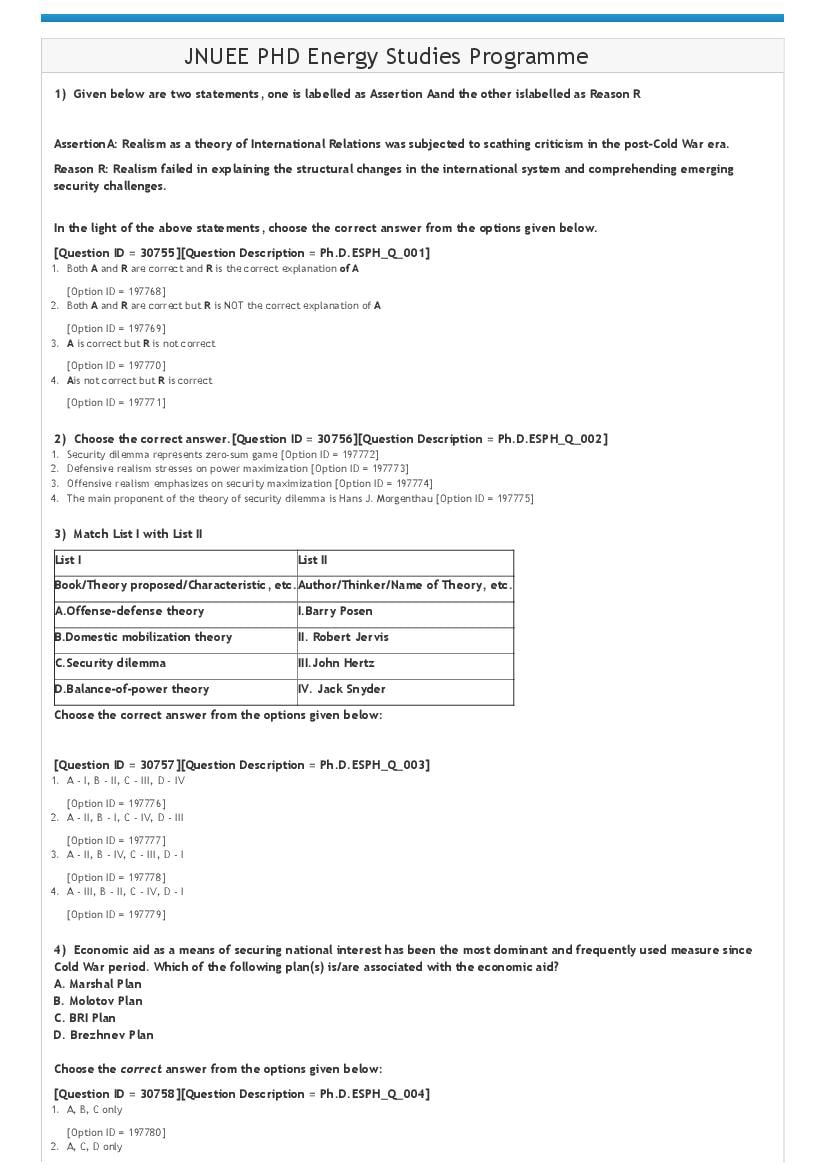
1) Given below are two statements, one is labelled as Assertion Aand the other islabelled as Reason R
AssertionA: Realism as a theory of International Relations was subjected to scathing criticism in the post‐Cold War era.
Reason R: Realism failed in explaining the structural changes in the international system and comprehending emerging
security challenges.
In the light of the above statements, choose the correct answer from the options given below.
[Question ID = 30755][Question Description = Ph.D.ESPH_Q_001]
1. Both A and R are correct and R is the correct explanation of A
[Option ID = 197768]
2. Both A and R are correct but R is NOT the correct explanation of A
[Option ID = 197769]
3. A is correct but R is not correct
[Option ID = 197770]
4. Ais not correct but R is correct
[Option ID = 197771]
2) Choose the correct answer.[Question ID = 30756][Question Description = Ph.D.ESPH_Q_002]
1. Security dilemma represents zero‐sum game [Option ID = 197772]
2. Defensive realism stresses on power maximization [Option ID = 197773]
3. Offensive realism emphasizes on security maximization [Option ID = 197774]
4. The main proponent of the theory of security dilemma is Hans J. Morgenthau [Option ID = 197775]
3) Match List I with List II
List I List II
Book/Theory proposed/Characteristic, etc.Author/Thinker/Name of Theory, etc.
A.Offense‐defense theory I.Barry Posen
B.Domestic mobilization theory II. Robert Jervis
C.Security dilemma III.John Hertz
D.Balance‐of‐power theory IV. Jack Snyder
[Question ID = 30757][Question Description = Ph.D.ESPH_Q_003]
1. A ‐ I, B ‐ II, C ‐ III, D ‐ IV
[Option ID = 197776]
2. A ‐ II, B ‐ I, C ‐ IV, D ‐ III
[Option ID = 197777]
3. A ‐ II, B ‐ IV, C ‐ III, D ‐ I
[Option ID = 197778]
4. A ‐ III, B ‐ II, C ‐ IV, D ‐ I
[Option ID = 197779]
4) Economic aid as a means of securing national interest has been the most dominant and frequently used measure since
Cold War period. Which of the following plan(s) is/are associated with the economic aid?
A. Marshal Plan
B. Molotov Plan
C. BRI Plan
D. Brezhnev Plan
[Question ID = 30758][Question Description = Ph.D.ESPH_Q_004]
1. A, B, C only
[Option ID = 197780]
2. A, C, D only
Page 2
3. A, B, C, D
[Option ID = 197782]
4. B, C, D only
[Option ID = 197783]
5) The ancient Indian principle of statecraft Mandala corresponds to which modern day’s principle?[Question ID = 30759]
[Question Description = Ph.D.ESPH_Q_005]
1. Principle of non‐intervention [Option ID = 197784]
2. Balance of power [Option ID = 197785]
3. Principle of complex interdependence [Option ID = 197786]
4. Regional integration [Option ID = 197787]
6) Match List I with List II
List I List II
(Book/Theory proposed/Characteristic, etc.)(Author/Thinker/Name of Theory, etc.)
A. PTBT I. 1961
B. NPT II. 1963
C. NAM III. 1972
D. SALT I IV. 1968
[Question ID = 30760][Question Description = Ph.D.ESPH_Q_006]
1. A ‐ I, B ‐ II, C ‐ III, D ‐ IV
[Option ID = 197788]
2. A ‐ II, B ‐ IV, C ‐ I, D ‐ III
[Option ID = 197789]
3. A ‐ II, B ‐ IV, C ‐ III, D ‐ I
[Option ID = 197790]
4. A ‐ III, B ‐ I, C ‐ II, D ‐ IV
[Option ID = 197791]
7) Statements:
A. Regionalism is regarded as a political process that leads to better integration in a geographical region
B. Regional integration is also a practice of generating institutional relationships among state units of a region through
various modes: economic, political, cultural, technological, and strategic.
C. Regionalisation is a tendency to forge regions.
D. Regionness refers to a process of integration at different levels in a particular geographical region.
[Question ID = 30761][Question Description = Ph.D.ESPH_Q_007]
1. A, B, C only
[Option ID = 197792]
2. A, B, D only
[Option ID = 197793]
3. A, B, C, D only
[Option ID = 197794]
4. B, C, D only
[Option ID = 197795]
8) Match List I with List II
List I List II
(Author/Thinker/Name of
(Book/Theory/Conventions/ proposed/Characteristic, etc.)
Theory/Years etc.)
A.The Universal declaration of Human Rights I. 1948
B.The Geneva Convention for the Amelioration of the Conditions of the Wounded and
II. 1949
the Sick in Armed forces
C.Convention on the Abolition of Slavery and Slave Trade III. 1976
Page 3
[Question ID = 30762][Question Description = Ph.D.ESPH_Q_008]
1. A ‐ I, B ‐ II, C ‐ III, D – IV
[Option ID = 197796]
2. A ‐ II, B ‐ IV, C ‐ I, D – III
[Option ID = 197797]
3. A ‐ II, B ‐ IV, C ‐ III, D – I
[Option ID = 197798]
4. A ‐ III, B ‐ I, C ‐ II, D ‐ IV
[Option ID = 197799]
9) The Agreement on Trade‐Related Aspects of Intellectual Property Rights (TRIPS) draws norms and standards for the
following types of intellectual property rights:
A. Copyrights, Patents and related rights
B. Trademarks
C. Geographical Indications
D. Lay out designs of integrated circuits
E. Protection of undisclosed information (trade secrets)
[Question ID = 30763][Question Description = Ph.D.ESPH_Q_009]
1. A, B and C only [Option ID = 197800]
2. A, B, C, D only [Option ID = 197801]
3. B, C, D, E only [Option ID = 197802]
4. A, B, C, D, E only [Option ID = 197803]
10) Which one of the following countries is not the part of the Caucasus?[Question ID = 30764][Question Description =
Ph.D.ESPH_Q_010]
1. Armenia [Option ID = 197804]
2. Azerbaijan [Option ID = 197805]
3. Georgia [Option ID = 197806]
4. Lithuania [Option ID = 197807]
11) When did India and the US sign new framework for the Indo‐US defence relationship?[Question ID = 35049][Question
Description = Ph.D.ESPH_Q_011]
1. 2005 [Option ID = 197808]
2. 2006 [Option ID = 197809]
3. 2007 [Option ID = 197810]
4. 2008 [Option ID = 197811]
12) Which of the following countries are included in ASEAN Plus Three ?[Question ID = 35050][Question Description =
Ph.D.ESPH_Q_012]
1. China, India, Japan [Option ID = 197812]
2. China, South Korea, Russia [Option ID = 197813]
3. China, Russia, Japan [Option ID = 197814]
4. China, Japan, South Korea [Option ID = 197815]
13) ‘Prisoner’s dilemma’ is a phenomenon that fuels?[Question ID = 35051][Question Description = Ph.D.ESPH_Q_013]
1. Arms race [Option ID = 197816]
2. Arms control [Option ID = 197817]
3. Disarmament [Option ID = 197818]
4. Peace [Option ID = 197819]
14) Given below are two statements, one is labelled as Assertion Aand the other islabelled as Reason R
Assertion A:Many of the South‐east Asian countries are aligning and re‐aligning with the extra‐regional powers in the post‐
cold war period.
Reason R:One of the primary reasons has been increasing Chinese behaviour as a Middle Kingdom in the region.
In light of the above statements, choose the most appropriateanswer from the options given below.
[Question ID = 35052][Question Description = Ph.D.ESPH_Q_014]
1. Both A and R, are correct and R is the correct explanation of A
Page 4
2. Both A and R are correct but R is NOT the correct explanation of A
[Option ID = 197821]
3. A is correct but R is not correct
[Option ID = 197822]
4. A is not correct but R is correct
[Option ID = 197823]
15) Given below are two statements
Statement I:The Nuclear Suppliers Group (NSG) is an export control group of 30 countries that provide nuclear materials,
equipment and technology on the global market.
Statement II:
The International Atomic Energy Agency (IAEA) was created in 1957 as part of the UN system to work with member states to
support safe, secure and peaceful nuclear technologies.
In light of the above statements, choose the correct answer from the options given below
[Question ID = 35053][Question Description = Ph.D.ESPH_Q_015]
1. Both Statement I and Statement II are true [Option ID = 197824]
2. Both Statement I and Statement II are false [Option ID = 197825]
3. Statement I is true but Statement II is false [Option ID = 197826]
4. Statement I is false but Statement II is true [Option ID = 197827]
16) Given below are two statements
Statement I: During Cold War, Truman doctrine of containment of communist expansionism helped generate an extremely
expensive and tense arms race with the USSR.
Statement II: Under the Marshall Plan, billions of dollar was given to European nations in order to revitalize them as allies
and trading partners of USA.
In light of the above statements, choose the correct answer from the options given below
[Question ID = 35054][Question Description = Ph.D.ESPH_Q_016]
1. Both Statement I and Statement II are true
[Option ID = 197828]
2. Both Statement I and Statement II are false
[Option ID = 197829]
3. Statement I is true but Statement II is false
[Option ID = 197830]
4. Statement I is false but Statement II is true
[Option ID = 197831]
17) Given below are two statements, one is labelled as Assertion Aand the other islabelled as Reason R
Assertion A: Indian foreign policy is currently encompassing many multilateral platforms to enable greater participation in
international decision making.
Reason R: The move towards multilateralism in foreign policy is enabling better relationship with Indian neighbours.
In light of the above statements, choose the most appropriateanswer from the options given below
[Question ID = 35055][Question Description = Ph.D.ESPH_Q_017]
1. Both A and R are true and R is the correct explanation of A
[Option ID = 197832]
2. Both A and R are correct but R is NOT the correct explanation of A
[Option ID = 197833]
3. A is correct but R is not correct
[Option ID = 197834]
4. A is not correct but R is correct
[Option ID = 197835]
18) What does the controversial ‘nine‐dash line’ demarcate?[Question ID = 35056][Question Description =
Ph.D.ESPH_Q_018]
1. China’s claim in Indian Ocean [Option ID = 197836]
2. China’s claim in Ussurai River [Option ID = 197837]
3. China’s claim in South China Sea [Option ID = 197838]
4. China’s claim in Senkaku Island [Option ID = 197839]
19) Given below are two statements, one is labelled as Assertion Aand the other islabelled as Reason R
Page 5
Reason R:It is mainly seen as India’s strategy to wean South Asian region away from its growing dependency on China.
In light of the above statements, choose the most appropriateanswer from the options given below
[Question ID = 35057][Question Description = Ph.D.ESPH_Q_019]
1. Both A and R are correct and R is the correct explanation of A
[Option ID = 197840]
2. Both A and R are correct but R is NOT the correct explanation of A
[Option ID = 197841]
3. A is correct but R is not correct
[Option ID = 197842]
4. A is not correct but R is correct
[Option ID = 197843]
20) Among the following, which is not the feature of Deep Ecology?[Question ID = 35058][Question Description =
Ph.D.ESPH_Q_020]
1. Rejects all forms of anthropocentrism [Option ID = 197844]
2. World is interconnected and interdependent [Option ID = 197845]
3. Human being is only one part of nature [Option ID = 197846]
4. Human being has privileged position in the ecosystem [Option ID = 197847]
21) What is not the feature of eco‐anarchism?[Question ID = 35059][Question Description = Ph.D.ESPH_Q_021]
1. Critique of authority and hierarchy from the perspective of environment [Option ID = 197848]
2. Domination over women leads to domination over nature [Option ID = 197849]
3. Advocates abolition of State [Option ID = 197850]
4. Advocates decentralized self managing communities [Option ID = 197851]
22) Who are free riders in environment debate?[Question ID = 35060][Question Description = Ph.D.ESPH_Q_022]
1. Enjoying the benefit without paying the price [Option ID = 197852]
2. Responsible exploitation of resources [Option ID = 197853]
3. Excessive exploitation of resources without caring for their sustainability [Option ID = 197854]
4. Responsible use of global commons [Option ID = 197855]
23) Which one of the following is not part of five global commons?[Question ID = 35061][Question Description =
Ph.D.ESPH_Q_023]
1. The High Seas [Option ID = 197856]
2. The Climate System [Option ID = 197857]
3. The Deep Ocean floor [Option ID = 197858]
4. The Arctic region [Option ID = 197859]
24) Which of the following refers to the dominant members of the International Solar Alliance?[Question ID = 35062]
[Question Description = Ph.D.ESPH_Q_024]
1. Sunburst states [Option ID = 197860]
2. Sun‐kissed countries [Option ID = 197861]
3. Sunbathed states [Option ID = 197862]
4. Sunshine countries [Option ID = 197863]
25) The concept of Sagarmala Programme was approved by the Indian Union Cabinet in 2015 with
which of the following vision ?
A. Reducing cost of transporting Cargo through optimizing model mix
B. Lowing logistics cost of bulk commodities by locating future industrial capacities near the
coast
C. Improving defence capabilities of India near the coast.
D. Optimizing time/cost EXIM container movement.
E. Improving export competitiveness by developing port proximate discrete manufacturing
clusters.
[Question ID = 35063][Question Description = Ph.D.ESPH_Q_025]
1. A, B, C, D only [Option ID = 197864]
2. A, B, D, E only [Option ID = 197865]
3. A, B, C, E only [Option ID = 197866]
4. B, C, D, E only [Option ID = 197867]
26) Which energy source requires combustion to provide energy services? [Question ID = 35064][Question Description =
Ph.D.ESPH_Q_026]
Page 6
2. Wind [Option ID = 197869]
3. Hydro [Option ID = 197870]
4. Fossil fuels [Option ID = 197871]
27) Which of the following is considered eco‐friendly construction material?[Question ID = 35065][Question Description =
Ph.D.ESPH_Q_027]
1. Red bricks [Option ID = 197872]
2. Fly‐ash bricks [Option ID = 197873]
3. Concrete [Option ID = 197874]
4. Cement [Option ID = 197875]
28) The amount of oil that is available for use is called oil _______________[Question ID = 35066][Question Description =
Ph.D.ESPH_Q_028]
1. Reserves [Option ID = 197876]
2. Reservoirs [Option ID = 197877]
3. Resources [Option ID = 197878]
4. Traps [Option ID = 197879]
29) A low carbon development pathway would necessarily involve changes in the following[Question ID = 35067][Question
Description = Ph.D.ESPH_Q_029]
1. Mode of electricity generation [Option ID = 197880]
2. Volume of electricity consumption [Option ID = 197881]
3. Use of efficient electric appliances [Option ID = 197882]
4. All of the above [Option ID = 197883]
30) Which of the following Indian Acts empower the Bureau of Energy Efficiency (BEE)?[Question ID = 35068][Question
Description = Ph.D.ESPH_Q_030]
1. The Electricity Act 2003 [Option ID = 197884]
2. The Energy conservation act 2001 [Option ID = 197885]
3. Integrated energy policy 2006 [Option ID = 197886]
4. All of the above [Option ID = 197887]
31) India and Bhutan have bilateral cooperation in[Question ID = 30765][Question Description = Ph.D.ESPH_Q_031]
1. Geothermal energy [Option ID = 197888]
2. Hydropower [Option ID = 197889]
3. Nuclear power [Option ID = 197890]
4. Solar power [Option ID = 197891]
32) Which of the following is not a mature technology from India’s perspective?
[Question ID = 30766][Question Description = Ph.D.ESPH_Q_032]
1. Ethanol production from cellulosic biomass
[Option ID = 197892]
2. Carbon capture and storage
[Option ID = 197893]
3. Integrated gasification combined cycle
[Option ID = 197894]
4. All of the above
[Option ID = 197895]
33) Net metering is associated with[Question ID = 30767][Question Description = Ph.D.ESPH_Q_033]
1. Efficient electric appliances [Option ID = 197896]
2. Solar PVs [Option ID = 197897]
3. Piped natural gas [Option ID = 197898]
4. None of the above [Option ID = 197899]
34) Which of the following Sustainable Development Goals (SDGs) is irrelevant to the debate of just transition to low carbon
development pathways?[Question ID = 30768][Question Description = Ph.D.ESPH_Q_034]
1. SDG 5 [Option ID = 197900]
2. SDG 13 [Option ID = 197901]
3. SDG 7 [Option ID = 197902]
4. All of the above [Option ID = 197903]
35) Which of the following is an incorrect combination?[Question ID = 30769][Question Description = Ph.D.ESPH_Q_035]
1. Company car tax as carbon tax – Italy [Option ID = 197904]
2. The star rating system – USA [Option ID = 197905]
3. The Top Runner Programme ‐ Japan [Option ID = 197906]
4. None of the above [Option ID = 197907]
36) India is[Question ID = 30770][Question Description = Ph.D.ESPH_Q_036]
1. Net importer of coal [Option ID = 197908]
Page 7
3. Net importer of natural gas [Option ID = 197910]
4. All of the above [Option ID = 197911]
37) Which of the following components of the Kaya identity has remained almost unchanged globally between 1990 and
2020?
[Question ID = 30771][Question Description = Ph.D.ESPH_Q_037]
1. CO2/energy
[Option ID = 197912]
2. Eenergy/GDP
[Option ID = 197913]
3. GDP/Capita
[Option ID = 197914]
4. None of the above
[Option ID = 197915]
38) Rapid diffusion of electric vehicles will negatively affect transition to low carbon economy if it is accompanied by a
simultaneous[Question ID = 30772][Question Description = Ph.D.ESPH_Q_038]
1. Reduction in demand for coal as well as oil [Option ID = 197916]
2. Reduction in demand for oil only [Option ID = 197917]
3. Increase in share of power generation from renewable energy sources [Option ID = 197918]
4. None of the above [Option ID = 197919]
39) Which of the following component of India’s Nationally Determined Contribution (NDC) is not related to energy
sector[Question ID = 30773][Question Description = Ph.D.ESPH_Q_039]
1. Emission Intensity target [Option ID = 197920]
2. Sequestration target [Option ID = 197921]
3. Non‐fossil fuel based power capacity target [Option ID = 197922]
4. None of the above [Option ID = 197923]
40) Power tariffs in India are regulated by[Question ID = 30774][Question Description = Ph.D.ESPH_Q_040]
1. Ministry of Power [Option ID = 197924]
2. Ministry of New and Renewable Energy [Option ID = 197925]
3. Central Electricity Regulatory Commission [Option ID = 197926]
4. All of the above [Option ID = 197927]
41) In the context of India’s energy security, (Iran‐Pakistan‐India) is an
[Question ID = 30775][Question Description = Ph.D.ESPH_Q_041]
1. Institute
[Option ID = 197928]
2. Infrastructure
[Option ID = 197929]
3. Initiative
[Option ID = 197930]
4. None of the above
[Option ID = 197931]
42) Feed‐in Tariff is an incentive, based on
[Question ID = 30776][Question Description = Ph.D.ESPH_Q_042]
1. Generatoin [Option ID = 197932]
2. Investment [Option ID = 197933]
3. Consumption [Option ID = 197934]
4. Distribution [Option ID = 197935]
43) Which of the following is a partnership between India and the US on energy?[Question ID = 30777][Question Description
= Ph.D.ESPH_Q_043]
1. Partnership to Advance Clean Energy [Option ID = 197936]
2. Partnership to Advance Clean Energy [Option ID = 197937]
3. International Solar Alliance [Option ID = 197938]
4. Energy for Growth Dialogue [Option ID = 197939]
44) Which of the following countries is not a member of the Powering Past Coal Alliance?[Question ID = 30778][Question
Description = Ph.D.ESPH_Q_044]
1. UK [Option ID = 197940]
2. Germany [Option ID = 197941]
3. USA [Option ID = 197942]
4. Canada [Option ID = 197943]
Page 8
Ph.D.ESPH_Q_045]
1. 2015 [Option ID = 197944]
2. 2020 [Option ID = 197945]
3. 2010 [Option ID = 197946]
4. 2016 [Option ID = 197947]
46) Which of the following mode of transport has the least per passenger kilometre energy consumption?
[Question ID = 30780][Question Description = Ph.D.ESPH_Q_046]
1. Private Car
[Option ID = 197948]
2. Bus
[Option ID = 197949]
3. Steamer
[Option ID = 197950]
4. Train
[Option ID = 197951]
47) Which of the following combination of renewable energy related trade‐offs is correct?[Question ID = 30781][Question
Description = Ph.D.ESPH_Q_047]
1. Wind – Waste [Option ID = 197952]
2. Solar – Noise pollution [Option ID = 197953]
3. Hydro – Biodiversity loss [Option ID = 197954]
4. All the above [Option ID = 197955]
48) Which of the following policy instrument does not directly relate to renewable energy?[Question ID = 30782][Question
Description = Ph.D.ESPH_Q_048]
1. Net‐metering [Option ID = 197956]
2. Feed‐in‐tariff [Option ID = 197957]
3. Tax holidays [Option ID = 197958]
4. Vehicular Emission Standards [Option ID = 197959]
49) Which of the following does not involve a choice by the end consumer?[Question ID = 30783][Question Description =
Ph.D.ESPH_Q_049]
1. Star rating system [Option ID = 197960]
2. Renewable Purchase Obligations [Option ID = 197961]
3. Net‐metering [Option ID = 197962]
4. Congestion tax [Option ID = 197963]
50) What is the just transition debate about? [Question ID = 30784][Question Description = Ph.D.ESPH_Q_050]
1. Phase out of coal power plants [Option ID = 197964]
2. Labour unions [Option ID = 197965]
3. Climate change [Option ID = 197966]
4. All of the above [Option ID = 197967]
51) Who define research as a “systematized effort to gain new knowledge?[Question ID = 30785][Question Description =
Ph.D.ESPH_Q_051]
1. Redman and Mory [Option ID = 197968]
2. Clifford Woody and Mory [Option ID = 197969]
3. Clifford Woody and Redman [Option ID = 197970]
4. D. Slesinger and M. Stephenson [Option ID = 197971]
52) D. Slesinger and M. Stephenson in the Encyclopaedia of Social Sciences define research as:‐[Question ID = 30786]
[Question Description = Ph.D.ESPH_Q_052]
1. The truth which is hidden and which has not been discovered as yet [Option ID = 197972]
2. To portray accurately the characteristics of a particular individual, situation or a group [Option ID = 197973]
3. The manipulation of things, concepts or symbols for the purpose of generalising to extend, correct or verify knowledge, whether that knowledge
aids in construction of theory or in the practice of an art [Option ID = 197974]
4. All of the above [Option ID = 197975]
53) List I List II
(Book/Theory proposed/Characteristic, etc.)(Author/Thinker/Name of Theory, etc.)
A.Understanding Educational Research I.D G Samant
B.The making of Educational research II.Paul Oliver
C.Scientific Methods & Social Research III.B N Ghosh
D.Understanding the research problem IV.Deobold Van
Page 9
1. A ‐II , B ‐III , C ‐ I, D ‐ IV
[Option ID = 197976]
2. A ‐IV , B ‐III , C ‐ II, D ‐I
[Option ID = 197977]
3. A ‐ IV, B ‐I , C ‐ III, D ‐ II
[Option ID = 197978]
4. A ‐ II, B ‐III , C ‐IV , D ‐ I
[Option ID = 197979]
54) Which term is used to refer Ex post facto research?[Question ID = 30788][Question Description = Ph.D.ESPH_Q_054]
1. Applied research [Option ID = 197980]
2. Qualitative research [Option ID = 197981]
3. Empirical research [Option ID = 197982]
4. Descriptive research studies [Option ID = 197983]
55) The process of writing your daily observation about any event without interpretation is called as
[Question ID = 30789][Question Description = Ph.D.ESPH_Q_055]
1. Prediction [Option ID = 197984]
2. Description [Option ID = 197985]
3. Exploration [Option ID = 197986]
4. Explanation [Option ID = 197987]
56) The purpose of ethnographic research is to[Question ID = 30790][Question Description = Ph.D.ESPH_Q_056]
1. Describe everything that the researchers observe, without making any inferences or subjective interpretations. [Option ID = 197988]
2. Describe the activities researchers observe and understand the meaning of those activities to participants. [Option ID = 197989]
3. Show that processes observed in a particular group also occur in a larger, more generalizable population. [Option ID = 197990]
4. Use existing records to better understand events from hundreds of years ago. [Option ID = 197991]
57) Which technical term is used when we design the study minimising the effects of extraneous independent variables?
[Question ID = 30791][Question Description = Ph.D.ESPH_Q_057]
1. Free [Option ID = 197992]
2. Control [Option ID = 197993]
3. Independent [Option ID = 197994]
4. Closed [Option ID = 197995]
58) ________ is a small‐scale preliminary study conducted to evaluate feasibility, duration, cost, adverse events, and
improve upon the study design prior to performance of a full‐scale research project[Question ID = 30792][Question
Description = Ph.D.ESPH_Q_058]
1. Kiosk Survey [Option ID = 197996]
2. Mail‐in Survey [Option ID = 197997]
3. Pilot Survey [Option ID = 197998]
4. Online Survey [Option ID = 197999]
59) Which of the following is a type of research design?
A. Survey
B. Ethnography
C. Secondary Research
D. Experimental
[Question ID = 30793][Question Description = Ph.D.ESPH_Q_059]
1. A, B and D only [Option ID = 198000]
2. B, C and D only [Option ID = 198001]
3. D, B and A only [Option ID = 198002]
4. A, B and C only [Option ID = 198003]
60) Which of the following statements is true of a theory?
A. it most simply means “explanation”
B. it answers the “how” and “why” questions
C. it can be a well developed explanatory system
D. all of the above are correct
[Question ID = 30794][Question Description = Ph.D.ESPH_Q_060]
1. A and C [Option ID = 198004]
2. B [Option ID = 198005]
3. B and C [Option ID = 198006]
4. D [Option ID = 198007]
Page 10
A. Using methods for data collection
B. Sampling
C. Review of literature
D. Formulation of Reserach questions and Hypothesis
E. Dissemination of findings
[Question ID = 30795][Question Description = Ph.D.ESPH_Q_061]
1. A, B and D only [Option ID = 198008]
2. A, B, C, and D only [Option ID = 198009]
3. B, C, and E only [Option ID = 198010]
4. B, C, D and E only [Option ID = 198011]
62) Quantitative and qualitative findings in a mixed methods research, should be :[Question ID = 30796][Question
Description = Ph.D.ESPH_Q_062]
1. Systematically kept separate [Option ID = 198012]
2. Must be mentioned in order of importance [Option ID = 198013]
3. Should be integrated in the process [Option ID = 198014]
4. Mentioned in Bibliography clearly [Option ID = 198015]
63) In qualitative social research identify which one is NOT a main step of the process of research ?
Choose the correct answer from the options given below :
A. Choosing relevant sites and subjects
B. Collection of relevant data
C. Designing research questions
D. Formulation of Hypothesis
E. Analysis and Interpretation of data
[Question ID = 30797][Question Description = Ph.D.ESPH_Q_063]
1. B and A only [Option ID = 198016]
2. E only [Option ID = 198017]
3. C only [Option ID = 198018]
4. D only [Option ID = 198019]
64) In social science research the concept of validity implies which of the following
A. Usefulness
B. Verification
C. Meaningfulness
D. Appropriateness
E. Predictability
[Question ID = 30798][Question Description = Ph.D.ESPH_Q_064]
1. A, B and E only [Option ID = 198020]
2. A, C and D only [Option ID = 198021]
3. B, E and D only [Option ID = 198022]
4. C, E and D only [Option ID = 198023]
65) _______ is also an example of non‐probability sampling?
[Question ID = 30799][Question Description = Ph.D.ESPH_Q_065]
1. Quota sampling
[Option ID = 198024]
2. Random sampling
[Option ID = 198025]
3. BothQuota sampling and Random sampling
[Option ID = 198026]
4. None of the above
[Option ID = 198027]
66) Given below are two statements
Statement I: Closed ended Questions provide opportunity to the respondents to give their opinion.
Statement II: Closed ended questions have a fixed range of possible anwers and perspectives on a particular issue
In light of the above statements, choose the correct answer from the options given below
[Question ID = 30800][Question Description = Ph.D.ESPH_Q_066]
1. Both Statement I and Statement II are true
Page 11
2. Both Statement I and Statement II are false
[Option ID = 198029]
3. Statement I is true but Statement II is false
[Option ID = 198030]
4. Statement I is false but Statement II is true
[Option ID = 198031]
67) Which of the following is NOT a Research Design?[Question ID = 30801][Question Description = Ph.D.ESPH_Q_067]
1. Experimental [Option ID = 198032]
2. Participant Observation [Option ID = 198033]
3. Longitudinal [Option ID = 198034]
4. Survey [Option ID = 198035]
68) Ethical principles in social research revolves around :[Question ID = 30802][Question Description = Ph.D.ESPH_Q_068]
1. Whether there is lack of informed consent [Option ID = 198036]
2. Whether there is invasion of privacy [Option ID = 198037]
3. Whether deception is involved [Option ID = 198038]
4. All of the above [Option ID = 198039]
69) Match List I with List II
List I List II
Theory proposed Thinker
A. Durkheim I. Normative Power
B. Radcliffe BrownII. Anomie
C. Ian Manners III. Soft Power
D. Joseph Nye IV. Structural Functionalism
[Question ID = 30803][Question Description = Ph.D.ESPH_Q_069]
1. A ‐I , B ‐III , C ‐ II, D ‐IV
[Option ID = 198040]
2. A ‐ III, B ‐ II, C ‐I , D ‐IV
[Option ID = 198041]
3. A ‐ II, B ‐IV , C ‐ I, D ‐ III
[Option ID = 198042]
4. A ‐ IV, B ‐ II, C ‐III , D ‐ I
[Option ID = 198043]
70) Which of the following is a characteristic of Quantitative data collection ?[Question ID = 30804][Question Description =
Ph.D.ESPH_Q_070]
1. It goes into indepth questioning [Option ID = 198044]
2. It gives respondent scope to express opinion freely [Option ID = 198045]
3. There is a room for flexibility [Option ID = 198046]
4. It is structured and precoded [Option ID = 198047]
71) Given below are two statements
Statement I: Official Statistics is readily available and arranged according to precoded categories.
Statement II: Ethnography is a popular research design among anthropologists
In light of the above statements, choose the most appropriate answer from the options given below
[Question ID = 30805][Question Description = Ph.D.ESPH_Q_071]
1. Both Statement I and Statement II are correct
[Option ID = 198048]
2. Both Statement I and Statement II are incorrect
[Option ID = 198049]
3. Statement I is correct but Statement II is incorrect
[Option ID = 198050]
4. Statement I is incorrect but Statement II is correct
Page 12
72) In social science research, which type of logical reasoning starts with a universal statement, and concluded with a
particular statement:[Question ID = 30806][Question Description = Ph.D.ESPH_Q_072]
1. Converse reasoning [Option ID = 198052]
2. Deductive reasoning [Option ID = 198053]
3. Inductive reasoning [Option ID = 198054]
4. Reverse reasoning [Option ID = 198055]
73) Interview as method help in collection of data from sample. Which of the following is NOT a type of interview
A. Focus Group
B. Questionnaire
C. Structured
D. Unstructured
E. Schedule
[Question ID = 30807][Question Description = Ph.D.ESPH_Q_073]
1. A, B and D only [Option ID = 198056]
2. A, E and C only [Option ID = 198057]
3. B and E only [Option ID = 198058]
4. C and D only [Option ID = 198059]
74) Given below are two statements
Statement I: The quantitative methods of data collection help in exploring personal view point of the respondents on a
particular topic
Statement II:In Social Science Research Reliability implies accuracy andconsistency
In light of the above statements, choose the most appropriate answer from the options given below
[Question ID = 30808][Question Description = Ph.D.ESPH_Q_074]
1. Both Statement I and Statement II are correct
[Option ID = 198060]
2. Both Statement I and Statement II are incorrect
[Option ID = 198061]
3. Statement I is correct but Statement II is incorrect
[Option ID = 198062]
4. Statement I is incorrect but Statement II is correct
[Option ID = 198063]
75) Which one of the following non parametric test is often used when the data happens to be
nominal and relate to two related samples?
[Question ID = 30809][Question Description = Ph.D.ESPH_Q_075]
1. McNemer test [Option ID = 198064]
2. Fischer‐Irwin test [Option ID = 198065]
3. Wilcoxon matched pains test [Option ID = 198066]
4. Chi‐Square test [Option ID = 198067]
76) Sample Survey is mostly related to [Question ID = 30810][Question Description = Ph.D.ESPH_Q_076]
1. Descriptive [Option ID = 198068]
2. Fact finding [Option ID = 198069]
3. Analytical [Option ID = 198070]
4. Systematic [Option ID = 198071]
77) Summarizing raw data and displaying them on compact statistical tables for analysis is [Question ID = 30811][Question
Description = Ph.D.ESPH_Q_077]
1. Tabulation [Option ID = 198072]
2. Coding [Option ID = 198073]
3. Transcription [Option ID = 198074]
4. Editing [Option ID = 198075]
78) Which of the following is the first step in starting the research process?[Question ID = 30812][Question Description =
Ph.D.ESPH_Q_078]
1. Searching sources of information to locate problem [Option ID = 198076]
2. Survey of related literature [Option ID = 198077]
3. Identification of problem [Option ID = 198078]
4. Searching for solutions to the problem [Option ID = 198079]
Page 13
1. Research Problem [Option ID = 198080]
2. Research design [Option ID = 198081]
3. Research tools [Option ID = 198082]
4. Research methods [Option ID = 198083]
80) In the process of conducting research ‘Formulation of hypothesis” is followed by[Question ID = 30814][Question
Description = Ph.D.ESPH_Q_080]
1. Statement of objectives [Option ID = 198084]
2. Analysis of data [Option ID = 198085]
3. Selection of research tools [Option ID = 198086]
4. Collection of data [Option ID = 198087]
81) “Empirically verifiable observation” is [Question ID = 30815][Question Description = Ph.D.ESPH_Q_081]
1. Theory [Option ID = 198088]
2. Value [Option ID = 198089]
3. Fact [Option ID = 198090]
4. Statement [Option ID = 198091]
82) A researcher selects only 10 members as a sample from the total population of 5000 and considers it good
because[Question ID = 30816][Question Description = Ph.D.ESPH_Q_082]
1. He/She was a good researcher [Option ID = 198092]
2. He/She was guided by his supervisor [Option ID = 198093]
3. The populations were homogeneous [Option ID = 198094]
4. All of these [Option ID = 198095]
83) Converting a question into a Researchable problem is called[Question ID = 30817][Question Description =
Ph.D.ESPH_Q_083]
1. Solution [Option ID = 198096]
2. Examination [Option ID = 198097]
3. Problem formulation [Option ID = 198098]
4. Problem Solving [Option ID = 198099]
84) “Reasoning from general to particular “is called[Question ID = 30818][Question Description = Ph.D.ESPH_Q_084]
1. Induction [Option ID = 198100]
2. Deduction [Option ID = 198101]
3. Observation [Option ID = 198102]
4. Experience [Option ID = 198103]
85) Which variable is not considered as a part of sample survey?[Question ID = 30819][Question Description =
Ph.D.ESPH_Q_085]
1. Marital status [Option ID = 198104]
2. Mental status [Option ID = 198105]
3. Economic status [Option ID = 198106]
4. Educational status [Option ID = 198107]
86) The first step in a survey is [Question ID = 30820][Question Description = Ph.D.ESPH_Q_086]
1. Application of methods [Option ID = 198108]
2. Rejection of ideas [Option ID = 198109]
3. Selection of problem [Option ID = 198110]
4. Planning the fieldwork [Option ID = 198111]
87) All surveys are essentially[Question ID = 30821][Question Description = Ph.D.ESPH_Q_087]
1. Narrative [Option ID = 198112]
2. Explanatory [Option ID = 198113]
3. Interdisciplinary [Option ID = 198114]
4. Communal [Option ID = 198115]
88) Survey is usually ………….[Question ID = 30822][Question Description = Ph.D.ESPH_Q_088]
1. Cheap [Option ID = 198116]
2. Expensive [Option ID = 198117]
3. Moderate [Option ID = 198118]
4. None of above [Option ID = 198119]
89) Bibliography means[Question ID = 30823][Question Description = Ph.D.ESPH_Q_089]
1. Foot note [Option ID = 198120]
2. Quotations [Option ID = 198121]
3. List of literature referred [Option ID = 198122]
4. Biography [Option ID = 198123]
90) Observation is a Physical and ……….. Activity[Question ID = 30824][Question Description = Ph.D.ESPH_Q_090]
1. Mental [Option ID = 198124]
Page 14
3. Psychological [Option ID = 198126]
4. Personal [Option ID = 198127]
91) Observation of an event personally by the observer is ……………..[Question ID = 30825][Question Description =
Ph.D.ESPH_Q_091]
1. Indirect observation [Option ID = 198128]
2. Direct observation [Option ID = 198129]
3. Controlled observation [Option ID = 198130]
4. Uncontrolled observation [Option ID = 198131]
92) A method of collecting primary data in which a number of individuals with common interest
interact is called
[Question ID = 30826][Question Description = Ph.D.ESPH_Q_092]
1. Telephone interview [Option ID = 198132]
2. Clinical interview [Option ID = 198133]
3. Focused interview [Option ID = 198134]
4. Group interview [Option ID = 198135]
93) Which statement is correct?[Question ID = 30827][Question Description = Ph.D.ESPH_Q_093]
1. Variable is a measurable characteristic that varies. [Option ID = 198136]
2. Variable is indictor of research [Option ID = 198137]
3. Variable is non‐measurable characters [Option ID = 198138]
4. Variable is used for data interpretation [Option ID = 198139]
94) The interviewer has no specific guidelines, restrictions, predetermined questions, or list of
options can be called as
[Question ID = 30828][Question Description = Ph.D.ESPH_Q_094]
1. Delphi interview [Option ID = 198140]
2. Telephonic interview [Option ID = 198141]
3. Key‐informant interview [Option ID = 198142]
4. Unstructured interview [Option ID = 198143]
95) Mixed method approach is exclusively used for [Question ID = 30829][Question Description = Ph.D.ESPH_Q_095]
1. Testing hypothesis [Option ID = 198144]
2. Validity and reliability [Option ID = 198145]
3. Measuring the scale [Option ID = 198146]
4. Quantifying the data [Option ID = 198147]
96) Various type of triangulation methods [Question ID = 30830][Question Description = Ph.D.ESPH_Q_096]
1. Data triangulation [Option ID = 198148]
2. Methodological triangulation [Option ID = 198149]
3. Theory triangulation [Option ID = 198150]
4. All of the above [Option ID = 198151]
97) Schedule is filled by ……………[Question ID = 30831][Question Description = Ph.D.ESPH_Q_097]
1. Respondent [Option ID = 198152]
2. Enumerator [Option ID = 198153]
3. Everybody [Option ID = 198154]
4. None of the above [Option ID = 198155]
98) Random sampling is a type of.....[Question ID = 30832][Question Description = Ph.D.ESPH_Q_098]
1. Snowball sampling [Option ID = 198156]
2. Purposive sampling [Option ID = 198157]
3. Accidental sampling [Option ID = 198158]
4. Probability sampling [Option ID = 198159]
99) Data related to geophysical characteristics are called…[Question ID = 30833][Question Description = Ph.D.ESPH_Q_099]
1. Demographic data [Option ID = 198160]
2. Territorial data [Option ID = 198161]
3. Personal data [Option ID = 198162]
4. Organizational data [Option ID = 198163]
100) Questions which allow only a few alternative way of answering is called...[Question ID = 30834][Question Description
= Ph.D.ESPH_Q_100]
1. Open ended questions [Option ID = 198164]
2. Unstructured questions [Option ID = 198165]
3. Structural questions [Option ID = 198166]
4. Dichotomous questions [Option ID = 198167]
Document Details
| Board / Org | NTA |
| Exam | Jawaharlal Nehru University Entrance Examination |
| Type | Question Paper |
| Pages | 15 |
| Updated | 22 Jul 2026 |