JNUEE 2021 Question Paper Ph.D European Studies
Finished viewing? Save it for later —
Download JNUEE 2021 Question Paper Ph.D European Studies (PDF · 21 pages)About JNUEE 2021 Question Paper Ph.D European Studies
JNUEE 2021 Question Paper Ph.D European Studies is available here for free download. Published by NTA for JNUEE, this question paper can be viewed online or downloaded as a PDF (21 pages). Candidates preparing for JNUEE can use JNUEE 2021 Question Paper Ph.D European Studies to understand the exam pattern, the type of questions asked, and the overall difficulty level.
Frequently Asked Questions
How can I download JNUEE 2021 Question Paper Ph.D European Studies?
Open this page and click the Download button to save JNUEE 2021 Question Paper Ph.D European Studies as a PDF. It is completely free on AglaSem Docs.
Is JNUEE 2021 Question Paper Ph.D European Studies free to download?
Yes. JNUEE 2021 Question Paper Ph.D European Studies can be viewed online and downloaded as a PDF free of cost on AglaSem Docs.
How many pages does JNUEE 2021 Question Paper Ph.D European Studies have?
JNUEE 2021 Question Paper Ph.D European Studies contains 21 pages, which you can read online or download together as a single PDF.
Where can I find more JNUEE study material?
You can find more JNUEE question papers, sample papers, syllabus, and answer keys on AglaSem Docs.
JNUEE 2021 Question Paper Ph.D European Studies – Text
Read the full text of this question paper below — useful to quickly search, copy and reference the content online without downloading the PDF.
📄 View text version (21 pages)
Page 1
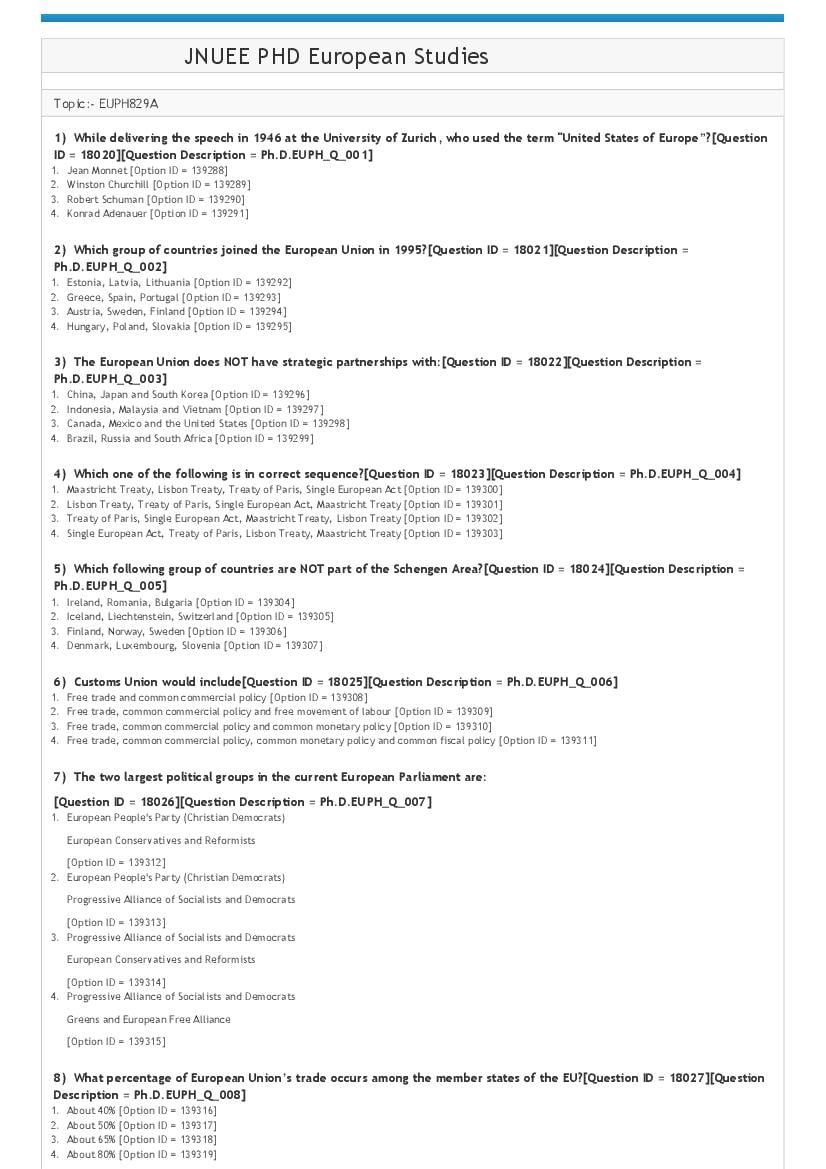
Topic:‐ EUPH829A
1) While delivering the speech in 1946 at the University of Zurich, who used the term "United States of Europe”?[Question
ID = 18020][Question Description = Ph.D.EUPH_Q_001]
1. Jean Monnet [Option ID = 139288]
2. Winston Churchill [Option ID = 139289]
3. Robert Schuman [Option ID = 139290]
4. Konrad Adenauer [Option ID = 139291]
2) Which group of countries joined the European Union in 1995?[Question ID = 18021][Question Description =
Ph.D.EUPH_Q_002]
1. Estonia, Latvia, Lithuania [Option ID = 139292]
2. Greece, Spain, Portugal [Option ID = 139293]
3. Austria, Sweden, Finland [Option ID = 139294]
4. Hungary, Poland, Slovakia [Option ID = 139295]
3) The European Union does NOT have strategic partnerships with:[Question ID = 18022][Question Description =
Ph.D.EUPH_Q_003]
1. China, Japan and South Korea [Option ID = 139296]
2. Indonesia, Malaysia and Vietnam [Option ID = 139297]
3. Canada, Mexico and the United States [Option ID = 139298]
4. Brazil, Russia and South Africa [Option ID = 139299]
4) Which one of the following is in correct sequence?[Question ID = 18023][Question Description = Ph.D.EUPH_Q_004]
1. Maastricht Treaty, Lisbon Treaty, Treaty of Paris, Single European Act [Option ID = 139300]
2. Lisbon Treaty, Treaty of Paris, Single European Act, Maastricht Treaty [Option ID = 139301]
3. Treaty of Paris, Single European Act, Maastricht Treaty, Lisbon Treaty [Option ID = 139302]
4. Single European Act, Treaty of Paris, Lisbon Treaty, Maastricht Treaty [Option ID = 139303]
5) Which following group of countries are NOT part of the Schengen Area?[Question ID = 18024][Question Description =
Ph.D.EUPH_Q_005]
1. Ireland, Romania, Bulgaria [Option ID = 139304]
2. Iceland, Liechtenstein, Switzerland [Option ID = 139305]
3. Finland, Norway, Sweden [Option ID = 139306]
4. Denmark, Luxembourg, Slovenia [Option ID = 139307]
6) Customs Union would include[Question ID = 18025][Question Description = Ph.D.EUPH_Q_006]
1. Free trade and common commercial policy [Option ID = 139308]
2. Free trade, common commercial policy and free movement of labour [Option ID = 139309]
3. Free trade, common commercial policy and common monetary policy [Option ID = 139310]
4. Free trade, common commercial policy, common monetary policy and common fiscal policy [Option ID = 139311]
7) The two largest political groups in the current European Parliament are:
[Question ID = 18026][Question Description = Ph.D.EUPH_Q_007]
1. European People's Party (Christian Democrats)
European Conservatives and Reformists
[Option ID = 139312]
2. European People's Party (Christian Democrats)
Progressive Alliance of Socialists and Democrats
[Option ID = 139313]
3. Progressive Alliance of Socialists and Democrats
European Conservatives and Reformists
[Option ID = 139314]
4. Progressive Alliance of Socialists and Democrats
Greens and European Free Alliance
[Option ID = 139315]
8) What percentage of European Union’s trade occurs among the member states of the EU?[Question ID = 18027][Question
Description = Ph.D.EUPH_Q_008]
1. About 40% [Option ID = 139316]
2. About 50% [Option ID = 139317]
3. About 65% [Option ID = 139318]
4. About 80% [Option ID = 139319]
Page 2
Statement I: Germany has adopted policy guidelines for the Indo‐Pacific region.
Statement II: The European Council has adopted conclusions on the EU strategy on the Indo‐Pacific
Statement III: France has adopted an Indo‐Pacific strategy
In light of the above statements, choose the correct answer from the options given below
[Question ID = 18028][Question Description = Ph.D.EUPH_Q_009]
1. Only Statement I is correct
[Option ID = 139320]
2. Statement I and Statement II are correct but Statement III is incorrect
[Option ID = 139321]
3. Statement I and Satement III are correct but Statement II is incorrect
[Option ID = 139322]
4. Statement I, Statement II and Statement III are correct
[Option ID = 139323]
10) An open ended question is one that:
[Question ID = 18029][Question Description = Ph.D.EUPH_Q_010]
1. Allows respondents to answer in their own terms
[Option ID = 139324]
2. Does not suggest or provide a limited range of responses
[Option ID = 139325]
3. Can help to generate answers for closed questions
[Option ID = 139326]
4. All of the above
[Option ID = 139327]
11) Which of the following is not a consideration in social Research?
[Question ID = 18386][Question Description = Ph.D.EUPH_Q_011]
1. Transparency
[Option ID = 139328]
2. Standardisation
[Option ID = 139329]
3. Ethics
[Option ID = 139330]
4. Judgemental
[Option ID = 139331]
12) Which of the following is not an example of an official document?[Question ID = 18387][Question Description =
Ph.D.EUPH_Q_012]
1. A report of a public inquiry into a disaster [Option ID = 139332]
2. A PhD student's collection of interview transcripts [Option ID = 139333]
3. Documentation from a pharmaceutical company about a new drug [Option ID = 139334]
4. A leaked memo from one member of parliament to another [Option ID = 139335]
13) If something is testable, it involves which of the following?[Question ID = 18388][Question Description =
Ph.D.EUPH_Q_013]
1. A scientific explanation that can be tested and potentially falsified [Option ID = 139336]
2. Research which has been collected under controlled conditions that will allow any other researcher to replicate the research [Option ID = 139337]
3. Research that involves cross‐cultural study [Option ID = 139338]
4. A repeated measured design [Option ID = 139339]
14) Which of the following you should NOT do when paraphrasing?[Question ID = 18389][Question Description =
Ph.D.EUPH_Q_014]
1. Restate information and ideas accurately [Option ID = 139340]
2. Use your own language and style [Option ID = 139341]
3. Change just few words in a sentence [Option ID = 139342]
4. Reference the source [Option ID = 139343]
15) Which form of reasoning is the process of drawing a specific conclusion from a set of premises?[Question ID = 18390]
Page 3
1. Objective reasoning [Option ID = 139344]
2. Positivistic reasoning [Option ID = 139345]
3. Inductive reasoning [Option ID = 139346]
4. Deductive reasoning [Option ID = 139347]
16) A positive correlation occurs when:[Question ID = 18391][Question Description = Ph.D.EUPH_Q_016]
1. Two variables remain constant [Option ID = 139348]
2. Two variables move in the same direction [Option ID = 139349]
3. One variable goes up and the other goes down [Option ID = 139350]
4. Two variables move in opposite directions [Option ID = 139351]
17) When each member of a population has an equal chance of being selected, this is called:[Question ID = 18392]
[Question Description = Ph.D.EUPH_Q_017]
1. A snowball sample [Option ID = 139352]
2. A stratified sample [Option ID = 139353]
3. A random probability sample [Option ID = 139354]
4. A non‐random sample [Option ID = 139355]
18) Statistical procedures used to analyse quantitative data can be divided into which two branches?[Question ID = 18393]
[Question Description = Ph.D.EUPH_Q_018]
1. Descriptive statistics and numerical statistics [Option ID = 139356]
2. Descriptive statistics and inferential statistics [Option ID = 139357]
3. Simple statistics and complex statistics [Option ID = 139358]
4. Simple statistics and inferential statistics [Option ID = 139359]
19) The key features of the Westphalian system are:
a. system of states or international society comprising sovereign state entities possessing the monopoly of force within their
mutually recognized territories.
b. Applies to Western Europe after the end of World War II and the relations with the United States
c. Relations between states are conducted by means of formal diplomatic ties between them
d. separation of the domestic and international spheres, such that states may not legitimately intervene in the domestic
affairs of another,
[Question ID = 18394][Question Description = Ph.D.EUPH_Q_019]
1. a, b and c
[Option ID = 139360]
2. a, c and d
[Option ID = 139361]
3. b, c and d
[Option ID = 139362]
4. a, b and d
[Option ID = 139363]
20) What is meant by the 'unipolar moment' ?
a) Occurred on 11 September 2001
b) Refers to US primacy since 1989.
c) Is over, according to most IR theorists.
d) All of the options given are correct.
[Question ID = 18395][Question Description = Ph.D.EUPH_Q_020]
1. a and b only
[Option ID = 139364]
2. b only
[Option ID = 139365]
3. b and c only
[Option ID = 139366]
4. d only
[Option ID = 139367]
21) The European Union brought out its Security Strategy in 2003 and identified the following as the key security threats:
a) Terrorism, and Proliferation of Weapons of Mass Destruction
b) State Failure and Organised Crime
Page 4
d) Proliferation of Weapons of Mass destruction, State Failure, Organised Crime [Question ID = 18396][Question Description
= Ph.D.EUPH_Q_021]
1. a and b only [Option ID = 139368]
2. b only [Option ID = 139369]
3. d only [Option ID = 139370]
4. a and c only [Option ID = 139371]
22) Which of the following factors offer a good explanation for the end of Cold War:
a) The role of Gorbachev and Reagan
b) The relative economic strength of the United States.
c) The ideological attractiveness of Western democracy and capitalism.
d) The breakdown of the Socialist system in Central and Eastern Europe and the USSR
[Question ID = 18397][Question Description = Ph.D.EUPH_Q_022]
1. a and b only [Option ID = 139372]
2. a only [Option ID = 139373]
3. a, b, c and d only [Option ID = 139374]
4. c and d only [Option ID = 139375]
23) The concept of Security dilemma was put forward by
a) John Herz
b) Kenneth Waltz
c) Hans Morgenthau
d) Charles Kupchan [Question ID = 18398][Question Description = Ph.D.EUPH_Q_023]
1. a only [Option ID = 139376]
2. b only [Option ID = 139377]
3. c only [Option ID = 139378]
4. d only [Option ID = 139379]
24) What is meant by the Acquis communautaire
a) A French term that refers to the European Union Parliament
b) A French term that refers to the cumulative body of the objectives, substantive rules, policies, and, in particular, the
primary and secondary legislation and case law‐all of which form part of the legal order of the EU.
c) It includes the content of the treaties, legislation, judgements by the courts, and international agreements signed by the
EU.
d) All EU member states are bound to comply with the acquis communautaire.
[Question ID = 18399][Question Description = Ph.D.EUPH_Q_024]
1. a only
[Option ID = 139380]
2. a, b and c only
[Option ID = 139381]
3. b, c and d only
[Option ID = 139382]
4. d only
[Option ID = 139383]
25) Under which Treaty of the European Union was the European External Action Service created?
a) Treaty of Maastricht
b) Treaty of Lisbon
c) Treaty of Amsterdam
d) Treaty of Nice [Question ID = 18400][Question Description = Ph.D.EUPH_Q_025]
1. a only [Option ID = 139384]
2. b only [Option ID = 139385]
3. c only [Option ID = 139386]
4. d only [Option ID = 139387]
26) Enlargement is the process by which the EU expands geographically to include new member states. Membership is
based on which of the following:
a) Dublin convention
b) Schengen Agreement
c) Copenhagen Criteria
d) Eurozone
[Question ID = 18401][Question Description = Ph.D.EUPH_Q_026]
Page 5
2. a only [Option ID = 139389]
3. c only [Option ID = 139390]
4. c and d only [Option ID = 139391]
27) Intergovernmentalism is a theory of European integration that privileges the role of states. When conceptualizing
decision‐making mechanisms in the context of the EU, this refers to decisions being made by the member states only,
without involvement of the supranational institutions. In which area does one see this apply the most?
a) Trade Policy
b) Monetary policy for the euro area countries
c) CFSP
d) Customs Union
[Question ID = 18402][Question Description = Ph.D.EUPH_Q_027]
1. a and b only
[Option ID = 139392]
2. c only
[Option ID = 139393]
3. c and d only
[Option ID = 139394]
4. d only
[Option ID = 139395]
28)
[Question ID = 18403][Question Description = Ph.D.EUPH_Q_028]
1. A ‐I , B ‐II , C ‐III , D‐IV
[Option ID = 139396]
2. A ‐III , B ‐IV , C ‐I , D ‐II
[Option ID = 139397]
3. A ‐ II, B ‐III , C ‐ I, D ‐ IV
[Option ID = 139398]
4. A ‐IV , B ‐II , C ‐ III, D ‐ I
[Option ID = 139399]
29) Who gave the definition of war as 'organized violence carried on by political units against each other'?
a) Thucydides
b) Quincy Wright
c) Hedley Bull
d) Karl von Clausewitz
[Question ID = 18404][Question Description = Ph.D.EUPH_Q_029]
1. b only
[Option ID = 139400]
2. c only
[Option ID = 139401]
3. a only
[Option ID = 139402]
4. d only
[Option ID = 139403]
30) What are the different domains to fight war
a) Land, sea, air
Page 6
c) Land, sea and space
d) Land, sea, air, space and cyber
[Question ID = 18405][Question Description = Ph.D.EUPH_Q_030]
1. a only
[Option ID = 139404]
2. b only
[Option ID = 139405]
3. d only
[Option ID = 139406]
4. c only
[Option ID = 139407]
31) What is a regime in international relations?
a) A country with a constitution.
b) A demarcated area of rule‐governed activity
c) A set of implicit or explicit principles, norms, rules, and decision‐making procedures around which actors' expectations
converge in a given area of international relations.
d) A closed and exclusive club of a few states
[Question ID = 18030][Question Description = Ph.D.EUPH_Q_031]
1. a only
[Option ID = 139408]
2. b and c only
[Option ID = 139409]
3. c only
[Option ID = 139410]
4. d only
[Option ID = 139411]
32) Which of the following does not include European countries as its members?
a) MERCOSUR
b) NATO
c) EFTA
d) NAFTA
[Question ID = 18031][Question Description = Ph.D.EUPH_Q_032]
1. a only
[Option ID = 139412]
2. b and c only
[Option ID = 139413]
3. d only
[Option ID = 139414]
4. a and d only
[Option ID = 139415]
33) What is supranationalism?
a) It is a concept in integration theory that indicates that states remain in control of the process and that common
institutions merely facilitate decision‐making among state representatives.
b) It is a concept in neo‐functionalist integration theory, indicating that there is an integration spillover.
c) It is a concept in integration theory that implies the creation of common institutions having independent decision‐making
authority and thus the ability to impose certain decisions and rules on member states.
d) None of the above options are correct.
[Question ID = 18032][Question Description = Ph.D.EUPH_Q_033]
1. a only
[Option ID = 139416]
2. b only
[Option ID = 139417]
3. c only
[Option ID = 139418]
4. d only
[Option ID = 139419]
Page 7
a) All 27 Member States of the European Union are signatories to the European Convention on Human Rights.
b) Membership of the European Union automatically results in the Member State becoming a signatory to the European
Convention on Human Rights
c) The Treaty of Lisbon provides that the European Union shall accede to the European Convention on Human Rights.
d) The Court of Justice is not bound by the decisions of the European Court of Human Rights.
[Question ID = 18033][Question Description = Ph.D.EUPH_Q_034]
1. a only
[Option ID = 139420]
2. b only
[Option ID = 139421]
3. c only
[Option ID = 139422]
4. d only
[Option ID = 139423]
35) Which one of the following types of EU legislation is directly applicable (that is, becomes part of domestic law of the
Member State once it is passed)?
a) Regulations
b) Directives
c) Decisions
d) Recommendations
[Question ID = 18034][Question Description = Ph.D.EUPH_Q_035]
1. a only
[Option ID = 139424]
2. b only
[Option ID = 139425]
3. c only
[Option ID = 139426]
4. d only
[Option ID = 139427]
36) Which institution of the European Union is responsible for initiating legislation?
a) The European Parliament
b) The European Commission
c) The Council of the European Union
d) The Court of Justice of the EU
[Question ID = 18035][Question Description = Ph.D.EUPH_Q_036]
1. a only
[Option ID = 139428]
2. b only
[Option ID = 139429]
3. c only
[Option ID = 139430]
4. all of the above.
[Option ID = 139431]
37) Historically, what was the key factor which held the Atlantic Alliance together?
a) Shared colonial interests among the members
b) Shared religious beliefs among the core group
c) Opposition to the Soviet Union during the Cold War
d) Opposition to Germany during the First World War
[Question ID = 18036][Question Description = Ph.D.EUPH_Q_037]
1. a only
[Option ID = 139432]
2. a and b only
Page 8
3. c only
[Option ID = 139434]
4. a and d only
[Option ID = 139435]
38) Who defines research as a “systematized effort to gain new knowledge?[Question ID = 18037][Question Description =
Ph.D.EUPH_Q_038]
1. Redman and Mory [Option ID = 139436]
2. Clifford Woody and Mory [Option ID = 139437]
3. Clifford Woody and Redman [Option ID = 139438]
4. D. Slesinger and M. Stephenson [Option ID = 139439]
39)
[Question ID = 18038][Question Description = Ph.D.EUPH_Q_039]
1. A ‐II , B ‐III , C ‐I , D ‐ IV
[Option ID = 139440]
2. A ‐IV , B ‐ III, C ‐ II, D ‐ I
[Option ID = 139441]
3. A ‐ IV, B ‐I , C ‐ III, D ‐ II
[Option ID = 139442]
4. A ‐ II, B ‐ III, C ‐ IV, D ‐ I
[Option ID = 139443]
40) Who is the author of Herr Vogt?[Question ID = 18039][Question Description = Ph.D.EUPH_Q_040]
1. Karl Marx [Option ID = 139444]
2. Peter M. Deck [Option ID = 139445]
3. Alice woodward [Option ID = 139446]
4. John Rex [Option ID = 139447]
41) For whom was the inclusion in the company of Western nations more important than German unification?[Question ID =
18040][Question Description = Ph.D.EUPH_Q_041]
1. Ludwig Erhard [Option ID = 139448]
2. Konrad Adenauer [Option ID = 139449]
3. Robert Schuman [Option ID = 139450]
4. Helmut Kohl [Option ID = 139451]
42) In April 1951, how many nations signed a treaty establishing the European Coal and Steel Community?[Question ID =
18041][Question Description = Ph.D.EUPH_Q_042]
1. Nine [Option ID = 139452]
2. Five [Option ID = 139453]
3. Six [Option ID = 139454]
4. Seven [Option ID = 139455]
43)
[Question ID = 18042][Question Description = Ph.D.EUPH_Q_043]
1. A ‐I , B ‐II , C ‐ IV, D ‐ III [Option ID = 139456]
2. A ‐IV , B ‐III , C ‐II , D ‐ I [Option ID = 139457]
Page 9
4. A ‐ III, B ‐I , C ‐ IV, D ‐ II [Option ID = 139459]
44) Fisher has enumerated three principles of experimental designs and they are:‐
A. Principle of Replication
B. Principle of Randomization
C. Principle of Local Control
D. Principle of Verification
Choose the correct answer from the options given below:
[Question ID = 18043][Question Description = Ph.D.EUPH_Q_044]
1. A, B and D only
[Option ID = 139460]
2. A, C and D only
[Option ID = 139461]
3. A, B and C only
[Option ID = 139462]
4. B, C and D only
[Option ID = 139463]
45) Port of Bilbao is located in which of the following country?[Question ID = 18044][Question Description =
Ph.D.EUPH_Q_045]
1. Italy [Option ID = 139464]
2. Spain [Option ID = 139465]
3. Portugal [Option ID = 139466]
4. Greece [Option ID = 139467]
46) In July 1944, how many representative nations met at Bretton Woods, New Hampshire, to create new international
monetary order?[Question ID = 18045][Question Description = Ph.D.EUPH_Q_046]
1. 44 [Option ID = 139468]
2. 55 [Option ID = 139469]
3. 33 [Option ID = 139470]
4. 66 [Option ID = 139471]
47) In the year 1776, which revolutionary American pamphleteer expressed it in Common Sense that government is at best
“a necessary evil.”[Question ID = 18046][Question Description = Ph.D.EUPH_Q_047]
1. Bernard Bailyn [Option ID = 139472]
2. Thomas Paine [Option ID = 139473]
3. Thomas Jefferson [Option ID = 139474]
4. John Adams [Option ID = 139475]
48) Which are the three different conceptions in political theory, on the basis of which, both the past and the present
theories can be conceptualised, judged and evaluated.
A. Historical
B. Normative
C. Behavioural
D. Empirical
Choose the correct answer from the options given below:
[Question ID = 18047][Question Description = Ph.D.EUPH_Q_048]
1. D and C only
[Option ID = 139476]
2. A and B only
[Option ID = 139477]
3. B, C and D only
[Option ID = 139478]
4. A, B and D only
[Option ID = 139479]
49) The BRICS mechanism aims to promote?[Question ID = 18426][Question Description = Ph.D.EUPH_Q_049]
1. Peace [Option ID = 139480]
2. Development and Cooperation [Option ID = 139481]
3. Security [Option ID = 139482]
4. All of the above [Option ID = 139483]
Page 10
[Question ID = 18427][Question Description = Ph.D.EUPH_Q_050]
1. Cominform [Option ID = 139484]
2. NATO [Option ID = 139485]
3. Warsaw Pact [Option ID = 139486]
4. Comecon [Option ID = 139487]
51) Which Political Philosopher believed that the physical world around us is not real; it is constantly changing and thus you
can never say what it really is?[Question ID = 18428][Question Description = Ph.D.EUPH_Q_051]
1. Plato [Option ID = 139488]
2. John Locke [Option ID = 139489]
3. Aristotle [Option ID = 139490]
4. Thomas Hobbes [Option ID = 139491]
52) When was the Treaty of Rome signed?[Question ID = 18429][Question Description = Ph.D.EUPH_Q_052]
1. 1951 [Option ID = 139492]
2. 1952 [Option ID = 139493]
3. 1957 [Option ID = 139494]
4. 1967 [Option ID = 139495]
53) Who said this “Being all equal and independent, no one ought to harm another in his life, health, liberty, or
possessions"?[Question ID = 18430][Question Description = Ph.D.EUPH_Q_053]
1. Aristotle [Option ID = 139496]
2. Immanuel Kant [Option ID = 139497]
3. Albert Einstein [Option ID = 139498]
4. John Locke [Option ID = 139499]
54)
[Question ID = 18431][Question Description = Ph.D.EUPH_Q_054]
1. A ‐ II, B ‐IV , C ‐ III, D ‐ I [Option ID = 139500]
2. A ‐II , B ‐ I, C ‐IV , D ‐ III [Option ID = 139501]
3. A ‐ I, B ‐III , C ‐II , D ‐IV [Option ID = 139502]
4. A ‐I , B ‐IV , C ‐ III, D ‐ II [Option ID = 139503]
55) Which term is used to refer Ex post facto research?[Question ID = 18432][Question Description = Ph.D.EUPH_Q_055]
1. Descriptive research studies [Option ID = 139504]
2. Applied research [Option ID = 139505]
3. Qualitative research [Option ID = 139506]
4. Empirical research [Option ID = 139507]
56) D. Slesinger and M. Stephenson in the 'Encyclopaedia of Social Sciences' define research as:‐[Question ID = 18433]
[Question Description = Ph.D.EUPH_Q_056]
1. The truth which is hidden and which has not been discovered as yet [Option ID = 139508]
2. To portray accurately the characteristics of a particular individual, situation or a group [Option ID = 139509]
3. The manipulation of things, concepts or symbols for the purpose of generalising to extend, correct or verify knowledge, whether that knowledge
aids in construction of theory or in the practice of an art [Option ID = 139510]
4. All of the above [Option ID = 139511]
57) Consider the correct statement with reference to David Mitrany’s functionalism
A. International co‐operation should begin by dealing with specific transnational issues.
B. Functionalism allows technical solutions to social ‐scientific problems.
C. ‘Functional’ arrangements would lead to further efforts to replicate the experience in an ever‐widening process.
D. Functional responsibilities is to be transferred to international agencies with specific mandate to deal with issues of
cooperation.
E. Functionalism would be difficult to separate technical from political issues .
Choose the correct answer from the options given below
Page 11
1. A, B, C, D
[Option ID = 139512]
2. B, D, E, A
[Option ID = 139513]
3. C, E, A, B
[Option ID = 139514]
4. A,C, E, D
[Option ID = 139515]
58)
[Question ID = 18435][Question Description = Ph.D.EUPH_Q_058]
1. A‐I, B‐II, C‐III, D‐IV [Option ID = 139516]
2. A‐III, B‐IV, C‐I, D‐V [Option ID = 139517]
3. A‐III, B‐IV, C‐I, D‐II [Option ID = 139518]
4. A‐III, B‐V, C‐I, D‐IV [Option ID = 139519]
59) Arrange the following legal evolution of the European Union in order of chronology
A.Single European Act
B. Constitutional Treaty
C. European Economic Community
D. Treaty of Amsterdam
Choose the correct answer from the options given below
[Question ID = 18436][Question Description = Ph.D.EUPH_Q_059]
1. A, C, D, B
[Option ID = 139520]
2. C, A, D, B
[Option ID = 139521]
3. C, A, B, D
[Option ID = 139522]
4. B, C, A, D
[Option ID = 139523]
60) Given below are two statements
Statement I: Between 1961 and 1967, Norway applied twice to join the European Economic Community (EEC).
Statement II: The accession negotiations were suspended on both times when the French’s President Charles de Gaulle
vetoed the UK’s membership application
In light of the above statements, choose the correct answer from the options given below
[Question ID = 18437][Question Description = Ph.D.EUPH_Q_060]
1. Both Statement I and Statement II are true
[Option ID = 139524]
2. Both Statement I and Statement II are false
[Option ID = 139525]
3. Statement I is true but Statement II is false
[Option ID = 139526]
4. Statement I is false but Statement II is true
Page 12
61) Given below are two statements, one is labelled as Assertion A and the other is labelled as Reason R
Assertion A : "France is an indivisible, secular, democratic and social Republic, guaranteeing that all citizens regardless of
their origin, race or religion are treated as equals before the law and respecting all religious beliefs".
Reason R : The French State does not favour any one religion and guarantees their peaceful co‐existence in respect of the
laws and principles of the Republic.
In light of the above statements, choose the correct answer from the options given below
[Question ID = 18438][Question Description = Ph.D.EUPH_Q_061]
1. Both A and R are true and R is the correct explanation of A
[Option ID = 139528]
2. Both A and R are true but R, is NOT the correct explanation of A
[Option ID = 139529]
3. A is true but R is false
[Option ID = 139530]
4. A is false but R is true
[Option ID = 139531]
62) Which of the following provinces is not under the autonomous community of Catalonia ?[Question ID = 18439][Question
Description = Ph.D.EUPH_Q_062]
1. Girona [Option ID = 139532]
2. Barcelona [Option ID = 139533]
3. Tarragona [Option ID = 139534]
4. Valencia [Option ID = 139535]
63) In the European Union, which of the following is true of the voting procedures available to the Council under Article
205 TEC
A. Simple Majority
B. Qualified Majority
C. Unanimity
D. Two‐Third Majority
Choose the correct answer from the options given below:
[Question ID = 18440][Question Description = Ph.D.EUPH_Q_063]
1. A, B and C only
[Option ID = 139536]
2. A, C and D only
[Option ID = 139537]
3. B, C and D only
[Option ID = 139538]
4. A, B and D only
[Option ID = 139539]
64) The Charter of the Fundamental Rights of the European Union that was proclaimed in 2000 entered into force in:
[Question ID = 18441][Question Description = Ph.D.EUPH_Q_064]
1. 2003, by the Treaty of Nice [Option ID = 139540]
2. 2009, by the Treaty of Lisbon [Option ID = 139541]
3. 2009, by the Treaty of Strasbourg [Option ID = 139542]
4. 2012, by the Treaty of Velsen [Option ID = 139543]
65) "‐‐‐‐‐‐‐‐‐‐‐‐‐is a term used to describe a method of philosophical argument that involves some sort of contradictory
process between opposing sides".[Question ID = 18442][Question Description = Ph.D.EUPH_Q_067]
1. Semantic [Option ID = 139544]
2. Dialectics [Option ID = 139545]
3. Dialogic [Option ID = 139546]
4. Semiotic [Option ID = 139547]
66)
Page 13
1. A‐I, B‐II, C‐III, D‐IV [Option ID = 139548]
2. A‐I, B‐II, C‐III, D‐V [Option ID = 139549]
3. A‐I, B‐II, C‐IV, D‐III [Option ID = 139550]
4. A‐V, B‐I, C‐IV, D‐III [Option ID = 139551]
67) In social science research, a concern with the question of whether social scientific findings are applicable to people’s
everyday, natural social settings is known as: [Question ID = 18444][Question Description = Ph.D.EUPH_Q_069]
1. Ecological fallacy [Option ID = 139552]
2. Ecological validity [Option ID = 139553]
3. External Validity [Option ID = 139554]
4. Experimental Validity [Option ID = 139555]
68) Which of the following meeting did Member States of the EU agreed on a set of enlargement criteria for the countries
of central and eastern Europe?[Question ID = 18445][Question Description = Ph.D.EUPH_Q_070]
1. Maastricht, 9‐10 December 1991 [Option ID = 139556]
2. Edinburgh, 11‐12 December 1992 [Option ID = 139557]
3. Copenhagen, 21‐22 June 1993 [Option ID = 139558]
4. Brussels, 10‐11 November 1993 [Option ID = 139559]
69) In which year did the Vichy Government of France withdraw from the League of Nations?[Question ID = 18048]
[Question Description = Ph.D.EUPH_Q_071]
1. 1939 [Option ID = 139560]
2. 1940 [Option ID = 139561]
3. 1941 [Option ID = 139562]
4. 1942 [Option ID = 139563]
70) In which year did Spain relinquish all rights over Western Sahara?[Question ID = 18049][Question Description =
Ph.D.EUPH_Q_072]
1. 1970 [Option ID = 139564]
2. 1972 [Option ID = 139565]
3. 1974 [Option ID = 139566]
4. 1976 [Option ID = 139567]
71) Who predicted it prior to the formation of the initial community of the present European Union:
"Europe will not be made all at once, or according to a single, general plan. It will be built through concrete achievements.
Which first create de‐facto solidarity"
[Question ID = 18050][Question Description = Ph.D.EUPH_Q_073]
1. Charles de Gaulle
[Option ID = 139568]
2. Jean Monnet
[Option ID = 139569]
3. Robert Schuman
[Option ID = 139570]
4. Winston Churchill
[Option ID = 139571]
72) Who in the declaration, at the creation of the European Coal and Steel Community affirmed that:
“Any war between France and Germany would become not merely unthinkable, but materially impossible”
[Question ID = 18051][Question Description = Ph.D.EUPH_Q_074]
1. Prime Minister Margaret Thatcher
[Option ID = 139572]
2. President de Gaulle
[Option ID = 139573]
3. Robert Schuman
[Option ID = 139574]
Page 14
[Option ID = 139575]
73)
[Question ID = 18052][Question Description = Ph.D.EUPH_Q_075]
1. A ‐ IV, B ‐ II, C ‐ III, D ‐ I [Option ID = 139576]
2. A ‐ II, B ‐ III, C ‐ I, D ‐ IV [Option ID = 139577]
3. A ‐ I, B ‐ II, C ‐ III, D ‐ IV [Option ID = 139578]
4. A ‐ III, B ‐ IV, C ‐ I, D ‐ II [Option ID = 139579]
74) Which one is not one of the pillars of the European Union:[Question ID = 18053][Question Description =
Ph.D.EUPH_Q_076]
1. The European Community [Option ID = 139580]
2. Common Foreign and Security Policy [Option ID = 139581]
3. Economic and Social Committee [Option ID = 139582]
4. Police and Judicial cooperation in criminal matters [Option ID = 139583]
75) Given below are two statements.
Statement I: Since the end of the cold war, a re‐evaluation has taken place in Europe which recognizes the new forms of
political order as cross‐border co‐operation. It is in order to create a region based on efficient economies, political stability,
conservation of ecological system, and exchange of social, cultural & educational policies.
Statement II: The EU concept of a ‘Europe of Regions’ has also been advanced, which has enhanced the role of non‐state
networks and administrative entities.
In light of the above statements, choose the correct answer from the options given below.
[Question ID = 18054][Question Description = Ph.D.EUPH_Q_077]
1. Both Statement I and Statement II are true
[Option ID = 139584]
2. Both Statement I and Statement II are false
[Option ID = 139585]
3. Statement I is true but Statement II is false
[Option ID = 139586]
4. Statement I is false but Statement II is true
[Option ID = 139587]
76) Given below are two statements
Statement I: According to the Japanese Scholar Ohmae, the regional states, because of their highly efficient networks are
becoming the successors of the nation‐state.
Statement II: The Nation‐State has lost its dynamism to be economically competitive in the age of globalisation.
In light of the above statements, choose the correct answer from the options given below
[Question ID = 18055][Question Description = Ph.D.EUPH_Q_078]
1. Both Statement I and Statement II are true
[Option ID = 139588]
2. Both Statement I and Statement II are false
[Option ID = 139589]
3. Statement I is true but Statement II is false
[Option ID = 139590]
4. Statement I is false but Statement II is true
[Option ID = 139591]
Page 15
Assertion A: The Copenhagen European Council declares associated central and east European states can join when they
fulfil the political and economic conditions.
Reason R: The Copenhagen European Council concludes accession negotiation with ten countries in central and east
European State and the Mediaterrian.
In light of the above statements, choose the most appropriate answer from the options given below
[Question ID = 18056][Question Description = Ph.D.EUPH_Q_079]
1. Both A and R are correct and R is the correct explanation of A
[Option ID = 139592]
2. Both A and R are correct but R is NOT the correct explanation of A
[Option ID = 139593]
3. A is correct but R is not correct
[Option ID = 139594]
4. A is not correct but R is correct
[Option ID = 139595]
78) Given below are two statements, one is labelled as Assertion A and the other is labelled as Reason R
Assertion A: By nineteenth century, the European states began to insist on a 'civilized standard' that non‐European states
would have to meet before participating in any international conventions
Reason R: The Europeans expected the non‐European states to accept international law, practice diplomacy in the
European way so as to form systems of justice suitable for the Europeans.
In light of the above statements, choose the most appropriate answer from the options given below
[Question ID = 18057][Question Description = Ph.D.EUPH_Q_080]
1. Both A and R are correct and R is the correct explanation of A
[Option ID = 139596]
2. Both A and R are correct but R is NOT the correct explanation of A
[Option ID = 139597]
3. A is correct but R is not correct
[Option ID = 139598]
4. A is not correct but R is correct
[Option ID = 139599]
79) What is a Research Design?[Question ID = 18058][Question Description = Ph.D.EUPH_Q_081]
1. A way of conducting research that is not grounded in theory. [Option ID = 139600]
2. The choice between using qualitative or quantitative methods. [Option ID = 139601]
3. The style in which you present your research findings e.g. a graph. [Option ID = 139602]
4. A framework for every stage of the collection and analysis of data. [Option ID = 139603]
80) The conclusions/findings of which type of research cannot be generalized to other situations?[Question ID = 18059]
[Question Description = Ph.D.EUPH_Q_082]
1. Causal Comparative Research [Option ID = 139604]
2. Historical Research [Option ID = 139605]
3. Descriptive Research [Option ID = 139606]
4. Experimental Research [Option ID = 139607]
81) In doing action research what is the usual sequence of steps?[Question ID = 18060][Question Description =
Ph.D.EUPH_Q_083]
1. Reflect, observe, plan, act [Option ID = 139608]
2. Plan, act, observe, reflect [Option ID = 139609]
3. Plan, reflect, observe, act [Option ID = 139610]
4. Act, observe, plan, reflect [Option ID = 139611]
82) Formulation of a research problem depends on:
a) The object behind the researcher’s choice.
b) The specific questions
c) The conceptual model.
d) The negative factors of the research.
e) Reasons for unlimiting the study.
f) Construction of hypotheses
[Question ID = 18061][Question Description = Ph.D.EUPH_Q_084]
1. a, c, e and f
Page 16
2. c, d, e and f
[Option ID = 139613]
3. b, c, d and e
[Option ID = 139614]
4. a, b, c and f
[Option ID = 139615]
83) In qualitative research paradigm, which of the following features may be considered critical?[Question ID = 18062]
[Question Description = Ph.D.EUPH_Q_085]
1. Data collection with standardized research tools. [Option ID = 139616]
2. Sampling design with probability sample techniques. [Option ID = 139617]
3. Data collection with bottom‐up empirical evidences. [Option ID = 139618]
4. Data gathering to take with top‐down systematic evidences. [Option ID = 139619]
84) A shift in attitude in respondents between two points during data collection is called as[Question ID = 18063][Question
Description = Ph.D.EUPH_Q_086]
1. Reactive effect [Option ID = 139620]
2. Maturation effect [Option ID = 139621]
3. Regression effect [Option ID = 139622]
4. Conditioning effect [Option ID = 139623]
85) Which of the following is not the critical feature of qualitative research?[Question ID = 18064][Question Description =
Ph.D.EUPH_Q_087]
1. Actual settings are the direct source of data. [Option ID = 139624]
2. Data take the forms of words or pictures. [Option ID = 139625]
3. Seeking to establish relationships among measured social facts. [Option ID = 139626]
4. Researcher becomes immersed in the situation, present or past related to the phenomena. [Option ID = 139627]
86) Which of the following statements is true in the context of the testing of a hypothesis?[Question ID = 18065][Question
Description = Ph.D.EUPH_Q_088]
1. It is only the alternative hypothesis that can be tested. [Option ID = 139628]
2. It is only the null hypothesis that can be tested. [Option ID = 139629]
3. Both, the alternative and the null hypotheses can be tested. [Option ID = 139630]
4. Both, the alternative and the null hypotheses cannot be tested. [Option ID = 139631]
87) The European Court of Justice is located in[Question ID = 18446][Question Description = Ph.D.EUPH_Q_089]
1. Paris [Option ID = 139632]
2. Luxembourg [Option ID = 139633]
3. Frankfurt [Option ID = 139634]
4. Vienna [Option ID = 139635]
88) On the basis of number of member states, arrange these organisations in ascending order:
A. Council of Europe
B. European Union
C. Nordic Council
D. North Atlantic Treaty Organisation
E. Organisation for Security and Cooperation in Europe
Choose the correct answer from the options given below:
[Question ID = 18447][Question Description = Ph.D.EUPH_Q_090]
1. C, A, D, B, E
[Option ID = 139636]
2. C, A, B, D, E
[Option ID = 139637]
3. C, B, D, A, E
[Option ID = 139638]
4. C, B, A, D, E
[Option ID = 139639]
89) The Members of European Parliament (MEPs) are[Question ID = 18448][Question Description = Ph.D.EUPH_Q_091]
1. Nominated by the respective national Parliaments of Member States. [Option ID = 139640]
2. Elected in accordance with the system of proportional representation by means of the single transferable votes. [Option ID = 139641]
3. Directly elected by the voters of the respective Member States. [Option ID = 139642]
4. Half directly elected and other half nominated by Member States. [Option ID = 139643]
90) What are the qualities of a good research?
Page 17
B. Logical
C. Cognitive
D. Broad
E. Empirical
Choose the correct answer from the options given below:
[Question ID = 18449][Question Description = Ph.D.EUPH_Q_096]
1. A, B and D only
[Option ID = 139644]
2. A, B and E only
[Option ID = 139645]
3. A, C and D only
[Option ID = 139646]
4. B, D and E only
[Option ID = 139647]
91) Given below are two statements
Statement I: When a prediction or a hypothesised relationship is to be tested by scientific methods, it is termed as research
hypothesis.
Statement II: The research hypothesis is a predictive statement that relates an independent variable to another
independent variable.
In light of the above statements,choose the most appropriate answer from the options given below
[Question ID = 18450][Question Description = Ph.D.EUPH_Q_097]
1. Both Statement I and Statement II are correct
[Option ID = 139648]
2. Both Statement I and Statement II are incorrect
[Option ID = 139649]
3. Statement I is correct but Statement II is incorrect
[Option ID = 139650]
4. Statement I is incorrect but Statement II is correct
[Option ID = 139651]
92) Identify the correct sequence of research process.
A. Design research
B. Formulate hypothesis
C. Define research problem
D. Collect and analyse data
E. Review literature
F. Interpret and report
Choose the correct answer from the options given below
[Question ID = 18451][Question Description = Ph.D.EUPH_Q_098]
1. A, B, C, D, E, F
[Option ID = 139652]
2. A, C, B, E, D, F
[Option ID = 139653]
3. C, E, A, B, D, F
[Option ID = 139654]
4. C, E, B, A, D, F
[Option ID = 139655]
93) Given below are two statements
Statement I: In 'random sampling' every item of the universe has an unequal chance of inclusion in the sample.
Statement II: In 'stratified sampling' the population is divided into several sub‐populations that are individually less
homogeneous than the total population.
In light of the above statements, choose the most appropriate answer from the options given below
Page 18
1. Both Statement I and Statement II are correct
[Option ID = 139656]
2. Both Statement I and Statement II are incorrect
[Option ID = 139657]
3. Statement I is correct but Statement II is incorrect
[Option ID = 139658]
4. Statement I is incorrect but Statement II is correct
[Option ID = 139659]
94) Given below are two statements
Statement I: Hypothesis should be consistent with most known facts.
Statement II: Hypothesis can not explain the facts.
In light of the above statements, choose the most appropriate answer from the options given below
[Question ID = 18453][Question Description = Ph.D.EUPH_Q_100]
1. Both Statement I and Statement II are correct
[Option ID = 139660]
2. Both Statement I and Statement II are incorrect
[Option ID = 139661]
3. Statement I is correct but Statement II is incorrect
[Option ID = 139662]
4. Statement I is incorrect but Statement II is correct
[Option ID = 139663]
Topic:‐ EUPH829B
1) Read the following passage and answer the question given.
Few players on the international scene are able to claim such a rich and ambiguous relationship as Israel and the European
Union (EU). The EU is one of the prime commercial partners of Israel, along with the United States, with a commercial
exchange volume that reached 20.2 billion Euros in 2009. On the geostrategical level, the two players cooperate more and
more actively on common threats, such as an Iranian nuclear power. On the cultural and scientific as well as the commercial
level, the EU is often defined as the Israeli "hinterland" due to the latter's regional isolation. Their relations have proven to
be profound and enduring – since the establishment of the diplomatic relations in 1959 – despite a particularly restrained
geopolitical context. The different crises that have affected the regional stability – the Six‐Day‐War of 1967, the October
War of 1973, the Lebanon War as well as the two Intifadas of 1987 and 2000 – have never permanently threatened the
deepening of their relations. Yet, it does not change the fact that their recurrent political dissent regularly characterizes
the course of events. Following Operation "Cast Lead", led by Israel in the Gaza Strip from December 27, 2008 to January
18, 2009, the ratification of certain agreements between Israel and the EU has been officially frozen, more particularly a
protocol on the participation of Israel within the EU‐programs, which were signed on May 17, 2008. Incidentally, shortly
after the events of the "Arab Spring", which were sparked off by the popular uprisings in Tunisia in December 2010/
January 2011, the EU and Israel have been divided on their significance: democratic movements that should be
encouraged, according to the first; a threat that could even destabilize the Middle East and its own security according to
Israel.
The author argues that EU‐Israel relations is:
A. Shaped by regional events
B. Permanently threatened
C. Ambiguously enduring
D. Freezing of certain agreement
E. Officially freezing of all agreements
Choose thecorrect answer from the options given below:
[Question ID = 18454][Question Description = Ph.D.EUPH_Q_065]
1. A and E only
[Option ID = 139664]
2. B and C only
[Option ID = 139665]
3. A and D only
[Option ID = 139666]
4. D and E only
[Option ID = 139667]
Page 19
In preparation for your dissertation, you may be required to write a short proposal or plan outlining what your research
project will be about and how you intend to go about it. This is a useful way of preparing for your research and it will
encourage you to think about many of the issues. In addition to outlining your proposed research design and methods, the
topic area in which your study is going to be located, and the research questions that you intend to address, the proposal
will ask you to demonstrate some knowledge of the literature in your chosen field—for example, by identifying several key
authors or important research studies. This information may be used as the basis for allocating a supervisor who is
knowledgeable in your area of research interest or who has experience with your proposed research approach. The proposal
is also a useful basis for discussion of your research project with your supervisor, and, if it includes a timetable for the
project, this can provide a basis for planning regular meetings with your supervisor to review your progress. Developing a
timetable can be very important in making you think about aspects of the overall research process such as the different
stages of your research and their timing and in giving you a series of ongoing goals to aim for. Even if you are not required
to produce a research proposal, it is worthwhile constructing a timetable for your research and asking your supervisor to look
at it, so that you can assess how (un)realistic your goals are and whether you are allowing enough time for each of the
components of the research.
The main purpose of writing a research proposal is to:
[Question ID = 18455][Question Description = Ph.D.EUPH_Q_066]
1. Secure a job after Ph.D
[Option ID = 139668]
2. Set realistic objectives for the researcher
[Option ID = 139669]
3. Set realistic objectives for the supervisor
[Option ID = 139670]
4. Preface your thesis
[Option ID = 139671]
Topic:‐ EUPH829C
1) Eurozone
The Maastricht Treaty took the first steps towards providing for the EMU and established the European Central Bank (ECB)
which, like the Bundesbank, is completely independent. Its primary objective is to maintain price stability besides
supporting the Community’s general economic policies. It enjoys the sole right to authorise the issue of notes, and to
approve the quantity of coins issued by the states’ mints. In response to German preference the single currency was named
the 'Euro’. The basic objective of the whole project being monetary stability, it was laid down that only states which had
attained such stability should participate in the Euro and five ’convergence criteria’ were established regarding rates of
inflation and of interest, ceilings for budget deficits and for total public debt, and stability of exchange rates. While allowing
states fulfil the criteria for participation, stages and timetables were fixed to enable a minimum number of states get the
time to comply with the requirements. Those who did not satisfy the criteria were given ’derogations' (time to meet the
criteria); the British and the Danes negotiated opt‐outs, allowing them to remain outside unless they should choose to join.
The introduction of Euro was a three‐stage process culminating in 2002 with the introduction of the new Euro notes and
coins and replacing the participants’ currencies completely. Twelve of the fifteen existing EU Member States initially joined
the Eurozone (after some prevarication over the convergence criteria) with the exceptions of Britain, Denmark and
Sweden, who had political and economic reasons for staying away. Among the new member states who joined the EU in
2004, 2007 and 2013 respectively, only Slovenia, Malta and Cyprus joined the Eurozone. Others are legally bound to
introduce the Euro as soon as possible, but have managed to stay away mainly for economic reasons, rather than any
political compulsions attached with their currency as a symbol of national identity. They have chosen in favour of the
financial flexibility that they gain from continuing with their own national currency.
According to the passage above, what is the primary objective of the European Central Bank?
[Question ID = 18456][Question Description = Ph.D.EUPH_Q_092]
1. Maintain price stability and support the Community’s general economic policies.
[Option ID = 139672]
2. Authorise the issue of notes and approve the quantity of coins issued by the states’ mints.
[Option ID = 139673]
3. To act as the lender of last resort for Member States.
[Option ID = 139674]
4. Both 2 and 3.
[Option ID = 139675]
2) Eurozone
The Maastricht Treaty took the first steps towards providing for the EMU and established the European Central Bank (ECB)
which, like the Bundesbank, is completely independent. Its primary objective is to maintain price stability besides
supporting the Community’s general economic policies. It enjoys the sole right to authorise the issue of notes, and to
Page 20
the 'Euro’. The basic objective of the whole project being monetary stability, it was laid down that only states which had
attained such stability should participate in the Euro and five ’convergence criteria’ were established regarding rates of
inflation and of interest, ceilings for budget deficits and for total public debt, and stability of exchange rates. While allowing
states fulfil the criteria for participation, stages and timetables were fixed to enable a minimum number of states get the
time to comply with the requirements. Those who did not satisfy the criteria were given ’derogations' (time to meet the
criteria); the British and the Danes negotiated opt‐outs, allowing them to remain outside unless they should choose to join.
The introduction of Euro was a three‐stage process culminating in 2002 with the introduction of the new Euro notes and
coins and replacing the participants’ currencies completely. Twelve of the fifteen existing EU Member States initially joined
the Eurozone (after some prevarication over the convergence criteria) with the exceptions of Britain, Denmark and
Sweden, who had political and economic reasons for staying away. Among the new member states who joined the EU in
2004, 2007 and 2013 respectively, only Slovenia, Malta and Cyprus joined the Eurozone. Others are legally bound to
introduce the Euro as soon as possible, but have managed to stay away mainly for economic reasons, rather than any
political compulsions attached with their currency as a symbol of national identity. They have chosen in favour of the
financial flexibility that they gain from continuing with their own national currency.
According to the passage above, which one of the following is one of the five ‘convergence criteria’ to participate in Euro?
[Question ID = 18457][Question Description = Ph.D.EUPH_Q_093]
1. Strong national currency
[Option ID = 139676]
2. Friendly relations with other Member States
[Option ID = 139677]
3. Stability of exchange rates
[Option ID = 139678]
4. High economic growth rate
[Option ID = 139679]
3) Eurozone
The Maastricht Treaty took the first steps towards providing for the EMU and established the European Central Bank (ECB)
which, like the Bundesbank, is completely independent. Its primary objective is to maintain price stability besides
supporting the Community’s general economic policies. It enjoys the sole right to authorise the issue of notes, and to
approve the quantity of coins issued by the states’ mints. In response to German preference the single currency was named
the 'Euro’. The basic objective of the whole project being monetary stability, it was laid down that only states which had
attained such stability should participate in the Euro and five ’convergence criteria’ were established regarding rates of
inflation and of interest, ceilings for budget deficits and for total public debt, and stability of exchange rates. While allowing
states fulfil the criteria for participation, stages and timetables were fixed to enable a minimum number of states get the
time to comply with the requirements. Those who did not satisfy the criteria were given ’derogations' (time to meet the
criteria); the British and the Danes negotiated opt‐outs, allowing them to remain outside unless they should choose to join.
The introduction of Euro was a three‐stage process culminating in 2002 with the introduction of the new Euro notes and
coins and replacing the participants’ currencies completely. Twelve of the fifteen existing EU Member States initially joined
the Eurozone (after some prevarication over the convergence criteria) with the exceptions of Britain, Denmark and
Sweden, who had political and economic reasons for staying away. Among the new member states who joined the EU in
2004, 2007 and 2013 respectively, only Slovenia, Malta and Cyprus joined the Eurozone. Others are legally bound to
introduce the Euro as soon as possible, but have managed to stay away mainly for economic reasons, rather than any
political compulsions attached with their currency as a symbol of national identity. They have chosen in favour of the
financial flexibility that they gain from continuing with their own national currency.
According to the passage above, those states that did not satisfy the criteria to participate in Euro were given:
[Question ID = 18458][Question Description = Ph.D.EUPH_Q_094]
1. Expulsion
[Option ID = 139680]
2. Derogation
[Option ID = 139681]
3. Sanction
[Option ID = 139682]
4. Revocation
[Option ID = 139683]
4) Eurozone
The Maastricht Treaty took the first steps towards providing for the EMU and established the European Central Bank (ECB)
which, like the Bundesbank, is completely independent. Its primary objective is to maintain price stability besides
supporting the Community’s general economic policies. It enjoys the sole right to authorise the issue of notes, and to
approve the quantity of coins issued by the states’ mints. In response to German preference the single currency was named
the 'Euro’. The basic objective of the whole project being monetary stability, it was laid down that only states which had
attained such stability should participate in the Euro and five ’convergence criteria’ were established regarding rates of
Page 21
states fulfil the criteria for participation, stages and timetables were fixed to enable a minimum number of states get the
time to comply with the requirements. Those who did not satisfy the criteria were given ’derogations' (time to meet the
criteria); the British and the Danes negotiated opt‐outs, allowing them to remain outside unless they should choose to join.
The introduction of Euro was a three‐stage process culminating in 2002 with the introduction of the new Euro notes and
coins and replacing the participants’ currencies completely. Twelve of the fifteen existing EU Member States initially joined
the Eurozone (after some prevarication over the convergence criteria) with the exceptions of Britain, Denmark and
Sweden, who had political and economic reasons for staying away. Among the new member states who joined the EU in
2004, 2007 and 2013 respectively, only Slovenia, Malta and Cyprus joined the Eurozone. Others are legally bound to
introduce the Euro as soon as possible, but have managed to stay away mainly for economic reasons, rather than any
political compulsions attached with their currency as a symbol of national identity. They have chosen in favour of the
financial flexibility that they gain from continuing with their own national currency.
According to the passage above, which one of the following EU Member States is not a part of the Eurozone?
[Question ID = 18459][Question Description = Ph.D.EUPH_Q_095]
1. Slovenia
[Option ID = 139684]
2. Malta
[Option ID = 139685]
3. Cyprus
[Option ID = 139686]
4. Denmark
[Option ID = 139687]