JNUEE 2021 Question Paper Ph.D Historical Studies Anc Med N Modern
Finished viewing? Save it for later —
Download JNUEE 2021 Question Paper Ph.D Historical Studies Anc Med N Modern (PDF · 16 pages)About JNUEE 2021 Question Paper Ph.D Historical Studies Anc Med N Modern
JNUEE 2021 Question Paper Ph.D Historical Studies Anc Med N Modern is available here for free download. Published by NTA for JNUEE, this question paper can be viewed online or downloaded as a PDF (16 pages). Candidates preparing for JNUEE can use JNUEE 2021 Question Paper Ph.D Historical Studies Anc Med N Modern to understand the exam pattern, the type of questions asked, and the overall difficulty level.
Frequently Asked Questions
How can I download JNUEE 2021 Question Paper Ph.D Historical Studies Anc Med N Modern?
Open this page and click the Download button to save JNUEE 2021 Question Paper Ph.D Historical Studies Anc Med N Modern as a PDF. It is completely free on AglaSem Docs.
Is JNUEE 2021 Question Paper Ph.D Historical Studies Anc Med N Modern free to download?
Yes. JNUEE 2021 Question Paper Ph.D Historical Studies Anc Med N Modern can be viewed online and downloaded as a PDF free of cost on AglaSem Docs.
How many pages does JNUEE 2021 Question Paper Ph.D Historical Studies Anc Med N Modern have?
JNUEE 2021 Question Paper Ph.D Historical Studies Anc Med N Modern contains 16 pages, which you can read online or download together as a single PDF.
Where can I find more JNUEE study material?
You can find more JNUEE question papers, sample papers, syllabus, and answer keys on AglaSem Docs.
JNUEE 2021 Question Paper Ph.D Historical Studies Anc Med N Modern – Text
Read the full text of this question paper below — useful to quickly search, copy and reference the content online without downloading the PDF.
📄 View text version (16 pages)
Page 1
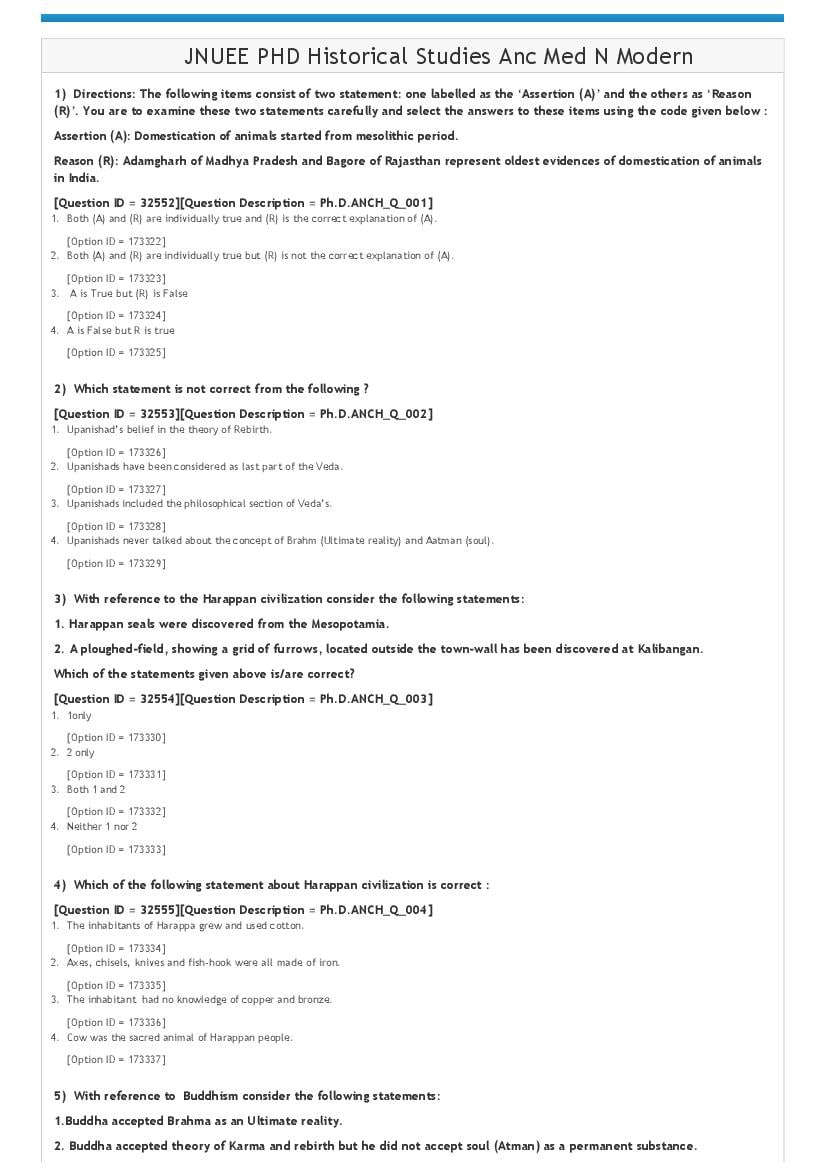
1) Directions: The following items consist of two statement: one labelled as the ‘Assertion (A)’ and the others as ‘Reason
(R)’. You are to examine these two statements carefully and select the answers to these items using the code given below :
Assertion (A): Domestication of animals started from mesolithic period.
Reason (R): Adamgharh of Madhya Pradesh and Bagore of Rajasthan represent oldest evidences of domestication of animals
in India.
[Question ID = 32552][Question Description = Ph.D.ANCH_Q_001]
1. Both (A) and (R) are individually true and (R) is the correct explanation of (A).
[Option ID = 173322]
2. Both (A) and (R) are individually true but (R) is not the correct explanation of (A).
[Option ID = 173323]
3. A is True but (R) is False
[Option ID = 173324]
4. A is False but R is true
[Option ID = 173325]
2) Which statement is not correct from the following ?
[Question ID = 32553][Question Description = Ph.D.ANCH_Q_002]
1. Upanishad’s belief in the theory of Rebirth.
[Option ID = 173326]
2. Upanishads have been considered as last part of the Veda.
[Option ID = 173327]
3. Upanishads included the philosophical section of Veda’s.
[Option ID = 173328]
4. Upanishads never talked about the concept of Brahm (Ultimate reality) and Aatman (soul).
[Option ID = 173329]
3) With reference to the Harappan civilization consider the following statements:
1. Harappan seals were discovered from the Mesopotamia.
2. A ploughed‐field, showing a grid of furrows, located outside the town‐wall has been discovered at Kalibangan.
Which of the statements given above is/are correct?
[Question ID = 32554][Question Description = Ph.D.ANCH_Q_003]
1. 1only
[Option ID = 173330]
2. 2 only
[Option ID = 173331]
3. Both 1 and 2
[Option ID = 173332]
4. Neither 1 nor 2
[Option ID = 173333]
4) Which of the following statement about Harappan civilization is correct :
[Question ID = 32555][Question Description = Ph.D.ANCH_Q_004]
1. The inhabitants of Harappa grew and used cotton.
[Option ID = 173334]
2. Axes, chisels, knives and fish‐hook were all made of iron.
[Option ID = 173335]
3. The inhabitant had no knowledge of copper and bronze.
[Option ID = 173336]
4. Cow was the sacred animal of Harappan people.
[Option ID = 173337]
5) With reference to Buddhism consider the following statements:
1.Buddha accepted Brahma as an Ultimate reality.
2. Buddha accepted theory of Karma and rebirth but he did not accept soul (Atman) as a permanent substance.
Page 2
[Question ID = 32556][Question Description = Ph.D.ANCH_Q_005]
1. 1only
[Option ID = 173338]
2. 2 only
[Option ID = 173339]
3. Both 1 and 2
[Option ID = 173340]
4. Neither 1 nor 2
[Option ID = 173341]
6) Which one of the statements is/are incorrect about Ashoka Rock Edicts?
[Question ID = 29841][Question Description = Ph.D.ANCH_Q_006]
1. Rock Edict I of Ashoka condemn animal sacrifices
[Option ID = 173342]
2. Rock Edict II mentions appointment of Rajjukas
[Option ID = 173343]
3. Rock Edict V mentions appointment of Dharma Mahamatras
[Option ID = 173344]
4. Rock Edict XIII refers to the Kalinga War
[Option ID = 173345]
7) Heliodorus worked as an Ambassador in the court of ?[Question ID = 29842][Question Description = Ph.D.ANCH_Q_007]
1. Pushyamitra Shunga [Option ID = 173346]
2. Chandraguta Mourya [Option ID = 173347]
3. Bhagabhadra [Option ID = 173348]
4. Chandragupta‐II [Option ID = 173349]
8) Directions: The following items consist of two statement: one labelled as the ‘Assertion (A)’ and the others as ‘Reason
(R)’. You are to examine these two statements carefully and select the answers to these items using the code given below :
Assertion (A): Chandragupta‐I established marriage relationship with Lichhavi’ princess Kumardevi.
Reason (R) : Chandragupta‐I wanted the help and support of Lichhavis through this marriage.
[Question ID = 29843][Question Description = Ph.D.ANCH_Q_008]
1. Both A and R are true and R is the correct explanation of A
[Option ID = 173350]
2. Both A and R are true but R is NOT the correct explanation of A
[Option ID = 173351]
3. A is true but R is false
[Option ID = 173352]
4. A is false but R is true
[Option ID = 173353]
9) Consider the following statements:
1. The Satavahanas have introduced ‘Potin’ currency in ancient India.
2. The purest gold coin has been found from the Kushana period.
Which of the statements given above is/are correct?
[Question ID = 29844][Question Description = Ph.D.ANCH_Q_009]
1. 1only
[Option ID = 173354]
2. 2 only
[Option ID = 173355]
3. Both 1 and 2
[Option ID = 173356]
4. Neither 1 nor 2
[Option ID = 173357]
10) Consider the following statements and choose incorrect about Indian Temple Architecture :
[Question ID = 29845][Question Description = Ph.D.ANCH_Q_010]
1. Garbhgriha (Sanctum Sanatorium) was the place of main deity in the temple.
Page 3
2. Gopuram/Gopura (Entrance gateway) was the specific traits of Dravidian Temple.
[Option ID = 173359]
3. The images of river goddesses, Ganga and Yamuna were common in the Nagara style temple while the sculptures of fierce dwarapals or door keeper
are found in Dravidian style of temple.
[Option ID = 173360]
4. The shape of the main temple tower is known as ‘Vimana’ in Nagara Style Temple.
[Option ID = 173361]
11) What is the ‘Panchayatana’ in Ancient India?
[Question ID = 29846][Question Description = Ph.D.ANCH_Q_011]
1. Group of five famous writers
[Option ID = 173362]
2. Group of five important deities.
[Option ID = 173363]
3. Types of worshiping
[Option ID = 173364]
4. Style of temple architecture
[Option ID = 173365]
12) What do you mean by ‘Udankuttam’ during Chola period:
[Question ID = 29847][Question Description = Ph.D.ANCH_Q_012]
1. Group of villages
[Option ID = 173366]
2. Group of high officers
[Option ID = 173367]
3. Tax imposed by state
[Option ID = 173368]
4. Coins
[Option ID = 173369]
13) Consider the following statements:
1.Adwait (Non‐dualism) philosophy of Shankaracharya accepted only Brahma as an Ultimate reality.
2. The philosophy of the unity of Brahma (Ultimate reality) and Jiva (soul) emerges from the Upanishads.
Which of the statements given above is/are correct?
[Question ID = 29848][Question Description = Ph.D.ANCH_Q_013]
1. 1only
[Option ID = 173370]
2. 2 only
[Option ID = 173371]
3. Both 1 and 2
[Option ID = 173372]
4. Neither 1 nor 2
[Option ID = 173373]
14) What is the common factor in both Brahmanical and Buddhist religion?
[Question ID = 29849][Question Description = Ph.D.ANCH_Q_014]
1. Both agreed soul as a permanent substance.
[Option ID = 173374]
2. Both agreed Brahma as an Ultimate reality.
[Option ID = 173375]
3. Both agreed on the concept of Karma and rebirth
[Option ID = 173376]
4. None of these
[Option ID = 173377]
15) Consider the following statements:
1. Kalidasa and Bharavi were contemporary to each other’s.
2. Aihole stone inscription, located in Karnataka, mentioned both of them, Bharavi and Kalidasa.
Which of the statements given above is/are correct?
Page 4
1. 1only
[Option ID = 173378]
2. 2 only
[Option ID = 173379]
3. Both 1 and 2
[Option ID = 173380]
4. Neither 1 nor 2
[Option ID = 173381]
16) Who were the contemporary of Kanishka?[Question ID = 29851][Question Description = Ph.D.ANCH_Q_016]
1. Aaryabhatta, Charak, Brahmgupta [Option ID = 173382]
2. Ashvaghosa, Nagarjuna, Vasumitra [Option ID = 173383]
3. Hsuan‐Tsang, Banabhatta, Divakar Mishra [Option ID = 173384]
4. Dhanvantari, Shanku, Amarsingh [Option ID = 173385]
17) Which of the following was not worshipped in Indus Valley civilization?[Question ID = 29852][Question Description =
Ph.D.ANCH_Q_017]
1. Mother Goddess [Option ID = 173386]
2. Peepal Tree [Option ID = 173387]
3. Pashupati [Option ID = 173388]
4. Krishna [Option ID = 173389]
18) With reference to the Indus Valley civilization consider the following statements:
1. Cities were usually divided into two or more parts. The part to the East was smaller but higher. Archaeologists describe
this as the citadel. The part to the west was larger but lower. This is called the lower town.
2. In some cities, special buildings were constructed on the citadel. For example, in Mohenjodaro, a very special tank,
which archaeologists call the Great Bath, was built in this area.
3. Cities such as Kalibangan and Lothal had fire altars, where sacrifices may have been performed. And some cities like
Mohenjodaro, Harappa, and Lothal had elaborate store‐houses.
Select the answer from the codes given below.
[Question ID = 29853][Question Description = Ph.D.ANCH_Q_018]
1. Only 1
[Option ID = 173390]
2. (2) and (3)
[Option ID = 173391]
3. (1) and (3)
[Option ID = 173392]
4. (1) (2) and (3)
[Option ID = 173393]
19) Consider the following statements regarding Vedas:
1. Rig‐Veda is a collection of hymns.
2. Samveda is shortest of all the four Vedas and is connected with the Rigveda. It is a collection of songs mostly taken from
Rig Veda.
3. Atharvaveda contains spells for healing various illnesses, spells for removal of demons, love spells, and speculative hymns
about particular forces of the cosmos.
Select the answer from the codes given below.
[Question ID = 29854][Question Description = Ph.D.ANCH_Q_019]
1. Only (1)
[Option ID = 173394]
2. Only (2)
[Option ID = 173395]
3. (1) (2) and (3)
[Option ID = 173396]
4. (2) and (3) Only
[Option ID = 173397]
20) Who wrote the book ‘Return of the Aryans’?[Question ID = 29855][Question Description = Ph.D.ANCH_Q_020]
1. Bhagwan S. Gidwani [Option ID = 173398]
2. R.S. Sharma [Option ID = 173399]
3. Avinash Chandra Das [Option ID = 173400]
Page 5
21) The river Beas was known during the Vedic period as [Question ID = 29856][Question Description = Ph.D.ANCH_Q_021]
1. Askini [Option ID = 173402]
2. Vipas [Option ID = 173403]
3. Purushni [Option ID = 173404]
4. Sindu [Option ID = 173405]
22) How many times does the word ‘Jana’ occur in the Rig Veda[Question ID = 29857][Question Description =
Ph.D.ANCH_Q_022]
1. 272 [Option ID = 173406]
2. 273 [Option ID = 173407]
3. 274 [Option ID = 173408]
4. 275 [Option ID = 173409]
23) Which of the following was not a distinguished tribe of early Vedic age?[Question ID = 29858][Question Description =
Ph.D.ANCH_Q_023]
1. Kurus [Option ID = 173410]
2. Matsyas [Option ID = 173411]
3. Bharatas [Option ID = 173412]
4. Krivis [Option ID = 173413]
24) With reference to the cultural history of India, consider the following pairs:
1. Parivrajaka – Renunciant and Wanderer
2. Shramana – followers of Vedic rites.
3. Upasaka‐ Lay follower of Buddhism
4. Pradakshina ‐ circumambulation
Select the answer from the codes given below.
[Question ID = 34030][Question Description = Ph.D.ANCH_Q_024]
1. Only (1)
[Option ID = 173414]
2. Only (2)
[Option ID = 173415]
3. (1) (3) and (4) only
[Option ID = 173416]
4. (1) and (2) Only
[Option ID = 173417]
25) Which one of the following post Vedic Upanishads was the first to deal with the concept of Trimurti ?[Question ID =
34031][Question Description = Ph.D.ANCH_Q_025]
1. Kena Upanishad [Option ID = 173418]
2. Maitrayana Upanishad [Option ID = 173419]
3. Aitareya Upanishad [Option ID = 173420]
4. Mukhya Upanishad [Option ID = 173421]
26) Which one of the following heterodox teachers of the post Vedic‐period is considered as predecessor of the Vaisesika
school of philosophy [Question ID = 34032][Question Description = Ph.D.ANCH_Q_026]
1. Pakudha Katyayana [Option ID = 173422]
2. Gautama [Option ID = 173423]
3. Nigantha Nataputta [Option ID = 173424]
4. Ajita Kesakambalin [Option ID = 173425]
27) Which of the following statements about the second Buddhist council is/are not true?
1.It was held in the fourth century BC.
2. Its purpose was to decide the controversy between the Vajji monks and their opponents.
3. It resulted in the first division of Buddhists into Sthaviravadins and Mahasanghikas.
4. It started the practice of sending missionaries to different parts of the world to propagate Buddhism.
Select the answer from the codes given below.
[Question ID = 34033][Question Description = Ph.D.ANCH_Q_027]
1. (1) and (2) Only
[Option ID = 173426]
2. (2) and (3) Only
[Option ID = 173427]
3. (3) and (4) Only
Page 6
4. Only (4) Only
[Option ID = 173429]
28) Which of the following dynasties patronised Buddhism?[Question ID = 34034][Question Description =
Ph.D.ANCH_Q_028]
1. Sungas [Option ID = 173430]
2. Kanvas [Option ID = 173431]
3. Indo‐Greeks [Option ID = 173432]
4. Satavahanas [Option ID = 173433]
29) ‘Just as for my children, I desire that they should enjoy all happiness and prosperity both in this world and the next. So
for all men I desire the like happiness and prosperity.’ This is stated in
[Question ID = 34035][Question Description = Ph.D.ANCH_Q_029]
1. Barabar Cave Inscription
[Option ID = 173434]
2. Minor Rock Edicts
[Option ID = 173435]
3. Tarai Pillars
[Option ID = 173436]
4. Kalinga Inscription
[Option ID = 173437]
30) Which of the following Jaina principles' is/are said to be the original contribution of Mahavira?
[Question ID = 34036][Question Description = Ph.D.ANCH_Q_030]
1. Observing continence
[Option ID = 173438]
2. Nonviolence and truth
[Option ID = 173439]
3. No property
[Option ID = 173440]
4. No stealing
[Option ID = 173441]
31) Which one of the following books of ancient India has mentions love story of the son of the founder of Sunga dynasty?
[Question ID = 34037][Question Description = Ph.D.ANCH_Q_031]
1. Swapnavasavadatta
[Option ID = 173442]
2. Malavikagnimitra
[Option ID = 173443]
3. Meghadoota
[Option ID = 173444]
4. Ratnavali
[Option ID = 173445]
32) Which one of the following schools of philosophy represented Bhagavatism?[Question ID = 34038][Question Description
= Ph.D.ANCH_Q_032]
1. Dvaita [Option ID = 173446]
2. Advaita [Option ID = 173447]
3. Visishtadvaita [Option ID = 173448]
4. Dvaitadvaita [Option ID = 173449]
33) The earliest name of the Mahabharata is [Question ID = 34039][Question Description = Ph.D.ANCH_Q_033]
1. Bharata [Option ID = 173450]
2. Maha Samhita [Option ID = 173451]
3. Jaya Samhita [Option ID = 173452]
4. Vijaya Samhita [Option ID = 173453]
34) Bhagavatism had accepted many concepts of Vedic religion, except one. What is that?[Question ID = 34040][Question
Description = Ph.D.ANCH_Q_034]
1. The doctrine of samsara. [Option ID = 173454]
2. Vedic religion as divine revelation. [Option ID = 173455]
3. Sacrificial ritual as divine revelation. [Option ID = 173456]
4. Sacrificial ritual as the only means of salvation. [Option ID = 173457]
Page 7
Ph.D.ANCH_Q_035]
1. Sambhu [Option ID = 173458]
2. Bhutapati [Option ID = 173459]
3. Shulapani [Option ID = 173460]
4. Hari [Option ID = 173461]
36)
Who is the author of the text Tantraloka?
[Question ID = 34042][Question Description = Ph.D.ANCH_Q_036]
1. Abhinavgupta
[Option ID = 173462]
2. Rajashekhara
[Option ID = 173463]
3. Govindasvami
[Option ID = 173464]
4. Adi Shankara
[Option ID = 173465]
37) The author of Mudrarakshasa is[Question ID = 34043][Question Description = Ph.D.ANCH_Q_037]
1. Bana [Option ID = 173466]
2. Bhoja [Option ID = 173467]
3. Yaska [Option ID = 173468]
4. Vishakadatta [Option ID = 173469]
38) The oldest extant text dealing primarily with etymology is
[Question ID = 34044][Question Description = Ph.D.ANCH_Q_038]
1. Ashtadhyayi
[Option ID = 173470]
2. Mahabhasya
[Option ID = 173471]
3. Nirukta
[Option ID = 173472]
4. Chanda
[Option ID = 173473]
39) Of the following, the ideas of schools whose texts have not survived include:
[Question ID = 34045][Question Description = Ph.D.ANCH_Q_039]
1. Charvaka
[Option ID = 173474]
2. Vaisheshika
[Option ID = 173475]
3. Uttara mimamsa
[Option ID = 173476]
4. Poorva mimamsa
[Option ID = 173477]
40) Krishi Parashara is a
[Question ID = 34046][Question Description = Ph.D.ANCH_Q_040]
1. Sanskrit text composed sometime between 3rd and 6th century in today’s Maharashtra
[Option ID = 173478]
2. Sanskrit text composed sometime between 6th and 11th century in today’s Bengal
[Option ID = 173479]
3. Sanskrit text composed sometime between 6th and 11th century in today’s Uttar Pradesh
[Option ID = 173480]
4. Sansfeirt text composed in 9th century kerala
[Option ID = 173481]
41) Harshacharita is
1. a biography of Harshavardhana
2. written by Banabhatta
Page 8
[Question ID = 34047][Question Description = Ph.D.ANCH_Q_041]
1. 2 Only
[Option ID = 173482]
2. 1 and 2 Only
[Option ID = 173483]
3. 2 and 3 Only
[Option ID = 173484]
4. 3 and 1 Only
[Option ID = 173485]
42) Lothal is known for discoveries of
1. One of the earliest rulers, an ivory one, with very minute and precise calibration
2. One of the earliest compasses, a shell compass
3. One of the earliest planned docks
[Question ID = 34048][Question Description = Ph.D.ANCH_Q_042]
1. 1,2 and 3
[Option ID = 173486]
2. 1 and 2 but not 3
[Option ID = 173487]
3. 2 and 3 but not 1
[Option ID = 173488]
4. 3 and 1 but not 2
[Option ID = 173489]
43) Evidence for rice cultivation in today’s India[Question ID = 34049][Question Description = Ph.D.ANCH_Q_043]
1. Does not date to a period before 1500 BCE [Option ID = 173490]
2. Does not date to a period before 1900 BCE [Option ID = 173491]
3. Does not date to a period before 2600 BCE [Option ID = 173492]
4. None of the above [Option ID = 173493]
44) Preservation of royal archives in Indian cities in mentioned by [Question ID = 29859][Question Description =
Ph.D.ANCH_Q_044]
1. Xuanzang [Option ID = 173494]
2. Mentioned in the Arthasastra [Option ID = 173495]
3. Neither 1 nor 2 [Option ID = 173496]
4. Both 1 and 2 [Option ID = 173497]
45) The destruction of Nalanda (accompanied by burning of an estimated 9 million manuscripts) by an army led by
Bakhtiyar Khilji took place in the year
[Question ID = 29860][Question Description = Ph.D.ANCH_Q_045]
1. 1093
[Option ID = 173498]
2. 1193
[Option ID = 173499]
3. 1127
[Option ID = 173500]
4. 1227
[Option ID = 173501]
46) Kashmir’s cultural history begins from[Question ID = 29861][Question Description = Ph.D.ANCH_Q_046]
1. 1947 [Option ID = 173502]
2. 1846 [Option ID = 173503]
3. 1200 [Option ID = 173504]
4. several millennia before 1200 [Option ID = 173505]
47) Radiocarbon dating came into existence in[Question ID = 29862][Question Description = Ph.D.ANCH_Q_047]
1. 1913 [Option ID = 173506]
2. 1931 [Option ID = 173507]
3. 1949 [Option ID = 173508]
4. 1963 [Option ID = 173509]
48) Which of the following are the names of dating methods
1. Electron spin resonance
Page 9
3. Dendrochronology
4. Uranium series
[Question ID = 29863][Question Description = Ph.D.ANCH_Q_048]
1. All of the above
[Option ID = 173510]
2. 3 and 4
[Option ID = 173511]
3. 3 and 2
[Option ID = 173512]
4. 1, 2 and 4
[Option ID = 173513]
49) The start to the process of Integral calculus can be attributed to
[Question ID = 29864][Question Description = Ph.D.ANCH_Q_049]
1. Gottfried Wilhelm Leibniz
[Option ID = 173514]
2. Madhava
[Option ID = 173515]
3. Isaac Newton
[Option ID = 173516]
4. Srinivasa Ramanujan
[Option ID = 173517]
50) The script which originated and developed in Kashmir is called[Question ID = 29865][Question Description =
Ph.D.ANCH_Q_050]
1. Grantha [Option ID = 173518]
2. Siddhamatrika [Option ID = 173519]
3. Nagari [Option ID = 173520]
4. Sharada [Option ID = 173521]
51) The 7th‐century Kudumiyamalai inscription is famous for
[Question ID = 29866][Question Description = Ph.D.ANCH_Q_051]
1. Listing the different kings of Chola empire
[Option ID = 173522]
2. Listing the methods of crop harvesting
[Option ID = 173523]
3. Listing taxes
[Option ID = 173524]
4. Listing musical notes
[Option ID = 173525]
52) Amongst the oldest archaeological evidence for what might have been an ancient theatre is associated with
1.Sitabenga cave 2.Ramgarh hill 3.Sitagarh cave 4. Rambenga hill 5. Chattisgarh 6. Tamil Nadu [Question ID = 29867]
[Question Description = Ph.D.ANCH_Q_052]
1. 1, 3, 5 [Option ID = 173526]
2. 1, 2, 5 [Option ID = 173527]
3. 1, 2, 6 [Option ID = 173528]
4. 2, 3, 6 [Option ID = 173529]
53) Permian, Carboniferous, Devonian, Silurian, Ordovician are part of:
[Question ID = 29868][Question Description = Ph.D.ANCH_Q_053]
1. Mesozoic
[Option ID = 173530]
2. Cenozoic
[Option ID = 173531]
3. Palaeozoic
[Option ID = 173532]
4. Pre‐cambrian
[Option ID = 173533]
54) Jodhpura is on the banks of
Page 10
1. Narmada
[Option ID = 173534]
2. Sahibi
[Option ID = 173535]
3. Berach
[Option ID = 173536]
4. Tungabhadra
[Option ID = 173537]
55) As of 2019, the oldest and largest Sindhu Saraswati (Indus Valley) sites are [Question ID = 29870][Question Description
= Ph.D.ANCH_Q_055]
1. Mehrgarh and Harappa respectively [Option ID = 173538]
2. Rakhigarhi and Bhiranna respectively [Option ID = 173539]
3. Bhiranna and Rakhigarhi respectively [Option ID = 173540]
4. Mohenjodaro and Bhiranna respectively [Option ID = 173541]
56) Banawali is a fortified site in today’s[Question ID = 29871][Question Description = Ph.D.ANCH_Q_056]
1. Himachal Pradesh [Option ID = 173542]
2. Rajasthan [Option ID = 173543]
3. Madhya Pradesh [Option ID = 173544]
4. Haryana [Option ID = 173545]
57) Places on what is referred to as Dakshinapatha usually include:
[Question ID = 29872][Question Description = Ph.D.ANCH_Q_057]
1. Mosali, Suvarnagiri, Kanchipuram, Kaveripattinam, Potana [Option ID = 173546]
2. Muchiri, Madurai, Kaveripattinam, Kanchipuram, Sopara [Option ID = 173547]
3. Kaushambhi, Ujjaini, Mahismati, Pratishthana, Bharukachchaa [Option ID = 173548]
4. Bhojakata, Potana, Mosali, Suvarnagiri, Kanchipuram [Option ID = 173549]
58) Nikkha, Kamsa, Pada, Masaka, Kakanika are connected to[Question ID = 29873][Question Description =
Ph.D.ANCH_Q_058]
1. Coins [Option ID = 173550]
2. Marriages [Option ID = 173551]
3. Musical instruments [Option ID = 173552]
4. Weapons [Option ID = 173553]
59) Which of the following contains a narration of the conquest by Mohammed Bin Qasim
[Question ID = 29874][Question Description = Ph.D.ANCH_Q_059]
1. Shahnama
[Option ID = 173554]
2. Gulistan
[Option ID = 173555]
3. Chachnama
[Option ID = 173556]
4. Rigunama
[Option ID = 173557]
60) At Dwarka, the remains of a submerged port‐city, including fortification walls and stone anchors, perhaps go back to:
[Question ID = 29875][Question Description = Ph.D.ANCH_Q_060]
1. 300 BCE [Option ID = 173558]
2. 700 BCE [Option ID = 173559]
3. 900 BCE [Option ID = 173560]
4. 1500 BCE [Option ID = 173561]
61) Processualism is
[Question ID = 29876][Question Description = Ph.D.ANCH_Q_061]
1. allied to anthropology and emerged in 1960s
[Option ID = 173562]
2. related to linguistics and emerged in 1920s
[Option ID = 173563]
3. another, lesser‐used name for chronology
[Option ID = 173564]
4. a method for processing facts
[Option ID = 173565]
Page 11
1. Dukkha [Option ID = 173566]
2. Anichcha [Option ID = 173567]
3. Atthanga‐maga [Option ID = 173568]
4. Samudaya [Option ID = 173569]
63) The expert‐committee report ‘Palaeochannels of North West India: Review and Assessment (Report of the expert committee to
review available information on palaeochannels)’, released in the year 2016, deals also with the question of the historicity of the
ancient river:
[Question ID = 34070][Question Description = Ph.D.ANCH_Q_063]
1. Durga
[Option ID = 173570]
2. Lakshmi
[Option ID = 173571]
3. Vitasta
[Option ID = 173572]
4. Sarasvati
[Option ID = 173573]
64) Which one of the following historian contributed to the theoretical understanding of ‘Moral Economy’
[Question ID = 34071][Question Description = Ph.D.ANCH_Q_064]
1. Marc Bloch
[Option ID = 173574]
2. Eric Hobsbawm
[Option ID = 173575]
3. Christopher Hill
[Option ID = 173576]
4. E.P. Thomson
[Option ID = 173577]
65) Recent estimates of the present monetary value of resources drained from India by the British are in the order of:
[Question ID = 34072][Question Description = Ph.D.ANCH_Q_065]
1. US$ 45 million [Option ID = 173578]
2. US$ 45 billion [Option ID = 173579]
3. US$45 trillion [Option ID = 173580]
4. British did not drain any wealth from India [Option ID = 173581]
66) Which of the following are true about the Pulangurichi Inscriptions
1. Documents written in early vatteluttu script are related land grants
2. Datable to the 5th century AD
3. Discovered from Ramanad district of Tamil Nadu
4. Refers to a ruler, namely, Chendan Kurran
[Question ID = 34073][Question Description = Ph.D.ANCH_Q_066]
1. I, II, IV
[Option ID = 173582]
2. II, III, IV
[Option ID = 173583]
3. IV only
[Option ID = 173584]
4. All of the above
[Option ID = 173585]
67) The term penttati found mentioned in medieval Tamil inscriptions refers to ‐‐‐
[Question ID = 34074][Question Description = Ph.D.ANCH_Q_067]
1. Devaradiyar
[Option ID = 173586]
2. Dancing girls
[Option ID = 173587]
3. Royal women
[Option ID = 173588]
4. Service women associated with Palaces
[Option ID = 173589]
Page 12
B. Servile peasant II. Burton Stein
C. Peasant State III. Harbans Mukhiya
D. Integrative Polity IV. B.D.Chattopadhyaya
[Question ID = 34075][Question Description = Ph.D.ANCH_Q_068]
1. A‐IV, B‐III, C‐II, D‐I
[Option ID = 173590]
2. A‐IV, B‐II, C‐III, D‐I
[Option ID = 173591]
3. A‐III, B‐I, C‐II, D‐IV
[Option ID = 173592]
4. A‐I, B‐III, C‐II, D‐IV
[Option ID = 173593]
69) Read the following statements with regard to the famous “Brenner Debate” on the question of transition from
feudalism to capitalism in Europe and choose the correct answer
1.Brenner rejected Demographic model of M.M.Postan and E.L.Roy Ladurie
2. Brenner rejected Commercialization Model of Wallerstein
3. Brenner stressed on internal conflict and class struggle
4. To Brenner, large scale farming is a pre‐condition for capitalism
[Question ID = 34076][Question Description = Ph.D.ANCH_Q_069]
1. Only the statements 1, 3 and 4 are correct
[Option ID = 173594]
2. Only the statements 1 and 2 are correct
[Option ID = 173595]
3. Only the statement 4 is correct
[Option ID = 173596]
4. All the statements are correct
[Option ID = 173597]
70) “The Hindus do not pay much attention to the historical order of things and are careless in narrating the historical
succession of their rulers” Who made this observation? [Question ID = 34077][Question Description = Ph.D.ANCH_Q_070]
1. Abu’s Fazl‐i‐Bayhaqi [Option ID = 173598]
2. Ibn Khaldun [Option ID = 173599]
3. Al‐Biruni [Option ID = 173600]
4. Willam Jones [Option ID = 173601]
71) Which of the following statements about Military Slavery in Medieval India is wrong[Question ID = 34078][Question
Description = Ph.D.ANCH_Q_071]
1. A slave could become Sultan after the death of his master [Option ID = 173602]
2. Slaves had marital relationship with their Masters’ family [Option ID = 173603]
3. After the death of their masters, Slaves generally accepted their Masters’ sons as their new masters [Option ID = 173604]
4. Contemporary sources rarely give reference to progeny of military slaves. [Option ID = 173605]
72) LIST I LIST II
1. Self Respect Movement I. E.V.Ramaswamy
2. Pure Tamil Movement II. Ayyankali
3. Sree Narayana Dharma Paripalana Yogam III. Narayana Guru
4. Sadhu Jana Paripalana Sangam IV. Maraimalai Adigal
[Question ID = 34079][Question Description = Ph.D.ANCH_Q_072]
1. A‐IV, B‐III, C‐II, D‐I
[Option ID = 173606]
2. A‐III, B‐IV, C‐I, D‐II
[Option ID = 173607]
3. A‐I, B‐II, C‐III, D‐IV
[Option ID = 173608]
4. A‐I, B‐IV, C‐III, D‐II
[Option ID = 173609]
73) Read the following statements on ‘Materialist conception of History’ and choose the correct answers.
Page 13
spiritual processes of life.
2. It is not the consciousness of men that determines their being, but on the contrary, their social being determines their
consciousness.
3. The dominant ideas are nothing more than the ideal expression of the dominant material relationship.
4. It is being criticized for reducing man's motives to only material interests
[Question ID = 34080][Question Description = Ph.D.ANCH_Q_073]
1. All the statements are correct
[Option ID = 173610]
2. Only statements I, II and III are correct
[Option ID = 173611]
3. Only Statements, I and II are correct
[Option ID = 173612]
4. Only statement I is correct
[Option ID = 173613]
74) “Early India wrote no history because it never made any’. Who made this statement?[Question ID = 34081][Question
Description = Ph.D.ANCH_Q_074]
1. MacDonell [Option ID = 173614]
2. E.J.Rapson [Option ID = 173615]
3. Willam Jones [Option ID = 173616]
4. James Mill [Option ID = 173617]
75) Match the colonial administrators‐scholars with the region in which they engaged in collecting/documenting local
histories, narratives, bardic poems, etc 1. Colin Mackenzie i. South India 2. H Risly ii. Bengal 3. James Tod iii. Assam 4.
Edward Gait iv Rajasthan
[Question ID = 34082][Question Description = Ph.D.ANCH_Q_075]
1. 1‐iii, 2‐ii, 3‐iv, 4‐i
[Option ID = 173618]
2. 1‐iv, 2‐iii, 3‐i, 4‐ii
[Option ID = 173619]
3. 1‐ii, 2‐iii, 3‐i, 4‐iv
[Option ID = 173620]
4. 1‐i, 2‐ii, 3‐iv, 4‐iii
[Option ID = 175897]
76) Match List I with List II
List I List II
(Book/Theory proposed/Characteristic, etc.)
(Author/Thinker/Name of Theory, etc.)
A. E.H.Carr I. What is history?
B.R.G.Collingwood II. The Idea of History
III. Metahistory: The Historical Imagination in Nineteenth‐
C. Hayden White
Century Europe
D. Paul Recoeur IV. Memory, History, Forgetting
[Question ID = 34083][Question Description = Ph.D.ANCH_Q_076]
1. A‐i, B‐ii, C‐iii, D‐iv
[Option ID = 175898]
2. A‐i, B‐ii, C‐iv, D‐iii
[Option ID = 175899]
3. A‐i, B‐iv, C‐iii, D‐ii
[Option ID = 175900]
4. A‐ii, B‐i, C‐iii, D‐iv
[Option ID = 175901]
77) According to Uma Chakravarti, “The general subordination of women assumed a particularly severe form in India
through the powerful instrument of religious traditions which have shaped social practices.” By this the author
means[Question ID = 34084][Question Description = Ph.D.ANCH_Q_077]
1. Subordination of women had religious sanction [Option ID = 175902]
Page 14
3. Most women held a subservient position in society [Option ID = 175904]
4. All of the above [Option ID = 175905]
78) “The safeguarding of the caste structure is achieved through the highly restricted movement of women or even
through female seclusion. Women are regarded as gateways – literally points of entrance into the caste system.”
From the above statement, which ONE of the following statements is\are INCORRECT
[Question ID = 34085][Question Description = Ph.D.ANCH_Q_078]
1. maintenace of the caste system requires that women were controlled
[Option ID = 175906]
2. Female seclusion was a means to achieve caste purity
[Option ID = 175907]
3. The movement of women ended the caste system
[Option ID = 175908]
4. The purity of the caste system depended on women
[Option ID = 175909]
79) “The past and history float free of each other; they are ages and miles apart for the same object of enquiry can be
read differently by different historians; there are different interpretive readings over time and space; as far as history is
concerned historiography shows this.” The above statement means that: [Question ID = 34086][Question Description =
Ph.D.ANCH_Q_079]
1. The past and history are one and the same thing [Option ID = 175910]
2. The past belongs to history [Option ID = 175911]
3. Time and space do not determine an object of enquiry [Option ID = 175912]
4. Historiography suggests that there are different interpretive readings of the past [Option ID = 175913]
80) “No reading, even by the same person, can be guaranteed to produce the same effects repeatedly, which means that
authors cannot force their intentions/interpretations on the reader. Conversely, readers cannot fully fathom everything the
authors intend.” The above statement means that: [Question ID = 34087][Question Description = Ph.D.ANCH_Q_080]
1. Nothing can be known by reading [Option ID = 175914]
2. The intent of the author may not be fully known by the reader [Option ID = 175915]
3. A reader can, by reading repeatedly, understand an author [Option ID = 175916]
4. Authors intentions are fully fathomable [Option ID = 175917]
81) “Marx insisted that human history is not a number of different parallel histories, economic, political, artistic, religious,
and so on, but one single history. He conceived this unity not as an organic unity in which every thread of the developing
process preserved its own continuity as well as its intimate connexion with the others, but as a unity in which there was
only one continuous thread, that of economic history…” Following the above statement, for Marx, [Question ID = 34088]
[Question Description = Ph.D.ANCH_Q_081]
1. All history is a single history that is determined by the economic [Option ID = 175918]
2. There are different kinds of histories [Option ID = 175919]
3. There is an organic unity in the past [Option ID = 175920]
4. Different histories run parallel with one another [Option ID = 175921]
82) “The sciences of observation and experiment are alike in this, that their aim is to detect the constant or recurring
features in all events of a certain kind. A meteorologist studies one cylcone in order to compare it with others. But the
historian has no such aim.” From the above statement one can infer that: [Question ID = 29878][Question Description =
Ph.D.ANCH_Q_082]
1. There is a similarity in the aim of the sciences of observation and experiment [Option ID = 175922]
2. There is no similarity in the sciences of observation and experiment [Option ID = 175923]
3. Both historians and metorologists study cyclones [Option ID = 175924]
4. Historians rely on precise comparisons in their understanding of the past [Option ID = 175925]
83) “For many of the chroniclers of the Sulatanate period, history was not exactly a matter of investigated information but
one of received knowledge of the past, and of personal testimony and memory. Barani’s chief source of information was his
own vast knowledge and prodigious memory” From the above statement one can infer that during the Sultanate period
[Question ID = 29879][Question Description = Ph.D.ANCH_Q_083]
1. Chroniclers mainly wrote personal histories [Option ID = 175926]
2. Writing about the past depended on personal knowledge [Option ID = 175927]
3. Barani’s knowledge was carefully investigated [Option ID = 175928]
4. Texts from the past were not valued by chroniclers [Option ID = 175929]
84) “With respect to the recognition of the significance of the physical environment for the historic development of a
people, most conventional historians have devoted little attention to geographic factors; indeed, one may doubt if many
historians even yet are vividly conscious of their existence or potency.” From the above statement, which ONE of the
following statements is FALSE? [Question ID = 29880][Question Description = Ph.D.ANCH_Q_084]
1. Many historians are unaware of geographic factors when analysing the past [Option ID = 175930]
2. The physical environment is important to understand the development of a people in the past [Option ID = 175931]
3. The historic development of a people depends on the physical environment [Option ID = 175932]
Page 15
85) Intellectual history refers to:–[Question ID = 29881][Question Description = Ph.D.ANCH_Q_085]
1. a study of the transformations of ideas, beliefs and opinions held by the intellectual classes; [Option ID = 175934]
2. a study of people with high intellect [Option ID = 175935]
3. those aspects of history that appeal only to intellectuals [Option ID = 175936]
4. a study of the transformation of social processes [Option ID = 175937]
86) “The noblest art appeals to the intellect as well as to the feelings (as a symphony appeals to us not only by its
harmonies and sequences but by its structure and development); and this intellectual pleasure is the highest form of joy to
which a man can rise.” Based on the above sentence, one can infer that [Question ID = 29882][Question Description =
Ph.D.ANCH_Q_086]
1. Feelings get in the way of understanding art [Option ID = 175938]
2. Both the mind and heart are needed to appreciate art at its best [Option ID = 175939]
3. Intellectual pursuits are more important than enjoying art [Option ID = 175940]
4. Harmonies and sequences are more important than structure in a symphony [Option ID = 175941]
87) Which ONE of the following statements is/are FALSE?
In the Agrarian System of Mughal India, Irfan Habib argues that
[Question ID = 29883][Question Description = Ph.D.ANCH_Q_087]
1. The ruling classes and the peasantry were in a state of contradiction even as the state needed more revenues
[Option ID = 175942]
2. Sufis played an important role in the extension of agriculture
[Option ID = 175943]
3. There was widespread conflict between the peasants and the revenue appropriating ruling classes
[Option ID = 175944]
4. Economic tyranny rather than religion led to the fall of the Mughal empire
[Option ID = 175945]
88) “History, then, is a science, but a science of a special kind. It is a science whose business is to study events not
accessible to our observation, and to study these inferentially, arguing to them from something else which is accessible to
our observation, and which the historian calls ‘evidence’ for the events in which he is interested.” According to the
statement above, [Question ID = 29884][Question Description = Ph.D.ANCH_Q_088]
1. Historians use the scientific method in their understanding of the past [Option ID = 175946]
2. Historians employ direct observation as a method of analysis [Option ID = 175947]
3. Historians make inferences from evidence in order to understand the past [Option ID = 175948]
4. History and science are incompatible [Option ID = 175949]
89) Who among the following historians belonged to the Marxist School of Indian historiography?
[Question ID = 29885][Question Description = Ph.D.ANCH_Q_089]
1. D.D. Kosambi
[Option ID = 175950]
2. Nilkantha Shastri
[Option ID = 175951]
3. K.M. Ashraf
[Option ID = 175952]
4. Jadunath Sarkar
[Option ID = 175953]
90) Agency is the material and ideological effect of encounters between different actors..... Linda Nash uses the example
of tidewater rice cultivation on the Georgia coast in the United States to illustrate this point. This large‐scale hydraulic
system was not purely the result of the intentional acts of human agents, but the product of complex interactions between
humans and the environment, .... Similarly, Timothy Mitchell has shown how the building of the Aswan Dam, a landmark
technocratic development project in post‐war Egypt, was shaped and undermined by the humble mosquito.... In their
analysis agency is the result of the entanglement of these actors and their capacities, actions and behaviours. What is the
view this author takes of agency in history [Question ID = 29886][Question Description = Ph.D.ANCH_Q_090]
1. environment is at the centre of history [Option ID = 175954]
2. interaction between the environment and human and other zoological species [Option ID = 175955]
3. human agency is the ultimate force of history [Option ID = 175956]
4. None of the above. [Option ID = 175957]
91) The term ‘Urban revolution’ in the context of medieval India was first coined by[Question ID = 29887][Question
Description = Ph.D.ANCH_Q_091]
1. Irfan Habib [Option ID = 175958]
2. Elliot and Dawson [Option ID = 175959]
3. Muhammad Habib [Option ID = 175960]
4. Ashin Dasgupta [Option ID = 175961]
Page 16
[Question ID = 29888][Question Description = Ph.D.ANCH_Q_092]
1. The whole administrative structure was organized around land tenure [Option ID = 175962]
2. Peasants were attached to the land through intermediaries [Option ID = 175963]
3. There was a reduced use of money during the period [Option ID = 175964]
4. Surplus production remained with the peasants [Option ID = 175965]
93) Which is the incorrect pair?[Question ID = 29889][Question Description = Ph.D.ANCH_Q_093]
1. Rekha Misra – Women in Mughal India
[Option ID = 175966]
2. Ruby Lal ‐ Domesticity and power in the early Mughal world.
[Option ID = 175967]
3. Uma Chakravarti – Gendering Caste, Through a Feminist Lens
[Option ID = 175968]
4. A.S. Altekar – Life and conditions of the people of Hindustan
[Option ID = 175969]
94) Which one of the following statement is FALSE?[Question ID = 29890][Question Description = Ph.D.ANCH_Q_094]
1. Akbar was concerned about the practice of slavery very early in his reign [Option ID = 175970]
2. Akbar rejected the idea of child marriage [Option ID = 175971]
3. Akbar was appreciative of the inheritance that Muslim women received [Option ID = 175972]
4. Akbar showed reservations about the practice of sati [Option ID = 175973]
95) Which one of the following statements is FALSE?[Question ID = 29891][Question Description = Ph.D.ANCH_Q_095]
1. In the medieval period, Muslim women could be property owners [Option ID = 175974]
2. Muslim women could not divorce their husbands [Option ID = 175975]
3. Islamic law treated a woman as a legal person [Option ID = 175976]
4. There were terms of contract in a Muslim marriage that could protect a woman against bigamy and concubinage [Option ID = 175977]
96) Which ONE does not fit with the other three?[Question ID = 29892][Question Description = Ph.D.ANCH_Q_096]
1. Mirabai [Option ID = 175978]
2. Rudrama devi [Option ID = 175979]
3. Bahina bai [Option ID = 175980]
4. Lal Ded [Option ID = 175981]
97) Which ONE does not fit with the other three?[Question ID = 29893][Question Description = Ph.D.ANCH_Q_097]
1. Lutherans [Option ID = 175982]
2. Jesuits [Option ID = 175983]
3. Franciscans [Option ID = 175984]
4. Augustinians [Option ID = 175985]
98) Kesudas, Manohar, Basawan were ____________in the Mughal Court[Question ID = 29894][Question Description =
Ph.D.ANCH_Q_098]
1. Painters/artists [Option ID = 175986]
2. Writers [Option ID = 175987]
3. Builders [Option ID = 175988]
4. Landscape artists [Option ID = 175989]
99) Who was the author of Humayun‐Nama?
[Question ID = 29895][Question Description = Ph.D.ANCH_Q_099]
1. Gulbadan Begum [Option ID = 175990]
2. Humayun [Option ID = 175991]
3. Hamida Bano Begum [Option ID = 175992]
4. Mariam uz Zamani [Option ID = 175993]
100) The historians who set to work to ascertain all the facts they could which led to the increase of historical knowledge
were known as[Question ID = 29896][Question Description = Ph.D.ANCH_Q_100]
1. Positivists [Option ID = 175994]
2. Whigs [Option ID = 175995]
3. Empiricists [Option ID = 175996]
4. Marxists [Option ID = 175997]