GATE 2024 Syllabus for Agricultural Engineering
Finished viewing? Save it for later —
Download GATE 2024 Syllabus for Agricultural Engineering (PDF · 4 pages)About GATE 2024 Syllabus for Agricultural Engineering
GATE 2024 Syllabus for Agricultural Engineering is available here for free download. Published by IIT for GATE, this syllabus can be viewed online or downloaded as a PDF (4 pages). Candidates preparing for GATE can use GATE 2024 Syllabus for Agricultural Engineering to understand the exam pattern, the type of questions asked, and the overall difficulty level.
Frequently Asked Questions
How can I download GATE 2024 Syllabus for Agricultural Engineering?
Open this page and click the Download button to save GATE 2024 Syllabus for Agricultural Engineering as a PDF. It is completely free on AglaSem Docs.
Is GATE 2024 Syllabus for Agricultural Engineering free to download?
Yes. GATE 2024 Syllabus for Agricultural Engineering can be viewed online and downloaded as a PDF free of cost on AglaSem Docs.
How many pages does GATE 2024 Syllabus for Agricultural Engineering have?
GATE 2024 Syllabus for Agricultural Engineering contains 4 pages, which you can read online or download together as a single PDF.
Where can I find more GATE study material?
You can find more GATE question papers, sample papers, syllabus, and answer keys on AglaSem Docs.
GATE 2024 Syllabus for Agricultural Engineering – Text
Read the full text of this syllabus below — useful to quickly search, copy and reference the content online without downloading the PDF.
📄 View text version (4 pages)
Page 1
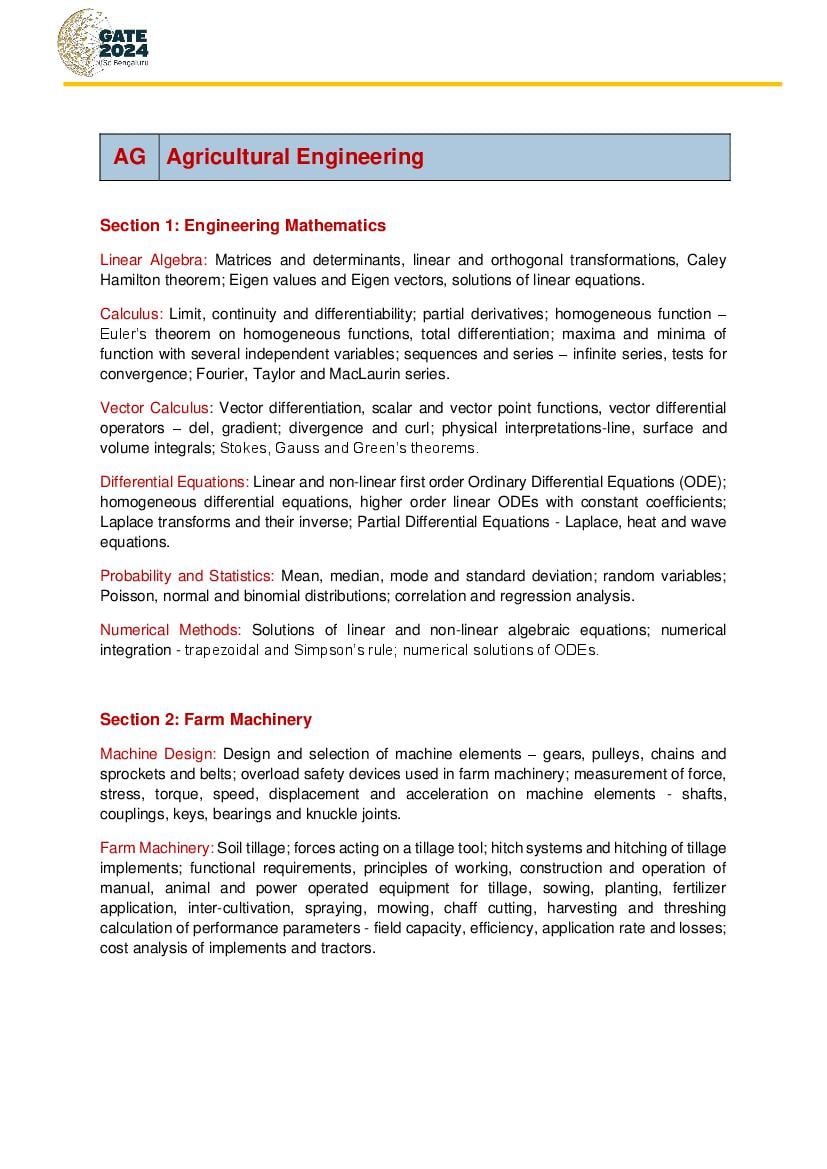
Section 1: Engineering Mathematics
Linear Algebra: Matrices and determinants, linear and orthogonal transformations, Caley
Hamilton theorem; Eigen values and Eigen vectors, solutions of linear equations.
Calculus: Limit, continuity and differentiability; partial derivatives; homogeneous function –
Euler’s theorem on homogeneous functions, total differentiation; maxima and minima of
function with several independent variables; sequences and series – infinite series, tests for
convergence; Fourier, Taylor and MacLaurin series.
Vector Calculus: Vector differentiation, scalar and vector point functions, vector differential
operators – del, gradient; divergence and curl; physical interpretations-line, surface and
volume integrals; Stokes, Gauss and Green’s theorems.
Differential Equations: Linear and non-linear first order Ordinary Differential Equations (ODE);
homogeneous differential equations, higher order linear ODEs with constant coefficients;
Laplace transforms and their inverse; Partial Differential Equations - Laplace, heat and wave
equations.
Probability and Statistics: Mean, median, mode and standard deviation; random variables;
Poisson, normal and binomial distributions; correlation and regression analysis.
Numerical Methods: Solutions of linear and non-linear algebraic equations; numerical
integration - trapezoidal and Simpson’s rule; numerical solutions of ODEs.
Section 2: Farm Machinery
Machine Design: Design and selection of machine elements – gears, pulleys, chains and
sprockets and belts; overload safety devices used in farm machinery; measurement of force,
stress, torque, speed, displacement and acceleration on machine elements - shafts,
couplings, keys, bearings and knuckle joints.
Farm Machinery: Soil tillage; forces acting on a tillage tool; hitch systems and hitching of tillage
implements; functional requirements, principles of working, construction and operation of
manual, animal and power operated equipment for tillage, sowing, planting, fertilizer
application, inter-cultivation, spraying, mowing, chaff cutting, harvesting and threshing
calculation of performance parameters - field capacity, efficiency, application rate and losses;
cost analysis of implements and tractors.
Page 2
Sources of Power: Sources of power on the farm - human, animal, mechanical, electrical,
wind,
solar and biomass; bio-fuels.
Farm Power: Thermodynamic principles of I.C. engines; I.C. engine cycles; engine
components;
fuels and combustion; lubricants and their properties; I.C. engine systems – fuel, cooling,
lubrication, ignition, electrical, intake and exhaust; selection, operation, maintenance and
repair of I.C. engines; power efficiencies and measurement; calculation of power, torque, fuel
consumption, heat load and power losses; performance index, cost analysis of implements
and tractors.
Tractors and Power tillers: Type, selection, maintenance and repair of tractors and power
tillers;
tractor clutches and brakes; power transmission systems – gear trains, differential, final drives
and power take-off; mechanics of tractor chassis; traction theory; three point hitches - free link
and restrained link operations; steering and hydraulic control systems used in tractors; tractor
tests and performance; human engineering and safety considerations in design of tractor and
agricultural implements.
Section 4: Soil and Water Conservation Engineering
Fluid Mechanics: Ideal and real fluids, properties of fluids; hydrostatic pressure and its
measurement; continuity equation, kinematics and dynamics of flow; Bernoulli’s theorem;
laminar and turbulent flow in pipes, Darcy- Weisbach and Hazen-Williams equations, Moody’s
diagram; flow through orifices, weirs and notches; flow in open channels, dimensional analysis
– concepts of geometric dimensionless numbers.
Soil Mechanics: Engineering properties of soils; fundamental definitions and relationships;
index properties of soils; permeability and seepage analysis; shear strength, Mohr’s circle of
stress, active and passive earth pressures; stability of slopes, Terzaghi’s one dimensional soil
consolidation theory.
Hydrology: Hydrological cycle and measurement of its components; meteorological
parameters and their measurement; analysis of precipitation data; runoff estimation;
hydrograph analysis, unit hydrograph theory and application; stream flow measurement; flood
routing, hydrological reservoir and channel routing, Infiltration – indices and equations,
drought and its classification.
Page 3
levelling; chain surveying, methods of traversing; measurement of angles and bearings, plane
table surveying; types of levelling; the odolite traversing; contouring; total station, introduction
to GPS survey, computation of areas and volume.
Soil and Water Erosion: Mechanics of soil erosion - wind and water erosion: soil erosion types,
factors affecting erosion; soil loss estimation; biological and engineering measures to control
erosion; terraces and bunds; vegetative waterways; gully control structures, drop, drop inlet
and chute spillways; earthen dams.
Watershed Management: Watershed characterization and land use capability classification;
water budgeting in watershed, rainwater harvesting, check dams and farm ponds.
Section 5: Irrigation and Drainage Engineering
Soil-Water-Plant Relationship: Water requirement of crops; consumptive use and
evapotranspiration; measurement of infiltration, soil moisture and irrigation water infiltration.
Irrigation Water Conveyance and Application Methods: Design of irrigation channels and
underground pipelines; irrigation scheduling; surface, sprinkler and micro irrigation methods,
design and evaluation of irrigation methods; irrigation efficiencies.
Agricultural Drainage: Drainage coefficient; planning, design and layout of surface and sub-
surface drainage systems; leaching requirement and salinity control; irrigation and drainage
water quality and reuse; non-conventional drainage system.
Groundwater Hydrology: Groundwater occurrence; Darcy’s Law, steady and unsteady flow in
confined and unconfined aquifers, groundwater exploration techniques; overview of
groundwater recharge estimation and artificial recharge techniques.
Wells and Pumps: Types of wells, steady flow through wells; design and construction of water
wells; classification of pumps; pump characteristics; pump selection and installation.
Section 6: Agricultural Process Engineering
Engineering properties of agriculture produce: Physical, thermal, frictional, rheological and
electrical properties.
Evaporation and Drying: Concentration and drying of liquid foods – evaporators, tray, drum
and spray dryers; hydrothermal treatments; drying and milling of cereals, pulses and oilseeds;
drying kinetics; psychrometry – properties of air-water vapor mixture.
Size Reduction and Material Handling: Mechanics and energy requirement in size reduction
of agriculture produce; particle size analysis for comminuted solids; size separation by
screening; fluidization of granular solids-pneumatic, bucket, screw and belt conveying;
cleaning and grading; effectiveness of separation; centrifugal separation of solids, liquids and
gases; homogenization; filtration and membrane separation.
Page 4
addition of agriculture produce.
Storage Systems: Controlled and modified atmosphere storage; perishable food storage,
godowns, bins and grain silos, packaging material and machines.
Section 7: Dairy and Food Engineering
Heat and Mass Transfer: Steady state heat transfer in conduction, convection and radiation;
transient heat transfer in simple geometry; working principles of heat exchangers; diffusive
and convective mass transfer; simultaneous heat and mass transfer in agricultural processing
operations; material and energy balances in food processing systems; water activity, sorption
and desorption isotherms.
Preservation of Food: Kinetics of microbial death – pasteurization and sterilization of milk and
other liquid foods; preservation of food by cooling and freezing; refrigeration and cold storage
basics and applications.
Document Details
| Board / Org | IIT |
| Exam | GATE |
| Type | Syllabus |
| Pages | 4 |
| Updated | 22 Jul 2026 |