UGC NET 2021 Question Paper Economics
Finished viewing? Save it for later —
Download UGC NET 2021 Question Paper Economics (PDF · 56 pages)About UGC NET 2021 Question Paper Economics
UGC NET 2021 Question Paper Economics is available here for free download. Published by NTA for UGC NET, this question paper can be viewed online or downloaded as a PDF (56 pages). Candidates preparing for UGC NET can use UGC NET 2021 Question Paper Economics to understand the exam pattern, the type of questions asked, and the overall difficulty level.
Frequently Asked Questions
How can I download UGC NET 2021 Question Paper Economics?
Open this page and click the Download button to save UGC NET 2021 Question Paper Economics as a PDF. It is completely free on AglaSem Docs.
Is UGC NET 2021 Question Paper Economics free to download?
Yes. UGC NET 2021 Question Paper Economics can be viewed online and downloaded as a PDF free of cost on AglaSem Docs.
How many pages does UGC NET 2021 Question Paper Economics have?
UGC NET 2021 Question Paper Economics contains 56 pages, which you can read online or download together as a single PDF.
Where can I find more UGC NET study material?
You can find more UGC NET question papers, sample papers, syllabus, and answer keys on AglaSem Docs.
UGC NET 2021 Question Paper Economics – Text
Read the full text of this question paper below — useful to quickly search, copy and reference the content online without downloading the PDF.
📄 View text version (56 pages)
Page 1
Topic:‐ GP_24NOV_A
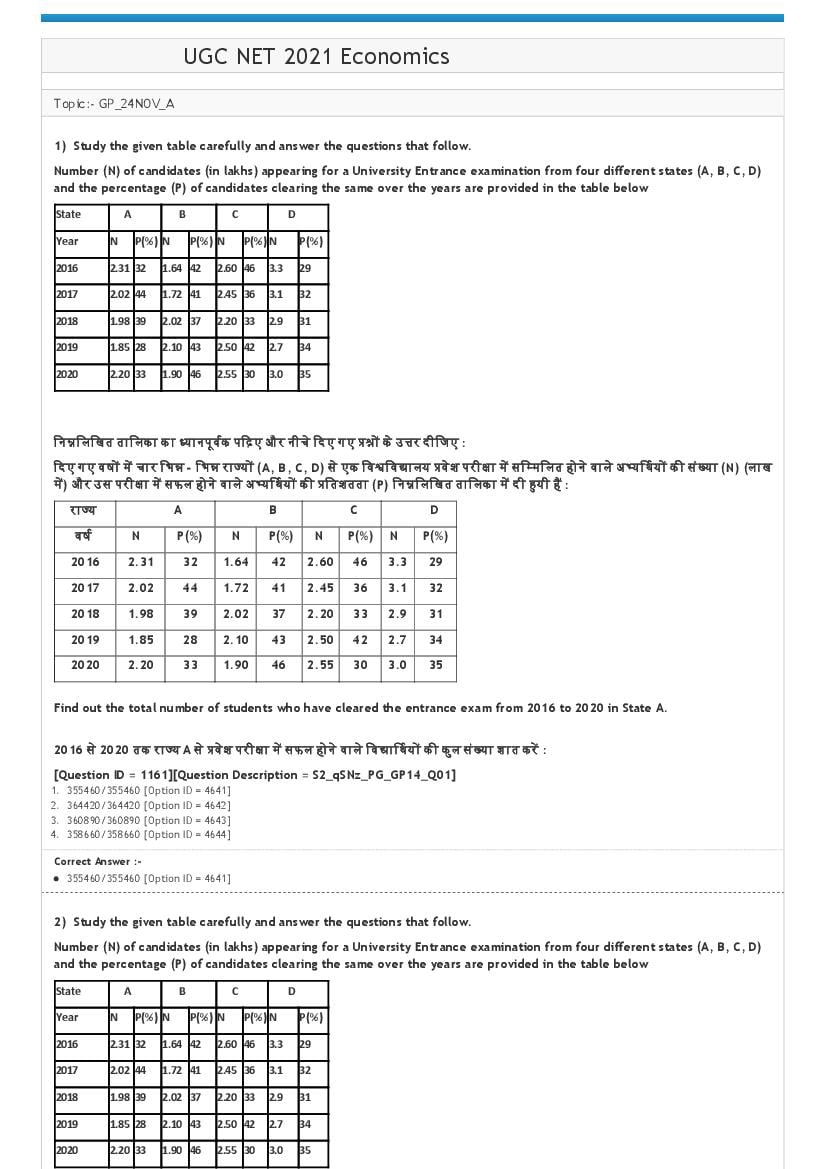
1) Study the given table carefully and answer the questions that follow.
Number (N) of candidates (in lakhs) appearing for a University Entrance examination from four different states (A, B, C, D)
and the percentage (P) of candidates clearing the same over the years are provided in the table below
State A B C D
Year N P(%) N P(%) N P(%) N P(%)
2016 2.31 32 1.64 42 2.60 46 3.3 29
2017 2.02 44 1.72 41 2.45 36 3.1 32
2018 1.98 39 2.02 37 2.20 33 2.9 31
2019 1.85 28 2.10 43 2.50 42 2.7 34
2020 2.20 33 1.90 46 2.55 30 3.0 35
िन िलिखत तािलका क ा यानपू व क प ढ़ए औ र नीचे द ए ग ए के उ र दीिजए :
द ए ग ए व ष म चार िभ ‐ िभ रा य (A, B, C, D) से ए क िव िव ालय वे श परी ा म सि मिलत होने वाले अ य थय क सं या (N) (ल ा ख
म ) औ र उ स परी ा म सफल होने वाले अ य थय क ितशतता (P) िन िलिखत तािलका म द ी य ी ह :
रा य A B C D
वष N P(%) N P(%) N P(%) N P(%)
2016 2.31 32 1.64 42 2.60 46 3.3 29
2017 2.02 44 1.72 41 2.45 36 3.1 32
2018 1.98 39 2.02 37 2.20 33 2.9 31
2019 1.85 28 2.10 43 2.50 42 2.7 34
2020 2.20 33 1.90 46 2.55 30 3.0 35
Find out the total number of students who have cleared the entrance exam from 2016 to 2020 in State A.
2016 से 2020 त क रा य A से वे श परी ा म सफल होने वाले िव ा थय क कु ल सं या ा त कर :
[Question ID = 1161][Question Description = S2_qSNz_PG_GP14_Q01]
1. 355460/355460 [Option ID = 4641]
2. 364420/364420 [Option ID = 4642]
3. 360890/360890 [Option ID = 4643]
4. 358660/358660 [Option ID = 4644]
355460/355460 [Option ID = 4641]
2) Study the given table carefully and answer the questions that follow.
Number (N) of candidates (in lakhs) appearing for a University Entrance examination from four different states (A, B, C, D)
and the percentage (P) of candidates clearing the same over the years are provided in the table below
State A B C D
Year N P(%) N P(%) N P(%) N P(%)
2016 2.31 32 1.64 42 2.60 46 3.3 29
2017 2.02 44 1.72 41 2.45 36 3.1 32
2018 1.98 39 2.02 37 2.20 33 2.9 31
2019 1.85 28 2.10 43 2.50 42 2.7 34
2020 2.20 33 1.90 46 2.55 30 3.0 35
Page 2
द ए ग ए व ष म चार िभ ‐ िभ रा य (A, B, C, D) से ए क िव िव ालय वे श परी ा म सि मिलत होने वाले अ य थय क सं या (N) (ल ा ख
म ) औ र उ स परी ा म सफल होने वाले अ य थय क ितशतता (P) िन िलिखत तािलका म द ी य ी ह :
रा य A B C D
वष N P(%) N P(%) N P(%) N P(%)
2016 2.31 32 1.64 42 2.60 46 3.3 29
2017 2.02 44 1.72 41 2.45 36 3.1 32
2018 1.98 39 2.02 37 2.20 33 2.9 31
2019 1.85 28 2.10 43 2.50 42 2.7 34
2020 2.20 33 1.90 46 2.55 30 3.0 35
Find out the average number of students who qualified in 2020 (from all states).
2020 म (स भ ी रा य से) सफल होने वाले िव ा थय क औ स त सं या ा त कर :
[Question ID = 1162][Question Description = S2_qSNz_PG_GP14_Q02]
1. 84550/84550 [Option ID = 4645]
2. 86770/86770 [Option ID = 4646]
3. 85375/85375 [Option ID = 4647]
4. 84580/84580 [Option ID = 4648]
84550/84550 [Option ID = 4645]
3) Study the given table carefully and answer the questions that follow.
Number (N) of candidates (in lakhs) appearing for a University Entrance examination from four different states (A, B, C, D)
and the percentage (P) of candidates clearing the same over the years are provided in the table below
State A B C D
Year N P(%) N P(%) N P(%) N P(%)
2016 2.31 32 1.64 42 2.60 46 3.3 29
2017 2.02 44 1.72 41 2.45 36 3.1 32
2018 1.98 39 2.02 37 2.20 33 2.9 31
2019 1.85 28 2.10 43 2.50 42 2.7 34
2020 2.20 33 1.90 46 2.55 30 3.0 35
िन िलिखत तािलका क ा यानपू व क प ढ़ए औ र नीचे द ए ग ए के उ र दीिजए :
द ए ग ए व ष म चार िभ ‐ िभ रा य (A, B, C, D) से ए क िव िव ालय वे श परी ा म सि मिलत होने वाले अ य थय क सं या (N) (ल ा ख
म ) औ र उ स परी ा म सफल होने वाले अ य थय क ितशतता (P) िन िलिखत तािलका म द ी य ी ह :
रा य A B C D
वष N P(%) N P(%) N P(%) N P(%)
2016 2.31 32 1.64 42 2.60 46 3.3 29
2017 2.02 44 1.72 41 2.45 36 3.1 32
2018 1.98 39 2.02 37 2.20 33 2.9 31
2019 1.85 28 2.10 43 2.50 42 2.7 34
2020 2.20 33 1.90 46 2.55 30 3.0 35
Find out the difference between the total number of students who qualified in 2017 and the total number of students who
qualified in 2018 (from all states):
(स भ ी रा य से) 2017 म सफल होने वाले िव ा थय क कु ल सं या औ र 2018 म सफल होने वाले िव ा थय क कु ल सं या क ा अं त र ा त कर :
Page 3
1. 31750/31750 [Option ID = 4649]
2. 31880/31880 [Option ID = 4650]
3. 32220/32220 [Option ID = 4651]
4. 32340/32340 [Option ID = 4652]
31750/31750 [Option ID = 4649]
4) Study the given table carefully and answer the questions that follow.
Number (N) of candidates (in lakhs) appearing for a University Entrance examination from four different states (A, B, C, D)
and the percentage (P) of candidates clearing the same over the years are provided in the table below
State A B C D
Year N P(%) N P(%) N P(%) N P(%)
2016 2.31 32 1.64 42 2.60 46 3.3 29
2017 2.02 44 1.72 41 2.45 36 3.1 32
2018 1.98 39 2.02 37 2.20 33 2.9 31
2019 1.85 28 2.10 43 2.50 42 2.7 34
2020 2.20 33 1.90 46 2.55 30 3.0 35
िन िलिखत तािलका क ा यानपू व क प ढ़ए औ र नीचे द ए ग ए के उ र दीिजए :
द ए ग ए व ष म चार िभ ‐ िभ रा य (A, B, C, D) से ए क िव िव ालय वे श परी ा म सि मिलत होने वाले अ य थय क सं या (N) (ल ा ख
म ) औ र उ स परी ा म सफल होने वाले अ य थय क ितशतता (P) िन िलिखत तािलका म द ी य ी ह :
रा य A B C D
वष N P(%) N P(%) N P(%) N P(%)
2016 2.31 32 1.64 42 2.60 46 3.3 29
2017 2.02 44 1.72 41 2.45 36 3.1 32
2018 1.98 39 2.02 37 2.20 33 2.9 31
2019 1.85 28 2.10 43 2.50 42 2.7 34
2020 2.20 33 1.90 46 2.55 30 3.0 35
In which year did the highest number of candidates clear the entrance exam from State B?
क स वष म रा य B से अिधकतम सं या म अ यथ वे श परी ा म सफल ए ?
[Question ID = 1164][Question Description = S2_qSNz_PG_GP14_Q04]
1. 2019/2019 [Option ID = 4653]
2. 2020/2020 [Option ID = 4654]
3. 2016/2016 [Option ID = 4655]
4. 2018/2018 [Option ID = 4656]
2019/2019 [Option ID = 4653]
5) Study the given table carefully and answer the questions that follow.
Number (N) of candidates (in lakhs) appearing for a University Entrance examination from four different states (A, B, C, D)
and the percentage (P) of candidates clearing the same over the years are provided in the table below
State A B C D
Year N P(%) N P(%) N P(%) N P(%)
2016 2.31 32 1.64 42 2.60 46 3.3 29
2017 2.02 44 1.72 41 2.45 36 3.1 32
2018 1.98 39 2.02 37 2.20 33 2.9 31
2019 1.85 28 2.10 43 2.50 42 2.7 34
2020 2.20 33 1.90 46 2.55 30 3.0 35
Page 4
द ए ग ए व ष म चार िभ ‐ िभ रा य (A, B, C, D) से ए क िव िव ालय वे श परी ा म सि मिलत होने वाले अ य थय क सं या (N) (ल ा ख
म ) औ र उ स परी ा म सफल होने वाले अ य थय क ितशतता (P) िन िलिखत तािलका म द ी य ी ह :
रा य A B C D
वष N P(%) N P(%) N P(%) N P(%)
2016 2.31 32 1.64 42 2.60 46 3.3 29
2017 2.02 44 1.72 41 2.45 36 3.1 32
2018 1.98 39 2.02 37 2.20 33 2.9 31
2019 1.85 28 2.10 43 2.50 42 2.7 34
2020 2.20 33 1.90 46 2.55 30 3.0 35
Find out the average number of non‐qualified candidates in 2019 (from all states).
2019 म (स भ ी रा य से) असफल अ य थय क औ स त सं या ा त कर :
[Question ID = 1165][Question Description = S2_qSNz_PG_GP14_Q05]
1. 135320/135320 [Option ID = 4657]
2. 144025/144025 [Option ID = 4658]
3. 137270/137270 [Option ID = 4659]
4. 139870/139870 [Option ID = 4660]
135320/135320 [Option ID = 4657]
Topic:‐ GP_24NOV_B
1) What is the name for the technique which uses images that are often more evocative than words, and more precise and
potent in triggering a wide range of associations and thinking?
उ स तकनीक क ा य ा न ा म है िजसम ब ब क ा योग कया जाता है ज ो ायः श द क अपे ा अिधक भ ा व करते ह औ र ि व ि व ध कार के
साहचय औ र स ो च क ो जगाने म अिधक स ट ी क व शि शाली होते ह ?
[Question ID = 1166][Question Description = S2_qSNz_PG_GP14_Q06]
1. Brainstorming/िवचारावेश [Option ID = 4661]
2. Story boarding/ टोरी बो डग [Option ID = 4662]
3. Synectics/िसनेि ट स [Option ID = 4663]
4. Mind‐mapping/माइंड ‐ मै पग [Option ID = 4664]
Brainstorming/िवचारावेश [Option ID = 4661]
2) The satellite used for the transmission and telecast of SWAYAMPRABHA is called
' वयं भा' के े ष ण औ र सारण के िलए योग क ए जाने वाले उप ह क ो कहते ह ‐
[Question ID = 1167][Question Description = S2_qSNz_PG_GP14_Q07]
1. EDUSAT Satellite/एडुसैट उप ह [Option ID = 4665]
2. GSAT‐15 Satellite/जीसैट ‐ 15 उप ह [Option ID = 4666]
3. GSAT‐3 Satellite/जीसैट ‐ 3 उप ह [Option ID = 4667]
4. SP‐EDU‐15 Satellite/एसपी ‐ एडु ‐ 15 उप ह [Option ID = 4668]
EDUSAT Satellite/एडुसैट उप ह [Option ID = 4665]
3) Given below are two statements
Statement I: Personal competencies determine how we manage ourselves
Statement II: Social competencies determine how we handle relationships
In light of the above statements, choose the most appropriate answer from the options given below
नीचे द ो क थ न द ए ग ए ह :
Page 5
क थ न ‐ II : सामािजक मताएँ िनधा रत करती है क ह म सं ब ं ध कै स े िनभाते ह
उपरो क थ न के आलोक म , नीचे द ए ग ए िवक प म से स ह ी उ र क ा चयन क िजए :
[Question ID = 1168][Question Description = S2_qSNz_PG_GP14_Q08]
1. Both Statement I and Statement II are correct/कथन I और II दोन सही ह [Option ID = 4669]
2. Both Statement I and Statement II are incorrect/कथन I और II दोन गलत ह [Option ID = 4670]
3. Statement I is correct but Statement II is incorrect/कथन I सही है, क तु कथन II गलत है [Option ID = 4671]
4. Statement I is incorrect but Statement II is correct/कथन I गलत है, क तु कथन II सही है [Option ID = 4672]
Both Statement I and Statement II are correct/कथन I और II दोन सही ह [Option ID = 4669]
4) Match List I with List II
List I List II
Thinking Hat System Concepts and Ideas
A. White Hat I. Judgement and caution‐the logical negative
B. Red Hat II. Data gathering‐facts, figures, information needs and gaps
C. Black Hat III. Provocations, alternatives and creativity‐proposals
D. Green Hat IV. Intuition and emotions
Choose the correct answer from the options given below:
सू च ी ‐I क ो सू च ी ‐II से सु म े ि लत क िजए :
सू च ी ‐I सू च ी ‐II
( चतन टोपी णाली ( थ क ग
(अवधारणाएं औ र िवचार)
है ट ि स ट म))
A. े त टोपी I. िनण य औ र िवचार ‐ ता कक िनषे ध ा मक
II. द सं ह ‐ त य, आँ क ड़े, सू च ना क
B. लाल टोपी
आव यकताएं औ र किमयाँ
C. काली टोपी III. उ ीपन, िव लप औ र रचना मक ‐ ताव
D. हरी टोपी IV. अं त ा न औ र भावनाएं
नीचे द ए ग ए िवक प म से स ह ी उ र चु ि नए :
[Question ID = 1169][Question Description = S2_qSNz_PG_GP14_Q09]
1. A ‐III , B ‐II , C ‐IV , D ‐I [Option ID = 4673]
2. A ‐II , B ‐IV , C ‐I , D ‐III [Option ID = 4674]
3. A ‐IV , B ‐I , C ‐III , D ‐II [Option ID = 4675]
4. A ‐I , B ‐III , C ‐II , D ‐IV [Option ID = 4676]
A ‐III , B ‐II , C ‐IV , D ‐I [Option ID = 4673]
5) Which of the following are in the "Six Thinking Hats System", a form of parallel thinking?
A. Brown Hat
B. White Hat
C. Violet Hat
D. Red Hat
E. Black Hat
Choose the correct answer from the options given below:
''छ ह चतन टोपी णाली'' (ि स स थ क ग है स ि स ट म) म , ज ो समां त र चतन क ा ए क प है, िन िलिखत म से क ौ न ‐ क ौ न से ह ?
A. भू र ी ( ा उ न) टोपी
B. े त टोपी
C. ब गनी टोपी
D. लाल टोपी
E. काली टोपी
नीचे द ए ग ए िवक प म से स ह ी उ र क ा चयन क िजए :
[Question ID = 1170][Question Description = S2_qSNz_PG_GP14_Q10]
1. A, B and C only/केवल A, B और C [Option ID = 4677]
2. B, C and D only/केवल B, C और D [Option ID = 4678]
3. C, D and E only/केवल C, D और E [Option ID = 4679]
Page 6
A, B and C only/केवल A, B और C [Option ID = 4677]
6) An extraneous variable is also known as
बिहरं ग चर क ो औ र क स न ा म से जाना जाता है ?
[Question ID = 1171][Question Description = S2_qSNz_PG_GP14_Q11]
1. Artifact/मानवकृित (आ टफै ट) [Option ID = 4681]
2. Dependent variable/िनभर चर [Option ID = 4682]
3. Intervener/अंतः ेपक (इंटरवीनर) [Option ID = 4683]
4. Contiguous factor/सि िहत कारक [Option ID = 4684]
Artifact/मानवकृित (आ टफै ट) [Option ID = 4681]
7) Which of the following are advantages of observation as a tool of data collection?
A. Observation takes place only in natural settings
B. Observation methods demand the active participation of subjects in the programme
C. Observations are known for directness
D. Artificiality can be minimised in observational studies
E. Recording devices can be used in observational studies for accuracy
Choose the correct answer from the options given below:
द सं ह के उपकरण के पम े ण के िन िलिखत म से क ौ न ‐ से लाभ ह ?
A. े ण के व ल ाकृ ि तक प रवे श म होता है
B. े ण िविधय के िलए काय म म कता क स य भागीदारी क आव यकता होती है
C. े ण य ता के िलए जाने जाते ह
D. े ण मू ल क अ ययन म कृ ि मता क ो यू न तम कया ज ा स क त ा है
E. े णमू ल क अ ययन म सटीकता के िलए रकाड करने वाली यु ि य (िडवाइस ) क ा योग कया ज ा स क त ा है
नीचे द ए ग ए िवक प म से स ह ी उ र क ा चयन क िजए :
[Question ID = 1172][Question Description = S2_qSNz_PG_GP14_Q12]
1. A, B and C only/केवल A, B और C [Option ID = 4685]
2. B, C and D only/केवल B, C और D [Option ID = 4686]
3. C, D and E only/केवल C, D और E [Option ID = 4687]
4. A, B and E only/केवल A, B और E [Option ID = 4688]
A, B and C only/केवल A, B और C [Option ID = 4685]
8) The characteristics of a normal distribution curve are:
A. It reflects an asymmetrical distribution
B. It is bell‐shaped
C. It does not show standard deviations
D. The mean, mode and median coincide at the centre of the distribution
E. The curve is based on an infinite number of observations
Choose the correct answer from the options given below:
ासाम य बं ट न व क िवशे ष ताएँ ह :
A. य ह असमिमत िवतरण क ो ित बिबत करता है
B. य ह घं ट ीनु म ा होता है
C. म ा न क िवचलन न ह दखाता है
D. म ा य, ब लक औ र माि यका िवतरण के क पर सं प ाती होते ह
E. व असं य े ण पर आधा रत होता है
नीचे द ए ग ए िवक प म से स ह ी उ र क ा चयन क िजए :
Page 7
1. A, B and C only/केवल A, B और C [Option ID = 4689]
2. B, C and D only/केवल B, C और D [Option ID = 4690]
3. C, D and E only/केवल C, D और E [Option ID = 4691]
4. B, D and E only/केवल B, D और E [Option ID = 4692]
A, B and C only/केवल A, B और C [Option ID = 4689]
9) Given below are two statements
Statement I: A variable measured at the nominal level can be used in higher‐level statistics if it is converted into another
form.
Statement II: The result of the conversion process is called dummy variable.
In light of the above statements, choose the correct answer from the options given below
नीचे द ो क थ न द ए ग ए ह :
क थ न ‐ I : नाममा क तर पर मािपत चर क ा योग उ तरीय सां ि यक म ह ो स क त ा है य द उसे पां त रत क र दया जाए
क थ न ‐ II : पां त रण क या के प रणाम क ो आभासी चर कहते ह
उपरो क थ न के आलोक म , नीचे द ए ग ए िवक प म से स ह ी उ र क ा चयन क िजए :
[Question ID = 1174][Question Description = S2_qSNz_PG_GP14_Q14]
1. Both Statement I and Statement II are true/कथन I और II दोन स य ह [Option ID = 4693]
2. Both Statement I and Statement II are false/कथन I और II दोन अस य ह [Option ID = 4694]
3. Statement I is true but Statement II is false/कथन I स य है , क तु कथन II अस य है [Option ID = 4695]
4. Statement I is false but Statement II is true/कथन I अस य है, क तु कथन II स य है [Option ID = 4696]
Both Statement I and Statement II are true/कथन I और II दोन स य ह [Option ID = 4693]
10) Match List I with List II
List I List II
Types of Design Characterestics
A. Solomon Four Group Design I. It is a cross‐sectional design
B. Post‐test only Control Group Design II. Contains an additional set of control and experimental groups
C. One‐shot Case Study III. Omits the pre‐tested groups altogather
D. Correlational Design IV. Observation of a single group at one point of time to observe the change
Choose the correct answer from the options given below:
सू च ी ‐I क ो सू च ी ‐II से सु म े ि लत क िजए :
सू च ी ‐I सू च ी ‐II
(अिभक प के कार) (िवशे ष ता)
A. सॉलोमन क ा चार समू ह
I. य ह ए क ॉ स ‐ से शनल अिभक प है
अिभक प
B. परी णोपरां त के व ल िनयं ण II. इसम िनयं ण औ र ायोिगक समू ह क ा ए क
समू ह अिभक प अित र समु य होता है
III. पू व ‐ परीि त समू ह क ो पू ण तया छ ो ड़ दे त ा
C. व न ‐ श ॉ ट के स अ ययन
है
IV. प रवत न क ो े ि त करने के िलए ए क स म य
D. सहसं ब ं ध ा मक अिभक प
म ए क समू ह क ा े ण
नीचे द ए ग ए िवक प म से स ह ी उ र चु ि नए :
[Question ID = 1175][Question Description = S2_qSNz_PG_GP14_Q15]
1. A ‐I , B ‐II , C ‐III , D ‐IV [Option ID = 4697]
2. A ‐II , B ‐III , C ‐IV , D ‐I [Option ID = 4698]
3. A ‐III , B ‐IV , C ‐I , D ‐II [Option ID = 4699]
4. A ‐IV , B ‐I , C ‐II , D ‐III [Option ID = 4700]
A ‐I , B ‐II , C ‐III , D ‐IV [Option ID = 4697]
11) The dynamics of classroom interaction can be effectively managed through
क ा म पार प रक या क गितक क ो कसके म ा य म से भावशाली ढं ग से बं ि धत कया ज ा स क त ा है ?
[Question ID = 1176][Question Description = S2_qSNz_PG_GP14_Q16]
Page 8
2. Language complexity/भाषा क ज टलता [Option ID = 4702]
3. Interpreting perceived meanings/समझे गए अथ क ा या करके [Option ID = 4703]
4. Repetitive symbolism/पुनरावत तीक करण [Option ID = 4704]
Verbosity/श दाडंबर [Option ID = 4701]
12) Which of the following are myths about communication?
A. Good communicators are born, not made
B. Stage fright is not a communication apprehension
C. Communication skills have nothing to do with relationships
D. Communication has its own barriers
E. Practice leads to the right habits of communication
Choose the correct answer from the options given below:
सं े ष ण के िवषय म िन िलिखत म से क ौ न से ि म थ क ह ?
A. अ छे सं े ष क ज मजात होते ह , बनाए न ह जाते ह
B. मं च भीित सं े ष ण क आशं क ा न ह है
C. सं े ष ण कौशल क ा सं ब ं ध से क ो ई ले न ा ‐ दे न ा न ह है
D. सं े ष ण क अपनी बाधाएँ होती ह
E. अ यास से सं े ष ण क स ह ी आदत आ त ी ह
नीचे द ए ग ए िवक प म से स ह ी उ र क ा चयन क िजए :
[Question ID = 1177][Question Description = S2_qSNz_PG_GP14_Q17]
1. A, B and C only/केवल A, B और C [Option ID = 4705]
2. B, C and D only/केवल B, C और D [Option ID = 4706]
3. C, D and E only/केवल C, D और E [Option ID = 4707]
4. A, D and E only/केवल A, D और E [Option ID = 4708]
A, B and C only/केवल A, B और C [Option ID = 4705]
13) Given below are two statements
Statement I: One's perceptions and beliefs are the basis of generalisation in communication
Statement II: Generalisations of the environment develop through experiences.
In light of the above statements, choose the correct answer from the options given below
नीचे द ो क थ न द ए ग ए ह :
कथन ‐ I : ि के ब ो ध औ र धारणाएं सं े ष ण म सामा यीकरण के आ ध ा र ह
क थ न ‐ II : प रवे श के सामा यीकरण अनु भ व के म ा य म से िवकिसत होते ह
उपरो क थ न के आलोक म , नीचे द ए ग ए िवक प म से स ह ी उ र क ा चयन क िजए :
[Question ID = 1178][Question Description = S2_qSNz_PG_GP14_Q18]
1. Both Statement I and Statement II are true/कथन I और II दोन स य ह [Option ID = 4709]
2. Both Statement I and Statement II are false/कथन I और II दोन अस य ह [Option ID = 4710]
3. Statement I is true but Statement II is false/कथन I स य है, क तु कथन II अस य है [Option ID = 4711]
4. Statement I is false but Statement II is true/कथन I अस य है, क तु कथन II स य है [Option ID = 4712]
Both Statement I and Statement II are true/कथन I और II दोन स य ह [Option ID = 4709]
14) According to Robbins et al, the sequence of barriers to effective communication in an organisation is
A. Language
B. Emotions
C. Selective perception
D. Information load
E. Filtering
Choose the correct answer from the options given below
Page 9
A. भाषा
B. भावनाएँ
C. चयना मक य ण
D. सू च ना भार
E. फ ट रग
नीचे द ए ग ए िवक प म से स ह ी उ र क ा चयन क िजए :
[Question ID = 1179][Question Description = S2_qSNz_PG_GP14_Q19]
1. A, B, D, E, C [Option ID = 4713]
2. B, C, D, A, E [Option ID = 4714]
3. D, A, E, C, B [Option ID = 4715]
4. E, C, D, B, A [Option ID = 4716]
A, B, D, E, C [Option ID = 4713]
15) Match List I with List II
List I List II
Elements of Effective Communication
Description
A. Common frame of reference I. Communications with people of similar background
B. Congruence II. Use of understandable language
III. Messages of common interest between encoder and
C. Language relevance
decoder
D. Compatible environment IV. Compatibility between the receiver and the sender
Choose the correct answer from the options given below:
सू च ी ‐I क ो सू च ी ‐II से सु म े ि लत क िजए :
सू च ी ‐I सू च ी ‐II
( भावी सं े ष ण के त व) (वण न)
A. सामा य स दभ
I. स म ा न पृ भू ि म के लोग से सं े ष ण करना
िव यास
B. सव समता II. बोधग य भाषा क ा योग
III. सं क े त क औ र िवसं क े त क के ब ी च सामा य ि च के
C. भाषा ासं ि गकता
स दे श
D. अनु प प रवे श IV. अिभ ाहक औ र े ष क के ब ी च सं ग तता
नीचे द ए ग ए िवक प म से स ह ी उ र चु ि नए :
[Question ID = 1180][Question Description = S2_qSNz_PG_GP14_Q20]
1. A ‐III , B ‐IV , C ‐I , D ‐II [Option ID = 4717]
2. A ‐IV , B ‐III , C ‐II , D ‐I [Option ID = 4718]
3. A ‐I , B ‐II , C ‐III , D ‐IV [Option ID = 4719]
4. A ‐II , B ‐III , C ‐IV , D ‐I [Option ID = 4720]
A ‐III , B ‐IV , C ‐I , D ‐II [Option ID = 4717]
16) What number comes next in this sequence?
6, 4, 2.5, 1.5, ?
इ स शृ ं ख ला म अगली सं या क ौ न स ी आ ए ग ी ?
6, 4, 2.5, 1.5, ?
[Question ID = 1181][Question Description = S2_qSNz_PG_GP14_Q21]
1. 1/1 [Option ID = 4721]
2. 0.5/0.5 [Option ID = 4722]
3. ‐0.5/‐0.5 [Option ID = 4723]
4. ‐1/‐1 [Option ID = 4724]
1/1 [Option ID = 4721]
Page 10
व ह पे ड़ कतना लं ब ा है ज ो उ स दीवार से 6 म ी ट र छ ो ट ा है ज ो पे ड़ से स ा त गु न ा ऊँ च ी है?
[Question ID = 1182][Question Description = S2_qSNz_PG_GP14_Q22]
1. 7 meters/7 मीटर [Option ID = 4725]
2. 2 meters/2 मीटर [Option ID = 4726]
3. 1.25 meters/1.25 मीटर [Option ID = 4727]
4. 1 meters/1 मीटर [Option ID = 4728]
7 meters/7 मीटर [Option ID = 4725]
18) If the selling price of ₹ 24 results in a discount of 20% on the list price, what selling price would result in a 30%
discount on list price?
य द ₹ 24 के िव य मू य क ा प रणाम सू च ी मू य पर 20% छू ट है, त ो क स िव य मू य क ा प रणाम सू च ी मू य पर 30% छू ट होगा ?
[Question ID = 1183][Question Description = S2_qSNz_PG_GP14_Q23]
1. 21/21 [Option ID = 4729]
2. 27/27 [Option ID = 4730]
3. 20/20 [Option ID = 4731]
4. 18/18 [Option ID = 4732]
21/21 [Option ID = 4729]
19) Given below are two statements
Statement I: The number 89325324 is divisible by 66.
Statement II: The set of natural numbers is also called the set of whole numbers.
In light of the above statements, choose the correct answer from the options given below
नीचे द ो क थ न द ए ग ए ह :
क थ न ‐ I : सं या 89325324 िवभा य है 66 से
क थ न ‐ II : ाकृ त सं या के समु य क ो पूण सं या क ा समु य भ ी कहते ह
उपरो क थ न के आलोक म , नीचे द ए ग ए िवक प म से स ह ी उ र क ा चयन क िजए :
[Question ID = 1184][Question Description = S2_qSNz_PG_GP14_Q24]
1. Both Statement I and Statement II are true/कथन I और II दोन स य ह [Option ID = 4733]
2. Both Statement I and Statement II are false/कथन I और II दोन अस य ह [Option ID = 4734]
3. Statement I is true but Statement II is false/कथन I स य है , क तु कथन II अस य है [Option ID = 4735]
4. Statement I is false but Statement II is true/कथन I अस य है, क तु कथन II स य है [Option ID = 4736]
Both Statement I and Statement II are true/कथन I और II दोन स य ह [Option ID = 4733]
20) Which of the following statements are correct?
A. If A's speed is more than B's speed, then to travel the same distance, A will take more time than B
B. Two speeds, 1500 m/min and 90 km/hr are equal
C. By walking at a speed of 18 km/hr, the distance covered in 2 minutes and 30 seconds is 750 meters
Choose the correct answer from the options given below
िन िलिखत क थ न पर िवचार कर :
A. य द A क चाल B क चाल से अिधक है, त ो स म ा न दू र ी त य करने म A क ो B से अिधक स म य लगे ग ा
B. द ो चाल , 1500 म ी ./ ि म न ट औ र 90 क म ी / घं, स म ा न ह
C. 18 क म ी / घं . क चाल से पै द ल चलते ए 2 ि म न ट 30 से क ड म त य क जाने व ाली दू र ी 750 म ी ट र है
नीचे द ए ग ए िवक प म से स ह ी उ र क ा चयन क िजए :
[Question ID = 1185][Question Description = S2_qSNz_PG_GP14_Q25]
1. A and B only/केवल A और B [Option ID = 4737]
2. B and C only/केवल B और C [Option ID = 4738]
3. A and C only/केवल A और C [Option ID = 4739]
4. C only/केवल C [Option ID = 4740]
Page 11
21) Match List I with List II
List I List II
A. If 'A' is True I. 'E' is True; 'O' is True
B. If 'E' is True II. 'O' is False; 'E' is False
C. If 'I' is False III. 'A' is False; 'I' is False
D. If 'O' is False IV. 'E' is False; 'I' is True
Choose the correct answer from the options given below:
सू च ी ‐I क ो सू च ी ‐II से सु म े ि लत क िजए :
सू च ी ‐I सू च ी ‐II
A. य द 'A' स य है I. 'E' स य है; 'O' स य है
B. य द 'E' स य है II. 'O' अस य है; 'E' अस य है
C. य द 'I' अस य है III. 'A' अस य है; 'I' अस य है
D. य द 'O' अस य है IV. 'E' अस य है; 'I' स य है
नीचे द ए ग ए िवक प म से स ह ी उ र चु ि नए :
[Question ID = 1186][Question Description = S2_qSNz_PG_GP14_Q26]
1. A ‐IV , B ‐II , C ‐III , D ‐I [Option ID = 4741]
2. A ‐III , B ‐I , C ‐II , D ‐IV [Option ID = 4742]
3. A ‐II , B ‐III , C ‐I , D ‐IV [Option ID = 4743]
4. A ‐I , B ‐II , C ‐III , D ‐IV [Option ID = 4744]
A ‐IV , B ‐II , C ‐III , D ‐I [Option ID = 4741]
22) Match List I with List II
List I List II
A. Ashrayāsiddha I. Sound is eternal because it is visible
B. Svarupāsiddha II. All real are momentory; sound is real; sound is momentory
C. Vyapyatvasiddha III. All objects are eternal because they are knowable
D. Anupasamhari IV. Sky lotus is fragrant because it belongs to the class of lotus
Choose the correct answer from the options given below:
सू च ी ‐I क ो सू च ी ‐II से सु म े ि लत क िजए :
सू च ी ‐I सू च ी ‐II
A. आ यािस I. व ि न शा त है य क व ह दृ यमान है
II. स भ ी वा तिवक िणक ह ; व ि न वा तिवक है; व ि न िणक
B. व पािस
है
C.
III. स भ ी पदाथ शा त ह य क वे य ह
ा य विस
D. अनु प सं ह ारी IV. आकाश क म ल सु ग ं ि धत है य क य ह क म ल वग क ा सद य है
नीचे द ए ग ए िवक प म से स ह ी उ र चु ि नए :
[Question ID = 1187][Question Description = S2_qSNz_PG_GP14_Q27]
1. A ‐III , B ‐II , C ‐IV , D ‐I [Option ID = 4745]
2. A ‐II , B ‐IV , C ‐I , D ‐III [Option ID = 4746]
3. A ‐IV , B ‐I , C ‐II , D ‐III [Option ID = 4747]
4. A ‐I , B ‐III , C ‐II , D ‐IV [Option ID = 4748]
A ‐III , B ‐II , C ‐IV , D ‐I [Option ID = 4745]
23) Name the fallacy committed in the argument below
"All men who understand women are potentially perfect husbands.
All potentially perfect husbands are men of infinite patience.
Therefore, some men of infinite patience are men who understand women."
इ स तक म क ए ग ए द ो ष क ा न ा म बताएं
''मिहला क ो समझने वाले स भ ी पु ष सं भ ा प से आदश पित ह
स भ ी सं भ ा प से आदश पित अ स ी म धै य वाले पु ष होते ह
Page 12
[Question ID = 1188][Question Description = S2_qSNz_PG_GP14_Q28]
1. Illicit major/अवैध सा य [Option ID = 4749]
2. Undistributed middle/अ ा हेतु [Option ID = 4750]
3. Existential fallacy/अि त वपरक तकदोष [Option ID = 4751]
4. Exclusive premises/ ावतक आधा रका [Option ID = 4752]
Illicit major/अवैध सा य [Option ID = 4749]
24) The middle term of the inference is related to the major term neither as a cause nor as an effect but because they are
uniformly related to each other in our experience, is known as
अनु म ान क ा हे त ु स ा य से सं ब ं ि धत है, न कारण के प म औ र न ह ी काय के प, म पर तु वे हमारे अनु भ व म ए क दू स रे से स म ा न प से सं ब ं ि धत ह
इसे कहते ह :
[Question ID = 1189][Question Description = S2_qSNz_PG_GP14_Q29]
1. Purvavat/पूववत [Option ID = 4753]
2. Sheshavat/शेषवत [Option ID = 4754]
3. Samanyatodrshta/सामा यतोदृ [Option ID = 4755]
4. Pakshdharmata/प धमता [Option ID = 4756]
Purvavat/पूववत [Option ID = 4753]
25) Pick the correct option to represent the given argument
All artists are egoists
Some artists are paupers
Therefore, some paupers are egoists
Choose the correct answer from the options given below
द ए ग ए तक क ो ोितत करने के िलए स ह ी कू ट ‐ सं क े त क ा चयन कर :
स भ ी कलाकार अहं क ारी ह
कु छ कलाकार रं क ह
अतः कु छ रं क अहं क ारी ह
[Question ID = 1190][Question Description = S2_qSNz_PG_GP14_Q30]
1. A II ‐ I figure/AII ‐ I आकार [Option ID = 4757]
2. A II ‐ II figure/AII ‐ II आकार [Option ID = 4758]
3. A II ‐ III figure/AII ‐ III आकार [Option ID = 4759]
4. A II ‐ IV figure/AII ‐ IV आकार [Option ID = 4760]
A II ‐ I figure/AII ‐ I आकार [Option ID = 4757]
26) What is the World Wide Web (www)?
व ड व ा इ ड वे ब (www) य ा है ?
[Question ID = 1191][Question Description = S2_qSNz_PG_GP14_Q31]
1. Collection of webpages stored on websites/वेबसाइट पर भंडा रत वेबपेज का सं ह [Option ID = 4761]
2. Interconnected networks/एक दूसरे से जुड़े ए नेटवक [Option ID = 4762]
3. Hypertext processor/हाइपरटे ट ोसेसर [Option ID = 4763]
4. Web browser/वेब ाउजर [Option ID = 4764]
Collection of webpages stored on websites/वेबसाइट पर भंडा रत वेबपेज का सं ह [Option ID = 4761]
27) What is Ethernet?
इथरने ट य ा है ?
[Question ID = 1192][Question Description = S2_qSNz_PG_GP14_Q32]
1. A protocol used by many wired LAN's./तार से जुड़े कई लैन (LAN) ारा यु ोटोकॉल [Option ID = 4765]
2. A protocol used for address translation/ऐ ेस ांसलेशन के िलए यु ोटोकॉल [Option ID = 4766]
3. A security protocol/सुर ा ोटोकॉल [Option ID = 4767]
4. A collision‐detection protocol/कॉिलजन ‐ िडटे शन ोटोकॉल [Option ID = 4768]
Page 13
28) Match List I with List II
List I List II
A. System Software I. Library Management System
B. Application Software II. Firewall
C. Security Software III. Compiler
D. Embedded Software IV. Automatic fridge
Choose the correct answer from the options given below:
सू च ी ‐I क ो सू च ी ‐II से सु म े ि लत क िजए :
सू च ी ‐I सू च ी ‐II
A. ि स ट म सॉ टवे य र I. लाइ े र ी मै न े ज म ट ि स ट म
B. ऐि लके श न सॉ टवे य र II. फायरवॉल
C. सु र ा सॉ टवे य र III. कं प ाइलर
D. सि िहत सॉ टवे य र IV. वचािलत ज
नीचे द ए ग ए िवक प म से स ह ी उ र चु ि नए :
[Question ID = 1193][Question Description = S2_qSNz_PG_GP14_Q33]
1. A ‐I , B ‐III , C ‐IV , D ‐II [Option ID = 4769]
2. A ‐II , B ‐IV , C ‐I , D ‐III [Option ID = 4770]
3. A ‐III , B ‐IV , C ‐I , D ‐II [Option ID = 4771]
4. A ‐III , B ‐I , C ‐II , D ‐IV [Option ID = 4772]
A ‐I , B ‐III , C ‐IV , D ‐II [Option ID = 4769]
29) Given below are two statements
Statement I: DVDs use a single spiral 'track' to store data working from the centre to the edge.
Statement II: DVDs are Read‐only devices
In light of the above statements, choose the correct answer from the options given below
नीचे द ो क थ न द ए ग ए ह :
क थ न ‐ I : ड ी व ी ड ी म ड ा ट ा क ो सं िहत करने के िलए एकल बलियत ' ै क' क ा योग कया जाता है ज ो क से शु होकर छ ो र क ओ र बढ़ते ए
काय करता है
क थ न ‐ II : ड ी व ी ड ी के व ल ‐ पठनीय (र ी ड ‐ ओ न ल ी) िडवाइस ह
उपरो क थ न के आलोक म , नीचे द ए ग ए िवक प म से स ह ी उ र क ा चयन क िजए :
[Question ID = 1194][Question Description = S2_qSNz_PG_GP14_Q34]
1. Both Statement I and Statement II are true/कथन I और II दोन स य ह [Option ID = 4773]
2. Both Statement I and Statement II are false/कथन I और II दोन अस य ह [Option ID = 4774]
3. Statement I is true but Statement II is false/कथन I स य है , क तु कथन II अस य है [Option ID = 4775]
4. Statement I is false but Statement II is true/कथन I अस य है , क तु कथन II स य है [Option ID = 4776]
Both Statement I and Statement II are true/कथन I और II दोन स य ह [Option ID = 4773]
30) Which of the following statements are true?
A. Simplex data transmission is in two‐directions only
B. Half‐duplex data transmission is in both directions but not at the same time
C. Full‐duplex data transmission is in both directions simultaneously
D. Serial data transmission is when data is sent, 8 bit at a time, over a single wire
E. Parallel data transmission is when one bit of data is sent down over a single wire
Choose the correct answer from the options given below:
िन िलिखत म से क ौ न से क थ न स ह ी ह ?
A. स ले स ड ा ट ा सं च रण के व ल द ो दशा म होता है
B. अध ‐ डु ले स ड ा ट ा सं च रण द ो न दशा म होता है पर ए क ह ी स म य म न ह
C. पूण डु ले स ड ा ट ा सं च रण ए क ह ी स म य म द ो न दशा म होता है
Page 14
E. समां त र ड ा ट ा सं च रण त ब होता है ज ब ए क ि ब ट ड ा ट ा क ो एकल त ा र पर भे ज ा जाता है
नीचे द ए ग ए िवक प म से स ह ी उ र क ा चयन क िजए :
[Question ID = 1195][Question Description = S2_qSNz_PG_GP14_Q35]
1. A, B and C only/केवल A, B और C [Option ID = 4777]
2. C, D and E only/केवल C, D और E [Option ID = 4778]
3. C and D only/केवल C और D [Option ID = 4779]
4. B and C only/केवल B और C [Option ID = 4780]
A, B and C only/केवल A, B और C [Option ID = 4777]
31) In agricultural regions, groundwater can have significant concentrations of which pollutant?
कृ ि ष े म भू ज ल म क स दू ष क क यथे म ा ा ह ो स क त ी है ?
[Question ID = 1196][Question Description = S2_qSNz_PG_GP14_Q36]
1. Lead/सीसा [Option ID = 4781]
2. Cadmium/कैडिमयम [Option ID = 4782]
3. Selenium/सेलेिनयम [Option ID = 4783]
4. Nitrate/नाइ ेट [Option ID = 4784]
Lead/सीसा [Option ID = 4781]
32) Which of the following types of power plants provide electricity consistently running 24 hrs per day, 7 days a week?
िन िलिखत म से क स कार के ऊजा सं य ं 24 घं ट े ित द न औ र 7 द न ित स ाह चलते ए िनयिमत प से िबजली दान करते ह ?
[Question ID = 1197][Question Description = S2_qSNz_PG_GP14_Q37]
1. Geothermal/भू ‐ तापीय [Option ID = 4785]
2. Solar/सौर [Option ID = 4786]
3. Wind/पवन [Option ID = 4787]
4. Hydro/जल [Option ID = 4788]
Geothermal/भू ‐ तापीय [Option ID = 4785]
33) Which of the following Green House bases were the target gases whose emission was to be covered under the first
commitment period of the Kyoto protocol?
A. SO2
B. CO2
C. N2O
D. NH3
E. CH4
Choose the correct answer from the options given below:
िन िलिखत म से क ौ न ‐ स ी ी न हा उ स गै स वे ल ि त गै स थ िजनके उ सज न क ो य ो ट ो ोटोकॉल के थ म ितब ता क ा ल के दायरे म लाया
जाना थ ा ?
A. SO2
B. CO2
C. N2O
D. NH3
E. CH4
नीचे द ए ग ए िवक प म से स ह ी उ र क ा चयन क िजए :
[Question ID = 1198][Question Description = S2_qSNz_PG_GP14_Q38]
1. A, B, C and D only/केवल A, B, C और D [Option ID = 4789]
2. A, B and C only/केवल A, B और C [Option ID = 4790]
3. B, C, D and E only/केवल B, C, D और E [Option ID = 4791]
4. B, C and E only/केवल B, C और E [Option ID = 4792]
Page 15
34) In India, according to Niti Ayog's SDG Index (2019‐2020), which is the best performing state on SDG‐9 (Industry,
Innovation and Infrastructure)
न ी ि त आ य ो ग के ए स ड ी ज ी सू च कां क (2019 ‐ 20) के अनु स ार भारत म ए स ड ी ज ी ‐ 9 (उ ोग, नवाचार व इं ा चर) पर सबसे बे ह तर
िन पादन करने वाला रा य क ौ न ‐ स ा है ?
[Question ID = 1199][Question Description = S2_qSNz_PG_GP14_Q39]
1. Kerala/केरल [Option ID = 4793]
2. Gujrat/गुजरात [Option ID = 4794]
3. Karnataka/कना टक [Option ID = 4795]
4. Telangana/तेलंगाना [Option ID = 4796]
Kerala/केरल [Option ID = 4793]
35) Identify the correct sequence of wind energy potential at 100 m above ground level in decreasing order
A. Karnataka
B. Andhra Pradesh
C. Gujarat
D. Tamil Nadu
E. Andaman and Nicobar Islands
Choose the correct answer from the options given below
भू तर से 100 म ी . क ऊं च ाई पर पवन ऊजा म त ा के स ह ी अवरोही म क पहचान कर :
A. कना टक
B. आं दे श
C. गु ज रात
D. तािमलनाडु
E. अं ड मान व िनकोबार ि पसमू ह
नीचे द ए ग ए िवक प म से स ह ी उ र क ा चयन क िजए :
[Question ID = 1200][Question Description = S2_qSNz_PG_GP14_Q40]
1. A>B>C>E>D
[Option ID = 4797]
2. D>C>A>B>E
[Option ID = 4798]
3. C>A>B>D>E
[Option ID = 4799]
4. C>E>B>D>A
[Option ID = 4800]
A>B>C>E>D
[Option ID = 4797]
36) Match List I with List II
List I List II
A. Lay down standards of legal education I. NCTE
B. Maintaining the quality of technical education II. AICTE
C. Maintenance of standards in teacher education III. NMC
D. Access to quality and affordable medical education IV. BCI
Choose the correct answer from the options given below:
सू च ी ‐I क ो सू च ी ‐II से सु म े ि लत क िजए :
सू च ी ‐I सू च ी ‐II
A. ि व ि ध ि श ा के म ा न क थािपत करना I. ए न स ी ट ी ई
Page 16
B. तकनीक ि श ा क गु ण व ा क ो बनाए रखना
ई
C. िश क ि श ा के म ा न क क ो बनाए रखना III. ए न ए म स ी
D. गु ण व ापू ण औ र व ह न करने यो य िच क सा ि श ा त क
IV. ब ी स ी आ ई
प ँच
नीचे द ए ग ए िवक प म से स ह ी उ र चु ि नए :
[Question ID = 1201][Question Description = S2_qSNz_PG_GP14_Q41]
1. A ‐IV , B ‐II , C ‐I , D ‐III [Option ID = 4801]
2. A ‐I , B ‐II , C ‐IV , D ‐III [Option ID = 4802]
3. A ‐II , B ‐III , C ‐IV , D ‐I [Option ID = 4803]
4. A ‐III , B ‐IV , C ‐I , D ‐II [Option ID = 4804]
A ‐IV , B ‐II , C ‐I , D ‐III [Option ID = 4801]
37) University of the ancient period which has been declared by UNESCO as a heritage site is:
A. Mithila
B. Vallabhi
C. Pushpagiri
D. Takshashila
E. Nalanda
Choose the correct answer from the options given below:
ाचीन क ा ल के वे िव िव ालय िज ह यू न े को ने धरोहर थल घोिषत कया है :
A. िमिथला
B. व लभी
C. पु पिगरी
D. त िशला
E. नालं द ा
नीचे द ए ग ए िवक प म से स ह ी उ र क ा चयन क िजए :
[Question ID = 1202][Question Description = S2_qSNz_PG_GP14_Q42]
1. A and B only/केवल A और B [Option ID = 4805]
2. B and C only/केवल B और C [Option ID = 4806]
3. C and D only/केवल C और D [Option ID = 4807]
4. D and E only/केवल D और E [Option ID = 4808]
A and B only/केवल A और B [Option ID = 4805]
38) The first education commission in Independant India is:
वतं भारत म पहला ि श ा आ य ो ग है :
[Question ID = 1203][Question Description = S2_qSNz_PG_GP14_Q43]
1. Secondary Education Commission/मा यिमक िश ा आयोग [Option ID = 4809]
2. The Education Commission/िश ा आयोग [Option ID = 4810]
3. University Education Commission/िव िव ालय िश ा आयोग [Option ID = 4811]
4. National Knowledge Commission/रा ीय ान आयोग [Option ID = 4812]
Secondary Education Commission/मा यिमक िश ा आयोग [Option ID = 4809]
39) Gender Parity Index in higher education in India is:
भारत म उ ि श ा म ल ग स म ा न त ा सू च कां क है :
[Question ID = 1204][Question Description = S2_qSNz_PG_GP14_Q44]
1. 1/1 [Option ID = 4813]
2. 1.1/1.1 [Option ID = 4814]
3. 0.99/0.99 [Option ID = 4815]
4. 0.98/0.98 [Option ID = 4816]
1/1 [Option ID = 4813]
Page 17
A. Dr. Babasaheb Ambedkar Open University
B. Jamia Millia Islamia
C. Panjab University
D. Punjabi University
E. University of Mumbai
Choose the correct answer from the options given below:
िन िलिखत म से क ीय िव िव ालय क ौ न ‐ से ह ?
A. ड ा . बाबासाहे ब आं ब े ड कर म ु िव िव ालय
B. जािमया िमि लया इ लािमया
C. पं ज ाब िव िव ालय
D. पं ज ाबी िव िव ालय
E. मु ं ब ई िव िव ालय
नीचे द ए ग ए िवक प म से स ह ी उ र क ा चयन क िजए :
[Question ID = 1205][Question Description = S2_qSNz_PG_GP14_Q45]
1. A and B only/केवल A और B [Option ID = 4817]
2. B and C only/केवल B और C [Option ID = 4818]
3. C and E only/केवल C और E [Option ID = 4819]
4. C and D only/केवल C और D [Option ID = 4820]
A and B only/केवल A और B [Option ID = 4817]
Topic:‐ GP_24NOV_C
1) Read the given passage and answer the following questions.
Despite the fact that social security programmes in India are not responses to structural adjustment but have a long history
of their own. Social expenditure in India is nevertheless particularly vulnerable to budget cuts. The social sector is a major
spending area of the government, comprising poverty reduction interventions, health, education, nutrition, social assistance
and social welfare. Most departments of government are in some way responsible for spending under this broad head.
The sector is highly divisible, thus facilitating incremental and piecemeal reductions in real expenditure. It has a weak
political constituency, dominated by technical‐expert persons, which the mass of evaluative research that has historically
been critical of state interventionism has further weakened. Such work has been put to uses other than those originally
intended ‐ not to reform the sector but as justification to abolish major components of it entirely. However, since 1991,
social sector expenditure has not declined as much as had been anticipated. Despite, or because of, its departmental
pervasiveness, it is an extremely‐perhaps uncuttable‐low proportion of GNP: 2.4 per cent as compared with 6.5 per cent in
Malaysia, 12.2 per cent in Botswana and 15‐25 per cent in OECD countries. Even though social sector expenditure is also
flawed by spatial patchiness, conflicting time trends in expenditure levels and composition and patterns specific to each
component of welfare, cuts have been widely resisted and certain Indian states have increased their current debt in order
to protect social expenditure. There is, fortunately, and necessarily, speculative literature predicting, sometimes with
illustrations drawn from elsewhere, the likely outcomes of cuts in various types of social expenditure. But it is far too early
for these to be evidence of the actual impact on social welfare is a long‐term project of several decades.
ग ां श क ो पढ़ औ र के उ र द :
इ स त य के बावजू द क भारत म सामािजक सु र ा काय म ढाँ च ागत समायोजन क ित याएँ न ह ब ि क उ न क ा अपना ए क लं ब ा इितहास है,
भारत म सामािजक य पर ब ज ट म क जाने वाली कटौितय से िवशे ष प से भाव पड़ने क ा खतरा रहता है सामािजक े सरकारी य क ा
ए क मु ख े है िजसम गरीबी क म करने के िलए ह त े प, वा य, ि श ा, पोषण, स म ा ज सहायता औ र स म ा ज क याण सि मिलत है सरकार के
अिधकां श िवभाग क स ी न क स ी प म इ स िव तृ त म द के त ह त खच करने के िलए उ रदायी होते ह य ह े अ ि त िवभा य है िजसके चलते
वा तिवक य म वृ ि परक एवं खं ड शः किमयाँ लाने क सु ि वधा ा होती है इ स क ा राजनीितक घ ट क कमजोर है औ र इसम तकनीक िवशे ष
लोग क ा बोलबाला है ऐितहािसक प से रा य ह त े प वाद क आलोचना करते रहने वाले अिधकां श मू यां क ना मक श ो ध से इसे औ र अिधक
िनब ल क र दया है ऐसे कृ य क ा मू ल ल य से हटके अ य प म योग ह ो रहा है ‐ इ स े क ो सु ध ारने के िलए न ह ब ि क इसके मु ख
घ ट क क ो पू ण तया स म ा करने के तक के प म वै स े 1991 से सामािजक े पर य म उ त न ी क म ी न ह आ ई है िजतनी यािशत थ ी इ स क
िवभागीय ाि के बावजू द य ा उसके कारण य ह स क ल रा ीय उ पाद क ा ब त ह ी छ ो ट ा िह सा है, इ त न ा छ ो ट ा क इसम क ट ौ त ी करना सं भ व न
ह ो : 2.4 ितशत जब क मले ि शया म य ह 6.5 ितशत है, बो वाना म 12.2 ितशत औ र ओईसीडी दे श म 15 ‐ 25 ितशत य िप सामािजक
े पर य म क ई कार के द ो ष ह ‐ थानीय िवषमताएँ, य के तर म पर पर ‐ िवरोधी सामियक वृ ि याँ औ र क याण के ह र घ ट क म
िविश सं य ोजन औ र ढां च क ा होना ‐ तथािप कटौितय क ा ापक िवरोध आ है औ र कु छ भारतीय रा य ने सामािजक य क ो सु र ि त रखने
के िलए अपने चालू ऋ ण म वृ ि क है सौभा यवश औ र अिनवाय तः ऐ स ा आनु म ािनक वा य है ज ो, कभी ‐ कभी दू स रे थान से उदाहरण ले त े ए,
Page 18
माण के प म इ ह ले न ा ब ड़ ी ज दबाजी होगी स म ा ज क याण क ा पां त रण क ई दशक क दीघा विध योजना है
Social security programmes in India encounter the issue of
भारत म सामािजक सु र ा काय म क स सम या क ा स ा म न ा करते ह ?
[Question ID = 1206][Question Description = S2_qSNz_PG_GP14_Q46]
1. Direct implementation/ य काया वयन [Option ID = 4821]
2. Indirect implementation/परो काया वयन [Option ID = 4822]
3. Increased government intervention/सरकार का अिधक ह त प े [Option ID = 4823]
4. Structural rearrangement/ढाँचागत पुन व था [Option ID = 4824]
Direct implementation/ य काया वयन [Option ID = 4821]
2) Read the given passage and answer the following questions.
Despite the fact that social security programmes in India are not responses to structural adjustment but have a long history
of their own. Social expenditure in India is nevertheless particularly vulnerable to budget cuts. The social sector is a major
spending area of the government, comprising poverty reduction interventions, health, education, nutrition, social assistance
and social welfare. Most departments of government are in some way responsible for spending under this broad head.
The sector is highly divisible, thus facilitating incremental and piecemeal reductions in real expenditure. It has a weak
political constituency, dominated by technical‐expert persons, which the mass of evaluative research that has historically
been critical of state interventionism has further weakened. Such work has been put to uses other than those originally
intended ‐ not to reform the sector but as justification to abolish major components of it entirely. However, since 1991,
social sector expenditure has not declined as much as had been anticipated. Despite, or because of, its departmental
pervasiveness, it is an extremely‐perhaps uncuttable‐low proportion of GNP: 2.4 per cent as compared with 6.5 per cent in
Malaysia, 12.2 per cent in Botswana and 15‐25 per cent in OECD countries. Even though social sector expenditure is also
flawed by spatial patchiness, conflicting time trends in expenditure levels and composition and patterns specific to each
component of welfare, cuts have been widely resisted and certain Indian states have increased their current debt in order
to protect social expenditure. There is, fortunately, and necessarily, speculative literature predicting, sometimes with
illustrations drawn from elsewhere, the likely outcomes of cuts in various types of social expenditure. But it is far too early
for these to be evidence of the actual impact on social welfare is a long‐term project of several decades.
ग ां श क ो पढ़ औ र के उ र द :
इ स त य के बावजू द क भारत म सामािजक सु र ा काय म ढाँ च ागत समायोजन क ित याएँ न ह ब ि क उ न क ा अपना ए क लं ब ा इितहास है,
भारत म सामािजक य पर ब ज ट म क जाने वाली कटौितय से िवशे ष प से भाव पड़ने क ा खतरा रहता है सामािजक े सरकारी य क ा
ए क मु ख े है िजसम गरीबी क म करने के िलए ह त े प, वा य, ि श ा, पोषण, स म ा ज सहायता औ र स म ा ज क याण सि मिलत है सरकार के
अिधकां श िवभाग क स ी न क स ी प म इ स िव तृ त म द के त ह त खच करने के िलए उ रदायी होते ह य ह े अ ि त िवभा य है िजसके चलते
वा तिवक य म वृ ि परक एवं खं ड शः किमयाँ लाने क सु ि वधा ा होती है इ स क ा राजनीितक घ ट क कमजोर है औ र इसम तकनीक िवशे ष
लोग क ा बोलबाला है ऐितहािसक प से रा य ह त े प वाद क आलोचना करते रहने वाले अिधकां श मू यां क ना मक श ो ध से इसे औ र अिधक
िनब ल क र दया है ऐसे कृ य क ा मू ल ल य से हटके अ य प म योग ह ो रहा है ‐ इ स े क ो सु ध ारने के िलए न ह ब ि क इसके मु ख
घ ट क क ो पू ण तया स म ा करने के तक के प म वै स े 1991 से सामािजक े पर य म उ त न ी क म ी न ह आ ई है िजतनी यािशत थ ी इ स क
िवभागीय ाि के बावजू द य ा उसके कारण य ह स क ल रा ीय उ पाद क ा ब त ह ी छ ो ट ा िह सा है, इ त न ा छ ो ट ा क इसम क ट ौ त ी करना सं भ व न
ह ो : 2.4 ितशत जब क मले ि शया म य ह 6.5 ितशत है, बो वाना म 12.2 ितशत औ र ओईसीडी दे श म 15 ‐ 25 ितशत य िप सामािजक
े पर य म क ई कार के द ो ष ह ‐ थानीय िवषमताएँ, य के तर म पर पर ‐ िवरोधी सामियक वृ ि याँ औ र क याण के ह र घ ट क म
िविश सं य ोजन औ र ढां च क ा होना ‐ तथािप कटौितय क ा ापक िवरोध आ है औ र कु छ भारतीय रा य ने सामािजक य क ो सु र ि त रखने
के िलए अपने चालू ऋ ण म वृ ि क है सौभा यवश औ र अिनवाय तः ऐ स ा आनु म ािनक वा य है ज ो, कभी ‐ कभी दू स रे थान से उदाहरण ले त े ए,
सामािजक य म कटौितय के सं भ ािवत प रणाम क भिव यवाणी करता है पर तु लाए ग ए सु ध ार क ा स म ा ज क याण पर वा तिवक भाव के
माण के प म इ ह ले न ा ब ड़ ी ज दबाजी होगी स म ा ज क याण क ा पां त रण क ई दशक क दीघा विध योजना है
The government spending on poverty reduction programmes suffers from
गरीबी क म करने के काय म पर सरकारी खच पर कसका भाव पड़ता है ?
[Question ID = 1207][Question Description = S2_qSNz_PG_GP14_Q47]
1. High demand from prospective beneficiaries/भावी लाभा थय ारा अिधक माँग [Option ID = 4825]
2. Too many divisible allocations/ब त सारे िवभा य आबंटन [Option ID = 4826]
3. Down‐sized expenditure in real terms/वा तिवक अथ म कम कया गया य [Option ID = 4827]
4. Several social welfare programmes competing for funds/िव पोषण के िलए कई समाज क याण काय म के बीच ित पधा होना [Option ID = 4828]
High demand from prospective beneficiaries/भावी लाभा थय ारा अिधक माँग [Option ID = 4825]
3) Read the given passage and answer the following questions.
Page 19
of their own. Social expenditure in India is nevertheless particularly vulnerable to budget cuts. The social sector is a major
spending area of the government, comprising poverty reduction interventions, health, education, nutrition, social assistance
and social welfare. Most departments of government are in some way responsible for spending under this broad head.
The sector is highly divisible, thus facilitating incremental and piecemeal reductions in real expenditure. It has a weak
political constituency, dominated by technical‐expert persons, which the mass of evaluative research that has historically
been critical of state interventionism has further weakened. Such work has been put to uses other than those originally
intended ‐ not to reform the sector but as justification to abolish major components of it entirely. However, since 1991,
social sector expenditure has not declined as much as had been anticipated. Despite, or because of, its departmental
pervasiveness, it is an extremely‐perhaps uncuttable‐low proportion of GNP: 2.4 per cent as compared with 6.5 per cent in
Malaysia, 12.2 per cent in Botswana and 15‐25 per cent in OECD countries. Even though social sector expenditure is also
flawed by spatial patchiness, conflicting time trends in expenditure levels and composition and patterns specific to each
component of welfare, cuts have been widely resisted and certain Indian states have increased their current debt in order
to protect social expenditure. There is, fortunately, and necessarily, speculative literature predicting, sometimes with
illustrations drawn from elsewhere, the likely outcomes of cuts in various types of social expenditure. But it is far too early
for these to be evidence of the actual impact on social welfare is a long‐term project of several decades.
ग ां श क ो पढ़ औ र के उ र द :
इ स त य के बावजू द क भारत म सामािजक सु र ा काय म ढाँ च ागत समायोजन क ित याएँ न ह ब ि क उ न क ा अपना ए क लं ब ा इितहास है,
भारत म सामािजक य पर ब ज ट म क जाने वाली कटौितय से िवशे ष प से भाव पड़ने क ा खतरा रहता है सामािजक े सरकारी य क ा
ए क मु ख े है िजसम गरीबी क म करने के िलए ह त े प, वा य, ि श ा, पोषण, स म ा ज सहायता औ र स म ा ज क याण सि मिलत है सरकार के
अिधकां श िवभाग क स ी न क स ी प म इ स िव तृ त म द के त ह त खच करने के िलए उ रदायी होते ह य ह े अ ि त िवभा य है िजसके चलते
वा तिवक य म वृ ि परक एवं खं ड शः किमयाँ लाने क सु ि वधा ा होती है इ स क ा राजनीितक घ ट क कमजोर है औ र इसम तकनीक िवशे ष
लोग क ा बोलबाला है ऐितहािसक प से रा य ह त े प वाद क आलोचना करते रहने वाले अिधकां श मू यां क ना मक श ो ध से इसे औ र अिधक
िनब ल क र दया है ऐसे कृ य क ा मू ल ल य से हटके अ य प म योग ह ो रहा है ‐ इ स े क ो सु ध ारने के िलए न ह ब ि क इसके मु ख
घ ट क क ो पू ण तया स म ा करने के तक के प म वै स े 1991 से सामािजक े पर य म उ त न ी क म ी न ह आ ई है िजतनी यािशत थ ी इ स क
िवभागीय ाि के बावजू द य ा उसके कारण य ह स क ल रा ीय उ पाद क ा ब त ह ी छ ो ट ा िह सा है, इ त न ा छ ो ट ा क इसम क ट ौ त ी करना सं भ व न
ह ो : 2.4 ितशत जब क मले ि शया म य ह 6.5 ितशत है, बो वाना म 12.2 ितशत औ र ओईसीडी दे श म 15 ‐ 25 ितशत य िप सामािजक
े पर य म क ई कार के द ो ष ह ‐ थानीय िवषमताएँ, य के तर म पर पर ‐ िवरोधी सामियक वृ ि याँ औ र क याण के ह र घ ट क म
िविश सं य ोजन औ र ढां च क ा होना ‐ तथािप कटौितय क ा ापक िवरोध आ है औ र कु छ भारतीय रा य ने सामािजक य क ो सु र ि त रखने
के िलए अपने चालू ऋ ण म वृ ि क है सौभा यवश औ र अिनवाय तः ऐ स ा आनु म ािनक वा य है ज ो, कभी ‐ कभी दू स रे थान से उदाहरण ले त े ए,
सामािजक य म कटौितय के सं भ ािवत प रणाम क भिव यवाणी करता है पर तु लाए ग ए सु ध ार क ा स म ा ज क याण पर वा तिवक भाव के
माण के प म इ ह ले न ा ब ड़ ी ज दबाजी होगी स म ा ज क याण क ा पां त रण क ई दशक क दीघा विध योजना है
The expert evaluation reports are used to
िवशे ष क मू यां क न रपोट क ा योग कया जाता है :
[Question ID = 1208][Question Description = S2_qSNz_PG_GP14_Q48]
1. Reform the social welfare sector/समाज क याण े को सुधारने के िलए [Option ID = 4829]
2. Support the government spending on social sector/सामािजक े पर कए जाने वाले सरकारी य का समथन करने के िलए [Option ID = 4830]
3. Strengthen the political constituency of social security/सामािजक सुर ा के राजनीितक घटक को मजबूती दान करने के िलए [Option ID = 4831]
4. Justify banishing the social security system/सामािजक सुर ा व था को समा करने को उिचत ठहराने के िलए [Option ID = 4832]
Reform the social welfare sector/समाज क याण े को सुधारने के िलए [Option ID = 4829]
4) Read the given passage and answer the following questions.
Despite the fact that social security programmes in India are not responses to structural adjustment but have a long history
of their own. Social expenditure in India is nevertheless particularly vulnerable to budget cuts. The social sector is a major
spending area of the government, comprising poverty reduction interventions, health, education, nutrition, social assistance
and social welfare. Most departments of government are in some way responsible for spending under this broad head.
The sector is highly divisible, thus facilitating incremental and piecemeal reductions in real expenditure. It has a weak
political constituency, dominated by technical‐expert persons, which the mass of evaluative research that has historically
been critical of state interventionism has further weakened. Such work has been put to uses other than those originally
intended ‐ not to reform the sector but as justification to abolish major components of it entirely. However, since 1991,
social sector expenditure has not declined as much as had been anticipated. Despite, or because of, its departmental
pervasiveness, it is an extremely‐perhaps uncuttable‐low proportion of GNP: 2.4 per cent as compared with 6.5 per cent in
Malaysia, 12.2 per cent in Botswana and 15‐25 per cent in OECD countries. Even though social sector expenditure is also
flawed by spatial patchiness, conflicting time trends in expenditure levels and composition and patterns specific to each
component of welfare, cuts have been widely resisted and certain Indian states have increased their current debt in order
to protect social expenditure. There is, fortunately, and necessarily, speculative literature predicting, sometimes with
illustrations drawn from elsewhere, the likely outcomes of cuts in various types of social expenditure. But it is far too early
for these to be evidence of the actual impact on social welfare is a long‐term project of several decades.
Page 20
इ स त य के बावजू द क भारत म सामािजक सु र ा काय म ढाँ च ागत समायोजन क ित याएँ न ह ब ि क उ न क ा अपना ए क लं ब ा इितहास है,
भारत म सामािजक य पर ब ज ट म क जाने वाली कटौितय से िवशे ष प से भाव पड़ने क ा खतरा रहता है सामािजक े सरकारी य क ा
ए क मु ख े है िजसम गरीबी क म करने के िलए ह त े प, वा य, ि श ा, पोषण, स म ा ज सहायता औ र स म ा ज क याण सि मिलत है सरकार के
अिधकां श िवभाग क स ी न क स ी प म इ स िव तृ त म द के त ह त खच करने के िलए उ रदायी होते ह य ह े अ ि त िवभा य है िजसके चलते
वा तिवक य म वृ ि परक एवं खं ड शः किमयाँ लाने क सु ि वधा ा होती है इ स क ा राजनीितक घ ट क कमजोर है औ र इसम तकनीक िवशे ष
लोग क ा बोलबाला है ऐितहािसक प से रा य ह त े प वाद क आलोचना करते रहने वाले अिधकां श मू यां क ना मक श ो ध से इसे औ र अिधक
िनब ल क र दया है ऐसे कृ य क ा मू ल ल य से हटके अ य प म योग ह ो रहा है ‐ इ स े क ो सु ध ारने के िलए न ह ब ि क इसके मु ख
घ ट क क ो पू ण तया स म ा करने के तक के प म वै स े 1991 से सामािजक े पर य म उ त न ी क म ी न ह आ ई है िजतनी यािशत थ ी इ स क
िवभागीय ाि के बावजू द य ा उसके कारण य ह स क ल रा ीय उ पाद क ा ब त ह ी छ ो ट ा िह सा है, इ त न ा छ ो ट ा क इसम क ट ौ त ी करना सं भ व न
ह ो : 2.4 ितशत जब क मले ि शया म य ह 6.5 ितशत है, बो वाना म 12.2 ितशत औ र ओईसीडी दे श म 15 ‐ 25 ितशत य िप सामािजक
े पर य म क ई कार के द ो ष ह ‐ थानीय िवषमताएँ, य के तर म पर पर ‐ िवरोधी सामियक वृ ि याँ औ र क याण के ह र घ ट क म
िविश सं य ोजन औ र ढां च क ा होना ‐ तथािप कटौितय क ा ापक िवरोध आ है औ र कु छ भारतीय रा य ने सामािजक य क ो सु र ि त रखने
के िलए अपने चालू ऋ ण म वृ ि क है सौभा यवश औ र अिनवाय तः ऐ स ा आनु म ािनक वा य है ज ो, कभी ‐ कभी दू स रे थान से उदाहरण ले त े ए,
सामािजक य म कटौितय के सं भ ािवत प रणाम क भिव यवाणी करता है पर तु लाए ग ए सु ध ार क ा स म ा ज क याण पर वा तिवक भाव के
माण के प म इ ह ले न ा ब ड़ ी ज दबाजी होगी स म ा ज क याण क ा पां त रण क ई दशक क दीघा विध योजना है
The social sector in India is experiencing
भारत म सामािजक े कसका अनु भ व क र रहा है ?
[Question ID = 1209][Question Description = S2_qSNz_PG_GP14_Q49]
1. A vast amount of speculative literature/आनुमािनक वा य का बड़ा भंडार [Option ID = 4833]
2. Upward revision of budget allocations in a few specific areas/कुछ िविश े म बजटीय आबंटन का बढ़ाया जाना [Option ID = 4834]
3. Increased current debt account by certain states to protect their social security measures/कुछ रा य ारा अपने सामािजक सुर ा उपाय को सुरि त रखने के िलए
बढ़ा आ चालू ऋण खाता [Option ID = 4835]
4. Change in composition and patterns of social welfare/समाज क याण के संयोजन और ढाँच म प रवतन [Option ID = 4836]
A vast amount of speculative literature/आनुमािनक वा य का बड़ा भंडार [Option ID = 4833]
5) Read the given passage and answer the following questions.
Despite the fact that social security programmes in India are not responses to structural adjustment but have a long history
of their own. Social expenditure in India is nevertheless particularly vulnerable to budget cuts. The social sector is a major
spending area of the government, comprising poverty reduction interventions, health, education, nutrition, social assistance
and social welfare. Most departments of government are in some way responsible for spending under this broad head.
The sector is highly divisible, thus facilitating incremental and piecemeal reductions in real expenditure. It has a weak
political constituency, dominated by technical‐expert persons, which the mass of evaluative research that has historically
been critical of state interventionism has further weakened. Such work has been put to uses other than those originally
intended ‐ not to reform the sector but as justification to abolish major components of it entirely. However, since 1991,
social sector expenditure has not declined as much as had been anticipated. Despite, or because of, its departmental
pervasiveness, it is an extremely‐perhaps uncuttable‐low proportion of GNP: 2.4 per cent as compared with 6.5 per cent in
Malaysia, 12.2 per cent in Botswana and 15‐25 per cent in OECD countries. Even though social sector expenditure is also
flawed by spatial patchiness, conflicting time trends in expenditure levels and composition and patterns specific to each
component of welfare, cuts have been widely resisted and certain Indian states have increased their current debt in order
to protect social expenditure. There is, fortunately, and necessarily, speculative literature predicting, sometimes with
illustrations drawn from elsewhere, the likely outcomes of cuts in various types of social expenditure. But it is far too early
for these to be evidence of the actual impact on social welfare is a long‐term project of several decades.
ग ां श क ो पढ़ औ र के उ र द :
इ स त य के बावजू द क भारत म सामािजक सु र ा काय म ढाँ च ागत समायोजन क ित याएँ न ह ब ि क उ न क ा अपना ए क लं ब ा इितहास है,
भारत म सामािजक य पर ब ज ट म क जाने वाली कटौितय से िवशे ष प से भाव पड़ने क ा खतरा रहता है सामािजक े सरकारी य क ा
ए क मु ख े है िजसम गरीबी क म करने के िलए ह त े प, वा य, ि श ा, पोषण, स म ा ज सहायता औ र स म ा ज क याण सि मिलत है सरकार के
अिधकां श िवभाग क स ी न क स ी प म इ स िव तृ त म द के त ह त खच करने के िलए उ रदायी होते ह य ह े अ ि त िवभा य है िजसके चलते
वा तिवक य म वृ ि परक एवं खं ड शः किमयाँ लाने क सु ि वधा ा होती है इ स क ा राजनीितक घ ट क कमजोर है औ र इसम तकनीक िवशे ष
लोग क ा बोलबाला है ऐितहािसक प से रा य ह त े प वाद क आलोचना करते रहने वाले अिधकां श मू यां क ना मक श ो ध से इसे औ र अिधक
िनब ल क र दया है ऐसे कृ य क ा मू ल ल य से हटके अ य प म योग ह ो रहा है ‐ इ स े क ो सु ध ारने के िलए न ह ब ि क इसके मु ख
घ ट क क ो पू ण तया स म ा करने के तक के प म वै स े 1991 से सामािजक े पर य म उ त न ी क म ी न ह आ ई है िजतनी यािशत थ ी इ स क
िवभागीय ाि के बावजू द य ा उसके कारण य ह स क ल रा ीय उ पाद क ा ब त ह ी छ ो ट ा िह सा है, इ त न ा छ ो ट ा क इसम क ट ौ त ी करना सं भ व न
ह ो : 2.4 ितशत जब क मले ि शया म य ह 6.5 ितशत है, बो वाना म 12.2 ितशत औ र ओईसीडी दे श म 15 ‐ 25 ितशत य िप सामािजक
े पर य म क ई कार के द ो ष ह ‐ थानीय िवषमताएँ, य के तर म पर पर ‐ िवरोधी सामियक वृ ि याँ औ र क याण के ह र घ ट क म
िविश सं य ोजन औ र ढां च क ा होना ‐ तथािप कटौितय क ा ापक िवरोध आ है औ र कु छ भारतीय रा य ने सामािजक य क ो सु र ि त रखने
के िलए अपने चालू ऋ ण म वृ ि क है सौभा यवश औ र अिनवाय तः ऐ स ा आनु म ािनक वा य है ज ो, कभी ‐ कभी दू स रे थान से उदाहरण ले त े ए,
सामािजक य म कटौितय के सं भ ािवत प रणाम क भिव यवाणी करता है पर तु लाए ग ए सु ध ार क ा स म ा ज क याण पर वा तिवक भाव के
Page 21
The gist of the passage is that
इ स ग ां श क ा स ा र है क
[Question ID = 1210][Question Description = S2_qSNz_PG_GP14_Q50]
1. The social security system in India should be strengthened/भारत म सामािजक सुर ा व था को मजबूती दान करना चािहए [Option ID = 4837]
2. The social welfare system must be abandoned/समाज क याण व था समा कर देनी चािहए [Option ID = 4838]
3. In actuality, diversification funds to areas other than social welfare are justifiable/वा तव म िनिधय का समाज क याण से इतर े म िविवधीकरण उिचत है
[Option ID = 4839]
4. There is no evidence as to the utility of social welfare measures in India/भारत म समाज क याण के उपाय क उपयोिगता का कोई माण नह है [Option ID =
4840]
The social security system in India should be strengthened/भारत म सामािजक सुर ा व था को मजबूती दान करना चािहए [Option ID = 4837]
Topic:‐ Economics_SHAAN_NOV21A
1) In case of indifference curve of two goods X and Y, as consumption of X increases:
X औ र Y द ो व तु के अनिधमान व क ि थित म , X क ा उपभोग बढ़ने के स ा थ ;
[Question ID = 2481][Question Description = S3_qSNz_PG_ECO_Q01]
1.
increases/MRSxy बढ़ता है
[Option ID = 9921]
2.
decreases/MRSxy घटता है
[Option ID = 9922]
3.
remains the same/MRSxy एक समान रहता है
[Option ID = 9923]
4.
[Option ID = 9924]
increases/MRSxy बढ़ता है
[Option ID = 9921]
2) General Economic Equilibrium is NOT related to which one of the following problems?
सामा य आ थ क सं त ु ल न िन िलिखत म से क स सम या से सं ब ं ि धत न ह है :
[Question ID = 2482][Question Description = S3_qSNz_PG_ECO_Q02]
1. Uniqueness problem/एकलता सम या [Option ID = 9925]
2. Existence problem/अि त व सम या [Option ID = 9926]
3. Stability problem/ि थरता सम या [Option ID = 9927]
4. Moral Hazard problem/नैितक प से खतरनाक सम या [Option ID = 9928]
Uniqueness problem/एकलता सम या [Option ID = 9925]
3) In the short‐run production function, which one of the following is CORRECT?
अ पिविध उ पादन फलन म , िन िलिखत म से य ा स ह ी है ?
[Question ID = 2483][Question Description = S3_qSNz_PG_ECO_Q03]
1. Technology is assumed to change as labour input changes/ मआगत म प रवतन के साथ ौ ोिगक प रवतन क क पना क जाती है [Option ID = 9929]
2. Technology is assumed to change as capital stock changes/पूजं ी टॉक म प रवतन के साथ ौ ोिगक प रवतन क क पना क जाती है [Option ID = 9930]
3. Technology is assumed to change positively until diminishing returns set in/ ासमान ितलाभ आरंभ होने तक ौ ोिगक म सकारा मक प रवतन क क पना क
जाती है [Option ID = 9931]
4. Technology is assumed to be constant for a given production function relationship/ द उ पादन फलन संबध ं के िलए ौ ोिगक ि थर होने क क पना क जाती है
[Option ID = 9932]
Page 22
4) As output expands, LAC curve falls. This is due to:
िनग त म िव तार के स ा थ, ए ल ए स ी व म िगरावट आ त ी है इ स क ा कारण है :
[Question ID = 2484][Question Description = S3_qSNz_PG_ECO_Q04]
1. Law of variable proportions/प रवत अनुपात िनयम
[Option ID = 9933]
2. Law of diminishing returns/ ासमान ितफल िनयम
[Option ID = 9934]
3. Economies of scale/प रमाण मूलक सुलाभ (इकोनॉिम स ऑफ़ केल)
[Option ID = 9935]
4. Diseconomies of scale/प रमाण मूलक हािन (िडस‐इकोनॉिम स ऑफ़ केल)
[Option ID = 9936]
Law of variable proportions/प रवत अनुपात िनयम
[Option ID = 9933]
5) In a situation of decision under uncertainty, if a consumer faces equal expected income from two alternatives, then s/he
will take decision on the basis of
अिनि तता के अं त ग त िनण य ले न े क ि थित म , य द उपभो ा क ो द ो िवक प से ए क स म ा न आ य क याशा होती है, त ो व ह िन िलिखत म से
क स आ ध ा र पर िनण य करे ग ा ?
[Question ID = 2485][Question Description = S3_qSNz_PG_ECO_Q05]
1. Expected utility of both the alternatives/दोन िवक प क यािशत उपयोिगता [Option ID = 9937]
2. Probability of risk attached with each alternative/ येक िवक प के साथ संब जोिखम क संभािवता [Option ID = 9938]
3. Variation of risk attached with each alternative/ येक िवक प के साथ संब जोिखम िवचरण [Option ID = 9939]
4. Mean of risk of each alternative/ येक िवक प के जोिखम का मा य [Option ID = 9940]
Expected utility of both the alternatives/दोन िवक प क यािशत उपयोिगता [Option ID = 9937]
6) What type of relationship the Phillips curve postulates between the rate of unemployment and the rate of increase of
money wages?
फिल स व के अनु स ार बे र ोजगारी व् मौ क मजदू र ी म वृ ि द द र के ब ी च क स कार क ा सं ब ं ध है ?
[Question ID = 2486][Question Description = S3_qSNz_PG_ECO_Q06]
1. Inverse/ ितलोम [Option ID = 9941]
2. Direct/ य [Option ID = 9942]
3. Direct and proportional/ य व समानुपाती [Option ID = 9943]
4. Inverse and proportional/ ितलोम व समानुपाती [Option ID = 9944]
Inverse/ ितलोम [Option ID = 9941]
7) The concept of 'money illusion' was first given by whom?
'मौ क म' क सं क पना सव थम कसने द ी थ ी ?
[Question ID = 2487][Question Description = S3_qSNz_PG_ECO_Q07]
1. Milton Friedman/िम टन डमैन [Option ID = 9945]
2. Irving Fisher/इर वग फशर [Option ID = 9946]
3. Robertson/राबटसन [Option ID = 9947]
4. J. M. Keynes/जे.एम. क स [Option ID = 9948]
Milton Friedman/िम टन डमैन [Option ID = 9945]
8) Which one of the following correctly describes the concept of 'Super Multiplier'?
िन िलिखत म से 'अितगु ण क' क सं क पना क ा स ह ी वण न क ौ न करता है ?
[Question ID = 2488][Question Description = S3_qSNz_PG_ECO_Q08]
1. Investment multiplier/िनवेश गुणक [Option ID = 9949]
Page 23
3. Interaction between multiplier and accelerator/गुणक व वरक के बीच अंतः या [Option ID = 9951]
4. Employment multiplier/रोजगार गुणक [Option ID = 9952]
Investment multiplier/िनवेश गुणक [Option ID = 9949]
9)
[Question ID = 2489][Question Description = S3_qSNz_PG_ECO_Q09]
1. 2500/2500 [Option ID = 9953]
2. 1250/1250 [Option ID = 9954]
3. 250/250 [Option ID = 9955]
4. 1500/1500 [Option ID = 9956]
2500/2500 [Option ID = 9953]
10) The independence of real variables from changes in money supply and nominal variables is called :
मु ा आपू त औ र न ा ि म क चर म प रवत न से वा तिवक चर क वतं ता क ो िन िलिखत म से य ा क ह ा जाता है ?
[Question ID = 2490][Question Description = S3_qSNz_PG_ECO_Q10]
1. Keynesian dichotomy/क सवादी ि भाजन [Option ID = 9957]
2. Classical dichotomy/ लािसक य ि भाजन [Option ID = 9958]
3. Money illusion/मौ क म [Option ID = 9959]
4. Money multiplier/मौ क गुणक [Option ID = 9960]
Keynesian dichotomy/क सवादी ि भाजन [Option ID = 9957]
11) Assuming the probability of a male birth as 0.5, find the chances that a family of 3 children will have two boys and one
girl
पु ष ज म क सं भ ा ता क ो 0.5 म ा न क र, इ स सं भ ावना क ा पता लगाए क 3 ब वाले प रवार म द ो बालक व ए क बािलका ह ो
[Question ID = 2491][Question Description = S3_qSNz_PG_ECO_Q11]
1.
Page 24
2.
[Option ID = 9962]
3.
[Option ID = 9963]
4.
[Option ID = 9964]
[Option ID = 9961]
12) Which one of the following measures of central tendency will be the most appropriate to use if the data relates to
rates, proportions and ratios?
य द आं क ड़े दर , समानु प ात व अनु प ात से सं ब ं ि धत ह त ो के ीय वृ ि के क ौ न से मापक क ा योग करना सवा िधक उपयु होगा ?
[Question ID = 2492][Question Description = S3_qSNz_PG_ECO_Q12]
1. Arithmetic Mean/अंकगिणतीय मा य [Option ID = 9965]
2. Median/माि यका [Option ID = 9966]
3. Harmonic Mean/हरा मक मा य [Option ID = 9967]
4. Geometric Mean/ यािमतीय मा य [Option ID = 9968]
Arithmetic Mean/अंकगिणतीय मा य [Option ID = 9965]
13) The sampling distribution of mean based on a sample of 13 units selected without replacement shows a variance of 5
units. If the population consists of 49 units, estimate the variance of the population
ित थापन के ि ब न ा चयिनत 13 इकाइय के ए क स िपल पर आधा रत ितचयन िवतरण क ा म ा य 5 इकाइय क ा िवचरण दशा ता है य द
जनसं या म 49 इकाइयां है, त ो जनसं या के िविभ क ा आकलन क िजए :
[Question ID = 2493][Question Description = S3_qSNz_PG_ECO_Q13]
1. 80.67/80.67 [Option ID = 9969]
2. 84.87/84.87 [Option ID = 9970]
3. 86.67/86.67 [Option ID = 9971]
4. 86.87/86.87 [Option ID = 9972]
80.67/80.67 [Option ID = 9969]
14) In the classical linear regression model, Xi and Ui are assumed to be:
लािसक य रे ख ीय समा यण म ॉ ड ल म Xi औ र Ui के बारे म क पना क जाती है क वे :
[Question ID = 2494][Question Description = S3_qSNz_PG_ECO_Q14]
1. highly correlated/अ यिधक सहसंब ह [Option ID = 9973]
2. not correlated/सहसंब नह ह [Option ID = 9974]
3. positively correlated/सकारा मक प से सहसंब ह [Option ID = 9975]
4. negatively correlated/नकारा मक प से सहसंब ह [Option ID = 9976]
highly correlated/अ यिधक सहसंब ह [Option ID = 9973]
15) Identify which one of the following statements is INCORRECT?
िन िलिखत म से ग ल त क थ न क पहचान क िजए:
[Question ID = 2495][Question Description = S3_qSNz_PG_ECO_Q15]
1. Intersection of two disjoint sets is a null set/दो असंयु समु य का तकगुणनफल र समु य है [Option ID = 9977]
2. Complement of a Universal set is a null set/सम ीय समु य का पूरक र समु य है [Option ID = 9978]
3.
[Option ID = 9979]
4.
Page 25
Intersection of two disjoint sets is a null set/दो असंयु समु य का तकगुणनफल र समु य है [Option ID = 9977]
16)
[Question ID = 2496][Question Description = S3_qSNz_PG_ECO_Q16]
1.
[Option ID = 9981]
2.
[Option ID = 9982]
3.
[Option ID = 9983]
4. Point of optimality is indeterminate/इ तमी बदु अिनयत है [Option ID = 9984]
[Option ID = 9981]
17) Identify which one of the following statements is CORRECT:
िन िलिखत म से स ह ी क थ न क पहचान क िजए :
[Question ID = 2497][Question Description = S3_qSNz_PG_ECO_Q17]
1. A‐1 is equal to Adj (A) if the value of the determinant A is unity/A‐1 Adj (A) के समान है य द िनधारक A का मू य एकाि वित (यूिनटी) है [Option ID = 9985]
2. If two columns of a determinant are interchanged, the sign of the determinant does not alter/य द एक िनधारक के दो कॉलम को पर पर प रव तत कर दया
जाता है, िनधारक का िच ह नह बदलता है [Option ID = 9986]
3. The value of a determinant changes if the rows and columns are interchanged/य द पंि य और कॉलम को पर पर प रव तत कर दया जाता है तो िनधारक का मू य
बदल जाता है [Option ID = 9987]
4. Law of division is allowed in matrix operations/मै स चालन म िवभाजन के िनयम क अनुमित है [Option ID = 9988]
A‐1 is equal to Adj (A) if the value of the determinant A is unity/A‐1 Adj (A) के समान है य द िनधारक A का मू य एकाि वित (यूिनटी) है [Option ID = 9985]
18)
Identify which of the following statements with respect to Linear Programming Problem (LPP) is CORRECT:
रै ि खक ौ ामन सम या (ए ल प ी प ी) के सं ब ं ध म िन िलिखत म से स ह ी क थ न क पहचान क िजए :
[Question ID = 2498][Question Description = S3_qSNz_PG_ECO_Q18]
1. A solution is unbounded in an LPP if all the feasible solutions of the problem fall within the boundary created by its constraints/य द सम या के सम त
सा य समाधान इसक बा यता ारा रिचत सीमा के भीतर आते ह, तो एल पी पी म समाधान अनाब है [Option ID = 9989]
2. If A is a primal problem and B is its dual, then dual of B is not A/य द A एक आ द सम या है और B इसका य है, तो B का य A नह है [Option ID = 9990]
3. The constraints of an LPP in standard form is always expressed in less than and equal to form/मानक प म एल पी पी क बा यताएं हमेशा कम और/अथवा
समान के प म अिभ होती है [Option ID = 9991]
4. If an LPP has two optimum solutions, then it has also infinite number of optimum solutions/य द कसी एल पी पी के दो इ म समाधान है तो इसके अिनयत सं या
म इ तम समाधान भी ह [Option ID = 9992]
A solution is unbounded in an LPP if all the feasible solutions of the problem fall within the boundary created by its constraints/य द सम या के सम त
सा य समाधान इसक बा यता ारा रिचत सीमा के भीतर आते ह, तो एल पी पी म समाधान अनाब है [Option ID = 9989]
19) The Net Barter terms of trade refer to:
ापार क शु व तु िविनमय द र बतलाती है ‐
[Question ID = 2499][Question Description = S3_qSNz_PG_ECO_Q19]
1. The excess of import expenditures over export earnings/िनयात उपाजन पर आयात य का आिध य [Option ID = 9993]
2. Trade agreements/ ापार समझौते [Option ID = 9994]
3. The ratio between export prices and import prices/िनयात क मत और आयात क मत के बीच का अनुपात [Option ID = 9995]
4. The terms and conditions on which a country is offered a loan in the event of balance of payments difficulties/िनबंधन और शत िजस पर एक देश को भुगतान
संतुलन क क ठनाइय क ि थित म ऋण देने का ताव कया गया है [Option ID = 9996]
Page 26
20) The items on the capital account of Balance of Payments are:
भु ग तान सं त ु ल न म पू ँ ज ी खाते क मद ह :
[Question ID = 2500][Question Description = S3_qSNz_PG_ECO_Q20]
1. Flow variables/ वाह चर [Option ID = 9997]
2. Stock variables/ टॉक चर [Option ID = 9998]
3. Changes in stock magnitudes/ टॉक प रमाण म बदलाव [Option ID = 9999]
4. Both Stock and Flow variables/दोन टॉक और वाह चर [Option ID = 10000]
Flow variables/ वाह चर [Option ID = 9997]
21) A sudden shift from import tariffs to free trade may induce short‐term unemployment in:
आ य ा त शु क से म ु ापार क ओ र अचानक अं त रण लघु क ािलक बे र ोजगारी क ो क स ओ र े रत क र स क त ा है
[Question ID = 2501][Question Description = S3_qSNz_PG_ECO_Q21]
1. Import competing industries/आयात‐ ित पध उ ोग [Option ID = 10001]
2. Industries that are only exporters/उन उ ोग म जो केवल िनयातक ह [Option ID = 10002]
3. Industries that sell domestically as well as export/उन उ ोग म जो आ त रक तर और बा तर पर िव य करते ह [Option ID = 10003]
4. Industries that neither import or export/उन उ ोग म जो न तो आयात और न ही िनयात करते ह [Option ID = 10004]
Import competing industries/आयात‐ ित पध उ ोग [Option ID = 10001]
22) The optimum tariff means:
इ त म शु क क ा म त ल ब है :
[Question ID = 2502][Question Description = S3_qSNz_PG_ECO_Q22]
1. Must occur in the elastic range of the tariff imposing home country's offer curve/ शु क लगाने वाले घरेलु देश के ताव व क लोचदार सीमा के भीतर ही होता है
[Option ID = 10005]
2. Takes account of the probability that the partner country will retaliate with protective measures of its own/लागू करने वाला देश इस संभा ता का यान
रखेगा क भागीदार देश अपने वयं के संर ण मापक के साथ ितकार करेगा [Option ID = 10006]
3. Maximises total export sales of the imposing country/लागू करने वाले देश के संपण
ू िनयात िव य को अिधकािधक करता है [Option ID = 10007]
4. Must occur in the elastic range of the partner country's offer curve/भागीदार देश के ताव व क लोचदार सीमा के भीतर होता है [Option ID = 10008]
Must occur in the elastic range of the tariff imposing home country's offer curve/ शु क लगाने वाले घरेलु देश के ताव व क लोचदार सीमा के भीतर ही होता है
[Option ID = 10005]
23) The movement from old level of expenditure and taxation to a new and higher level is called:
य औ र कराधान के पु र ाने तर से न ए औ र उ तर तर क ओ र सं च लन क ो य ा क ह ा जाता है ?
[Question ID = 2503][Question Description = S3_qSNz_PG_ECO_Q23]
1. Concentration effect/संके ण भाव [Option ID = 10009]
2. Inspection effect/िनरी ण भाव [Option ID = 10010]
3. Displacement effect/िव थापन भाव [Option ID = 10011]
4. All of the above/उपयु म से सभी [Option ID = 10012]
Concentration effect/संके ण भाव [Option ID = 10009]
24) Which method can help in obtaining a welfare improvement, if externalities exist?
य द बा ताएं अि त व म रहती ह , त ो िन िलिखत म क ौ न‐स ी ि व ि ध क याण सु ध ार क ाि म सहायक ह ो सकते ह ?
[Question ID = 2504][Question Description = S3_qSNz_PG_ECO_Q24]
1. Pigovian taxes/िपगोिवयन कर [Option ID = 10013]
2. Regulation/िविनयमन [Option ID = 10014]
3. Assigning property rights and permitting bargaining/स पदा अिधकार दान करना और मोल‐भाव क अनुमित देना [Option ID = 10015]
4. All of the above/उपयु म से सभी [Option ID = 10016]
Pigovian taxes/िपगोिवयन कर [Option ID = 10013]
25) The efficiency condition in the production of pure public good requires that the production be carried out up to a point
when:
Page 27
individual and MC is the marginal cost}
िवशु साव जिनक व तु के उ पादन म द त ा ि थित के िलए य ह अपे ि त है क उ पादन उ स िब दु त क जारी रखा जाए ज ब :
जहां MBi , (i) ि के सीमां त लाभ क ो दशा ता है , औ र MBj सीमां त लाभ ज ो (j) ’ ि त क सं ि चत होता है क ो दशा ता है, औ र MC सीमां त
लागत है
[Question ID = 2505][Question Description = S3_qSNz_PG_ECO_Q25]
1.
[Option ID = 10017]
2.
[Option ID = 10018]
3.
[Option ID = 10019]
4.
[Option ID = 10020]
[Option ID = 10017]
26) The incidence of which of the following will entirely be on the monopolist?
िन िलिखत म से क ौ न स ा एकािधकारवादी पर पू र ी तरह आपितत होगा :
[Question ID = 2506][Question Description = S3_qSNz_PG_ECO_Q26]
1. Lump‐sum tax/एकमु त कर [Option ID = 10021]
2. Specific tax/िविश कर [Option ID = 10022]
3. Regulated monopoly pricing/िविनयिमत एकािधकार मू यन [Option ID = 10023]
4. None of these/इनम से कोई नह [Option ID = 10024]
Lump‐sum tax/एकमु त कर [Option ID = 10021]
27) Which of the following is NOT a Commercial Bank?
िन िलिखत म से क ौ न ए क वािणि यक ब क न ह है ?
[Question ID = 2507][Question Description = S3_qSNz_PG_ECO_Q27]
1. Public Sector Bank/सावजिनक े ब क [Option ID = 10025]
2. Private Sector Bank/िनजी े ब क [Option ID = 10026]
3. Regional Rural Bank/ े ीय ामीण ब क [Option ID = 10027]
4. Co‐operative Bank/सहकारी ब क [Option ID = 10028]
Public Sector Bank/सावजिनक े ब क [Option ID = 10025]
28) Liquidity Adjustment Facility (LAF) was recommended by
तरलता समायोजन सु ि वधा (ए ल ए एफ) क िसफा रश कसने क :
Page 28
1. C. Rangarajan Committee/सी रंगराजन सिमित [Option ID = 10029]
2. Raghuram Rajan Committee/रघुराम राजन सिमित [Option ID = 10030]
3. Narasimham Committee ‐ ll/नर सहम सिमित II [Option ID = 10031]
4. Bimal Jalan Committee/िबमल जालान सिमित [Option ID = 10032]
C. Rangarajan Committee/सी रंगराजन सिमित [Option ID = 10029]
29) Which of the following is TRUE for Bank Rate?
ब क द र के बारे म िन िलिखत म क ौ न स ह ी है ?
[Question ID = 2509][Question Description = S3_qSNz_PG_ECO_Q29]
1. Increase in Bank rate by Central Bank would increase money supply keeping other factors constant/क ीय ब क दर म वृि दूसरे कारक को ि थर रखते ए आपू त
को बढ़ा देगी [Option ID = 10033]
2. Bank rate is a qualitative instrument/ब क दर एक गुणा मक उपकरण (इं मट) है [Option ID = 10034]
3. Bank rate is the minimum rate at which the Central Bank provides credit to financial institutions against securities of the government/ब क दर वह
यूनतम दर है िजस पर क ीय ब क सरकारी ितभूित के बदले िव ीय सं थान को ऋण दान करती है [Option ID = 10035]
4. Bank rate is a direct instrument of credit control/ब क दर साख िनयं ण का एक य उपकरण है [Option ID = 10036]
Increase in Bank rate by Central Bank would increase money supply keeping other factors constant/क ीय ब क दर म वृि दूसरे कारक को ि थर रखते ए आपू त
को बढ़ा देगी [Option ID = 10033]
30) Human Development Index (HDI) currently, as published by the UNDP is calculated by using which of the following?
यू ए न ड ी प ी ारा कािशत म ा न व िवकास सू च कां क (ए च ड ी आ ई) क व मान म िन िलिखत म से कसके उपयोग ारा गणन क जाती है ?
[Question ID = 2510][Question Description = S3_qSNz_PG_ECO_Q30]
1. Geometric Mean/ यािमतीय मा य [Option ID = 10037]
2. Arithmetic Mean/अंकगिणतीय मा य [Option ID = 10038]
3. Harmonic Mean/हरा मक मा य [Option ID = 10039]
4. Quadratic Mean/ि घातीय मा य [Option ID = 10040]
Geometric Mean/ यािमतीय मा य [Option ID = 10037]
31) Harrod‐neutral technical progress is necessarily:
हे र ोड िनरपे तकनीक िवकास अिनवाय ता
[Question ID = 2511][Question Description = S3_qSNz_PG_ECO_Q31]
1. Growth augmenting/संवृि संवधक है [Option ID = 10041]
2. Labour augmenting/ म संवधक है [Option ID = 10042]
3. Capital augmenting/पूज
ं ी संवधक है [Option ID = 10043]
4. Resource augmenting/संसाधन संवधक है [Option ID = 10044]
Growth augmenting/संवृि संवधक है [Option ID = 10041]
32) Which among the following is NOT part of the neoclassical theory of growth?
िन िलिखत म से क ौ न सं व ृ ि के न व‐ लािसक य िस ां त क ा भ ा ग न ह है ?
[Question ID = 2512][Question Description = S3_qSNz_PG_ECO_Q32]
1. Swan Model/ वान मॉडल [Option ID = 10045]
2. Meade's Model/मीड मॉडल [Option ID = 10046]
3. Pasinetti Model/पैिसने ी मॉडल [Option ID = 10047]
4. Solow Model/सोलो मॉडल [Option ID = 10048]
Swan Model/ वान मॉडल [Option ID = 10045]
33) If a production function admits both Harrod and Hicks neutral technical progress, the elasticity of substitution should be
य द क ो ई उ पादन फलन हे र ोड व् ह स िनरपे तकिनक गित द ो न वीकार करता है त ो थानापि लोच िन िलिखत होनी चािहए :
[Question ID = 2513][Question Description = S3_qSNz_PG_ECO_Q33]
1. equal to one/एक के समान [Option ID = 10049]
2. equal to zero/शू य के समान [Option ID = 10050]
3. equal to infinity/अनंत के समान [Option ID = 10051]
4. equal to one divided by two/एक बटा दो के समान [Option ID = 10052]
Page 29
34) The total population of city 'X' in 2011 was 28 lakhs and the total number of live births was 50 thousand. Find out
crude birth rate per 1000 population
2011 म शहर X क फु ल जनसं या 28 ल ा ख थ ी औ र कु ल जीिवत िशशु क सं या 50 हजार थ ी ये क हजार जनसं या पर अशोिधत ज मदर
पता लगाइए ?
[Question ID = 2514][Question Description = S3_qSNz_PG_ECO_Q34]
1. 178.57/178.57 [Option ID = 10053]
2. 1.7857/1.7857 [Option ID = 10054]
3. 17.857/17.857 [Option ID = 10055]
4. 0.17857/0.17857 [Option ID = 10056]
178.57/178.57 [Option ID = 10053]
35) According to Ronald Coase, which of the following statements is CORRECT for pollution control?
रोनॉ ड कोज के अनु स ार दू ष ण िनयं ण हे त ु िन िलिखत क थ न म क ौ न स ह ी ह ?
[Question ID = 2515][Question Description = S3_qSNz_PG_ECO_Q35]
1. Providing property rights to the state/रा य को संपि के अिधकार दान करना [Option ID = 10057]
2. Providing property rights to the legal institutions/िविधक सं थान को संपि के अिधकार दान करना [Option ID = 10058]
3. Providing property rights to polluters and pollutees/ दूषक और दूिषत को संपि के अिधकार दान करना [Option ID = 10059]
4. Providing property rights to Trade Unions/ म संघ को संपि के अिधकार दान करना [Option ID = 10060]
Providing property rights to the state/रा य को संपि के अिधकार दान करना [Option ID = 10057]
36) According to Census 2011, which one of the following states has the highest share of rural population?
वष 2011 म जनगणना के अनु स ार िन िलिखत म से क न रा य म ामीण आबादी क ा सवा िधक है ?
[Question ID = 2516][Question Description = S3_qSNz_PG_ECO_Q36]
1. Bihar/िबहार [Option ID = 10061]
2. Odisha/ओिड़शा [Option ID = 10062]
3. Uttar Pradesh/उ र देश [Option ID = 10063]
4. Himachal Pradesh/िहमाचल देश [Option ID = 10064]
Bihar/िबहार [Option ID = 10061]
37) At present, for the estimation of GDP in India at constant prices, which one of the following years is used as the base
year?
वत मान म भारत म ज ी ड ी प ी के ि थर क म त पर आकलन के िलए क स िन िलिखत वष क ो आ ध ा र वष के प म योग कया जाता है ?
[Question ID = 2517][Question Description = S3_qSNz_PG_ECO_Q37]
1. 2011‐12/2011‐12 [Option ID = 10065]
2. 2010‐11/2010‐11 [Option ID = 10066]
3. 2014‐15/2014‐15 [Option ID = 10067]
4. 2000‐01/2000‐01 [Option ID = 10068]
2011‐12/2011‐12 [Option ID = 10065]
38) Which of the following statement is CORRECT for 'Atmanirbhar Bharat Rozgar Yojana' launched on November 12,
2020?
12 नवं ब र 2020 क ो आरं भ क ग ई 'आ मिनभ र भारत रोजगार योजना' के सं ब ं ध म िन िलिखत म से क ौ न स ा क थ न स ह ी है ?
[Question ID = 2518][Question Description = S3_qSNz_PG_ECO_Q38]
1. Establishments which make new hires will get a subsidy to cover retirement fund contribution by employees and employers for 2 years/नए रोजगार
सृिजत करने वाले ित ान को सेवा िनवृि िनिध म िनयोजक व कमचा रय के अंशदान क मद म दो वष तक राज सहायता िमलेगी [Option ID = 10069]
2. Establishment will get a subsidy of Rs.10 crore for a period of 5 years/ ित ान को 5 वष क अविध के िलए 10 करोड़ पये क राज सहायता िमलेगी [Option ID =
10070]
3. Establishment will get tax profit continously for a period of 3 years/ ित ान को लगातार तीन वष के िलए कर म लाभ िमलेगा [Option ID = 10071]
4. Establishment will get tax subsidy for 5 years./ ित ान को 5 वष तक कर राज सहायता िमलेगी [Option ID = 10072]
Page 30
सृिजत करने वाले ित ान को सेवा िनवृि िनिध म िनयोजक व कमचा रय के अंशदान क मद म दो वष तक राज सहायता िमलेगी [Option ID = 10069]
39) The 15th Finance Commission ( FC ) has recommended that the States be given what per cent of the divisible tax pool
of the Centre during the period 2021‐2022 to 2025‐26?
15 व ि व आ य ो ग (एफ स ी) ने अनु श ं स ा क है क 2021‐22 से 2025‐26 क अविध के दौरान रा य क ो के के िवभा य क र पू ल क ा _____
ितशत दया जाए :
[Question ID = 2519][Question Description = S3_qSNz_PG_ECO_Q39]
1. 51/51 [Option ID = 10073]
2. 31/31 [Option ID = 10074]
3. 41/41 [Option ID = 10075]
4. 61/61 [Option ID = 10076]
51/51 [Option ID = 10073]
40) Which of the following sectors of the economy registered highest growth rate in the second quarter of 2020‐21 as per
estimate of NSO?
अथ व था के िन िलिखत म से क न े म वष 2020‐21 क दू स री ितमाही म सव सं व ृ ि द र दज ई है रा ीय सां ि यक काया लय के
आं क ड़ के अनु स ार :
[Question ID = 2520][Question Description = S3_qSNz_PG_ECO_Q40]
1. Manufacturing/िविनमाण [Option ID = 10077]
2. Electricity, Gas, Water supply and other Utility services/िव ुत्, गैस जलआपू त व अ य उपयोगी सेवाएं [Option ID = 10078]
3. Agriculture and Allied sectors/कृिष व संब े [Option ID = 10079]
4. General Administration/सामा य शासन [Option ID = 10080]
Manufacturing/िविनमाण [Option ID = 10077]
41) Which of the following measures are used by a risk‐averse person to minimize risk?
A. Diversification of resources
B. Insurance of risk event
C. Total cost of resources
D. Value of information of risk event
Choose the correct answer from the options given below:
जोिखम से बचने वाले ि ारा जोिखम क ो यू न तम करने के िलए िन िलिखत म से क ौ न ‐ से उपाय कये जाते ह :
A. सं स ाधन क ा वै ि व यकरण
B. जोिखम घ ट न ा क ब ी म ा
C. सं स ाधन क कु ल लागत
D. जोिखम घ ट न ा क जानकारी क ा मू य
नीचे द ए ग ए िवक प म से स ह ी उ र क ा चयन क िजए :
[Question ID = 2521][Question Description = S3_qSNz_PG_ECO_Q41]
1. A, B and C only/केवल A, B और C [Option ID = 10081]
2. A, B and D only/केवल A, B और D [Option ID = 10082]
3. B, C and D only/केवल B, C और D [Option ID = 10083]
4. A, C and D only/केवल A, C और D [Option ID = 10084]
A, B and C only/केवल A, B और C [Option ID = 10081]
42) Which of the following statements are CORRECT for welfare economics?
A. Any competitive equilibrium leads to a Pareto efficient allocation of resources
B. Competitive equilibrium does not lead to Pareto efficient allocation of resources
C. Any efficient allocation can be attained by a competitive equilibrium given the market mechanism leading to
redistribution
D. There will be no Pareto efficient allocation of resources in the society
Page 31
िन िलिखत म से क ौ न ‐ से क थ न क याण अथ शा के िलए स ह ी ह ?
A. क स ी ितयोगी सं त ु ल न से सं स ाधन क ा परे ट ो ‐ द आबं ट न होता है
B. ितयोगी सं त ु ल न से सं स ाधन क ा परे ट ो ‐ द आबं ट न न ह होता है
C. बाजार तं से पु न वतरण होने के चलते ितयोगी सं त ु ल न से क ो ई द आबं ट न ा ह ो स क त ा है
D. स म ा ज म सं स ाधन क ा क ो ई परे ट ो ‐ द आबं ट न न ह होगा
नीचे द ए ग ए िवक प म से स ह ी उ र क ा चयन क िजए :
[Question ID = 2522][Question Description = S3_qSNz_PG_ECO_Q42]
1. A, B and C only/केवल A, B और C [Option ID = 10085]
2. A and C only/केवल A और C [Option ID = 10086]
3. B and C only/केवल B और C [Option ID = 10087]
4. C and D only/केवल C और D [Option ID = 10088]
A, B and C only/केवल A, B और C [Option ID = 10085]
43) Which of the following conditions hold true for factor pricing when factor market is perfectly competitive and product
market is monopolistic?
A. VMP > MRP
B. Both VMP and MRP decreasing
C. VMP < MRP
D. MRPL = W
Choose the correct answer from the options given below:
िन िलिखत म से क ौ न ‐स ी ि थितयाँ उपादान क म त िनधा रण के िलए स य ह य द उपादान बाजार पू ण तया ित पध है औ र उ पाद बाजार
एकािधका रक है ?
A. VMP > MRP
B. VMP औ र MRP द ो न क म ह ो रहे ह
C. VMP < MRP
D.MRPL = W
नीचे द ए ग ए िवक प म से स ह ी उ र क ा चयन क िजए :
[Question ID = 2523][Question Description = S3_qSNz_PG_ECO_Q43]
1. A, B and C only/केवल A, B और C [Option ID = 10089]
2. B, C and D only/केवल B, C और D [Option ID = 10090]
3. A, B and D only/केवल A, B और D [Option ID = 10091]
4. A, C and D only/केवल A, C और D [Option ID = 10092]
A, B and C only/केवल A, B और C [Option ID = 10089]
44) Which of the following functions will result in an investment multiplier of value 4?
A. C = 50 + .25 Y
B. C = 50 + .75 Y
C. S = ‐50 + .25 Y
D. I = 50 + .75 Y
Choose the correct answer from the options given below:
िन िलिखत फलन म कसका प रणाम ए क ऐ स ा िनवे श गु ण क होगा, िजसका म ा न 4 है :
A. C = 50 + .25 Y
B. C = 50 + .75 Y
C. S = ‐50 + .25 Y
D. I = 50 + .75 Y
नीचे द ए ग ए िवक प म से स ह ी उ र क ा चयन क िजए :
Page 32
1. A and C only/केवल A और C [Option ID = 10093]
2. C and D only/केवल C और D [Option ID = 10094]
3. A and D only/केवल A और D [Option ID = 10095]
4. B and C only/केवल B और C [Option ID = 10096]
A and C only/केवल A और C [Option ID = 10093]
45) Which of the following are CORRECT?
A. If observations are selected purposively, it is called a method of non‐random sampling
B. If observations are selected in an ad‐hoc manner, it is called a method of non‐random sampling
C. If observations are selected in a systematic manner it is called a method of non‐random sampling
D. If observations are selected on the basis of judgment, it is called a method of non‐random sampling
Choose the correct answer from the options given below:
िन िलिखत म से क ौ न क थ न स ह ी है ?
A. य द े ण क ा चयन सौ े य है, त ो इसे गै र यादृ ि छक ितचयन के ि व ि ध क ह ा जाता है
B. य द े ण क ा चयन तदथ प म कया जाता है, त ो इसे गै र ‐ यादृ ि छक ितचयन क ि व ि ध क ह ा जाता है
C. य द े ण क ा चयन सु वि थत प म कया जाता है, त ो इसे गै र यादृ ि छक ितचयन क ि व ि ध क ह ा जाता है
D. य द े ण क ा चयन िनण य के आ ध ा र पर कया जाता है, त ो इसे गै र ‐ यादृ ि छक ितचयन क ि व ि ध क ह ा जाता है
नीचे द ए ग ए िवक प म से स ह ी उ र क ा चयन क िजए :
[Question ID = 2525][Question Description = S3_qSNz_PG_ECO_Q45]
1. A, B and C only/केवल A, B और C [Option ID = 10097]
2. B, C and D only/केवल B, C और D [Option ID = 10098]
3. A, C and D only/केवल A, C और D [Option ID = 10099]
4. A, B and D only/केवल A, B और D [Option ID = 10100]
A, B and C only/केवल A, B और C [Option ID = 10097]
46)
[Question ID = 2526][Question Description = S3_qSNz_PG_ECO_Q46]
1. A and B only/केवल A और B [Option ID = 10101]
2. B and C only/केवल B और C [Option ID = 10102]
3. A and C only/केवल A और C [Option ID = 10103]
4. C and D only/केवल C और D [Option ID = 10104]
A and B only/केवल A और B [Option ID = 10101]
Page 33
A. Rupee has depreciated
B. Dollar has depreciated
C. Rupee has appreciated
D. Dollar has appreciated
Choose the correct answer from the options given below:
ज ब िविनमय द र $ 1 (डॉलर) = . 72 से 1 डॉलर = . 68 म प रव तत होता है त ब :
A. पये के मू य म िगरावट होती है
B. डॉलर के मू य म िगरावट होती है
C. पये के मू य म वृ ि होती है
D. डालर के मू य म वृ ि होती है
नीचे द ए ग ए िवक प म से स ह ी उ र क ा चयन क िजए :
[Question ID = 2527][Question Description = S3_qSNz_PG_ECO_Q47]
1. A and D only/केवल A और D [Option ID = 10105]
2. B and C only/केवल B और C [Option ID = 10106]
3. C and D only/केवल C और D [Option ID = 10107]
4. A and B only/केवल A और B [Option ID = 10108]
A and D only/केवल A और D [Option ID = 10105]
48) Which of the following are a source of market failure?
A. The existence of public goods
B. The presence of externalities
C. The fact that some goods are rivals in consumption
D. The existence of monopolies
Choose the correct answer from the options given below:
िन िलिखत म से क ौ न ‐ स ा बाजार िवफलता क ा ो त है ?
A. साव जिनक व तु क ा अि त व
B. बा ता क उपि थित
C. य ह त य क कु छ व तु ए ं उपभोग म ित पध है
D. एकािधकार क ा अि त व
नीचे द ए ग ए िवक प म से स ह ी उ र क ा चयन क िजए :
[Question ID = 2528][Question Description = S3_qSNz_PG_ECO_Q48]
1. A, B and D only/केवल A, B और D [Option ID = 10109]
2. A, B and C only/केवल A, B और C [Option ID = 10110]
3. B, C and D only/केवल B, C और D [Option ID = 10111]
4. A, C and D only/केवल A, C और D [Option ID = 10112]
A, B and D only/केवल A, B और D [Option ID = 10109]
49) Which of the following would reduce the credit creation capacity of a Commercial Bank?
A. Time and Demand deposits
B. Loans
C. Deposits with the Central Bank
D. Cash in hand
Choose the correct answer from the options given below:
िन िलिखत म से क स ‐ क स के कारण वािणि यक ब क क ऋ ण सृ ज न म त ा क म ह ो जाएगी ?
A. स ा व ि ध व मां ग ज म ा
Page 34
C. के ीय ब क के प ा स ज म ा
D. ह ा थ म नकदी
नीचे द ए ग ए िवक प म से स ह ी उ र क ा चयन क िजए :
[Question ID = 2529][Question Description = S3_qSNz_PG_ECO_Q49]
1. A and B only/केवल A और B [Option ID = 10113]
2. B and C only/केवल B और C [Option ID = 10114]
3. C and D only/केवल C और D [Option ID = 10115]
4. A and D only/केवल A और D [Option ID = 10116]
A and B only/केवल A और B [Option ID = 10113]
50) Which of the following measures would result in an increase in the money supply in the economy?
A. Purchase of government securities from the public by Central Bank
B. Deposit of currency in Commercial Banks by the public
C. Borrowing by the government from the Central Bank
D. Sale of government securities to the public by the Central Bank
E. Minting of more money by the Central Bank for circulation
Choose the correct answer from the options given below:
िन िलिखत म से क न उपाय के फल व प अथ व था म मु ा आपू त म वृ ि होगी ?
A. के ीय ब क ारा जनसाधारण से सरकारी ितभू ि तय क खरीद
B. जनसाधारण ारा वािणि यक ब क म मु ा ज म ा करना
C. सरकार ारा क ीय ब क से ऋ ण ले न ा
D. क ीय ब क ारा जनसाधारण क ो सरकारी ितभू ि तय क ि ब
E. क ीय ब क ारा प रचालन के िलए अिधक मु ा ढलाई / मु ण
नीचे द ए ग ए िवक प म से स ह ी उ र क ा चयन क िजए :
[Question ID = 2530][Question Description = S3_qSNz_PG_ECO_Q50]
1. A, C and E only/केवल A, C और E [Option ID = 10117]
2. B, C and D only/केवल B, C और D [Option ID = 10118]
3. A, B and C only/केवल A, B और C [Option ID = 10119]
4. B, D and E only/केवल B, D और E [Option ID = 10120]
A, C and E only/केवल A, C और E [Option ID = 10117]
51) Inequalities in income are measured by which of the following?
A. Lorenz Ratio
B. Theil's Index
C. Palma Ratio
D. Deprivation Ratio
Choose the correct answer from the options given below:
िन िलिखत म कसके ारा आ य म असमानता क ो मापा जाता है ?
A. लॉर ज अनु प ात
B. थे इ स सू च कां क
C. पा मा अनु प ात
D. वं च न अनु प ात
नीचे द ए ग ए िवक प म से स ह ी उ र क ा चयन किजए :
[Question ID = 2531][Question Description = S3_qSNz_PG_ECO_Q51]
1. A only/केवल A [Option ID = 10121]
2. A and B only/केवल A और B [Option ID = 10122]
3. A and D only/केवल A और D [Option ID = 10123]
4. A, B and C only/केवल A, B और C [Option ID = 10124]
Page 35
52) Which of the following is/are true?
A. Ministry of Environment and Forests in India was established in 1985
B. Central Pollution Control Board was established in 1984
C. Environment Protection Act was enacted in 1990
D. National Environment Appellate Authority Act was passed in 1977
Choose the correct answer from the options given below:
िन िलिखत म से क ौ न ‐ क ौ न स ह ी है ?
A. भारत म पया वरण व व न मं ालय क थापना 1985 म ई थी
B. क ीय दू ष ण िनयं ण बोड क थापना 1984 म ई थी
C. पया वरण सं र ण अिधिनयम 1990 म आर भ आ था
D. रा ीय पया वरण अपीली ािधकरण अिधिनयम 1977 म पा रत आ था
नीचे द ए ग ए िवक प म से स ह ी उ र क ा चयन क िजए :
[Question ID = 2532][Question Description = S3_qSNz_PG_ECO_Q52]
1. A, B, C and D only/A, B, C और D [Option ID = 10125]
2. B only/केवल B [Option ID = 10126]
3. C only/केवल C [Option ID = 10127]
4. A and D only/केवल A और D [Option ID = 10128]
A, B, C and D only/A, B, C और D [Option ID = 10125]
53) In which of the following ways have there been structural changes in agricultural and rural areas in India?
A. Crop diversification within agriculture sector
B. Diversification from livestock to crop husbandry
C. Diversification from non‐commercial crops to commercial crops
D. Diversification from traditional inputs to modern inputs
Choose the correct answer from the options given below:
िन िलिखत म से क न तरीक से भारत म कृ ि ष औ र ामीण े म ढां च ागत प रवत न ए ह ?
A. कृ ि ष े म फसल िविवधीकरण
B. पशु ध न से खे त ी ‐ ब ा ड़ ी क ो ओ र िविवधीकरण
C. गै र ‐ ावसाियक फसल से ावासाियक फसल क ओ र िविवधीकरण
D. पारं प रक आ ग त से आधु ि नक आ ग त क ओ र िविवधीकरण
नीचे द ए ग ए िवक प म से स ह ी उ र क ा चयन क िजए :
[Question ID = 2533][Question Description = S3_qSNz_PG_ECO_Q53]
1. A, C and D only/केवल A, C और D [Option ID = 10129]
2. A, B and C only/केवल A, B और C [Option ID = 10130]
3. A, B and D only/केवल A, B और D [Option ID = 10131]
4. B, C and D only/केवल B, C और D [Option ID = 10132]
A, C and D only/केवल A, C और D [Option ID = 10129]
54) With reference to the programme 'NIDHI' which of the following statement(s) is/are CORRECT?
A. The programme of 'NIDHI' was started for students to begin startups
B. Its aim is to financially support 20 students for startups each year
C. Its aim is to financially support 200 students for startups each year
D. Its aim is to financially support only students of backward classes to start up each year
Choose the correct answer from the options given below:
Page 36
A. 'ि न ि ध' काय म िव ा थय के िलए टाट ‐ अप आरं भ करने के िलए चलाया ग य ा
B. इ स क ा उ े य टाट ‐ अप के िलए ह र वष 20 िव ा थय क िव ीय सहायता करता है
C. इ स क ा उ े य टाट ‐ अप के िलए ह र वष 200 िव ा थय क िव ीय सहायता करता है
D. इ स क ा उ े य टाट ‐ अप के िलए ह र वष के व ल िपछु ड़ े व ग के िव ा थय क िव ीय सहायता करता है
नीचे द ए ग ए िवक प म से स ह ी उ र क ा चयन क िजए :
[Question ID = 2534][Question Description = S3_qSNz_PG_ECO_Q54]
1. A and D only/केवल A और D [Option ID = 10133]
2. A and B only/केवल A और B [Option ID = 10134]
3. A , C and D only/केवल A, C और D [Option ID = 10135]
4. C and D only/केवल C और D [Option ID = 10136]
A and D only/केवल A और D [Option ID = 10133]
55) Which of the following statements are CORRECT in regard to FDI in India in FY 2020?
A. Share of services sector is highest
B. Share of infrastructure activities is highest
C. Share of computer hardware and software is in the second position
D. Share of telecommunications is highest
Choose the correct answer from the options given below:
िन िलिखत म से क ौ न ‐ से क थ न िव ीय वष 2019 ‐ 2020 म भारत म य िवदे श ी िनवे श के सं ब ं ध म स ह ी ह ?
A. से व ा े क ा िह सा अिधकतम है
B. आधा रक सं र चना याकलाप क िह सा अिधकतम है
C. कं यू ट र हाड वे य र औ र सॉ टवे य र क ा िह सा ि तीय थ ा न पर है
D. दू र सं च ार क ा िह सा अिधकतम है
नीचे द ए ग ए िवक प म से स ह ी उ र क ा चयन किजए :
[Question ID = 2535][Question Description = S3_qSNz_PG_ECO_Q55]
1. A and C only/केवल A और C [Option ID = 10137]
2. B and C only/केवल B और C [Option ID = 10138]
3. B only/केवल B [Option ID = 10139]
4. C and D only/केवल C और D [Option ID = 10140]
A and C only/केवल A और C [Option ID = 10137]
56) Consider the following statements about the rational expectations model :
A. Monetary policy cannot affect output and employment
B. Unanticipated changes will not affect real variables in the very short run
C. There is equilibrium in the markets
D. Economic agents use all relevant available information to form their expectations
Choose the correct answer from the options given below:
ता कक याशा म ॉ ड ल के बारे म िन िलिखत क थ न पर िवचार क िजए :
A. मौ क न ी ि त िनग त औ र रोजगार क ो भािवत न ह क र स क त ी
B. अ ि त लघु अविध म वा तिवक चर क ो अ यािशत बदलाव भािवत न ह करे ग ा
C. बाजार म सं त ु ल न क ि थित है
D. आ थ क अिभकता (ऐज ट) अपनी याशा क ो आकार दे न े म स भ ी सां ग त उपल ध सू च ना क ा इ ते म ाल करता है
नीचे द ए ग ए िवक प म से स ह ी उ र क ा चयन क िजए :
[Question ID = 2536][Question Description = S3_qSNz_PG_ECO_Q56]
1. A, C and D only/केवल A, C और D [Option ID = 10141]
2. A, B and C only/केवल A, B और C [Option ID = 10142]
3. B, C and D only/केवल B, C और D [Option ID = 10143]
4. A, B, C and D/A, B, C और D [Option ID = 10144]
Page 37
57) In the context of investments, which of the following statement(s) is/are CORRECT?
A. According to the accelerator model, investment demand is proportional to change in income
B. The higher the real interest rate, the higher is the rental cost of capital
C. Investment is a stock variable
D. The real rate of interest is equal to the nominal rate of interest plus the inflation rate
Choose the correct answer from the options given below:
िनवे श के स दभ म िन िलिखत क थ न म क ौ न से स ह ी है /ह ?
A. वरक म ॉ ड ल के अनु स ार िनवे श मां ग आ य म प रवत न के समानु प ाती है
B. िजतना ह ी वा तिवक ा ज द र अिधक होगी उ त न ा ह ी पू ं ज ी क कराया लागत अिधक होगी
C. िनवे श ए क टॉक चर है
D. ा ज क वा तिवक द र याज क अिधक द र औ र मु ा फ ित द र के स म ा न होगी य ो ग के बराबर होगी
नीचे द ए ग ए िवक प म से स ह ी उ र क ा चयन क िजए :
[Question ID = 2537][Question Description = S3_qSNz_PG_ECO_Q57]
1. A and B only/केवल A और B [Option ID = 10145]
2. A and D only/केवल A और D [Option ID = 10146]
3. B and C only/केवल B और C [Option ID = 10147]
4. C and D only/केवल C और D [Option ID = 10148]
A and B only/केवल A और B [Option ID = 10145]
58) Which of the following statements are CORRECT for correlation analysis?
A. Degree of linear association is measured between two variables
B. Predictability is not part of correlation analysis
C. Spearman has no contribution to correlation analysis
D. Cause and effect relationship is established through correlation analysis
Choose the correct answer from the options given below:
सहसं ब ं ध िव े ष ण म िन िलिखत म से क ौ न से क थ न स ह ी ह ?
A. द ो चर के ब ी च रै ि खक सं ब ं ध क ि ड ी क ो मापा जाता है
B. पू व ा नु म ान क ा साम य सहसं ब ं ध िव े ष ण क ा भ ा ग न ह है
C. स ह ‐ सं ब ं ध िव े ष ण म म ि पयरमै न क ा क ो ई योगदान न ह है
D. स ह ‐ सं ब ं ध िव े ष ण के म ा य म से कारण औ र भाव क ा सं ब ं ध थािपत कया जाता है
नीचे द ए ग ए िवक प म से स ह ी उ र क ा चयन क िजए :
[Question ID = 2538][Question Description = S3_qSNz_PG_ECO_Q58]
1. A and C only/केवल A और C [Option ID = 10149]
2. B and C only/केवल B और C [Option ID = 10150]
3. A and B only/केवल A और B [Option ID = 10151]
4. A and D only/केवल A और D [Option ID = 10152]
A and C only/केवल A और C [Option ID = 10149]
59) Which of the following are NOT properties of Cobb‐Douglas production function?
A. Cobb‐Douglas production function is a homogeneous production function
B. Curves representing average and marginal productivity of inputs are not downward sloping
C. Marginal productivity of labour and capital in Cobb‐Douglas production function are functions of the capital‐labour ratio
D. Iso‐quants of Cobb‐Douglas production functions are positively sloped
Choose the correct answer from the options given below:
Page 38
A. क ॉ ब ‐ ड गल स उ पादन फलन ए क सजातीय उ पादन फलन है
B. आ ग त क औ स त व सीमां त उ पादकता क ा ितिनिध व करने वाले व अधोमु ख ी ढलवा न ह ह
C. क ॉ ब ‐ ड ग ल स उ पादन फलन म म औ र पू ं ज ी क सीमां त उ पादकता पू ं ज ी ‐ म अनु प ात क ा फलन है
D. क ॉ ब ‐ ड गल स उ पादन फलन के स म ‐ उ पादक व (आ इ स ो ‐ ां स) घ न ा म क प से ढलवां ह
नीचे द ए ग ए िवक प म से स ह ी उ र क ा चयन क िजए :
[Question ID = 2539][Question Description = S3_qSNz_PG_ECO_Q59]
1. A and B only/केवल A और B [Option ID = 10153]
2. B and D only/केवल B और D [Option ID = 10154]
3. B and C only/केवल B और C [Option ID = 10155]
4. C and D only/केवल C और D [Option ID = 10156]
A and B only/केवल A और B [Option ID = 10153]
60) Improvement in the balance of payments deficit may be effected through:
A. Import controls
B. Export promotion
C. Foreign exchange control
D. Devaluation
Choose the correct answer from the options given below:
भु ग तान सं त ु ल न म घाटे म सु ध ार हे त ु य ा कया ज ा स क त ा है ?
A. आ य ा त िनयं ण
B. िनया त ो साहन
C. िवदे श ी मु ा िनयं ण
D. अवमू यन
नीचे द ए ग ए िवक प म से स ह ी उ र क ा चयन क िजए :
[Question ID = 2540][Question Description = S3_qSNz_PG_ECO_Q60]
1. A, B, C and D/A, B, C और D [Option ID = 10157]
2. A and B only/केवल A और B [Option ID = 10158]
3. C and D only/केवल C और D [Option ID = 10159]
4. A, B and C only/केवल A, B और C [Option ID = 10160]
A, B, C and D/A, B, C और D [Option ID = 10157]
61) Which of the following are relevant conditions assumed by the Factor Price Equalization theorem?
A. The countries are characterized by different factor endowments
B. The countries are characterized by different production functions
C. The industries are characterized by different factor intensities
D. Each country will export the commodity which uses its abundant factor
Choose the correct answer from the options given below:
स ा ध न क म त स म त ा िस ां त ारा क न सं ग त दशा क ो म ा न ा जाता है ?
A. वे दे श ज ो िविभ स ा ध न इं ड ाऊम स क िवशे ष ता वाले ह
B. वे दे श ज ो िविभ उ पादन काय क िवशे ष ता वाले ह
C. वे उ ोग ज ो िविभ स ा ध न त ी त ा क िवशे ष ता वाले ह
D. ये क दे श व तु क ा िनया त करे ग ा ज ो इसके चु र स ा ध न क ा उपयोग करते ह
नीचे द ए ग ए िवक प म से स ह ी उ र क ा चयन क िजए :
[Question ID = 2541][Question Description = S3_qSNz_PG_ECO_Q61]
1. A, B and C only/केवल A, B और C [Option ID = 10161]
2. A, C and D only/केवल A, C और D [Option ID = 10162]
3. A, B and D only/केवल A, B और D [Option ID = 10163]
4. B, C and D only/केवल B, C और D [Option ID = 10164]
Page 39
62) Zero Based Budgeting (ZBB) lays emphasis on:
A. Allocation of resources based on cost‐benefit terms
B. Unlimited deficit financing
C. Preparing a new budget right from the scratch
D. Preparing the budget, neglecting the history of expenditure
Choose the correct answer from the options given below:
शू ल आधा रत ब ज ट न (जे ड ब ी ब ी) क स पर ब ल दे त ा है :
A. लागत ‐ लाभ श त पर आधा रत सं स ाधन पर आधा रत आबं ट न
B. असीिमत घ ट क ि व व था
C. ै च से न य ा ब ज ट अिधकार तै य ार करना
D. य के इितहास क उपे ा करते ए ब ज ट तै य ार करना
नीचे द ए ग ए िवक प म से स ह ी उ र क ा चयन क िजए :
[Question ID = 2542][Question Description = S3_qSNz_PG_ECO_Q62]
1. A, B and C only/केवल A, B और C [Option ID = 10165]
2. A, C and D only/केवल A, C और D [Option ID = 10166]
3. B, C and D only/केवल B, C और D [Option ID = 10167]
4. A, B and D only/केवल A, B और D [Option ID = 10168]
A, B and C only/केवल A, B और C [Option ID = 10165]
63) Which of the following statements are relevant for Gender Budgeting?
A. Preparing a separate budget for women
B. Gender budget is not practised by the Government of India
C. Evaluating budgetary provisions with a gender perspective
D. Gender budgeting is a tool for Gender Empowerment
Choose the correct answer from the options given below:
ल ग आधा रत बज टग (ज डर बज टग) के िलए िन िलिखत क थ न म से क ौ न सां ग त ह ?
A. मिहला के िलए पृ थ क ब ज ट ब न ा न ा
B. भारत सरकार ारा ज डर ब ज ट बनाने क परं प रा न ह है
C. ल ग (ज डर) प र े य से स ा थ ब ज ट के ावधान क ा मू यां क न
D. ल ग (ज डर) सश करण के िलए ज डर बज टग ए क स ा ध न के प म है
नीचे द ए ग ए िवक प म से स ह ी उ र क ा चयन क िजए :
[Question ID = 2543][Question Description = S3_qSNz_PG_ECO_Q63]
1. A only/केवल A [Option ID = 10169]
2. A and D only/केवल A और D [Option ID = 10170]
3. C and D only/केवल C और D [Option ID = 10171]
4. A, B, C and D/A, B, C और D [Option ID = 10172]
A only/केवल A [Option ID = 10169]
64) Which of the following are true for the Environmental Kuznets Curve (EKC)?
A. The relationship between Income and Environmental damages take the shape of an inverted U
B. EKC is applicable in case of irreversible environmental damage
C. EKC holds true for global pollutants
D. EKC hypothesis intends to represent a long term relationship between economic growth and pollution
Choose the correct answer from the options given below:
Page 40
A. आ य व पया वरणीय ि त के ब ी च क ा सं ब ं ध िवपय त U क ा आकार ले ले त ा है
B. अ यावत नीय पया वरणीय ि त के मामले म ईके स ी लागू है
C. वै ि क दू ष क के सं ब ं ध म ई के स ी लागू है
D. ई के स ी क ा पना आ थ क सं व ृ ि व दू ष ण के ब ी च दीघा विध सं ब ं ध बनाने क है
नीचे द ए ग ए िवक प म से स ह ी उ र क ा चयन क िजए :
[Question ID = 2544][Question Description = S3_qSNz_PG_ECO_Q64]
1. A and B only/केवल A और B [Option ID = 10173]
2. A and D only/केवल A और D [Option ID = 10174]
3. C and D only/केवल C और D [Option ID = 10175]
4. A, B, C and D/A, B, C और D [Option ID = 10176]
A and B only/केवल A और B [Option ID = 10173]
65) Which of the following statement(s) is/are CORRECT for environmental evaluation?
A. Travel cost method measures the recreational values of Environmental Resources
B. Hedonic pricing is used for environmental amenities associated with property values
C. Replacement cost method is used by substituting natural resources with a man‐made equipment
D. Defensive expenditure deals with preventive measures
Choose the correct answer from the options given below:
पया वरणीय आकलन के िलए िन िलिखत म से क ौ न ‐ क ौ न से क थ न स ह ी है ?
A. या ा लागत ि व ि ध पया वरणीय सं स ाधन के म न ो ‐ िवनोद मू य क ो मापती है
B. सु ख ा मक मू य िनधा रण क ा योग सं प ि मू य से सं ब ं ि धत पया वरणीय सु ि वधा के िलए कया जाता है
C. ित थापन लागत ि व ि ध क ा योग ाकृ ि तक सं स ाधन क ो म ा न व ि न म त समतु य से ित थािपत क र दया जाता है
D. र ा मक य िनवारक उपाय से सं ब ं ि धत है
नीचे द ए ग ए िवक प म से स ह ी उ र क ा चयन क िजए :
[Question ID = 2545][Question Description = S3_qSNz_PG_ECO_Q65]
1. A and B only/केवल A और B [Option ID = 10177]
2. B and C only/केवल B और C [Option ID = 10178]
3. C only/केवल C [Option ID = 10179]
4. A, B, C and D/A, B, C और D [Option ID = 10180]
A and B only/केवल A और B [Option ID = 10177]
66) Match List I with List II
List I List II
A. Perfect competition I. Many real or perceived differences in products
B. Monopoly II. Little or no difference in products
C. Monopolistic competitionIII. Identical products
D. Oligopoly IV. Product without close substitutes
Choose the correct answer from the options given below:
सू च ी ‐I क ो सू च ी ‐II से सु म े ि लत क िजए :
सू च ी ‐I सू च ी ‐II
A. पूण ित प ा I. उ पाद म अने क वा तिवक अथवा अनु ब ोिधत अं त र
B. एकािधकार II. उ पाद म अ प अथवा क ो ई अं त र न होना
C. एकािधकारी ित प ा III. सम पी उ पाद
D. अ पािधकार IV. ि न क ट अनु क प के ि ब न ा उ पाद
नीचे द ए ग ए िवक प म से स ह ी उ र चु ि नए :
[Question ID = 2546][Question Description = S3_qSNz_PG_ECO_Q66]
1. A ‐ III, B ‐ IV, C ‐ I, D ‐II [Option ID = 10181]
2. A ‐ III, B ‐ I, C ‐ II, D ‐ IV [Option ID = 10182]
3. A ‐ II, B ‐ IV, C ‐I, D ‐ III [Option ID = 10183]
4. A ‐ III, B ‐ IV, C ‐ II, D ‐ I [Option ID = 10184]
Page 41
67) Match List I with List II
List I List II
A. Menu cost I. Monetary Policy
B. Quantitative Easing II. Inflation
C. Pump Priming III. Phillips curve
D. Trade‐off between inflation and unemploymentIV. Fiscal policy
Choose the correct answer from the options given below:
सू च ी ‐I क ो सू च ी ‐II से सु म े ि लत क िजए :
सू च ी ‐I सू च ी ‐II
A. मे यू लागत I. मौ क न ी ि त
B. मा ा मक सु ग मता II. मु ा फ ित
C. साव जिनक अित य III. फिल स व
D. मु ा फ ित व बे र ोजगारी IV. राजकोषीय न ी ि त
नीचे द ए ग ए िवक प म से स ह ी उ र चु ि नए :
[Question ID = 2547][Question Description = S3_qSNz_PG_ECO_Q67]
1. A ‐ II, B ‐ I, C ‐ IV, D ‐ III [Option ID = 10185]
2. A ‐ I, B ‐ II, C ‐ III, D ‐ IV [Option ID = 10186]
3. A ‐ III, B ‐ IV, C ‐ I, D ‐ II [Option ID = 10187]
4. A ‐ IV, B ‐ III, C ‐ II, D ‐ I [Option ID = 10188]
A ‐ II, B ‐ I, C ‐ IV, D ‐ III [Option ID = 10185]
68) Match List I with List II
List I List II
A. Carl Friedrich Gauss I. Central Tendency
B. Multicollinearity II. OLS
C. Mode III. Karl Pearson
D. Correlation coefficient IV. Relationship among explanatory variables
Choose the correct answer from the options given below:
सू च ी ‐I क ो सू च ी ‐II से सु म े ि लत क िजए :
सू च ी ‐I सू च ी ‐II
A. काल े ड रख ग ॉ स I. क ीय वृ ि
B. ब समरे ि खता II. ओ ए ल ए स
C. ब लक III. काल िपयस न
D. सहसं ब ं ध गु ण ां क IV. प कारी चर के ब ी च सं ब ं ध
नीचे द ए ग ए िवक प म से स ह ी उ र चु ि नए :
[Question ID = 2548][Question Description = S3_qSNz_PG_ECO_Q68]
1. A ‐ IV, B ‐ I, C ‐ II, D ‐ III [Option ID = 10189]
2. A ‐ III, B ‐ IV, C ‐ I, D ‐ II [Option ID = 10190]
3. A ‐ II, B ‐ IV, C ‐ III, D ‐ I [Option ID = 10191]
4. A ‐ II, B ‐ IV, C ‐ I, D ‐ III [Option ID = 10192]
A ‐ IV, B ‐ I, C ‐ II, D ‐ III [Option ID = 10189]
69) Match List I with List II
List I List II
A. Convex Function I. Basic Variable
B. Input‐Output Analysis II. Use of Derivative
C. Linear Programming III. Hawkins–Simon condition
D. Marginal Propensity to Consume IV. Demand Curve
Choose the correct answer from the options given below:
सू च ी ‐I क ो सू च ी ‐II से सु म े ि लत क िजए :
सू च ी ‐I सू च ी ‐II
A. उ ल फलन I. मू ल चर
B. आ ग त ‐ िनग त िव े ष ण II. ु प (डे रवे टव) क ा योग
Page 42
D. सीमां त उपभोग ‐ वृ ि IV. मां ग व
नीचे द ए ग ए िवक प म से स ह ी उ र चु ि नए :
[Question ID = 2549][Question Description = S3_qSNz_PG_ECO_Q69]
1. A ‐ IV, B ‐ III, C ‐ I, D ‐ II [Option ID = 10193]
2. A ‐ II, B ‐ III, C ‐ I, D ‐ IV [Option ID = 10194]
3. A ‐ III, B ‐ IV, C ‐ I, D ‐ II [Option ID = 10195]
4. A ‐ IV, B ‐ I, C ‐ III, D ‐ II [Option ID = 10196]
A ‐ IV, B ‐ III, C ‐ I, D ‐ II [Option ID = 10193]
70) Match List I with List II
List I List II
A. Supply side of International Trade I. David Ricardo
B. Demand side of International Trade II. Bastable and Alfred Marshall
C. Opportunity cost of International TradeIII. G. Haberler
D. Real cost theory of International Trade IV. Alfred Marshall and Edgeworth
Choose the correct answer from the options given below:
सू च ी ‐I क ो सू च ी ‐II से सु म े ि लत क िजए :
सू च ी ‐I सू च ी ‐II
A. अं त रा ीय ापार क ा आपू त प I. डे ि वड़ रकाड
B. अं त रा ीय ापार क ा मां ग II. बा टे ब ल औ र अ फड
C. अं त रा ीय ापार क अवसर लागत III. जी. हबल र
D. अं त रा ीय ापार क ा वा तिवक लागत IV. अ फड माश ल औ र
िस ां त एजवथ
नीचे द ए ग ए िवक प म से स ह ी उ र चु ि नए :
[Question ID = 2550][Question Description = S3_qSNz_PG_ECO_Q70]
1. A ‐ I, B ‐ IV, C ‐ II, D ‐ III [Option ID = 10197]
2. A ‐ IV, B ‐ I, C ‐ II, D ‐ III [Option ID = 10198]
3. A ‐ I, B ‐ IV, C ‐ III, D ‐ II [Option ID = 10199]
4. A ‐ IV, B ‐ I, C ‐ III, D ‐ II [Option ID = 10200]
A ‐ I, B ‐ IV, C ‐ II, D ‐ III [Option ID = 10197]
71) Match List I with List II
List I List II
A. Canons of Taxation I. U. K. Hicks
B. Canons of Public Expenditure II. Adam Smith
C. Effective Incidence of Tax III. Findlay Shirras
D. Benefit received approach of Public ExpenditureIV. Erik Lindahl
Choose the correct answer from the options given below:
सू च ी ‐I क ो सू च ी ‐II से सु म े ि लत क िजए :
सू च ी ‐I सू च ी ‐II
A. कराधान के िस ां त I. यू . के . ि ह स
B. साव जिनक य के िस ां त II. ए ड म ि म थ
C. क र क ा भावी आप प III. फडले िशरास
D. साव जिनक य से ा लाभ क ा दृ ि कोण IV. ए रक लडाल
नीचे द ए ग ए िवक प म से स ह ी उ र चु ि नए :
[Question ID = 2551][Question Description = S3_qSNz_PG_ECO_Q71]
1. A ‐ II, B ‐ III, C ‐ I, D ‐ IV [Option ID = 10201]
2. A ‐ I, B ‐ II, C ‐ III, D ‐ IV [Option ID = 10202]
3. A ‐ II, B ‐ III, C ‐ IV, D ‐ I [Option ID = 10203]
4. A ‐ IV, B ‐ I, C ‐ II, D ‐ III [Option ID = 10204]
A ‐ II, B ‐ III, C ‐ I, D ‐ IV [Option ID = 10201]
72) Match List I with List II
List I List II
A. Security Exchange Board of India (SEBI) I. 1991
Page 43
C. Credit Rating Information Service of India Ltd (CRISIL) III. 1988
D. Investment Information and Credit Rating Agency of India (ICRA)IV. 1996
Choose the correct answer from the options given below:
सू च ी ‐I क ो सू च ी ‐II से सु म े ि लत क िजए :
सू च ी ‐I सू च ी ‐II
A. िस यू रटी ए सच ज बोड (से ब ी) I. 1991
B. ने श नल िस यू रटीज िडपॉिजटरी िल. (ए न ए स ड ी ए ल) II. 1992
C. े ि डट रे टग इं फ ारमे श न स व स ऑ फ इं ि डया िल. ( िसल) III. 1988
D. इ वे टम ट इ फारमे श न एं ड े ि डट रे टग ऐज सी ऑ फ इं ि डया (इ ा)IV. 1996
नीचे द ए ग ए िवक प म से स ह ी उ र चु ि नए :
[Question ID = 2552][Question Description = S3_qSNz_PG_ECO_Q72]
1. A ‐ I, B ‐ II, C ‐ III, D ‐ IV [Option ID = 10205]
2. A ‐ IV, B ‐ III, C ‐ II, D ‐ I [Option ID = 10206]
3. A ‐ III, B ‐ II, C ‐ IV, D ‐ I [Option ID = 10207]
4. A ‐ II, B ‐ IV, C ‐ III, D ‐ I [Option ID = 10208]
A ‐ I, B ‐ II, C ‐ III, D ‐ IV [Option ID = 10205]
73) Match List I with List II
List I List II
A. Adam Smith I. Theory of Big Push
B. R. Rodan II. Traditional Society
C. W. W. Rostow III. Reserve army of labour
D. Karl Marx IV. Division of labour
Choose the correct answer from the options given below:
सू च ी ‐I क ो सू च ी ‐II से सु म े ि लत क िजए :
सू च ी ‐I सू च ी ‐II
A. ए ड म ि म थ I. बड़े ध े क ा िस ां त ( योरी ऑ फ ि ब ग पु श)
B. आर. रोडन II. पारं प रक स म ा ज
C. ड यू . ड यू रो तोव III. िमक क आरि त से न ा
D. काल मा स IV. म िवभाजन
नीचे द ए ग ए िवक प म से स ह ी उ र चु ि नए :
[Question ID = 2553][Question Description = S3_qSNz_PG_ECO_Q73]
1. A ‐ IV, B ‐ I, C ‐ II, D ‐ III [Option ID = 10209]
2. A ‐ II, B ‐ III, C ‐ I, D ‐ IV [Option ID = 10210]
3. A ‐ III, B ‐ II, C ‐ IV, D ‐ I [Option ID = 10211]
4. A ‐ I, B ‐ IV, C ‐ III, D ‐ II [Option ID = 10212]
A ‐ IV, B ‐ I, C ‐ II, D ‐ III [Option ID = 10209]
74) Match List I with List II
List I List II
A. Conserving the Environment for benefit of the future generation I. Indirect use value
B. Search of Alternative fuels is necessary because traditional sources are non‐renewableII. Option Value
C. Wood from the forest is useful as timber III. Bequest Value
D. Insects are important as they help in pollination IV. Use Value
Choose the correct answer from the options given below:
सू च ी ‐I क ो सू च ी ‐II से सु म े ि लत क िजए :
सू च ी ‐I सू च ी ‐II
A. आगे क पीढ़ी के उपयोग के िलए पया वरण क ा सं र ण I. अ य
करना उपयोग मू य
B. वै क ि पक ध न क खोज आव यक है य क पारं प रक ो त
II. िवक प मू य
गै र ‐ नवीकरणीय ो त ह
C. व न से ा लकड़ी इमारती लकड़ी के प म उपयोगी होती
III. वसीयत मू य
है
D. क ट ‐ पतग मह वपू ण ह य क वे परागण म म द द करते ह IV. उपयोग मू य
Page 44
[Question ID = 2554][Question Description = S3_qSNz_PG_ECO_Q74]
1. A ‐ I, B ‐ II, C ‐ III, D ‐ IV [Option ID = 10213]
2. A ‐ III, B ‐ II, C ‐ IV, D ‐ I [Option ID = 10214]
3. A ‐ II, B ‐ IV, C ‐ I, D ‐ III [Option ID = 10215]
4. A ‐ III, B ‐ IV, C ‐ II, D ‐ I [Option ID = 10216]
A ‐ I, B ‐ II, C ‐ III, D ‐ IV [Option ID = 10213]
75) Match List I with List II
List I List II
A. NIRVIK I. A project directed to provide piped cooking gas to millions of households
B. Ayushman Bharat II. A scheme to enhance energy efficiency
C. Pradhan Mantri Urja Ganga (PMUG)
III. Export credit insurance scheme
IV. Programme related to health issues in the primary, secondary and tertiary
D. Perform, Achieve and Trade (PAT)
sectors
Choose the correct answer from the options given below:
सू च ी ‐I क ो सू च ी ‐II से सु म े ि लत क िजए :
सू च ी ‐I सू च ी ‐II
I. लाख प रवार क ो पाईप के ारा रसोई गै स दान
A. ए न आ इ आ र ब ी आ ई के
करने क प रयोजना
B. आयु यमान भारत II. ऊजा द त ा वृ ि करने क क म
C. धानमं ी ऊजा गं ग ा (प ी
III. िनया त ऋ ण ब ी म ा क म
ए म यू ज ी)
D. िन पादन, ाि व IV. ाथिमक, ि तीयक व तृ त ीयक े म वा य
ापार (प ी ए ट ी) मु से सं ब ं ि धत काय म
नीचे द ए ग ए िवक प म से स ह ी उ र चु ि नए :
[Question ID = 2555][Question Description = S3_qSNz_PG_ECO_Q75]
1. A ‐ II, B ‐ III, C ‐ I, D ‐ IV [Option ID = 10217]
2. A ‐ III, B ‐ IV, C ‐ II, D ‐ I [Option ID = 10218]
3. A ‐ II, B ‐ IV, C ‐ III, D ‐ I [Option ID = 10219]
4. A ‐ III, B ‐ IV, C ‐ I, D ‐ II [Option ID = 10220]
A ‐ II, B ‐ III, C ‐ I, D ‐ IV [Option ID = 10217]
76) Arrange the following concepts of consumer behaviour in chronological order
A. Law of diminishing marginal utility
B. Law of demand
C. Revealed Preference Analysis
D. Indifference Curve Analysis
Choose the correct answer from the options given below
उपभो ा वहार क िन िलिखत सं क पना क ो काल मानु स ार लगाएं :
A. ासमान सीमां त उपयोिगता ि न य म
B. मां ग क ा ि न य म
C. उ ा टत वरीयता िव े ष ण
D. अनिधमान व िव े ष ण
नीचे द ए ग ए िवक प म से स ह ी उ र क ा चयन क िजए :
[Question ID = 2556][Question Description = S3_qSNz_PG_ECO_Q76]
1. A, B, D, C [Option ID = 10221]
2. B, A, D, C [Option ID = 10222]
3. B, A, C, D [Option ID = 10223]
4. A, B, C, D [Option ID = 10224]
A, B, D, C [Option ID = 10221]
Page 45
A. Kondratiev cycle
B. Kitchin cycle
C. Jugular cycle
D. Kuznets cycle
Choose the correct answer from the options given below
िन िलिखत वसाय च क ो उ न क अनु म ािनत अविध के अनु स ार आरोही म म लगाएं :
A. को ाितएव च
B. किचन च
C. जु ग ु ल र च
D. कु ने स च
नीचे द ए ग ए िवक प म से स ह ी उ र क ा चयन क िजए :
[Question ID = 2557][Question Description = S3_qSNz_PG_ECO_Q77]
1. C, B, A, D [Option ID = 10225]
2. B, C, D, A [Option ID = 10226]
3. A, C, B, D [Option ID = 10227]
4. D, A, C, B [Option ID = 10228]
C, B, A, D [Option ID = 10225]
78) Identify the proper sequence in the traditional econometric methodology of conducting research
A. Data collection
B. Policy prescription
C. Testing of hypothesis
D. Formulation of hypothesis
Choose the correct answer from the options given below
श ो ध करने के पारं प रक अथ िमतीय प ित म उिचत म क ो पहचािनए :
A. आँ क ड़ा सं हण
B. न ी ि त ‐ िनधा रण
C. प रक पना क ा परी ण करना
D. प रक पना क ा िनमा ण
नीचे द ए ग ए िवक प म से स ह ी उ र क ा चयन क िजए :
[Question ID = 2558][Question Description = S3_qSNz_PG_ECO_Q78]
1. D, A, B, C [Option ID = 10229]
2. A, D, B, C [Option ID = 10230]
3. D, A, C, B [Option ID = 10231]
4. A, B, C, D [Option ID = 10232]
D, A, B, C [Option ID = 10229]
79) What is the CORRECT sequence of the following?
A. Uruguay Round
B. Kennedy Round
C. Doha Round
D. Geneva Round
Choose the correct answer from the options given below
िन क ा सही म य ा है ?
A. उर वे दौर
B. के न े ड ी दौर
Page 46
D. जे न े व ा दौर
नीचे द ए ग ए िवक प म से स ह ी उ र क ा चयन क िजए :
[Question ID = 2559][Question Description = S3_qSNz_PG_ECO_Q79]
1. D, B, A, C [Option ID = 10233]
2. B, D, C, A [Option ID = 10234]
3. A, B, C, D [Option ID = 10235]
4. C, A, B, D [Option ID = 10236]
D, B, A, C [Option ID = 10233]
80) Arrange the introduction of the following taxes in India in chronological order.
A. Service Tax
B. Income Tax
C. Banking Transaction Tax
D. Gift Tax
E. Goods and Services Tax
Choose the correct answer from the options given below
भारत म िन िलिखत कर क शु आत क ो काल मानु स ार वि थत क िजए :
A. से व ा क र
B. आयकर
C. ब कग सं वहार क र
D. उपहार क र
E. म ा ल औ र से व ा क र
नीचे द ए ग ए िवक प म से स ह ी उ र क ा चयन क िजए :
[Question ID = 2560][Question Description = S3_qSNz_PG_ECO_Q80]
1. B, D, A, C, E [Option ID = 10237]
2. B, A, C, E, D [Option ID = 10238]
3. B, C, A, D, E [Option ID = 10239]
4. D, B, A, C, E [Option ID = 10240]
B, D, A, C, E [Option ID = 10237]
81) Arrange the following committees appointed for the Banking sector in India in chronological order:
A. Urjit Patel Committee
B. Goiporia Committee
C. Narasimham Committee‐1
D. Chakravarty Committee
Choose the correct answer from the options given below
भारत म ब क े के िलए ग ठ त िन िलिखत सिमितय क ो काल मानु स ार वि थत क िजए :
A. उ जत पटे ल स ि म ि त
B. गोइपु रया स ि म ि त
C. नर सहम स ि म ि त ‐ I
D. च वत स ि म ि त
नीचे द ए ग ए िवक प म से स ह ी उ र क ा चयन क िजए :
[Question ID = 2561][Question Description = S3_qSNz_PG_ECO_Q81]
1. D, C, B, A [Option ID = 10241]
2. A, C, D, B [Option ID = 10242]
3. C, B, D, A [Option ID = 10243]
4. D, B, C, A [Option ID = 10244]
Page 47
82) Arrange the following in chronological order in which they were introduced:
A. SDGs
B. MPI
C. PQLI
D. HDI
Choose the correct answer from the options given below
िन िलिखत क ो उनके चलन म आने के काल मानु स ार लगाएं :
A. ए स ड ी ज ी
B. ए म प ी आ ई
C. प ी यू ए ल आ ई
D. ए च ड ी आ ई
नीचे द ए ग ए िवक प म से स ह ी उ र क ा चयन क िजए :
[Question ID = 2562][Question Description = S3_qSNz_PG_ECO_Q82]
1. D, C, A, B [Option ID = 10245]
2. C, D, B, A [Option ID = 10246]
3. C, B, A, D [Option ID = 10247]
4. D, C, B, A [Option ID = 10248]
D, C, A, B [Option ID = 10245]
83) Arrange the following United Nations Framework Convention on Climate Change (UNFCCC) conferences in chronological
order
A. Copenhagen Conference
B. Doha Conference
C. Paris Conference
D. Katowice Conference
Choose the correct answer from the options given below
जलवायु प रवत न पर सं य ु रा सं घ े म वक कं व े श न (यु ए न एफ स ी स ी स ी) िन िलिखत स मे ल न क ो काल मनु स ार वि थत क िजए :
A. कोपे न हे ग े न स मे ल न
B. दोहा स मे ल न
C. पे रस स मे ल न
D. काटोवाइस स मे ल न
नीचे द ए ग ए िवक प म से स ह ी उ र क ा चयन क िजए :
[Question ID = 2563][Question Description = S3_qSNz_PG_ECO_Q83]
1. B, C, D, A [Option ID = 10249]
2. D, C, B, A [Option ID = 10250]
3. A, B, C, D [Option ID = 10251]
4. C, D, B, A [Option ID = 10252]
B, C, D, A [Option ID = 10249]
84) Consider some of the schemes/programs introduced by the Government of India to enhance agriculture productivity
and farmer's income. Arrange them in chronological order of their appearance.
A. Soil Health Card Scheme
B. Kisan Credit Card Scheme
C. Pradhan Mantri Fasal Bima Yojana
D. Doubling Farmers' income program
Choose the correct answer from the options given below
Page 48
आरं भ क ए जाने के काल मानु स ार लगाएं
A. मृ द ा वा य काड योजना
B. कसान के ि डट काड क म
C. धानमं ी फसल ब ी म ा योजना
D. कसान क आ य क ो दु ग ना करने क ा काय म
नीचे द ए ग ए िवक प म से स ह ी उ र क ा चयन क िजए :
[Question ID = 2564][Question Description = S3_qSNz_PG_ECO_Q84]
1. A, B, C, D [Option ID = 10253]
2. B, A, C, D [Option ID = 10254]
3. B, C, A, D [Option ID = 10255]
4. B, A, D, C [Option ID = 10256]
A, B, C, D [Option ID = 10253]
85) Arrange the following Committees of poverty estimation in chronological order:
A. Alagh Committee
B. Lakdawala Committee
C. Tendulkar Committee
D. Rangarajan Committee
Choose the correct answer from the options given below
िनध नता आकलन क िन िलिखत सिमितय क ो काल मानु स ार लगाएं :
A. अलघ स ि म ि त
B. लकडावाला स ि म ि त
C. त दु ल कर स ि म ि त
D. रं ग राजन स ि म ि त
नीचे द ए ग ए िवक प म से स ह ी उ र क ा चयन क िजए :
[Question ID = 2565][Question Description = S3_qSNz_PG_ECO_Q85]
1. A, B, C, D [Option ID = 10257]
2. A, C, B, D [Option ID = 10258]
3. B, C, A, D [Option ID = 10259]
4. B, A, C, D [Option ID = 10260]
A, B, C, D [Option ID = 10257]
86) Given below are two statements, one is labelled as Assertion A and the other is labelled as Reason R
Assertion A: A lumpsum tax imposed on a monopolist cannot be shifted to the consumers.
Reason R: The lumpsum tax becomes a part of his fixed cost and it does not affect the marginal cost of production.
In light of the above statements, choose the most appropriate answer from the options given below
नीचे द ो क थ न द ए ग ए ह : ए क अिभकथन (A) के प म िलिखत है त ो दू स रा उसके कारण (R) के पम :
अिभकथन (A) : एकािधकारवादी पर आरोिपत एकमु त क र क ो उपभो ा पर अं त रत न ह कया ज ा स क त ा है
कारण (R) : एकमु त क र उ स क िनधा रत लागत क ा िह सा ह ो स क त ा है औ र य ह उ पादन क सीमां त लागत क ो भािवत करता है
उपरो क थ न के आलोक म , नीचे द ए ग ए िवक प म से सबसे उपयु उ र क ा चयन क िजए :
[Question ID = 2566][Question Description = S3_qSNz_PG_ECO_Q86]
1. Both A and R are correct and R is the correct explanation of A/(A) और (R) दोन सही ह और (R), (A) क सही ा या है [Option ID = 10261]
2. Both A and R are correct but R is NOT the correct explanation of A/(A) और (R) दोन सही ह पर तु (R), (A) क सही ा या नह है [Option ID = 10262]
3. A is correct but R is not correct/(A) सही है पर तु (R) सही नह है [Option ID = 10263]
4. A is not correct but R is correct/(A) सही नह है पर तु (R) सही है [Option ID = 10264]
Page 49
87) Given below are two statements, one is labelled as Assertion A and the other is labelled as Reason R
Assertion A: There is no incentive for a profit maximising producer to supply public goods
Reason R: If he produces it, he is unable to exclude people from consuming it and hence he cannot charge a price
In light of the above statements, choose the most appropriate answer from the options given below
नीचे द ो क थ न द ए ग ए ह : ए क अिभकथन (A) के प म िलिखत है त ो दू स रा उसके कारण (R) के पम :
अिभकथन (A) : लाभ क ो अिधकतम बनाने वाले उ पादक के िलए साव जिनक व तु के िलए क ो ई ो साहन न ह है
कारण (R) : य द व ह इ स क ा उ पादन करता है, व ह लोग क ो उ स क ा उपभोग करने से बिह कृ त करने म असमथ है औ र इसिलए व ह मू य पा रत
न ह क र स क त ा है
उपरो क थ न के आलोक म , नीचे द ए ग ए िवक प म से सबसे उपयु उ र क ा चयन क िजए :
[Question ID = 2567][Question Description = S3_qSNz_PG_ECO_Q87]
1. Both A and R are correct and R is the correct explanation of A/(A) और (R) दोन सही ह और (R), (A) क सही ा या है [Option ID = 10265]
2. Both A and R are correct but R is NOT the correct explanation of A/(A) और (R) दोन सही ह पर तु (R), (A) क सही ा या नह है [Option ID = 10266]
3. A is correct but R is not correct/(A) सही है पर तु (R) सही नह है [Option ID = 10267]
4. A is not correct but R is correct/(A) सही नह है पर तु (R) सही है [Option ID = 10268]
Both A and R are correct and R is the correct explanation of A/(A) और (R) दोन सही ह और (R), (A) क सही ा या है [Option ID = 10265]
88) Given below are two statements, one is labelled as Assertion A and the other is labelled as Reason R
Assertion A: New capital accumulation is the vehicle of technical progress
Reason R: Technical progress is embodied in new machines
In light of the above statements, choose the correct answer from the options given below
नीचे द ो क थ न द ए ग ए ह : ए क अिभकथन (A) के प म िलिखत है त ो दू स रा उसके कारण (R) के पम :
अिभकथन (A) : न व पू ं ज ी सं च यन तकनीक क ा वाहक है
कारण (R) : तकनीक गित न य ी मशीन म सि िहत होती है
उपरो क थ न के आलोक म , नीचे द ए ग ए िवक प म से सबसे उपयु उ र क ा चयन क िजए :
[Question ID = 2568][Question Description = S3_qSNz_PG_ECO_Q88]
1. Both A and R are true and R is the correct explanation of A/(A) और (R) दोन स य ह और (R), (A) क सही ा या है [Option ID = 10269]
2. Both A and R are true but R is NOT the correct explanation of A/(A) और (R) दोन स य ह, ले कन (R), (A) क सही ा या नह है [Option ID = 10270]
3. A is true but R is false/(A) स य है, ले कन (R) अस य ह [Option ID = 10271]
4. A is false but R is true/(A) अस य है, ले कन (R) स य है [Option ID = 10272]
Both A and R are true and R is the correct explanation of A/(A) और (R) दोन स य ह और (R), (A) क सही ा या है [Option ID = 10269]
89) Given below are two statements:
Statement l: Social Welfare Function (SWF) is a sort of social indifference map consisting of the Social Indifference Curves
(SICs) which shows the various combination of utilities that gives the same level of social welfare (SW).
Statement ll: Social Indifference Curves (SICs) may not be convex or concave to the origin
In light of the above statements, choose the most appropriate answer from the options given below
नीचे द ो क थ न द ए ग ए ह :
क थ न ‐ I : स म ा ज क याण फलन (ए स ड यू एफ) ए क कार क ा सामािजक अनिधमान मानिच है िजसम ए क स म ा न तर क ा सामािजक क याण
(ए स ड यू) दान करने वाले िविभ सं य ोजन क ो दशा ने वाले सामािजक अनिधमान व (ए स आ ई स ी) ह
क थ न ‐ II : सामािजक अनिधमान व उ पि से उ ल य ा अवतल न ह ह ो सकते ह
उपरो क थ न के आलोक म , नीचे द ए ग ए िवक प म से सबसे उपयु उ र क ा चयन क िजए :
[Question ID = 2569][Question Description = S3_qSNz_PG_ECO_Q89]
1. Both Statement I and Statement II are correct/कथन I और II दोन सही ह [Option ID = 10273]
2. Both Statement II and Statement II are incorrect/कथन I और II दोन गलत ह [Option ID = 10274]
3. Statement I is correct but Statement II is incorrect/कथन I सही है, क तु कथन II गलत है [Option ID = 10275]
4. Statement I is incorrect but Statement II is correct/कथन I गलत है, क तु कथन II सही है [Option ID = 10276]
Page 50
90) Given below are two statements:
Statement l: One of the assumptions under OLS method states that the regression model is linear in the parameters, though
it may or may not be linear in the variables.
Statement ll: The variance of the error, or disturbance, term is not the same regardless of the value of the explanatory
variable under OLS.
In light of the above statements, choose the most appropriate answer from the options given below
नीचे द ो क थ न द ए ग ए ह :
क थ न ‐ I : ओ ए ल ए स ि व ि ध के अं त ग त ए क पू व धारणा य ह है क समा यण म ॉ ड ल पै र ामीटर म रै ि खक है य िप चर म य ह रै ि खक न ह भ ी ह ो
स क त ा है
क थ न ‐ II : ओ ए ल ए स के अं त ग त प करने वाले चर क ा मू य कु छ भ ी ह ो, ु ट क ा सरण अथवा िव ोभ प द ए क स म ा न न ह है
उपरो क थ न के आलोक म , नीचे द ए ग ए िवक प म से सबसे उपयु उ र क ा चयन क िजए :
[Question ID = 2570][Question Description = S3_qSNz_PG_ECO_Q90]
1. Both statement l and statement ll are correct/कथन I और II दोन सही ह [Option ID = 10277]
2. Both statement l and statement ll are incorrect/कथन I और II दोन गलत ह [Option ID = 10278]
3. Statement l is correct but statement ll is incorrect/कथन I सही है , क तु कथन II गलत है [Option ID = 10279]
4. Statement l is incorrect but statement ll is correct/कथन I गलत है, क तु कथन II सही है [Option ID = 10280]
Both statement l and statement ll are correct/कथन I और II दोन सही ह [Option ID = 10277]
Topic:‐ Economics_SHAAN_NOV21B
1) Read the following passage and answer the question based on it
The study titled, "Monetary Policy Transparency and Anchoring of Inflation Expectation in India" constructs an index of
monetary policy transparency for India and examines the role of transparency in anchoring inflation expectations. Empirical
results show that the degree of policy transparency has indeed increased substantially since the adoption of Flexible
Inflation Targeting (FIT) in 2016. Further, empirical evidence suggests that inflation expectations of professional forecasters
and households were anchored, in weak‐form, in the post‐FIT period, though households' expectations did not necessarily lie
within the inflation tolerance band. During the transition period (between the self‐imposed disinflationary glide‐path since
2014 and adoption of the FIT) both realized inflation and expectations followed a declining path, which resulted in a
positive association between them. During the pre‐transition period, when explicit inflation target was absent. expectations
were also reasonably anchored, albeit, at a higher level.
िन िलिखत ग ां श क ो प ढ़ए औ र उ स पर आधा रत के उ र दीिजए :
'''मािनटरी पािलसी ां स पे र सी एं ड एं क रग ऑ फ इन ले श न ए सपे टे श ं स इ न इं ि डया'' शीष क अ ययन म भारत के िलए मौ क न ी ि त पारद शता
क ा ए क सू च कां क बनाया ग य ा है औ र मु ा फ ित याशा के ि थरीकरण म पारद शता क भू ि मका क जां च क ग ई है आनु भ िवक प रणाम दशा ते
ह क 2016 म न य मु ा फ ित ल य (एफआईटी) क ो वीकार क ए जाने के ब ा द से न ी ि त पारद शता के अं श म वा तव म मह वपू ण वृ ि ई है
आगे, आनु भ िवक सा य इं ि गत करता है क पू व ा नु म ान लगाने व ाले पे श े व र औ र प रवार क मु ा फ ित याशाएं एफआईटी के ब ा द क अविध म
कमजोर प म ि थर थ ी य िप प रवार क याशाएं अिनवाय प म मु ा फ ित स स ी म ा के भीतर न ह थ ी सं मण क ा ल [2014 म
वारोिपत अव फ ितकारी बहाव ( लाइड) माग औ र एफआईटी क ो वीकार क ए जाने के ब ा द ] के दौरान वा तिवक मु ा फ ित व याशाएं
द ो न अवरोही माग पर चली िजसक प रणित इनके ब ी च ए क सकारा मक सं ब ं ध म ई सं मण पू त क अविध के दौरान ज ब सु प मु ा फ ित
ल य अनु प ि थत थ ा, याशाएं भ ी, बे श क उ तर तर पर ह ी स ह ी, समु ि चत प से ि थर थ ी
Which time span has been described as the transition period of monetary policy?
िन िलिखत म से क स कालाविध क ो मौ क न ी ि त क ा सं मण क ा ल क ह ा ग य ा है :
[Question ID = 198][Question Description = S3_qSNz_PG_ECO_Q91]
1. 2014‐2016/2014‐2016 [Option ID = 789]
2. 2016‐2020/2016‐2020 [Option ID = 790]
3. 2000‐2014/2000‐2014 [Option ID = 791]
4. 2008‐2014/2008‐2014 [Option ID = 792]
2014‐2016/2014‐2016 [Option ID = 789]
Page 51
The study titled, "Monetary Policy Transparency and Anchoring of Inflation Expectation in India" constructs an index of
monetary policy transparency for India and examines the role of transparency in anchoring inflation expectations. Empirical
results show that the degree of policy transparency has indeed increased substantially since the adoption of Flexible
Inflation Targeting (FIT) in 2016. Further, empirical evidence suggests that inflation expectations of professional forecasters
and households were anchored, in weak‐form, in the post‐FIT period, though households' expectations did not necessarily lie
within the inflation tolerance band. During the transition period (between the self‐imposed disinflationary glide‐path since
2014 and adoption of the FIT) both realized inflation and expectations followed a declining path, which resulted in a
positive association between them. During the pre‐transition period, when explicit inflation target was absent. expectations
were also reasonably anchored, albeit, at a higher level.
िन िलिखत ग ां श क ो प ढ़ए औ र उ स पर आधा रत के उ र दीिजए :
'''मािनटरी पािलसी ां स पे र सी एं ड एं क रग ऑ फ इन ले श न ए सपे टे श ं स इ न इं ि डया'' शीष क अ ययन म भारत के िलए मौ क न ी ि त पारद शता
क ा ए क सू च कां क बनाया ग य ा है औ र मु ा फ ित याशा के ि थरीकरण म पारद शता क भू ि मका क जां च क ग ई है आनु भ िवक प रणाम दशा ते
ह क 2016 म न य मु ा फ ित ल य (एफआईटी) क ो वीकार क ए जाने के ब ा द से न ी ि त पारद शता के अं श म वा तव म मह वपू ण वृ ि ई है
आगे, आनु भ िवक सा य इं ि गत करता है क पू व ा नु म ान लगाने व ाले पे श े व र औ र प रवार क मु ा फ ित याशाएं एफआईटी के ब ा द क अविध म
कमजोर प म ि थर थ ी य िप प रवार क याशाएं अिनवाय प म मु ा फ ित स स ी म ा के भीतर न ह थ ी सं मण क ा ल [2014 म
वारोिपत अव फ ितकारी बहाव ( लाइड) माग औ र एफआईटी क ो वीकार क ए जाने के ब ा द ] के दौरान वा तिवक मु ा फ ित व याशाएं
द ो न अवरोही माग पर चली िजसक प रणित इनके ब ी च ए क सकारा मक सं ब ं ध म ई सं मण पू त क अविध के दौरान ज ब सु प मु ा फ ित
ल य अनु प ि थत थ ा, याशाएं भ ी, बे श क उ तर तर पर ह ी स ह ी, समु ि चत प से ि थर थ ी
What happened to the anchoring of inflation expectations?
मु ा फ ित याशा के ि थरीकरण (एं क रग) क ा य ा आ ?
[Question ID = 199][Question Description = S3_qSNz_PG_ECO_Q92]
1. Inflation expectations anchored in a strong form/मु ा फ ित याशाएं सश प म ि थर ई [Option ID = 793]
2. Inflation expectations anchored in a weak‐form in the post FIT period./एफ आई डी के बाद क अविध म मु ा फ ित याशाएं कमजोर प म ि थर ई [Option ID =
794]
3. There was no association between realised and expected inflation/वा तिवक और यािशत मु ा फ ित म कोई संबध ं नह था [Option ID = 795]
4. There was a negative association between realised and expected inflation/अनुभव क गई व यािशत मु ा फ ित म ऋणा मक संबध ं था [Option ID = 796]
Inflation expectations anchored in a strong form/मु ा फ ित याशाएं सश प म ि थर ई [Option ID = 793]
3) Read the following passage and answer the question based on it
The study titled, "Monetary Policy Transparency and Anchoring of Inflation Expectation in India" constructs an index of
monetary policy transparency for India and examines the role of transparency in anchoring inflation expectations. Empirical
results show that the degree of policy transparency has indeed increased substantially since the adoption of Flexible
Inflation Targeting (FIT) in 2016. Further, empirical evidence suggests that inflation expectations of professional forecasters
and households were anchored, in weak‐form, in the post‐FIT period, though households' expectations did not necessarily lie
within the inflation tolerance band. During the transition period (between the self‐imposed disinflationary glide‐path since
2014 and adoption of the FIT) both realized inflation and expectations followed a declining path, which resulted in a
positive association between them. During the pre‐transition period, when explicit inflation target was absent. expectations
were also reasonably anchored, albeit, at a higher level.
िन िलिखत ग ां श क ो प ढ़ए औ र उ स पर आधा रत के उ र दीिजए :
'''मािनटरी पािलसी ां स पे र सी एं ड एं क रग ऑ फ इन ले श न ए सपे टे श ं स इ न इं ि डया'' शीष क अ ययन म भारत के िलए मौ क न ी ि त पारद शता
क ा ए क सू च कां क बनाया ग य ा है औ र मु ा फ ित याशा के ि थरीकरण म पारद शता क भू ि मका क जां च क ग ई है आनु भ िवक प रणाम दशा ते
ह क 2016 म न य मु ा फ ित ल य (एफआईटी) क ो वीकार क ए जाने के ब ा द से न ी ि त पारद शता के अं श म वा तव म मह वपू ण वृ ि ई है
आगे, आनु भ िवक सा य इं ि गत करता है क पू व ा नु म ान लगाने व ाले पे श े व र औ र प रवार क मु ा फ ित याशाएं एफआईटी के ब ा द क अविध म
कमजोर प म ि थर थ ी य िप प रवार क याशाएं अिनवाय प म मु ा फ ित स स ी म ा के भीतर न ह थ ी सं मण क ा ल [2014 म
वारोिपत अव फ ितकारी बहाव ( लाइड) माग औ र एफआईटी क ो वीकार क ए जाने के ब ा द ] के दौरान वा तिवक मु ा फ ित व याशाएं
द ो न अवरोही माग पर चली िजसक प रणित इनके ब ी च ए क सकारा मक सं ब ं ध म ई सं मण पू त क अविध के दौरान ज ब सु प मु ा फ ित
ल य अनु प ि थत थ ा, याशाएं भ ी, बे श क उ तर तर पर ह ी स ह ी, समु ि चत प से ि थर थ ी
Which of the following index has been constructed?
िन िलिखत म से क ौ न स ा सू च कां क बनाया ग य ा है ?
[Question ID = 200][Question Description = S3_qSNz_PG_ECO_Q93]
1. Index of monetary policy/मौ क नीित सूचकांक [Option ID = 797]
2. Index of inflation expectations/मु ा फ ित याशा सूचकांक [Option ID = 798]
3. Index monetary policy transparency for India/भारत के िलए मौ क नीित पारद शता सूचकांक [Option ID = 799]
4. Index of transparency/पारद शता सूचकांक [Option ID = 800]
Page 52
4) Read the following passage and answer the question based on it
The study titled, "Monetary Policy Transparency and Anchoring of Inflation Expectation in India" constructs an index of
monetary policy transparency for India and examines the role of transparency in anchoring inflation expectations. Empirical
results show that the degree of policy transparency has indeed increased substantially since the adoption of Flexible
Inflation Targeting (FIT) in 2016. Further, empirical evidence suggests that inflation expectations of professional forecasters
and households were anchored, in weak‐form, in the post‐FIT period, though households' expectations did not necessarily lie
within the inflation tolerance band. During the transition period (between the self‐imposed disinflationary glide‐path since
2014 and adoption of the FIT) both realized inflation and expectations followed a declining path, which resulted in a
positive association between them. During the pre‐transition period, when explicit inflation target was absent. expectations
were also reasonably anchored, albeit, at a higher level.
िन िलिखत ग ां श क ो प ढ़ए औ र उ स पर आधा रत के उ र दीिजए :
'''मािनटरी पािलसी ां स पे र सी एं ड एं क रग ऑ फ इन ले श न ए सपे टे श ं स इ न इं ि डया'' शीष क अ ययन म भारत के िलए मौ क न ी ि त पारद शता
क ा ए क सू च कां क बनाया ग य ा है औ र मु ा फ ित याशा के ि थरीकरण म पारद शता क भू ि मका क जां च क ग ई है आनु भ िवक प रणाम दशा ते
ह क 2016 म न य मु ा फ ित ल य (एफआईटी) क ो वीकार क ए जाने के ब ा द से न ी ि त पारद शता के अं श म वा तव म मह वपू ण वृ ि ई है
आगे, आनु भ िवक सा य इं ि गत करता है क पू व ा नु म ान लगाने व ाले पे श े व र औ र प रवार क मु ा फ ित याशाएं एफआईटी के ब ा द क अविध म
कमजोर प म ि थर थ ी य िप प रवार क याशाएं अिनवाय प म मु ा फ ित स स ी म ा के भीतर न ह थ ी सं मण क ा ल [2014 म
वारोिपत अव फ ितकारी बहाव ( लाइड) माग औ र एफआईटी क ो वीकार क ए जाने के ब ा द ] के दौरान वा तिवक मु ा फ ित व याशाएं
द ो न अवरोही माग पर चली िजसक प रणित इनके ब ी च ए क सकारा मक सं ब ं ध म ई सं मण पू त क अविध के दौरान ज ब सु प मु ा फ ित
ल य अनु प ि थत थ ा, याशाएं भ ी, बे श क उ तर तर पर ह ी स ह ी, समु ि चत प से ि थर थ ी
What has empirical evidence shown?
िन िलिखत म से य ा आनु भ िवक स ा दशा या ग य ा है ?
[Question ID = 201][Question Description = S3_qSNz_PG_ECO_Q94]
1. Degree of policy transparency declined/नीित पारद शता के अंश म िगरावट आई है [Option ID = 801]
2. Degree of policy transparency increased/नीित पारद शता के अंश म वृि ई है [Option ID = 802]
3. Degree of policy transparency increased but after coming into force of FIT./नीित पारद शता के अंश म वृि ई है, पर तु एफ आई टी के लागू होने के बाद से
[Option ID = 803]
4. Actual inflation turned out to be high/वा तिवक मु ा फ ित उ रही है [Option ID = 804]
Degree of policy transparency declined/नीित पारद शता के अंश म िगरावट आई है [Option ID = 801]
5) Read the given passage and answer the questions that follow
One argument of protection that stands up to close economic scrutiny is the infant‐industry argument. It holds that a nation
may have a potential comparative advantage in a commodity, but because of lack of knowledge and the initial small level of
output, the industry cannot successfully compete with more established foreign firms. The infant‐industry argument for
protection is correct but requires several important qualifications. First, such an argument is more justified for developing
nations, where capital markets may not function properly. Second, as experience has shown that protection, once given, is
difficult to remove. Third, what trade protection in the form of import tariff can do an equivalent production subsidy to the
infant industry can do better. The reason is that a purely domestic distortion such as this should be overcome with a purely
domestic policy such as direct production subsidy to the infant industry. A production subsidy is also a more direct form of
aid and it is easier to remove than an import tariff. A better policy would be to provide a direct subsidy to the industry.
Similarly, a direct tax would also be better than a tariff to discourage activities that give rise to external diseconomies
because the tax does not distort relative prices and consumption.
िन िलिखत ग ां श क ो प ढ़ए औ र उ स पर आधा रत के उ र दीिजए :
'''मािनटरी पािलसी ां स पे र सी एं ड एं क रग ऑ फ इन ले श न ए सपे टे श ं स इ न इं ि डया'' शीष क अ ययन म भारत के िलए मौ क न ी ि त पारद शता
क ा ए क सू च कां क बनाया ग य ा है औ र मु ा फ ित याशा के ि थरीकरण म पारद शता क भू ि मका क जां च क ग ई है आनु भ िवक प रणाम दशा ते
ह क 2016 म न य मु ा फ ित ल य (एफआईटी) क ो वीकार क ए जाने के ब ा द से न ी ि त पारद शता के अं श म वा तव म मह वपू ण वृ ि ई है
आगे, आनु भ िवक सा य इं ि गत करता है क पू व ा नु म ान लगाने व ाले पे श े व र औ र प रवार क मु ा फ ित याशाएं एफआईटी के ब ा द क अविध म
कमजोर प म ि थर थ ी य िप प रवार क याशाएं अिनवाय प म मु ा फ ित स स ी म ा के भीतर न ह थ ी सं मण क ा ल [2014 म
वारोिपत अव फ ितकारी बहाव ( लाइड) माग औ र एफआईटी क ो वीकार क ए जाने के ब ा द ] के दौरान वा तिवक मु ा फ ित व याशाएं
द ो न अवरोही माग पर चली िजसक प रणित इनके ब ी च ए क सकारा मक सं ब ं ध म ई सं मण पू त क अविध के दौरान ज ब सु प मु ा फ ित
ल य अनु प ि थत थ ा, याशाएं भ ी, बे श क उ तर तर पर ह ी स ह ी, समु ि चत प से ि थर थ ी
Inflation expectations of which group was empirically tested?
िन िलिखत म से क स समू ह क मु ा फ ित याशा क ा आनु भ िवक परी ण कया ग य ा ?
Page 53
1. Only of professional forecasters/केवल पूवानुमान लगाने वाले पेशव
े र का [Option ID = 805]
2. Only of Households/केवल प रवार का [Option ID = 806]
3. Both of professional forecasters and Households/पूवानुमान लगाने वाले पेशवे र और प रवार दोन का [Option ID = 807]
4. Neither of professional forecasters nor Households/न पूवानुमान लगाने वाले पेशवे र का और न ही प रवार का [Option ID = 808]
Only of professional forecasters/केवल पूवानुमान लगाने वाले पेशव
े र का [Option ID = 805]
Topic:‐ Economics_SHAAN_NOV21C
1) Read the given passage and answer the questions that follow
One argument of protection that stands up to close economic scrutiny is the infant‐industry argument. It holds that a nation
may have a potential comparative advantage in a commodity, but because of lack of knowledge and the initial small level of
output, the industry cannot successfully compete with more established foreign firms. The infant‐industry argument for
protection is correct but requires several important qualifications. First, such an argument is more justified for developing
nations, where capital markets may not function properly. Second, as experience has shown that protection, once given, is
difficult to remove. Third, what trade protection in the form of import tariff can do an equivalent production subsidy to the
infant industry can do better. The reason is that a purely domestic distortion such as this should be overcome with a purely
domestic policy such as direct production subsidy to the infant industry. A production subsidy is also a more direct form of
aid and it is easier to remove than an import tariff. A better policy would be to provide a direct subsidy to the industry.
Similarly, a direct tax would also be better than a tariff to discourage activities that give rise to external diseconomies
because the tax does not distort relative prices and consumption.
िन िलिखत ग ां श क ो यानपू व क पढ़कर पू छ े ग ए के उ र दीिजए :
सं र ण क ा ए क तक ज ो आ थ क सू मपरी ण क ा डटकर स ा म न ा करता है व ह है िशशु उ ोग वाला तक इ स क ा म ा न न ा है क क स ी र ा के प ा स
क स ी व तु म स भा तु ल ना मक े ता ह ो स क त ी है, पर तु ा न के अभाव म औ र उ पाद क ारि भक क म म ा ा क ई चलते व ह उ ोग
सु वि थत िवदे श ी ित ान क ा सफलतापू व क मु क ाबला न ह क र पाता है सं र ण के िलए िशशु ‐ उ ोग वाला तक स ह ी है पर तु इसम क ई
मह वपू ण श त क आव यकता है
पहला, ऐ स ा तक िवकासशील रा के िलए अिधक काय न करते ह दू स रा, अनु भ व य ह दखा चु क ा है क य द ए क ब ा र सं र ण दे दया ग य ा त ो
उसे हटाना क ठन होता है तीसरा, ज ो ापार सं र ण आ य ा त शु क के प म दया ज ा स क त ा है, उससे बे ह तर सं र ण िशशु उ ोग क ो समतु य
उ पादन राज ‐सहायता दे क र दया ज ा स क त ा है इ स क ा कारण य ह है क इ स कार के िवशु घरे ल ू िन पण क ो िशशु उ ोग क य उ पादन
राज ‐ सहायता जै स ी िवशु घरे ल ू न ी ि त से ह ी दू र करना चािहए स ा थ ह ी उ पादन राज ‐ सहायता क ा अिधक य प है औ र इसे आ य ा त शु क
क तु ल ना म अिधक आ स ा न ी से हटाया ज ा स क त ा है बे ह तर न ी ि त व ह होगी क उ ोग क ो य राज ‐ सहायता द ी जाए उ स ी कार बा
अलाम क ो ज म दे न े व ाले याकलाप क ो हतो सािहत करने के िलए शु क से बे ह तर य क र होगा य क य ह क र सापे मू य औ र उपभोग क ा
िन पण न ह करता है
Which is the most appropriate instrument of trade protection?
ापार सं र ण क ा सबसे उपयु स ा ध न क ौ न ‐ स ा है ?
[Question ID = 203][Question Description = S3_qSNz_PG_ECO_Q96]
1. Import tariff/आयात शु क [Option ID = 809]
2. Export tariff/िनयात शु क [Option ID = 810]
3. Non‐tariff barriers/गैर ‐ शु क ितब ध [Option ID = 811]
4. Production subsidy/उ पादन राज ‐ सहायता [Option ID = 812]
Import tariff/आयात शु क [Option ID = 809]
2) Read the given passage and answer the questions that follow
One argument of protection that stands up to close economic scrutiny is the infant‐industry argument. It holds that a nation
may have a potential comparative advantage in a commodity, but because of lack of knowledge and the initial small level of
output, the industry cannot successfully compete with more established foreign firms. The infant‐industry argument for
protection is correct but requires several important qualifications. First, such an argument is more justified for developing
nations, where capital markets may not function properly. Second, as experience has shown that protection, once given, is
difficult to remove. Third, what trade protection in the form of import tariff can do an equivalent production subsidy to the
infant industry can do better. The reason is that a purely domestic distortion such as this should be overcome with a purely
domestic policy such as direct production subsidy to the infant industry. A production subsidy is also a more direct form of
aid and it is easier to remove than an import tariff. A better policy would be to provide a direct subsidy to the industry.
Similarly, a direct tax would also be better than a tariff to discourage activities that give rise to external diseconomies
because the tax does not distort relative prices and consumption.
िन िलिखत ग ां श क ो यानपू व क पढ़कर पू छ े ग ए के उ र दीिजए :
Page 54
क स ी व तु म स भा तु ल ना मक े ता ह ो स क त ी है, पर तु ा न के अभाव म औ र उ पाद क ारि भक क म म ा ा क ई चलते व ह उ ोग
सु वि थत िवदे श ी ित ान क ा सफलतापू व क मु क ाबला न ह क र पाता है सं र ण के िलए िशशु ‐ उ ोग वाला तक स ह ी है पर तु इसम क ई
मह वपू ण श त क आव यकता है
पहला, ऐ स ा तक िवकासशील रा के िलए अिधक काय न करते ह दू स रा, अनु भ व य ह दखा चु क ा है क य द ए क ब ा र सं र ण दे दया ग य ा त ो
उसे हटाना क ठन होता है तीसरा, ज ो ापार सं र ण आ य ा त शु क के प म दया ज ा स क त ा है, उससे बे ह तर सं र ण िशशु उ ोग क ो समतु य
उ पादन राज ‐सहायता दे क र दया ज ा स क त ा है इ स क ा कारण य ह है क इ स कार के िवशु घरे ल ू िन पण क ो िशशु उ ोग क य उ पादन
राज ‐ सहायता जै स ी िवशु घरे ल ू न ी ि त से ह ी दू र करना चािहए स ा थ ह ी उ पादन राज ‐ सहायता क ा अिधक य प है औ र इसे आ य ा त शु क
क तु ल ना म अिधक आ स ा न ी से हटाया ज ा स क त ा है बे ह तर न ी ि त व ह होगी क उ ोग क ो य राज ‐ सहायता द ी जाए उ स ी कार बा
अलाम क ो ज म दे न े व ाले याकलाप क ो हतो सािहत करने के िलए शु क से बे ह तर य क र होगा य क य ह क र सापे मू य औ र उपभोग क ा
िन पण न ह करता है
Developing countries are characterised by:
िवकासशील दे श क िविश ता होती है :
[Question ID = 204][Question Description = S3_qSNz_PG_ECO_Q97]
1. Absence of both money markets and capital markets/मु ा बाजार और पूज ँ ी बाजार दोन क अनुपि थित [Option ID = 813]
2. Improper functioning of the capital markets/पूज
ँ ी बाजार का ठीक से काय न करना [Option ID = 814]
3. Improper functioning of money markets/मु ा बाजार का ठीक से काय न करना [Option ID = 815]
4. Absence of capital markets/पूज
ँ ी बाजार क अनुपि थित [Option ID = 816]
Absence of both money markets and capital markets/मु ा बाजार और पूज
ँ ी बाजार दोन क अनुपि थित [Option ID = 813]
3) Read the given passage and answer the questions that follow
One argument of protection that stands up to close economic scrutiny is the infant‐industry argument. It holds that a nation
may have a potential comparative advantage in a commodity, but because of lack of knowledge and the initial small level of
output, the industry cannot successfully compete with more established foreign firms. The infant‐industry argument for
protection is correct but requires several important qualifications. First, such an argument is more justified for developing
nations, where capital markets may not function properly. Second, as experience has shown that protection, once given, is
difficult to remove. Third, what trade protection in the form of import tariff can do an equivalent production subsidy to the
infant industry can do better. The reason is that a purely domestic distortion such as this should be overcome with a purely
domestic policy such as direct production subsidy to the infant industry. A production subsidy is also a more direct form of
aid and it is easier to remove than an import tariff. A better policy would be to provide a direct subsidy to the industry.
Similarly, a direct tax would also be better than a tariff to discourage activities that give rise to external diseconomies
because the tax does not distort relative prices and consumption.
िन िलिखत ग ां श क ो यानपू व क पढ़कर पू छ े ग ए के उ र दीिजए :
सं र ण क ा ए क तक ज ो आ थ क सू मपरी ण क ा डटकर स ा म न ा करता है व ह है िशशु उ ोग वाला तक इ स क ा म ा न न ा है क क स ी र ा के प ा स
क स ी व तु म स भा तु ल ना मक े ता ह ो स क त ी है, पर तु ा न के अभाव म औ र उ पाद क ारि भक क म म ा ा क ई चलते व ह उ ोग
सु वि थत िवदे श ी ित ान क ा सफलतापू व क मु क ाबला न ह क र पाता है सं र ण के िलए िशशु ‐ उ ोग वाला तक स ह ी है पर तु इसम क ई
मह वपू ण श त क आव यकता है
पहला, ऐ स ा तक िवकासशील रा के िलए अिधक काय न करते ह दू स रा, अनु भ व य ह दखा चु क ा है क य द ए क ब ा र सं र ण दे दया ग य ा त ो
उसे हटाना क ठन होता है तीसरा, ज ो ापार सं र ण आ य ा त शु क के प म दया ज ा स क त ा है, उससे बे ह तर सं र ण िशशु उ ोग क ो समतु य
उ पादन राज ‐सहायता दे क र दया ज ा स क त ा है इ स क ा कारण य ह है क इ स कार के िवशु घरे ल ू िन पण क ो िशशु उ ोग क य उ पादन
राज ‐ सहायता जै स ी िवशु घरे ल ू न ी ि त से ह ी दू र करना चािहए स ा थ ह ी उ पादन राज ‐ सहायता क ा अिधक य प है औ र इसे आ य ा त शु क
क तु ल ना म अिधक आ स ा न ी से हटाया ज ा स क त ा है बे ह तर न ी ि त व ह होगी क उ ोग क ो य राज ‐ सहायता द ी जाए उ स ी कार बा
अलाम क ो ज म दे न े व ाले याकलाप क ो हतो सािहत करने के िलए शु क से बे ह तर य क र होगा य क य ह क र सापे मू य औ र उपभोग क ा
िन पण न ह करता है
The obstacles for an industry to compete with more established foreign firms are due to:
सु थािपत िवदे श ी ित ान से मु क ाबला करने म क स ी उ ोग क ो क स कारण से बाधाएं आ त ी ह ?
[Question ID = 205][Question Description = S3_qSNz_PG_ECO_Q98]
1. Lack of know‐how and initial small level of output/ ान का अभाव और उ पाद क ारंिभक कम मा ा [Option ID = 817]
2. Lack of flexibility/लचीलेपन का अभाव [Option ID = 818]
3. Lack of markets/बाजार का अभाव [Option ID = 819]
4. Lack of human resources/मानव संसाधन का अभाव [Option ID = 820]
Lack of know‐how and initial small level of output/ ान का अभाव और उ पाद क ारंिभक कम मा ा [Option ID = 817]
4) Read the given passage and answer the questions that follow
Page 55
may have a potential comparative advantage in a commodity, but because of lack of knowledge and the initial small level of
output, the industry cannot successfully compete with more established foreign firms. The infant‐industry argument for
protection is correct but requires several important qualifications. First, such an argument is more justified for developing
nations, where capital markets may not function properly. Second, as experience has shown that protection, once given, is
difficult to remove. Third, what trade protection in the form of import tariff can do an equivalent production subsidy to the
infant industry can do better. The reason is that a purely domestic distortion such as this should be overcome with a purely
domestic policy such as direct production subsidy to the infant industry. A production subsidy is also a more direct form of
aid and it is easier to remove than an import tariff. A better policy would be to provide a direct subsidy to the industry.
Similarly, a direct tax would also be better than a tariff to discourage activities that give rise to external diseconomies
because the tax does not distort relative prices and consumption.
िन िलिखत ग ां श क ो यानपू व क पढ़कर पू छ े ग ए के उ र दीिजए :
सं र ण क ा ए क तक ज ो आ थ क सू मपरी ण क ा डटकर स ा म न ा करता है व ह है िशशु उ ोग वाला तक इ स क ा म ा न न ा है क क स ी र ा के प ा स
क स ी व तु म स भा तु ल ना मक े ता ह ो स क त ी है, पर तु ा न के अभाव म औ र उ पाद क ारि भक क म म ा ा क ई चलते व ह उ ोग
सु वि थत िवदे श ी ित ान क ा सफलतापू व क मु क ाबला न ह क र पाता है सं र ण के िलए िशशु ‐ उ ोग वाला तक स ह ी है पर तु इसम क ई
मह वपू ण श त क आव यकता है
पहला, ऐ स ा तक िवकासशील रा के िलए अिधक काय न करते ह दू स रा, अनु भ व य ह दखा चु क ा है क य द ए क ब ा र सं र ण दे दया ग य ा त ो
उसे हटाना क ठन होता है तीसरा, ज ो ापार सं र ण आ य ा त शु क के प म दया ज ा स क त ा है, उससे बे ह तर सं र ण िशशु उ ोग क ो समतु य
उ पादन राज ‐सहायता दे क र दया ज ा स क त ा है इ स क ा कारण य ह है क इ स कार के िवशु घरे ल ू िन पण क ो िशशु उ ोग क य उ पादन
राज ‐ सहायता जै स ी िवशु घरे ल ू न ी ि त से ह ी दू र करना चािहए स ा थ ह ी उ पादन राज ‐ सहायता क ा अिधक य प है औ र इसे आ य ा त शु क
क तु ल ना म अिधक आ स ा न ी से हटाया ज ा स क त ा है बे ह तर न ी ि त व ह होगी क उ ोग क ो य राज ‐ सहायता द ी जाए उ स ी कार बा
अलाम क ो ज म दे न े व ाले याकलाप क ो हतो सािहत करने के िलए शु क से बे ह तर य क र होगा य क य ह क र सापे मू य औ र उपभोग क ा
िन पण न ह करता है
Which of the following is effective in preventing external diseconomies
िन िलिखत म से क ौ न ‐ स ा बा अलाभ क ो रोकने म भावी होता है ?
[Question ID = 206][Question Description = S3_qSNz_PG_ECO_Q99]
1. Trade policies/ ापार नीितयां [Option ID = 821]
2. Production subsidies/उ पादन राज ‐ सहायता [Option ID = 822]
3. A direct tax/ य कर [Option ID = 823]
4. Tariff/शु क [Option ID = 824]
Trade policies/ ापार नीितयां [Option ID = 821]
5) Read the given passage and answer the questions that follow
One argument of protection that stands up to close economic scrutiny is the infant‐industry argument. It holds that a nation
may have a potential comparative advantage in a commodity, but because of lack of knowledge and the initial small level of
output, the industry cannot successfully compete with more established foreign firms. The infant‐industry argument for
protection is correct but requires several important qualifications. First, such an argument is more justified for developing
nations, where capital markets may not function properly. Second, as experience has shown that protection, once given, is
difficult to remove. Third, what trade protection in the form of import tariff can do an equivalent production subsidy to the
infant industry can do better. The reason is that a purely domestic distortion such as this should be overcome with a purely
domestic policy such as direct production subsidy to the infant industry. A production subsidy is also a more direct form of
aid and it is easier to remove than an import tariff. A better policy would be to provide a direct subsidy to the industry.
Similarly, a direct tax would also be better than a tariff to discourage activities that give rise to external diseconomies
because the tax does not distort relative prices and consumption.
िन िलिखत ग ां श क ो यानपू व क पढ़कर पू छ े ग ए के उ र दीिजए :
सं र ण क ा ए क तक ज ो आ थ क सू मपरी ण क ा डटकर स ा म न ा करता है व ह है िशशु उ ोग वाला तक इ स क ा म ा न न ा है क क स ी र ा के प ा स
क स ी व तु म स भा तु ल ना मक े ता ह ो स क त ी है, पर तु ा न के अभाव म औ र उ पाद क ारि भक क म म ा ा क ई चलते व ह उ ोग
सु वि थत िवदे श ी ित ान क ा सफलतापू व क मु क ाबला न ह क र पाता है सं र ण के िलए िशशु ‐ उ ोग वाला तक स ह ी है पर तु इसम क ई
मह वपू ण श त क आव यकता है
पहला, ऐ स ा तक िवकासशील रा के िलए अिधक काय न करते ह दू स रा, अनु भ व य ह दखा चु क ा है क य द ए क ब ा र सं र ण दे दया ग य ा त ो
उसे हटाना क ठन होता है तीसरा, ज ो ापार सं र ण आ य ा त शु क के प म दया ज ा स क त ा है, उससे बे ह तर सं र ण िशशु उ ोग क ो समतु य
उ पादन राज ‐सहायता दे क र दया ज ा स क त ा है इ स क ा कारण य ह है क इ स कार के िवशु घरे ल ू िन पण क ो िशशु उ ोग क य उ पादन
राज ‐ सहायता जै स ी िवशु घरे ल ू न ी ि त से ह ी दू र करना चािहए स ा थ ह ी उ पादन राज ‐ सहायता क ा अिधक य प है औ र इसे आ य ा त शु क
क तु ल ना म अिधक आ स ा न ी से हटाया ज ा स क त ा है बे ह तर न ी ि त व ह होगी क उ ोग क ो य राज ‐ सहायता द ी जाए उ स ी कार बा
अलाम क ो ज म दे न े व ाले याकलाप क ो हतो सािहत करने के िलए शु क से बे ह तर य क र होगा य क य ह क र सापे मू य औ र उपभोग क ा
िन पण न ह करता है
Page 56
िन िलिखत म से क ौ न ‐ स ी घरे ल ू उ ोग क य सहायता है ?
[Question ID = 207][Question Description = S3_qSNz_PG_ECO_Q100]
1. Import controls/आयात िनयं ण [Option ID = 825]
2. Import quota/आयात कोटा [Option ID = 826]
3. Production subsidy/उ पादन राज ‐ सहायता [Option ID = 827]
4. Patent rights/पेटट के अिधकार [Option ID = 828]
Import controls/आयात िनयं ण [Option ID = 825]
Document Details
| Board / Org | NTA |
| Exam | UGC NET |
| Type | Question Paper |
| Pages | 56 |
| Updated | 09 Jun 2026 |