MAHA SET 2025 Paper II Physical Education Set A Question Paper
Finished viewing? Save it for later —
Download MAHA SET 2025 Paper II Physical Education Set A Question Paper (PDF · 32 pages)About MAHA SET 2025 Paper II Physical Education Set A Question Paper
MAHA SET 2025 Paper II Physical Education Set A Question Paper is available here for free download. Published by Maharashtra Exams for MAHA SET, this question paper can be viewed online or downloaded as a PDF (32 pages). Candidates preparing for MAHA SET can use MAHA SET 2025 Paper II Physical Education Set A Question Paper to understand the exam pattern, the type of questions asked, and the overall difficulty level.
Frequently Asked Questions
How can I download MAHA SET 2025 Paper II Physical Education Set A Question Paper?
Open this page and click the Download button to save MAHA SET 2025 Paper II Physical Education Set A Question Paper as a PDF. It is completely free on AglaSem Docs.
Is MAHA SET 2025 Paper II Physical Education Set A Question Paper free to download?
Yes. MAHA SET 2025 Paper II Physical Education Set A Question Paper can be viewed online and downloaded as a PDF free of cost on AglaSem Docs.
How many pages does MAHA SET 2025 Paper II Physical Education Set A Question Paper have?
MAHA SET 2025 Paper II Physical Education Set A Question Paper contains 32 pages, which you can read online or download together as a single PDF.
Where can I find more MAHA SET study material?
You can find more MAHA SET question papers, sample papers, syllabus, and answer keys on AglaSem Docs.
MAHA SET 2025 Paper II Physical Education Set A Question Paper – Text
Read the full text of this question paper below — useful to quickly search, copy and reference the content online without downloading the PDF.
📄 View text version (33 pages)
Page 1
MAHA SET 2025
Paper II Physical
Education Set A
Question Paper
EXAM YEAR TYPE
MAHA SET 2025 Question Paper
Notes · Sample Papers · Previous Year Papers · Mock Tests
Page 2
m .co s e m
l a
ag
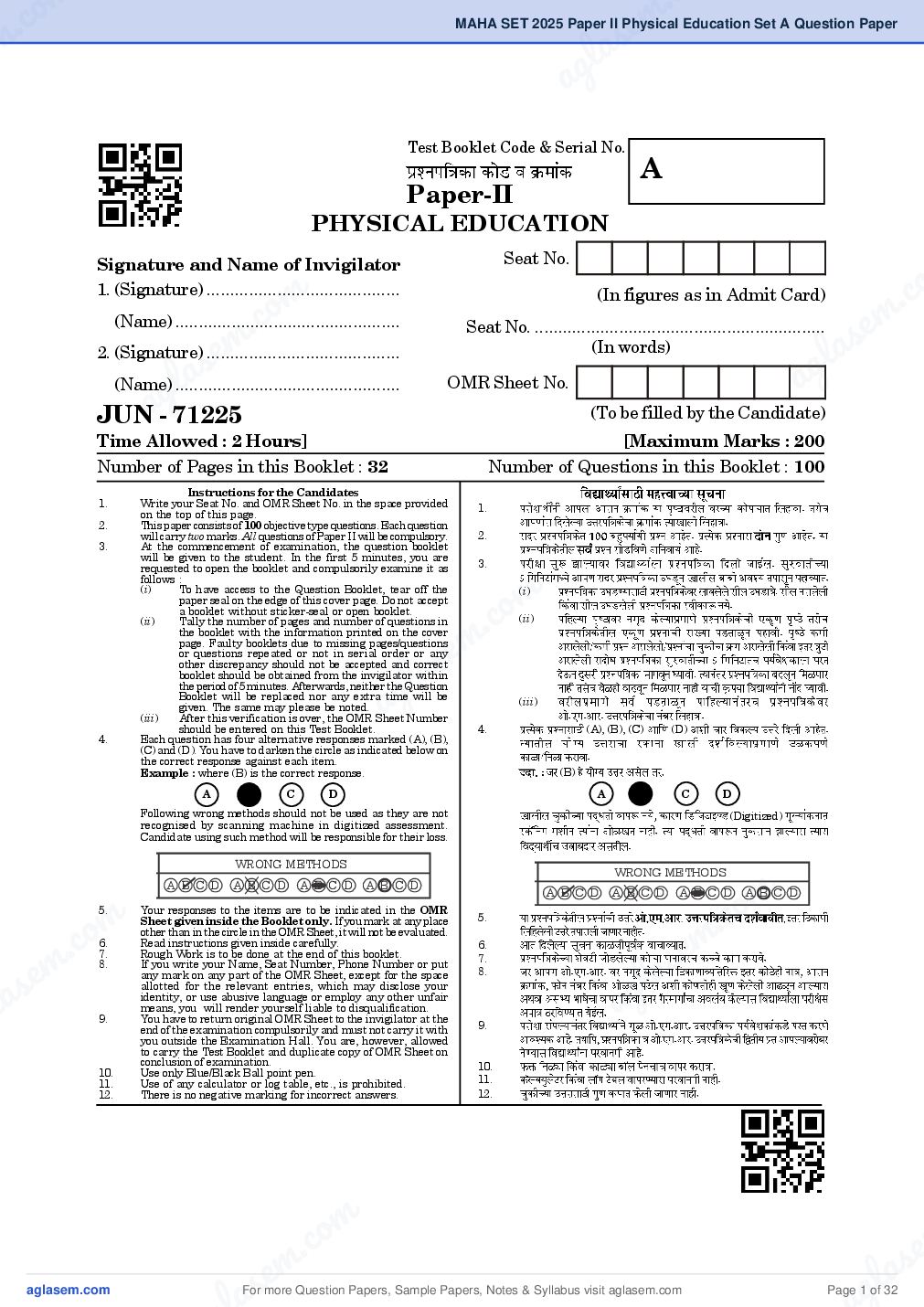
Test Booklet Code & Serial No.
A
Paper-II
PHYSICAL EDUCATION
Signature and Name of Invigilator Seat No.
m
1. (Signature) .........................................
. co
c. o
(In figures as in Admit Card)
(Name) ................................................
e m
em
Seat No. ..............................................................
(In words)
l as
la s
2. (Signature) .........................................
ag
g
(Name) ................................................
JUNa- 71225
OMR Sheet No.
(To be filled by the Candidate)
Time Allowed : 2 Hours] [Maximum Marks : 200
Number of Pages in this Booklet : 32 Number of Questions in this Booklet : 100
Instructions for the Candidates
1. Write your Seat No. and OMR Sheet No. in the space provided 1.
on the top of this page.
2. This paper consists of 100 objective type questions. Each question
will carry two marks. All questions of Paper II will be compulsory. 2.
3. At the commencement of examination, the question booklet
will be given to the student. In the first 5 minutes, you are
requested to open the booklet and compulsorily examine it as 3.
m
follows :
c. o
(i) To have access to the Question Booklet, tear off the (i)
paper seal on the edge of this cover page. Do not accept
a booklet without sticker-seal or open booklet.
(ii) Tally the number of pages and number of questions in (ii)
the booklet with the information printed on the cover
e m
s
page. Faulty booklets due to missing pages/questions
or questions repeated or not in serial order or any
l a
other discrepancy should not be accepted and correct
ag
booklet should be obtained from the invigilator within
the period of 5 minutes. Afterwards, neither the Question
Booklet will be replaced nor any extra time will be (iii)
given. The same may please be noted.
(iii) After this verification is over, the OMR Sheet Number
should be entered on this Test Booklet. 4. (A), (B), (C) (D)
4. Each question has four alternative responses marked (A), (B),
(C) and (D). You have to darken the circle as indicated below on
the correct response against each item.
Example : where (B) is the correct response. (B)
A C D A C D
Following wrong methods should not be used as they are not (Digitized)
recognised by scanning machine in digitized assessment.
Candidate using such method will be responsible for their loss.
CORRECT METHOD WRONG METHODS
CORRECT METHOD WRONG METHODS
C D A B C D A B C D A B C D A B C D
m
.co
C D A B C D A B C D A B C D A B C D
m
5. Your responses to the items are to be indicated in the OMR
.co
Sheet given inside the Booklet only. If you mark at any place 5.
other than in the circle in the OMR Sheet, it will not be evaluated.
e m
s
6. Read instructions given inside carefully. 6.
m la
7. Rough Work is to be done at the end of this booklet.
e
7.
8. If you write your Name, Seat Number, Phone Number or put
s
8.
g
any mark on any part of the OMR Sheet, except for the space
la a
allotted for the relevant entries, which may disclose your
identity, or use abusive language or employ any other unfair
means, you will render yourself liable to disqualification.
9. You have to return original OMR Sheet to the invigilator at the
end of the examination compulsorily and must not carry it with 9.
you outside the Examination Hall. You are, however, allowed
to carry the Test Booklet and duplicate copy of OMR Sheet on
conclusion of examination. 10.
10. Use only Blue/Black Ball point pen.
11. Use of any calculator or log table, etc., is prohibited. 11.
12. There is no negative marking for incorrect answers. 12.
m
.co s e
s em
For more Question Papers, Sample Papers, Notes & Syllabus visit
gl a
Page 1 of 32
Page 3
For more Question Papers, Sample Papers, Notes & Syllabus visit Page 2 of 32
Page 4
m .co s e m
l a
ag
Physical Education JUN - 71225/II—A
Paper II
m II . c o
.
Time Allowed : 120c oMinutes] [Maximum Marks : 200
e m
emTwo (2) marks. Attempt All questions.
Note : This paper contains Hundred (100) multiple choice questions. Each question
l as
las
carrying g
g (100) (2) a
a
1. Which of the following Philosophies 1.
of physical education is also known
as Experimentation ?
(A)
(A) Existentialism
(B)
(B) Realism
m
(C) Pragmatism c. o(C)
e m (D)
(D) Electicism
s
2. Which disability requires focuslaon 2.
ag in
muscle strength and flexibility
adapted Physical Education ?
(A) Visual impairment (A)
(B) Autism spectrum (B)
(C) Cerebral palsy (C)
(D) Learning disability (D)
m
m
3. The cash prize given to the winner
.co
.co
3.
e m
e m
of Arjun Award is :
las
las (A) 5 Lakh (A)
ag
(B) 10 Lakh (B)
(C) 15 Lakh (C)
(D) 20 Lakh (D)
3
m
.co s e
s em
For more Question Papers, Sample Papers, Notes & Syllabus visit
gl a
Page 3 of 32
Page 5
Team was attacked by terrorists ?
(A) 1968 (A)
(B) 1972 (B)
(C) 1900 (C)
(D) 1980 (D)
5. The exact duration for the Summer 5.
Olympic Games is fixed :
(A) 18 days (A)
(B) 16 days (B)
(C) 15 days (C)
(D) 20 days (D)
6. Match the following theories of 6.
Play : I
List I
(a)
(a) Surplus Energy Theory
(b)
(b) Recreational Theory
(c) Instinctive Practice Theory (c)
(d) Psycho-Analytic Theory (d)
List II II
(i) Play is the result of an aimless (i)
expenditure of surplus energy
(ii) Instead of discharging the
(ii)
surplus energy through play
activities play rebuilds it
(iii) Insticts are the prime movers of
behaviors of both men and (iii)
animals
(iv) Play is medium of outlet for (iv)
anxieties, tension, conflicts,
frustrations etc.
Codes : (a) (b) (c) (d)
(a) (b) (c) (d) (A) (i) (ii) (iii) (iv)
(A) (i) (ii) (iii) (iv) (B) (ii) (iii) (iv) (i)
(B) (ii) (iii) (iv) (i) (C) (iii) (iv) (i) (ii)
(C) (iii) (iv) (i) (ii) (D) (iv) (i) (ii) (iii)
(D) (iv) (i) (ii) (iii)
4
For more Question Papers, Sample Papers, Notes & Syllabus visit Page 4 of 32
Page 6
m .co s e m
l a
ag
7. Which term is associated with the 7.
economic value placed on sports
om
events by communities ?
. co
. c (A)
e m
(A) Social Capital
em l as
s
(B) Human Rights
a
(B)
ag
(C)gl (C)
a Cultural Diversity
(D) Sports Tourism (D)
8. Individual difference’s impact on the 8.
ability to learn skills is influenced
by :
(A)
(A) Heredity
(B)
(B) Environment
m
(C) Sex of Participants c. o(C)
e m (D)
(D) Heredity and Environment
l as
ag
9. Which is the most widely accepted
method of education, according to
9.
the pragmatists ?
(A)
(A) Lecturing by the teachers
(B) Leaving the child free to learn (B)
(C) Learning by doing (C)
(D) Heuristic method (D)
m
m originally known as the :
10. The Commonwealth Games were
.co
.co
10.
e m
e m las
las (A) Empire Games
(B) Global Games
(A)
ag
(B)
(C) British Games (C)
(D) Colonial Games (D)
5
m
.co s e
s em
For more Question Papers, Sample Papers, Notes & Syllabus visit
gl a
Page 5 of 32
Page 7
release energy for muscle
contraction, ................... is broken
down to release both energy and
phosphate to allow reconstitution of ADP ATP
ATP from ADP. (A)
(A) ADP
(B)
(B) Phosphate
(C) Cohline (C)
(D) PCr (D)
12. The conductive modalities are 12.
generally classified into those that
produce a tissue temperature
increase, which is referred as ............
(A)
(A) Diathermy
(B) Cryotherapy (B)
(C) Thermotherapy (C)
(D) Ultrasound (D)
13. Hoffa massage is essentially the 13.
classical massage technique that
uses a variety of superficial strokes
which includes effleurage, ...............
tapotement and vibration.
(A) Petrissage (A)
(B) Deep stroking (B)
(C) Friction (C)
(D) Strissage (D)
14. When applied intermittently with 14.
compression, rest and elevation it
reduces inflammation and reactive
phase of acute injury the therapy is
called as ...............................
(A) Ultrasound (A)
(B) Cryotherapy (B)
(C) Infra-red (C)
(D) Thermotherapy (D)
6
For more Question Papers, Sample Papers, Notes & Syllabus visit Page 6 of 32
Page 8
m .co s e m
l a
ag
15. The hormone catecholamine of 15.
Adrenal gland is responsible for .......
m
(A) Breakdown of glycogen to (A)
. co
glucose incoliver and muscle m
m . s e
s e of protein
(B) Synthesis
(B)
g l a
(C) l
g a
Utilization of glucose
(C)
a
a Maintain blood glucose level
(D)
(D)
16. Factors affecting the flight path of 16.
an object are .................., force of
gravity and air resistance.
(A) Projectile (A)
(B) Linear (B)
m
c. o(D)
(C) Popelling (C)
(D) Angular
e m17.
17. The probable reason being decline
as
in the neuromuscular function land
relative impairment in theag cell
associated with age is ..................
(A) Oxygen consumption (A)
(B) ATP synthesis (B)
(C) Fat synthesis (C)
(D) Protein synthesis (D)
m
.co
18. ................. is the term used to describe
m the loss of muscle mass associated 18.
m .co s e m
la
with aging process.
s e (A)
g
la (A) Sarcopenia
(B) Ostiopenia (B) a
(C) Musclepenia (C)
(D) Mayopenia (D)
7
m
.co s e
s em
For more Question Papers, Sample Papers, Notes & Syllabus visit
gl a
Page 7 of 32
Page 9
more force and time is applied
increases more power than hit, is an
example of which principle of
biomechanics ?
(A)
(A) Force-motion
(B) Force-time (B)
(C) Range-motion (C)
(D) Time-motion (D)
20. Just beneath the endomysium, the 20.
fibers are covered by the muscle cell
membrane called as .................
(A) Perimysium (A)
(B) Endomysium (B)
(C) Epimysium (C)
(D) Sarcolemma (D)
21. In striking activities .............. is most 21.
important factor for producing
striking force.
(A) Final velocity (A)
(B) Average velocity (B)
(C) Average speed (C)
(D) Final momentum (D)
22. In walking the leg stride occur in 22.
three phases—propulsion, .................
and catch and support.
(A) Mid-stance (A)
(B) Swing (B)
(C) Support (C)
(D) Swing and support (D)
8
For more Question Papers, Sample Papers, Notes & Syllabus visit Page 8 of 32
Page 10
m .co s e m
l a
ag
23. Lateral arm raise and side bending 23.
is the movements in frontal plane
and .................... axis.
om . co
(A) Sagital
. c (A)
e m
e m
(B) Vertical (B)
l as
la s
(C) Frontal (C)
ag
(D)g Both sagital and vertical
a
24. Strategy is used for both players
(D)
24.
amateur as well as professional.
(A) Emotional skills (A)
(B) Specific task (B)
(C) Both (A) and (B) (C) (A) (B)
(D) Self talk (D)
m
.co
25. The id, ego and superego personality 25.
analysis theory is developed by .......
e m
(A) Freud
l as (A)
ag
(B) C. Jung
(B)
(C) S. Hall (C)
(D) Allport (D)
26. Inverted ‘U’ theory is also known as 26. ‘U’
the .......................
(A) Eysenck law (A)
(B) Yerkes-Dodson law (B)
(C) Newton’s law (C)
m
m (D) Ericson law
c. o27. Which is not an Aspirational domain 27.
(D)
m.co
m s e
s e of motivation ?
g la
la (A) Success
(B) Recognition
(A) a
(B)
(C) Purpose (C)
(D) Urge (D)
9
m
.co s e
s em
For more Question Papers, Sample Papers, Notes & Syllabus visit
gl a
Page 9 of 32
Page 11
enters the :
(A) Tertiary memory (A)
(B) Primary memory (B)
(C) Sensory memory (C)
(D) Secondary memory (D)
29. The process of forgetting due to the 29.
passage of time and lack of use is
known as :
(A) Repression (A)
(B) Decay (B)
(C) Retrieval failure (C)
(D) Interference (D)
30. Which type of hypothesis predicts a 30.
relationship between two variables ?
(A) Null Hypothesis (A)
(B) Alternative Hypothesis (B)
(C) Descriptive Hypothesis (C)
(D) Correlation Hypothesis (D)
31. Classification of the population
31.
based on mother tongue is an
example of :
(A)
(A) Geographical Classification
(B)
(B) Chronological Classification
(C) Qualitative Classification (C)
(D) Quantitative Classification (D)
10
For more Question Papers, Sample Papers, Notes & Syllabus visit Page 10 of 32
Page 12
m .co s e m
l a
ag
32. A researcher asked 933 people 32.
regarding, what their favorite type
of TV programme was : news,
om . co
c
documentary, soap or sports. They
. e m
m
could only choose one answer. As
e l as
as
such, the researcher had the number
l ag
ag
of people who choose each category
of programme ? How should
researcher analyze these data ?
(A)
(A) t-test
(B)
(B) One-way analysis of variance
(C) Chi-square test (C)
(D) Regression (D)
33. Given below are two statements; one 33.
m
c. o(A)
is labelled as Assertion (A), and the
(R)
other is labelled as Reason (R) :
e m
l as
Assertion (A) : Mode is the most
(A) :
agin a
reliable measure of central tendency.
Reason (R) : The score
distribution that occurs with
(R) :
greatest frequency is called mode.
In the context of the above
statements, which one of the
following is correct ?
Codes :
m
.co
(A) Both (A) and (R) are true, but
m (R) is not the correct (A) (A) (R)
.co explanation of (A) (R)
e
(A) m
e m (B) (A) (R) as
s (B) Both (A) and (R) are true and
(A) ag
l (R)
la (R) is the correct explanation
of (A)
(C) (A) (R)
(C) (A) is true but (R) is false
(D) (A) is false but (R) is true (D) (A) (R)
11
m
.co s e
s em
For more Question Papers, Sample Papers, Notes & Syllabus visit
gl a
Page 11 of 32
Page 13
statements : I :
Statement-I : The standard error
of mean decreases in direct
proportion to sample size. II :
Statement-II : The standard error
of mean is the standard deviation
III :
of the sampling distribution.
Statement-III : A Statistics is a
characteristic of a population.
Code : (A) I II
(A) Only I and II are true
(B) I III
(B) Only I and III are true
(C) I, II and III are true (C) I, II III
(D) Only II is true (D) II
35. Match List I with List II and select 35. I II
the correct answer from the codes
given below :
I
List I (a) F-
(a) F-test (b)
(b) Measuring central tendency (c)
(c) Test of correlation
(d)
(d) Measuring variability
II
List II (i)
(i) Coefficient of correlation (ii)
(ii) Standard deviation
(iii)
(iii) ANOVA
(iv)
(iv) Median
Codes :
(a) (b) (c) (d) (a) (b) (c) (d)
(A) (i) (iii) (ii) (iv) (A) (i) (iii) (ii) (iv)
(B) (iii) (iv) (i) (ii) (B) (iii) (iv) (i) (ii)
(C) (iv) (ii) (iii) (i) (C) (iv) (ii) (iii) (i)
(D) (ii) (i) (iv) (iii) (D) (ii) (i) (iv) (iii)
12
For more Question Papers, Sample Papers, Notes & Syllabus visit Page 12 of 32
Page 14
m .co s e m
l a
ag
36. Assertion (A) : The statistical 36. (A) :
approach to prediction is through
regression equations.
m . co
Reason (R) c. o : Accuracy of s e m
predictionsmrests on the magnitude a
s e
of theacorrelation.
(R) :
g l
g l a
a the context of above statements,
In
which one of the following
statements is correct ?
(A) Both (A) and (R) are true but
(A) (A) (R)
(R) is not the correct
explanation of (A) (R) (A)
(B) Both (A) and (R) are false
o m (A)
(B) (R)
(C) Both (A) and (R) are true and
m .c
s e (C) (A) (R)
of (A) g a
(R) is the correct explanation
l (R) (A)
a
(D) (A) is true and (R) is false (D) (A) (R)
37. To assess aggression in U-19 37.
national kabaddi players, which
sampling technique will be used ?
(A) Random sampling method (A)
(B) Cluster sampling method (B)
m
.co
(C) Stratified sampling method (C)
m
.co
(D) Purposive sampling method (D)
e m
e m
38. What is the purpose of a pilot study 38.
las
las in research ?
(A) To collect final data (A) ag
(B) To test research instruments (B)
(C) To analyze data (C)
(D) To report findings (D)
13
m
.co s e
s em
For more Question Papers, Sample Papers, Notes & Syllabus visit
gl a
Page 13 of 32
Page 15
useful when :
(A) You want to gather detailed
(A)
insights on behaviors in natural
settings
(B)
(B) You need to collect numerical
data quickly
(C) You prefer participants to (C)
answer open-ended questions
(D) You want to control all variables (D)
in the study
40. The process of training targets the 40.
development of specific attributes,
these specific attributes include :
(a) Multilateral physical
(a)
development and sport-specific
physical development
(b) Technical skills and tactical (b)
abilities
(c) Psychological characteristics (c)
and health maintenance
(d) Injury resistance and
(d)
theoretical knowledge
(A) (a) and (c) only (A) (a) (c)
(B) (b), (c) and (d) only (B) (b), (c) (d)
(C) (a) and (b) only (C) (a) (b)
(D) (a), (b), (c) and (d) (D) (a), (b), (c) (d)
14
For more Question Papers, Sample Papers, Notes & Syllabus visit Page 14 of 32
Page 16
m .co s e m
l a
ag
41. Training for sport results in 41.
physiological adaptations that are
specific to the ......................
o m (a)
. co
. c
(a) Activities movement pattern
(b) e m
e m demand
(b) Metabolic
l as
l as generation pattern
(c) Force
(c)
ag
(d)g Contraction type
(d)
a
(A) (a), (b) and (d) only (A) (a), (b) (d)
(B) (a) and (c) only (B) (a) (c)
(C) (a), (b), (c) and (d) (C) (a), (b), (c) (d)
(D) (a), (c) and (d) only (D) (a), (c) (d)
42. Specialized training will be 42.
dominated by ................ that will lead
m
.co
to a faster rate of adaptations and
ultimately to greater levels of
e m
performance.
l as (A)
ag
(A) Drills and techniques
(B)
(B) Basic exercises
(C)
(C) Fundamental movements
(D) Practice (D)
43. Technique is developed based on 43.
athlete’s .....................
(a) Abilities (a)
(b) Physiological and mechanical
m
.co
(b)
m (c) Socio-economical characteristics
characteristics
.co
(c)
m (d)
s em
s e (d) Level of development
la (d)
(a), g(b)
la
(A)
(A) (a), (b) and (d) only
(B) (b), (c) and (d) only (B)
a
(b), (c) (d)
(C) (a) and (b) only (C) (a) (b)
(D) (a), (b), (c) and (d) (D) (a), (b), (c) (d)
15
m
.co s e
s em
For more Question Papers, Sample Papers, Notes & Syllabus visit
gl a
Page 15 of 32
Page 17
plan regardless of the sporting
activity is a high level of ..............
(A) Technical proficiency (A)
(B) Strategy (B)
(C) Recovery (C)
(D) Overload (D)
45. The training volume varies 45.
according to the .........................
(a) Sport and training objectives
(a)
(b) Athlete’s needs and training age
(b)
(c) Athlete’s stage of development
(c)
(d) Phase of the annual training
(d)
plan
(A) (a), (b) and (c) only (A) (a), (b) (c)
(B) (a), (c) and (d) only (B) (a), (c) (d)
(C) (a), (b), (c) and (d) (C) (a), (b), (c) (d)
(D) (b) and (d) only (D) (b) (d)
46. .................... is associated with
46.
physiological and phychological
signs of maladaptation.
(A)
(A) Over-loading
(B)
(B) Over-speeding
(C) Over-reaching (C)
(D) Over-training (D)
16
For more Question Papers, Sample Papers, Notes & Syllabus visit Page 16 of 32
Page 18
m .co s e m
l a
ag
47. During the .................... phase, the 47.
quantity of work is very high and
m
the intensity of work is low and
. co
c. o phase has a higher
during .................
s e m
emphasis m a
work. as e on intensity or quality of
g l
g lPreparatory, Competitive (A) a
a
(A)
(B)
(B) Competitive, Preparatory
(C) Competitive, Transition (C)
(D) Transition, Preparatory (D)
48. ................... is an important tool in the 48.
management of fatigue that
accumulates in response to
m
physiological, psychological and
m .co
e
sociological stressors resulting from
s
training and competition.
g l a
(A) Periodization
(B) Adaptation
a (A)
(B)
(C) Overreaching (C)
(D) Reversibility (D)
49. Component of agility is perceptual 49.
decision-making, which is related to
reaction time or visual scanning,
m
.co
anticipation, pattern recognition and
m knowledge of situations. This has
m .co s e m
e la
been termed ................. agility.
las (A) Retention (A)
ag
(B) Reflection (B)
(C) Reaction (C)
(D) Reactive (D)
17
m
.co s e
s em
For more Question Papers, Sample Papers, Notes & Syllabus visit
gl a
Page 17 of 32
Page 19
of the training load during a
variable period of time, in an attempt
to reduce the physiological and
psychological stress of daily training
and optimize sports performance
is ......................... (A)
(A) Adaptation
(B)
(B) Recovery
(C) Supercompensation (C)
(D) Taper (D)
51. The structure and content of the ........ 51.
determines the quality of the
training process.
(A)
(A) Mesocycle
(B)
(B) Macrocycle
(C) Microcycle (C)
(D) Individual cycle (D)
52. .................. is a complex set of 52.
interdependent skills that converge
for the athlete to respond to an
external stimulus with a rapid
deceleration, change of direction and
reacceleration. (A)
(A) Speed
(B)
(B) Agility
(C) Flexibility (C)
(D) Power (D)
53. A scoring scale used to assess 53.
student performance along a task-
specific set of criteria is called :
(A) Rating scale (A)
(B) Questionnaire (B)
(C) Question paper (C)
(D) Skill test (D)
18
For more Question Papers, Sample Papers, Notes & Syllabus visit Page 18 of 32
Page 20
m .co s e m
l a
ag
54. Which test can be administered by 54.
mass testing method ?
(A) Vertical jump
om
(A)
. co
. c
(B) Bent knee sit ups (B)
e m
m
(C) Medicine ball throw
e
(C)
l as
as
(D) 30 m flying test
l
(D)
ag
ag
55. Which of the following instruments 55.
is used for cadence in step test ?
(A) Metronome (A)
(B) Anthropometer (B)
(C) Skinfold caliper (C)
(D) Stadiometer (D)
56. AAHPERD Basketball skill test does 56. AAHPERD
not include :
m
(A) Speed spot shooting c. o(A)
(B) Controlled dribble
e m (B)
(C) Defensive movement
l as (C)
(D) Forward pass
57. Which of the following statements
ag (D)
57.
is NOT correct ?
(A)
(A) Normative tables provide the
means to compare individual
performance with a large
population
(B)
m
.co
(B) Norms should be current and
m
.co
update (C)
e m
e m
(C) Norms are naturally occurring
las
las normal value and the normal
ranges cannot be modified by ag
expert (D)
(D) The norms should be
representative of population
19
m
.co s e
s em
For more Question Papers, Sample Papers, Notes & Syllabus visit
gl a
Page 19 of 32
Page 21
components with their respective
tests : I
List I (a)
(a) Muscular strength (b)
(b) Agility (c)
(c) Body composition (d)
(d) Balance
II
List II (1)
(1) Skinfold test (2)
(2) Plate tapping (3)
(3) 1 Repetition max
(4)
(4) Zig-Zag test
(5)
(5) Bass stick test
Codes :
(a) (b) (c) (d)
(a) (b) (c) (d)
(A) (4) (2) (1) (5)
(A) (4) (2) (1) (5)
(B) (3) (4) (1) (5)
(B) (3) (4) (1) (5)
(C) (4) (1) (5) (3) (C) (4) (1) (5) (3)
(D) (1) (5) (3) (4) (D) (1) (5) (3) (4)
59. Which somatotype is associated with 59. (Somatotype)
a higher tendency to accumulate
body fat ?
(A) Ectomorph (A)
(B) Endomorph (B)
(C) Mesomorph (C)
(D) Hypermorph (D)
20
For more Question Papers, Sample Papers, Notes & Syllabus visit Page 20 of 32
Page 22
m .co s e m
l a
ag
60. Which of the following is NOT part 60.
of item analysis in knowledge test ?
(A) Item difficulty (A)
(B) Responce quality
om
(B)
. co
. c
(C) Item complexity (C)
e m
m
(D) Discrimination power
e
(D)
l as
l as
61. When formative evaluation is 61.
ag
ag
typically conducted in the
educational setting ?
(A) At the beginning of the school
year (A)
(B) Throughout the instructional (B)
process
(C) After the completion of a course (C)
(D) During standerdized testing
periods (D)
62. Match Column I with Column II : 62. I II
Column I
.c (a) om I
(a) Planning m
e (b)
(b) Programming
l as
ag
(c) Budgeting (c)
(d) Evaluating (d)
II
Column II
(i) Determining how adequately (i)
budget fits the program
(ii) Establishing clear goals and (ii)
objectives (iii)
(iii) Developing activities and (events)
events to produce
m
.co
distinguishable results (iv)
m
.co
(iv) Allocating resources, financial
m
plan
s em
s e Options :
g
(a) (b) (c)la (d)
la (a) (b) (c) (d)
(A) (i) (ii) (iii) (iv)
(A) (i) (ii)a (iii) (iv)
(B) (ii) (iii) (iv) (i)
(B) (ii) (iii) (iv) (i)
(C) (iii) (iv) (i) (ii) (C) (iii) (iv) (i) (ii)
(D) (iv) (i) (ii) (iii) (D) (iv) (i) (ii) (iii)
21
m
.co s e
s em
For more Question Papers, Sample Papers, Notes & Syllabus visit
gl a
Page 21 of 32
Page 23
financial budget ? (A)
(A) Sales budget
(B)
(B) Cash budget
(C)
(C) Capital budget
(D) Budgeted funds flow statement (D)
64. Which of this is critical and 64.
educational responsibilies of Sports
media ?
(A) Sound Manipulation (A)
(B) The use of drugs and inhuman (B)
training practices
(C) Adaptation to sports time-table
(C)
(D) Regulations adapted to
television (D)
65. ................. is anything that an 65.
organization owns that can be used
to generate future revenues.
(A)
(A) Profits
(B)
(B) Income
(C) Assets (C)
(D) Equity (D)
66. A formal organizational structure is 66.
based on :
(A) Hierarchical job structure (A)
(B) Team based approach (B)
(C) Authority with responsibility (C)
(D) Duties and rights of personnel (D)
22
For more Question Papers, Sample Papers, Notes & Syllabus visit Page 22 of 32
Page 24
m .co s e m
l a
ag
67. ‘‘Physical educator’s and sports 67.
managers must continually and
co
enthusiastically reach out to their
om
respective publics.’’ Which principle
. c e m .
e m
of marketing physical education is
l as
l as
referred here ? (A)
ag
ag
(A) Customer principle
(B) Competition principle
(B)
(C) Practice principle (C)
(D) Cross-functional principle (D)
68. Clerical support, communications, 68.
book-keepings, purchasing and
distribution are part of :
(A)
(A) External support systems
(B)
(B) Extensions or ancillary spaces
m
(C) Maintenance c. o(C)
(D) Internal support system
e m (D)
69. Statement-I : One of the most
l as 69. I :
important functions of recreation
facility managers is managing
ag
personnel and working effectively
with people or employee relations.
Statement-II : Facility manager’s I:
shall create number of associations
that work to enhance the
management of recreation agencies. (A) I II
m
m
(A) Statement I is true, statement
c. oII
.co m
II true
m (B) Statement I is false, statement
(B) I
s e
s e II is false
I g
la
la (C) Statement I is true, statement
(C)
a II
II is false
(D) Statement I is false, statement (D) I II
II is true
23
m
.co s e
s em
For more Question Papers, Sample Papers, Notes & Syllabus visit
gl a
Page 23 of 32
Page 25
construction of rectangular are most
popular because :
(A) Provides safe environment
(A)
(B) Easy to control
(C) Easy to fix equipments (B)
(D) Practicality of conducting (C)
competitions (D)
71. Which of the following is not one of 71.
the contents of organizing ?
(A) The development of leadership
(A)
(B) The identification and
classification of required (B)
activities
(C) The grouping of activities (C)
necessary to attain the
objectives
(D)
(D) The assignment of each group
to a manager with authority
necessary to supervise it
72. Direct instruction, formal authority 72.
on the learner is example of :
(A) Student centric approach (A)
(B) Teacher centric approach (B)
(C) Kinesthetic approach (C)
(D) None of the above (D)
73. Technology in education refers to :
73.
(A) Use of Instagram
(B) Use of technological (A)
advancements in equipments, (B)
material and machines for
education
(C) Use of mass media in education (C)
(D) Use of social media (D)
24
For more Question Papers, Sample Papers, Notes & Syllabus visit Page 24 of 32
Page 26
m .co s e m
l a
ag
74. The concept of Curriculum 74.
development excludes :
co
(A)
om .
(A) Learning Goals
. c (B)
e m
(B) Societal Goals
e m l as
s
(C) National Goals
a
(C)
ag
(D)gl
a Self-Goals
75. A quality physical education 75.
(D)
program should :
(A) adapt local culture and festivals (A)
(B) avoid national standard or your
(B)
state standards
(C) provide opportunities to develop
m
sports skills and to understand c. o(C)
e m
rules of sports
l as
a g
(D) develop program to achieve (D)
personal goals
76. The Autonomous Stage of learning 76.
motor skills learner :
(A) Try to deligently understand (A)
and perform the skill correctly
(B) Notable improvement occurs as
m
.co
(B)
m learner progress from the
m .co cognitive stage to motor stage
s e m
s e (C) Demonstrate the fundamental
g la
la mechanics of each skill learned (C) a
(D) able to perform the skills
effortlessly (D)
25
m
.co s e
s em
For more Question Papers, Sample Papers, Notes & Syllabus visit
gl a
Page 25 of 32
Page 27
proficiency with appropriate
teaching styles : I
I (a)
(a) Pre control
(b)
(b) Control
(c) Utilization (c)
(d) Proficiency (d)
II II
(i) Teacher feedback and divergent (i)
discovery (ii)
(ii) Direct, teacher feedback,
partner feedback
(iii)
(iii) Direct teaching, teacher
feedback, partner feedback
(iv) Direct teaching self-feedback, (iv)
convergent discovery, divergent
discovery
Choose the correct answer : (a) (b) (c) (d)
(a) (b) (c) (d) (A) (i) (ii) (iii) (iv)
(A) (i) (ii) (iii) (iv) (B) (ii) (iii) (iv) (i)
(B) (ii) (iii) (iv) (i) (C) (iii) (iv) (ii) (i)
(C) (iii) (iv) (ii) (i)
(D) (iv) (i) (ii) (iii)
(D) (iv) (i) (ii) (iii)
78. Devices such as electronic blood 78.
pressure machines, heart monitors
and pedometers help students
learn : I.
I. More about scientific side of
fitness. II.
II. Helps to compare with more
sophisticated and expensive III.
devices.
III. Motivate students, increasing
their knowledge of exercise
physiology.
Select the correct answer from codes (A) I II
given below :
(A) Both I and II (B) II III
(B) Both II and III (C) I III
(C) I and III
(D) Only I (D) I
26
For more Question Papers, Sample Papers, Notes & Syllabus visit Page 26 of 32
Page 28
m .co s e m
l a
ag
79. Match group A and B : 79. A B :
Group A A
co
(a) Long distance run (a)
(b) PNF
. c om (b)
e m .
(c)
m
Cone drills
e
(c)
l as
(d) s
Single leg stand
a
l Group B
(d)
B ag
(i)
g
a Agility (i)
(ii)
(ii) Balance
(iii)
(iii) C.V. endurance
(iv)
(iv) Flexibility
Codes :
(a) (b) (c) (d)
(a) (b) (c) (d)
(A) (iii) (iv) (i) (ii) (A) (iii) (iv) (i) (ii)
m
(B) (iii) (i) (iv) (ii)
.co
(B) (iii) (i) (iv) (ii)
(C) (i) (ii) (iv) (iii) (C) (i) (ii) (iv) (iii)
(D) (iv) (iii) (ii) (i) e m (D) (iv) (iii) (ii) (i)
80. The portion of physical fitness directed
l as 80.
towards the prevention of or
rehabilitation from disease, the ag
development of high level of functional
capacity for the necessary and
discretionary tasks of life refers as : (A)
(A) Sports-specific physical fitness (B)
(B) Functional fitness (C)
(C) Health related physical fitness (D)
(D) All of the above 81.
81. Which amino acid enhances and
m
m strengthens muscle as well as helps
.co
m .co to slow the breakdown of muscle
during exercise ? s e m
s e (A) Conjugated linoleum acid (A)
g la (CLA)
la (CLA)
(B) Carnitine (B) a
(C) Hydroxy methyl butyrate (C) (HMB)
(HMB)
(D) Chromium (D)
27
m
.co s e
s em
For more Question Papers, Sample Papers, Notes & Syllabus visit
gl a
Page 27 of 32
Page 29
formation of hormones and cell
membranes ?
(A) Proteins (A)
(B) Fats (B)
(C) Vitamins (C)
(D) Minerals (D)
83. Talk test is generally used to assess 83.
the exercise intensity for :
(A) Obese individual (A)
(B) Active women (B)
(C) Highly reconditioned people (C)
(D) Old age people (D)
84. Which organ is particularly affected 84.
by a sedentary lifestyle, leading to
increased risk of diseases ?
(A) Liver (A)
(B) Heart (B)
(C) Kidneys (C)
(D) Lungs (D)
85. What is the primary objective of 85.
public health ?
(A) Individual treatment
(A)
(B) Disease prevention and health
promotion (B)
(C) Medical research (C)
(D) Emergency response (D)
86. What is the primary purpose of 86.
carbohydrate loading before an
endurance event ?
(A)
(A) To increase body weight
(B)
(B) To enhance endurance
(C)
performance
(C) To reduce blood sugar levels
(D) To decrease hydration (D)
28
For more Question Papers, Sample Papers, Notes & Syllabus visit Page 28 of 32
Page 30
m .co s e m
l a
ag
87. During prolonged exercise, what 87.
should athletes consume to maintain
hydration
om
and electrolyte
. co
balance ?
. c e m
e m drinks
(A) Carbonated
(A)
l as
l as
(B) Alcohol (B)
ag
g
a Sports drinks
(C) (C)
(D) Water (D)
88. What is the primary role of protein 88.
in a sports diet ?
(A) Energy production (A)
(B) Building and repairing tissues (B)
(C) Regulating body temperature
m (C)
(D) Enhancing flexibility
c. o(D)
89. The technique in which selected
e m89.
l a
behavior is identified and observeds
for a specific time period isag
:
(A)
(A) Duration recording
(B)
(B) Event recording
(C) Interval recording (C)
(D) Group time sampling (D)
90. In which of the following teaching 90.
styles, the learners with varying
m
m to participate in a task designed for
degrees of skill development are able
.co
m .co s e m
s e multiple degrees of difficulty ?
(A)
g la
la (A) Reciprocal style
(B) Command style
(B) a
(C) Inclusion style (C)
(D) Self-check style (D)
29
m
.co s e
s em
For more Question Papers, Sample Papers, Notes & Syllabus visit
gl a
Page 29 of 32
Page 31
dysgraphia and select the correct
option : (i)
(i) Cramped finger on pen (ii)
(ii) Irregular letter sizes & shapes (iii)
(iii) Excessive erasures (iv)
(iv) Decreased or excessive writing
speed
(A) (i), (ii), (iii)
(A) (i), (ii), (iii)
(B) (i), (ii), (iii), (iv) (B) (i), (ii), (iii), (iv)
(C) (i), (iii), (iv) (C) (i), (iii), (iv)
(D) (i), (iv) (D) (i), (iv)
92. WHO defined health as ‘‘a state of 92.
complete physical, mental and social
well-being and not merely absence
of disease or infirmity’’ in the
year .................. (A) 1948
(A) 1948
(B) 1950
(B) 1950
(C) 1952
(C) 1952
(D) 1954 (D) 1954
93. Which one of the following is NOT 93.
the type of autism ?
(A) Asperger syndrome (A)
(B) Pervasive developmental
(B)
disorder
(C) Ataxia (C)
(D) Childhood disintegrative
disorder (D)
94. Inherent interest and urge 94.
means :
(A) Extrinsic motivation (A)
(B) Intrinsic motivation (B)
(C) Calm (C)
(D) Satisfaction (D)
95. Insight theory was performed by : 95.
(A) Kohler (A)
(B) Watson (B)
(C) Thorndike (C)
(D) Pavlov (D)
30
For more Question Papers, Sample Papers, Notes & Syllabus visit Page 30 of 32
Page 32
m .co s e m
l a
ag
96. The mental process of knowing, 96.
including aspects such as
co
awareness, perception, reasoning
om
and judgement means :
. c
(A)
e m .
e m
(A) Emotional process (B)
l as
l as
(B) Social process
(C)
ag
ag
(C) Cognitive process
(D) Functional process (D)
97. What is the other name to Attempt 97.
and Error Theory ?
(A) Conditional Response (A)
(B) Stimulus Response (B)
(C) Trial and Error (C)
(D) Insight (D)
98. The process of affecting permanent 98. m
changes in the individual’s
m .co
behaviour means :
s e (A)
(A) Learning
l a
ag
(B)
(B) Teaching
(C) Motivation (C)
(D) Process (D)
99. Which one of the following is a more 99.
appropriate technique to guide
visually impaired students ?
(A)
(A) Direct teaching
(B)
(B) Computer aided teaching
m
.co
(C) Sign language (C)
m
.co
(D)
(D) Human guide technique
e m
e m 100. Which of the following vitamin helps 100.
las
las in blood clotting ?
(A) Vitamin K (A) ag
(B) Vitamin C (B)
(C) Vitamin D (C)
(D) Vitamin A
(D)
31
m
.co s e
s em
For more Question Papers, Sample Papers, Notes & Syllabus visit
gl a
Page 31 of 32
Page 33
32
For more Question Papers, Sample Papers, Notes & Syllabus visit Page 32 of 32
Document Details
| Board / Org | Maharashtra Exams |
| Exam | MAHA SET |
| Type | Question Paper |
| Pages | 32 |
| Updated | 17 Nov 2026 |