MBOSE Class 12 Syllabus
Finished viewing? Save it for later —
Download MBOSE Class 12 Syllabus (PDF · 62 pages)About MBOSE Class 12 Syllabus
MBOSE Class 12 Syllabus is available here for free download. Published by Meghalaya Board for Class 12, this syllabus can be viewed online or downloaded as a PDF (62 pages). Candidates preparing for Class 12 can use MBOSE Class 12 Syllabus to understand the exam pattern, the type of questions asked, and the overall difficulty level.
Frequently Asked Questions
How can I download MBOSE Class 12 Syllabus?
Open this page and click the Download button to save MBOSE Class 12 Syllabus as a PDF. It is completely free on AglaSem Docs.
Is MBOSE Class 12 Syllabus free to download?
Yes. MBOSE Class 12 Syllabus can be viewed online and downloaded as a PDF free of cost on AglaSem Docs.
How many pages does MBOSE Class 12 Syllabus have?
MBOSE Class 12 Syllabus contains 62 pages, which you can read online or download together as a single PDF.
Where can I find more Class 12 study material?
You can find more Class 12 question papers, sample papers, syllabus, and answer keys on AglaSem Docs.
MBOSE Class 12 Syllabus – Text
Read the full text of this syllabus below — useful to quickly search, copy and reference the content online without downloading the PDF.
📄 View text version (62 pages)
Page 1
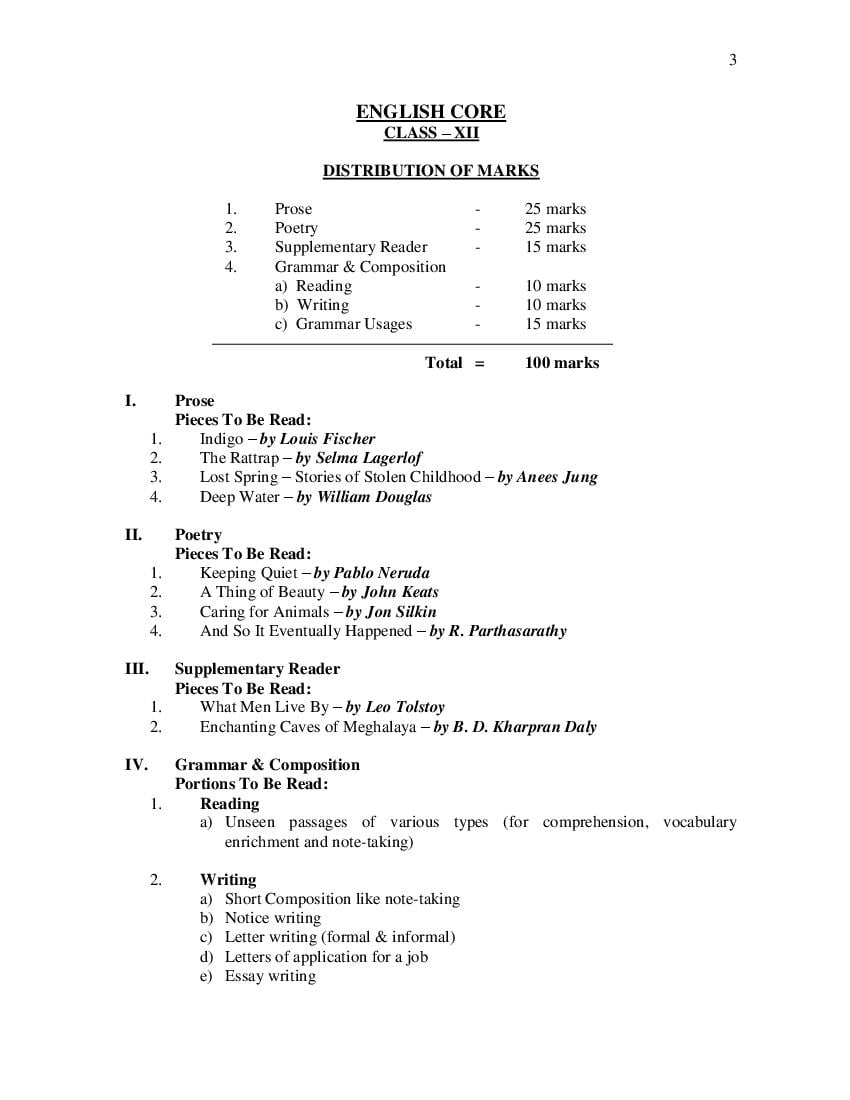
ENGLISH CORE
CLASS – XII
DISTRIBUTION OF MARKS
1. Prose - 25 marks
2. Poetry - 25 marks
3. Supplementary Reader - 15 marks
4. Grammar & Composition
a) Reading - 10 marks
b) Writing - 10 marks
c) Grammar Usages - 15 marks
Total = 100 marks
I. Prose
Pieces To Be Read:
1. Indigo – by Louis Fischer
2. The Rattrap – by Selma Lagerlof
3. Lost Spring – Stories of Stolen Childhood – by Anees Jung
4. Deep Water – by William Douglas
II. Poetry
Pieces To Be Read:
1. Keeping Quiet – by Pablo Neruda
2. A Thing of Beauty – by John Keats
3. Caring for Animals – by Jon Silkin
4. And So It Eventually Happened – by R. Parthasarathy
III. Supplementary Reader
Pieces To Be Read:
1. What Men Live By – by Leo Tolstoy
2. Enchanting Caves of Meghalaya – by B. D. Kharpran Daly
IV. Grammar & Composition
Portions To Be Read:
1. Reading
a) Unseen passages of various types (for comprehension, vocabulary
enrichment and note-taking)
2. Writing
a) Short Composition like note-taking
b) Notice writing
c) Letter writing (formal & informal)
d) Letters of application for a job
e) Essay writing
Page 2
3. Grammar Usage
a) Transformation of sentences
b) Direct & Indirect Speech
c) Active & Passive Voice
d) Error correction in sentences
e) Use of word substitution
f) Opposite words
Recommended Textbooks:
1. Resonance XII - Published by Macmillan India Ltd.,
S. C. Goswami Road,
Pan Bazar, Guwahati – 781001.
2. Voices Classes XI & XII - – do –
3. English Grammar & Compositon - Published by Pearson Education,
482 F. I. E. Patparganj,
Delhi – 110092, India.
4. Current English Grammar & Usage
By R. P. Sinha Edited by Prof. P. Madhavan Published by
Oxford University Press.
5. Writing With A Purpose:
By Champa Tickoo and Jaya Sasikumar
********
Page 3
ALTERNATIVE ENGLISH
CLASS – XII
DISTRIBUTION OF MARKS
I. Prose - 25 marks
II. Poetry - 25 marks
III. Short Plays - 20 marks
IV. Grammar & Composition
a) Reading Unseen Passages - 10 marks
b) Precis Writing/Amplification - 10 marks
of an idea
c) Grammar & Usage - 10 marks
Total = 100 marks
I. PROSE
Pieces To Be Read:
1) The Rebellion – George Orwell
2) Trailing the Jaguar – Willard Price
3) A Day in the Life of a Debt Collector – Munshi Premchand
4) Growing Up – Joyce Cary
II. POETRY
Pieces To Be Read:
1) The Soul‘s Prayer – by Sarojini Naidu
2) The Education of Nature – by William Wordsworth
3) The Human Seasons – by John Keats
4) Enterprise – by Nissim Ezekiel
III. SHORT PLAYS
The Prescribed Plays are:
1) The Bishop‘s Candlesticks – by Norman Mckinnell
Or
2) Macbeth – by William Shakespeare
IV. GRAMMAR & COMPOSITION
The Prescribed Portions are:
1) Reading
Unseen Passages (descriptive/narrative/speech form) with a variety of questions
leading to learning of New Vocabulary, test understanding and ability to write
independently.
2) Writing
a) Precis Writing
b) Amplification of an idea
Page 4
3) Grammar & Usage
a) Correction of grammatical errors in the given sentences
b) Active and Passive Voice
c) Use of Adverbs
d) Question Tags
e) Modals
f) One word substitution
Recommended Textbook for Prose/Poetry/Plays:
Imprints Class XII - Published by Macmillan India Ltd.,
- S. C. Goswami Road, Pan Bazar,
Guwahati - 781001.
Reference Books for Grammar & Composition:
1) English Grammar & Composition XII
- Published by Pearson Education,
482 F.I.E. Patparganj, New Delhi – 110092, India.
2) Current English Grammar & Usage by R. P. Sinha
copy edited by Prof. P. Madhavan
- Oxford University Press
3) Writing With A Purpose by Champa Tickoo & Jaya Sasikumar
- Oxford University Press.
*******
Page 5
ENVIRONMENTAL EDUCATION
CLASS – XII
UNIT – I: BIODIVERSITY (18 Marks)
a) Concepts and Values of Biodiversity: Concepts of biodiversity; Species of
various gene pools; Biodiversity in an ecosystem; Values of biodiversity; Why
value diversity.
b) Types of Biodiversity (Species, Ecosystem and Genetic): Species diversity;
Ecosystem diversity, Marine ecosystem; Estuarine ecosystem; Genetic diversity.
c) Interdependence between Species: Interactions between plants and animals.
d) Economic Potential of Biodiversity: Introduction; Economic potential of plant
diversity; Economic importance of animal diversity.
e) Loss of Biodiversity (Threatened, Endangered and Extinct Species):
Introduction; Causes leading to loss of biodiversity; Threatened, endangered
and extinct species.
f) Strategies for Conservation of Biodiversity: Introduction; Why conserve
biodiversity.
UNIT – II: ENVIRONMENTAL MANAGEMENT (16 Marks)
a) Need for Environmental Development Vis-à-vis Development: Introduction;
Development levels and environment impacts.
UNIT – III: SUSTAINABLE AGRICULTURE (16 Marks)
a) Need for Sustainable Agriculture: Key components in the industrialization of
modern agriculture.
b) Green Revolution: Impact of green revolution on the environment; Ecological
impacts; Sociological impacts.
c) Impact of Agrochemicals on Environment.
d) Management of Agriculture Produce: Storage and preservation; Transportation.
Page 6
UNIT – IV: SUSTAINABLE DEVELOPMENT (20 Marks)
a) Concept of Sustainable Development: Introduction.
b) Concept of Sustainable Consumption: Lessons on Sustainable Consumption;
Contemporary concept of sustainable consumption.
c) Challenges for Sustainable Development: Economic considerations; Need for
sound economic policies; Political considerations; Social considerations; Need
for a transformation in social conditions.
d) Role of Individual and Community.
EXEMPLAR ACTIVITIES (INTERNAL ASSESSMENT) (30 Marks)
Students must undertake at least one activity in a year. Teachers may design their own
set of activities keeping in view the overall objectives of teaching and learning of
Environmental education at this stage. Activities may be planned and designed
depending upon the local situations, available resources and environmental issues of
concern. The learners should be encouraged to initiate action on their own. As
illustrations activities may be of the following types:
To study the changes that have taken place in a given land area during a specific
time in respect of number of houses and families and determine the effects on civic
amenities like availability of water. Electricity and fuels, drainage system, disposal
of wastes, etc.
To study the practices followed in the region for storage, preservation,
transportation and processing of perishable or nonperishable farm products and to
assess the extent of wastage due to faulty practices.
To study the status of an endangered species listed for the region by collecting
information through different sources and observation, if possible and to assess the
reasons for its diminishing number. Suggests ways and means to protect the
species.
Conduct a survey of plants and trees in the locality and collect information about
their cultural, economic and medicinal values. Prepare action plans for the
propagation of trees that are most valuable for use.
Prepare plans for beautification of the school campus or a park in the locality.
Identify suitable plants and trees for the same.
Prepare a flow chart to show different steps involved in the supply of tap water
from the source to houses in the locality. Plan and execute campaign to educate the
society about the implications of wastage of water in terms of energy.
Page 7
RECOMMENDED TEXTBOOK: Frank Environmental Education (Class XII)
- Frank Bros. & Co. (Publishers) Ltd.
REFERENCE BOOKS:
Ecology and Environment by P. D. Sharma; Rastogi Publications.
Environmental Biology by P. D. Sharma; Rastogi Publications.
Man & His Environment by Dr. S. R. Joshi & N. Joshi; Gautam Bros. & Co.
********
Page 8
ASSAMESE (MIL)
CLASS – XII
DISTRIBUTION OF MARKS
Unit I Prose - 30 marks
Unit II Poetry - 25 marks
Unit III Drama - 15 marks
Unit IV Grammar - 10 marks
Composition - 10 marks
Essay - 10 marks
Total = 100 marks
I. PROSE
The Prescribed Pieces are:
1. Kabir Ahaituk Priti by Dr. B. K. Kakati
2. Asomiya Vaishnab Kabir Narad by Tirtha Nath Sarma
3. Barnabodh by Dr. Bhabendra Saikia
4. Shahitya by Upendra Nath Goswami
II. POETRY
The Prescribed Poems are:
1. Indramunya Rajar Jagya Ayojon (Uresha Barnan) by Srimanta Shankar Dev
2. Naatghar by Nalini Bala Devi
3. Kukur by Amulya Boruah
4. Ubhati Nahar Kabita by Nabakanta Barua
III. DRAMA: Chiraj
The Prescribed Portions are:
Dwitiya and Tritiya Anka (Page 26 – till the end)
IV. GRAMMAR & COMPOSITION
The Prescribed Portions are:
1. Karak
2. Pratyoy
3. Bibhakti
4. Make sentences with phrases & idioms
5. Bhab Samprasharan
6. Comprehension
7. Essay
Page 9
RECOMMENDED TEXTBOOKS:
1. Sahitya Saurav
Published by: Jyoti Prakashan, Jasowanta Road,
Pan Bazar, Guwahati – 1
2. Chiraj (Drama) by Phani Sharma
Published by: Asom Prakashan Parishad
3. Prabeshika Rachana Siksha by: Giridhar Sharma
4. Rachana Bichitra by: Dharma Singha Deka
5. Bohal Byakaran by: Satyanath Bora.
********
Page 10
BENGALI (MIL)
CLASS – XII
DISTRIBUTION OF MARKS
I. Prose - 25 marks
II. Poetry - 20 marks
III. Novel - 15 marks
IV. Grammar
a) Definition & Examples - 7 marks
b) Alankar - 7 marks
c) Banganubad/Prabad - 8 marks
Prabachan
V. Composition
a) Summary Writing - 8 marks
b) Prabandha Rachana - 10 marks
Total = 100 marks
I. PROSE
Pieces To Be Read:
a) Banglar Nabya Lekhokdiger Proti Nibedon – Bankim Chandra Chattopaddhay
b) Balai – Rabindranath Tagore
c) Dudher Dam – Banophul
II. POETRY
Pieces To Be Read:
a) Sita-o-Sarama – Michael Madhusudan Dutta
b) Dui Bigha Jami – Rabindra Nath Tagore
c) Bangla Bhasha Uchchorito Holey – Shamsur Rahaman
III. NOVEL
- Rajsingha (Selected Part): Bankim Chandra Chattopaddhay.
IV. GRAMMAR
i) Definition & Examples
a) Samibhaban
b) Apinihiti
c) Swar Sangati
d) Swar Bhakti
e) Abhishruti
ii) Alankar
a) Anupras
b) Shles
c) Upoma
d) Samasokti
Page 11
iii) Banganubad/Prabad – Prabachan
V. COMPOSITION
a) Summary Writing
b) Prabandha Rachana
Recommended Textbook for Prose, Poetry& Novel:
Uchcho Madhyamik Path Sankalan by MBOSE
Published by C & P Enterprises, Educational Publishers,
M. C. Road, Guwahati – 781003.
Grammar & Composition (Any standard textbook on Bengali Grammar & Composition
may be used)
******
Page 12
GARO (MIL)
CLASS – XII
DISTRIBUTION OF MARKS
1. Prose - 35 marks
2. Poetry - 35 marks
3. Essay - 15 marks
4. Agan Me·apa/Ku·jikse - 15 marks
Total = 100 marks
I. PROSE
The Prescribed Pieces are:
1. Ki·tap Seani – Hubert K. Sangma
2. Lekka Pora aro Gisik Bimik – K. M. Momin
3. Gital Chasong Janggi Tangani – L. R. Marak
II. POETRY
The Prescribed Pieces are:
1. A·chik Ku·rang – Howard Denison W. Momin
2. Nang·ko Gisik Ra·gen – Howard Denison W. Momin
3. Hobani Sinteani – Evelyn R. Marak
4. Tom·tomani Dongja Ia A·gilsako – Meckjin R. Marak
5. Katta Ma·gitcham Niam Songgitcham – D. S. Rongmuthu
III. ESSAY WRITING (UNSEEN)
IV. AGAN ME·APA/KU·JIKSE
RECOMMENDED TEXTBOOKS
1. A·chik Chanchibewale Seanirang Compiled and edited by – K. M. Momin,
Published by – Tura Book Room, Tura.
2. Seokgimin Poetryrang by D. S. Nengminza
Published by – Garo Hills Book Emporium
3. Chasong Gital A·chik Poetryrang by K. M. Momin
4. A·chik Kattarang by Winnish K. Sangma
********
Page 13
HINDI (MIL)
CLASS – XII
DISTRIBUTION OF MARKS
1. Prose - 25 marks
2. Poetry - 25 marks
3. Rapid Reader - 20 marks
4. Grammar & Composition
a) Essay Writing - 10 marks
b) Letter Writing - 10 marks
c) Unseen Passage - 10 marks
Total = 100 marks
I. PROSE
The Prescribed Pieces are:
1. Bazaar Darshan – by Jainaindra
2. Pahalwan Ki Dholak – by Phanishwar Nath Renu
3. Charlie Chaplin Yani Hum Sab – by Vishnu Khare
4. Namak – by Rajiya Sajjad Zahir
5. (a) Shram Vibhajan aur Jati Pratha – by Bhimrao Ambedkar
(b) Meri Kalpana Ka Adarsh Samaj – by Bhimrao Ambedkar
II. POETRY
The Prescribed Pieces are:
1. Atma Parichay – by Harivansh Rai Bachchan
2. Bat Sidhi Thi Par – by Kuwar Narayan
3. Usha – by Rameshwar Bahadur Singh
4. Badal Rag – by Suryakant Tripathi ‘Nirala’
5. (a) Kavitavali (Uttar Kand Se) – by Tulsidas
(b) Lakshman – Murchcha Aur Ram Ka Vilap – by Tulsidas
III. RAPID READER
1. Atit Mein Dabe Pau - by Om Thanvi
2. Diary Ke Panne - by Anne Frank
IV. GRAMMAR & COMPOSITION
a) Composition
i) Essay Writing
ii) Letter Writing
iii) Unseen Passage
Page 14
b) Grammar
i) Sandhi – Sandhi Vichched Aur Sandhi Ki Pahachan
ii) Samas – Vigrah Aur Samas Ki Pahachan
iii) Vakya – Prakar Aur Rupantaran
RECOMMENDED TEXTBOOKS:
1. Aroh Bhag 2 – NCERT Publications.
2. Vitan Bhag 2 – NCERT Publications.
3. Hindi Vyakaran Aur Vyavahar – NCERT.
*******
Page 15
KHASI (MIL)
CLASS – XII
DISTRIBUTION OF MARKS
1) Prose - 30
2) Poetry - 40
3) Grammar and Composition - 30
Total marks = 100
1. PROSE
Recommended Textbooks Pieces To Be Read
i) Ka Pyrkhat U Khasi - Chapter II: ―U Khasi bad Ka Akor‖
by H. O. Mawrie Chapter 16: ―U Khasi Ha Ka Mariang‖
ii) Ki Syntiew Ha Ranab - Chapter 3: ―Ka Jingiakynduh Jong U Bah Ta
by W. Kharkrang En‖
a) Bah Ta En Sa Leit Suk Ho.
b) ...... Iaishah Bah Ta En
c) U Blei Un Kyrkhu Ia Phi Bah Ta En‖
2. POETRY
Recommended Textbooks Pieces To Be Read
i) Ki Jingsneng Tymmen (PartII) - Chapter I to Chapter 17
by R. S. Berry
ii) Ki Poetry Khasi - Chapter 10: ―Hapdeng Ki ‗Law Kynjah Ka
by V. G. Bareh Tlang‖
Chapter 15: ―Ka Weiking‖
iii) Na Nengpei Ki Sur Myllung - Chapter: ―Ka Sor Shillong‖
by B. C. Jyrwa. Chapter: ― Ym Dei U Nongthaw
iv) Ka Samoi Jong Ka Lyer - Chapter: ―U Ren‖
by K. S. Nongkynrih Chapter: ―Haba U Myntri Rangbah Ha
Shillong U Wan Hiar,
Ki Siej Jar Jar Ki Shu Iapeit Siar‖
Page 16
3. GRAMMAR & COMPOSITION
Recommended Textbook Pieces To Be Read
i) Ka Grammar - Chapter 4: ―Ka Adjective‖
by H. W. Sten Chapter 5: ― Ka Verb‖
Chapter 6: ―Ka Preposition‖
Chapter 8: ―Ka Adverb‖
ii) Essay: - Unseen
*********
Page 17
MIZO (MIL)
CLASS – XII
DISTRIBUTION OF MARKS
A. Hla (Poetry) - 20
B. Thu (Prose) - 20
C. Fiction leh Drama - 15
D. Grammar - 10
E. Chhiar - 15
F. Ziak - 20
Total = 100 marks
A. HLA (POETRY)
Pieces To Be Read:
1. Pi Pu Chhuahtlang Hlui – Liandala
2. Kan Ram Nuahmah – Rokunga
3. Piallei Hmun Rem Kan Bele – Dozinga
4. Tleitirah Tleitiri – Dura Chongthu
5. Awmkhawar Lenkawl Ka Han Thlira – Van Khama
6. Zun Phur Thing Tin Par – Damhauhva
7. Tahlai Ni Kawklung – Romani
8. Khuavel i La Chhing Ngei Ang – V. Thangzama
9. Panlai Kei Ka Ramtuanna – Lalsangzuali Sailo
10. Phungrual an tin anga – Laithangpuia
B. THU (PROSE)
Pieces To Be Read:
1. Hnam Inpumkhatna Kawnga Tawng Pawimawhna – P. C. Biaksiama
2. Mizo Inneih Dan – B. Lalthangliana
3. Mizo Nula Huaisen Pahnih – R. L. Thanmawia
4. Val Upa – Darchhawna
5. Lung In Malsawmna – H. Lallungmuana
6. Zoram Indopui Pahnihna – C. Chhuanvawra
7. Thangualte u, Nangmahni Khawvel a Nie – P. L. Liandinga (Lehlin)
8. Thlaa Lawn – A. Sawihlira
C. FICTION LEH DRAMA
Pieces To Be Read:
1. Fiction: Lali – Biakliana
3. Drama: Zothansangi – Vanneihtluanga
Page 18
D. GRAMMAR
Pieces To Be Read:
1. Applied Grammar
(a) Prefix and suffix
(b) Double Adverbs/Adjective Adverbs
2. Idioms and Phrases
E. CHHIAR
Portions To Be Read:
Zirlai bu pawn lam thuziak pahnih hetiang hian lak turani:
1. Thumal 500-600 inkar - 10 marks
2. Thumal 300-400 inkar - 05 marks
Mark 10 pu zawk hi zawhna chi hrang hrang, thuziak awnzia an man leh man loh
enna tur ania Tin, thurnal awmzia an hriat dan enna tur mark 2 a awm ang.
F. ZIAK
1. Thuphuah tawi – Advertisement, notice, inneih sawmna, lungphun hriattirna,
poster, form filled up etc. 05 marks
2. Report emaw, thil thleng chanchin mi thusawi atanga ziak (Thumal 80 – 100)
lekhathawn chi hrang leh mi lekkhathawn chhan 05 marks
3. Thuziak sei (article etc.) – Chanchibua chhuahtlak tura topic hrang hrang thuziak
(Thumal 150 – 200) 10 marks
RECOMMENDED TEXTBOOKS
1. Mizo – XII (Core) by MBSE
- St. Joseph‘s Press, Tlangnuam, Aizawl – 796005.
2. Mizo Grammar & Composition for Classes XI & XII by MBSE
- Milan Press, Zodin Square, Aizawl – 796001.
******
Page 19
NEPALI (MIL)
CLASS – XII
DISTRIBUTION OF MARKS
Section A – Literature - 60 marks
Section B – Grammar - 15 marks
Section C – Reading (Unseen) - 10 marks
Section D – Composition and Writing - 15 marks
Total = 100 marks
Section A – Literature - 60 marks
I. PROSE
The Prescribed Short Stories are:
1. Paral Ko Aago – Guru Prasad Mainali
2. Logne – Puskar Shamsher
3. Shatru – Vishweshwar Prasad Koirala
4. Kaikei – Balkrishna Sama
II. ESSAY
Types of Essays:
1. Nepali Hamro Matribhasa – Parasmani Pradhan
2. Adhunik Shikshak – Indra Rai
3. Gundruk Ko Pukar – Rudra Raj Pandey
III. DRAMA
- „Mukunda – Indira‟ by Balkrishna Sama, Sajha Prakashan, Kathmandu.
IV. POETRY
- „Muna – Madan‟ by Laxmi Prasad Deokota, Sajha Prakashan, Kathmandu.
Section B – Grammar - 15 marks
(Suggested Chapters):
(i) Linga
(ii) Vachan
(iii) Karak Ra Vivakti
(iv) Dhatu Ra Pratya
(v) Upasarga
(vi) Paryawachi Shabda
(vii) Viparitarthak Shabda
(viii) Shabda Suddhi Bimarsha
(ix) Ukhan Tukka
Page 20
Section C – Reading (Unseen) - 10 marks
(Books not prescribed)
Section D – Composition and Writing - 15 marks
1. Essay Writing
i. Atmaparak
ii. Vicharatmak
2. Letter Writing
a. Vyaktigat
b. Vyaparik
c. Daftari
d. Smarak Patra
RECOMMENDED TEXTBOOKS:
1. Uchha Madhyamik Nepali Sahitya
- Textbook Committee (Nepali), Shillong.
2. Madhyamik Nepali Vyakaran Ra Rachana
- Shree Raj Prakashan, Darjeeling.
3. Ramro Rachana Mitho Nepali by Krishna Prasad Parajuli
- Sahayogi Press, Kathmandu.
********
Page 21
POLITICAL SCIENCE
CLASS – XII
DISTRIBUTION OF MARKS
1) Course III – Political Theory (II) - 50 marks
2) Course IV – The Indian Constitution and - 50 marks
Political System in operation
Total = 100 marks
Course III Political Theory (II) (80 Periods)
Unit I Key Concepts: (30 Periods)
Rights: Meaning and characteristics of Rights; kinds of Rights; classification
of Rights; relation between Rights and Duties.
Liberty: negative and positive meaning of Liberty; kinds of Liberty – natural,
civil, political, economic, national; relation between Law and Liberty.
Equality: negative and positive meaning of Equality; kinds of Equality –
natural, social, civil, political, economic; the relationship between Liberty and
Equality.
Justice: the varied meanings of Justice; kinds of justice – natural, social,
economic, political, legal.
Law: meaning; source – customs, religion, equity, scientific commentaries
judicial decisions, Legislature; kinds of Law; relationship between Law and
Morality.
Citizenship – Meaning of citizenship; Legal and Moral aspects of citizenship;
similarities and differences between citizens and aliens; citizens and nationals;
methods of acquiring citizenship – by birth and by naturalisation; double
citizenship; loss or termination of citizenship.
Unit II The Electorate: meaning and basis of franchise; Universal Adult Franchise
arguments for and against. (15 Periods)
Systems of Representation: kinds of Representation – Proportional (Hare
System & List System), Functional, Territorial, Communal, and their merits
and demerits.
Unit III Major Contemporary Political Theories (25 Periods)
Liberalism: its meaning and essence; classical or negative Liberalism and
contemporary or positive Liberalism and the shift from classical Liberalism.
Marxism: Genesis; tenets of Marxism – dialectical materialism, historical
materialism, class struggle, surplus value, revolution and dictatorship of the
proletariat, classless society.
Page 22
Unit IV The United Nations: Origins of the United Nations, development, aims and
principles of the United Nations Organization of the United Nations
(10 Periods)
Course IV The Indian Constitution and Political System in operation.
(80 Periods)
Unit V The Fundamental Rights: Characteristics; Kinds of Fundamental Rights;
Writs for enforcement of the Fundamental Rights; Evaluation of the
Fundamental Rights.
The Fundamental Duties: Kinds, characteristics and evaluation.
(25 Periods)
The Directive Principles of State Policy: Sources, meaning and objectives.
Classification – social welfare, Gandhian, economic, administrative,
educational and cultural principles. Constitutional significance of the
Directive Principles. Distinction between Fundamental Rights and Directive
Principles.
Unit VI The Union Government (35 Periods)
The President of India: - Qualifications, method of election, tenure and
removal, privileges, powers and functions, constitutional position.
The Vice-President of India: - Qualifications, election, tenure and removal,
privileges, functions, position.
The Union Council of Ministers: - Composition, powers and functions.
The Prime Minister:- Appointment, tenure, powers, functions and position of
the Council of Ministers, distribution of portfolios, as a supervisor of and co-
ordinator between the different ministries, as a leader of the Parliament, as a
link between the President and the Parliament, etc.
The Parliament:-
(i) The Rajya Sabha (Council of States) – composition, qualifications of
members, term of office, presiding officers, privileges, quorum, powers and
functions.
(ii) The Lok Sabha (House of the People) – composition, qualifications of
members, election, term of office, privileges, quorum, powers and functions –
legislative, executive, financial, constituent and miscellaneous. The Speaker
of the Lok Sabha – election, tenure, powers and functions, position.
The Judiciary: The Supreme Court of India – Composition, appointment of
Judges, qualifications of Judges, tenure and method of removal of Judges.
Powers and functions – original jurisdiction, appellate jurisdiction, advisory
jurisdiction, miscellaneous. Evaluation of the Supreme Court.
Page 23
Unit VII India and the world: India and the United Nations; India and SAARC; India‘s
role in the Non-Align movement; India‘s approach to major world issues like
Disarmament, Human Rights and Globalisation. (20 Periods)
Recommended Textbook: Political Science for Class XII
Published by - Pearson Education, Dorling Kindersley (P) Ltd.,
482 F. I. E. Patparganj, Delhi – 110092.
Reference Books:-
1. Political Science ( for +2 stage)
Theory and Constitution
Volume I & II
Author: Durga Kant Sarmah (Wiley Eastern Limited)
2. Political Science – Key Concepts and Theories
A Textbook for Class XII
Author: V.R.Mehta
Editor: Nalini Pant (NCERT – 2003)
3. Democracy in India – Issues and Challenges
A Textbook in Political Science for Class XII
Author: A.S. Narang
Editor: Nalini Pant (NCERT – 2003)
4. Foundations of Political Science by J.C.Johari.
*******
Page 24
HISTORY
CLASS – XII
DISTRIBUTION OF MARKS
Question Type Section No. of Marks for Total Grand
Questions each Marks Total
Questions
A. Objective Type
i) Multiple Choice I 20 x 01 20 30
ii) True/False 10 x 01 10
iii) Short Answer II 10 x 02 20 20
Total = 50
B. Descriptive Type - 02 x 12 24
02 x 13 26
= 50
Total = 100
Class XII: Themes in Indian History
Themes Objectives
The Story of the First Cities: Harappan
Archaeology. Familiarize the learner with early
Broad overview: Early urban centres. urban centres as economic and
social institutions.
Story of discovery: Harappan civilization.
Introduce the ways in which new
Excerpt: Archaeological report on a major site.
data can lead to a revision of
Discussion: How it has been utilized by existing notions of history.
archaeologists/historians.
Illustrate how archaeological
reports are analyzed and
interpreted by scholars.
Political and Economic History: How Familiarize the learner with major
Inscriptions tell a story. trends in the political and
economic history of the
Broad overview: Political and economic history:
subcontinent from c. 4th century
Mauryan to the Gupta period.
BCE to c. 5th century CE.
Page 25
Themes Objectives
Story of discovery: Inscriptions and the
decipherment of the script. Shifts in the Introduce inscriptional analysis
understanding of political and economic history. and the ways in which these have
Excerpt: Asokan inscription and Gupta period shaped the understanding of
land grant. political and economic processes.
Discussion: Interpretation of inscriptions by
historians.
Use of Literary Sources in Reconstructing
social History Familiarize the learner with issues
Broad overview: Issues in social history, in social history.
including caste, class, kinship and gender. Introduce strategies of textual
Story of discovery: How the Vedas, Puranas, analysis and their use in
Upanishads and the Mahabharata were reconstructing social history.
discovered.
Excerpt: from the Mahabharata, illustrating how
it has been used by historians.
Discussion: Other sources for reconstructing
social history.
A History of Buddhism: Sanchi Stupa
Broad overview: (a) A brief review of histories Discuss the major religious
of Vedic religion, Jainism and Vaisnavism. (b) developments in early India.
Focus on Buddhism. Introduce strategies of visual
Story of discovery: Sanchi stupa. analysis and their use in
reconstructing histories of religion.
Excerpt: Reproduction of sculptures from
Sanchi.
Discussion: Ways in which sculpture has been
interpreted by historians and other sources for
reconstructing the history of Buddhism.
The Evolution of South Indian Architecture
from the Pallavas, Chola, Chalukya and Familiarize the learner with the
Vijayanagar Period. patterns of this evolution and how
it influenced the overall
development of Indian
Outlines only
architecture.
Page 26
Themes Objectives
Agrarian Relations: The Ain – i - Akbari Discuss developments in agrarian
relations.
Broad overview: a) Structure of agrarian
relations in the 16th and 17th centuries. (b) Discuss how to supplement
Patterns of change over the period. official documents with other
sources.
Story of Discovery: Account of the compilation
and translation of Ain-i-Akbari.
Excerpt: from the Ain-i-Akbari
Discussion: Ways in which historians have used
the text to reconstruct history.
The Mughal Court: Reconstructing Histories
through Chronicles
Broad Overview: (a) Outline of political history Familiarize the learner with the
c. 15th – 17th centuries. (b) Discussion of the major landmarks in political
Mughal court and politics. history.
Story of Discovery: Account of the production of Show how chronicles and other
court chronicles, and their subsequent translation sources are used to reconstruct the
and transmission. histories of political institutions.
Excerpts: from the Akbarnama and
Padshahnama.
Discussion: Ways in which historians used the
texts to reconstruct political histories.
Religious Histories: Bhakti-Sufi tradition
Broad Overview: (a) Outline of religious Familiarize the learner with
developments during this period. (b) Ideas and religious developments.
practices of the Bhakti-Sufi saints. Discuss ways of analyzing
Story of Transmission: How Bhakti-Sufi devotional literature as sources of
compositions have been preserved. history.
Excerpt: Extracts from selected Bhakti-Sufi
works.
Discussion: Ways in which these have been
interpreted by historians.
Medieval Society Through Travellers‟ Familiarize the learner with the
Accounts salient features of social histories
Broad Overview: Outline of social and cultural described by the travellers.
life as they appear in travellers‘ accounts. Discuss how travellers‘ accounts
Page 27
Themes Objectives
Story of their writings: A discussion of where can be used as sources of social
they travelled, why they travelled, what they history.
wrote, and for whom they wrote.
Excerpt: from Alberuni, Ibn Batuta and Bernier.
Discussion: What these travel accounts can tell
us and how they have been interpreted by
historians.
Colonialism and Rural Society: Evidence from Discuss how colonialism affected
Official Reports zamindars and peasants
Broad overview: (a) Life of zamindars, peasants Understand the problems and
and artisans in the late 18th century. (b) East India limits of using official sources for
Company, revenue settlements and surveys. (c) understanding the lives of people.
Changes over the nineteenth century.
Story of official records: An account of why
official investigations into rural societies were
under taken and the types of records and reports
produced.
Excerpts: From Firminger‘s Fifth Report,
Accounts of Francis Buchanan, Hamilton and
Deccan Riots Report.
Discussion: What the official records tell and do
not tell, and how they have been used by
historians.
Colonialism and Indian Towns: Town Plans
and Municipal Reports Familiarize the learner with the
Broad Overview: The growth of Mumbai, history of modern urban centres.
Chennai, hill stations and cantonments (including Discuss how urban histories can be
Shillong) in the 18th and 19th century. written by drawing on different
Excerpts: Photographs and paintings. Plans of types of sources.
cities. Extract form town plan reports.
Focus on Kolkata town planning.
Discussion: How the above sources can be used
to reconstruct the history of towns. What these
sources do not reveal.
British Expansion and the North East Familiarize the learners about.
Broad Overview: British Expansion in the North (i) the nature of British expansion
East; 1824 to early 20th Century. in the North East India.
Page 28
Themes Objectives
Focus: Social and cultural impact of the colonial (ii) Social and cultural impact of
Rule with special reference to British rule.
(i) Christian missionaries for e.g., Role of
the American Baptist Missionaries.
(ii) Modern Education.
Excerpt: Reports from Pemberton‘s (1835),
Francis Jenkins and other contemporary writers.
Discussion: How reports can be used to
reconstruct history.
Representations of 1857
Broad Overview: (a) The events of 1857-58. (b) Discuss how the events of 1857
How these events were recorded and narrated. are being reinterpreted.
Focus: Lucknow. Discuss how visual material can be
used by historians.
Excerpts: Pictures of 1857. Extracts from
contemporary accounts.
Discussion: How the pictures of 1857 shaped
British opinion of what had happened.
Mahatma Gandhi in National Movement
Broad Overview: (i) Early political Familiarize the learner with
organizations and the Indian National Congress – significant elements of –
1840s to 1885 (ii) Advent of Gandhi. i) the nationalist movement and
Focus: Nature of the Gandhian Movement 1917 – ii) the nature of Gandhian
1942. leadership (starting with the
Excerpts: Reports from English and Indian Champaron Satyagraha).
language newspapers and other contemporary
writings.
Discussion: How newspapers can be a source of
history.
Partition, Transfer of Power and Making of
the Constitution Familiarize the learner in the rise
Broad Overview: Nationalism and the Rise of of communalism as an important
Communalism. (b) Transfer of Power and the by-product of the National
creation of Pakistan. (c) Constitutional movement which led to partition.
Development 1909 – 1946.
Page 29
Themes Objectives
Focus: (a) How Communalism worked in Punjab The learners should be able to
and Bengal. (b) The making of the Indian rationally understand the events.
Constitution (1946 – 1950). Discuss how the founding ideals of
Excerpts: From the Newspaper, reports and the new National State were
constituent Assembly Debates. debated and formulated.
Discussion: How such sources reveal and how
they can be analyzed.
RECOMMENDED TEXTBOOK: A Textbook of History Class XII
Published by - Sunflower Publication (P) Ltd.,
542/16 Joshi Road, Karol Bagh,
New Delhi - 110005.
Reference Books:
1. Textbook in History for Class XII: Themes In Indian History Part I – NCERT
Publications.
2. Textbook in History for Class XII: Themes In Indian History Part II – NCERT
Publications.
3. Textbook in History for Class XII: Themes In Indian History Part III – NCERT
Publications.
*********
Page 30
PHILOSOPHY
CLASS – XII
DISTRIBUTION OF MARKS
Full Marks-100
UNIT 1: (Marks: 20) (No. of Lectures: 20-25)
INDUCTION – Relation between Induction and Deduction, Kinds of Induction –
Scientific Induction, Unscientific Induction, Analogy, Perfect Induction, Colligation of
Fact, Parity of Reasoning. LAWS OF THOUGHT – Meaning and Characteristics.
UNIT 2: (Marks: 20) (No. of Lectures: 20-25)
GROUND OF INDUCTION – FORMAL GROUND of Induction – Law of Uniformity
and Law of Causation, CAUSE – Definition, Qualitative & Quantitative Marks of
Causation, CAUSE AND CONDITION, PLURALITY OF CAUSE, PARADOX OF
INDUCTION, MATERIAL GROUNDS of Induction – Observation and Experiment.
UNIT 3: (Marks: 20)(No. of Lectures: 20-25)
EXPERIMENTAL METHODS – Method of Agreement, Method of Difference, Joint
Method of Agreement and Difference, Method of Concomitant Variation and Method of
Residue, HYPOTHESIS – Meaning, Forms and Conditions of Hypothesis.
UNIT 4: (Marks: 25) (No. of Lectures: 25)
SYMBOLIC LOGIC – Statement and Arguments, Statement form and Argument form,
Logical Connectives – Conjunction, Disjunction, Implication, Implication
SYMBOLIZATION, CONSTRUCTION of Truth Tables (TAUTOLOGY,
CONTRADICTORY, CONTINGENT), PROVING INVALIDITY.
UNIT 5: (Marks: 15) (No. of Lectures: 20)
PHILOSOPHY – Definition of Philosophy with Reference to Indian Philosophy,
DISTINCTIVE FEATURE of Indian Philosophy, RATIONALISM and
EMPERICISM.
REFERENCE BOOKS:
1. Textbook Of Inductive Logic : B. N. Roy
2. Symbolic Logic : I. M. Copi
Page 31
3. Introduction To Indian Philosophy : J. N. Sinha
4. Introduction To General Philosophy : John Patrick
5. A Manual Of Ethics : J. N. Sinha
*********
Page 32
GEOGRAPHY
CLASS – XII
DISTRIBUTION OF MARKS
A. Fundamentals of Human Geography - 35 marks
B. India People and Economy - 35 marks
C. Practical Work - 30 marks
Total = 100 marks
A. Fundamental of Human Geography (35 marks)
Unit I: Human Geography: Nature and Scope (3 marks) (4 periods)
Unit II: People (7 marks) (10 periods)
Population of the world – distribution, density and growth
Population change – spatial patterns and structure; determinants of
population change
Age – sex ratio, rural – urban composition
Human development – concept, selected indicators (literacy and occupation)
Unit III: Human Activities (10 marks) (24 periods)
Primary activities – concept and changing trends, subsistence agriculture,
modern agriculture, major crops – rice, wheat, tea, coffee, rubber and
sugarcane (conditions of growth and distribution)
Mining – world distribution of iron ore, copper, bauxite, coal and petroleum
Secondary activities – concept; manufacturing – agro – processing,
household, small scale, large scale; iron and steel industries, location of
industries.
Tertiary activities – concept; knowledge – based industries (information
technology industry)
Quaternary activities – concept, knowledge – based industries (information
technology industry)
Unit IV: Transport, Communication and Trade (10 marks) (24 periods)
Land transport – roads, railways, trans-continental railways
Water transport – inland waterways; major ocean routes
Air transport – intercontinental air routes
Oil and gas pipelines
Satellite communication
International trade – based, and changing patterns; ports as gateways of
international trade, role of WTO in International trade
Page 33
Unit V: Human Settlement (5 marks) (8 periods)
Settlement types – rural and urban; morphology of cities, distribution of
mega cities; problems of human settlement in developing countries
B. India People and Economy (35 Marks)
Unit I: People (5 marks) (10 periods)
Population – distribution, density and growth; composition of population:
linguistic and religious compositions; occupations
Migration – international, national – causes and consequences
Human development – selected indicators (literacy and occupations)
Unit II: Human settlements (4 marks) (6 periods)
Urban settlements – types and distribution and functional classification
Unit III: Recourse and development (10 marks) (24 periods)
Land resources – general land use; agricultural land use – major crops
agricultural development and problems
Water resource utilization – irrigation; scarcity of water and Conservation
method – rain – water harvesting
Minerals and energy resources – metallic mineral (iron ore, copper, bauxite)
and non-metallic minerals (limestone and dolomite). Their distribution,
conventional and non conventional energy sources
Industries – types and distribution, industrial location and clustering;
changing pattern of selected industries- iron and steel cotton textiles,
petrochemicals and knowledge – based industries impact of liberalization,
privatization and globalization on industrial location
Unit IV: Transport, Communication and International Trade
(7 marks) (10 periods)
Transport and communication – roads, railways, waterways and airways; oil
and gas pipelines; national electric grid; satellite Communication
International trade – changing patterns of India‘s foreign trade; seaports and
their hinterland and airports
Unit V: Geographical Perspective on Selected Issues and Problems
(4 marks) (7 periods)
Environment pollution, urban – waste disposal
Urbanization – rural – urban migration; problems of slum
Land degradation
Unit VI: Regional study of Meghalaya (5 marks) (8 periods)
Relief, climate, agriculture and minerals
Page 34
C. Practical Work (30 Marks)
Unit I: Processing of Data and Thematic Mapping (8 marks) (12 periods)
Sources of Data (primary and secondary)
Tabulation and processing of data; Calculation of averages, measures of
Central tendency.
Representation of data – choropleth and isopleths maps
Unit II: Map Projection and used of computer in Data Processing
(6 marks) (7 periods)
Map projection – topology construction and properties of conical with one
standard parallel and Mercator‘s projection
Use of computers in data processing and mapping (only theory)
Unit III: Field Study (8 marks) (6 periods)
Field visit and study on any one of the local concerns : pollution, land-use,
or literary (any one topic may be taken up for study; observation and
questionnaire survey may be adopted for the data collection; collected data
may be tabulated and analyzed with diagrams and maps)
Practical Report Book (5 marks)
Viva Voce (3 marks)
RECOMMENDED BOOKS:
1. Saraswati Geography, Published by: Saraswati House Pvt. Ltd., Educational
Publishers, New Delhi – 110002.
2. ‗Fundamentals of Human Geography‘ – Hira Lal Yadav, Savita Sinha,
NCERT publication Editor – R. P Mishra Reprinted – November 2003
3. ‗ India – People and Economy‘ – S. K. Sharma, NCERT Publication, Editor –
R. P. Mishra, May 2003
4. ‗Practical Work in Geography – Part II ‗ – R. B. Singh, NCERT Publication
Editor - R. P. Mishra Reprinted – February 2005
********
Page 35
EDUCATION
CLASS – XII
DISTRIBUTION OF MARKS
SECTION I : EDUCATION - 60
SECTION II : PSYCHOLOGY - 40
TOTAL = 100
SECTION – I: EDUCATION
1. CURRICULUM: (24 Periods)
a. Concept of Curriculum.
b. Principles of Curriculum Construction.
c. Types of Curriculum
Child centred.
Subject centred.
Activity centred.
d. Approaches to Curriculum Development
2. INCLUSIVE EDUCATION (18 Periods)
Meaning and Concept
Importance of Inclusive Education (As a basic human right)
Children with Special Needs (Physically and Mentally challenged) —
Preliminary Idea.
Approaches to Inclusive Education — Discrimination and Psycho — Social
Implications.
3. ART EDUCATION: (26 Periods)
a. Concept of Art Education
b. Modes of Expression – Visual Arts.
c. Performing Arts.
d. Need and Importance of Art Education.
e. Stages and Process of Imparting Art Education
Page 36
4. EDUCATIONAL TECHNOLOGY (26 Periods)
a. Meaning and definition of Educational Technology
b. Types of Educational Technology
c. Aspects and Steps of Educational Technology
d. Forms of Educational Technology
SECTION – II: PSYCHOLOGY
1. PSYCHOLOGICAL ATTRIBUTES: (18 Periods)
a. Individual differences in human functioning – meaning, factors and
significance.
b. Intelligence:
Concept of Intelligence.
Theories of Intelligence.
- Spearman‘s Theory.
- Thurstone‘s Theory
c. Individual Differences in Intelligence
2. PERSONALITY: (24 Periods)
a. Personality — Concept, definition and nature.
b. Factors affecting personality development.
c. Structure of Personality – type and trait approaches
3. ATTENTION AND MEMORY: (22 Periods)
a. Attention —
Characteristics
Types.
b. Attention and Interest — their Educational Implications.
c. Memory — Meaning and Definition.
Factors involved in Memory
d. Forgetting — Nature and Causes.
e. Enhancing Memory.
Page 37
4. THINKING AND REASONING: (22 Periods)
a. Concept and Nature of Thinking.
b. Conditions that Stimulate Thinking.
c. Reasoning: Concept and Steps in Reasoning.
d. Training in Thought and Reasoning.
Recommended Textbook: Intermediate Education Class XII
Published by - Pearson Education,
Dorling Kindersley (P) Ltd.,
482 F. I. E., Patparganj, Delhi – 110092.
Reference Books - Class XII
1. Aggarwal, J.C; Theory and Vani Educational
Principles of Books
Education Vikas Publishers
House Pvt.
Ltd.
2. Alur, M. Inclusive DVS Publishers,
Education – 2005 Pan Bazar,
Guwahati.
3. Bhatia & Bhatia, A Textbook of Kalyani
Education for Publishers
Beginners
4. Bhati, H.R. Elements of Orient Longman
Educational Pvt. Ltd.
Psychology
5. Brown, Robert Psychology Pearson Education
(Singapore) Indian
Branch, New
Delhi — 110092.
Page 38
6. Chauhan, S.S. Exceptional Vikas Publishing
Children House, Pvt. Ltd.,
New Delhi.
7. Jam, M. Developmental Eastern Book
Psychology House, Guwahati.
8. Loreman, T. Inclusive DVS Publishers,
Education — 2005 Pan Bazar,
Guwahati.
9. Mangal, S.K. Fundamentals of Parkash Brothers,
Educational Ludhiana
Technology
10. Mangal, S.K. Psychological Prentice Hall of
Foundations of India, New Delhi.
Education
11. Mohanty, Jagannath Modern Trends in Deep and Deep
Indian Education Publications, New
Delhi – 110027.
12. Morgan, Clifford & Co. Introduction to Tata McGraw
Psychology Hills, New Delhi.
13. Panda, K.C. Exceptional Vikas Publishing
Children House, Pvt. Ltd.,
New Delhi.
14. Prasad, J Art Education — DVS Publishers,
Concepts, Pan Bazar,
Epistemacy and Guwahati.
Role — 2005
15. Reddy, G.L. B of Children with Ekta Book
Special Needs Distributors, New
Delhi — 110059.
Page 39
16. Roback, A.A. Psychology and Eastern Book
Personality House, Guwahati.
Development
17. Safaya, R.N. Development of Bani Mandir,
Educational Guwahati.
Theory and
Practice
18. Sen, Anima Psycho — Social Mittal
Integration of the Publications, New
Handicapped—A Delhi— 110054.
Challenge to the
Society
19. Sharma, R.A. Technology of Loyal Book
Teaching Depot, Meerut
20. Smith, W. Art Education — DVS Publishers,
Scholastic and Pan Bazar,
Industry — 2005 Guwahati.
21. Taneja, V.R. Educational Sterling
Thought and Publishers, Pvt.
Practice Ltd.
**********
Page 40
HOME SCIENCE
CLASS – XII
DISTRIBUTION OF MARKS
Theory - 70 marks
Practical - 30 marks
Total = 100 marks
THEORY
I. Community Development and Services - 20 marks
II. Textiles and Clothing - 25 marks
III. Food and Nutrition - 25 marks
Total = 70 marks
PRACTICAL
I. Community Development and Services - 7 marks
II. Textiles and Clothing - 8 marks
III. Food and Nutrition - 8 marks
Practical Journal - 5 marks
Viva Voce - 2 marks
Total = 30 marks
I. Community Development and Services (Theory) (20 marks)
Community Development. (8 Periods)
Definition, Objectives, Principles and philosophy of Community Development.
Food Laws and Food Standards. (10 Periods)
Consumer rights, Consumer challenges, Food adulteration and Voluntary agencies.
Community Development Programmes. (8 Periods)
Feeding programmes (Local, State, National)
Rural Employment Programme (TRYSEM, Village Co-operatives, Mahila mandals,
Youth clubs)
Adult Education Programmes.
Page 41
Kitchen Gardening. (8 Periods)
Importance of kitchen gardening,
Layout of a Kitchen garden, Selection of Rabi and Kharif crops Selection of
manures, Compost making.
PRACTICAL (7 marks)
1 Practical is equal to 4 Periods
Simple Test for Checking Adulteration in
1. Wheat
2. Rice
3. Red Gram Pulse
4. Tea leaves
5. Turmeric powder
6. Chilly Powder
7. Pepper Corns
II. Textiles and Clothing (Theory) (25 marks)
Fibre Science: (10 Periods)
Classification of fibres with examples,
Properties of fibres (chemical and physical) of cotton, wool, silk, polyester,
Identification of fibres (visual inspection, microscopic observation, burning and
chemical tests/ of cotton, wool, silk, polyester.)
Yarn: (4 Periods)
Yarn making processing, Types of Yarns.
Stains: (8 Periods)
Meaning, classification of stains with examples.
Removal of stains from different fabrics.
Fabrics – Cotton, wool, silk, synthetics.
Stains – Blood, ink, curry, lipstick, grease, tea, ice-cream.
Bleaching: (6 Periods)
Meaning and use of different bleaching agents.
Types of bleaching agents.
Sewing: (2 Periods)
Sewing equipments and tools.
Page 42
PRACTICAL (8 marks)
1 Practical is equal to 4 Periods
Microscopic Identification of Fibres: (2 marks)
1. Cotton
2. Wool
3. Silk and
4. Polyester
Removal of Stains Cotton Fabric: (2 marks)
1. Curry
2. Ice-cream
3. Lipstick and
4. Tea
Drafting and Construction of an Apron. (1 + 3*)
(*3 Internal Assessment of the Completed Product. The marks should be added in
to the Final Board Practical Examination)
III. Food and Nutrition (Theory) (25 marks)
Foods and Nutrition: (4 Periods)
Definition and Meaning of Food, Nutrition and Health.
Functions and Constituents (nutrients) of food.
Food Guide. (3, 4, 5, 7, 9 and 11)
Diets: (8 Periods)
Definition and Meaning of Balanced and Therapeutic Diets.
Balanced Diet and Nutritional Requirements during:
Infancy (0- 2 yrs),
Pre-school (2 -6 yrs),
School Age (6-12 years) and
Adolescence (12 – 18 yrs).
Deficiency Diseases: (12 Periods)
Definition, Causes and Preventive measures of:
Protein-Calorie Malnutrition. (Kwashiorkor, Marasmus and Marasmic
Kwashiorkor), Iron deficiency,
Iodine deficiency, Vitamin-A deficiency.
Methods of Food Preparation: (10 Periods)
General principles and methods of food preparation: Boiling, Steaming, Pressure
Cooking, Deep and Shallow Frying, Roasting and Grilling
Page 43
PRACTICAL (4 Periods)
Using Different Methods of Cooking, Prepare Snacks with
Locally Available Foods: (8 marks)
1. Cereals,
2. Pulses,
3. Meat,
4. Fish and
5. Egg.
Practical Journal: (5 marks)
Viva voce: (2 marks)
Reference Books:
1. Chandra. A. Shah. A and Joshi. U: Fundamentals of Teaching Home Science,
Sterling publishers, Pvt, Ltd., New Delhi, 1989.
2. Dantyagi, S: Fundamentals of Textiles and Clothing, 1985
3. Deulkar, D: Household Textiles and Laundry Work, Atma Ram and Sons
publishers, Kashmere Gate, Delhi 6, 1985.
4. Educational Planning Group: Food and Nutrition, Arya Publishing House, New
Delhi, 1993.
5. Mullick, Prem lata: Elements of Home Science, Kalyani Publishers, 4863/2B,
Bharat Ram Nagar, 24, Daryaganj, New Delhi 110 002, 1997.
6. Reddy A.V.: Extension Education, Srilakshmi Press, Bapatla, 522101, A.P. 1997.
7. Srilakshmi B: Dietetics, New Age International (p) Ltd., 4835/24 Ansari Road,
Daryaganj, New Delhi, 2005.
8. Swaminathan, M: Handbook of Food and Nutrition, Bangalore Printing and
Publishing Co. Ltd., P.B. No. 1807, 88, Mysore Road, Bangalore 560 018. 1992.
9. Teachers of Lady Irwin College: A Text Book of Home Science, Orient Longman
(p). Ltd., 1/24 Asaf Ali Road, New Delhi 110 002, 1999.
********
Page 44
GEOLOGY
CLASS – XI
DISTRIBUTION OF MARKS
Theory – 70 Marks
Practical – 30 Marks
COURSE STRUCTURE
(THEORY)
One Paper 3 Hours
Unit Title Marks allotted Estimated no.
of periods
Unit I General Geology 15 23
Unit II Crystallography and Mineralogy 13 17
Unit III Structural Geology & Tectonics 14 23
Unit IV Igneous Petrology 15 23
Unit V Metamorphic Petrology 13 15
Total 70 101
Unit I: General Geology (23 Periods/15 Marks)
Geology: different branches and scope.
Recent thoughts on the origin of the Earth/Solar system.
Geological Time Scale; Principle of Order of Superposition; Principle of Original
Horizontality, Principle of Uniformitarianism.
Weathering: definition, agents and processes; erosion, denudation and deposition.
Geological work of running water and resulting erosional and depositional features.
Earthquakes – causes, classification, seismic waves, seismograph, seismogram; Earthquake
intensity and magnitude. Earthquake belts of the World. Earthquake zones of India.
Interpretation of the Earth‘s interior with the help of seismic waves.
Volcanoes: Types and products of volcanoes.
Page 45
GEOLOGY
CLASS – XII
DISTRIBUTION OF MARKS
Theory - 70 marks
Practical - 30 marks
Total - 100 marks
THEORY
I. Sedimentology - 13 marks
II. Paleontology - 15 marks
III. Stratigraphy - 14 marks
IV. Mineral and Energy Resources - 15 marks
V. Engineering Geology, Groundwater, - 13 marks
Environment and Disaster Studies
Total = 70 marks
Unit I: Sedimentology (17 Periods/13 Marks)
Processess of formation of sedimentary rocks: disintegration and decomposition,
transporation, deposition, diagenesis and lithification.
Textures of sedimentary rocks.
Structures of sedimentary rocks – beds, laminations, ripple marks, current beddings, mud
cracks, rain prints, borings, flute casts, load casts, nodules and concretions.
Genetic classification of sedimentary rocks: clastics-(rudaceous, arenaceous and
argillaceous) and non-clastics.
Elementary idea of the classification of sedimentary environments of deposition.
Unit II: Paleontology (23Periods/15 Marks)
Paleontology: definition and scope.
Fossils: definition, conditions for preservation and modes of preservation.
Habits and habitats of organisms.
Morphological study of the following phyla: Brachiopoda and Mollusca (Lamellibranchia,
Gastropoda and Cephalopoda).
Study of the following Gondwana flora: Glossopteris, Gangamopteris, Vertebraria and
Ptillophylum
Unit III: Stratigraphy (23Periods/14 Marks)
A brief idea of Stratigraphic correlation.
Lithostratigraphy of the following:
Precambrian of Dharwar Supergroup of Karnataka, Vindhyan Supergroup of Sone Valley,
Palaeozoic of Spiti and Tertiary of Upper Assam.
Lithostratigraphy of Meghalaya.
Page 46
Unit IV: Mineral and Energy Resources (23Periods/15 Marks)
Mineral Resources: definition and its importance.
Definition of ore, gangue and tenor.
Processes of formation of mineral deposits- Magmatic, Sedimentary and Metamorphic
processes.
Genetic classification of mineral deposits- Primary (Syngenetic and Epigenetic) and
Secondary deposits.
Study of the mode of occurrence, distribution in India and uses of the following mineral
resources: Galena, chalcopyrite, hematite, bauxite, magnetite, chromite and mica.
Energy Resources: sources and types.
Petroleum: origin, migration and accumulation; occurrence of petroleum in North- eastern
region.
Coal: origin and mode of occurrence; types of coal; coal deposits of North – eastern region.
Study of the mode of occurrence, distribution in India and uses of the radioactive minerals.
Unit V: Engineering Geology, Groundwater, Environment and Disaster Studies
(17 Periods/13 Marks)
Engineering Geology: definition. Geological considerations in the construction of dams.
Groundwater: definition and occurrence; porosity and permeability; hydrologic cycle;
aquifer.
Environment: definition and components; impact of open-cast and underground mining on
the environment.
Disasters: Landslides- causes, effects and remedial measures; Earthquakes – effects and
mitigation.
Reference Books:
1. A Textbook of Geology – P. K. Mukerjee (World Press, 1997)
2. Principles of Petrology – G. W. Tyrrell (B. I. Publications Pvt. Ltd,1998)
3. Petrology – E. G. Ehlers and H. Blatt (CBS, 1986)
4. Invertebrate Palaeontology – H. Woods (CBS,1985)
5. Invertebrate Palaeontology – R. R. Shrock and W. Twenhofel (CBS,1987)
6. Geology of India and Burma – M. S. Krishnan (CBS,1986)
7. Fundamentals of Historical Geology and Stratigraphy of India – R. Kumar (Wiley
Eastern, 1996)
8. Rec. Geological Survey of India, 107(2):80-90
9. Economic Mineral Deposits – A. M. Bateman and M. L. Jensen (John Wiley,1981)
10. Indian Mineral Resources – Krishnaswamy and Sinha (Oxford IBH, 1988)
11. A Handbook Of Economic Geology – A. K. Sen and P. K. Guha (Modern Book
Agency, Calcutta,1993)
12. Geology of Petroleum – A. I. Levorsen (Vahil, Jetfor and Simon, 1997)
Page 47
13. An Introduction to Geology of Coal and Indian Coalfields – N. L. Sharma and K. S.
V. Ram (1991)
14. Engineering Geology – N. C. Kesavelu (Mc Millan India, 1993)
15. Environmental Geology – D. R. Coates (John Wiley)
16. Environmental Geology – E. A. Keller (Oxford, 1985)
17. Ground Water Hydrology – D. K. Todd (John Wiley)
18. Introducing Groundwater – M. Price (George Allen and Unwin, London)
PRACTICALS: 30 Marks 45 periods 3 (Three) Hours
Identification of the following sedimentary rocks in hand specimens on the basis of their
physical characters, mineralogy, texture and structure:
Sandstone, limestone, shale, conglomerate, clay and coal. 1½ x 2 = 3
Drawing, labelling and study of the morphological characters of the following fossils with
mention of their respective age-range: Spirifer, Productus, Terebratula, Unio, Ostrea,
Exogyra, Pecten, Cardita, Conus, Physa, Turritella, Nautilus, Perisphinctis, Glossopteris,
Gangamopteris, Vertebraria and Ptillophylum. 2 + (2 x 4) = 10
Identification of rocks from Meghalaya on the basis of their stratigraphic position, age and
characteristic lithological features :
Mylliem Granite, Khasi Greenstone, Quartzite and Phyllite of the Shillong Group, Sylhet
Trap, Mahadek Sandstone, Therria Sandstone, Lakadong Limestone, Prang Limestone,
Tura Sandstone, Siju Limestone. 1x4=4
Recognition in hand specimens of the following economic minerals on the basis of physical
characters and chemical composition:
Galena, sphalerite, chalcopyrite, hematite, magnetite, chromite, asbestos, bauxite and
pyrolusite. 2x4=8
Field work of 4 (Four) days duration as per the requirement of the syllabus and Viva voce
3+2=5
Reference Books:
1. Laboratory Manual of Geology – A. K. Sen (Modern Book Agency, Calcutta,
1995)
2. A Handbook Of Economic Geology – A. K. Sen and P. K. Guha (Modern Book
Agency, Calcutta,1993)
3. Invertebrate Palaeontology – H. Woods (CBS, 1985)
4. Field Geology – F. H. Lahee (McGraw Hill)
********
Page 48
ANTHROPOLOGY
CLASS – XII
DISTRIBUTION OF MARKS
Theory – 70 marks
Practical – 30 marks
PART I: THEORY
(Total 48 Periods)
1. Hominid Evolution (12 Periods)
i. Australopithecine.
ii. Homo – Erectus
iii. Homo – Neanderthal.
2. Human Adaptation (12 Periods)
i. Concept of Adaptation
ii. Morphological adaptation
iii. Ecological adaptation (cases of Mountain, Desert, Coastal & Riverine)
3. Human Growth (12 Periods)
i. Concept of Growth.
ii. Stages of growth.
iii. Factors responsible for growth and development.
4. Human Race (12 Periods)
i. Race formation.
ii. Major races of the world
iii. Classification of Indian population by Risley and Guha.
PART II: THEORY
(72 Lectures)
1. Human Cultural Evolution (12 Periods)
i. Emergence of life on earth, geological time-scale and cultural – chronology.
ii. Nature, Causes and Evidences of Glaciation
iii. Bio-cultural Mechanism Behind the evolution of Man.
2. Prehistoric Technology (12 Periods)
i. Techniques of tool-making.
ii. Paleolithic typologies (Chopper, Hand-axes and Cleavers)
iii. Mesolithic and Neolithic typologies (Microliths and Celts)
Page 49
3. Main features of Prehistoric Cultures (12 Periods)
i. Paleolithic: Lower, Middle & Upper Paleolithic cultures.
ii. Mesolithic & Neolithic cultures.
iii. Prehistoric Arts.
4. Political Aspect of Society (12 Periods)
i. Traditional Political structure in tribal societies
ii. Sanctions and Taboo, Customary Law and Statutory Law.
iii. Justice and punishment in tribal societies.
5. Gender and Culture (12 Periods)
i. Concept of Sex and Gender, Gender Roles and Socialization
ii. Women in the Public and Private domain
iii. Women‘s status in North-East India (Patrilineal and Matrilineal societies)
6. Indian Society (12 Periods)
i. Caste: Origin, formation and characteristics of caste; concept of Schedule Caste
and OBC.
ii. Tribe: Concept of Tribe, Tribal Problems and Welfare measures.
iii. Social change in India: Culture contact, Sanskritization and Modernization.
PART III: PRACTICAL
(30 Classes)
1. Prehistoric Culture (15 Periods)
Drawing and identification of the following:
i. Chopper, Handaxe & Cleavers (5 Nos.)
ii. Blades and Scrapers (4 Nos.)
iii. Microliths, Celts and Ring-stones (6 Nos.)
2. Human Bones (15 Periods)
Drawing and identification of the following:
i. Long bones (4 Nos.)
ii. Flat bones (2 Nos.)
Reference Books:
Bhattacharya D. K. 1997 (1st published 1973). Prehistoric Archeology (A Comparative
Study of Human Succession). Delhi Hindustan Publishing Corporation (India).
Basu Roy, Indrani. 2003. Anthropology: The Study of Man. New Delhi. S. Chand &
Company Ltd.
Page 50
Das, B. M. Outlines of Physical Anthropology. Allahabad.1997 (1st Published 1961. Kitab
Mahal)
Das, B. M.and Deka, R.1992. Practical in Physical Anthropology. Allahabad. Kitab Mahal
Doshi S.L. and Jain, P. C.2001. Social Anthropology. New Delhi. Rawat Publications.
Hasnain Nadeem. 1992. General Anthropology. New Delhi. Jawahar Publishers and
Distributors.
Mair Lucy. 1984 (1st published 1965). An Introduction to Social Anthropology. New Delhi.
Oxford University Press
Jha Makhan. 1994. An Introduction to Social Anthropology. Vikas Publishing House Pvt.
Ltd.
Sarkar, R.M 1994. Fundamentals of Physical Anthropology. Calcutta. Book World
Publishers.
Scupin, Raymond and Decorse, Christopher R. 2005.Anthropology: A Global Perspective.
New Delhi. Prentice-Hall of India.
Srivastava, A.R.N. 2005. Essentials of Cultural Anthropology. New Delhi. Prentice-Hall
of India.
******
Page 51
STATISTICS
CLASS – XII
100 marks
3 (three) hours
GROUP – A
1. Mathematical expectation: Definition of random variable and expectation.
Statement of theorem on the expectation of sum and product of several
variables. (Proof not necessary) Simple problems.
2. Standard distribution: Definition of Bernoulli trials, Binomial, Poisson and
Normal distributions. (Their definitions, expressions for mean and standard
deviation, properties, example and simple problems involving their uses, no
derivations).
GROUP – B
1. Index Numbers: Construction and use of index numbers; Simple and weighted
relative of aggregates and averages of relatives; Laspeyre‘s, Paasche‘s, Marshall
Edgeworth‘s and Fisher‘s formulae.
2. Time Series: Components of time series and moving average. To determine
trends. (Only free hand smoothing and method of moving averages).
GROUP – C
Sample survey: Sampling versus census; sources of errors in a survey –
sampling and non-sampling: simple random sampling (definitions, uses,
expressions for estimation of mean, total and standard deviations). Stratified
random sampling; definition, uses, advantages, expression for the estimates of
mean and total. (Derivation is not necessary).
*********
Page 52
ELECTIVE ENGLISH
CLASS – XII
DISTRIBUTION OF MARKS
I. Prose - 15 marks
II. Poetry - 15 marks
III. Fiction - 25 marks
IV. Drama - 25 marks
V. Reading/Writing - 20 marks
Total = 100 marks
I. PROSE
Pieces To Be Read:
1. The Conquest of Malaria – T. C. Bridges & H. H. Tiltman
2. On The Rule of the Road – A. G. Gardiner
II. POETRY
Poems To Be Read:
1. The Highwayman – Alfred Noyes
2. The Solitary Reaper – William Wordsworth
3. On His Blindness – John Milton
III. FICTION
The Guide - R. K. Narayan
IV. DRAMA
Arms and the Man - Bernard Shaw
V. Reading/Writing
a) Phonology (Phonology or the study of sounds is not included for written
examination)
b) Comprehension
(Unseen)
Poetry of fifteen lines followed by short questions to test interpretation and
appreciation.
c) Essay: Argumentative, Discursive, Reflective, Narrative and Descriptive.
No Textbook has been recommended for Grammar & Phonology.
Page 53
Recommended Textbooks:
1. Gateways to Prose and Poetry – R. S. Macnicol
Published by – Oxford University Press, Danish Road, Pan Bazar,
Guwahati – 781001
2. Novel: The Guide (Unabridged) – R. K. Narayan
Published by – Indian Thought Publications
New No. 38, Thinakachalam Road, T. Nagar, Chennai – 600017
3. Arms And The Man – Bernard Shaw
Published by – Orient Blackswan Private Limited, H. B. Road,
Mission Compound, Pan Bazar, Guwahati – 781001.
********
Page 54
ASSAMESE (ELECTIVE)
CLASS – XII
DISTRIBUTION OF MARKS
A. Prose - 30 Marks
B. Poetry - 30 Marks
C. Drama - 20 Marks
D. History of Assamese - 20 Marks
Literature
Total - 100 Marks
A. Prose: Prabandhawali: Guwahati University
Pieces To Be Read:
1. Omar Khaiyam – by Jatindranath Dowerah
2. Sahitya Sadhana Art aru Ruchi – by M. Neog
3. Madhavdevar Rachanat – by S. N. Sarmah Dhaltiras
B. Poetry: Kavya
Pieces To Be Read:
1. Khatasuh-Badh – by Rama Saraswati
C. Drama:
Pieces To Be Read:
1. Maariban Ajan – by Sarada Bardaloi
D. History of Assamese Literature
Topics To Be Read:
1. Assamiya Vaiwava Sahitya (Sankardev, Madhavdev and Battadev)
2. Adhunik Assamiya Sahitya (1826 – 1910) (Michanarir Avadan and General
idea of Janaki writers)
RECOMMENDED BOOKS:
1. Assamiya Sahityar Dristipat – by Hemanta Kumar Sarmaah
2. Assamiya Sahityar Katha – by Satendra Goswami
3. Assamiya Sahityar Chamu Buranji – by Jatindranath Goswami
********
Page 55
BENGALI (ELECTIVE)
CLASS – XII
DISTRIBUTION OF MARKS
I. Bibidha Prabandha – Bankim Chatterjee - 20 marks
II. Prayaschitta (Drama) Rabindranath Tagore - 30 marks
III. Pre- University Poetry Selection - 30 marks
IV. History of Bengali Literature - 20 marks
Total - 100 marks
I. Bibidha Prabadha – Bankim Chaterjee
Pieces To Be Read:
1) Banglar nabya Lekhadiger Prati
2) Banglar Itihas
3) Bhalobasar Atyachar
4) Anukaran
II. Prayaschitta (Drama) Rabindranath Tagore
Portions To Be Read:
The Whole Drama
III. Pre – University Poetry Selection
Pieces To Be Read:
1) Purbarang
2) Padukagrahan
3) Annandar Atmaparichaya O Bhabananda Bhabane Gaman
4) Dasananer Bilap
5) Satisunya Kailas
6) Prasna
7) Abar Asiba Phire
8) Sree Kshetre
IV. History of Bengali Literature
Portions To Be Read:
Charyapad theke Bharat Chandra parjanta.
********
Page 56
GARO (ELECTIVE)
CLASS – XII
DISTRIBUTION OF MARKS
1. Prose - 55 marks
2. Dakmesokani (Drama) - 30 marks
3. Garo Grammar - 15 marks
Total = 100 marks
I. PROSE
RECOMMENDED TEXTBOOKS:
A. Chigitchakgreni Nokma by Icylian R. Marak
- Published by Tura Book Room, Tura.
B. Maniani Bidik by Mihir N. Sangma
- Published by Tura Book Room, Tura.
Pieces To Be Read:
a) Asi Malja
b) Nokpante
II. DAKMESOKANI (ONE ACT PLAY)
RECOMMENDED TEXTBOOK:
Dak Ge·sao Dakmesokani by Viola Sonachi B. Sangma
- Distribution: Mrs V. S. B. Sangma,
Upper Chandmari, Tura, West Garo Hills,
Meghalaya – 794002.
The Prescribed Pieces are:
a) Do·sia
b) Watanggimin Ripeng
III. GRAMMAR
RECOMMENDED TEXTBOOK:
A·chik Grammar Bak III & IV by E. G. Phillips
- Published by - Tura Book Room, Tura.
*********
Page 57
HINDI (ELECTIVE)
CLASS – XII
DISTRIBUTION OF MARKS
I. Prose - 30 marks
II. Poetry - 30 marks
III. Rapid Reader - 15 marks
IV. Essay - 10 marks
V. Shabda-shakti, Rasa, Alankar - 15 marks
Total = 100 marks
I. PROSE
Pieces To Be Read:
1. Premdhan Ki Smritichchaya - Ramchandra Shukla
2. Sumirini Ke Manke - Pundit Chandradhar Sharma Guleri
3. Kachcha Chittha - Brajmohan Vyas
4. Gandhi, Nehru aur Yasser Arafat - Bhishm Sahini
5. Doosra Devdas - Mumta Kaliyan
II. POETRY
Poems To Be Read:
1. Devsena Ka Geet - Jaishankar Prasad
2. Geet Gane Do Mujhe - Suryakant Tripathi Nirala
3. Yah Deep Akela - Sachchidanand Heeranand Vatsyayan
Agya
4. Satya - Vishnu Kher
5. Bharat-Ram Ka Prem - Tulsidas
6. Barahmasa - Malik Muhammad Jayasi
Recommended Textbook for Prose & Poetry: Antaraa Bhag – 2
- NCERT Publications
III. Rapid Reader
Pieces To Be Read:
1. Surdas Ki Jhopri - Premchand
2. Aarohan - Sanjeev
3. Biskohar Ki Mati - Vishwanath Tripathi
4. Apna Malwa - Prabhash Joshi
Recommended Textbook for Rapid Reader: Antaral Bhag – 2
- NCERT Publications
Page 58
IV. Shabda – Shakti, Rasa, Alankar
1. Shabda : Shakti – Abhida – Lakshana, Vyanjana.
2. Rasa: Sthayi – bhava, Vibhava, Anubhava, Sanchari – bhava, Rasa – Nishpatti
3. Alankar: Anuprasa, Yamak, Shlesha, Uparna, Roopak, Utpreksha, Drishtanth,
Manaveekaran.
Recommended Textbook: Sahitya Shastra Parichaya – Prem Swaroop Gupta
- NCERT Publications.
******
Page 59
KHASI (ELECTIVE)
CLASS – XII
DISTRIBUTION OF MARKS
1) Theory and Criticism - 10
2) Poetry - 30
3) Drama - 25
4) Novel - 25
5) Folklore - 10
Total = 100 marks
1. THEORY AND CRITICISM
Recommended Textbook Pieces To Be Read
Katto Katne Shaphang Ka Sonnet - Chapter 1 and Chapter 2
by B. L. Swer
2. POETRY
Recommended Textbooks Pieces To Be Read
1) Na Dymmiew Tngen by Edward Dkhar - Chapter 3: ―Ka Snap B‘la Jah‖
Chapter 12: ―Phi Dei Ma Phi‖
ii) Ha Ki Sur Ka Poetry by S. S. Majaw - Chapter: ―Ka Shnong Jingthala‖
iii) Ki Sur Shongsbai by K. W. Nongrum - Chapter: ― Ka Saia Nongrum‖
3. DRAMA
Recommended Textbook
- Ka Sohpdung Ki Jingphohsniew by W. D. Jyrwa.
4. NOVEL
Recommended Textbook - U Klop by C. Wolflang
5. FOLKLORE
Recommended Textbook Pieces To Be Read
Ki Khana Nongtymmen Na Ki - Chapter II: ―Ka Panshandi‖
Tnum Soppring U 7 Trep Chapter XXXII: ―U Sim Tyngwieng‖
by E. W. Dkhar Chapter XXXVI: ― Ka Sunapani‖
Chapter XXXVIII:‖Tiew Lalyngngi Pep
Shad‖.
**********
Page 60
MIZO (ELECTIVE)
CLASS – XII
DISTRIBUTION OF MARKS
I. Hla (Poetry) - 25 marks
II. Thu (Prose) - 25 marks
III. Fiction - 25 marks
IV. Drama - 25 marks
Total = 100 marks
I. HLA (POETRY)
Pieces to be read:
1. Chai Hla - Hla 8
2. Chawngchen Zai - Hla 8
3. Ram Hmangaihna hla - R. L. Kamlaha
4. Zoram Ka Ram - Kaphleia
5. Parnawi Thang Vulna - Liandala
6. Khuanuleng Chawi - Hrawva
7. Kan Sutpui Ber - R. L. Thanmawia
8. Ka Nu - P. S. Chongthu
9. Chunnu - Biakliana
10. Chul Ram Ka Thlir - C. Zachhungna
11. Nungchate - R. Rochungnunga
12. Zun - C. Chhuanvawra
13. Pum - James Dokhuma
14. Ka Hmaah Luiral Khaw Mawi - Zumi
15. Ka Awmkhawhar Changin - Zasiama
II. THU (PROSE)
Pieces to be read:
1. Mi Puitling - Lalena
2. Nun Puitling - C. Vanlallawma
3. Awithangpa Hla Phuah Thiamzia - R. Lallianzuala
4. Mizo Zai Leh Hla - C. Lalsiamthanga
5. Mizo, Hnam Leh Sakhua - Lal Rinawma
6. Mi Huaisen - J. Malsawma
7. Nihawi Par - Vanneihthuanga
8. Duhthusam - P. L. Liandinga
9. Kan Nun Khuarei A Chang Tur Hi - C. Thuamluaia
10. Zirlaite Hnena Thuchah - Zikpuii pa
11. Mizo Arsi Hriat Dan - Liangkhaia
12. America Ram Ha Hmuh Dan - R. Vanlawma
Page 61
III. FICTION
Pieces to be read:
1. Lal Hlau Lo Thi - Lalzuia Colney
2. Lallianvunga Vanglai - H. Thangkhuma
IV. DRAMA
Pieces to be read:
1. Tlai ngai lo Pathian - Liansailova
2. The Taming of the Shrew - P. L. Liandinga (Lehlin)
RECOMMENDED TEXTBOOKS:
1. Mizo – XII (Elective) by MBSE - Baptist Literature Service
Serkawn, Lunglei.
2. The Taming of the Shrew (Drama) - - do -
Translated by P. L. Liandianga
3. Lal Hlau Lo Thi (Fiction) - - do -
by Lalzuia Colney
*******
Page 62
NEPALI (ELECTIVE)
CLASS – XII
DISTRIBUTION OF MARKS
Literature - 60 marks
Grammar - 15 marks
Reading Unseen - 10 marks
Composition & Writing - 15 marks
Total = 100 marks
A. NOVEL (30 marks)
Pieces To Be Read: Writer
Basai - Lil Bahadur Chettri
- Sajha Prakashan, Kathmandu
B. DRAMA (30 marks)
Pieces To Be Read: Writer
Masan - Gopal Prasad Rimal
- Sajha Prakashan, Kathmandu
C. GRAMMAR (15 marks)
Pieces To Be Read:
1. Ramro Rachana Mitho Nepali
by Krishna Prasad Parajuli
- Sahayogi Press, Kathmandu
2. Madhyamik Nepali Vyakaran Ra Rachana
by Shree Raj Prakashan, Darjeeling
Chapters: Chanda Parichaya, Alankar, Wachya, Shabdabibhao, Karak Ra Vivakti, Ras
Parichaya
D. COMPOSITION & WRITING
(i) Letter Writing and Essay Writing (15 marks)
(ii) Reading Unseen (10 marks)
**********
Document Details
| Board / Org | Meghalaya Board |
| Exam | Class 12 |
| Type | Syllabus |
| Pages | 62 |
| Updated | 09 Jun 2026 |