WB SET 2020 Question Paper 2 Law
Finished viewing? Save it for later —
Download WB SET 2020 Question Paper 2 Law (PDF · 16 pages)About WB SET 2020 Question Paper 2 Law
WB SET 2020 Question Paper 2 Law is available here for free download. Published by Default for Govt Jobs Exams, this question paper can be viewed online or downloaded as a PDF (16 pages). Candidates preparing for Govt Jobs Exams can use WB SET 2020 Question Paper 2 Law to understand the exam pattern, the type of questions asked, and the overall difficulty level.
Frequently Asked Questions
How can I download WB SET 2020 Question Paper 2 Law?
Open this page and click the Download button to save WB SET 2020 Question Paper 2 Law as a PDF. It is completely free on AglaSem Docs.
Is WB SET 2020 Question Paper 2 Law free to download?
Yes. WB SET 2020 Question Paper 2 Law can be viewed online and downloaded as a PDF free of cost on AglaSem Docs.
How many pages does WB SET 2020 Question Paper 2 Law have?
WB SET 2020 Question Paper 2 Law contains 16 pages, which you can read online or download together as a single PDF.
Where can I find more Govt Jobs Exams study material?
You can find more Govt Jobs Exams question papers, sample papers, syllabus, and answer keys on AglaSem Docs.
WB SET 2020 Question Paper 2 Law – Text
Read the full text of this question paper below — useful to quickly search, copy and reference the content online without downloading the PDF.
📄 View text version (15 pages)
Page 1
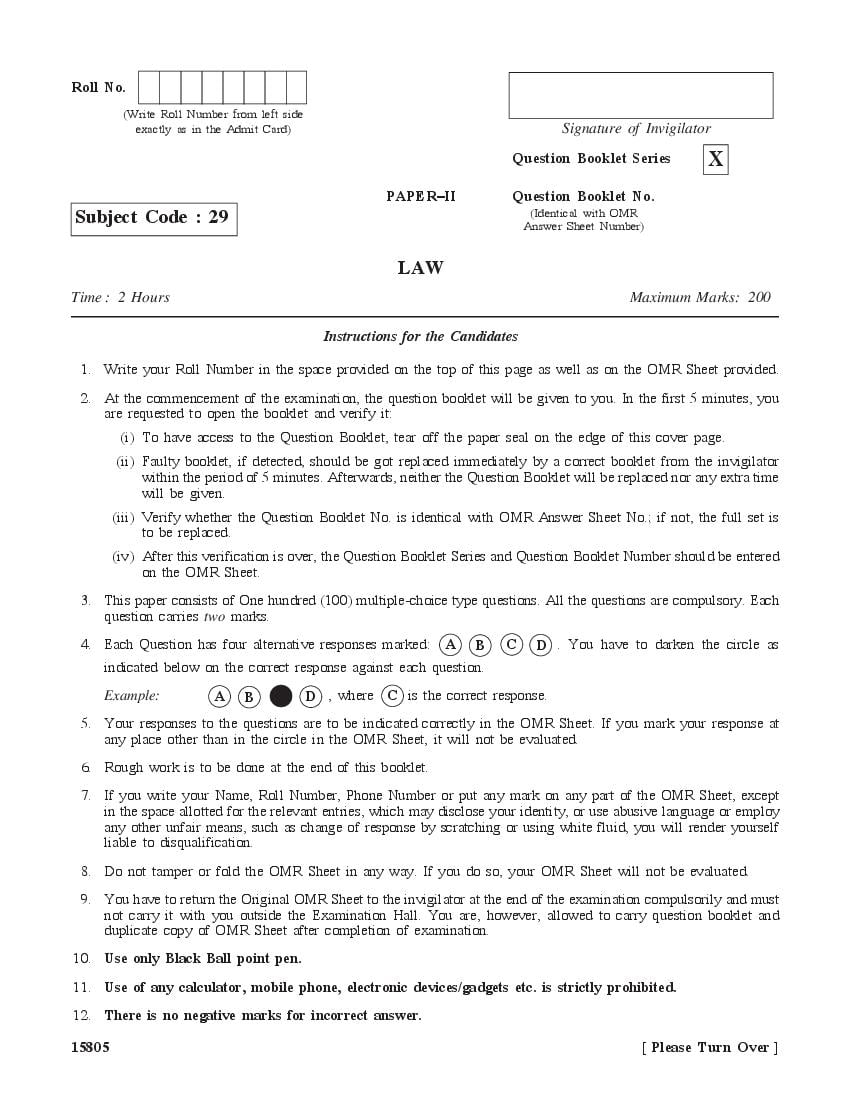
(Write Roll Number from left side
exactly as in the Admit Card) Signature of Invigilator
Question Booklet Series X
PAPER–II Question Booklet No.
Subject Code : 29 (Identical with OMR
Answer Sheet Number)
LAW
Time : 2 Hours Maximum Marks: 200
Instructions for the Candidates
1. Write your Roll Number in the space provided on the top of this page as well as on the OMR Sheet provided.
2. At the commencement of the examination, the question booklet will be given to you. In the first 5 minutes, you
are requested to open the booklet and verify it:
(i) To have access to the Question Booklet, tear off the paper seal on the edge of this cover page.
(ii) Faulty booklet, if detected, should be got replaced immediately by a correct booklet from the invigilator
within the period of 5 minutes. Afterwards, neither the Question Booklet will be replaced nor any extra time
will be given.
(iii) Verify whether the Question Booklet No. is identical with OMR Answer Sheet No.; if not, the full set is
to be replaced.
(iv) After this verification is over, the Question Booklet Series and Question Booklet Number should be entered
on the OMR Sheet.
3. This paper consists of One hundred (100) multiple-choice type questions. All the questions are compulsory. Each
question carries two marks.
4. Each Question has four alternative responses marked: A B C D . You have to darken the circle as
indicated below on the correct response against each question.
Example: A B C D , where C is the correct response.
5. Your responses to the questions are to be indicated correctly in the OMR Sheet. If you mark your response at
any place other than in the circle in the OMR Sheet, it will not be evaluated.
6. Rough work is to be done at the end of this booklet.
7. If you write your Name, Roll Number, Phone Number or put any mark on any part of the OMR Sheet, except
in the space allotted for the relevant entries, which may disclose your identity, or use abusive language or employ
any other unfair means, such as change of response by scratching or using white fluid, you will render yourself
liable to disqualification.
8. Do not tamper or fold the OMR Sheet in any way. If you do so, your OMR Sheet will not be evaluated.
9. You have to return the Original OMR Sheet to the invigilator at the end of the examination compulsorily and must
not carry it with you outside the Examination Hall. You are, however, allowed to carry question booklet and
duplicate copy of OMR Sheet after completion of examination.
10. Use only Black Ball point pen.
11. Use of any calculator, mobile phone, electronic devices/gadgets etc. is strictly prohibited.
12. There is no negative marks for incorrect answer.
15805 [ Please Turn Over ]
Page 3
LAW
PAPER II
1. The doctrine of contributory negligence is not 6. Res ipsa loquitur means:
applicable, when negligence is committed by (A) As you sow, so you reap.
(A) Women
(B) Guilty shall be punished.
(B) Child
(C) The thing speaks for itself.
(C) State
(D) None of the above (D) The guilty speaks lies.
2. Choose the correct statement out of the 7. Mark the correct answer in the following
following: ‘Volenti non fit injuria’ means: statements:
(A) A specific tort (A) Dangerous goods arise on proof of
(B) Is a good defence if there is knowledge of the negligence.
risk. (B) Strict liability arises only when the thing
(C) Is a good defence if injury to risk is consented. causing harm escapes.
(D) Is a good defence in cases of rescue. (C) Liability for dangerous goods in India is
absolute.
(D) Liability for dangerous goods in India is
strict.
3. The principle of ‘Novus actus interveniens’
applies to determine
(A) Vicarious Liability
(B) Strict Liability 8. In Donoghue v Stevenson Case, the duty of a
(C) Act of God manufacturer was fixed towards
(D) Remoteness of Damage (A) retailer only
(B) buyer from retailer
(C) ultimate consumer
4. Which one of the following pairs is correctly (D) None of the above
matched in the maxim ‘Injuria sine damno’ in the code:
(i) actionable per se
(ii) not actionable
(iii) actionable on proof of damage 9. In which of the following cases did the Supreme
(iv) actionable on violation of legal right Court of India gave the ruling that sovereign immunity
of the state is subject to the Fundamental Rights?
Codes:
(A) Kasturilal Ralia Ram Jain v State of UP
(A) (i) and (iv)
(B) (i) and (ii) (B) State of Rajasthan v Vidhyawati
(C) (ii) and (iii) (C) People’s Union for Democratic Rights v State
(D) (iii) and (iv) of Bihar
(D) Shyam Sundar v State of Rajasthan
5. The tort involved in Hurst v Picture Theatres Ltd.
Case is 10. Rule of Absolute liability was propounded by
(A) Defamation (A) Justice Bhagwati
(B) Nuisance (B) Justice Sodhi
(C) Negligence (C) Justice Ahmadi
(D) Trespass (D) Justice Kuldeep Singh
Page 4
11. The rule laid down in Re Polemis Case is that the 16. Duties without a corresponding rights are called
defendant shall be liable for all (A) Absolute duty
(A) direct consequences of his act.
(B) Relative duty
(B) direct consequences of his act, if he could
foresee some damage to the plaintiff from his (C) Secondary duty
act. (D) None of the above
(C) direct consequences of his act, only if he
could foresee the kind of damage which has
actually occurred.
(D) foreseeable damage.
17. Fiction theory is related to which one of the
following concepts?
(A) Legal personality
12. The actus veus of omission commands ______.
(A) there must be moral duty (B) Ownership
(B) the state has option to fix criminal liability (C) Liability
(C) there should be legal duty to act (D) Justice
(D) the act performed is due to unavoidable
accident
13. “Tortious Liability arises from the breach of a 18. Who of the following has made distinction
duty primarily fixed by law; this duty is towards persons between distributive justice and corrective justice?
generally and its breach is redressible by an action for (A) Plato
unliquidated damages”. This statement is made by (B) Aristotle
(A) Salmond
(B) Dias (C) John Stuart
(C) Julius Stone (D) John Austin
(D) Winfield
14. Who is a ‘Consumer’ under the Consumer 19. Adverse possession may lead to loss of
Protection Act, 1986?
(A) Possession
(A) A person who gives his pants for stitching to
a tailor. (B) Power
(B) A person who purchases goods for sale in his (C) Ownership
shop. (D) Liberty
(C) A person who purchases a car for being used
as a taxi in his taxi service.
(D) A person who avails of medical services free
of cost.
20. ‘Ratio decidendi’ may be defined as
(A) statement of law applied to the legal
15. Which of the following section of the Motor problems disclosed by facts.
Vehicles Act, 1988 defines the term ‘Owner’? (B) finding of material facts, direct and inferential,
(A) Sec. 2 (10) based on earlier case law.
(B) Sec. 2 (20)
(C) Sec. 2 (30) (C) Both (A) and (B)
(D) None of the above (D) None of the above
Page 5
21. The term ‘Legal Theory’ has been first time 26. Which of the following is not covered by the
coined by definition of Negotiable Instrument?
(A) Hans Kelsen (A) A Bill of Lading
(B) W. Friedmann (B) A Cheque
(C) Salmond (C) Promissory Note
(D) Ronald Dworkin (D) Bill of Exchange
22. Which one of the following is not a theory of
corporate personality?
(A) Fiction theory 27. A registered company is not
(B) Realist theory (A) a body corporate
(C) Bracket theory (B) a legal person
(D) Will theory (C) a citizen of India
(D) All of the above
23. The negligence which is a result of ignorance,
thoughtlessness or forgetfulness is
(A) advertent negligence
28. An application for allotment of Director
(B) inadvertent negligence
Identification number can be made to the
(C) (A) and (B) both
(A) Central Government
(D) None of the above
(B) State Government
(C) Registrar of the Companies
24. Which of the following is not correct? (D) None of the above
(A) In a contract for sale by sample there is
implied condition that bulk shall correspond
with the sample.
(B) In contract for sale by description there is
29. Which of the following is an offer?
implied condition that goods shall correspond
with the description. (A) Catalogue of books indicating the price
(C) An express condition can negative a condition (B) Invitation of tenders
implied by law. (C) Advertising the auction sale
(D) In sale by sample as well as description, it is (D) Submission of a tender
not sufficient that bulk corresponds with
description if goods do not also correspond
with description.
30. Which of the following is not true about valid
25. Which of the following is not true about nature of consideration?
partnership?
(A) Past consideration is a good consideration.
(A) A society for charitable purposes is a
partnership. (B) Consideration may be given by other person.
(B) Partnership firm is not a legal person. (C) Consideration must be adequate.
(C) Registration of partnership is not mandatory. (D) Consideration should be given at the desire of
(D) Partnership is the relation between partners. promisor.
Page 6
31. Which of the following is not true about void 35. Match List-I with List-II and give correct answer
agreement? by using codes given below:
(A) Minors agreement is void. List-I List-II
(B) Unlawful agreements are void. (a) Concept of law (i) Austin
(C) All void agreements are unlawful. (b) Province of Jurisprudence (ii) Bentham
(D) Unlawful agreement in part is also void. Determined
(c) Some Reflections on (iii) Hart
Jurisprudence
32. Contract of Insurance is a (d) Limits of Jurisprudence (iv) Buckland
(A) Contract of Indemnity u/s 124 Defined
(B) Contingent contract Codes:
(C) Contract of guarantee (a) (b) (c) (d)
(D) None of the above (A) (iii) (ii) (i) (iv)
(B) (iii) (i) (iv) (ii)
(C) (i) (ii) (iii) (iv)
33. Which of the following is not essential of valid (D) (iv) (i) (ii) (iii)
ratification?
(A) Ratification of the acts done on behalf of
other persons.
(B) Ratification of whole transactions.
36. Who said that customs are superior to
(C) Ratification with full knowledge of facts. legislation?
(D) Ratified act should not be injurious to third (A) Henry Maine
person. (B) Sauigny
(C) HLA Hart
(D) Hans Kelson
34. Match List-I with List-II and give correct answer
by using codes given below:
List-I List-II
(a) Jurisprudence is science (i) Salmond 37. Match List-I with List-II and give correct answer
of just and unjust by using codes given below:
(b) Jurisprudence is science (ii) Gray List-I List-II
of first principle of law (a) Interest theory (i) Dugit
(c) Jurisprudence is (iii) Ulpian (b) Realist theory of corporate (ii) Jhering
philosophical aspect of law personality
(d) Jurisprudence is no more a (iv) Cicero (c) Social solidarity (iii) Gierke
formal science than physiology (d) Social engineering (iv) Pound
Codes: Codes:
(a) (b) (c) (d) (a) (b) (c) (d)
(A) (i) (ii) (iii) (iv) (A) (ii) (iii) (i) (iv)
(B) (iii) (i) (iv) (ii) (B) (iii) (ii) (iv) (i)
(C) (ii) (iii) (i) (iv) (C) (i) (ii) (iii) (iv)
(D) (iii) (iv) (i) (ii) (D) (iv) (iii) (ii) (i)
Page 7
38. Who said “law like language develops with the 43. Match List-I with List-II and give correct answer
life of people”? by using codes given below:
(A) Sauigny List-I List-II
(B) Henry Maine (a) Goods of principal (i) Corporeal possession
(C) Austin in hands of agent
(D) Hegel (b) Pledgers possession (ii) Mediate possession
(c) Author’s copyright (iii) Immediate possession
39. Which of the following is not requisite essential (d) Owner’s watch (iv) Incorporeal Possession
of a valid custom?
Codes:
(A) Reasonableness
(B) Antiquity (a) (b) (c) (d)
(C) Conformity with statute law (A) (ii) (iii) (i) (iv)
(D) Conformity with public policy (B) (iii) (ii) (iv) (i)
(C) (i) (ii) (iii) (iv)
(D) (iii) (iv) (ii) (i)
40. Who propounded that there are 2 types of rules —
Primary and Secondary rules?
(A) HLA Hart
(B) Kelson
(C) Pound
44. Read Assertion (A) and Reason (R) and give
(D) Maine
correct answer with the help of codes given below:
Assertion (A) : Austin said laws set by
41. Which of the following is not a jural postulate of sovereign to the members of
legal system as propounded by Roseoe Pound? political society is positive law.
(A) There will be no intentional aggression. Reason (R) : Austin emphasised on the
(B) Members of society will act in good faith. element of sanction.
(C) People will make use of what they have Codes:
created.
(A) (A) and (R) are true and (R) is correct
(D) People will cause injury to others during explanation of (A).
their course of work.
(B) (A) and (R) are true but (R) is not the correct.
explanation of (A).
42. Match List-I with List-II and give correct answer (C) (A) is true but (R) is false.
by using codes given below: (D) (A) is false but (R) is true.
List-I List-II
(a) Right (i) Disability
(b) Liberty (ii) Duty
(c) Power (iii) No right
(d) Immunity (iv) Liability 45. By the Criminal Law (Amendment) Act, 2013
Codes: which of the following clause (s) was/were inserted in
(a) (b) (c) (d) section 100 of the Indian Penal Code?
(A) Fifthly
(A) (ii) (iii) (iv) (i)
(B) (i) (ii) (iii) (iv) (B) Sixthly
(C) (iv) (iii) (ii) (i) (C) Seventhly
(D) (iv) (ii) (i) (iii) (D) Seventhly and eighthly
Page 8
46. ‘In order to convict a person vicariously liable 51. ‘It is now well settled principle of law that if two
under section 34 or section 149, Indian Penal Code, it is views are possible, one in favour of the accused and the
not necessary to prove that each and everyone of them other adversely against it, the view favouring the
had indulged in overts act’ was held in accused must be accepted’ was held in
(A) Major Singh v State of Punjab, AIR 2003 (A) State of Rajasthan v Dhool Singh, AIR 2004
sec 342
SC 1264
(B) Mrinal Das v State of Tripura, AIR 2011
(B) Balaji Gunthu Dhule v State of Maharashta,
SC 3753
AIR 2013 SC 264
(C) Rangaswami v State of Tamil Nadu, AIR
1989 SC 1137 (C) Raghunath v State of Haryana, AIR 2003 SC
165
(D) Ram Bilas Sing. v State of Bihar, AIR 1989
SC 1593 (D) Virsa Singh v State of Punjab, AIR 1958 SC
465
47. Where no sum is expressed to which a five may
extend, the amount of five to which the offender is liable
is 52. Where a woman is raped by one or more persons
(A) unlimited, but shall not be excessive. constituting a group or acting in furtherance of a
common intention, any five imposed under section 376 D
(B) limited, but shall not be excessive.
shall be
(C) to be fixed by the court in proportion to
imprisonment. (A) paid and levied as per process of law.
(D) unlimited, but shall not be exemplary. (B) paid and levied by due process of law.
(C) paid to meet the desire of the victim.
(D) paid to the victim.
48. The law relating to ‘consent known to be given
under fear or misconception’ is given under
(A) Section 88, I.P.C.
(B) Section 89, I.P.C. 53. Direction : Point out incorrect response.
(C) Section 90, I.P.C. When extortion is robbery, the offender is said to
(D) Section 94, I.P.C. be present if he is sufficiently near to put the other
person in fear of
(A) instant death
49. For Criminal conspiracy, it is immaterial
whether the illegal act is the ultimate object of such (B) instant hurt
agreement, or is merely (C) instant grievous hurt
(A) accidental to that object. (D) instant wrongful restraint
(B) collateral to that object.
(C) incidental to that object.
(D) ancillary to that object. 54. X finds a rupee on the high road, not knowing to
whom the rupee belongs. X picks up the rupee. Here X
has
50. If the assembly is an unlawful assembly within (A) committed dishonest misappropriation of
the meaning of section 141, I.P.C., the offender will be property.
punishable under
(B) not committed dishonest misappropriation of
(A) Section 144, I.P.C property.
(B) Section 145, I.P.C (C) committed dishonest concealment of fact.
(C) Section 149, I.P.C (D) committed cheating and dishonestly inducing
(D) Section 153A, I.P.C delivery of property.
Page 9
55. “It is logically impossible to distinguish 60. Narada Smriti deals with the following:
administrative law from constitutional law and all (A) Achara
attempts to do so are artificial.” The above statement
(B) Vyavahara
was observed by
(C) Prayaschitta
(A) Maitland
(D) All of the above
(B) Keith
(C) Hood Phillips
(D) Dicey
61. Under the Modern Hindu Law, a hindu marriage
is
56. The term “natural justice” expresses the close (A) Sacrament
relationship between (B) Contract
(A) Common law and equitable principles. (C) Has a semblance of both contract and
(B) Common law and moral principles. sacrament
(C) Common law and legal principles. (D) None of the above
(D) Roman law and moral principles.
62. Legitimacy of Children of void and voidable
57. The originator of concept of Rule of Law is marriages are provided under
(A) Wade (A) Section 12 of the Hindu Marriage Act
(B) Sir Edward Coke (B) Section 16 of the Hindu Marriage Act
(C) Dicey (C) Section 17 of the Hindu Marriage Act
(D) Davis (D) Section 22 of the Hindu Marriage Act
58. “The concept of reasonableness and non-
63. A married Hindu Woman has been given the
arbitrariness pervades the entire constitutional scheme
right to adopt a child by the Personal Laws
and is a golden thread which runs through the whole of
(Amendment) Act of
the fabric of the constitution.” The above principle was
observed by the Supreme Court in the case (A) 2005
(A) S. R. Bommai v Union of India (1994) 3sec (B) 2008
(B) Bandhna Mukti Morcha v Union of India (C) 2010
(1984) 3 sec 161 (D) 2012
(C) Indra Sawhney v Union of India (1992)
Supp (3) sec 217
(D) R. K. Jain v Union of India (1993) 4 sec 119
64. Section 23 of Hindu Succession Act which
provided for partition of dwelling house has been
deleted from the Act by virtue of Hindu Succession
59. Doctrine of separation of powers originated by (Amendment) Act of
(A) Ivor Jennings (A) 2000
(B) Dicey (B) 2002
(C) Aristotle (C) 2005
(D) Montesquieu (D) 2006
Page 10
65. Fatwa, a form of adjudication in Islam, “does not 69. “Even religious denomination shall have the
have a force of law and therefore, cannot be enforce by right to manage its own affairs in matter of religion.”
any process using coercive method”. This has been held This right has been recognised in the Constitution of
by the Supreme Court in India in
(A) Vishwa Lochan Madan v UOI, (2014) 7 (A) Article 26(a)
SCC 707 (B) Article 26(b)
(B) Sant Ram v Labh Singh, AIR 1965 SC 314 (C) Article 26(c)
(C) Ashok Kumar Gupta v State of UP, (1997) 5 (D) Article 26(d)
SCC 201
(D) Raju Prasad v State of Assam (2015) 9
SCC 461 70. The directive principles of state policy under the
Constitution of India is
(A) a soft law.
(B) not a law at all as not enforceable.
(C) fundamental in the governance of the country.
66. Article 16(6) of the Constitution of India (D) a positive morality.
provides: “Nothing in this Article shall prevent the state
from making any provision for the reservation of
appointments or posts in favour of any economically
71. The Constitution of India has given power to
weaker sections of citizens .....”. The above provision
parliament to provide for the establishment of certain
has been added to the constitution by
addition court.
(A) the 103rd Amendment Under which article of the constitution has provided
(B) the 104th Amendment this power?
(C) the 105th Amendment (A) By the Article 251
(D) the 99th Amendment
(B) By the Article 247
(C) By the Article 229
67. The protection in respect of conviction for
offences is recognised in the Constitution of India in (D) By the Article 224
(A) Article 35(A)
(B) Article 369
(C) Article 229 72. The Parliament of India has power to make
(D) Article 20 treaty, agreement or convention with any other country.
Under which Article of the Constitution provided for
the above power?
68. The Right to livelihood is an integral facet of the
right to life under Article 21 of the Constitution of India, (A) By the Article 253
held by the Supreme Court in (B) By the Article 256
(A) Parmananda Katara v UOI, AIR 1986 (C) By the Article 248
SC 2039 (D) By the Article 246
(B) Suk Das v UT of Arunachal, AIR 1986
SC 991
(C) P.V. Kappor v UOI, (1992) Cri LJ 140 73. Initially the term “industrial property” has been
(Del) used in the
(D) Narendra Kumar v State of Haryana, (1994) (A) Paris Convention
4 SCC 460
(B) TRIPS Agreement
(C) Brussels Convention
(D) English Convention
Page 11
74. “Everyone has the right to the protection of the 79. The National Commission for Backward Classes
moral and material interests resulting from any science, has been introduced by the Constitution of India by
literacy or artistic production of which he is the author”. (A) the 102nd Amendment
This principle has been provided in
(B) the 104th Amendment
(A) Article 7 of the Universal Declaration of
(C) the 65th Amendment
Human Rights.
(D) the 99th Amendment
(B) Article 17 of the Universal Declaration of the
Human Rights.
(C) Article 21 of the Universal Declaration of 80. The words “socialist” and “secular” were added
Human Rights. in the Preamble to the Consitution of India by the
(D) The Article 27 of the Universal Declaration (A) 44th Amendment
of Human Rights. (B) 1st Amendment
(C) 42nd Amendment
(D) 17th Amendment
75. The Copyright (Amendment) Act, 1984 has
made copyright infringement
81. ICT stands for
(A) a Civil Wrong only.
(A) International Communication Technology
(B) A cognizable non-bailable offence.
(B) Inter Common Terminology
(C) a Civil as well as tortious wrong only.
(C) Information and Communication Technology
(D) an administrative wrong.
(D) Interconnected Terminals
76. “Works in which copyright subsists” 82. Which of the following is the appropriate
definition of Information Technology?
(A) Original literacy, dramatic, musical and
artistic works (A) Information Technology refers to the use of
hardware and software for processing
(B) Original sound recordings
information.
(C) Original cinematograph films
(B) Information Technology refers to the use of
(D) Original books and Journals hardware and software for distribution of
useful information.
(C) Information Technology refers to the use of
77. What are not inventions? hardware and software for storage, retrieval,
(A) Computer software processing and distributing information of
(B) Traditional knowledge many kinds.
(C) Topography of integrated circuits (D) Information Technology refers to the use of
(D) A presentation of information principles of physical sciences and social
sciences for processing of information of
many kinds.
78. Under which legislation or legislations the
protection of computer software is permissible? 83. Which section of Information Technology Act
(A) Information Technology Act, 2000 was invalidated by Supreme Court of India?
(B) Copyright Act, 1957 and Information (A) Section 66B
Technology Act, 2000 (B) Section 66D
(C) Copyright Act, 1957 (C) Section 66A
(D) Companies Act, 2013 (D) Section 66E
Page 12
84. Who has originated the doctrine of rule of law? 90. A minor of sound mind under Muslim law is
(A) Dicey capable of disposing of his property by will to the extent
of
(B) Coke
(A) 1/3
(C) Black stone
(B) Full
(D) Halsbury (C) 3/4
(D) None of the above
85. Lord Hewart used the expression ‘New 91. Which provisions of the Criminal Procedure
Despotism’ with respect to Code (Cr.P.C.), 1973 empower the District and
(A) Rule of law Executive Magistrate to take action for prevention of
(B) Public law noxious activity or public nuisance?
(C) Constitutional law (A) Section 133
(D) Administrative law (B) Section 144
(C) Both (A) and (B)
(D) None of the above
86. Revelation is the source of Islamic law
92. In which of the following cases was the doctrine
(A) only
of ‘public trust’ first recognised and originated in India?
(B) secondary source
(C) primary (A) M.I. Builders (P) Ltd. v. Radhey Shyam
Sahu, AIR 1999 SC 2468
(D) None of the above
(B) M.C. Mehta v. Kamal Nath (1997)1
SCC 388
(C) Union Carbide Corpn. v. Union of India, AIR
87. A marriage with a woman before completion of 1992 SC 317
her iddat period is
(D) M.C. Mehta v. Union of India, (2004)6
(A) void
SCC 588
(B) voidable
(C) irregular 93. What was the objective of the passing of the
(D) None of the above Green Tribunal Act, 2010?
(A) Consolidation of environmental laws in the
country
88. The Dissolution of Muslim Marriage Act was (B) In order to conform to the standards set out by
enacted in the Vienna Convention
(A) 1929 (C) In order to ensure conformity to the Rio
(B) 1937 Convention
(C) 1939 (D) None of the above
(D) 1941
94. The Indigenous and Tribal peoples convention,
1989 was drafted by
89. Sadaqah once completed by delivery is (A) The International Labour Organisation
(A) Revocable (B) United Nations Educaional, Scientific and
(B) Non-revocable Cultural Organisation (UNESCO)
(C) Revocable subject to conditions (C) United Nations Children’s Fund (UNICEF)
(D) None of the above (D) None of the above
Page 13
95. Why is ‘sustainable development’ a principle of 98. What is Jus Cogens?
paramount importance in international law? (A) They are preemptory norms of international
(A) Because it promotes world peace. law, from which no derogations are allowed
(B) Because it is a principle which did not exist and which can never be altered even with
before. the consent of the states.
(C) Because it is a principle recognised by the (B) They are rules of international law that are
International Court of Justice as well as by a laid down in multilateral treaties with a wide
number of leading International participation.
Organisations. (C) They are the decisions of the UN Security
(D) Because non-governmental organisation Council.
support this principle. (D) They are the rules of international law on
which the International Court of Justice (ICJ)
96. What does it mean for a state to be sovereign? found its decisions.
(A) Sovereignty means being recognised by all
other states. 99. What is the constitutive theory of recognition?
(B) Sovereignty means to be able to enter into (A) Recognition is determinative of statehood.
treaties and join the UN. (B) Recognition requires constitutional approval
(C) Sovereignty means freedom to determine by third nations.
one’s own affairs without external (C) Recognition requires that the constitution of
interference. the recognised state includes sufficient human
(D) Sovereignty means possessing the right to rights guarantees.
defend oneself. (D) Countries wishing to be recognised must
possess a valid constitution.
97. What is fundamental premise of monist theory?
(A) Monism posits that international law is 100. What is the legal nature of the Universal
superior to domestic laws. Declaration of Human Rights (UDHR)?
(B) Monism posits that international and domestic (A) The UDHR is a multilateral treaty.
law are part of the same legal order. (B) The UDHR is a UN General Assembly
(C) Monism posits that domestic laws are superior resolution.
to international law. (C) The UDHR is a UN Security resolution.
(D) Monism posits that domestic and international (D) The UDHR is a declaration adopted by several
law never clash. states at an international conference.
Page 14
ROUGH WORK
Page 15
ROUGH WORK
Page 16
ROUGH WORK
Document Details
| Board / Org | Default |
| Exam | Govt Jobs Exams |
| Type | Question Paper |
| Pages | 16 |
| Updated | 30 Apr 2026 |