UGC NET 2021 Question Paper Education Shift 1
Finished viewing? Save it for later —
Download UGC NET 2021 Question Paper Education Shift 1 (PDF · 75 pages)About UGC NET 2021 Question Paper Education Shift 1
UGC NET 2021 Question Paper Education Shift 1 is available here for free download. Published by NTA for UGC National Eligibility Test, this question paper can be viewed online or downloaded as a PDF (75 pages). Candidates preparing for UGC National Eligibility Test can use UGC NET 2021 Question Paper Education Shift 1 to understand the exam pattern, the type of questions asked, and the overall difficulty level.
Frequently Asked Questions
How can I download UGC NET 2021 Question Paper Education Shift 1?
Open this page and click the Download button to save UGC NET 2021 Question Paper Education Shift 1 as a PDF. It is completely free on AglaSem Docs.
Is UGC NET 2021 Question Paper Education Shift 1 free to download?
Yes. UGC NET 2021 Question Paper Education Shift 1 can be viewed online and downloaded as a PDF free of cost on AglaSem Docs.
How many pages does UGC NET 2021 Question Paper Education Shift 1 have?
UGC NET 2021 Question Paper Education Shift 1 contains 75 pages, which you can read online or download together as a single PDF.
Where can I find more UGC National Eligibility Test study material?
You can find more UGC National Eligibility Test question papers, sample papers, syllabus, and answer keys on AglaSem Docs.
UGC NET 2021 Question Paper Education Shift 1 – Text
Read the full text of this question paper below — useful to quickly search, copy and reference the content online without downloading the PDF.
📄 View text version (75 pages)
Page 1
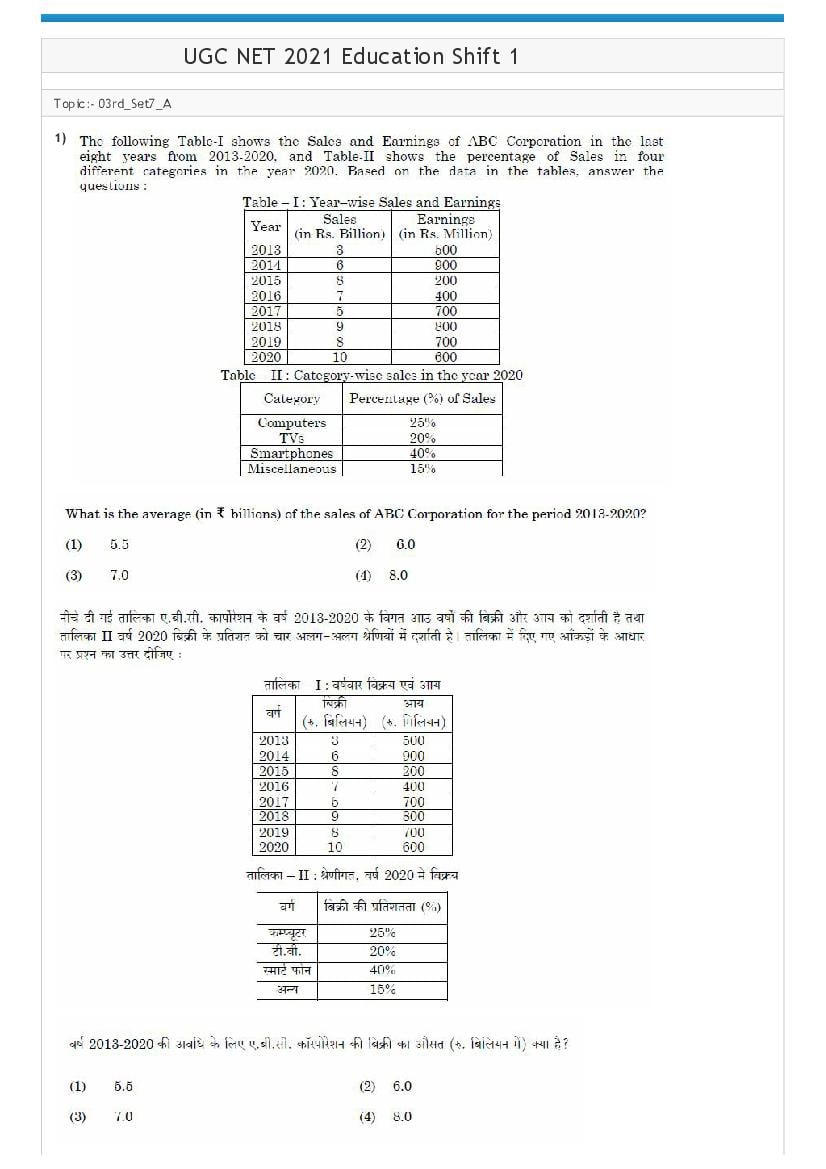
Topic:‐ 03rd_Set7_A
1)
Page 2
1. 1 [Option ID = 10313]
2. 2 [Option ID = 10314]
3. 3 [Option ID = 10315]
4. 4 [Option ID = 10316]
1 [Option ID = 10313]
2)
[Question ID = 2580][Question Description = Q02_GP_24NOV_S1_SHAAN_Shift1]
Page 3
2. 2 [Option ID = 10318]
3. 3 [Option ID = 10319]
4. 4 [Option ID = 10320]
1 [Option ID = 10317]
3)
[Question ID = 2581][Question Description = Q03_GP_24NOV_S1_SHAAN_Shift1]
Page 4
2. 2 [Option ID = 10322]
3. 3 [Option ID = 10323]
4. 4 [Option ID = 10324]
1 [Option ID = 10321]
4)
Page 5
1. 1 [Option ID = 10325]
2. 2 [Option ID = 10326]
3. 3 [Option ID = 10327]
4. 4 [Option ID = 10328]
1 [Option ID = 10325]
5)
Page 6
1. 1 [Option ID = 10329]
2. 2 [Option ID = 10330]
3. 3 [Option ID = 10331]
4. 4 [Option ID = 10332]
1 [Option ID = 10329]
Topic:‐ 03rd_Set7_B
1)
[Question ID = 2584][Question Description = Q06_GP_24NOV_S1_SHAAN_Shift1]
1. 1 [Option ID = 10333]
2. 2 [Option ID = 10334]
3. 3 [Option ID = 10335]
4. 4 [Option ID = 10336]
1 [Option ID = 10333]
2)
Page 7
1. 1 [Option ID = 10337]
2. 2 [Option ID = 10338]
3. 3 [Option ID = 10339]
4. 4 [Option ID = 10340]
1 [Option ID = 10337]
3)
[Question ID = 2586][Question Description = Q08_GP_24NOV_S1_SHAAN_Shift1]
1. 1 [Option ID = 10341]
2. 2 [Option ID = 10342]
3. 3 [Option ID = 10343]
Page 8
1 [Option ID = 10341]
4)
[Question ID = 2587][Question Description = Q09_GP_24NOV_S1_SHAAN_Shift1]
1. 1 [Option ID = 10345]
2. 2 [Option ID = 10346]
3. 3 [Option ID = 10347]
4. 4 [Option ID = 10348]
1 [Option ID = 10345]
5)
Page 9
1. 1 [Option ID = 10349]
2. 2 [Option ID = 10350]
3. 3 [Option ID = 10351]
4. 4 [Option ID = 10352]
1 [Option ID = 10349]
6)
[Question ID = 2589][Question Description = Q11_GP_24NOV_S1_SHAAN_Shift1]
1. 1 [Option ID = 10353]
2. 2 [Option ID = 10354]
3. 3 [Option ID = 10355]
4. 4 [Option ID = 10356]
1 [Option ID = 10353]
7)
Page 10
1. 1 [Option ID = 10357]
2. 2 [Option ID = 10358]
3. 3 [Option ID = 10359]
4. 4 [Option ID = 10360]
1 [Option ID = 10357]
8)
Page 11
1. 1 [Option ID = 10361]
2. 2 [Option ID = 10362]
3. 3 [Option ID = 10363]
4. 4 [Option ID = 10364]
1 [Option ID = 10361]
9)
[Question ID = 2592][Question Description = Q14_GP_24NOV_S1_SHAAN_Shift1]
Page 12
2. 2 [Option ID = 10366]
3. 3 [Option ID = 10367]
4. 4 [Option ID = 10368]
1 [Option ID = 10365]
10)
[Question ID = 2593][Question Description = Q15_GP_24NOV_S1_SHAAN_Shift1]
1. 1 [Option ID = 10369]
2. 2 [Option ID = 10370]
3. 3 [Option ID = 10371]
4. 4 [Option ID = 10372]
1 [Option ID = 10369]
11)
Page 13
1. 1 [Option ID = 10373]
2. 2 [Option ID = 10374]
3. 3 [Option ID = 10375]
4. 4 [Option ID = 10376]
1 [Option ID = 10373]
12)
[Question ID = 2595][Question Description = Q17_GP_24NOV_S1_SHAAN_Shift1]
1. 1 [Option ID = 10377]
2. 2 [Option ID = 10378]
3. 3 [Option ID = 10379]
4. 4 [Option ID = 10380]
1 [Option ID = 10377]
13)
Page 14
1. 1 [Option ID = 10381]
2. 2 [Option ID = 10382]
3. 3 [Option ID = 10383]
4. 4 [Option ID = 10384]
1 [Option ID = 10381]
14)
Page 15
1. 1 [Option ID = 10385]
2. 2 [Option ID = 10386]
3. 3 [Option ID = 10387]
4. 4 [Option ID = 10388]
1 [Option ID = 10385]
15)
[Question ID = 2598][Question Description = Q20_GP_24NOV_S1_SHAAN_Shift1]
1. 1 [Option ID = 10389]
2. 2 [Option ID = 10390]
3. 3 [Option ID = 10391]
4. 4 [Option ID = 10392]
1 [Option ID = 10389]
16)
[Question ID = 2599][Question Description = Q21_GP_24NOV_S1_SHAAN_Shift1]
1. 1 [Option ID = 10393]
2. 2 [Option ID = 10394]
3. 3 [Option ID = 10395]
4. 4 [Option ID = 10396]
1 [Option ID = 10393]
17)
Page 16
1. 1 [Option ID = 10397]
2. 2 [Option ID = 10398]
3. 3 [Option ID = 10399]
4. 4 [Option ID = 10400]
1 [Option ID = 10397]
18)
[Question ID = 2601][Question Description = Q23_GP_24NOV_S1_SHAAN_Shift1]
1. 1 [Option ID = 10401]
2. 2 [Option ID = 10402]
3. 3 [Option ID = 10403]
4. 4 [Option ID = 10404]
1 [Option ID = 10401]
19)
[Question ID = 2602][Question Description = Q24_GP_24NOV_S1_SHAAN_Shift1]
1. 1 [Option ID = 10405]
2. 2 [Option ID = 10406]
3. 3 [Option ID = 10407]
4. 4 [Option ID = 10408]
1 [Option ID = 10405]
20)
[Question ID = 2603][Question Description = Q25_GP_24NOV_S1_SHAAN_Shift1]
1. 1 [Option ID = 10409]
2. 2 [Option ID = 10410]
3. 3 [Option ID = 10411]
Page 17
1 [Option ID = 10409]
21)
[Question ID = 2604][Question Description = Q26_GP_24NOV_S1_SHAAN_Shift1]
1. 1 [Option ID = 10413]
2. 2 [Option ID = 10414]
3. 3 [Option ID = 10415]
4. 4 [Option ID = 10416]
1 [Option ID = 10413]
22)
Page 18
1. 1 [Option ID = 10417]
2. 2 [Option ID = 10418]
3. 3 [Option ID = 10419]
4. 4 [Option ID = 10420]
1 [Option ID = 10417]
23)
[Question ID = 2606][Question Description = Q28_GP_24NOV_S1_SHAAN_Shift1]
1. 1 [Option ID = 10421]
2. 2 [Option ID = 10422]
3. 3 [Option ID = 10423]
4. 4 [Option ID = 10424]
1 [Option ID = 10421]
24)
Page 19
1. 1 [Option ID = 10425]
2. 2 [Option ID = 10426]
3. 3 [Option ID = 10427]
4. 4 [Option ID = 10428]
1 [Option ID = 10425]
25)
[Question ID = 2608][Question Description = Q30_GP_24NOV_S1_SHAAN_Shift1]
1. 1 [Option ID = 10429]
2. 2 [Option ID = 10430]
3. 3 [Option ID = 10431]
4. 4 [Option ID = 10432]
Page 20
26)
[Question ID = 2609][Question Description = Q31_GP_24NOV_S1_SHAAN_Shift1]
1. 1 [Option ID = 10433]
2. 2 [Option ID = 10434]
3. 3 [Option ID = 10435]
4. 4 [Option ID = 10436]
1 [Option ID = 10433]
27)
Page 21
1. 1 [Option ID = 10437]
2. 2 [Option ID = 10438]
3. 3 [Option ID = 10439]
4. 4 [Option ID = 10440]
1 [Option ID = 10437]
28)
[Question ID = 2611][Question Description = Q33_GP_24NOV_S1_SHAAN_Shift1]
1. 1 [Option ID = 10441]
2. 2 [Option ID = 10442]
3. 3 [Option ID = 10443]
4. 4 [Option ID = 10444]
1 [Option ID = 10441]
29)
Page 22
1. 1 [Option ID = 10445]
2. 2 [Option ID = 10446]
3. 3 [Option ID = 10447]
4. 4 [Option ID = 10448]
1 [Option ID = 10445]
30)
Page 23
1. 1 [Option ID = 10449]
2. 2 [Option ID = 10450]
3. 3 [Option ID = 10451]
4. 4 [Option ID = 10452]
1 [Option ID = 10449]
31)
[Question ID = 2614][Question Description = Q36_GP_24NOV_S1_SHAAN_Shift1]
1. 1 [Option ID = 10453]
2. 2 [Option ID = 10454]
3. 3 [Option ID = 10455]
4. 4 [Option ID = 10456]
1 [Option ID = 10453]
32)
Page 24
1. 1 [Option ID = 10457]
2. 2 [Option ID = 10458]
3. 3 [Option ID = 10459]
4. 4 [Option ID = 10460]
1 [Option ID = 10457]
33)
Page 25
1. 1 [Option ID = 10461]
2. 2 [Option ID = 10462]
3. 3 [Option ID = 10463]
4. 4 [Option ID = 10464]
1 [Option ID = 10461]
34)
[Question ID = 2617][Question Description = Q39_GP_24NOV_S1_SHAAN_Shift1]
1. 1 [Option ID = 10465]
2. 2 [Option ID = 10466]
3. 3 [Option ID = 10467]
4. 4 [Option ID = 10468]
1 [Option ID = 10465]
35)
Page 26
1. 1 [Option ID = 10469]
2. 2 [Option ID = 10470]
3. 3 [Option ID = 10471]
4. 4 [Option ID = 10472]
1 [Option ID = 10469]
36)
[Question ID = 2619][Question Description = Q41_GP_24NOV_S1_SHAAN_Shift1]
1. 1 [Option ID = 10473]
2. 2 [Option ID = 10474]
3. 3 [Option ID = 10475]
4. 4 [Option ID = 10476]
1 [Option ID = 10473]
Page 27
[Question ID = 2620][Question Description = Q42_GP_24NOV_S1_SHAAN_Shift1]
1. 1 [Option ID = 10477]
2. 2 [Option ID = 10478]
3. 3 [Option ID = 10479]
4. 4 [Option ID = 10480]
1 [Option ID = 10477]
38)
[Question ID = 2621][Question Description = Q43_GP_24NOV_S1_SHAAN_Shift1]
1. 1 [Option ID = 10481]
2. 2 [Option ID = 10482]
3. 3 [Option ID = 10483]
4. 4 [Option ID = 10484]
1 [Option ID = 10481]
39)
Page 28
1. 1 [Option ID = 10485]
2. 2 [Option ID = 10486]
3. 3 [Option ID = 10487]
4. 4 [Option ID = 10488]
1 [Option ID = 10485]
40)
[Question ID = 2623][Question Description = Q45_GP_24NOV_S1_SHAAN_Shift1]
1. 1 [Option ID = 10489]
2. 2 [Option ID = 10490]
3. 3 [Option ID = 10491]
4. 4 [Option ID = 10492]
1 [Option ID = 10489]
Topic:‐ 03rd_Set7_C
1)
Page 29
1. 1 [Option ID = 10493]
2. 2 [Option ID = 10494]
3. 3 [Option ID = 10495]
4. 4 [Option ID = 10496]
1 [Option ID = 10493]
2)
Page 30
1. 1 [Option ID = 10497]
2. 2 [Option ID = 10498]
3. 3 [Option ID = 10499]
4. 4 [Option ID = 10500]
1 [Option ID = 10497]
3)
Page 31
1. 1 [Option ID = 10501]
2. 2 [Option ID = 10502]
3. 3 [Option ID = 10503]
4. 4 [Option ID = 10504]
1 [Option ID = 10501]
4)
Page 32
1. 1 [Option ID = 10505]
2. 2 [Option ID = 10506]
3. 3 [Option ID = 10507]
4. 4 [Option ID = 10508]
Page 33
5)
Page 34
1. 1 [Option ID = 10509]
2. 2 [Option ID = 10510]
3. 3 [Option ID = 10511]
4. 4 [Option ID = 10512]
1 [Option ID = 10509]
Topic:‐ Education_SH1_A
1) A researcher conducted a study to have initial idea of scope and magnitude of the problem under study and to test the
feasibility of more extensive research. Such a study is called:
एक शोधकता ने अ ययन म सम या के िव तार एवं प रमाण के आ िवचार को पा करने के िलए तथा यादा यापक अनुसंधान क संभा यता क जांच करने
के िलए एक अ ययन संचािलत िकया इस पकार के अ ययन को कहते ह ◌ः
[Question ID = 2929][Question Description = S1_qSNz_PG_EDU_Q01]
1. Explanatory study/ या या मक अ ययन
[Option ID = 11713]
2. Confirmatory study/संपोषक अ ययन
[Option ID = 11714]
3. Descriptive study/िववरणा मक अ ययन
[Option ID = 11715]
4. Exploratory study/अ वेषणा मक अ ययन
[Option ID = 11716]
Explanatory study/ या या मक अ ययन
[Option ID = 11713]
2) An independent variable in an experimental study, which is manipulated by the investigator at his will, is technically
known as:
एक पायोिगक अ ययन म एक वतंत चर, िजसम अ वेषक ने अपनी इ छा से बदलाव िकया है, को तकनीक प से जाना जाता है :
[Question ID = 2930][Question Description = S1_qSNz_PG_EDU_Q02]
1. Moderator variable/प रमाजक चर
[Option ID = 11717]
2. Treatment variable/उपचार चर
[Option ID = 11718]
3. Interfering variable/ यितकारी चर
[Option ID = 11719]
4. Confounding variable/अ फुट चर
[Option ID = 11720]
Moderator variable/प रमाजक चर
[Option ID = 11717]
3) If the distribution of scores obtained by a group of examinees on a test is skewed negatively, then which of the following
statements is false?
यिद िकसी परी ण म परी ािथय के समूह ारा पा अंक का िवतरण प प से ऋणा मक िदशा म िवषम हो, तो िन निलिखत म से कौन सा कथन सही
नह है ?
[Question ID = 2931][Question Description = S1_qSNz_PG_EDU_Q03]
1. Most of the examinees crossed the passing cut‐score of the test./अिधकांश परी ािथय ने परी ा के उ ीणता‐ तर‐अंक को पार कर िलया
[Option ID = 11721]
2. The average difficulty level of the test‐items was low./परी ण‐सामगी का औसत‐किठनाई‐ तर कम था
[Option ID = 11722]
3. The mean score of the examinees was more than the median score./परी ािथय के माि यका‐पा ांक से यादा मा य‐पा ांक था
[Option ID = 11723]
4. The modal value was less than the mean, but more than median./बहलक मू य मा य से कम था , लेिकन माि यका से अिधक था
[Option ID = 11724]
Most of the examinees crossed the passing cut‐score of the test./अिधकांश परी ािथय ने परी ा के उ ीणता‐ तर‐अंक को पार कर िलया
[Option ID = 11721]
Page 35
' यि अ ययन' िविध िन निलिखत म से अिधकतर िकस गुणा मक अनुसंधान‐पा प म शािमल है ?
[Question ID = 2932][Question Description = S1_qSNz_PG_EDU_Q04]
1. Phenomenological Design/घटनाकमीय पा प
[Option ID = 11725]
2. Ethnographical Design/नृजाितवृ पा प
[Option ID = 11726]
3. Grounded Theory Design/बुिनयादी िस ांत पा प
[Option ID = 11727]
4. Narrative Design/वणना मक पा प
[Option ID = 11728]
Phenomenological Design/घटनाकमीय पा प
[Option ID = 11725]
5) Which of the following statements defines the basic philosophy, theory, and practice of teaching children according to
critical pedagogy?
िन निलिखत म से कौन सा कथन िववेचना मक‐िश ाशा त के अनुसार ब च को पढ़ाने के मूल दशन, िस ांत और पिकया को प रभािषत करता है ?
[Question ID = 2933][Question Description = S1_qSNz_PG_EDU_Q05]
1. Emphasis on concepts like compassion, kind‐heartedness and healthy dialogue to ensure children's wellbeing and social development./ब च क भलाई
और सामािजक िवकास सुिनि त करने के िलए क णा, दया और व थ‐संवाद जैसी अवधारणाओं पर जोर देना
[Option ID = 11729]
2. Questioning dominant beliefs or world views about knowledge and learning, and discover deeper meaning and root causes of the phenomena./ ान
और अिधगम के बारे म पबल‐मा यताओं या िव के मा य‐िवचार पर प करना, और प रघटना के गहरे अथ और मूल कारण क खोज करना
[Option ID = 11730]
3. Accepting multicultural needs to create equally comfortable learning environment for all childern irrespective of cultural and social origin/सां कृितक
और सामािजक उ पि का यान िकये िबना सभी सभी ब च हेतु बहसां कृितक आव यकताओं को समान प से आरामदायक अिधगम‐वातावरण बनाने क आव यकता को वीकार करना
[Option ID = 11731]
4. Challenges traditional beliefs about knowledge, look for alternatives, and create knowledge through thoughts, experience and dialogue./ ान के बारे म
पारंप रक मा यताओं को चुनौती देता है, िवक प क तलाश करता है, और िवचार , अनुभव और संवाद के मा यम से ान का सृजन करता है
[Option ID = 11732]
Emphasis on concepts like compassion, kind‐heartedness and healthy dialogue to ensure children's wellbeing and social development./ब च क भलाई
और सामािजक िवकास सुिनि त करने के िलए क णा, दया और व थ‐संवाद जैसी अवधारणाओं पर जोर देना
[Option ID = 11729]
6) An engineering company wants to recruit fresh graduates for its specific nature of work. The company decides to
conduct a selection test. What kind of test would be most appropriate for this purpose?
एक अिभयांितक कंपनी अपने िविश पकार के काय के िलए नए नातक क भत करना चाहती है कंपनी चयन परी ा आयोिजत करने का िनणय लेती है इस
उ े य के िलए िकस तरह का परी ण सबसे उपयु होगा ?
[Question ID = 2934][Question Description = S1_qSNz_PG_EDU_Q06]
1. Mental Ability Test/मानिसक मता परी ण
[Option ID = 11733]
2. Achievement Test/उपलि ध परी ण
[Option ID = 11734]
3. Aptitude Test/अिभ मता परी ण
[Option ID = 11735]
4. Personality Assessment/ यि व मू यांकन
[Option ID = 11736]
Mental Ability Test/मानिसक मता परी ण
[Option ID = 11733]
7) The Portfolio Assessment technique, as a part of pedagogical practices, is used for the purpose of evaluating students
and involves recording:
पोटफोिलयो‐आकलन तकनीक, शै िणक प थाओं के एक भाग के प म, छात के मू यांकन के िलए पयोग क जाती है:
[Question ID = 2935][Question Description = S1_qSNz_PG_EDU_Q07]
Page 36
[Option ID = 11737]
2. Readiness for an impending competitive examination./एक आस न पितयोगी परी ा के िलए तैयारी और त परता
[Option ID = 11738]
3. Laboratory work after the end of a semester./एक सत के अंत के बाद पयोगशाला काय
[Option ID = 11739]
4. Progress in learning and performance over a period of time./एक समय अविध म अिधगम और पदशन म पगित
[Option ID = 11740]
Learning outcomes after completion of a course./पा यकम पूरा होने के बाद अिधगम पितफल
[Option ID = 11737]
8) Flander's Interaction analysis technique used for analysis of teaching‐learning situation in the classroom, as a feedback
mechanism, mainly takes into account:
ल डर के अंतःिकया िव ष
े ण तकनीक का उपयोग क ा म िश ण‐अिधगम क ि थित के िव े ण के िलए िकया जाता है, एक पितपुि
ष तंत के प म, मु य
प से यान म रखता है:
[Question ID = 2936][Question Description = S1_qSNz_PG_EDU_Q08]
1. Non‐verbal behavior of teacher and the students/िश क और छात का गैर‐मौिखक यवहार
[Option ID = 11741]
2. Only verbal behaviour of teacher in the classroom/क ा म िश क का केवल मौिखक यवहार
[Option ID = 11742]
3. Verbal behaviour of the teacher and students/िश क और छात का मौिखक यवहार
[Option ID = 11743]
4. Both verbal and non‐verbal behaviour of teacher and students/िश क और छात के मौिखक और गैर‐मौिखक दोन यवहार
[Option ID = 11744]
Non‐verbal behavior of teacher and the students/िश क और छात का गैर‐मौिखक यवहार
[Option ID = 11741]
9) The system of objective analysis of written or spoken verbal communications is known as:
िलिखत या उ मौिखक संचार के व तुिन िव ष
े ण क पणाली को िन निलिखत के प म जाना जाता है:
[Question ID = 2937][Question Description = S1_qSNz_PG_EDU_Q09]
1. Interaction Analysis/अंतःिकया िव ेषण
[Option ID = 11745]
2. Profile Analysis/प र छेिदका िव ेषण
[Option ID = 11746]
3. Content Analysis/िवषय िव ेषण
[Option ID = 11747]
4. Factor analysis/कारक िव ेषण
[Option ID = 11748]
Interaction Analysis/अंतःिकया िव ेषण
[Option ID = 11745]
10) Which of the following terms best indicates the intent of a qualitative research?
A. Understanding
B. Explanation
C. Description
D. Exploration
E. Interpretation
िन निलिखत म से कौन सा पद गुणा मक अनुसंधान के उ े य को सव म प से संकेितत करता है ?
A. अवबोधन
B. प ीकरण
C. िववरण
D. अ वेषण
Page 37
[Question ID = 2938][Question Description = S1_qSNz_PG_EDU_Q10]
1. A, C and D/A , C और D
[Option ID = 11749]
2. A, D and E/A , D और E
[Option ID = 11750]
3. B, C and D/B , C और D
[Option ID = 11751]
4. B, D and E/B , D और E
[Option ID = 11752]
A, C and D/A , C और D
[Option ID = 11749]
11) Which from the following are parts of the purpose of quantitative research?
A. Understanding of cultural traditions
B. Discovery of relationships among variables
C. Interpretation of human relationships
D. Confirmation of hypotheses
E. Generalization of results to other situations
िन निलिखत म से कौन प रमाणा मक‐अनुसंधान के उ े य के भाग ह ?
A. सां कृितक परंपराओं को समझना
B. चर के बीच संबंध क खोज
C. मानव संबंध क या या
D. प रक पनाओं क पुि
E. अ य प रि थितय के प रणाम का सामा यीकरण
[Question ID = 2939][Question Description = S1_qSNz_PG_EDU_Q11]
1. A, C and D/A , C और D
[Option ID = 11753]
2. A, B and E/A , B और E
[Option ID = 11754]
3. B, C and D/B , C और D
[Option ID = 11755]
4. B, D and E/B , D और E
[Option ID = 11756]
A, C and D/A , C और D
[Option ID = 11753]
12) Which of the following statistical techniques may be successfully used to analyse research data available on ordinal
scale only?
A. Quartile Deviation
B. Student's t‐test
C. Percentile Ranks
D. Chi‐square test
E. Spearman's correlation method
Choose the correct answer from the options given below.
िन निलिखत म से कौन सी सांि यक य तकनीक का उपयोग केवल कमसूचक मापनी पर उपल ध अनुसंधान डेटा का िव ष
े ण करने के िलए सफलतापूवक िकया
जा सकता है ?
A. चतुथक िवचलन
B. छात का टी‐टे ट
C. शतमक शेणी
Page 38
E. पीयरमैन क सहसंबंध िविध
नीचे िदए गए िवक प म से सही उ र चुिनए
[Question ID = 2940][Question Description = S1_qSNz_PG_EDU_Q12]
1. B. D and E/B , D और E
[Option ID = 11757]
2. A, C and E/A , C और E
[Option ID = 11758]
3. A, B and D/A , B और D
[Option ID = 11759]
4. B, C and E/B , C और E
[Option ID = 11760]
B. D and E/B , D और E
[Option ID = 11757]
13) Which of the following statements are true for portfolio assessment technique used for performance evaluation of
students?
A. Assess students' growth and achievement over a period of time
B. Scoring process is simple, reliable and valid
C. Motivation and involment of students in learning is enhanced
D. Enable students to evaluate their own performance and products
E. The process of operation is less‐demanding and time‐saving
Choose the correct answer from the options given below.
छात के पदशन‐मू यांकन के िलए पयोग क जाने वाली पोटफोिलयो आकलन तकनीक के िलए िन निलिखत म से कौन सा कथन सही ह ?
A. एक समय‐अविध के बाद छात क वृि और उपलि ध का आकलन कर
B. पा ांक पिकया सरल, िव सनीय और वै ध है
C. अिधगम म छात क पेरणा और भागीदारी को बढ़ाया जाता है
D. छात को अपने वयं के पदशन और उ पाद का मू यांकन करने म स म बनाना
E. पचालन क पिकया यून आव यकता वाली और समय क बचत करने वाली है
नीचे िदए गए िवक प म से सही उ र चुिनए
[Question ID = 2941][Question Description = S1_qSNz_PG_EDU_Q13]
1. A, C and D/A , C और D
[Option ID = 11761]
2. A, B, and E/A , B और E
[Option ID = 11762]
3. B, D and E/B , D और E
[Option ID = 11763]
4. B, C and D/B , C और D
[Option ID = 11764]
A, C and D/A , C और D
[Option ID = 11761]
14) Which of the following are the characteristics of criteron‐referenced‐interpretation of test scores?
A. Achievement of specific skills or concepts by each individual learner is assessed.
B. Instructional objectives are based on identified skills, rather than on broader learning.
C. Test‐items discriminate between examinees in terms of their relative postions in the group tested.
D. Scores are expressed in terms of percentile ranks or stanines to ensure inter‐examinee comparison.
E. An examinee can compare his own performance in terms of development of skills over testing occasions.
Choose the correct answer from the options given below.
िनि ननिलिखत म से कौन परी ण‐पा ांक क िनकष‐संदिभत‐ या या क िवशेषताएँ ह ?
Page 39
B. अनुदेशा मक उ े य यापक अिधगम के बजाय पहचाने गए कौशल पर आधा रत होते ह
C. परी ण‐व तु परी ािथय के बीच परी ण िकए गए समूह म उनके सापे थान के संदभ म भेदभाव करते ह
D. पा ांक अंतर‐परी ाथ तुलना सुिनि त करने के िलए शतमक शेणी या टैिनन के प म अिभ य ह
E. एक परी ाथ परी ण के अवसर पर कौशल के िवकास के मामले म अपने वयं के पदशन क तुलना कर सकता है
नीचे िदए गए िवक प म से सही उ र का चयन कर :
[Question ID = 2942][Question Description = S1_qSNz_PG_EDU_Q14]
1. B, D and E/B, D और E
[Option ID = 11767]
2. B, C and D/B, C और D
[Option ID = 11768]
3. A, B and E/A, B और E
[Option ID = 11766]
4. A, C and E/A, C और E
[Option ID = 11765]
A, C and E/A, C और E
[Option ID = 11765]
15) Given below are two statements, one is labelled as Assertion A and the other is labelled as Reason R
Assertion A : The value of reliability coefficient of a test varies from 0 to +1, but can not be negative.
Reason R : The correlation of a set of scores with itself or a set of parallel scores can not be negative.
In light of the above statements, choose the correct answer from the options given below.
नीचे िदए गए दो कथन ह, एक को अिभकथन A के प म और दूसरे को कारण R के प म नामपितत िकया गया है
अिभकथन A: िकसी परी ण क िव सनीयता गुणांक का मान 0 से +1 तक िभ न होता है, लेिकन नकारा मक नह हो सकता
कारण R: पा ांक के समूह का वयं के साथ या समाना तर पा ांक समूह के साथ सहसंबंध नकारा मक नह हो सकता
उपरो कथन के पकाश म, नीचे िदए गए िवक प म से सही उ र चुिनए
[Question ID = 2943][Question Description = S1_qSNz_PG_EDU_Q15]
1. Both A and R are true and R is the correct explanation of A/A और R दोन सही ह और R, A क सही या या है
[Option ID = 11769]
2. Both A and R are true but R is NOT the correct explanation of A/A और R दोन सही ह लेिकन R , A क सही या या नह है
[Option ID = 11770]
3. A is true but R is false/A सही है लेिकन R सही नह है
[Option ID = 11771]
4. A is false but R is true/A सही नह है लेिकन R सही है
[Option ID = 11772]
Both A and R are true and R is the correct explanation of A/A और R दोन सही ह और R, A क सही या या है
[Option ID = 11769]
Topic:‐ Education_SH1_B
1) Read the passage below and answer the question
One of the major weaknesses of the existing educational system is that it places an almost exhaustive reliance on full‐time instruction and does not
develop adequately the two alternative channels of part‐time and private study or own‐time education. It has to be remembered that reliance on full‐time
education as the sole channel of instruction often divides the life of an individual into three water‐tight and sharply divided stages: a pre‐school stage of
non‐formal education or work, a school stage of full‐time education, and a post‐school stage of full‐time work and no education. In a modernizing and
rapidly changing society, education should be regarded, not as a terminal, but as a life‐long process. It should begin informally in the home itself, and
thereafter it should be the ultimate objective of the national policy to strive to bring every individual under the influence of the formal system of
education as early as possible, and to keep him under it, directly or indirectly, throughout his life. Similarly, there should be no water‐tight separation
between work and education at any stage of man’s life, but only a relative shift of emphasis. An individual under full‐time education should have some
work‐experience as an integral part of his education itself; and every full‐time worker should have the inclination, leisure and means to continue his
education still further. In the same way, the transition from one stage to another should not be abrupt.
Page 40
िव मान िश ा पणाली क प मुख कमजो रय म से एक यह है िक इसम पूणकािलक अनुदेशन पर लगभग स पूण अवलंब रखा गया है और अंशकािलक और िनजी अ ययन या वा याय के दो वैकि पक
मा यम का पया प से िवकास नह िकया गया है यह याद रखना होगा िक अनुदेशन के एकमात मा यम के प म पूणकािलक िश ा पर िनभरता अ सर िकसी यि के जीवन को बहधा तीन अन य और
सु प प से िवभािजत चरण म िवभ कर देता है: काम या गै र‐औपचा रक िश ा का एक पूव‐िव ालयीय चरण, पूणकािलक िश ा का िव ालयीय चरण, और पूणकािलक काय और िश ा नह उ र
िव ालयीय चरण आधुिनक और तेजी से बदलते समाज म , िश ा को एक आविधक पिकया के प म नह , बि क जीवन भर चलने वाली पिकया के प म माना जाना चािहए यह घर म ही अनौपचा रक प से
शु होनी चािहए,और इसके बाद रा ीय नीित का अंितम उ े य प येक यि को जीवन भर प य या अप य प से िश ा क औपचा रक पणाली के पभाव म लाने के िलए पयास के प म होना चािहए इसी
तरह,मनु य के जीवन के िकसी भी चरण म केवल बल का एक सापे प रवतन के अित र काम और िश ा के बीच कोई जल िवभाजन नह होना चािहए पूणकािलक िश ा के तहत एक यि को अपनी
िश ा के एक अिभ न अंग के प म कुछ काय‐अनुभव होना चािहए;और प येक पूणकािलक कामगार को अपनी िश ा अभी भी आगे जारी रखने के िलए झुकाव, अवकाश और साधन होना चािहए उसी तरह से
,एक चरण से दूसरे चरण म संक मण अप यािशत नह होना चािहए
The major emphasis of the contents of the passage is on:
ग ांश क िवषय‐व तु का प मुख बल िन न पर है:
[Question ID = 2944][Question Description = S1_qSNz_PG_EDU_Q16]
1. Pre‐school and childhood education/पूव िव ालयीन और बा याव था क िश ा
[Option ID = 11773]
2. Vocational and skill‐based education/ यावसाियक और कौशल आधा रत िश ा
[Option ID = 11774]
3. Life‐long and continuing education/जीवनपयत और िनरंतर िश ा
[Option ID = 11775]
4. Workers’ skill up‐gradation training/शिमक का कौशल उ नयन पिश ण
[Option ID = 11776]
Pre‐school and childhood education/पूव िव ालयीन और बा याव था क िश ा
[Option ID = 11773]
2) Read the passage below and answer the question
One of the major weaknesses of the existing educational system is that it places an almost exhaustive reliance on full‐time instruction and does not
develop adequately the two alternative channels of part‐time and private study or own‐time education. It has to be remembered that reliance on full‐time
education as the sole channel of instruction often divides the life of an individual into three water‐tight and sharply divided stages: a pre‐school stage of
non‐formal education or work, a school stage of full‐time education, and a post‐school stage of full‐time work and no education. In a modernizing and
rapidly changing society, education should be regarded, not as a terminal, but as a life‐long process. It should begin informally in the home itself, and
thereafter it should be the ultimate objective of the national policy to strive to bring every individual under the influence of the formal system of
education as early as possible, and to keep him under it, directly or indirectly, throughout his life. Similarly, there should be no water‐tight separation
between work and education at any stage of man’s life, but only a relative shift of emphasis. An individual under full‐time education should have some
work‐experience as an integral part of his education itself; and every full‐time worker should have the inclination, leisure and means to continue his
education still further. In the same way, the transition from one stage to another should not be abrupt.
नीचे िदए गए ग ांश को पढ़ और प का उ र द:
िव मान िश ा पणाली क प मुख कमजो रय म से एक यह है िक इसम पूणकािलक अनुदेशन पर लगभग स पूण अवलंब रखा गया है और अंशकािलक और िनजी अ ययन या वा याय के दो वैकि पक
मा यम का पया प से िवकास नह िकया गया है यह याद रखना होगा िक अनुदेशन के एकमात मा यम के प म पूणकािलक िश ा पर िनभरता अ सर िकसी यि के जीवन को बहधा तीन अन य और
सु प प से िवभािजत चरण म िवभ कर देता है: काम या गै र‐औपचा रक िश ा का एक पूव‐िव ालयीय चरण, पूणकािलक िश ा का िव ालयीय चरण, और पूणकािलक काय और िश ा नह उ र
िव ालयीय चरण आधुिनक और तेजी से बदलते समाज म , िश ा को एक आविधक पिकया के प म नह , बि क जीवन भर चलने वाली पिकया के प म माना जाना चािहए यह घर म ही अनौपचा रक प से
शु होनी चािहए,और इसके बाद रा ीय नीित का अंितम उ े य प येक यि को जीवन भर प य या अप य प से िश ा क औपचा रक पणाली के पभाव म लाने के िलए पयास के प म होना चािहए इसी
तरह,मनु य के जीवन के िकसी भी चरण म केवल बल का एक सापे प रवतन के अित र काम और िश ा के बीच कोई जल िवभाजन नह होना चािहए पूणकािलक िश ा के तहत एक यि को अपनी
िश ा के एक अिभ न अंग के प म कुछ काय‐अनुभव होना चािहए;और प येक पूणकािलक कामगार को अपनी िश ा अभी भी आगे जारी रखने के िलए झुकाव, अवकाश और साधन होना चािहए उसी तरह से
,एक चरण से दूसरे चरण म संक मण अप यािशत नह होना चािहए
Which alternatives to full‐time education are suggested in this passage?
इस ग ांश म पूणकािलक िश ा के कौन से िवक प सुझाए गए ह?
[Question ID = 2945][Question Description = S1_qSNz_PG_EDU_Q17]
1. Both school‐based and private study
[Option ID = 11777]
2. Regular evening and night classes
[Option ID = 11778]
3. Evening classes and personal self‐study
[Option ID = 11779]
4. Half‐day school and half‐day work
[Option ID = 11780]
Page 41
[Option ID = 11777]
3) Read the passage below and answer the question
One of the major weaknesses of the existing educational system is that it places an almost exhaustive reliance on full‐time instruction and does not
develop adequately the two alternative channels of part‐time and private study or own‐time education. It has to be remembered that reliance on full‐time
education as the sole channel of instruction often divides the life of an individual into three water‐tight and sharply divided stages: a pre‐school stage of
non‐formal education or work, a school stage of full‐time education, and a post‐school stage of full‐time work and no education. In a modernizing and
rapidly changing society, education should be regarded, not as a terminal, but as a life‐long process. It should begin informally in the home itself, and
thereafter it should be the ultimate objective of the national policy to strive to bring every individual under the influence of the formal system of
education as early as possible, and to keep him under it, directly or indirectly, throughout his life. Similarly, there should be no water‐tight separation
between work and education at any stage of man’s life, but only a relative shift of emphasis. An individual under full‐time education should have some
work‐experience as an integral part of his education itself; and every full‐time worker should have the inclination, leisure and means to continue his
education still further. In the same way, the transition from one stage to another should not be abrupt.
नीचे िदए गए ग ांश को पढ़ और प का उ र द:
िव मान िश ा पणाली क प मुख कमजो रय म से एक यह है िक इसम पूणकािलक अनुदेशन पर लगभग स पूण अवलंब रखा गया है और अंशकािलक और िनजी अ ययन या वा याय के दो वैकि पक
मा यम का पया प से िवकास नह िकया गया है यह याद रखना होगा िक अनुदेशन के एकमात मा यम के प म पूणकािलक िश ा पर िनभरता अ सर िकसी यि के जीवन को बहधा तीन अन य और
सु प प से िवभािजत चरण म िवभ कर देता है: काम या गै र‐औपचा रक िश ा का एक पूव‐िव ालयीय चरण, पूणकािलक िश ा का िव ालयीय चरण, और पूणकािलक काय और िश ा नह उ र
िव ालयीय चरण आधुिनक और तेजी से बदलते समाज म , िश ा को एक आविधक पिकया के प म नह , बि क जीवन भर चलने वाली पिकया के प म माना जाना चािहए यह घर म ही अनौपचा रक प से
शु होनी चािहए,और इसके बाद रा ीय नीित का अंितम उ े य प येक यि को जीवन भर प य या अप य प से िश ा क औपचा रक पणाली के पभाव म लाने के िलए पयास के प म होना चािहए इसी
तरह,मनु य के जीवन के िकसी भी चरण म केवल बल का एक सापे प रवतन के अित र काम और िश ा के बीच कोई जल िवभाजन नह होना चािहए पूणकािलक िश ा के तहत एक यि को अपनी
िश ा के एक अिभ न अंग के प म कुछ काय‐अनुभव होना चािहए;और प येक पूणकािलक कामगार को अपनी िश ा अभी भी आगे जारी रखने के िलए झुकाव, अवकाश और साधन होना चािहए उसी तरह से
,एक चरण से दूसरे चरण म संक मण अप यािशत नह होना चािहए
What is meant by the concept of ‘own‐time’ education in the context of the given passage?
िदए गए ग ांश के संदभ म वा याय क अवधारणा से या अिभपाय है ?
[Question ID = 2946][Question Description = S1_qSNz_PG_EDU_Q18]
1. Going to school as per own convenience
[Option ID = 11781]
2. Studying in a private coaching school
[Option ID = 11782]
3. Going to attending night classes
[Option ID = 11783]
4. Studying at home at leisure‐time
[Option ID = 11784]
Going to school as per own convenience
[Option ID = 11781]
4) Read the passage below and answer the question
One of the major weaknesses of the existing educational system is that it places an almost exhaustive reliance on full‐time instruction and does not
develop adequately the two alternative channels of part‐time and private study or own‐time education. It has to be remembered that reliance on full‐time
education as the sole channel of instruction often divides the life of an individual into three water‐tight and sharply divided stages: a pre‐school stage of
non‐formal education or work, a school stage of full‐time education, and a post‐school stage of full‐time work and no education. In a modernizing and
rapidly changing society, education should be regarded, not as a terminal, but as a life‐long process. It should begin informally in the home itself, and
thereafter it should be the ultimate objective of the national policy to strive to bring every individual under the influence of the formal system of
education as early as possible, and to keep him under it, directly or indirectly, throughout his life. Similarly, there should be no water‐tight separation
between work and education at any stage of man’s life, but only a relative shift of emphasis. An individual under full‐time education should have some
work‐experience as an integral part of his education itself; and every full‐time worker should have the inclination, leisure and means to continue his
education still further. In the same way, the transition from one stage to another should not be abrupt.
नीचे िदए गए ग ांश को पढ़ और प का उ र द:
िव मान िश ा पणाली क प मुख कमजो रय म से एक यह है िक इसम पूणकािलक अनुदेशन पर लगभग स पूण अवलंब रखा गया है और अंशकािलक और िनजी अ ययन या वा याय के दो वैकि पक
मा यम का पया प से िवकास नह िकया गया है यह याद रखना होगा िक अनुदेशन के एकमात मा यम के प म पूणकािलक िश ा पर िनभरता अ सर िकसी यि के जीवन को बहधा तीन अन य और
सु प प से िवभािजत चरण म िवभ कर देता है: काम या गै र‐औपचा रक िश ा का एक पूव‐िव ालयीय चरण, पूणकािलक िश ा का िव ालयीय चरण, और पूणकािलक काय और िश ा नह उ र
िव ालयीय चरण आधुिनक और तेजी से बदलते समाज म , िश ा को एक आविधक पिकया के प म नह , बि क जीवन भर चलने वाली पिकया के प म माना जाना चािहए यह घर म ही अनौपचा रक प से
शु होनी चािहए,और इसके बाद रा ीय नीित का अंितम उ े य प येक यि को जीवन भर प य या अप य प से िश ा क औपचा रक पणाली के पभाव म लाने के िलए पयास के प म होना चािहए इसी
तरह,मनु य के जीवन के िकसी भी चरण म केवल बल का एक सापे प रवतन के अित र काम और िश ा के बीच कोई जल िवभाजन नह होना चािहए पूणकािलक िश ा के तहत एक यि को अपनी
िश ा के एक अिभ न अंग के प म कुछ काय‐अनुभव होना चािहए;और प येक पूणकािलक कामगार को अपनी िश ा अभी भी आगे जारी रखने के िलए झुकाव, अवकाश और साधन होना चािहए उसी तरह से
Page 42
Who should be the first teacher(s) for a child, as indicated in the passage?
एक ब चे के िलए पहले िश क कौन होने चािहए, जैसा िक ग ांश म दशाया गया है ?
[Question ID = 2947][Question Description = S1_qSNz_PG_EDU_Q19]
1. Peers in the neighbourhood/पड़ोस के सहपाठी
[Option ID = 11785]
2. Mother and father at home/घर म माँ और िपता
[Option ID = 11786]
3. Care‐takers in child‐care center/ब चे क देखभाल‐कद म देखभाल करने वाले
[Option ID = 11787]
4. Teachers in a nursery school/एक नसरी कूल म िश क
[Option ID = 11788]
Peers in the neighbourhood/पड़ोस के सहपाठी
[Option ID = 11785]
5) Read the passage below and answer the question
One of the major weaknesses of the existing educational system is that it places an almost exhaustive reliance on full‐time instruction and does not
develop adequately the two alternative channels of part‐time and private study or own‐time education. It has to be remembered that reliance on full‐time
education as the sole channel of instruction often divides the life of an individual into three water‐tight and sharply divided stages: a pre‐school stage of
non‐formal education or work, a school stage of full‐time education, and a post‐school stage of full‐time work and no education. In a modernizing and
rapidly changing society, education should be regarded, not as a terminal, but as a life‐long process. It should begin informally in the home itself, and
thereafter it should be the ultimate objective of the national policy to strive to bring every individual under the influence of the formal system of
education as early as possible, and to keep him under it, directly or indirectly, throughout his life. Similarly, there should be no water‐tight separation
between work and education at any stage of man’s life, but only a relative shift of emphasis. An individual under full‐time education should have some
work‐experience as an integral part of his education itself; and every full‐time worker should have the inclination, leisure and means to continue his
education still further. In the same way, the transition from one stage to another should not be abrupt.
नीचे िदए गए ग ांश को पढ़ और प का उ र द:
िव मान िश ा पणाली क प मुख कमजो रय म से एक यह है िक इसम पूणकािलक अनुदेशन पर लगभग स पूण अवलंब रखा गया है और अंशकािलक और िनजी अ ययन या वा याय के दो वैकि पक
मा यम का पया प से िवकास नह िकया गया है यह याद रखना होगा िक अनुदेशन के एकमात मा यम के प म पूणकािलक िश ा पर िनभरता अ सर िकसी यि के जीवन को बहधा तीन अन य और
सु प प से िवभािजत चरण म िवभ कर देता है: काम या गै र‐औपचा रक िश ा का एक पूव‐िव ालयीय चरण, पूणकािलक िश ा का िव ालयीय चरण, और पूणकािलक काय और िश ा नह उ र
िव ालयीय चरण आधुिनक और तेजी से बदलते समाज म , िश ा को एक आविधक पिकया के प म नह , बि क जीवन भर चलने वाली पिकया के प म माना जाना चािहए यह घर म ही अनौपचा रक प से
शु होनी चािहए,और इसके बाद रा ीय नीित का अंितम उ े य प येक यि को जीवन भर प य या अप य प से िश ा क औपचा रक पणाली के पभाव म लाने के िलए पयास के प म होना चािहए इसी
तरह,मनु य के जीवन के िकसी भी चरण म केवल बल का एक सापे प रवतन के अित र काम और िश ा के बीच कोई जल िवभाजन नह होना चािहए पूणकािलक िश ा के तहत एक यि को अपनी
िश ा के एक अिभ न अंग के प म कुछ काय‐अनुभव होना चािहए;और प येक पूणकािलक कामगार को अपनी िश ा अभी भी आगे जारी रखने के िलए झुकाव, अवकाश और साधन होना चािहए उसी तरह से
,एक चरण से दूसरे चरण म संक मण अप यािशत नह होना चािहए
What is the opinion of the author about education and work?
िश ा और काय के बारे म लेखक क या राय है ?
[Question ID = 2948][Question Description = S1_qSNz_PG_EDU_Q20]
1. No work at the time of education/िश ा के समय कोई काम नह
[Option ID = 11789]
2. No education while working on a job/नौकरी पर करते हए कोई िश ा नह
[Option ID = 11790]
3. Education and work to be integrated/िश ा और काम को एक कृत िकया जाना चािहए
[Option ID = 11791]
4. Education and work should not go together/िश ा और काम साथ‐साथ नह होने चािहए
[Option ID = 11792]
No work at the time of education/िश ा के समय कोई काम नह
[Option ID = 11789]
Topic:‐ Education_SH1_C
1) How does organisational climate affect the employees in an organisation?
िकसी संगठन म संगठना मक माहौल कमचा रय को कैसे पभािवत करती है ?
Page 43
1. Respect for employer and salary/िनयो ा और वेतन का स मान
[Option ID = 11793]
2. Team spirit and quality of products/टीम भावना और उ पाद क गुणव ा
[Option ID = 11794]
3. Productivity level and motivation level/उ पादकता तर और पेरणा तर
[Option ID = 11795]
4. Employees’ dedication and salary/कमचा रय का समप ण और वेतन
[Option ID = 11796]
Respect for employer and salary/िनयो ा और वेतन का स मान
[Option ID = 11793]
2) Who among the following has propounded Scientific Management theory?
िन निलिखत म से िकसने वै ािनक पबंधन िस ांत को पितपािदत िकया है ?
[Question ID = 2950][Question Description = S1_qSNz_PG_EDU_Q22]
1. Gullick and Urick/गुिलक और यू रक
[Option ID = 11797]
2. F.W. Taylor/एफ ड यू टेलर
[Option ID = 11798]
3. Elton Mayo/ए टन मेयो
[Option ID = 11800]
4. Peter Drucker/पीटर डकर
[Option ID = 11799]
Gullick and Urick/गुिलक और यू रक
[Option ID = 11797]
3) Which of the following states the principles of Scientific Management theory?
िन निलिखत म से कौन वै ािनक पबंधन िस ांत के मूल त व को बताता है ?
[Question ID = 2951][Question Description = S1_qSNz_PG_EDU_Q23]
1. Science, not rule of thumb, Harmony, Co‐operation, and personal efficiency level/िव ान, स ाव, सहयोग ,वैयि क द ता तर ,अनुभवािशत या यावहा रक नह
[Option ID = 11801]
2. Leisure time, Work environment, Harmony among employees, and relation with employer/अवकाश का समय, काम करने का माहौल , कमचा रय के बीच सामंज य, और िनयो ा
के साथ संबंध
[Option ID = 11802]
3. Working hour, Profit from work, Work‐specification, and leisure time benefit/काम के घंट,े काम से लाभ, काय‐िविनदश, और अवकाश समय का लाभ
[Option ID = 11803]
4. Routine work, Hierarchical structure, Motivation, and Punishment/िनयिमत काम, पदानुकिमत संरचना, पेरणा और दंड
[Option ID = 11804]
Science, not rule of thumb, Harmony, Co‐operation, and personal efficiency level/िव ान, स ाव, सहयोग ,वैयि क द ता तर ,अनुभवािशत या यावहा रक नह
[Option ID = 11801]
4) Who among the following list of thinkers of management has developed the theory of “Variation”?
पबंधन के िवचारक क िन निलिखत सूची म से िकसने "िविवधता" के िस ांत को िवकिसत िकया है ?
[Question ID = 2952][Question Description = S1_qSNz_PG_EDU_Q24]
1. Peter Drucker/पीटर डकर
[Option ID = 11805]
2. Mouton and Blake/मॉटन और लेक
[Option ID = 11806]
3. Edward Deming/एडवड डेिमंग
[Option ID = 11807]
4. Henry Fayol/हेनरी फेयोल
[Option ID = 11808]
Page 44
[Option ID = 11805]
5) What does PDCA stand for in the theory of Total Quality Management (TQM)?
कुल गुणव ा पबंधन (TQM) के िस ांत म PDCA का या अथ है ?
[Question ID = 2953][Question Description = S1_qSNz_PG_EDU_Q25]
1. Play, Dig, Cry, Act/ ले, िडग, काई, ए ट
[Option ID = 11809]
2. Plan, Do, Carry, Act/ लान, डू, कैरी, ए ट
[Option ID = 11810]
3. Plan, Do, Check, Act/ लान, डू, चेक, ए ट
[Option ID = 11811]
4. Publish, Dashboard, Careful, Act/पबिलश, डैशबोड, केअरफुल , ए ट
[Option ID = 11812]
Play, Dig, Cry, Act/ ले, िडग, काई, ए ट
[Option ID = 11809]
6) Which of the following gives a description about health and health‐related states of an individual?
िन निलिखत म से कौन सा यि के वा य और वा य से संबंिधत अव था के बारे म िववरण देता है ?
[Question ID = 2954][Question Description = S1_qSNz_PG_EDU_Q26]
1. ICF Model/ICF मॉडल
[Option ID = 11813]
2. ICMR Act/ICMR अिधिनयम
[Option ID = 11814]
3. UGC Model Act/UGC मॉडल अिधिनयम
[Option ID = 11815]
4. PWD Act/पीड यूडी अिधिनयम
[Option ID = 11816]
ICF Model/ICF मॉडल
[Option ID = 11813]
7) How many types of disabilities are listed in the PWD Act 2016 of India?
भारत के पीड यूडी अिधिनयम 2016 म िकतने पकार क िवकलांगता सूचीब ह?
[Question ID = 2955][Question Description = S1_qSNz_PG_EDU_Q27]
1. Five (5)/पांच (5)
[Option ID = 11817]
2. Fifteen (15)/पंदह (15)
[Option ID = 11818]
3. Twenty‐one (21)/इ क स (21)
[Option ID = 11819]
4. Twenty‐seven (27)/स ाईस (27)
[Option ID = 11820]
Five (5)/पांच (5)
[Option ID = 11817]
8) As per 2011 Census of India, what is the total number of disabled persons in India?
2011 क भारत क जनगणना के अनुसार, भारत म िवकलांग क कुल सं या िकतनी है ?
[Question ID = 2956][Question Description = S1_qSNz_PG_EDU_Q28]
1. 1.8 crore/1.8 करोड़ [Option ID = 11821]
2. 2.68 crore/2.68 करोड़ [Option ID = 11822]
3. 3.80 crore/3.80 करोड़ [Option ID = 11823]
4. 4.86 crore/4.86 करोड़ [Option ID = 11824]
Page 45
9) Match List I with List II
List I List II
System of education Meaning of the system of education
A. Inclusive education I. Where the disabled children are taught in separate institution
B. Special education II. Where the children with special needs are taught along with normal ones
C. Integrated educationIII. Where the children without any special needs are taught
D. Normal education IV. Where disabled children are taught in the same class with special care
Choose the correct answer from the options given below:
सूची ‐I को सूची ‐II से सुमेिलत क िजए :
सूची ‐I सूची ‐II
िश ा‐ यव था िश ा‐ यव था के अथ
A.समावेशी
I.जहाँ िद यांग ब च को अलग सं था म पढ़ाया जाता है
िश ा
B. II.जहाँ िविश ज रत वाले ब च को सामा य ब च के साथ पढ़ाया
िविश िश ा जाता है
C.
III.जहाँ िबना िविश ज रत वाले ब च को पढ़ाया जाता है
एक कृत िश ा
D. IV.जहाँ िद यांग ब च को समान क ा म िवशेष यानपूवक पढ़ाया जाता
सामा य िश ा है
नीचे िदए गए िवक प म से सही उ र चुिनए :
[Question ID = 2957][Question Description = S1_qSNz_PG_EDU_Q29]
1. A ‐ I, B ‐ II, C ‐ III, D ‐ IV
[Option ID = 11825]
2. A ‐ II, B ‐ I, C ‐ IV , D ‐ III
[Option ID = 11826]
3. A ‐ III, B ‐ IV, C ‐ II, D ‐ I
[Option ID = 11827]
4. A ‐ II, B ‐ IV, C ‐ I, D ‐ III
[Option ID = 11828]
A ‐ I, B ‐ II, C ‐ III, D ‐ IV
[Option ID = 11825]
10) Match the theory of leadership in column‐A with its focus in column‐B.
List I List II
Leadership theory Basic focus of the leadership theory
A. Contingency theory I. Motivate followers by appealing to their interest areas
B. Transactional theory II. Identify needed change and create a vision for the organization and make people commit to it
C.Transformational theoryIII. Understand the needs of people and satisfy them
D. Servant theory IV. It is the circumstance that make a leader
Choose the correct answer from the options given below:
कॉलम‐A म नेतृ व िस ांत के साथ कॉलम‐B म नेतृ व िस ांत के आधारभूत कद से सुमेिलत क िजए :
सूची ‐I सूची ‐II
नेतृ व िस ांत नेतृ व िस ांत के आधारभूत कद
A.
आकि मकता I.अनुयाियय को उनके िच ेत के अनुसार पे रत कर
िस ांत
B. लेन‐देन का II. आव यक प रवतन को पहचान और संगठन के िलए एक ि बनाएं
िस ांत और लोग को इसके िलए पितब कर
C. प रवतनकारी III. लोग क ज रत को समझ और उ ह संतु कर
िस ांत
D. नौकर का IV. यह वह प रि थित ही है जो एक नेता को बनाती है
िस ांत
Page 46
[Question ID = 2958][Question Description = S1_qSNz_PG_EDU_Q30]
1. A ‐ II, B ‐ I, C ‐ III, D ‐ IV
[Option ID = 11829]
2. A ‐ IV, B ‐ II, C ‐ III, D ‐ I
[Option ID = 11830]
3. A ‐ IV, B ‐ I, C ‐ II, D ‐ III
[Option ID = 11831]
4. A ‐ III, B ‐ I, C ‐ II , D ‐ IV
[Option ID = 11832]
A ‐ II, B ‐ I, C ‐ III, D ‐ IV
[Option ID = 11829]
11) What is the process of organizing inclusive education in a classroom?
A. Evaluation of students' progress
B. Identify CWSN in the class
C. Study the problems of CWSN
D. Plan and Organize teaching by adapting the method and approach
E. Provide feedback to stakeholders
Choose the correct answer from the options given below
एक क ा म समावेशी िश ा के आयोजन क पिकया या है?
A.छात क पगित का मू यांकन
B. क ा म CWSN क पहचान कर
C. CWSN क सम याओं का अ ययन कर
D. िविध और ि कोण को अपनाकर िश ण को यवि थत और सुिनयोिजत कर
E. िहतधारक को पितपुि द
नीचे िदए गए िवक प म से सही उ र चुन :
[Question ID = 2959][Question Description = S1_qSNz_PG_EDU_Q31]
1. A, B, C, D, E
[Option ID = 11833]
2. B, A, D, E. C
[Option ID = 11834]
3. C, E, D, B, A
[Option ID = 11835]
4. B, C, D, A, E
[Option ID = 11836]
A, B, C, D, E
[Option ID = 11833]
12) What are the essential requirements to make education inclusive?
िश ा को समावेशी बनाने के िलए या आव यक ह ?
[Question ID = 2960][Question Description = S1_qSNz_PG_EDU_Q32]
1. Teacher's competencies to teach, Teacher's Attitude, Classroom, and Computers/अ यापन हेतु िश क क द ताएं, िश क का रवैया, क ा और कं यूटर
[Option ID = 11837]
2. Parental involvement, Teacher's attitude, Teacher's competencies in teaching, and Administrator's support/माता‐िपता क भागीदारी, िश क का रवैया, अ यापन
म िश क क द ता और पशासक का समथन
[Option ID = 11838]
3. Peer group support, Teacher's competencies, Principal's support, Parent's involvement, and Counsellor's support/सहपािठय के समूह का समथन , िश क क
द ता, पधानाचाय का समथन, माता‐िपता क भागीदारी, और परामशदाता का समथन
[Option ID = 11839]
4. Accessibility of institution, Support from teachers, Teacher's competencies, Peergroup support, and Counsellor's support/सं था क पहच
ं , िश क से समथन
, िश क क द ता, सहपािठय क सहायता, और परामशदाता का समथन
Page 47
Teacher's competencies to teach, Teacher's Attitude, Classroom, and Computers/अ यापन हेतु िश क क द ताएं, िश क का रवैया, क ा और कं यूटर
[Option ID = 11837]
13) Given below are two statements, one is labelled as Assertion A and the other is labelled as Reason R
Assertion A: Democratic management is based on the principle of peoples participation.
Reason R: A leaders who takes administrative decision by himself/herself believes in democratic procedures.
In light of the above statements, choose the correct answer from the options given below
नीचे दो कथन िदए गए ह : एक को अिभकथन (A) और दूसरे को तक (R) कहा गया है
अिभकथन (A) : लोकतांितक पबंधन लोग क भागीदारी के िस ांत पर आधा रत है
तक (R) : एक नेता जो वयं पशासिनक िनणय लेता/ लेती है, लोकतांितक प िक याओं म िव ास करता / करती है
उपयु कथन के आलोक म िन नांिकत िवक प म से सही उ र चुन :
[Question ID = 2961][Question Description = S1_qSNz_PG_EDU_Q33]
1. Both A and R are true and R is the correct explanation of A/(A) और (R) दोन सही ह और (R), (A) क सही या या है
[Option ID = 11841]
2. Both A and R are true but R is NOT the correct explanation of A/(A) और (R) दोन सही ह पर तु (R), (A) क सही या या नह है
[Option ID = 11842]
3. A is true but R is false/(A) सही है पर तु (R) सही नह ह
[Option ID = 11843]
4. A is false but R is true/(A) सही नह है पर तु (R) सही ह
[Option ID = 11844]
Both A and R are true and R is the correct explanation of A/(A) और (R) दोन सही ह और (R), (A) क सही या या है
[Option ID = 11841]
14) Which of the following is known as unit cost?
िन निलिखत म से िकसे इकाई लागत के प म जाना जाता है ?
[Question ID = 2962][Question Description = S1_qSNz_PG_EDU_Q34]
1. Total expenditure incurred by an institution and spent by it/िकसी सं था ारा िकया गया कुल उपगत यय और उसके ारा िकया गया यय
[Option ID = 11845]
2. Total income minus the expenditure/ यय के अित र कुल आय
[Option ID = 11846]
3. Total amount earned from cess and donations/कुल रािश शु क और दान से अिजत क गई
[Option ID = 11847]
4. Total expenditure by the institution divided by total number of students/सं था ारा िकए गए कुल यय को छात क कुल सं या ारा िवभािजत िकया गया
[Option ID = 11848]
Total expenditure incurred by an institution and spent by it/िकसी सं था ारा िकया गया कुल उपगत यय और उसके ारा िकया गया यय
[Option ID = 11845]
15) Given below are two statements, one is labelled as Assertion A and the other is labelled as Reason R
Assertion A: NAAC assesses and accredits only those institutions of higher learning that have either completed six years of
establishment or have produced two batches of graduates.
Reason R: IQAC helps to find out the new courses to start and recruits teachers.
In light of the above statements, choose the correct answer from the options given below
नीचे दो कथन िदए गए ह : एक को अिभकथन (A) और दूसरे को तक (R) कहा गया है
अिभकथन (A) : NAAC उ च िश ा के केवल उ ह सं थान का आकलन करता और उ ह मा यता देता है, िज ह ने अपनी थापना के छह साल पूरे कर िलए
है या िजनके नातक के दो बैच उ ीण ह
तक (R) : IQAC छात को नए पार भ िकए जाने यो य पा यकम का पता लगाने म और िश क क भत करने म मदद करता है
उपयु कथन के आलोक म िन नांिकत िवक प म से सही उ र चुन :
[Question ID = 2963][Question Description = S1_qSNz_PG_EDU_Q35]
1. Both A and R are true and R is the correct explanation of A/(A) और (R) दोन सही ह और (R), (A) क सही या या है
Page 48
2. Both A and R are true but R is NOT the correct explanation of A/(A) और (R) दोन सही ह पर तु (R), (A) क सही या या नह है
[Option ID = 11850]
3. A is true but R is false/(A) सही है पर तु (R) सही नह है
[Option ID = 11851]
4. A is false but R is true/(A) सही नह है पर तु (R) सही है
[Option ID = 11852]
Both A and R are true and R is the correct explanation of A/(A) और (R) दोन सही ह और (R), (A) क सही या या है
[Option ID = 11849]
Topic:‐ Education_SH1_D
1) Read the following passage and answer the question.
Pedagogy as practiced today in the classroom is mostly a teacher‐centred, input‐output model. It entails inputs by the teacher. It envisages a prototype
output in the learner, confined within the philosophy — ‘What is relevant for examination is relevant for education’. However, in the context of learning
in the constructivist framework, the ‘Desirability’ of Teaching‐learning Process (TLP) consists of input by the learner leading to output by the learner. One
may call this the learner‐centred input‐output model. However, optimisation of TLP leading to maximization of meaningful learning cannot afford to
consider the teacher and the learner in isolation. Thus in ‘Ideality’ the composite model for TLP involves input by both the teacher and the learner
expecting a planned construction by the learner. This means the ‘Reality’ should help the ‘Desirability’ to approach the ‘Ideality’. We call this crucial
because through conclusive field study‐based evidences constructivism advocates that; the learner constructs his/her knowledge, no learner enters a class
devoid of personal constructs (Alternative conceptions), and knowledge is constructed through a process of conceptualization. Thus to maximise
meaningful learning it is essential to know what are the contributing structures (inputs) the learner carries with him/her into the classroom and using
which he/she is going to construct new structures (output).
नीचे िदए गए ग ांश को पढ़ और प का उ र द:
आज िजस प म क ा म िश ण‐शा त यव त होता है वह अिधकांशतः अ यापक‐केि दत, िनवेश‐बिहवश मॉडल है. इसम अ यापक ारा िनवेश अपेि त होता है. इसम अिधगमक ा म एक आ प बिहवश
प रकि पत होता है जो इस िवचार से आब होता है िक ‘जो परी ा के िलए पासंिगक है, वह िश ण के िलए भी पासंिगक है.’ िक तु, संरचनावादी तंत म अिधगम के प रपे य म , िश ण‐अिधगम पकम (टीएलपी)
क ‘वांछनीयता’ म अिधगमक ा ारा िकये जाने वाले िनवेश से उ प न अिधगमक ा का बिहवश शािमल होता है. इसे अिधगमक ा‐केि दत िनवेश‐बिहवश मॉडल कहा जा सकता है. तथािप, टीएलपी क
इ तमता से जिनत साथ क अिधगम अिधकतमकरण के िलए अ यापक और अिधगमक ा को पृथक कर के नह देखा जा सकता. इस पकार ‘आदशतः’ टीएलपी के सि मश मॉडल म अ यापक और अिधगमक ा
दोन का िनवेश शािमल होता है और अिधगमक ा ारा एक िनयोिजत िनिमि क अपे ा क जाती है. इसका अथ है िक ‘आदश ि थित’ तक पहच
ँ ने के िलए ‘यथाथ’ को ‘वांछनीयता’ का सहायक होना चािहए. हम
इसे मह वपूण कहते ह य िक िनणायक ेत अ ययन‐आधा रत सा य के मा यम से संरचनावाद इसक वकालत करता है िक; अिधगमक ा अपने ान का िनमाण करता/करती है, कोई भी अिधगमक ा
वैयि क िनिमि य (वैकि पक सं क पनाओं) से रिहत हो कर क ा म पवेश नह करता है और ान का िनमाण संक पना‐िनधारण क एक पिकया के मा यम से होता है. अतः साथ क अिधगम को अिधकतम
बनाने के िलए यह जानना आव यक है िक अिधगमक ा कौन सी योगदायी संरचनाएं (िनवेश) अपने साथ ले कर क ा म पवेश करता/करती है और िजसके पयोग के ारा वह नई संरचनाओं (बिहवश) का िनमाण
करने वाला/वाली है.
Given below are two statements, one is labelled as Assertion A and the other is labelled as Reason R
Assertion A: Education today is based on the belief that “what is relevant to examination is relevant to education.”
Reason R: Constructivist approach is based on “input by student leading to output by learner.”
In light of the above statements, choose the correct answer from the options given below
नीचे दो कथन िदए गए ह : एक को अिभकथन (A) और दूसरे को तक (R) कहा गया है
अिभकथन (A) : वतमान िश ा इस धारणा पर आधा रत है िक "जो परी ा के िलए पासंिगक है, वह िश ण के िलए भी पासंिगक है."
तक (R) : संरचनावादी उपागम "िव ाथ ारा िकये जाने वाले िनवेश से उ प न अिधगमक ा के बिहवश" पर आधा रत है.
उपयु कथन के आलोक म िन नांिकत िवक प म से सही उ र चुन :
[Question ID = 2964][Question Description = S1_qSNz_PG_EDU_Q36]
1. Both A and R are true and R is the correct explanation of A/(A) और (R) दोन सही ह और (R), (A) क सही या या है
[Option ID = 11853]
2. Both A and R are true but R is NOT the correct explanation of A/(A) और (R) दोन सही ह पर तु (R), (A) क सही या या नह है
[Option ID = 11854]
3. A is true but R is false/(A) सही है पर तु (R) सही नह है
[Option ID = 11855]
4. A is false but R is true/(A) सही नह है पर तु (R) सही है
[Option ID = 11856]
Both A and R are true and R is the correct explanation of A/(A) और (R) दोन सही ह और (R), (A) क सही या या है
[Option ID = 11853]
Page 49
Pedagogy as practiced today in the classroom is mostly a teacher‐centred, input‐output model. It entails inputs by the teacher. It envisages a prototype
output in the learner, confined within the philosophy — ‘What is relevant for examination is relevant for education’. However, in the context of learning
in the constructivist framework, the ‘Desirability’ of Teaching‐learning Process (TLP) consists of input by the learner leading to output by the learner. One
may call this the learner‐centred input‐output model. However, optimisation of TLP leading to maximization of meaningful learning cannot afford to
consider the teacher and the learner in isolation. Thus in ‘Ideality’ the composite model for TLP involves input by both the teacher and the learner
expecting a planned construction by the learner. This means the ‘Reality’ should help the ‘Desirability’ to approach the ‘Ideality’. We call this crucial
because through conclusive field study‐based evidences constructivism advocates that; the learner constructs his/her knowledge, no learner enters a class
devoid of personal constructs (Alternative conceptions), and knowledge is constructed through a process of conceptualization. Thus to maximise
meaningful learning it is essential to know what are the contributing structures (inputs) the learner carries with him/her into the classroom and using
which he/she is going to construct new structures (output).
नीचे िदए गए ग ांश को पढ़ और प का उ र द:
आज िजस प म क ा म िश ण‐शा त यव त होता है वह अिधकांशतः अ यापक‐केि दत, िनवेश‐बिहवश मॉडल है. इसम अ यापक ारा िनवेश अपेि त होता है. इसम अिधगमक ा म एक आ प बिहवश
प रकि पत होता है जो इस िवचार से आब होता है िक ‘जो परी ा के िलए पासंिगक है, वह िश ण के िलए भी पासंिगक है.’ िक तु, संरचनावादी तंत म अिधगम के प रपे य म , िश ण‐अिधगम पकम (टीएलपी)
क ‘वांछनीयता’ म अिधगमक ा ारा िकये जाने वाले िनवेश से उ प न अिधगमक ा का बिहवश शािमल होता है. इसे अिधगमक ा‐केि दत िनवेश‐बिहवश मॉडल कहा जा सकता है. तथािप, टीएलपी क
इ तमता से जिनत साथ क अिधगम अिधकतमकरण के िलए अ यापक और अिधगमक ा को पृथक कर के नह देखा जा सकता. इस पकार ‘आदशतः’ टीएलपी के सि मश मॉडल म अ यापक और अिधगमक ा
दोन का िनवेश शािमल होता है और अिधगमक ा ारा एक िनयोिजत िनिमि क अपे ा क जाती है. इसका अथ है िक ‘आदश ि थित’ तक पहच
ँ ने के िलए ‘यथाथ’ को ‘वांछनीयता’ का सहायक होना चािहए. हम
इसे मह वपूण कहते ह य िक िनणायक ेत अ ययन‐आधा रत सा य के मा यम से संरचनावाद इसक वकालत करता है िक; अिधगमक ा अपने ान का िनमाण करता/करती है, कोई भी अिधगमक ा
वैयि क िनिमि य (वैकि पक सं क पनाओं) से रिहत हो कर क ा म पवेश नह करता है और ान का िनमाण संक पना‐िनधारण क एक पिकया के मा यम से होता है. अतः साथ क अिधगम को अिधकतम
बनाने के िलए यह जानना आव यक है िक अिधगमक ा कौन सी योगदायी संरचनाएं (िनवेश) अपने साथ ले कर क ा म पवेश करता/करती है और िजसके पयोग के ारा वह नई संरचनाओं (बिहवश) का िनमाण
करने वाला/वाली है.
What does constructivist approach advocate?
A. Learner constructs his knowledge
B. Teacher is fore‐runner of knowledge
C. Books are the basic source of knowledge
D. Each learner has his own constructs
E. Conceptualization process is individualistic
Choose the correct answer from the options given below
संरचनावादी उपागम िकसक वकालत करता है?
A. अिधगमक ा अपने ान का िनमाण करता है.
B. अ यापक ान का अग‐दूत होता है.
C. पु तक ान का मूल सोत ह.
D. प येक अिधगमक ा क अपनी वयं क िनिमि होती है.
E. संक पना‐िनधारण क पिकया यि ‐िन होती है.
नीचे िदए गए िवक प म से सही उ र चुन.
[Question ID = 2965][Question Description = S1_qSNz_PG_EDU_Q37]
1. A, B, and D only/
केवल A, B और D
[Option ID = 11857]
2. A, C, and E only/केवल A, C और E
[Option ID = 11858]
3. A, D, and E only/केवल A, D और E
[Option ID = 11859]
4. C, D and E only/केवल C, D और E
[Option ID = 11860]
A, B, and D only/
केवल A, B और D
[Option ID = 11857]
3) Read the following passage and answer the question.
Pedagogy as practiced today in the classroom is mostly a teacher‐centred, input‐output model. It entails inputs by the teacher. It envisages a prototype
Page 50
in the constructivist framework, the ‘Desirability’ of Teaching‐learning Process (TLP) consists of input by the learner leading to output by the learner. One
may call this the learner‐centred input‐output model. However, optimisation of TLP leading to maximization of meaningful learning cannot afford to
consider the teacher and the learner in isolation. Thus in ‘Ideality’ the composite model for TLP involves input by both the teacher and the learner
expecting a planned construction by the learner. This means the ‘Reality’ should help the ‘Desirability’ to approach the ‘Ideality’. We call this crucial
because through conclusive field study‐based evidences constructivism advocates that; the learner constructs his/her knowledge, no learner enters a class
devoid of personal constructs (Alternative conceptions), and knowledge is constructed through a process of conceptualization. Thus to maximise
meaningful learning it is essential to know what are the contributing structures (inputs) the learner carries with him/her into the classroom and using
which he/she is going to construct new structures (output).
नीचे िदए गए ग ांश को पढ़ और प का उ र द:
आज िजस प म क ा म िश ण‐शा त यव त होता है वह अिधकांशतः अ यापक‐केि दत, िनवेश‐बिहवश मॉडल है. इसम अ यापक ारा िनवेश अपेि त होता है. इसम अिधगमक ा म एक आ प बिहवश
प रकि पत होता है जो इस िवचार से आब होता है िक ‘जो परी ा के िलए पासंिगक है, वह िश ण के िलए भी पासंिगक है.’ िक तु, संरचनावादी तंत म अिधगम के प रपे य म , िश ण‐अिधगम पकम (टीएलपी)
क ‘वांछनीयता’ म अिधगमक ा ारा िकये जाने वाले िनवेश से उ प न अिधगमक ा का बिहवश शािमल होता है. इसे अिधगमक ा‐केि दत िनवेश‐बिहवश मॉडल कहा जा सकता है. तथािप, टीएलपी क
इ तमता से जिनत साथ क अिधगम अिधकतमकरण के िलए अ यापक और अिधगमक ा को पृथक कर के नह देखा जा सकता. इस पकार ‘आदशतः’ टीएलपी के सि मश मॉडल म अ यापक और अिधगमक ा
दोन का िनवेश शािमल होता है और अिधगमक ा ारा एक िनयोिजत िनिमि क अपे ा क जाती है. इसका अथ है िक ‘आदश ि थित’ तक पहच
ँ ने के िलए ‘यथाथ’ को ‘वांछनीयता’ का सहायक होना चािहए. हम
इसे मह वपूण कहते ह य िक िनणायक ेत अ ययन‐आधा रत सा य के मा यम से संरचनावाद इसक वकालत करता है िक; अिधगमक ा अपने ान का िनमाण करता/करती है, कोई भी अिधगमक ा
वैयि क िनिमि य (वैकि पक सं क पनाओं) से रिहत हो कर क ा म पवेश नह करता है और ान का िनमाण संक पना‐िनधारण क एक पिकया के मा यम से होता है. अतः साथ क अिधगम को अिधकतम
बनाने के िलए यह जानना आव यक है िक अिधगमक ा कौन सी योगदायी संरचनाएं (िनवेश) अपने साथ ले कर क ा म पवेश करता/करती है और िजसके पयोग के ारा वह नई संरचनाओं (बिहवश) का िनमाण
करने वाला/वाली है.
Which of the following characterize Constructivist approach?
िन निलिखत म से कौन संरचनावादी उपागम का अिभल ण है?
[Question ID = 2966][Question Description = S1_qSNz_PG_EDU_Q38]
1. Learner centeric/अिधगमक ा केि दत
[Option ID = 11861]
2. Teacher centeric/अ यापक केि दत
[Option ID = 11862]
3. Group centeric/समूह केि दत
[Option ID = 11863]
4. Subject centeric/िवषय केि दत
[Option ID = 11864]
Learner centeric/अिधगमक ा केि दत
[Option ID = 11861]
4) Read the following passage and answer the question.
Pedagogy as practiced today in the classroom is mostly a teacher‐centred, input‐output model. It entails inputs by the teacher. It envisages a prototype
output in the learner, confined within the philosophy — ‘What is relevant for examination is relevant for education’. However, in the context of learning
in the constructivist framework, the ‘Desirability’ of Teaching‐learning Process (TLP) consists of input by the learner leading to output by the learner. One
may call this the learner‐centred input‐output model. However, optimisation of TLP leading to maximization of meaningful learning cannot afford to
consider the teacher and the learner in isolation. Thus in ‘Ideality’ the composite model for TLP involves input by both the teacher and the learner
expecting a planned construction by the learner. This means the ‘Reality’ should help the ‘Desirability’ to approach the ‘Ideality’. We call this crucial
because through conclusive field study‐based evidences constructivism advocates that; the learner constructs his/her knowledge, no learner enters a class
devoid of personal constructs (Alternative conceptions), and knowledge is constructed through a process of conceptualization. Thus to maximise
meaningful learning it is essential to know what are the contributing structures (inputs) the learner carries with him/her into the classroom and using
which he/she is going to construct new structures (output).
नीचे िदए गए ग ांश को पढ़ और प का उ र द:
आज िजस प म क ा म िश ण‐शा त यव त होता है वह अिधकांशतः अ यापक‐केि दत, िनवेश‐बिहवश मॉडल है. इसम अ यापक ारा िनवेश अपेि त होता है. इसम अिधगमक ा म एक आ प बिहवश
प रकि पत होता है जो इस िवचार से आब होता है िक ‘जो परी ा के िलए पासंिगक है, वह िश ण के िलए भी पासंिगक है.’ िक तु, संरचनावादी तंत म अिधगम के प रपे य म , िश ण‐अिधगम पकम (टीएलपी)
क ‘वांछनीयता’ म अिधगमक ा ारा िकये जाने वाले िनवेश से उ प न अिधगमक ा का बिहवश शािमल होता है. इसे अिधगमक ा‐केि दत िनवेश‐बिहवश मॉडल कहा जा सकता है. तथािप, टीएलपी क
इ तमता से जिनत साथ क अिधगम अिधकतमकरण के िलए अ यापक और अिधगमक ा को पृथक कर के नह देखा जा सकता. इस पकार ‘आदशतः’ टीएलपी के सि मश मॉडल म अ यापक और अिधगमक ा
दोन का िनवेश शािमल होता है और अिधगमक ा ारा एक िनयोिजत िनिमि क अपे ा क जाती है. इसका अथ है िक ‘आदश ि थित’ तक पहच
ँ ने के िलए ‘यथाथ’ को ‘वांछनीयता’ का सहायक होना चािहए. हम
इसे मह वपूण कहते ह य िक िनणायक ेत अ ययन‐आधा रत सा य के मा यम से संरचनावाद इसक वकालत करता है िक; अिधगमक ा अपने ान का िनमाण करता/करती है, कोई भी अिधगमक ा
वैयि क िनिमि य (वैकि पक सं क पनाओं) से रिहत हो कर क ा म पवेश नह करता है और ान का िनमाण संक पना‐िनधारण क एक पिकया के मा यम से होता है. अतः साथ क अिधगम को अिधकतम
बनाने के िलए यह जानना आव यक है िक अिधगमक ा कौन सी योगदायी संरचनाएं (िनवेश) अपने साथ ले कर क ा म पवेश करता/करती है और िजसके पयोग के ारा वह नई संरचनाओं (बिहवश) का िनमाण
करने वाला/वाली है.
What type of teaching‐learning process is practiced today in our classrooms?
वतमान समय म हमारी क ाओं म िकस पकार का िश ण‐अिधगम पकम यव त होता है?
[Question ID = 2967][Question Description = S1_qSNz_PG_EDU_Q39]
1. Student centeric/िवधाथ केि दत
[Option ID = 11865]
Page 51
[Option ID = 11866]
3. Practice based/ यवहार आधा रत
[Option ID = 11867]
4. Computer based/कं यूटर आधा रत
[Option ID = 11868]
Student centeric/िवधाथ केि दत
[Option ID = 11865]
5) Read the following passage and answer the question.
Pedagogy as practiced today in the classroom is mostly a teacher‐centred, input‐output model. It entails inputs by the teacher. It envisages a prototype
output in the learner, confined within the philosophy — ‘What is relevant for examination is relevant for education’. However, in the context of learning
in the constructivist framework, the ‘Desirability’ of Teaching‐learning Process (TLP) consists of input by the learner leading to output by the learner. One
may call this the learner‐centred input‐output model. However, optimisation of TLP leading to maximization of meaningful learning cannot afford to
consider the teacher and the learner in isolation. Thus in ‘Ideality’ the composite model for TLP involves input by both the teacher and the learner
expecting a planned construction by the learner. This means the ‘Reality’ should help the ‘Desirability’ to approach the ‘Ideality’. We call this crucial
because through conclusive field study‐based evidences constructivism advocates that; the learner constructs his/her knowledge, no learner enters a class
devoid of personal constructs (Alternative conceptions), and knowledge is constructed through a process of conceptualization. Thus to maximise
meaningful learning it is essential to know what are the contributing structures (inputs) the learner carries with him/her into the classroom and using
which he/she is going to construct new structures (output).
नीचे िदए गए ग ांश को पढ़ और प का उ र द:
आज िजस प म क ा म िश ण‐शा त यव त होता है वह अिधकांशतः अ यापक‐केि दत, िनवेश‐बिहवश मॉडल है. इसम अ यापक ारा िनवेश अपेि त होता है. इसम अिधगमक ा म एक आ प बिहवश
प रकि पत होता है जो इस िवचार से आब होता है िक ‘जो परी ा के िलए पासंिगक है, वह िश ण के िलए भी पासंिगक है.’ िक तु, संरचनावादी तंत म अिधगम के प रपे य म , िश ण‐अिधगम पकम (टीएलपी)
क ‘वांछनीयता’ म अिधगमक ा ारा िकये जाने वाले िनवेश से उ प न अिधगमक ा का बिहवश शािमल होता है. इसे अिधगमक ा‐केि दत िनवेश‐बिहवश मॉडल कहा जा सकता है. तथािप, टीएलपी क
इ तमता से जिनत साथ क अिधगम अिधकतमकरण के िलए अ यापक और अिधगमक ा को पृथक कर के नह देखा जा सकता. इस पकार ‘आदशतः’ टीएलपी के सि मश मॉडल म अ यापक और अिधगमक ा
दोन का िनवेश शािमल होता है और अिधगमक ा ारा एक िनयोिजत िनिमि क अपे ा क जाती है. इसका अथ है िक ‘आदश ि थित’ तक पहच
ँ ने के िलए ‘यथाथ’ को ‘वांछनीयता’ का सहायक होना चािहए. हम
इसे मह वपूण कहते ह य िक िनणायक ेत अ ययन‐आधा रत सा य के मा यम से संरचनावाद इसक वकालत करता है िक; अिधगमक ा अपने ान का िनमाण करता/करती है, कोई भी अिधगमक ा
वैयि क िनिमि य (वैकि पक सं क पनाओं) से रिहत हो कर क ा म पवेश नह करता है और ान का िनमाण संक पना‐िनधारण क एक पिकया के मा यम से होता है. अतः साथ क अिधगम को अिधकतम
बनाने के िलए यह जानना आव यक है िक अिधगमक ा कौन सी योगदायी संरचनाएं (िनवेश) अपने साथ ले कर क ा म पवेश करता/करती है और िजसके पयोग के ारा वह नई संरचनाओं (बिहवश) का िनमाण
करने वाला/वाली है.
How is output of teaching‐learning visualized today?
िश ण‐अिधगम के बिहवश को वतमान म िकस प म देखा जाता है?
[Question ID = 2968][Question Description = S1_qSNz_PG_EDU_Q40]
1. Proto type/आ प
[Option ID = 11869]
2. Differential/िवभेदक
[Option ID = 11870]
3. Societal relevance/सामािजक पासंिगकता
[Option ID = 11871]
4. Financially gainful/िव ीय प से लाभदायक
[Option ID = 11872]
Proto type/आ प
[Option ID = 11869]
Topic:‐ Education_SH1_E
1) Among the following which relationship remains inconclusive?
िन निलिखत म से कौन सा स ब ध अिनणायक बना रहता है ?
[Question ID = 2969][Question Description = S1_qSNz_PG_EDU_Q41]
1. Micronutrients are helpful in the cognitive development /सू म पोषक त व अिभ ाना मक िवकास म सहायक होते ह
[Option ID = 11873]
2. Malnutrition can impair cognitive development /कुपोषण अिभ ाना मक िवकास को बािधत कर सकता है
[Option ID = 11874]
3. Eating breakfast is beneficial for cognition/जलपान करना अिभ ान के िलए लाभदायक है
[Option ID = 11875]
Page 52
[Option ID = 11876]
Micronutrients are helpful in the cognitive development /सू म पोषक त व अिभ ाना मक िवकास म सहायक होते ह
[Option ID = 11873]
2) Match List I with List I
List I List II
Concept Characteristic
A. People who live in individualist culturesI. opposes Western approaches to the study of personality in non‐Western settings
B. People who live in collectivist cultures II. tests Western ideas about personality in other cultures
C. The cultural‐comparative approach III. value social harmony, respectfulness, and group needs
D. The indigenous approach IV. value independence, competition, and personal achievement
Choose the correct answer from the options given below:
सूची ‐I को सूची ‐II से सुमेिलत क िजए :
सूची ‐I सूची ‐II
अवधारणा िवशेषताएँ
A.जो लोग यि वादी I.गैर‐पि मी यव था म यि व के अ ययन के िलए
सं कृितय म रहते ह पि मी ि कोण का िवरोध करता है
B.जो लोग सामूिहक II.अ य सं कृितय म यि व के बारे म पि मी िवचार का
सं कृितय म रहते ह परी ण करता है
C.सां कृितक‐तुलना मक III.सामािजक स ाव, स मान और समूह क ज रत को
ि कोण मह व देता है
D. वदेशी ि कोण IV.मू य वतंतता, पितयोिगता, और यि गत उपलि ध
नीचे िदए गए िवक प म से सही उ र चुिनए :
[Question ID = 2970][Question Description = S1_qSNz_PG_EDU_Q42]
1. A ‐ II, B ‐ III, C ‐ IV, D ‐ I
[Option ID = 11877]
2. A ‐ IV, B ‐ III, C ‐ II, D ‐ I
[Option ID = 11878]
3. A ‐ I, B ‐ II, C ‐ III, D ‐ IV
[Option ID = 11879]
4. A ‐ III, B ‐ IV, C ‐ I, D ‐ II
[Option ID = 11880]
A ‐ II, B ‐ III, C ‐ IV, D ‐ I
[Option ID = 11877]
3) “Health is a state of complete physical, mental, and social well‐being, and not merely the absence of disease or
infirmity.” This definition is from:
" वा य पूण शारी रक, मानिसक और सामािजक सु वा य है, न िक केवल बीमारी या दुबलता क अनुपि थित " यह प रभाषा कहाँ से ली गयी है ?
[Question ID = 2971][Question Description = S1_qSNz_PG_EDU_Q43]
1. World Health Organization /िव वा य संगठन
[Option ID = 11881]
2. World Bank/िव ब क
[Option ID = 11882]
3. American Psychological Association/अमे रकन मनोवै ािनक सं था
[Option ID = 11883]
4. World Federation for Mental Health/मानिसक वा य के िलए िव संघ
[Option ID = 11884]
World Health Organization /िव वा य संगठन
Page 53
4) Successful intelligence involves three different factors (i) analytical intelligence, (ii) creative intelligence, and (iii)
practical intelligence. This theory of intelligence belongs to:
सफल बुि म ा म तीन अलग‐अलग कारक शािमल ह (i) िव े णा मक बुि म ा, (ii) रचना मक बुि म ा और (iii) यावहा रक बुि म ा बुि म ा का यह िस ांत
ष
िकसका है ?
[Question ID = 2972][Question Description = S1_qSNz_PG_EDU_Q44]
1. Howard Gardener/हावड गाडनर
[Option ID = 11885]
2. Daniel Goleman/डैिनयल गोलमैन
[Option ID = 11886]
3. Robert Strenberg/रॉबट टेनबग
[Option ID = 11887]
4. Carl Rogers/काल रोजस
[Option ID = 11888]
Howard Gardener/हावड गाडनर
[Option ID = 11885]
5) Wechsler Adult Intelligence Scale helps in measuring:
वेशलर वय क बुि म ा मापनी िकसको मापने म मदद करती है ?
[Question ID = 2973][Question Description = S1_qSNz_PG_EDU_Q45]
1. Intellectual abilities/बौि क मताएँ
[Option ID = 11889]
2. Social intelligence/सामािजक बुि म ा
[Option ID = 11890]
3. Emotional intelligence/भावा मक‐बुि म ा
[Option ID = 11891]
4. Multiple intelligences/बह‐बुि म ा
[Option ID = 11892]
Intellectual abilities/बौि क मताएँ
[Option ID = 11889]
6) Regarding metacognition which statement is NOT correct?
अिभ ान के संबंध म कौन सा कथन सही नह है ?
[Question ID = 2974][Question Description = S1_qSNz_PG_EDU_Q46]
1. Metacognition is thinking about one’s thinking. /अिभ ान , िकसी क सोच के बारे म सोचना है
[Option ID = 11893]
2. Metacognition refers to the processes used to plan, monitor, and assess other’s understanding and performance. /अिभ ान से ता पय उन पिकयाओं से है जो
योजना बनाने म , िनगरानी करने म और दूसर क समझ और पदशन का आकलन करने के िलए उपयोग क जाती ह
[Option ID = 11894]
3. Metacognition includes a critical awareness of one’s thinking and learning./अिभ ान म िकसी क सोच और सीखने क मह वपूण जाग कता शािमल है
[Option ID = 11895]
4. Metacognition requires students to externalize mental events./अिभ ान के ारा छात को मानिसक घटनाओं को बाहर िनकालने क आव यकता होती है
[Option ID = 11896]
Metacognition is thinking about one’s thinking. /अिभ ान , िकसी क सोच के बारे म सोचना है
[Option ID = 11893]
7) Students create their learning based on their previous experience is the basic assumption of the:
छात अपने िपछले अनुभव के आधार पर अपनी िश ा का िनमाण करते ह:
[Question ID = 2975][Question Description = S1_qSNz_PG_EDU_Q47]
Page 54
[Option ID = 11897]
2. Behaviourist learning theory/ यवहारवादी अिधगम िस ांत
[Option ID = 11898]
3. Cognitive learning theory/सं ाना मक अिधगम िस ांत
[Option ID = 11899]
4. Humanism learning theory/मानवतावाद अिधगम िस ांत
[Option ID = 11900]
Constructivist learning theory /रचनावादी अिधगम िस ांत
[Option ID = 11897]
8) The concept of counselling is essentially:
परामश क अवधारणा आव यक प से है ?
[Question ID = 2976][Question Description = S1_qSNz_PG_EDU_Q48]
1. Democratic/लोकताि तक
[Option ID = 11901]
2. Autocratic/एकतंतीय
[Option ID = 11902]
3. Individualistic/ यि वादी
[Option ID = 11903]
4. Humanistic/मानवतावादी
[Option ID = 11904]
Democratic/लोकताि तक
[Option ID = 11901]
9) The approach to counselling in which the therapeutic process is directed along lines considered relevant by the
counsellor is named as:
उपबोधन के िलए वह ि कोण िजसम िचिक सीय पिकया को परामश दाता ारा पासंिगक मानी गयी िविध के ारा िनदिशत िकया जाता है, का नाम है:
[Question ID = 2977][Question Description = S1_qSNz_PG_EDU_Q49]
1. Non‐directive counselling/गैर‐िनदेशा मक उपबोधन
[Option ID = 11905]
2. Directive counselling/िनदेशा मक उपबोधन
[Option ID = 11906]
3. Eclectic counselling/संकलाना मक उपबोधन
[Option ID = 11907]
4. Vocational counselling/ यावसाियक परामशन
[Option ID = 11908]
Non‐directive counselling/गैर‐िनदेशा मक उपबोधन
[Option ID = 11905]
10) Match List I with List II
List I List II
A. Client‐centred approach of counselling I. Sigmund Freud
B. Psychodynamic approach of counselling II. Ivan Pavlov
C. Behavioural approach of counselling III. Aaron Beck
D. Cognitive approach of counselling IV. Carl Rogers
Choose the correct answer from the options given below:
सूची ‐I को सूची ‐II से सुमेिलत क िजए :
सूची ‐I सूची ‐II
A.परामश का सेवाथ केि दत ि कोण I. िस मंड फायड
Page 55
C. परामश का यवहारा मक ि कोण III. आरोन बेक
D.परामश का सं ाना मक ि कोण
IV. काल रॉजस
नीचे िदए गए िवक प म से सही उ र चुिनए :
[Question ID = 2978][Question Description = S1_qSNz_PG_EDU_Q50]
1. A ‐ I , B ‐ II , C ‐ III, D ‐ IV
[Option ID = 11909]
2. A ‐ II, B ‐ III, C ‐ IV, D ‐ I
[Option ID = 11910]
3. A ‐ IV, B ‐ I, C ‐ II, D ‐ III
[Option ID = 11911]
4. A ‐ III, B ‐ IV, C ‐ I, D ‐ II
[Option ID = 11912]
A ‐ I , B ‐ II , C ‐ III, D ‐ IV
[Option ID = 11909]
11) Which of the following statements are correct?
A. Learning is a lifelong process
B. Learning is not possible without a teacher
C. Learning is enhanced through socially supported interactions.
D. Learning is enhanced through experiences
E. Learning is not possible without a school
Choose the correct answer from the options given below:
िन निलिखत म से कौन से कथन सही ह?
A. अिधगम जीवनपयत चलने वाली पिकया है
B. िकसी िश क के बगैर अिधगम संभव नह है
C. समाज‐समिथत अंतःिक याओं से अिधगम म अिभवृि होती है
D. अनुभव से अिधगम म अिभवृि होती है
E. िव ालय के बगैर अिधगम संभव नह है
िन निलिखत िवक प म से सही उ र चुन :
[Question ID = 2979][Question Description = S1_qSNz_PG_EDU_Q51]
1. A, C and D only/केवल A, C और D
[Option ID = 11913]
2. A, B, C and D only/केवल A, B, C और D
[Option ID = 11914]
3. A, D and E only/केवल A, D और E
[Option ID = 11915]
4. A, B, C and E only/केवल A, B, C और E
[Option ID = 11916]
A, C and D only/केवल A, C और D
[Option ID = 11913]
12) Curricula ought to emphasize providing students with a deep understanding of the important ………… of a discipline and
how they are organized.
पा यचया को िकसी िव ा‐शाखा के/क मह वपूण ‐‐‐‐‐‐‐ और उनक आयोजन िविध के बारे म िव ािथय को गहन बोध पदान करने पर बल देना चािहए.
[Question ID = 2980][Question Description = S1_qSNz_PG_EDU_Q52]
1. Concepts/संक पनाओं
[Option ID = 11917]
2. Facts/त य
[Option ID = 11918]
Page 56
[Option ID = 11919]
4. Theories/िस ांत
[Option ID = 11920]
Concepts/संक पनाओं
[Option ID = 11917]
13) The following are essential considerations for curriculum development. Arrange them in a sequential order
A. Formulating intended learning outcomes
B. Suggesting methods to accomplish intended outcomes
C. Assessing of characteristics and needs of learners
D. Analysing issue/problem /need
E. Identifying the important and relevant content
Choose the correct answer from the options given below
पा यचया िवकास के िन निलिखत मह वपूण चरण को कमवार सु यवि थत कर.
A. अभी अिधगम प रणाम को सूतब करना
B. अभी प रणाम क पाि के िलए िविधय का सुझाव देना
C. अिधगमकताओं क आव यकताओं और िवशेषताओं का मू यांकन
D. मु ा/ सम या/ आव यकता िव ष
े ण
E. मह वपूण और सुसंगत िवषय‐व तु क पहचान करना
नीचे िदए गए िवक प म से सही उ र चुन :
[Question ID = 2981][Question Description = S1_qSNz_PG_EDU_Q53]
1. A, B, C, D, E
[Option ID = 11921]
2. D, C, A, E, B
[Option ID = 11922]
3. A, C, D, E, B
[Option ID = 11923]
4. D, B, A, E, C
[Option ID = 11924]
A, B, C, D, E
[Option ID = 11921]
14) Given below are two statements
Statement I: Tyler Model of curriculum is based on four main components: purposes, experiences, methods and
evaluation.
Statement II: Stake’s model of curriculum evaluation is based explicitly on the assumption that the concerns of the
stakeholders—those for whom the evaluation is done—should be paramount in determining the evaluation issues.
In light of the above statements, choose the most appropriate answer from the options given below
नीचे दो कथन िदए गए ह :
कथन ‐ I : पा यचया का टाइलर मॉडल चार मु य घटक पर आधा रत है: उ े य, अनुभव, िविधयाँ और मू यांकन.
कथन ‐ II : पा यचया मू यांकन का टे स मॉडल प प से इस अवधारणा पर आधा रत है िक मू यांकन संबंधी मु के िनधारण म िहतधारक ‐ िजनके िलए
मू यांकन िकया जाता है‐ क िचंताएं सव प र होनी चािहए.
उपयु कथन के आलोक म िन निलिखत िवक प म से सबसे उपयु उ र चुन :
[Question ID = 2982][Question Description = S1_qSNz_PG_EDU_Q54]
1. Both Statement I and Statement II are correct/कथन I और II दोन सही ह
[Option ID = 11925]
2. Both Statement I and Statement II are incorrect/कथन I और II दोन गलत ह
Page 57
3. Statement I is correct but Statement II is incorrect/कथन I सही है , िक तु कथन II गलत है |
[Option ID = 11927]
4. Statement I is incorrect but Statement II is correct/कथन I गलत है , िक तु कथन II सही है
[Option ID = 11928]
Both Statement I and Statement II are correct/कथन I और II दोन सही ह
[Option ID = 11925]
15) Given below are two statements
Statement I: ADDIE model of instructional design is an acronym for the five phases: Approach, Design, Development,
Implementation, Evaluation.
Statement II: Remembering, Understanding, Applying, Analysing, Evaluating, and Creating are core components of Bloom’s
taxonomy of learning objectives.
In light of the above statements, choose the most appropriate answer from the options given below
नीचे दो कथन िदए गए ह :
कथन ‐ I :अनुदेशा मक अिभक प का ADDIE मॉडल पांच चरण ‐ एपोच, िडजाईन, डेवलपमट, इ लीमटेशन, इवै यूएशन‐ का पथमा र है.
कथन ‐ II : मरण, अवबोध, अनुपयोग, िव ष
े ण, मू यांकन और सृजन अिधगम उ े य के लू स वग करण के मूल घटक ह .
उपयु कथन के आलोक म िन निलिखत िवक प म से सवािधक उपयु उ र चुन :
[Question ID = 2983][Question Description = S1_qSNz_PG_EDU_Q55]
1. Both Statement I and Statement II are correct/कथन I और II दोन सही ह
[Option ID = 11929]
2. Both Statement I and Statement II are incorrect/कथन I और II दोन गलत ह
[Option ID = 11930]
3. Statement I is correct but Statement II is incorrect/कथन I सही है , िक तु कथन II गलत है |
[Option ID = 11931]
4. Statement I is incorrect but Statement II is correct/कथन I गलत है , िक तु कथन II सही है
[Option ID = 11932]
Both Statement I and Statement II are correct/कथन I और II दोन सही ह
[Option ID = 11929]
16) Books, cinema, television, radio, newspapers and computers are termed as:
पु तक , िसनेमा, टेलीिवजन, रेिडओ और क यूटर को कहा जाता है :
[Question ID = 2984][Question Description = S1_qSNz_PG_EDU_Q56]
1. Traditional media/पारंप रक मीिडया
[Option ID = 11933]
2. Instructional media/अनुदश
े ा मक मीिडया
[Option ID = 11934]
3. Teaching media/िश ण मीिडया
[Option ID = 11935]
4. Social media/सोशल मीिडया
[Option ID = 11936]
Traditional media/पारंप रक मीिडया
[Option ID = 11933]
17) Following are the steps to curriculum change. Arrange them in a sequential order.
A. Re‐examine the links between goals and course design
B. Gather data
C. Brainstorm the major issues and available information
D. Formulate, deliberate, and assess possible reform models
E. Analyse current teaching practices and learning goals
Choose the correct answer from the options given below
Page 58
A. ल य और पा यकम अिभक प क पुनपरी ा
B. डाटा इक ा करना
C. मु य मु और उपल ध सूचना पर मंथन
D. संभािवत सुधार मॉडल का सूतण, िवचारण और मू यांकन करना
E. पचिलत िश ण पर पराओं और अिधगम ल य का िव ष
े ण
नीचे िदए गए िवक प म से सही उ र चुन :
[Question ID = 2985][Question Description = S1_qSNz_PG_EDU_Q57]
1. A, B, C, D, E
[Option ID = 11937]
2. B, C, D, E, A
[Option ID = 11938]
3. E, A, B, C, D
[Option ID = 11939]
4. D, E, A, B, C
[Option ID = 11940]
A, B, C, D, E
[Option ID = 11937]
18) Which is NOT an example of curriculum change?
िन निलिखत म से कौन पा यचया प रवतन का उदहारण नह है?
[Question ID = 2986][Question Description = S1_qSNz_PG_EDU_Q58]
1. Introduction of a new degree program /एक नए िडगी पोगाम का पवतन
[Option ID = 11941]
2. Introduction of a new subject/एक नए िवषय का पवतन
[Option ID = 11942]
3. Change to or within a subject /िकसी िवषय म या उसके भीतर प रवतन
[Option ID = 11943]
4. Upgrading the educational resource centre/शै िणक संसाधन कद का उ नयन
[Option ID = 11944]
Introduction of a new degree program /एक नए िडगी पोगाम का पवतन
[Option ID = 11941]
19) Given below are two statements
Statement I: Comprehensive, content‐rich curriculum is a common feature of academically high‐performing countries.
Statement II: The impact of high‐quality curriculum can be significant and matters most to achievement in the lower level
of schooling.
In light of the above statements, choose the most appropriate answer from the options given below
नीचे दो कथन िदए गए ह :
कथन ‐ I : यापक और िवपुल िवषय‐व तु वाली पा यचया अकादिमक प से उ च काय िन पादन मता वाले रा क समान िवशेषता है.
कथन ‐ II : उ च गुणव ा वाली पा यचया मह वपूण हो सकती है और कूिलंग के िनचले तर पर उपलि ध म इसका सवािधक मह व है.
उपयु कथन के आलोक म िन निलिखत िवक प म से सवािधक उपयु उ र चुन :
[Question ID = 2987][Question Description = S1_qSNz_PG_EDU_Q59]
1. Both Statement I and Statement II are correct/कथन I और II दोन सही ह
[Option ID = 11945]
2. Both Statement I and Statement II are incorrect/कथन I और II दोन गलत ह
[Option ID = 11946]
3. Statement I is correct but Statement II is incorrect/कथन I सही है , िक तु कथन II गलत है |
Page 59
4. Statement I is incorrect but Statement II is correct/कथन I गलत है , िक तु कथन II सही है
[Option ID = 11948]
Both Statement I and Statement II are correct/कथन I और II दोन सही ह
[Option ID = 11945]
20) Given below are two statements
Statement I: Curriculum studies as a field of research deals with questions found at the point of intersection between an
area of activity or knowledge, and education, teaching, learning and socialisation.
Statement II: Curriculum studies is understood as both a disciplinary and an interdisciplinary field of study
In light of the above statements, choose the most appropriate answer from the options given below
नीचे दो कथन िदए गए ह :
कथन ‐ I : एक अनुसंधान ेत के प म पा यचया अ ययन िकसी िकयाकलाप अथवा ान ेत और िश ण, अ यापन, अिधगम तथा समाजीकरण के पित छेदन
िबंदु पर पा प से संबंिधत होता है.
कथन ‐ II : पा यचया अ ययन को अ ययन का िवषयक और अंतिवषयक ेत दोन समझा जाता है.
उपयु कथन के आलोक म िन निलिखत िवक प म से सवािधक उपयु उ र चुन :
[Question ID = 2988][Question Description = S1_qSNz_PG_EDU_Q60]
1. Both Statement I and Statement II are correct/कथन I और II दोन सही ह
[Option ID = 11949]
2. Both Statement I and Statement II are incorrect/कथन I और II दोन गलत ह
[Option ID = 11950]
3. Statement I is correct but Statement II is incorrect/कथन I सही है , िक तु कथन II गलत है |
[Option ID = 11951]
4. Statement I is incorrect but Statement II is correct/कथन I गलत है , िक तु कथन II सही है
[Option ID = 11952]
Both Statement I and Statement II are correct/कथन I और II दोन सही ह
[Option ID = 11949]
21) Which study points to the fact that human brains treat each word as an image, which needs to be decoded before
being processed for meaning?
िकस अ ययन म इस त य क ओर संकत े िकया जाता है िक मानव मि त क प येक श द को एक िचत के प म गहण करता है िजसे अथ के िलए पकिमत िकये
जाने के पूव िवसंकिे तत करने क आव यकता पड़ती है?
[Question ID = 2989][Question Description = S1_qSNz_PG_EDU_Q61]
1. Neurological Studies/तंितका संबध
ं ी अ ययन
[Option ID = 11953]
2. Psychological Studies/मनोवै ािनक अ ययन
[Option ID = 11954]
3. Physiological Studies/शरीरिकया मक अ ययन
[Option ID = 11955]
4. Communication Studies/संपष
े ण अ ययन
[Option ID = 11956]
Neurological Studies/तंितका संबध
ं ी अ ययन
[Option ID = 11953]
22) Presentation slides are most suitably meant to be‐
पेजटेशन लाइ स का सवािधक उपयु आशय है‐
[Question ID = 2990][Question Description = S1_qSNz_PG_EDU_Q62]
1. A transcript /एक पितलेख
[Option ID = 11957]
2. A visual aid/एक य सहायक सामगी
Page 60
3. A learning support/एक अिधगम सहायता
[Option ID = 11959]
4. A teaching support /एक िश ण सहायता
[Option ID = 11960]
A transcript /एक पितलेख
[Option ID = 11957]
23) According to Kolb (1984), match the learning style with their respective characteristics as given in List I and List II
List I List II
Learning Style Characteristics
A. Accommodators I. Real life experience and discussion
B. Converger II. Theories and facts
C. Diverger III. Hands‐on learning
D. Assimilator IV. Hands‐on learning and theory
Choose the correct answer from the options given below:
सूची ‐I म दी गई अिधगम शैिलय को सूची ‐II म िदए गए अिभल ण से को ब (1984) के अनुसार सुमेिलत क िजए :
सूची ‐I (अिधगम शैली) सूची ‐II (अिभल ण)
A. समायोजक I. जीवनानुभव और चचा
B. अिभसरणा मक II. िस ांत और त य
C. अपसारी III. प य ह त ेप अिधगम
D. समंजक IV. प य ह त ेप अिधगम और िस ांत
नीचे िदए गए िवक प म से सही उ र चुिनए :
[Question ID = 2991][Question Description = S1_qSNz_PG_EDU_Q63]
1. A ‐ IV, B ‐ II, C ‐ I, D ‐ III
[Option ID = 11961]
2. A ‐ III, B ‐ I, C ‐ IV, D ‐ II
[Option ID = 11962]
3. A ‐ I, B ‐ III, C ‐ II, D ‐ IV
[Option ID = 11963]
4. A ‐ III, B ‐ IV , C ‐ I , D ‐ II
[Option ID = 11964]
A ‐ IV, B ‐ II, C ‐ I, D ‐ III
[Option ID = 11961]
24) An Educational technologist is concerned with :
A. Designing instruction
B. Producing instructional materials
C. Managing instructional computing services or learning resources collections
D. Applying theories of cognition and research to utilize technology for the benefit of the learner
Choose the correct answer from the options given below:
शै िणक पो ोिगक िवद का संबंध होता है :
A. अिभक प अनुदेश से
B. अनुदेशा मक सामगी तैयार करने से
C. अनुदेशा मक प रकलन से व ाओं के पबंधन अथवा अिधगम संसाधन संकलन से
D. अिधगमकता के लाभाथ पो ोिगक पयोग के िलए अनुसंधान और अिभ ान िस ांत के अनुपयोग से
नीचे िदए गए िवक प म से सही उ र चुन :
[Question ID = 2992][Question Description = S1_qSNz_PG_EDU_Q64]
1. A, B and C only/केवल A, B और C
[Option ID = 11965]
2. B, C and D only/केवल B, C और D
[Option ID = 11966]
Page 61
[Option ID = 11967]
4. A , B, C and D all/केवल A, B, C और D
[Option ID = 11968]
A, B and C only/केवल A, B और C
[Option ID = 11965]
25) Which of the following is not a platform for MOOCs?
िन निलिखत म से कौन MOOCs का एक लेटफ़ॉम नह है?
[Question ID = 2993][Question Description = S1_qSNz_PG_EDU_Q65]
1. SWAYAM/ वयं
[Option ID = 11969]
2. SWAYAM‐PRABHA/ वयं‐पभा
[Option ID = 11970]
3. edX/edX
[Option ID = 11971]
4. Blackboard/ लैकबोड
[Option ID = 11972]
SWAYAM/ वयं
[Option ID = 11969]
26) Which of the following is not a component of 'System Approach'?
िन निलिखत म से कौन 'िस टम एपोच' का एक घटक नह है?
[Question ID = 2994][Question Description = S1_qSNz_PG_EDU_Q66]
1. Feedback/फ डबैक
[Option ID = 11974]
2. Web Network/वे ब नेटवक
[Option ID = 11973]
3. Input/इनपुट
[Option ID = 11975]
4. Process/पोसेस
[Option ID = 11976]
Web Network/वे ब नेटवक
[Option ID = 11973]
27) Asynchronous Learning approach does not include :
असहकािलक अिधगम उपागम म िन निलिखत म से या शािमल नह होता है?
[Question ID = 2995][Question Description = S1_qSNz_PG_EDU_Q67]
1. Communication/संपष
े ण
[Option ID = 11977]
2. Collaboration/साझेदारी
[Option ID = 11978]
3. Content Hosting/िवषय‐व तु आयोजन
[Option ID = 11979]
4. Mathetics/अिधगम िव ान (मेथिे ट स)
[Option ID = 11980]
Communication/संपष
े ण
[Option ID = 11977]
28) An instructional system that teachers can use to develop lesson plans which integrate the use of technology and media
is known as :
वह अनुदेशा मक पणाली िजसका पयोग िश क ारा पोधोिगक और मीिडया के समेिकत पयोग वाली पाठ योजना िवकिसत करने म िकया जा सकता है :
Page 62
1. Dick and Carey Model/िडक एंड कैरी मॉडल
[Option ID = 11983]
2. Synchronous Learning Model/सहकािलक अिधगम मॉडल
[Option ID = 11984]
3. ADDIE Model/ADDIE मॉडल
[Option ID = 11981]
4. ASSURE Model/ASSURE मॉडल
[Option ID = 11982]
ADDIE Model/ADDIE मॉडल
[Option ID = 11981]
29) BigBlueButton is :
िबग लूबटन है :
[Question ID = 2997][Question Description = S1_qSNz_PG_EDU_Q69]
1. Web Conferencing System & Synchronous Learning Tool/वे ब कांफ िसंग पणाली और सहकािलक अिधगम उपकरण
[Option ID = 11985]
2. Web Conferencing System & Asynchronous Learning Tool/वे ब कांफ िसंग पणाली और असहकािलक अिधगम उपकरण
[Option ID = 11986]
3. Learning Management System/अिधगम पबंधन पणाली
[Option ID = 11987]
4. Recording & Editing Software Tool/ रकॉिडग और संपादन सॉ टवेर उपकरण
[Option ID = 11988]
Web Conferencing System & Synchronous Learning Tool/वे ब कांफ िसंग पणाली और सहकािलक अिधगम उपकरण
[Option ID = 11985]
30) Podcast and Vodcast are useful for students with :
A. Dyslexia
B. Visual impairment with severe mental impairment
C. Severe mental impairment
D. Sound health
Choose the correct answer from the options given below:
पॉडका ट और वोडका ट िकन िवधािथय के िलए उपयोगी ह‐
A. पठनवैक य से गिसत
B. ि बािधत और गंभीर मानिसक णता से गिसत
C. गंभीर मानिसक णता से गिसत
D. व थ
नीचे िदए गए िवक प म से सही उ र चुन :
[Question ID = 2998][Question Description = S1_qSNz_PG_EDU_Q70]
1. A and B only/केवल A और B
[Option ID = 11989]
2. A and C only/केवल A और C
[Option ID = 11990]
3. A and D only/केवल A और D
[Option ID = 11991]
4. A, C and D only/केवल A, C और D
[Option ID = 11992]
A and B only/केवल A और B
[Option ID = 11989]
31) Which of the following factors resist Social Change?
A. Cultural Inertia
Page 63
C. Scientific Invention
D. Physical Environment
E. Degree of Isolation
Choose the correct answer from the options given below:
िन निलिखत म से कौन से कारक सामािजक प रवतन का पितरोध करते ह?
A. सां कृितक जड़ता
B. नवीन चीज का भय
C. वै ािनक आिव कार
D. भौितक प रवेश
E. पृथ करण का तर
नीचे िदए गए िवक प म से सही उ र चुन :
[Question ID = 2999][Question Description = S1_qSNz_PG_EDU_Q71]
1. A, B and C only/केवल A, B और C
[Option ID = 11993]
2. A, B and D only/केवल A, B और D
[Option ID = 11994]
3. A, B and E only/केवल A, B और E
[Option ID = 11995]
4. A, C and E only/केवल A, C और E
[Option ID = 11996]
A, B and C only/केवल A, B और C
[Option ID = 11993]
32) Match the Book given in the List I with their respective Author given in the List II
List I List II
Book Author
A. Karma Yoga I. M. K. Gandhi
B. Women and Evil II. Sri Aurobindo
C. Ethical Religion III. Swami Vivekananda
D. Synthesis of Yoga IV. Nel Noddings
V. J. Krishnamurthy
Choose the correct answer from the options given below:
सूची ‐I क पु तक को सूची ‐II के लेखक से सुमेिलत क िजए :
सूची ‐I सूची ‐II
पु तक लेखक
A. कम योग I. एम. के. गाँधी
B. वीमेन एंड ईिवल II. शी अरिबंदो
C. एिथकल रिलजन III. वामी िववेकानंद
D. िसंथेिसस ऑफ़ योगा IV. नेल नोिदं स
V. जे. कृ णामूित
नीचे िदए गए िवक प म से सही उ र चुिनए :
[Question ID = 3000][Question Description = S1_qSNz_PG_EDU_Q72]
1. A ‐ III, B ‐ IV, C ‐ I, D ‐ II
[Option ID = 11997]
2. A ‐ II, B ‐ III, C ‐ I, D ‐ IV
[Option ID = 11998]
3. A ‐ III, B ‐ IV, C ‐ V, D ‐ II
[Option ID = 11999]
4. A ‐ I, B ‐ III, C ‐ IV, D ‐ V
[Option ID = 12000]
A ‐ III, B ‐ IV, C ‐ I, D ‐ II
[Option ID = 11997]
Page 64
concerning a cohesive set of cultural standards as functionalists do” The statement indicates towards which of the following
theories?
"सां कृितक मानक के एक संस समु चय के संबंध म पकायवादी िजस पकार समाज को सामूिहक सहमित से आब मानते ह, उसक जगह शि को समाज क
के दीय िवशेषता मानना", यह कथन िन निलिखत म से िकस िस ांत क ओर इंिगत करता है?
[Question ID = 3001][Question Description = S1_qSNz_PG_EDU_Q73]
1. Social Movement Theory/सामािजक संचलन िस ांत
[Option ID = 12001]
2. Conflict Theory/संघष िस ांत
[Option ID = 12002]
3. New Social Movement Theory/नवीन सामािजक संचलन िस ांत
[Option ID = 12003]
4. Political Process Theory/राजिनितक पिकया िस ांत
[Option ID = 12004]
Social Movement Theory/सामािजक संचलन िस ांत
[Option ID = 12001]
34) Match the School of Philosophy given in List I with the respective Metaphysics given in List II :
List I List II
School of Philosophy
Metaphysics
A. Idealism I. The world is "characterised throughout by process and change"
II. The cosmos is made up of number of entities having various relations to one another and various
B. Realism
qualities
C. Naturalism III. A surrounding world which is spiritual
D. Pragmatism IV. Nature in terms of process rather than either substance or structure
Choose the correct answer from the options given below:
सूची ‐I म दी गई दशन शाखाओं को सूची ‐II म दी गई त व‐मीमांसा से सुमेिलत क िजए :
सूची ‐I सूची ‐II
दशन शाखा त व‐मीमांसा
A.
I. संसार क "पकम और प रवतन सतत िवशेषता रही है"
आदशवाद
B. II. ब ा ड अनेक त व से िमल कर बना है िजनके एक दूसरे के साथ अनेक
यथाथवाद संबंध और अनेक गुण ह .
C.
III. एक पितवेशी संसार आ याि मक होता है
पकृितवाद
D.
यवहारवाद IV. पदाथ या संरचना क बजाय पकम के स दभ म पकृित
नीचे िदए गए िवक प म से सही उ र चुिनए :
[Question ID = 3002][Question Description = S1_qSNz_PG_EDU_Q74]
1. A ‐ III, B ‐ II, C ‐ IV, D ‐ I
[Option ID = 12005]
2. A ‐ II, B ‐ III, C ‐ I, D ‐ IV
[Option ID = 12006]
3. A ‐ III, B ‐ I, C ‐ II, D ‐ IV
[Option ID = 12007]
4. A ‐ I, B ‐ III, C ‐ IV, D ‐ II
[Option ID = 12008]
A ‐ III, B ‐ II, C ‐ IV, D ‐ I
[Option ID = 12005]
35) Arrange the following in order according to the Eight Limbs of Yoga :
A. Niyama
B. Asana
C. Dhyan
D. Pranayama
Page 65
Choose the correct answer from the options given below
अ ांग योग के अनुसार िन निलिखत का सही कम या है :
A. िनयम
B. आसन
C. यान
D. पाणायाम
E. प याहार
नीचे िदए गए िवक प म से सही उ र चुन :
[Question ID = 3003][Question Description = S1_qSNz_PG_EDU_Q75]
1. A, D, C, B, E
[Option ID = 12009]
2. A, B, D, E, C
[Option ID = 12010]
3. A, D, B, E, C
[Option ID = 12011]
4. C, E, B, A, D
[Option ID = 12012]
A, D, C, B, E
[Option ID = 12009]
36) 'Mind is merely a function of the brain, an overtone accompanying bodily activity. It is an onlooker at events, never
influencing them' belongs to :
'मन मि त क का केवल एक पकाय है, यह शारी रक िकयाकलाप का एक अिततान है. यह घटनाओं का दशक होता है, उ ह कभी पभािवत नह करता.' यह िकससे
संबंिधत है?
[Question ID = 3004][Question Description = S1_qSNz_PG_EDU_Q76]
1. Parallelism/समांतरवाद
[Option ID = 12013]
2. Interactionism/अंतःिकयावाद
[Option ID = 12014]
3. Epiphenomenalism/उपो पादवाद
[Option ID = 12015]
4. Absolutism/ब वाद
[Option ID = 12016]
Parallelism/समांतरवाद
[Option ID = 12013]
37) The Preamble of our Indian Constitution has a sequence of :
A. Justice
B. Equity
C. Equality
D. Fraternity
E. Liberty
Choose the correct answer from the options given below
हमारे भारत के संिवधान म िन निलिखत का कम है :
A. याय
B. समता
C. समानता
D. बंधु व
E. वतंतता
नीचे िदए गए िवक प म से सही उ र चुन :
Page 66
1. A, E, C, D
[Option ID = 12017]
2. A, B, E, D
[Option ID = 12018]
3. A, C, D, E
[Option ID = 12019]
4. A, E, D, C
[Option ID = 12020]
A, E, C, D
[Option ID = 12017]
38) Stratification in society is based on‐
समाज म तरीकरण आधा रत होता है‐
[Question ID = 3006][Question Description = S1_qSNz_PG_EDU_Q78]
1. Power, Property and Prestige/शि , संपि और पित ा पर
[Option ID = 12021]
2. Culture, Caste and Class/सं कृत, जाित और वग पर
[Option ID = 12022]
3. Education, Earning and Empowerment/िश ा, आय और सशि करण पर
[Option ID = 12023]
4. Motivation, Mobility and Material possession/पेरणा, गितशीलता और भौितक संपि पर
[Option ID = 12024]
Power, Property and Prestige/शि , संपि और पित ा पर
[Option ID = 12021]
39) “What we want is progress, development, realization. No theories ever made human being higher. No amount of books
can help us to become purer. The only power is in realization and that lies in ourselves and comes from thinking. Let Human
Being Think!” is a statement of :
"हम पगित, िवकास और अनुभिू त चाहते ह . िकसी भी िस ांत ने मनु य को उ चतर नह बनाया है. िकतनी भी पु तक पढने से हम और अिधक पिवत नह बन
सकते. एक मात शि अनुभिू त म होती है और वह वयं हमम िनिहत है और िचंतन से पा होती है. मनु य को िचंतन करने दो!" यह िकसका कथन है?
[Question ID = 3007][Question Description = S1_qSNz_PG_EDU_Q79]
1. J. Krishnamurthy/जे. कृ णामूित
[Option ID = 12025]
2. Rabindranath Tagore/रिब दनाथ टैगोर
[Option ID = 12026]
3. Mahatma Gandhi/महा मा गाँधी
[Option ID = 12027]
4. Swami Vivekananda/ वामी िववेकानंद
[Option ID = 12028]
J. Krishnamurthy/जे. कृ णामूित
[Option ID = 12025]
40) Which of the following statements is not correct in case of 'Wollstonecraft'?
'वोल टोनका ट' के संबंध म िन निलिखत कथन म से कौन सा कथन सही नह है?
[Question ID = 3008][Question Description = S1_qSNz_PG_EDU_Q80]
1. Wollstonecraft was an English writer, philosopher and advocate of Women's Rights./वोल टोनका ट एक अंगज
े लेखक, दाशिनक और मिहला अिधकार के पैरोकार थे.
[Option ID = 12029]
2. Wollstonecraft is regarded as one of the founding feminist philosophers./वोल टोनका ट को आरंिभक नारीवादी दाशिनक म से एक माना जाता है .
[Option ID = 12030]
3. Wollstonecraft's first sole‐authored book is 'Caring: A Feminine Approach to Ethics and Moral Education'/वोल टोनका ट क पहली अकेले‐रिचत पु तक 'केय रंग: अ
फेिमिनन एपोच टू एिथ स एंड मोरल एजुकश
े न' है .
[Option ID = 12031]
4. The majority of Wollstonecraft's early productions are about education./वोल टोनका ट क अिधकांश आरंिभक रचनाएं िश ा संबध
ं ी ह.
[Option ID = 12032]
Page 67
े लेखक, दाशिनक और मिहला अिधकार के पैरोकार थे.
[Option ID = 12029]
41) Education was brought into the Concurrent list by
िन निलिखत म से िकसके ारा िश ा को समवत सूची म लाया गया?
[Question ID = 3009][Question Description = S1_qSNz_PG_EDU_Q81]
1. 41st Amendment of the Constitution/41वां संिवधान संशोधन
[Option ID = 12033]
2. 42nd Amendment of the Constitution/42वां संिवधान संशोधन
[Option ID = 12034]
3. 43rd Amendment of the Constitution/43वां संिवधान संशोधन
[Option ID = 12035]
4. 44th Amendment of the Constitution/44वां संिवधान संशोधन
[Option ID = 12036]
41st Amendment of the Constitution/41वां संिवधान संशोधन
[Option ID = 12033]
42) A group of institutions had invested Rs 200 Cr in the year 2010 to improve the Learning Outcomes of their students. In
order to know whether the investment has yielded the desired results, the group should perform :
िकसी सं थान समूह ने वष 2010 म अपने िवधािथय के अिधगम पितफल म सुधार के िलए 200 करोड़ पये का िनवेश िकया. यह जानने के िलए िक या
िनवेश के वांिछत नतीजे पा हए ह, समूह को िनि लिखत म से या करना चािहए?
[Question ID = 3010][Question Description = S1_qSNz_PG_EDU_Q82]
1. Cost benefit Analysis/लागत लाभ िव ेषण
[Option ID = 12037]
2. Tangible benefit Analysis/मूत लाभ िव ेषण
[Option ID = 12038]
3. Intangible benefit Analysis/अमूत लाभ िव ेषण
[Option ID = 12039]
4. Cost effectiveness Analysis/लागत पभािवकता िव ेषण
[Option ID = 12040]
Cost benefit Analysis/लागत लाभ िव ेषण
[Option ID = 12037]
43) Which of the following curriculums is more susceptible to political influence?
िन निलिखत म से कौन सी पा यचया राजनीितक पभाव से अिधक पभािवत होती है?
[Question ID = 3011][Question Description = S1_qSNz_PG_EDU_Q83]
1. Higher Education curriculum/उ चतर िश ा पा यचया
[Option ID = 12041]
2. School Education curriculum/िव ालयी िश ा पा यचया
[Option ID = 12042]
3. Vocational Education curriculum/ यावसाियक िश ा पा यचया
[Option ID = 12043]
4. Teacher Education curriculum/अ यापक िश ण पा यचया
[Option ID = 12044]
Higher Education curriculum/उ चतर िश ा पा यचया
[Option ID = 12041]
44) The primary belief of Existentialism is :
अि त ववाद का मूल िवचार है :
[Question ID = 3012][Question Description = S1_qSNz_PG_EDU_Q84]
1. Essence precedes Existence/त व अि त व से पहले आता है
[Option ID = 12045]
2. Action precedes Intuition/िकया अ तःपरे णा से पहले आती है
[Option ID = 12046]
Page 68
[Option ID = 12047]
4. Existence precedes Essence/अि त व त व से पहले आता है
[Option ID = 12048]
Essence precedes Existence/त व अि त व से पहले आता है
[Option ID = 12045]
45) The concept of Latent Learning was advocated by :
अ य अिधगम क अवधारणा के प म िकसने तक िदया?
[Question ID = 3013][Question Description = S1_qSNz_PG_EDU_Q85]
1. Piaget/िपयाजे
[Option ID = 12049]
2. Tolman/टोलमैन
[Option ID = 12050]
3. Hull/हल
[Option ID = 12051]
4. Bloom/ लूम
[Option ID = 12052]
Piaget/िपयाजे
[Option ID = 12049]
46) A history teacher arranged a visit of students to local historical monuments, while teaching Ancient Indian architecture.
This is an example of :
पाचीन भारतीय थाप य पढ़ाने के दौरान एक इितहास िश क ने िव ािथय के िलए थानीय ऐितहािसक इमारत के भमण क यव था क . यह उदाहरण है :
[Question ID = 3014][Question Description = S1_qSNz_PG_EDU_Q86]
1. Activity based teaching/िकयाकलाप आधा रत िश ण का
[Option ID = 12053]
2. Experiential teaching/आनुभिवक िश ण का
[Option ID = 12054]
3. Blended teaching/िमिशत िश ण का
[Option ID = 12055]
4. Project based teaching/प रयोजना आधा रत िश ण का
[Option ID = 12056]
Activity based teaching/िकयाकलाप आधा रत िश ण का
[Option ID = 12053]
47) The family of models which is more concerned with intellectual skills and acquisition of knowledge by the students :
वह पित प प रवार जो िव ािथय के बौि क कौशल और ानाजन से अिधक संबंिधत है :
[Question ID = 3015][Question Description = S1_qSNz_PG_EDU_Q87]
1. Behaviour modification Family/ यवहार प रवतन प रवार
[Option ID = 12057]
2. Social interaction Family/सामािजक अंतःिकया प रवार
[Option ID = 12058]
3. Information processing Family/सूचना पकम प रवार
[Option ID = 12059]
4. Personal Family/वैयि क प रवार
[Option ID = 12060]
Behaviour modification Family/ यवहार प रवतन प रवार
[Option ID = 12057]
48) The major contributor to the theory of communicative reason and communicative rationality was :
संपेषणा मक तक और संपेषणा मक तािककता िस ांत म पमुख योगदानकता थे :
Page 69
1. Habermas/हेबरमास
[Option ID = 12061]
2. Allan Luke/एलन युक
[Option ID = 12062]
3. Deng ‐Xiao‐ Ping/दग िजआओ िपंग
[Option ID = 12063]
4. Schulman/शु मैन
[Option ID = 12064]
Habermas/हेबरमास
[Option ID = 12061]
49) In a Socialist economy, the aims of education, curricula and methods of teaching are determined by
A. welfare of the society
B. market forces
C. democratic ideals, secularism, modernisation
D. social reforms and national development
E. aspiration of private stakeholders
Choose the correct answer from the options given below:
िकसी समाजवादी अथ यव था म िश ा के येय, पा यचया और िश ण िविधयाँ िनधा रत होती ह
A. समाज क याण से
B. बाजार क शि य से
C. लोकताि तक आदश , धमिनरपे ता, आधुिनक करण से
D. सामािजक सुधार और रा ीय िवकास से
E. िनजी िहतधारक क आकां ाओं से
नीचे िदए गए िवक प म से सही उ र चुन :
[Question ID = 3017][Question Description = S1_qSNz_PG_EDU_Q89]
1. A, B, D only/
केवल A, B, D
[Option ID = 12065]
2. A, C, D only/केवल A, C, D
[Option ID = 12066]
3. B, C, E only/केवल B, C, E
[Option ID = 12067]
4. C, D, E only/केवल C, D, E
[Option ID = 12068]
A, B, D only/
केवल A, B, D
[Option ID = 12065]
50) Recommendations by the Secondary Education Commission (1952‐53) regarding teachers training were
A. Two types of institutions for teacher training
B. Training colleges should conduct research work
C. Teacher Training colleges should charge fee from the students
D. Residential facilities for teacher trainees
E. Admission for masters degree in education for graduates in any discipline
Choose the correct answer from the options given below:
Page 70
A. अ यापक पिश ण के िलए दो पकार के सं थान
B. पिश ण महािव ालय को शोध काय संचािलत करना चािहए.
C. अ यापक पिश ण महािव ालय को िव ािथय पर शु क पभा रत करना चािहए
D. अ यापक प िश ुओं के िलए आवासीय सुिवधाएँ
E. िकसी भी िवषय के नातक के िलए िश ण म नातको र िडगी के िलए नामांकन
नीचे िदए गए िवक प म से सही उ र चुन :
[Question ID = 3018][Question Description = S1_qSNz_PG_EDU_Q90]
1. A, B, D only/केवल A, B, D
[Option ID = 12069]
2. B, C, D only/केवल B, C, D
[Option ID = 12070]
3. A, C, E only/केवल A, C, E
[Option ID = 12071]
4. A, B, C only/केवल A, B, C
[Option ID = 12072]
A, B, D only/केवल A, B, D
[Option ID = 12069]
51) The courses hosted on SWAYAM platform have
A. video lectures
B. self‐assessment tests
C. credit transfer for all learners
D. offline discussion forums
E. exclusively prepared reading material
Choose the correct answer from the options given below:
वयं लेटफ़ॉम पर उपल ध पा यकम म होता है
A. िविडयो या यान
B. व‐मू यांकन परी ण
C. सभी अिधगमक ाओं के िलए क े ि डट अंतरण
D. ऑफलाइन चचा मंच
E. अन य प से तैयार क गई पठन सामगी
नीचे िदए गए िवक प म से सही उ र चुन :
[Question ID = 3019][Question Description = S1_qSNz_PG_EDU_Q91]
1. A, B, D only/केवल A, B, D
[Option ID = 12073]
2. B, C, D only/केवल B, C, D
[Option ID = 12074]
3. B, C, E only/केवल B, C, E
[Option ID = 12075]
4. A, B, E only/केवल A, B, E
[Option ID = 12076]
A, B, D only/केवल A, B, D
[Option ID = 12073]
52) The objectives of induction training of teachers are :‐
A. to acquaint them with general & specific duties and responsibilities.
B. to acquaint teachers with school organisation and its policies
C. to develop skills and attitudes responsive to emerging national development goals and programmes
D. to inform them about equipments, materials and facilities available in the institution
Page 71
Choose the correct answer from the options given below:
िश क के पवतन पिश ण का उ े य है :
A. उनको सामा य एवं िविश क य और उ रदािय व का प रिचत करना
B. िश क को िव ालयीय संगठन एवं उसक नीितय से प रिचत करना
C. नवीन रा ीय िवकास ल य और कायकम के पित अनुिकयाशील कौशल और यवहार का िवकास
D. उनको सं था म उपल ध उपकरण , सामगी और सुिवधाओं क सूचनापदान करना
E. िश ण कौशल और िवषय‐व तु का ान पदान करना
नीचे िदए गए िवक प म से सही उ र चुन :
[Question ID = 3020][Question Description = S1_qSNz_PG_EDU_Q92]
1. A, B ,C only/केवल A, B और C
[Option ID = 12077]
2. A, B, D only/केवल A, B और D
[Option ID = 12078]
3. B, C, E only/केवल B , C और E
[Option ID = 12079]
4. C, D, E only/केवल C, D और E
[Option ID = 12080]
A, B ,C only/केवल A, B और C
[Option ID = 12077]
53) Match List I with List II
List I List II
Education Commission Chairpersons
A. University Education Commission I. Dr. D. S. Kothari
B. National Knowledge Commission II. Sam Pitroda
C. Education Commission III. Dr. L. Mudaliyar
D. Secondary Education CommissionIV. Acharya Ram Murthy
V. Dr. Radhakrishnan
Choose the correct answer from the options given below:
सूची ‐I को सूची ‐II से सुमेिलत क िजए :
सूची ‐I सूची ‐II
िश ा आयोग अ य
A. िव िव ालय िश ा आयोग I. डॉ डी एस कोठारी
B. रा ीय ान आयोग II. सैम िपतोदा
C. िश ा आयोग III. डॉ एम मुदिलयर
IV. आचाय राम मूित
D. मा यिमक िश ा आयोग
V. डॉ राधाकृ णन
नीचे िदए गए िवक प म से सही उ र चुिनए :
[Question ID = 3021][Question Description = S1_qSNz_PG_EDU_Q93]
1. A ‐ V, B ‐ III, C ‐ II, D ‐ I
[Option ID = 12081]
2. A ‐ V, B ‐ II, C ‐ I , D ‐ III
[Option ID = 12082]
3. A ‐ II, B ‐ III, C ‐ I, D ‐ V
[Option ID = 12083]
4. A ‐ III, B ‐ IV, C ‐ I, D ‐ II
[Option ID = 12084]
Page 72
[Option ID = 12081]
54) Match List I with List II
List I List II
Training types Major Objective
A.Pre‐service teacher training I. acquaint new entrants with duty and reponsibility
B. Practice teaching II. upgradation of knowledge
C. Induction training III. to develop teaching skills
D. In‐service teacher training IV. understanding aims &objectives of education
Choose the correct answer from the options given below:
सूची ‐I को सूची ‐II से सुमेिलत क िजए :
सूची ‐I सूची ‐II
पिश ण का पकार मु य उ े य
A.सेवापूव िश क I. क य और उ रदािय व के साथ नव पवेशक का प रचय या
पिश ण जानकारी पा करना
B. अ यास िश ण II. ान का उ नयन
C. पवतन पिश ण III. िश ण कौशल का िवकास
D. सेवारत िश क
IV. िश ा के येय एवं उ े य क समझ
पिश ण
नीचे िदए गए िवक प म से सही उ र चुिनए :
[Question ID = 3022][Question Description = S1_qSNz_PG_EDU_Q94]
1. A ‐ II, B ‐ I, C ‐ III, D ‐ IV
[Option ID = 12085]
2. A ‐ II, B ‐ IV, C ‐ I, D ‐ III
[Option ID = 12086]
3. A ‐ III, B ‐ IV, C ‐ I, D ‐ II
[Option ID = 12087]
4. A ‐ IV, B ‐ III, C ‐ I, D ‐ II
[Option ID = 12088]
A ‐ II, B ‐ I, C ‐ III, D ‐ IV
[Option ID = 12085]
55) Arrange the following in chronological order of being established :
A. NCTE
B. NCERT
C. UGC
D. BHU
E. NIEPA
Choose the correct answer from the options given below
िन निलिखत को उनक थापना के कालकमानुसार सु यवि थत क िजए :
A. एन सी टी ई
B. एन सी ई आर टी
C. यू जी सी
D. बी एच यू
E. एन आई ई पी ए
नीचे िदए गए िवक प म से सही उ र चुन :
[Question ID = 3023][Question Description = S1_qSNz_PG_EDU_Q95]
1. D, C, B, E, A
[Option ID = 12091]
2. C, A, B, E, D
Page 73
3. D, B, C, A, E
[Option ID = 12089]
4. B, C, A, D, E
[Option ID = 12090]
D, B, C, A, E
[Option ID = 12089]
56) The order of activity in advance organiser model of teaching is :
A. presentation of learning task/material
B. strengthening cognitive organisation
C. presentation of advance organiser
D. clarification of students' problems
Choose the correct answer from the options given below
िश ण के अिगम आयोजक मॉडल म गितिविध का कम है: ‐
A. अिधगम काय / अिधगम सामगी क प तुित
B. सं ाना मक संगठन का सु ढ़ीकरण
C. अिगम िश ण सामगी क प तुित
D. छात क सम याओं का प ीकरण
नीचे िदए गए िवक प म से सही उ र चुन :
[Question ID = 3024][Question Description = S1_qSNz_PG_EDU_Q96]
1. A, B, D, C
[Option ID = 12093]
2. C, A, B, D
[Option ID = 12096]
3. C, B, A, D
[Option ID = 12094]
4. B, A, C, D
[Option ID = 12095]
A, B, D, C
[Option ID = 12093]
57) Given below are two statements, one is labelled as Assertion A and the other is labelled as Reason R
Assertion A: The teacher must be at the centre of fundamental reforms in the education system.
Reason R: The teachers shape the next generation of nations' economy.
In light of the above statements, choose the most appropriate answer from the options given below
नीचे दो कथन िदए गए ह : एक को अिभकथन (A) और दूसरे को तक (R) कहा गया है
अिभकथन (A) : िश क को िश ा पणाली म मूलभूत सुधार के कद म होना चािहए
तक (R) : िश क रा क अथ यव था क अगली पीढ़ी को आकार देते ह
उपयु कथन के आलोक म िन नांिकत िवक प म से सही उ र चुन :
[Question ID = 3025][Question Description = S1_qSNz_PG_EDU_Q97]
1. Both A and R are correct and R is the correct explanation of A/(A) और (R) दोन सही ह और (R), (A) क सही या या है
[Option ID = 12097]
2. Both A and R are correct but R is NOT the correct explanation of A/(A) और (R) दोन सही ह पर तु (R), (A) क सही या या नह है
[Option ID = 12098]
3. A is correct but R is not correct/(A) सही है पर तु (R) सही नह ह
[Option ID = 12099]
4. A is not correct but R is correct/(A) सही नह है पर तु (R) सही ह
[Option ID = 12100]
Both A and R are correct and R is the correct explanation of A/(A) और (R) दोन सही ह और (R), (A) क सही या या है
[Option ID = 12097]
Page 74
Assertion A: The effectiveness of an in‐service training programme depends on the appropriateness of the content,
relevant to the objectives of training and has the potential to meet the training needs of the target group.
Reason R: The mismatch between objectives, content and needs of the training leads to wastage of resources.
In light of the above statements, choose the correct answer from the options given below
नीचे दो कथन िदए गए ह : एक को अिभकथन (A) और दूसरे को तक (R) कहा गया है
अिभकथन (A) : सेवारत पिश ण कायकम क पभावशीलता सामगी क सटीकता पर िनभर करती है, जो पिश ण के उ े य के िलए पासंिगक है और ल य
समूह क पिश ण आव यकताओं को पूरा करने क मता रखती है
तक (R) : उ े य , सामगी और पिश ण क आव यकता के बीच मेल न होने से संसाधन क बबादी क होती है
उपयु कथन के आलोक म िन नांिकत िवक प म से सही उ र चुन :
[Question ID = 3026][Question Description = S1_qSNz_PG_EDU_Q98]
1. Both A and R are true and R is the correct explanation of A/(A) और (R) दोन सही ह और (R), (A) क सही या या है
[Option ID = 12101]
2. Both A and R are true but R is NOT the correct explanation of A/(A) और (R) दोन सही ह पर तु (R), (A) क सही या या नह है
[Option ID = 12102]
3. A is true but R is false/(A) सही है पर तु (R) सही नह ह
[Option ID = 12103]
4. A is false but R is true/(A) सही नह है पर तु (R) सही ह
[Option ID = 12104]
Both A and R are true and R is the correct explanation of A/(A) और (R) दोन सही ह और (R), (A) क सही या या है
[Option ID = 12101]
59) Given below are two statements
Statement I: The aim of education in ancient India was not just the acquisition of knowledge as preparation for life in this
world, or life beyond schooling, but for the complete realisation of the self.
Statement II: The aim of education should be cognitive development equipped with 21st century skills only.
In light of the above statements, choose the most appropriate answer from the options given below
नीचे दो कथन िदए गए ह :
कथन ‐ I : पाचीन भारत म िश ा का उ े य इस जगत म जीवन क तैयारी के प म या िव ालय से परे जीवन म केवल ान पाि नह था, अिपतु वयं
के संपूण आ मबोध के िलए था
कथन ‐ II : िश ा का उ े य केवल 21 व सदी के कौशल से प रपूण सं ाना मक िवकास होना चािहए
उपयु कथन के आलोक म िन निलिखत िवक प म से सवािधक उपयु उ र चुिनए:
[Question ID = 3027][Question Description = S1_qSNz_PG_EDU_Q99]
1. Both Statement I and Statement II are correct/कथन I और II दोन सही ह
[Option ID = 12105]
2. Both Statement I and Statement II are incorrect/कथन I और II दोन सही नह ह
[Option ID = 12106]
3. Statement I is correct but Statement II is incorrect/कथन I सही है , िक तु कथन II सही नह है |
[Option ID = 12107]
4. Statement I is incorrect but Statement II is correct/कथन I सही नह है , िक तु कथन II सही है
[Option ID = 12108]
Both Statement I and Statement II are correct/कथन I और II दोन सही ह
[Option ID = 12105]
60) Given below are two statements
Statement I: Teacher education should be provided in all standalone TEIs as it requires high‐quality content as well as
pedagogy and multidisciplinary inputs.
Statement II: Regulatory efforts of teacher education regulatory body are able to curb the malpractices and able to enforce
basic standards for quality in teacher education.
In light of the above statements, choose the most appropriate answer from the options given below
Page 75
कथन ‐ I : िश क‐िश ा को सभी उ कृ TEI म पदान िकया जाना चािहए य िक इसम उ च गुणव ा वाली सामगी के साथ‐साथ िश णशा त और बह‐
िवषयक िनिवि क आव यकता होती है
कथन ‐ II : िश क िश ा िविनयामक िनकाय के िविनयामक पयास कुप थाओं पर अंकुश लगाने और िश क िश ा म गुणव ा के िलए बुिनयादी मानक को लागू
करने म स म ह
उपयु कथन के आलोक म िन निलिखत िवक प म से सही उ र चुन :
[Question ID = 3028][Question Description = S1_qSNz_PG_EDU_Q100]
1. Both Statement I and Statement II are correct/कथन I और II दोन सही ह
[Option ID = 12109]
2. Both Statement I and Statement II are incorrect/कथन I और II दोन गलत ह
[Option ID = 12110]
3. Statement I is correct but Statement II is incorrect/कथन I स य है , िक तु कथन II गलत है |
[Option ID = 12111]
4. Statement I is incorrect but Statement II is correct/कथन I अ स य है , िक तु कथन II सही है
[Option ID = 12112]
Both Statement I and Statement II are correct/कथन I और II दोन सही ह
[Option ID = 12109]
Document Details
| Board / Org | NTA |
| Exam | UGC National Eligibility Test |
| Type | Question Paper |
| Pages | 75 |
| Updated | 22 Jul 2026 |