WB SET 2020 Question Paper 2 Anthropology
Finished viewing? Save it for later —
Download WB SET 2020 Question Paper 2 Anthropology (PDF · 20 pages)About WB SET 2020 Question Paper 2 Anthropology
WB SET 2020 Question Paper 2 Anthropology is available here for free download. Published by West Bengal Exams for WB SET, this question paper can be viewed online or downloaded as a PDF (20 pages). Candidates preparing for WB SET can use WB SET 2020 Question Paper 2 Anthropology to understand the exam pattern, the type of questions asked, and the overall difficulty level.
Frequently Asked Questions
How can I download WB SET 2020 Question Paper 2 Anthropology?
Open this page and click the Download button to save WB SET 2020 Question Paper 2 Anthropology as a PDF. It is completely free on AglaSem Docs.
Is WB SET 2020 Question Paper 2 Anthropology free to download?
Yes. WB SET 2020 Question Paper 2 Anthropology can be viewed online and downloaded as a PDF free of cost on AglaSem Docs.
How many pages does WB SET 2020 Question Paper 2 Anthropology have?
WB SET 2020 Question Paper 2 Anthropology contains 20 pages, which you can read online or download together as a single PDF.
Where can I find more WB SET study material?
You can find more WB SET question papers, sample papers, syllabus, and answer keys on AglaSem Docs.
WB SET 2020 Question Paper 2 Anthropology – Text
Read the full text of this question paper below — useful to quickly search, copy and reference the content online without downloading the PDF.
📄 View text version (19 pages)
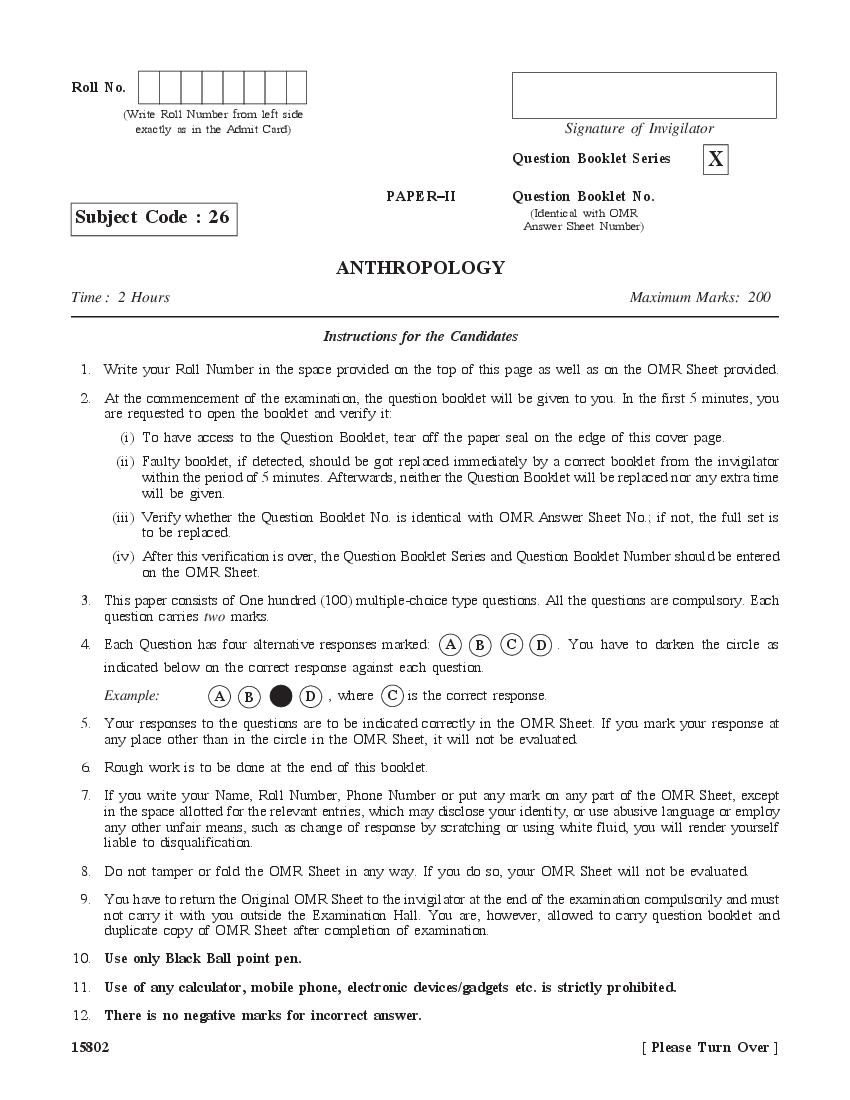
Page 1
(Write Roll Number from left side
exactly as in the Admit Card) Signature of Invigilator
Question Booklet Series X
PAPER–II Question Booklet No.
Subject Code : 26 (Identical with OMR
Answer Sheet Number)
ANTHROPOLOGY
Time : 2 Hours Maximum Marks: 200
Instructions for the Candidates
1. Write your Roll Number in the space provided on the top of this page as well as on the OMR Sheet provided.
2. At the commencement of the examination, the question booklet will be given to you. In the first 5 minutes, you
are requested to open the booklet and verify it:
(i) To have access to the Question Booklet, tear off the paper seal on the edge of this cover page.
(ii) Faulty booklet, if detected, should be got replaced immediately by a correct booklet from the invigilator
within the period of 5 minutes. Afterwards, neither the Question Booklet will be replaced nor any extra time
will be given.
(iii) Verify whether the Question Booklet No. is identical with OMR Answer Sheet No.; if not, the full set is
to be replaced.
(iv) After this verification is over, the Question Booklet Series and Question Booklet Number should be entered
on the OMR Sheet.
3. This paper consists of One hundred (100) multiple-choice type questions. All the questions are compulsory. Each
question carries two marks.
4. Each Question has four alternative responses marked: A B C D . You have to darken the circle as
indicated below on the correct response against each question.
Example: A B C D , where C is the correct response.
5. Your responses to the questions are to be indicated correctly in the OMR Sheet. If you mark your response at
any place other than in the circle in the OMR Sheet, it will not be evaluated.
6. Rough work is to be done at the end of this booklet.
7. If you write your Name, Roll Number, Phone Number or put any mark on any part of the OMR Sheet, except
in the space allotted for the relevant entries, which may disclose your identity, or use abusive language or employ
any other unfair means, such as change of response by scratching or using white fluid, you will render yourself
liable to disqualification.
8. Do not tamper or fold the OMR Sheet in any way. If you do so, your OMR Sheet will not be evaluated.
9. You have to return the Original OMR Sheet to the invigilator at the end of the examination compulsorily and must
not carry it with you outside the Examination Hall. You are, however, allowed to carry question booklet and
duplicate copy of OMR Sheet after completion of examination.
10. Use only Black Ball point pen.
11. Use of any calculator, mobile phone, electronic devices/gadgets etc. is strictly prohibited.
12. There is no negative marks for incorrect answer.
15802 [ Please Turn Over ]
Page 3
ANTHROPOLOGY
PAPER II
1. Tasting ability of PTC is a/an 6. Which one of the following is a parametric test?
(A) sex-limited trait (A) Wilcoxian signed Rank test
(B) autosomal dominant trait (B) Mann Whitney U test
(C) autosomal recessive trait (C) Fisher’s exact test
(D) sex-linked trait (D) ‘t’ test
2. In Heath-Carter somatotype rating, which of the
following skinfold measurements is NOT considered? 7. Which of the following characteristics does not
(A) Triceps apply to the definition of Primates?
(B) Biceps (A) tactile pads
(C) Subscapular (B) unguiculate
(D) Supraspinale (C) claviculate
(D) opposability of thumb/great toe
3. Which of the following formula is correct for
estimating ‘Pattern Intensity Index’?
8. A model of macroevolutionary change whereby
Arch
(A) ×100 changes occur at a slow and steady rate over time is
Whorl known as
Whorl (A) Gradualism
(B) ×100
Arche (B) Punctuated equilibrium
2 (Whorl) + Loop (C) Adaptive radiation
(C)
N (D) Genetic drift
Whorl
(D) ×100
Loop 9. In which of the cases of marriage, the effect of
inbreeding is likely to be maximum?
4. Brachiation leads to the elongation of (A) Uncle-niece
(A) hind limbs (B) First cousin
(B) fore limbs
(C) Second cousin
(C) body size
(D) tail length (D) Brother-sister
5. Suppose a researcher wishes to compare the mean
ages at marriage of four ethnic groups. Which of the 10. Edward syndrome is caused by an abnormal
following statistical tests should a researcher apply? chromosomal condition known as
(A) ‘t’ test (A) Trisomy 13
(B) ANCOVA (B) Trisomy 16
(C) ANOVA (C) Trisomy 18
(D) Chi square (D) Trisomy 21
Page 4
11. Positivism was propounded by 16. The book ‘Argonauts of the Western Pacific’ was
authored by
(A) Auguste Comte
(A) E. E. Evans Pritchard
(B) Chegg Tutors
(B) Emile Durkheim
(C) Anthony Giddens
(C) A. R. Radcliffe-Brown
(D) John Stuart Mill
(D) B. Malinowski
12. The theoretical position of viewing every culture
as unique because it is the product of specific 17. The book ‘Chrysanthemum and the Sword’ of
circumstances is known as Ruth Benedict deals with
(A) Historical particularism (A) Mexican Culture
(B) Cultural relativism (B) Kwakiutl Culture
(C) Cultural determinism (C) Japanese Culture
(D) Psychic unity of mankind (D) Samoan Culture
13. The inventor of the concept of Psychic Unity of 18. Which of the following is not a component of
mankind was culture according to Leslie White?
(A) M. G. Smith (A) Technological sector
(B) Adolf Bastian (B) Symbolic sector
(C) E. B. Tylor (C) Attitudinal sector
(D) Franz Boas (D) Ideational sector
14. Which one of the following is a great Andamanese 19. The Thebar Commission dealt with the problems
tribe? of
(A) Charier (A) Bonded labour
(B) Koya (B) Scheduled areas
(C) Adiyan (C) Criminal tribes
(D) Varli (D) Multipurpose tribal blocks
15. The French School of Anthropological thought 20. The book ‘India’s Changing Villages’ was
was founded by authored by
(A) Marcel Mauss (A) M. N. Srinivas
(B) Paul Fauconnet (B) D. N. Majumdar
(C) Lucien Levy-Bruhl (C) S. C. Dube
(D) Emile Durkheim (D) McKim Marriott
Page 5
21. Pluviation means 26. Which of the following statements are true for the
Prosimians?
(A) Low Rainfall
(i) Today prosimians are found in some parts of
(B) Intermediate Rainfall Africa, Asia and Australia.
(C) High Rainfall (ii) They have a well-developed olfactory apparatus.
(D) Dry Period (iii) Most of them have a dental specialization called
a ‘toothcomb’.
(iv) Their cranial capacity ranges from 300-400 cc.
Codes:
(A) (ii) and (iii) are correct.
22. _______ is a pile of refuse, often shells found in
some archaeological sites. (B) (i), (ii) and (iv) are correct.
(C) (ii) and (iv) are correct.
(A) Debitage
(D) (i) and (iv) are correct.
(B) Kitchen Midden
(C) Debris
(D) Litter
27. Which of the following best describe the Gorilla?
(i) In terms of phylogenetic status, they are closest to
Gibbons.
(ii) In their natural habitat, today they are confined to
23. Dwelling pits have been recovered from the
Africa and Asia.
neolithic site of
(iii) They have developed a special kind of locomotion
(A) Utnur pattern called knuckle walking.
(B) Kuchai (iv) As their lower jaw is very strong, they have a
sagittal crest present in their skull.
(C) Gufkral
Codes:
(D) Chirand
(A) (i) and (ii) are correct.
(B) (iii) and (iv) are correct.
(C) (ii) and (iv) are correct.
(D) (i), (iii) and (iv) are correct.
24. Juni Karan, a Harappan site in an island of Rann
of Kutch is important for the recovery of
(A) Town Planning
(B) Trade 28. For alleles to be in Hardy-Weinberg equilibrium,
which of the following assumptions must be met?
(C) Agriculture
(i) There should be no mutation, natural selection,
(D) Finding of two stadia and gene flow.
(ii) The population should be very large.
(iii) A lot of inbreeding should be there.
(iv) Every individual breeds and produces the same
25. Who wrote ‘Dawn of European Civilisation’? number of offspring.
(A) John Lubbock Codes:
(A) (ii) and (iii) are correct.
(B) V. Gordon Childe
(B) (iii) and (iv) are correct.
(C) Glyn Daniel (C) (i) and (ii) are correct.
(D) Colin Renfrew (D) (i), (iii) and (iv) are correct.
Page 6
29. Which of the following statements best describe 32. Which of the following statements about HLA
the punctuated equilibrium theory? system are true?
(i) The theory was proposed by Gould and Eldredge. (i) The HLA system is one of the most variable
(ii) It proposes that there could be rapid changes in a genetic systems in humans.
few populations resulting in a speciation event. (ii) There is only one locus involved having more
(iii) These rapid changes are followed by a long than 100 alleles.
relatively static period during which little (iii) HLA system consists of a series of proteins on the
biological changes occur. surface of white blood cells.
(iv) This theory is now universally accepted. (iv) HLA proteins differentiate between ‘self’ and
Codes: ‘other’ based on specific chemical structures.
(A) (i), (ii) and (iv) are correct. Codes:
(B) (ii) and (iv) are correct. (A) (ii) and (iii) are correct.
(C) (ii), (iii) and (iv) are correct. (B) (i), (ii) and (iv) are correct.
(D) (i), (ii) and (iii) are correct. (C) (i), (iii) and (iv) are correct.
(D) (ii) and (iv) are correct.
30. Which of the following statements are true for
Homo neanderthalensis?
(i) The type fossil was discovered in 1856 from
Israel.
(ii) The fossil finds come from Europe, Asia and 33. Which of the following feature best describe
Australia. G6PD deficiency?
(iii) Neanderthals were well adapted to live in the cold (i) It is a sex-linked disease.
climates of Europe at the end of pleistocene. (ii) The red cells have a tendency to burst when
(iv) A majority of the present day Europeans have exposed to certain antimalarial drugs.
some percentage of DNA which comes from the (iii) Eating fish can cause the same type of hemolytic
Neanderthals. reaction as certain drugs do.
Codes:
(iv) In India, more tribal populations have this
(A) (iii) and (iv) are correct. deficiency as compared to caste groups.
(B) (ii) and (iii) are correct. Codes:
(C) (i), (ii) and (iv) are correct. (A) (i) and (iii) are correct.
(D) (i) and (iv) are correct. (B) (ii) and (iii) are correct.
(C) (i), (iii) and (iv) are correct.
31. Which of the following statements best describe
the early Homo sapiens and anatomically modern (D) (i), (ii) and (iv) are correct.
humans?
(i) The earliest specimens of H. sapiens come from
East Africa.
(ii) Fully modern humans first appeared in Middle
East and Europe. 34. Cranial characteristics of a typical hominin are
(iii) In India, fully modern humans appeared as early (i) A forward placed foramen magnum.
as 100000 years B.P. (ii) Diastema is always present.
(iv) In Australia, fully modern humans were present (iii) Mastoid process is present.
by 60000 years ago. (iv) Dental arcade is parabolic.
Codes: Codes:
(A) (ii) and (iii) are correct. (A) (i), (iii) and (iv) are correct.
(B) (i), (ii) and (iv) are correct. (B) (ii), (iii) and (iv) are correct.
(C) (i), (iii) and (iv) are correct. (C) (ii) and (iv) are correct.
(D) (iii) and (iv) are correct. (D) (i), (ii) and (iv) are correct.
Page 7
35. Which of the following features about Rh blood 38. Constitutional provisions in connection with
group system are true? reservation are meant for
(i) The Rh blood group system was discovered by (i) protective measure.
Landsteiner and Levine in 1935. (ii) concessional measure.
(ii) The Rh antigen is designated as ‘D’. (iii) protective and concessional measures.
(iii) Mongoloid populations have the highest (iv) ameliorative measure.
frequencies of Rh-negative allele. Codes:
(iv) There are no naturally occurring antibodies in the
(A) (i) and (ii) are correct.
Rh blood group system.
Codes: (B) (ii) and (iii) are correct.
(A) (i), (iii) and (iv) are correct. (C) (iii) and (iv) are correct.
(B) (ii), (iii) and (iv) are correct. (D) (ii) and (iv) are correct.
(C) (i), (ii) and (iii) are correct.
(D) (i), (ii) and (iv) are correct.
39. Which of the following are correct teacher-student
combination?
36. Pioneering studies on Jajmani system were made
by (i) F. Boas – A. L. Kroeber
(i) W. H. Wiser (ii) A. L. Kroeber – J. Steward
(ii) J. H. Hutton (iii) F. Boas – J. Steward
(iii) T. O. Beidelman (iv) R. Benedict – A. L. Kroeber
(iv) M. N. Srinivas Codes:
Codes: (A) (i) and (ii) are correct.
(A) (i) and (ii) are correct. (B) (i) and (iii) are correct.
(B) (ii) and (iii) are correct. (C) (ii) and (iii) are correct.
(C) (iii) and (iv) are correct. (D) (iii) and (iv) are correct.
(D) (i) and (iii) are correct.
37. The concept of primitive communism originated 40. The basic objectives behind introduction of
from the writings of Panchayati Raj Institution are
(i) Karl Marx (i) democratic decentralization.
(ii) Marshal Sahlins (ii) gram swaraj.
(iii) E. A. Hoebel (iii) people’s participation.
(iv) Friedrich Engels (iv) administration at doorstep.
Codes: Codes:
(A) (i) and (ii) are correct. (A) (i) and (ii) are correct.
(B) (ii) and (iii) are correct. (B) (ii) and (iii) are correct.
(C) (i) and (iv) are correct. (C) (i) and (iii) are correct.
(D) (ii) and (iv) are correct. (D) (iii) and (iv) are correct.
Page 8
41. L. H. Morgan is best known for his contributions 45. Who among the following were not associated
on with culture and personality studies?
(i) kinship study (i) Ruth Benedict
(ii) theory of cultural evolution (ii) Alice Cora- du-Bois
(iii) change in marriage types (iii) Oscar Lewis
(iv) ancient civilization (iv) James Frazer
Codes: Codes:
(A) (i) and (ii) are correct (A) (i) and (ii) are correct.
(B) (i) and (iii) are correct (B) (ii) and (iii) are correct.
(C) (ii) and (iii) are correct (C) (iii) and (iv) are correct.
(D) (iii) and (iv) are correct (D) (i) and (iv) are correct.
42. Sampling method is characterized by 46. The list of Harappan sites in India includes
(i) representativeness (i) Farmana
(ii) small part (ii) Alamgirpur
(iii) adequate part (iii) Dholavira
(iv) small and adequate parts (iv) Ahichchhatra
Codes: Codes:
(A) (i) and (ii) are correct. (A) (i), (ii), (iii), (iv) are correct.
(B) (ii) and (iv) are correct. (B) (i), (ii), (iii) are correct.
(C) (i) and (iv) are correct. (C) (ii), (iii), (iv) are correct.
(D) (i) and (iii) are correct. (D) (i), (iii), (iv) are correct.
43. Nominal-level variable has the following
characteristics: 47. Which of the following is correct?
(i) categories should be homogeneous. (i) Nevasa – Chalcolithic
(ii) categories involve ranking of objects or events. (ii) Jericho – Neolithic
(iii) categories are mutually exclusive. (iii) Bagor – Mesolithic
(iv) categories may not be exhaustive. (iv) Mahadaha – Palaeolithic
Codes: Codes:
(A) (i) and (ii) are correct. (A) (i), (ii), (iii), (iv) are correct.
(B) (i) and (iii) are correct. (B) (i), (ii), (iii) are correct.
(C) (iii) and (iv) are correct. (C) (ii), (iii), (iv) are correct.
(D) (ii) and (iv) are correct. (D) (i), (iii), (iv) are correct.
44. ‘Sacred complex’ has the following elements: 48. Which of the following is correct?
(i) sacred geography (i) Perigordian culture – Upper Palaeolithic
(ii) sacred books (ii) Oldowan – Pebble tool culture
(iii) sacred period (iii) Ambrona – Neolithic culture
(iv) sacred specialists (iv) Jericho – Neolithic culture
Codes: Codes:
(A) (i) and (ii) are correct. (A) (i), (ii), (iii) are correct.
(B) (ii) and (iii) are correct. (B) (i), (ii), (iv) are correct.
(C) (ii) and (iv) are correct. (C) (i), (iii), (iv) are correct.
(D) (i) and (iv) are correct. (D) (ii), (iii), (iv) are correct.
Page 9
49. Which of the following is correct? 52. Given below are two statements, one is labelled as
(i) Stratigraphy – Relative Dating Assertion (A) and the other is labelled as Reason (R):
(ii) Thermoluminiscence Dating – Absolute Dating Assertion (A): ‘Race’ and ‘Ethnic group’ are
synonymous.
(iii) Moraine – Glaciations
Reason (R): A sense of hierarchy is embedded in the
(iv) Three Age System – John Lubbock
concept of ‘Race’ but not in the concept of ‘Ethnic
Codes: group’.
(A) (i), (ii), (iii) are correct.
In the context of the above two statements, which one of
(B) (ii), (iii), (iv) are correct. the following is correct?
(C) (i), (iii), (iv) are correct. Codes:
(D) (i), (ii), (iv) are correct. (A) Both (A) and (R) are true.
(B) Both (A) and (R) are false.
(C) (A) is true, but (R) is false.
(D) (A) is false, but (R) is true.
50. Which of the following is correct? 53. Given below are two statements, one is labelled as
(i) Mesolithic Culture – Composite tools Assertion (A) and the other is labelled as Reason (R):
(ii) Neolithic Culture – Incipient agriculture Assertion (A): In probability sampling, all the elements
of the universe have the equal chance of being selected.
(iii) Chalcolithic Culture – Use of stone and irron tools
Reason (R): Stratified sampling is a type of
(iv) Harappan Civilization – Internal and External
probability sampling.
trade
Codes: In the context of the above two statements, which one of
the following is correct?
(A) (i), (ii), (iv) are correct.
Codes:
(B) (i), (ii), (iii) are correct.
(A) Both (A) and (R) are correct.
(C) (ii), (iii), (iv) are correct.
(B) Both (A) and (R) are wrong.
(D) (i), (ii), (iii), (iv) are correct.
(C) (A) is wrong and (R) is correct.
(D) (A) is correct and (R) is wrong.
54. Given below are two statements, one is labelled as
Assertion (A) and the other is labelled as Reason (R):
51. Given below are two statements, one is labelled as Assertion (A): Phenylketonuria (PKU) is a disease
Assertion (A) and the other is labelled as Reason (R): caused by the inheritence of an autosomal dominant
Assertion (A): The term ‘pedigree’ and not ‘geneology’ gene/allele.
is more often employed in genetic inheritence studies. Reason (R): Individuals homozygous for this allele
Reason (R): ‘Genealogy’ also includes adopted are unable to metabolize an essential amino acid,
children and parents. phenylalanine, which is present in nearly all proteins.
In the context of the above two statements, which one of In the context of the above two statements, which one of
the following is correct? the following is correct?
Codes: Codes:
(A) Both (A) and (R) are true. (A) (A) is true and (R) is false.
(B) Both (A) and (R) are false. (B) (A) is false and (R) is true.
(C) (A) is true, but (R) is false. (C) Both (A) and (R) are true.
(D) (A) is false, but (R) is true. (D) Both (A) and (R) are false.
Page 10
55. Given below are two statements, one is labelled as 58. Given below are two statements, one is labelled as
Assertion (A) and the other is labelled as Reason (R): Assertion (A) and the other is labelled as Reason (R):
Assertion (A): Molecular anthropology is one of the Assertion (A): Anthropology undertakes scientific
evolving subfields of biological anthropology. study of human beings. The term anthropology means
Reason (R): Genome wide association studies science of man.
accelerated with the completion of the Human Genome Reason (R): The tenets of scientific research like
Project. objectivity, replicability and predictability are difficult
to achieve in anthropology.
In the context of the above two statements, which one of
the following is correct? In the context of the above two statements, which one of
the following is correct?
Codes:
Codes:
(A) (A) is true and (R) is false.
(A) (A) is true and (R) is false.
(B) (A) is false and (R) is true.
(B) (A) is false and (R) is true.
(C) Both (A) and (R) are true.
(D) Both (A) and (R) are false. (C) Both (A) and (R) are true but (R) is not the
correct explanation of (A).
56. Given below are two statements, one is labelled as (D) Both (A) and (R) are true and (R) is the correct
Assertion (A) and the other is labelled as Reason (R): explanation of (A).
Assertion (A): M. J. Herskovits states that man created
culture. He stated culture is man made part of environment.
Reason (R): Man is subordinate to culture as he
follows and obeys the prescriptions of culture.
In the context of the above two statements, which one of
the following is correct?
Codes:
(A) (A) is true and (R) is false.
(B) (A) is false and (R) is true.
(C) Both (A) and (R) are true but (R) is not the
correct explanation of (A).
(D) Both (A) and (R) are true and (R) is the correct
explanation of (A).
59. Given below are two statements, one is labelled as
57. Given below are two statements, one is labelled as Assertion (A) and the other is labelled as Reason (R):
Assertion (A) and the other is labelled as Reason (R):
Assertion (A): Savagery, Barbarism and Civilization
Assertion (A): The non-literate societies followed are the evolutionary stages proposed by L. H. Morgan,
rituals and practices based on magico-religious beliefs. who is well known for his classical evolutionism.
Reason (R): In literate societies, people are rational Reason (R): Civilization is an advancement over
in their approach. Hence, there is no place for belief in culture, i.e. all people have culture, but all cultures are not
magical practices. civilizations.
In the context of the above two statements, which one of In the context of the above two statements, which one of
the following is correct? the following is correct?
Codes: Codes:
(A) (A) is true and (R) is false. (A) (A) is true and (R) is false.
(B) (A) is false and (R) is true. (B) (A) is false and (R) is true.
(C) Both (A) and (R) are true but (R) is not the (C) Both (A) and (R) are true, but (R) is not the
correct explanation of (A). correct explanation of (A).
(D) Both (A) and (R) are true and (R) is the correct (D) Both (A) and (R) are true, and (R) is the
explanation of (A). correct explanation of (A).
Page 11
60. Given below are two statements, one is labelled as 63. Arrange the correct order of divergence from the
Assertion (A) and the other is labelled as Reason (R): main line of descent leading to human.
Assertion (A): Heterogenetic cities are the centers of (i) Prosimians
heterodoxy and dissent. (ii) Monkeys
Reason (R): People are concerned with economic (iii) African apes
growth, expansion of power and elements of secular
activities. (iv) Asian apes
In the context of the above two statements, which one of Codes:
the following is correct? (A) (i), (iii), (iv), (ii)
Codes: (B) (i), (iv), (iii), (ii)
(A) Both (A) and (R) are true and (R) is the correct (C) (i), (ii), (iv), (iii)
explanation. (D) (ii), (i), (iii), (iv)
(B) Both (A) and (R) are true and (R) is not the
correct explanation.
(C) (A) is true but (R) is false.
(D) (A) is false but (R) is true.
61. Given below are two statements, one is labelled as 64. Arrange the books from earliest to latest in order
Assertion (A) and the other is labelled as Reason (R): of year of publications.
14
Assertion (A): C is a radiometric dating technique. (i) On Origin of Species by Natural Selection, or The
14 Preservation of Favoured Races in the Struggle
Reason (R): C atoms take 5730 years to reduce to
14 for Life.
half the original C .
(ii) Systems Naturae
In the context of the above two statements, which one of
(iii) Philosophie Zoologique
the following is correct?
(iv) Descent of Man, and Selection in Relation to Sex,
Codes: Codes:
(A) Both (A) and (R) are true and (R) is not the
(A) (ii), (i), (iii), (iv)
correct explanation of (A).
(B) (i), (iv), (ii), (iii)
(B) (A) is true but (R) is false.
(C) (A) is false but (R) is true. (C) (iii), (iv), (i), (ii)
(D) Both (A) and (R) are true and (R) is the correct (D) (ii), (iii), (i), (iv)
explanation of (A).
62. Given below are two statements, one is labelled as
Assertion (A) and the other is labelled as Reason (R):
Assertion (A): There are two kinds of excavations
vertical and horizontal. 65. Arrange the correct sequence of steps involved in
a typical polymerase chain reaction.
Reason (R): Vertical excavation gives a diachromic
perspective, while horizontal excavation provides a (i) Denaturing of DNA
synchronic perspective. (ii) Designing of primers
In the context of the above two statements, which one of (iii) Annealing of primers
the following is correct? (iv) Extension of primers
Codes: Codes:
(A) (A) is correct, (R) is false. (A) (i), (ii), (iv), (iii)
(B) (A) is false, (R) is correct. (B) (ii), (i), (iii), (iv)
(C) Both (A) and (R) are false. (C) (i), (iii), (iv), (ii)
(D) Both (A) and (R) are correct. (D) (iii), (ii), (i), (iv)
Page 12
66. Arrange the following epochs in ascending order. 69. Arrange the following books in the order of their
(i) Pliocene appearance in print.
(ii) Oligocene (i) Argonauts of Western Pacific
(iii) Pleistocene (ii) Patterns of Culture
(iv) Miocene (iii) Writing Cultures
Codes: (iv) The Andaman Islanders
(A) (iv), (ii), (i), (iii) Codes:
(B) (iii), (i), (iv), (ii) (A) (iv), (i), (ii), (iii)
(C) (i), (ii), (iv), (iii) (B) (iv), (ii), (i), (iii)
(D) (ii), (iv), (i), (iii) (C) (i), (iv), (ii), (iii)
(D) (i), (ii), (iv), (iii)
67. Arrange the correct sequence of the following 70. Arrange the following from the perspective of
fossil finds in the order of their year of discovery. evolution of human marriage.
(i) Ramapithecus (i) Group marriage
(ii) Sivapithecus (ii) Sexual promiscuity
(iii) Gigantopithecus (iii) Polyandry
(iv) Narmada Man (iv) Monogamy
Codes: Codes:
(A) (ii), (i), (iii), (iv) (A) (i), (ii), (iii), (iv)
(B) (i), (ii), (iv), (iii) (B) (ii), (i), (iii), (iv)
(C) (i), (ii), (iii), (iv) (C) (ii), (iii), (i), (iv)
(D) (iii), (ii), (i), (iv) (D) (iii), (i), (iv), (ii)
71. Identify the order in which Robert Redfield
68. In the context of tribal education, arrange the presented his units of study for explaining Folk-Urban
issues in the order of their occurrence. continuum.
(i) Non-enrolment and low enrolment (i) City
(ii) Absenteeism (ii) Peasant village
(iii) Drop out (iii) Tribal village
(iv) Stagnation and wastage (iv) Town
Codes: Codes:
(A) (iv), (iii), (ii), (i) (A) (iii), (ii), (i), (iv)
(B) (i), (ii), (iv), (iii) (B) (i), (ii), (iv), (iii)
(C) (i), (ii), (iii), (iv) (C) (ii), (iii), (i), (iv)
(D) (iii), (ii), (i), (iv) (D) (iii), (ii), (iv), (i)
Page 13
72. Arrange the following reports in the chronological 75. Identify the correct sequence in ascending order
order of their submission to Government of India. of the following sites in terms of cultural recoveries:
(i) Thebar Commision Report (i) Mahurihari
(ii) Xaxa Committee Report (ii) Tilwara
(iii) Shilu Ao Committee Report (iii) Hathnora
(iv) Lokur Committee (iv) Piklihal
Codes: Codes:
(A) (i), (iv), (iii), (ii) (A) (iii), (iv), (ii), (i)
(B) (i), (iii), (iv), (ii) (B) (iii), (ii), (iv), (i)
(C) (iv), (iii), (i), (ii) (C) (ii), (iii), (iv), (i)
(D) (iv), (iii), (ii), (i) (D) (ii), (iv), (iii), (i)
76. Match the items of List I with those of List II.
List-I List-II
(a) Electrophoresis (i) Cytogenetics
73. Identify the following tools in their correct
sequence of apperance from earliest to latest. (b) Biometry (ii) Biochemical
(i) Clever genetics
(ii) Celt (c) FISH technique (iii) Facial reconstruction
(iii) Microliths (d) DNA sequencing (iv) Molecular genetics
(iv) Mousterian flake Codes:
Codes: (a) (b) (c) (d)
(A) (i), (iv), (iii), (ii) (A) (ii) (iv) (i) (iii)
(B) (i), (iv), (ii), (iii) (B) (ii) (iii) (i) (iv)
(C) (i), (ii), (iv), (iii) (C) (ii) (iii) (iv) (i)
(D) (i), (iii), (iv), (ii)
(D) (iv) (iii) (i) (ii)
77. Match the items of List I with those of List II.
List-I List-II
74. Identify the correct sequence of the following (a) Karyotype (i) Sickle cell
prehistorians in order of their contributions: (b) Qualitative character (ii) Finger pattern types
(i) H. D. Sankalia (c) Metabolic disorder (iii) Set of chromosomes
(ii) Robert Bruce Foote (d) Monogenic trait (iv) Diabetes
(iii) Shanti Pappu
Codes:
(iv) V. N. Misra
(a) (b) (c) (d)
Codes:
(A) (i) (iv) (ii) (iii)
(A) (i), (ii), (iii), (iv)
(B) (i), (ii), (iv), (iii) (B) (iii) (i) (ii) (iv)
(C) (ii), (i), (iv), (iii) (C) (iii) (ii) (iv) (i)
(D) (ii), (i), (iii), (iv) (D) (ii) (iv) (iii) (i)
Page 14
78. Match the items of List I with those of List II. 81. Match the items of List I with those of List II.
List-I List-II List-I List-II
(a) Arboreal (i) Gibbon (a) Genetic drift (i) J.B.S. Haldane
(b) Brachiation (ii) Baboon (b) Selection intensity (ii) Francis Galton
(c) Knuckle walking (iii) Tree shrew (c) Twin method (iii) James Crow
(d) Quadrupedalism (iv) Gorilla (d) Genetic load (iv) Sewal Wright
Codes: Codes:
(a) (b) (c) (d) (a) (b) (c) (d)
(A) (iii) (i) (iv) (ii) (A) (ii) (iv) (iii) (i)
(B) (iv) (ii) (i) (iii) (B) (iv) (iii) (ii) (i)
(C) (i) (iii) (iv) (ii) (C) (i) (ii) (iv) (iii)
(D) (iv) (i) (iii) (ii) (D) (iii) (ii) (i) (iv)
79. Match the items of List I with those of List II.
List-I List-II
82. Match the items of List I with those of List II.
(a) Turner syndrome (i) Autosomal recessive
List-I List-II
(b) Albinism (ii) Trisomy 21
(a) Haemophilia (i) Autosomal recessive
(c) Down syndrome (iii) Extra X chromosome
(b) Sickle cell disease (ii) Sex limited
(d) Super female (iv) Sex chromosomal
(c) Development of beard (iii) Sex-linked recessive
aberration
in man
Codes: (d) Klinefelter syndrome (iv) XXY
(a) (b) (c) (d)
Codes:
(A) (i) (ii) (iii) (iv) (a) (b) (c) (d)
(B) (i) (ii) (iv) (iii) (A) (iv) (i) (ii) (iii)
(C) (ii) (i) (iii) (iv) (B) (iii) (i) (ii) (iv)
(D) (iv) (i) (ii) (iii) (C) (iii) (ii) (i) (iv)
(D) (i) (iv) (iii) (ii)
80. Match the items of List I with those of List II.
List-I List-II
(a) Homo habilis (i) Raymond Dart
(b) Australopithecus (ii) Louis Leakey 83. Which of the following pairs is NOT correctly
(c) Gigantopithecus (iii) Simons and Chopra matched?
(d) Java man (iv) Eugene Dubois (A) A chart depicting — Genealogy
genetic relationship
Codes: and transmission of
(a) (b) (c) (d) genetic trait
(A) (ii) (i) (iii) (iv) (B) Alkaptonuria — Inborn errors of
(B) (i) (ii) (iii) (iv) metabolism
(C) (iv) (ii) (iii) (i) (C) Dermatoglypic trait — Polygenic inheritance
(D) (iii) (iv) (i) (ii) (D) Non-disjunction — Linkage
Page 15
84. Match the items of List I with those of List II. 87. Match the items of List I with those of List II.
List-I List-II List-I List-II
(a) Loop (i) Sagittal crest (a) Rampura (i) F. G. Bailey
(b) Olecranon process (ii) Cervical vertebrae (b) Chankom (ii) W. H. Wiser
(c) Skull (iii) Ulna (c) Bisipara (iii) M. N. Srinivas
(d) Odontoid process (iv) Finger ball pattern (d) Karimpur (iv) Robert Redfield
Codes: Codes:
(a) (b) (c) (d) (a) (b) (c) (d)
(A) (ii) (i) (iii) (iv) (A) (i) (iii) (ii) (iv)
(B) (iii) (iv) (i) (ii) (B) (ii) (iv) (i) (iii)
(C) (i) (iv) (ii) (iii) (C) (iii) (iv) (i) (ii)
(D) (iv) (iii) (i) (ii) (D) (iv) (ii) (iii) (i)
85. Match the items of List I with those of List II. 88. Match the items of List I with those of List II.
List-I List-II List-I List-II
(a) S. S. Sarkar (i) Asiatic (a) McKim Marriott (i) Universalization
(b) B. S. Guha (ii) Turko-Iranian (b) M. N. Srinivas (ii) Tribe-caste continuum
(c) H. Risley (iii) Mundari speaker (c) F. G. Bailey (iii) Folk-urban continuum
(d) W. C. Boyd (iv) Negrito (d) Robert Redfield (iv) Dominant caste
Codes: Codes:
(a) (b) (c) (d) (a) (b) (c) (d)
(A) (iii) (iv) (ii) (i) (A) (i) (iv) (iii) (ii)
(B) (iv) (iii) (i) (ii) (B) (i) (iv) (ii) (iii)
(C) (ii) (i) (iv) (iii) (C) (ii) (iii) (iv) (i)
(D) (i) (iii) (iv) (ii) (D) (iii) (ii) (i) (iv)
86. Match the items of List I with those of List II. 89. Match the items of List I with those of List II.
List-I List-II List-I List-II
(a) The Evolution of Culture (i) A. L. Kroeber (a) W. H. R. Rivers (i) Azande
(b) Theory of Culture Change(ii) Leslie White (b) E. E. Evans-Pritchard (ii) Toda
(c) Man Makes Himself (iii) Julian Steward (c) Frantz Boas (iii) Andamanese
(d) The Nature of Culture (iv) Gordon Childe (d) A. R. Radcliffe-Brown (iv) Eskimo
Codes: Codes:
(a) (b) (c) (d) (a) (b) (c) (d)
(A) (i) (iii) (ii) (iv) (A) (ii) (iii) (i) (iv)
(B) (ii) (iii) (iv) (i) (B) (iii) (ii) (iv) (i)
(C) (iii) (ii) (i) (iv) (C) (i) (iii) (ii) (iv)
(D) (iv) (iii) (ii) (i) (D) (ii) (i) (iv) (iii)
Page 16
90. Match the items of List I with those of List II. 93. Match the items of List I with those of List II.
List-I List-II List-I List-II
(a) Margaret Mead (i) Coral Gardens and (a) Casteism (i) Subjugation
Their Magic (b) Bonded labour (ii) Discrimination
(b) Ralph Linton (ii) The People of Alor (c) Ethnocentrism (iii) Racism
(c) Alice Cora-du-Bois (iii) Coming of Age in (d) Gender issues (iv) Hierarchy
Samoa
(d) B. Malinowski (iv) The Study of Man Codes:
(a) (b) (c) (d)
Codes:
(a) (b) (c) (d) (A) (iv) (i) (iii) (ii)
(A) (iii) (iv) (ii) (i) (B) (ii) (iii) (i) (iv)
(B) (iii) (ii) (i) (iv) (C) (iii) (ii) (iv) (i)
(C) (ii) (iii) (iv) (i) (D) (i) (iii) (ii) (iv)
(D) (ii) (i) (iii) (iv)
91. Match the items of List I with those of List II.
List-I List-II 94. Match the items of List I with those of List II.
(a) Tribal Areas of (i) PVTG programme List-I List-II
Central India (a) Maori (i) Potlach
(b) Tribal Areas of N.E. (ii) Sub-plan approach (b) Kyaka (ii) Moka
India (c) Kwakiutl (iii) Kula
(c) Tribal people facing (iii) Vth schedule (d) Kwakwakawakw (iv) Koha
the threat of
Codes:
depopulation
(a) (b) (c) (d)
(d) Integrated development (iv) VIth schedule
of tribal people (A) (ii) (i) (iii) (iv)
Codes: (B) (iii) (ii) (i) (iv)
(a) (b) (c) (d) (C) (iv) (ii) (i) (iii)
(A) (i) (iii) (ii) (iv) (D) (iv) (iii) (i) (ii)
(B) (ii) (iii) (i) (iv)
(C) (iii) (iv) (i) (ii)
(D) (iii) (ii) (i) (iv)
95. Match the items of List I with those of List II.
92. Match the items of List I with those of List II. List-I List-II
List-I List-II (a) D. N. Majumdar (i) Gaya
(a) Genealogical method (i) G. P. Murdock (b) L. P. Vidyarthi (ii) Lucknow
(b) Cross-cultural method (ii) A. L. Epstein (c) Robert Redfield (iii) Calcutta
(c) Participant observation (iii) B. Malinowski (d) N. K. Bose (iv) Merida
(d) Extended case method (iv) W. R. H. Rivers
Codes:
Codes: (a) (b) (c) (d)
(a) (b) (c) (d)
(A) (ii) (i) (iv) (iii)
(A) (iv) (iii) (i) (ii)
(B) (ii) (iv) (i) (iii)
(B) (ii) (iii) (iv) (i)
(C) (iv) (iii) (ii) (i) (C) (i) (ii) (iii) (iv)
(D) (iv) (i) (iii) (ii) (D) (i) (iv) (iii) (ii)
Page 17
96. Match the items of List I with those of List II. 99. Match the items of List I with those of List II.
List-I List-II List-I List-II
(a) Hungsi (i) Lower Palaeolithic (a) Solutrean (i) India
(b) Kuchai (ii) Upper Palaeolithic (b) Clactonian (ii) France
(c) Patne (iii) Chalcolithic (c) Natufian (iii) England
(d) Inamgaon (iv) Neolithic (d) Sohan (iv) Palestine
Codes: Codes:
(a) (b) (c) (d) (a) (b) (c) (d)
(A) (i) (iv) (ii) (iii) (A) (i) (ii) (iii) (iv)
(B) (i) (ii) (iii) (iv) (B) (ii) (iii) (iv) (i)
(C) (i) (iii) (ii) (iv) (C) (iv) (iii) (i) (ii)
(D) (ii) (i) (iii) (iv) (D) (ii) (i) (iii) (iv)
97. Match the items of List I with those of List II.
List-I List-II
(a) Mohenjodaro (i) Water Management 100. Match the items of List I with those of List II.
(b) Dholavira (ii) Granary List-I List-II
(c) Banawali (iii) Terracotta cakes (a) Hungsi Valley (i) M. K. Dhavalikar
(d) Kalibangan (iv) A worship room with a (b) Balathal (ii) B. K. Thapar
fire place (c) Kuchai (iii) V. N. Misra
Codes: (d) Inamgaon (iv) K. Paddaiyya
(a) (b) (c) (d)
Codes:
(A) (ii) (i) (iii) (iv) (a) (b) (c) (d)
(B) (ii) (i) (iv) (iii) (A) (i) (ii) (iii) (iv)
(C) (i) (ii) (iii) (iv) (B) (i) (iii) (ii) (iv)
(D) (ii) (iii) (i) (iv) (C) (iv) (ii) (iii) (i)
(D) (iv) (iii) (ii) (i)
98. Match the items of List I with those of List II.
List-I List-II
(a) The Aryans : A Study of (i) M.C. Burkitt
Indo-European Origins
(b) Old Stone Age (ii) Brian Fagan
(c) Stone Age Tools (iii) V. Gordon Childe
(d) People of the Earth (iv) H. D. Sankalia
Codes:
(a) (b) (c) (d)
(A) (i) (ii) (iii) (iv)
(B) (iii) (i) (ii) (iv)
(C) (i) (iv) (iii) (ii)
(D) (iii) (i) (iv) (ii)
Page 18
ROUGH WORK
Page 19
ROUGH WORK
Page 20
ROUGH WORK
Document Details
| Board / Org | West Bengal Exams |
| Exam | WB SET |
| Type | Question Paper |
| Pages | 20 |
| Updated | 23 Oct 2026 |