WB SET 2020 Question Paper 2 Earth Atmospheric Ocean and Planetary Sciences
Finished viewing? Save it for later —
Download WB SET 2020 Question Paper 2 Earth Atmospheric Ocean and Planetary Sciences (PDF · 16 pages)About WB SET 2020 Question Paper 2 Earth Atmospheric Ocean and Planetary Sciences
WB SET 2020 Question Paper 2 Earth Atmospheric Ocean and Planetary Sciences is available here for free download. Published by Default for Govt Jobs Exams, this question paper can be viewed online or downloaded as a PDF (16 pages). Candidates preparing for Govt Jobs Exams can use WB SET 2020 Question Paper 2 Earth Atmospheric Ocean and Planetary Sciences to understand the exam pattern, the type of questions asked, and the overall difficulty level.
Frequently Asked Questions
How can I download WB SET 2020 Question Paper 2 Earth Atmospheric Ocean and Planetary Sciences?
Open this page and click the Download button to save WB SET 2020 Question Paper 2 Earth Atmospheric Ocean and Planetary Sciences as a PDF. It is completely free on AglaSem Docs.
Is WB SET 2020 Question Paper 2 Earth Atmospheric Ocean and Planetary Sciences free to download?
Yes. WB SET 2020 Question Paper 2 Earth Atmospheric Ocean and Planetary Sciences can be viewed online and downloaded as a PDF free of cost on AglaSem Docs.
How many pages does WB SET 2020 Question Paper 2 Earth Atmospheric Ocean and Planetary Sciences have?
WB SET 2020 Question Paper 2 Earth Atmospheric Ocean and Planetary Sciences contains 16 pages, which you can read online or download together as a single PDF.
Where can I find more Govt Jobs Exams study material?
You can find more Govt Jobs Exams question papers, sample papers, syllabus, and answer keys on AglaSem Docs.
WB SET 2020 Question Paper 2 Earth Atmospheric Ocean and Planetary Sciences – Text
Read the full text of this question paper below — useful to quickly search, copy and reference the content online without downloading the PDF.
📄 View text version (15 pages)
Page 1
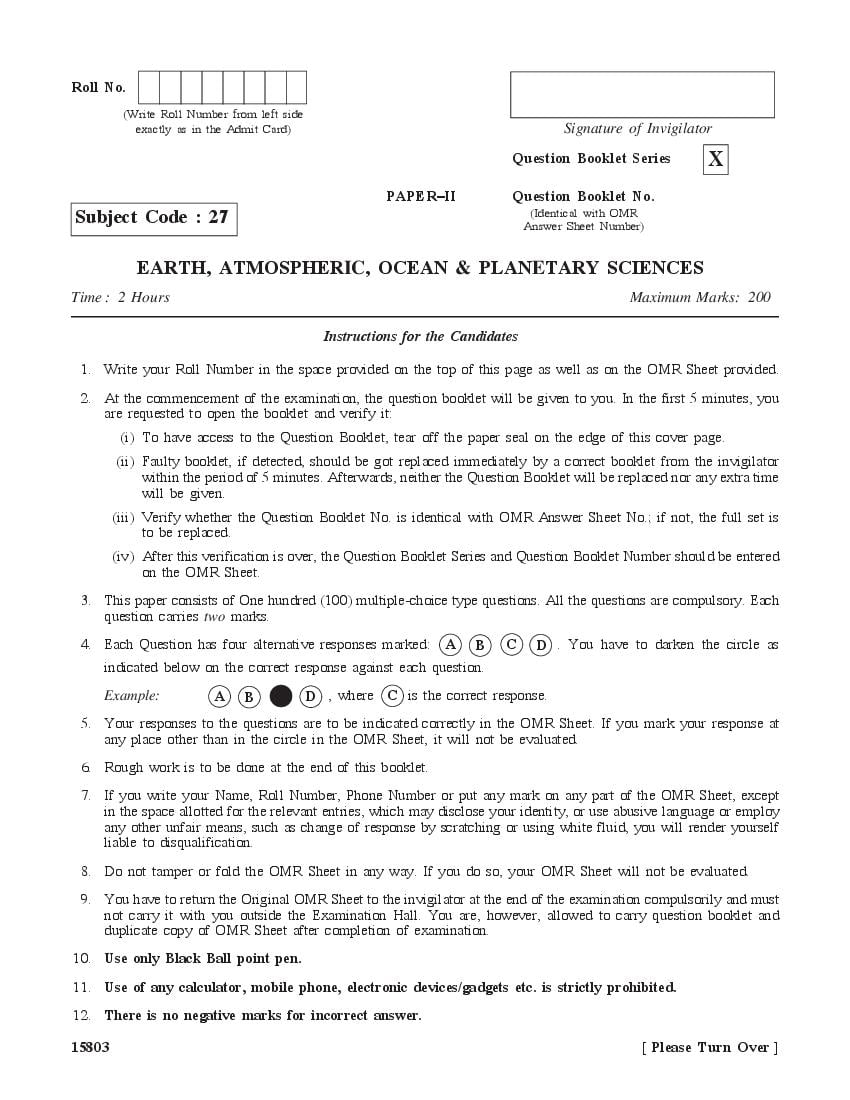
(Write Roll Number from left side
exactly as in the Admit Card) Signature of Invigilator
Question Booklet Series X
PAPER–II Question Booklet No.
Subject Code : 27 (Identical with OMR
Answer Sheet Number)
EARTH, ATMOSPHERIC, OCEAN & PLANETARY SCIENCES
Time : 2 Hours Maximum Marks: 200
Instructions for the Candidates
1. Write your Roll Number in the space provided on the top of this page as well as on the OMR Sheet provided.
2. At the commencement of the examination, the question booklet will be given to you. In the first 5 minutes, you
are requested to open the booklet and verify it:
(i) To have access to the Question Booklet, tear off the paper seal on the edge of this cover page.
(ii) Faulty booklet, if detected, should be got replaced immediately by a correct booklet from the invigilator
within the period of 5 minutes. Afterwards, neither the Question Booklet will be replaced nor any extra time
will be given.
(iii) Verify whether the Question Booklet No. is identical with OMR Answer Sheet No.; if not, the full set is
to be replaced.
(iv) After this verification is over, the Question Booklet Series and Question Booklet Number should be entered
on the OMR Sheet.
3. This paper consists of One hundred (100) multiple-choice type questions. All the questions are compulsory. Each
question carries two marks.
4. Each Question has four alternative responses marked: A B C D . You have to darken the circle as
indicated below on the correct response against each question.
Example: A B C D , where C is the correct response.
5. Your responses to the questions are to be indicated correctly in the OMR Sheet. If you mark your response at
any place other than in the circle in the OMR Sheet, it will not be evaluated.
6. Rough work is to be done at the end of this booklet.
7. If you write your Name, Roll Number, Phone Number or put any mark on any part of the OMR Sheet, except
in the space allotted for the relevant entries, which may disclose your identity, or use abusive language or employ
any other unfair means, such as change of response by scratching or using white fluid, you will render yourself
liable to disqualification.
8. Do not tamper or fold the OMR Sheet in any way. If you do so, your OMR Sheet will not be evaluated.
9. You have to return the Original OMR Sheet to the invigilator at the end of the examination compulsorily and must
not carry it with you outside the Examination Hall. You are, however, allowed to carry question booklet and
duplicate copy of OMR Sheet after completion of examination.
10. Use only Black Ball point pen.
11. Use of any calculator, mobile phone, electronic devices/gadgets etc. is strictly prohibited.
12. There is no negative marks for incorrect answer.
15803 [ Please Turn Over ]
Page 3
EARTH, ATMOSPHERIC, OCEAN & PLANETARY SCIENCES
PAPER II
1. Polytypism refers to 6. If a volcano erupts explosively and then collapses
(A) type of polymorphism where different into the void left by the emptying of the magma chamber
polymorphs exist in different domains of the below the mountain, it produces a wide and deep circular
same crystal. hole called a
(B) a phenomenon that is only found in potash (A) Crater
feldspar. (B) Cinder cone
(C) a phenomenon related to pyrite-marcasite (C) Caldera
transition.
(D) Lava dome
(D) a particular transformation related to
calcite -aragonite change.
7. Pull apart basins develop along the __________.
2. Which one of the following is the correct (A) releasing bends of strike slip faults.
chronological order of different periods in the Paleozoic (B) restraining bends of strike slip faults.
Era?
(C) trailing ramps of thrusts.
(A) Cambrian, Silurian, Ordovician,
Carboniferous, Devonian, Permian (D) lateral ramps of thrusts.
(B) Cambrian, Devonian, Ordovician, Silurian,
Permian, Carboniferous 8. Quartz, Garnet, Sillimanite and Graphite bearing
schists and gneisses are known as
(C) Cambrian, Ordovician, Silurian, Devonian,
Carboniferous, Permian (A) Gondites
(D) Cambrian, Ordovician, Silurian, Devonian, (B) Charnockites
Permian, Carboniferous (C) Khondalites
3. Which of the following combinations are all (D) Migmatites
considered to be Jovian planets?
(A) Mercury–Mars–Saturn–Jupiter 9. The equation that represents the value of shear
stress is
(B) Mars–Venus–Earth–Jupiter
(C) Mercury–Venus–Earth–Mars 1 2
(A) sin 2
(D) Jupiter–Saturn–Uranus–Neptune 2
4. Storage capacity of a reservoir depends on 1 2
(B) sin 2
(A) porosity of rocks. 2
(B) inter-connections.
1 2 1 2
(C) quality of solidity of rocks. (C) cos 2
2 2
(D) porosity and inter-connections.
1 2
5. How does mechanical weathering aid chemical (D) sin
2
weathering?
(A) Chemical weathering can not proceed
10. Deccan Trap lavas of India are result of
without the aid of mechanical weathering.
(B) Mechanical weathering promotes the (A) volcanism caused due to subduction of
physical breakdown of rock, thus producing Indian plate and Tibetan plate.
chemical weathering. (B) intraplate volcanism caused by Reunion
(C) Mechanical weathering increases surface plume.
area for chemical attack. (C) volcanism caused by mid-oceanic rift ridges.
(D) Chemical weathering is controlled by the (D) volcanism initially caused at Himalayan
presence or absence of effect of physical region which later transgressed to Central
weathering. India.
Page 4
11. Which one of the following is the stable mineral 16. Point bar deposits are associated with
assemblage in metamorphism of a rock with politic bulk (A) Glaciers
composition under granulite facis?
(B) Deserts
(A) Staurolite + Muscovite + Sillimanite +
(C) Oceans
K-feldspar
(D) Rivers
(B) Phengite + Garnet + Chloritoid + Biotite
(C) Garnet + Orthopyroxene + Clinopyroxene +
Plagioclase
(D) Garnet + Cordierite + K-feldspar + Sillimanite
17. Which of the following is not yet extinct?
12. Which of the following is the direct ancestor of (A) Ammonites
Homo sapiens? (B) Trilobites
(A) Siwapithecus (C) Echinoderms
(B) Ramapithecus (D) Belemnites
(C) Australopithecus
(D) Homo erectus
13. Which of the following best explains the principle 18. Crystals belonging to the following
of order of superposition? crystallographic systems are biaxial:
(A) Older strata are generally deposited directly (A) Triclinic, Orthorombic and Trigonal
on younger strata without intermediate age (B) Trigonal, Monoclinic and Isometric
strata.
(C) Triclinic, Monoclinic, Orthorombic
(B) Fossiliferous strata are generally deposited
(D) Trigonal, Hexagonal and Tetragonal
on strata with no fossils.
(C) All sedimentary deposits accumulate
randomly without any order.
(D) All sedimentary strata accumulate on older
rocks or sediment layers.
19. In R f – method of strain measurement R f
represents the
14. What is the pressure of upper surface of unconfined (A) final ellipticity.
aquifer? (B) orientation of deformed object.
(A) Very high pressure (C) initial ellipticity.
(B) Lower than atmospheric pressure (D) initial orientation of undeformed object.
(C) Equal to atmospheric pressure
(D) Greater than atmospheric pressure
15. How many tonnes of gold ore (having an assay 20. The half width of vertical magnetic intensity
value of 2 ppm of Au) need to be processed to produce anomaly over a magnetised sphere is 25 meters. The
1 Kg of gold? depth to the center of sphere from the surface will be
(A) 5000 (A) 32·5 m
(B) 500 (B) 50·0 m
(C) 50 (C) 25·0 m
(D) 550 (D) None of the above
Page 5
21. With reference to the sub-tropical high pressure 26. The ratio of the total solar radiant energy returned
belt, consider the following statements: by a planetary body to the total radiant energy incident on
I. It is affected by Earth’s rotation and descent the body, is called
of winds from higher altitudes. (A) Reflectance
II. It dynamically induced and characterised (B) Reflectance factor
with anti-cyclonic conditions. (C) Albedo
Which of the statement/statements given above is/ (D) None of the above
are correct?
(A) I only.
(B) II only.
(C) Both I and II. 27. Which of the following subtropical gyre has been
(D) Neither I nor II. named as the Columbus Gyre by the oceanographers?
(A) North Atlantic Subtropical Gyre
22. A troctolite (when investigated with a petrological (B) South Atlantic Subtropical Gyre
microscope) shows presence of corona structure. This
can be best explained by crystallization of parent magma (C) North Pacific Subtropical Gyre
in the (D) South Pacific Subtropical Gyre
(A) Albite – Anorthite system
(B) Diopside – Albite – Anorthite system
(C) Forsterite – Silica system
28. Perthitic texture is the result of
(D) Nepheline – Kalsilite –Silica system
(A) peritectic reaction between orthoclase and
23. If gm is the measured gravity value, gn is the albite.
normal gravity value and g is the free-air correction,
FA
(B) solid solution between albite and anorthite.
then the free-air gravity anamoly ( g ) is expressed as
(C) high pressure breakdown reaction of
F orthoclase.
__________.
(D) sub-solvus cooling of alkali feldspar.
(A) g g g g
F m FA n
(B) g g g g
F m FA n
(C) g g g g
F m FA n 29. Sand dunes migrate in the
(D) g g g g
(A) gentle windward direction.
F m FA n
(B) leeward direction.
24. As per the Goldisch Mineral stability order (C) both windward and leeward.
(A) olivine, pyroxene and hornblende have equal (D) sand dunes are generally stable and do not
susceptibility to weathering. migrate.
(B) olivine is least stable than pyroxene and
hornblende.
(C) olivine weathers to pyroxenes and pyroxene
weathers to hornblende. 30. In any sample of ocean water worldwide, the
(D) olivine is more stable than orthoclase. chloride ions account for 54·04% of the total proportion
of dissolved solids. Thus, it can be used to determine
25. In Flinn diagram of presentation of strain ellipsoid, salinity of the ocean water sample by using the following
strain ellipsoid present along the line K = 1 is formula:
(A) Uniaxial oblate type (A) Salinity (‰) = 1·10655 × Chlorinity (‰)
(B) Uniaxial prolate type (B) Salinity (‰) = 1·50665 × Chlorinity (‰)
(C) Plain-strain type (C) Salinity (‰) = 1·80665 × Chlorinity (‰)
(D) Flattening type (D) Salinity (‰) = 2·10665 × Chlorinity (‰)
Page 6
31. Which one of the following statements is correct 36. If a magnetic reversal occurred in Earth today, it
regarding GPS satellites? would result in new rocks exhibiting
(A) Remanent magnetism
(A) The nominal altitude is about 20,200 km.
(B) Reverse polarity
(B) The inclination of axis satellite is 55º. (C) Palaeomagnetism
(C) The satellite transmits two L band signals (D) No magnetic signature
(L 1 with 1575·42 MHz and L 2 with
37. Which of the following compounds is used in
1276·6 MHz).
cloud-seeding, for artificial precipitation?
(D) All of the above (A) Silver bromide (AgBr)
(B) Silver chloride (AgCl)
32. Sanidine, Orthoclase and Microcline are examples
(C) Silver fluoride (AgF)
of order-disorder transformation of potassium feldspar
where (D) Silver iodide (AgI)
(A) Microcline shows maximum ordering and
38. Match the following sedimentary rock/deposits
least crystallographic symmetry.
with characteristic structures/textures listed in Group-I
(B) Sanidine shows maximum ordering and least
with the depositional environments listed in Group-II.
crystallographic symmetry.
Choose the correct answer.
(C) Microcline shows minimum ordering and
maximum crystallographic symmetry. Group-I Group-II
(D) Sanidine shows maximum ordering and (a) Sandstone with herring (i) Eolian
maximum crystallographic symmetry. bone cross-bedding
(b) Poorly sorted sediments (ii) Pelagic
33. Which of the following material is required for
Optically Simulated Luminiscence (OSL) dating? with faceted and striated
(A) Wood pieces pebbles
(B) Charcoal pieces (c) Chalk with cocoliths (iii) Sabkha
(C) Quartz grains (d) Well-sorted arenite with (iv) Tidal
(D) Carbonate shell large scale cross-bedding (v) Glacial
(5-10 m thick)
34. Which of the following sentences is NOT TRUE (a) (b) (c) (d)
about the seawater salinity?
(A) (iv) (v) (ii) (i)
(A) It varies from place to place and also with the
depth. (B) (iv) (i) (ii) (v)
(B) Surface seawater salinity is lowest at the (C) (iv) (i) (ii) (iii)
poles. (D) (ii) (i) (iv) (v)
(C) Surface seawater salinity is highest at the
equator. 39. Veins, developed during buckling mechanism of
folding in the outer and inner fold arc of the folded layer
(D) Surface seawater salinity in far northern
in an antiformal fold, show the following orientation with
latitudes is lower as compared to that in
respect to the folded layer boundary.
equivalent latitudes in the southern
(A) Nearly parallel with the folded surface in the
hemisphere.
outer arc but perpendicular with the folded
35. ‘Taphonomy’ is the science dealing with surface in the inner arc.
(B) Nearly perpendicular with the folded surface
(A) study of fossil pollens and spores.
in the outer arc but parallel with the folded
(B) reconstruction of palaeo-environments by surface in the inner arc.
means of fossils. (C) Everywhere the orientation is same
(C) modes of preservation of fossils. irrespective of the position in the fold.
(D) study of the conditions of burial history of (D) Veins are randomly oriented throughout the
fossils. fold.
Page 7
40. In extensional tectonic regime of plate tectonics 45. Which of the following microfossil groups is
(A) normal fault is most dominant structure. generally associated with deep sea below the CCD levels?
(B) reverse fault is most dominant structure. (A) Foraminifera
(C) both normal and reverse faults are dominant (B) Radiolaria
structures. (C) Microgastropods
(D) fold and strike ship faults are dominant (D) Cocoliths
structures.
46. The degree of freedom at the Eutectic point for the
Diopside-Anorthite system (1 atm dry) is
41. Van allen zones form at
(A) Three
(A) North pole
(B) Two
(B) South pole
(C) One
(C) North and South pole
(D) Zero
(D) Equator
47. Paired Metamorphic Belt is characteristically
42. In a fluvial landscape, a palaeochannel is seen a formed at
few kilometers away from the meander belt of an active (A) divergent plate boundary.
channel. And, no other palaeochannels are seen between
(B) convergent plate boundary.
it and the active meander belt. Then, this palaeochannel
indicates the landscape was modified __________. (C) transform faults.
(A) suddenly due to change in extrinsic variable (D) plume Lithospheric interaction zone.
(B) suddenly due to crossing of threshold by 48. If a planet’s orbital period is ‘T’and its semi-major
intrinsic variable axis is ‘a’, then according to the Kepler’s third law of
(C) gradually due to change in extrinsic variable planetary motion __________.
(D) gradually due to crossing of threshold by 2
intrinsic variable (A) the ratio of T2 to a3 is constant (k), i.e. T 3 k
a
43. The relationship between applied load ‘P’, cross- 2
sectional area of the sample ‘A’ and compressive strength (B) the ratio of T2 to a2 is constant (k), i.e. T k
a2
‘’ is expressed by the formula __________.
3
P (C) the ratio of T3 to a2 is constant (k), i.e. T k
(A) a2
A
3
(B)
A (D) the ratio of T3 to a3 is constant (k), i.e. T k
P a3
(C)
P A 49. Sensitivity of a gravimeter is
A (A) 0·001 mgal
(D)
P A (B) 0·002 mgal
P (C) 0·1 mgal
(D) 0·01 mgal
44. The formation which may be porous enough to
hold enough quantity of water but does not allow an easy 50. Which of the following characterize the grain
and quick flow through it is an supported limestones with presence of matrix?
(A) Aquifer (A) Wackestone
(B) Aquiclude (B) Grainstone
(C) Aquifuge (C) Packstone
(D) Aquitard (D) Dolostone
Page 8
51. Pick up the correct statement from the following: 56. Which of the following is not the Indian Ocean
(A) In remote sensing technique, the obervation current?
place, is called a platform. (A) Northeast Monsoon Drift
(B) Platforms may be either stationary or mobile. (B) Southwest Monsoon Drift
(C) Spatial resolution of the imaging system (C) Auglhas current
becomes poorer with increase of platform (D) Benguela current
height.
(D) All of the above
52. Steepness of seawaves is defined as the ratio of wave
wave height 57. Layered Anorthosites are represented by
height to wavelength, i.e. wave steepness = wavelength . (A) highly sodic plagioclase.
A wave breaks if the wave steepness is __________. (B) highly sodic plagioclase and orthoclase.
(C) highly calcic plagioclase and biotite.
1
(A) (D) highly calcic plagioclase.
3
1
(B)
5
1 58. The flow of water/air could be laminar or turbulent.
(C)
7
A dimensionless number, which differentiates between
1 laminar and turbulent water/air flows is known as the
(D) __________.
9
(A) Rossby Number
53. Ancient lake level in preserved deltaic sequence is (B) Reynolds Number
marked by the _________. (C) Froude Number
(A) topmost part of the topset bed (D) Richardson Number
(B) contact between topset and foreset beds
(C) contact between foreset and bottomset beds
(D) base of the bottommost bottomset bed
54. An area around the earth where trade winds of the 59. Van der Waal’s bond is present in
northern and southern hemisphere collide is known as the (A) Graphite
__________. (B) Pyroxene
(A) Intertropical Convergence Zone (C) Olivine
(B) Intertropical Collision Zone (D) Anorthite
(C) Intertrade Convergence Zone
(D) Intertrade Collision Zone
55. Which of these controls on mass wasting reduces
the cohesion of slope material? 60. The inclination of the subducted oceanic plate is
(A) A decrease in the steepness of the slope. high when
(B) An increase in the amount of water in the (A) the rate of subduction is very low.
regolith. (B) the rate of subduction has no control on
(C) An increase in the amount of vegetation inclination.
cover. (C) the rate of subduction is very high.
(D) An increase in the shear strenght of the (D) the thickness of the overriding plate is higher
regolith particles. than the subducted plate.
Page 9
61. A good example of a type of cap rock in an oil 66. A compass spins at the North pole because
reservoir is (A) it is too cold for a compass to work properly.
(A) Sandstone (B) the magnetic declination changes through
(B) Limestone time.
(C) Conglomerate
(C) the magnetic field is inclined vertically with
(D) Shale respect to the surface.
62. Which of the following sentences in NOT TRUE (D) the magnetic field direction constantly
about the tidal bore? reverses.
(A) Tidal bores move up the river during
incoming tides.
(B) Tidal bores develop if the tidal cycle has
abrupt flood tide phase and elongated ebb 67. In case of TEM technique, following statements
tidal phase. would be most appropriate:
(C) Tidal bores can develop even if the tidal (A) An accelerated beam of electrons which
range is as short as 3 meters. passes through a very thin specimen.
(D) Tidal bores develop in low-lying rivers that (B) A retarded beam of electrons which passes
have a persistent seaward current during the through a very thick specimen.
time when an incoming high tide begins. (C) Thick hand specimens are directly studied.
63. Which of the following statements is NOT TRUE (D) The same output is obtained as in case of
about the earthquakes? SEM.
(A) Only shallow earthquakes occur on the
oceanic ridge systems.
(B) P-waves are fastest seismic waves.
68. The thickness of the oceanic lithosphere varies
(C) An earthquake having the focal depth of from oceanic ridge-rift system to the margin of the ocean.
230 km. will be classified as an intermediate Its thickness increases
focus earthquake.
(A) as we move from ridge-rift system to margin
(D) The largest proportion (> 80%) of the annual
of the ocean.
release of global seismic energy is liberated
in deep-sea earthquakes. (B) as we move from margin of the ocean to the
ridge-rift system.
64. Which of the following statements is TRUE about
the gas composition of the earth’s atmosphere? (C) no regular relation exist.
(A) Proportion of argon is more than that of the (D) thickness remain constant with minor
carbon dioxide. increase at the ridge.
(B) Proportion of oxyzen is maximum among all
gases.
(C) Trace gases constitute about 10% of the total 69. Coriolis force is directly proportional to
gas composition. (A) Poles
(D) Proportion of the ozone is more than that of
(B) Tropic of Cancer
the helium.
(C) Equator
65. Which of the following statements is NOT TRUE
regarding the atmospheric Rossby Waves? (D) Arctic circle
(A) These are giant meanders in low-altitude
winds that do not influence the weather.
(B) These are associated with pressure systems 70. Which one of the upheavals was the most
and jet streams. pronounced phase of the Himalayan orogeny?
(C) Barotropic Rossby waves have the fastest (A) Second
propagation speed, and they do not vary in
(B) Third
vertical.
(D) Baroclinic Rossby waves are slower and (C) Fourth
vary in vertical. (D) Fifth
Page 10
71. Clay minerals are also represented by which of 76. Synthesis of primitive matter started with which
the following? of the following process?
(A) Resistates (A) C – burning
(B) Hydrolysates (B) He – burning
(C) Oxidates (C) O – burning
(D) Bicarbonates (D) H – burning
72. Diameter of a chondrule ranges from which one of 77. Find out the correct answer from the following:
the following? Pathfinder Media Ore types
(A) 0·5–1 mm elements
(B) 1–5 mm (A) As Water Sulphide deposit
(C) 0–2·2 mm (B) Se Gossan Epigenetic deposit
(D) 0·1–1 mm (C) Mo Wall rock Ag-bearing
Au ore deposit
(D) Hg Residual soil Porphyry Cu
deposit
73. Phenomenon of MONOTROPY can be explained
by which of the following?
(A) Quartz–Tridymite 78. Canyon-Diablo meteorite triolite is used as
(B) Diamond–Graphite standard for which of the following isotopes?
(C) Pyrite–Marcasite (A) O
(D) Quartz–Tridymite–Cristobalite (B) C
(C) H
(D) S
74. Find out the correct answer from the following:
Nuclides Half life Material to be
(year) dated 79. Pick up the most important High Field Strength
element from the following.
(A) 235U–206Pb 4·48×1010 Sanidine
40 40 9
(A) Ba
(B) K– Ar 1·31×10 Zircon
(B) Bi
87 87 9
(C) Rb– Sr 4·47×10 Micas (C) Sr
(D) 147Sm–143Nd 1·06×1011 Igneous rocks (D) Hf
75. When Hf4+ enters into Ziron crystal lattice, the 80. Which of the following is not matching correctly?
phenomenon is called as Twin Twin Plane
(A) Captured (A) Baveno 021
(B) Admittance (B) Carlsbad 010
(C) Diadochy (C) Carlsbad 001
(D) Camouflaged (D) Manebach 001
Page 11
81. Which of the following statements about optical 86. Montmorillonite is formed by the chemical
property of mineral is TRUE? weathering of
(A) Quartz has high birefringence value than (A) Calcite
calcite. (B) Augite
(B) Garnet is highly pleochroic. (C) Orthoclase
(C) Melatopes are the indicators of emergence (D) Kyanite
of optic axes.
(D) Isotropic minerals extinct four times during
360º rotation of microscope stage.
87. Copper-Nickel ores of sulfide association in
Sudbury type of deposits are formed by
82. An orthorhombic crystal face intercepts the
crystallographic axes and the parameters are 2a, 2b and (A) contact metasomatism
(B) hydrothermal fracture filling
2
c, the miller indices will be (C) liquid immiscibility process
3
(A) 223 (D) early magmatic dissemination
(B) 311
(C) 113
(D) 123
88. Extensive hydrothermal alteration is generally
associated with
(A) Quartz-pebble conglomerate hosted gold
83. When did supercontinent Pangaea begin to break
deposit
up?
(B) Superior type iron deposit
(A) Cenozoic
(C) Stratiform chromite deposit
(B) Mesozoic
(D) Porphyry copper deposit
(C) Palaeozoic
(D) Proterozoic
84. Which one of the following can be best explored 89. The correct sequence of metamorphic facies with
using electrical method? increasing depth in a subduction zone is
(A) Oil-bearing strata (A) greenschist, blueschist, eclogite
(B) Coal-bearing strata (B) greenschist, ecologite, blueschist
(C) Massive sulfide deposit (C) blueschist, greenschist, ecologite
(D) blueschist, ecologite, greenschist
(D) Bedded Manganese deposit
85. Of the following stratigraphic sequences, which
one is the oldest? 90. Which one of the following is a continental hotspot?
(A) Cuddalore Sandstone (A) Reunion
(B) Kajrahat Limestone (B) Macdonald
(C) Gulcheru Quartzite (C) Hawaii
(D) Closepet Granite (D) Afar
Page 12
91. The geomorphic feature ‘horns’ are formed by 95. Considering that (1) __________ are unable to
pass through liquids, we know that the (2) __________
(A) wind erosion
must be a liquid because seismic wave shadow zones are
(B) river erosion observed after a major earthquake occurs.
(C) wind deposition (A) (1) P-waves (2) outer core
(D) glacial erosion (B) (1) P-waves (2) inner core
(C) (1) S-waves (2) outer core
(D) (1) S-waves (2) inner core
92. The age of the most of the bituminous coal seams
of India is
96. In a fault its tip line marks the line that
(A) Silurian
(A) demarcates the boundary of the fault surface
(B) Miocane in 3-dimension.
(C) Carboniferous (B) is any line parallel to the strike of the fault on
(D) Permian fault surface.
(C) represents trace of the fault on Earth’s surface.
(D) represents trace of the fault in section
perpendicular to the strike of the fault.
93. Maculose structure is produced due to
(A) thermal metamorphism of argilaceous rocks.
97. The Jurassic stratigraphic succession of Kutch is
(B) involvement of high stress.
characterized by which one of the following fossil groups?
(C) regional metamorphism of limestone.
(A) Trilobites
(D) shock metamorphism.
(B) Graptolites
(C) Cephalopods
(D) Foraminifera
94. Abukuma type of metamorphism represents
(A) low pressure metamorphism of regional
98. The Refractive Index of ocean water _________.
extent.
(A) increases with temperature
(B) very high pressure metamorphism of regional
extent. (B) decreases with temperature
(C) very high pressure shock effects. (C) decreases with salinity
(D) a type of retrograde metamorphism. (D) increases with salinity
Page 13
99. Match the following items listed in Group-I with 100. Match the detrital rock from Group-I with the
those in Group-II. Choose the correct answer. appropriate description as listed in Group-II.
Group-I Group-II
Group-I Group-II
(a) Breccia (i) well sorted, medium size
(a) Determination of co-efficient of (i) Shotcreting (upto 2 mm) particles, good
compressibility of soils porosity, mature
(b) Determination of indirect tensile (ii) Oedometer (b) Graywacke (ii) angular large particles that
strength of rocks test are poorly sorted, few pore
spaces
(c) Quartz Arenite (iii) gravel and sometimes
(c) A method of slope stabilization (iii) Overcoring
boulder-sized particles that
(d) A method of insitu stress (iv) Brazilian test are poorly sorted and rounded,
determination few pore spaces
(d) Conglomerate (iv) Poorly sorted, medium sized,
(a) (b) (c) (d)
immature, rock fragment
(A) (ii) (iv) (i) (iii) dominated
(B) (ii) (i) (iii) (iv) (a) (b) (c) (d)
(C) (iv) (i) (ii) (iii) (A) (ii) (iv) (i) (iii)
(D) (iii) (iv) (ii) (i) (B) (iii) (ii) (iv) (i)
(C) (ii) (i) (iii) (iv)
(D) (iii) (iv) (i) (ii)
Page 14
ROUGH WORK
Page 15
ROUGH WORK
Page 16
ROUGH WORK
Document Details
| Board / Org | Default |
| Exam | Govt Jobs Exams |
| Type | Question Paper |
| Pages | 16 |
| Updated | 30 Apr 2026 |