GATE 2021 Question Paper XL P Life Sciences - Chemistry
Finished viewing? Save it for later —
Download GATE 2021 Question Paper XL P Life Sciences - Chemistry (PDF · 15 pages)About GATE 2021 Question Paper XL P Life Sciences - Chemistry
GATE 2021 Question Paper XL P Life Sciences - Chemistry is available here for free download. Published by IIT for GATE, this question paper can be viewed online or downloaded as a PDF (15 pages). Candidates preparing for GATE can use GATE 2021 Question Paper XL P Life Sciences - Chemistry to understand the exam pattern, the type of questions asked, and the overall difficulty level.
Frequently Asked Questions
How can I download GATE 2021 Question Paper XL P Life Sciences - Chemistry?
Open this page and click the Download button to save GATE 2021 Question Paper XL P Life Sciences - Chemistry as a PDF. It is completely free on AglaSem Docs.
Is GATE 2021 Question Paper XL P Life Sciences - Chemistry free to download?
Yes. GATE 2021 Question Paper XL P Life Sciences - Chemistry can be viewed online and downloaded as a PDF free of cost on AglaSem Docs.
How many pages does GATE 2021 Question Paper XL P Life Sciences - Chemistry have?
GATE 2021 Question Paper XL P Life Sciences - Chemistry contains 15 pages, which you can read online or download together as a single PDF.
Where can I find more GATE study material?
You can find more GATE question papers, sample papers, syllabus, and answer keys on AglaSem Docs.
GATE 2021 Question Paper XL P Life Sciences - Chemistry – Text
Read the full text of this question paper below — useful to quickly search, copy and reference the content online without downloading the PDF.
📄 View text version (15 pages)
Page 1
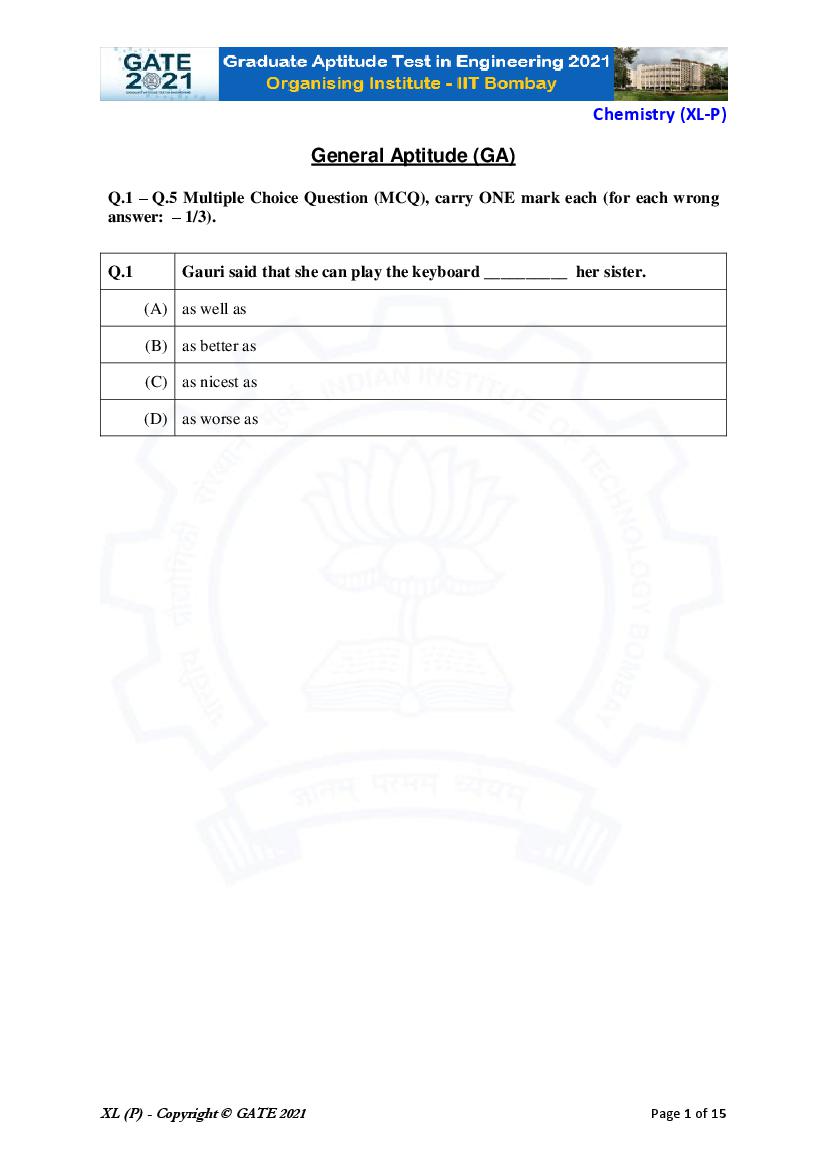
Q.1 – Q.5 Multiple Choice Question (MCQ), carry ONE mark each (for each wrong
answer: – 1/3).
Q.1 Gauri said that she can play the keyboard __________ her sister.
(A) as well as
(B) as better as
(C) as nicest as
(D) as worse as
XL (P) - Copyright © GATE 2021 Page 1 of 15
Page 2
A transparent square sheet shown above is folded along the dotted line. The
folded sheet will look like ________.
(A)
(B)
(C)
(D)
XL (P) - Copyright © GATE 2021 Page 2 of 15
Page 3
any one of the edges of the cube, then, cos =
(A) 1
2
(B) 1
√3
(C) 1
√2
(D) √3
2
Q.4 2 2
1 3
If x − − x − = x + 2 , then the value of x is:
2 2
(A) 2
(B) 4
(C) 6
(D) 8
Q.5 Pen : Write :: Knife : _________
Which one of the following options maintains a similar logical relation in the
above?
(A) Vegetables
(B) Sharp
(C) Cut
(D) Blunt
XL (P) - Copyright © GATE 2021 Page 3 of 15
Page 4
answer: – 2/3).
Q.6 Listening to music during exercise improves exercise performance and
reduces discomfort. Scientists researched whether listening to music while
studying can help students learn better and the results were inconclusive.
Students who needed external stimulation for studying fared worse while
students who did not need any external stimulation benefited from music.
Which one of the following statements is the CORRECT inference of the
above passage?
(A) Listening to music has no effect on learning and a positive effect on physical
exercise.
(B) Listening to music has a clear positive effect both on physical exercise and on
learning.
(C) Listening to music has a clear positive effect on physical exercise. Music has a
positive effect on learning only in some students.
(D) Listening to music has a clear positive effect on learning in all students. Music
has a positive effect only in some students who exercise.
XL (P) - Copyright © GATE 2021 Page 4 of 15
Page 5
A jigsaw puzzle has 2 pieces. One of the pieces is shown above. Which one
of the given options for the missing piece when assembled will form a
rectangle? The piece can be moved, rotated or flipped to assemble with the
above piece.
(A)
(B)
(C)
(D)
XL (P) - Copyright © GATE 2021 Page 5 of 15
Page 6
are added to each class, the ratio changes to 15:35:21.
The total number of students in all the three classes in the beginning was:
(A) 22
(B) 66
(C) 88
(D) 110
XL (P) - Copyright © GATE 2021 Page 6 of 15
Page 7
296 300
300
240
250
200 210
200
150
100
100
50
0
Year 1 Year 2 Year 3
Number of units (`)
Net Profit (INR)
The number of units of a product sold in three different years and the
respective net profits are presented in the figure above. The cost/unit in Year
3 was ` 1, which was half the cost/unit in Year 2. The cost/unit in Year 3
was one-third of the cost/unit in Year 1. Taxes were paid on the selling price
at 10%, 13% and 15% respectively for the three years. Net profit is calculated
as the difference between the selling price and the sum of cost and taxes paid
in that year.
The ratio of the selling price in Year 2 to the selling price in Year 3 is
________.
A) 4:3
(B) 1:1
(C) 3:4
(D) 1:2
XL (P) - Copyright © GATE 2021 Page 7 of 15
Page 8
heights and make the following observations.
Observation I: S is taller than R.
Observation II: Q is the shortest of all.
Observation III: U is taller than only one student.
Observation IV: T is taller than S but is not the tallest.
The number of students that are taller than R is the same as the number of
students shorter than ______.
(A) T
(B) R
(C) S
(D) P
XL (P) - Copyright © GATE 2021 Page 8 of 15
Page 9
answer: – 1/3).
Q.1 The geometry of Fe(CO)5 is
(Given: Atomic number of Fe = 26)
(A) pentagonal planar
(B) square pyramidal
(C) trigonal bipyramidal
(D) trigonal pyramidal
Q.2 The structure of the major product Q of the following reaction is
(A)
(B)
(C)
(D)
XL (P) - Copyright © GATE 2021 Page 9 of 15
Page 10
Q. 3 The time taken by a first order reaction to reach 90% completion is 20 s.
The time taken for the reaction to reach 50% completion is ___________ s
(rounded off to the closest integer).
Q. 4 The ground state energy of an electron in a hydrogen atom is –13.60 eV.
The energy of the electron in the third excited state is _________eV
(rounded off to two decimal places).
Q.5 A solution of a compound shows an absorbance of 0.42 at 275 nm in a
cuvette with 0.1 dm light path. The molar absorptivity of the compound is
ε275 = 8.4 × 10³ M–1 cm–1. The concentration of the compound is ______×
10–5 M (rounded off to the closest integer).
XL (P) - Copyright © GATE 2021 Page 10 of 15
Page 11
answer: – 2/3).
Q. 6 The CORRECT order of acidity of the following compounds is
(A) II > I > III
(B) II > III > I
(C) III > II > I
(D) III > I > II
Q. 7 The O–O bond order in O22– species is
(A) 0.5
(B) 1.0
(C) 1.5
(D) 2.0
XL (P) - Copyright © GATE 2021 Page 11 of 15
Page 12
Group I contains three plots of reactant concentrations as functions of
time, where x = concentration of reactant X at time t; x0 = concentration of
reactant X at initial time, t = 0. Group II gives a list of different orders of
reaction. Match the plots with the order of the reaction.
Group I Group II
(P)
(1) Zero order
(Q)
(2) First order
(R)
(3) Second order
(A) (P) – (1), (Q) – (2), (R) – (3)
(B) (P) – (3), (Q) – (2), (R) – (1)
(C) (P) – (2), (Q) – (3), (R) – (1)
(D) (P) – (2), (Q) – (1), (R) – (3)
XL (P) - Copyright © GATE 2021 Page 12 of 15
Page 13
(A)
(B)
(C)
(D)
XL (P) - Copyright © GATE 2021 Page 13 of 15
Page 14
Q. 10 The CORRECT combination(s) of Y and T for the following elimination
reaction is(are)
(A)
(B)
(C)
(D)
Q. 11 Among the following, the diamagnetic species is(are)
(Given: Atomic numbers of Fe = 26, Co = 27, and Ni = 28)
(A) [CoF6]3-
(B) [Ni(H2O)6]2+
(C) [Fe(CN)6]4-
(D) [Co(NH3)6]3+
XL (P) - Copyright © GATE 2021 Page 14 of 15
Page 15
Q. 12 Given the following standard heats of formation, ∆𝒇 𝐇 ⦵ (𝐏, 𝐠) = 𝟑𝟏𝟒. 𝟔 kJ
mol−1, ∆𝒇 𝐇 ⦵ (𝐏𝐇𝟑 , 𝐠) = 𝟓. 𝟒 kJ mol−1, and ∆𝒇 𝐇 ⦵ (𝐇, 𝐠) = 𝟐𝟏𝟖. 𝟎 kJ mol−1,
the average bond enthalpy of a P–H bond in PH3(g) is __________ kJ mol−1
(rounded off to one decimal place).
Q. 13 The total number of possible geometrical isomer(s) for [PtBrCl(NH3)(py)]0
is _______.
(Given: py = Pyridine and atomic number of Pt = 78)
Q. 14 ⦵
Given the standard reduction potentials, 𝐄𝐌𝐠 𝟐+ /𝐌𝐠 = −𝟐. 𝟑𝟕 𝐕 and
⦵
𝐄𝐀𝐠 + /𝐀𝐠 = 𝟎. 𝟖𝟎 𝐕, the potential of the following cell
𝐀𝐠 + (𝐚𝐪. , 𝟏 𝐦𝐌) + 𝐌𝐠(𝐬) ⇌ 𝐀𝐠(𝐬) + 𝐌𝐠 𝟐+ (𝐚𝐪. , 𝟎. 𝟐 𝐌)
at 𝟐𝟓 °𝐂 is___________ V (rounded off to two decimal places).
(Given: Faraday constant = 96500 C mol−1, Gas constant R = 8.314 J
K−1mol−1)
Q. 15 The freezing point of 80 g of acetic acid (freezing point constant 3.9 K kg
mol−1) was lowered by 7.8 K due to the addition of 20 g of a compound. The
molar mass of the compound is _____________ g mol−1 (rounded off to
closest integer).
END OF THE QUESTION PAPER
XL (P) - Copyright © GATE 2021 Page 15 of 15
Document Details
| Board / Org | IIT |
| Exam | GATE |
| Type | Question Paper |
| Pages | 15 |
| Language | english |
| Updated | 01 May 2026 |