GATE 2021 Question Paper XL S Life Sciences - Microbiology
Finished viewing? Save it for later —
Download GATE 2021 Question Paper XL S Life Sciences - Microbiology (PDF · 9 pages)About GATE 2021 Question Paper XL S Life Sciences - Microbiology
GATE 2021 Question Paper XL S Life Sciences - Microbiology is available here for free download. Published by IIT for Graduate Aptitude Test in Engineering, this question paper can be viewed online or downloaded as a PDF (9 pages). Candidates preparing for Graduate Aptitude Test in Engineering can use GATE 2021 Question Paper XL S Life Sciences - Microbiology to understand the exam pattern, the type of questions asked, and the overall difficulty level.
Frequently Asked Questions
How can I download GATE 2021 Question Paper XL S Life Sciences - Microbiology?
Open this page and click the Download button to save GATE 2021 Question Paper XL S Life Sciences - Microbiology as a PDF. It is completely free on AglaSem Docs.
Is GATE 2021 Question Paper XL S Life Sciences - Microbiology free to download?
Yes. GATE 2021 Question Paper XL S Life Sciences - Microbiology can be viewed online and downloaded as a PDF free of cost on AglaSem Docs.
How many pages does GATE 2021 Question Paper XL S Life Sciences - Microbiology have?
GATE 2021 Question Paper XL S Life Sciences - Microbiology contains 9 pages, which you can read online or download together as a single PDF.
Where can I find more Graduate Aptitude Test in Engineering study material?
You can find more Graduate Aptitude Test in Engineering question papers, sample papers, syllabus, and answer keys on AglaSem Docs.
GATE 2021 Question Paper XL S Life Sciences - Microbiology – Text
Read the full text of this question paper below — useful to quickly search, copy and reference the content online without downloading the PDF.
📄 View text version (9 pages)
Page 1
answer: – 1/3).
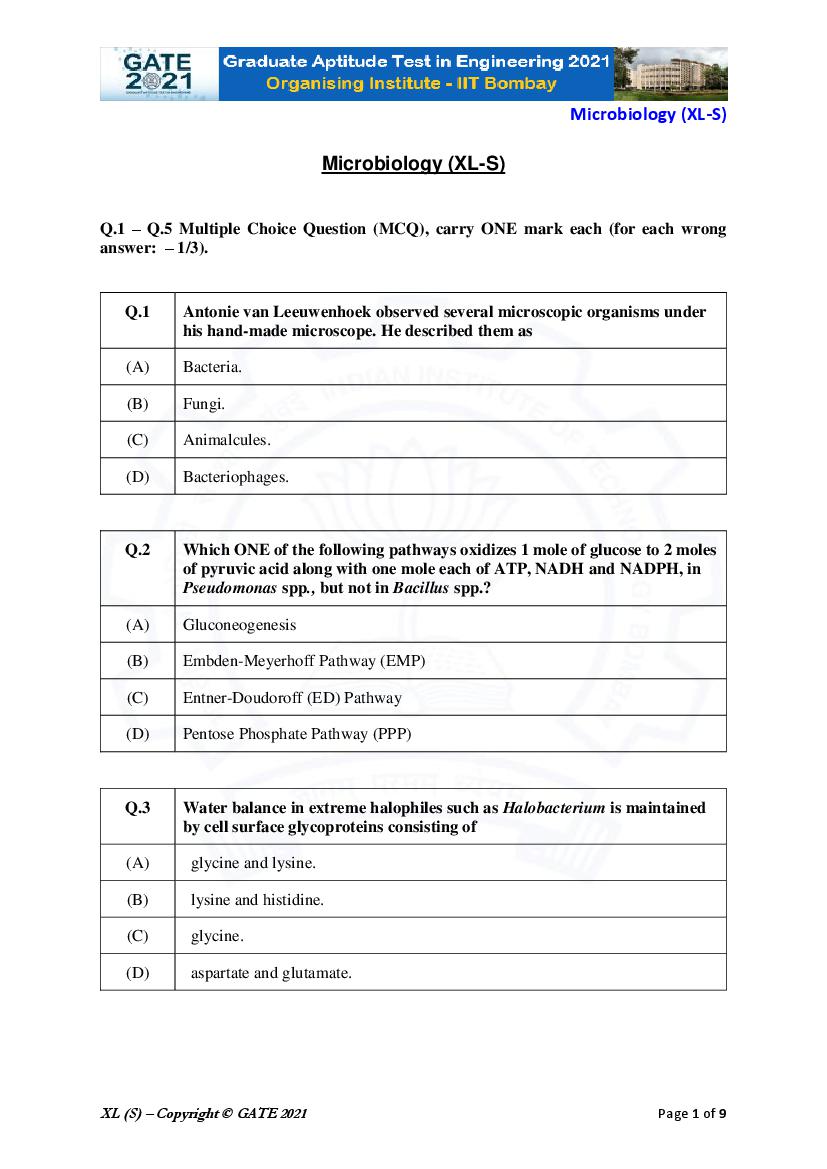
Q.1 Antonie van Leeuwenhoek observed several microscopic organisms under
his hand-made microscope. He described them as
(A) Bacteria.
(B) Fungi.
(C) Animalcules.
(D) Bacteriophages.
Q.2 Which ONE of the following pathways oxidizes 1 mole of glucose to 2 moles
of pyruvic acid along with one mole each of ATP, NADH and NADPH, in
Pseudomonas spp., but not in Bacillus spp.?
(A) Gluconeogenesis
(B) Embden-Meyerhoff Pathway (EMP)
(C) Entner-Doudoroff (ED) Pathway
(D) Pentose Phosphate Pathway (PPP)
Q.3 Water balance in extreme halophiles such as Halobacterium is maintained
by cell surface glycoproteins consisting of
(A) glycine and lysine.
(B) lysine and histidine.
(C) glycine.
(D) aspartate and glutamate.
XL (S) – Copyright © GATE 2021 Page 1 of 9
Page 2
due to the presence of
(A) N-acetyltalosaminuronic acid in the cell wall.
(B) thick peptidoglycan.
(C) mycolic acid.
(D) keto-deoxy-octulosonic acid.
Q.5 Protists belonging to the genus Trichonympha thrive in the gut of termites.
They help the termites use wood as a food source. This relationship is an
example of
(A) parasitism.
(B) competition.
(C) commensalism.
(D) mutualism.
XL (S) – Copyright © GATE 2021 Page 2 of 9
Page 3
Q.6 Which of the following is/are used as electron donor/s for CO2 reduction
during photosynthesis in purple sulfur bacteria?
(A) Hydrogen sulfide
(B) Thiosulfates
(C) Methane
(D) Sulfates
Q.7 Which of the following catalyze(s) substrate-level phosphorylation?
(A) ATP synthase
(B) Succinate thiokinase
(C) Phosphofructokinase
(D) Pyruvate kinase
Q.8 Which of the following method(s) can be applied to identify a bacterial
species?
(A) Fluorescent in situ hybridization (FISH)
(B) Polymerase chain reaction (PCR) followed by sequencing of the amplicon
(C) Gram staining
(D) Acid-fast staining
XL (S) – Copyright © GATE 2021 Page 3 of 9
Page 4
operon in a wild-type strain of E. coli?
(A) Accumulation of allolactose in the cell
(B) Direct binding of cAMP to the promoter DNA
(C) Binding of cAMP to a specific protein leading to its interaction with the
promoter
(D) Elimination of cAMP from the cell
XL (S) – Copyright © GATE 2021 Page 4 of 9
Page 5
Q.10 One mole of a circular bacterial plasmid was digested with a high-fidelity
restriction enzyme. The plasmid has five restriction sites for the enzyme
used. The number of moles of fragments released upon cleavage at all sites
is________.
XL (S) – Copyright © GATE 2021 Page 5 of 9
Page 6
answer: – 2/3).
Q. 11 Under anaerobic fermentative growth conditions, one mole of glucose yields
22 grams of Streptococcus faecalis or 8.6 grams of Zymomonas mobilis. The
molar growth yield (YATP) for (i) S. faecalis and (ii) Z. mobilis will be
(A) (i) 11 and (ii) 4.3
(B) (i) 22 and (ii) 4.3
(C) (i) 22 and (ii) 8.6
(D) (i) 11 and (ii) 8.6
Q. 12 The order of abundance of quinones (ubiquinone [UQ], menaquinone [MQ]
and demethylmenaquinone [DMQ]) in E. coli growing anaerobically on
fumarate is
(A) UQ > DMQ > MQ
(B) MQ > DMQ >UQ
(C) MQ = DMQ > UQ
(D) MQ > UQ > DMQ
Q. 13 What is the number of ATPs generated per molecule of NADH during
oxidative phosphorylation in E. coli via (i) NDH-1 and cytochrome bo
complex or (ii) the NDH-2 and cytochrome bd complex? (Assume H+/ATP =
3)
(A) (i) 2.00 and (ii) 3.67
(B) (i) 3.00 and (ii) 2.67
(C) (i) 2.70 and (ii) 0.67
(D) (i) 2.50 and (ii) 0.50
XL (S) – Copyright © GATE 2021 Page 6 of 9
Page 7
Immunoglobulin Function
(i) IgE (p) protects the fetus
(ii) IgG (q) first antibody to be produced in response to infection
(iii) IgM (r) provides localized protection of mucosal surfaces
(iv) IgA (s) mediates allergic reaction
(t) directly lyses the target cells
(A) (i)- (s), (ii)-(p), (iii)-(q), (iv)-(r)
(B) (i)- (p), (ii)-(t), (iii)-(q), (iv)-(r)
(C) (i)- (q), (ii)-(p), (iii)-(t), (iv)-(r)
(D) (i)- (r), (ii)-(p), (iii)-(t), (iv)-(s)
Q. 15 The figure shows the profiles of quantitative real-time PCR (qRT-PCR) tests
for SARS-CoV-2 conducted on the throat swab samples of three individuals
(X, Y and Z). Tests were carried out under identical conditions. Dotted line
represents the threshold fluorescent value. Identify the correct statement on
the status of the COVID-19 tests of the individuals based on their qRT-PCR
profiles.
(A) X and Y are negative; Z is positive
(B) X and Y are positive; There is no apparent difference in their viral load
(C) X and Y are positive; X has the highest viral load
(D) X and Y are positive; Y has the highest viral load
XL (S) – Copyright © GATE 2021 Page 7 of 9
Page 8
genes after a mating between Hfr and F⁻ strains is shown in the graph (left).
The approximate location of different genes (p, q, r, s, t, x, and y) along the
Hfr chromosome is also shown (right). Based on this information, identify
the recombinants X, Y and Z.
(A) X is x+, Y is r+ and Z is p+
(B) X is p+, Y is r+ and Z is x+
(C) X is x+, Y is p+ and Z is r+
(D) X is p+, Y is x+ and Z is r+
XL (S) – Copyright © GATE 2021 Page 8 of 9
Page 9
Q.17 The genome of a bacterium encodes for 10 different surface antigens, whose
expression can be turned ‘ON’ or ‘OFF’ randomly and independently. The
number of possible antigenic combinations is__________.
Q.18 Suppose the mRNAs in a newly discovered bacteria are composed of only
two distinct nucleotides (as opposed to four found in all known organisms).
Considering that the organism has no nucleotide modification systems, the
number of nucleotides required per codon to encode at least 20 distinct
amino acids will be________.
Q. 19 The decimal reduction time (D) for reducing 1012 spores of Clostridium
botulinum to 1 spore at 111°C will be_______ min (in integer). The D value
is 0.2 min at 121°C. The increase in temperature required to change D to
1/10th of its initial value (Z value) is 10°C.
Q. 20 The generation time of E. coli is 30 minutes. For an exponentially growing
culture, the initial number of bacteria required to reach a number of 109 in
2 hours is_________×107 (round off to two decimal places).
END OF THE QUESTION PAPER
XL (S) – Copyright © GATE 2021 Page 9 of 9
Document Details
| Board / Org | IIT |
| Exam | Graduate Aptitude Test in Engineering |
| Type | Question Paper |
| Pages | 9 |
| Language | english |
| Updated | 30 Apr 2026 |