GATE 2021 Question Paper XL R Life Sciences - Botany
Finished viewing? Save it for later —
Download GATE 2021 Question Paper XL R Life Sciences - Botany (PDF · 12 pages)About GATE 2021 Question Paper XL R Life Sciences - Botany
GATE 2021 Question Paper XL R Life Sciences - Botany is available here for free download. Published by IIT for GATE, this question paper can be viewed online or downloaded as a PDF (12 pages). Candidates preparing for GATE can use GATE 2021 Question Paper XL R Life Sciences - Botany to understand the exam pattern, the type of questions asked, and the overall difficulty level.
Frequently Asked Questions
How can I download GATE 2021 Question Paper XL R Life Sciences - Botany?
Open this page and click the Download button to save GATE 2021 Question Paper XL R Life Sciences - Botany as a PDF. It is completely free on AglaSem Docs.
Is GATE 2021 Question Paper XL R Life Sciences - Botany free to download?
Yes. GATE 2021 Question Paper XL R Life Sciences - Botany can be viewed online and downloaded as a PDF free of cost on AglaSem Docs.
How many pages does GATE 2021 Question Paper XL R Life Sciences - Botany have?
GATE 2021 Question Paper XL R Life Sciences - Botany contains 12 pages, which you can read online or download together as a single PDF.
Where can I find more GATE study material?
You can find more GATE question papers, sample papers, syllabus, and answer keys on AglaSem Docs.
GATE 2021 Question Paper XL R Life Sciences - Botany – Text
Read the full text of this question paper below — useful to quickly search, copy and reference the content online without downloading the PDF.
📄 View text version (12 pages)
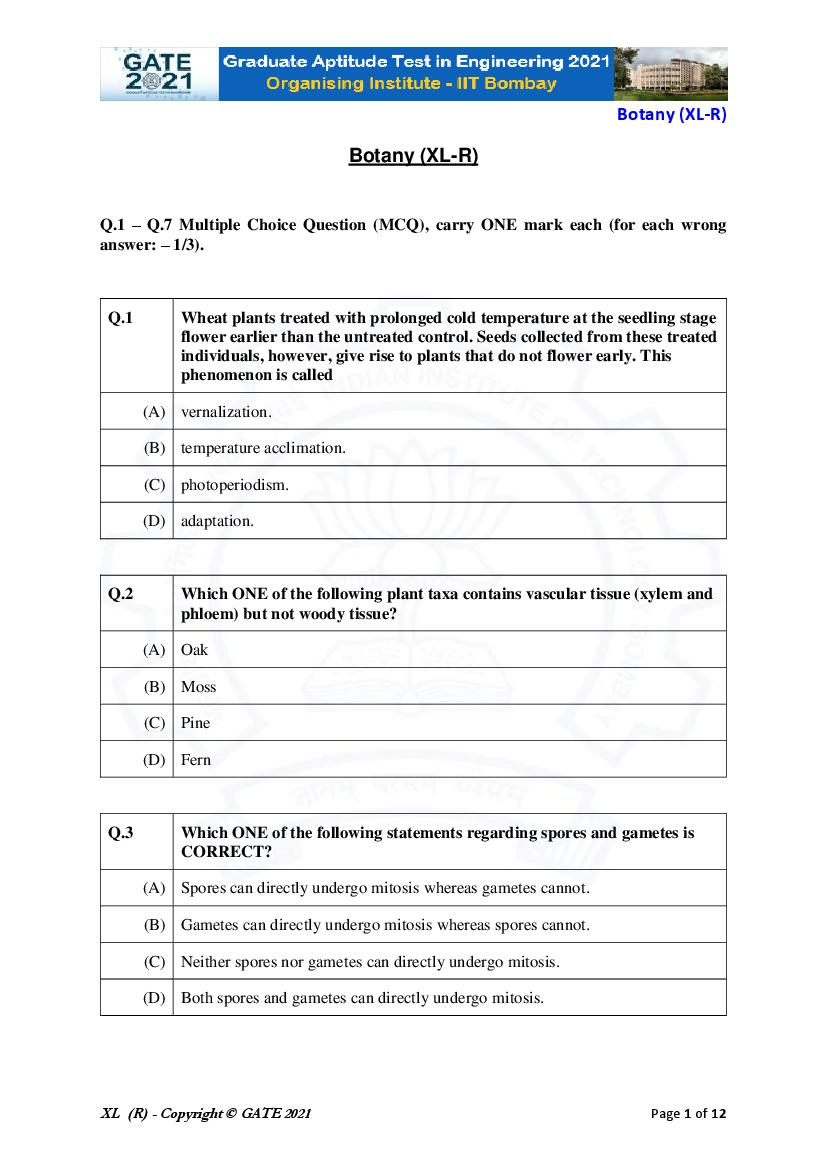
Page 1
answer: – 1/3).
Q.1 Wheat plants treated with prolonged cold temperature at the seedling stage
flower earlier than the untreated control. Seeds collected from these treated
individuals, however, give rise to plants that do not flower early. This
phenomenon is called
(A) vernalization.
(B) temperature acclimation.
(C) photoperiodism.
(D) adaptation.
Q.2 Which ONE of the following plant taxa contains vascular tissue (xylem and
phloem) but not woody tissue?
(A) Oak
(B) Moss
(C) Pine
(D) Fern
Q.3 Which ONE of the following statements regarding spores and gametes is
CORRECT?
(A) Spores can directly undergo mitosis whereas gametes cannot.
(B) Gametes can directly undergo mitosis whereas spores cannot.
(C) Neither spores nor gametes can directly undergo mitosis.
(D) Both spores and gametes can directly undergo mitosis.
XL (R) - Copyright © GATE 2021 Page 1 of 12
Page 2
of higher plants?
(A) Chromoplast
(B) Amyloplast
(C) Chloroplast
(D) Etioplast
Q.5 Phytoalexins play important role in plant defense against pathogens.
Choose the INCORRECT option related to phytoalexins.
(A) Phytoalexins belong to secondary metabolites.
(B) Phytoalexins have antifungal activity.
(C) Phytoalexins are abundant in plants under normal condition.
(D) Different hosts produce phyallexins of varying chemical nature.
XL (R) - Copyright © GATE 2021 Page 2 of 12
Page 3
the given sequence of red (R) and far-red (F) light (each exposure lasting 5
min). The percentage of germination was scored after 72 hours in darkness
at 25 °C. Based on this, which ONE of the following options is CORRECT?
120
100
Germination %
80
60
40
20
0
(A) Red light induces seed germination whereas far-red light inhibits it.
(B) Red light inhibits seed germination whereas far-red light induces it.
(C) Both red and far-red light inhibit seed germination.
(D) Both red and far-red light induce seed germination.
XL (R) - Copyright © GATE 2021 Page 3 of 12
Page 4
hormone that is responsible for bending of coleoptile of canary grass in
response to unidirectional white light.
CH2 COOH
(A)
N
H
H H
(B)
C C
H H
(C) O
OH
OH
(D) O
COOH
XL (R) - Copyright © GATE 2021 Page 4 of 12
Page 5
Q.8 Which of the following cellular component(s) is/are NOT part(s) of
cytoskeleton in Angiosperms?
(A) Microtubules
(B) Microfilaments
(C) Intermediate filaments
(D) Centrioles
Q.9 Which of the following enzyme(s), when overexpressed, would result in rice
grains with increased β-carotene content?
(A) Phytoene synthase
(B) Carotene desaturase
(C) β-glucoronidase
(D) Enolpyruvalshikimate-3-phosphate synthase (EPSPS)
XL (R) - Copyright © GATE 2021 Page 5 of 12
Page 6
Q.10 In spiral phyllotaxis, leaves are initiated sequentially on the meristem with
two successive primordia being separated by golden angle. If a plant
follows right-handed spiral phyllotaxis when looked down the meristem,
then the angle between two successive leaves would be _________degrees
(with correct sign, round off to one decimal place).
XL (R) - Copyright © GATE 2021 Page 6 of 12
Page 7
answer: – 2/3).
Q. 11 Match the cell/tissue types in GROUP I with their corresponding total DNA
content in GROUP II of a typical diploid Angiosperm species and choose
the CORRECT option (C denotes DNA content in haploid genome).
GROUP I GROUP II
(P) Pollen tube (1) 1C
(Q) Megaspore mother cell (2) 2C
(R) Synergid (3) 3C
(S) Embryo sac prior to fertilization (4) 4C
(5) 8C
(A) P-1, Q-2, R-3, S-5
(B) P-2, Q-2, R-1, S-5
(C) P-1, Q-2, R-1, S-5
(D) P-2, Q-1, R-2, S-4
Q. 12 Match the modified organs in GROUP I with their corresponding
prototypic forms in GROUP II and choose the CORRECT option.
GROUP I GROUP II
P. Tendrils in grape vine 1. Modified stem
Q. Tendrils in garden pea 2. Modified leaf
R. Spines
S. Thorns
(A) P-1, Q-2, R-2, S-1
(B) P-2, Q-1, R-1, S-2
(C) P-1, Q-2, R-1, S-2
(D) P-1, Q-1, R-2, S-1
XL (R) - Copyright © GATE 2021 Page 7 of 12
Page 8
where the A, B and C functions are operational in the whorls (1+2), (2+3)
and (3+4), respectively, in the wild-type flower. Removal of A or C function
results in the floral organ arrangements as (carpel; stamen; stamen; carpel)
or (sepal; petal; petal; sepal), respectively. Based on these observations,
which ONE of the following molecular pathways is CORRECT for floral
organ pattern generation? Arrow indicates activation and bar indicates
inhibition.
Whorl 1
(sepal)
Whorl 2
(petal)
Whorl 3
(stamen)
Whorl 4
(carpel)
(A)
A C
(B)
A C
(C)
A C
(D)
A C
XL (R) - Copyright © GATE 2021 Page 8 of 12
Page 9
predominant phytochemical in GROUP II and the economic/medical use in
GROUP III.
GROUP I GROUP II GROUP III
P. Syzygium aromaticum i. Vincristine 1. Toothache relief
Q. Gracillaria sp. ii. Eugenol 2. Dessert jelly
R. Catharanthus roseus iii. Agar 3. Leukaemia treatment
S. Theobroma cacao iv. Morphine 4. Analgesic
T. Papaver somniferum v. Flavonols 5. Beverage
(A) P-i-1, Q-ii-3, R-iii-4, S-v-5, T-iv-2
(B) P-ii-1, Q-iii-2, R-i-3, S-v-5, T-iv-4
(C) P-ii-1, Q-iii-2, R-v-4, S-i-3, T-iv-5
(D) P-i-2, Q-ii-3, R-iv-1, S-iii-5, T-v-4
Q. 15 Match the genetically modified crop in GROUP I with the corresponding
genetic element in GROUP II.
GROUP I GROUP II
P. Tomato with delayed fruit ripening 1. EPSP synthase
Q. Herbicide-resistant soybean 2. 12-Desaturase
R. Insect-resistant cotton 3. Polygalacturonase
S. Soybean with modified oil content 4. Bt-Cry protein
(A) P-3, Q-1, R-4, S-2
(B) P-1, Q-3, R-2, S-4
(C) P-2, Q-1, R-4, S-3
(D) P-3, Q-2, R-4, S-1
XL (R) - Copyright © GATE 2021 Page 9 of 12
Page 10
marks)
Q.16 To understand the mechanism of systemic acquired resistance (SAR), a
team of researchers isolated a mutant with reduced SAR response.
Sequencing of this mutant revealed homozygous mutations in two genes, X
and Y. Which of the following experiment(s) would test whether the mutant
phenotype is caused by mutation in either or both the genes?
(A) Complement the mutant with X or Y and analyze the phenotype in each case.
(B) Complement the mutant with both X and Y and analyze the phenotype.
(C) Cross the mutant with wild-type and analyze the segregation pattern of the
phenotype.
(D) Compare the expression of X and Y in mutant and wild-type plants.
XL (R) - Copyright © GATE 2021 Page 10 of 12
Page 11
genotypes under different light conditions are given, where √ and X
indicate germination and the lack of it, respectively.
Genotype Blue Red Far-red White Dark
Wild-type √ √ √ √ X
cry1 mutant X √ √ √ X
phyA mutant √ √ X √ X
phyB mutant √ X √ √ X
vp1 mutant √ √ √ √ √
Based on these observations, which of the following option(s) is/are
CORRECT?
(A) All the three light qualities– blue, red and far-red – are required for seed
germination.
(B) Any one of the three light qualities - blue, red and far-red – is sufficient to
induce seed germination.
(C) The CRY1, phyA and phyB proteins are required for blue, red and far-red light
perception, respectively.
(D) The VP1 protein is unlikely to be involved in light perception.
Q.18 Which of the following option(s) is/are CORRECT in the context of hybrid
plant generation using Barnase/Barstar-based male sterile lines?
(A) Barnase inhibits Barstar.
(B) Barstar inhibits Barnase.
(C) Barnase and Barstar are used to generate the male sterile line and the restorer
line, respectively.
(D) Barnase and Barstar are used to generate the restorer line and the male sterile
line, respectively.
XL (R) - Copyright © GATE 2021 Page 11 of 12
Page 12
Q.19 In a diploid plant species, the T allele produces tall individuals and is
completely dominant over the t allele that produces short individuals.
Similarly, the W allele produces round seeds and is completely dominant
over the w allele that produces wrinkled seeds (assume T and W loci not
linked). If a parent with TTWW genotype is crossed to another parent with
ttww genotype, the fraction of the F2 population produced by the fusion of
both recombinant gametes would be ___________. (Round-off to two
decimal places.)
Q.20 In a population of a diploid plant species obeying Hardy-Weinberg
equilibrium, a locus regulating flower color has two alleles R and r.
Individuals with RR, Rr and rr genotypes produce red, pink and white
flowers, respectively. If the ratio of red, pink and white flower-producing
individuals in the population is 6:3:1, then the frequency of r allele in the
population would be __________%.
(Round-off to two decimal places.)
END OF THE QUESTION PAPER
XL (R) - Copyright © GATE 2021 Page 12 of 12
Document Details
| Board / Org | IIT |
| Exam | GATE |
| Type | Question Paper |
| Pages | 12 |
| Language | english |
| Updated | 30 Apr 2026 |