MAHA SET 2026 Paper II Chemical Sciences Set A Question Paper
Finished viewing? Save it for later —
Download MAHA SET 2026 Paper II Chemical Sciences Set A Question Paper (PDF · 32 pages)About MAHA SET 2026 Paper II Chemical Sciences Set A Question Paper
MAHA SET 2026 Paper II Chemical Sciences Set A Question Paper is available here for free download. Published by Maharashtra Exams for MAHA SET, this question paper can be viewed online or downloaded as a PDF (32 pages). Candidates preparing for MAHA SET can use MAHA SET 2026 Paper II Chemical Sciences Set A Question Paper to understand the exam pattern, the type of questions asked, and the overall difficulty level.
Frequently Asked Questions
How can I download MAHA SET 2026 Paper II Chemical Sciences Set A Question Paper?
Open this page and click the Download button to save MAHA SET 2026 Paper II Chemical Sciences Set A Question Paper as a PDF. It is completely free on AglaSem Docs.
Is MAHA SET 2026 Paper II Chemical Sciences Set A Question Paper free to download?
Yes. MAHA SET 2026 Paper II Chemical Sciences Set A Question Paper can be viewed online and downloaded as a PDF free of cost on AglaSem Docs.
How many pages does MAHA SET 2026 Paper II Chemical Sciences Set A Question Paper have?
MAHA SET 2026 Paper II Chemical Sciences Set A Question Paper contains 32 pages, which you can read online or download together as a single PDF.
Where can I find more MAHA SET study material?
You can find more MAHA SET question papers, sample papers, syllabus, and answer keys on AglaSem Docs.
MAHA SET 2026 Paper II Chemical Sciences Set A Question Paper – Text
Read the full text of this question paper below — useful to quickly search, copy and reference the content online without downloading the PDF.
📄 View text version (33 pages)
Page 1
MAHA SET 2026 Paper
II Chemical Sciences
Set A Question Paper
EXAM YEAR TYPE
MAHA SET 2026 Question Paper
Notes · Sample Papers · Previous Year Papers · Mock Tests
Page 2
. s e
em l a
as dddddddddddddddddddddddddddddddddddddddddd a g
dddddddddddddddddddddddddddddddddddddddddddddddddddddddd
dddddddddddddddddddddddddddddddddddddddddddddddddddddddd
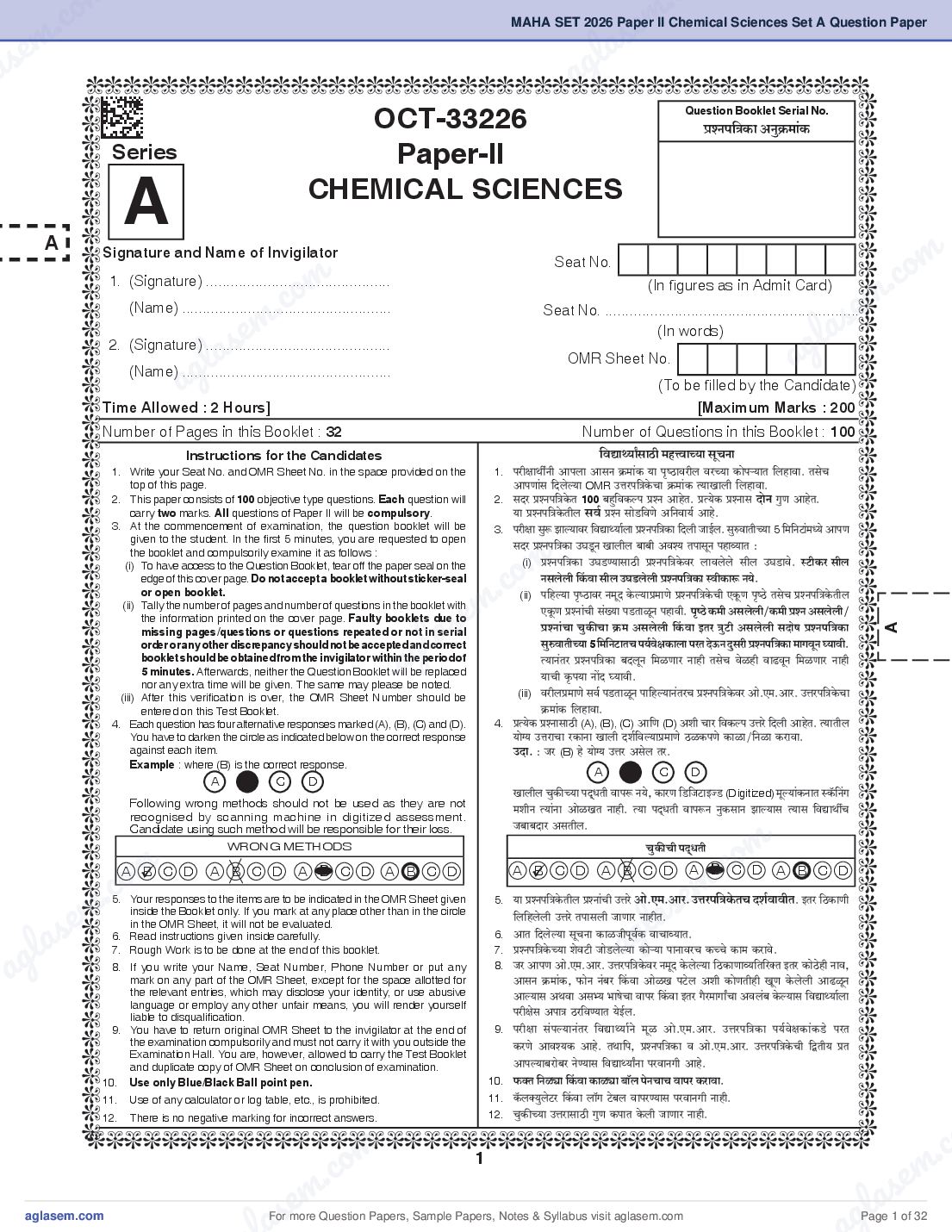
OCT-33226 Question Booklet Serial No.
àíZn{ÌH$m AZwH«$_m§H$
Series Paper-II
A Chemical Science
m
co
A
om
Signature and Name of Invigilator
.
Seat No.
.c e m
1. (Signature) ............................................. (In figures as in Admit Card)
e m
(Name) ...................................................
l a s
Seat No. ..............................................................
l a s (In words)
a g
ag
2. (Signature) .............................................
OMR Sheet No.
(Name) ...................................................
(To be filled by the Candidate)
Time Allowed : 2 Hours] [Maximum Marks : 200
Number of Pages in this Booklet : 32 Number of Questions in this Booklet : 100
Instructions for the Candidates {dÚmÏ`mªgmR>r _hÎdmÀ`m gyMZm
1. Write your Seat No. and OMR Sheet No. in the space provided on the 1.narjmWvZr Amnbm AmgZ H«$_m§H$ `m n¥îR>mdarb daÀ`m H$monè`mV {bhmdm. VgoM
top of this page. AmnUm§g {Xboë`m OMR CÎman{ÌHo$Mm H«$_m§H$ Ë`mImbr {bhmdm.
2. This paper consists of 100 objective type questions. Each question will 2. gXa àíZn{ÌHo$V 100 ~hþ{dH$ën àíZ AmhoV. àË`oH$ àíZmg XmoZ JwU AmhoV.
carry two marks. All questions of Paper II will be compulsory. `m àíZn{ÌHo$Vrb gd© àíZ gmoS>{dUo A{Zdm`© Amho.
3. At the commencement of examination, the question booklet will be 3. narjm gwê$ Pmë`mda {dÚmÏ`m©bm àíZn{ÌH$m {Xbr OmB©b. gwédmVrÀ`m 5 {_{ZQ>m_
§ Ü`o AmnU
m
given to the student. In the first 5 minutes, you are requested to open
co
the booklet and compulsorily examine it as follows :
gXa àíZn{ÌH$m CKSy>Z Imbrb ~m~r Adí` VnmgyZ nhmì`mV :
.
(i) To have access to the Question Booklet, tear off the paper seal on the (i) àíZn{ÌH$m CKS>Ê`mgmR>r àíZn{ÌHo$da bmdbobo grb CKS>mdo. ñQ>rH$a grb
em
edge of this cover page. Do not accept a booklet without sticker-seal Zgbobr {H§$dm grb CKS>bobr àíZn{ÌH$m ñdrH$mê$ Z`o.
or open booklet.
s
(ii) n{hë`m n¥îR>mda Z_yX Ho$ë`mà_mUo àíZn{ÌHo$Mr EHy$U n¥îR>o VgoM àíZn{ÌHo$Vrb
a
(ii) Tally the number of pages and number of questions in the booklet with
l
the information printed on the cover page. Faulty booklets due to
EHy$U àíZm§Mr g§»`m nS>VmiyZ nhmdr. n¥îR>o H$_r Agbobr/H$_r àíZ Agbobr/
g
A
missing pages/questions or questions repeated or not in serial àíZm§Mm MwH$sMm H«$_ Agbobr {H§$dm BVa ÌwQ>r Agbobr gXmof àíZn{ÌH$m
a
order or any other discrepancy should not be accepted and correct gwédmVrÀ`m 5 {_{ZQ>mVM n`©dojH$mbm naV XoD$Z Xwgar àíZn{ÌH$m _mJdyZ ¿`mdr.
booklet should be obtained from the invigilator within the period of Ë`mZ§Va àíZn{ÌH$m ~XbyZ {_iUma Zmhr VgoM doihr dmT>dyZ {_iUma Zmhr
5 minutes. Afterwards, neither the Question Booklet will be replaced
`mMr H¥$n`m Zm|X ¿`mdr.
nor any extra time will be given. The same may please be noted.
(iii) After this verification is over, the OMR Sheet Number should be (iii) darbà_mUo gd© nS>VmiyZ nm{hë`mZ§VaM àíZn{ÌHo$da Amo.E_.Ama. CÎman{ÌHo$Mm
entered on this Test Booklet. H«$_m§H$ {bhmdm.
4. Each question has four alternative responses marked (A), (B), (C) and (D). 4. àË`oH$ àíZmgmR>r (A), (B), (C) Am{U (D) Aer Mma {dH$ën CÎmao {Xbr AmhoV. Ë`mVrb
You have to darken the circle as indicated below on the correct response `mo½` CÎmamMm aH$mZm Imbr Xe©{dë`mà_mUo R>iH$nUo H$mim/{Zim H$amdm.
against each item. CXm. : Oa (B) ho `mo½` CÎma Agob Va.
Example : where (B) is the correct response.
A B C D
A B C D
Imbrb MwH$sÀ`m nX²²YVr dmnê$ Z`o, H$maU {S>{OQ>mBÁS> (Digitized) _yë`m§H$ZmV ñH°${Z§J
Following wrong methods should not be used as they are not
_erZ Ë`m§Zm AmoiIV Zmhr. Ë`m nX²YVr dmnê$Z ZwH$gmZ Pmë`mg Ë`mg {dÚmWuM
m
recognised by scanning machine in digitized assessment.
c. o
Candidate using such method will be responsible for their loss. O~m~Xma AgVrb.
m
wrong methods MwH$sMr nX²²YVr
c. o e m
A
B C D A B C D A B C D A B C D A
B C D A B C D A B C D A B C D
em
5. Your responses to the items are to be indicated in the OMR Sheet given
la s
`m àíZn{ÌHo$Vrb àíZm§Mr CÎmao Amo.E_.Ama. CÎman{ÌHo$VM Xe©dmdrV. BVa {R>H$mUr
s
5.
la ag
inside the Booklet only. If you mark at any place other than in the circle
in the OMR Sheet, it will not be evaluated.
{b{hbobr CÎmao Vnmgbr OmUma ZmhrV.
g
6. Read instructions given inside carefully. 6. AmV {Xboë`m gyMZm H$miOrnyd©H$ dmMmì`mV.
a
7. Rough Work is to be done at the end of this booklet. 7. àíZn{ÌHo$À`m eodQ>r OmoS>boë`m H$moè`m nmZmdaM H$ÀMo H$m_ H$amdo.
8. If you write your Name, Seat Number, Phone Number or put any 8. Oa AmnU Amo.E_.Ama. CÎman{ÌHo$da Z_yX Ho$boë`m {R>H$mUmì`{V{aŠV BVa H$moR>ohr Zmd,
mark on any part of the OMR Sheet, except for the space allotted for AmgZ H«$_m§H$, \$moZ Z§~a {H§$dm AmoiI nQ>ob Aer H$moUVrhr IyU Ho$bobr AmT>iyZ
the relevant entries, which may disclose your identity, or use abusive Amë`mg AWdm Agä` ^mfoMm dmna {H§$dm BVa J¡a_mJmªMm Adb§~ Ho$ë`mg {dÚmÏ`m©bm
language or employ any other unfair means, you will render yourself
liable to disqualification. narjog AnmÌ R>a{dÊ`mV `oB©b.
9. You have to return original OMR Sheet to the invigilator at the end of 9. narjm g§në`mZ§Va {dÚmÏ`m©Zo _yi Amo.E_.Ama. CÎman{ÌH$m n`©dojH$m§H$S>o naV
the examination compulsorily and must not carry it with you outside the H$aUo Amdí`H$ Amho. VWm{n, àíZn{ÌH$m d Amo.E_.Ama. CÎman{ÌHo$Mr {ÛVr` àV
Examination Hall. You are, however, allowed to carry the Test Booklet
and duplicate copy of OMR Sheet on conclusion of examination. Amnë`m~amo~a ZoÊ`mg {dÚmÏ`mªZm nadmZJr Amho.
10. Use only Blue/Black Ball point pen. 10. \$ŠV {Ziçm {H§$dm H$miçm ~m°b noZMmM dmna H$amdm.
11. Use of any calculator or log table, etc., is prohibited. 11. H°$bŠ`wboQ>a {H§$dm bm°J Q>o~b dmnaÊ`mg nadmZJr Zmhr.
12. MwH$sÀ`m CÎmamgmR>r JwU H$nmV Ho$br OmUma Zmhr.
c
12. There is no negative marking for incorrect answers.
m .
c. o m
dddddddddddddddddddddddddddddddddddddddddd
e
1
m a s
se
For more Question Papers, Sample Papers, Notes & Syllabus visit
g l Page 1 of 32
Page 3
For more Question Papers, Sample Papers, Notes & Syllabus visit Page 2 of 32
Page 4
. s e
em l a
as a g
Chemical Sciences
Paper II
m
Time Allowed : 120 Minutes] [Maximum Marks : 200
om
Note : This Paper contains Hundred (100) multiple choice questions. Each question
. co
.c e m
s
carrying Two (2) marks. Attempt All questions.
e m l a
l a s ag
ag
1. In Monsanto acetic acid process, the 2. The following reaction produces
species that exhibits CO insertion is OMe
RC CR
(CO)5 Cr C
Ph
I CO
(A) R
Rh
R R
I CO
(A)
om
R
.c
R
Me R
e m Cr(CO)3
I CO
l a s
(B) Rh
CO a g R
I
(B) (CO)5 Cr C
I
R
CO
CO R R
I
m
c. oOMe
(C) Rh O
m
c. o
(C) MeO
I
e m Ph
em
I Me
la s
s ag OH
Ph
gla
a
CO
CO R
(D) H Rh (D)
CO R
OMe
CO (CO)3Cr
m . c
3
c. o s e m
m a
se
For more Question Papers, Sample Papers, Notes & Syllabus visit
g l Page 3 of 32
Page 5
in the naked p-block clusters, (Bi9)+5,
describe(s) the spacial arrangement
(Sn9)–4 and (Se8)+2 respectively is
and bonding of framework atoms in
(A) 25, 16, 25
S4N4 ring is/are
(B) 11, 11, 15
i. All S – N bond distances within the
(C) 20, 20, 23
ring are equal.
(D) 25, 20, 25
ii. The sulphur atoms form a square
4. The front and back-side view of
plane while nitrogen atoms form a
[B12H12]2– framework is given below,
where s = number of B – H – B bonds, surrounding tetrahedron.
t = number of B – B – B bonds,
y = number of B – B bonds and iii. The four nitrogen atoms form a
x = number of BH2.
square plane with two non-bonding
sulphur atoms at a distance of
258 pm.
iv. Both sulphur and nitrogen atoms
form two interpenetrating coplanar
Front view Back view squares.
The styx code for this molecule is
(A) i and ii only
(A) (0, 12, 1, 0)
(B) ii and iv only
(B) (2, 8, 3, 0)
(C) i and iii only
(C) (0, 11, 2, 0)
(D) (0, 10, 3, 0) (D) iii only
4
For more Question Papers, Sample Papers, Notes & Syllabus visit Page 4 of 32
Page 6
. s e
em l a
as ag
6. The major product formed in the 7. The sequence of reactions involved
in the synthesis of following molecule
following reaction is using 2-methyl-1,3-butadiene and
methyl vinyl ketone is
m
m . co
O
c. o
Ph i) hν, MeOOC
se m
em
COOMe
s
limonene
g l a
la a
ii) pTSA (A) Diels-Alder reaction followed by
ag
Reformatsky reaction
(B) Wittig reaction followed by
Diels-Alder reaction
COOMe
(C) Wittig reaction followed by
COOMe Peterson olefination
(A) (D) Diels-Alder reaction followed by
Ph
Wittig reaction
8. The correct structure of major product
m
formed in the following reaction based
. co
on the given spectral data is
Ph
s em HNO3
COOMe
g l a
a
N N
(B) H
COOMe 1
H NMR (δ ppm) : 8.0 (1H, d, J = 8.2 Hz),
6.7 (1H, d, J = 7 Hz), 4.0 (1H, s),
3.1 (2H, t), 1.6 (2H, m), 0.9 (3H, t)
NO2
(A)
COOMe N N
H
m
NO2
c. o
COOMe
m
(C)
c. o m
O (B)
s e
em la
Ph N N
s ag
H
gla O2N
a COPh
(C)
N N
COOMe H
(D)
COOMe
(D)
O2N N N
H
m . c
5
c. o s e m
m a
se
For more Question Papers, Sample Papers, Notes & Syllabus visit
g l Page 5 of 32
Page 7
color with FeCl3 and shows the reaction are
following spectral data is 1H NMR
δ (ppm) 3.9 (s, 3H), 4.6 (s, 2H), O H2, Pd/C
5.3 (bs, 1H, Exchanges with D2O), Ph EtOH, rt
Ph O
6.9 (dd, J = 8, 2 Hz, 1H),
6.95 (d, J = 2 Hz, 1H), (A) Benzoic acid and benzyl alcohol
7.0 (dd, J = 8, 2 Hz, 1H),
7.3 (t, J = 8 Hz, 1H) MS : m/z 138, 107 (B) Cyclohexane carboxylic acid and
OH toluene
(A)
OCH3 (C) Benzoic acid and toluene
(D) Only benzyl alcohol
OH
(B)
12. The major product formed in the
OCH3
following reaction is
OH
(C) Me
OCH3 O2N NaOH
N
OH EtOH, 0-5°C
OCH3 Br
(D)
H
O2N N O
OH (A)
Me
10. The correct order of C == O Br
stretching frequency in IR spectrum
for the following compounds is O
(B) O2N NHMe
O O
Br
O O O
O O
O2N
P Q R OH
(C)
(A) P > R > Q Br
(B) R > Q > P
Me
(C) Q > P > R O2N
(D) N
(D) R > P > Q O
6
For more Question Papers, Sample Papers, Notes & Syllabus visit Page 6 of 32
Page 8
. s e
em l a
as ag
13. The major product formed in the 14. The major product formed in the
following reaction sequence is following reaction is
m
co
O
om .
O i) HOCH2CH2OH/TsOH F CO2H i) HN NH
c m
. e
ii) mCPBA
m s
ii) HCl/H2O
a
N
e l
Cl
s
iii) HCIO4, H2O
l a
Et
a g
g
SiMe
a
3
O
F CO2H
O (A)
N N
(A) OH HCl.HN Et
OH
o m HCl.HN
.c (B)
O
m
O N CO2H
s e
l a
(B) Cl N
CHO
a g Et
O O
O F
N
(C) NH.HCl
(C) Cl N
Et
m
c. o
CHO
m
c. o s e m
em la
O
s ag N N
F
la
O
g
(D)
a (D) Cl
O NH.HCl
Et
m . c
7
c. o s e m
m a
se
For more Question Papers, Sample Papers, Notes & Syllabus visit
g lPage 7 of 32
Page 9
of acetophenone with hydroxyl constant ‘A’, in the Debye-Hückel
amine followed by Beckmann limiting law is
rearrangement is
(A) mol2kg2
⊕ CH3
I. N (B) mol–2kg–2
(C) mol–0.5kg0.5
O
NHCH3 (D) mol0.5kg–0.5
II.
17. For the consecutive reaction
H
N CH3
III. A
K1 K2
→ B →C
O
starting with [A] = [A]0 ; [B]0 = [C]0 = 0
N OH the value for K1 and K2 are estimated
IV. CH3
to be 2.0 s–1 and 1.0 s–1, respectively.
At what time, the concentration [B], will
(A) The intermediate I is responsible passed through maxima ?
for the formation of II
(A) 0.2 s
(B) II and III have identical physical
and chemical properties (B) 0.1 s
(C) The oxime IV leads to I (C) 0.4 s
(D) The oxime IV leads to II (D) 0.3 s
8
For more Question Papers, Sample Papers, Notes & Syllabus visit Page 8 of 32
Page 10
. s e
em l a
as a g
18. According to the transition state theory 21. From the given data, identify the
+
−∆h≠ strongest base to (i) H (in gas phase)
the plot with slope equal to is and (ii) trimethyl borane.
R
m
(A) In k vs. T
co
J K L
om .
K CH3NH2 (CH3)2NH (CH3)3N
c m
(B) In vs. T
T
m . 2-methyl 4-Methyl
se
e l a
pyridine
s g
K 1 pyridine pyridine
a a
(C) In vs.
l
ag
T T
1 (A) (i) – J; (ii) – L
(D) In k vs.
T
(B) (i) – L; (ii) – L
19. For the enzymolysis following Michaelis-
Vmax [S] (C) (i) – K; (ii) – J
Menten Kinetics, ν = .
K m + [S]
(D) (i) – L; (ii) – K
What is the value of substrate
concentration [S], when the rate of
m
22. The correct statement regarding the
c. o
reaction ν, is 80% of the maximum
solubility and colours of silver halides
rate (velocity) Vmax ?
em (A) AgI has highest solubility
in water is
(A) 2 Km
l a s
(B) 4 Km
a g because of flavourable soft acid-
soft base interaction and yellow
(C) 5 Km colour is because of large band
(D) 8 Km gap
(B) AgBr is more soluble than AgI as
20. The designers of new industrial bromine is the most polarizable
plant wanted to use catalyst in a halide and is yellow coloured due
step involving the flourination of to ligand to metal charge transfer
m
c. o
butadiene. The following data were
m
(C) Solubility of silver halides
o
obtained from the adsorption studies
. c e m
decreases from AgF to AgI due
em la s
to increasing covalent character
s
3
p(Kpa)/V(cm ) 15.1 30.0 44.9 60.1 75.2
a ag
and colours change from white
l The data would best fit in
p(Kpa) 10.0 20.0 30.0 40.0 50.0
ag
for AgF and AgCl to yellow for
AgBr and AgI due to ligand to
metal charge transfer
(A) BET isotherm
(D) Solubility of AgF is highest due to
(B) Langmuir isotherm
high hydration energy of F ion and
(C) Freunrich isotherm it is white because of decreased
(D) Physical adsorption isotherm band gap
m . c
9
c. o s e m
m a
se
For more Question Papers, Sample Papers, Notes & Syllabus visit
g l Page 9 of 32
Page 11
R2PCl can be prepared from PCl3 by measures the hydrodynamic radius
treatment with
of nanoparticles suspended in liquid
(A) LiR media. The technique is based on
(A) Differential absorption of polarized
(B) RMgCl
light.
(C) HgR2 (B) Fluctuation in scattered light
intensity caused by Brownian
(D) RCl motion via stokes-Einstein
equation.
24. Phosphazines contain (C) Thermally induced refractive
index gradient at particle-media
(A) P atom in (+V) oxidation state and
N atom in (+III) oxidation state interface.
(D) Elastic deflection of high energy
(B) P atom in (+III) oxidation state and primary electron.
N atom in (+V) oxidation state
27. The powder XRD recorded on
(C) Both P and N atoms in (+III)
oxidation state nanoparticle samples, the scherrer
Kλ
equation, D = is used to
bcosθ
(D) Both P and N atoms in (+V) estimate the crystalline size. ‘b’ in this
oxidation state
equation is
(A) Full width half Maxima (FWHM)
25. In Thermite reaction, aluminum
becomes white hot upon reaction with of diffraction peak in radian
(A) N2 (B) Bragg’s diffraction angle in
degree
(B) Cl2
°
(C) X-ray wavelength in A
(C) NaOH
(D) Lattice mismatch due to strain
(D) O2 factor
10
For more Question Papers, Sample Papers, Notes & Syllabus visit Page 10 of 32
Page 12
. s e
em l a
as ag
28. Which supramolecular structure is 31. The compound which on oxidation
formed by self-assembly in water ? with dimethyl dioxirane (1 equivalent)
m
furnishes achiral product is
co
(A) Rotaxane
om .
S
.c e m
s
(A)
m
(B) Micelle
s e g l a
g l a
(C) Catenane S a
a
(D) Fullerene
(B)
S
(C)
29. Vitamin B12 contains
(A) Fe
m(D)
S
(B) Mo
. co
s em
(C) Co
g l a 32. The correct order for the rate
(D) Cu
a of substitution of the following
nitrobenzenes is
X OMe
30. [Co(NH3)5Br] and [Co(NH3)5SO4] Br NO2 MeONa NO2
are ionization isomers. Which of the MeOH
m
following will react under aqueous
m c. o
c. o (A) [Co(NH ) Br]SO + Ba
conditions ? X = F, Br and I
e m
em la s
s
2+ (A) Br > I > F
la ag
3 5 4
ag (B) [Co(NH ) SO ]Br + Ba3 5 4
2+ (B) I > Br > F
(C) [Co(NH3)5 SO4]Br + Mg2+ (C) Br > F > I
(D) [Co(NH3)5Br]SO4 + Ag+ (D) F > Br > I
m . c
11
c. o s e m
m a
se
For more Question Papers, Sample Papers, Notes & Syllabus visit
g l
Page 11 of 32
Page 13
formed in the following sequence of
sequence of following reactions is
reactions are
O
NaNH2, liq. NH3
OMe
1) N Cl i)
N CN
EtMgCl [P] Me [Q]
O 2) H3O+ OMe ii) DIBAL-H
iii) H3O+
MgCl
N
(A) [P] =
O
NH2
OMe
N (A)
[Q] = O N
O
OMe
N
(B) [P] = NH2
O MgCl
N
(B)
[Q] = O OMe
O
N
(C) [P] =
O MgCl CHO
N (C)
[Q] =
O OMe
O
N
(D) [P] = MgCl
O CHO
N (D)
[Q] = O
O OMe
12
For more Question Papers, Sample Papers, Notes & Syllabus visit Page 12 of 32
Page 14
. s e
em l a
as ag
35. The major product formed in the 37. Selection rule for diatomic rigid
following reaction is rotator is
CHO
m
(A) µ0 = 0, ∆m = 0, ∆l = ±1
co
+ DABCO
om .
CN
80°C
c m
OH (B) µ0 ≠ 0, ∆m = ±1, ∆l = 0
m . se
s e CN (C) µ0 = 0, ∆m = 0, ∆l = 0
g l a
(A)
g a
l O a
a
(D) µ0 ≠ 0, ∆m = 0, ±1, ∆l = ±1
(B) 38. Suppose µif is the transition dipole
O CN moment associated with pair of
stationary states ψi and ψf of a molecule,
OH the probability of transition from the
m
CN state ψi to ψf is directly proportional to
c. o
(C)
OH (A) | µif |
em (B) | µ |
las
2
CHO
ag
if
(D)
CN 1
O (C) | µif |
1
36. As the rotational quantum number (J) (D) | µif |2
increases for a diatomic molecule
39. Some ideal gas molecules are confined
(A) Degeneracy increases, while in a part of an adiabatic chamber with a
m
c. o
population decreases partition. At some instant the partition is
m
c. o (B) Both degeneracy and population em
removed and the gas expands against
em s
lathe following is correct ?
vacuum to fill the whole chamber.
l as decrease
a g
Which among
ag (C) Degeneracy decreases, while
(A) Entropy will increase
population increases (B) Temperature will decrease
(C) Work done is positive
(D) Both degeneracy and population
increase (D) Gibb’s free energy will increase
m . c
13
c. o s e m
m a
se
For more Question Papers, Sample Papers, Notes & Syllabus visit
g l
Page 13 of 32
Page 15
in entropy of the system is following species is correctly shown
dq in (Given 31P, I = 12 )
(A) ds = rev
T
Me3P M (M = Metal)
dq 90°
(B) ds =
T PMe3
(C) ds = dqrev × T
(D) ds = dq × T
(A)
41. The 31P NMR spectrum of RhCl(PPh3)3
at 30°C is shown in (Given Rh I = 12 ,
100%)
(A) (B)
(B)
(C)
(C)
(D)
(D)
14
For more Question Papers, Sample Papers, Notes & Syllabus visit Page 14 of 32
Page 16
. s e
em l a
as ag
43. The following nuclear reaction is an 46. The major product formed in the
example of following reaction sequence is
m
co
74 Be + −01 e
→ 73 Li + ν Br O
om .
Me
.c e m
(A) Proton emission
s
+
em a
– H 2O
s l
NH2
g
(B) β emission
g la capture a
a
(C) K-electron
Br
(D) γ radiation Me NaNH2/NH3
t-BuOK
N
44. For the following decay series
141
Ba β
( A ) → 57 La
141 β
( B ) → 58 Ce
141 β
( C ) → 59 Pr
141
56 t1 t1 t1
2 2 2
m
c. o (A) Br
The correct order of the half-lives Me
em
( )
t 1 is given by
a s
2
l
N
(A) t 12 (B ) < t 12 ( C ) < t 12 ( A )
a g
H
(B) t 12 ( A ) = t 12 (B ) = t 12 ( C )
Me
(C) t 12 (B ) = t 12 ( C ) < t 12 ( A )
(B)
N
H
(D) t 12 ( A ) < t 12 (B ) < t 12 ( C )
m
m c. o
c. 45.o In nuclear thermal reactors,
Br
e m
Me
em
(C)
la s
las Be and C serve as good
agNH
9 12
4 6
ag moderators as they
(A) Slow down neutrons
Me
(B) Emit β particles
(D)
(C) Facilitate k-electron capture
N
(D) Emits positrons H
m . c
15
c. o s e m
m a
se
For more Question Papers, Sample Papers, Notes & Syllabus visit
g l
Page 15 of 32
Page 17
equilibria from Column – I with the the most stable chair conformations of
respective equilibrium constant from
Column – II. X and Y, respectively, are
Column – I Column – II
I. p. 1.1 × 10⁻³
O OH
X Y
II. q. 1.1 × 10¹³ (A) Three and three
N O N OH
H
(B) Two and three
III. r. 2.0 × 10⁻⁶
O OH (C) Three and two
(A) I – r, II – p, III – q (D) Two and two
(B) I – q, II – r, III – p
(C) I – p, II – r, III – q 50. The major product formed in the
following reaction is
(D) I – r, II – q, III – p
∆
→
48. The most suitable reagents that effect
the following transformation is
H
O O
O O (A)
H
OH O
H H
I. CrO3, H2SO4 (B)
II. Dess-Martin periodinane H
III. Ag2CO3 on celite H
IV. MnO2 (C)
(A) I, III and IV H
(B) I, II and III
H
(C) II, III and IV (D)
(D) I, II and IV H
16
For more Question Papers, Sample Papers, Notes & Syllabus visit Page 16 of 32
Page 18
. s e
em l a
as ag
51. Potential energy of an electron and 54. The radial probability density of an
a proton separated by distance r is
given by electron in hydrogenic orbital is given
m
4 2 −2r / a0
co
(A) V (r ) =
e2 by P = a 3 r e . The most probable
om .
4π ∈0 r
0
ec
. e m
m s
value of r for the state will be
e a
2
l
(B) V (r ) = −
l a s 4π ∈0 r
ag
(C)ag
2
(A) a0
e
V (r ) = −
4π ∈ r 0
2
3
e2 (B) a0
(D) V (r ) = 2
4π ∈0 r 2
52. An eigenvalue obtained on operating 2
(C) a0
dn 3
m
an operator on a function eαx
c. o
n
will be dx
s em (D) 2 a
(A) nα eαx 1
l a
0
(B)
α αx
n
e
a g
(C) n(n – 1) eαx 55. How many angular nodes are present
(D) αneαx in a 4s orbital ?
53. An electron in a hydrogen atom
m
occupies a 3d orbital. What is the (A) 0
m c. o
minimum possible angle (θmin)
c. o m
that the orbital that the angular
s e
em la
momentum vector L can make with (B) 1
las the positive z-axis ?
ag
ag (A) 0°
(C) 2
(B) 10.2°
(C) 35.3°
(D) 45.8° (D) 3
m . c
17
c. o s e m
m a
se
For more Question Papers, Sample Papers, Notes & Syllabus visit
g l
Page 17 of 32
Page 19
a cup of tea which cools is equivalent mixture of 0.1N HCI and
(A) Greater than the magnitude HCN against 0.1N NaOH (aq.) would
of change in entropy of the have a form
surrounding
(B) Less than the magnitude of change
Conductance
in entropy of the surrounding
(A)
(C) Equal to the magnitude of
change in entropy of the
surrounding NaOH (mL)
(D) Can be more or less than the
magnitude of change in entropy
Conductance
of the surrounding
(B)
57. When each system is characterized by
constant µ, V and T it is
NaOH (mL)
(A) Closed isothermal system
(B) Grand canonical ensemble
Conductance
(C) Micro canonical ensemble
(C)
(D) Condensed system
58. Contribution of zero point energy to NaOH (mL)
heat capacity is
(A) Zero
Conductance
(B) R
(D)
(C) 3R/2
(D) R/2 NaOH (mL)
18
For more Question Papers, Sample Papers, Notes & Syllabus visit Page 18 of 32
Page 20
. s e
em l a
as a g
60. Which thermodynamic equation 62. Which of the following metal ions
will have the same CFSE for an ML6
correctly represents the relationship
m
octahedral complex ?
co
for temperature coefficient of an
o m?
electrochemicalccell m .
m . se
e ∂E° a
(A) V2+ and Fe2+ (Low spin)
a s g l
g
(A) ∆g l nFT ∂T
° = a
a (B) Cr3+ and Ni2+
(B) ∆G° = –nFE°
(C) V3+ and Ni2+
∂E° (D) Cu2+ and Ti3+
(C) ∆S° = nF
m
∂T
c. 63.o Which of the following metal ions will
s em
a
RT aR
l
∆E = E° + In
g
(D) have the same crystal field stabilization
a
nF a o
energy but different number of unpaired
electrons for a given ML6 octahedral
61. The ∆0 of a certain ML6 complex will
metal complex ?
vary in the order
(A) Ti3+ and Co3+ (High spin)
m
–
c. o
(A) H2O < I < PR3 < NH3
m
c. o (B) Br < H O < CO < NH m
(B) Ni2+ and V3+
s e
em la
–
las ag
2 3
(C) Fe3+ and Mn3+ (both are high spin
ag –
(C) Cl < H O < NH < CO 2 3
complexes)
– (D) Co2+ (high spin) and V2+
(D) NH3 < I < CO < H2O
m . c
19
c. o s e m
m a
se
For more Question Papers, Sample Papers, Notes & Syllabus visit
g l
Page 19 of 32
Page 21
D-galactose, the possible structure
La+ to Lu3+ is not attributed to of L-galactose is
cho
(A) Increase in effective atomic
H oh
number Z
ho h
(B) Poor shielding of 4f subshells ho h
h oh
(C) Poor basic character of the
ch2oh
cations D-galactose
cho
(D) Subtle contribution from
Ho h
relativistic effects
ho h
(A) ho h
65. The ground state term symbol for h oh
Pr3+ (f2) is ch2oh
cho
(A) 3H4
H oh
(B) 3F2 ho h
(B)
h oh
(C) 1D
h oh
1
(D) G ch2oh
cho
H oh
66. The set of compounds that do
h OH
not undergo autoionization in (C)
hO h
liquid phase at normal laboratory h oh
conditions is ch2oh
cho
(A) IF5, AsCl3, BrF3
Ho h
(B) POCl3, AsCl3, BrF3 h oh
(C) AsF3, BrF3, CIF3 (D) h oh
hO h
(D) IF5, AsCl3, POCl3 ch2oh
20
For more Question Papers, Sample Papers, Notes & Syllabus visit Page 20 of 32
Page 22
. s e
em l a
as ag
68. The correct match of molecules 70. Which of the following reagents can
given in Column – I with the class of act as formyl anion equivalent ?
biomolecules given in Column – II is
m
co
Column – I Column – II OEt
a. Keratin
.c omi. Terpenoid e m .
m s
(A) + sec-BuLi
s
b. Quinine
e
ii. Carbohydrate
g l a
g l a
c. Glycogen iii. Proteins
a
d.aTaxol iv. Alkaloids SR
(A) a – ii, b – iii, c – i, d – iv (B) + sec-BuLi
(B) a – iii, b – iv, c – ii, d – i
(C) a – iii, b – i, c – ii, d – iv
(C) S S + NaH
(D) a – i, b – iv, c – iii, d – ii
m
O
c. o
em (D) CH CH NO + base
69. The major product formed in the
as
following reaction is
Phl(OCOCHg)l
3 2 2
a
oh
3 2
nh2
Ch CN, 40°C
3
o
o 71. The valence electron configuration
o nh of 13, 15 and 17 respectively
correspond to
(A)
o
m
c. o
(A) ns2 np1, ns2 np2 and ns2 np3
m
o nh
c. o (B) s e m
s em la
ag
(B) ns2 np3, ns2 np5 and ns1 np2
la
oh
ag (C)
nhcoch3
(C) ns2 np1, ns2 np3 and ns2 np5
oh
nh2
(D) (D) ns1 np2, ns2 np5 and ns2 np3
m . c
21
c. o s e m
m a
se
For more Question Papers, Sample Papers, Notes & Syllabus visit
g l
Page 21 of 32
Page 23
row transition metal is achieved with exhibit the same shape ?
which one of the following valence
(A) CH4 and XeF4
electron configuration ?
(A) nd5 ns2 (B) PCl5 and Sb(Ph)5
(B) nd5 (n + 1)s2 (C) NH3 and (SO4)2–
(C) (n + 1)d5 ns2 (D) SO3 and (CO3)2–
(D) nd7 (n + 1)s2
76. Following plot represents the drift-
velocity of Bovin Serum Albumin (BSA)
73. The correct order of bond enthalpy
. recorded at varied pH values, under
for O2, O2+. and O2– is
the influence of electric field in aqueous
. .
(A) O2+ > O2 > O2– media. The iso-electric point for the said
. .
(B) O2– > O2+ > O2 protein is around
. .
(C) O2 > O2+ > O2– +1.0
+0.5
Drift Velocity
. .
(D) O2 > O2– > O2+ 0
–0.5
–1.0
74. For the heterodiatomic molecule ICl –1.5
–2.0
(A) I contributes to non bonding
4.0 5.0 6.0 7.0
orbital pH
(B) The bonding orbitals are
(A) 1.2
predominantly Cl in character
(B) 7.0
(C) The bonding orbitals have equal
contributions from I and Cl (C) 5.0
(D) LUMO is a non bonding orbital (D) 1.0
22
For more Question Papers, Sample Papers, Notes & Syllabus visit Page 22 of 32
Page 24
. s e
em l a
as a g
77. For cubic crystal system, the 79. Which experimental technique is most
m
essential symmetry is directly associated with determination of
(A) One fourfold o m . co
c. axis m
the number-average molecular weight
se
em l a
of a polymer ?
(B) Threes fourfold axes g
g la a
a (A) Turbidimetry
(C) Four threefold axes
(B) Viscosity
(D) Two twofold axes
(C) Osmometry
m
78. A polymer sample consists of
80 parts by weight of a polymer c. o (D) Light scattering
s em
l a
having molecular weight 80000
ag
and 20 parts by weight of another 80. A statistical test which provides with
polymer having molecular weight a specified probability, whether the
20000. The number-average mean of two determination differ
molecular weight and weight-average significantly
molecular weight, respectively, are
m
c. o
(A) F-test
m
c. o m
(A) 50000 and 68000
s e
s em (B) 60000 and 68000 (B) Q-test
la
gla ag
a (C) 60000 and 50000
(C) t-test
(D) 68000 and 40000 (D) Variance ratio test
m . c
23
c. o s e m
m a
se
For more Question Papers, Sample Papers, Notes & Syllabus visit
g l
Page 23 of 32
Page 25
in the following reactions are
in the following set of the reactions
CBrCI3 CCI4
[X] [Y] are
h h
CCI3 CCI3 N2
(A) [X] = [Y] = N2
Cl OCH3 OCH3
Br ∆ [X] ∆ [Y]
CCI3 CCI3
(B) [X] = [Y] =
Br Cl
OCH3
CCI3 CCI3
(C) [X] = [Y] =
Br Cl (A) [X] = [Y] =
CCI3 CCI3
(D) [X] = [Y] =
Br
Cl
OCH3 OCH3
82. The major product formed in the
following reaction sequence is (B) [X] = [Y] =
O 1) NaOH, EtOH
2) H3O+
Ph
3) a. Hg(OAc)2, H2O
Ph
b. NaBH4 OCH3 OCH3
(A) Benzoic acid and acetophenone (C) [X] = [Y] =
(B) Benzoic acid and
phenylacetaldehyde
(C) Benzyl alcohol and
acetophenone OCH3 OCH3
(D) Benzaldehyde and (D) [X] = [Y] =
acetophenone
24
For more Question Papers, Sample Papers, Notes & Syllabus visit Page 24 of 32
Page 26
. s e
em l a
as ag
84. The major products formed in the 85. The correct order of reactivity of
following reaction is following compounds for the addition
m
O
co
of one equivalent of HCI is
om .
CF3 Br Br
c m
heat
. e
+
m Br Br a s
I. Me CH
s e g l
a
NMe2
l a
ag CF3 II.
Me
CH2
OH
(A) + Br Br Cl
Br
NMe2
Me
III. CH2
m
H
Br
c. o (A) II < III < I
em
OH
s
CF3 Br
a
Br
l
(B)
g
+
a
(B) II < I < III
NMe2 Br
(C) I < II < III
(D) III < I < II
Br OH
CF3 Br Br
m
(C) + 86. The resonance integral β in Hückel
m c. o
c. o
molecular orbital theory is usually
m
NMe2
s e
s em la
(A) Positive
gla ag
a
(B) Negative
OH
CF3 Br Br
(D) + (C) Zero
Br
NMe2 Br (D) Equal to α
m . c
25
c. o s e m
m a
se
For more Question Papers, Sample Papers, Notes & Syllabus visit
g l
Page 25 of 32
Page 27
strength for the oxygen molecule and symbol “E” typically denotes
its ions ?
(A) A singly degenerate irreducible
− +
(A) O > O 2 > O
2 2 representation
(B) O 2+ > O 2 > O 2− (B) A doubly degenerate irreducible
+ − representation
(C) O 2 > O 2 > O 2
+ − (C) A triply degenerate irreducible
(D) O 2 > O 2 > O 2
representation
88. According to the variational principle, (D) A totally symmetric irreducible
if ψtrial is an arbitrary normalized, representation
well behaved trial wave function for
a quantum system governed by a 91. The major product formed in the
’ following reaction is
time-independent Hamiltonian ‘ h
with ground state energy E0, which
195°C
inequality must the expectation value
Etrial = ψ trial | h | ψ trial satisfy ?
O
(A) Etrial = 0
(A)
(B) Etrial ≤ E0
O
(C) Etrial ≥ E0
(D) Etrial ≤ 0 O
(B)
89. The number of irreducible
representations of a point group CHO
is equal to
(C)
(A) The number of symmetry
operations
(B) The order of the group
(C) The number of classes (D)
(D) The number of generators O
26
For more Question Papers, Sample Papers, Notes & Syllabus visit Page 26 of 32
Page 28
. s e
em l a
as a g
92. The major product formed in the 93. The major product formed in the
following reaction sequence is following reaction is
m
co
O
m .
OCH3 i) Me2CuCNLi2
c.2)o O
1) KHMDS ii) TBAF
se m
em Ph N SO Ph
O
a
H3CO O CH2OTBDMS
s g l
g la a
2
a H3C
OH
OCH3
(A)
H3CO O CH2OTBDMS
OH
(A) O
m
c. o CH3
em (B)
HO OCH3
l a s
(B)
NH2
O a g H3CO O CH2OTBDMS
CH3
HO OCH3
(C)
m
c. o
O
m
(C) H3CO O CH2OH
c. o m
OH
s e
em la
H
las ag
ag
OH
H3C OCH3
O (D)
(D) H CH2OH
H3CO O
OH
m . c
27
c. o s e m
m a
se
For more Question Papers, Sample Papers, Notes & Syllabus visit
g l
Page 27 of 32
Page 29
be an intermediate in the following octahedral complex displays an
reaction is
OH OH EPR (ESR) spectrum of five sextets
pTSA
(5×6=30 lines). Ignoring the spin-
HO O spin interaction between metal
OH
and ligands, this spectrum can be
+
(A) interpreted as
HO
OH (A) ± 12 spin states from Zeeman
(B) +
splitting
OH
(B) Due to 0, ±1, ±2 spin states
+ OH
(C) (C) Four spin states from Zeeman
HO splitting
O H (D) Non degenerate Kramer doublets
(D) +
in zero field
95. Classify the following reactions
as either stereoselective or 97. When 100 mg sample of calcium oxalate
stereospecific. monohydrate (Mol. wt. 146.12 g) was
OH
heated at the rate of 10°C/min in air,
O loss of 7.0 mg was noted at onset
I II III temperature of 140°C corresponding
i. Reaction of epoxide I with NaN3 to water. The percentage (w/w) of
ii. Epoxidation of II with m-CPBA calcium oxalate monohydrate in the
iii. Epoxidation of III with m-CPBA original sample is
(A) i stereospecific ii stereospecific
iii stereoselective (A) 56.82%
(B) i stereospecific ii stereoselective
iii stereoselective (B) 56.00%
(C) i stereoselective ii stereospecific
iii stereoselective (C) 61.32%
(D) i stereoselective ii stereoselective
iii stereospecific (D) 56.21%
28
For more Question Papers, Sample Papers, Notes & Syllabus visit Page 28 of 32
Page 30
. s e
em l a
as a g
98. Oxyhemocyanin is diamagnetic
because of antiferromagnetic 99. Match the mode of dioxygen binding
coupling of unpaired electron on two (column – II) to the proteins (column – I).
similar Cu(II) centers. The diagram
m
that correctly represents this spin- Column – I Column – II
co
spin coupling is
om .
i. Hemoglobin P. η1 -end-on
.c e m
s
peroxo
Am
e
Ss=½
B ii. Hemocyanin Q. η1 -end-on
g l a
a
Energy
a
(A)
l
S =½
ag
superoxo
R. µ − η : η
1 1
iii. Hemerythrin
-end-on
peroxo
iv. Hemosiderin S. µ − η : η
2 2
-side-on
peroxo
Energy
(B)
m
A B
T. µ − η -oxo
2
c. o (A) i – P , ii – R , iii – T , iv – S
S =½ S =½
s em (B) i – Q , ii – S , iii – P , iv – T
g l a
a
(C) i – T , ii – P , iii – Q , iv – R
(D) i – R , ii – S , iii – T , iv – P
A
Energy
(C) S =½ 100. The given Vit-B12-dependent
B isomerization is catalyzed by the
S =½
enzyme
O
+H2O
m
HO OH HO H
co
H OH
m (A) diol dehydratase.
c. o (D) em
B
s
Energy
em a
S =½
s g ldehydratase
(B) glutamate mutase
A
la a
S =½
g
(C) glycerol
a (D) glyceraldehyde synthase
m . c
29
c. o s e m
m a
se
For more Question Papers, Sample Papers, Notes & Syllabus visit
g l
Page 29 of 32
Page 31
30
For more Question Papers, Sample Papers, Notes & Syllabus visit Page 30 of 32
Page 32
. s e
em l a
as a g
Rough Work
m
om . co
.c e m
e m l a s
l a s ag
ag
m
. co
s em
g l a
a
m
m c. o
c. o s e m
s em la
gla ag
a
m . c
31
c. o s e m
m a
se
For more Question Papers, Sample Papers, Notes & Syllabus visit
g l
Page 31 of 32
Page 33
32
For more Question Papers, Sample Papers, Notes & Syllabus visit Page 32 of 32
Document Details
| Board / Org | Maharashtra Exams |
| Exam | MAHA SET |
| Type | Question Paper |
| Pages | 32 |
| Updated | 17 Nov 2026 |