GATE 2021 Question Paper XL U Life Sciences - Food Technology
Finished viewing? Save it for later —
Download GATE 2021 Question Paper XL U Life Sciences - Food Technology (PDF · 8 pages)About GATE 2021 Question Paper XL U Life Sciences - Food Technology
GATE 2021 Question Paper XL U Life Sciences - Food Technology is available here for free download. Published by IIT for Graduate Aptitude Test in Engineering, this question paper can be viewed online or downloaded as a PDF (8 pages). Candidates preparing for Graduate Aptitude Test in Engineering can use GATE 2021 Question Paper XL U Life Sciences - Food Technology to understand the exam pattern, the type of questions asked, and the overall difficulty level.
Frequently Asked Questions
How can I download GATE 2021 Question Paper XL U Life Sciences - Food Technology?
Open this page and click the Download button to save GATE 2021 Question Paper XL U Life Sciences - Food Technology as a PDF. It is completely free on AglaSem Docs.
Is GATE 2021 Question Paper XL U Life Sciences - Food Technology free to download?
Yes. GATE 2021 Question Paper XL U Life Sciences - Food Technology can be viewed online and downloaded as a PDF free of cost on AglaSem Docs.
How many pages does GATE 2021 Question Paper XL U Life Sciences - Food Technology have?
GATE 2021 Question Paper XL U Life Sciences - Food Technology contains 8 pages, which you can read online or download together as a single PDF.
Where can I find more Graduate Aptitude Test in Engineering study material?
You can find more Graduate Aptitude Test in Engineering question papers, sample papers, syllabus, and answer keys on AglaSem Docs.
GATE 2021 Question Paper XL U Life Sciences - Food Technology – Text
Read the full text of this question paper below — useful to quickly search, copy and reference the content online without downloading the PDF.
📄 View text version (8 pages)
Page 1
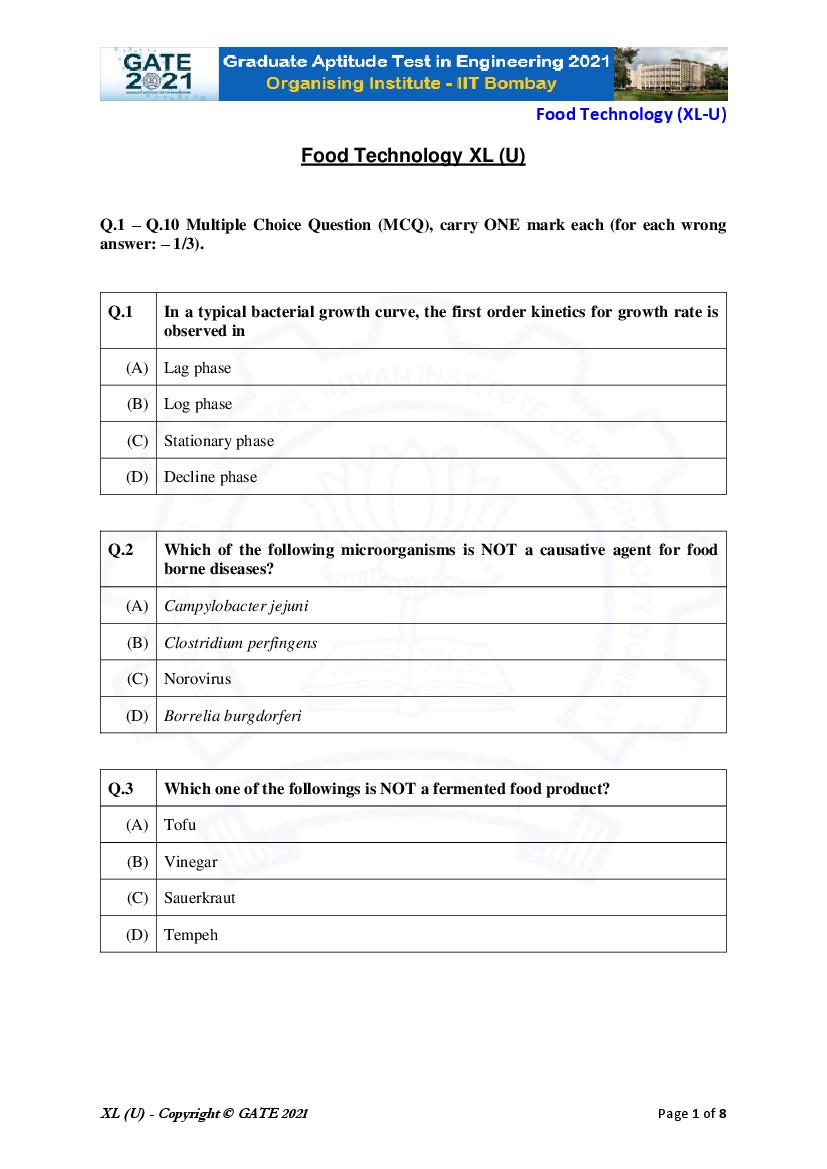
Q.1 – Q.10 Multiple Choice Question (MCQ), carry ONE mark each (for each wrong
answer: – 1/3).
Q.1 In a typical bacterial growth curve, the first order kinetics for growth rate is
observed in
(A) Lag phase
(B) Log phase
(C) Stationary phase
(D) Decline phase
Q.2 Which of the following microorganisms is NOT a causative agent for food
borne diseases?
(A) Campylobacter jejuni
(B) Clostridium perfingens
(C) Norovirus
(D) Borrelia burgdorferi
Q.3 Which one of the followings is NOT a fermented food product?
(A) Tofu
(B) Vinegar
(C) Sauerkraut
(D) Tempeh
XL (U) - Copyright © GATE 2021 Page 1 of 8
Page 2
(A) Percentage of absorbed nitrogen retained in the body
(B) Weight gain in body mass (in gram) per gram protein intake
(C) Ratio of essential and non-essential amino acids in a protein
(D) Percent in vitro digestibility of a protein
Q.5 Which one of the following enzymes sequentially releases maltose from starch?
(A) −Amylase
(B) − Amylase
(C) Glucoamylase
(D) Pullulanase
Q.6 Highest mole % of amino acid mixture present in glutenin of wheat gluten are
(A) Glutamine and glutamic acid
(B) Serine and lysine
(C) Alanine and tryptophan
(D) Proline and glycine
Q.7 Which one of the following compounds is present in soybean and acts as
phytoesterogen?
(A) Tangeretin
(B) Lutin
(C) Quercetin
(D) Genistein
XL (U) - Copyright © GATE 2021 Page 2 of 8
Page 3
(A) Xanthan
(B) Alginate
(C) Raffinose
(D) Gellan
Q.9 Bittering agent in grape fruit formed after juice extraction under acidic
conditions is
(A) Quinine
(B) Theobromine
(C) Isohumulone
(D) Limonin
Q.10 Difference between adsorption and desorption isotherms is known as
(A) Hysteresis
(B) Dryness
(C) Evaporation
(D) Dehydration
XL (U) - Copyright © GATE 2021 Page 3 of 8
Page 4
answer: – 2/3).
Q.11 The conversion of pyruvate to lactic acid in homolactic fermentation is
catalyzed by
(A) Lactate dehydrogenase
(B) Pyruvate dehydrogenase
(C) Lactase
(D) Pyruvate decarboxylase
Q.12 Which one of the following statements is INCORRECT with respect to
Controlled Atmosphere Package (CAP) and Modified Atmosphere Package
(MAP) of agro- produce?
(A) CAP and MAP limit microbial as well as biochemical activities.
(B) Gas composition inside a MAP during the storage is continuously monitored and
regulated.
(C) CAP implies a greater degree of precision than MAP in maintaining specific levels
of the gas composition.
(D) Modification of the atmosphere inside a MAP is achieved by natural interplay
between respiration of products and permeation of gases through the packaging
film.
XL (U) - Copyright © GATE 2021 Page 4 of 8
Page 5
Column II.
Column I Column II
P. Hydrogenation 1. Removal of soft wax
Q. Blanching 2. Shortening of fat
R. Leaching 3. Inactivation of enzyme
S. Winterization 4. Separation of dye
(A) P-2, Q-4, R-2, S-I
(B) P-2, Q-3, R-4, S-1
(C) P-4, Q-1, R-2, S-3
(D) P-4, Q-2, R-1, S-3
XL (U) - Copyright © GATE 2021 Page 5 of 8
Page 6
marks).
Q.14 Which of the followings are correct pair of GRAS chemical food preservative,
affected organism and given food matrix?
(A) Sodium lactate-Bacteria-Pre-cooked meat
(B) Caprylic acid-Insects-Cheese wraps
(C) Dehydroacetic acid-Molds-Squash
(D) Sodium nitrite-Clostridia-Meat curing preparations
Q.15 Choose the correct pair of pigment and their corresponding color in plant
products
(A) Carotene-Yellow-orange-Peppers
(B) Betanin-Purple/red-Cactus pear
(C) Lycopene-Red-Red beets
(D) Flavanols-Orange-red-Cauliflowers
Q.16 Which of the following compounds act as anti-nutritional factors?
(A) Phytate
(B) Isoflavones
(C) Trypsin Inhibitor
(D) Resveratrol
XL (U) - Copyright © GATE 2021 Page 6 of 8
Page 7
supercritical fluid extraction of spices and tea?
(A) Water
(B) Carbon dioxide
(C) Dichloromethane
(D) Carbon dioxide with Ethanol
Q.18 Which of the following expressions represent the Reynolds number of a fluid
flowing through a uniform circular cross section pipe?
(A) (density of the fluid)× (average velocity of the fluid)× (internal diamater of the pipe)
(dynamic viscosity of the fluid)
(B) (average velocity of the fluid) × (internal diamater of the pipe)
(kinematic viscosity of the fluid)
(C) (dynamic viscosity of the fluid)
(average velocity of the fluid)× (density of the fluid)× (internal diamater of the pipe)
(D) (kinematic viscosity of the fluid)
(average velocity of the fluid) × (internal diamater of the pipe)
Q. 19 Which of the following combinations of analytical equipment, property
measured and food property are correct?
(A) Particle size analyzer - particle size distribution - span value
(B) Texture profile analyzer - morphology - chewiness
(C) Differential scanning calorimeter - glass transition temperature - degree of caking
(D) Capillary viscometer - viscosity - sensory
XL (U) - Copyright © GATE 2021 Page 7 of 8
Page 8
Q.20 Dry air is fed into a tray dryer. The percentage relative humidity of the air
leaving the dryer is 60% at 70°C and 101.35 kPa. If, saturated vapour pressure
of water at 70°C is 31.2 kPa, the humidity of the air leaving the dryer in kg
water per kg dry air (round off to 3 decimal places) will be ________.
(Given : Molecular weight of water and air are 18.02 g mol-1 and 28.97 g mol-1
respectively)
END OF THE QUESTION PAPER
XL (U) - Copyright © GATE 2021 Page 8 of 8
Document Details
| Board / Org | IIT |
| Exam | Graduate Aptitude Test in Engineering |
| Type | Question Paper |
| Pages | 8 |
| Language | english |
| Updated | 30 Apr 2026 |