JNUEE 2021 Question Paper Ph.D Linguistics
Finished viewing? Save it for later —
Download JNUEE 2021 Question Paper Ph.D Linguistics (PDF · 20 pages)About JNUEE 2021 Question Paper Ph.D Linguistics
JNUEE 2021 Question Paper Ph.D Linguistics is available here for free download. Published by NTA for JNUEE, this question paper can be viewed online or downloaded as a PDF (20 pages). Candidates preparing for JNUEE can use JNUEE 2021 Question Paper Ph.D Linguistics to understand the exam pattern, the type of questions asked, and the overall difficulty level.
Frequently Asked Questions
How can I download JNUEE 2021 Question Paper Ph.D Linguistics?
Open this page and click the Download button to save JNUEE 2021 Question Paper Ph.D Linguistics as a PDF. It is completely free on AglaSem Docs.
Is JNUEE 2021 Question Paper Ph.D Linguistics free to download?
Yes. JNUEE 2021 Question Paper Ph.D Linguistics can be viewed online and downloaded as a PDF free of cost on AglaSem Docs.
How many pages does JNUEE 2021 Question Paper Ph.D Linguistics have?
JNUEE 2021 Question Paper Ph.D Linguistics contains 20 pages, which you can read online or download together as a single PDF.
Where can I find more JNUEE study material?
You can find more JNUEE question papers, sample papers, syllabus, and answer keys on AglaSem Docs.
JNUEE 2021 Question Paper Ph.D Linguistics – Text
Read the full text of this question paper below — useful to quickly search, copy and reference the content online without downloading the PDF.
📄 View text version (20 pages)
Page 1
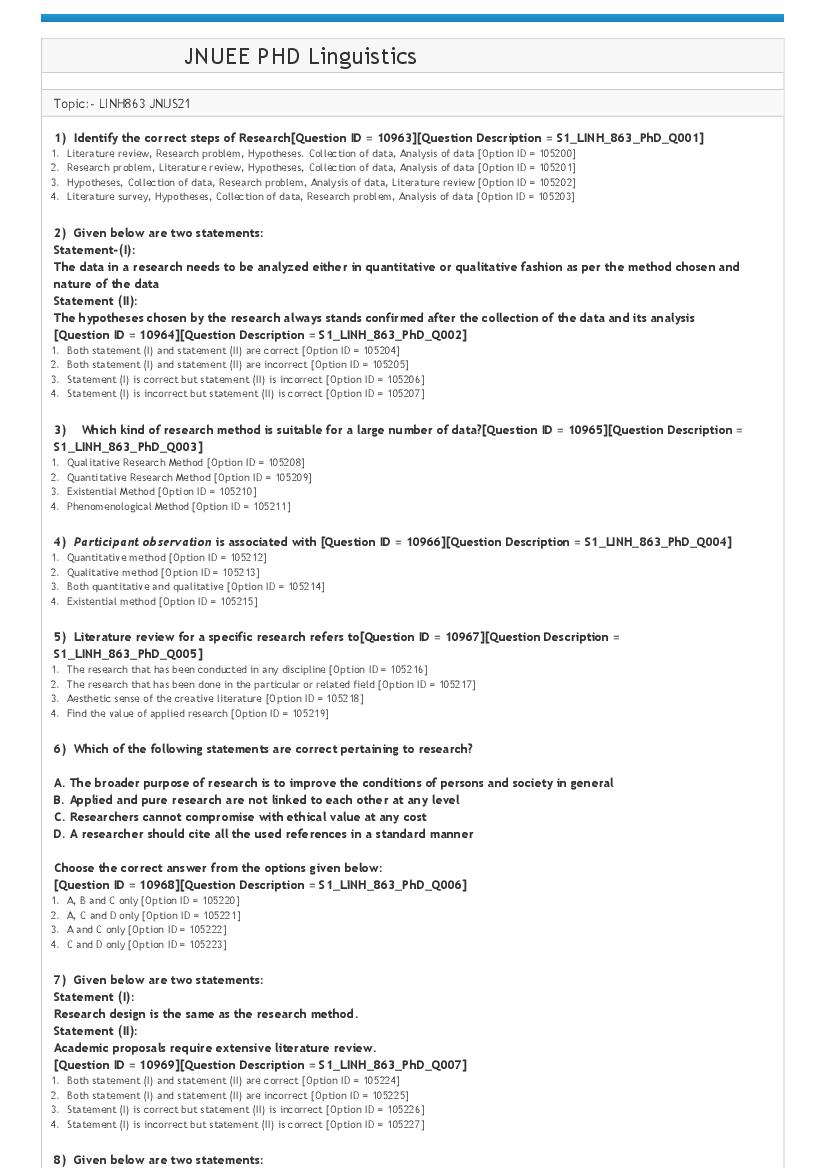
Topic:‐ LINH863 JNUS21
1) Identify the correct steps of Research[Question ID = 10963][Question Description = S1_LINH_863_PhD_Q001]
1. Literature review, Research problem, Hypotheses. Collection of data, Analysis of data [Option ID = 105200]
2. Research problem, Literature review, Hypotheses, Collection of data, Analysis of data [Option ID = 105201]
3. Hypotheses, Collection of data, Research problem, Analysis of data, Literature review [Option ID = 105202]
4. Literature survey, Hypotheses, Collection of data, Research problem, Analysis of data [Option ID = 105203]
2) Given below are two statements:
Statement‐(I):
The data in a research needs to be analyzed either in quantitative or qualitative fashion as per the method chosen and
nature of the data
Statement (II):
The hypotheses chosen by the research always stands confirmed after the collection of the data and its analysis
[Question ID = 10964][Question Description = S1_LINH_863_PhD_Q002]
1. Both statement (I) and statement (II) are correct [Option ID = 105204]
2. Both statement (I) and statement (II) are incorrect [Option ID = 105205]
3. Statement (I) is correct but statement (II) is incorrect [Option ID = 105206]
4. Statement (I) is incorrect but statement (II) is correct [Option ID = 105207]
3) Which kind of research method is suitable for a large number of data?[Question ID = 10965][Question Description =
S1_LINH_863_PhD_Q003]
1. Qualitative Research Method [Option ID = 105208]
2. Quantitative Research Method [Option ID = 105209]
3. Existential Method [Option ID = 105210]
4. Phenomenological Method [Option ID = 105211]
4) Participant observation is associated with [Question ID = 10966][Question Description = S1_LINH_863_PhD_Q004]
1. Quantitative method [Option ID = 105212]
2. Qualitative method [Option ID = 105213]
3. Both quantitative and qualitative [Option ID = 105214]
4. Existential method [Option ID = 105215]
5) Literature review for a specific research refers to[Question ID = 10967][Question Description =
S1_LINH_863_PhD_Q005]
1. The research that has been conducted in any discipline [Option ID = 105216]
2. The research that has been done in the particular or related field [Option ID = 105217]
3. Aesthetic sense of the creative literature [Option ID = 105218]
4. Find the value of applied research [Option ID = 105219]
6) Which of the following statements are correct pertaining to research?
A. The broader purpose of research is to improve the conditions of persons and society in general
B. Applied and pure research are not linked to each other at any level
C. Researchers cannot compromise with ethical value at any cost
D. A researcher should cite all the used references in a standard manner
Choose the correct answer from the options given below:
[Question ID = 10968][Question Description = S1_LINH_863_PhD_Q006]
1. A, B and C only [Option ID = 105220]
2. A, C and D only [Option ID = 105221]
3. A and C only [Option ID = 105222]
4. C and D only [Option ID = 105223]
7) Given below are two statements:
Statement (I):
Research design is the same as the research method.
Statement (II):
Academic proposals require extensive literature review.
[Question ID = 10969][Question Description = S1_LINH_863_PhD_Q007]
1. Both statement (I) and statement (II) are correct [Option ID = 105224]
2. Both statement (I) and statement (II) are incorrect [Option ID = 105225]
3. Statement (I) is correct but statement (II) is incorrect [Option ID = 105226]
4. Statement (I) is incorrect but statement (II) is correct [Option ID = 105227]
8) Given below are two statements:
Page 2
All primates (including humans) have pharynx.
Statement (II):
Pharynx acts as a resonator for increased range and clarity of the sounds produced via the larynx and the vocal tract.
[Question ID = 10970][Question Description = S1_LINH_863_PhD_Q008]
1. Both statement (I) and statement (II) are correct [Option ID = 105228]
2. Both statement (I) and statement (II) are incorrect [Option ID = 105229]
3. Statement (I) is correct but statement (II) is incorrect [Option ID = 105230]
4. Statement (I) is incorrect but statement (II) is correct [Option ID = 105231]
9) Given below are two statements: one is labelled as Assertion A and the other is labelled as Reason R
Assertion A:
There is no voiced glottal plosive sound in the IPA.
Reason R:
It is physiologically impossible to produce the voiced glottal plosive sound.
In the light of the above statements, choose the correct answer from the options given below
[Question ID = 10971][Question Description = S1_LINH_863_PhD_Q009]
1. Both A and R are correct and R is the correct explanation of A. [Option ID = 105232]
2. Both A and R are correct and R is not the correct explanation of A. [Option ID = 105233]
3. A is correct but R is not correct. [Option ID = 105234]
4. A is not correct but R is correct. [Option ID = 105235]
10) Which frequencies correlate and inversely correlate to the tongue frontness and tongue height, respectively?
A. F3
B. F2
C. F1
D. F0
Choose the correct answer from the options given below:
[Question ID = 10972][Question Description = S1_LINH_863_PhD_Q010]
1. A and B only [Option ID = 105236]
2. B and C only [Option ID = 105237]
3. C and D only [Option ID = 105238]
4. A and D only [Option ID = 105239]
11)
[Question ID = 10973][Question Description = S1_LINH_863_PhD_Q011]
1. Deletion [Option ID = 105240]
2. Gliding [Option ID = 105241]
3. Gliding and Deletion [Option ID = 105242]
4. Metathesis [Option ID = 105243]
12)
[Question ID = 10974][Question Description = S1_LINH_863_PhD_Q012]
1. Main stress is on the first syllable irrespective of weight
[Option ID = 105244]
2. Main stress is on the first syllable if it is heavy and on the second syllable if it is not
[Option ID = 105245]
3. Main stress is on the second syllable if it is light and on the second if it is not
[Option ID = 105246]
4. Main stress is on the second syllable irrespective of weight
[Option ID = 105247]
13) Which among the following class of segments has the lowest sonority?[Question ID = 10975][Question Description =
Page 3
1. Voiced Fricative sounds [Option ID = 105248]
2. Voiced Plosive sounds [Option ID = 105249]
3. Voiceless Fricative sounds [Option ID = 105250]
4. Voiceless Plosive sounds [Option ID = 105251]
14) One can distinguish between /b,d,g/ on the basis of[Question ID = 10976][Question Description =
S1_LINH_863_PhD_Q014]
1. Manner of articulation [Option ID = 105252]
2. Level of acoustic energy [Option ID = 105253]
3. Voicing and aspiration [Option ID = 105254]
4. Place of articulation [Option ID = 105255]
15) Which of the following refers to manner of articulation?[Question ID = 10977][Question Description =
S1_LINH_863_PhD_Q015]
1. Glottal, Retroflex, Dental [Option ID = 105256]
2. Retroflex, Labial, Palatal [Option ID = 105257]
3. Trill, Lateral, Rhotic [Option ID = 105258]
4. Plosive, Fricative, Retroflex [Option ID = 105259]
16)
[Question ID = 10978][Question Description = S1_LINH_863_PhD_Q016]
1. A‐II, B‐I, C‐III, D‐IV [Option ID = 105260]
2. A‐IV, B‐II, C‐III, D‐I [Option ID = 105261]
3. A‐I, B‐II, C‐III, D‐IV [Option ID = 105262]
4. A‐IV, B‐III, C‐II, D‐I [Option ID = 105263]
17) Which among the following segments is termed as releasing consonant in the word ‘pen’?[Question ID = 10979]
[Question Description = S1_LINH_863_PhD_Q017]
1. /p/ [Option ID = 105264]
2. /e/ [Option ID = 105265]
3. /n/ [Option ID = 105266]
4. /p/, /e/, /n/ [Option ID = 105267]
18) Which of the following sound is not produced by pulmonic egressive air stream mechanism?[Question ID = 10980]
[Question Description = S1_LINH_863_PhD_Q018]
1. / ɸ / [Option ID = 105268]
2. /ɗ / [Option ID = 105269]
3. / ә / [Option ID = 105270]
4. / ŋ/ [Option ID = 105271]
19) Given below are two statements:
Statement I:
Derivation generally creates a new word by changing the category or meaning of the base to which it applies.
Statement II:
Inflection always changes the grammatical category of the word to which it applies.
In the light of the above statements, choose the most appropriate answer from the options given below
[Question ID = 10981][Question Description = S1_LINH_863_PhD_Q019]
1. Both Statement I and Statement II are correct [Option ID = 105272]
2. Both Statement I and Statement II are incorrect [Option ID = 105273]
3. Statement I is correct but Statement II is incorrect [Option ID = 105274]
4. Statement I is incorrect but Statement II is correct [Option ID = 105275]
20) A single morpheme that is used to encode more than one grammatical contrast is called _______________.[Question
ID = 10982][Question Description = S1_LINH_863_PhD_Q020]
1. Portmanteau morpheme [Option ID = 105276]
Page 4
3. Stem extender [Option ID = 105278]
4. Base morpheme [Option ID = 105279]
21)
[Question ID = 10983][Question Description = S1_LINH_863_PhD_Q021]
1. A‐III, B‐II, C‐I, D‐IV [Option ID = 105280]
2. A‐II, B‐III, C‐IV, D‐I [Option ID = 105281]
3. A‐I, B‐IV, C‐II, D‐III [Option ID = 105282]
4. A‐IV, B‐II, C‐I, D‐III [Option ID = 105283]
22)
[Question ID = 10984][Question Description = S1_LINH_863_PhD_Q022]
1. A‐II, B‐III, C‐IV, D‐I [Option ID = 105284]
2. A‐IV, B‐II, C‐I, D‐III [Option ID = 105285]
3. A‐III, B‐IV, C‐I, D‐II [Option ID = 105286]
4. A‐III, B‐II, C‐IV, D‐I [Option ID = 105287]
23) Given below are two statements: one is labelled as Assertion A and the other is labelled as Reason R
Assertion A:
English word ‘kudos’ is pronounced with a word‐final [z] (as in dogs).
Reason R:
‘kudo’ is a new backformation from ‘kudos’, which is a synonym for ‘praise’.
In the light of the above statements, choose the correct answer from the options given below
[Question ID = 10985][Question Description = S1_LINH_863_PhD_Q023]
1. Both A and R are correct and R is the correct explanation of A. [Option ID = 105288]
2. Both A and R are correct and R is not the correct explanation of A. [Option ID = 105289]
3. A is correct but R is not correct. [Option ID = 105290]
4. A is not correct but R is correct. [Option ID = 105291]
24) Consider the following words and identify the examples of clipping.
A. tax
B. fax
C. hoax
D. max
E. box
Choose the correct answer from the options given below:
Page 5
1. A and C only [Option ID = 105292]
2. B and D only [Option ID = 105293]
3. C and E only [Option ID = 105294]
4. A and E only [Option ID = 105295]
25)
[Question ID = 10987][Question Description = S1_LINH_863_PhD_Q025]
1. A‐I, B‐II, C‐III, D‐IV
[Option ID = 105296]
2. A‐IV, B‐II, C‐III, D‐I
[Option ID = 105297]
3. A‐III, B‐IV, C‐II, D‐I
[Option ID = 105298]
4. A‐II, B‐IV, C‐III, D‐I
[Option ID = 105299]
26) Given below are two statements:
Statement (I):
Panini’s Astadhyayi is considered to be one of the early works on Sanskrit morphology.
Statement (II):
Panini gave around 4000 rules (sutras) of the Sanskrit morphology in this book.
In the light of the above statements, choose the correct answer from the options given below
[Question ID = 10988][Question Description = S1_LINH_863_PhD_Q026]
1. Both statement (I) and statement (II) are correct
[Option ID = 105300]
2. Both statement (I) and statement (II) are incorrect
[Option ID = 105301]
3. Statement (I) is correct but statement (II) is incorrect
[Option ID = 105302]
4. Statement (I) is incorrect but statement (II) is correct
[Option ID = 105303]
27) ‘Metaphorical extension’ is a way in which the __________ of an existing word is modified, thus resulting in new uses.
[Question ID = 10989][Question Description = S1_LINH_863_PhD_Q027]
1. length [Option ID = 105304]
2. morphemes [Option ID = 105305]
3. syllables [Option ID = 105306]
4. meaning [Option ID = 105307]
28) Given below are two statements: one is labelled as Assertion A and the other is labelled as Reason R
Assertion A:
Semantics of natural language cannot deal with truth and falsity.
Reason R:
Some truth properties and truth relations hold regardless of reference and the way the world actually is, provided meaning
is held constant.
In the light of the above statements, choose the correct answer from the options given below
[Question ID = 10990][Question Description = S1_LINH_863_PhD_Q028]
1. Both A and R are correct and R is the correct explanation of A. [Option ID = 105308]
2. Both A and R are correct and R is not the correct explanation of A. [Option ID = 105309]
3. A is correct but R is not correct. [Option ID = 105310]
4. A is not correct but R is correct. [Option ID = 105311]
29) Given below are two statements:
Page 6
A relationship between two sentences wherein the truth of one sentence entails the falsity of the other is called
entailment.
Statement II:
Contradiction relation between two sentences wherein the truth of the second necessarily follows from the truth of the
first, but the reverse is not necessarily the case.
In the light of the above statements, choose the most appropriate answer from the options given below
[Question ID = 10991][Question Description = S1_LINH_863_PhD_Q029]
1. Both Statement I and Statement II are correct [Option ID = 105312]
2. Both Statement I and Statement II are incorrect [Option ID = 105313]
3. Statement I is correct but Statement II is incorrect [Option ID = 105314]
4. Statement I is incorrect but Statement II is correct [Option ID = 105315]
30) Which of the following option(s) is/are incorrect?
A. Saville Troike: Hard shelled and soft shelled speech community
B. Gumperz: Frequency of interaction among the members of speech community
C. Dell Hymes: Shared use and shared perception among the members of the speech community
D. Le Page: Geographical proximity and Speech behavior
Choose the correct answer from the options given below:
[Question ID = 10992][Question Description = S1_LINH_863_PhD_Q030]
1. C and D only [Option ID = 105316]
2. A and B only [Option ID = 105317]
3. C only [Option ID = 105318]
4. D only [Option ID = 105319]
31) “Butler English of Madras”’ “Boxwallah English of Upper India”, “Cheechee English” and “Baboo English” are examples
of [Question ID = 10993][Question Description = S1_LINH_863_PhD_Q031]
1. Creole [Option ID = 105320]
2. Mesolect [Option ID = 105321]
3. Basilect [Option ID = 105322]
4. Pidgin [Option ID = 105323]
32) “No individual is free to describe nature with absolute impartiality but is constrained to certain modes of
interpretation. It means that all observers are not led by the same physical evidence to the same picture of the universe,
unless their linguistic backgrounds are similar or can in some way be calibrated.”
This proposition highlights the tenets of ____________.
[Question ID = 10994][Question Description = S1_LINH_863_PhD_Q032]
1. Linguistic deficiency [Option ID = 105324]
2. Linguistic relativity [Option ID = 105325]
3. Sociology of language [Option ID = 105326]
4. Language planning [Option ID = 105327]
33) Equative function in Bilingualism refers to
[Question ID = 10995][Question Description = S1_LINH_863_PhD_Q033]
1. Assigning functional allocation to two languages
[Option ID = 105328]
2. Assigning equal respect and importance to the two languages
[Option ID = 105329]
3. Diglossic situation embedded in Bilingualism
[Option ID = 105330]
4. Subordinate status of Bilingualism
[Option ID = 105331]
34) Identify the incorrect statement
[Question ID = 10996][Question Description = S1_LINH_863_PhD_Q034]
Page 7
[Option ID = 105332]
2. Mutual intelligibility is a matter of degree, ranging from total intelligibility down to total unintelligibility.
[Option ID = 105333]
3. Mutual intelligibility is confined to a relation between varities, not between people.
[Option ID = 105334]
4. Mutual intelligibility need not be reciprocal, since A and B need not have the same degree of motivation for understanding each other
[Option ID = 105335]
35) Identify the incorrect statement[Question ID = 10997][Question Description = S1_LINH_863_PhD_Q035]
1. Creoles are contact‐induced varieties [Option ID = 105336]
2. Creoles are no one’s first languages [Option ID = 105337]
3. Pidgins can give rise to creoles [Option ID = 105338]
4. Basilect, Mesolect and Acolect are different processes involved in decrolization [Option ID = 105339]
36) Planning directed towards creating a favorable psychological background which is crucial for the long term success of
language planning activities is[Question ID = 10998][Question Description = S1_LINH_863_PhD_Q036]
1. Acquisition Planning [Option ID = 105340]
2. Prestige Planning [Option ID = 105341]
3. Corpus Planning [Option ID = 105342]
4. Status Planning [Option ID = 105343]
37) In the sentences, ‘her hair was kind of long’ or ‘the book cover is sort of pink’; ‘sort of’ and ‘kind of’ are
called_______________.[Question ID = 10999][Question Description = S1_LINH_863_PhD_Q037]
1. Hedges [Option ID = 105344]
2. Filled pauses [Option ID = 105345]
3. Turns [Option ID = 105346]
4. Maxims [Option ID = 105347]
38) A Speech act that has a particular effect on the listener (e.g. an utterance that frightens, ridicules or insults) is
called______________________________.[Question ID = 11000][Question Description = S1_LINH_863_PhD_Q038]
1. Locutionary act [Option ID = 105348]
2. Illocutionary act [Option ID = 105349]
3. Perlocultoinary act [Option ID = 105350]
4. Contralocutionary act [Option ID = 105351]
39) Given below are two statements:
Statement I:
The term ‘back channels’ refers to the use of words and sounds as for example ‘yeah’, ‘hmm’ by listeners while someone
else is speaking.
Statement II:
‘Cuneiform’ is a way of reading designed for the dyslexic patients.
In the light of the above statements, choose themost appropriate answer from the options given below
[Question ID = 11001][Question Description = S1_LINH_863_PhD_Q039]
1. Both Statement I and Statement II are correct [Option ID = 105352]
2. Both Statement I and Statement II are incorrect [Option ID = 105353]
3. Statement I is correct but Statement II is incorrect [Option ID = 105354]
4. Statement I is incorrect but Statement II is correct [Option ID = 105355]
40)
[Question ID = 11002][Question Description = S1_LINH_863_PhD_Q040]
1. A‐III, B‐II, C‐I, D‐IV [Option ID = 105356]
Page 8
3. A‐I, B‐IV, C‐II, D‐III [Option ID = 105358]
4. A‐IV, B‐II, C‐I, D‐III [Option ID = 105359]
41) Given below are two statements:
Statement (I):
According to Lexical Diffusion Theory sound changes are phonetically grounded and lexically abrupt
Statement (II):
Lexical Theory relies on the notion that sound change does not occur in all potential environments simultaneously
In the light of the above statements, choose the correct answer from the options given below
[Question ID = 11003][Question Description = S1_LINH_863_PhD_Q041]
1. Both statement (I) and statement (II) are correct [Option ID = 105360]
2. Both statement (I) and statement (II) are incorrect [Option ID = 105361]
3. Statement (I) is correct but statement (II) is incorrect [Option ID = 105362]
4. Statement (I) is incorrect but statement (II) is correct [Option ID = 105363]
42)
[Question ID = 11004][Question Description = S1_LINH_863_PhD_Q042]
1. A‐III, B‐IV, C‐I, D‐II [Option ID = 105364]
2. A‐IV, B‐III, C‐I, D‐II [Option ID = 105365]
3. A‐I, B‐II, C‐III, D‐IV [Option ID = 105366]
4. A‐II, B‐III, C‐IV, D‐I [Option ID = 105367]
43) Which of the following concepts is not associated with Saussure?
[Question ID = 11005][Question Description = S1_LINH_863_PhD_Q043]
1. Language vs. Parole, Syntagmatic vs. Paradigmatic
[Option ID = 105368]
2. Synchrony vs. Diachrony, Competence vs. Performance
[Option ID = 105369]
3. Competence vs. Performance, I‐ language vs. E‐language
[Option ID = 105370]
4. Signifier vs. Signified, Synchrony vs. Diachrony
[Option ID = 105371]
44) Which among the following laws is known as first Germanic sound shift?[Question ID = 11006][Question Description =
S1_LINH_863_PhD_Q044]
1. Grassmann’s Law [Option ID = 105372]
2. Grimm’s Law [Option ID = 105373]
3. Verner’s Law [Option ID = 105374]
4. Lexial Diffusion [Option ID = 105375]
45) Which of the following languages are examples of language isolates?[Question ID = 11007][Question Description =
S1_LINH_863_PhD_Q045]
1. Apatani and Santhali [Option ID = 105376]
2. Khamti and Tai Ahom [Option ID = 105377]
3. Burushakshi and Nahali [Option ID = 105378]
4. Pnar and Khasi [Option ID = 105379]
46)
Page 9
1. A‐II, B‐IV, C‐I, D‐III [Option ID = 105380]
2. A‐III, B‐II, C‐IV, D‐I [Option ID = 105381]
3. A‐IV, B‐II, C‐III, D‐I [Option ID = 105382]
4. A‐IV, B‐III, C‐I, D‐II [Option ID = 105383]
47) Given below are two statements:
Statement (I): The English writing system is alphabetic in a very loose sense.
Statement (II): There are no purely syllabic writing system in use today, but Japanese ‘hiragana’ has a (partially) syllabic
writing system.
In the light of the above statements, choose the correct answer from the options given below
[Question ID = 11009][Question Description = S1_LINH_863_PhD_Q047]
1. Both statement (I) and statement (II) are correct
[Option ID = 105384]
2. Both statement (I) and statement (II) are incorrect
[Option ID = 105385]
3. Statement (I) is correct but statement (II) is incorrect
[Option ID = 105386]
4. Statement (I) is incorrect but statement (II) is correct
[Option ID = 105387]
48) Musical aptitude, according to Eric Lenneberg is located in the[Question ID = 11010][Question Description =
S1_LINH_863_PhD_Q048]
1. Left Hemisphere of the brain [Option ID = 105388]
2. Right Hemisphere of the brain [Option ID = 105389]
3. Corpus Callosum [Option ID = 105390]
4. Arcuate Fasciculus [Option ID = 105391]
49) Which among the following disorder is known as receptive or sensory aphasia?[Question ID = 11011][Question
Description = S1_LINH_863_PhD_Q049]
1. Broca’s aphasia [Option ID = 105392]
2. Wernicke’s aphasia [Option ID = 105393]
3. Transcortical aphasia [Option ID = 105394]
4. Agrammatism [Option ID = 105395]
50) Which of the following statements is TRUE?
A. Wernicke’s area of the brain involves in the interpretation and selection of lexical item.
B. Agraphia is the loss of ability to write caused by brain damage.
C. Anomia is a loss of ability to read due to brain damage.
D. Conduction aphasia is a language disorder resulting from damage to the arcuate fasciculus and characterized by severe
difficulty in repeating auditory forms
E. Alexia is a language disorder in which it is difficult to find words, often associated with Wernicke’s aphasia.
Choose the correct answer from the options given below:
[Question ID = 11012][Question Description = S1_LINH_863_PhD_Q050]
1. C, D, E Only [Option ID = 105396]
2. C,E Only [Option ID = 105397]
3. A,B, D Only [Option ID = 105398]
4. B, C, E Only [Option ID = 105399]
51)
Page 10
1. A‐III, B‐II, C‐IV, D‐I [Option ID = 105400]
2. A‐IV, B‐III, C‐II, D‐I [Option ID = 105401]
3. A‐II, B‐IV, C‐I, D‐III [Option ID = 105402]
4. A‐IV, B‐II, C‐I, D‐III [Option ID = 105403]
52) The articulatory muscles of the face, jaw, tongue and larynx are controlled by the __________.[Question ID = 11014]
[Question Description = S1_LINH_863_PhD_Q052]
1. motor cortex [Option ID = 105404]
2. Broca’s area [Option ID = 105405]
3. Wernicke’s area [Option ID = 105406]
4. cochlea [Option ID = 105407]
53)
[Question ID = 11015][Question Description = S1_LINH_863_PhD_Q053]
1. A‐III, B‐I, C‐II, D‐IV [Option ID = 105408]
2. A‐II, B‐I, C‐IV, D‐III [Option ID = 105409]
3. A‐IV, B‐I, C‐III, D‐II [Option ID = 105410]
4. A‐IV, B‐II, C‐III, D‐I [Option ID = 105411]
54)
[Question ID = 11016][Question Description = S1_LINH_863_PhD_Q054]
1. A‐III, B‐II, C‐I, D‐IV [Option ID = 105412]
2. A‐IV, B‐III, C‐II, D ‐I [Option ID = 105413]
3. A‐IV, B‐III, C‐I, D‐II [Option ID = 105414]
4. A‐III, B‐I, C‐II, D‐IV [Option ID = 105415]
55) Who among the following thinkers is associated with “Interlanguage”?[Question ID = 11017][Question Description =
S1_LINH_863_PhD_Q055]
1. Selinkar [Option ID = 105416]
2. Jerome Bruner [Option ID = 105417]
3. Dell Hymes [Option ID = 105418]
4. Stephen Krashen [Option ID = 105419]
56) Given below are two statements:
Statement (I):
Every child irrespective of race, culture and general intelligence with proper brain function is equipped with certain
principles and parameters that are instrumental in flawless language acquisition
Statement (II):
Parameters account for the uniformities across languages whereas principles are responsible for the diversities attested with
the languages
In the light of the above statements, choose the correct answer from the options given below
[Question ID = 11018][Question Description = S1_LINH_863_PhD_Q056]
1. Both statement (I) and statement (II) are correct [Option ID = 105420]
2. Both statement (I) and statement (II) are incorrect [Option ID = 105421]
3. Statement (I) is correct but statement (II) is incorrect [Option ID = 105422]
Page 11
57) Planning directed towards creating a favorable psychological background which is crucial for the long term success of
language planning activities is[Question ID = 11019][Question Description = S1_LINH_863_PhD_Q057]
1. Acquisition Planning [Option ID = 105424]
2. Prestige Planning [Option ID = 105425]
3. Corpus Planning [Option ID = 105426]
4. Status Planning [Option ID = 105427]
58) Article 350 (A) of the constitution of India is dedicated to the causes of[Question ID = 11020][Question Description =
S1_LINH_863_PhD_Q058]
1. Tribal Languages [Option ID = 105428]
2. Mega Languages [Option ID = 105429]
3. Minority Languages [Option ID = 105430]
4. Regional Languages [Option ID = 105431]
59) Given below are two statements
Statement I:
Integrative motivation is the desire to achieve proficiency in a new language for utilitarian reasons such as getting a job or
promotion.
Statement II:
Instrumental motivation is a desire to achieve proficiency in a new language in order to participate in the life of the
community that speaks the language.
In the light of the above statements, choose the most appropriate answer from the options given below
[Question ID = 11021][Question Description = S1_LINH_863_PhD_Q059]
1. Both Statement I and Statement II are correct [Option ID = 105432]
2. Both Statement I and Statement II are incorrect [Option ID = 105433]
3. Statement I is correct but Statement II is incorrect [Option ID = 105434]
4. Statement I is incorrect but Statement II is correct [Option ID = 105435]
60) ____________________________ is a developmental phenomenon in which a child uses a lexical item to denote only
a subset of the items it denotes in adult speech as for example ‘cat’ is used to refer to only one specific cat.[Question ID =
11022][Question Description = S1_LINH_863_PhD_Q060]
1. Overextension [Option ID = 105436]
2. Under‐extension [Option ID = 105437]
3. Hypertension [Option ID = 105438]
4. Supra‐vention [Option ID = 105439]
61)
[Question ID = 11023][Question Description = S1_LINH_863_PhD_Q061]
1. A‐III, B‐II, C‐IV, D‐I [Option ID = 105440]
2. A‐IV, B‐III, C‐II, D‐I [Option ID = 105441]
3. A‐II, B‐IV, C‐I, D‐III [Option ID = 105442]
4. A‐IV, B‐II, C‐I, D‐III [Option ID = 105443]
62) Designing a research test to look at how variables influences cognitive and behavioral performance with bilingual is
known as [Question ID = 11024][Question Description = S1_LINH_863_PhD_Q062]
1. experimental research [Option ID = 105444]
2. observational research [Option ID = 105445]
3. Cognitive research [Option ID = 105446]
4. behavioral research [Option ID = 105447]
63) Given below are two statements:
Statement I: Deductive approach proceeds from a generalized statement to arrive at the particular statement.
Statement II: Inductive approach proceeds from a particularized statement to arrive at the general statement.
In the light of the above statements, choose the most appropriate answer from the options given below
[Question ID = 11025][Question Description = S1_LINH_863_PhD_Q063]
1. Both Statement I and Statement II are correct
[Option ID = 105448]
2. Both Statement I and Statement II are incorrect
Page 12
3. Statement I is correct and but Statement II is incorrect
[Option ID = 105450]
4. Statement I is incorrect by Statement II is correct.
[Option ID = 105451]
64) Fill in the blank with appropriate choices from below___________________________ refers to the process by which a
consonant is added between two other consonants in a word[Question ID = 11026][Question Description =
S1_LINH_863_PhD_Q064]
1. Anaptyxis [Option ID = 105452]
2. Excrescence [Option ID = 105453]
3. Prothesis [Option ID = 105454]
4. Haplology [Option ID = 105455]
65) The process of the development of tone is known as ________________[Question ID = 11027][Question Description =
S1_LINH_863_PhD_Q065]
1. Tonogenetic [Option ID = 105456]
2. Tonogenesis [Option ID = 105457]
3. Tonemes [Option ID = 105458]
4. Allotones [Option ID = 105459]
66)
[Question ID = 11028][Question Description = S1_LINH_863_PhD_Q066]
1. A‐III, B‐I, C‐IV, D‐II [Option ID = 105460]
2. A‐III, B‐I, C‐II, D‐IV [Option ID = 105461]
3. A‐I, B‐III, C‐II, D‐IV [Option ID = 105462]
4. A‐II, B‐III, C‐I, D‐IV [Option ID = 105463]
67) Which of the following statement is true?
[Question ID = 11029][Question Description = S1_LINH_863_PhD_Q067]
1. Causative construction increases the valency of the verb.
[Option ID = 105464]
2. Causative construction decreases the valency of the verb.
[Option ID = 105465]
3. Causative construction neither increases nor decreases the valency of the verb.
[Option ID = 105466]
4. Causative construction affects only compound verbs.
[Option ID = 105467]
68) “Our thinking is affected by the grammar of our language” is associated with________________ [Question ID = 11030]
[Question Description = S1_LINH_863_PhD_Q068]
1. Labov hypothesis [Option ID = 105468]
2. Sapir‐Whorf hypothesis [Option ID = 105469]
3. Grice hypothesis [Option ID = 105470]
4. Gumperz hypothesis [Option ID = 105471]
69)
[Question ID = 11031][Question Description = S1_LINH_863_PhD_Q069]
1. A‐III, B‐II, C‐IV, D‐1
[Option ID = 105472]
2. A‐II, B‐IV, C‐III, D‐I
[Option ID = 105473]
Page 13
[Option ID = 105474]
4. A‐II, B‐III, C‐I, D‐IV
[Option ID = 105475]
70) Which of the following statement is not the guiding principles of Comparative Method?
[Question ID = 11032][Question Description = S1_LINH_863_PhD_Q070]
1. Any reconstruction should involve sound changes that are plausible.
[Option ID = 105476]
2. Any reconstruction should involve as few changes as possible between the proto‐language and the daughter languages.
[Option ID = 105477]
3. Any reconstruction should involve languages which are unrelated.
[Option ID = 105478]
4. Reconstruction should fill gaps in phonological system rather than create unbalanced systems.
[Option ID = 105479]
71) The most difficult task in establishing genetic relatedness of languages is __________.[Question ID = 11033][Question
Description = S1_LINH_863_PhD_Q071]
1. lack of written literature [Option ID = 105480]
2. distinguishing genuine cognates from borrowing [Option ID = 105481]
3. geographical separation of languages [Option ID = 105482]
4. confusion of language and dialect [Option ID = 105483]
72) Which one of the following statements is true
[Question ID = 11034][Question Description = S1_LINH_863_PhD_Q072]
1. Tibeto‐Burman languages tend to have only externally headed relative clauses.
[Option ID = 105484]
2. Tibeto‐Burman languages tend to have only internally headed relative clauses.
[Option ID = 105485]
3. Tibeto‐Burman languages tend to exhibit both externally and internally headed relative clauses.
[Option ID = 105486]
4. Tibeto‐Burman languages tend to have only relative pronouns.
[Option ID = 105487]
73) Given below are two statements:
Statement I: Sinospheric languages typically have tone and are commonly isolating.
Statement II: In Garo, a Tibeto‐Burman language, the absence of tone is replaced by a glottal stop.
In the light of the above statements, choose the most appropriate answer from the options given below:
[Question ID = 11035][Question Description = S1_LINH_863_PhD_Q073]
1. Both Statement I and Statement II are correct
[Option ID = 105488]
2. Both Statement I and Statement II are incorrect
[Option ID = 105489]
3. Statement I is correct and but Statement II is incorrect
[Option ID = 105490]
4. Statement I is incorrect by Statement II is correct.
[Option ID = 105491]
74) In many Southeast Asian languages, which have differential object marking, the occurrence of the accusative marker
on the direct object depends on:[Question ID = 11036][Question Description = S1_LINH_863_PhD_Q074]
1. the specificity and the animacy of the direct object [Option ID = 105492]
2. the specificity and the animacy of the subject [Option ID = 105493]
3. the specificity and animacy of the indirect object [Option ID = 105494]
4. the specificity of the genitive case [Option ID = 105495]
75)
Page 14
1. A‐I, B‐II, C‐III, D‐IV
[Option ID = 105496]
2. A‐II, B‐III, C‐IV, D‐I
[Option ID = 105497]
3. A‐III, B‐I, C‐II, D‐IV
[Option ID = 105498]
4. A‐III, B‐IV, C‐I, D‐II
[Option ID = 105499]
76)
[Question ID = 11038][Question Description = S1_LINH_863_PhD_Q076]
1. A‐IV, B‐II, C‐III, D‐I
[Option ID = 105500]
2. A‐IV, B‐III, C‐II, D‐I
[Option ID = 105501]
3. A‐III, B‐IV, C‐I, D‐II
[Option ID = 105502]
4. A‐II, B‐I, C‐IV, D‐III
[Option ID = 105503]
77) Research Methodology in Linguistics does not include ________________.[Question ID = 11039][Question Description =
S1_LINH_863_PhD_Q077]
1. Language Documentation Methods [Option ID = 105504]
2. Language Standardization Methods [Option ID = 105505]
3. Experimental Methods [Option ID = 105506]
4. Computational Methods [Option ID = 105507]
78) The Falsifiability Test by Karl Popper says that every scientific theory should specify conditions that would falsify it. In
which of the following perspectives in Linguistics, would it be possible to propose falsifiability conditions?
A. Language is a means of communication
B. Language is a social construct
C. Grammar generates all possible linguistic outputs and rules out all ungrammatical ones
D. Grammar describes the actual linguistic outputs of a language
Choose the correct answer from the options given below:
[Question ID = 11040][Question Description = S1_LINH_863_PhD_Q078]
1. A and B Only
[Option ID = 105508]
2. C and D Only
[Option ID = 105509]
3. C Only
[Option ID = 105510]
4. D only
[Option ID = 105511]
79) Which of the following are reference styles?
A. APA
B. IPA
C. MLA
D. Chicago
E. New York
Choose the correct answer from the options given below:
[Question ID = 11041][Question Description = S1_LINH_863_PhD_Q079]
1. A, B and D Only
Page 15
2. B, C and D Only
[Option ID = 105513]
3. A, C and D Only
[Option ID = 105514]
4. A, C, D and E Only
[Option ID = 105515]
80) The plural morpheme in language L has two allomorphs [‐C] and [‐D]. Singular stems of the type [P] and [Q] correspond
to [[P]‐C] and [[Q]‐D] respectively. Given below are two statements: Which of the following are possible hypotheses in this
context?
Statement I: [‐C] [‐D]/Q]__
Statement II: [‐D] [‐C]/P]__
In the light of the above statements, choose the most appropriate answer from the options given below
[Question ID = 11042][Question Description = S1_LINH_863_PhD_Q080]
1. Both Statement I and Statement II are correct
[Option ID = 105516]
2. Both Statement I and Statement II are incorrect
[Option ID = 105517]
3. Statement I is correct but Statement II is incorrect
[Option ID = 105518]
4. Statement I is incorrect but Statement II is correct
[Option ID = 105519]
81) By the principle of Occams’s razor, if you have two explanations that account for all the data, then you should select
_____________________________.[Question ID = 11043][Question Description = S1_LINH_863_PhD_Q081]
1. the one which most peer researchers agree on [Option ID = 105520]
2. the simplest one [Option ID = 105521]
3. the one with the highest number of derivational steps [Option ID = 105522]
4. the most intuitive one [Option ID = 105523]
82) When referring to a theoretical principle X that was proposed in 1982, you should write __________.[Question ID =
11044][Question Description = S1_LINH_863_PhD_Q082]
1. Principle X states that … [Option ID = 105524]
2. Principle X stated that … [Option ID = 105525]
3. Principle X used to state that … [Option ID = 105526]
4. Principle X was stated as … [Option ID = 105527]
83)
[Question ID = 11045][Question Description = S1_LINH_863_PhD_Q083]
1. A‐I, B‐IV, C‐II, D‐III
[Option ID = 105528]
2. A‐IV, B‐I, C‐II, D‐III
[Option ID = 105529]
3. A‐IV, B‐I, C‐III, D‐II
[Option ID = 105530]
4. A‐I, B‐IV, C‐III, D‐II
[Option ID = 105531]
84) Select which of the following statements are TRUE.
A. Feeding order leads to overapplication.
B. Counter‐feeding order leads to underapplication.
C. Bleeding order leads to underapplication.
D. Counter‐bleeding order leads to overapplication.
Choose the correct answer from the options given below:
Page 16
1. B and D Only
[Option ID = 105532]
2. A and C Only
[Option ID = 105533]
3. B, C and D Only
[Option ID = 105534]
4. B and C Only
[Option ID = 105535]
85)
[Question ID = 11047][Question Description = S1_LINH_863_PhD_Q085]
1. A‐I B‐IV C‐III D‐II [Option ID = 105536]
2. A‐I B‐IV C‐II D‐III [Option ID = 105537]
3. A‐IV B‐I C‐III D‐II [Option ID = 105538]
4. A‐IV B‐I C‐II D‐III [Option ID = 105539]
86)
[Question ID = 20393][Question Description = S1_LINH_863_PhD_Q086]
1. A‐IV, B‐I, C‐III, D‐II
[Option ID = 105540]
2. A‐I, B‐IV, C‐II, D‐III
[Option ID = 105541]
3. A‐IV, B‐I, C‐III, D‐II
[Option ID = 105542]
4. A‐IV, B‐IV, C‐II, D‐III
[Option ID = 105543]
87) Assimilation of feature F is possible between non‐string‐adjacent segments A and B in case of __________.[Question ID
= 20394][Question Description = S1_LINH_863_PhD_Q087]
1. nasal place assimilation [Option ID = 105544]
2. vowel harmony [Option ID = 105545]
3. final devoicing [Option ID = 105546]
4. vowel hiatus [Option ID = 105547]
88)
[Question ID = 20395][Question Description = S1_LINH_863_PhD_Q088]
1. A‐III B‐I C‐IV D‐II [Option ID = 105548]
2. A‐III B‐IV C‐I D‐II [Option ID = 105549]
3. A‐II B‐IV C‐I D‐III [Option ID = 105550]
4. A‐III B‐IV C‐II D‐I [Option ID = 105551]
89) Based on the given data from Italian, select the statements that are TRUE.
Page 17
io parlo noi parliamo
1st person
I speak we speak
tu parli voi parlate
2nd Person
you (sg) speak you (pl) speak
lei parla loro parlano
3rd person
she speaks they speak
In Italian there is
A. person agreement but not number agreement
B. plural agreement, which is derived from singular agreement
C. both person and number agreement, which are derived systematically from the pronominal
D. both person and number, but not derived from the pronominal
E. conflation of person and number feature in the agreement morphemes
[Question ID = 20396][Question Description = S1_LINH_863_PhD_Q089]
1. D and E Only
[Option ID = 105552]
2. D, E and C Only
[Option ID = 105553]
3. B, D and E Only
[Option ID = 105554]
4. A, E and D Only
[Option ID = 105555]
90) Select which of the following statements in true with respect to the given sentence‐pair.
I. Raju is slowly realizing what’s happening.
II. Raju is slowly knowing what’s happening.
Unlike realize the verb know cannot be used in progressive aspect because ___________________.
A. know refers to a static context where the state of knowledge does not change over time.
B. know refers to a dynamic event where the state of knowledge changes over time.
C. realize refers to a static context where the state of knowledge does not change over time.
D. realize refers to a dynamic event where the state of knowledge changes over time.
Choose the correct answer from the options given below:
[Question ID = 20397][Question Description = S1_LINH_863_PhD_Q090]
1. A and C Only
[Option ID = 105556]
2. B and D Only
[Option ID = 105557]
3. B and C Only
[Option ID = 105558]
4. A and D Only
[Option ID = 105559]
91) Select which of the following statements in true with respect to the given sentences.
I. John wanted Bill to win.
II. John tried Bill to win.
Unlike wanted the verb tried cannot appear as the subject of the embedded non‐finite clause because
___________________.
A. [Bill] cannot be case‐marked by the matrix verb tried due to PIC.
B. [Bill] can be case‐marked by the matrix verb tried despite PIC.
C. [Bill] can be case‐marked by the ECM matrix verb want despite PIC.
D. [Bill] can be case‐marked by the ECM matrix verb want due to PIC.
Choose the correct answer from the options given below:
Page 18
1. A and D Only
[Option ID = 105560]
2. A and C Only
[Option ID = 105561]
3. B and C Only
[Option ID = 105562]
4. B and D Only
[Option ID = 105563]
92) Select which of the options match with the context of the given sentence.
Q: What did they say he weighed last week?
Possible answer1: mangoes
Possible answer 2: sixty kilos
Both mangoes and sixty kilos are possible answers to the given question because the complement of the verb weigh, what
can refer to either _______________ or ______________.
A. Measure phrase
B. Anaphor
C. Pronominal
D. R‐expression
Choose the correct answer from the options given below:
[Question ID = 20399][Question Description = S1_LINH_863_PhD_Q092]
1. A and D Only [Option ID = 105564]
2. A and C Only [Option ID = 105565]
3. A and B Only [Option ID = 105566]
4. B and D Only [Option ID = 105567]
93) Select which of the following statements are TRUE about the syntactic structure of bi‐clausal sentences in natural
languages. Sentences, I, II and III are given as examples.
I. I will ask if John will abandon his investigation.
II. I will ask John to abandon his investigation.
III. I will ask that John abandons his investigation
These sentences show that
A. The complementizer determines the type of embedded clause.
B. All bi‐clausal sentences need overt complementizers.
C. The complementizer is determined by the matrix verb.
D. All bi‐clausal sentences have complementizers that precede the embedded clause.
Choose the correct answer from the options given below:
[Question ID = 20400][Question Description = S1_LINH_863_PhD_Q093]
1. A Only
[Option ID = 105568]
2. A and D Only
[Option ID = 105569]
3. A, B and D Only
[Option ID = 105570]
4. B and C Only
[Option ID = 105571]
94) Given below are two statements: one is labelled as Assertion A and the other is labelled as Reason R
Assertion A:
In the sentence [There accused Mary John] the expletive [there] cannot be merged in the subject position.
Reason R:
The specifier of the vP [Mary] needs case from T.
In the light of the above statements, choose the correct answer from the options given below
[Question ID = 20401][Question Description = S1_LINH_863_PhD_Q094]
1. Both A and R are true and R is the correct explanation of A
Page 19
2. Both A and R are true but R is NOT the correct explanation of A
[Option ID = 105573]
3. A is true but R is false
[Option ID = 105574]
4. A is false but R is true
[Option ID = 105575]
95)
[Question ID = 20402][Question Description = S1_LINH_863_PhD_Q095]
1. A‐IV B‐I C‐II D‐III [Option ID = 105576]
2. A‐I B‐IV C‐II D‐III [Option ID = 105577]
3. A‐IV B‐I C‐III D‐II [Option ID = 105578]
4. A‐I B‐IV C‐III D‐II [Option ID = 105579]
96) If node A C‐commands node B then, ________________________.[Question ID = 20403][Question Description =
S1_LINH_863_PhD_Q096]
1. Node B necessarily c‐commands node A [Option ID = 105580]
2. Node B does not c‐command node A [Option ID = 105581]
3. Node B dominates node A [Option ID = 105582]
4. Node B does not dominate node A [Option ID = 105583]
97) Select which of the following statements in true with respect to the given sentence.
Every child saw two monkeys.
A. There are exactly two monkeys X and Y such that if C is a child then C saw X and Y
B. There is a particular child C such that C saw two monkeys X and Y
C. If C is a child then, C saw at least two monkeys
D. If C is a child then, C saw any two monkeys
Choose the correct answer from the options given below:
[Question ID = 20404][Question Description = S1_LINH_863_PhD_Q097]
1. A and B Only
[Option ID = 105584]
2. B and D Only
[Option ID = 105585]
3. C and D Only
[Option ID = 105586]
4. A and C Only
[Option ID = 105587]
98) Select which of the following statements is true with respect to the given sentence.
John cannot even hurt a fly.
[Question ID = 20405][Question Description = S1_LINH_863_PhD_Q098]
1. Of the creatures John can hurt, fly is the most likely [Option ID = 105588]
2. Of the creatures John can hurt, fly is the least likely [Option ID = 105589]
3. Of the creatures John cannot hurt, fly is the most likely [Option ID = 105590]
4. Of the creatures John cannot hurt, fly is the least likely [Option ID = 105591]
99) Select which of the following statements can be TRUE for all three given sentences (I, II and III).
I. Sheep follow other sheep.
II. The sheep follow the sheep.
III. A sheep follows a sheep.
These sentences show that
A. All sheep follow other sheep.
B. Any sheep follows other sheep.
C. There is a sheep such that it does not follow other sheep.
Page 20
[Question ID = 20406][Question Description = S1_LINH_863_PhD_Q099]
1. A Only
[Option ID = 105592]
2. A and B Only
[Option ID = 105593]
3. A, B and C Only
[Option ID = 105594]
4. C Only
[Option ID = 105595]
100) Given below are two statements:
Statement (I):
Phonotactics is the constraints on the permissible combination of sounds in a language.
Statement (II):
The lack of nasal vowels in English phonemic inventory is a result of the phonotactics of this language.
[Question ID = 20407][Question Description = S1_LINH_863_PhD_Q100]
1. Both statement (I) and statement (II) are correct
[Option ID = 105596]
2. Both statement (I) and statement (II) are incorrect
[Option ID = 105597]
3. Statement (I) is correct but statement (II) is incorrect
[Option ID = 105598]
4. Statement (I) is incorrect but statement (II) is correct
[Option ID = 105599]