Kerala Plus Two Question Paper 2022 Anthropology
Finished viewing? Save it for later —
Download Kerala Plus Two Question Paper 2022 Anthropology (PDF · 8 pages)About Kerala Plus Two Question Paper 2022 Anthropology
Kerala Plus Two Question Paper 2022 Anthropology is available here for free download. Published by Kerala Board for Class 12, this question paper can be viewed online or downloaded as a PDF (8 pages). Candidates preparing for Class 12 can use Kerala Plus Two Question Paper 2022 Anthropology to understand the exam pattern, the type of questions asked, and the overall difficulty level.
Frequently Asked Questions
How can I download Kerala Plus Two Question Paper 2022 Anthropology?
Open this page and click the Download button to save Kerala Plus Two Question Paper 2022 Anthropology as a PDF. It is completely free on AglaSem Docs.
Is Kerala Plus Two Question Paper 2022 Anthropology free to download?
Yes. Kerala Plus Two Question Paper 2022 Anthropology can be viewed online and downloaded as a PDF free of cost on AglaSem Docs.
How many pages does Kerala Plus Two Question Paper 2022 Anthropology have?
Kerala Plus Two Question Paper 2022 Anthropology contains 8 pages, which you can read online or download together as a single PDF.
Where can I find more Class 12 study material?
You can find more Class 12 question papers, sample papers, syllabus, and answer keys on AglaSem Docs.
Kerala Plus Two Question Paper 2022 Anthropology – Text
Read the full text of this question paper below — useful to quickly search, copy and reference the content online without downloading the PDF.
📄 View text version (8 pages)
Page 1
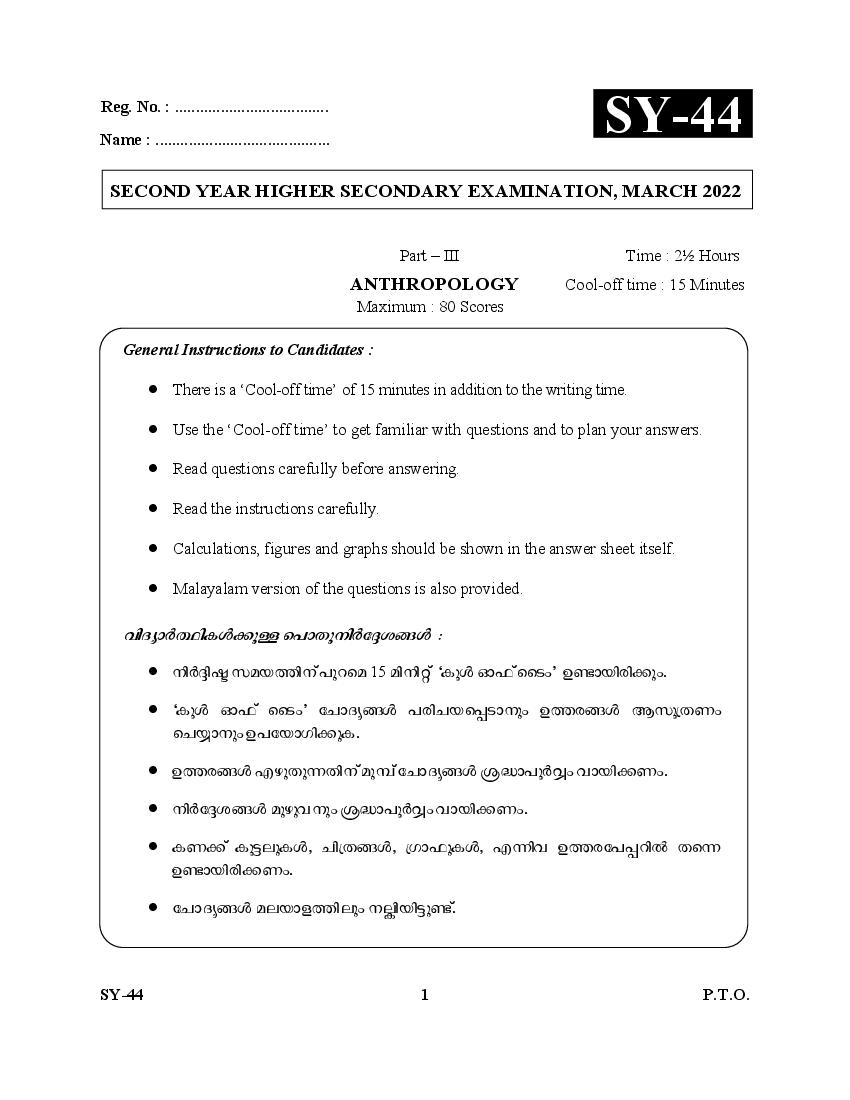
Name : ..........................................
SY-44
SECOND YEAR HIGHER SECONDARY EXAMINATION, MARCH 2022
Part – III Time : 2½ Hours
ANTHROPOLOGY Cool-off time : 15 Minutes
Maximum : 80 Scores
General Instructions to Candidates :
There is a ‘Cool-off time’ of 15 minutes in addition to the writing time.
Use the ‘Cool-off time’ to get familiar with questions and to plan your answers.
Read questions carefully before answering.
Read the instructions carefully.
Calculations, figures and graphs should be shown in the answer sheet itself.
Malayalam version of the questions is also provided.
15 ‘ ’ .
‘ ’
.
.
.
, , ,
.
.
SY-44 1 P.T.O.
Page 2
A. Answer any four questions from 1 to 6. Each carries 1 score. (4 1 = 4)
Select the appropriate answer to the following questions from the bracket given below :
1. Unbiased condition of scientific research is ________.
2. ______ is an example for scientific product.
3. Pan Egyptian school is also known as ______.
4. Behavioural adaptation is also known as ________.
(Theory, American diffusionism, Objectivity, Cultural adaptation, Analysis, British
diffusionism, Subjectivity, Physical adaptation)
5. Name the anthropologist related to the idea ‘E T = C’.
6. ________ is the study of interrelationship between organism and environment.
B. Answer all questions from 7 to 10. Each carries 1 score. (4 1 = 4)
7. Which of the following is not included in negroid race ?
(a) Onge (b) Naga
(c) Jarawa (d) Shompen
8. Write an example for a mongoloid tribe in India.
9. Which of the following approaches was proposed by A.V. Thakkar ?
(a) Social Service approach (b) Religious approach
(c) Political approach (d) Anthropological approach
10. Name the author of the book ‘Philosophy for NEFA’.
SY-44 2
Page 3
A. 1 6 4 .
1 . (4 1 = 4)
:
1. ________.
2. ______.
3. ______ .
4. ________ .
(, , , ,
, , , )
5. ‘ = ’ .
6.
________.
B. 7 10 . 1 . (4 1 = 4)
7. ?
(a) (b)
(c) (d)
8.
.
9. .. ?
(a) (b)
(c) (d)
10. (NEFA) ?
SY-44 3 P.T.O.
Page 4
A. Answer any three questions from 11 to 15. Each carries 2 scores.
(3 2 = 6)
11. Write the difference between questionnaire and schedule.
12. Describe the concept of ‘Actual Social Structure’ proposed by Radcliffe Brown.
13. Briefly describe any two ideas of ‘Unilinear Evolution’.
14. Write any two relationship among ‘Health’, ‘Disease’ and ‘Culture’.
15. Give a brief description on the diagnosis of disease in ethnomedicine.
B. Answer any two questions from 16 to 18. Each carries 2 scores. (2 2 = 4)
16. Describe the Indo Aryan linguistic family with an example.
17. Write the contribution of L.K. Ananthakrishna Iyer in Indian Anthropology.
18. Give a short biographic sketch of A. Aiyappan.
PART – III
A. Answer any three questions from 19 to 23. Each carries 4 scores. (3 4 = 12)
19. Examine any two types of need proposed by B. Malinowski.
20. Explain any four differences between ‘Peasant Society’ and ‘Urban Society’.
21. Give a note on any two concepts proposed by Oscar Lewis.
22. Write the difference between the concepts ‘ethno ecology’ and ‘population ecology’.
23. Describe the four features of Particularly Vulnerable Tribal Groups (PVTG).
B. Answer any one question from 24 to 25. Carries 4 scores. (1 4 = 4)
24. Write a brief description on the following geographical regions of India :
(a) Northern Mountain region
(b) Island region
25. List out any four principles of Tribal Panchasheel proposed by Jawaharlal Nehru.
SY-44 4
Page 5
A. 11 15 3 .
2 . (3 2 = 6)
11. , .
12. ‘ ’
.
13. ‘ ’ ( )
.
14. , , .
15. ()
.
B. 16 18 2 .
2 . (2 2 = 4)
16. - .
17. .. .
18. . .
PART – III
A. 19 23 3 .
4 . (3 4 = 12)
19. . ()
.
20. ( ) ( )
.
21.
.
22. ( )
( ) .
23. (...)
.
B. 24 25 1 .
4 . (1 4 = 4)
24. :
(a)
(b)
25.
.
SY-44 5 P.T.O.
Page 6
A. Answer any three questions from 26 to 29. Each carries 6 scores. (3 6 = 18)
26. Describe any four types of ‘Survey’ List out any two merits of this method.
27. Examine the classification of evolutionism into Unilinear, Universal and Multilinear
evolution by Julian Steward.
28. Explain the difference between universalisation and parochialisation with example.
29. Explain the four approaches of tribal development in India.
B. Answer any two questions from 30 to 32. Each carries 6 scores. (2 6 = 12)
30. Explain the direct and indirect factors affecting fertility.
31. Examine the concept of ‘Migration’. List out its different types and explain the push
and pull factors of migration.
32. List out and explain any four features of tribal life.
PART – V
Answer any two questions from 33 to 35. Each carries 8 scores. (2 8 = 16)
33. Explain the importance of questionnaire in anthropological research. Describe its
different types and explain the characteristics of a good questionnaire.
34. Prepare a chart showing different medical systems and describe the medical pluralism
in India using the following hints :
(Hints : Traditional Medicine, Modern Medicine, Little Traditional Medicine, Great
Traditional Medicine)
35. Explain the features of the following four stages of ecocultural adaptation with
examples of tribal communities practicing it.
(Hints : Hunting and gathering, Pastoralism, Shifting Cultivation, Agriculture)
_____________
SY-44 6
Page 7
A. 26 29 3 .
6 . (3 6 = 18)
26. ‘’ .
.
27. ,
, .
28. ()
()
.
29. .
B. 30 32 2 .
6 . (2 6 = 12)
30. ()
.
31. () .
( )
( ) .
32. .
PART – V
33 35 2 .
8 . (2 8 = 16)
33. .
, .
34.
( )
:
: , , ,
)
35. - ( )
.
( : , ,
( ), )
_____________
SY-44 7 P.T.O.
Page 8
Document Details
| Board / Org | Kerala Board |
| Exam | Class 12 |
| Type | Question Paper |
| Pages | 8 |
| Updated | 22 Jul 2026 |