UGC NET 2021 Question Paper Environmental Sciences
Finished viewing? Save it for later —
Download UGC NET 2021 Question Paper Environmental Sciences (PDF · 52 pages)About UGC NET 2021 Question Paper Environmental Sciences
UGC NET 2021 Question Paper Environmental Sciences is available here for free download. Published by NTA for UGC National Eligibility Test, this question paper can be viewed online or downloaded as a PDF (52 pages). Candidates preparing for UGC National Eligibility Test can use UGC NET 2021 Question Paper Environmental Sciences to understand the exam pattern, the type of questions asked, and the overall difficulty level.
Frequently Asked Questions
How can I download UGC NET 2021 Question Paper Environmental Sciences?
Open this page and click the Download button to save UGC NET 2021 Question Paper Environmental Sciences as a PDF. It is completely free on AglaSem Docs.
Is UGC NET 2021 Question Paper Environmental Sciences free to download?
Yes. UGC NET 2021 Question Paper Environmental Sciences can be viewed online and downloaded as a PDF free of cost on AglaSem Docs.
How many pages does UGC NET 2021 Question Paper Environmental Sciences have?
UGC NET 2021 Question Paper Environmental Sciences contains 52 pages, which you can read online or download together as a single PDF.
Where can I find more UGC National Eligibility Test study material?
You can find more UGC National Eligibility Test question papers, sample papers, syllabus, and answer keys on AglaSem Docs.
UGC NET 2021 Question Paper Environmental Sciences – Text
Read the full text of this question paper below — useful to quickly search, copy and reference the content online without downloading the PDF.
📄 View text version (52 pages)
Page 1
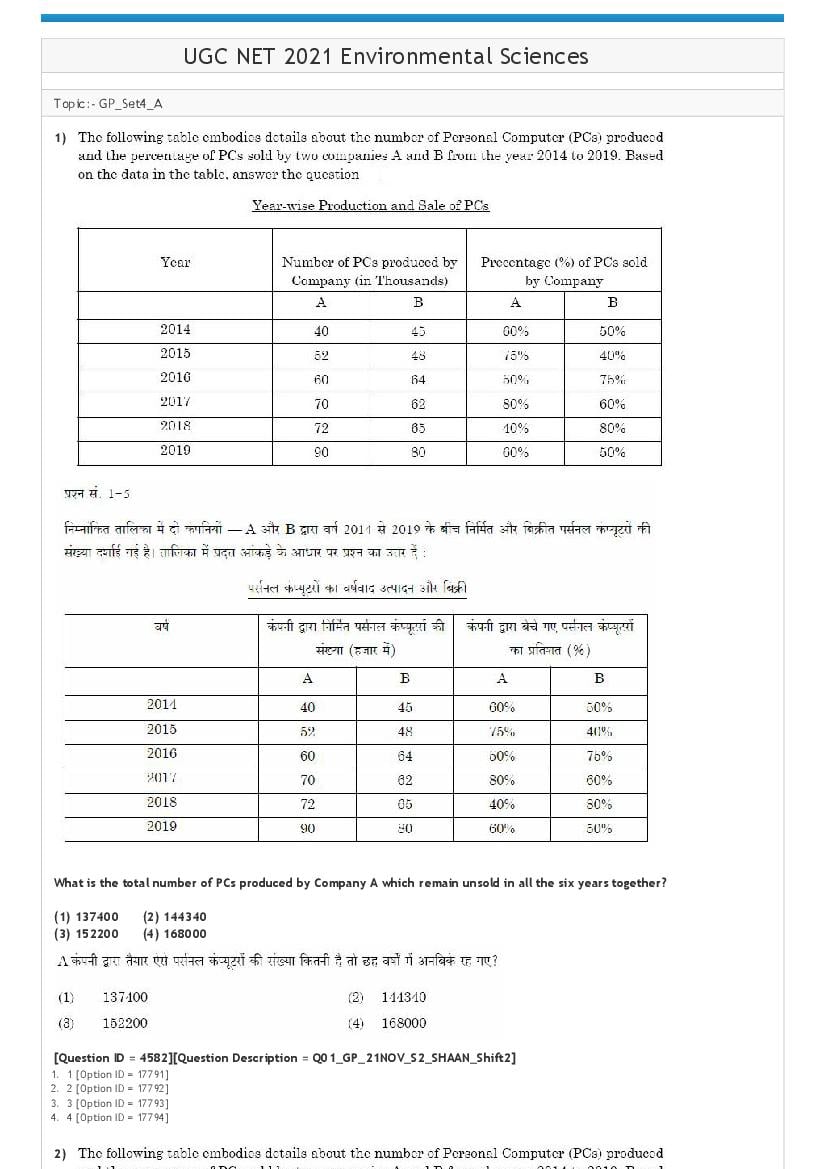
Topic:‐ GP_Set4_A
1)
What is the total number of PCs produced by Company A which remain unsold in all the six years together?
(1) 137400 (2) 144340
(3) 152200 (4) 168000
[Question ID = 4582][Question Description = Q01_GP_21NOV_S2_SHAAN_Shift2]
1. 1 [Option ID = 17791]
2. 2 [Option ID = 17792]
3. 3 [Option ID = 17793]
4. 4 [Option ID = 17794]
2)
Page 2
in the year 2015?
(1) 5 : 2 (2) 4 : 1
(3) 5 : 3 (4) 4 : 3
[Question ID = 4583][Question Description = Q02_GP_21NOV_S2_SHAAN_Shift2]
1. 1 [Option ID = 17795]
2. 2 [Option ID = 17796]
3. 3 [Option ID = 17797]
4. 4 [Option ID = 17798]
3)
Page 3
years together?
(1) 68700 (2) 70500
(3) 72100 (4) 73800
[Question ID = 4584][Question Description = Q03_GP_21NOV_S2_SHAAN_Shift2]
1. 1 [Option ID = 17799]
2. 2 [Option ID = 17800]
3. 3 [Option ID = 17801]
4. 4 [Option ID = 17802]
4)
Page 4
2019?
(1) 82.5% (2) 87.5%
(3) 90% (4) 97.5%
[Question ID = 4585][Question Description = Q04_GP_21NOV_S2_SHAAN_Shift2]
1. 1 [Option ID = 17803]
2. 2 [Option ID = 17804]
3. 3 [Option ID = 17805]
4. 4 [Option ID = 17806]
5)
Page 5
in year 2016?
(1) 250%> (2) 200%
(3) 120% (4) 80%
[Question ID = 4586][Question Description = Q05_GP_21NOV_S2_SHAAN_Shift2]
1. 1 [Option ID = 17807]
2. 2 [Option ID = 17808]
3. 3 [Option ID = 17809]
4. 4 [Option ID = 17810]
Topic:‐ GP_Set4_B
1) Which level of teaching is also designated as ‘exploratory understanding’?
(1) Memory level (2) Understanding level
(3) Reflective level (4) Autonomous development level
[Question ID = 4587][Question Description = Q06_GP_21NOV_S2_SHAAN_Shift2]
1. 1 [Option ID = 17811]
2. 2 [Option ID = 17812]
3. 3 [Option ID = 17813]
4. 4 [Option ID = 17814]
2) Identify the characteristics of ‘Field‐independent learner’
(A) Seeks guidance and demonstrations from teacher
(B) Focuses on details of curriculum materials
(C) Likes to compete
(D) Relates concepts to personal experience
(E) Can organize imformation by himself or herself
Choose the correct answer from the options given below :
(1) (A), (B) and (C) only (2) (A), (C) and (D) only
(3) (B), (C) and (E) only (4) (C), (D) and (E) only
Page 6
1. 1 [Option ID = 17815]
2. 2 [Option ID = 17816]
3. 3 [Option ID = 17817]
4. 4 [Option ID = 17818]
3) Match List I with List II
List I List II
(Teaching Method) (Examples)
(A) Monologic teaching method (I) Cybernetics and computer‐aided instruction
(B) Dialogic teaching method (II) Case studies and tutorials
(C) Action based teaching method (III) Team teaching and demonstration
(D) Self study based teaching method (IV) Simulation and role playing
Choose the correct answer from the options given below :
(1) (A)‐(II), (B)‐(III), (C)‐(I), (D)‐(IV) (2) (A)‐(III), (B)‐(II), (C)‐(IV), (D)‐(I)
(3) (A)‐(I), (B)‐(IV), (C)‐(II), (D)‐(III) (4) (A)‐(IV), (B)‐(I), (C)‐(III), (D)‐(II)
[Question ID = 4589][Question Description = Q08_GP_21NOV_S2_SHAAN_Shift2]
1. 1 [Option ID = 17819]
2. 2 [Option ID = 17820]
3. 3 [Option ID = 17821]
4. 4 [Option ID = 17822]
4) Given below are two statements :
Statement I : Engagement in the learning process refers to the amount of time students devote to learning in the classroom.
Statement II : Formative assessment is formal whereas summative assessment is informal.
In the light of the above statements, Choose the correct answer from the options given below :
Page 7
(3) Statement I is true but Statement II is false. (4) Statement I is false but Statement II is true.
[Question ID = 4590][Question Description = Q09_GP_21NOV_S2_SHAAN_Shift2]
1. 1 [Option ID = 17823]
2. 2 [Option ID = 17824]
3. 3 [Option ID = 17825]
4. 4 [Option ID = 17826]
5) Given below are two statements : One is labelled as Assertion A and the other is labelled as Reason R.
Assertion (A) : Teaching support system as provided by ICT based gadgets is intended to optimise learning and interest in
learning material.
Reasons (R) : Any meaningful support in teaching has to be instrumental in augmenting learning conditions and outcomes.
In the light of the above statements, Choose the most appropriate answer from the options given below :
(1) Both (A) and (R) are correct and (R) is the correct explanation of (A). (2) Both (A) and (R) are correct but (R) is NOT
the correct explanation of (A).
(3) (A) is correct but (R) is not correct. (4) (A) is not correct but (R) is correct.
[Question ID = 4591][Question Description = Q10_GP_21NOV_S2_SHAAN_Shift2]
1. 1 [Option ID = 17827]
2. 2 [Option ID = 17828]
3. 3 [Option ID = 17829]
4. 4 [Option ID = 17830]
6) Data of research take the forms of words or pictures with the researcher as the key instrument in which of the following
studies?
(1) Participant observation based Studies (2) Ex Post Facto Studies
(3) Experimental Studies (4) Descriptive survey Studies
Page 8
1. 1 [Option ID = 17831]
2. 2 [Option ID = 17832]
3. 3 [Option ID = 17833]
4. 4 [Option ID = 17834]
7) Identify the characteristic features of ‘Hypothetico‐deductive research’ paradigm :
(A) Researcher is detached from the study to avoid bias
(B) Researcher becomes immersed in the research situation present or past
(C) The researcher seeks to establish relationships and explains causes of changes in measured social facts
(D) Actual settings are the direct source of data
(E) An attempt is made to set up universal context free generalizations.
Choose the correct answer from the options given below :
(1) (A), (B) and (C) only (2) (B), (C) and (D) only
(3) (A), (C) and (E) only (4) (C), (D) and (E) only
[Question ID = 4593][Question Description = Q12_GP_21NOV_S2_SHAAN_Shift2]
1. 1 [Option ID = 17835]
2. 2 [Option ID = 17836]
3. 3 [Option ID = 17837]
4. 4 [Option ID = 17838]
8) Match List I with List II
List I List II
Research Types Goal of Research
(A) Fundamental Research (I) Appraising impact of interventions
(B) Applied Research (II) Amelioration of a given situation
(C) Action of Research (III) Exploring applicability of already established principles
(D) Evaluative Research (IV) Advancing the corpus of knowledge in a field
Choose the correct answer from the options given below :
(1) (A)‐(I), (B)‐(II), (C)‐(III), (D)‐(IV) (2) (A)‐(IV), (B)‐(III), (C)‐(II), (D)‐(I)
(3) (A)‐(III), (B)‐(IV), (C)‐(I), (D)‐(II) (4) (A)‐(II), (B)‐(I), (C)‐(IV), (D)‐(III)
Page 9
1. 1 [Option ID = 17839]
2. 2 [Option ID = 17840]
3. 3 [Option ID = 17841]
4. 4 [Option ID = 17842]
9) Given below are two statements :
Statement I : At every step of research genuineness is to be vouched. Hence the issue of research ethics becomes
germane.
Statement II : ICT application in research is supportive and facilitative rather than mandatory and absolute.
In the light of the above statements, Choose the most appropriate answer from the options given below :
(1) Both Statement I and Statement II are correct. (2) Both Statement I and Statement II are incorrect.
(3) Statement I is correct but Statement II is incorrect. (4) Statement I is incorrect but Statement II is correct.
[Question ID = 4595][Question Description = Q14_GP_21NOV_S2_SHAAN_Shift2]
1. 1 [Option ID = 17843]
2. 2 [Option ID = 17844]
3. 3 [Option ID = 17845]
4. 4 [Option ID = 17846]
10) Given below are two statements : One is labelled as Assertion A and the other is labeled as Reason R.
Assertion (A) : Research Hypothesis (H1) cannot be directly verified.
Reasons (R) : Null Hypothesis (H0) is helpful in making a claim by the researcher that his/her findings are not fortuitous or by
chance.
In the light of the above statements, Choose the most appropriate answer from the options given below :
(1) Both (A) and (R) are correct and (R) is the correct explanation of (A). (2) Both (A) and (R) are correct but (R) is NOT
the correct explanation of (A).
(3) (A) is correct but (R) is not correct. (4) (A) is not correct but (R) is correct.
Page 10
1. 1 [Option ID = 17847]
2. 2 [Option ID = 17848]
3. 3 [Option ID = 17849]
4. 4 [Option ID = 17850]
11) Which type of Communication is most difficult in gearing message to an audience?
(1) Interpersonal Communication (2) Mass Communication
(3) Intrapersonal Communication (4) Group Communication
[Question ID = 4597][Question Description = Q16_GP_21NOV_S2_SHAAN_Shift2]
1. 1 [Option ID = 17851]
2. 2 [Option ID = 17852]
3. 3 [Option ID = 17853]
4. 4 [Option ID = 17854]
12) Given below are two statements :
Statement I : Audience noise is potent when the message is controversial.
Statement II : It is impossible for any communication to convert an audience from one viewpoint to another.
In the light of the above statements, Choose the correct answer from the options given below :
(1) Both Statement I and Statement II are true. (2) Both Statement I and Statement II are false.
(3) Statement I is true but Statement II is false. (4) Statement I is false but Statement II is true.
[Question ID = 4598][Question Description = Q17_GP_21NOV_S2_SHAAN_Shift2]
1. 1 [Option ID = 17855]
2. 2 [Option ID = 17856]
3. 3 [Option ID = 17857]
4. 4 [Option ID = 17858]
13) Given below are two statements : One is labelled as Assertion A and the other is labeled as Reason R.
Assertion (A) : Research has shown that the two‐step flow theory is oversimplified for every field of interest.
Reasons (R) : People tend to make great use of the media now in their respective interest.
In the light of the above statements, Choose the most appropriate answer from the options given below :
(1) Both (A) and (R) are correct and (R) is the correct explanation of (A). (2) Both (A) and (R) are correct but (R) is NOT
the correct explanation of (A).
Page 11
[Question ID = 4599][Question Description = Q18_GP_21NOV_S2_SHAAN_Shift2]
1. 1 [Option ID = 17859]
2. 2 [Option ID = 17860]
3. 3 [Option ID = 17861]
4. 4 [Option ID = 17862]
14) Physical barriers to communication are rapidly disappearing, but psychological obstacles remain owing to which of the
following?
(A) By formal language
(B) By visual presentation
(C) By use of technology
(D) By emotional appeal
(E) By cultural attitude
Choose the correct answer from the options given below :
(1) (A), (D) and (E) only (2) (A), (B) and (C) only
(3) (B), (C) and (D) only (4) (C), (D) and (E) only
[Question ID = 4600][Question Description = Q19_GP_21NOV_S2_SHAAN_Shift2]
1. 1 [Option ID = 17863]
2. 2 [Option ID = 17864]
3. 3 [Option ID = 17865]
4. 4 [Option ID = 17866]
15) Match List I with List II.
Page 12
Elements of Communication Characteristic feature
(A) Source (I) Means used to convey the message
(B) Receiver (II) Set of verbal and nonverbal cues from a source
(C) Message (III) A person who interprets the message
(D) Channel (IV) A person or an event which provides verbal/non verbal cues.
Choose the correct answer from the options given below :
[Question ID = 4601][Question Description = Q20_GP_21NOV_S2_SHAAN_Shift2]
1. 1 [Option ID = 17867]
2. 2 [Option ID = 17868]
3. 3 [Option ID = 17869]
4. 4 [Option ID = 17870]
16) If the selling price is doubled, the profit triples. What would be the profit percentage?
(1) 25% (2) 50%
(3) 100% (4) 125%
[Question ID = 4602][Question Description = Q21_GP_21NOV_S2_SHAAN_Shift2]
1. 1 [Option ID = 17871]
2. 2 [Option ID = 17872]
3. 3 [Option ID = 17873]
4. 4 [Option ID = 17874]
17) Mohan buys a second hand television at a cost of Rs. 7,500 and spends Rs. 500 on its repair. Later on he sells it at a
cost of Rs. 9,000. How much profit he gets in this process?
(1) 7.5% (2) 12.5%
(3) 20% (4) 25%
[Question ID = 4603][Question Description = Q22_GP_21NOV_S2_SHAAN_Shift2]
1. 1 [Option ID = 17875]
2. 2 [Option ID = 17876]
3. 3 [Option ID = 17877]
4. 4 [Option ID = 17878]
Page 13
(1) 8% (2) 16%
(3) 20% (4) 25%
[Question ID = 4604][Question Description = Q23_GP_21NOV_S2_SHAAN_Shift2]
1. 1 [Option ID = 17879]
2. 2 [Option ID = 17880]
3. 3 [Option ID = 17881]
4. 4 [Option ID = 17882]
19) The average age of A, B and C is 25 years. If the average age of A and B is 22 and that of B and C is 23. Then what is
the age of B?
(1) 15 years (2) 20 years
(3) 25 years (4) 30 years
[Question ID = 4605][Question Description = Q24_GP_21NOV_S2_SHAAN_Shift2]
1. 1 [Option ID = 17883]
2. 2 [Option ID = 17884]
3. 3 [Option ID = 17885]
4. 4 [Option ID = 17886]
20) In a cricket match, in the first 20 overs run rate was 4.5. What should be the run rate in the remaining 30 overs to
meet a target of 325?
(1) 6.24 (2) 7.83
(3) 5.94 (4) 8.21
[Question ID = 4606][Question Description = Q25_GP_21NOV_S2_SHAAN_Shift2]
1. 1 [Option ID = 17887]
2. 2 [Option ID = 17888]
3. 3 [Option ID = 17889]
4. 4 [Option ID = 17890]
21) Which of the following statements is true regarding two contrary propositions?
(1) They can both be true (2) The truth of one entails the falsity of the other
(3) They cannot both be false (4) The falsity of one entails the truth of the other
[Question ID = 4610][Question Description = Q29_GP_21NOV_S2_SHAAN_Shift2]
1. 1 [Option ID = 17903]
2. 2 [Option ID = 17904]
3. 3 [Option ID = 17905]
4. 4 [Option ID = 17906]
Page 14
Statement I : An informal fallacy is one that may be identified through mere inspection of the form or structure of an
argument.
Statement II : Formal fallacy is one that can be detected only through analysis of the content of the argument.
In the light of the above statements, Choose the most appropriate answer from the options given below :
(1) Both Statement I and Statement II are correct. (2) Both Statement I and Statement II are incorrect.
(3) Statement I is correct but Statement II is incorrect. (4) Statement I is incorrect but Statement II is correct.
[Question ID = 4611][Question Description = Q30_GP_21NOV_S2_SHAAN_Shift2]
1. 1 [Option ID = 17907]
2. 2 [Option ID = 17908]
3. 3 [Option ID = 17909]
4. 4 [Option ID = 17910]
23) Which of the following statements about blogs in network communication is True?
(1) The content of a blog can be edited by anyone. (2) A blog is a synchronous communication system that allows people
to chat in real‐time.
(3) A blog consists of posts in reverse chronological order. (4) A blog is a history of web pages that you have visited,
maintained by an ISP.
[Question ID = 4612][Question Description = Q31_GP_21NOV_S2_SHAAN_Shift2]
1. 1 [Option ID = 17911]
2. 2 [Option ID = 17912]
3. 3 [Option ID = 17913]
4. 4 [Option ID = 17914]
24) Identify the correct order of the following INTEL processors in the increasing order of speed.
(A) 80486
(B) 8085
(C) Dual Core
(D) Pentium‐III
Choose the correct answer from the options given below :
(1) (A), (B), (C), (D) (2) (B), (A), (D), (C)
(3) (A), (B), (D), (C) (4) (A), (C), (D), (B)
Page 15
1. 1 [Option ID = 17915]
2. 2 [Option ID = 17916]
3. 3 [Option ID = 17917]
4. 4 [Option ID = 17918]
25) Given below are two statements :
Statement I : Bus, Ring, Star, and Mesh are types of network protocols.
Statement II : A short‐range radio communication standard that transmits data over short distances upto approximately 30
feet is known as Bluetooth.
In the light of the above statements, Choose the correct answer from the options given below :
(1) Both Statement I and Statement II are true. (2) Both Statement I and Statement II are false.
(3) Statement I is true but Statement II is false. (4) Statement I is false but Statement II is true.
[Question ID = 4614][Question Description = Q33_GP_21NOV_S2_SHAAN_Shift2]
1. 1 [Option ID = 17919]
2. 2 [Option ID = 17920]
3. 3 [Option ID = 17921]
4. 4 [Option ID = 17922]
26) Which of the following group of statements in the context of Information Technology (IT) is correct?
(A) Mouse, Keyboard, and Plotter are all input devices.
(B) Unix, Windows, and Linux are all operating systems.
(C) Register, Cache Memory, and Hard Disk are all memory modules.
(D) Montior, Printer, and Scanner are all output devices.
Choose the correct answer from the options given below :
(1) (A) and (B) only (2) (A) and (D) only
(3) (C) and (D) only (4) (B) and (C) only
Page 16
1. 1 [Option ID = 17923]
2. 2 [Option ID = 17924]
3. 3 [Option ID = 17925]
4. 4 [Option ID = 17926]
27) Match List I with List II
List I List II
(Computer Terms) (Description)
(A) Processor (I) Part that runs executable programs
(B) RAM (II) Part that stores files permanently
(C) Hard Disk (III) Part that stores instructions and data temporarily for use
(D) Compiler (IV) Part that translates source program to executable program
Choose the correct answer from the options given below :
(1) (A)‐(I), (B)‐(III), (C)‐(II), (D)‐(IV) (2) (A)‐(IV), (B)‐(III), (C)‐(II), (D)‐(I)
(3) (A)‐(II), (B)‐(I), (C)‐(III), (D)‐(IV) (4) (A)‐(I), (B)‐(II), (C)‐(IV), (D)‐(III)
[Question ID = 4616][Question Description = Q35_GP_21NOV_S2_SHAAN_Shift2]
1. 1 [Option ID = 17927]
2. 2 [Option ID = 17928]
3. 3 [Option ID = 17929]
4. 4 [Option ID = 17930]
28) A coal fired thermal power plant has an efficiency of 35%. The electricity from the power plant is used entirely for
lighting purposes with average efficiency of 20%. What is the overall efficiency of conversion form coal to lighting?
(1) 15% (2) 55%
(3) 70% (4) 7%
Page 17
1. 1 [Option ID = 17931]
2. 2 [Option ID = 17932]
3. 3 [Option ID = 17933]
4. 4 [Option ID = 17934]
29) As per Sustainable Development Goal 3, one of the targets is to reduce under‐5 mortality per 1000 live births to at
least as low as
(1) 50 (2) 40
(3) 25> (4) 15
[Question ID = 4619][Question Description = Q38_GP_21NOV_S2_SHAAN_Shift2]
1. 1 [Option ID = 17939]
2. 2 [Option ID = 17940]
3. 3 [Option ID = 17941]
4. 4 [Option ID = 17942]
30) In a polluted urban area, which of the following constituents of photochemical smog has the least concentration (parts
per billion by volume)?
(1) CO Carbon monoxide (2) Nitrogen dioxide
(3) Hydrocarbons (without methane) (4) Ozone
[Question ID = 4620][Question Description = Q39_GP_21NOV_S2_SHAAN_Shift2]
1. 1 [Option ID = 17943]
2. 2 [Option ID = 17944]
3. 3 [Option ID = 17945]
4. 4 [Option ID = 17946]
31) For drinking and irrigation purposes, the availability of suitable water out of earth’s total water supplies is about less
than
(1) 1% (2) 5%
(3) 6% (4) 10%
[Question ID = 4621][Question Description = Q40_GP_21NOV_S2_SHAAN_Shift2]
1. 1 [Option ID = 17947]
2. 2 [Option ID = 17948]
3. 3 [Option ID = 17949]
4. 4 [Option ID = 17950]
32) The Indian council of Social Science Research was established for :
(A) strengthening different disciplines
(B) promoting researches in social science
(C) enhancing quality of social science as a discipline
(D) providing a platform for discussion on social scientists’ concerns
(E) supporting seminars and conferences organized by Universities
Page 18
(1) (A) and (C) only (2) (B) and (C) only
(3) (A) and (B) only (4) (B) and (D) only
[Question ID = 4622][Question Description = Q41_GP_21NOV_S2_SHAAN_Shift2]
1. 1 [Option ID = 17951]
2. 2 [Option ID = 17952]
3. 3 [Option ID = 17953]
4. 4 [Option ID = 17954]
33) The first regulatory body in higher education in India was set up under the rubric of :
(1) UGC (2) MCI
(3) BCI (4) AICTE
[Question ID = 4623][Question Description = Q42_GP_21NOV_S2_SHAAN_Shift2]
1. 1 [Option ID = 17955]
2. 2 [Option ID = 17956]
3. 3 [Option ID = 17957]
4. 4 [Option ID = 17958]
34) Who among the following was the Chairman of University Education Commission (1948)?
(1) Dr. D.S. Kothari (2) Maulana Abul Kalam Azad
(3) Dr. Zakir Hussain (4) Dr. S. Radhakrishnan
[Question ID = 4624][Question Description = Q43_GP_21NOV_S2_SHAAN_Shift2]
1. 1 [Option ID = 17959]
2. 2 [Option ID = 17960]
3. 3 [Option ID = 17961]
4. 4 [Option ID = 17962]
35) For maintenance of standards of teaching examination and research and coordination of University Education which of
the following section of UGC act should be referred to?
(1) Section 28 (2) Section 25
(3) Section 15 (4) Section 12
Page 19
1. 1 [Option ID = 17963]
2. 2 [Option ID = 17964]
3. 3 [Option ID = 17965]
4. 4 [Option ID = 17966]
36) The NEP 2020 prioritises the increase in the GER in preschool to secondary level by 100% by the year
(1) 2025 (2) 2030
(3) 2035 (4) 2040
[Question ID = 4626][Question Description = Q45_GP_21NOV_S2_SHAAN_Shift2]
1. 1 [Option ID = 17967]
2. 2 [Option ID = 17968]
3. 3 [Option ID = 17969]
4. 4 [Option ID = 17970]
37)
[Question ID = 4627][Question Description = Q26_GP_21NOV_S2_SHAAN_Shift2]
1. 1 [Option ID = 17971]
2. 2 [Option ID = 17972]
3. 3 [Option ID = 17973]
4. 4 [Option ID = 17974]
38)
[Question ID = 4628][Question Description = Q27_GP_21NOV_S2_SHAAN_Shift2]
1. 1 [Option ID = 17975]
2. 2 [Option ID = 17976]
3. 3 [Option ID = 17977]
4. 4 [Option ID = 17978]
39)
Page 20
1. 1 [Option ID = 17979]
2. 2 [Option ID = 17980]
3. 3 [Option ID = 17981]
4. 4 [Option ID = 17982]
40)
[Question ID = 4630][Question Description = Q37_GP_21NOV_S2_SHAAN_Shift2]
1. 1 [Option ID = 17983]
2. 2 [Option ID = 17984]
3. 3 [Option ID = 17985]
4. 4 [Option ID = 17986]
Topic:‐ GP_Set4_C
1) Read the passage carefully and answer the question that follow:
How much time should you allot for group work? It depends on task complexity, but you must make some more refined
estimates as well. You need to determine the time to devote to group work and time to devote to all groups coming
together to share their contributions. This latter time may be used for group reports, a whole‐class discussion, debriefing to
relate the work experiences of each group to the end product, or some combination of these tasks. Group work can easily
get out of hand in the excitement, controversy, and natural dialogue that can come from passionate discussion. This
possibility requires you to place limits on each stage of the cooperative learning activity, so one stage does not take time
from another and leave the task disjointed and incomplete in your learners’ minds. Most time naturally will be devoted to
the work of individual groups, during which the major portion of the end product will be completed. Individual group work
normally will consume 60% to 80% of the time devoted to the cooperative learning activity. The remaining time must be
divided among individual group presentations and/or whole class discussion and debriefing that places the group work into
the perspective of a single end product. If you plan both group reports and whole class discussion for the same day, be
aware that the discussion probably will get squeezed into a fraction of the time required to make it meaningful. To avoid
this, the group discussion or debriefing for the following class day may be so scheduled so that class members have ample
time to reflect on their group reports and to pull together their own thoughts about the colloborative process, which may or
may not have occured as intended. Providing 15 or 20 minutes at the begining of class the next day is usually enough time
for students to have acquired the proper distance to reflect meaningfully on their experiences of the day before‐and to
learn from them.
What is the main determinant of time allocation in cooperative learning?
(1) Time devoted to group work (2) Time devoted to all groups
(3) Time devoted to presentation of reports (4) Complexity and the number of tasks involved
Page 21
1. 1
[Option ID = 17987]
2. 2
[Option ID = 17988]
3. 3
[Option ID = 17989]
4. 4
[Option ID = 17990]
2) Read the passage carefully and answer the question that follow:
How much time should you allot for group work? It depends on task complexity, but you must make some more refined
estimates as well. You need to determine the time to devote to group work and time to devote to all groups coming
together to share their contributions. This latter time may be used for group reports, a whole‐class discussion, debriefing to
relate the work experiences of each group to the end product, or some combination of these tasks. Group work can easily
get out of hand in the excitement, controversy, and natural dialogue that can come from passionate discussion. This
possibility requires you to place limits on each stage of the cooperative learning activity, so one stage does not take time
from another and leave the task disjointed and incomplete in your learners’ minds. Most time naturally will be devoted to
the work of individual groups, during which the major portion of the end product will be completed. Individual group work
normally will consume 60% to 80% of the time devoted to the cooperative learning activity. The remaining time must be
divided among individual group presentations and/or whole class discussion and debriefing that places the group work into
the perspective of a single end product. If you plan both group reports and whole class discussion for the same day, be
aware that the discussion probably will get squeezed into a fraction of the time required to make it meaningful. To avoid
this, the group discussion or debriefing for the following class day may be so scheduled so that class members have ample
time to reflect on their group reports and to pull together their own thoughts about the colloborative process, which may or
may not have occured as intended. Providing 15 or 20 minutes at the begining of class the next day is usually enough time
for students to have acquired the proper distance to reflect meaningfully on their experiences of the day before‐and to
learn from them.
What can disrupt group work?
(1) Difficulty of task (2) A whole class discussion
(3) Discussions which involve emotions (4) Arguments on various points
Page 22
1. 1
[Option ID = 17991]
2. 2
[Option ID = 17992]
3. 3
[Option ID = 17993]
4. 4
[Option ID = 17994]
3) Read the passage carefully and answer the question that follow:
How much time should you allot for group work? It depends on task complexity, but you must make some more refined
estimates as well. You need to determine the time to devote to group work and time to devote to all groups coming
together to share their contributions. This latter time may be used for group reports, a whole‐class discussion, debriefing to
relate the work experiences of each group to the end product, or some combination of these tasks. Group work can easily
get out of hand in the excitement, controversy, and natural dialogue that can come from passionate discussion. This
possibility requires you to place limits on each stage of the cooperative learning activity, so one stage does not take time
from another and leave the task disjointed and incomplete in your learners’ minds. Most time naturally will be devoted to
the work of individual groups, during which the major portion of the end product will be completed. Individual group work
normally will consume 60% to 80% of the time devoted to the cooperative learning activity. The remaining time must be
divided among individual group presentations and/or whole class discussion and debriefing that places the group work into
the perspective of a single end product. If you plan both group reports and whole class discussion for the same day, be
aware that the discussion probably will get squeezed into a fraction of the time required to make it meaningful. To avoid
this, the group discussion or debriefing for the following class day may be so scheduled so that class members have ample
time to reflect on their group reports and to pull together their own thoughts about the colloborative process, which may or
may not have occured as intended. Providing 15 or 20 minutes at the begining of class the next day is usually enough time
for students to have acquired the proper distance to reflect meaningfully on their experiences of the day before‐and to
learn from them.
A major chunk of time in cooperative learning is devoted to which of the following?
(1) Individual group presentation (2) Whole class discussion
(3) Individual group work (4) Debriefing
Page 23
1. 1
[Option ID = 17995]
2. 2
[Option ID = 17996]
3. 3
[Option ID = 17997]
4. 4
[Option ID = 17998]
4) Read the passage carefully and answer the question that follow:
How much time should you allot for group work? It depends on task complexity, but you must make some more refined
estimates as well. You need to determine the time to devote to group work and time to devote to all groups coming
together to share their contributions. This latter time may be used for group reports, a whole‐class discussion, debriefing to
relate the work experiences of each group to the end product, or some combination of these tasks. Group work can easily
get out of hand in the excitement, controversy, and natural dialogue that can come from passionate discussion. This
possibility requires you to place limits on each stage of the cooperative learning activity, so one stage does not take time
from another and leave the task disjointed and incomplete in your learners’ minds. Most time naturally will be devoted to
the work of individual groups, during which the major portion of the end product will be completed. Individual group work
normally will consume 60% to 80% of the time devoted to the cooperative learning activity. The remaining time must be
divided among individual group presentations and/or whole class discussion and debriefing that places the group work into
the perspective of a single end product. If you plan both group reports and whole class discussion for the same day, be
aware that the discussion probably will get squeezed into a fraction of the time required to make it meaningful. To avoid
this, the group discussion or debriefing for the following class day may be so scheduled so that class members have ample
time to reflect on their group reports and to pull together their own thoughts about the colloborative process, which may or
may not have occured as intended. Providing 15 or 20 minutes at the begining of class the next day is usually enough time
for students to have acquired the proper distance to reflect meaningfully on their experiences of the day before‐and to
learn from them.
The members of cooperative learning team should be given enough time to
(1) reflect (2) discuss
(3) ask questions (4) present new ideas
Page 24
1. 1
[Option ID = 17999]
2. 2
[Option ID = 18000]
3. 3
[Option ID = 18001]
4. 4
[Option ID = 18002]
5) Read the passage carefully and answer the question that follow:
How much time should you allot for group work? It depends on task complexity, but you must make some more refined
estimates as well. You need to determine the time to devote to group work and time to devote to all groups coming
together to share their contributions. This latter time may be used for group reports, a whole‐class discussion, debriefing to
relate the work experiences of each group to the end product, or some combination of these tasks. Group work can easily
get out of hand in the excitement, controversy, and natural dialogue that can come from passionate discussion. This
possibility requires you to place limits on each stage of the cooperative learning activity, so one stage does not take time
from another and leave the task disjointed and incomplete in your learners’ minds. Most time naturally will be devoted to
the work of individual groups, during which the major portion of the end product will be completed. Individual group work
normally will consume 60% to 80% of the time devoted to the cooperative learning activity. The remaining time must be
divided among individual group presentations and/or whole class discussion and debriefing that places the group work into
the perspective of a single end product. If you plan both group reports and whole class discussion for the same day, be
aware that the discussion probably will get squeezed into a fraction of the time required to make it meaningful. To avoid
this, the group discussion or debriefing for the following class day may be so scheduled so that class members have ample
time to reflect on their group reports and to pull together their own thoughts about the colloborative process, which may or
may not have occured as intended. Providing 15 or 20 minutes at the begining of class the next day is usually enough time
for students to have acquired the proper distance to reflect meaningfully on their experiences of the day before‐and to
learn from them.
The most appropriate caption for the passage will be :
(1) Guidelines for cooperative learning (2) Procedure for cooperative learning
(3) Precaution in the conduct of cooperative learning (4) Limitations of cooperative learning
Page 25
1. 1
[Option ID = 18003]
2. 2
[Option ID = 18004]
3. 3
[Option ID = 18005]
4. 4
[Option ID = 18006]
Topic:‐ 89EVS_A
1) The pioneer community in human evolution is :
(1) Pastoralists (Nomadic) (2) Agrosociety
(3) Hunting and Gathering Society (4) Industrial Society
[Question ID = 4636][Question Description = Q01_EVS_89_SHAAN_21NOV_S1_Shift2]
1. 1
[Option ID = 18007]
2. 2
[Option ID = 18008]
3. 3
[Option ID = 18009]
4. 4
[Option ID = 18010]
2) Name the person, who launched the ‘‘Green Belt Movement’’ in Kenya, and got the Nobel Peace Prize :
(1) Wangari Maathai (2) Gehard Ertl
(3) Koichi Tanaka (4) Ryojii Noyori
[Question ID = 4637][Question Description = Q02_EVS_89_SHAAN_21NOV_S1_Shift2]
1. 1
[Option ID = 18011]
2. 2
[Option ID = 18012]
3. 3
[Option ID = 18013]
4. 4
[Option ID = 18014]
3) Identify the environmental system with lowest entropy
(1) Land in monoculture agriculture sustained by high energy input (2) Soils containing a balanced community of living
organisms
(3) Coal reduced to CO2 (4) Polluted rivers
[Question ID = 4638][Question Description = Q03_EVS_89_SHAAN_21NOV_S1_Shift2]
1. 1
[Option ID = 18015]
2. 2
[Option ID = 18016]
3. 3
[Option ID = 18017]
4. 4
[Option ID = 18018]
Page 26
(1) Elemental mercury in liquid state (2) Monomethyl mercury
(3) Elemental mercury in vapour state (4) Dimethyl mercury
[Question ID = 4639][Question Description = Q04_EVS_89_SHAAN_21NOV_S1_Shift2]
1. 1
[Option ID = 18019]
2. 2
[Option ID = 18020]
3. 3
[Option ID = 18021]
4. 4
[Option ID = 18022]
5) The water is classified as ‘‘aggressive’’ if :
(1) The Ca2+ concentration is much less than CaCO3 saturation (2) The Ca2+ concentration is equal to the CaCO3 saturation
(3) The Ca2+ concentration is more than the CaCO3 saturation (4) The Ca2+ concentration is double of the
CaCO3 saturation
[Question ID = 4640][Question Description = Q05_EVS_89_SHAAN_21NOV_S1_Shift2]
1. 1
[Option ID = 18023]
2. 2
[Option ID = 18024]
3. 3
[Option ID = 18025]
4. 4
[Option ID = 18026]
6) The portion of UV spectrum which readily destroys DNA and causes skin cancer is :
(1) 320 mm to 400 mm (2) 280 mm to 320 mm
(3) 100 mm to 280 mm (4) 400 mm to 700 mm
[Question ID = 4641][Question Description = Q06_EVS_89_SHAAN_21NOV_S1_Shift2]
1. 1 [Option ID = 18027]
2. 2 [Option ID = 18028]
3. 3 [Option ID = 18029]
4. 4 [Option ID = 18030]
7)
[Question ID = 4642][Question Description = Q07_EVS_89_SHAAN_21NOV_S1_Shift2]
1. 1 [Option ID = 18031]
2. 2 [Option ID = 18032]
3. 3 [Option ID = 18033]
4. 4 [Option ID = 18034]
8) A gas fired, combined heat and power plant produces 5000 MWh electricity and heat of 30,000 GJ. If the input energy
required to run the power plant is 60,000 GJ, the efficiency of the plant is :
(1) 35% (2) 40%
(3) 50% (4) 80%
[Question ID = 4643][Question Description = Q08_EVS_89_SHAAN_21NOV_S1_Shift2]
1. 1
[Option ID = 18035]
2. 2
[Option ID = 18036]
Page 27
[Option ID = 18037]
4. 4
[Option ID = 18038]
9) Which of the following compounds has the least Ozone Depleting Potential?
(1) CFC‐11 (2) Halons
(3) HCFCs (4) Methyl Bromide
[Question ID = 4644][Question Description = Q09_EVS_89_SHAAN_21NOV_S1_Shift2]
1. 1 [Option ID = 18039]
2. 2 [Option ID = 18040]
3. 3 [Option ID = 18041]
4. 4 [Option ID = 18042]
10) Which one among the following is not an example of detrital sedimentary rocks?
(1) Sandstone (2) Chalk
(3) Shale (4) Conglomerate
[Question ID = 4645][Question Description = Q10_EVS_89_SHAAN_21NOV_S1_Shift2]
1. 1
[Option ID = 18043]
2. 2
[Option ID = 18044]
3. 3
[Option ID = 18045]
4. 4
[Option ID = 18046]
11) According to the U.S. Department of Agriculture system of classification, the size of silt particles in soil ranges between
:
(1) 0.02 to 0.2 mm (2) 0.05 to 0.5 mm
(3) 0.002 to 0.05 mm (4) 0.0002 to 0.002 mm
[Question ID = 4646][Question Description = Q11_EVS_89_SHAAN_21NOV_S1_Shift2]
1. 1
[Option ID = 18047]
2. 2
[Option ID = 18048]
3. 3
[Option ID = 18049]
4. 4
[Option ID = 18050]
12) Which one among the following has the lowest hydraulic conductivity (m/day)?
(1) Gravel (2) Sandstone
(3) Sand (4) Clay
[Question ID = 4647][Question Description = Q12_EVS_89_SHAAN_21NOV_S1_Shift2]
1. 1
[Option ID = 18051]
2. 2
[Option ID = 18052]
3. 3
[Option ID = 18053]
4. 4
[Option ID = 18054]
13)
Page 28
1. 1 [Option ID = 18055]
2. 2 [Option ID = 18056]
3. 3 [Option ID = 18057]
4. 4 [Option ID = 18058]
14)
[Question ID = 4649][Question Description = Q14_EVS_89_SHAAN_21NOV_S1_Shift2]
1. 1 [Option ID = 18059]
2. 2 [Option ID = 18060]
3. 3 [Option ID = 18061]
4. 4 [Option ID = 18062]
15) The minimum time needed for the formation of one inch of the top soil is :
(1) Less than 10 years (2) 10‐50 years
(3) 100‐400 years (4) 1,000‐2,000 years
[Question ID = 4650][Question Description = Q15_EVS_89_SHAAN_21NOV_S1_Shift2]
1. 1
[Option ID = 18063]
2. 2
[Option ID = 18064]
3. 3
[Option ID = 18065]
4. 4
[Option ID = 18066]
16) Which zone of a pond/lake ecosystem does not receive light?
(1) Littoral (2) Limnetic
(3) Profundal (4) Epilimnion
[Question ID = 4651][Question Description = Q16_EVS_89_SHAAN_21NOV_S1_Shift2]
1. 1
[Option ID = 18067]
2. 2
[Option ID = 18068]
3. 3
[Option ID = 18069]
4. 4
[Option ID = 18070]
17) ‘‘Slash and burn’’ is a term that is usually associated with the practice of :
(1) Illicit felling and encroachment (2) Grazing and lopping
(3) Incineration of waste (4) Shifting cultivation
[Question ID = 4652][Question Description = Q17_EVS_89_SHAAN_21NOV_S1_Shift2]
1. 1 [Option ID = 18071]
2. 2 [Option ID = 18072]
3. 3 [Option ID = 18073]
4. 4 [Option ID = 18074]
18) A species that has profound effect on the ecological processes of an ecosystem and whose removal or loss would result
in disturbing the community structure is known as :
(1) Dominant species (2) Keystone species
(3) Indicator species (4) Flagship species
[Question ID = 4653][Question Description = Q18_EVS_89_SHAAN_21NOV_S1_Shift2]
1. 1 [Option ID = 18075]
2. 2 [Option ID = 18076]
3. 3 [Option ID = 18077]
Page 29
19) The flagship species of Kedarnath Wildlife sanctuary is :
(1) Elephant (2) Musk Deer
(3) Tiger (4) Wild Boar
[Question ID = 4654][Question Description = Q19_EVS_89_SHAAN_21NOV_S1_Shift2]
1. 1
[Option ID = 18079]
2. 2
[Option ID = 18080]
3. 3
[Option ID = 18081]
4. 4
[Option ID = 18082]
20) The maximum permissible limit of BOD (mg/l) in the treated waste water that can be discharged into garden for
watering is :
(1) 20 (2) 30
(3) 40 (4) 10
[Question ID = 4655][Question Description = Q20_EVS_89_SHAAN_21NOV_S1_Shift2]
1. 1 [Option ID = 18083]
2. 2 [Option ID = 18084]
3. 3 [Option ID = 18085]
4. 4 [Option ID = 18086]
21) What is the concentration of H+ in a solution of 0.1 N NaOH at 250 C?
(1) 1013 M (2) 10–13 M
(3) 10–14 M (4) 1014 M
[Question ID = 4656][Question Description = Q21_EVS_89_SHAAN_21NOV_S1_Shift2]
1. 1
[Option ID = 18087]
2. 2
[Option ID = 18088]
3. 3
[Option ID = 18089]
4. 4
[Option ID = 18090]
22) Which method is used to separate proteins on the basis of their sizes?
(1) Ion exchange chromatography (2) Thin layer chromatography
(3) Adsorption chromatography (4) Gel filtration chromatography
[Question ID = 4657][Question Description = Q22_EVS_89_SHAAN_21NOV_S1_Shift2]
1. 1 [Option ID = 18091]
2. 2 [Option ID = 18092]
3. 3 [Option ID = 18093]
4. 4 [Option ID = 18094]
23) Which of the following is not a molecular method for identification of microbial population form soil or water?
(1) MPN (2) rRNA sequencing
(3) RT–PCR (4) PCR
[Question ID = 4658][Question Description = Q23_EVS_89_SHAAN_21NOV_S1_Shift2]
1. 1
[Option ID = 18095]
2. 2
[Option ID = 18096]
3. 3
[Option ID = 18097]
4. 4
[Option ID = 18098]
Page 30
(1) 6.80C/Km (2) 200C/Km
0
(3) 25 C/Km (4) 37.40C/Km
[Question ID = 4659][Question Description = Q24_EVS_89_SHAAN_21NOV_S1_Shift2]
1. 1 [Option ID = 18099]
2. 2 [Option ID = 18100]
3. 3 [Option ID = 18101]
4. 4 [Option ID = 18102]
25) For wind power generation, the percentage of maximum extractable power contained in the wind is :
(1) ~45% (2) ~59%
(3) ~62% (4) ~37%
[Question ID = 4660][Question Description = Q25_EVS_89_SHAAN_21NOV_S1_Shift2]
1. 1 [Option ID = 18103]
2. 2 [Option ID = 18104]
3. 3 [Option ID = 18105]
4. 4 [Option ID = 18106]
26) Carbon content in a certain type of coal is 0.81. Assume that the combustion efficiency of coal is ~100%, then how
much CO2 will be produced on combustion of 1 kg of coal?
(1) ~3 kg (2) ~5.4 kg
(3) ~1.8 kg (4) ~4.8 kg
[Question ID = 4661][Question Description = Q26_EVS_89_SHAAN_21NOV_S1_Shift2]
1. 1 [Option ID = 18107]
2. 2 [Option ID = 18108]
3. 3 [Option ID = 18109]
4. 4 [Option ID = 18110]
27)
[Question ID = 4662][Question Description = Q27_EVS_89_SHAAN_21NOV_S1_Shift2]
1. 1 [Option ID = 18111]
2. 2 [Option ID = 18112]
3. 3 [Option ID = 18113]
4. 4 [Option ID = 18114]
28) Which of the following organisms is the most tolerant to sewage pollution?
(1) Scenedesmus (2) Daphnia
(3) Chironomus (4) Chlorella
[Question ID = 4663][Question Description = Q28_EVS_89_SHAAN_21NOV_S1_Shift2]
1. 1 [Option ID = 18115]
2. 2 [Option ID = 18116]
3. 3 [Option ID = 18117]
4. 4 [Option ID = 18118]
29) The process of illuviation in soil indicates :
(1) Removal of particles from the top soil (2) Removal of particles from the C horizon
(3) Percolation of soluble salts into deeper soil layers (4) Accumulation of particles in the B horizon
[Question ID = 4664][Question Description = Q29_EVS_89_SHAAN_21NOV_S1_Shift2]
1. 1
[Option ID = 18119]
2. 2
[Option ID = 18120]
3. 3
[Option ID = 18121]
4. 4
[Option ID = 18122]
30) Carbonmonooxide is harmful to human beings, as it :
Page 31
(3) depletes ozone layer (4) has high affinity with haemoglobin as compared to oxygen
[Question ID = 4665][Question Description = Q30_EVS_89_SHAAN_21NOV_S1_Shift2]
1. 1
[Option ID = 18123]
2. 2
[Option ID = 18124]
3. 3
[Option ID = 18125]
4. 4
[Option ID = 18126]
31) The ash content in coal used in stand‐alone thermal power plants in India should not be more than
(1) 20% (2) 27%
(3) 34% (4) 40%
[Question ID = 4666][Question Description = Q31_EVS_89_SHAAN_21NOV_S1_Shift2]
1. 1 [Option ID = 18127]
2. 2 [Option ID = 18128]
3. 3 [Option ID = 18129]
4. 4 [Option ID = 18130]
32) Pyrolysis of solid wastes refers to :
(1) High temperature burning in presence of excess air (2) High temperature anaerobic distillation
(3) Low temperature combustion in pressure of limited air (4) Ambient anaerobic distillation
[Question ID = 4667][Question Description = Q32_EVS_89_SHAAN_21NOV_S1_Shift2]
1. 1 [Option ID = 18131]
2. 2 [Option ID = 18132]
3. 3 [Option ID = 18133]
4. 4 [Option ID = 18134]
33) Which of the following mixture of gases can be found in biogas?
(1) CO, CH4, NO, H2S, H2O vapor (2) CO2, CH4, NH3, H2S, H2O vapor
(3) CO2, CH4, N2O, NH3, H2O vapor (4) CO2, CH4, NO, NH3
[Question ID = 4668][Question Description = Q33_EVS_89_SHAAN_21NOV_S1_Shift2]
1. 1
[Option ID = 18135]
2. 2
[Option ID = 18136]
3. 3
[Option ID = 18137]
4. 4
[Option ID = 18138]
34) India became a party to CITES in the year :
(1) 1972 (2) 1976
(3) 1974 (4) 1986
[Question ID = 4670][Question Description = Q35_EVS_89_SHAAN_21NOV_S1_Shift2]
1. 1 [Option ID = 18143]
2. 2 [Option ID = 18144]
3. 3 [Option ID = 18145]
4. 4 [Option ID = 18146]
35) Time clocked by an athlete in a 100 m race is an example of which type of variable?
(1) discrete (2) continuous
(3) nominal (4) oridnal
[Question ID = 4671][Question Description = Q36_EVS_89_SHAAN_21NOV_S1_Shift2]
1. 1 [Option ID = 18147]
2. 2 [Option ID = 18148]
3. 3 [Option ID = 18149]
4. 4 [Option ID = 18150]
Page 32
7, 5. The median value of marks of all the 13 students is :
(1) 5 (2) 5.5
(3) 6 (4) 6.5
[Question ID = 4672][Question Description = Q37_EVS_89_SHAAN_21NOV_S1_Shift2]
1. 1
[Option ID = 18151]
2. 2
[Option ID = 18152]
3. 3
[Option ID = 18153]
4. 4
[Option ID = 18154]
37)
[Question ID = 4673][Question Description = Q38_EVS_89_SHAAN_21NOV_S1_Shift2]
1. 1 [Option ID = 18155]
2. 2 [Option ID = 18156]
3. 3 [Option ID = 18157]
4. 4 [Option ID = 18158]
38) Population of a city doubled in a span of 20 years. Assuming exponential growth at a constant rate over the given
period, the growth rate would have been :
(1) ~3.5% (2) ~3.0%
(3) ~2.5% (4) ~2.0%
[Question ID = 4674][Question Description = Q39_EVS_89_SHAAN_21NOV_S1_Shift2]
1. 1 [Option ID = 18159]
2. 2 [Option ID = 18160]
3. 3 [Option ID = 18161]
4. 4 [Option ID = 18162]
39)
[Question ID = 4675][Question Description = Q40_EVS_89_SHAAN_21NOV_S1_Shift2]
1. 1 [Option ID = 18163]
2. 2 [Option ID = 18164]
3. 3 [Option ID = 18165]
4. 4 [Option ID = 18166]
40) For a regression model, the following information is given :
Unexplained sum of squares = 25
Explained sum of squares = 75
The value of coefficient of determination for this model is
(1) 0.33 (2) 3
(3) 0.67 (4) 0.75
[Question ID = 4676][Question Description = Q41_EVS_89_SHAAN_21NOV_S1_Shift2]
1. 1 [Option ID = 18167]
2. 2 [Option ID = 18168]
3. 3 [Option ID = 18169]
4. 4 [Option ID = 18170]
41)
Page 33
1. 1 [Option ID = 18171]
2. 2 [Option ID = 18172]
3. 3 [Option ID = 18173]
4. 4 [Option ID = 18174]
42) The place of origin of the National River Ganga is :
(1) Bhagirath Kharak (2) Chaukhamba Peak
(3) Gomukh (4) Pindari Glacier
[Question ID = 4678][Question Description = Q43_EVS_89_SHAAN_21NOV_S1_Shift2]
1. 1
[Option ID = 18175]
2. 2
[Option ID = 18176]
3. 3
[Option ID = 18177]
4. 4
[Option ID = 18178]
43) Water remains in liquid state over a wide range of temperature because of its :
(A) Specific heat
(B) Heat of vaporisation
(C) Density at 00C
(D) Bipolar nature
Choose the most appropriate answer from the options given below :
(1) (A) and (C) Only (2) (A) and (D) Only
(3) (A) and (B) Only (4) (B) and (D) Only
[Question ID = 4679][Question Description = Q44_EVS_89_SHAAN_21NOV_S1_Shift2]
1. 1
[Option ID = 18179]
2. 2
[Option ID = 18180]
3. 3
[Option ID = 18181]
4. 4
[Option ID = 18182]
44) The difference in values of theoretical oxygen demand and actual oxygen demand is observed because of :
(A) difference in rate of reaeration and deoxygenation
(B) addition of dead cell biomass of bacteria as waste
(C) accumulation of waste in bacterial tissue
(D) formation of humus which resists degradation
Choose the most appropriate answer from the options given below :
(1) (A) and (C) Only (2) (B) and (D) Only
(3) (A) and (D) Only (4) (B) and (C) Only
[Question ID = 4680][Question Description = Q45_EVS_89_SHAAN_21NOV_S1_Shift2]
1. 1 [Option ID = 18183]
2. 2 [Option ID = 18184]
3. 3 [Option ID = 18185]
4. 4 [Option ID = 18186]
45) The crystal structure of a compound/material can be determined using :
(A) Scanning Electron Microscope
(B) X‐Ray Fluorescence
(C) Transmission Electron Microscopy
(D) X‐Ray Diffraction
Page 34
(1) (A) and (D) Only (2) (B) and (C) Only
(3) (A) and (C) Only (4) (C) and (D) Only
[Question ID = 4681][Question Description = Q46_EVS_89_SHAAN_21NOV_S1_Shift2]
1. 1 [Option ID = 18187]
2. 2 [Option ID = 18188]
3. 3 [Option ID = 18189]
4. 4 [Option ID = 18190]
46) Which of the following are living fossils?
(A) Ginkgo biloba
(B) Panthera tigris
(C) Elephas Maximas
(D) Latimavia
Choose the most appropriate answer from the options given below :
(1) (A) and (D) Only (2) (A) and (C) Only
(3) (B) and (C) Only (4) (A) and (B) Only
[Question ID = 4682][Question Description = Q47_EVS_89_SHAAN_21NOV_S1_Shift2]
1. 1 [Option ID = 18191]
2. 2 [Option ID = 18192]
3. 3 [Option ID = 18193]
4. 4 [Option ID = 18194]
47) Consider the following statements :
(A) Earth is farthest from the sun at the time of perehelion
(B) When perehelion occurs, it is winter season in the northern hemisphere
(C) Seasons on earth occur due to inclination in earth’s axis of rotation
Choose the most appropriate answer from the options given below :
(1) (A) and (B) Only (2) (B) and (C) Only
(3) (A) and (C) Only (4) (A), (B) and (C)
[Question ID = 4683][Question Description = Q48_EVS_89_SHAAN_21NOV_S1_Shift2]
1. 1 [Option ID = 18195]
2. 2 [Option ID = 18196]
3. 3 [Option ID = 18197]
4. 4 [Option ID = 18198]
48) Ferromagnesian minerals are :
(A) a group of silicates
(B) black, brown or green colour minerals
(C) a group of bicarbonates
(D) highly resistant to weathering and erosional process
Choose the most appropriate answer from the options given below :
(1) (A), (B) and (D) Only (2) (B), (C) and (D) Only
(3) (A) and (B) Only (4) (C) and (D) Only
[Question ID = 4684][Question Description = Q49_EVS_89_SHAAN_21NOV_S1_Shift2]
1. 1 [Option ID = 18199]
2. 2 [Option ID = 18200]
3. 3 [Option ID = 18201]
4. 4 [Option ID = 18202]
49) Consider the following statements regarding clay minerals in soil :
(A) Some clay particles are technically not colloids yet they have colloid like properties
(B) There are four major types of colloids present in soil
(C) All types of clays are crystalline in nature
(D) Soil humus are not considered as colloids
Choose the most appropriate answer from the options given below :
Choose the most appropriate answer from the options given below :
(1) (A) and (C) Only (2) (B) and (C) Only
(3) (A) and (B) Only (4) (B) and (D) Only
[Question ID = 4685][Question Description = Q50_EVS_89_SHAAN_21NOV_S1_Shift2]
1. 1
[Option ID = 18203]
2. 2
Page 35
3. 3
[Option ID = 18205]
4. 4
[Option ID = 18206]
50) Consider the following statements :
(A) Richter magnitude is based upon the amplitude of the largest seismic wave produced during an earthquake
(B) An earthquake with Richter magnitude 7 producers 10 times larger displacement on the seismogram than does a
magnitude 6
(C) S‐waves travel faster than P waves through solid materials
Choose the most appropriate answer from the options given below :
(1) (A) and (B) Only (2) (B) and (C) Only
(3) (A) and (C) Only (4) (A), (B) and (C)
[Question ID = 4686][Question Description = Q51_EVS_89_SHAAN_21NOV_S1_Shift2]
1. 1
[Option ID = 18207]
2. 2
[Option ID = 18208]
3. 3
[Option ID = 18209]
4. 4
[Option ID = 18210]
51)
[Question ID = 4687][Question Description = Q52_EVS_89_SHAAN_21NOV_S1_Shift2]
1. 1 [Option ID = 18211]
2. 2 [Option ID = 18212]
3. 3 [Option ID = 18213]
4. 4 [Option ID = 18214]
52) Energy crops :
(A) are fast growing plants
(B) can be grown on degraded, waste, saline or water logged lands
(C) can not be used to produce liquid fuels
(D) usually have high calorific values
Choose the most appropriate answer from the options given below :
(1) (A) and (B) Only (2) (B) and (C) Only
(3) (A), (B) and (C) Only (4) (A), (B) and (D) Only
[Question ID = 4688][Question Description = Q53_EVS_89_SHAAN_21NOV_S1_Shift2]
1. 1 [Option ID = 18215]
2. 2 [Option ID = 18216]
3. 3 [Option ID = 18217]
4. 4 [Option ID = 18218]
53) Among the following effects of noise on people, identify the Auditory effects :
(A) Annoyance
(B) Speech interference
(C) Acoustical privacy
(D) Sleep interference
Page 36
Choose the most appropriate answer from the options given below :
(1) (A), (B) (C) and (E) Only (2) (B) and (E) Only
(3) (B), (C) and (E) Only (4) (A), (C), (D) and (E) Only
[Question ID = 4689][Question Description = Q54_EVS_89_SHAAN_21NOV_S1_Shift2]
1. 1 [Option ID = 18219]
2. 2 [Option ID = 18220]
3. 3 [Option ID = 18221]
4. 4 [Option ID = 18222]
54) In Isokinetic air sampling :
(A) the inlet is faced against the prevailing wind
(B) sampling flow rate is chosen so that inlet speed is same as the wind speed
(C) there should be least possibility of distortion of particles sampled
Choose the most appropriate answer from the options given below :
(1) (A), (B) and (C) (2) (B) and (C) Only
(3) (A) and (C) Only (4) (A) and (B) Only
[Question ID = 4690][Question Description = Q55_EVS_89_SHAAN_21NOV_S1_Shift2]
1. 1 [Option ID = 18223]
2. 2 [Option ID = 18224]
3. 3 [Option ID = 18225]
4. 4 [Option ID = 18226]
55) Consider the following statements regarding organic carbon estimation following Walkley and Black method :
(A) Organic carbon estimated by this method excludes most of the less active organic matter
(B) 100% of the total oxidizable organic carbon is oxidized in this method
(C) Soil organic matter percentage can be calculated by multiplying estimated organic carbon percentage by 1.724
(D) K2SO4 and H2SO4 are used as reagents
Choose the most appropriate answer from the options given below :
(1) (B) and (D) Only (2) (A) and (B) Only
(3) (A) and (C) Only (4) (B) and (C) Only
[Question ID = 4691][Question Description = Q56_EVS_89_SHAAN_21NOV_S1_Shift2]
1. 1 [Option ID = 18227]
2. 2 [Option ID = 18228]
3. 3 [Option ID = 18229]
4. 4 [Option ID = 18230]
56)
[Question ID = 4692][Question Description = Q57_EVS_89_SHAAN_21NOV_S1_Shift2]
1. 1
[Option ID = 18231]
2. 2
[Option ID = 18232]
3. 3
[Option ID = 18233]
4. 4
[Option ID = 18234]
57) Consider the following statements regarding the 2012 application of vermicompost :
(A) Vermicompost is an excellent base for the establishment of beneficial microorganisms
(B) Presence of earthworms helps in aerating the soil
(C) Plants respond slowly compared to compost or farm yard manure
Page 37
(E) Earthworm casts do not harbor vesicular arbuscular micorrhizal (VAM) propagules
Choose the most appropriate answer from the options given below :
(1) (A), (B) and (E) Only (2) (A), (D) and (E) Only
(3) (A), (B) and (D) Only (4) (B), (C) and (E) Only
[Question ID = 4693][Question Description = Q58_EVS_89_SHAAN_21NOV_S1_Shift2]
1. 1 [Option ID = 18235]
2. 2 [Option ID = 18236]
3. 3 [Option ID = 18237]
4. 4 [Option ID = 18238]
58) Consider the following statements regarding incineration of urban waste :
(A) Incineration of urban waste is a clean process
(B) Under ideal condition, incineration may reduce the volume of waste by 75–95%
(C) Ash is generated as by‐product of incineration
(D) This process of pollutant abatement is inexpensive
Choose the most appropriate answer from the options given below :
(1) (A) and (B) Only (2) (B) and (C) Only
(3) (B), (C) and (D) Only (4) (A), (B) and (D) Only
[Question ID = 4694][Question Description = Q59_EVS_89_SHAAN_21NOV_S1_Shift2]
1. 1
[Option ID = 18239]
2. 2
[Option ID = 18240]
3. 3
[Option ID = 18241]
4. 4
[Option ID = 18242]
59) Match List I with List II
List I List II
(A) Stenothermal (i) Daphnia
(B) Eurythermal (ii) Heteroneries
(C) Cyclomorphosis (iii) Toads
(D) Circalunar rhythms (iv) Fishes
Choose the correct answer from the options given below :
(1) (A)‐(iv), (B)‐(iii), (C)‐(i), (D)‐(ii) (2) (A)‐(ii), (B)‐(iv), (C)‐(iii), (D)‐(i)
(3) (A)‐(iv), (B)‐(iii), (C)‐(ii), (D)‐(i) (4) (A)‐(iii), (B)‐(ii), (C)‐(i), (D)‐(iv)
[Question ID = 4700][Question Description = Q65_EVS_89_SHAAN_21NOV_S1_Shift2]
1. 1
[Option ID = 18263]
2. 2
[Option ID = 18264]
3. 3
[Option ID = 18265]
4. 4
[Option ID = 18266]
60) Match List I with List II :
List I List II
Mineral type Geometric shape
(A) Helicitic (i) Arranged like a star
(B) Micaceous (ii) Consists of small ellipsoid or spheroids
(C) Oolitic (iii) Consists of thin plate like lamelae
(D) Stellate (iv) Twisted and curved, like coral branching
Page 38
(1) (A)‐(iv), (B)‐(iii), (C)‐(i), (D)‐(ii) (2) (A)‐(iv), (B)‐(iii), (C)‐(ii), (D)‐(i)
(3) (A)‐(i), (B)‐(ii), (C)‐(iii), (D)‐(iv) (4) (A)‐(i), (B)‐(ii), (C)‐(iv), (D)‐(iii)
[Question ID = 4701][Question Description = Q66_EVS_89_SHAAN_21NOV_S1_Shift2]
1. 1
[Option ID = 18267]
2. 2
[Option ID = 18268]
3. 3
[Option ID = 18269]
4. 4
[Option ID = 18270]
61) Match List I with List II :
List I List II
Air Quality Index Categorization
(A) 0 – 50 (i) Poor
(B) 51 – 100 (ii) Severe
(C) 201 – 300 (iii) Good
(D) 401 – 500 (iv) Satisfactory
Choose the correct answer from the options given below :
(1) (A)‐(iii), (B)‐(iv), (C)‐(ii), (D)‐(i) (2) (A)‐(iii), (B)‐(iv), (C)‐(i), (D)‐(ii)
(3) (A)‐(i), (B)‐(ii), (C)‐(iv), (D)‐(iii) (4) (A)‐(i), (B)‐(ii), (C)‐(iii), (D)‐(iv)
[Question ID = 4702][Question Description = Q67_EVS_89_SHAAN_21NOV_S1_Shift2]
1. 1
[Option ID = 18271]
2. 2
[Option ID = 18272]
3. 3
[Option ID = 18273]
4. 4
[Option ID = 18274]
62) Match List I with List II :
List I List II
Water Quality Parameter Chemical/Reagent used in Analysis
(A) Iron (i) Barium Chloride
(B) Dissolved Oxygen (ii) Phenanthroline
(C) Calcium (iii) Murexide
(D) Sulphate (iv) Manganous Sulphate
Choose the correct answer from the options given below :
(1) (A)‐(i), (B)‐(iii), (C)‐(ii), (D)‐(iv) (2) (A)‐(ii), (B)‐(iv), (C)‐(iii), (D)‐(i)
(3) (A)‐(ii), (B)‐(iii), (C)‐(i), (D)‐(iv) (4) (A)‐(iv), (B)‐(ii), (C)‐(iii), (D)‐(i)
[Question ID = 4703][Question Description = Q68_EVS_89_SHAAN_21NOV_S1_Shift2]
1. 1
[Option ID = 18275]
2. 2
[Option ID = 18276]
3. 3
[Option ID = 18277]
4. 4
[Option ID = 18278]
63) Match List I with List II :
Page 39
(A) Animal Anatomical
(i) White
Waste
(B) Waste sharp (ii) Blue
(C) Discarded
(iii) Yellow
catheters
(D) Disposable
(iv) Red
glasswares
Choose the correct answer from the options given below :
(1) (A)‐(ii), (B)‐(iii), (C)‐(iv), (D)‐(i) (2) (A)‐(iii), (B)‐(ii), (C)‐(iv), (D)‐(i)
(3) (A)‐(iv), (B)‐(i), (C)‐(ii), (D)‐(iii) (4) (A)‐(iii), (B)‐(i), (C)‐(iv), (D)‐(ii)
[Question ID = 4704][Question Description = Q69_EVS_89_SHAAN_21NOV_S1_Shift2]
1. 1
[Option ID = 18279]
2. 2
[Option ID = 18280]
3. 3
[Option ID = 18281]
4. 4
[Option ID = 18282]
64) Match List I with List II :
List I List II
(Waste type) (Toxic elements)
(A) Wood
(i) Cadmium
preservatives
(B) Food cans (ii) Mercury
(C) Colored printing
(iii) Arsenic
inks
(D) Fluorescent lamps (iv) Lead
Choose the correct answer from the options given below :
(1) (A)‐(iii), (B)‐(i), (C)‐(ii), (D)‐(iv) (2) (A)‐(iii), (B)‐(iv), (C)‐(i), (D)‐(ii)
(3) (A)‐(iii), (B)‐(ii), (C)‐(iv), (D)‐(i) (4) (A)‐(iv), (B)‐(ii), (C)‐(iii), (D)‐(i)
[Question ID = 4705][Question Description = Q70_EVS_89_SHAAN_21NOV_S1_Shift2]
1. 1
[Option ID = 18283]
2. 2
[Option ID = 18284]
3. 3
[Option ID = 18285]
4. 4
[Option ID = 18286]
65) Match List I with List II :
List I List II
Wild Animal / Plant Schedule of Wildlife Protection Act
(A) Musk Deer (i) III
(B) Himalayan Black
(ii) VI
Bear
(C) Pitcher Plant (iii) I
(D) Bison (Gaur) (iv) II
Choose the correct answer from the options given below :
(1) (A)‐(iii), (B)‐(i), (C)‐(ii), (D)‐(iv) (2) (A)‐(i), (B)‐(ii), (C)‐(iii), (D)‐(iv)
(3) (A)‐(iv), (B)‐(iii), (C)‐(ii), (D)‐(i) (4) (A)‐(ii), (B)‐(iii), (C)‐(iv), (D)‐(i)
Page 40
1. 1
[Option ID = 18287]
2. 2
[Option ID = 18288]
3. 3
[Option ID = 18289]
4. 4
[Option ID = 18290]
66) Match List I with List II :
List I List II
(Pollutant) (Health Effects)
(A) Cadmium (i) Severe skin condition ‘Chloracne’
(B) Dioxin (ii) Cancer
(C) Carbofuran (iii) Weakening of bones
(D) Benzo (a) Pyrene (iv) Impeded neuro‐transmission
Choose the correct answer from the options given below :
(1) (A)‐(iv), (B)‐(iii), (C)‐(i), (D)‐(ii) (2) (A)‐(iv), (B)‐(i), (C)‐(ii), (D)‐(iii)
(3) (A)‐(iii), (B)‐(iv), (C)‐(i), (D)‐(ii) (4) (A)‐(iii), (B)‐(i), (C)‐(iv), (D)‐(ii)
[Question ID = 4707][Question Description = Q72_EVS_89_SHAAN_21NOV_S1_Shift2]
1. 1
[Option ID = 18291]
2. 2
[Option ID = 18292]
3. 3
[Option ID = 18293]
4. 4
[Option ID = 18294]
67) Match List I with List II :
List I List II
Method Estimation of
(A) X‐Ray Fluorescence
(i) Functional groups
meter
(B) Quartz Crystal
(ii) Inorganic compounds
Microbalance
(C) Fourier Transform
Infrared (iii) Multi‐element analysis
Spectrometer
(D) Laser Microprobe Mass
(iv) Particulate matter
Spectrometry
Choose the correct answer from the options given below :
(1) (A)‐(i), (B)‐(iii), (C)‐(iv), (D)‐(ii) (2) (A)‐(iii), (B)‐(iv), (C)‐(ii), (D)‐(i)
(3) (A)‐(iii), (B)‐(iv), (C)‐(i), (D)‐(ii) (4) (A)‐(i), (B)‐(iii), (C)‐(ii), (D)‐(iv)
[Question ID = 4708][Question Description = Q73_EVS_89_SHAAN_21NOV_S1_Shift2]
1. 1
[Option ID = 18295]
2. 2
[Option ID = 18296]
3. 3
[Option ID = 18297]
4. 4
[Option ID = 18298]
Page 41
List I List II
Hydropower projects River
(A) Sardar Sarovar project (i) Bhagirathi River
(B) Tehri Dam project (ii) Narmada River
(C) Pong Dam (iii) Mahanadi River
(D) Hirakund Dam (iv) Beas River
Choose the correct answer from the options given below :
(1) (A)‐(i), (B)‐(ii), (C)‐(iv), (D)‐(iii) (2) (A)‐(iv), (B)‐(iii), (C)‐(ii), (D)‐(i)
(3) (A)‐(iii), (B)‐(iv), (C)‐(i), (D)‐(ii) (4) (A)‐(ii), (B)‐(i), (C)‐(iv), (D)‐(iii)
[Question ID = 4709][Question Description = Q74_EVS_89_SHAAN_21NOV_S1_Shift2]
1. 1
[Option ID = 18299]
2. 2
[Option ID = 18300]
3. 3
[Option ID = 18301]
4. 4
[Option ID = 18302]
69) Identify the correct sequence of the following data products of Indian satellites according to their spatial resolutions :
(A) Cartosat ‐ 2 PAN
(B) Oceansat ‐ 2 OCM
(C) Resourcesat ‐ 2 AWIFS
(D) IRS ‐ ID LISS ‐ 3
Choose the correct answer from the options given below :
(1) C > A > B > D (2) B > D > C > A
(3) C > B > D > A (4) B > C > D > A
[Question ID = 4710][Question Description = Q75_EVS_89_SHAAN_21NOV_S1_Shift2]
1. 1 [Option ID = 18303]
2. 2 [Option ID = 18304]
3. 3 [Option ID = 18305]
4. 4 [Option ID = 18306]
70) Identify the correct sequence of natural surfaces according to their albedo :
(A) Ocean
(B) Fresh snow
(C) Grass
(D) Desert Sand
Choose the correct answer from the options given below :
(1) A < B < C < D (2) C < A < D < B
(3) C < A < B < D (4) A < C < D < B
[Question ID = 4711][Question Description = Q76_EVS_89_SHAAN_21NOV_S1_Shift2]
1. 1
[Option ID = 18307]
2. 2
[Option ID = 18308]
3. 3
[Option ID = 18309]
4. 4
[Option ID = 18310]
71) What is the correct order of abundance of following heavy metals in the earth’s crust?
(A) Fe
(B) Mg
(C) Al
(D) Cu
Choose the correct answer from the options given below :
(1) A > C > B > D (2) A > C > D > B
Page 42
[Question ID = 4712][Question Description = Q77_EVS_89_SHAAN_21NOV_S1_Shift2]
1. 1 [Option ID = 18311]
2. 2 [Option ID = 18312]
3. 3 [Option ID = 18313]
4. 4 [Option ID = 18314]
72) Identify the correct sequence in ascending order of the grade of metamorphism :
(A) Gneiss
(B) Slate
(C) Schist
(D) Shale
Choose the correct answer from the options given below :
(1) (A), (B), (C), (D) (2) (D), (C), (B), (A)
(3) (B), (D), (C), (A) (4) (D), (B), (C), (A)
[Question ID = 4713][Question Description = Q78_EVS_89_SHAAN_21NOV_S1_Shift2]
1. 1 [Option ID = 18315]
2. 2 [Option ID = 18316]
3. 3 [Option ID = 18317]
4. 4 [Option ID = 18318]
73) In the context of urban environment, arrange the following in order of increasing residence time.
(A) Formaldehyde
(B) Carbon‐mono‐oxide
(C) Peroxyacetyl nitrate
(D) Hydroxyl radical
Choose the correct answer from the options given below :
(1) A < D < B < C (2) A < B < D < C
(3) D < A < C < B (4) B < C < A < D
[Question ID = 4714][Question Description = Q79_EVS_89_SHAAN_21NOV_S1_Shift2]
1. 1
[Option ID = 18319]
2. 2
[Option ID = 18320]
3. 3
[Option ID = 18321]
4. 4
[Option ID = 18322]
74) Identify the correct sequence of Life Time (years) of the green house gases in increasing order
: (A) CH4 (Methane)
(B) N2O (Nitrous Oxide)
(C) CFC‐12
(D) O3 (Tropospheric)
Choose the correct answer from the options given below :
(1) A, D, B, C (2) D, A, C, B
(3) B, A, D, C (4) B, D, A, C
[Question ID = 4715][Question Description = Q80_EVS_89_SHAAN_21NOV_S1_Shift2]
1. 1
[Option ID = 18323]
2. 2
[Option ID = 18324]
3. 3
[Option ID = 18325]
4. 4
[Option ID = 18326]
75) Identify the correct sequence of Net Heating Value (MJ/Kg) in increasing order for the following fuels.
(A) Charcoal
Page 43
(C) Regular gasoline
(D) Natural gas
(E) Oak wood
Choose the correct answer from the options given below :
(1) A, E, B, C, D (2) E, B, A, C, D
(3) B, A, E, D, C (4) E, A, B, C, D
[Question ID = 4716][Question Description = Q81_EVS_89_SHAAN_21NOV_S1_Shift2]
1. 1
[Option ID = 18327]
2. 2
[Option ID = 18328]
3. 3
[Option ID = 18329]
4. 4
[Option ID = 18330]
76)
[Question ID = 4717][Question Description = Q82_EVS_89_SHAAN_21NOV_S1_Shift2]
1. 1 [Option ID = 18331]
2. 2 [Option ID = 18332]
3. 3 [Option ID = 18333]
4. 4 [Option ID = 18334]
77) Identify the correct sequence of moisture content (%) in ascending order in the following categories of wastes :
(A) Animal solids and organic waste
(B) Trash
(C) Rubbish
(D) Garbage
(E) Refuse
Choose the correct answer from the options given below :
(1) E, D, B, C, A (2) C, B, D, E, A
(3) A, B, C, E, D (4) B, C, E, D, A
[Question ID = 4719][Question Description = Q84_EVS_89_SHAAN_21NOV_S1_Shift2]
1. 1 [Option ID = 18339]
2. 2 [Option ID = 18340]
3. 3 [Option ID = 18341]
4. 4 [Option ID = 18342]
78) According to the Solid Waste Management Rules 2016, arrange the following metals in decreasing order of their
permissible concentration (mg/kg) in the prepared compost :
(A) Chromium
(B) Lead
(C) Cadmium
(D) Copper
Choose the correct answer from the options given below :
(1) A, B, C, D (2) B, D, A, C
(3) D, B, A, C (4) D, A, B, C
[Question ID = 4720][Question Description = Q85_EVS_89_SHAAN_21NOV_S1_Shift2]
1. 1 [Option ID = 18343]
Page 44
3. 3 [Option ID = 18345]
4. 4 [Option ID = 18346]
79) Given below are two statements :
Statement I : Mean deviation is a better measure of dispersion than the quartile deviation.
Statement II : Mean deviation is obtained by dividing the algebraic sum of deviations about mean by total number of
observations.
In the light of the above statements, choose the correct answer from the options given below :
(1) Both Statement I and Statement II are true (2) Both Statement I and Statement II are false
(3) Statement I is true but Statement II is false (4) Statement I is false but Statement II is true
[Question ID = 4721][Question Description = Q86_EVS_89_SHAAN_21NOV_S1_Shift2]
1. 1 [Option ID = 18347]
2. 2 [Option ID = 18348]
3. 3 [Option ID = 18349]
4. 4 [Option ID = 18350]
80) Given below are two statements :
Statement I : The log‐normal distribution is positively skewed.
Statement II : A negatively skewed distribution has its long tail to the left
. In the light of the above statements, choose the correct answer from the options given below :
(1) Both Statement I and Statement II are true (2) Both Statement I and Statement II are false
(3) Statement I is true but Statement II is false (4) Statement I is false but Statement II is true
[Question ID = 4722][Question Description = Q87_EVS_89_SHAAN_21NOV_S1_Shift2]
1. 1 [Option ID = 18351]
2. 2 [Option ID = 18352]
3. 3 [Option ID = 18353]
4. 4 [Option ID = 18354]
81) Given below are two statements : One is labelled as Assertion A and the other is labelled as Reason R.
Assertion A : In the hybrid car technology, cars run on both petrol and battery based electrical engines.
Reason R : Battery of the hybrid car is externally charged.
In the light of the above statements, choose the correct answer from the options given below :
(1) Both A and R are true and R is the correct explanation of A (2) Both A and R are true but R is NOT the correct
explanation of A
(3) A is true but R is false (4) A is false but R is true
[Question ID = 4724][Question Description = Q89_EVS_89_SHAAN_21NOV_S1_Shift2]
1. 1
[Option ID = 18359]
2. 2
[Option ID = 18360]
3. 3
[Option ID = 18361]
4. 4
[Option ID = 18362]
82) Given below are two statements :
Statement I : Gasoline mixed with biofuels (ethanol) has generally more energy content than pure gasoline.
Statement II : Energy content per unit volume of ethanol is more than that of gasoline.
In the light of the above statements, choose the correct answer from the options given below :
(1) Both Statement I and Statement II are true (2) Both Statement I and Statement II are false
(3) Statement I is true but Statement II is false (4) Statement I is false but Statement II is true
[Question ID = 4725][Question Description = Q90_EVS_89_SHAAN_21NOV_S1_Shift2]
1. 1 [Option ID = 18363]
2. 2 [Option ID = 18364]
3. 3 [Option ID = 18365]
4. 4 [Option ID = 18366]
83)
Page 45
1. 1
[Option ID = 18367]
2. 2
[Option ID = 18368]
3. 3
[Option ID = 18369]
4. 4
[Option ID = 18370]
84)
[Question ID = 4727][Question Description = Q60_EVS_89_SHAAN_21NOV_S1_Shift2]
1. 1
[Option ID = 18371]
2. 2
[Option ID = 18372]
3. 3
[Option ID = 18373]
4. 4
[Option ID = 18374]
85)
[Question ID = 4728][Question Description = Q61_EVS_89_SHAAN_21NOV_S1_Shift2]
1. 1
[Option ID = 18375]
2. 2
[Option ID = 18376]
3. 3
[Option ID = 18377]
4. 4
[Option ID = 18378]
86)
Page 46
1. 1
[Option ID = 18379]
2. 2
[Option ID = 18380]
3. 3
[Option ID = 18381]
4. 4
[Option ID = 18382]
87)
[Question ID = 4730][Question Description = Q63_EVS_89_SHAAN_21NOV_S1_Shift2]
1. 1
[Option ID = 18383]
2. 2
[Option ID = 18384]
3. 3
[Option ID = 18385]
4. 4
[Option ID = 18386]
88)
Page 47
1. 1
[Option ID = 18387]
2. 2
[Option ID = 18388]
3. 3
[Option ID = 18389]
4. 4
[Option ID = 18390]
89)
[Question ID = 4732][Question Description = Q83_EVS_89_SHAAN_21NOV_S1_Shift2]
1. 1
[Option ID = 18391]
2. 2
[Option ID = 18392]
3. 3
[Option ID = 18393]
4. 4
[Option ID = 18394]
90)
[Question ID = 4733][Question Description = Q88_EVS_89_SHAAN_21NOV_S1_Shift2]
1. 1
[Option ID = 18395]
2. 2
[Option ID = 18396]
3. 3
[Option ID = 18397]
4. 4
Page 48
Topic:‐ 89EVS_B
1) Read the passage given below. Based on it answer the question.
According to a study published recently in the journal Nature Climate Change, while black carbon has a large effect on snow
darkening and resultant melting of snow, dust particles transported from as far as Saudi Arabia that get deposited in the
Western Himalayan Region (WHR) have a large role to play in melting of snow, particularly at higher elevations. Dust
transported as elevated, aerosol layers get deposited at 1 – 5 km elevations, black carbon emission is mostly a surface
phenomenon and influences melting of snow from surface to about 3 km elevation.
Based on remote sensing data of spatial distribution of dust aerosol concentration over the Indian subcontinent and dust‐
induced snow albedo reduction over Himalayas during the period 2011‐2016 and simulations, it has been inferred that the
relative impacts of dust and black carbon vary with surface elevation of snow pack. This is in addition to snow‐melt caused
by warming due to climate change. Earlier studies have shown that the magnitude of snow mass decrease is about 1mm per
year at 1 km elevation, about 5 mm per year at 4.5 km elevation and about 3 mm per year at 6 km elevation.
Though black carbon has a larger snow albedo darkening effect than dust due to a larger mass absorption efficiency, the
study found that radiative effects of dust deposited on snow are comparable to black carbon in the WHR at higher
elevations. This is mainly because the deposition of the dust by mass is 100‐1000 times more than black carbon.
As the elevation increases, the influence of dust comes greater than black carbon and this coincides with maximum
intensity of snow melt reduction seen at 3‐5 km elevation. Between these two black carbon mainly contributes to snow melt
at lower elevation while dust is the major contributor for snow melt at higher elevation.
Westerlies transport dust particles as elevated aerosol layers at maximum intensities mostly during the pre‐monsoon period
and this gets deposited at higher elevations in the WHR.
Due to global warming, snow cover at lower elevations in the Himalayas will occur less frequently or totally disappear
compared with snow cover at higher elevations. The annual contribution of dust to snow melt will therefore likely increase
in future as the black carbon effect at lower elevation weakness with dwindling snow pack.
Snow melt in Himalayas is on account of :
(A) Dust deposition
(B) Black carbon deposition
(C) Increase in albedo
(D) Climate change
(1) (A) and (B) only (2) (A), (B), (C) and (D)
(3) (A), (B) and (C) only (4) (A), (B) and (D) only
[Question ID = 4734][Question Description = Q91_EVS_89_SHAAN_21NOV_S1_Shift2]
1. 1 [Option ID = 18399]
2. 2 [Option ID = 18400]
3. 3 [Option ID = 18401]
4. 4 [Option ID = 18402]
2) Read the passage given below. Based on it answer the question.
According to a study published recently in the journal Nature Climate Change, while black carbon has a large effect on snow
darkening and resultant melting of snow, dust particles transported from as far as Saudi Arabia that get deposited in the
Western Himalayan Region (WHR) have a large role to play in melting of snow, particularly at higher elevations. Dust
transported as elevated, aerosol layers get deposited at 1 – 5 km elevations, black carbon emission is mostly a surface
phenomenon and influences melting of snow from surface to about 3 km elevation.
Based on remote sensing data of spatial distribution of dust aerosol concentration over the Indian subcontinent and dust‐
induced snow albedo reduction over Himalayas during the period 2011‐2016 and simulations, it has been inferred that the
relative impacts of dust and black carbon vary with surface elevation of snow pack. This is in addition to snow‐melt caused
by warming due to climate change. Earlier studies have shown that the magnitude of snow mass decrease is about 1mm per
year at 1 km elevation, about 5 mm per year at 4.5 km elevation and about 3 mm per year at 6 km elevation.
Though black carbon has a larger snow albedo darkening effect than dust due to a larger mass absorption efficiency, the
study found that radiative effects of dust deposited on snow are comparable to black carbon in the WHR at higher
elevations. This is mainly because the deposition of the dust by mass is 100‐1000 times more than black carbon.
As the elevation increases, the influence of dust comes greater than black carbon and this coincides with maximum
intensity of snow melt reduction seen at 3‐5 km elevation. Between these two black carbon mainly contributes to snow melt
at lower elevation while dust is the major contributor for snow melt at higher elevation.
Westerlies transport dust particles as elevated aerosol layers at maximum intensities mostly during the pre‐monsoon period
and this gets deposited at higher elevations in the WHR.
Due to global warming, snow cover at lower elevations in the Himalayas will occur less frequently or totally disappear
compared with snow cover at higher elevations. The annual contribution of dust to snow melt will therefore likely increase
in future as the black carbon effect at lower elevation weakness with dwindling snow pack.
Maximum rate of snow mass reduction per annum is at elevation of :
(1) 1 km (2) 3‐5 km
(3) 6 km (4) 2 km
Page 49
1. 1 [Option ID = 18403]
2. 2 [Option ID = 18404]
3. 3 [Option ID = 18405]
4. 4 [Option ID = 18406]
3) Read the passage given below. Based on it answer the question.
According to a study published recently in the journal Nature Climate Change, while black carbon has a large effect on snow
darkening and resultant melting of snow, dust particles transported from as far as Saudi Arabia that get deposited in the
Western Himalayan Region (WHR) have a large role to play in melting of snow, particularly at higher elevations. Dust
transported as elevated, aerosol layers get deposited at 1 – 5 km elevations, black carbon emission is mostly a surface
phenomenon and influences melting of snow from surface to about 3 km elevation.
Based on remote sensing data of spatial distribution of dust aerosol concentration over the Indian subcontinent and dust‐
induced snow albedo reduction over Himalayas during the period 2011‐2016 and simulations, it has been inferred that the
relative impacts of dust and black carbon vary with surface elevation of snow pack. This is in addition to snow‐melt caused
by warming due to climate change. Earlier studies have shown that the magnitude of snow mass decrease is about 1mm per
year at 1 km elevation, about 5 mm per year at 4.5 km elevation and about 3 mm per year at 6 km elevation.
Though black carbon has a larger snow albedo darkening effect than dust due to a larger mass absorption efficiency, the
study found that radiative effects of dust deposited on snow are comparable to black carbon in the WHR at higher
elevations. This is mainly because the deposition of the dust by mass is 100‐1000 times more than black carbon.
As the elevation increases, the influence of dust comes greater than black carbon and this coincides with maximum
intensity of snow melt reduction seen at 3‐5 km elevation. Between these two black carbon mainly contributes to snow melt
at lower elevation while dust is the major contributor for snow melt at higher elevation.
Westerlies transport dust particles as elevated aerosol layers at maximum intensities mostly during the pre‐monsoon period
and this gets deposited at higher elevations in the WHR.
Due to global warming, snow cover at lower elevations in the Himalayas will occur less frequently or totally disappear
compared with snow cover at higher elevations. The annual contribution of dust to snow melt will therefore likely increase
in future as the black carbon effect at lower elevation weakness with dwindling snow pack.
Given below are two statements : One is labelled as Assertion A and the other is labelled as Reason R :
Assertion A : Reduction in snow albedo is more in case of black carbon than dust
Reason R : Black carbon has higher mass absorption efficiency compared to dust.
In the light of the above statements, choose the correct answer from the options given below :
(1) Both A and R are true and R is the correct explanation of A (2) Both A and R are true but R is NOT the correct
explanation of A
(3) A is true but R is false (4) A is false but R is true
[Question ID = 4736][Question Description = Q93_EVS_89_SHAAN_21NOV_S1_Shift2]
1. 1 [Option ID = 18407]
2. 2 [Option ID = 18408]
3. 3 [Option ID = 18409]
4. 4 [Option ID = 18410]
4) Read the passage given below. Based on it answer the question.
According to a study published recently in the journal Nature Climate Change, while black carbon has a large effect on snow
darkening and resultant melting of snow, dust particles transported from as far as Saudi Arabia that get deposited in the
Western Himalayan Region (WHR) have a large role to play in melting of snow, particularly at higher elevations. Dust
transported as elevated, aerosol layers get deposited at 1 – 5 km elevations, black carbon emission is mostly a surface
phenomenon and influences melting of snow from surface to about 3 km elevation.
Based on remote sensing data of spatial distribution of dust aerosol concentration over the Indian subcontinent and dust‐
induced snow albedo reduction over Himalayas during the period 2011‐2016 and simulations, it has been inferred that the
relative impacts of dust and black carbon vary with surface elevation of snow pack. This is in addition to snow‐melt caused
by warming due to climate change. Earlier studies have shown that the magnitude of snow mass decrease is about 1mm per
year at 1 km elevation, about 5 mm per year at 4.5 km elevation and about 3 mm per year at 6 km elevation.
Though black carbon has a larger snow albedo darkening effect than dust due to a larger mass absorption efficiency, the
study found that radiative effects of dust deposited on snow are comparable to black carbon in the WHR at higher
elevations. This is mainly because the deposition of the dust by mass is 100‐1000 times more than black carbon.
As the elevation increases, the influence of dust comes greater than black carbon and this coincides with maximum
intensity of snow melt reduction seen at 3‐5 km elevation. Between these two black carbon mainly contributes to snow melt
at lower elevation while dust is the major contributor for snow melt at higher elevation.
Westerlies transport dust particles as elevated aerosol layers at maximum intensities mostly during the pre‐monsoon period
and this gets deposited at higher elevations in the WHR.
Due to global warming, snow cover at lower elevations in the Himalayas will occur less frequently or totally disappear
compared with snow cover at higher elevations. The annual contribution of dust to snow melt will therefore likely increase
in future as the black carbon effect at lower elevation weakness with dwindling snow pack.
Given below are two statements : one is labelled as Assertion A and the other is labelled as Reason R :
Assertion A : Radiative effects of dust deposited on snow are comparable to black carbon in the WHR at higher elevations.
Page 50
In the light of the above statements, choose the correct answer from the options given below :
(1) Both A and R are true and R is the correct explanation of A (2) Both A and R are true but R is NOT the correct
explanation of A
(3) A is true but R is false (4) A is false but R is true
[Question ID = 4737][Question Description = Q94_EVS_89_SHAAN_21NOV_S1_Shift2]
1. 1 [Option ID = 18411]
2. 2 [Option ID = 18412]
3. 3 [Option ID = 18413]
4. 4 [Option ID = 18414]
5) Read the passage given below. Based on it answer the question.
According to a study published recently in the journal Nature Climate Change, while black carbon has a large effect on snow
darkening and resultant melting of snow, dust particles transported from as far as Saudi Arabia that get deposited in the
Western Himalayan Region (WHR) have a large role to play in melting of snow, particularly at higher elevations. Dust
transported as elevated, aerosol layers get deposited at 1 – 5 km elevations, black carbon emission is mostly a surface
phenomenon and influences melting of snow from surface to about 3 km elevation.
Based on remote sensing data of spatial distribution of dust aerosol concentration over the Indian subcontinent and dust‐
induced snow albedo reduction over Himalayas during the period 2011‐2016 and simulations, it has been inferred that the
relative impacts of dust and black carbon vary with surface elevation of snow pack. This is in addition to snow‐melt caused
by warming due to climate change. Earlier studies have shown that the magnitude of snow mass decrease is about 1mm per
year at 1 km elevation, about 5 mm per year at 4.5 km elevation and about 3 mm per year at 6 km elevation.
Though black carbon has a larger snow albedo darkening effect than dust due to a larger mass absorption efficiency, the
study found that radiative effects of dust deposited on snow are comparable to black carbon in the WHR at higher
elevations. This is mainly because the deposition of the dust by mass is 100‐1000 times more than black carbon.
As the elevation increases, the influence of dust comes greater than black carbon and this coincides with maximum
intensity of snow melt reduction seen at 3‐5 km elevation. Between these two black carbon mainly contributes to snow melt
at lower elevation while dust is the major contributor for snow melt at higher elevation.
Westerlies transport dust particles as elevated aerosol layers at maximum intensities mostly during the pre‐monsoon period
and this gets deposited at higher elevations in the WHR.
Due to global warming, snow cover at lower elevations in the Himalayas will occur less frequently or totally disappear
compared with snow cover at higher elevations. The annual contribution of dust to snow melt will therefore likely increase
in future as the black carbon effect at lower elevation weakness with dwindling snow pack.
The passage clearly brings out the finding that :
(1) Black carbon causes global warming (2) Dust causes global warming
(3) Dust modifies the radiative properties of snow cover to the same extent as black carbon (4) Black carbon and dust
are competing agents in melting of snow packs
[Question ID = 4738][Question Description = Q95_EVS_89_SHAAN_21NOV_S1_Shift2]
1. 1 [Option ID = 18415]
2. 2 [Option ID = 18416]
3. 3 [Option ID = 18417]
4. 4 [Option ID = 18418]
Topic:‐ 89EVS_C
1) Read the following passage carefully and answer the question :
Ecologists and Economists have joined forces to estimate the value of the services that the World’s ecosystems provide.
There are many direct goods such as foods and indirect services, such as the assimilation of waste that ecological systems
provide on a renewable basis. Many ecosystems provide more than one service. For example, swamps are important in flood
control, water supply and waste treatment and as habitat. In turn, most services are provided by more than one ecosystem;
for instance, many systems are involved in nutrient cycling. Robert Constanza and his colleagues estimated that the World’s
ecosystems provide atleast US $ 33 trillion worth of services annually. This staggering figure is more than the total gross
national product, which is around US $ 19 trillion per year. The majority of the services are currently outside the market
system and include atmospheric gas regulation, waste treatment and nutrient cycling, which at US $ 17 trillion, was by far
the most expensive services performed, but even if we eliminate this, the total annual value would still be a whopping US $
16 trillion. About 63 percent of the estimated value of natural ecosystems is contributed by marine system; with most of
the value coming from coastal systems (US $ 10.6 trillion per year). About 37 percent of the estimated value cames from
terrestrial systems, mainly forests (US $ 4.7 trillion) and wetlands (US $ 4.9 trillion). If ecosystem services were actually
paid for, the global price system would be very different from what it is today. The price of commodities would skyrocket.
However, because ecosystem services are largely outside the market, they are usually ignored or grossly undervalued.
Ecosystem services which have no market value are :
(A) Providing food
(B) Nutrient cycling
(C) Atmospheric gas regulation
(D) Water supply
Choose the most appropriate answer from the options given below :
Page 51
(3) (A) and (D) only (4) (C) and (D) only
[Question ID = 4739][Question Description = Q96_EVS_89_SHAAN_21NOV_S1_Shift2]
1. 1 [Option ID = 18419]
2. 2 [Option ID = 18420]
3. 3 [Option ID = 18421]
4. 4 [Option ID = 18422]
2) Read the following passage carefully and answer the question :
Ecologists and Economists have joined forces to estimate the value of the services that the World’s ecosystems provide.
There are many direct goods such as foods and indirect services, such as the assimilation of waste that ecological systems
provide on a renewable basis. Many ecosystems provide more than one service. For example, swamps are important in flood
control, water supply and waste treatment and as habitat. In turn, most services are provided by more than one ecosystem;
for instance, many systems are involved in nutrient cycling. Robert Constanza and his colleagues estimated that the World’s
ecosystems provide atleast US $ 33 trillion worth of services annually. This staggering figure is more than the total gross
national product, which is around US $ 19 trillion per year. The majority of the services are currently outside the market
system and include atmospheric gas regulation, waste treatment and nutrient cycling, which at US $ 17 trillion, was by far
the most expensive services performed, but even if we eliminate this, the total annual value would still be a whopping US $
16 trillion. About 63 percent of the estimated value of natural ecosystems is contributed by marine system; with most of
the value coming from coastal systems (US $ 10.6 trillion per year). About 37 percent of the estimated value cames from
terrestrial systems, mainly forests (US $ 4.7 trillion) and wetlands (US $ 4.9 trillion). If ecosystem services were actually
paid for, the global price system would be very different from what it is today. The price of commodities would skyrocket.
However, because ecosystem services are largely outside the market, they are usually ignored or grossly undervalued.
Which one of the following ecosystems provide maximum estimated value of ecosystem services?
(1) Forest ecosystem (2) Coastal ecosystem
(3) Grassland ecosystem (4) Desert ecosystem
[Question ID = 4740][Question Description = Q97_EVS_89_SHAAN_21NOV_S1_Shift2]
1. 1 [Option ID = 18423]
2. 2 [Option ID = 18424]
3. 3 [Option ID = 18425]
4. 4 [Option ID = 18426]
3) Read the following passage carefully and answer the question :
Ecologists and Economists have joined forces to estimate the value of the services that the World’s ecosystems provide.
There are many direct goods such as foods and indirect services, such as the assimilation of waste that ecological systems
provide on a renewable basis. Many ecosystems provide more than one service. For example, swamps are important in flood
control, water supply and waste treatment and as habitat. In turn, most services are provided by more than one ecosystem;
for instance, many systems are involved in nutrient cycling. Robert Constanza and his colleagues estimated that the World’s
ecosystems provide atleast US $ 33 trillion worth of services annually. This staggering figure is more than the total gross
national product, which is around US $ 19 trillion per year. The majority of the services are currently outside the market
system and include atmospheric gas regulation, waste treatment and nutrient cycling, which at US $ 17 trillion, was by far
the most expensive services performed, but even if we eliminate this, the total annual value would still be a whopping US $
16 trillion. About 63 percent of the estimated value of natural ecosystems is contributed by marine system; with most of
the value coming from coastal systems (US $ 10.6 trillion per year). About 37 percent of the estimated value cames from
terrestrial systems, mainly forests (US $ 4.7 trillion) and wetlands (US $ 4.9 trillion). If ecosystem services were actually
paid for, the global price system would be very different from what it is today. The price of commodities would skyrocket.
However, because ecosystem services are largely outside the market, they are usually ignored or grossly undervalued.
Swamp ecosystems provide the following ecosystem services.
(A) Assimilation of waste
(B) Provide habitat for organisms
(C) Terrestrial fruits
(D) Flood control
Choose the most appropriate answer from the options given below :
(1) (A) and (C) only (2) (B), (C) and (D) only
(3) (A), (B) and (D) only (4) (A), (B) and (C) only
[Question ID = 4741][Question Description = Q98_EVS_89_SHAAN_21NOV_S1_Shift2]
1. 1 [Option ID = 18427]
2. 2 [Option ID = 18428]
3. 3 [Option ID = 18429]
4. 4 [Option ID = 18430]
4) Read the following passage carefully and answer the question :
Ecologists and Economists have joined forces to estimate the value of the services that the World’s ecosystems provide.
There are many direct goods such as foods and indirect services, such as the assimilation of waste that ecological systems
provide on a renewable basis. Many ecosystems provide more than one service. For example, swamps are important in flood
control, water supply and waste treatment and as habitat. In turn, most services are provided by more than one ecosystem;
for instance, many systems are involved in nutrient cycling. Robert Constanza and his colleagues estimated that the World’s
ecosystems provide atleast US $ 33 trillion worth of services annually. This staggering figure is more than the total gross
Page 52
system and include atmospheric gas regulation, waste treatment and nutrient cycling, which at US $ 17 trillion, was by far
the most expensive services performed, but even if we eliminate this, the total annual value would still be a whopping US $
16 trillion. About 63 percent of the estimated value of natural ecosystems is contributed by marine system; with most of
the value coming from coastal systems (US $ 10.6 trillion per year). About 37 percent of the estimated value cames from
terrestrial systems, mainly forests (US $ 4.7 trillion) and wetlands (US $ 4.9 trillion). If ecosystem services were actually
paid for, the global price system would be very different from what it is today. The price of commodities would skyrocket.
However, because ecosystem services are largely outside the market, they are usually ignored or grossly undervalued.
[Question ID = 4742][Question Description = Q99_EVS_89_SHAAN_21NOV_S1_Shift2]
1. 1
[Option ID = 18431]
2. 2
[Option ID = 18432]
3. 3
[Option ID = 18433]
4. 4
[Option ID = 18434]
5) Read the following passage carefully and answer the question :
Ecologists and Economists have joined forces to estimate the value of the services that the World’s ecosystems provide.
There are many direct goods such as foods and indirect services, such as the assimilation of waste that ecological systems
provide on a renewable basis. Many ecosystems provide more than one service. For example, swamps are important in flood
control, water supply and waste treatment and as habitat. In turn, most services are provided by more than one ecosystem;
for instance, many systems are involved in nutrient cycling. Robert Constanza and his colleagues estimated that the World’s
ecosystems provide atleast US $ 33 trillion worth of services annually. This staggering figure is more than the total gross
national product, which is around US $ 19 trillion per year. The majority of the services are currently outside the market
system and include atmospheric gas regulation, waste treatment and nutrient cycling, which at US $ 17 trillion, was by far
the most expensive services performed, but even if we eliminate this, the total annual value would still be a whopping US $
16 trillion. About 63 percent of the estimated value of natural ecosystems is contributed by marine system; with most of
the value coming from coastal systems (US $ 10.6 trillion per year). About 37 percent of the estimated value cames from
terrestrial systems, mainly forests (US $ 4.7 trillion) and wetlands (US $ 4.9 trillion). If ecosystem services were actually
paid for, the global price system would be very different from what it is today. The price of commodities would skyrocket.
However, because ecosystem services are largely outside the market, they are usually ignored or grossly undervalued.
What was the estimated value per year for the global ecosystem services outside the market system?
(1) US $ 19 trillion (2) US $ 33 trillion
(3) US $ 16 trillion (4) US $ 17 trillion
[Question ID = 4743][Question Description = Q100_EVS_89_SHAAN_21NOV_S1_Shift2]
1. 1 [Option ID = 18435]
2. 2 [Option ID = 18436]
3. 3 [Option ID = 18437]
4. 4 [Option ID = 18438]
Document Details
| Board / Org | NTA |
| Exam | UGC National Eligibility Test |
| Type | Question Paper |
| Pages | 52 |
| Updated | 22 Jul 2026 |