Kerala Class 9 First Term Question Paper 2025 Physics
Finished viewing? Save it for later —
Download Kerala Class 9 First Term Question Paper 2025 Physics (PDF · 8 pages)About Kerala Class 9 First Term Question Paper 2025 Physics
Kerala Class 9 First Term Question Paper 2025 Physics is available here for free download. Published by Kerala Board for Class 9, this question paper can be viewed online or downloaded as a PDF (8 pages). Candidates preparing for Class 9 can use Kerala Class 9 First Term Question Paper 2025 Physics to understand the exam pattern, the type of questions asked, and the overall difficulty level.
Frequently Asked Questions
How can I download Kerala Class 9 First Term Question Paper 2025 Physics?
Open this page and click the Download button to save Kerala Class 9 First Term Question Paper 2025 Physics as a PDF. It is completely free on AglaSem Docs.
Is Kerala Class 9 First Term Question Paper 2025 Physics free to download?
Yes. Kerala Class 9 First Term Question Paper 2025 Physics can be viewed online and downloaded as a PDF free of cost on AglaSem Docs.
How many pages does Kerala Class 9 First Term Question Paper 2025 Physics have?
Kerala Class 9 First Term Question Paper 2025 Physics contains 8 pages, which you can read online or download together as a single PDF.
Where can I find more Class 9 study material?
You can find more Class 9 question papers, sample papers, syllabus, and answer keys on AglaSem Docs.
Kerala Class 9 First Term Question Paper 2025 Physics – Text
Read the full text of this question paper below — useful to quickly search, copy and reference the content online without downloading the PDF.
📄 View text version (4 pages)
Page 1
SAMAGRA SHIKSHA, KERALA
Summative Assessment —Term 1 2025 —26
PHYSICS
Standard : IX Time : 11/2hour
Total Score : 40
Instructions
The first 15 minutes is cool-off time. This time is meant for reading the questions and planning
your answers.
This question paper includes 18 questions in section A,B,C,D
Questions 10, •11,16, 17 and 18 contain choices.
• Graph paper is included. Use the graph paper given as page 5.
Section - A
W rite down the correct answer for questions 1 to 4. Each question carries 1 score. (4 x 1 = 4)
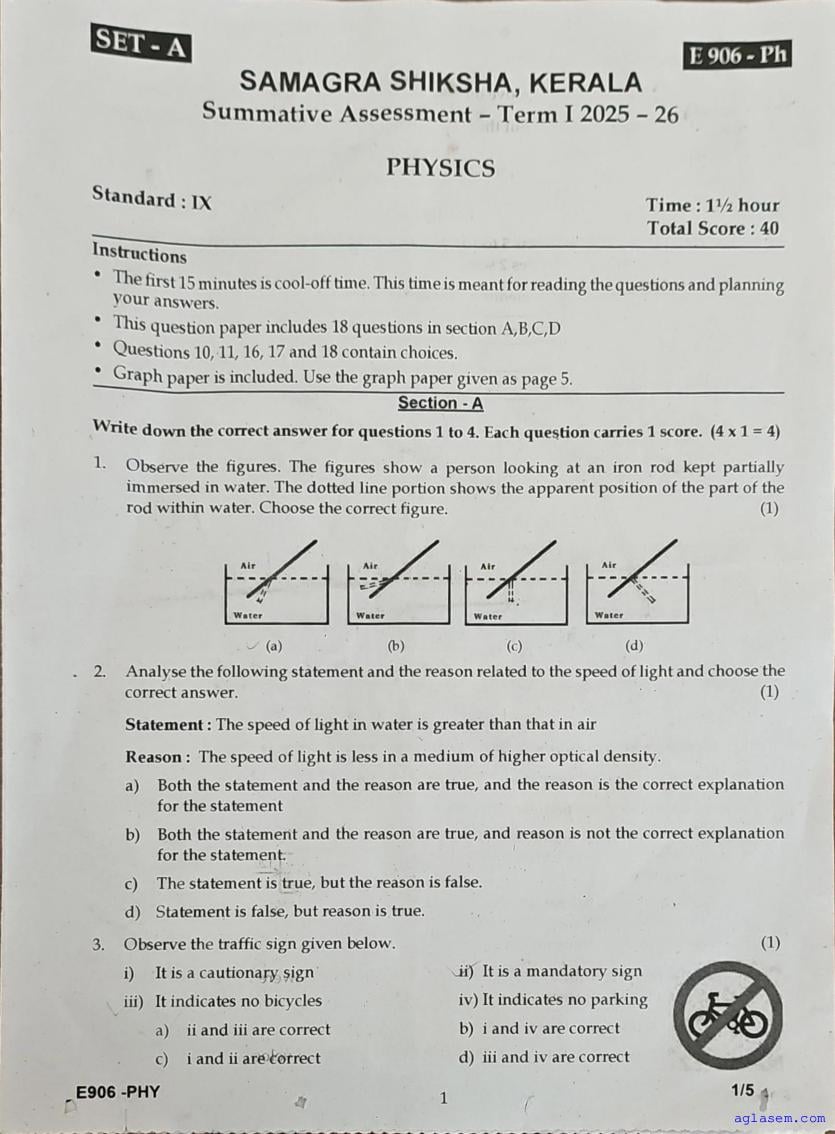
Observe the figures. The figures show a person looking at an iron rod kept partially
immersed in water. The dotted line portion shows the apparent position of the part of the
rod within water. Choose the correct figure. (1)
Air Air Air Air
Water Water Water
(b) (c) (d)
2. Analyse the following statement and the reason related to the speed of light and choose the
correct answer. (1)
Statement : The speed of light in water is greater than that in air
Reason : The speed of light is less in a medium of higher optical density.
a) Both the statement and the reason are true, and the reason is the correct explanation
for the statement
b) Both the statement and the reason are true, and reason is not the correct explanation
for the statement:
c) The statement is true, but the reason is false.
d) Statement is false, but reason is true.
3. Observe the traffic sign given below. (1)
i) It is a cautionary 9ign äij It is a mandatory sign
iii) It indicates no bicycles iv) It indicates no parking
a) ii and iii are correct b) i and iv are correct
c) i and ii d) iii and iv are correct
E906 -PHY 1 115
Page 2
4. Examine the following statement.
Statement: A vehicle will not move on pushing from inside.
write it down.
Based on this statement, find out the correct option from the following and
a) The statement is wrong This is an internal force
c) This is an external force d) Both a and b are correct
Section -
and 11
Write the answers to the questions 5 to 11 in one or more sentences. Questions 10
have choices. Each question carries 2 score. (7 14)
5. The refractive index of some mediums are given below. (2)
Refractive index Medium
1.33 W a ter
Kerosene
Kerosene I Kerosene Kerosene I Kerosene
I Water Water I Water
1Water
(c) (d)
Identify the correct figure and justify your answer.
(9 Observe the.graphsgiven below.
Time Time
(d)
a) Which graph represents the motion of a body coming to rest? (1)
b) Which graph is never possible with respect to motion? (1)
7. Two forces acting on a body are depicted.
a) Write down the magnitude of the
resultant force. In which direction , N 120N w
does it act? (1)
b) To make the forces balanced, S
the force in which direction should
be reduced? By how much?? (1)
8. A body is moving with a uniformvelocity.Though forceswere applied on it, the body
•dn't get any acceleration or retardation.
a) Which type of force is applied? (1)
'b) Which type of force is to be applied to bring a change in velocity. Explain. (1)
E90C -PHY 2 215
a
Page 3
10. (A) Complete the given diagrams. (2)
1
1 o
Air Air 45
Glan Glngg
45 •
(a) (b)
OR
10. (B) Complete the path of light in the figure. (2)
1
Air • Air
1
Glass Glass
(a) (b)
11. (A) Correct the wrong data given in the table, and write them down. (2)
Vector quantity Magnitude alone is
Acceleration
mentioned
Scalar quantity - (Direction is not mentioned \ DiSplacement
OR
11. (B). Write down two important differences between speed and velocity. (2)
Section - C
Write the answers to questions 12 to 17. Questions 16 and 17 have choices. Each question
carries 3 score. (6 3 = 18)
12. A coin kept at the bottom of a vessel appears raised on adding water into the vessel.
a) Which is the phenomenon behind this? Define. (1)
b) Describe how the coin appears r ised. (2)
13, Observe the figure. 45
a) Write down the angle of incidence and 600
angle of refraction from the figure.
b) Write down two situations for angle of
incidence to be equal to the angle of refraction. (2)
14. A ray of light undergoes deviation when it enters obliquely from air to another medium.
The speed of light in air is 3 x 10⁸m/ s and that of the second medium is 2 x 10⁸m/ s.
a) When the ray of light enters obliquely from air to the second medium, it (1)
(deviates towards the normal, does not deviate, deviaeyay from the normal,
undergoes total internal reflection)
b) Calculate the refractive index of the second medium. (2)
E906 -PHY 3 3/5
Page 4
cover the full track
15. The peritneter of track is 400 m. An
100 s, cajculnte time? (2)
50 9? What is the speed in this
a) What is the distance coverd by the athelete in of the
in 100 9? Calculate the velocity
b) What is the displacement of the athelete
in this time.
Represeht them
motion of body along straight line are given.
16 AA) The details of the as well. displacement
graphically in the given graph paper. Find the
12 14 16 18
o 2 4 6 8 10
Time (s)
20 10 0
30 30 30
Velocity (m/s) o 10 20 30
OR
graphically in the given
16 B) The data tvgardinp, the 'notion of a body is given. Represent it (3)
graph paper. Find the distance covered in the 17th second.
16 18 .20 22
Time (s) 0 2 4 6 8 10 12 14
100 120 140 160
Distance (m) o 20 40 60 80 80 80 80
17 A) Write down your comments on the following.
dresses when there is
a) A person walks along the side of road with dark coloured (1)
dim light.
path. (1)
b) A pedestrian walks along the left side of a road, which has no foot
footpath. (1)
c) A pedestrian walks along the right side of a road, without using the
OR
note
17. B) Road signs can be broadly classified into three categories. Write down a short
about them. (3)
Section - p
There is a choice for question 18. Answer any one of the two questions. Each question
carries 4 score.
18. A) A bullet fired from a gun goes ahead with a velocity 80 m/ s and starts penetrating a
tree. It comes to rest on penetrating 8 cm.
a) Find the acceleration of the bullet within the tree. (2)
b) Calculate the time taken for penetration within the tree. (2)
OR
18. B) A stone thrown up from the top of a buil#ihg 50 m went upto ah ight of 30 m and fell
on the ground. If so, what is the
a) distance travelled by the stone?
b) displacement of the stone? p. (1)
c) Calculate the time taken by the body to hil thé grouhd ifrom the maximum height
reached. (a = 10 m/s 2). (2)
E906 -PHY 4
Document Details
| Board / Org | Kerala Board |
| Exam | Class 9 |
| Type | Question Paper |
| Pages | 8 |
| Updated | 29 Aug 2026 |