HBSE Class 12 Philosophy Question Paper 2017
Finished viewing? Save it for later —
Download HBSE Class 12 Philosophy Question Paper 2017 (PDF · 7 pages)About HBSE Class 12 Philosophy Question Paper 2017
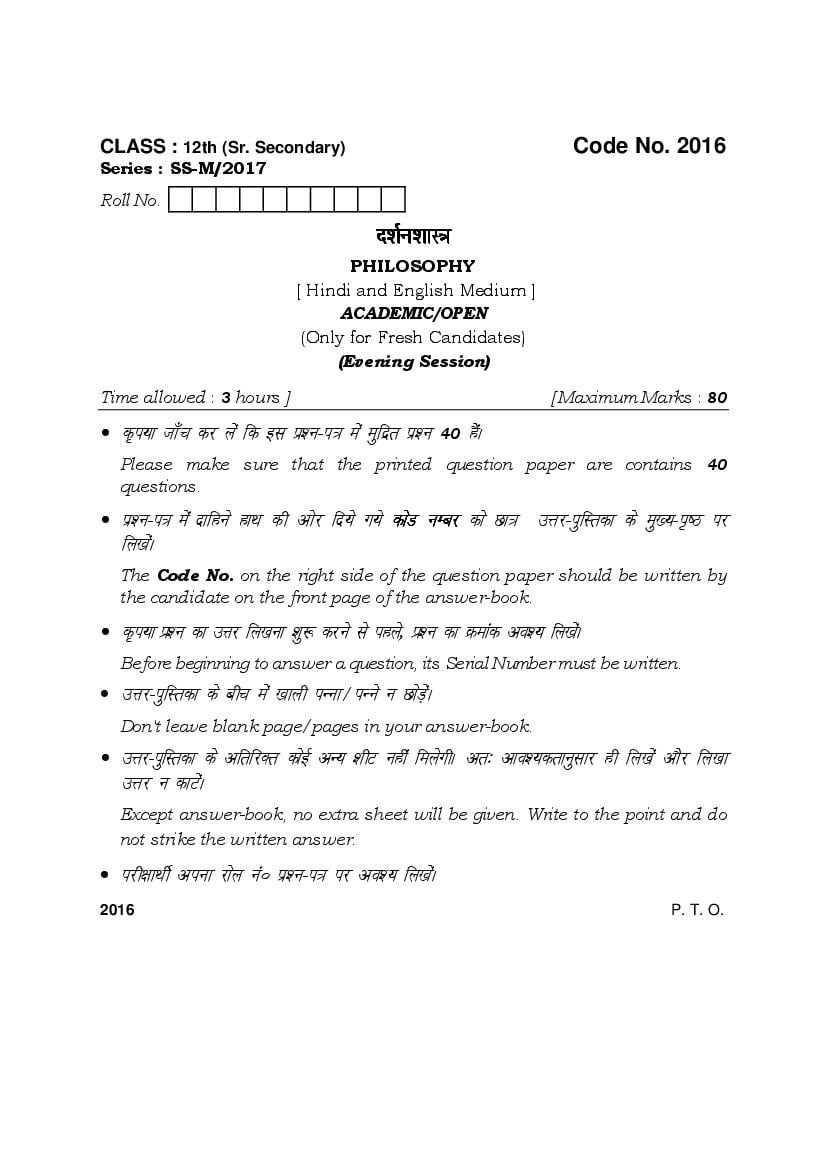
HBSE Class 12 Philosophy Question Paper 2017 is available here for free download. Published by Haryana Board for Class 12, this question paper can be viewed online or downloaded as a PDF (7 pages). Candidates preparing for Class 12 can use HBSE Class 12 Philosophy Question Paper 2017 to understand the exam pattern, the type of questions asked, and the overall difficulty level.
Frequently Asked Questions
How can I download HBSE Class 12 Philosophy Question Paper 2017?
Open this page and click the Download button to save HBSE Class 12 Philosophy Question Paper 2017 as a PDF. It is completely free on AglaSem Docs.
Is HBSE Class 12 Philosophy Question Paper 2017 free to download?
Yes. HBSE Class 12 Philosophy Question Paper 2017 can be viewed online and downloaded as a PDF free of cost on AglaSem Docs.
How many pages does HBSE Class 12 Philosophy Question Paper 2017 have?
HBSE Class 12 Philosophy Question Paper 2017 contains 7 pages, which you can read online or download together as a single PDF.
Where can I find more Class 12 study material?
You can find more Class 12 question papers, sample papers, syllabus, and answer keys on AglaSem Docs.
HBSE Class 12 Philosophy Question Paper 2017 – Text
Read the full text of this question paper below — useful to quickly search, copy and reference the content online without downloading the PDF.
📄 View text version (7 pages)
Page 1
Series : SS-M/2017
Roll No.
n'kZu'kkL=
PHILOSOPHY
[ Hindi and English Medium ]
ACADEMIC/OPEN
(Only for Fresh Candidates)
(Evening Session)
Time allowed : 3 hours ] [ Maximum Marks : 80
• d`i;k tk¡p dj ysa fd bl iz'u-i= esa eqfnzr iz'u 40 gSaA
Please make sure that the printed question paper are contains 40
questions.
• iz'u-i= esa nkfgus gkFk dh vksj fn;s x;s dksM uEcj dks Nk= mÙkj-iqfLrdk ds eq[;-i`"B ij
fy[ksaA
The Code No. on the right side of the question paper should be written by
the candidate on the front page of the answer-book.
• d`i;k iz'u dk mÙkj fy[kuk 'kq: djus ls igys] iz'u dk Øekad vo'; fy[ksAa
Before beginning to answer a question, its Serial Number must be written.
• mÙkj-iqfLrdk ds chp esa [kkyh iUuk / iUus u NksMsa+A
Don't leave blank page/pages in your answer-book.
• mÙkj-iqfLrdk ds vfrfjDr dksbZ vU; 'khV ugha feysxhA vr% vko';drkuqlkj gh fy[ksa vkSj fy[kk
mÙkj u dkVsaA
Except answer-book, no extra sheet will be given. Write to the point and do
not strike the written answer.
• ijh{kkFkhZ viuk jksy ua0 iz'u-i= ij vo'; fy[ksaA
2016 P. T. O.
Page 2
Candidates must write their Roll Number on the question paper.
• d`i;k iz'uksa ds mÙkj nsus lss iwoZ ;g lqfuf'pr dj ysa fd iz'u-i= iw.kZ o lgh gS] ijh{kk ds
mijkUr bl
bl lEcU/k esa dksbZ Hkh nkok Lohdkj ugha fd;k tk;sxkA
Before answering the questions, ensure that you have been supplied the
correct and complete question paper, no claim in this regard, will be
entertained after examination.
lkekU; funsZ'k %
General Instructions :
(i) iz'u-i= ds pkj [k.M gSa % ^v*]
v*] ^c*] ^l* ,oa ^n*A lHkh iz'u vfuok;Z gSaA
There are four Sections in this question paper : 'A', 'B', 'C' and 'D'. All
questions are compulsory.
[k.M – v
SECTION – A
¼fucU/kkRed iz'u½
(Essay Type Questions)
uksV % iz'u la[;k 1 ls 5 rd fucU/kkRed iz'u gSaA izR;sd iz'u 4 vad dk gSA
Question Nos. 1 to 5 are essay type questions. Each question carries 4
marks.
1. tSu ds vusdkUrokn ds fl)kUr dh O;k[;k dhft,A
Explain the Jaina theory of Anekantvada.
2. Hkxon~ xhrk ds deZ;ksx dh ppkZ dhft,A
Discuss the Karma Yoga of Bhagwad Gita.
3. iq#"kkFkZ ds fl)kUr dh O;k[;k dhft,A
Explain the concept of Purusartha.
4. U;k;-n'kZu ds vuqeku izek.k dh O;k[;k dhft,A
2016
Page 3
Explain the Inference Pramana of Nyaya Philosophy.
5. v}Sr osnkUr ds czá ds fl)kUr dh O;k[;k dhft,A
Explain the Advaita Vedanta's concept of Brahma.
vFkok
OR
n.M ds fujks/kkRed fl)kUr dh O;k[;k dhft,A
Explain the Preventive Theory of Punishment.
[k.M – c
SECTION – B
¼y?kwÙkjkRed iz'u½
(Short Answer Type Questions)
uksV % iz'u la[;k 6 ls 12 rd y?kwÙkjkRed iz'u gSaA izR;sd iz'u 3 vad dk gSA
Question Nos. 6 to 12 are short answer type questions. Each question
carries 3 marks.
6. _r ds vFkZ dh O;k[;k dhft,A
Explain the meaning of Rta.
7. ckSn/~ k n'kZu ds izFke vk;Z lR; dh O;k[;k dhft,A
Explain the first noble truth of Buddhist Philosophy.
8. oS'ksf"kd-n'kZu ds nzO; inkFkZ dh O;k[;k dhft,A
Explain the substance category of Vaisesika Philosophy.
9. vuqHkookn D;k gS \
What is Empiricism ?
10. vjLrw ds vuqlkj miknku dkj.k dh O;k[;k dhft,A
Explain the material cause according to Aristotle.
11. bZ'oj ds vfLrRo dks fln~/k djus ds fy, fo'odkj.k ;qfDr dh O;k[;k dhft,A
Explain the cosmological proof for the existence of God.
12. oLrqokn D;k gS \
What is realism ?
2016 P. T. O.
Page 4
[k.M – l
SECTION – C
¼vfr y?kwÙkjh;
Ùkjh; iz'u½
(Very Short Answer Type Questions)
uksV % iz'u la[;k 13 ls 23 rd vfr y?kwÙkjkRed iz'u gSaA izR;sd iz'u 2 vad dk gSA
Question Nos. 13 to 23 are very short answer type questions. Each
question carries 2 marks.
13. D;k Hkkjrh; n'kZu vk/;kfRed gS \
Is Indian Philosophy Spiritualistic ?
14. L;knokn dks ifjHkkf"kr dhft,A
Define Sayadvada ?
15. ;ksx n'kZu esa ^;e* ds fdrus izdkj gS \
How many types of 'Yama' in Yoga Philosophy ?
16. osnkUr n'kZu ds laLFkkid dkSu Fks \
Who was the founder of Vedanta Philosophy ?
17. cqf)okn dk D;k vFkZ gS \
What is the meaning of Rationalism ?
18. dk.V ds leh{kkRed n'kZu dks ifjHkkf"kr dhft,A
Define Kant's Critical Philosophy.
19. dkj.k D;k gS \
What is Cause ?
20. Lo:i dkj.k D;k gS \
What is Formal Cause ?
21. lÙkkewyd izek.k dk D;k vFkZ gS \
What meant by Ontological Proof ?
22. eu-'kjhj ds lEcU/k ds lUnHkZ esa lekukUrjokn ds fl)kUr dh vfr laf{kIr O;k[;k dhft,A
Explain very shortly the doctrine of parallelism in the context of mind-
body relationship.
23. n.M ds fl)kUrksa ds uke fyf[k,A
Write the names of the theories of punishment.
2016
Page 5
[k.M – n
SECTION – D
¼oLrqfu"B iz'u½
(Objective Type Questions)
uksV % iz'u la[;k 24 ls 40 rd oLrqfu"B iz'u gSaA izR;sd iz'u 1 vad dk gSA
Question Nos. 24 to 40 are objective type questions. Each question
carries 1 mark.
24. Hkkjrh; n'kZu deZ fl)kUr esa fo'okl djrs gSaA ¼lR; /vlR; ½
Indian Philosophy believes in the doctrine of Karma.
(True /False )
25. vk;Z lR; la[;k esa ik¡p gSAa ¼lR; /vlR; ½
Noble truths are five in number. (True /False )
26. fuokZ.k dk vFkZ ^thou dk vUr* gSA ¼lR; /vlR; ½
Nirvana meant 'End of life'. (True /False )
27. tSu n'kZu ds 24osa rhFkZadj o/kZeku egkohj FksA ¼lR; /vlR; ½
24th tirthankara of Jaina Philosophy was Vardhaman Mahavir.
(True /False )
28. oS'ksf"kd-n'kZu ds vuqlkj inkFkZ la[;k esa lkr gSaA ¼lR; /vlR; ½
According to Vaisheshika Philosophy categories are seven in number.
(True /False )
29. lk¡[;-n'kZu ds izorZd egf"kZ dfiy FksA ¼lR; /vlR; ½
The founder of Samkhaya-Philosophy was Maharshi Kapil.
(True /False )
30. ;ksx-n'kZu ds izorZd egf"kZ iratfy FksA ¼lR; /vlR; ½
Maharshi Patanjali was the founder of Yoga Philosophy.
(True /False )
31. xhrk yksdlaxzg ds fl)kUr esa fo'okl ugha djrh gSA
2016 P. T. O.
Page 6
¼lR; /vlR; ½
Gita does not believe in the theory of Lokasmgraha.
(True /False )
32. osnkUr ^osnksa dk lkj* gSA ¼lR; /vlR; ½
Vedanta is the 'Essence of Vedas'. (True /False )
33. osn la[;k esa rhu gSaA ¼lR; /vlR; ½
Vedas are three in number. (True /False )
34. dk.V cqf)okn vkSj vuqHkookn dk leUo; djrs gSaA
¼lR; /vlR; ½
Kant reconciles between rationalism and empiricism.
(True /False )
35. dkj.k-dk;Z ds chp dksbZ lEcU/k ugha gSA ¼lR; /vlR; ½
There is no relation between cause-effect.
(True /False )
36. 'kqHk ,d uSfrd lEizR;; ugha gSA ¼lR; /vlR; ½
Good is not an ethical concept. (True /False )
37. uhfr'kkL= ,d vkn'kZewyd foKku gSA ¼lR; /vlR; ½
Ethics is a normative science. (True /False )
38. uhfr'kkL= ds fy, ladYi-LorU=rk t:jh gSA ¼lR; /vlR; ½
Free-will is necessary for ethics. (True /False )
39. n.M ds fl)kUr la[;k esa rhu gSaA ¼lR; /vlR; ½
Theories of punishment are three in number.
2016
Page 7
(True /False )
40. vjLrw Hkkjrh; nk'kZfud FkkA ¼lR; /vlR; ½
Aristotle was an Indian Philosopher. (True /False )
s
2016 P. T. O.
Document Details
| Board / Org | Haryana Board |
| Exam | Class 12 |
| Type | Question Paper |
| Pages | 7 |
| Updated | 22 Jul 2026 |