JNUEE 2021 Question Paper Ph.D Media Studies
Finished viewing? Save it for later —
Download JNUEE 2021 Question Paper Ph.D Media Studies (PDF · 12 pages)About JNUEE 2021 Question Paper Ph.D Media Studies
JNUEE 2021 Question Paper Ph.D Media Studies is available here for free download. Published by NTA for JNUEE, this question paper can be viewed online or downloaded as a PDF (12 pages). Candidates preparing for JNUEE can use JNUEE 2021 Question Paper Ph.D Media Studies to understand the exam pattern, the type of questions asked, and the overall difficulty level.
Frequently Asked Questions
How can I download JNUEE 2021 Question Paper Ph.D Media Studies?
Open this page and click the Download button to save JNUEE 2021 Question Paper Ph.D Media Studies as a PDF. It is completely free on AglaSem Docs.
Is JNUEE 2021 Question Paper Ph.D Media Studies free to download?
Yes. JNUEE 2021 Question Paper Ph.D Media Studies can be viewed online and downloaded as a PDF free of cost on AglaSem Docs.
How many pages does JNUEE 2021 Question Paper Ph.D Media Studies have?
JNUEE 2021 Question Paper Ph.D Media Studies contains 12 pages, which you can read online or download together as a single PDF.
Where can I find more JNUEE study material?
You can find more JNUEE question papers, sample papers, syllabus, and answer keys on AglaSem Docs.
JNUEE 2021 Question Paper Ph.D Media Studies – Text
Read the full text of this question paper below — useful to quickly search, copy and reference the content online without downloading the PDF.
📄 View text version (12 pages)
Page 1
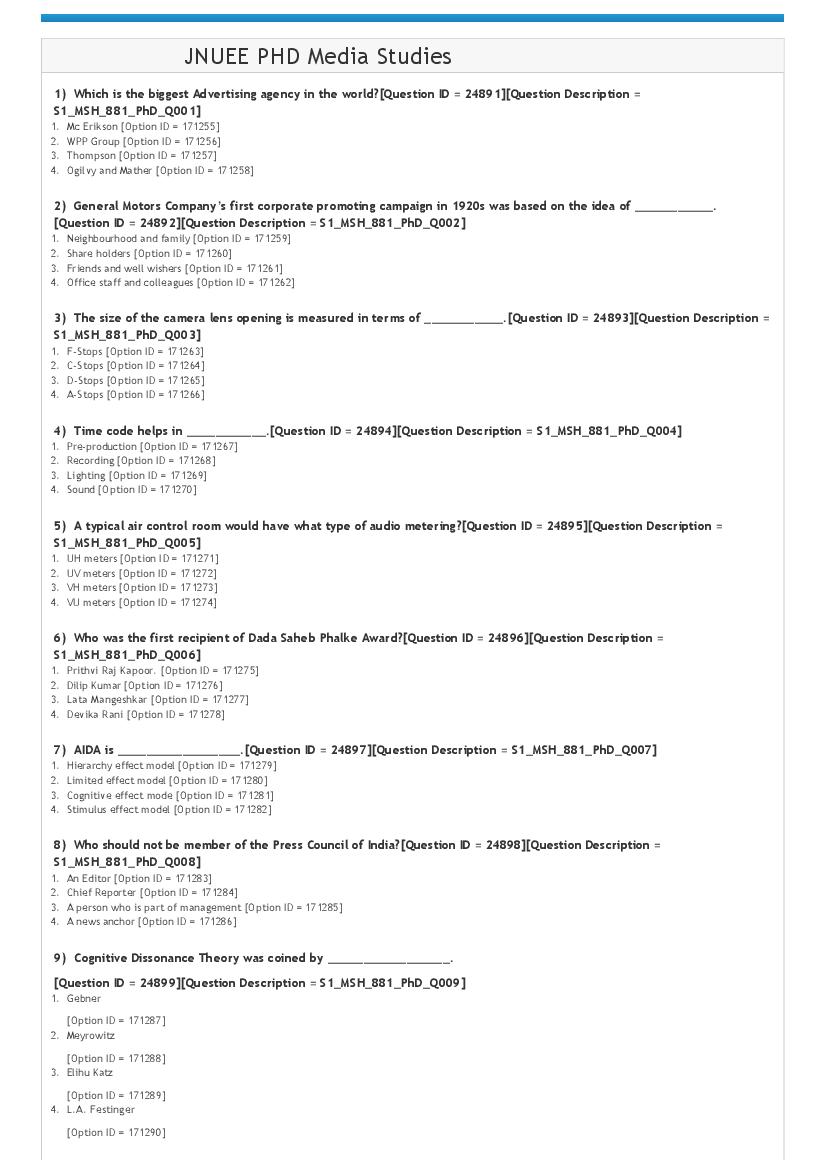
1) Which is the biggest Advertising agency in the world?[Question ID = 24891][Question Description =
S1_MSH_881_PhD_Q001]
1. Mc Erikson [Option ID = 171255]
2. WPP Group [Option ID = 171256]
3. Thompson [Option ID = 171257]
4. Ogilvy and Mather [Option ID = 171258]
2) General Motors Company’s first corporate promoting campaign in 1920s was based on the idea of ___________.
[Question ID = 24892][Question Description = S1_MSH_881_PhD_Q002]
1. Neighbourhood and family [Option ID = 171259]
2. Share holders [Option ID = 171260]
3. Friends and well wishers [Option ID = 171261]
4. Office staff and colleagues [Option ID = 171262]
3) The size of the camera lens opening is measured in terms of ___________.[Question ID = 24893][Question Description =
S1_MSH_881_PhD_Q003]
1. F‐Stops [Option ID = 171263]
2. C‐Stops [Option ID = 171264]
3. D‐Stops [Option ID = 171265]
4. A‐Stops [Option ID = 171266]
4) Time code helps in ___________.[Question ID = 24894][Question Description = S1_MSH_881_PhD_Q004]
1. Pre‐production [Option ID = 171267]
2. Recording [Option ID = 171268]
3. Lighting [Option ID = 171269]
4. Sound [Option ID = 171270]
5) A typical air control room would have what type of audio metering?[Question ID = 24895][Question Description =
S1_MSH_881_PhD_Q005]
1. UH meters [Option ID = 171271]
2. UV meters [Option ID = 171272]
3. VH meters [Option ID = 171273]
4. VU meters [Option ID = 171274]
6) Who was the first recipient of Dada Saheb Phalke Award?[Question ID = 24896][Question Description =
S1_MSH_881_PhD_Q006]
1. Prithvi Raj Kapoor. [Option ID = 171275]
2. Dilip Kumar [Option ID = 171276]
3. Lata Mangeshkar [Option ID = 171277]
4. Devika Rani [Option ID = 171278]
7) AIDA is _________________.[Question ID = 24897][Question Description = S1_MSH_881_PhD_Q007]
1. Hierarchy effect model [Option ID = 171279]
2. Limited effect model [Option ID = 171280]
3. Cognitive effect mode [Option ID = 171281]
4. Stimulus effect model [Option ID = 171282]
8) Who should not be member of the Press Council of India?[Question ID = 24898][Question Description =
S1_MSH_881_PhD_Q008]
1. An Editor [Option ID = 171283]
2. Chief Reporter [Option ID = 171284]
3. A person who is part of management [Option ID = 171285]
4. A news anchor [Option ID = 171286]
9) Cognitive Dissonance Theory was coined by _________________.
[Question ID = 24899][Question Description = S1_MSH_881_PhD_Q009]
1. Gebner
[Option ID = 171287]
2. Meyrowitz
[Option ID = 171288]
3. Elihu Katz
[Option ID = 171289]
4. L.A. Festinger
[Option ID = 171290]
Page 2
1. A.R. Rehman [Option ID = 171291]
2. Amir Khan [Option ID = 171292]
3. Bhanu Athaiya [Option ID = 171293]
4. Sekhar Kapoor [Option ID = 171294]
11) Homi Vyarawalla was associated with ____________.[Question ID = 24901][Question Description =
S1_MSH_881_PhD_Q011]
1. Film Direction [Option ID = 171295]
2. Photo Journalism [Option ID = 171296]
3. Documentary Production [Option ID = 171297]
4. TV Journalism [Option ID = 171298]
12) According to McQuail the _______________ paradigm has a functionalist perspective
[Question ID = 24902][Question Description = S1_MSH_881_PhD_Q012]
1. Scientific
[Option ID = 171299]
2. Dominant
[Option ID = 171300]
3. Functional
[Option ID = 171301]
4. Passive
[Option ID = 171302]
13) Which section of Information Technology Act 2000 was critically reviewed by Supreme Court?[Question ID = 24903]
[Question Description = S1_MSH_881_PhD_Q013]
1. 66C [Option ID = 171303]
2. 76A [Option ID = 171304]
3. 66A [Option ID = 171305]
4. 76B [Option ID = 171306]
14) Reasonable restrictions of Freedom of Speech and expression was given by Supreme Court in which case?[Question ID =
24904][Question Description = S1_MSH_881_PhD_Q014]
1. Maneka Gandhi Vs Union of India [Option ID = 171307]
2. Indian Express VS Union of India [Option ID = 171308]
3. Indira Sahweny Vs State of Rajasthan [Option ID = 171309]
4. Romesh Thapar Vs State of Madras [Option ID = 171310]
15) A cutline under a graphic illustration is popularly known as _______________.[Question ID = 24905][Question
Description = S1_MSH_881_PhD_Q015]
1. Legend [Option ID = 171311]
2. Line cast [Option ID = 171312]
3. Picture line [Option ID = 171313]
4. Back line [Option ID = 171314]
16) Who is the director of ‘India’s Daughter’?[Question ID = 24906][Question Description = S1_MSH_881_PhD_Q016]
1. Ben Kingsley [Option ID = 171315]
2. Leslee Udwin [Option ID = 171316]
3. Anand Patwardhan [Option ID = 171317]
4. Nandita Das [Option ID = 171318]
17) In which of text of Alvin Toffler’s the term ‘telecommunity’ is found?[Question ID = 24907][Question Description =
S1_MSH_881_PhD_Q017]
1. Future Shock [Option ID = 171319]
2. The Third Wave [Option ID = 171320]
3. Digital Revolution [Option ID = 171321]
4. Global Village [Option ID = 171322]
18) Who built the world’s first film production studio?[Question ID = 24908][Question Description =
S1_MSH_881_PhD_Q018]
1. Luminaire Brothers [Option ID = 171323]
2. 20th Century Fox production [Option ID = 171324]
3. Walt Disney [Option ID = 171325]
4. Edison [Option ID = 171326]
19) Who propounded DAGMAR hierarchy model?[Question ID = 24909][Question Description = S1_MSH_881_PhD_Q019]
1. Russell Colley [Option ID = 171327]
2. Maslow [Option ID = 171328]
3. David Ogilvy [Option ID = 171329]
4. Schramm [Option ID = 171330]
Page 3
S1_MSH_881_PhD_Q020]
1. Immanuel Kant [Option ID = 171331]
2. Hagel [Option ID = 171332]
3. Aristotle [Option ID = 171333]
4. Socrates [Option ID = 171334]
21) Cultivation Theory was brought by ______________.[Question ID = 24911][Question Description =
S1_MSH_881_PhD_Q021]
1. Gerbner [Option ID = 171335]
2. Raymond [Option ID = 171336]
3. Greenfield [Option ID = 171337]
4. New Comb [Option ID = 171338]
22) What are the Three point lighting which is a traditional method of illuminating a subject in a scene with light sources
from 3 distinct points?[Question ID = 24912][Question Description = S1_MSH_881_PhD_Q022]
1. Key light, Kicker Light, Backlight [Option ID = 171339]
2. Focus light, Key light, Fill light [Option ID = 171340]
3. Backlight, Key light, Top light. [Option ID = 171341]
4. Key light, Fill light, Back light [Option ID = 171342]
23) ____________ is an accent light that highlights the edges of the subject[Question ID = 24913][Question Description =
S1_MSH_881_PhD_Q023]
1. Kicker Light [Option ID = 171343]
2. Key light [Option ID = 171344]
3. Fill light [Option ID = 171345]
4. Back light [Option ID = 171346]
24) Who was the first Indian to get the prestigious Pulitzer Award?[Question ID = 24914][Question Description =
S1_MSH_881_PhD_Q024]
1. Arundhati Roy [Option ID = 171347]
2. Gobind Bihari Lal [Option ID = 171348]
3. MJ Akbar [Option ID = 171349]
4. RK Laxman [Option ID = 171350]
25) The human perception of sound Intensity is _____________.[Question ID = 24915][Question Description =
S1_MSH_881_PhD_Q025]
1. Loudness [Option ID = 171351]
2. Noise [Option ID = 171352]
3. Frequency [Option ID = 171353]
4. Vibration [Option ID = 171354]
26) Which of these is a folk form of the state of Karnataka? [Question ID = 24916][Question Description =
S1_MSH_881_PhD_Q026]
1. Yakshagana [Option ID = 171355]
2. Bharatanatyam [Option ID = 171356]
3. Kathak [Option ID = 171357]
4. Kuchipudi [Option ID = 171358]
27) Which is the brightest light on the scene?[Question ID = 24917][Question Description = S1_MSH_881_PhD_Q027]
1. Key light [Option ID = 171359]
2. Warm light [Option ID = 171360]
3. Crane light [Option ID = 171361]
4. Trolley light [Option ID = 171362]
28) Who directed the film ‘Birth of a Nation’?
[Question ID = 24918][Question Description = S1_MSH_881_PhD_Q028]
1. Fellini
[Option ID = 171363]
2. Cappolo
[Option ID = 171364]
3. Griffith
[Option ID = 171365]
4. Spilberg
[Option ID = 171366]
29) ________________ is also known as the width to height proportions of TV screen.[Question ID = 24919][Question
Description = S1_MSH_881_PhD_Q029]
1. Pixel Ration [Option ID = 171367]
2. Resolution Ration [Option ID = 171368]
3. Aspect Ratio [Option ID = 171369]
Page 4
30) ____________________ Theory of media effects was given by Joseph Kalpper.[Question ID = 24920][Question
Description = S1_MSH_881_PhD_Q030]
1. Multiple effect [Option ID = 171371]
2. Two Step flow [Option ID = 171372]
3. Cultivation effect [Option ID = 171373]
4. Limited effect [Option ID = 171374]
31) Who is the father of animation?[Question ID = 24921][Question Description = S1_MSH_881_PhD_Q031]
1. Charles Babbage [Option ID = 171375]
2. Winsor McCay [Option ID = 171376]
3. Featherstone [Option ID = 171377]
4. Robert Flattery [Option ID = 171378]
32) The term ‘Crawl’ is associated with _________________.[Question ID = 24922][Question Description =
S1_MSH_881_PhD_Q032]
1. Film Production [Option ID = 171379]
2. Radio Journalism [Option ID = 171380]
3. TV journalism [Option ID = 171381]
4. Print journalism [Option ID = 171382]
33) A digital signature is ________________________.[Question ID = 24923][Question Description =
S1_MSH_881_PhD_Q033]
1. Scanned information. [Option ID = 171383]
2. Non Encrypting information [Option ID = 171384]
3. Encrypting information [Option ID = 171385]
4. Digital information. [Option ID = 171386]
34) What type of microphone is needed in a live musical show for a singer?
[Question ID = 24924][Question Description = S1_MSH_881_PhD_Q034]
1. Hydraulic
[Option ID = 171387]
2. Power
[Option ID = 171388]
3. Dynamic
[Option ID = 171389]
4. Corded Condensor
[Option ID = 171390]
35) In which film Playback singing was started for the first time?
[Question ID = 24925][Question Description = S1_MSH_881_PhD_Q035]
1. Jhanak Jhanak Payal Baje
[Option ID = 171391]
2. Pyaasa
[Option ID = 171392]
3. Alam Ara
[Option ID = 171393]
4. Jawani Ki Hawa
[Option ID = 171394]
36) According to Wilbur Schramm which is a value free asset?[Question ID = 24926][Question Description =
S1_MSH_881_PhD_Q036]
1. Message [Option ID = 171395]
2. Medium [Option ID = 171396]
3. Technology [Option ID = 171397]
4. Noise [Option ID = 171398]
37) _____________ will help how and when the lights will change during a production?
[Question ID = 24927][Question Description = S1_MSH_881_PhD_Q037]
1. Cue sheet
[Option ID = 171399]
2. Continuity Sheet
[Option ID = 171400]
3. Production sheet
[Option ID = 171401]
4. Optic sheet
Page 5
38) Who authored the book ‘Manufacturing Consent: The Political Economy of the Mass Media’?[Question ID = 24928]
[Question Description = S1_MSH_881_PhD_Q038]
1. Noam Chomsky [Option ID = 171403]
2. McCarthy [Option ID = 171404]
3. Paul Newman [Option ID = 171405]
4. Rupert Murdoch [Option ID = 171406]
39) ______________ was a school of Social theory and critical philosophy associated with the Institute of Social Research.
[Question ID = 24929][Question Description = S1_MSH_881_PhD_Q039]
1. Russian School [Option ID = 171407]
2. American School [Option ID = 171408]
3. German School [Option ID = 171409]
4. Frankfurt School [Option ID = 171410]
40) Photographic effects are also called as _____________.[Question ID = 24930][Question Description =
S1_MSH_881_PhD_Q040]
1. Special effects [Option ID = 171411]
2. Graphic effects [Option ID = 171412]
3. Optical effects [Option ID = 171413]
4. Neo lights effects [Option ID = 171414]
41) What is GIF?[Question ID = 24931][Question Description = S1_MSH_881_PhD_Q041]
1. Graphic inter format [Option ID = 171415]
2. Graphic intra format [Option ID = 171416]
3. Graphic intro change format. [Option ID = 171417]
4. Graphics interchange format [Option ID = 171418]
42) Harlow Gale is associated with ____________________.[Question ID = 24932][Question Description =
S1_MSH_881_PhD_Q042]
1. Psychology of Advertising [Option ID = 171419]
2. News Reporting [Option ID = 171420]
3. Propaganda and Public Relations [Option ID = 171421]
4. TV Journalism [Option ID = 171422]
43) Claiming one’s product is the ‘best in the world’ is an example of _____________.[Question ID = 24933][Question
Description = S1_MSH_881_PhD_Q043]
1. Puffery [Option ID = 171423]
2. Propaganda [Option ID = 171424]
3. Push theory [Option ID = 171425]
4. Spin Doctrine [Option ID = 171426]
44) Which is the First Communication satellite in India?[Question ID = 24934][Question Description =
S1_MSH_881_PhD_Q044]
1. Sputnik [Option ID = 171427]
2. Apollo‐1 [Option ID = 171428]
3. APPLE [Option ID = 171429]
4. Tel Star [Option ID = 171430]
45) Posting deliberately obnoxious or proactive messages in online discussion groups is known as __________.[Question ID =
24935][Question Description = S1_MSH_881_PhD_Q045]
1. Stalking [Option ID = 171431]
2. Trolling [Option ID = 171432]
3. Hacking [Option ID = 171433]
4. Spoofing [Option ID = 171434]
46) Which of the following online advertising methods through which advertisers attempt to drive traffic to Internet Sites
are _________.[Question ID = 24936][Question Description = S1_MSH_881_PhD_Q046]
1. SEM [Option ID = 171435]
2. Banner [Option ID = 171436]
3. SEO [Option ID = 171437]
4. CPC [Option ID = 171438]
47) One of the following was associated with Frankfurt School?
[Question ID = 24937][Question Description = S1_MSH_881_PhD_Q047]
1. Kazaa
[Option ID = 171439]
2. Radway
[Option ID = 171440]
3. Bennett
Page 6
4. Max Horkheimer
[Option ID = 171442]
48) In photography the total amount of light that is captured is ______________.[Question ID = 24938][Question
Description = S1_MSH_881_PhD_Q048]
1. Aperture [Option ID = 171443]
2. Focus [Option ID = 171444]
3. Exposure [Option ID = 171445]
4. Shutter Speed [Option ID = 171446]
49) Who was generally considered as the founder of modern newspaper chain?[Question ID = 24939][Question Description =
S1_MSH_881_PhD_Q049]
1. Joseph Pulitzer [Option ID = 171447]
2. Edward Scripps [Option ID = 171448]
3. Hickey [Option ID = 171449]
4. James Buckingham [Option ID = 171450]
50) Which of the following file systems applies gossip protocols?[Question ID = 24940][Question Description =
S1_MSH_881_PhD_Q050]
1. CODA [Option ID = 171451]
2. Ficus [Option ID = 171452]
3. Rover [Option ID = 171453]
4. Java [Option ID = 171454]
51) A sampling frame is __________________.
[Question ID = 24941][Question Description = S1_MSH_881_PhD_Q051]
1. Random sample
[Option ID = 171455]
2. A list of all the units in the population from which a sample will be selected
[Option ID = 171456]
3. Selected and identified units of the sample
[Option ID = 171457]
4. Total population
[Option ID = 171458]
52) If coders differed in their interpretations of the categories in the schedule this would be ____________.[Question ID =
24942][Question Description = S1_MSH_881_PhD_Q052]
1. Inter coder reliability [Option ID = 171459]
2. Construct reliability [Option ID = 171460]
3. Intra‐interviewer generalization [Option ID = 171461]
4. Internal generalization [Option ID = 171462]
53) Clustering techniques can be classified into as _________________.[Question ID = 24943][Question Description =
S1_MSH_881_PhD_Q053]
1. Group clustering techniques and non‐group clustering techniques [Option ID = 171463]
2. Directional clustering techniques and non‐directional clustering techniques [Option ID = 171464]
3. Hierarchical clustering techniques and non‐hierarchical clustering techniques [Option ID = 171465]
4. Joint clustering techniques and non‐joint clustering techniques [Option ID = 171466]
54) Which among these is not a Non‐probability sampling plans_______________.[Question ID = 24944][Question
Description = S1_MSH_881_PhD_Q054]
1. Judgment sampling [Option ID = 171467]
2. Quota sampling [Option ID = 171468]
3. Snowball sampling [Option ID = 171469]
4. Group sampling [Option ID = 171470]
55) Frequency polygon is a line diagram connecting the ______________ of the histogram of a given problem.[Question ID
= 24945][Question Description = S1_MSH_881_PhD_Q055]
1. right side at the top of different vertical strips [Option ID = 171471]
2. left side at the top of different vertical strips [Option ID = 171472]
3. mid‐points at the top of different vertical strips [Option ID = 171473]
4. mid‐points at the side of different vertical strips [Option ID = 171474]
56) Quartile deviation is the half of the difference between the _________________.[Question ID = 24946][Question
Description = S1_MSH_881_PhD_Q056]
1. second quartile and the first quartile [Option ID = 171475]
2. third quartile and the first quartile [Option ID = 171476]
3. second quartile and the third quartile [Option ID = 171477]
4. third quartile and the fourth quartile [Option ID = 171478]
Page 7
S1_MSH_881_PhD_Q057]
1. Guttmann [Option ID = 171479]
2. Rensis Likert [Option ID = 171480]
3. Karl Pearson [Option ID = 171481]
4. Bowley [Option ID = 171482]
58) Which of the following is not a component of sampling error?[Question ID = 24948][Question Description =
S1_MSH_881_PhD_Q058]
1. Frame error [Option ID = 171483]
2. Chance error [Option ID = 171484]
3. Probability error [Option ID = 171485]
4. Response error [Option ID = 171486]
59) The Kruskall‐Wallis test or H test is used to test[Question ID = 24949][Question Description = S1_MSH_881_PhD_Q059]
1. Null Hypothesis [Option ID = 171487]
2. Void Hypothesis [Option ID = 171488]
3. Simple Hypothesis [Option ID = 171489]
4. Composite Hypothesis [Option ID = 171490]
60) Which among the following is not a type of research?[Question ID = 24950][Question Description =
S1_MSH_881_PhD_Q060]
1. Longitudinal research [Option ID = 171491]
2. Descriptive research [Option ID = 171492]
3. Simulation research [Option ID = 171493]
4. Extensive research [Option ID = 171494]
61) In which sampling technique the ultimate size of the sample is not fixed?[Question ID = 24951][Question Description =
S1_MSH_881_PhD_Q061]
1. Sequential sampling [Option ID = 171495]
2. Cluster sampling [Option ID = 171496]
3. Stratified random sampling [Option ID = 171497]
4. Probability sampling [Option ID = 171498]
62) One of the methods of logical reasoning process is known as _______________.[Question ID = 24952][Question
Description = S1_MSH_881_PhD_Q062]
1. Induction [Option ID = 171499]
2. Deduction [Option ID = 171500]
3. Research [Option ID = 171501]
4. Experiment [Option ID = 171502]
63) Which of these is an essential criterion of scientific study? [Question ID = 24953][Question Description =
S1_MSH_881_PhD_Q063]
1. Objectivity [Option ID = 171503]
2. Belief [Option ID = 171504]
3. Value [Option ID = 171505]
4. Subjectivity [Option ID = 171506]
64) A ________________ is an abstraction formed by generalization from particulars.
[Question ID = 24954][Question Description = S1_MSH_881_PhD_Q064]
1. Hypothesis
[Option ID = 171507]
2. Concept
[Option ID = 171508]
3. Variable
[Option ID = 171509]
4. Facts
[Option ID = 171510]
65) The first variable is a ____________ variable.
[Question ID = 24955][Question Description = S1_MSH_881_PhD_Q065]
1. Independent
[Option ID = 171511]
2. Abstract
[Option ID = 171512]
3. Dependent
[Option ID = 171513]
4. Separate
Page 8
66) _________________ from theory leads to Hypothesis.[Question ID = 24956][Question Description =
S1_MSH_881_PhD_Q066]
1. Deduction [Option ID = 171515]
2. Induction [Option ID = 171516]
3. Logical deduction [Option ID = 171517]
4. Observation [Option ID = 171518]
67) Interview with a detailed standardize schedule is known as ______________.[Question ID = 24957][Question
Description = S1_MSH_881_PhD_Q067]
1. Group Interview [Option ID = 171519]
2. Direct Interview [Option ID = 171520]
3. Direct Interview [Option ID = 171521]
4. Structural Interview [Option ID = 171522]
68) Empirically verifiable observation is a ___________.[Question ID = 24958][Question Description =
S1_MSH_881_PhD_Q068]
1. Theory [Option ID = 171523]
2. Value [Option ID = 171524]
3. Statement [Option ID = 171525]
4. Fact [Option ID = 171526]
69) Sample value is called as ___________.[Question ID = 24959][Question Description = S1_MSH_881_PhD_Q069]
1. Variable [Option ID = 171527]
2. Core value [Option ID = 171528]
3. Statistic [Option ID = 171529]
4. Parameter [Option ID = 171530]
70) What is the major attribute of Correlation analysis?[Question ID = 24960][Question Description =
S1_MSH_881_PhD_Q070]
1. Association among variables [Option ID = 171531]
2. Difference among variables [Option ID = 171532]
3. Regression among variables [Option ID = 171533]
4. Variations among variables [Option ID = 171534]
71) Which of these claims true initial assumptions?[Question ID = 24961][Question Description = S1_MSH_881_PhD_Q071]
1. Null Hypothesis [Option ID = 171535]
2. Hypothesis [Option ID = 171536]
3. Research problem [Option ID = 171537]
4. Research design [Option ID = 171538]
72) Any group of individuals who are linked in some way or who have experienced the same significant life event within a
given period is called as _____________.[Question ID = 24962][Question Description = S1_MSH_881_PhD_Q072]
1. A cohort [Option ID = 171539]
2. A group [Option ID = 171540]
3. Sample [Option ID = 171541]
4. Variable [Option ID = 171542]
73) Any systematic procedure devised to examine the content of recorded information is known as
____________________.[Question ID = 24963][Question Description = S1_MSH_881_PhD_Q073]
1. Case study [Option ID = 171543]
2. Focus group [Option ID = 171544]
3. Field study [Option ID = 171545]
4. Content analysis [Option ID = 171546]
74) Which variable can have only one category or value for, example Taxi or Tree it is known as _________________?
[Question ID = 24964][Question Description = S1_MSH_881_PhD_Q074]
1. Permanent variable [Option ID = 171547]
2. Temporary variable [Option ID = 171548]
3. Construct variable [Option ID = 171549]
4. Constant variable [Option ID = 171550]
75) ___________________ is a statistical procedure in quantitative research that can be applied to any variable that is
measured on any one of the four measurement scales.
[Question ID = 24965][Question Description = S1_MSH_881_PhD_Q075]
1. Graphic distribution
[Option ID = 171551]
2. Equivalent distribution
[Option ID = 171552]
3. Frequency distribution
Page 9
4. Cumulative distribution
[Option ID = 171554]
76) In _______________________ study of population researcher will visit a number of times at regular intervals usually
over a long period, to collect the required information.[Question ID = 24966][Question Description =
S1_MSH_881_PhD_Q076]
1. Phenomenological [Option ID = 171555]
2. Latitudinal [Option ID = 171556]
3. Observation [Option ID = 171557]
4. Longitudinal [Option ID = 171558]
77) The qualitative paradigm concentrate on investigating in ________________.
[Question ID = 24967][Question Description = S1_MSH_881_PhD_Q077]
1. Subjective
[Option ID = 171559]
2. Objective
[Option ID = 171560]
3. Both Subjective and Objective
[Option ID = 171561]
4. Ethnography
[Option ID = 171562]
78) Uniting various qualitative methods with quantitative methods can be called as __________.[Question ID = 24968]
[Question Description = S1_MSH_881_PhD_Q078]
1. Impassive [Option ID = 171563]
2. Coalesce [Option ID = 171564]
3. Bipartite [Option ID = 171565]
4. Triangulation [Option ID = 171566]
79) Mean, Median and Mode are _____________.
[Question ID = 24969][Question Description = S1_MSH_881_PhD_Q079]
1. Measures of deviation
[Option ID = 171567]
2. Ways of sampling tools
[Option ID = 171568]
3. Measures of control tendency
[Option ID = 171569]
4. Measures of center in a numerical data set
[Option ID = 171570]
80) In a group interview there are ________________.
[Question ID = 24970][Question Description = S1_MSH_881_PhD_Q080]
1. One interviewer and more than one interviewee
[Option ID = 171571]
2. One interviewer and one interviewee.
[Option ID = 171572]
3. More than one interviewer and one interviewee
[Option ID = 171573]
4. More than one interviewer and more than one interviewee
[Option ID = 171574]
81) To identify multiple relationships between sets of variables simultaneously we can use _________________.[Question
ID = 24971][Question Description = S1_MSH_881_PhD_Q081]
1. Correlation analysis [Option ID = 171575]
2. Structural equation modelling [Option ID = 171576]
3. Canonical correlation [Option ID = 171577]
4. Regression analysis [Option ID = 171578]
82) Hypothesis is _______________.
[Question ID = 24972][Question Description = S1_MSH_881_PhD_Q082]
1. An explanation for a phenomenon which can be tested in some way which ideally either proves or disproves the hypothesis
[Option ID = 171579]
2. Phenomenon which has to be observed
Page 10
3. A type of variable
[Option ID = 171581]
4. A type of sample
[Option ID = 171582]
83) Which research is the problem oriented to solve a specific problem that requires a decision?[Question ID = 24973]
[Question Description = S1_MSH_881_PhD_Q083]
1. Fundamental research [Option ID = 171583]
2. Applied research [Option ID = 171584]
3. Exploratory research [Option ID = 171585]
4. Applied research [Option ID = 171586]
84) Research methodology is a scientific approach to solve ________________.
[Question ID = 24974][Question Description = S1_MSH_881_PhD_Q084]
1. Research methods
[Option ID = 171587]
2. Research problem
[Option ID = 171588]
3. Research operations
[Option ID = 171589]
4. Research education
[Option ID = 171590]
85) Which one is the objective of research problem?
[Question ID = 24975][Question Description = S1_MSH_881_PhD_Q085]
1. Must be highly focused and feasible
[Option ID = 171591]
2. Address the less immediate project outcomes
[Option ID = 171592]
3. Not presented consciously and briefly
[Option ID = 171593]
4. Very generalised
[Option ID = 171594]
86) On what basis did Jean Piaget give his theory of cognitive development of humans?[Question ID = 24976][Question
Description = S1_MSH_881_PhD_Q086]
1. Evaluation research [Option ID = 171595]
2. Applied research [Option ID = 171596]
3. Action research [Option ID = 171597]
4. Fundamental research [Option ID = 171598]
87) Which of the following is not a characteristic of research[Question ID = 24977][Question Description =
S1_MSH_881_PhD_Q087]
1. Systematic [Option ID = 171599]
2. Perspective [Option ID = 171600]
3. Objective [Option ID = 171601]
4. Logical [Option ID = 171602]
88) Review of literature helps to identify _________________.[Question ID = 24978][Question Description =
S1_MSH_881_PhD_Q088]
1. Estimation of budget of literature [Option ID = 171603]
2. Location of research [Option ID = 171604]
3. Gaps in the literature [Option ID = 171605]
4. Plagiarism in the literature [Option ID = 171606]
89) Research problems can be stated in the form of ____________________.[Question ID = 24979][Question Description =
S1_MSH_881_PhD_Q089]
1. Only questions [Option ID = 171607]
2. Only statements [Option ID = 171608]
3. Neither questions nor statements [Option ID = 171609]
4. Either questions or statements [Option ID = 171610]
90) Research design is ___________________.
[Question ID = 24980][Question Description = S1_MSH_881_PhD_Q090]
1. Planning of budget
[Option ID = 171611]
Page 11
[Option ID = 171612]
3. Process in a sequential step by step
[Option ID = 171613]
4. Planning of statistical tools
[Option ID = 171614]
91) ________________ survey is an example of total population in India.
[Question ID = 24981][Question Description = S1_MSH_881_PhD_Q091]
1. Stratified
[Option ID = 171615]
2. Cluster
[Option ID = 171616]
3. Census
[Option ID = 171617]
4. Random
[Option ID = 171618]
92) In order to pursue the research, which of the following is priorly required?[Question ID = 24982][Question Description =
S1_MSH_881_PhD_Q092]
1. Developing a research design [Option ID = 171619]
2. Deciding about the data analysis procedure [Option ID = 171620]
3. Formulating a research hypothesis [Option ID = 171621]
4. Formulating a research question [Option ID = 171622]
93) Which of the following is not the method of research?[Question ID = 35168][Question Description =
S1_MSH_881_PhD_Q093]
1. Survey [Option ID = 171623]
2. Historical [Option ID = 171624]
3. Observation [Option ID = 171625]
4. Philosophical [Option ID = 171626]
94) What is the name of the conceptual frame work in which the research is carried out?[Question ID = 35169][Question
Description = S1_MSH_881_PhD_Q094]
1. Research hypothesis [Option ID = 171627]
2. Synopsis of research [Option ID = 171628]
3. Research paradigm [Option ID = 171629]
4. Research design [Option ID = 171630]
95) ______________ is the list of books publication, periodicals, journals, reports, etc. which are used by the researcher
in connection with the study?
[Question ID = 35170][Question Description = S1_MSH_881_PhD_Q095]
1. Impact Factor
[Option ID = 171631]
2. Citation
[Option ID = 171632]
3. Index factor
[Option ID = 171633]
4. Bibliography
[Option ID = 171634]
96) Which of the following is not a plagiarism software?[Question ID = 35171][Question Description =
S1_MSH_881_PhD_Q096]
1. Urkund [Option ID = 171635]
2. Turntin [Option ID = 171636]
3. SPSS [Option ID = 171637]
4. Dupli checker [Option ID = 171638]
97) _______________ is a technique which measures the strength of association between two variables.
[Question ID = 35172][Question Description = S1_MSH_881_PhD_Q097]
1. Linear regression
[Option ID = 171639]
2. Multivariate analysis
[Option ID = 171640]
3. Correlation
Page 12
4. Chi square
[Option ID = 171642]
98) ______________ Research is the analysis of pre‐existing data or records.[Question ID = 35173][Question Description =
S1_MSH_881_PhD_Q098]
1. Exploratory [Option ID = 171643]
2. Philosophical [Option ID = 171644]
3. Phenomenological [Option ID = 171645]
4. Archival [Option ID = 171646]
99) Which of the following is not a data collection method?[Question ID = 35174][Question Description =
S1_MSH_881_PhD_Q099]
1. Research questions [Option ID = 171647]
2. Unstructured interviewing [Option ID = 171648]
3. Postal survey questionnaires [Option ID = 171649]
4. Participant Observation [Option ID = 171650]
100) ________________ are necessary only in those rare cases when the report will use a number of terms that are not
familiar to the reader.[Question ID = 35175][Question Description = S1_MSH_881_PhD_Q100]
1. References [Option ID = 171651]
2. Bibliometrics [Option ID = 171652]
3. Glossaries [Option ID = 171653]
4. Citation [Option ID = 171654]