WB SET 2020 Question Paper 2 Library and Information Science
Finished viewing? Save it for later —
Download WB SET 2020 Question Paper 2 Library and Information Science (PDF · 20 pages)About WB SET 2020 Question Paper 2 Library and Information Science
WB SET 2020 Question Paper 2 Library and Information Science is available here for free download. Published by Default for Govt Jobs Exams, this question paper can be viewed online or downloaded as a PDF (20 pages). Candidates preparing for Govt Jobs Exams can use WB SET 2020 Question Paper 2 Library and Information Science to understand the exam pattern, the type of questions asked, and the overall difficulty level.
Frequently Asked Questions
How can I download WB SET 2020 Question Paper 2 Library and Information Science?
Open this page and click the Download button to save WB SET 2020 Question Paper 2 Library and Information Science as a PDF. It is completely free on AglaSem Docs.
Is WB SET 2020 Question Paper 2 Library and Information Science free to download?
Yes. WB SET 2020 Question Paper 2 Library and Information Science can be viewed online and downloaded as a PDF free of cost on AglaSem Docs.
How many pages does WB SET 2020 Question Paper 2 Library and Information Science have?
WB SET 2020 Question Paper 2 Library and Information Science contains 20 pages, which you can read online or download together as a single PDF.
Where can I find more Govt Jobs Exams study material?
You can find more Govt Jobs Exams question papers, sample papers, syllabus, and answer keys on AglaSem Docs.
WB SET 2020 Question Paper 2 Library and Information Science – Text
Read the full text of this question paper below — useful to quickly search, copy and reference the content online without downloading the PDF.
📄 View text version (19 pages)
Page 1
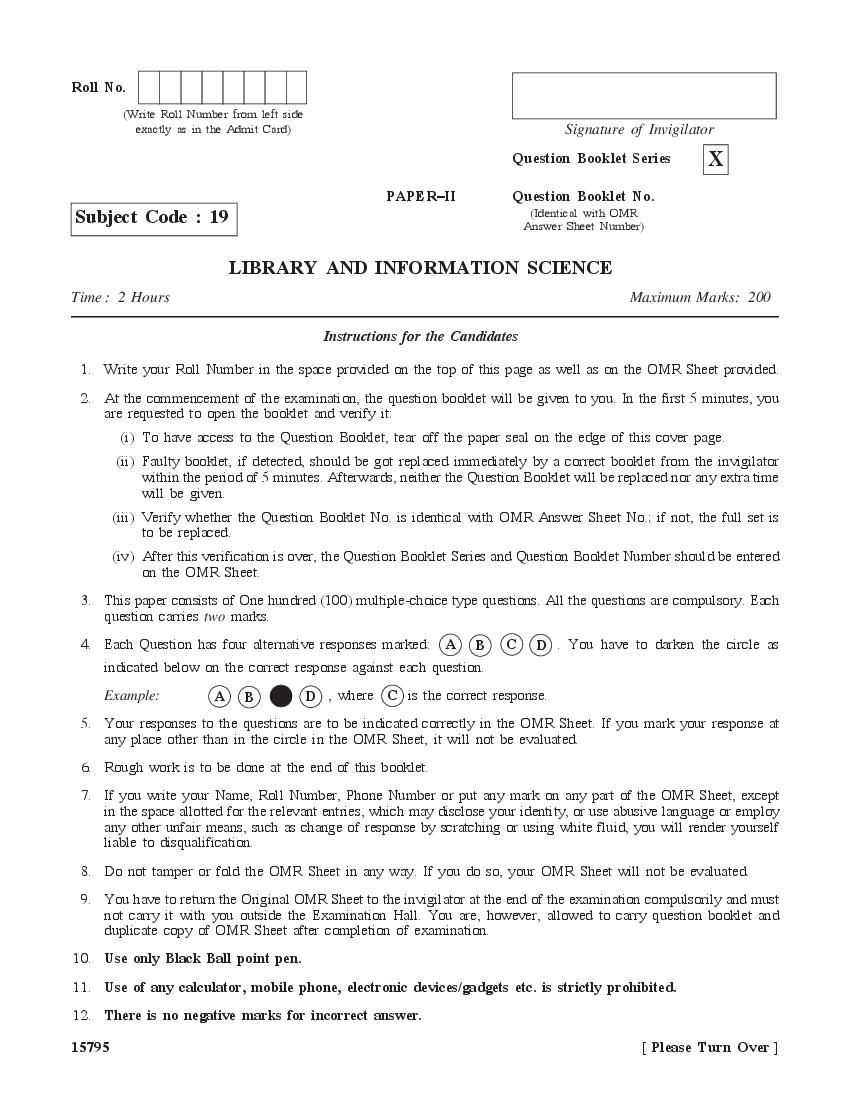
(Write Roll Number from left side
exactly as in the Admit Card) Signature of Invigilator
Question Booklet Series X
PAPER–II Question Booklet No.
Subject Code : 19 (Identical with OMR
Answer Sheet Number)
LIBRARY AND INFORMATION SCIENCE
Time : 2 Hours Maximum Marks: 200
Instructions for the Candidates
1. Write your Roll Number in the space provided on the top of this page as well as on the OMR Sheet provided.
2. At the commencement of the examination, the question booklet will be given to you. In the first 5 minutes, you
are requested to open the booklet and verify it:
(i) To have access to the Question Booklet, tear off the paper seal on the edge of this cover page.
(ii) Faulty booklet, if detected, should be got replaced immediately by a correct booklet from the invigilator
within the period of 5 minutes. Afterwards, neither the Question Booklet will be replaced nor any extra time
will be given.
(iii) Verify whether the Question Booklet No. is identical with OMR Answer Sheet No.; if not, the full set is
to be replaced.
(iv) After this verification is over, the Question Booklet Series and Question Booklet Number should be entered
on the OMR Sheet.
3. This paper consists of One hundred (100) multiple-choice type questions. All the questions are compulsory. Each
question carries two marks.
4. Each Question has four alternative responses marked: A B C D . You have to darken the circle as
indicated below on the correct response against each question.
Example: A B C D , where C is the correct response.
5. Your responses to the questions are to be indicated correctly in the OMR Sheet. If you mark your response at
any place other than in the circle in the OMR Sheet, it will not be evaluated.
6. Rough work is to be done at the end of this booklet.
7. If you write your Name, Roll Number, Phone Number or put any mark on any part of the OMR Sheet, except
in the space allotted for the relevant entries, which may disclose your identity, or use abusive language or employ
any other unfair means, such as change of response by scratching or using white fluid, you will render yourself
liable to disqualification.
8. Do not tamper or fold the OMR Sheet in any way. If you do so, your OMR Sheet will not be evaluated.
9. You have to return the Original OMR Sheet to the invigilator at the end of the examination compulsorily and must
not carry it with you outside the Examination Hall. You are, however, allowed to carry question booklet and
duplicate copy of OMR Sheet after completion of examination.
10. Use only Black Ball point pen.
11. Use of any calculator, mobile phone, electronic devices/gadgets etc. is strictly prohibited.
12. There is no negative marks for incorrect answer.
15795 [ Please Turn Over ]
Page 3
LIBRARY & INFORMATION SCIENCE
PAPER II
1. Which technique allows embedding of a visible or 6. Librachine refers to
invisible copyright notices or other verification messages (A) Mobile Library
in digital documents? (B) Reprographic System
(A) Digital Document Protecting (C) Charging System
(B) Digital Watermarking (D) Virtual Reference System
(C) Digital Clipboarding
(D) Digital Embargo
7. Who identified eight central values of
Librarianship?
(A) Michael Gorman
2. Identify the name of the Copyright Clearing (B) Jesse H. Shera
Agency of India.
(C) Charles Oppenheim
(A) Federation of Indian Publishers
(D) Patrick Wilson
(B) Indian Reprographic Rights Organisation
(C) National Library, Kolkata
(D) Authors Guild of India
8. Who argued that the logistic growth of knowledge
over a period of time is a result of a number of applications
of intellectual innovations?
(A) Michael Mabe
3. Which of the following phrase in Indian Copyright (B) Derek J. de Solla Price
Act, 1957 (last amended in 2012) is in use to indicate (C) Thomas Robert Malthus
‘Certain acts not to be infringement of Copyright’?
(D) S. C. Bradford
(A) Fair use
(B) Fair application
(C) Fair handling
(D) Fair dealing 9. Which section of the ‘IT Act, 2000’ describes the
provision for “Compensation for failure to protect data”?
(A) Sec. 33
(B) Sec. 43A
(C) Sec. 52A
4. Who has proposed 7 traditional communication
(D) Sec. 44
theories?
(A) David Berlo
(B) Robert T. Craig
(C) Claude E. Shannon 10. Arrange the following ancient libraries according
(D) George Gerbner to their year of establishment:
(i) The Library of Alexandria
(ii) The Villa of the Papyri
(iii) The Library of Ashurbanipal
(iv) The Library of Pergamum
5. Which of the plagiarism software allows users to
scan for plagiarism on the Moodle platforms? Codes:
(A) Copyleaks (A) (i), (ii), (iii), (iv)
(B) Copyscape (B) (ii), (iii), (i), (iv)
(C) Noplag (C) (iii), (i), (iv), (ii)
(D) Unicheck (D) (iv), (i), (ii), (iii)
Page 4
11. Match the following: 16. Among the following which one is NOT identified
List-I List-II as Core Competencies for 21st Century Librarians of
(a) Bibliopsychology (i) Louis Jacob de Saint Canadian Association of Research Libraries (CARL)?
Charles (A) Communication Skill
(b) Bibliography (ii) Samuel Crothers (B) Interpersonal Skill
(c) Bibliomania (iii) Nicholas Rubakin (C) Information Literacy
(d) Bibliotherapy (iv) John Ferrier (D) Foundational Knowledge
Codes:
(a) (b) (c) (d)
(A) (i) (iv) (ii) (iii) 17. What is Kindred Works?
(B) (iv) (i) (iii) (ii) (A) A content-based recommendation system
(C) (iii) (i) (iv) (ii) developed by OCLC.
(D) (ii) (iv) (iii) (i) (B) An intuitive search interface developed by
OCLC for WorldCat.
(C) An automatic system of OCLC to support the
assignment of classification numbers.
12. Which one of the following has recently published (D) A system of OCLC to visualize the
the advocacy toolkit of IFLA? networks of entities associated with
(A) ALP bibliographic records.
(B) TAP
(C) WLIC
(D) WSIS
18. Which of the following national libraries are
similar in purpose and scope?
(i) Library of Congress
13. Information need which satisfies a special problem, (ii) National Library of Colombia
diagnosed and immediate is known as (iii) National Library Board, Singapore
(A) Potential need (iv) National Diet Library
(B) Kinetic need Codes:
(C) Pragmatic information need (A) (i) and (ii) are correct.
(D) Professional information need (B) (i) and (iv) are correct.
(C) (i), (ii) and (iii) are correct.
(D) (ii), (iii) and (iv) are correct.
14. Which one of the following was the first legal
deposit library in the United Kingdom?
(A) British Museum
19. Which of the following libraries are autonomous
(B) Bodleian Library, Oxford bodies under the Ministry of Culture, Govt. of India?
(C) Cambridge University Library (i) Delhi Public Library, Delhi
(D) Library of Trinity College, Dublin (ii) Khuda Baksh Oriental Public Library, Patna
(iii) National Library, Kolkata
(iv) Rampur Raza Library, Rampur
15. Which state do not have a Public Library Act? Codes:
(A) Madhya Pradesh (A) (i) and (ii) are correct.
(B) Kerala (B) (i) and (iii) are correct.
(C) Mizoram (C) (i), (ii) and (iii) are correct.
(D) Uttar Pradesh (D) (i), (ii) and (iv) are correct.
Page 5
20. Match the following: 23. The map that traces the details of geographical,
List-I List-II soil, forest and other basic information is called
(a) Arunachal (i) 2001 (A) Political Map
Pradesh Act (B) Physical Map
(b) The Bihar State (ii) 2006 (C) Topographical Map
Public Library and (D) Historical Map
Information Centre Act
(c) Rajasthan Public (iii) 2008
Libraries Act
(d) Gujarat Public (iv) 2009
Libraries Act
24. Match the following:
Codes: List-I List-II
(a) (b) (c) (d) (Sherpa/ROMEO code) (Scope)
(A) (ii) (iii) (i) (iv) (a) Blue (i) Can archive post-print
(B) (i) (iv) (iii) (ii) (b) Green (ii) Can archive both post-
(C) (iii) (ii) (i) (iv) print and pre-print
(D) (iv) (i) (ii) (iii) (c) Yellow (iii) Can archive pre-print
(d) White (iv) Archiving not formally
supported
Codes:
(a) (b) (c) (d)
21. Match the following: (A) (i) (ii) (iii) (iv)
List-I List-II (B) (iv) (iii) (ii) (i)
(a) OCLC (i) Science Tracer Bullet (C) (ii) (iv) (i) (iii)
Online (D) (iii) (iv) (ii) (i)
(b) Library of Congress (ii) Kindred Works
(c) British Library (iii) Co-Lab
(d) Library and (iv) THOR: Technical and
Archives Canada Human Infrastructure for
Open Resarch 25. Match the following:
Codes: List-I List-II
(a) (b) (c) (d) (a) Lexis-Nexis (i) Has PDFs of hundreds
(A) (ii) (i) (iv) (iii) of journals
(B) (iv) (ii) (i) (iii) (b) HeinOnline (ii) Law reviews and
journals files
(C) (iii) (i) (ii) (iv)
(c) Wolters Cluwer (iii) A unified delivery
(D) (i) (iii) (ii) (iv)
platform specialized in
biomedical contents
(d) Ovid Discovery (iv) The world’s most trusted
medical research
platform
22. ‘National Register of Social Scientists in India’ is Codes:
an example of (a) (b) (c) (d)
(A) Statistical Source (A) (i) (ii) (iii) (iv)
(B) Almanac (B) (iv) (iii) (i) (ii)
(C) Directory (C) (iii) (i) (ii) (iv)
(D) Yearbook (D) (ii) (i) (iv) (iii)
Page 6
26. SciFinder provides access to 30. The Patent Information System, Government of
(i) CAPlus India is located at
(ii) CAS Registry (A) New Delhi
(iii) CHEMLIST (B) Pune
(iv) ChemSpider (C) Bhopal
(D) Nagpur
Codes:
(A) (i) and (iii) are correct.
(B) (i) and (ii) are correct.
(C) (i), (ii) and (iii) are correct.
(D) (ii), (iii) and (iv) are correct.
31. Arrange the following initiatives taken by OCLC
27. Which canon is responsible for arrangement of according to their year of emergence:
books on library shelves? (i) Printed its last card catalogue
(A) Canon of Coextensiveness (ii) Preservation microfilm and digitization
(B) Canon for Filiatory Sequence operation
(C) Canon of Relevance (iii) Produced first catalogue card for members
(D) Canon of Underextensiveness (iv) Started advocacy campaign called “geek the
library”
Codes:
(A) (ii), (i), (iii), (iv)
(B) (iii), (i), (iv), (ii)
28. Identify the person based on following (C) (iii), (i), (ii), (iv)
characteristics:
(D) (iii), (ii), (i), (iv)
(a) A library scholar, known for her research on
bibliographic control.
(b) She authored a book entitled “The Intellectual
Foundation of Information Organization”.
(c) A recipient of Margaret Mann Citation and
the Ranganathan Award for Classification
Research.
(A) Elaine Svenonius
(B) Barbara B. Tillet
32. Match the following:
(C) Linda Eastman
List-I List-II
(D) Nita Kibble
(a) Memex (i) H.P. Luhn
(b) BALLOTS (ii) Vannever Bush
(c) SRU (iii) Library of Congress
(d) KWIC (iv) Stanford University
29. Who among the following is acknowleged as the Codes:
“father of GIS” (Geographic Information System)? (a) (b) (c) (d)
(A) Howard T. Fisher (A) (ii) (iv) (iii) (i)
(B) Jack Dangermond (B) (ii) (iii) (iv) (i)
(C) Roger Tomlinson (C) (iv) (ii) (iii) (i)
(D) Waldo Rudolph Tobler (D) (i) (iii) (iv) (ii)
Page 7
33. Match the following: 36. Match the following:
List-I List-II List-I List-II
(CIS tools) (Use) (Govt.-based Community (State)
(a) AIRS (i) Code list Information Service)
(b) IPSV (ii) Category list (a) CHIPS (i) Kerala
(c) GCL (iii) Thesaurus (b) Mahitishakti (ii) Chhattisgarh
(d) LGAL (iv) Taxonomy (c) Akshaya (iii) Haryana
Codes: (d) Nai Disha (iv) Gujarat
(a) (b) (c) (d) Codes:
(A) (iii) (i) (ii) (iv) (a) (b) (c) (d)
(B) (ii) (iii) (iv) (i) (A) (iii) (i) (ii) (iv)
(C) (iv) (ii) (iii) (i) (B) (iii) (ii) (i) (iv)
(D) (iv) (iii) (ii) (i) (C) (ii) (iv) (i) (iii)
(D) (iii) (iv) (ii) (i)
34. Match the following:
List-I List-II
(a) LOCKSS (i) British Library
(b) DORIA (ii) University of Glassgow
(c) ESPIDA (iii) Helsinki University
Library 37. Match the following:
(d) LIFE (iv) Stanford University List-I List-II
Libraries (a) DeLCON (i) Astronomy and
Codes: Astrophysics
(a) (b) (c) (d) (b) CeRA (ii) Science and Technology
(A) (i) (ii) (iii) (iv) (c) NKRC (iii) Agriculture
(B) (iv) (iii) (ii) (i) (d) FORSA (iv) Biotechnology
(C) (ii) (iv) (i) (iii) Codes:
(D) (iii) (iv) (i) (ii) (a) (b) (c) (d)
(A) (i) (ii) (iii) (iv)
(B) (iii) (iv) (i) (ii)
35. Match the following: (C) (i) (iii) (ii) (iv)
List-I List-II (D) (iv) (iii) (ii) (i)
(a) H.W. Wilson Co. (i) Cambridge Information
Group
(b) University (ii) Rowman & Littlefield
Microfilms Publishing Group
(c) R. R. Bowker LLC (iii) EBSCO Publishing
(d) Scarecrow Press (iv) ProQuest LLC
Codes: 38. In 7th ed. of CC, which indicator digit among the
(a) (b) (c) (d) following has no antertiorizing value:
(A) (i) (iv) (ii) (iii) (A) (Backward Arrow)
(B) (iv) (i) (iii) (ii) (B) * (Asterisk)
(C) (iii) (iv) (i) (ii) (C) “ ”(Double Inverted Comma)
(D) (ii) (iii) (iv) (i) (D) = (Equal to)
Page 8
39. Who is considered as the ‘mother of MARC’ 44. Identify the person based on the features given
(declaned by Library of Congress in 2006)? below:
(A) Henriette Avram (a) A leading computer scientist working in the
(B) Carla Hayden field of information retrieval during his time.
(C) Laura Welch Bush (b) He was associated with the SMART (System
(D) Beverly Cleary for the Mechanical Analysis and Retrieval of
Text) Information Retrieval System.
(c) He is well known for developing the now
widely used vector space model for
Information Retrieval.
(A) Stephen Robertson
40. ‘Peek-a-Boo Cards’, a generic term to represent
(B) W. Bruce Croft
aspects cards, optical coincidence cards, feature cards,
and Batten cards, was chosen by (C) Hans Peter Luhn
(A) Allen Kent and J. W. Perry (D) Gerard Salton
(B) Charles P. Bourne and Harold Borko
(C) J. L. Jolley and J. Edwin Holmstrom
(D) W. A. Wildhack and J. Stern 45. Contribution of W.C.B. Sayers in Library
Classification is introduction of
(A) 27 canons
(B) 30 canons
(C) 29 canons
41. Which concept among the following belongs to (D) 24 canons
‘Five predicables’?
(A) Principles
(B) Accident 46. Which one of the following is not a principle for
(C) Canons mapping the Universe of Knowledge as suggested by
(D) Characteristics D.W. Langridge?
(A) Ideological Principle
(B) Principle of Social Purpose
(C) Scientific Order
(D) Principle of Cognition
42. Role of Speciators in Colon Classification is to
form
(A) a basic subject. 47. Which of the following is an example of Canon of
(B) a complex subject. Terminology as depicted in Colon Classification?
(C) a secondary basic subject. (A) Canon of Modulation
(D) a compound basic subject. (B) Canon of Coordinate Class
(C) Canon of Consistency
(D) Canon of Currency
43. Which of the following is a secondary basic 48. The Classic ‘Probabilistic Model’ of IR was
subject? introduced by Robertson and Spärck Jones in the year
(A) X 26 (Standard of living) (A) 1886
(B) 9f (Research methodology) (B) 1976
(C) L-9C (Child medicine) (C) 1986
(D) XYT (Econometrics) (D) 1990
Page 9
49. Who identified the six functions of bibliographic 54. Identify from the following, the principal theories
control? as identified by Andrew Osborn in “The Crisis in
(A) Arlene G. Taylor Cataloguing”:
(B) Patrick Wilson (i) Legalistic
(C) Robert B. Downs (ii) Perfectionistic
(D) Ronald Hagler (iii) Characteristics
(iv) Bibliographic
50. The index of the AACR2R (1988) was complied Codes:
by (A) (i), (ii) and (iii) are correct.
(A) Eric J. Hunter (B) (ii), (iii) and (iv) are correct.
(B) K. G. B. Bakewell (C) (i), (ii) and (iv) are correct.
(C) Jean Weihs (D) (i), (iii) and (iv) are correct.
(D) Paul Winkler
51. Which one of the following does not belong to the
group?
(A) Moy’s Classification Scheme for Law Books 55. The AACR2R (1988) used the following tools for
reconciliation and standardization of its rules and
(B) ACM’s Computing Classification Scheme
examples:
(C) International Patent Classification
(i) The Chicago Manual of Style
(D) Harvard Classification of Business Studies
(ii) Webster’s Third New International
Dictionary of the English Language,
52. The primary uses of descriptive metadata are Unabridged
(i) Discovery (iii) The ALA/LC Romanization Tables
(ii) Display (iv) LC Descriptive Cataloging Manual Section
(iii) Interoperability Z12
(iv) Navigation Codes:
Codes: (A) (i) and (ii) are correct.
(A) (i) and (ii) are correct. (B) (iii) and (iv) are correct.
(B) (i) and (iii) are correct. (C) (i), (ii) and (iii) are correct.
(C) (i), (ii) and (iii) are correct. (D) (i), (ii) and (iv) are correct.
(D) (i), (ii) and (iv) are correct.
53. Identify the key features of ‘Boolean Model’ of IR
56. Map Semantically:
from the following:
List-I List-II
(i) Provides a framework that is extermely
difficult to grasp by common user. (DCE Element) (MARC tag)
(ii) Its queries are specified having precise (a) DC.Title (i) 041
semantics. (b) DC. Identifier (ii) 650
(iii) Its inherent simplicity, neat formalism attracts (c) DC. Subject (iii) 245
the users. (d) DC. Language (iv) 856
(iv) It does not provide relevance ranking. Codes:
Codes: (a) (b) (c) (d)
(A) (i) and (ii) are correct. (A) (i) (ii) (iii) (iv)
(B) (i) and (iii) are correct. (B) (iv) (iii) (ii) (i)
(C) (ii) and (iii) are correct. (C) (ii) (iii) (iv) (i)
(D) (i) and (iv) are correct. (D) (iii) (iv) (ii) (i)
Page 10
57. Match the following (in context of CC 6th ed. 60. Match the following:
[rep.]): List-I List-II
List-I List-II (a) Open eNRICH (i) Data format
(a) Cold Storage (i) System Facet (b) IPSV (ii) Metadata
(b) Harvesting (ii) Foci in [2E] (c) CCF/F (iii) Software
(c) Sowing (iii) Foci in [E] (d) Seamless UK (iv) Vocabulary control
(d) Forestry (iv) Foci in [2E] cum [3P]
Codes:
Codes: (a) (b) (c) (d)
(a) (b) (c) (d) (A) (iii) (ii) (i) (iv)
(A) (i) (ii) (iii) (iv) (B) (iii) (iv) (i) (ii)
(B) (iv) (iii) (i) (ii) (C) (ii) (iii) (i) (iv)
(C) (iii) (iv) (ii) (i) (D) (iv) (iii) (i) (ii)
(D) (iv) (i) (iii) (ii)
58. Match the following:
List-I List-II
(a) ETDs (i) Shodhganga
(b) Images (ii) CCO
(c) Cultural Objects (iii) CanCore
(d) Learning Objects (iv) VRA-Core
Codes:
(a) (b) (c) (d)
(A) (i) (iii) (iv) (ii)
(B) (i) (ii) (iii) (iv)
(C) (i) (ii) (iv) (iii)
(D) (i) (iv) (ii) (iii)
61. Match the following:
59. Match the following: List-I List-II
List-I List-II (Marc 21 Tag) (Control Field in MARC 21
(a) Organization of (i) A. C. Foskett Bibliographic Format)
Knowledge and (a) 005 (i) Fixed-length data
System of Science elements— general
(b) Classification: (ii) H. E. Bliss information
Theoritical and (b) 006 (ii) Physical description
Practical fixed field—Text
(c) Principle of Book (iii) E. W. Hulme (c) 007 (iii) Books-(00-17)— Fixed-
Classification length field
(d) Subject Approach (iv) E. C. Richardson (d) 008 (iv) Date and time of latest
to Information transaction
Codes: Codes:
(a) (b) (c) (d) (a) (b) (c) (d)
(A) (i) (iii) (ii) (iv) (A) (i) (ii) (iii) (iv)
(B) (ii) (iv) (iii) (i) (B) (iv) (iii) (ii) (i)
(C) (iii) (ii) (i) (iv) (C) (ii) (iv) (i) (iii)
(D) (iv) (iii) (ii) (i) (D) (i) (iv) (ii) (iii)
Page 11
62. Match the following: 64. Assertion (A) : Boolean Model, one of the three
List-I List-II Classic Information Retrieval
(a) Inverse document (i) Anthony Debons Models, remained as the most
frequency popular and dominate IR Model,
of IR in the past.
(b) Context (ii) C. J. van Rijsbergen
dependency Reason (R) : This model provides a framework
that is easy to grasp by common
(c) Informatology (iii) Derek W. Austin
users (of an IR system) for its
(d) Retrieval (iv) Karen Spø˙Ërck Jones inherent simplicity and neat
uncertainty formalism as Boolean
Codes: expressions have precise
(a) (b) (c) (d) semantics which led to the
(A) (ii) (i) (iv) (iii) adoption of this IR model in early
commercial bibliographic
(B) (iv) (iii) (i) (ii)
systems.
(C) (iii) (i) (ii) (iv)
(D) (i) (iii) (ii) (iv) Codes:
(A) (A) is true, (R) is false.
(B) (A) and (R) both are false.
(C) (A) is false, but (R) is true.
(D) (A) and (R) both are true.
63. Match the following:
List-I List-II
(a) C. J. van Rijsbergen (i) Information retrieval
today
65. Assertion (A) : In UDC, the order of facets in
(b) B. Rebeiro and (ii) Modern information
class numbers is reverse of their
R. Baeza-Yates retrieval
arrangements on the shelves.
(c) F.W. Lancaster (iii) Introduction to modern
Reason (R) : In terms of citation order, this
and A. J. Warner information retrieval arrangement is known as
(d) G. Salton and (iv) The geometry of ‘Principle of Inversion’, however,
M. J. McGill information retrieval no formulated order has been
Codes: presented for special auxiliaries.
(a) (b) (c) (d) Codes:
(A) (i) (iv) (ii) (iii) (A) (A) is true, (R) is false.
(B) (iv) (ii) (i) (iii) (B) (A) and (R) both are true.
(C) (iii) (i) (ii) (iv) (C) (A) is false, but (R) is true.
(D) (ii) (iii) (i) (iv) (D) (A) and (R) both are false.
Page 12
66. SWOC Analysis can be used 70. Match the following:
(i) As a framework used to evaluate a library’s List-I List-II
competitive position. (a) General Financial (i) Grant-in Aid to Public
(ii) To develop strategic planning and assess Rule (2017) Library
internal and external factors and current, as Rule 213
well as, future potential of the library.
(b) General Financial (ii) Physical Verification
(iii) To unease and complicate a realistic, fact- Rule (2017) of Fixed Assets
based and data-driven look at the strength Rule 215
and weaknesses of the Library.
(c) General Financial (iii) Physical Verification
(iv) To exclusively use as a guide and as a
Rule (2017) of Library Books
prescription.
Rule 210
Codes: (d) General Financial (iv) Custody of Goods
(A) (i) and (iv) are correct. Rule (2017) and Materials
(B) (i) and (iii) are correct. Rule 228
(C) (i) and (ii) are correct. Codes:
(D) (ii) and (iii) are correct. (a) (b) (c) (d)
(A) (i) (ii) (iii) (iv)
(B) (ii) (iii) (iv) (i)
67. Information in the SIVA model of marketing mix (C) (iv) (ii) (i) (iii)
corresponds to (D) (iii) (i) (ii) (iv)
(A) Place
(B) Promotion
(C) Price
(D) Product
68. Every PERT/CPM network has two basic
components, namely
(A) Float and Slack
(B) Event and Activity
(C) Nodes and Processor 71. Match the following:
(D) Time and Work List-I List-II
(a) Disability (i) 1974
Discrimination Act
(b) Employment (ii) 1975
69. Which of the following techniques are used for Rights Act
forecasting a library’s future manpower requirement? (c) Rehabilitation of (iii) 1996
(i) Managerial judgement Offenders Act
(ii) Delphi technique (d) Sex (iv) 1997
(iii) Job design Discrimination Act
(iv) Ratio-trend analysis Codes:
Codes: (a) (b) (c) (d)
(A) (i) and (ii) are correct. (A) (iv) (ii) (i) (iii)
(B) (ii) and (iv) are correct. (B) (iii) (iv) (i) (ii)
(C) (i), (ii) and (iii) are correct. (C) (i) (ii) (iii) (iv)
(D) (i), (ii) and (iv) are correct. (D) (iv) (iii) (i) (ii)
Page 13
72. Stateful Packet Inspection 74. Assertion (A) : The web is becoming a universal
(i) is also sometimes called dynamic packet repository of human knowledge
filtering. and culture that allows
(ii) is a powerful firewall architecture that unprecedented sharing of ideas
examines traffic streams from end to end. or information in a scale never
seen before.
(iii) is more secured than basic packet filtering
firewalls. Reason (R) : The success of web is usually
based on conception of a standard
(iv) works at the application layer in the OSI
user-interface which is always
model.
the same, no matter what
Codes: computational environment is
(A) (i) and (ii) are correct. used to run the interface. Morever,
(B) (i), (ii) and (iii) are correct. the user is shielded from details
(C) (i), (iii) and (iv) are correct. of communication protocols,
machine location, and operating
(D) (ii), (iii) and (iv) are correct.
system.
Codes:
(A) (A) is true, (R) is false.
(B) (A) and (R) both are false.
(C) (A) is false, but (R) is true.
(D) (A) and (R) both are true.
75. What is the name of the cloud-based interface
produced by OCLC for resource sharing?
(A) Tipasa
(B) Relais D2D
(C) World Share Inter Library Loan
(D) CONTENT dm
76. Given below is a term-document incidence matrix
on the basis of characters and drama of Shakespeare.
Matrix element (t, d) is 1 if the play in column d contains
73. Match the following: the term (character) in row t, and is 0 (zero) otherwise.
List-I List-II Antony Julius The Hamlet Othello Macbeth
and Caesar Tempest
(a) Calcutta Public Library (i) 1821 Cleopatra
(b) Khuda Baksh Oriental (ii) 1876 Antony 1 1 0 0 0 1
Public Library Brutus 1 1 0 1 0 0
(c) Raghunandan Library, (iii) 1835 Caesar 1 1 0 1 1 1
Calpurnia 0 1 0 0 0 0
Puri
(d) Rampur Raza Library (iv) 1774
Use Boolean Retrieval Model to answer which
Codes: document vector will be retrieved for the query: (Antony
(a) (b) (c) (d) OR Brutus) NOT Calpurnia
(A) (i) (ii) (iii) (iv) (A) 110100
(B) (iii) (ii) (i) (iv) (B) 110111
(C) (iii) (iv) (i) (ii) (C) 100101
(D) (i) (iv) (ii) (iii) (D) 100100
Page 14
77. Consider the following key principles about 80. Assertion (A) : Ontology is a formal, machine-
“Digital Library Architecture”: readable specification of a
(i) Middleware is an important part of this conceptual model.
architecture which connects applications to Reason (R) : Ontology is a controlled
the software on clients and servers. vocabulary, which uses one or
(ii) It follows open architecture mechanism. more relations for a defined
(iii) Scalability, extensibility and sustainability domain.
are the three key features of this architecture. Codes:
(iv) Well defined standards and protocols are not (A) (A) is false but (R) is true.
required for interoperability. (B) (A) is true but (R) is false.
Codes: (C) Both (A) and (R) are true.
(A) (i), (ii) and (iv) are correct. (D) Both (A) and (R) are false.
(B) (ii), (iii) and (iv) are correct.
(C) (i), (iii) and (iv) are correct.
(D) (i), (ii) and (iii) are correct.
78. Match the following:
List-I List-II 81. Assertion (A) : Modern Computers and
(Search Engine) (Associated Software) Communications can store and
(a) Solr (i) VuFind (Ver. 6.0) process information and made it
(b) Zebra (ii) DSpace (Ver. 3.X) accessible in ways never before
achieved.
(c) MGPP (iii) Koha (Ver. 19.05)
Reason (R) : These ICTs can also enhance
(d) Lucene (iv) Green Stone (Ver. 2.X)
opportunities for misuse, theft,
Codes: loss and abuse and, in particular,
(a) (b) (c) (d) indiscriminate dissemination of
(A) (ii) (iii) (i) (iv) information.
(B) (iii) (i) (iv) (ii) Codes:
(C) (i) (iii) (iv) (ii) (A) (A) is false but (R) is true.
(D) (iv) (iii) (ii) (i) (B) (A) is true but (R) is false.
(C) (A) and (R) both are false.
(D) (A) and (R) both are true.
79. Arrange the following open access declarations in
chronological order of their date of initiation:
(i) Bothesda statement on Open Access
Publishing
(ii) Brisbane Declaration on Open Access
(iii) Budapest Open Access Initiative
(iv) OECD Declaration on Access to Research
82. “Goole can bring you back 100,000 answers, a
Data from Public Funding
librarian can bring you back the right one.” Who said
Codes: this?
(A) (i), (ii), (iv), (iii) (A) Issac Asimov
(B) (ii), (iv), (iii), (i) (B) Neil Gaiman
(C) (iv), (iii), (ii), (i) (C) Norman Cousins
(D) (iii), (i), (iv), (ii) (D) Peter Singer
Page 15
83. In the size of the study population is very small, 87. Consider the following statements about ‘R’
the following sampling method will give better results: statistical software and mark the incorrect statement:
(A) Purposive (A) R was initially written at University of
(B) Stratified Auckland, New Zealand.
(C) Random (B) R provides a suite of operators for calculations
(D) Census on array, chain, vector and matrices.
(C) The biggest drawback of R is that it cannot be
used for recursive function.
(D) R provides a large, coherent and integrated
collection of tools for data analysis.
84. The description of relation between work and
88. Drawing information or content from the work of
time could be drawn in a
another without acknowledging the source by citing a
(A) Organization chart reference is considered to be plagiarism in all of the
(B) Pie chart following cases except:
(C) Gantt chart (i) Using the exact words of the author.
(D) Bar chart (ii) Using data that the author has compiled
through his/her independent investigation.
(iii) Using information from the author’s work
that is regarded as common knowledge in the
discipline.
(iv) Reproducing a chart contained in the author’s
work.
Codes:
85. In SPSS, what is the “Data Viewer”? (A) (i), (ii) and (iv) are correct.
(A) A table summarizing the frequencies of data (B) (i), (ii) and (iii) are correct.
for one variable. (C) (i), (iii) and (iv) are correct.
(B) A dialog box that allows you to choose a (D) (ii), (iii) and (iv) are correct.
statistical test.
(C) A screen in which variables can be defined
and labeled.
(D) A spread sheet into which data can be entered.
89. Match the following:
List-I List-II
(a) SIGIT (i) Information
Technology
(b) Sci Central (ii) Science
(c) TIPTOP (iii) Physics
(d) DMOZ (iv) Multidisciplinary
86. Identify a free reference manager and academic
social networking tool that helps in organising research, Codes:
collaborative online and discover new research. (a) (b) (c) (d)
(A) EndNote (A) (i) (ii) (iii) (iv)
(B) JobRef (B) (i) (ii) (iv) (iii)
(C) PaperPile (C) (iv) (ii) (iii) (i)
(D) Mendeley (D) (iv) (iii) (ii) (i)
Page 16
90. Match the following: 92. Match the following variables with their
List-I List-II corresponding descriptions:
(a) Alan Jeffreys (i) Information retrieval/ List-I List-II
Award natural language (a) Intervening (i) Two or more variables
processing variable represent the same
(b) Takeshi Murofushi (ii) Chemical information variable
Research Award Science (b) Antecedent (ii) Variable occurs prior
variable to some already
(c) Herman Skolnik (iii) Cataloguing and
identified or independent
Award Indexing variable
(d) Karen Spø˙Ërck (iv) School librarianship (c) Component (iii) Another influence that
Jones Award variable may affect the dependent
Codes: variable in which the
(a) (b) (c) (d) researcher is not
interested.
(A) (i) (iv) (ii) (iii)
(d) Confounding or (iv) Occurs in the causal
(B) (iv) (ii) (iii) (i)
Interfering chain between some
(C) (iii) (iv) (ii) (i)
variable independent variable and
(D) (ii) (iii) (i) (iv) its dependent variable.
Codes:
(a) (b) (c) (d)
(A) (i) (ii) (iii) (iv)
(B) (iv) (iii) (ii) (i)
(C) (iv) (ii) (i) (iii)
(D) (ii) (i) (iv) (iii)
91. Match the following:
List-I List-II
(a) Journal of (i) American 93. Match the following:
Information Science Documentation List-I List-II
(b) Information (ii) The Information (a) Inductive (i) Proposing a relationship
Processing and Scientist Hypothesis between two phenomena
Management or variables
(c) SRELS Journal of (iii) Information storage and (b) Deductive (ii) Generalisation-based on
Information Retrieval Hypothesis observation (from
particular to general)
Management
(c) Directional (iii) Derived from a theory
(d) Journal of the (iv) Library Science with a
Hypothesis (shifts from the general
Association for Slant to Documentation to particular)
Information (d) Bi-variate (iv) Indicates nature of
Science and Hypothesis relationship between or
Technology among variables.
Codes: Codes:
(a) (b) (c) (d) (a) (b) (c) (d)
(A) (i) (ii) (iv) (iii) (A) (ii) (iii) (iv) (i)
(B) (iii) (i) (iv) (ii) (B) (i) (ii) (iii) (iv)
(C) (ii) (iii) (iv) (i) (C) (iv) (iii) (ii) (i)
(D) (ii) (iv) (iii) (i) (D) (iii) (i) (iv) (ii)
Page 17
94. Match the following: 96. Identify the odd one out:
List-I List-II (A) Case folding
(a) Chicago Style (i) Writers, Editors & (B) Dictionary compression
Manual Publishes (C) Stemming
(b) Blue Book (ii) Legal Profession (D) Stop word elimination
(c) Turabian (iii) Academic Profession
(d) Oxford Guide (iv) General to all
to Style
Codes:
(a) (b) (c) (d)
(A) (iv) (ii) (iii) (i)
(B) (ii) (i) (iv) (iii)
(C) (iii) (ii) (i) (iv)
(D) (i) (ii) (iii) (iv)
97. What is ‘The Library 100’?
(A) The 100 mostly used research libraries
across the world as identified by Association
of Research Libraries (ARL), US.
(B) The 100 mostly used medical libraries across
the world as identified by National Library of
Medicine, US.
(C) The 100 timeless, top novels—those found
in thousands of libraries around the world—
using WorldCat.
(D) The 100 mostly used public libraries across
the world as identified by American Library
Association (ALA), US.
95. Assertion (A) : Compared with co-citation and
bibliographic coupling, direct
citations (some times referred to
as cross citations) offer a more
direct indication of the relatedness
of publications.
Reason (R) : Nevertheless, in the Literature on
Visualizing bibliometric
networks, it is relatively
uncommon to work with direct
citations, as the use of direct
98. What is the name of web-based, password-
citations often leads to very sparse
protected service that provides access to thousands of
networks.
audio and Braille books, magazines and musics, provided
Codes: by Library of Congress?
(A) (A) is true but (R) is false. (A) BRAILSIS
(B) (A) and (R) both are false. (B) BRUCE
(C) (A) is false but (R) is true. (C) BARD
(D) (A) and (R) both are true. (D) DAISY
Page 18
99. ‘Sugamya Pustakalaya’ is 100. Arrange the following public libraries in
(i) an online library for persons with visual chronological order of their date of establishment:
disabilities. (i) New York Public Library
(ii) organized by the Ministry of Social Justice (ii) Manchester Free Library
and Empowerment, Govt. of India. (iii) State Central Library, Kerala
(iii) books for Divyangjans are available only in (iv) Boston Public Library
single language.
Codes:
(iv) aims to bridge the digital divide between
have’s and have not’s. (A) (i), (ii), (iv), (iii)
(B) (iii), (iv), (ii), (i)
Codes:
(C) (ii), (iii), (iv), (i)
(A) (i), (ii) & (iii) are correct.
(D) (iii), (i), (ii), (iv)
(B) (i), (ii) & (iv) are correct.
(C) (ii), (iii) & (iv) are correct.
(D) (i), (iii) & (iv) are correct.
Page 19
ROUGH WORK
Page 20
ROUGH WORK
Document Details
| Board / Org | Default |
| Exam | Govt Jobs Exams |
| Type | Question Paper |
| Pages | 20 |
| Updated | 30 Apr 2026 |