Kerala Plus Two Question Paper 2022 Biology
Finished viewing? Save it for later —
Download Kerala Plus Two Question Paper 2022 Biology (PDF · 16 pages)About Kerala Plus Two Question Paper 2022 Biology
Kerala Plus Two Question Paper 2022 Biology is available here for free download. Published by Kerala Board for Class 12, this question paper can be viewed online or downloaded as a PDF (16 pages). Candidates preparing for Class 12 can use Kerala Plus Two Question Paper 2022 Biology to understand the exam pattern, the type of questions asked, and the overall difficulty level.
Frequently Asked Questions
How can I download Kerala Plus Two Question Paper 2022 Biology?
Open this page and click the Download button to save Kerala Plus Two Question Paper 2022 Biology as a PDF. It is completely free on AglaSem Docs.
Is Kerala Plus Two Question Paper 2022 Biology free to download?
Yes. Kerala Plus Two Question Paper 2022 Biology can be viewed online and downloaded as a PDF free of cost on AglaSem Docs.
How many pages does Kerala Plus Two Question Paper 2022 Biology have?
Kerala Plus Two Question Paper 2022 Biology contains 16 pages, which you can read online or download together as a single PDF.
Where can I find more Class 12 study material?
You can find more Class 12 question papers, sample papers, syllabus, and answer keys on AglaSem Docs.
Kerala Plus Two Question Paper 2022 Biology – Text
Read the full text of this question paper below — useful to quickly search, copy and reference the content online without downloading the PDF.
📄 View text version (16 pages)
Page 1
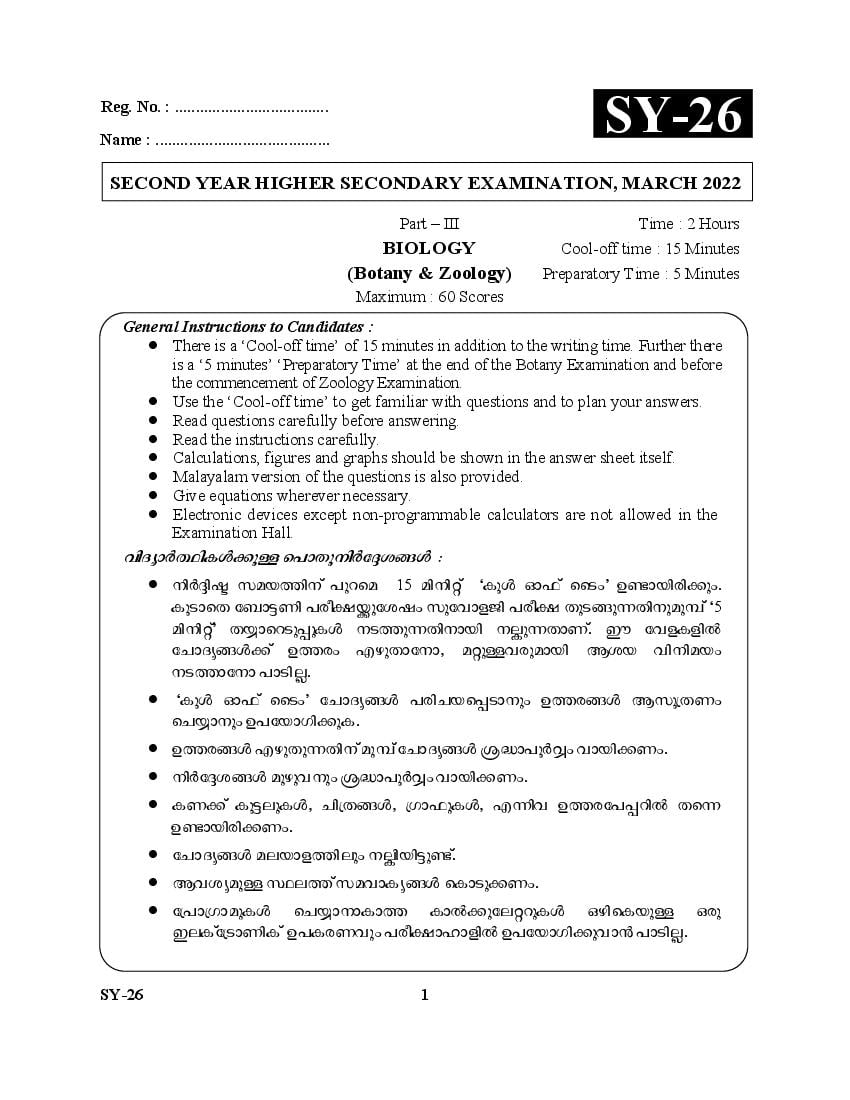
Name : ..........................................
SY-26
SECOND YEAR HIGHER SECONDARY EXAMINATION, MARCH 2022
Part – III Time : 2 Hours
BIOLOGY Cool-off time : 15 Minutes
(Botany & Zoology) Preparatory Time : 5 Minutes
Maximum : 60 Scores
General Instructions to Candidates :
There is a ‘Cool-off time’ of 15 minutes in addition to the writing time. Further there
is a ‘5 minutes’ ‘Preparatory Time’ at the end of the Botany Examination and before
the commencement of Zoology Examination.
Use the ‘Cool-off time’ to get familiar with questions and to plan your answers.
Read questions carefully before answering.
Read the instructions carefully.
Calculations, figures and graphs should be shown in the answer sheet itself.
Malayalam version of the questions is also provided.
Give equations wherever necessary.
Electronic devices except non-programmable calculators are not allowed in the
Examination Hall.
15 ‘ ’ .
‘5
’ .
,
.
‘ ’
.
.
.
, , ,
.
.
.
.
SY-26 1
Page 2
BOTANY
(Maximum : 30 Scores) Time : 1 Hour
PART – I
A. Answer any 3 questions from 1 to 4. Each carries 1 score. (3 1 = 3)
Choose the correct answer :
1. Innermost wall layer of Micro-sporangium is ________
(a) Middle layer (b) Epidermis
(c) Tapetum (d) Endothecium
2. Fill in the blank.
The first restriction endonuclease enzyme isolated is ________.
3. In polar seas, seals have a thick layer of fat. Name the fat layer seen below their skin.
4. Choose the correct answer :
The green plants in the ecosystem are the chief ________
(a) Decomposers (b) Consumers
(c) Producers (d) Herbivores
B. Answer all questions from 5 to 6. Each carries 1 score. (2 1 = 2)
5. Fill in the blank.
The time period from birth to the natural death of an organism is known as _______.
6. Expand ELISA.
SY-26 2
Page 3
BOTANY
(Maximum : 30 Scores) Time : 1 Hour
PART – I
A. 1 4 3 .
1 . (3 1 = 3)
:
1. ________
(a) (b)
(c) (d)
2. :
?
3.
. ?
4. :
________ .
(a) (b)
(c) (d)
B. 5 6 . 1 .
(2 1 = 2)
5. .
________.
6. ELISA .
SY-26 3 P.T.O.
Page 4
A. Answer any two questions from 7 to 9. Each carries 2 scores. (2 2 = 4)
7. What are the four main objectives of Bio-fortification ?
8. Mention the functions of GEAC (Genetic Engineering Approval Committee).
9. Fill in the blanks with suitable terms :
Asexual Reproduction
Asexual Reproductive Structure Examples
Zoospores (a)
(b) Penicillium
(c) Hydra
Gemmules (d)
B. Answer any two questions from 10 to 13. Each carries 2 scores. (2 2 = 4)
10. Comment on Self-incompatibility.
11. Introduction of semi-dwarf varieties increased production of rice and wheat. Complete
the table with the names of any two semi-dwarf varieties of wheat and rice.
Rice Wheat
(1) __________ (1) __________
(2) __________ (2) __________
SY-26 4
Page 5
A. 7 9 2 .
2 . (2 2 = 4)
7. ?
8. GEAC ?
9. :
(a)
(b)
(c)
(d)
B. 10 13 2 .
2 . (2 2 = 4)
10. .
11.
.
:
(1) __________ (1) __________
(2) __________ (2) __________
SY-26 5 P.T.O.
Page 6
Population Interactions
Species-A Species-B Name of Interaction
(a)
___________ (b)
___________ Competition
(c)
___________ — Predation
— 0 (d)
___________
13. Name the type of succession that occurs in wet area. What is the climax community in
that succession ?
PART – III
A. Answer any three questions from 14 to 17. Each carries 3 scores. (3 3 = 9)
14. Explain the method of genetically engineered human insulin production by ‘Eli Lilly’
in 1983.
15. List out some of the adaptations seen in desert plants.
16. What are the consequences of deforestation ?
17. The figure shows the pyramid of energy. Pyramid of energy is always upright. Why ?
SY-26 6
Page 7
- -
()
___________ ()
___________
()
___________ —
— 0 ()
___________
13.
.
?
PART – III
A. 14 17 3 .
3 . (3 3 = 9)
14. 1983 ‘ ’
.
15. .
16. ?
17. .
?
SY-26 7 P.T.O.
Page 8
18. CNG is widely used in vehicles in Delhi.
(a) Expand CNG.
(b) What are the advantages of using CNG than Diesel ?
PART – IV
Answer any one question from 19 to 20. Carries 5 scores. (1 5 = 5)
19. Pollination is an important mechanism found in flowering plants.
(a) Define Pollination.
(b) Write short note on :
(1) Autogamy
(2) Geitonogamy
(3) Xenogamy
20. Restriction enzymes are widely used in Biotechnology.
(a) Name two kinds of restriction enzymes.
(b) Explain the naming procedure of restriction enzymes with one example.
SY-26 8
Page 9
18. CNG :
(a) CNG
(b) CNG ?
PART – IV
19 20 1 .
5 . (1 5 = 5)
19. :
(a)
(b) :
(1)
(2)
(3)
20.
.
(a) .
(b)
.
SY-26 9 P.T.O.
Page 10
ZOOLOGY
(Maximum : 30 Scores) Time : 1 Hour
PART – I
A. Answer any three questions from 1 to 4. Each carries 1 score. (3 1 = 3)
1. Homologous organ : Divergent evolution :: Analogous organ : ________
2. Expand the term ZIFT.
3. Mitotic division of zygote results in the formation of blastomeres is called ________.
4. Name the enzyme that joins the DNA fragments in dis-continuous strand during
replication.
B. Answer all questions from 5 to 6. Each carries 1 score. (2 1 = 2)
5. The term ‘Biodiversity’ was popularised by the scientist ________.
6. The first antibiotic discovered was _______.
PART – II
A. Answer any two questions from 7 to 9. Each carries 2 scores. (2 2 = 4)
7. ‘Codon AUG is known as initiator codon.
(a) Name the amino acid coded by AUG.
(b) Write any two stop codons.
8. Write the functions of the following structures in human reproduction :
(a) Leydig cells
(b) Corpus luteum
SY-26 10
Page 11
ZOOLOGY
(Maximum : 30 Scores) Time : 1 Hour
PART – I
A. 1 4 3 .
1 . (3 1 = 3)
1. : :: : _______
2. ZIFT .
3. ________
.
4. ... (Replication)
(enzyme) .
B. 5 6 . .
(2 1 = 2)
5. ‘Biodiversity’ ________ .
6. _______ .
PART – II
A. 7 9 2 .
2 . (2 2 = 4)
7. AUG .
(a) AUG ?
(b) (stop codons) .
8. ,
:
(a)
(b)
SY-26 11 P.T.O.
Page 12
(A) (B)
(i) Trichoderma polysporum (a) Citric acid
(ii) Monascus purpureus (b) Ethanol
(iii) Saccharomyces cerevisiae (c) Cyclosporin A
(iv) Aspergillus niger (d) Statin
B. Answer any two questions from 10 to 13. Each carries 2 scores. (2 2 = 4)
10. Choose the correct terms from the bracket to fill in the blanks and complete the table :
(Bigbang theory, Miller’s experiment, Lamarkism, Darwinism)
(A) (B)
(i) Natural selection (a) ____________
(ii) Chemical evolution (b) ____________
(iii) Origin of Universe (c) ____________
(iv) Use and Disuse of organs (d) ____________
11. Write any four ill-effects of Drug/Alcohol abuse.
12. (a) Name the cap-like structure present in sperm head.
(b) Write its function.
13. (a) Distinguish between Male heterogamety and Female heterogamety.
(b) Write one example for each.
PART – III
A. Answer any three questions from 14 to 17. Each carries 3 scores. (3 3 = 9)
14. “Allele frequencies in a population are stable and is constant from generation to
generation.”
(a) Name the principle.
(b) Mention any four factors those affect this principle.
15. “Sex of a child is determined by father.” Substantiate the statement.
SY-26 12
Page 13
(A) (B)
(i) (a)
(ii) (b)
(iii) (c) A
(iv) (d)
B. 10 13 2 .
2 . (2 2 = 4)
10. :
( , , , )
(A) (B)
(i) (a) ____________
(ii) (b) ____________
(iii) (c) ____________
(iv) (d) ____________
11. /
.
12. (a)
.
(b) .
13. (a) (Male heterogamety)
(Female heterogamety) .
(b) .
PART – III
A. 14 17 3 .
3 . (3 3 = 9)
14. “
” :
(a)
(b) .
15. “ .”
.
SY-26 13 P.T.O.
Page 14
(a) What is STD ?
(b) Name any four STDs.
17. (a) Write four major causes of Biodiversity loss.
(b) Give one example for in-situ conservation and ex-situ conservation of
Biodiversity.
B. Answer the following question. Carries 3 scores. (1 3 = 3)
18. (a) Expand the term DNA. Who proposed double helical model of DNA ?
(b) List out the nitrogen bases in DNA.
PART – IV
Answer any one question from 19 to 20. Each carries 5 scores. (1 5 = 5)
19. (a) Expand the term AIDS. Mention the name of virus that causes AIDS.
(b) Name the widely used diagnostic test for AIDS.
(c) List out any four practices for the prevention of AIDS.
20. Schematic diagram of a transcription unit is given below :
(a) Identify the parts A and B.
(b) What is transcription ?
(c) Write the complementary DNA strand by observing the strand given below :
5'-ATGCATGCAT-3'
___________
SY-26 14
Page 15
(a) STD ?
(b) STD .
17. (a) .
(b) ( ) (-)
.
B. . 3 . (1 3 = 3)
18. (a) DNA . DNA
?
(b) DNA .
PART – IV
19 20 1 .
5 . (1 5 = 5)
19. (a) AIDS .
.
(b) AIDS
?
(c) AIDS
.
20. :
(a) A, B .
(b) (Transcription) ?
(c) DNA (Complementary
strand) :
5'-ATGCATGCAT-3'
___________
SY-26 15 P.T.O.
Page 16
Document Details
| Board / Org | Kerala Board |
| Exam | Class 12 |
| Type | Question Paper |
| Pages | 16 |
| Updated | 22 Jul 2026 |