JNUEE 2021 Question Paper Ph.D Nano Sciences
Finished viewing? Save it for later —
Download JNUEE 2021 Question Paper Ph.D Nano Sciences (PDF · 30 pages)About JNUEE 2021 Question Paper Ph.D Nano Sciences
JNUEE 2021 Question Paper Ph.D Nano Sciences is available here for free download. Published by NTA for JNUEE, this question paper can be viewed online or downloaded as a PDF (30 pages). Candidates preparing for JNUEE can use JNUEE 2021 Question Paper Ph.D Nano Sciences to understand the exam pattern, the type of questions asked, and the overall difficulty level.
Frequently Asked Questions
How can I download JNUEE 2021 Question Paper Ph.D Nano Sciences?
Open this page and click the Download button to save JNUEE 2021 Question Paper Ph.D Nano Sciences as a PDF. It is completely free on AglaSem Docs.
Is JNUEE 2021 Question Paper Ph.D Nano Sciences free to download?
Yes. JNUEE 2021 Question Paper Ph.D Nano Sciences can be viewed online and downloaded as a PDF free of cost on AglaSem Docs.
How many pages does JNUEE 2021 Question Paper Ph.D Nano Sciences have?
JNUEE 2021 Question Paper Ph.D Nano Sciences contains 30 pages, which you can read online or download together as a single PDF.
Where can I find more JNUEE study material?
You can find more JNUEE question papers, sample papers, syllabus, and answer keys on AglaSem Docs.
JNUEE 2021 Question Paper Ph.D Nano Sciences – Text
Read the full text of this question paper below — useful to quickly search, copy and reference the content online without downloading the PDF.
📄 View text version (30 pages)
Page 1
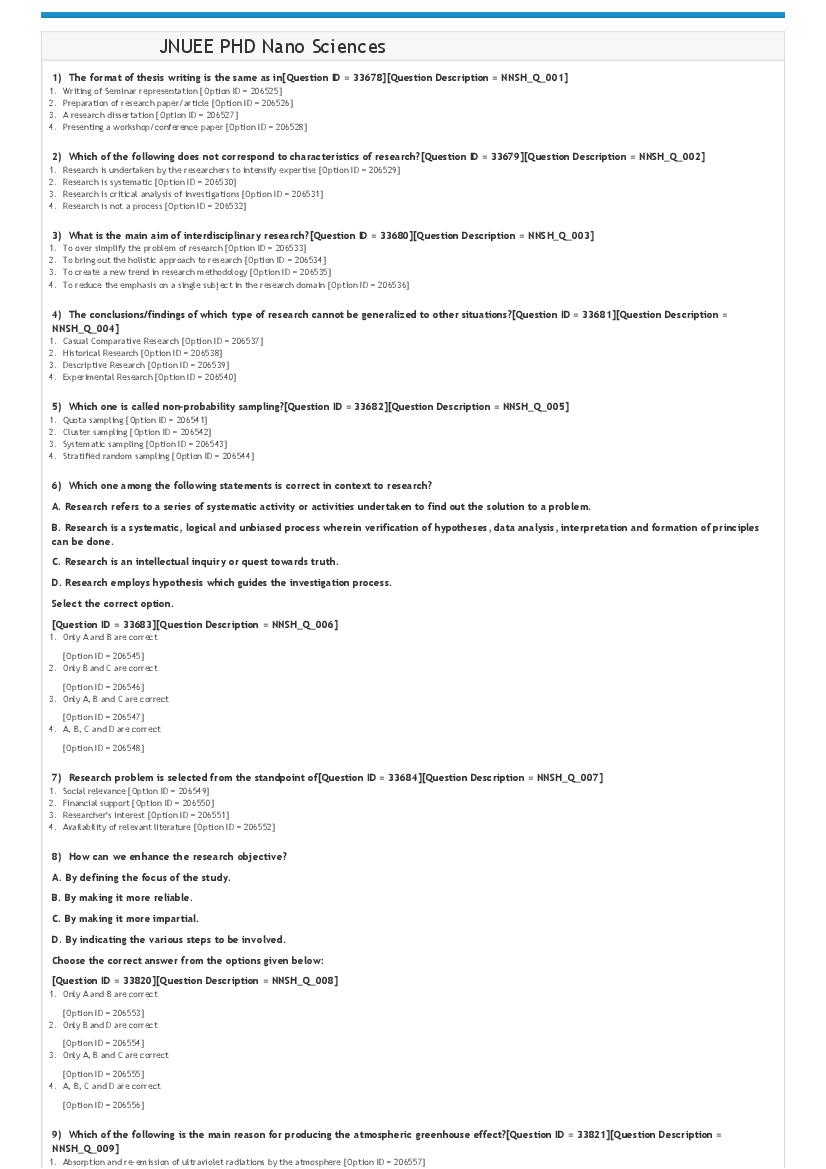
1) The format of thesis writing is the same as in[Question ID = 33678][Question Description = NNSH_Q_001]
1. Writing of Seminar representation [Option ID = 206525]
2. Preparation of research paper/article [Option ID = 206526]
3. A research dissertation [Option ID = 206527]
4. Presenting a workshop/conference paper [Option ID = 206528]
2) Which of the following does not correspond to characteristics of research?[Question ID = 33679][Question Description = NNSH_Q_002]
1. Research is undertaken by the researchers to intensify expertise [Option ID = 206529]
2. Research is systematic [Option ID = 206530]
3. Research is critical analysis of investigations [Option ID = 206531]
4. Research is not a process [Option ID = 206532]
3) What is the main aim of interdisciplinary research?[Question ID = 33680][Question Description = NNSH_Q_003]
1. To over simplify the problem of research [Option ID = 206533]
2. To bring out the holistic approach to research [Option ID = 206534]
3. To create a new trend in research methodology [Option ID = 206535]
4. To reduce the emphasis on a single subject in the research domain [Option ID = 206536]
4) The conclusions/findings of which type of research cannot be generalized to other situations?[Question ID = 33681][Question Description =
NNSH_Q_004]
1. Casual Comparative Research [Option ID = 206537]
2. Historical Research [Option ID = 206538]
3. Descriptive Research [Option ID = 206539]
4. Experimental Research [Option ID = 206540]
5) Which one is called non‐probability sampling?[Question ID = 33682][Question Description = NNSH_Q_005]
1. Quota sampling [Option ID = 206541]
2. Cluster sampling [Option ID = 206542]
3. Systematic sampling [Option ID = 206543]
4. Stratified random sampling [Option ID = 206544]
6) Which one among the following statements is correct in context to research?
A. Research refers to a series of systematic activity or activities undertaken to find out the solution to a problem.
B. Research is a systematic, logical and unbiased process wherein verification of hypotheses, data analysis, interpretation and formation of principles
can be done.
C. Research is an intellectual inquiry or quest towards truth.
D. Research employs hypothesis which guides the investigation process.
Select the correct option.
[Question ID = 33683][Question Description = NNSH_Q_006]
1. Only A and B are correct
[Option ID = 206545]
2. Only B and C are correct
[Option ID = 206546]
3. Only A, B and C are correct
[Option ID = 206547]
4. A, B, C and D are correct
[Option ID = 206548]
7) Research problem is selected from the standpoint of[Question ID = 33684][Question Description = NNSH_Q_007]
1. Social relevance [Option ID = 206549]
2. Financial support [Option ID = 206550]
3. Researcher's interest [Option ID = 206551]
4. Availability of relevant literature [Option ID = 206552]
8) How can we enhance the research objective?
A. By defining the focus of the study.
B. By making it more reliable.
C. By making it more impartial.
D. By indicating the various steps to be involved.
Choose the correct answer from the options given below:
[Question ID = 33820][Question Description = NNSH_Q_008]
1. Only A and B are correct
[Option ID = 206553]
2. Only B and D are correct
[Option ID = 206554]
3. Only A, B and C are correct
[Option ID = 206555]
4. A, B, C and D are correct
[Option ID = 206556]
9) Which of the following is the main reason for producing the atmospheric greenhouse effect?[Question ID = 33821][Question Description =
NNSH_Q_009]
1. Absorption and re‐emission of ultraviolet radiations by the atmosphere [Option ID = 206557]
Page 2
3. Absorption and re‐emission of visible light by the atmosphere [Option ID = 206559]
4. None of the above [Option ID = 206560]
10) Which of the following is the cause of soil pollution?[Question ID = 33822][Question Description = NNSH_Q_010]
1. Ozone [Option ID = 206561]
2. Aerosol [Option ID = 206562]
3. Acid rain [Option ID = 206563]
4. None of the above [Option ID = 206564]
11) Which of the following gas is present in the air in maximum amount?[Question ID = 33823][Question Description = NNSH_Q_011]
1. Nitrogen oxide [Option ID = 206565]
2. Oxygen [Option ID = 206566]
3. Carbon dioxide [Option ID = 206567]
4. Methane [Option ID = 206568]
12) Which of the following energy is converted into electrical energy by a lead storage battery?[Question ID = 33824][Question Description =
NNSH_Q_012]
1. Mechanical energy [Option ID = 206569]
2. Solar energy [Option ID = 206570]
3. Chemical energy [Option ID = 206571]
4. Heat energy [Option ID = 206572]
13) Which of the following is said to be a biodegradable waste?[Question ID = 33825][Question Description = NNSH_Q_013]
1. Plastics [Option ID = 206573]
2. Glasses [Option ID = 206574]
3. Eggshell [Option ID = 206575]
4. Polythene [Option ID = 206576]
14) The uses of CFCs are ‐[Question ID = 33826][Question Description = NNSH_Q_014]
1. Only insulators [Option ID = 206577]
2. Only aerosol propellants [Option ID = 206578]
3. Only refrigerants [Option ID = 206579]
4. All of the above [Option ID = 206580]
15) The ozone layer is present in ‐[Question ID = 33827][Question Description = NNSH_Q_015]
1. Mesosphere [Option ID = 206581]
2. Thermosphere [Option ID = 206582]
3. Stratosphere [Option ID = 206583]
4. None of the above [Option ID = 206584]
16) Paper is made up of[Question ID = 33828][Question Description = NNSH_Q_016]
1. Polythene and cotton [Option ID = 206585]
2. Lipids and proteins [Option ID = 206586]
3. Plastics and glass [Option ID = 206587]
4. Grass and bamboo [Option ID = 206588]
17) On which day the world environment day is celebrated?[Question ID = 33829][Question Description = NNSH_Q_017]
1. 5th April [Option ID = 206589]
2. 15th May [Option ID = 206590]
3. 5th June [Option ID = 206591]
4. 25th April [Option ID = 206592]
18) PNG stands for ‐[Question ID = 33830][Question Description = NNSH_Q_018]
1. Pumped Natural gas [Option ID = 206593]
2. Pressurized Natural gas [Option ID = 206594]
3. Piped Natural gas [Option ID = 206595]
4. Portable Natural gas [Option ID = 206596]
19) What is a Microsoft PowerPoint?[Question ID = 33831][Question Description = NNSH_Q_019]
1. Spreadsheet Program [Option ID = 206597]
2. Presentation Program [Option ID = 206598]
3. Database Program [Option ID = 206599]
4. All of the above [Option ID = 206600]
20) Which of the following is the file extension of the PowerPoint application?[Question ID = 33832][Question Description = NNSH_Q_020]
1. .pptx [Option ID = 206601]
2. .jpg [Option ID = 206602]
3. .html [Option ID = 206603]
4. .docs [Option ID = 206604]
21) Which of the following compound is mainly used in hand sanitizer?[Question ID = 33833][Question Description = NNSH_Q_021]
1. Aldehyde [Option ID = 206605]
2. Acetic acid [Option ID = 206606]
3. Alcohol [Option ID = 206607]
4. Ketone [Option ID = 206608]
22) Which of the following is the first step in starting the research process?[Question ID = 33834][Question Description = NNSH_Q_022]
1. Searching sources of information to locate problem [Option ID = 206609]
2. Survey of related literature [Option ID = 206610]
3. Identification of problem [Option ID = 206611]
4. Searching for solutions to the problem [Option ID = 206612]
23) Which of the following is not a “Graphic representation”?[Question ID = 33835][Question Description = NNSH_Q_023]
1. Pie Chart [Option ID = 206613]
2. Bar Chart [Option ID = 206614]
3. Table [Option ID = 206615]
4. Histogram [Option ID = 206616]
Page 3
ID = 33836][Question Description = NNSH_Q_024]
1. Copyright [Option ID = 206617]
2. Geographical indications [Option ID = 206618]
3. Patents [Option ID = 206619]
4. Registered designs [Option ID = 206620]
25) Which of the following is not true about e‐journals?[Question ID = 33837][Question Description = NNSH_Q_025]
1. They are distributed through digital methods. [Option ID = 206621]
2. They also have editors or editorial boards. [Option ID = 206622]
3. They are publications of serial nature. [Option ID = 206623]
4. They are always free of cost. [Option ID = 206624]
26) A research paper[Question ID = 33838][Question Description = NNSH_Q_026]
1. is a compilation of information on a topic. [Option ID = 206625]
2. contains original research as deemed by the author. [Option ID = 206626]
3. contains peer‐reviewed original research or evaluation of research conducted by others. [Option ID = 206627]
4. can be published in more than one journal. [Option ID = 206628]
27) A Gigabyte is equal to[Question ID = 33839][Question Description = NNSH_Q_027]
1. 1024 Megabytes [Option ID = 206629]
2. 1024 Kilobytes [Option ID = 206630]
3. 1024 Terabytes [Option ID = 206631]
4. 1024 Bytes [Option ID = 206632]
28) Which one of the following statements is not correct about the University Grants Commission (UGC)?[Question ID = 33840][Question Description =
NNSH_Q_028]
1. It was established in 1956 by an Act of Parliament. [Option ID = 206633]
2. It is tasked with promoting and coordinating higher education. [Option ID = 206634]
3. It receives Plan and Non‐Plan funds from the Central Government. [Option ID = 206635]
4. It receives funds from State Governments in respect of State Universities. [Option ID = 206636]
29) Full form of URL is[Question ID = 33841][Question Description = NNSH_Q_029]
1. University Resource Locator [Option ID = 206637]
2. Uniform Resource Locator [Option ID = 206638]
3. Uniform Reform Locator [Option ID = 206639]
4. Universal Reform Locations [Option ID = 206640]
30) The effect of increase in carbon dioxide level of the atmosphere and its profound effect on our climate is called the[Question ID = 33842]
[Question Description = NNSH_Q_030]
1. Catalytic conversion [Option ID = 206641]
2. Greenhouse effect [Option ID = 206642]
3. Global warming [Option ID = 206643]
4. Both 2) and 3) [Option ID = 206644]
31) Which one of the following options is incorrect?[Question ID = 33843][Question Description = NNSH_Q_031]
1. UGC is University Grants Commission whereas NAAC is National Assessment and Accreditation Council. [Option ID = 206645]
2. UGC approves a college or University whereas NAAC accredits the programs offered in the University or institute. [Option ID = 206646]
3. NAAC is an accreditation body, which comes under the University Grants Commission of India. [Option ID = 206647]
4. NAAC is a statutory body. [Option ID = 206648]
32) The software used to navigate through the web is known as[Question ID = 33844][Question Description = NNSH_Q_032]
1. Website [Option ID = 206649]
2. Web Browser [Option ID = 206650]
3. Internet [Option ID = 206651]
4. World Wide Web [Option ID = 206652]
33) Which of the following university/institute is ranked first in the NIRF Rankings 2020?[Question ID = 33845][Question Description = NNSH_Q_033]
1. Jawaharlal Nehru University, New Delhi [Option ID = 206653]
2. Central University of Hyderabad [Option ID = 206654]
3. Indian Institute of Science, Bangalore [Option ID = 206655]
4. Institute of Chemical Technology, Mumbai [Option ID = 206656]
34) Which of the following is/are instant messaging application(s)?
A. WhatsApp
B. Telegram
C. Viber
Select the correct answer from the options given below:
[Question ID = 33846][Question Description = NNSH_Q_034]
1. A and B only
[Option ID = 206657]
2. B and C only
[Option ID = 206658]
3. A only
[Option ID = 206659]
4. A, B and C
[Option ID = 206660]
35) Which of the following is an open‐source software?[Question ID = 33847][Question Description = NNSH_Q_035]
1. MS Office [Option ID = 206661]
2. Windows [Option ID = 206662]
3. Mozilla Firefox [Option ID = 206663]
4. Adobe Photoshop [Option ID = 206664]
Page 4
1. Keyboard [Option ID = 206665]
2. Printer [Option ID = 206666]
3. Speaker [Option ID = 206667]
4. Monitor [Option ID = 206668]
37) MOOC stands for[Question ID = 33849][Question Description = NNSH_Q_037]
1. Media Online Open Course [Option ID = 206669]
2. Massachusetts Open Online Course [Option ID = 206670]
3. Massive Open Online Course [Option ID = 206671]
4. Myrind Open Online Course [Option ID = 206672]
38) Which one of the following is not a search engine?[Question ID = 33850][Question Description = NNSH_Q_038]
1. Google [Option ID = 206673]
2. Chrome [Option ID = 206674]
3. Yahoo [Option ID = 206675]
4. Bing [Option ID = 206676]
39) Deuterium and tungsten lamps are used as a light source in which of the following techniques?[Question ID = 33851][Question Description =
NNSH_Q_039]
1. Nuclear magnetic resonance spectrophotometer [Option ID = 206677]
2. X‐ray diffractometer [Option ID = 206678]
3. Gas chromatograph [Option ID = 206679]
4. UV/Visible spectrophotometer [Option ID = 206680]
40) Which of the following is not true for transmission electron microscopy?[Question ID = 33852][Question Description = NNSH_Q_040]
1. Specimen should be ultrathin and dry [Option ID = 206681]
2. Produces images of a sample by scanning the surface with a focused beam of electrons [Option ID = 206682]
3. Electron beam must pass through evacuated chamber [Option ID = 206683]
4. A beam of electrons is transmitted through a specimen to form an image [Option ID = 206684]
41) Which one of the following radiations has longer wavelength?[Question ID = 33853][Question Description = NNSH_Q_041]
1. Infra‐red [Option ID = 206685]
2. Visible [Option ID = 206686]
3. X‐ray [Option ID = 206687]
4. Ultra violet [Option ID = 206688]
42) What is the name of an instrument used to measure the absorbance of a coloured compound in solution?[Question ID = 33854][Question
Description = NNSH_Q_042]
1. Ammeter [Option ID = 206689]
2. Calorimeter [Option ID = 206690]
3. Colorimeter [Option ID = 206691]
4. Coulometer [Option ID = 206692]
43) What happens to the molecules in the ion source of the mass spectrometer?[Question ID = 33855][Question Description = NNSH_Q_043]
1. They are ionized and split in fragments [Option ID = 206693]
2. They are ionized only [Option ID = 206694]
3. They lose hydrogen atoms only [Option ID = 206695]
4. They are excited and emit radiation at various wavelengths [Option ID = 206696]
44) According to the Beer‐Lambert Law, absorbance does not depend on ‐‐‐‐‐‐‐‐‐‐‐‐‐‐‐.[Question ID = 33856][Question Description = NNSH_Q_044]
1. Extinction coefficient of the sample. [Option ID = 206697]
2. Colour of the solution. [Option ID = 206698]
3. Distance that the light has travelled through the sample. [Option ID = 206699]
4. Solution concentration. [Option ID = 206700]
45) What is a virus pandemic?[Question ID = 33857][Question Description = NNSH_Q_045]
1. A sharp and rapid epidemic involving more than one country. [Option ID = 206701]
2. An outbreak which occurs again and again. [Option ID = 206702]
3. A rapid global outbreak starting from a single locus. [Option ID = 206703]
4. A characteristic of common cold virus and HIV. [Option ID = 206704]
46) Isotopes of an element have nuclei with[Question ID = 33858][Question Description = NNSH_Q_046]
1. The same number of protons, but different numbers of neutrons. [Option ID = 206705]
2. The same number of protons, and the same number of neutrons. [Option ID = 206706]
3. A different number of protons, and a different number of neutrons. [Option ID = 206707]
4. A different number of protons, and the same number of neutrons. [Option ID = 206708]
47) Which tissue sample is/are used for DNA fingerprinting?[Question ID = 33859][Question Description = NNSH_Q_047]
1. Hair only [Option ID = 206709]
2. Skin only [Option ID = 206710]
3. Blood only [Option ID = 206711]
4. All of the above [Option ID = 206712]
48) To label a statistical test definitely significant, the p value should be
[Question ID = 33860][Question Description = NNSH_Q_048]
1. < 0.5
[Option ID = 206713]
2. ≤ 0.05
[Option ID = 206714]
3. > 0.5
[Option ID = 206715]
4. =1.0
[Option ID = 206716]
49) What is not correct about Error bars?[Question ID = 33861][Question Description = NNSH_Q_049]
Page 5
2. Error bars are used on graphs to indicate the error or uncertainty in a reported measurement [Option ID = 206718]
3. Error bars can also be expressed in a plus–minus sign (±), where plus sign indicates the upper limit of the error and minus the lower limit of the error. [Option ID = 206719]
4. Error bar does not communicate about how spread the data are around the mean value. [Option ID = 206720]
50) All of these are true for Bibliography except[Question ID = 33862][Question Description = NNSH_Q_050]
1. A bibliography is a list of all of the sources used during the process of research. [Option ID = 206721]
2. Bibliography includes the author names, title of work, date of publication, publication sources, page numbers, volume and issue details. [Option ID = 206722]
3. It usually includes all the sources consulted even if they are not directly cited (referred to) in the text. [Option ID = 206723]
4. Bibliography does not give credit to authors, whose work has been consulted during research. [Option ID = 206724]
51) The energy required to initiate a reaction is[Question ID = 33863][Question Description = NNSH_Q_051]
1. potential energy of the reactants [Option ID = 206725]
2. potential energy of the products [Option ID = 206726]
3. activation energy [Option ID = 206727]
4. heat of reaction [Option ID = 206728]
52) Consider the following choices:
A. solid to liquid
B. liquid to gas
C. solid to gas
Which phase change above is endothermic?
Choose the correct answer from the options given below:
[Question ID = 33864][Question Description = NNSH_Q_052]
1. A only
[Option ID = 206729]
2. B only
[Option ID = 206730]
3. A and B only
[Option ID = 206731]
4. A, B and C
[Option ID = 206732]
53) Which group in the periodic table contains elements from all three phases of matter at 298 K and 1 atm?[Question ID = 33865][Question
Description = NNSH_Q_053]
1. 1 [Option ID = 206733]
2. 2 [Option ID = 206734]
3. 16 [Option ID = 206735]
4. 17 [Option ID = 206736]
54) Which one of the following electronic transitions have highest energy?[Question ID = 33866][Question Description = NNSH_Q_054]
1. n to σ* [Option ID = 206737]
2. σ to σ * [Option ID = 206738]
3. π to π * [Option ID = 206739]
4. σ * to π * [Option ID = 206740]
55) Considering 1 mole of CH4(g) at STP, which of the following statement are true?
A. 6.02 × 10²³ molecules of CH4(g) are there.
B. The sample occupies 22.4 L of volume.
C. The sample will weigh 16 g.
Choose the correct answer from the options given below:
[Question ID = 33867][Question Description = NNSH_Q_055]
1. A, B and C
[Option ID = 206741]
2. A and B only
[Option ID = 206742]
3. A and C only
[Option ID = 206743]
4. B and C only
[Option ID = 206744]
56) The reaction: NaCl(s) ⇌ NaCl(aq) has reached equilibrium. For the phase equilibrium to exist, the NaCl(aq) must be a solution which is[Question ID
= 33868][Question Description = NNSH_Q_056]
1. concentrated [Option ID = 206745]
2. saturated [Option ID = 206746]
3. diluted [Option ID = 206747]
4. heated [Option ID = 206748]
57) In the mass spectrum of 2‐pentanone, base peak will be observed at m/z value of[Question ID = 33869][Question Description = NNSH_Q_057]
1. 97 [Option ID = 206749]
2. 54 [Option ID = 206750]
3. 16 [Option ID = 206751]
4. 43 [Option ID = 206752]
58) How many molecules of H2 gas are present in a 11.2 liter sample at 273 K and a pressure of 760 mm Hg?
[Question ID = 33870][Question Description = NNSH_Q_058]
1. 0.5
[Option ID = 206753]
Page 6
[Option ID = 206754]
3. 1.5
[Option ID = 206755]
4. 2
[Option ID = 206756]
59) Which of the following carbocations is likely to undergo rearrangement through a methyl shift?
[Question ID = 33890][Question Description = NNSH_Q_059]
1. II and III only [Option ID = 206913]
2. II only [Option ID = 206914]
3. I and II only [Option ID = 206915]
4. I and III only [Option ID = 206916]
60) Alkenes add to OsO4 to give diolate species that hydrolyzes to give______[Question ID = 33871][Question Description = NNSH_Q_060]
1. cis‐diols [Option ID = 206757]
2. trans‐diols [Option ID = 206758]
3. mixture of both cis‐diols and trans‐diols [Option ID = 206759]
4. simple diol [Option ID = 206760]
61) Compounds of carbon and hydrogen, represented by general formula CxHyOz, where hydrogen and oxygen are not present in the ratio of water
are called as.........[Question ID = 33872][Question Description = NNSH_Q_061]
1. Carbohydrates [Option ID = 206761]
2. Terpenoids [Option ID = 206762]
3. Alkaloids [Option ID = 206763]
4. Aldehydes [Option ID = 206764]
62) Toxic nicotine present in the tobacco belongs to which of the following class?[Question ID = 33873][Question Description = NNSH_Q_062]
1. Amino acids [Option ID = 206765]
2. Carotenoids [Option ID = 206766]
3. Alkaloids [Option ID = 206767]
4. Purines [Option ID = 206768]
63) Consider the folowing reduction reaction:
Which of the following reagents could accomplish the above reduction?
[Question ID = 33891][Question Description = NNSH_Q_063]
1. NaBH4
[Option ID = 206917]
2. MgSO4
[Option ID = 206918]
3. PbS
[Option ID = 206919]
4. TiO2
[Option ID = 206920]
64) Main reason for the deviation from the Beer’s law among the following is/are:
A. Dissociation of analyte
B. Very High concentration of the analyte
C. Light from the lamp source
Choose the correct answer from the options given below:
[Question ID = 33874][Question Description = NNSH_Q_064]
1. A only
[Option ID = 206769]
2. A and B only
[Option ID = 206770]
3. C only
[Option ID = 206771]
4. A and C only
[Option ID = 206772]
65) Boric acid is a weak acid in aqueous solution. But its acidity increases significantly in the presence of ethylene glycol, because
Page 7
1. Ethylene glycol releases additional H+
[Option ID = 206773]
2. B(OH)4‐ is consumed in forming a complex with ethylene glycol
[Option ID = 206774]
3. Ethylene glycol neutralizes H+ released by boric acid
[Option ID = 206775]
4. Boric acid dissociates better in the mixed‐solvent
[Option ID = 206776]
66) Which name reaction is used to converts acetamide to methanamine?
[Question ID = 34383][Question Description = NNSH_Q_066]
1. Hoffmann bromamide reaction
[Option ID = 206777]
2. Stephens reaction
[Option ID = 206778]
3. Cannizzaro reaction
[Option ID = 206779]
4. A ldol condensation
[Option ID = 206780]
67) Super glue or crazy glue is.....
[Question ID = 34384][Question Description = NNSH_Q_067]
1. Poly (methyl αcyanoacrylate)
[Option ID = 206781]
2. Poly (ethyl acrylate)
[Option ID = 206782]
3. Poly (methyl methacrylate)
[Option ID = 206783]
4. Poly (ethyl methacrylate)
[Option ID = 206784]
68) One mole of magnesium in the vapour state absorbed 1200kJ of energy. If the first and second ionization potentials of magnesium are 750 and
1450 kJ mol‐1 respectively, the final composition of the mixture is .....
[Question ID = 34385][Question Description = NNSH_Q_068]
1. 69% Mg+, 31% Mg2+
[Option ID = 206785]
2. 59% Mg+, 41% Mg2+
[Option ID = 206786]
3. 49% Mg+, 51% Mg2+
[Option ID = 206787]
4. 39% Mg+, 61% Mg2+
[Option ID = 206788]
69) Which of these statements about a galvanic cell are NOT true?
A. the cathode carries a positive sign
B. the anions migrate toward the cathode
C. the electrons are released through the anode
D. reduction occurs at the anode
Choose the correct option below:
[Question ID = 34386][Question Description = NNSH_Q_069]
1. A and B only
[Option ID = 206789]
2. A and C only
[Option ID = 206790]
3. B and C only
[Option ID = 206791]
4. B and D only
[Option ID = 206792]
70) A graph of ln K against 1/T (abscissa) comes out to be a straight line. The intercept on ordinate axis will be equal to
[Question ID = 34387][Question Description = NNSH_Q_070]
1. ΔSo/ R
[Option ID = 206793]
2. ΔHo/ R
[Option ID = 206794]
3. ΔGo/ T
[Option ID = 206795]
4. ΔSo/ T
[Option ID = 206796]
71) Which two of the following metals do not react with HCl(aq)?
Page 8
[Question ID = 34388][Question Description = NNSH_Q_071]
1. Ag and Zn
[Option ID = 206797]
2. Mg and Fe
[Option ID = 206798]
3. Ag and Au
[Option ID = 206799]
4. Zn and Mg
[Option ID = 206800]
72) Consider the following reactions:
A. AgCl → Ag+ + Cl–
B. Ag+ + Cl– → AgCl
C. Ag+ + Cl– → Ag + Cl
D. Ag + Cl → Ag+ + Cl–
Which of the above reaction(s) have the equilibrium expression, k = [Ag+] [Cl–]?
Choose the Correct option below:
[Question ID = 34389][Question Description = NNSH_Q_072]
1. A, B and D only
[Option ID = 206801]
2. A only
[Option ID = 206802]
3. B only
[Option ID = 206803]
4. B and C only
[Option ID = 206804]
73) How many moles of He atoms are in 6.46 g of He?[Question ID = 34390][Question Description = NNSH_Q_073]
1. 2 moles [Option ID = 206805]
2. 1 mole [Option ID = 206806]
3. 1.61 moles [Option ID = 206807]
4. 0.5 moles [Option ID = 206808]
74) A person’s average daily intake of glucose (a form of sugar) is 0.0833 pound (lb). What is this mass in milligrams (mg)?
(1 lb = 453.6 g)
[Question ID = 34391][Question Description = NNSH_Q_074]
1. 2.79 X 10² mg
[Option ID = 206809]
2. 1.18 X 10⁴ mg
[Option ID = 206810]
3. 6.26 X 10³ mg
[Option ID = 206811]
4. 3.78 X 10⁴ mg
[Option ID = 206812]
75) Consider the following chemical formulas: Cu(NO3) 2, KH2PO4, NH4ClO3.
The naming combinations for the above are:
A. copper(II) nitrate, potassium dihydrogen phosphate, ammonium chlorate
B. copper(III) nitrate, potassium dihydrogen phosphine, ammonium chlorate
C. copper(II) nitrate, potassium dihydrogen phosphate, ammonium perchlorate
D. copper(II) nitrite, potassium dihydrogen phosphate, ammonium chlorate
Choose the correct naming combination for above compounds from the options given below:
[Question ID = 34392][Question Description = NNSH_Q_075]
1. A,B,C
[Option ID = 206813]
2. A,B only
[Option ID = 206814]
3. A only
[Option ID = 206815]
4. C only
[Option ID = 206816]
76) When a potassium phosphate (K3PO4) solution is mixed with a calcium nitrate [Ca(NO3) 2 ] solution, the net ionic equation for the reaction is....
[Question ID = 34393][Question Description = NNSH_Q_076]
1. 3Ca2+ (aq) + 2PO43‐ (aq) → Ca3(PO4)2 (g)
[Option ID = 206817]
2. 3Ca2+ (aq) + 2PO43‐ (aq) → Ca3(PO4)2 (l)
[Option ID = 206818]
3. 3Ca2+ (aq) + 2PO43‐ (aq) → Ca3(PO4)2 (s)
Page 9
4. 2Ca3+ (aq) + 2PO34‐ (aq) → Ca2(PO3)2 (g)
[Option ID = 206820]
77) Consider the following statements:
A. HBr is a Brønsted acid, NO2‐ is a Brønsted base and HCO3‐ a Brønsted acid.
B. HBr is a Brønsted acid, NO2‐ is a Brønsted base and HCO3‐ a Brønsted Base.
C. HBr is a Brønsted acid, NO2‐ is a Brønsted acid and HCO3‐ a Brønsted acid.
Which of the above statement(s) is correct? Choose the correct answer from the options given below:
[Question ID = 34394][Question Description = NNSH_Q_077]
1. A, B and C
[Option ID = 206821]
2. A and B only
[Option ID = 206822]
3. A and C only
[Option ID = 206823]
4. C only
[Option ID = 206824]
78) Which of the following is not correct for electromagnetic waves?[Question ID = 34395][Question Description = NNSH_Q_078]
1. the wavelength is the distance between two successive crests [Option ID = 206825]
2. the frequency is the number of waves which pass a given point in one second [Option ID = 206826]
3. the velocity of a wave is the distance covered by the particular wave in one second [Option ID = 206827]
4. all electromagnetic waves have equal wavelengths [Option ID = 206828]
79) If a beam of light of sufficiently high frequency is allowed to strike a metal surface in vacuum, electrons are ejected from the metal surface. This
phenomenon is called[Question ID = 34396][Question Description = NNSH_Q_079]
1. Black body radiation [Option ID = 206829]
2. Photoelectric effect [Option ID = 206830]
3. Stark effect [Option ID = 206831]
4. Zeeman effect [Option ID = 206832]
80) The correct order of increasing atomic radius for P, Si, N, referring to periodic table is:
[Question ID = 34397][Question Description = NNSH_Q_080]
1. N < P < Si
[Option ID = 206833]
2. P < N < Si
[Option ID = 206834]
3. Si < P < N
[Option ID = 206835]
4. P< Si < N
[Option ID = 206836]
81) Number of structural isomers which can be identified for pentane, C5H12
[Question ID = 34398][Question Description = NNSH_Q_081]
1. 1
[Option ID = 206837]
2. 2
[Option ID = 206838]
3. 3
[Option ID = 206839]
4. 0
[Option ID = 206840]
82) The product of the alpha decay of Rn‐220 is
[Question ID = 34399][Question Description = NNSH_Q_082]
1. Po‐216
[Option ID = 206841]
2. Rn‐220
[Option ID = 206842]
3. Rn‐216
[Option ID = 206843]
4. Ra‐224
[Option ID = 206844]
83) Which of the following statements about the biological effects of radiation is false?[Question ID = 34400][Question Description = NNSH_Q_083]
1. Radiation can cause leukemia [Option ID = 206845]
2. Ionizing radiation is more dangerous than non‐ionising radiation [Option ID = 206846]
3. Radon is absorbed through the skin [Option ID = 206847]
4. Radon is harmful because it decays to polonium [Option ID = 206848]
84) Which statement in the following is incorrect?[Question ID = 34401][Question Description = NNSH_Q_084]
1. all molecules with polar bonds have dipole moment [Option ID = 206849]
2. all molecules with polar bonds may or may not have dipole moment [Option ID = 206850]
3. the greater the difference in electronegativity between two atoms, greater is the polarity [Option ID = 206851]
4. if the electronegativity difference between two atoms is greater than 1.7, the bond will be ionic [Option ID = 206852]
Page 10
[Question ID = 34402][Question Description = NNSH_Q_085]
1. ΔH = ΔE
[Option ID = 206853]
2. ΔH = ΔE + RT
[Option ID = 206854]
3. ΔH = ΔE + ½ RT
[Option ID = 206855]
4. ΔH = ΔE – ½ RT
[Option ID = 206856]
86) Which of the following compounds will show an IR absorption band at 2200 cm–1?
[Question ID = 33876][Question Description = NNSH_Q_086]
1. CH3CH2CH2CH=O
[Option ID = 206857]
2. CH3CH2CH2C≡N
[Option ID = 206858]
3. CH3CH2CH2OH
[Option ID = 206859]
4. CH3CH2CH2COOH
[Option ID = 206860]
87) The IR spectrum of carbon‐carbon triple bond show a stretching vibration at....
[Question ID = 33877][Question Description = NNSH_Q_087]
1. 3100 cm–1
[Option ID = 206861]
2. 2100 cm– 1
[Option ID = 206862]
3. 2700 cm– 1
[Option ID = 206863]
4. 3300 cm–1
[Option ID = 206864]
88) Ebullioscopy deals with study of[Question ID = 33878][Question Description = NNSH_Q_088]
1. osmotic pressure and membranes [Option ID = 206865]
2. depression in freezing point [Option ID = 206866]
3. relative lowering of vapour pressure [Option ID = 206867]
4. elevation in boiling point [Option ID = 206868]
89) Which of the following statements is true?[Question ID = 33879][Question Description = NNSH_Q_089]
1. Osmosis can be reversed by application of pressure on the solution [Option ID = 206869]
2. Beckmann thermometer can be used to measure elevation in boiling point [Option ID = 206870]
3. Osmosis and diffusion are same in solutions [Option ID = 206871]
4. Barometer can be used to measure osmotic pressure [Option ID = 206872]
90) The yield of the following would be increased by
AB(g) A(g) + B(g) AB(g) + heat
[Question ID = 33880][Question Description = NNSH_Q_090]
1. decreasing the pressure
[Option ID = 206873]
2. adding additional AB to the reaction mixture
[Option ID = 206874]
3. decreasing the temperature
[Option ID = 206875]
4. adding a non‐reactive liquid to the reaction mixture
[Option ID = 206876]
91) The equilibrium constant for the isomerization of butane at 25°C is Kc = 7.94.
If 5.00 g butane is introduced into a 12.5 L flask at 25°C, what mass of isobutane will be present when equilibrium is reached?
[Question ID = 33892][Question Description = NNSH_Q_091]
1. 4.44 g
[Option ID = 206921]
2. 0.00613 g
[Option ID = 206922]
3. 0.684 g
[Option ID = 206923]
4. 39.7 g
[Option ID = 206924]
92) If a mixture of gases is in contact with a liquid, the partial pressure of the individual gas determines the mass of each gas dissolving i.e., the
Page 11
1. total pressure [Option ID = 206877]
2. concentration of the liquid [Option ID = 206878]
3. partial pressure [Option ID = 206879]
4. temperature [Option ID = 206880]
93) Consider the reaction in which ammonia is synthesized from nitrogen and hydrogen gases:
N2(g) + 3H2(g) → 2NH3(g)
How is the rate of formation of ammonia related to the rate of consumption of hydrogen?
[Question ID = 33882][Question Description = NNSH_Q_093]
1. the rate of formation of ammonia is half the rate of consumption of hydrogen
[Option ID = 206881]
2. the rate of formation of ammonia is twice the rate of consumption of hydrogen
[Option ID = 206882]
3. the rate of formation of ammonia is equal to the rate of consumption of hydrogen
[Option ID = 206883]
4. the rate of formation of ammonia is two‐thirds the rate of consumption of hydrogen
[Option ID = 206884]
94) Which of the following reactions occurs at the fastest rate?[Question ID = 33883][Question Description = NNSH_Q_094]
1. one which is exothermic by 15 kcal/mole and has an activation energy of 20 kcal/mole [Option ID = 206885]
2. one which is endothermic by 5 kcal/mole and has an activation energy of 30 kcal/mole [Option ID = 206886]
3. one which is exothermic by 30 kcal/mole and has an activation energy of 15 kcal/mole [Option ID = 206887]
4. one which is exothermic by 20 kcal/mole and has an activation energy of 20 kcal/mole [Option ID = 206888]
95) In Haber’s process for the synthesis of ammonia, the use of finely divided iron (a catalyst) increases:
[Question ID = 33884][Question Description = NNSH_Q_095]
1. the rate of formation of NH3 as well as amount of ammonia formed
[Option ID = 206889]
2. the rate of formation of NH3 without changing the amount of ammonia formed
[Option ID = 206890]
3. the rate of formation of NH3 but decreases the amount of ammonia formed
[Option ID = 206891]
4. the amount of ammonia formed without increasing the rate of formation
[Option ID = 206892]
96) The number of milligrams of a hydrophilic colloid that will just prevent the precipitation of 10 ml of gold sol on addition of 1 ml of 10 per cent
sodium chloride solution is called[Question ID = 33885][Question Description = NNSH_Q_096]
1. gold number [Option ID = 206893]
2. charge number [Option ID = 206894]
3. absorption number [Option ID = 206895]
4. silver number [Option ID = 206896]
97) Which of the following has minimum flocculating power?
Pb4+, Al3+, Ba2+, Na+
[Question ID = 33886][Question Description = NNSH_Q_097]
1. Na+
[Option ID = 206897]
2. Ba2+
[Option ID = 206898]
3. Al3+
[Option ID = 206899]
4. Pb4+
[Option ID = 206900]
98) An electrolytic cell is set up for the production of aluminum, which involves the reduction of Al3+ to Al. The external source passes a current of
11.2 A through the cell with an emf of 6.0 V. How long does it take for the cell to produce a pound (454 g) of aluminum metal?
[Question ID = 33887][Question Description = NNSH_Q_098]
1. 226 hr
[Option ID = 206901]
2. 40 hr
[Option ID = 206902]
3. 121 hr
[Option ID = 206903]
4. 3.26 × 10³ hr
[Option ID = 206904]
99) The solution A has pH equal to 2 and solution B has pH of 4. Which one of the following is true?[Question ID = 33888][Question Description =
NNSH_Q_099]
1. solution B is 100 times more acidic than solution A [Option ID = 206905]
2. solution B is twice more acidic than solution A [Option ID = 206906]
3. solution A is twice more acidic than solution B [Option ID = 206907]
4. solution A is 100 times more acidic than solution B [Option ID = 206908]
100) In photochemical reactions, the absorption of light takes place in[Question ID = 33889][Question Description = NNSH_Q_100]
1. primary processes only [Option ID = 206909]
2. secondary processes only [Option ID = 206910]
3. either primary or secondary process [Option ID = 206911]
Page 12
101) A phase difference π between two interfering beams is equivalent to path difference[Question ID = 33758][Question Description =
NNSH_Q_101]
1. 2λ [Option ID = 208745]
2. λ [Option ID = 208746]
3. λ/2 [Option ID = 208747]
4. λ/4 [Option ID = 208748]
102) Given below are two statements, one is labelled as Assertion A and the other is labelled as Reason R
Assertion A: Two independent sodium lamps illuminating two pinholes will not lead to any interference fringes
Reason R: Two sodium lamps are incoherent
In light of the above statements, choose the correct answer from the options given below
[Question ID = 33759][Question Description = NNSH_Q_102]
1. Both A and R are true and R is the correct explanation of A
[Option ID = 208749]
2. Both A and R are true but R is NOT the correct explanation of A
[Option ID = 208750]
3. A is true but R is false
[Option ID = 208751]
4. A is false but R is true
[Option ID = 208752]
103) Shape of the wavefront of light diverging from a point source is[Question ID = 34871][Question Description = NNSH_Q_103]
1. Planar [Option ID = 208753]
2. Cubical [Option ID = 208754]
3. Spherical [Option ID = 208755]
4. Hemispherical [Option ID = 208756]
104) Which one of the followings is incorrect for light waves? Light waves[Question ID = 34872][Question Description = NNSH_Q_104]
1. can have a unique wavelength [Option ID = 208757]
2. can transmit energy [Option ID = 208758]
3. require medium for propogation [Option ID = 208759]
4. can have a unique velocity [Option ID = 208760]
105) Two Nicol prisms have parallel polarising directions so that the intensity of the transmitted light is maximum. Through what angle must either
Nicol prism be turned if the intensity is to drop by one‐fourth of its maximum value?
[Question ID = 34873][Question Description = NNSH_Q_105]
1. θ = 30o
[Option ID = 208761]
2. θ = 45o
[Option ID = 208762]
3. θ = 60o
[Option ID = 208763]
4. θ = 90o
[Option ID = 208764]
106) Planck constant has the same dimensions as[Question ID = 34874][Question Description = NNSH_Q_106]
1. force × time [Option ID = 208765]
2. force × distance [Option ID = 208766]
3. force × speed [Option ID = 208767]
4. force × distance × time [Option ID = 208768]
107) A photon of energy hv is absorbed by a free electron of a metal having work function Φ< hv.
[Question ID = 34875][Question Description = NNSH_Q_107]
1. The electron is sure to come out
[Option ID = 208769]
2. The electron is sure to come out with a kinetic energy hv‐Φ
[Option ID = 208770]
3. Either the electron does not come out or it comes out with a kinetic energy hv‐Φ
[Option ID = 208771]
4. It may come out with a kinetic energy less than hv‐Φ
[Option ID = 208772]
108) For a particle in a one‐dimensional infinite potential well, if the quantum number 'n' and 'mass' are decreased by half, the corresponding energy
[Question ID = 34876][Question Description = NNSH_Q_108]
1. is decreased by a factor of 4
[Option ID = 208773]
2. is doubled
[Option ID = 208774]
3. is quadrupled
[Option ID = 208775]
4. is decreased by a factor of 2
[Option ID = 208776]
109) The expectation value of momentum for a free particle of energy 'E' in a one‐dimensional infinite potential well is[Question ID = 34877][Question
Description = NNSH_Q_109]
Page 13
2. √(2mE) [Option ID = 208778]
3. 2mE [Option ID = 208779]
4. √(mE) [Option ID = 208780]
110) Eigenvalue corresponding to the eigen function sinx of operator
is[Question ID = 34920][Question Description = NNSH_Q_110]
1. 4 [Option ID = 208941]
2. 1 [Option ID = 208942]
3. ‐2 [Option ID = 208943]
4. ‐1 [Option ID = 208944]
111) Which one of the followings is false?[Question ID = 34878][Question Description = NNSH_Q_111]
1. [Px,Px]=ih/2π [Option ID = 208781]
2. [Px, Py]= 0 [Option ID = 208782]
3. [x,Py]=0 [Option ID = 208783]
4. [Px,x]=‐ih/2π [Option ID = 208784]
112) The de‐Broglie hypothesis is associated with[Question ID = 34879][Question Description = NNSH_Q_112]
1. Wave nature of protons only [Option ID = 208785]
2. Wave nature of electrons only [Option ID = 208786]
3. Wave nature of all material particles [Option ID = 208787]
4. None of above [Option ID = 208788]
113) Which one of the following relations can be used to determine de‐Broglie wavelength associated with a particle of mass 'm' and having kinetic
energy 'Ek ' ?
[Question ID = 34880][Question Description = NNSH_Q_113]
1. λ = h/√Ek
[Option ID = 208789]
2. λ = h/√(mEk)
[Option ID = 208790]
3. λ = h/√(2mEk)
[Option ID = 208791]
4. None of above
[Option ID = 208792]
114) A normalized wave function is given by ,where ϕ0 and ϕ1 are normalized Eigen functions with energies E0 and E1,
corresponding to ground state and first excited state respectively. What is the probability of getting E1 when energy is measured?
[Question ID = 34881][Question Description = NNSH_Q_114]
1. 2/3
[Option ID = 208793]
2. √(2/3
[Option ID = 208794]
3. 1
[Option ID = 208795]
4. 0
[Option ID = 208796]
115) Energy levels of the Harmonic Oscillator corresponding to quantum states denoted by n (n = 0, 1, 2, …) are proportional to
[Question ID = 34882][Question Description = NNSH_Q_115]
1. n
[Option ID = 208797]
2. √n
[Option ID = 208798]
3. n+1
[Option ID = 208799]
4. n2
[Option ID = 208800]
116) Which of the following is true for the transmission probability T for a particle incident on a potential barrier of width L ?
[Question ID = 34883][Question Description = NNSH_Q_116]
1. T is proportional to L
[Option ID = 208801]
2. T is inversely proportional to L
[Option ID = 208802]
3. T is inversely proportional to L2
[Option ID = 208803]
4. Log of T is proportional to L
[Option ID = 208804]
117) The critical magnetic field of a superconductor[Question ID = 34884][Question Description = NNSH_Q_117]
1. Varies linearly with temperature [Option ID = 208805]
2. Is independent of temperature [Option ID = 208806]
Page 14
4. Decreases with increasing temperature [Option ID = 208808]
118) An electric dipole is placed in an uniform electric field. The net electric force on the dipole[Question ID = 34885][Question Description =
NNSH_Q_118]
1. is always zero [Option ID = 208809]
2. depends on the orientation of the dipole [Option ID = 208810]
3. can never be zero [Option ID = 208811]
4. depends on the strength of the dipole [Option ID = 208812]
119) Which one of the following statements is correct?[Question ID = 34886][Question Description = NNSH_Q_119]
1. Gauss's law is valid only for symmetrical charge distributions [Option ID = 208813]
2. Gauss's law is valid only for charges placed in vacuum [Option ID = 208814]
3. The electric field calculated by Gauss's law is the field due to the charges inside the Gaussian surface [Option ID = 208815]
4. The flux of the electric field through a closed surface due to all the charges is equal to the flux due to the charges enclosed by the surface [Option ID = 208816]
120) Electric field outside an uniformly charged sphere of radius R and total charge q at distance r (>R) from its centre is proportional to
[Question ID = 34887][Question Description = NNSH_Q_120]
1. q/r
[Option ID = 208817]
2. q/r2
[Option ID = 208818]
3. q/R
[Option ID = 208819]
4. q/R2
[Option ID = 208820]
121) Which of the following is correct for the given statement
Magnetic field at position r due small infinitesimal wire of length dl placed at the origin and carrying a current I
[Question ID = 34888][Question Description = NNSH_Q_121]
1. is maximum if r and dl are parallel
[Option ID = 208821]
2. is maximum if r and dl are perpendicular
[Option ID = 208822]
3. does not depend on angle between r and dl
[Option ID = 208823]
4. does not depend on the direction of the current
[Option ID = 208824]
122) Consider a long straight wire of radius a, carrying a current I distributed uniformly over its cross section. The magnitude of magnetic field
is[Question ID = 34889][Question Description = NNSH_Q_122]
1. Maximum at the axis of the wire [Option ID = 208825]
2. Maximum at radial distance of a/2 from the axis of the wire [Option ID = 208826]
3. Maximum at the surface of the wire [Option ID = 208827]
4. Minimum at the surface of the wire [Option ID = 208828]
123) In electromagnetic wave, the phase difference between electric and magnetic field vectors E and B, respectively is[Question ID = 34890]
[Question Description = NNSH_Q_123]
1. 0 [Option ID = 208829]
2. π/2 [Option ID = 208830]
3. π/4 [Option ID = 208831]
4. π [Option ID = 208832]
124) The first law of thermodynamics is a statement of[Question ID = 34501][Question Description = NNSH_Q_124]
1. conservation of heat [Option ID = 208833]
2. conservation of work [Option ID = 208834]
3. conservation of momentum [Option ID = 208835]
4. conservation of energy [Option ID = 208836]
125) Consider the following statements:
A. An emf can be induced by moving a conductor in a magnetic field.
B. An emf can be induced by changing the magnetic field.
Choose the correct answer from the options given below:
[Question ID = 34502][Question Description = NNSH_Q_125]
1. Both A and B are true
[Option ID = 208837]
2. A is true but B is false
[Option ID = 208838]
3. B is true but A is false
[Option ID = 208839]
4. Both A and B are false
[Option ID = 208840]
126) Which of the following is incorrect?[Question ID = 34503][Question Description = NNSH_Q_126]
1. First law of thermodynamics is not equivalent to law of conservation of energy [Option ID = 208841]
2. Second law of thermodynamics disallows many phenomena which are consistent with first law of thermodynamics [Option ID = 208842]
3. First law of thermodynamics cannot explain why many phenomena do not occur in nature [Option ID = 208843]
4. First law of thermodynamics treats heat as form of energy in transit [Option ID = 208844]
Page 15
following is/are correct?
A. Q = 0
B. W = 0
C. Q=W
D. Q≠W
Choose the correct answer from the options given below:
[Question ID = 34504][Question Description = NNSH_Q_127]
1. Only C
[Option ID = 208845]
2. Only B
[Option ID = 208846]
3. Only A
[Option ID = 208847]
4. A and D
[Option ID = 208848]
128) Thermal expansion of materials arises from[Question ID = 34505][Question Description = NNSH_Q_128]
1. Strong bonds [Option ID = 208849]
2. Thermal vibrations [Option ID = 208850]
3. Weak bonds [Option ID = 208851]
4. Asymmetry of potential energy curve [Option ID = 208852]
129) Which of the following structures have equal atomic packing factor (APF)?
P. Simple cubic
F. Face centred cubic
I. Body centred cubic
H. Hexagonal close packed
Choose the correct answer from the options given below:
[Question ID = 34506][Question Description = NNSH_Q_129]
1. P and I
[Option ID = 208853]
2. I and F
[Option ID = 208854]
3. I and H
[Option ID = 208855]
4. F and H
[Option ID = 208856]
130) Among the crystal systems, the one with the least symmetry is[Question ID = 34507][Question Description = NNSH_Q_130]
1. Tetragonal [Option ID = 208857]
2. Monoclinic [Option ID = 208858]
3. Rhombohedral [Option ID = 208859]
4. Triclinic [Option ID = 208860]
131) A plane cuts intercepts a, 2b and 3c along the crystallographic axes in a crystal. The Miller indices of plane is[Question ID = 34508][Question
Description = NNSH_Q_131]
1. (123) [Option ID = 208861]
2. (632) [Option ID = 208862]
3. (362) [Option ID = 208863]
4. None of these [Option ID = 208864]
132) Which of the following statement/s is/are correct?
A. Reciprocal lattice of body centred cubic lattice is face centred cubic
B. Reciprocal lattice of body centred cubic lattice is body centred cubic
C. Reciprocal lattice of body centred cubic lattice is simple cubic
D. Reciprocal lattice of simple cubic lattice is simple cubic
Choose the correct answer from the options given below:
[Question ID = 34509][Question Description = NNSH_Q_132]
1. Only A
[Option ID = 208865]
2. Only C
[Option ID = 208866]
3. A and D
[Option ID = 208867]
4. Only D
[Option ID = 208868]
133) X‐rays of wavelength λ = a are reflected from the (200) plane of a simple cubic lattice. If the lattice constant is a, the corresponding Bragg angle
(in radian) is[Question ID = 34510][Question Description = NNSH_Q_133]
1. π/2 [Option ID = 208869]
2. π/3 [Option ID = 208870]
3. π/5 [Option ID = 208871]
Page 16
134) A system can be taken from the initial state p1, V1 to the final state p2, V2 by two different methods. Let ΔQ and ΔW represent the heat given
to the system and the work done by the system. Which of the following must be the same in both the methods?[Question ID = 34511][Question
Description = NNSH_Q_134]
1. ΔQ [Option ID = 208873]
2. ΔW [Option ID = 208874]
3. ΔQ + ΔW [Option ID = 208875]
4. ΔQ − ΔW [Option ID = 208876]
135) The second order reflection from (200) planes coincides with the first order reflection from[Question ID = 34512][Question Description =
NNSH_Q_135]
1. (100) [Option ID = 208877]
2. (400) [Option ID = 208878]
3. (200) [Option ID = 208879]
4. None of these [Option ID = 208880]
136) Thermal conduction in metals accomplished by the crystal lattice is substantially[Question ID = 34513][Question Description = NNSH_Q_136]
1. More than the electron conduction [Option ID = 208881]
2. Equal to the electron conduction [Option ID = 208882]
3. Less than the electron conduction [Option ID = 208883]
4. There is no relation with electron [Option ID = 208884]
137) The thermal conductivity of a material at temperature very much greater than Debye temperature[Question ID = 34514][Question Description =
NNSH_Q_137]
1. Is independent of temperature [Option ID = 208885]
2. Decrease as 1/T [Option ID = 208886]
3. Increases with increasing temperature [Option ID = 208887]
4. Increases exponentially with temperature [Option ID = 208888]
138) With the decrease in temperature, the resistance of a normal metal[Question ID = 34515][Question Description = NNSH_Q_138]
1. Remains constant [Option ID = 208889]
2. Increases [Option ID = 208890]
3. Decreases [Option ID = 208891]
4. Becomes zero [Option ID = 208892]
139) Which of the following pairs represent units of the same physical quantity?[Question ID = 34516][Question Description = NNSH_Q_139]
1. Joule and calorie [Option ID = 208893]
2. Kelvin and joule [Option ID = 208894]
3. Kelvin and calorie [Option ID = 208895]
4. Newton and calorie [Option ID = 208896]
140) In a one‐dimensional lattice of interatomic separation 'a', the maximum wavelength of the electron that gets Bragg reflected is[Question ID =
34517][Question Description = NNSH_Q_140]
1. 2a [Option ID = 208897]
2. a/4 [Option ID = 208898]
3. a/2 [Option ID = 208899]
4. a [Option ID = 208900]
141) The Hall effect in solid state physics is used to measure[Question ID = 34518][Question Description = NNSH_Q_141]
1. Ratio of charge to mass [Option ID = 208901]
2. Magnetic susceptibility [Option ID = 208902]
3. The sign of the charge carrier [Option ID = 208903]
4. Fermi energy [Option ID = 208904]
142) The density of the free electron states in a metal
[Question ID = 34911][Question Description = NNSH_Q_142]
1. Varies as E1/2
[Option ID = 208905]
2. Varies as E‐1/2
[Option ID = 208906]
3. Varies as E
[Option ID = 208907]
4. Varies as 1/E
[Option ID = 208908]
143) At 0 K, a semiconductor behaves as[Question ID = 34912][Question Description = NNSH_Q_143]
1. Insulator [Option ID = 208909]
2. Conductor [Option ID = 208910]
3. Semiconductor [Option ID = 208911]
4. None of these [Option ID = 208912]
144) The majority charge carriers in p‐type Ge are[Question ID = 34913][Question Description = NNSH_Q_144]
1. free electrons [Option ID = 208913]
2. ions [Option ID = 208914]
3. holes [Option ID = 208915]
4. conduction electrons [Option ID = 208916]
145) Orientational polarisation[Question ID = 34914][Question Description = NNSH_Q_145]
1. increases with temperature [Option ID = 208917]
2. decreases with increase in temperature [Option ID = 208918]
3. is independent of temperature [Option ID = 208919]
4. none of these [Option ID = 208920]
146) Which is false for ferroelectric materials?[Question ID = 34915][Question Description = NNSH_Q_146]
1. Exhibit piezoelectric effect [Option ID = 208921]
Page 17
3. Exhibit pyroelectric effect [Option ID = 208923]
4. Possess spontaneous polarization [Option ID = 208924]
147) Curie‐Weiss Law is obeyed by[Question ID = 34916][Question Description = NNSH_Q_147]
1. Paraelectric materials [Option ID = 208925]
2. Antiferroelectric materials below Curie temperature [Option ID = 208926]
3. Ferroelectric materials above Curie temperature [Option ID = 208927]
4. Ferroelectric materials below Curie temperature [Option ID = 208928]
148) The magnetic susceptibility is negative for[Question ID = 34917][Question Description = NNSH_Q_148]
1. paramagnetic materials [Option ID = 208929]
2. diamagnetic materials [Option ID = 208930]
3. ferromagnetic materials [Option ID = 208931]
4. None of these [Option ID = 208932]
149) The susceptibility of diamagnetic material[Question ID = 34918][Question Description = NNSH_Q_149]
1. Varies directly with temperature [Option ID = 208933]
2. Varies as 1/(T‐θ) [Option ID = 208934]
3. Varies as 1/T [Option ID = 208935]
4. Is independent of temperature [Option ID = 208936]
150) For a type‐I superconductor, the relative magnetic permeability is[Question ID = 34919][Question Description = NNSH_Q_150]
1. ‐1 [Option ID = 208937]
2. 0 [Option ID = 208938]
3. π/2 [Option ID = 208939]
4. None of the above [Option ID = 208940]
151) In a p‐type semiconductor, the Fermi level is 0.2 eV above the valence band at a room temperature of 300 K. The new position of the Fermi
level at T = 400 K is :[Question ID = 33963][Question Description = NNSH_Q_151]
1. 0.153 V [Option ID = 207125]
2. 0.2 V [Option ID = 207126]
3. 0.266 V [Option ID = 207127]
4. 0.32 V [Option ID = 207128]
152)
A current of 15 A is passed through a thin metal strip, which is subjected to a magnetic flux density of 1.5 wb/m2. The magnetic field is directly perpendicular to
the current. If the thickness of the strip in the direction of the magnetic field is 0.5 mm, and the Hall voltage VH = 55V, then find the electron density.
[Question ID = 33964][Question Description = NNSH_Q_152]
1. 4.5 X 10²⁰ electrons/m3
[Option ID = 207129]
2. 5.1136 X 10²¹ electrons/m3
[Option ID = 207130]
3. 5.25 X 10¹⁹ electrons/m3
[Option ID = 207131]
4. None of the above
[Option ID = 207132]
153) Match List I with List II
List I List II
P. Continuity equationI. Relates diffusion coefficient with mobility
Q. Einstein's equation II. Relates charge density with electric field
R. Poisson's equation III. Concentration gradient
S. Diffusion current IV. Rate of change of minority carrier density with time
Choose the correct answer from the options given below:
[Question ID = 33965][Question Description = NNSH_Q_153]
1. P ‐ IV, Q ‐ I, R ‐ III, S ‐ II [Option ID = 207133]
2. P ‐ IV, Q ‐ I, R ‐ II, S ‐ III [Option ID = 207134]
3. P ‐ I, Q ‐ IV, R ‐ II, S ‐ III [Option ID = 207135]
4. P ‐ I, Q ‐ IV, R ‐ III, S ‐ II [Option ID = 207136]
154)
The Hall constant in a p‐type Si bar is given by 4 X 103 cm3/coulombs. The hole concentration in the bar is given by :
[Question ID = 33966][Question Description = NNSH_Q_154]
1. 1.56 x 10¹⁵/cm3
[Option ID = 207137]
2. 1.25 x 10¹⁵/cm3
[Option ID = 207138]
3. 1.56 x 10¹⁴/cm3
[Option ID = 207139]
4. 1.6 x 10¹⁵/cm3
[Option ID = 207140]
155) For a heavily doped n‐type semiconductor, parameters are as follows:
A. Hole‐electron mobility ratio is 0.4.
Page 18
C. Intrinsic concentration is 1.6 x 10⁵ atoms/m3.
The ratio of conductance of n‐type semiconductor to that of intrinsic semiconductor of same material and at same temperature is :
[Question ID = 33967][Question Description = NNSH_Q_155]
1. 1.91 x 10³
[Option ID = 207141]
2. 1.91 x 10⁶
[Option ID = 207142]
3. 9.91 x 10³
[Option ID = 207143]
4. 10.9 x 10³
[Option ID = 207144]
156)
If donor impurity is added to the extent of 1 impurity atom in
107 Ge atoms, then the conductivity changes to __
[Question ID = 33968][Question Description = NNSH_Q_156]
1. 30.4 Ʊ/cm [Option ID = 207145]
2. 3.04 Ʊ/cm [Option ID = 207146]
3. 1.275 Ʊ/cm [Option ID = 207147]
4. 12.75 Ʊ/cm [Option ID = 207148]
157)
A sample of Ge is doped to the extent of 2 x 10¹⁴ donor atoms/cm3 and 1.5 x 10¹⁴ acceptors/cm3. At temperature of sample, the resistivity of pure Ge is 80 Ω‐cm.
If the applied electric field is 5 V/cm, find the total current density?
[Question ID = 33969][Question Description = NNSH_Q_157]
1. 0.168 A/m2
[Option ID = 207149]
2. 1.68 A/cm2
[Option ID = 207150]
3. 0.168 A/cm2
[Option ID = 207151]
4. 1.68 A/m2
[Option ID = 207152]
158) A cylindrically shaped section of n‐type Ge has 1 mm length and 0.1 mm2 cross‐sectional area. The ratio of resistance of pure Ge to that of Ge
doped with 8 x 10¹³ donors/cm3 is approximately .....
[ Given µn = 1500 cm2/V‐s & µp = 500 cm2/V‐s ]
[Question ID = 33970][Question Description = NNSH_Q_158]
1. 300 [Option ID = 207153]
2. 4,000 [Option ID = 207154]
3. 5,000 [Option ID = 207155]
4. 6,000 [Option ID = 207156]
159) Find the temperature at which there is 1% probability that a state with an energy 0.2 ev above the Fermi level will be occupied by the
electron.
[Question ID = 33971][Question Description = NNSH_Q_159]
1. 450 K
[Option ID = 207157]
2. 505 K
[Option ID = 207158]
3. 450 oC
[Option ID = 207159]
4. 505 oC
[Option ID = 207160]
160) Find the electric field required to give an electron in silicon an average energy of 1 eV.[Question ID = 33992][Question Description =
NNSH_Q_160]
1. 4.56 kV/cm [Option ID = 207161]
2. 45.6 kV/cm [Option ID = 207162]
3. 456 kV/cm [Option ID = 207163]
4. 4.56 MV/cm [Option ID = 207164]
161) Determine AC resistance for a germanium semiconductor diode having a forward bias of 200 mV and reverse saturation current of 1 µA at room
temperature.
[Question ID = 33993][Question Description = NNSH_Q_161]
1. 11.05 Ω
[Option ID = 207165]
2. 12.5 Ω
[Option ID = 207166]
Page 19
[Option ID = 207167]
4. 11.5 Ω
[Option ID = 207168]
162) In an n‐type semiconductor, the Fermi level is 0.24 eV below the conduction band at a room temperature of 300 K. If the temperature is
increased to 350 K, determine the new position of the Fermi level.[Question ID = 33994][Question Description = NNSH_Q_162]
1. 0.28 eV below the conduction band. [Option ID = 207169]
2. 0.18 eV below the conduction band [Option ID = 207170]
3. 0.28 eV above the conduction band [Option ID = 207171]
4. 0.18 eV above the conduction band [Option ID = 207172]
163) If the diode breakdown voltage is 7 volts and its reverse saturation current is 10 nA, then the current “I” shown is ___. [Assume VD = 0.7 volts
under Forward Bias]
[Question ID = 34936][Question Description = NNSH_Q_163]
1. 1.2 mA [Option ID = 207253]
2. 1.5 mA [Option ID = 207254]
3. 2 mA [Option ID = 207255]
4. 1.15 mA [Option ID = 207256]
164) A BJT has IB = 10 µA, β= 99 and Ico = 1 µA. What is the collector current IC?
[Question ID = 33995][Question Description = NNSH_Q_164]
1. IC= 0.09 mA
[Option ID = 207173]
2. IC= 1.9 mA
[Option ID = 207174]
3. IC= 1.09 mA
[Option ID = 207175]
4. IC= 3.09 mA
[Option ID = 207176]
165) A BJT has a base current of 200 µA and emitter current of 20 µA. Determine collector current and β[Question ID = 33996][Question Description
= NNSH_Q_165]
1. Ic = 9.3 mA & β = 94
[Option ID = 207177]
2. Ic = 1.08 mA & β = 99
[Option ID = 207178]
3. Ic = 19.8 mA & β = 99
[Option ID = 207179]
4. Ic = 12.4 mA & β = 90
[Option ID = 207180]
166) Determine VC and VB for the given network
[Question ID = 34937][Question Description = NNSH_Q_166]
1. Vc= ‐4.48 V & VB = ‐8.3 V. [Option ID = 207257]
2. Vc= 4.8 V & VB = 8.5 V. [Option ID = 207258]
3. Vc= ‐2.48 V & VB = ‐2.3 V [Option ID = 207259]
4. Vc= 14.48 V & VB = ‐18.3 V [Option ID = 207260]
167) The MOSFET differs from a JFET mainly because:
Page 20
1. the JFET has a p‐n junction
[Option ID = 207181]
2. the MOSFET has two gates
[Option ID = 207182]
3. of power rating
[Option ID = 207183]
4. None of the above
[Option ID = 207184]
168)
A JFET fixed bias configuration has an operating point defined by VGSQ = ‐2 V and IDQ = 5.625 mA with IDSS = 10 mA and VP = ‐8 V. Yos = 40 µs. Determine the value of
A V and Rd.
[Question ID = 33998][Question Description = NNSH_Q_168]
1. Av = ‐3.76 & Rd = 12 kΩ
[Option ID = 207185]
2. Av = ‐3.76 & Rd = 25 kΩ
[Option ID = 207186]
3. Av = ‐0.76 & Rd = 25 kΩ
[Option ID = 207187]
4. Av = ‐1.76 & Rd = 22 kΩ
[Option ID = 207188]
169) A current source i(t) is applied to a series RLC circuit shown in the following figure.
The maximum voltage across resistor is.
[Question ID = 34938][Question Description = NNSH_Q_169]
1. 10V
[Option ID = 207261]
2. 15V
[Option ID = 207262]
3. 5V
[Option ID = 207263]
4. 20V
[Option ID = 207264]
170) In the given circuit, the voltage across the 4 Ω resistance is…
[Question ID = 34939][Question Description = NNSH_Q_170]
1. 5 V [Option ID = 207265]
2. 2.5 V [Option ID = 207266]
3. 7.5 V [Option ID = 207267]
4. None of these [Option ID = 207268]
171) In the circuit given below, the voltage V(t) is:
Page 21
1. eat ‐ ebt [Option ID = 207269]
2. eat + ebt [Option ID = 207270]
3. a.eat ‐b. ebt [Option ID = 207271]
4. a.eat + b. ebt [Option ID = 207272]
172) Determine the Thevenin equivalent circuit across AB for the network as shown in the figure.
[Question ID = 34941][Question Description = NNSH_Q_172]
1. Vth = 3.33 V, Rth = 33.35 Ω
[Option ID = 207273]
2. Vth = 33.35 V, Rth = 3.33 Ω
[Option ID = 207274]
3. Vth = 30 V, Rth = 5 Ω
[Option ID = 207275]
4. Vth = 5 V, Rth = 30 Ω
[Option ID = 207276]
173) In the circuit shown in figure, what is the power absorbed by 30 Ω resistance ?
[Question ID = 34942][Question Description = NNSH_Q_173]
1. 1920 W [Option ID = 207277]
2. 192 W [Option ID = 207278]
3. 920 W [Option ID = 207279]
4. 20 W [Option ID = 207280]
174) In the following circuit, the Norton equivalent current (in A) across A‐B is:
[Question ID = 34943][Question Description = NNSH_Q_174]
1. 19.45 + j3.24 [Option ID = 207281]
2. 6.48 ‐j1.08 [Option ID = 207282]
3. 12.97‐j2.16 [Option ID = 207283]
4. 20 + j0 [Option ID = 207284]
175) When a resistor R is fed from an electrical network, “N” consumes a power of “P” W, as shown in the figure (a).
If an identical network is added as shown in figure (b), the power consumed by R will be
Page 22
1. 2P
[Option ID = 207285]
2. P
[Option ID = 207286]
3. P/2
[Option ID = 207287]
4. Between P and 4P
[Option ID = 207288]
176)
The divergence of the vector field Ā = xâx + yây + zâz is:
[Question ID = 33999][Question Description = NNSH_Q_176]
1. 0
[Option ID = 207189]
2. 1/3
[Option ID = 207190]
3. 1
[Option ID = 207191]
4. 3
[Option ID = 207192]
177) In a source free region in vacuum, if the electrostatic potential
the value of constant ‘c’ must be:[Question ID = 34945][Question Description = NNSH_Q_177]
1. 1.0 [Option ID = 207289]
2. ‐3.0 [Option ID = 207290]
3. 6 [Option ID = 207291]
4. 3.0 [Option ID = 207292]
178) The force on a point charge +q kept at a distance d from the surface of an infinite grounded metal plate in a medium of permittivity is:
[Question ID = 34000][Question Description = NNSH_Q_178]
1. 0
[Option ID = 207193]
2. away from th plate
[Option ID = 207194]
3. towards the plate
[Option ID = 207195]
4. towards the plate
[Option ID = 207196]
179) Electric field on the surface of a perfect conductor is 4 Volts/m. The conductor is immersed in water with = 40 0 . The surface charge
density on the conductor is:
[Question ID = 34001][Question Description = NNSH_Q_179]
1. 80 0
[Option ID = 207197]
2. 40 0
[Option ID = 207198]
3. 20 0
[Option ID = 207199]
4. 160 0
[Option ID = 207200]
180) Two infinite plane sheets of equal charge densities 1C/m2 are placed at (0, 0, 0) and (0, 0, 2), respectively. Then, the electric field intensity at
(0, 0, 1) is:
[Question ID = 34946][Question Description = NNSH_Q_180]
1. 0 N/m
[Option ID = 207293]
2.
Page 23
3.
[Option ID = 207295]
4. None
[Option ID = 207296]
181) The electric scalar potential to a charge of ‘q’ at origin at a distance ‘r’ is :[Question ID = 34947][Question Description = NNSH_Q_181]
1.
[Option ID = 207297]
2.
[Option ID = 207298]
3.
[Option ID = 207299]
4.
[Option ID = 207300]
182) Two point charges ‐5 nC and 5 nC are located in free space at (‐1, 0, 0) and (1, 0, 0), respectively. The energy stored in field is :[Question ID =
34002][Question Description = NNSH_Q_182]
1. 0 [Option ID = 207201]
2. 225 nJ [Option ID = 207202]
3. 112.5 nJ [Option ID = 207203]
4. ‐112.5 nJ [Option ID = 207204]
183)
[Question ID = 27846][Question Description = NNSH_Q_183]
1. 1/3 [Option ID = 207321]
2. 0 [Option ID = 207322]
3. ‐1/3 [Option ID = 207323]
4. 2/3 [Option ID = 207324]
184) Two wires carrying current in the same direction with magnitude of 500 A and 800 A are placed with their axes 5 cm apart. Calculate the force
between them.[Question ID = 34003][Question Description = NNSH_Q_184]
1. 0.4 N [Option ID = 207205]
2. 0.15 N [Option ID = 207206]
3. 0.6 N [Option ID = 207207]
4. 0.8 N [Option ID = 207208]
185)
A parallel plate capacitor with d = 1m and plate area 0.8 m2 and dielectric relative permittivity of 2.8. A DC volt of 500 V is applied between the plates. Find the
energy stored.
[Question ID = 34004][Question Description = NNSH_Q_185]
1. 2.479 μJ
[Option ID = 207209]
2. 24.79 μJ
[Option ID = 207210]
3. 247.9 μJ
[Option ID = 207211]
4. 24.79 J
Page 24
186) The electric field strength at a distance p due to a point charge +q located on the origin is 10 μV/m. If the point charge now enclosed by a
perfectly conducting metal sheet whose centre is at the origin, then the electric field strength at the point p, outside the sphere, becomes:[Question
ID = 34005][Question Description = NNSH_Q_186]
1. 0 [Option ID = 207213]
2. 10 μV/m [Option ID = 207214]
3. 100 μV/m [Option ID = 207215]
4. 50 μV/m [Option ID = 207216]
187)
[Question ID = 34948][Question Description = NNSH_Q_187]
1. Helical motion in the direction
[Option ID = 207301]
2. Circular motion in the xy plane
[Option ID = 207302]
3. linear motion in the direction
[Option ID = 207303]
4. linear motion in the direction
[Option ID = 207304]
188)
[Question ID = 34949][Question Description = NNSH_Q_188]
1. 1.3 X 10‐5 [Option ID = 207305]
2. 0.6538 X 10‐5 [Option ID = 207306]
3. 0.65 X 10‐6 [Option ID = 207307]
4. 1.3 X 10‐6 [Option ID = 207308]
189)
[Question ID = 34950][Question Description = NNSH_Q_189]
1. 0.288 m [Option ID = 207309]
2. 3.464 m [Option ID = 207310]
3. 1.717 m [Option ID = 207311]
4. 0.858 m [Option ID = 207312]
190)
[Question ID = 27844][Question Description = NNSH_Q_190]
1. 30° [Option ID = 207313]
2. 45° [Option ID = 207314]
3. 60° [Option ID = 207315]
4. 90° [Option ID = 207316]
191) Find the characteristic impedance of the medium whose relative permeability is 1 and relative permittivity is 3.
Given : The characteristic impedance of free space is 377 Ω.
[Question ID = 34006][Question Description = NNSH_Q_191]
1. 217.66 Ω
[Option ID = 207217]
2. 218.59 Ω
[Option ID = 207218]
3. 21.766 Ω
[Option ID = 207219]
4. 0
[Option ID = 207220]
192) Find the skin depth of penetration of a plane wave in free space with a frequency of 60 Hz and conductivity of σ = 5.8 x 10⁷ mole/m
Page 25
1. 8.53 m
[Option ID = 207221]
2. 8.53 x 10‐3 m
[Option ID = 207222]
3. 8.53 x 10‐6 m
[Option ID = 207223]
4. 8.53 x 10‐9 m
[Option ID = 207224]
193) The clock frequency of an 8085 microprocessor is 5 MHz. If the time required to execute an instruction is 1.4 µs, then the number of T states
needed for executing the instruction is:[Question ID = 34008][Question Description = NNSH_Q_193]
1. 1 [Option ID = 207225]
2. 6 [Option ID = 207226]
3. 7 [Option ID = 207227]
4. 8 [Option ID = 207228]
194) In an 8085 microprocessor, the shift registers which store the result of an addition and the overflow bit are, respectively[Question ID = 34009]
[Question Description = NNSH_Q_194]
1. B and F [Option ID = 207229]
2. A and F [Option ID = 207230]
3. H and F [Option ID = 207231]
4. A and C [Option ID = 207232]
195) In the circuit shown the device connected to Y5 can have addresses in the range:
[Question ID = 27845][Question Description = NNSH_Q_195]
1. 200H – 20FFH
[Option ID = 207317]
2. 2D00H – 2DFFH
[Option ID = 207318]
3. 2E00H – 2EFFH
[Option ID = 207319]
4. FD00H ‐ FDFFH
[Option ID = 207320]
196) An 8085 microprocessor based system uses a 4K × 8‐bit RAM whose starting address is AA00. The address of the last byte in this RAM is:[Question
ID = 34931][Question Description = NNSH_Q_196]
1. 0FFFH [Option ID = 207233]
2. 1000 H [Option ID = 207234]
3. B9FF H [Option ID = 207235]
4. BA00 H [Option ID = 207236]
197) Consider the AM signal
S(t) = Ac cos(ωc t) + 5 cos(ωmt) cos(ωc t)
The maximum value of Ac to avoid over‐modulation is[Question ID = 34932][Question Description = NNSH_Q_197]
1. 1 [Option ID = 207237]
2. 5 [Option ID = 207238]
3. 0 [Option ID = 207239]
4. 2.5 [Option ID = 207240]
198) A 1 MHz sinusoidal carrier is amplitude modulated by a symmetric square wave of period 50 μs. Which one of the following frequencies will be
present in the modulated signal?[Question ID = 34933][Question Description = NNSH_Q_198]
1. 1010 kHz [Option ID = 207241]
2. 1020 kHz [Option ID = 207242]
3. 1030 kHz [Option ID = 207243]
4. 1040 kHz [Option ID = 207244]
199) A signal m(t) = 10 cos(2000πt) is applied to an FM modulator with the sensitivity constant of 10 kHz/V. The modulation index of FM wave
is[Question ID = 34934][Question Description = NNSH_Q_199]
1. 100 [Option ID = 207245]
Page 26
3. 200 [Option ID = 207247]
4. 20 [Option ID = 207248]
200) Simplify the Boolean expression = Y = A̅B̅C̅ + A̅BC̅ + ABC̅ + AB̅C̅
[Question ID = 34935][Question Description = NNSH_Q_200]
1. C̄
[Option ID = 207249]
2. AC
[Option ID = 207250]
3. B̄C̄
[Option ID = 207251]
4. AB
[Option ID = 207252]
201) Which of the following is not true about biofilms?
[Question ID = 27847][Question Description = NNSH_Q_201]
1. Biofilms are assemblage of one or more types of microorganisms that can grow on many different surfaces.
[Option ID = 207325]
2. Biofilm‐associated cells can be differentiated from their suspended counterparts by the generation of an extracellular polymeric substance (EPS) matrix.
[Option ID = 207326]
3. Biofilms provide an optimal environment for the exchange of genetic material between cells.
[Option ID = 207327]
4. Biofilm‐associated cells are unable to communicate via quorum sensing, which may in turn affect biofilm processes such as detachment.
[Option ID = 207328]
202) What does the “19” in “COVID‐19” refer to?[Question ID = 27848][Question Description = NNSH_Q_202]
1. There are 19 variants of the coronavirus. [Option ID = 207329]
2. There are 19 symptoms of coronavirus disease. [Option ID = 207330]
3. This is the 19th coronavirus pandemic. [Option ID = 207331]
4. The coronavirus and the disease it causes was identified in 2019. [Option ID = 207332]
203) Enzymes in an enzymatic reaction do not interfere with:[Question ID = 27849][Question Description = NNSH_Q_203]
1. Free energy of reaction [Option ID = 207333]
2. Rate of reaction [Option ID = 207334]
3. Activation energy of the transition state [Option ID = 207335]
4. Reaction equilibrium [Option ID = 207336]
204) Multiple forms of enzymes with the same catalytic activity but with different structures are called:[Question ID = 27850][Question Description =
NNSH_Q_204]
1. Holoenzyme [Option ID = 207337]
2. Isoenzyme [Option ID = 207338]
3. Prosthetic groups [Option ID = 207339]
4. Apoenzymes [Option ID = 207340]
205) The DNA chain acting as a template for RNA synthesis has the following order of bases, AGCTTCGA. What will be the order of bases in mRNA?
[Question ID = 27851][Question Description = NNSH_Q_205]
1. TCGAAGCT [Option ID = 207341]
2. UGCUAGCT [Option ID = 207342]
3. TCGAUCGU [Option ID = 207343]
4. UCGAAGCU [Option ID = 207344]
206) The enzyme used for the synthesis of cDNA is[Question ID = 27852][Question Description = NNSH_Q_206]
1. DNA Polymerase [Option ID = 207345]
2. DNA Ligase [Option ID = 207346]
3. Reverse Transcriptase and Taq Polymerase [Option ID = 207347]
4. Reverse Transcriptase [Option ID = 207348]
207) Cytokines in the immune system[Question ID = 27853][Question Description = NNSH_Q_207]
1. Are proteins or glycoproteins [Option ID = 207349]
2. Bind to cell surface receptors to mediate their effect [Option ID = 207350]
3. Are able to kill pathogens directly [Option ID = 207351]
4. Often act in synergy to induce immune responses [Option ID = 207352]
208) Organisms which enter the body via the respiratory tract include[Question ID = 27854][Question Description = NNSH_Q_208]
1. Vibrio cholerae
[Option ID = 207353]
2. Mycobacterium tuberculosis
[Option ID = 207354]
3. Plasmodium falciparum
[Option ID = 207355]
4. Onchocerca volvulus
[Option ID = 207356]
209) Antibodies recognize antigens[Question ID = 27855][Question Description = NNSH_Q_209]
1. Via their hypervariable regions [Option ID = 207357]
2. By covalent bonding to specific epitopes [Option ID = 207358]
3. Have a similar high binding affinity regardless of their isotype [Option ID = 207359]
4. Can neutralise pathogens within host cells [Option ID = 207360]
210) Vaccines against viruses are usually[Question ID = 27856][Question Description = NNSH_Q_210]
1. Given at birth [Option ID = 207361]
Page 27
3. Either live‐attenuated or killed [Option ID = 207363]
4. Mainly polysaccharide [Option ID = 207364]
211) Macrophage activation to kill intracellular pathogens is primarily mediated by
[Question ID = 27857][Question Description = NNSH_Q_211]
1. IL‐2
[Option ID = 207365]
2. IFN
[Option ID = 207366]
3. GM‐CSF
[Option ID = 207367]
4. IL‐12
[Option ID = 207368]
212) IgG consists of[Question ID = 27858][Question Description = NNSH_Q_212]
1. 2 light chains and two heavy chains joined by di‐sulphide bond (H2L 2)
[Option ID = 207369]
2. 2 light chains and two heavy chains joined by hydrogen bond (H2L 2)
[Option ID = 207370]
3. 2 light chains and one heavy chain joined by di‐sulphide bond (H1L 2)
[Option ID = 207371]
4. One light chain and 2 heavy chains joined by di‐sulphide bond (H2L 1)
[Option ID = 207372]
213) Monoclonal antibodies are
[Question ID = 27859][Question Description = NNSH_Q_213]
1. Heterogeneous antibodies produced from single clone of plasma cells
[Option ID = 207373]
2. Homogeneous antibodies produced from single clone of plasma cells
[Option ID = 207374]
3. Both 1) and 2)
[Option ID = 207375]
4. None of these
[Option ID = 207376]
214) During cell division, sometimes there will be failure of separation of sister chromatids. This event is called[Question ID = 27860][Question
Description = NNSH_Q_214]
1. Interference [Option ID = 207377]
2. Coincidence [Option ID = 207378]
3. Fusion [Option ID = 207379]
4. Non‐disjunction [Option ID = 207380]
215) Which of the following is not a restriction endonuclease?[Question ID = 27861][Question Description = NNSH_Q_215]
1. Eco RI [Option ID = 207381]
2. DNA Ligase [Option ID = 207382]
3. Hind III [Option ID = 207383]
4. Bam H1 [Option ID = 207384]
216) Translation involves[Question ID = 27862][Question Description = NNSH_Q_216]
1. Mapping genes in bacteria using a viral carrier [Option ID = 207385]
2. Reading a DNA strand and making a mRNA copy [Option ID = 207386]
3. Taking up DNA into a cell and changing its genetic makeup [Option ID = 207387]
4. Reading a mRNA to yield an amino acid sequence in a protein [Option ID = 207388]
217) The main difference between active transport and facilitated diffusion is that[Question ID = 27863][Question Description = NNSH_Q_217]
1. in active transport, the molecules move from areas of high concentration to areas of low concentration [Option ID = 207389]
2. carrier protein is involved only in case of active transport [Option ID = 207390]
3. in active transport, energy is consumed to move molecules against a concentration gradient [Option ID = 207391]
4. in active transport, only water molecules are transported [Option ID = 207392]
218) The major contribution to the stability of Watson‐Crick structure of DNA in aqueous solution comes from[Question ID = 27864][Question
Description = NNSH_Q_218]
1. hydrogen bonds between Watson‐Crick base pairs [Option ID = 207393]
2. stacking interaction of bases [Option ID = 207394]
3. counter‐ion condensation on phosphates [Option ID = 207395]
4. entropic contribution [Option ID = 207396]
219) The component(s) of prokaryotic cells is/are:
A. Plasma membrane
B. DNA
C. Cytoplasm
D. Cell wall
Choose the correct answer from the options given below:
[Question ID = 27865][Question Description = NNSH_Q_219]
1. A and B only
[Option ID = 207397]
2. A, C and D only
Page 28
3. B, C and D only
[Option ID = 207399]
4. A, B, C and D
[Option ID = 207400]
220) Antigen binding sites are present in
[Question ID = 27866][Question Description = NNSH_Q_220]
1. Fab regions of an antibody
[Option ID = 207401]
2. Fc region of an antibody
[Option ID = 207402]
3. only in the light chain
[Option ID = 207403]
4. only in the heavy chain
[Option ID = 207404]
221) Which occurs last in the clotting process?[Question ID = 27867][Question Description = NNSH_Q_221]
1. Formation of thrombin [Option ID = 207405]
2. Formation of thromboplastin [Option ID = 207406]
3. Aggregation of platelets [Option ID = 207407]
4. Formation of fibrin network [Option ID = 207408]
222) Which of the following statement is/are correct about Red Blood Cells (RBC)?
A. RBC carries oxygen from the lungs to all the cells of the body.
B. It contains a pigment called Haemoglobin.
C. RBCs lack nucleus.
D. Red blood cells are made in the bone marrow and live for about 120 days.
Choose the correct answer from the options given below: [Question ID = 27868][Question Description = NNSH_Q_222]
1. A and B are only correct [Option ID = 207409]
2. A and C are only correct [Option ID = 207410]
3. A, B and C are only correct [Option ID = 207411]
4. A, B, C and D are correct [Option ID = 207412]
223) On what basis ABO blood grouping is classified?[Question ID = 27869][Question Description = NNSH_Q_223]
1. Antigen and antibody [Option ID = 207413]
2. Rh factor [Option ID = 207414]
3. Haemoglobin content [Option ID = 207415]
4. Oxygen content [Option ID = 207416]
224) The order of stains in Gram‐staining procedure is[Question ID = 27870][Question Description = NNSH_Q_224]
1. Crystal violet, Iodine solution, Alcohol, Safranin [Option ID = 207417]
2. Iodine solution, Crystal violet, Safranin, Alcohol [Option ID = 207418]
3. Alcohol, Crystal violet, Iodine solution, Safranin [Option ID = 207419]
4. None of these [Option ID = 207420]
225) Prokaryotic cells are generally ‐‐‐‐‐‐‐‐‐‐‐‐‐‐‐ and multiply ‐‐‐‐‐‐‐‐‐‐‐‐‐ than the eukaryotic cells.[Question ID = 27871][Question Description =
NNSH_Q_225]
1. smaller, slower [Option ID = 207421]
2. larger, slower [Option ID = 207422]
3. smaller, faster [Option ID = 207423]
4. larger, faster [Option ID = 207424]
226) Triglycerides are fatty acid esters of glycerol, which are formed by the esterification of ‐‐‐‐‐‐‐‐‐‐‐‐‐‐ molecules of fatty acids, with ‐‐‐‐‐‐‐‐‐‐‐‐‐‐‐‐‐
‐ molecules of glycerol.[Question ID = 27872][Question Description = NNSH_Q_226]
1. one, two [Option ID = 207425]
2. one, three [Option ID = 207426]
3. three, one [Option ID = 207427]
4. two, one [Option ID = 207428]
227) Saturated fatty acids possess ‐‐‐‐‐‐‐‐‐‐‐‐‐ bonds between carbon atoms and are ‐‐‐‐‐‐‐‐‐‐ at room temperature.[Question ID = 27873][Question
Description = NNSH_Q_227]
1. single, solids [Option ID = 207429]
2. double, solids [Option ID = 207430]
3. single, liquids [Option ID = 207431]
4. double, liquid [Option ID = 207432]
228) Find the correct statement about phosphodiester linkage between adjacent nucleotides in nucleic acids[Question ID = 27874][Question
Description = NNSH_Q_228]
1. 3’‐phosphate of one nucleotide joins the 3’‐hydroxyl of the next nucleotide [Option ID = 207433]
2. 3’‐phosphate of one nucleotide joins the 5’‐hydroxyl of the next nucleotide [Option ID = 207434]
3. 5’‐phosphate of one nucleotide joins the 5’‐hydroxyl of the next nucleotide [Option ID = 207435]
4. 5’‐phosphate of one nucleotide joins the 3’‐hydroxyl of the next nucleotide [Option ID = 207436]
229) Which of the following statements about amino acids is incorrect?[Question ID = 27875][Question Description = NNSH_Q_229]
1. Essential amino acids are not synthesized in the body; therefore, have to be provided in the diet [Option ID = 207437]
2. Leucine, isoleucine, lysine, valine are essential amino acids [Option ID = 207438]
3. Cysteine and methionine are sulphur containing amino acids [Option ID = 207439]
4. Lysine and arginine are acidic amino acids [Option ID = 207440]
230) Colchicine is a cell poison which arrests cell division at ‐‐‐‐‐‐‐‐‐‐‐‐‐‐ and can induce ‐‐‐‐‐‐‐‐‐‐‐‐‐‐‐‐‐‐‐‐‐.[Question ID = 27876][Question Description
= NNSH_Q_230]
1. metaphase, parthenocarpy [Option ID = 207441]
2. anaphase, parthenocarpy [Option ID = 207442]
Page 29
4. anaphase, polyploidy [Option ID = 207444]
231) Strength of the linkage between two genes is ‐‐‐‐‐‐‐‐‐‐‐‐ proportional to ‐‐‐‐‐‐‐‐‐‐‐‐‐‐‐‐‐‐‐‐‐‐,[Question ID = 27877][Question Description =
NNSH_Q_231]
1. directly; length of chromosomes [Option ID = 207445]
2. inversely; number of genes [Option ID = 207446]
3. directly; width of chromosomes [Option ID = 207447]
4. inversely; distance between genes [Option ID = 207448]
232) Mendel did not give ______________[Question ID = 27878][Question Description = NNSH_Q_232]
1. Concept of genes [Option ID = 207449]
2. Concept of inheritance [Option ID = 207450]
3. Concept of dominance [Option ID = 207451]
4. Concept of chromosomes [Option ID = 207452]
233) Apoptotic bodies can be recognized by the presence of _____________________ on the surface.[Question ID = 27879][Question Description =
NNSH_Q_233]
1. phosphatidylserine [Option ID = 207453]
2. phosphatidylcholine [Option ID = 207454]
3. phosphatidylinositol [Option ID = 207455]
4. phosphatidyltyrosine [Option ID = 207456]
234) Arrange the following sequences of tumor development in the correct order?
A. Metastasis
B. Progression
C. Promotion
D. Initiation
Select the correct option. [Question ID = 27880][Question Description = NNSH_Q_234]
1. B, C, D, A [Option ID = 207457]
2. D, C, B, A [Option ID = 207458]
3. A, B, C, D [Option ID = 207459]
4. A, C, D, B [Option ID = 207460]
235) Which of the following is a set of bacterial diseases?[Question ID = 27881][Question Description = NNSH_Q_235]
1. Malaria, Poliomyelitis, Mumps [Option ID = 207461]
2. Mumps, Cholera, Typhoid [Option ID = 207462]
3. Plague, Leprosy, Diphtheria [Option ID = 207463]
4. Measles, Tuberculosis, Tetanus [Option ID = 207464]
236) The termination codon is not ____________[Question ID = 27882][Question Description = NNSH_Q_236]
1. AUG [Option ID = 207465]
2. UAA [Option ID = 207466]
3. UAG [Option ID = 207467]
4. UGA [Option ID = 207468]
237) If the total amount of adenine and thiamine in a double stranded DNA is 45%, the amount of guanine in this DNA will be:
[Question ID = 27883][Question Description = NNSH_Q_237]
1. 22.5%
[Option ID = 207469]
2. 27.5%
[Option ID = 207470]
3. 45%
[Option ID = 207471]
4. 55%
[Option ID = 207472]
238) Some of the steps of DNA fingerprinting are given below.
A. Electrophoresis of DNA fragments
B. Hybridization with DNA probe
C. Digestion of DNA by restriction endonuclease
D. Autoradiography
E. Blotting of DNA fragments to nitrocellulose membrane
Identify their correct sequence from the options given below. [Question ID = 27884][Question Description = NNSH_Q_238]
1. C‐A‐B‐E‐D [Option ID = 207473]
2. C‐A‐E‐B‐D [Option ID = 207474]
3. A‐E‐C‐B‐D [Option ID = 207475]
4. A‐C‐E‐D‐B [Option ID = 207476]
239) Which of the following genetic code shows ambiguity?[Question ID = 27885][Question Description = NNSH_Q_239]
1. CGU [Option ID = 207477]
2. AUG [Option ID = 207478]
3. GAC [Option ID = 207479]
4. UGA [Option ID = 207480]
240) ‐‐‐‐‐‐‐‐‐‐‐‐‐‐‐‐‐‐‐‐‐‐‐‐‐ is a form of mutation that does not cause a significant change in the amino acid and the protein is still functional[Question
ID = 27886][Question Description = NNSH_Q_240]
1. point mutation [Option ID = 207481]
2. silent mutation [Option ID = 207482]
3. missense mutation [Option ID = 207483]
4. nonsense mutation [Option ID = 207484]
241) Which of the following is incorrect about Michaelis‐Menten kinetics?
Page 30
1. Michaelis‐Menten kinetics assumes non‐covalent binding between enzyme and substrate.
[Option ID = 207485]
2. It describes single substrate enzymes.
[Option ID = 207486]
3. Km, the Michaelis constant is the concentration of substrate which permits the enzyme to achieve half Vmax.
[Option ID = 207487]
4. Km, the Michaelis constant, is defined as that concentration of substrate at which enzyme is working at maximum velocity.
[Option ID = 207488]
242) Which of the following options contain only non‐covalent interactions?[Question ID = 27888][Question Description = NNSH_Q_242]
1. Disulfide bond, Ionic bond [Option ID = 207489]
2. Ionic bond, Peptide bond [Option ID = 207490]
3. Hydrogen bond, Disulfide bond [Option ID = 207491]
4. Hydrogen bond, Ionic bond [Option ID = 207492]
243) What are the most common secondary structures found in proteins?[Question ID = 27889][Question Description = NNSH_Q_243]
1. Alpha‐helix and turns [Option ID = 207493]
2. Beta‐sheets and loops [Option ID = 207494]
3. Loops and turns [Option ID = 207495]
4. Alpha‐helix and beta‐sheets [Option ID = 207496]
244) Which of the following is a technique for the determination of the three‐dimensional structure of a protein?[Question ID = 27890][Question
Description = NNSH_Q_244]
1. Gas chromatography [Option ID = 207497]
2. Mass spectroscopy [Option ID = 207498]
3. Radiotherapy [Option ID = 207499]
4. NMR spectroscopy [Option ID = 207500]
245) Which of the following gives the correct characteristics of the genetic code?[Question ID = 27891][Question Description = NNSH_Q_245]
1. Duplet, overlapping, and degenerate [Option ID = 207501]
2. Duplet, non‐overlapping, and degenerate [Option ID = 207502]
3. Triplet, overlapping, and degenerate [Option ID = 207503]
4. Triplet, non‐overlapping, degenerate [Option ID = 207504]
246) Which of the following technique is used to determine the protein sequence?[Question ID = 27892][Question Description = NNSH_Q_246]
1. X‐ray crystallography [Option ID = 207505]
2. NMR spectroscopy [Option ID = 207506]
3. Atomic spectroscopy [Option ID = 207507]
4. Mass spectroscopy [Option ID = 207508]
247) ∆G° is defined as the ____________ [Question ID = 27893][Question Description = NNSH_Q_247]
1. Residual energy present in the reactants at equilibrium [Option ID = 207509]
2. Residual energy present in the products at equilibrium [Option ID = 207510]
3. Difference in the residual energy of reactants and products at equilibrium [Option ID = 207511]
4. Energy required in converting one mole of reactants to one mole of products [Option ID = 207512]
248) Formation of one molecule of glucose from pyruvate requires ____________[Question ID = 27894][Question Description = NNSH_Q_248]
1. 4 ATP, 2 GTP and 2 NADH [Option ID = 207513]
2. 3 ATP, 2 GTP and 2 NADH [Option ID = 207514]
3. 4 ATP, 1 GTP and 2 NADH [Option ID = 207515]
4. 2 ATP, 2 GTP and 2 NADH [Option ID = 207516]
249) Which of the following cannot denature a protein?[Question ID = 27895][Question Description = NNSH_Q_249]
1. Iodoacetic acid [Option ID = 207517]
2. SDS detergent [Option ID = 207518]
3. Urea [Option ID = 207519]
4. Heating to 90°C [Option ID = 207520]
250) Which of the following is a function of Macrophages?[Question ID = 27896][Question Description = NNSH_Q_250]
1. Ingest large particles and cells by phagocytes [Option ID = 207521]
2. Produce and secrete antibodies [Option ID = 207522]
3. Interact with infected host cells through receptors on T‐cell surface [Option ID = 207523]
4. Interact with macrophages and secrete cytokines [Option ID = 207524]