WB SET 2020 Question Paper 2 Psychology
Finished viewing? Save it for later —
Download WB SET 2020 Question Paper 2 Psychology (PDF · 16 pages)About WB SET 2020 Question Paper 2 Psychology
WB SET 2020 Question Paper 2 Psychology is available here for free download. Published by Default for Govt Jobs Exams, this question paper can be viewed online or downloaded as a PDF (16 pages). Candidates preparing for Govt Jobs Exams can use WB SET 2020 Question Paper 2 Psychology to understand the exam pattern, the type of questions asked, and the overall difficulty level.
Frequently Asked Questions
How can I download WB SET 2020 Question Paper 2 Psychology?
Open this page and click the Download button to save WB SET 2020 Question Paper 2 Psychology as a PDF. It is completely free on AglaSem Docs.
Is WB SET 2020 Question Paper 2 Psychology free to download?
Yes. WB SET 2020 Question Paper 2 Psychology can be viewed online and downloaded as a PDF free of cost on AglaSem Docs.
How many pages does WB SET 2020 Question Paper 2 Psychology have?
WB SET 2020 Question Paper 2 Psychology contains 16 pages, which you can read online or download together as a single PDF.
Where can I find more Govt Jobs Exams study material?
You can find more Govt Jobs Exams question papers, sample papers, syllabus, and answer keys on AglaSem Docs.
WB SET 2020 Question Paper 2 Psychology – Text
Read the full text of this question paper below — useful to quickly search, copy and reference the content online without downloading the PDF.
📄 View text version (15 pages)
Page 1
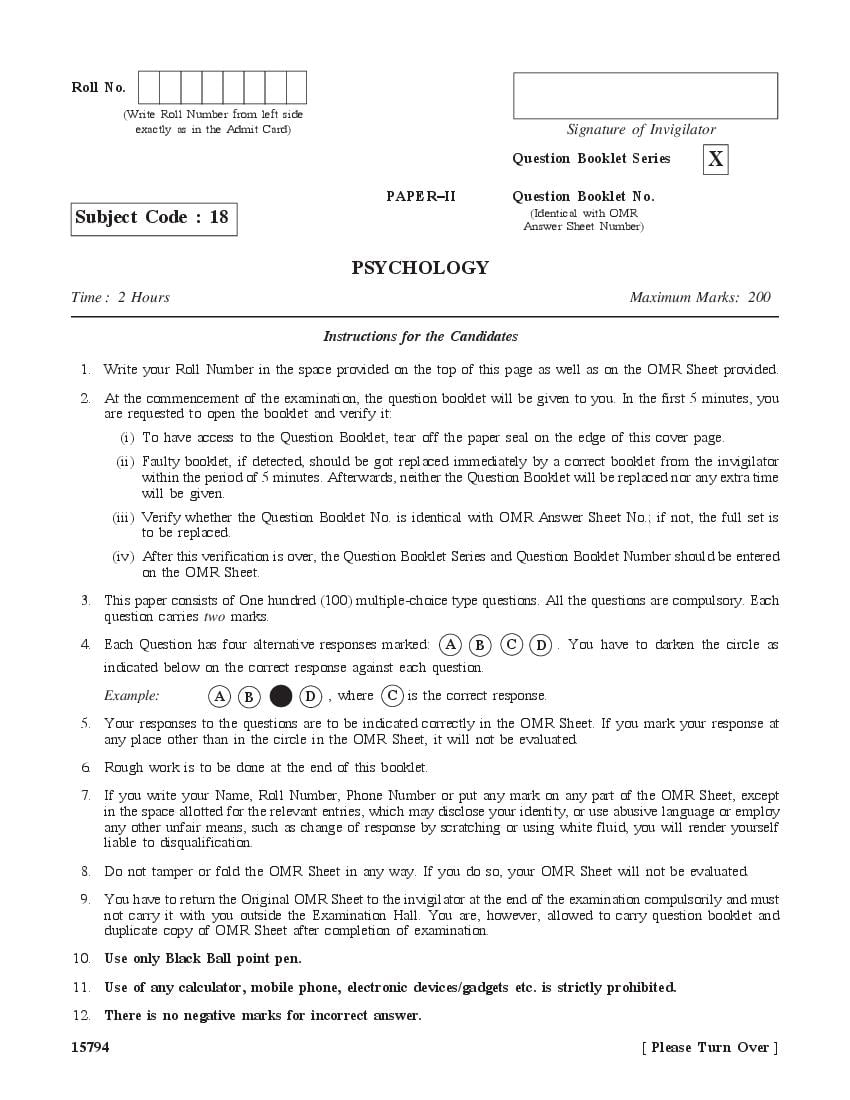
(Write Roll Number from left side
exactly as in the Admit Card) Signature of Invigilator
Question Booklet Series X
PAPER–II Question Booklet No.
Subject Code : 18 (Identical with OMR
Answer Sheet Number)
PSYCHOLOGY
Time : 2 Hours Maximum Marks: 200
Instructions for the Candidates
1. Write your Roll Number in the space provided on the top of this page as well as on the OMR Sheet provided.
2. At the commencement of the examination, the question booklet will be given to you. In the first 5 minutes, you
are requested to open the booklet and verify it:
(i) To have access to the Question Booklet, tear off the paper seal on the edge of this cover page.
(ii) Faulty booklet, if detected, should be got replaced immediately by a correct booklet from the invigilator
within the period of 5 minutes. Afterwards, neither the Question Booklet will be replaced nor any extra time
will be given.
(iii) Verify whether the Question Booklet No. is identical with OMR Answer Sheet No.; if not, the full set is
to be replaced.
(iv) After this verification is over, the Question Booklet Series and Question Booklet Number should be entered
on the OMR Sheet.
3. This paper consists of One hundred (100) multiple-choice type questions. All the questions are compulsory. Each
question carries two marks.
4. Each Question has four alternative responses marked: A B C D . You have to darken the circle as
indicated below on the correct response against each question.
Example: A B C D , where C is the correct response.
5. Your responses to the questions are to be indicated correctly in the OMR Sheet. If you mark your response at
any place other than in the circle in the OMR Sheet, it will not be evaluated.
6. Rough work is to be done at the end of this booklet.
7. If you write your Name, Roll Number, Phone Number or put any mark on any part of the OMR Sheet, except
in the space allotted for the relevant entries, which may disclose your identity, or use abusive language or employ
any other unfair means, such as change of response by scratching or using white fluid, you will render yourself
liable to disqualification.
8. Do not tamper or fold the OMR Sheet in any way. If you do so, your OMR Sheet will not be evaluated.
9. You have to return the Original OMR Sheet to the invigilator at the end of the examination compulsorily and must
not carry it with you outside the Examination Hall. You are, however, allowed to carry question booklet and
duplicate copy of OMR Sheet after completion of examination.
10. Use only Black Ball point pen.
11. Use of any calculator, mobile phone, electronic devices/gadgets etc. is strictly prohibited.
12. There is no negative marks for incorrect answer.
15794 [ Please Turn Over ]
Page 3
PSYCHOLOGY
PAPER II
1. Who has proposed the Theory of Cognitive 6. Who came up with the concept of flow?
Dissonance? (A) Mihaly Csikszentmihalyi
(A) Leon Festinger (B) Zuckerman
(B) Elbert Bandura (C) Kobasa
(C) George Homans (D) None of them
(D) Bibb Latane
2. The tendency to attribute behaviour to internal
7. The basic premise, that physiological arousal
causes to a greater extent than is actually justified, is
instigates the experience of emotion is propounded by
known as
(A) Cannon-Bard theory
(A) Self serving bias
(B) James Lange theory
(B) Fundamental attribution error
(C) Schachter and Senger theory
(C) Self perception bias
(D) Lazarus Lindsley theory
(D) Decision error
3. Cognitive frameworks suggesting that all 8. Who is the author of the book entitled ‘The
members of specific social groups share certain Achieving Society’?
characteristics, are known as (A) Herzberg
(A) Obedience (B) Weinimont
(B) Compliance (C) Vroom
(C) Conformity (D) McClelland
(D) Stereotypes
9. The Principle on which id operates, and
4. A technique for gainning compliance in which a immediate pleasure is the sole motivation for behaviour,
small request is followed by a much larger one, is is labelled as
known as (A) Reality principle
(A) Door-in-the-face Technique (B) Secondary principle
(B) Door-in-the-door Technique (C) Pleasure principle
(C) Foot-in-the-door Technique (D) None of the above
(D) Foot-in-the-foot Technique
10. Children’s fear of being left alone, helpless, and
5. ‘Kitty Genovese’ case is related to
insecure is termed as ‘Basic Anxiety’ by whom?
(A) Attraction
(A) Erick Fromm
(B) Ingratiation (B) Harry Sullivan
(C) Impression (C) Keren Horney
(D) Altruism (D) Anna Freud
Page 4
11. According to Maslow, intense emotional 16. By rationalization, one tries to justify his
experiences during which individual feels at ‘one with (A) Motive
the universe’, is refered to as
(B) Personality
(A) Unconditional Positive Regard
(C) Behaviour
(B) Peak experiences
(D) Emotion
(C) Empathy
(D) Transference
17. A girl likes candy very much, at the same time,
she does not want to be fat, she is supposed to be
12. Which theory of ‘Social Facilitation’ explanied
confronted with
that when others are present but are not evaluating
performance, social facilitation effects are reduced? (A) double approach avoidance conflict
(A) Evaluation Apprehension Theory (B) approach avoidance conflict
(B) Distraction Theory (C) approach approach conflict
(C) Conflict Theory (D) avoidance avoidance conflict
(D) None of the above
18. The ‘Sour grapes’ attitude characterizes
13. The measure of how attractive a group is to its (A) Sublimation
membership, is known as
(B) Rationalization
(A) Group Status
(C) Repression
(B) Group Role
(D) Regression
(C) Group Structure
(D) Group Cohesiveness
19. The internal mechanisms of the body, which, by
controlling numerous highly complicated physiological
14. ‘Frustration Leads to Aggression’ hypothesis is
processes, keep it in a state of equilibrium are known as
propounded by
(A) Homeostasis
(A) Dollard and Miller
(B) Nervous system
(B) Latane and Darley
(C) Nutrition
(C) Homans and Festinger
(D) None of the above
(D) Schachter and Singer
15. Theory of Equity in social exchange is 20. Behavioural theory of Attachment was
propounded by developed by
(A) Atkinson (A) Harlow
(B) Homans (B) Heider
(C) Osgood (C) Homans
(D) Adams (D) Hoffman
Page 5
21. Development occuring from head to foot is 26. Down syndrome is related to deviation in
known as (A) Twenty first set of chromosomes
(A) Cephalocaudal Development (B) Twenty second set of chromosomes
(B) Proximodistal Development (C) Twenty third set of chromosomes
(C) Sensorimotor Development (D) None of the above
(D) Operational Development
27. Intense emotional expression of love or hate
toward the analyst on the part of a patient undergoing
22. Each cell contains psychoanalysis, is termed as
(A) 23 pairs of chromosomes (A) Transgression
(B) 22 pairs of chromosomes (B) Transfer of Training
(C) 20 pairs of chromosomes (C) Transference
(D) 10 pairs of chromosomes (D) None of the above
28. A form of behaviour therapy for phobias in
23. In anal stage, chief frustrations are those which which individuals first learn how to induce a relaxed
are concerned with state in their own bodies. While in a relaxed state, they
(A) Weaning are exposed to stimuli that elicit fear. Above situation
(B) Loving describes the therapy, known as
(C) Toilet training (A) Classical Desensitization
(D) None of the above (B) Chromic Desensitization
(C) Systematic Desensitization
(D) None of the above
24. The concept of people wanting to imitate the
behaviour of someone by observing him/her being
rewarded as a result of a certain action, is refered to as 29. A form of therapy that focuses on changing
(A) Variable reinforcement illogical patterns of thoughts that underlie depression,
is known as
(B) Vicarious reinforcement
(C) Continuous reinforcement (A) CBT
(B) MBTI
(D) None of the above
(C) DBT
(D) RTT
25. Which one of the following is popularly known
as ‘master gland’? 30. A parameter is a property descriptive of
(A) Pancreas (A) sample
(B) Pituitary gland (B) population
(C) Adrenal gland (C) group
(D) Thyroid gland (D) crowd
Page 6
31. If a curve has a long tail one right side, it is called 36. J.B. Watson’s experiment on ‘conditioning fear
(A) a positively skewed curve in Little Albert’ is often quoted to explain
(B) a negatively skewed curve (A) Hysteria
(C) an ogive (B) Obsessive-compulsive neurosis
(D) a smoothed curve (C) Phobia
(D) Schizophrenia
32. What is the mean of the following ungrouped
data? 37. The use of electronic communication to harass a
Scores: 3, 2, 1, 4, 5 person, typically by sending messages of an
intimidating or threatening nature, is termed as
(A) 4
(A) Domestic violence
(B) 3
(B) Cyber bullying
(C) 5
(C) Self directed violence
(D) 2
(D) Collective bullying
33. A research study in a realistic situation in which 38. ‘Memory is a dynamic process in which traces
one or more independent variables are manipulated by undergo progressive changes according to some
the experimenter under as carefully controlled principles of organization that govern original
conditions as the situation permit, is known as perception.’ Above definition of memory was given by
(A) a field experiment (A) Behaviourists
(B) a situational experiment
(B) Structuralists
(C) observational study
(C) Functionalists
(D) None of the above
(D) Gestaltists
34. A research through launching of a direct action
39. The perception of whiteness of the snow, even in
with the objective of obtaining workable solutions to the the night when it is dark, can be explanied on the basis
given problems is known as of
(A) Survey research
(A) Perceptual defense
(B) Evaluation research
(B) Brightness constancy
(C) Experimentation (C) Dark adaptations
(D) Action research
(D) None of the above
35. How many disabilities are listed in the rights of 40. The theory that behaviour is aimed at attainment
“Person with Disabilities Act, 2016”? of pleasure and avoidance of pain, is known as
(A) 21 (A) Field theory
(B) 7 (B) Hedonism
(C) 18 (C) Psychoanalytic theory
(D) None of the above (D) None of the above
Page 7
41. Males are more extraverted than females, is an 46. ‘Give me a dozen healthy infants. Well formed,
example of and my own specified world to bring them up in, and I
(A) Null hypothesis will guarantee to take any one at random and train him
to become any type of specialist I might select doctor,
(B) Non-directional hypothesis lawyer, artist, merchant chief, and yes, even beggarman
(C) Directional hypothesis and thief, regardless of his talents ...’.
(D) Unverifiable hypothesis Above sentence is propounded by whom?
(A) Freud
(B) Watson
(C) Titchner
42. Which of the following is not the obstacle to
problem solving? (D) Wundt
(A) Heuristics
(B) Confirmation bias
47. Branch of Psychology that deals with nonviolent
(C) Fixation management of conflict and the pursuit of social justice,
(D) Apparent motions is labelled as
(A) Managerial Psychology
(B) Structural Psychology
(C) Justice Psychology
43. Which of the following attitude scaling method (D) Peace Psychology
has been proposed by Thurstone?
(A) Paired comparison
(B) Summated ratings 48. Subjective experiences associated with living a
(C) Scalogram life of virtue in pursuit of human excellence, is termed
as
(D) Equal appearing interval
(A) Endemonic well being
(B) Hedonic well being
(C) Resilient well being
44. The nerves that carry sensory information from (D) Functional well being
the periphery of the body and internal organs to the
spinal cord and brain are called
(A) Afferent nerves 49. Ability to mentally or emotionally cope with a
crisis or to return to precrisis status quickly, is termed as
(B) Peripheral nerves
(A) Resistance
(C) Efferent nerves
(B) Reluctance
(D) Connector nerves
(C) Resonance
(D) Resilience
45. Which of the following systems of Psychology
concluded that there were three types of mental 50. General responsibility for your actions on the
elements constituting conscious experience-images, internet, and treating people, like you would do in real
ideas, and emotions? life, is termed as
(A) Behaviourism (A) Digital detox
(B) Gestaltism (B) Digital bullying
(C) Functionalism (C) Digital etiquette
(D) Structuralism (D) Digital behaviour
Page 8
51. Which of the following bodily patterns does not 56. Out of the following which one is the basic
typically accompany dreaming activity? building block of nervous system?
(A) A distinctive EEG pattern (A) Reflex
(B) Rapid eye movements (B) Endocrine system
(C) Neuro hormones
(C) Higher levels of cerebral blood flow
(D) Neuron
(D) Higher levels of general muscle activity
52. The central nervous system refers to the 57. Predominantly________ regulates sleep and
dreaming.
(A) Autonomic system
(A) Brain-stem
(B) Cerebral hemisphere
(B) Putamen
(C) Cerebral cortex and cerebellum (C) Pituitary gland
(D) Brain and Spinal Cord (D) Hippocampus
58. In split-half brain procedure, which part of brian
53. In some neurons, the axon is insulated by the in severed?
(A) Myelin Sheath (A) Left hemisphere
(B) Sylvian Sheath (B) Right hemisphere
(C) Ganglion (C) Corpus Callosum
(D) Corpus Callosum (D) Parietal lobe
54. Computer programme used to mirror the 59. Sensory motor responses that are rapid and
cognitive activity of human being is called automatic are called
(A) Computer Model (A) Reaction time
(B) Robotic Model (B) Permeable response
(C) Simulation Model (C) Affective response
(D) Reflexes
(D) Problem Solving Model
55. Parasympathetic nervous system attempts to 60. Which of the following is not classified as a sleep
restore which of the following? disorder?
(A) Homeostasis (A) Insomnia
(B) Excitation (B) Narcolepsy
(C) Fight (C) Cerebral palsy
(D) All of the above (D) Sleep apnea
Page 9
61. Distal stimulus : Proximal stimulus as : 66. Who among the following explained most
(A) Right brain : Left brain clearly the contiguity theory of reinforcement in the
(B) External object : Retinal image most pronounced and consistent manner?
(A) C. Hull
(C) Anterior : Posterior
(B) Guthrie
(D) Cerebrum : Cerebellum
(C) Tolman
(D) Skinner
62. A condition under which a person experiences
the Gestalt phenomenon called “Closure” involves
(A) parallel lines 67. Under which of the following reinforcement
schedules it is most important for an organism to learn
(B) a circle with approximately one-eighth of its
to estimate time accurately?
line omitted
(A) Fixed interval
(C) a square with diagonal lines going to opposite (B) Fixed ratio
corners
(C) Variable interval
(D) intersecting lines (D) Variable ratio
63. Which of the following colors is produced by
light of the shortest wavelength relative to the others 68. What term did Hull include in his theory to better
listed here? understand behaviour?
(A) Intervening variable (e.g. drives)
(A) Yellow
(B) Personal constructs
(B) Green
(C) Primary reinforcement
(C) Red
(D) Reinforcement schedule
(D) Violet
64. Social learning theory gives prominence to 69. What are the four parts of Dollard and Miller’s
theory in behaviourism called reinforcement theory?
learning that occurs
(A) Drives, cues, responses and reinforcements
(A) by imitation
(B) Drive, goals, responses and reinforcements
(B) by modelling
(C) Drives, responses, goals and reinforcements
(C) vicariously (D) Drives, emotional responses, behavioural
(D) All of the above responses and reinforcements
65. Kolb’s learning styles model 1984 is represented
70. A method for shaping a novel behaviour using
by how many learning cycle stages in which the learner
“touches all the bases”? operant conditioning is
(A) Four (A) Second-order conditioning
(B) Five (B) Positive reinforcement
(C) Three (C) The law of effect
(D) None of the above (D) Successive approximations
Page 10
71. Appraisals are important aspects of Lazarus’s 76. When does a frequency distribution approach the
theory on stress. According to Lazarus (1984) appraisal normal distribution?
process ________ stress response. (A) If the number of scores included gets large.
(A) moderates (B) If the number of scores included gets very
(B) disturbs small.
(C) If more variables are included in the frequency
(C) highlights
distribution.
(D) mediates
(D) Certain scores are eliminated from the
distribution.
72. According to Lazarus (1984) what does a
secondary appraisal involve? 77. Responding to a stimulus in order to avoid
(A) It tends to perceive threat. electric shock is an example of
(B) It tends to perceive challenge. (A) Punishment
(C) A judgement about the individuals’ resources (B) Shaping
to cope with stressor. (C) Avoidance conditioning
(D) None of the above (D) None of the above
78. To what phenomenon does the Zeigarnik effect
73. Holmes and Rahe (1967) ascribed readjustment
refer?
values for each item in his scale to assess stress. These
values were termed as Life Change Unit (LCU). How (A) A completed task is more likely to be
many LCU was attached to death of spouse? remembered than an interrupted one.
(B) An interrupted task is more likely to be
(A) 90 units
remembered than a completed one.
(B) 60 units (C) A task at the beginning of a sequence is more
(C) 100 units likely to be remembered than a task in the
(D) 120 units middle of a sequence.
(D) None of the above
74. In Hobfoll’s (1989) “Conservation of resource”
theory, what is his key arguement? 79. The process that allows one to reach a general
conclusion from individual observations is called
(A) Stress stems from cognitive process
(A) Inductive reasoning
(B) Stress is only transaction
(B) Inter position
(C) Stress is result of appraisal process
(C) Introspection
(D) None of the above (D) Intentional learning
75. Which of the following not a process in Sclye’s 80. In Guilford’s approach to intelligence the ability
(1974) model of General Adaptation Syndrome (GAS) to generate a variety of hypotheses in a given problem
model of stress? situation is known as
(A) Alarm reaction (A) Cognitive memory
(B) Stage of exhaustion (B) Convergent production
(C) Stage of conflict (C) Divergent production
(D) Stage of resistance (D) Intuitive production
Page 11
81. The Ebbinghaus forgetting curve shows 86. According to Guilford’s model of intelligence,
(A) a gradual drop in retention followed by a how many dimensions of intelligence are there?
steep decline. (A) Three
(B) a steep initial drop in retention followed by a (B) Variable number depending on I.Q.
gradual decline. (C) 120 dimensions
(C) a S-shaped pattern. (D) 12 dimensions
(D) an U-shaped pattern.
87. When the difference between two means is
shown to be statistically significant?
82. A syllogism contains two ______ and one
__________ . (A) The null hypothesis is rejected
(A) heuristics; premise (B) The null hypothesis is confirmed
(B) premises; conclusion (C) The alternative hypothesis is disproved
(C) conditions; conclusion (D) None of the above
(D) analogies; premise
88. Intelligence tests measure
(A) Interest
83. If the mean, median and mode are identical, we
(B) Performance
have a
(C) Adjustment
(A) normal distribution
(D) Both (A) and (B)
(B) negatively skewed distribution
(C) positively skewed distribution
(D) bimodal distribution
89. Irving Janis is best known for his work on
(A) Social crowding
(B) Social facilitation
84. The type 1 error rate describes the likelihood of (C) Conformity
an experimenter to
(D) Group think
(A) consider a result significant when it is not.
(B) consider a result insignificant when it is.
(C) failing to take variance into account. 90. The main difference between caste and class is
(D) being overly risk-taking. that—
(A) Caste operates in a classless society and
class operates in casteless society.
(B) Caste is always closed; and class is always
85. Identify the last stage creativity process. open.
(A) Verification (C) The status given to an individual is ascribed
in the case of caste, whereas in class it is
(B) Evaluation
achieved.
(C) Incubation (D) The individual suffers most in the case of
(D) Preparation caste, whereas in class he does not.
Page 12
91. Health Psychology is concerned with— 96. Which year did the World Health Organization
(A) What causes illness first express the right to health as a fundamental human
right?
(B) Who is responsible for illness
(A) 1946
(C) How should illness be treated
(B) 1952
(D) All of the above (C) 1987
(D) 2000
92. Descartes (1596-1650) advocated which of the
following theoretical approaches for understanding the
relationship between the mind and the body? 97. In Maslow’s concept of ‘D’ needs, he is referring
to
(A) Dualism
(A) Deficit
(B) Monism
(B) Desirable
(C) Epistemology
(C) Denial
(D) Ontology
(D) Durable
93. Hardy people have which characteristics?
(A) Commitment, challenge and control 98. The term etiology refers to
(B) Control, self-efficacy, control (A) Syndrome
(C) Self-esteem, type B personality, control (B) Contributing factors
(D) Both (A) and (B) (C) Outcome of treatment
(D) Prognosis for curve
94. Attention Deficit Hyperactivity Disorder
(ADHD) is a childhood disorder known as
99. What does the term one way design mean?
(A) Hypokinetic disorders (A) A one tailed rather than two tailed design
(B) Overactivity disorders (B) Only one independent variable is being
(C) Hyperkinetic disorders manipulated
(D) Hyperstasis disorders (C) Design has only one condition
(D) Design can only be run one way
95. People with a collectivist view of health
(A) deny the role of individual in determining 100. The basic altruism model in helping behaviour
health. when
(B) are more likely to engage in social actions to (A) the action is voluntary.
influence health than personal actions. (B) the action is costly (perhaps time, money,
(C) consider that health targets should be personal risk).
determined by the general promotion. (C) the action carries no anticipation of reward.
(D) All of the above (D) All of the above
Page 13
ROUGH WORK
Page 14
ROUGH WORK
Page 15
ROUGH WORK
Page 16
ROUGH WORK
Document Details
| Board / Org | Default |
| Exam | Govt Jobs Exams |
| Type | Question Paper |
| Pages | 16 |
| Updated | 30 Apr 2026 |