Kerala Plus Two Question Paper 2022 Chemistry
Finished viewing? Save it for later —
Download Kerala Plus Two Question Paper 2022 Chemistry (PDF · 12 pages)About Kerala Plus Two Question Paper 2022 Chemistry
Kerala Plus Two Question Paper 2022 Chemistry is available here for free download. Published by Kerala Board for Class 12, this question paper can be viewed online or downloaded as a PDF (12 pages). Candidates preparing for Class 12 can use Kerala Plus Two Question Paper 2022 Chemistry to understand the exam pattern, the type of questions asked, and the overall difficulty level.
Frequently Asked Questions
How can I download Kerala Plus Two Question Paper 2022 Chemistry?
Open this page and click the Download button to save Kerala Plus Two Question Paper 2022 Chemistry as a PDF. It is completely free on AglaSem Docs.
Is Kerala Plus Two Question Paper 2022 Chemistry free to download?
Yes. Kerala Plus Two Question Paper 2022 Chemistry can be viewed online and downloaded as a PDF free of cost on AglaSem Docs.
How many pages does Kerala Plus Two Question Paper 2022 Chemistry have?
Kerala Plus Two Question Paper 2022 Chemistry contains 12 pages, which you can read online or download together as a single PDF.
Where can I find more Class 12 study material?
You can find more Class 12 question papers, sample papers, syllabus, and answer keys on AglaSem Docs.
Kerala Plus Two Question Paper 2022 Chemistry – Text
Read the full text of this question paper below — useful to quickly search, copy and reference the content online without downloading the PDF.
📄 View text version (12 pages)
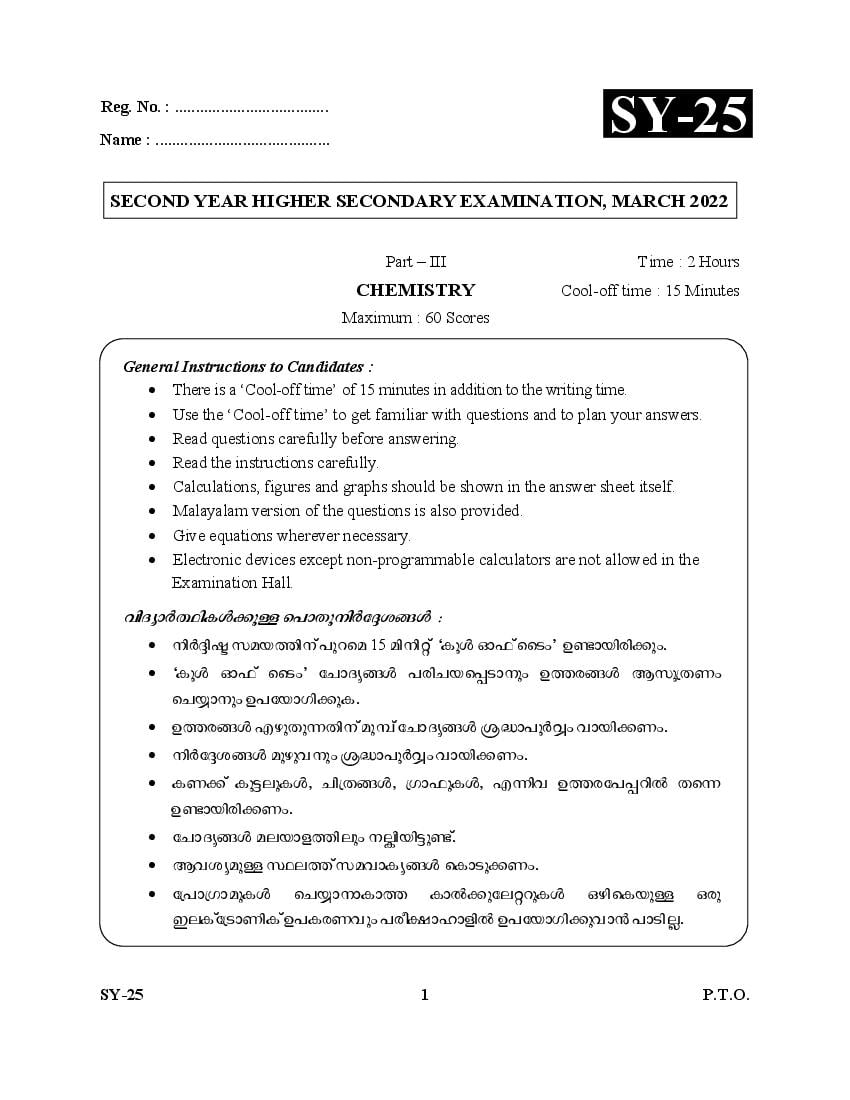
Page 1
Name : ..........................................
SY-25
SECOND YEAR HIGHER SECONDARY EXAMINATION, MARCH 2022
Part – III Time : 2 Hours
CHEMISTRY Cool-off time : 15 Minutes
Maximum : 60 Scores
General Instructions to Candidates :
There is a ‘Cool-off time’ of 15 minutes in addition to the writing time.
Use the ‘Cool-off time’ to get familiar with questions and to plan your answers.
Read questions carefully before answering.
Read the instructions carefully.
Calculations, figures and graphs should be shown in the answer sheet itself.
Malayalam version of the questions is also provided.
Give equations wherever necessary.
Electronic devices except non-programmable calculators are not allowed in the
Examination Hall.
15 ‘ ’ .
‘ ’
.
.
.
, , ,
.
.
.
.
SY-25 1 P.T.O.
Page 2
A. Answer any 5 questions from 1 to 9. Each carries 1 score. (5 1 = 5)
1. Write an ionic compound which can exhibit both Schottky and Frenkel defect.
2. Two solutions having same osmotic pressure at a given temperature are called _____.
3. The law that can be used to determine the limiting molar conductivity (m) of weak
electrolytes is _____.
4. The unit of rate constant of a first order chemical reaction is
(a) mol–1Ls–1 (b) s–1
(c) molL–1s–1 (d) mol–2L2s–1
5. What is the name of the colloidal system in which both the dispersed phase and
dispersion medium are liquids ?
(a) Emulsions (b) Gel
(c) Sol (d) Foam
6. The method used for the concentration of sulphide ores is
(a) Hydraulic washing (b) Leaching
(c) Magnetic separation (d) Froth flotation
7. The reaction which converts benzene diazonium chloride to chlorobenzene using
CuCl in HCl is known as _____.
(a) Swarts reaction (b) Sandmeyer reaction
(c) Finkelstein reaction (d) Kolbe’s reaction
8. Give a reagent which is used to distinguish 1, 2 and 3 alcohols.
9. The galvanic cells which are used to convert the energy of combustion of fuels like
hydrogen, methane etc into electrical energy are generally called as _____.
SY-25 2
Page 3
A. 1 9 5 .
1 . (5 1 = 5)
1. ,
.
2.
_____ .
3. (m)
_____.
4. .
(a) mol–1Ls–1 (b) s–1
(c) molL–1s–1 (d) mol–2L2s–1
5. - .
(a) (b)
(c) (d)
6.
(a) (b)
(c) (d)
7. CuCl / HCl
_____.
(a) (b)
(c) (d)
8. 1, 2, 3
.
9. ,
_____
.
SY-25 3 P.T.O.
Page 4
10. A white precipitate is obtained when aniline reacts with bromine water at room
temperature. The chemical name of the precipitate is _____.
11. Identify the peptide bond among the following :
O H
| | || |
(a) – C–O–C (b) – O – P– O – C –
| | | |
O H
|
(c) – CO – NH – (d) – COO –
12. Name the polymerization product formed by the condensation reaction between
phenol and formaldehyde
(a) Bakelite (b) Melamine formaldehyde
(c) Nylon (d) Dacron
13. The artificial sweetener which is used in cold foods and soft drinks is
(a) BHT (b) Aspartase
(c) Sodium benzoate (d) Ranitidine
PART – II
A. Answer any 2 questions from 14 to 17. Each carries 2 scores. (2 2 = 4)
14. KCl crystals develop violet colour when heated in an atmosphere of potassium
vapour. Explain.
15. State Henry’s law and mention any one of its application.
16. (i) Write Arrhenius equation. (1)
(ii) How will you obtain the value of activation energy (Ea) from a graphical plot
using Arrhenius equation ? (1)
17. What is lanthanoid contraction ? Mention any one of its consequences.
SY-25 4
Page 5
(4 1 = 4)
10.
_____.
11. :
O H
| | || |
(a) – C–O–C (b) – O – P– O – C –
| | | |
O H
|
(c) – CO – NH – (d) – COO –
12.
.
(a) (b)
(c) (d)
13.
.
(a) BHT (b)
(c) (d)
PART – II
A. 14 17 2 .
2 . (2 2 = 4)
14. KCl
. .
15. . .
16. (i) . (1)
(ii) (Ea)
. (1)
17. ? .
SY-25 5 P.T.O.
Page 6
18. Why is Cr2+ reducing and Mn3+ oxidizing when both have d4 configuration ?
19. Explain carbylamine reaction with equation.
20. CH3 – NH2 is more basic than NH3 while C6H5 – NH2 is less basic than NH3.
Explain.
PART – III
A. Answer any 3 questions from 21 to 24. Each carries 3 scores. (3 3 = 9)
21. Write any three differences between crystalline and amorphous solids. (3)
22. 18g of glucose, C6H12O6, is dissolved in 1 kg of water in a sauce pan. At what
temperature will water boil at 1.013 bar ? (3)
(Kb for water is 0.52 Kkgmol–1, boiling point of water = 373.15 K)
23. (i) Mention any two factors which influence the rate of a chemical reaction. (1)
(ii) Derive an expression for half life of a first order reaction from its integrated rate
equation. (2)
24. (i) Write a suitable method to convert. (1)
CH3 – CH2 – Br to CH3 – CH2 – I
(ii) Suggest and explain a suitable mechanism for the nucleophilic substitution of
tert – butyl bromide with NaOH. (2)
SY-25 6
Page 7
2 . (2 2 = 4)
18. d4 Cr2+ Mn3+
?
19. .
20. CH3 – NH2 C6H5 – NH2
. .
PART – III
A. 21 24 3 .
3 . (3 3 = 9)
21. , . (3)
22. 1 kg 18g C6H12O6
. 1.013 .
Kb 0.52 Kkgmol–1 . 373.15 K? (3)
23. (i)
. (1)
(ii)
. (2)
24. (i) CH3 – CH2 – Br CH3 – CH2 – I
. (1)
(ii) NaOH
. (2)
SY-25 7 P.T.O.
Page 8
25. (i) What are Grignard reagents ? (1)
(ii) State Saytzeff rule and illustrate it with an example. (2)
26. (i) Alcohols and phenols have higher boiling points. Why ? (1)
(ii) What is aspirin ? How is it prepared from salicylic acid ? (2)
27. (i) Identify A and B in the following reaction (1)
+ HI A + B
(ii) What is meant by hydroboration – oxidation reaction ? Illustrate it with an
example. (2)
PART – IV
A. Answer any 3 questions from 28 to 31. Each carries 4 scores. (3 4 = 12)
28. (i) What are secondary batteries ? (1)
(ii) Write the electrode reactions and the overall cell reaction happening in the lead
storage battery when it is in use. (3)
29. (i) Distinguish homogeneous and heterogeneous catalysis. (2)
(ii) Explain Tyndal effect. Write any one practical application of this effect. (2)
30. (i) Write chemical equations involved in the leaching of alumina from bauxite. (3)
(ii) What is the purpose of adding cryolite or CaF2 into purified Al2O3 during the
extraction of Al ? (1)
31. (i) What are oligosaacharides ? Give an example. (2)
(ii) What is glycogen ? (1)
(iii) Explain the chemical constitution of starch. (1)
SY-25 8
Page 9
3 . (2 3 = 6)
25. (i) ? (1)
(ii) . . (2)
26. (i) .
? (1)
(ii) ?
? (2)
27. (i) A, B . (1)
+ HI A + B
(ii) ?
. (2)
PART – IV
A. 28 31 3 .
4 . (3 4 = 12)
28. (i) ? (1)
(ii)
. (3)
29. (i) , . (2)
(ii) .
. (2)
30. (i)
. (3)
(ii) Al2O3
CaF2 ? (1)
31. (i) ? . (2)
(ii) ? (1)
(iii) . (1)
SY-25 9 P.T.O.
Page 10
32. (i) Differentiate between thermoplastics and thermosetting plastics. (2)
(ii) Write the name and structure of monomer of neoprene. (2)
33. (i) Distinguish anionic detergents and cationic detergents with suitable examples. (3)
(ii) Name any one antioxidant used in food materials. (1)
PART – V
Answer any 2 questions from 34 to 36. Each carries 6 scores. (2 6 = 12)
34. (i) Write the chemical reaction when PCl5 is strongly heated. (1)
(ii) What are interhalogen compounds ? Give two examples. (2)
(iii) Explain the steps involved in the contact process for the manufacture of H 2SO4. (3)
35. (i) Draw the geometrical isomers of [Co(NH 3)4Cl2]+ (2)
(ii) Describe the four types of structural isomerism exhibited by co-ordination
compounds. (4)
36. (i) Write the products of the following reaction :
Con NaOH
2H – CHO _____ + _____ (2)
(ii) Explain Hell – Volhard – Zelinsky (HVZ) reaction. (2)
(iii) Suggest a suitable method for the following conversion : (2)
__________
SY-25 10
Page 11
4 . (1 4 = 4)
32. (i) ,
. (2)
(ii) . (2)
33. (i)
. (3)
(ii)
. (1)
PART – V
34 36 2 .
6 . (2 6 = 12)
34. (i) PCl5 . (1)
(ii) ? . (2)
(iii) H2SO4
. (3)
35. (i) [Co(NH3)4Cl2]+ . (2)
(ii)
. (4)
36. (i) :
Con NaOH
2H – CHO _____ + _____ (2)
(ii) – – (HVZ) . (2)
(iii)
: (2)
____________
SY-25 11 P.T.O.
Page 12
Document Details
| Board / Org | Kerala Board |
| Exam | Class 12 |
| Type | Question Paper |
| Pages | 12 |
| Updated | 22 Jul 2026 |